
A complete issue · 24 pages · 1924
Judge — November 22, 1924
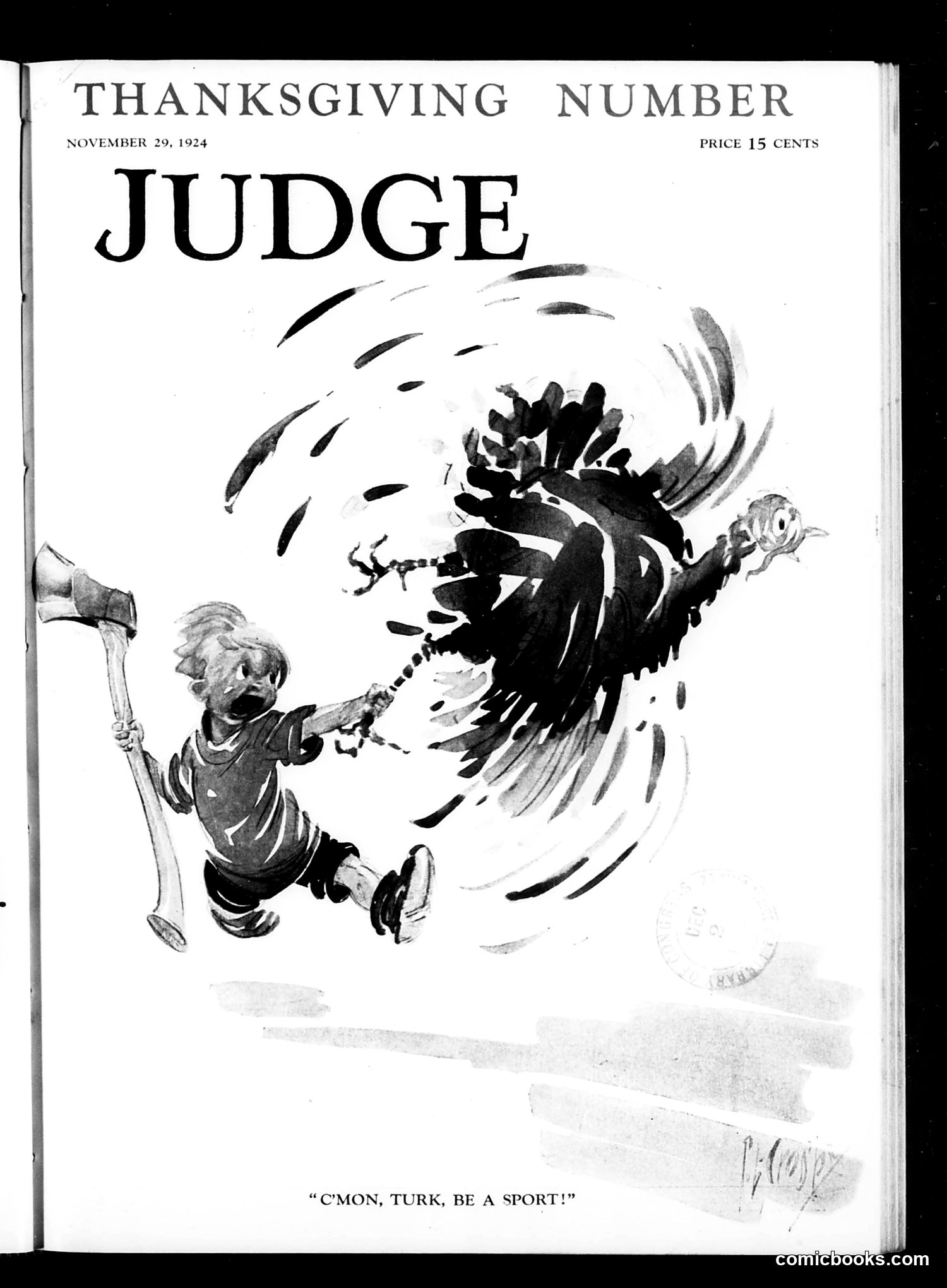
This Thanksgiving-themed cover depicts a figure wielding an axe chasing a turkey with the caption "C'MON, TURK, BE A SPORT!" The cartoon appears to be a political allegory. "Turk" likely references Turkey or Ottoman leadership during a period of significant geopolitical change (1924 was shortly after the Turkish War of Independence and Atatürk's reforms). The axe-wielding figure suggests an aggressor or pursuer, while the "be a sport" caption implies mocking an opponent to fight fairly or accept their fate. The satirical intent seems to comment on contemporary international relations or political conflicts involving Turkey, presenting the pursuit as a grim "game" while also playing on Thanksgiving's turkey-eating tradition for dark humor.
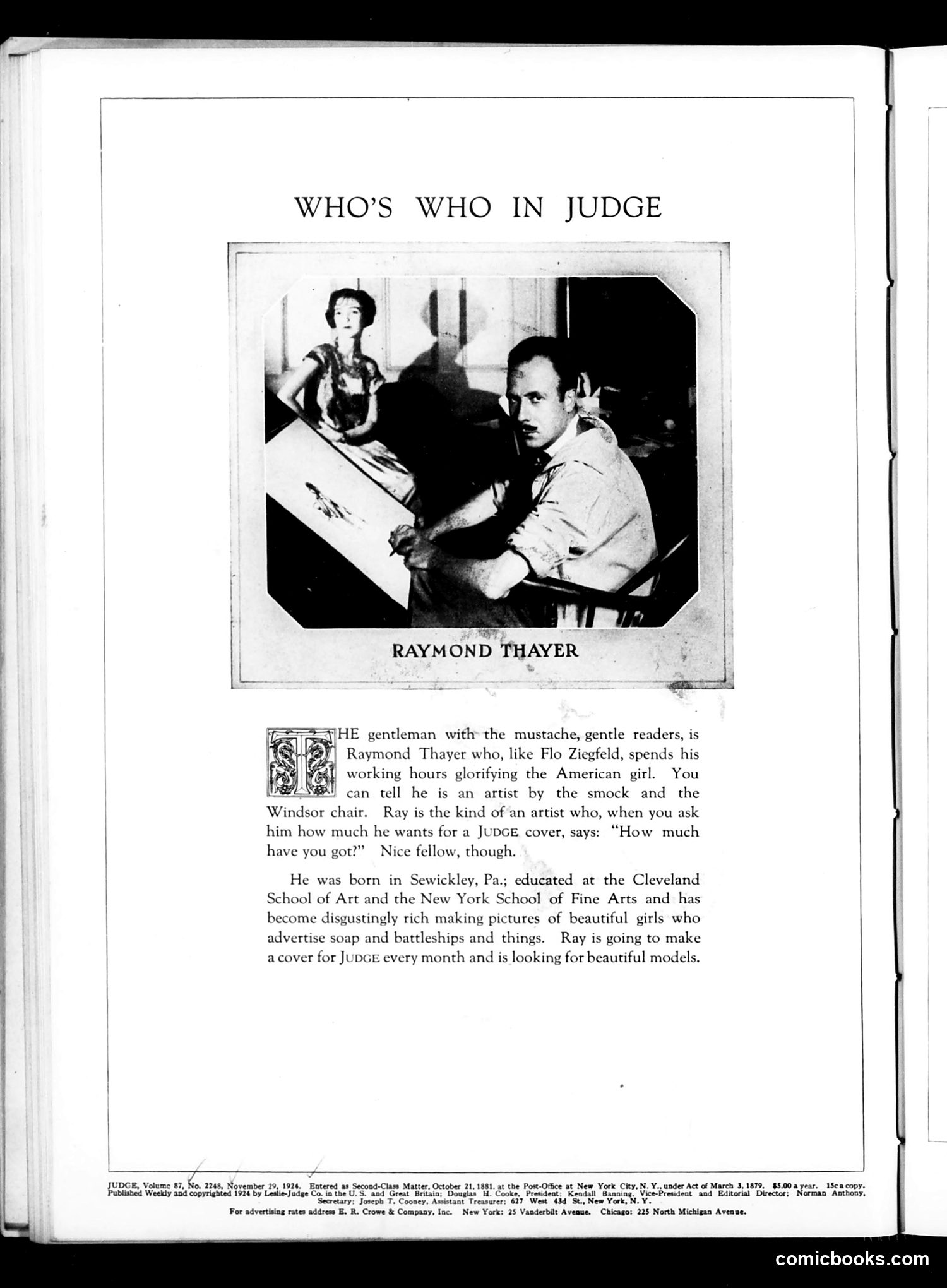
This is a profile feature, not political satire. The page introduces Raymond Thayer, a commercial illustrator who creates magazine covers and advertisements for *Judge*. The photograph shows Thayer (the man with the mustache) working on artwork with a female model posing. The text humorously characterizes him as an artist focused on "glorifying the American girl"—painting beautiful women to advertise consumer goods like soap and battleships. Thayer was educated at Cleveland School of Art and New York School of Fine Arts. The profile notes he'll create monthly *Judge* covers and is actively recruiting beautiful models, presented with light, tongue-in-cheek humor typical of the magazine's house-of-mirrors commentary on advertising and commercial art.
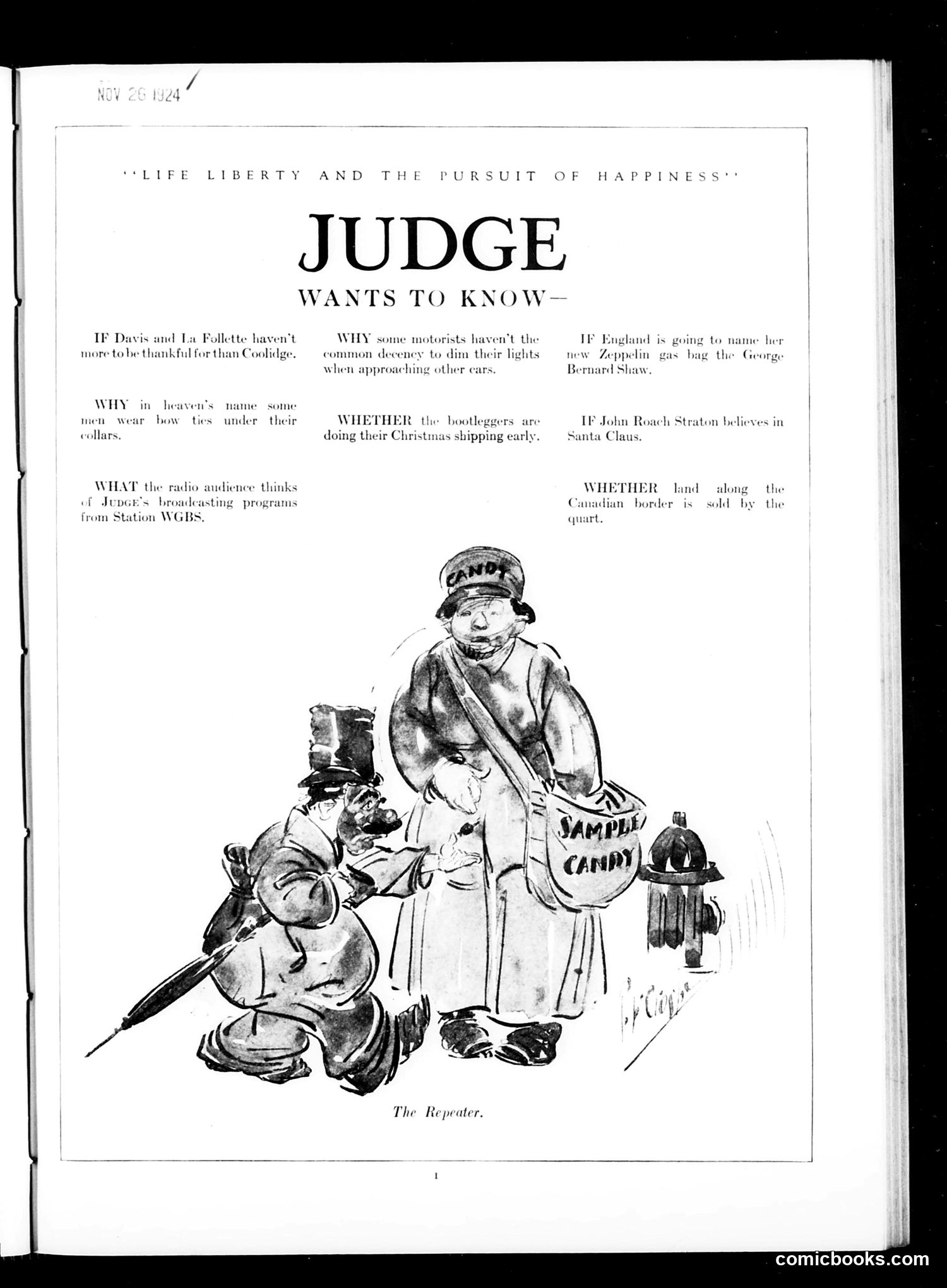
This 1924 satirical cartoon depicts a reporter as a vendor hawking "sample candy" to a diminutive judge or authority figure. The cartoon mocks journalistic practices of the era, particularly sensationalism and the peddling of unreliable information. The "Questions a Judge Wants to Know" listed above—ranging from trivial (bow ties under collars) to absurd (Santa Claus, gas-bag dirigibles)—suggest reporters covering frivolous, gossipy, or nonsensical stories rather than substantive news. The candy imagery implies journalism as cheap entertainment rather than serious information, while the tiny judge dwarfed by the vendor suggests reporters' growing power and influence over public discourse, regardless of accuracy or importance. This reflects early 20th-century anxieties about press accountability and sensationalism.
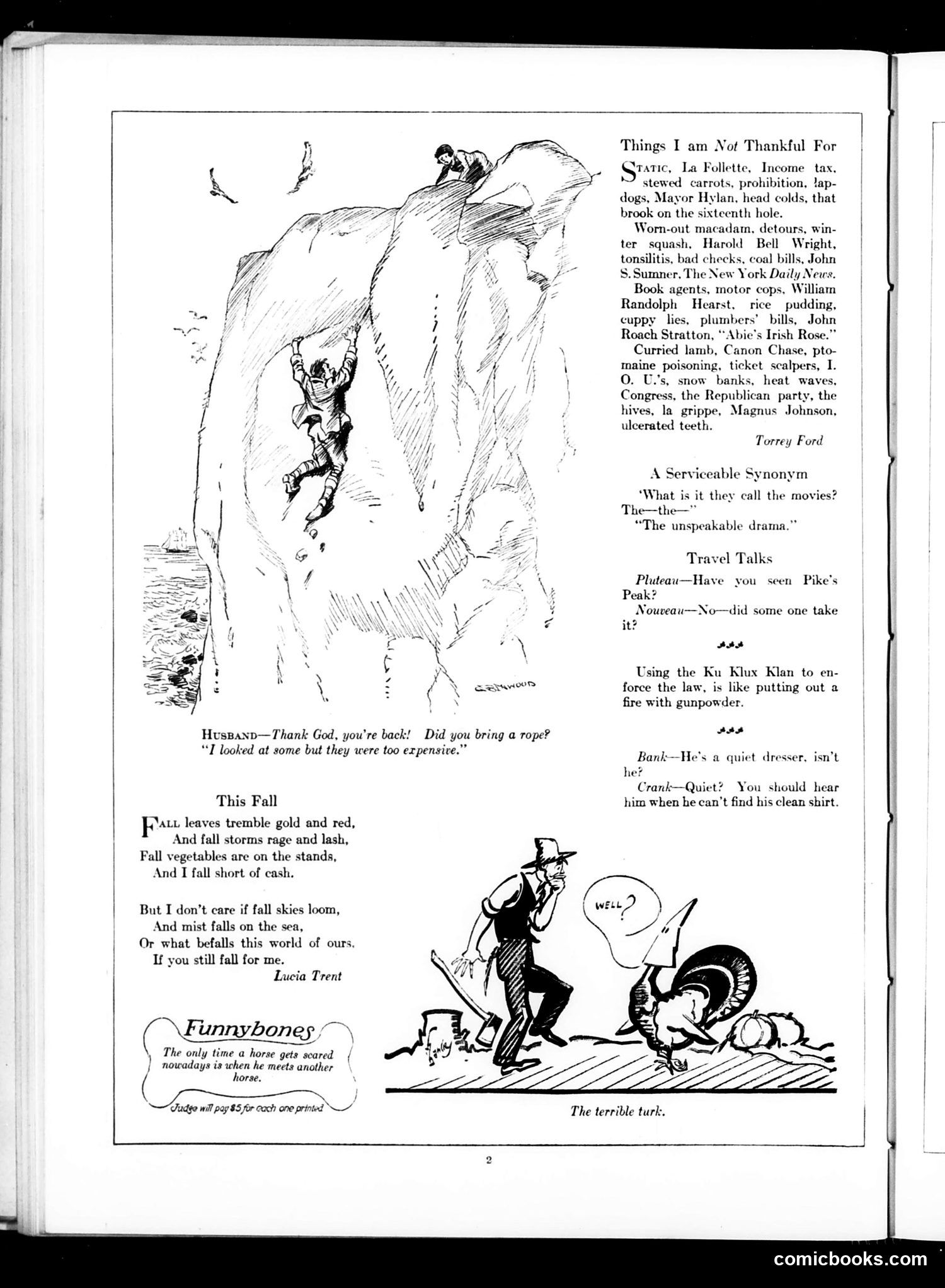
The top cartoon depicts a man dangling from a cliff while his wife holds a rope, with the caption "Thank God, you're back! Did you bring a rope? 'I looked at some but they were too expensive.'" This satirizes economic hardship—likely from the Great Depression era—where even emergency supplies are unaffordable. The "Things I am Not Thankful For" list by Torrey Ford is satirical social commentary on contemporary annoyances: traffic, politicians, celebrities, and mundane frustrations. The bottom cartoon titled "The terrible turk" shows a man confronting what appears to be a turkey, with one saying "Well?" The humor likely plays on the word "turk" and holiday cooking anxiety. The poem "This Fall" by Lucia Trent addresses romantic devotion despite financial hardship, reinforcing Depression-era themes throughout the page.
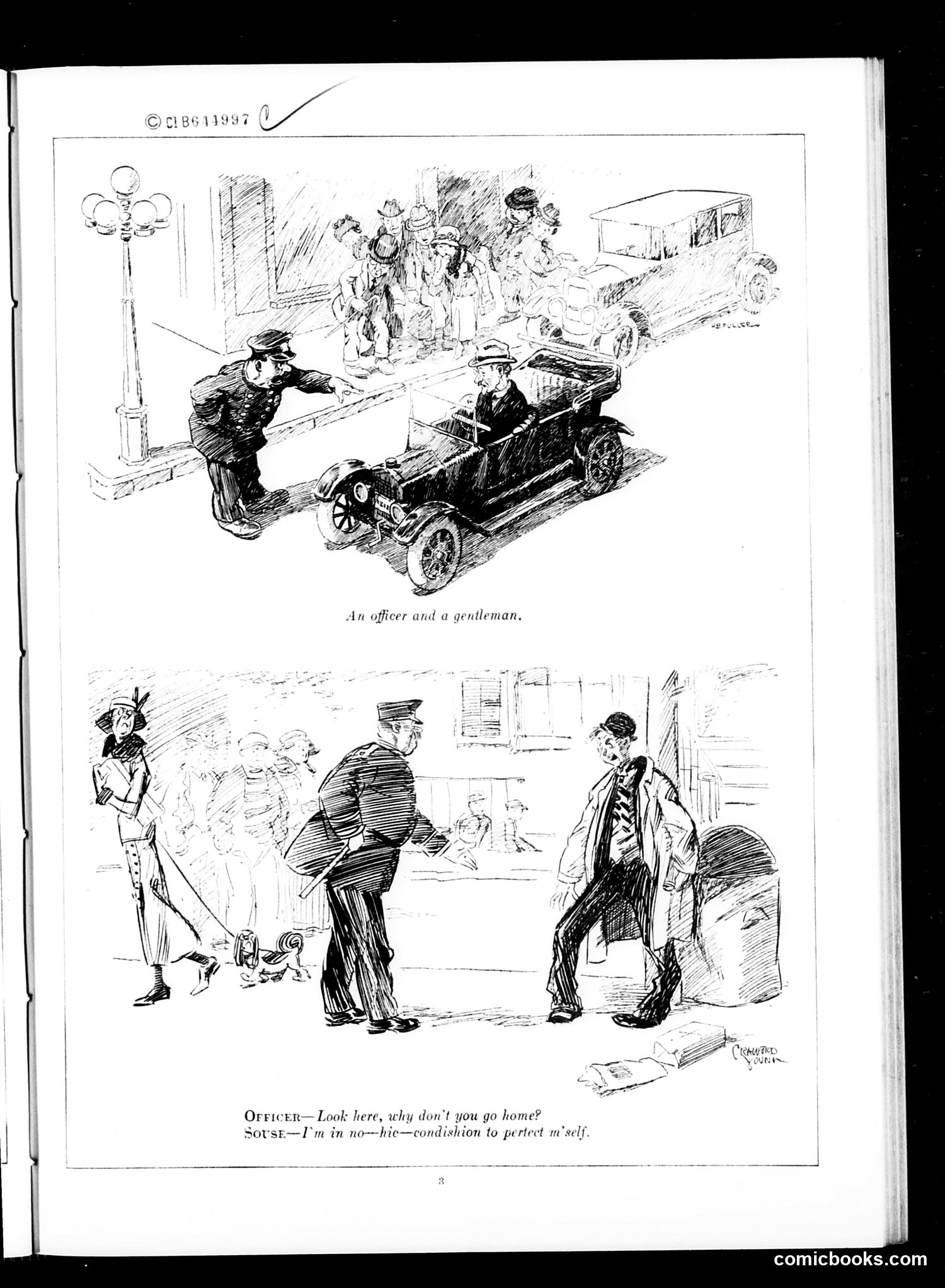
This page contains two satirical scenes about police and traffic enforcement, likely from the early automotive era (1910s-1920s based on the car styles). **Top cartoon** ("An officer and a gentleman"): Depicts a police officer stopping a motorist. The humor appears to rest on the contrast between the officer's formal demeanor and the situation—either commentary on overzealous traffic enforcement or the novelty of automobile regulation itself. **Bottom cartoon**: Shows an officer confronting a vagabond or homeless man about loitering. The vagrant's excuse—claiming to be in "no—hic—condition to perfect m'self"—suggests he's drunk. The satire likely mocks either police harassment of the poor or the absurdity of their reasoning for being outdoors. Both cartoons satirize police authority and its application to different social classes.
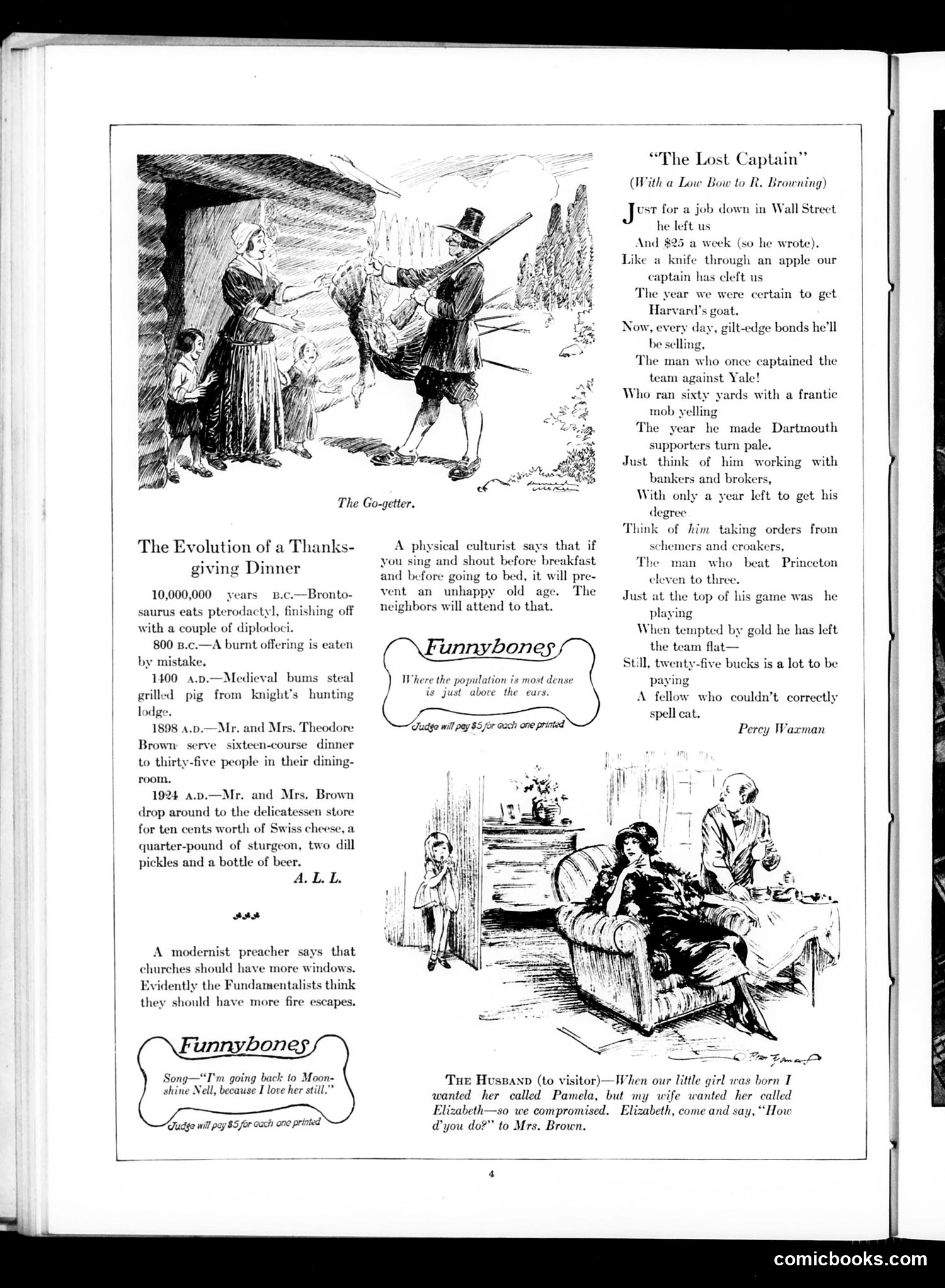
This page contains several humor pieces rather than political cartoons: 1. **"The Lost Captain"** (poem by Percy Wazman): Satirizes a former Yale football captain who left coaching for Wall Street banking, now reduced to selling "gilt-edge bonds." The joke mocks his fall from athletic glory to mundane financial work. 2. **"The Evolution of a Thanksgiving Dinner"**: Humorous timeline from prehistoric times (10,000,000 B.C.) to 1924, tracing how Thanksgiving meals have changed—ultimately ending with the Browns buying modest groceries rather than elaborate feasts. 3. **"Funnybones"**: Two brief comic jokes about churches and a sentimental song. 4. **Bottom illustration**: A domestic scene about naming a newborn daughter, showing marital compromise between parents' preferences. The page is primarily light social humor rather than sharp political satire.
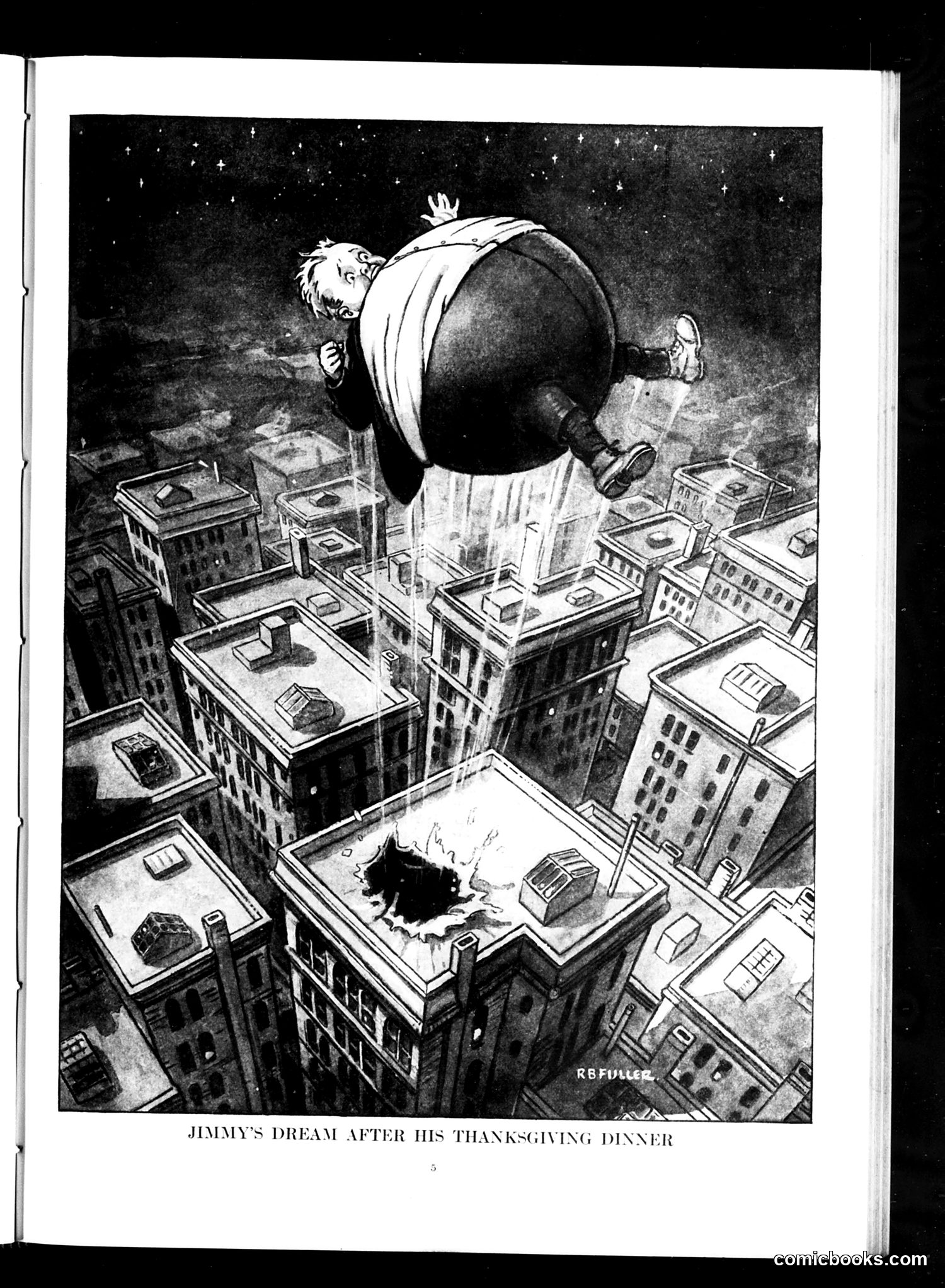
This satirical cartoon depicts a figure labeled "Jimmy" floating above a cityscape, clutching a large bomb or spherical explosive device. Below, one building shows a crater-like explosion damage on its roof. The cartoon appears to be political satire, likely from the early 20th century, commenting on post-Thanksgiving digestive troubles through absurdist humor. The "dream" framing suggests indigestion-induced nightmares. The bomb imagery suggests either anarchist fears prevalent during that era or simply exaggerated depiction of stomach distress as destructive force. The artist is credited as "R.B FULLER" at bottom. The cartoon satirizes overeating at holiday dinners by rendering the physical discomfort as violent, surreal consequences affecting the urban landscape.
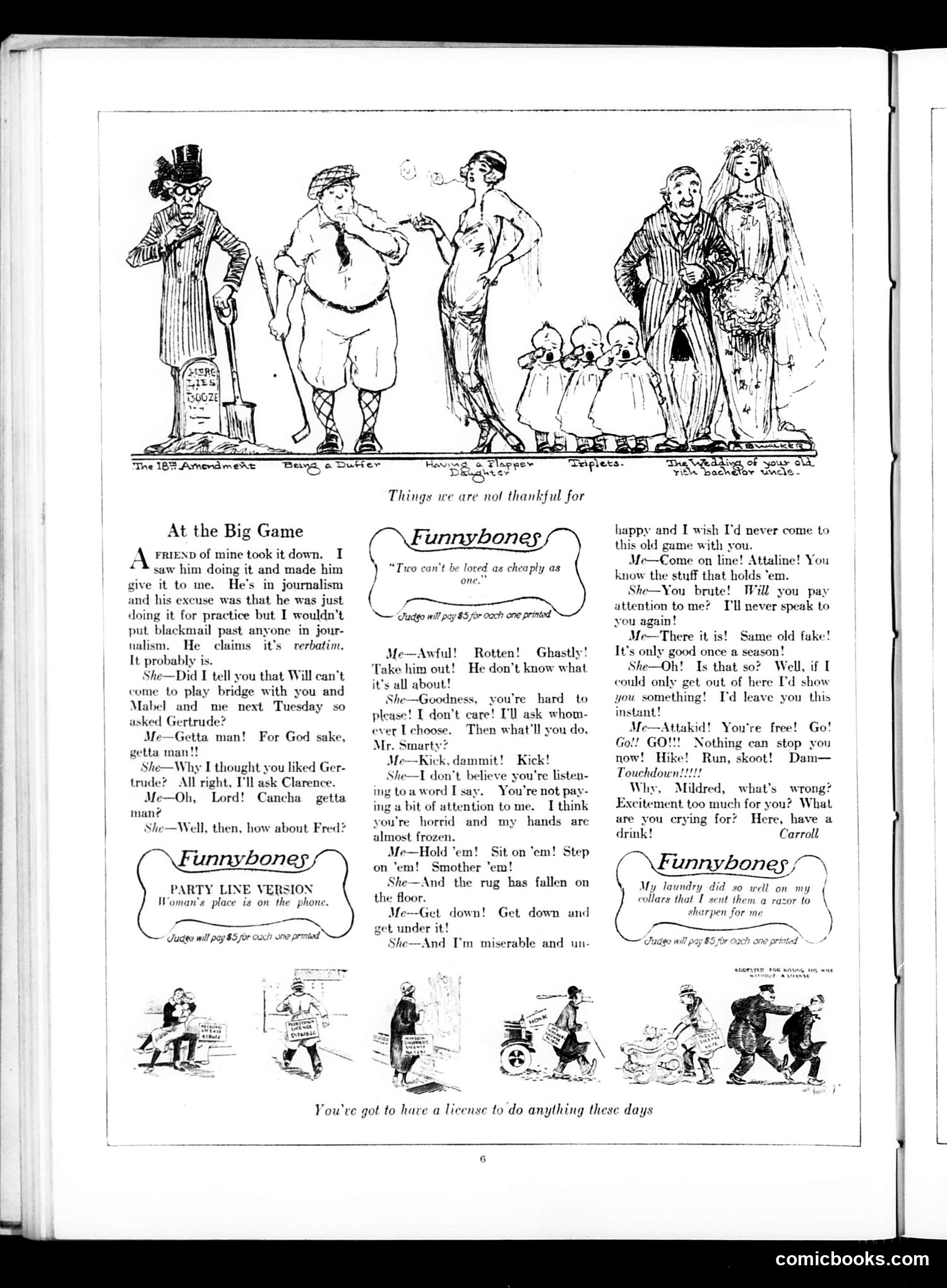
This page presents satirical commentary on early 20th-century social dynamics, specifically around courtship and gender relations. **"At the Big Game"** depicts a couple at a football game where the man is intensely focused on the match while his female companion tries to engage him in conversation about social plans. The humor lies in his dismissive, frustrated responses—he'd rather watch football than discuss bridge games or find male companions. The satire mocks masculine obsession with sports and the disconnect between men's and women's social priorities. **"Party Line Version"** is a sidebar joke about women monopolizing telephone party lines (shared telephone lines common in that era), suggesting women's tendency to gossip endlessly. **"Funnybones"** sections present exaggerated romantic dialogue where couples bicker and exchange emotional manipulation—he ignores her, she threatens to leave, he encourages her to go, etc. The satire critiques the performative nature of courtship arguments and emotional blackmail in relationships. The bottom cartoon's caption, "You've got to have a license to do anything these days," suggests modern life's increasing regulation, shown through various licensed activities.
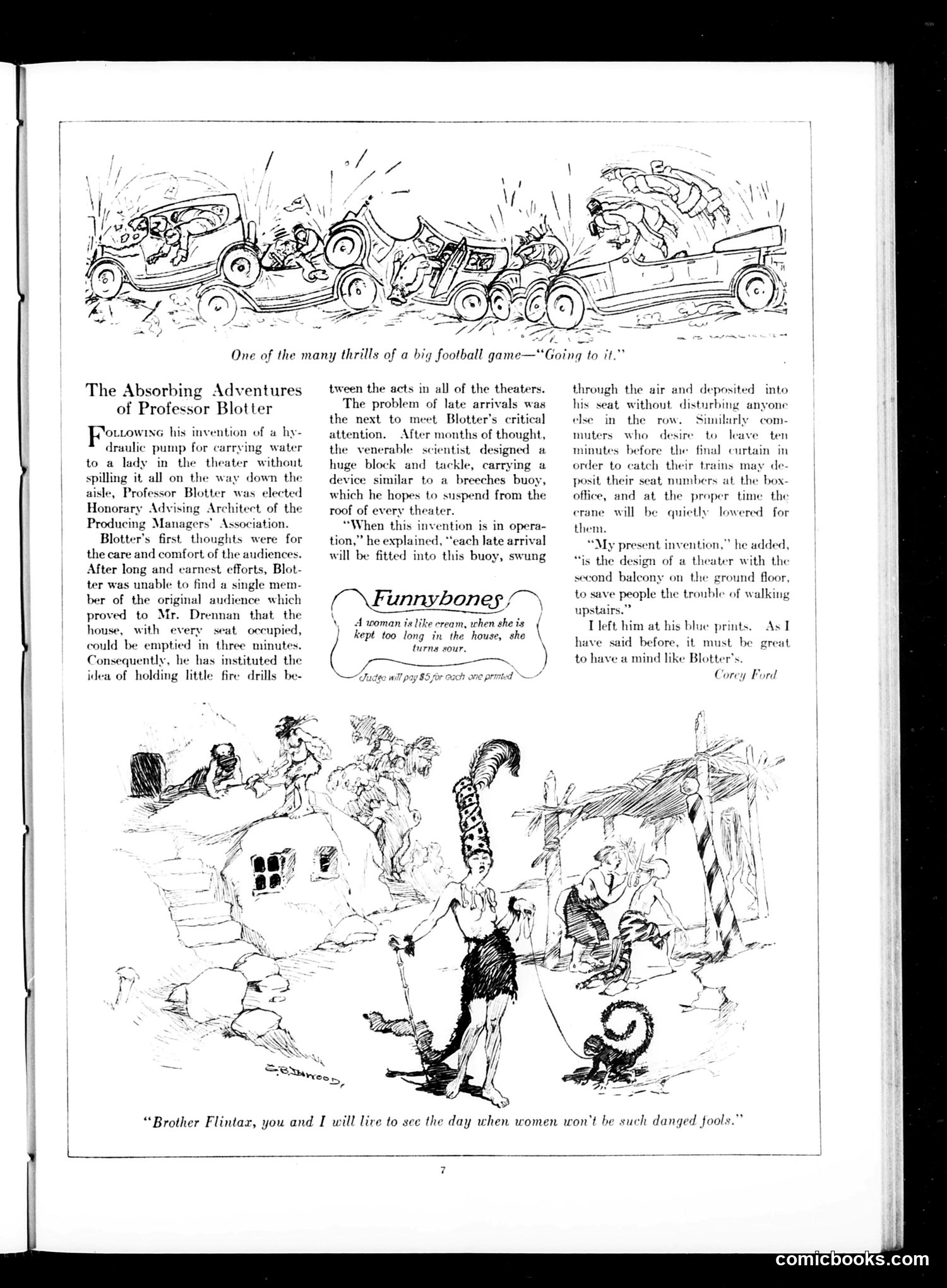
This page satirizes theater management and early 20th-century entertainment anxieties. Professor Blotter is a fictional inventor solving theatrical problems through absurdly over-engineered contraptions. The top cartoon depicts automobiles colliding—illustrating one "thrill of a big football game" (likely comparing chaotic crowds to traffic accidents). The main story mocks three real theater complaints: evacuations during intermissions (via unnecessary "fire drills"), late arrivals (proposing a ridiculous breeches-buoy system to hoist latecomers through the air into seats), and patrons needing to leave early (suggesting a pulley system to lower them out quietly). The final joke—putting the second balcony on the ground floor to avoid stairs—is pure absurdist humor. The page gently ridicules theater owners' pretensions and over-complicated "solutions" to minor social problems, while poking fun at modern efficiency obsessions. The "Funnybones" aside about women "turning sour" if kept too long appears unrelated filler.
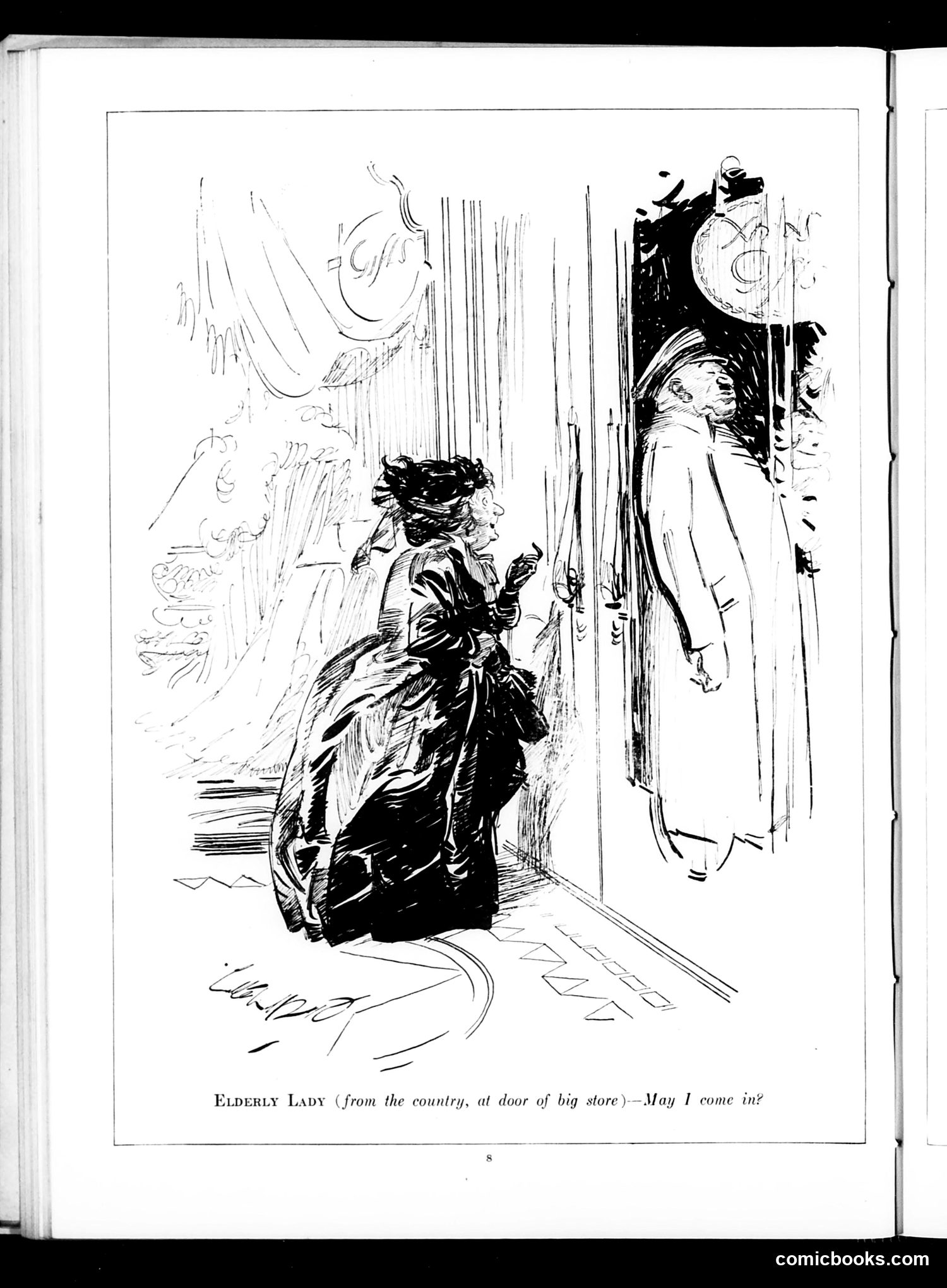
This is a single cartoon from *Judge* magazine showing a scene at a store entrance. An elderly country woman in heavy clothing stands at a doorway, asking "May I come in?" to what appears to be a doorman or store attendant (shown in profile on the right). The satire likely critiques class barriers or shopping discrimination of the era—the implication being that the woman's rural, modest appearance makes her question whether she'll be permitted inside a "big store." The joke exposes the snobbery of urban retail establishments that made working-class or country people feel unwelcome based on appearance alone. The sketch style is typical of early-to-mid 20th century *Judge* humor, using physical appearance and social awkwardness for satirical effect.
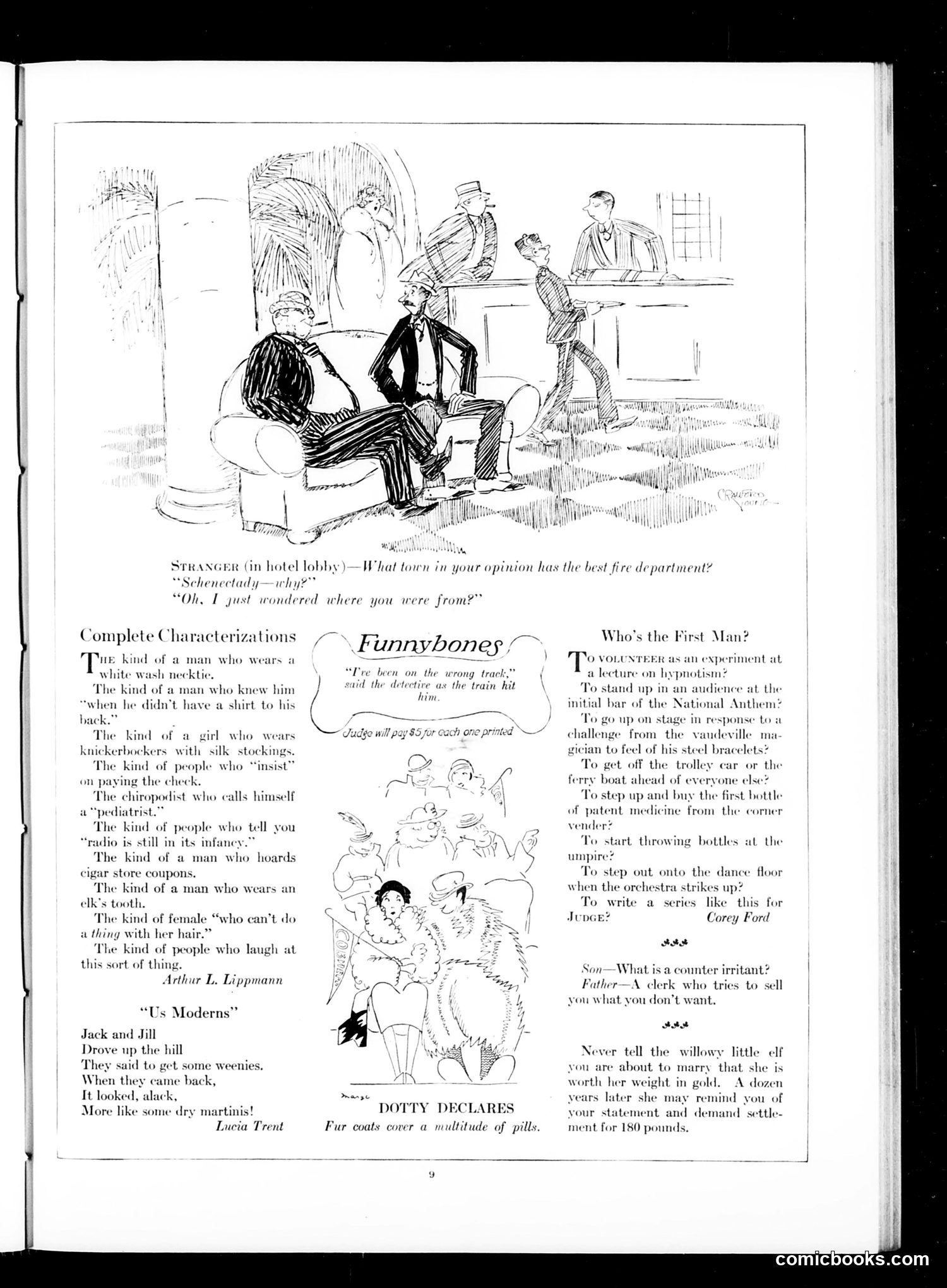
This page contains several satirical pieces typical of 1920s-30s humor: **Top Cartoon:** A stranger in a hotel lobby asks a man about Schenectady's fire department. The joke's premise—that someone's hometown identity is defined by such mundane details—mocks small-town pride and predictable social conversation. **"Complete Characterizations"** by Arthur L. Lippmann catalogs social types through their possessions and affectations: men wearing "wash neckties," people hoarding cigar coupons, those claiming chiropody expertise as "piatrists." This satirizes the emerging consumer culture and pretension of the modern era. **"Us Moderns"** by Lucia Trent is a poem mocking Prohibition-era drinking: young people driving to get hot dogs ("weenies") but returning with dry martinis instead—a joke about illegal alcohol consumption during the alcohol ban. **Other pieces** (Funnybones, Dotty Declares) continue with light domestic humor typical of the era—observations about relationships, hypnotism lectures, and marriage. The overall tone reflects 1920s-30s satirical commentary on modern behavior, consumerism, and changing social norms.
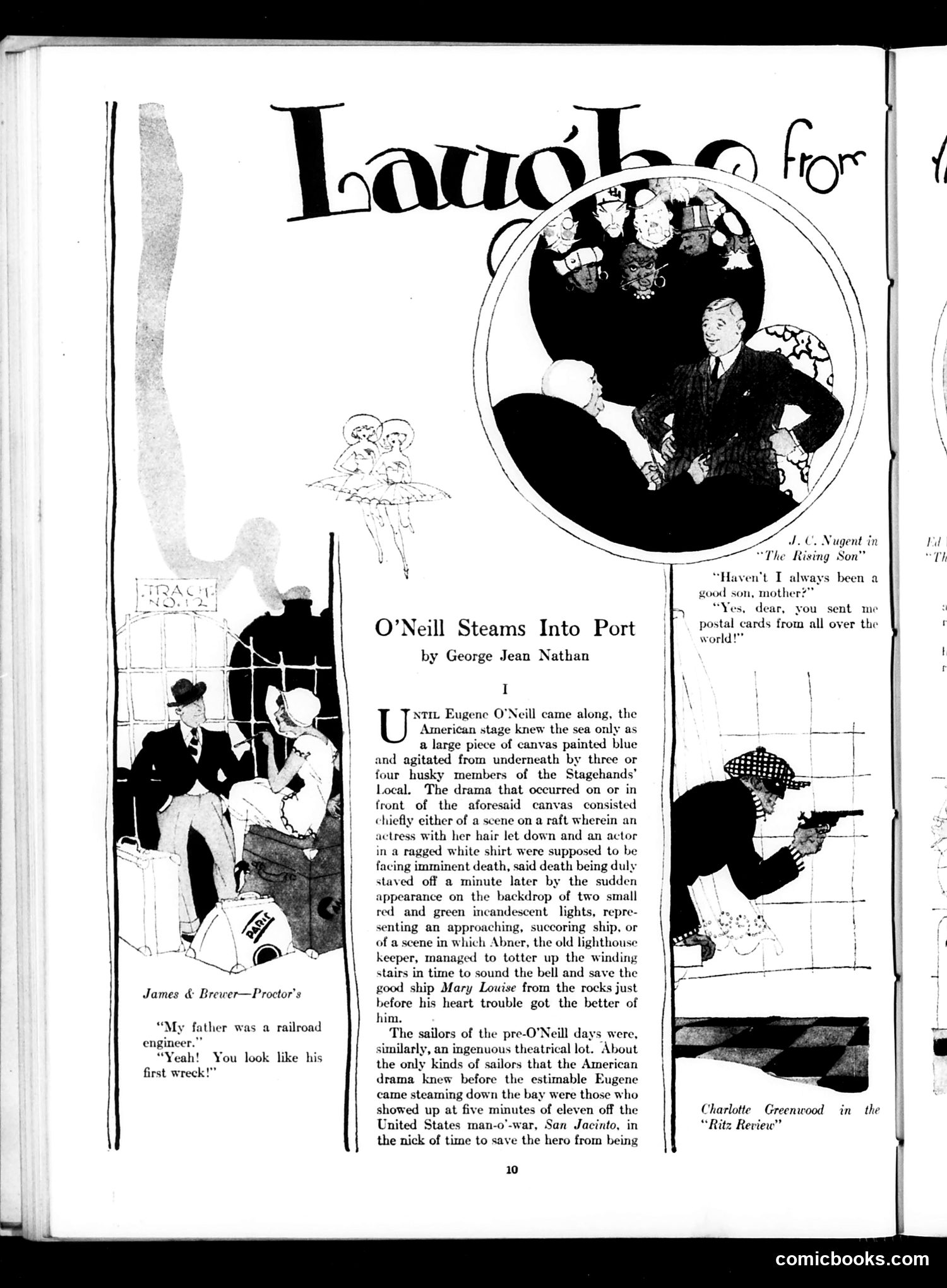
This page contains **two distinct items**: 1. **"O'Neill Steams Into Port"** (main article by George Jean Nathan): A theatrical critique praising playwright Eugene O'Neill for revolutionizing how the American stage depicts the sea and sailors. Before O'Neill, Nathan argues, theatrical sea scenes were crude—painted backdrops with actors in melodramatic poses, rescued by artificial lights representing ships. Pre-O'Neill sailors were stock theatrical types appearing at the last moment to save heroes. O'Neill brought more realistic, nuanced treatment of maritime drama to American theater. 2. **Two separate comedic vignettes** with accompanying illustrations: - A joke about a man resembling his father (a railroad engineer) but being his "first wreck" (implying he's a failure) - Advertisements or theater references to "The Rising Son" and "Ritz Review" productions The page primarily celebrates O'Neill's theatrical innovations rather than offering satire; it's a serious critical appreciation mixed with unrelated comedy.
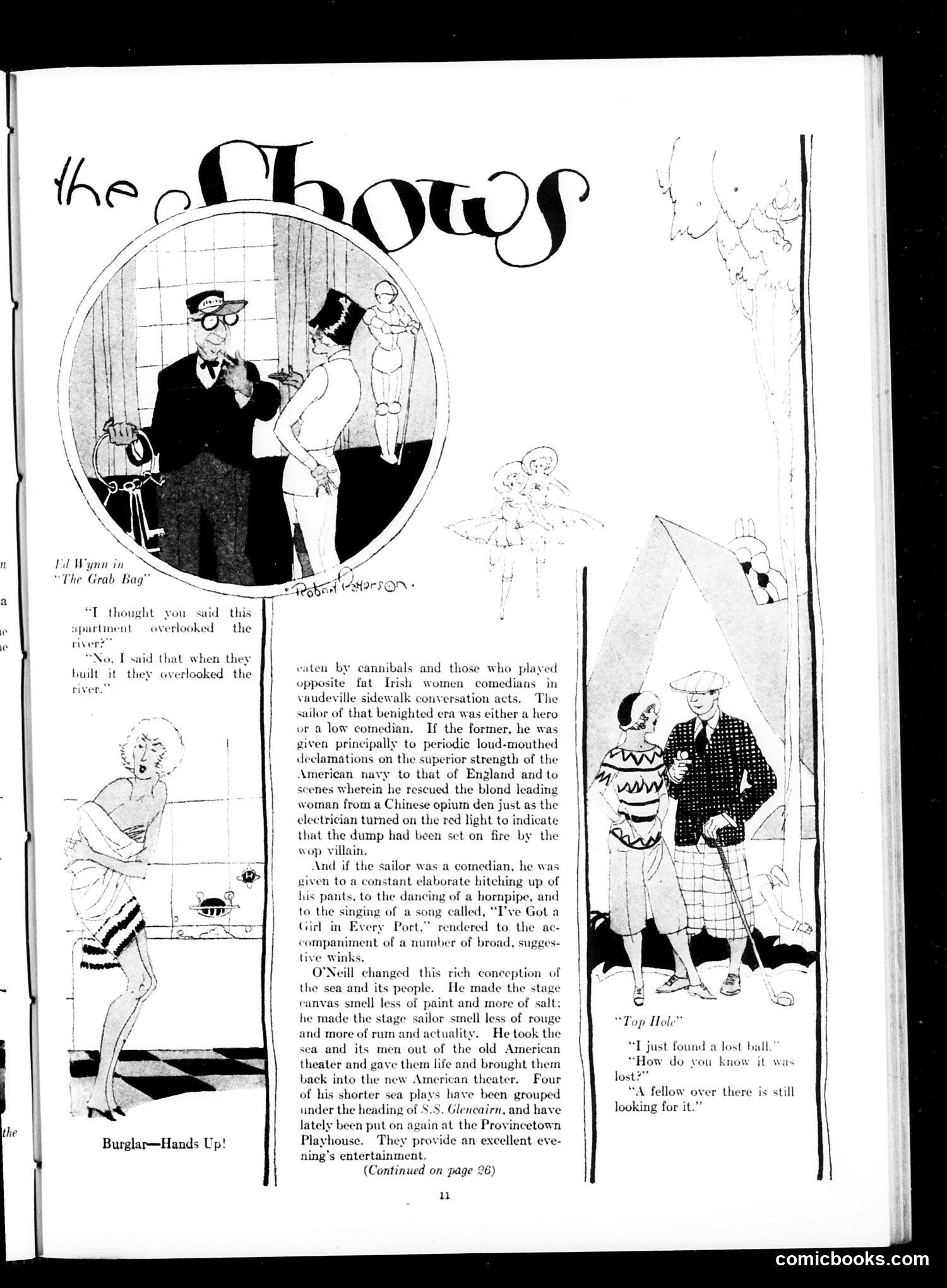
This page contains three distinct satirical pieces: 1. **"The Grab Bag" (top)**: A simple apartment-hunting joke where a prospective tenant complains the apartment "overlooked the river," and the landlord clarifies they overlooked building it near the river at all—satirizing poor construction or false advertising in real estate. 2. **"Burglar—Hands Up!" (left)**: A visual gag showing a burglar confronting a woman, likely playing on period anxiety about home security and crime. 3. **Main article (center/right)**: A theater review of Eugene O'Neill's sea plays grouped under *S.S. Glencairn*, recently revived at the Provincetown Playhouse. The critic praises O'Neill for modernizing theatrical depictions of sailors and seafaring life—replacing melodramatic clichés (rescuing blondes from opium dens, ethnic stereotypes) with authentic realism about working sailors. The "Top Hat" illustration shows an unrelated social scene. The page reflects 1920s theatrical culture and O'Neill's revolutionary impact on American drama.
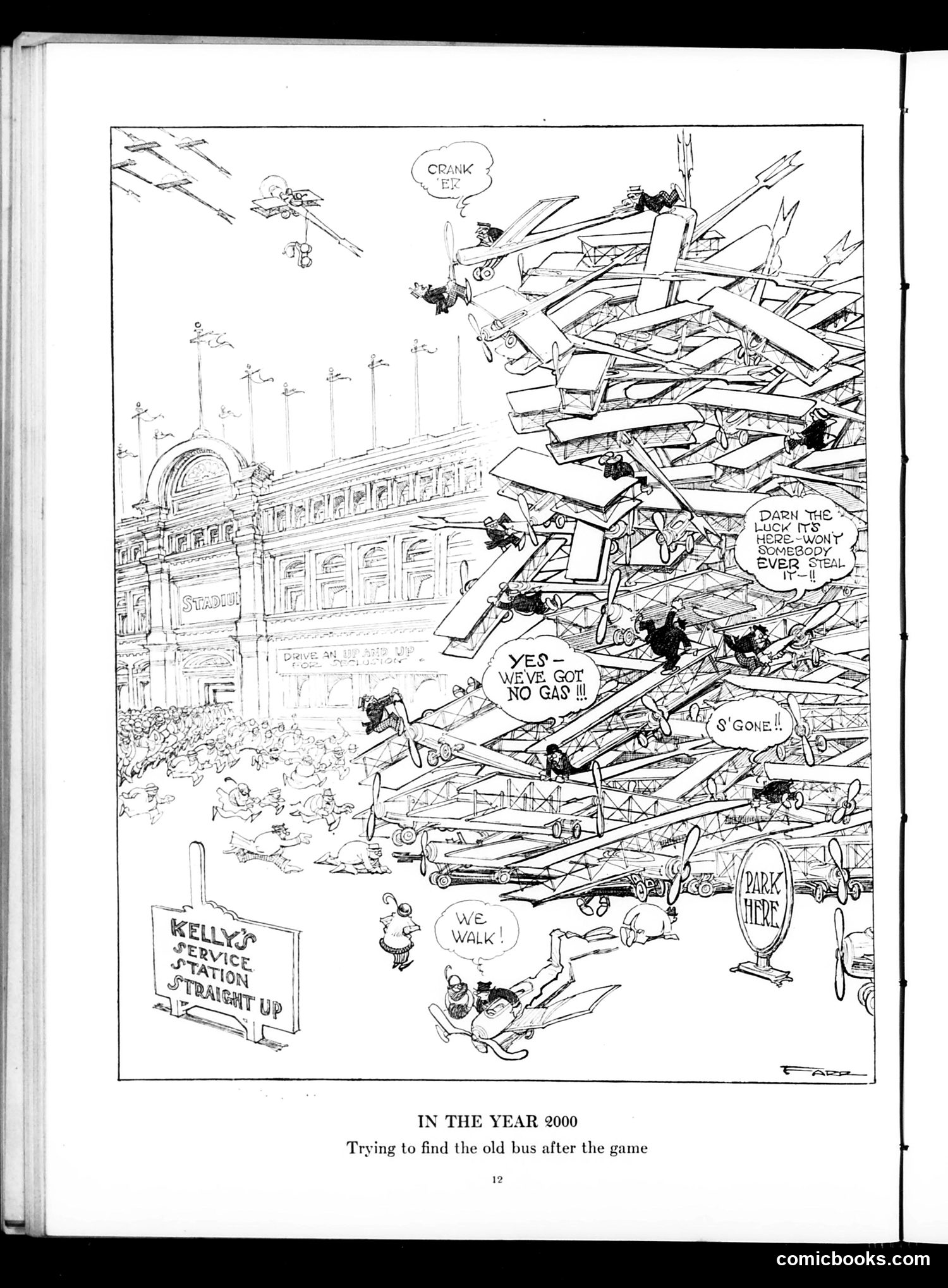
This is a futuristic satirical cartoon dated to Judge magazine, depicting a chaotic scene titled "In the Year 2000: Trying to find the old bus after the game." The cartoon shows a massive pile of wrecked and stacked vehicles near what appears to be a grand civic building (possibly a stadium or arena). Small figures navigate the debris. Speech bubbles include "Crank 'er!", "Darn the luck!", "Yes—we've got no gas!", and "We walk!" The satire mocks traffic congestion and automobile culture. By projecting parking and vehicle chaos into an exaggerated future scenario, the cartoonist critiques the growing automobile dependency of early 20th-century American life. The "old bus" reference and "Kelly's Service Station" sign suggest this relates to contemporary public transit and automotive concerns. The joke works through absurdist escalation—imagining the logical endpoint of unmanaged vehicle accumulation.
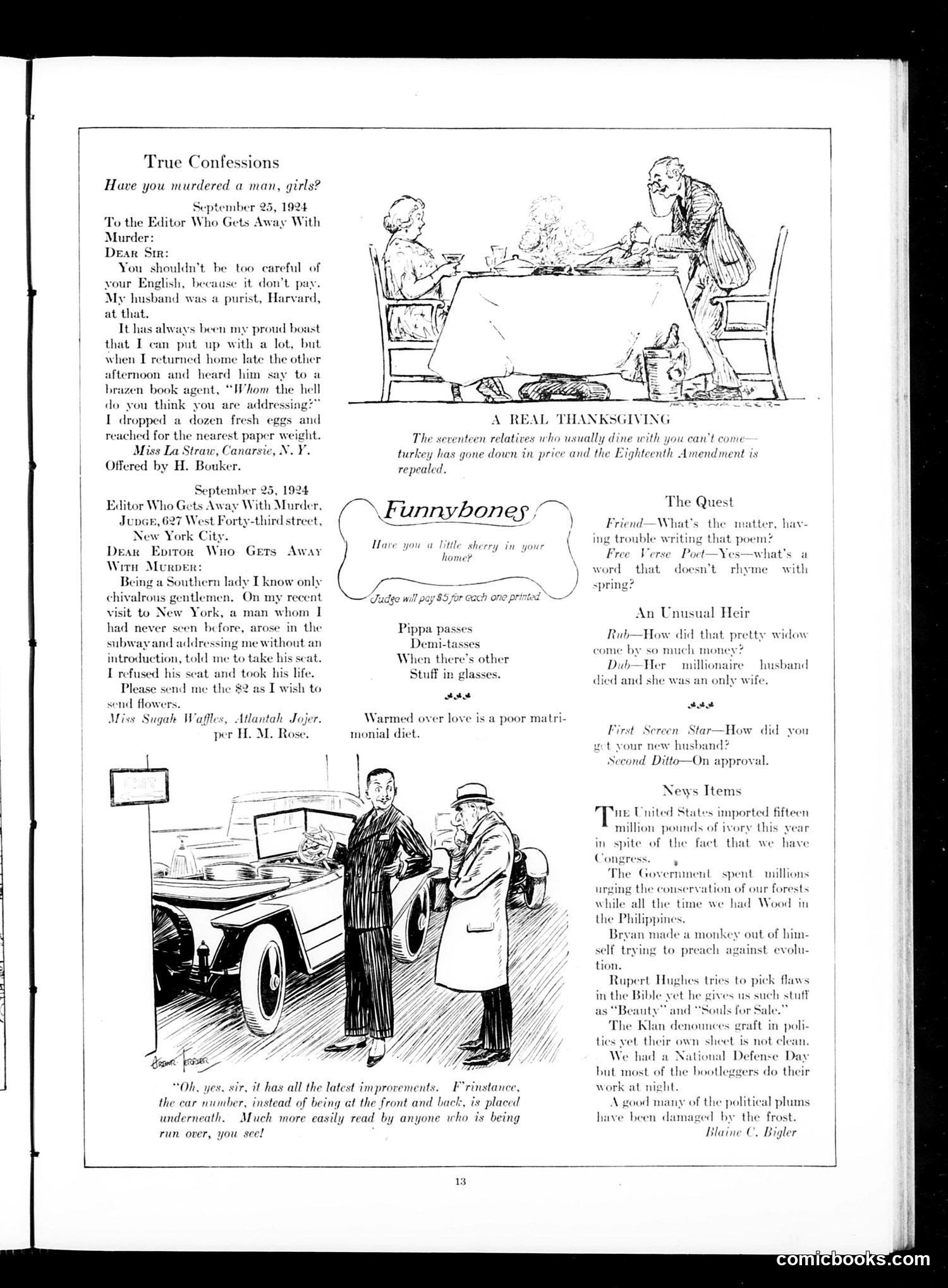
This satirical page uses the "True Confessions" format to mock Prohibition-era anxieties and changing social mores. The opening section presents humorous fake letters where women confess to murdering men—one for grammatical pedantry, another for subway rudeness—as dark comedy about female patience with male behavior. The automobile cartoon critiques car design: a salesman boasts about "improvements" while the feature he highlights (relocated car number) is trivial; the joke undercuts advertising hyperbole. "Funnybones" contains brief quips about romance and the Eighteenth Amendment (Prohibition), mocking domestic life and failed alcohol legislation. The "News Items" section satirizes contemporary absurdities: importing ivory while protecting forests, Bryan's anti-evolution stance, the KKK's hypocrisy (criticizing morality while operating secretly), and political corruption. The tone throughout is cynical about 1920s American contradictions and excess.
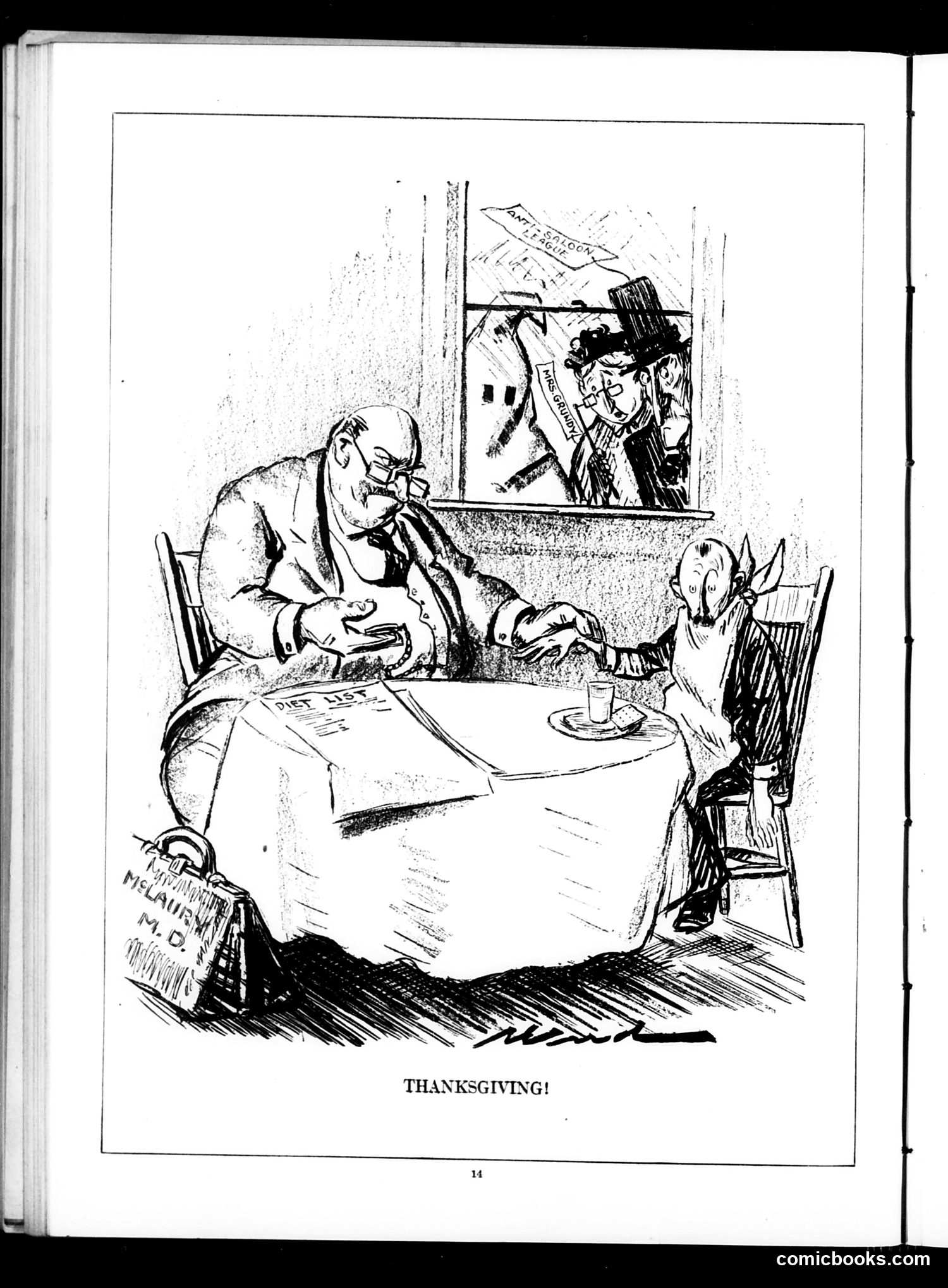
This satirical cartoon depicts a wealthy man in formal attire dining at a table while peering out a window at what appears to be a disheveled, impoverished figure in a top hat. The contrast suggests social commentary on class inequality during the Thanksgiving holiday. The cartoon's message appears critical: while the affluent dine comfortably indoors, the poor remain outside, excluded from prosperity and celebration. The bag labeled "M.D." (likely indicating a medical doctor or professional) on the left suggests the wealthy figure's status. The single-word caption "THANKSGIVING!" emphasizes the irony—the holiday traditionally celebrates gratitude and abundance, yet the cartoon highlights the stark division between rich and poor, suggesting whose cause for gratitude is genuine during economically unequal times.
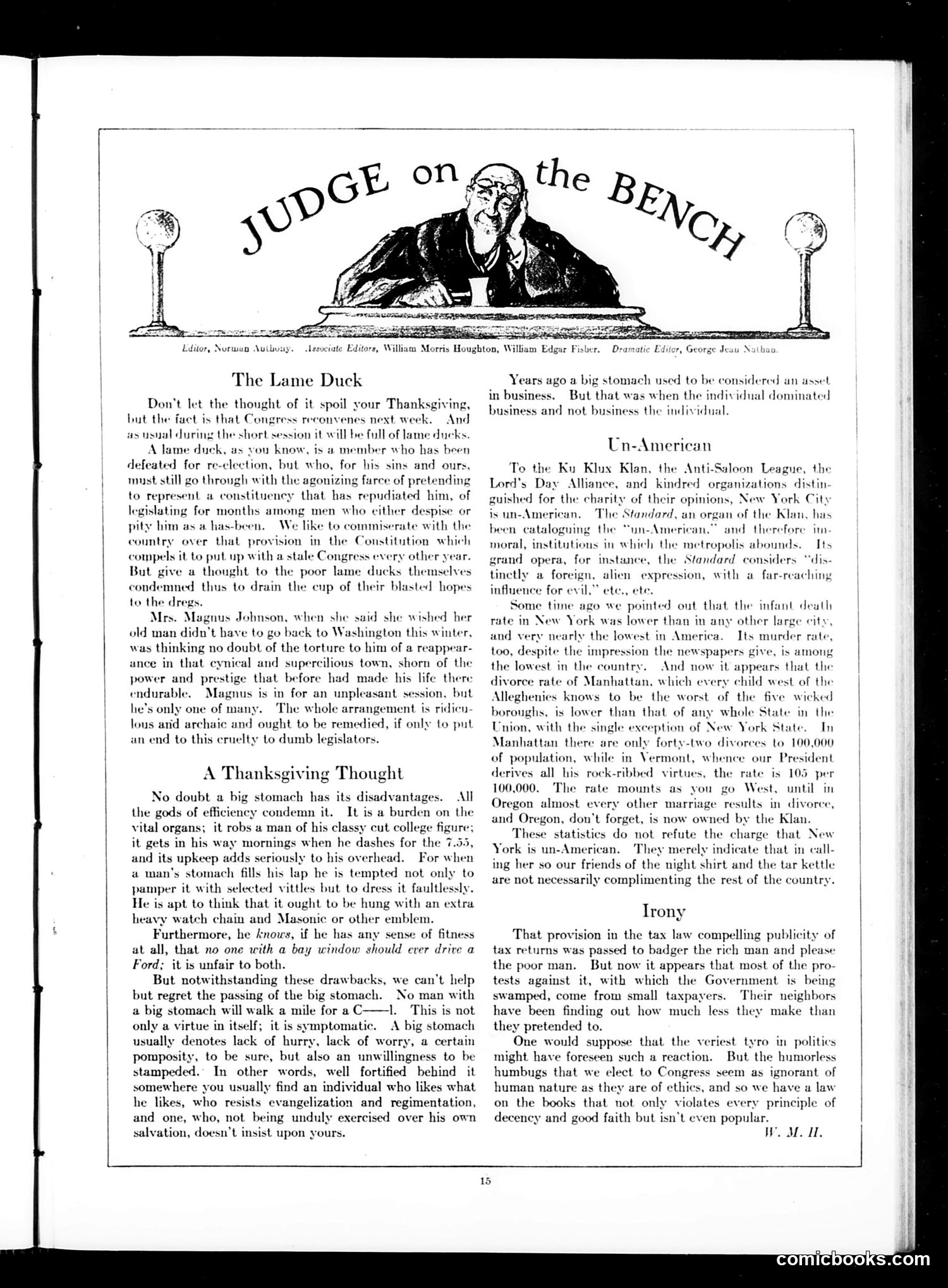
This page from *Judge* magazine contains three satirical essays rather than visual cartoons. **"The Lame Duck"** mocks the constitutional provision forcing defeated congressmen to serve until their terms end. The author sympathizes with these politically "lame" legislators—like Representative Magnus Johnson—condemned to work in Washington stripped of power and respect. **"A Thanksgiving Thought"** nostalgically praises the "big stomach" (pot belly) as a symbol of old-fashioned independence and resistance to modern conformity and "evangelization." It represents men who resist being "stampeded" by contemporary pressures. **"Un-American"** defends New York City against criticism from the Ku Klux Klan and Anti-Saloon League, which condemned institutions like opera as "foreign" and immoral. The author counters with statistics showing New York's low infant mortality and murder rates, arguing these organizations' narrow moralism is itself un-American. The satire targets both defeated politicians and cultural reactionaries.
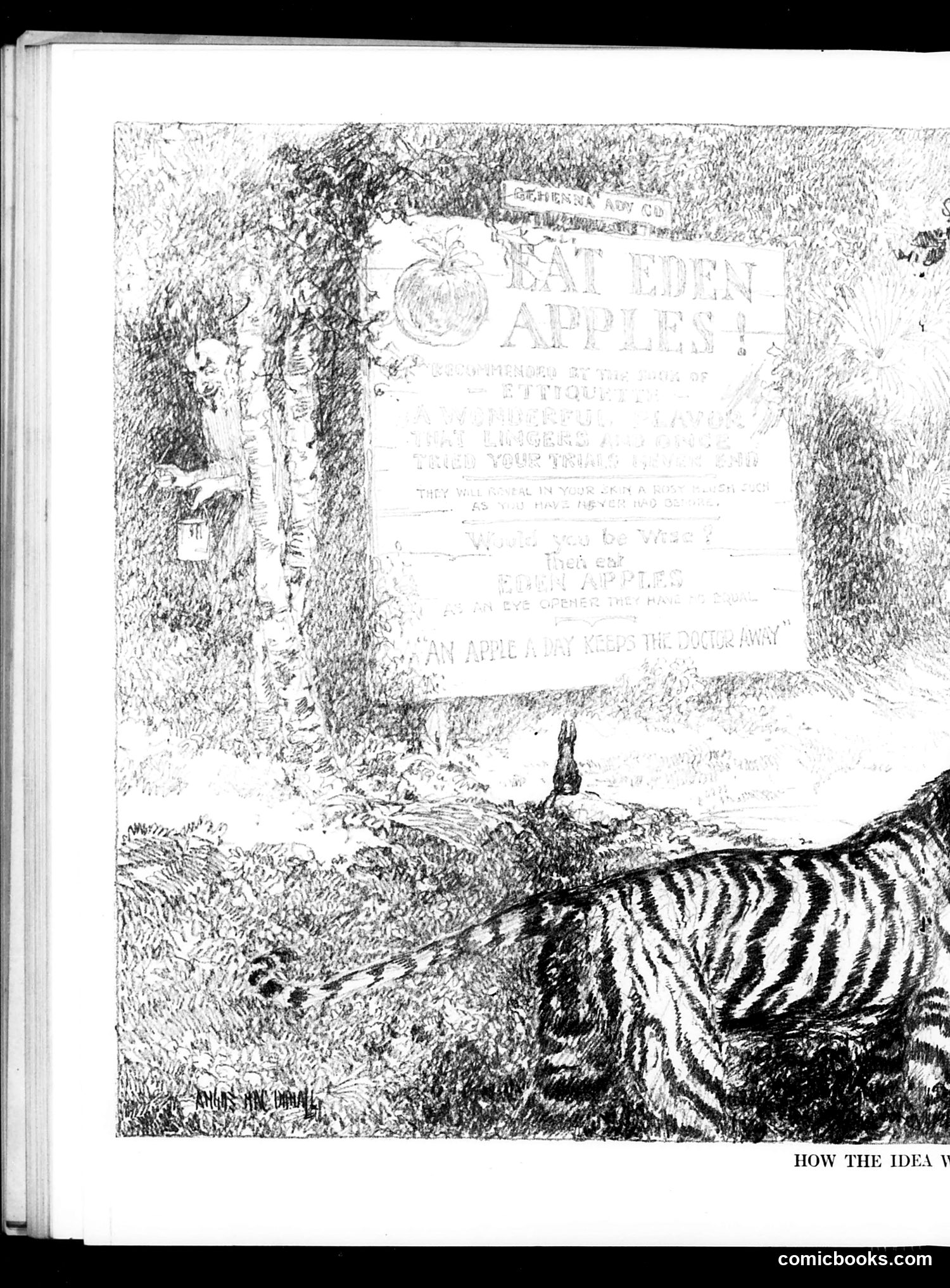
This page appears to be a title page or section divider from *Judge* magazine featuring an illustration rather than a traditional political cartoon. The image shows a zebra in a natural landscape beneath a large tree, with a framed text block (likely containing the title "Eden Apples" based on partial visible text) positioned above. The zebra's presence and the pastoral "Eden" reference suggest this may be satirizing natural history, evolutionary theory, or perhaps the romanticization of nature—common *Judge* targets. However, the OCR text is too degraded and the caption fragment too incomplete to determine the specific political or social satire being referenced. Without clearer text or date information, I cannot confidently explain what contemporary issue or figure this addresses.
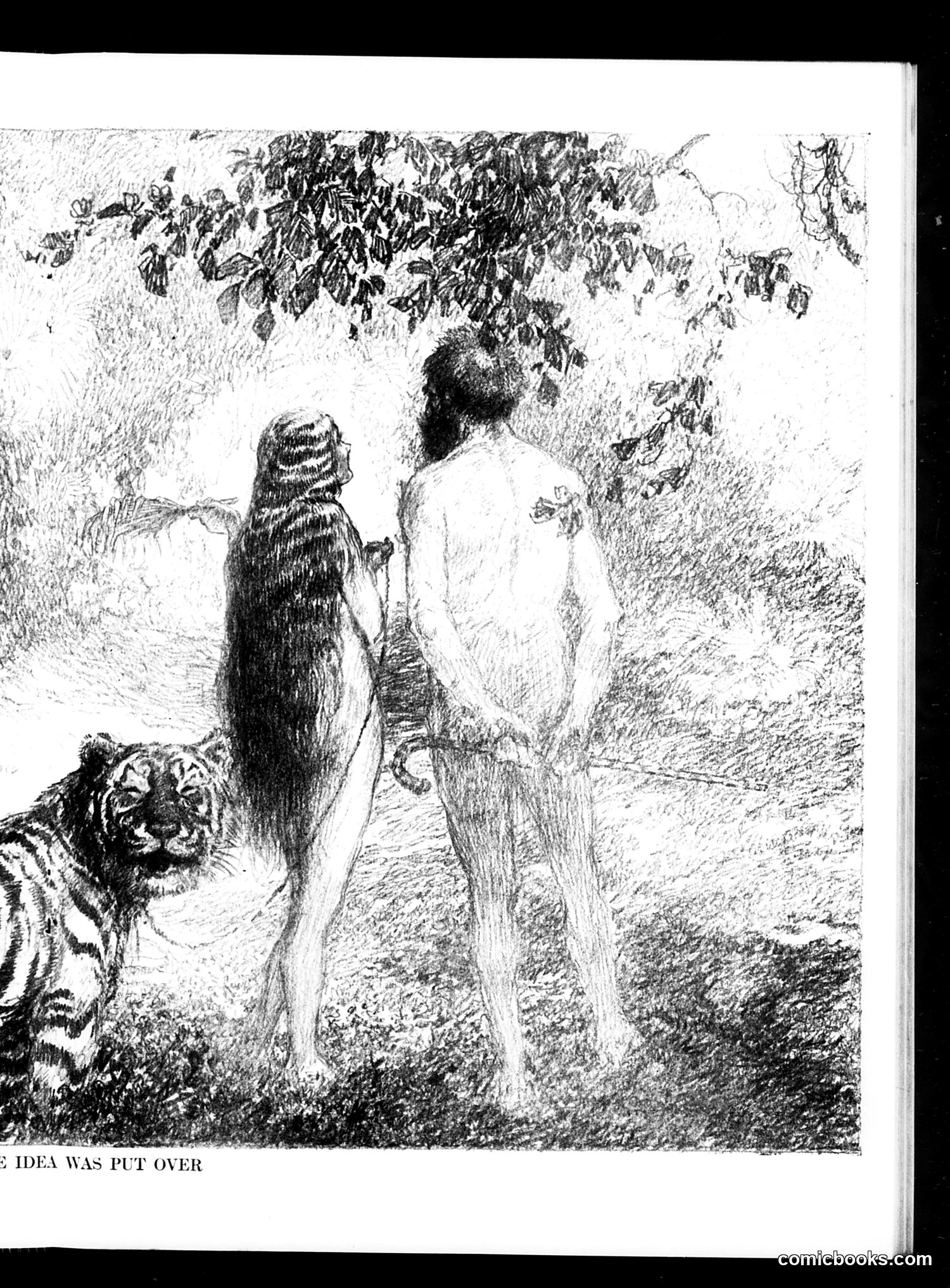
This appears to be an illustration from *Judge* magazine showing two nude figures in a natural setting with a tiger present. The partial caption reads "IDEA WAS PUT OVER," suggesting a completed thought or successful deception. Without the full caption or surrounding context, the precise satirical target is unclear. However, given *Judge*'s style, this likely satirizes a contemporary social, political, or cultural "idea" that gained traction despite questionable merit. The classical nude figures and garden setting may invoke themes of primitivism, natural philosophy, or idealized concepts being sold to the public. The tiger's presence suggests danger or threat lurking beneath an attractive surface—a common satirical device warning readers that appealing ideas can mask actual risks. More context would be needed to identify the specific target.
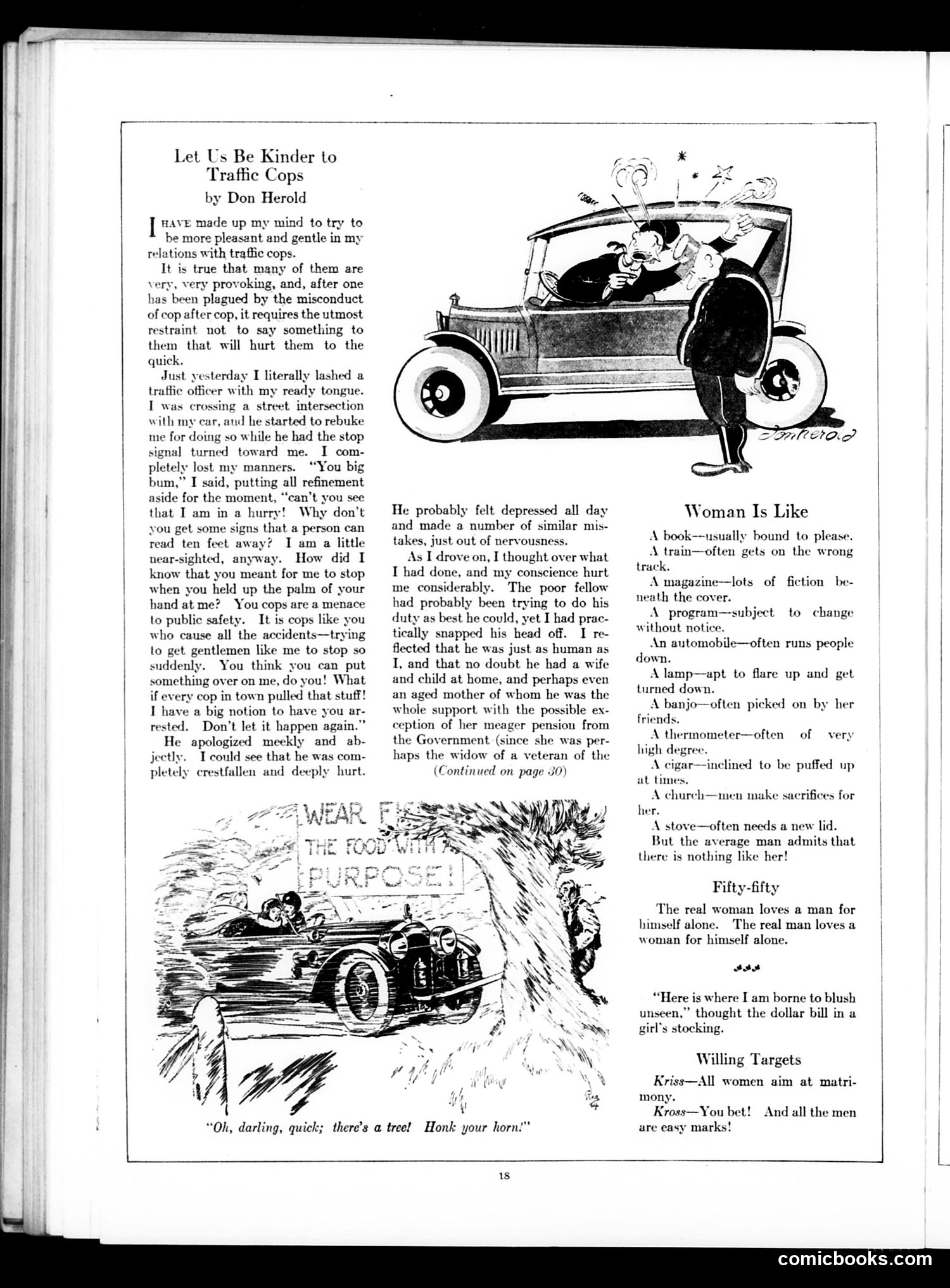
**"Let Us Be Kinder to Traffic Cops"** by Don Herold is a humorous essay about the author's regret after verbally abusing a traffic officer for enforcing a stop signal. Herold mocks his own impatience and rudeness, then reflects sympathetically on the cop's difficult job and likely hardships (supporting a family, possibly an elderly veteran's widow mother). The accompanying cartoon shows an angry driver being stopped, illustrating typical traffic confrontations of the era. The piece satirizes American drivers' entitled rudeness toward working-class authority figures—a timeless theme. The humor comes from Herold's exaggerated self-awareness of his own bad behavior. The page also includes lighter content: "Woman Is Like" offers stereotypical comparisons (trains going wrong, books, etc.); "Fifty-Fifty" makes cynical observations about gender and marriage; "Willing Targets" jokes that women aim for marriage while men are easy victims. These reflect period attitudes toward women rather than forward-thinking commentary.
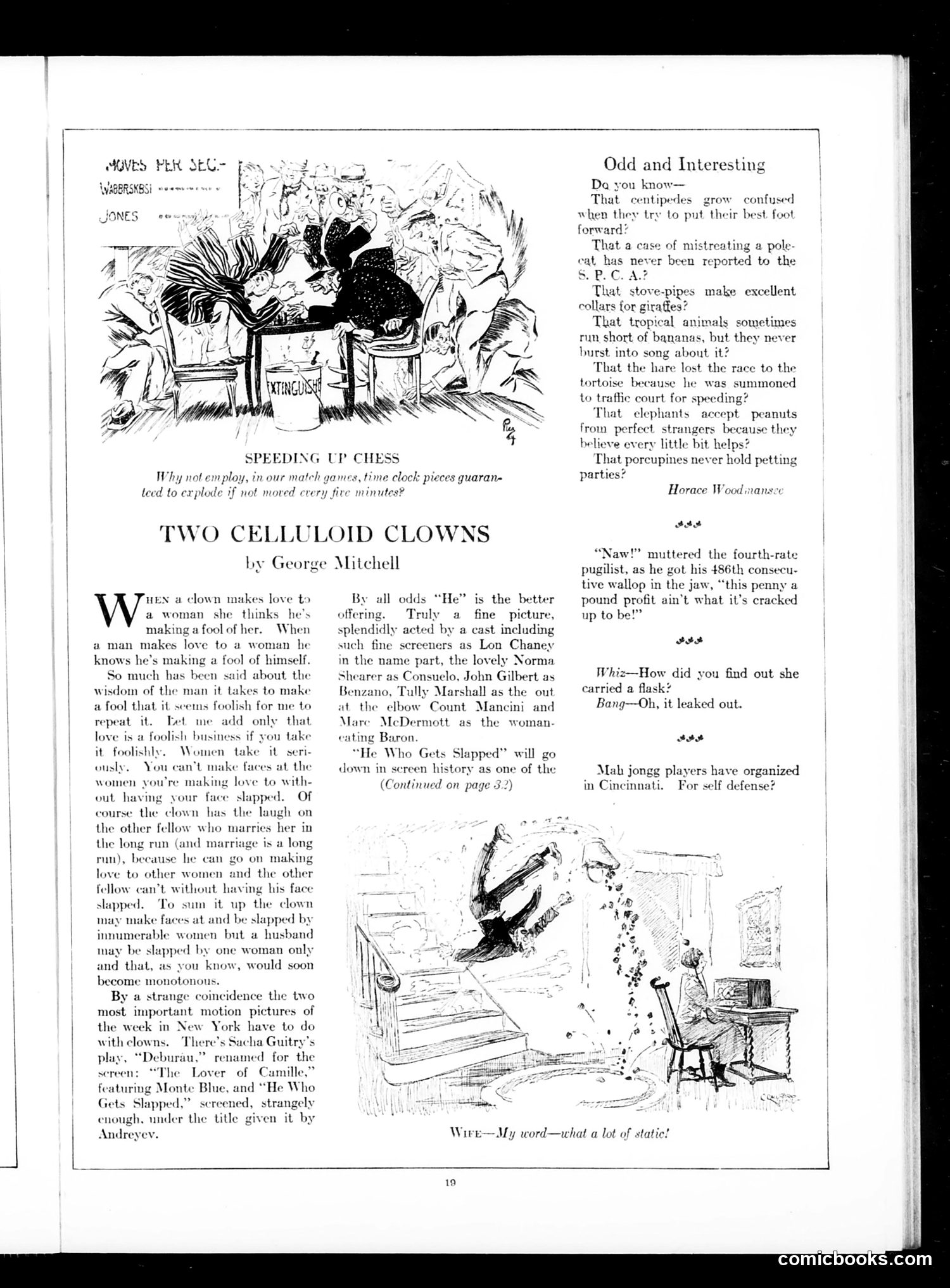
This page mixes entertainment criticism with humor snippets typical of 1920s Judge magazine. **Main article ("Two Celluloid Clowns"):** George Mitchell reviews two silent films featuring clowns—"He Who Gets Slapped" and "Deburau"—using them as a springboard for philosophical humor about romantic foolishness. The conceit: clowns can seduce women consequence-free because audiences expect clownish behavior, while ordinary men face serious social repercussions (face-slapping) for identical conduct. It's gentle satire on gender dynamics and the performative nature of courtship. **Other content:** "Speeding Up Chess" proposes exploding chess clocks as absurdist humor. "Odd and Interesting" presents whimsical fake facts (centipedes confused about footwork, giraffes wearing stovepipes). Brief joke snippets mock prizefighters and reference flasks (alluding to Prohibition-era drinking). The cartoons are slapstick illustrations supporting these comedic bits. This appears to be filler/humor content rather than political satire—typical of Judge's lighter entertainment pages alongside social commentary.
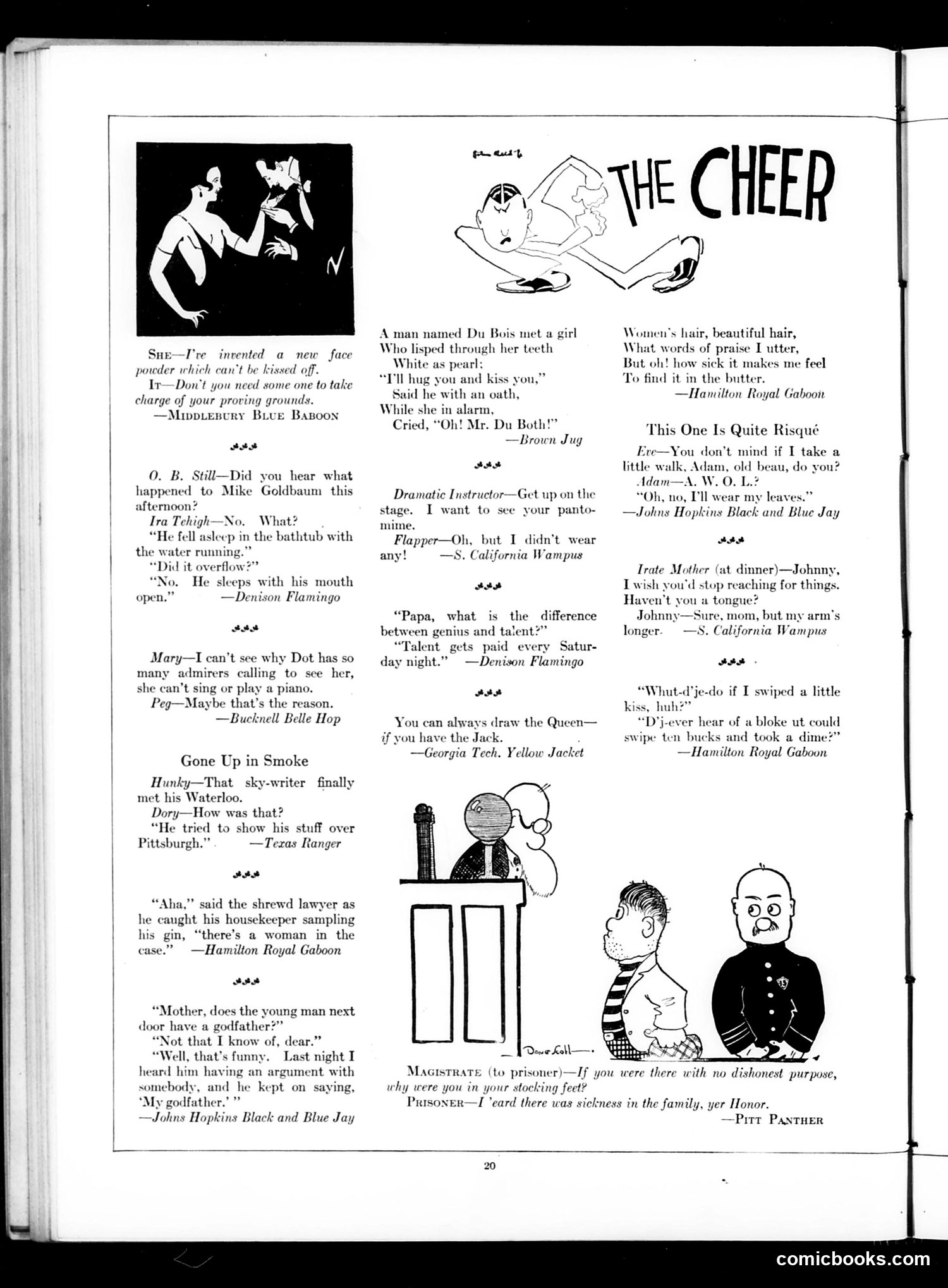
This page collects brief jokes and quips typical of early 20th-century American humor magazines. The content reflects period attitudes and social norms: **Key themes:** - **Gender/dating humor**: Women's appearance, flirtation, and romantic pursuit (Du Bois/lisping girl; Eve and Adam joke about "A.W.O.L." — a military term repurposed for romantic escapades) - **Class/ethnic humor**: Jewish names (Goldbaum) used in stereotypical jokes; domestic servant humor - **Absurdist wordplay**: Puns on "Jack" (playing cards), pantomime mishaps, stocking feet as suspicious behavior **The cartoons** illustrate specific gags: a magistrate interrogating a prisoner, and what appears to be a stage scene. **Social context**: These jokes assume audiences familiar with vaudeville, silent films, and period slang. The humor is largely innocent by modern standards—focused on domestic situations, mishaps, and verbal humor rather than complex satire. The magazine's satirical edge here is genteel rather than sharp, targeting universal human foibles rather than specific political figures.
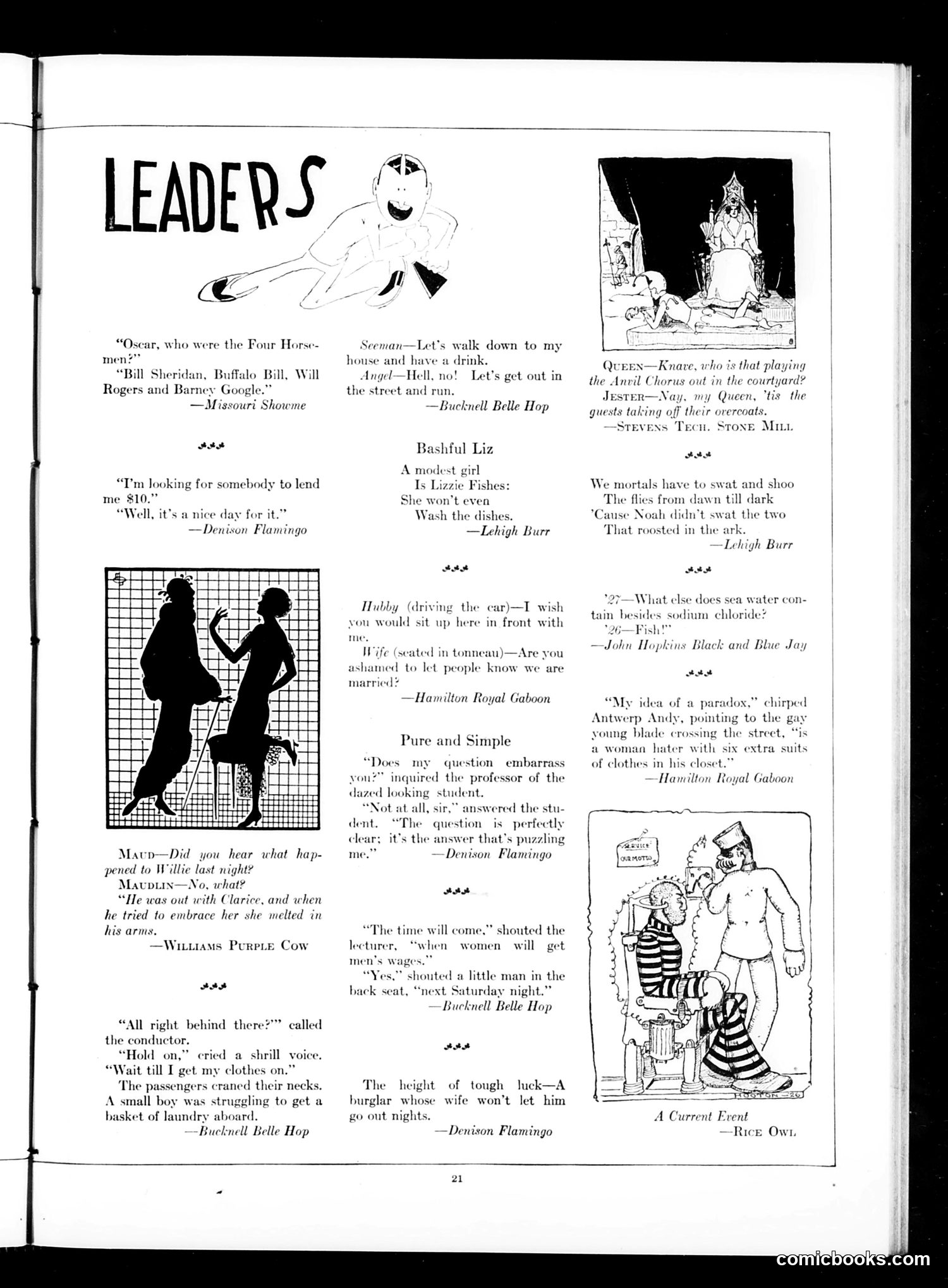
This page from *Judge* magazine collects short humorous anecdotes and jokes rather than political cartoons. The content reflects early 20th-century American humor focused on domestic situations, courtship, and social awkwardness. Key references include: - **"Four Horsemen"** joke plays on the biblical apocalypse concept, humorously substituting Wild West/entertainment figures (Buffalo Bill, Will Rogers) and comic character Barney Google - **Gender dynamics** dominate multiple jokes: wives resisting husbands, women's wages (referencing emerging women's labor activism), and bashful/modest female stereotypes - **College humor** appears frequently (Bucknell, Lehigh, Hamilton Royal references suggest college publication sources) - **Social embarrassment** themes pervade (melting in arms, laundry struggles, marital visibility) The satire is gentle, targeting everyday social conventions rather than politics. The cartoons depict ordinary people—no identifiable political figures—in relatable predicaments. The humor reflects period attitudes about gender roles, courtship propriety, and middle-class social anxiety that modern readers would find both quaint and occasionally problematic.
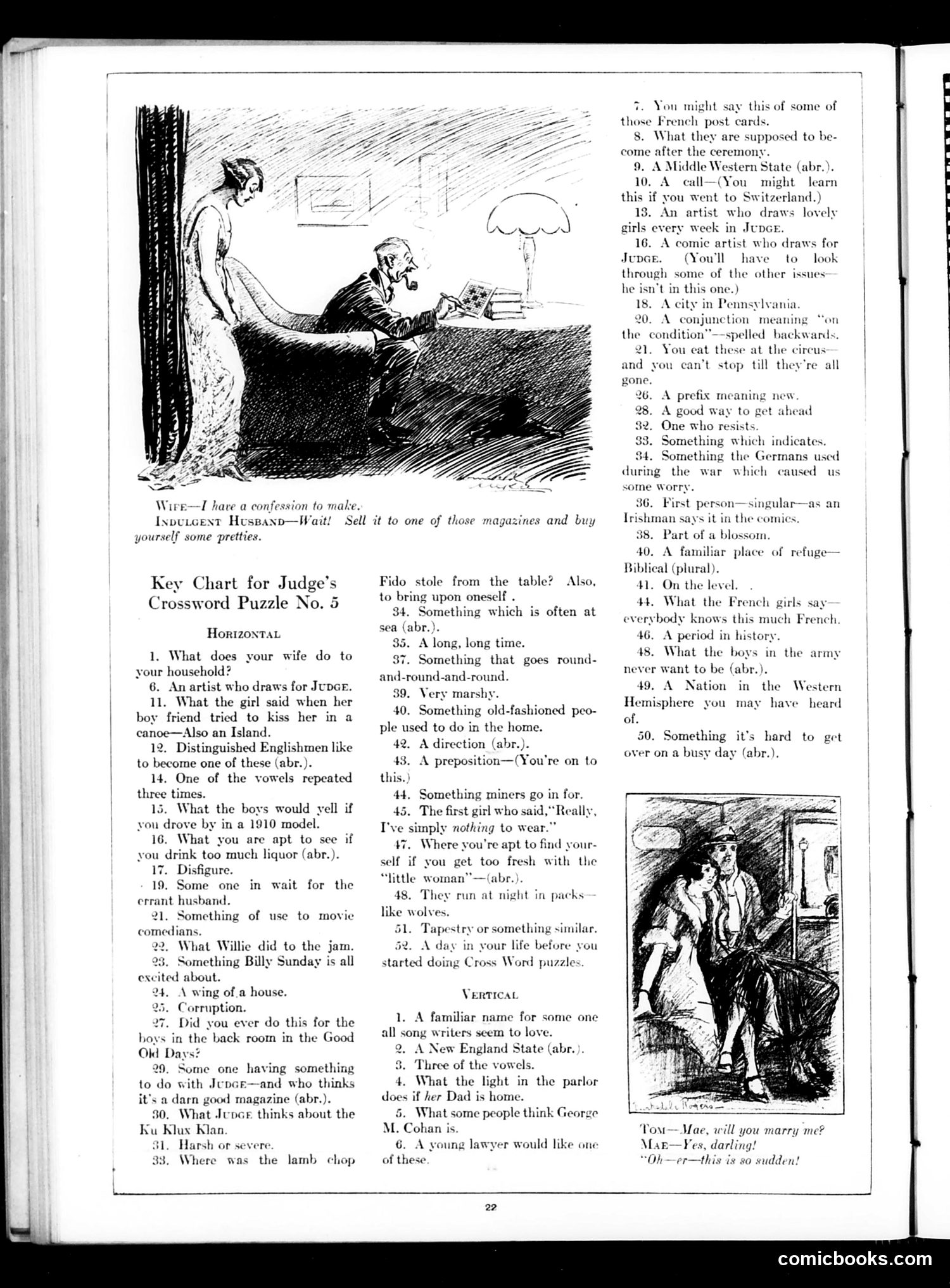
This page contains two distinct elements: **Top Cartoon:** A domestic scene showing a wife confessing to her husband that she wants to sell her confession to a magazine for money to buy "pretties" (luxury items). The husband's response—that she should monetize it—is the joke: he's either indifferent to her confession or sarcastically suggesting she profit from marital discord. This satirizes the popular magazine market of the era, which apparently published sensational personal stories, and pokes fun at consumer materialism among wives. **Main Content:** A crossword puzzle answer key for "Judge's Crossword Puzzle No. 5." The clues are self-referential jokes about Judge magazine itself, its artists, contemporary culture (Billy Sunday, the Ku Klux Klan, 1910 automobiles), and period humor (French postcards, suffragette references). **Bottom Cartoon:** A romantic proposal scene where the woman accepts, then adds "Oh—er—this is so sudden!"—a humorous commentary on the artificiality of romantic conventions. These are lighthearted, domestic-focused humor pieces typical of Judge's satirical approach to American society.