
Judge, 1924-11-22 · page 12 of 24
Judge — November 22, 1924 — page 12: what you’re looking at
What you’re looking at
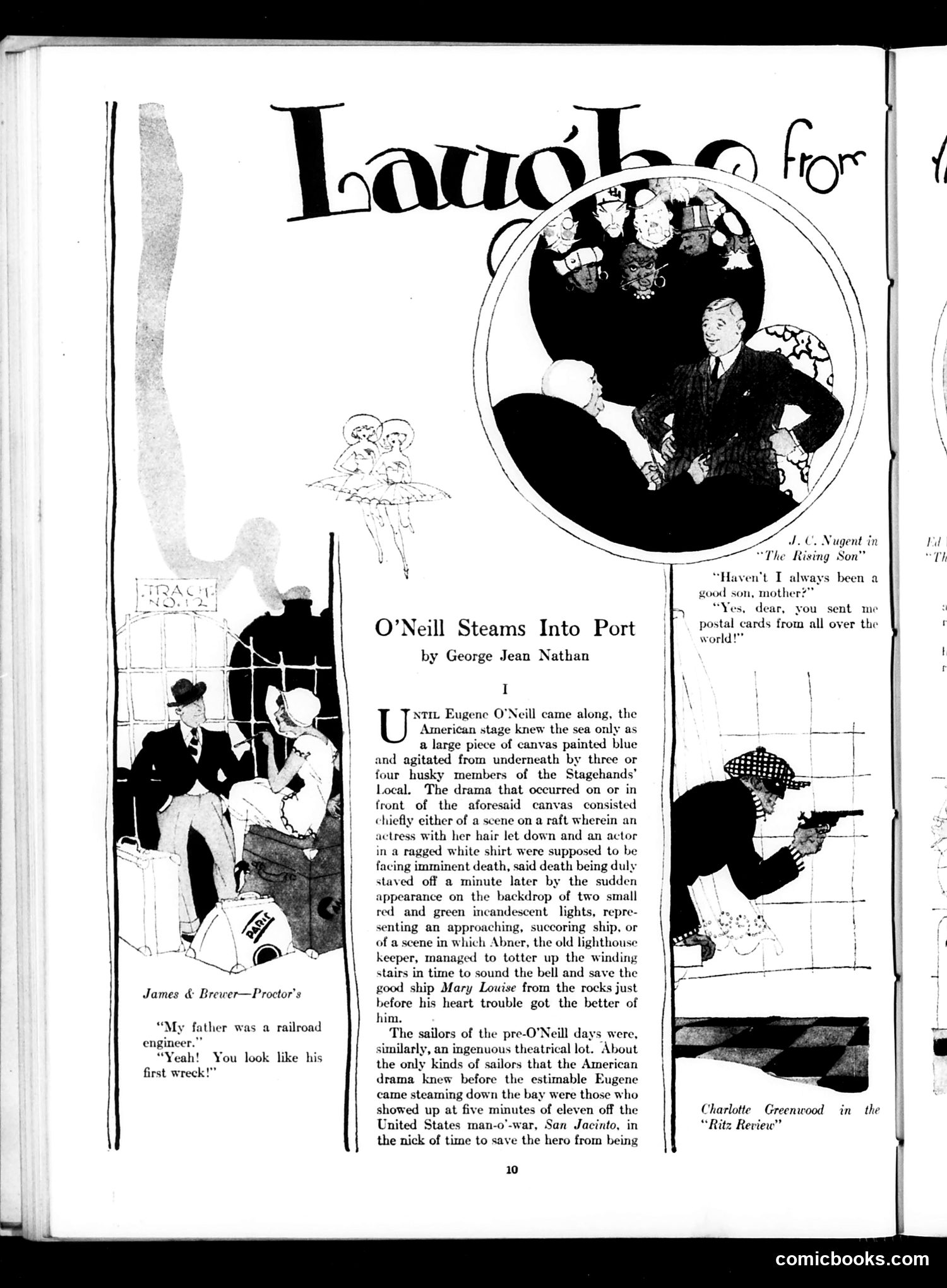
This page contains **two distinct items**: 1. **"O'Neill Steams Into Port"** (main article by George Jean Nathan): A theatrical critique praising playwright Eugene O'Neill for revolutionizing how the American stage depicts the sea and sailors. Before O'Neill, Nathan argues, theatrical sea scenes were crude—painted backdrops with actors in melodramatic poses, rescued by artificial lights representing ships. Pre-O'Neill sailors were stock theatrical types appearing at the last moment to save heroes. O'Neill brought more realistic, nuanced treatment of maritime drama to American theater. 2. **Two separate comedic vignettes** with accompanying illustrations: - A joke about a man resembling his father (a railroad engineer) but being his "first wreck" (implying he's a failure) - Advertisements or theater references to "The Rising Son" and "Ritz Review" productions The page primarily celebrates O'Neill's theatrical innovations rather than offering satire; it's a serious critical appreciation mixed with unrelated comedy.
📄 Transcribed text from this page (OCR, searchable)
Machine-transcribed from the original scan — historical spelling and the odd misread are preserved.
James & Brewer—Proctor’s “My father was a railroad engine “Yeah! You look like his first wreck! “= O’Neill Steams Into Port by George Jean Nathan I NTL Eugene O'Neill came along, the American stage knew the sea only as a large piece of canvas painted blue and agitated from underneath by three or four husky members of the Stagehands’ Local. The drama that occurred on or in front of the aforesaid canvas consisted chiefly either of a scene on a raft wherein an actress with her hair let down and an actor in a ragged white shirt were supposed to be facing imminent death, said death being duly staved off a minute later by the sudden appearance on the backdrop of two small red and green incandescent lights, repre- senting an approaching, succoring ship, or of a scene in which Abner, the old lighthouse keeper, managed to totter up the winding stairs in time to sound the bell and save the good ship Mary Louise from the rocks just before his heart trouble got the better of him. The sailors of the pre-O’Neill days were, similarly, an ingenuous theatrical lot. About the only kinds of sailors that the American drama knew before the estimable Eugene came steaming down the bay were those who showed up at five minutes of eleven off the United States man-o’-war, San Jacinto, in the nick of time to save the hero from being 10 A . Nugent in The Rising Son” “Haven't I always been a good son, mothe “Yes, dear, you sent me postal cards from all over the world!” Charlotte Greenwood in the “Ritz Review” comicbooks.com