
Judge, 1924-11-22 · page 13 of 24
Judge — November 22, 1924 — page 13: what you’re looking at
What you’re looking at
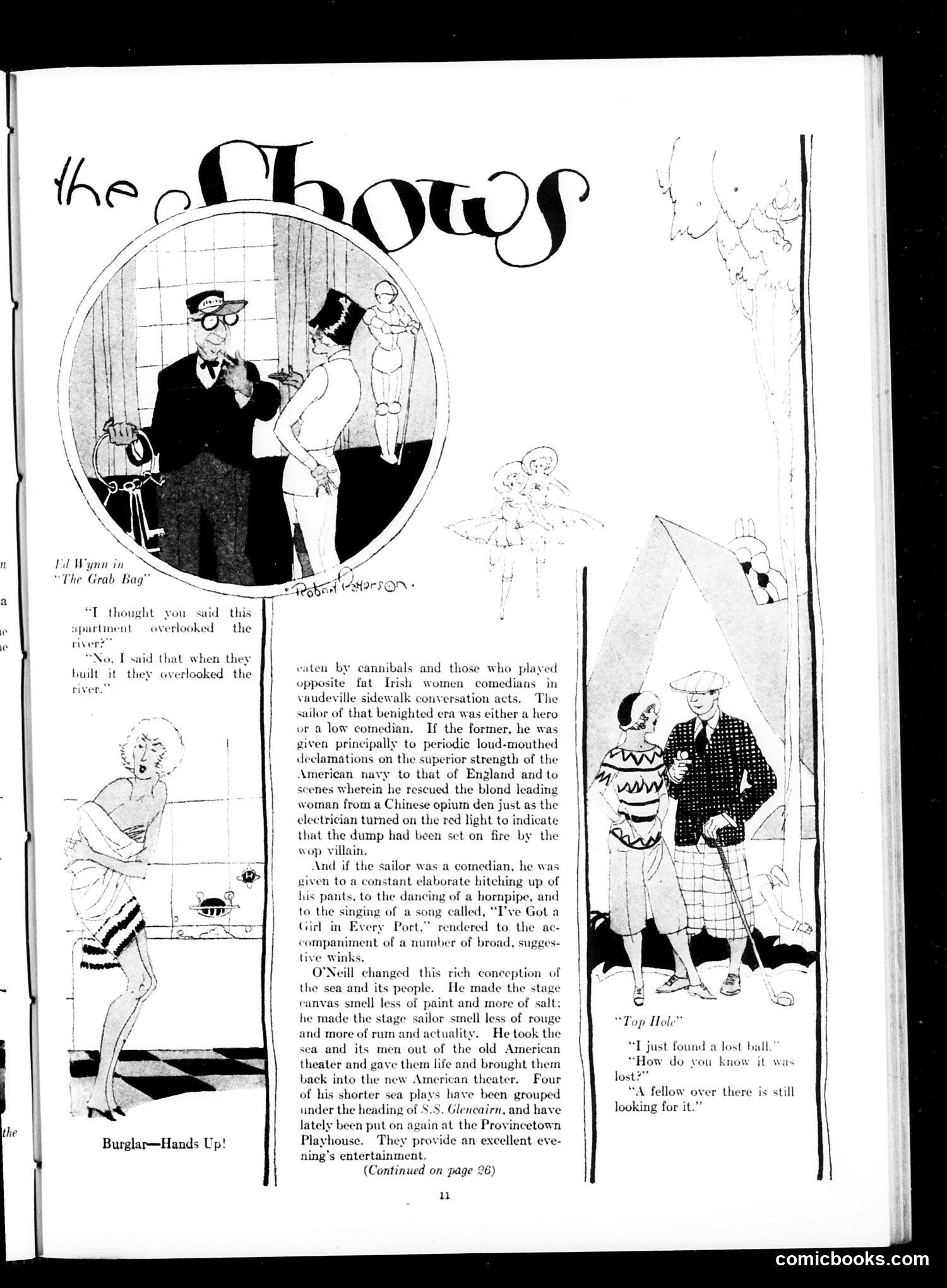
This page contains three distinct satirical pieces: 1. **"The Grab Bag" (top)**: A simple apartment-hunting joke where a prospective tenant complains the apartment "overlooked the river," and the landlord clarifies they overlooked building it near the river at all—satirizing poor construction or false advertising in real estate. 2. **"Burglar—Hands Up!" (left)**: A visual gag showing a burglar confronting a woman, likely playing on period anxiety about home security and crime. 3. **Main article (center/right)**: A theater review of Eugene O'Neill's sea plays grouped under *S.S. Glencairn*, recently revived at the Provincetown Playhouse. The critic praises O'Neill for modernizing theatrical depictions of sailors and seafaring life—replacing melodramatic clichés (rescuing blondes from opium dens, ethnic stereotypes) with authentic realism about working sailors. The "Top Hat" illustration shows an unrelated social scene. The page reflects 1920s theatrical culture and O'Neill's revolutionary impact on American drama.
📄 Transcribed text from this page (OCR, searchable)
Machine-transcribed from the original scan — historical spelling and the odd misread are preserved.
Fd Wynn in “The Grab Bag “T thought you said this ipartment overlooked — the river?” “No, T said that when they huilt it they overlooked the river, Burglar—Hands Up! ee AtarsQN+ eaten by cannibals and those who played opposite fat Irish women comedians in vaudeville sidewalk conversation acts. The sailor of that benighted era was either a hero or a low comedian. If the former, he was given principally to periodic loud-mouthed declamations on the superior strength of the American navy to that of England and to scenes Wherein he rescued the blond leading woman from a Chinese opium den just as the electrician tumed on the red light to indicate that the dump had been set on fire by the wop villain. And if the sailor was a comedian, he was given to a constant elaborate hitching up of his pants, to the dancing of a hornpipe, and to the singing of a song called, “I’ve Got a Girl in Every Port,” rendered to the ac- companiment of a number of broad, sugges- tive winks. O'Neill changed this rich conception of the sea and its people. He made the stage canvas smell less of paint and more of salt; he made the stage sailor smell less of rouge and more of rum and actuality. He took the sea and its men out of the old American theater and gave them life and brought them back into the new American theater. Four of his shorter sea plays have been grouped under the heading of S.S. Glencairn, and have lately been put on again at the Provincetown Playhouse. They provide an excellent eve- ning’s entertainment. (Continued on page 26) il “T just found a lost ball lost?” “A fellow over there is still looking for it.” comicbooks.com