
A complete issue · 37 pages · 1924
Judge — September 6, 1924
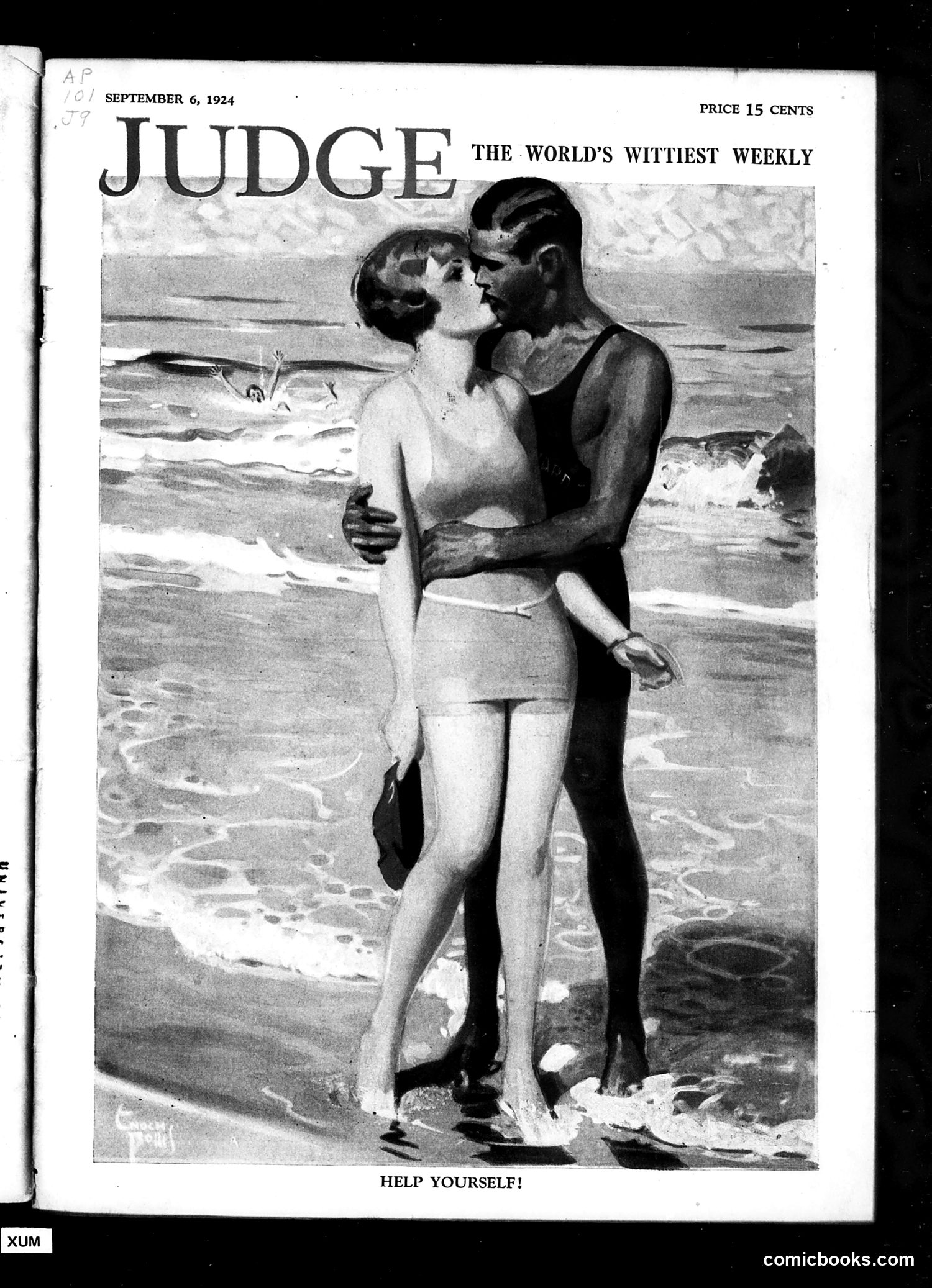
This is the cover of *Judge* magazine from September 6, 1924. The image shows two people in swimwear at a beach in an intimate embrace, with the caption "HELP YOURSELF!" The satire likely comments on 1920s beach culture and changing social mores during the Jazz Age. The "Help Yourself!" caption appears to mock the casual attitude toward romantic/physical intimacy that scandalized more conservative Americans during this era. The magazine's subtitle, "The World's Wittiest Weekly," indicates this is humorous social commentary. Without additional context from the magazine's interior, the specific satirical target remains unclear—whether this mocks permissive attitudes, gender relations, or commercial exploitation of beachwear and romance. The image reflects 1920s anxieties about rapidly changing American social values.
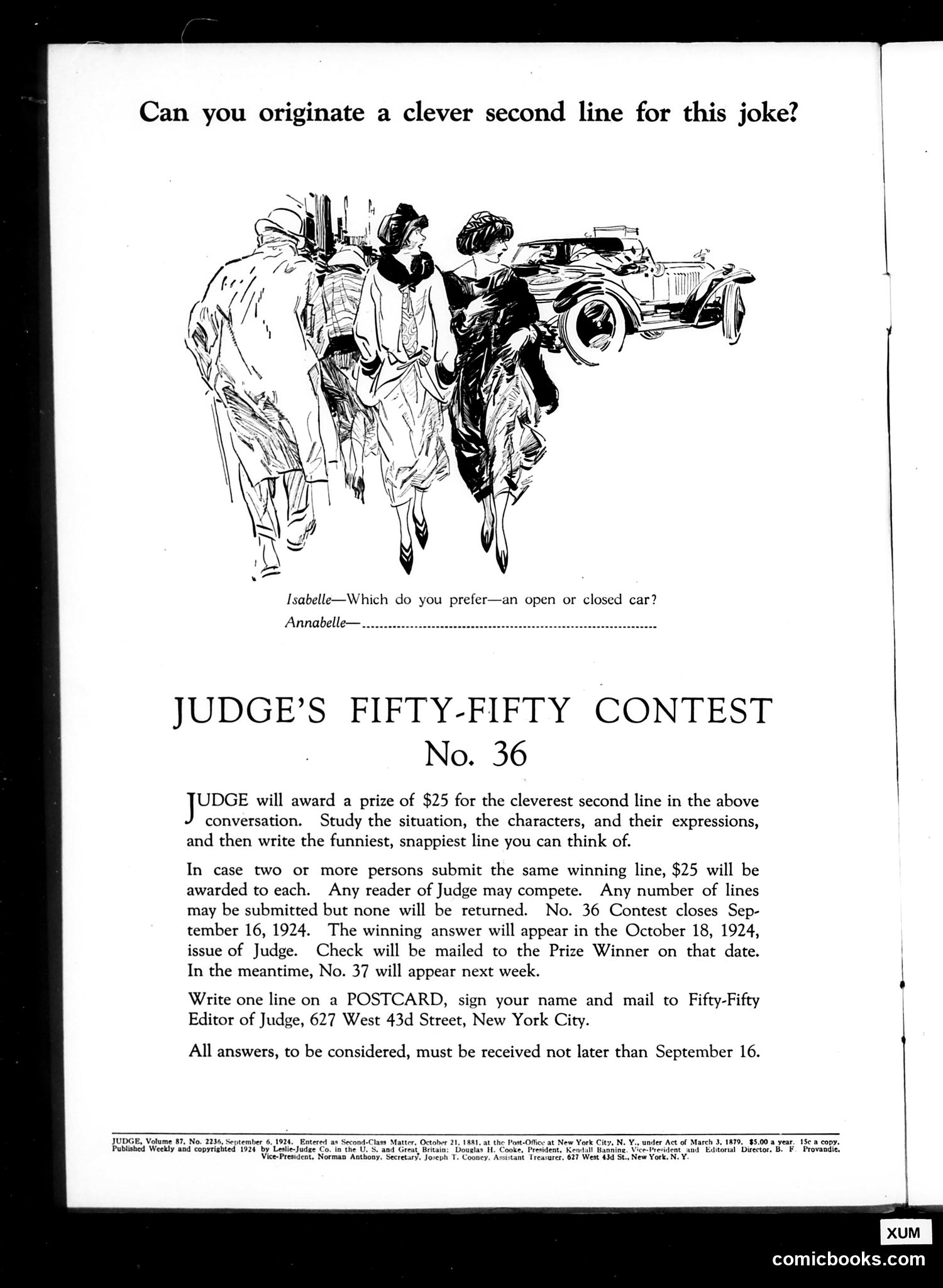
This page presents a humor contest rather than a political cartoon. The illustration shows two fashionably dressed women in 1920s attire standing beside an early automobile, with a man visible in the car. The setup is a conversation between "Isabelle" and "Annabelle" about car preferences—open versus closed vehicles. Readers were invited to submit clever punchlines for Annabelle's response, with the best answer winning $25. The joke likely played on social attitudes of the era regarding courtship, propriety, or dating customs of the "Roaring Twenties," but without the original winning answer provided on this page, the specific satirical target remains unclear. The contest format was typical of Judge's interactive reader engagement strategy from this period.
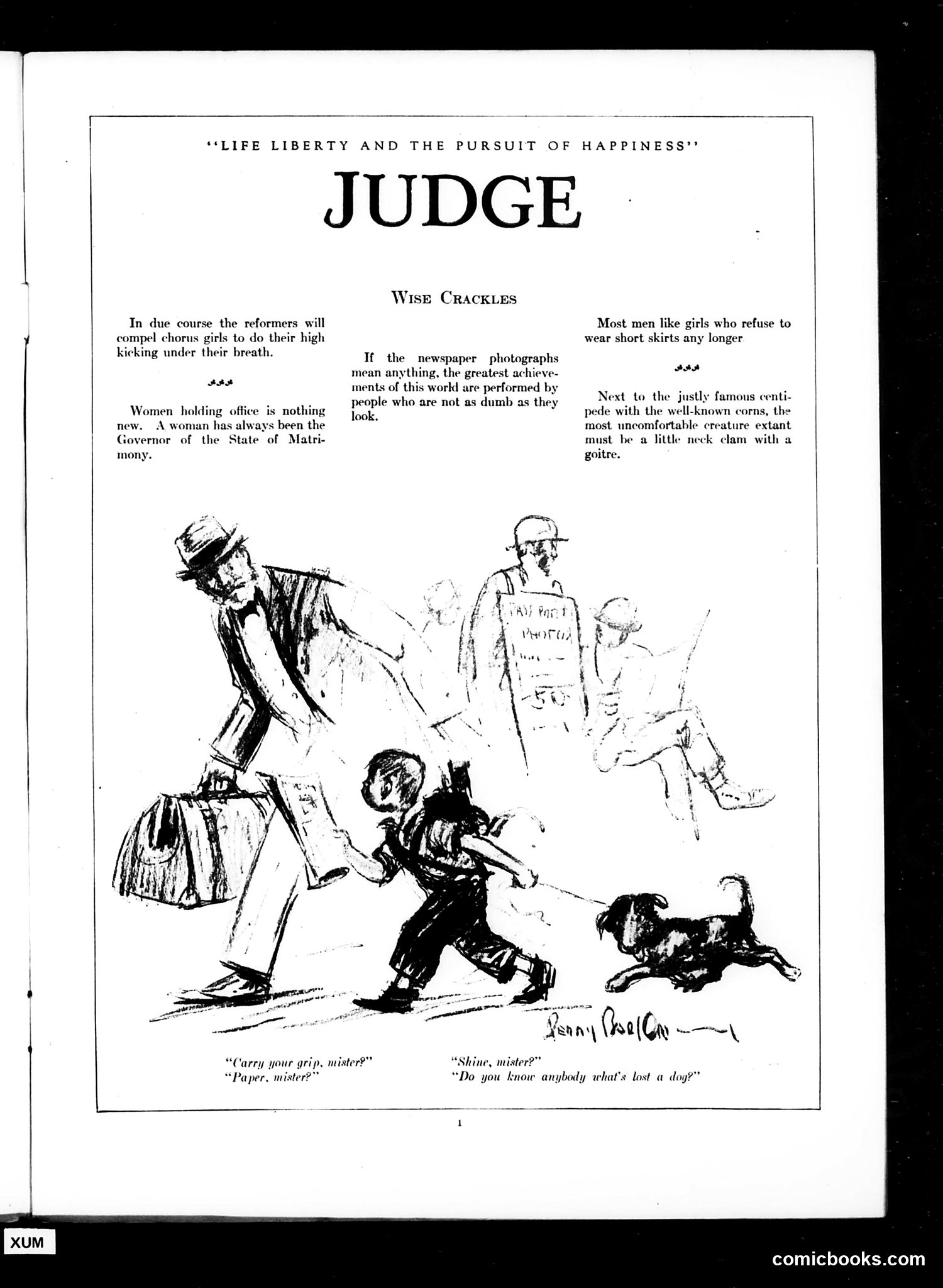
This page from *Judge* magazine contains satirical commentary on social issues of the era. The main cartoon depicts an adult (likely representing authority or law enforcement) interacting with children and a dog on a street. The caption "Carry your grip, mister?" and "Do you know anybody what's lost a dog?" suggests street children hustling passersby—a commentary on urban poverty and child labor. The "Wise Crackles" (aphorisms) above address women's suffrage, fashion (short skirts), and social reform. The opening reference to "reformers" compelling "chorus girls to do their high kicking" satirizes moral crusaders' efforts to regulate women's clothing and behavior. The overall page mocks Progressive Era reform movements while highlighting genuine social problems like homelessness and street children.
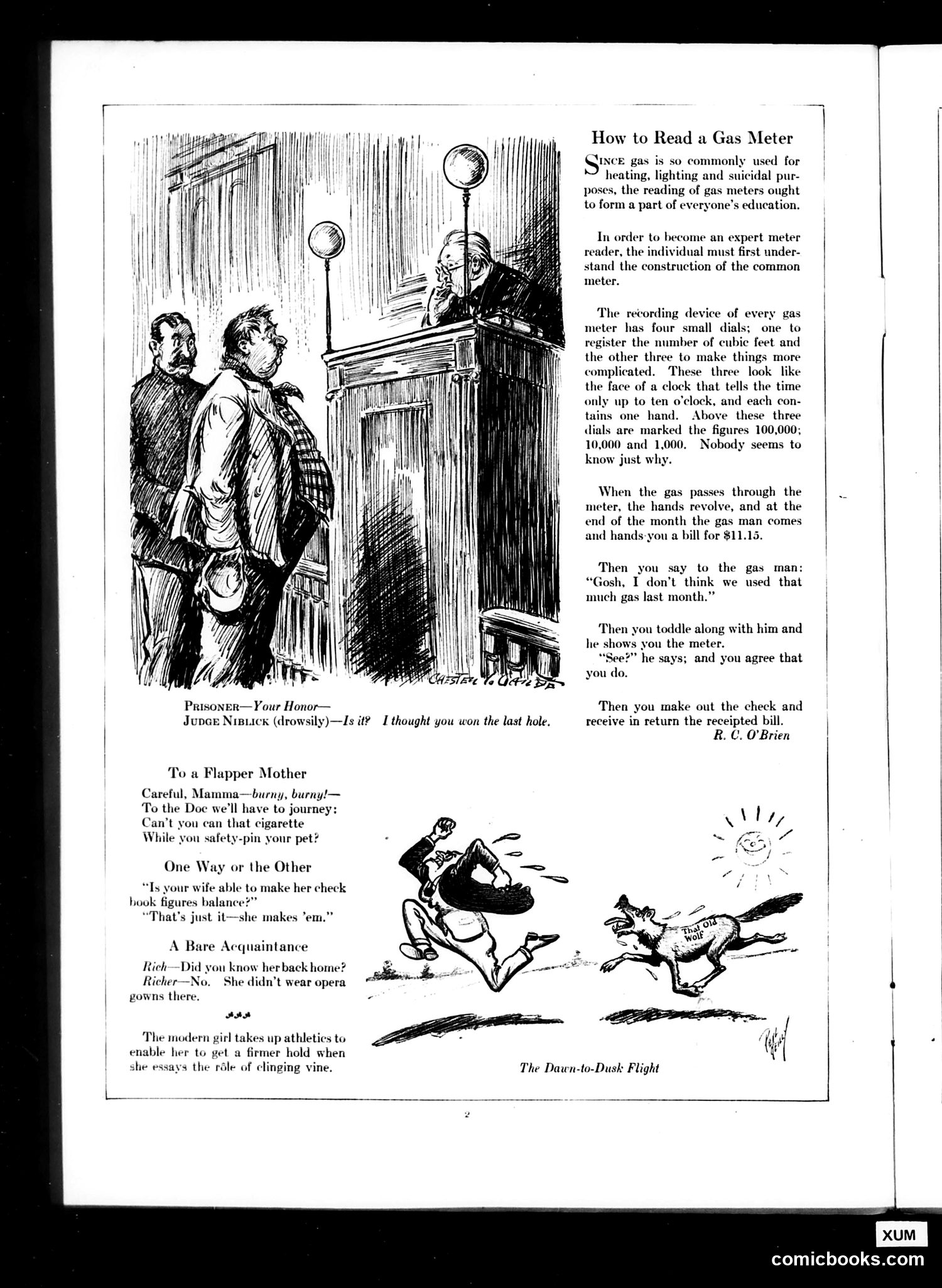
**Main Feature: "How to Read a Gas Meter"** This instructional piece satirizes the gas company's billing practices. The humor lies in the gap between meter readings and actual consumption—the gas man shows a bill for $11.13, the customer protests they didn't use that much gas, but they're shown the meter and comply anyway. The satire targets how consumers are essentially powerless against utility company charges, unable to verify or dispute readings. **Supporting Humor Pieces:** - "To a Flapper Mother": Mocks anxious mothers warning daughters against smoking while traveling - "One Way or the Other": Jokes about women's accounting abilities - "A Bare Acquaintance": Social satire about class pretension **Minor Cartoon:** "The Dawn-to-Dusk Flight" depicts comedic chaos—unclear if referencing a specific aviation event or simply generic slapstick.
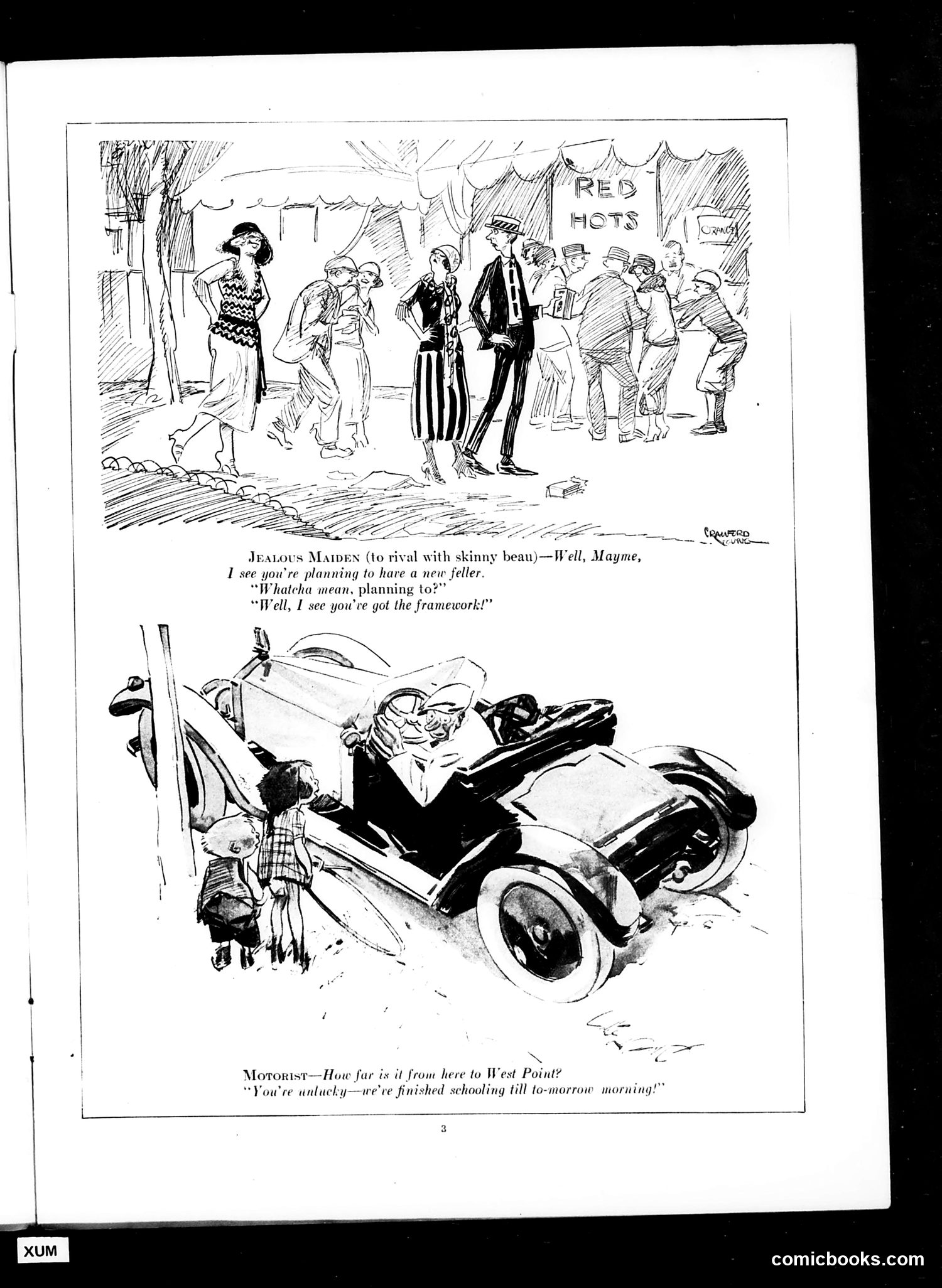
This page contains two unrelated satirical cartoons typical of Judge magazine's humor style. **Top cartoon:** depicts a "Jealous Maiden" confronting a rival about a "new feller." The humor relies on the woman's competitive jealousy and the phrase "I see you've got the framework!"—a dig at the rival's skeletal thinness, suggesting she's all bone with no substance. **Bottom cartoon:** shows a motorist who's hit a pedestrian or caused an accident. The joke plays on the motorist's claim of being "unlucky" while explaining they must finish "schooling till to-morrow morning"—suggesting the victim is a schoolchild, darkly implying casual indifference to injuring a young person. Both cartoons reflect early 20th-century attitudes toward class, romance, and nascent automobile culture.
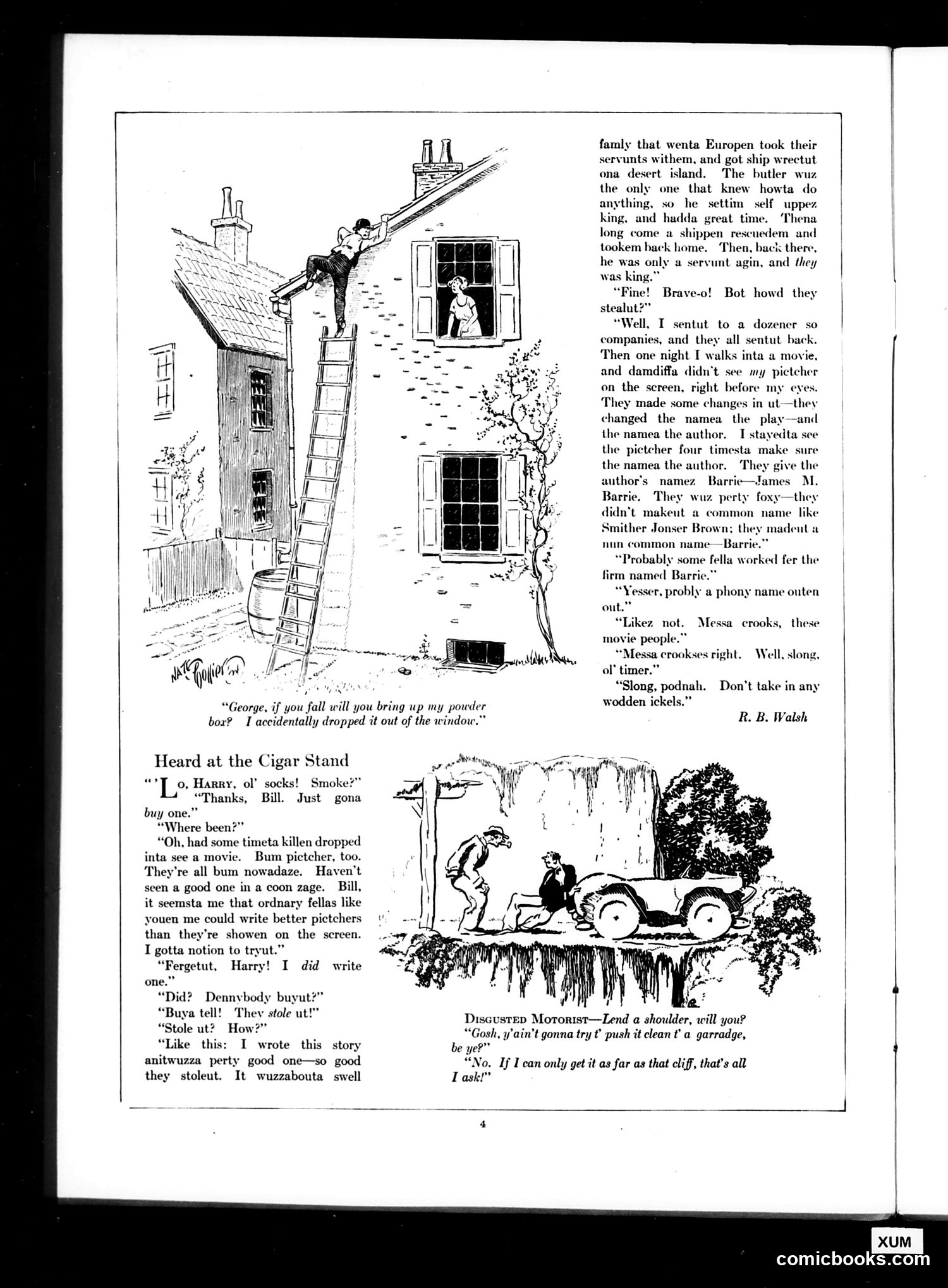
This page contains two unrelated humorous pieces typical of early 20th-century Judge magazine: **Top cartoon:** Shows a domestic scene where someone has climbed a ladder to retrieve a powder box dropped from a window. The caption jokes about the mishap, reflecting period humor about household accidents and gender roles. **"Heard at the Cigar Stand":** A dialogue between men discussing a story about movie pitchers (baseball players appearing in films). The conversation mocks both the quality of cinematic depictions of baseball and the boastfulness of writers claiming credit for stories. It satirizes emerging Hollywood's exploitation of sports celebrities and the pretentiousness of writers. **Bottom cartoon:** "Disgusted Motorist" depicts an early automobile driver asking another motorist for help, satirizing the unreliability and difficulty of early motor vehicles as novelty items. These represent typical Judge satire: domestic life, popular entertainment, and modern technology.
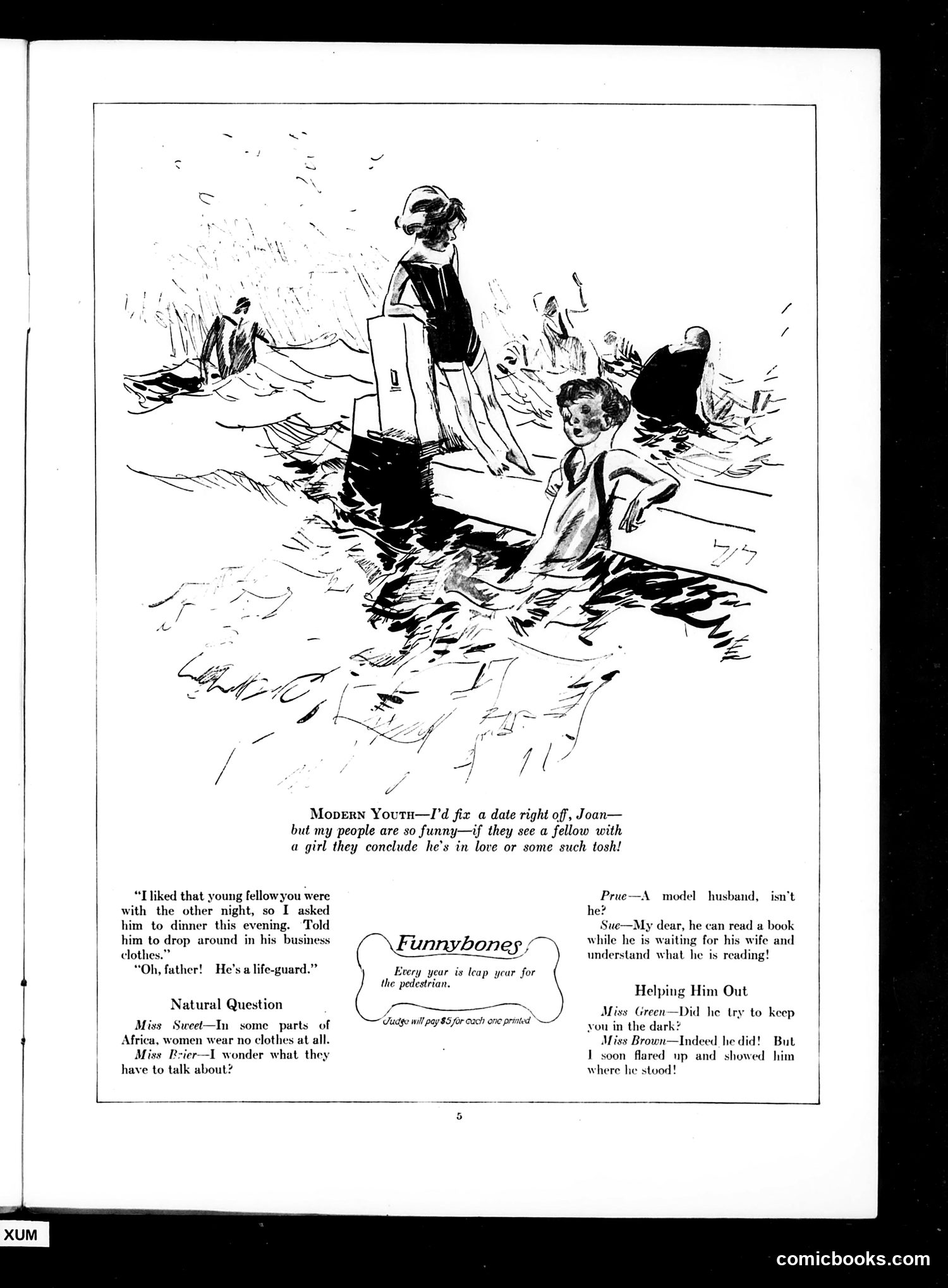
This page contains four separate jokes satirizing early 20th-century social conventions: 1. **"Modern Youth"**: Mocks parental anxiety about dating. A father invites a young man to dinner, only to learn he's a lifeguard—suggesting parents jump to romantic conclusions whenever their daughter spends time with any male. 2. **"Natural Question"**: A mild racist joke playing on stereotypes about African women, implying women exist primarily for romantic conversation. 3. **"Funnybones"**: A brief quip about pedestrians being hit by vehicles during leap years—a dark joke about traffic accidents. 4. **"Helping Him Out"**: A domestic humor piece where a wife literally "flares up" (loses her temper) to counter her husband's attempt to keep her "in the dark" (uninformed/controlled). The wordplay on "flared" suggests her fiery reaction. The overall theme involves social relationships—dating customs, gender dynamics, and marital power struggles—typical of Judge's satirical commentary on contemporary manners.
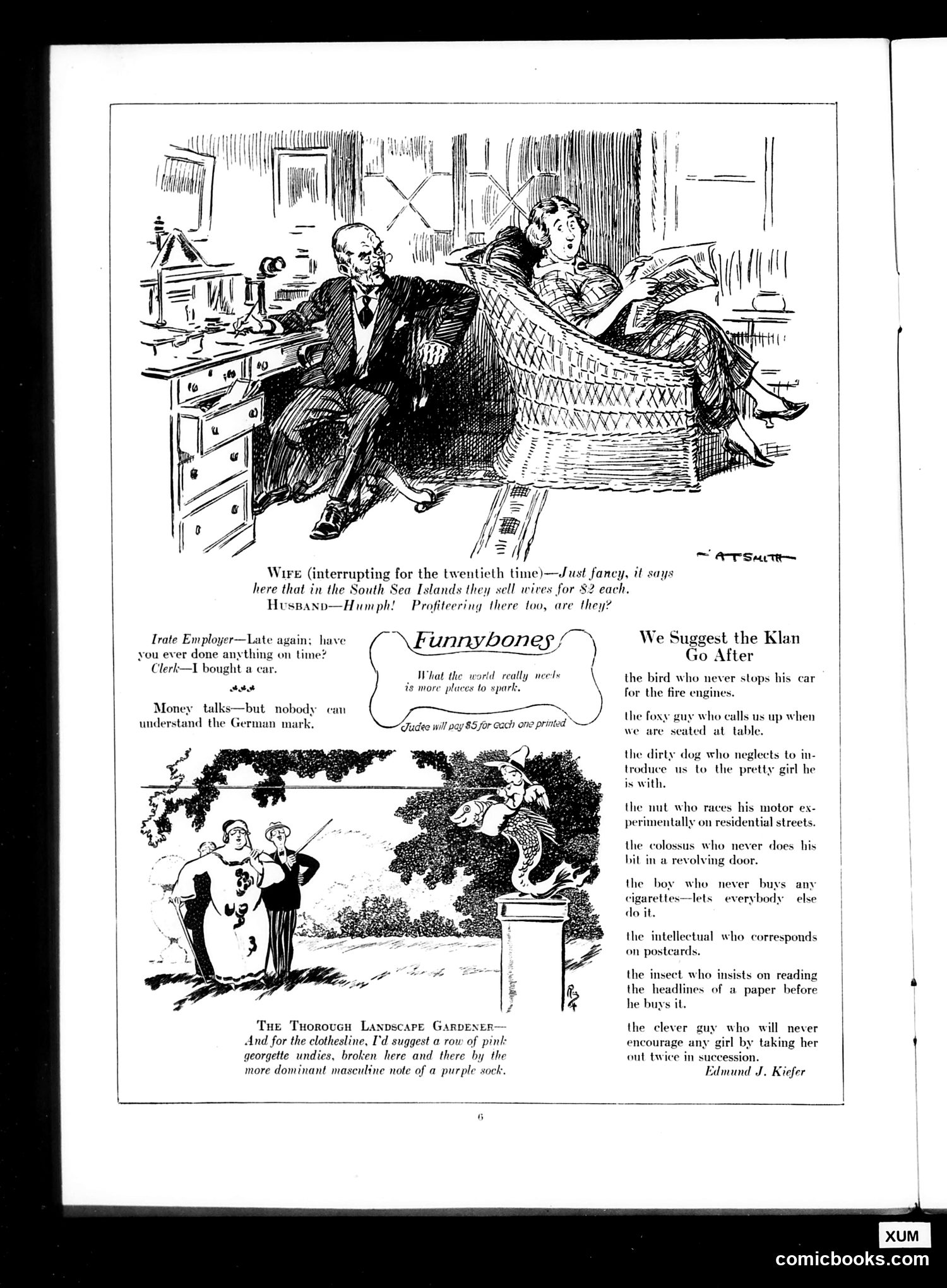
This page contains three separate satirical pieces typical of Judge's humor: **Top cartoon**: A husband and wife discuss an article about South Sea Islanders selling wives cheaply. The husband's response—"Profiteering there too, are they?"—is satirical commentary on post-WWI economic inflation and price-gouging, suggesting even remote island economies are affected by this widespread problem. **Middle section ("Funnybones")**: A list of social types to mock—people who interrupt conversations, never buy cigarettes, race cars recklessly, etc. This reflects early 20th-century urban social anxieties about modern behavior and etiquette. The reference to "the Klan" appears to be a satirical jab, though context is unclear. **Bottom cartoon**: A landscape gardener humorously suggests adding women's colored undergarments to clotheslines for visual effect—absurdist domestic humor playing on aesthetic pretension. The "Late Employer/Clerk" exchange jokes about automobiles causing tardiness, reflecting early-century anxieties about cars as disruptive technology.
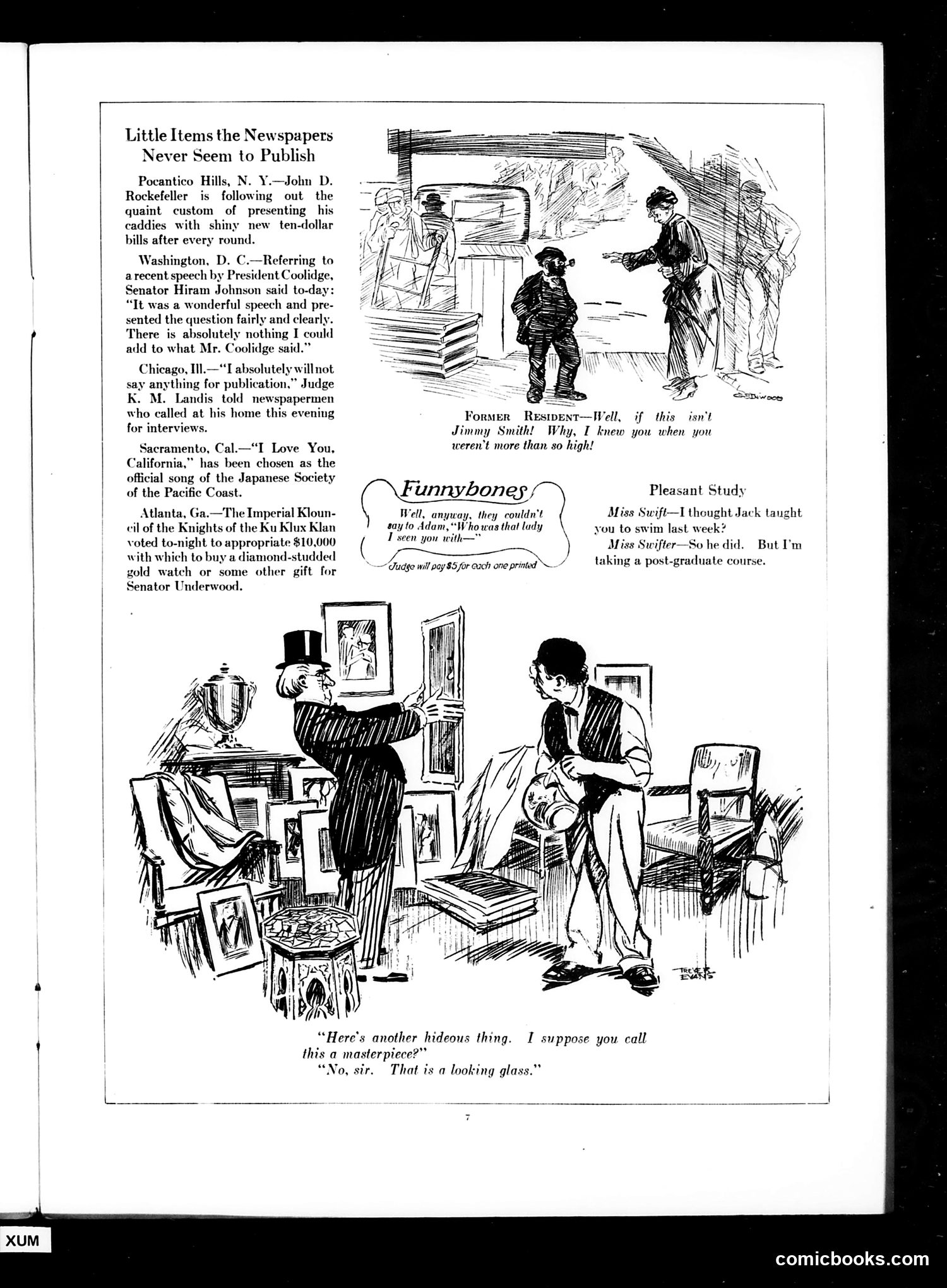
This page contains satirical "news items" mocking prominent figures and institutions of the era. The top section presents fake newspaper briefs ridiculing: - **John D. Rockefeller** for allegedly giving $10 bills to caddies (mocking his wealth) - **Senator Hiram Johnson** for being unable to add to President Coolidge's speech (implying Coolidge said nothing substantive) - **Judge K.M. Landis** (baseball's commissioner) refusing to speak to press - The **Ku Klux Klan** planning to gift Senator Underwood a diamond watch—likely satirizing either the KKK's absurdity or Underwood's perceived alignment with them Below are three separate humorous cartoons: one about a man showing his girlfriend art (she mistakes a mirror for a "masterpiece"), one about greeting an old acquaintance, and one about a woman's post-graduate romantic education. The satire targets political hypocrisy, corporate excess, and organizational ridiculousness through feigned "news" items that expose contradictions or absurdities.
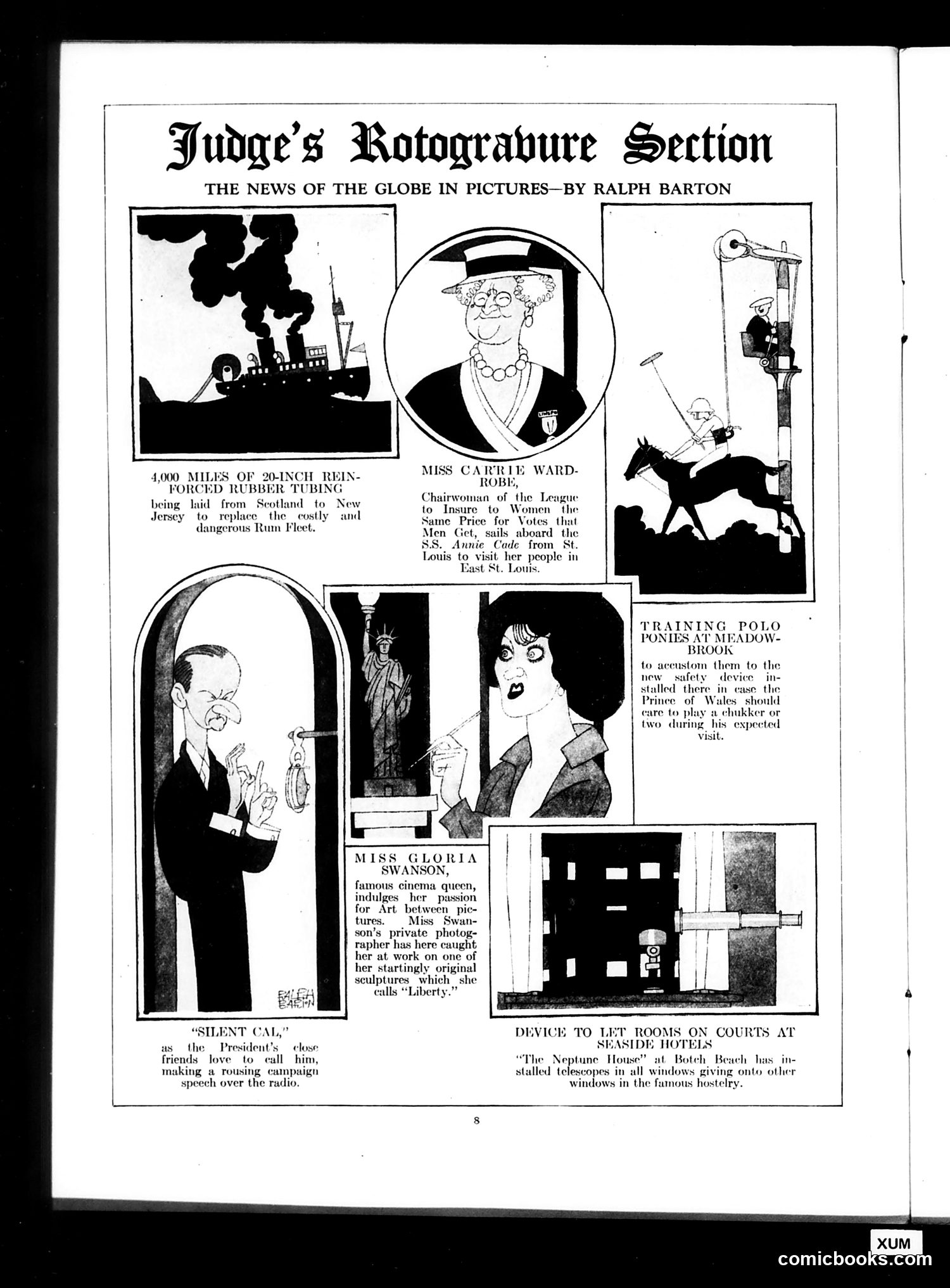
This page from Judge magazine presents satirical pictorial commentary by Ralph Barton on 1920s American society and politics. **Key items:** - **"Silent Cal"**: A caricature mocking President Calvin Coolidge's famous taciturnity, satirizing his use of radio for campaign speeches despite his reputation for silence. - **Miss Carrie Ward-Robe**: A play on words ("wardrobe"), satirizing women's suffrage advocacy and voting rights debates of the era. - **Gloria Swanson sculpture**: Mocking the famous silent film actress's artistic pretensions; her sculpture titled "Liberty" appears crude, suggesting mockery of celebrity dilettantism. - **Prohibition-era humor**: The "4,000 miles of rubber tubing" replacing the "Rum Fleet" references bootlegging during Prohibition—satirizing illegal alcohol smuggling. - **Polo ponies safety device**: Appears to joke about aristocratic leisure activities. - **"Neptune House" telescope gimmick**: Satirizes invasive voyeurism at seaside hotels, poking fun at the wealthy's questionable behavior. Overall, the page employs visual wit to mock 1920s political figures, social pretensions, and contemporary scandals.
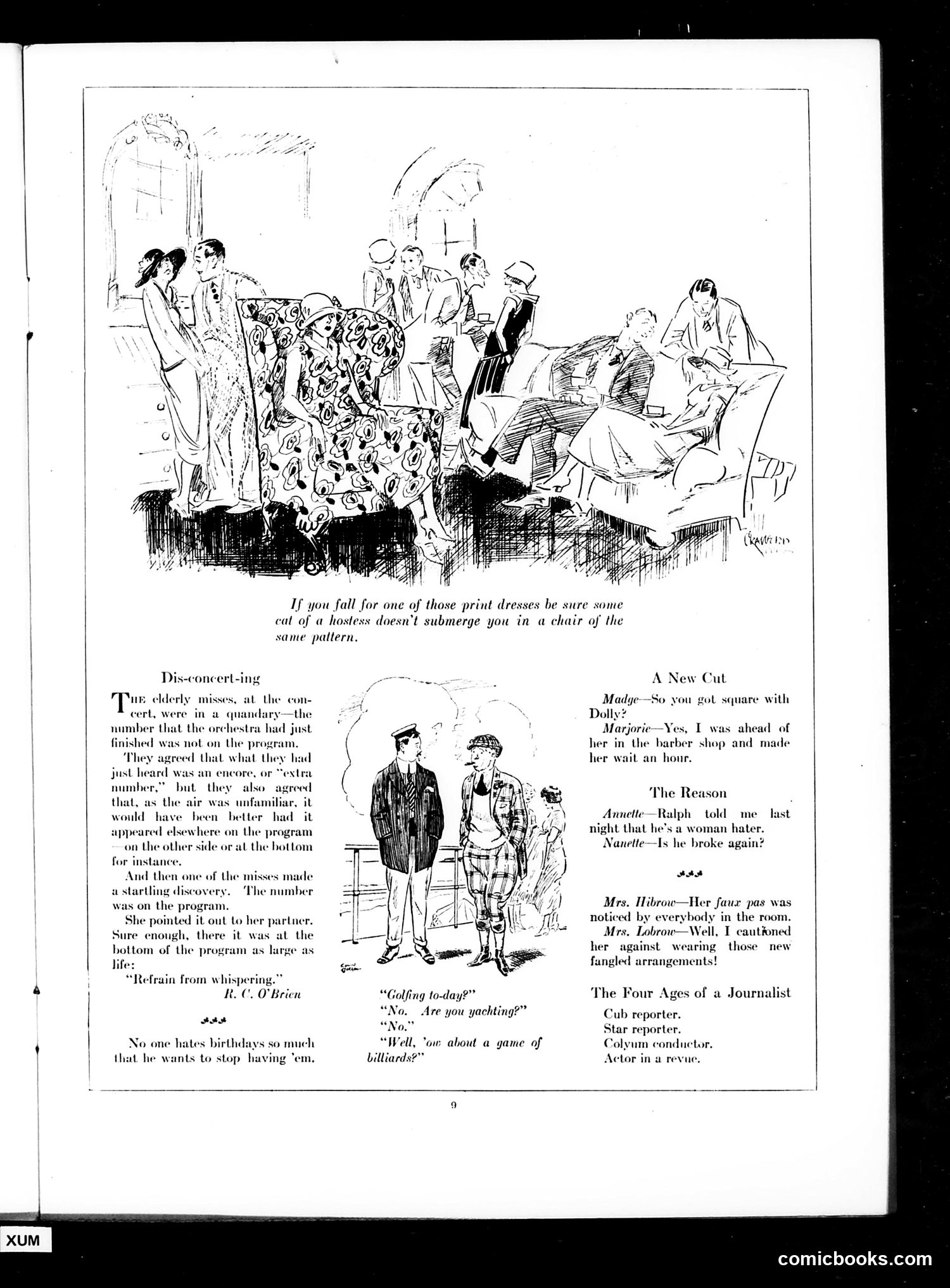
This page contains several short humorous sketches typical of early 20th-century American comic magazines. **Top cartoon**: Satirizes printed fabric fashion—specifically dresses with busy patterns. The joke warns that if you wear a patterned dress to a social event, you risk being camouflaged by similarly patterned furniture, making you literally disappear into a chair. **"Dis-concert-ing"**: Elderly women attend a concert but discover the orchestra's number wasn't actually on the printed program—it was printed at the bottom in tiny text. The humor lies in their missed expectation and the mundane nature of the mix-up. **Other brief jokes** mock social pretension ("faux pas," "fangled arrangements"), competitive female pettiness (Marjorie making Dolly wait at the barber), and masculine excuses (a man claiming to hate women when he's financially broke). **"The Four Ages of a Journalist"**: A career trajectory joke showing how journalists progress from cub reporter to eventually becoming actors in theatrical revues—suggesting the profession attracts failed thespians or leads to show business. The overall tone is gentle social satire aimed at middle-class manners and vanity.
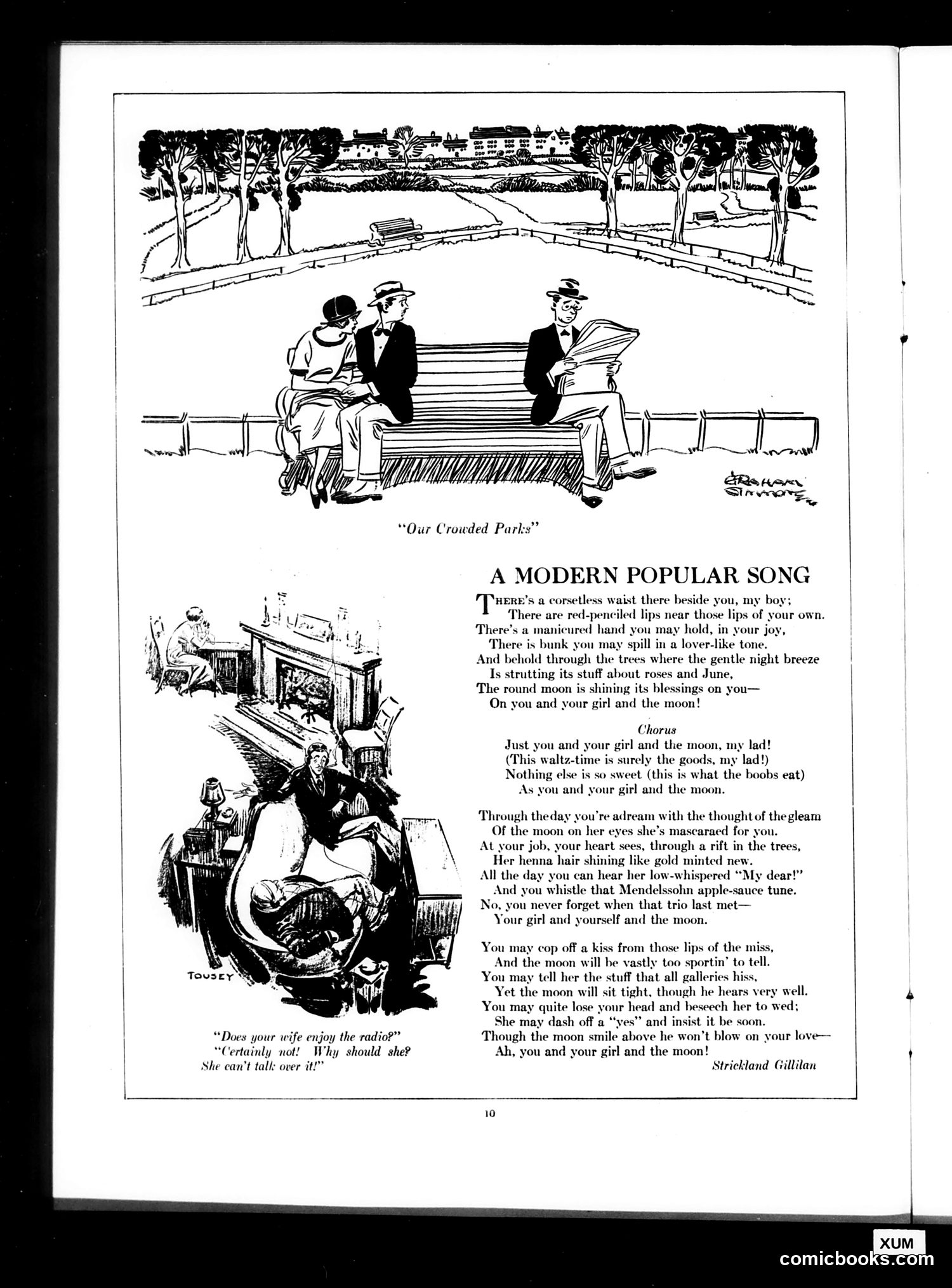
This page satirizes romantic sentimentality and the commercialization of love in early 20th-century popular culture. The song "You and Your Girl and the Moon" mocks overwrought romantic clichés—corsetless waists, red lips, manicured hands, and moon-gazing—that were stock elements of sentimental popular songs of the era. The cartoons flanking the lyrics reinforce the satire: the top sketch shows couples in a crowded park (titled "Our Crowded Parks"), and the bottom features a couple in an automobile with a caption questioning whether a wife enjoys the radio. Together, these suggest the song's romantic fantasies clash with mundane domestic reality. The lyricist (Strickland Gillilan) uses parenthetical asides like "(this is what the boobs eat)" to mock audiences who accepted such saccharine sentiments uncritically, positioning Judge's readers as sophisticates above such sentimentality.
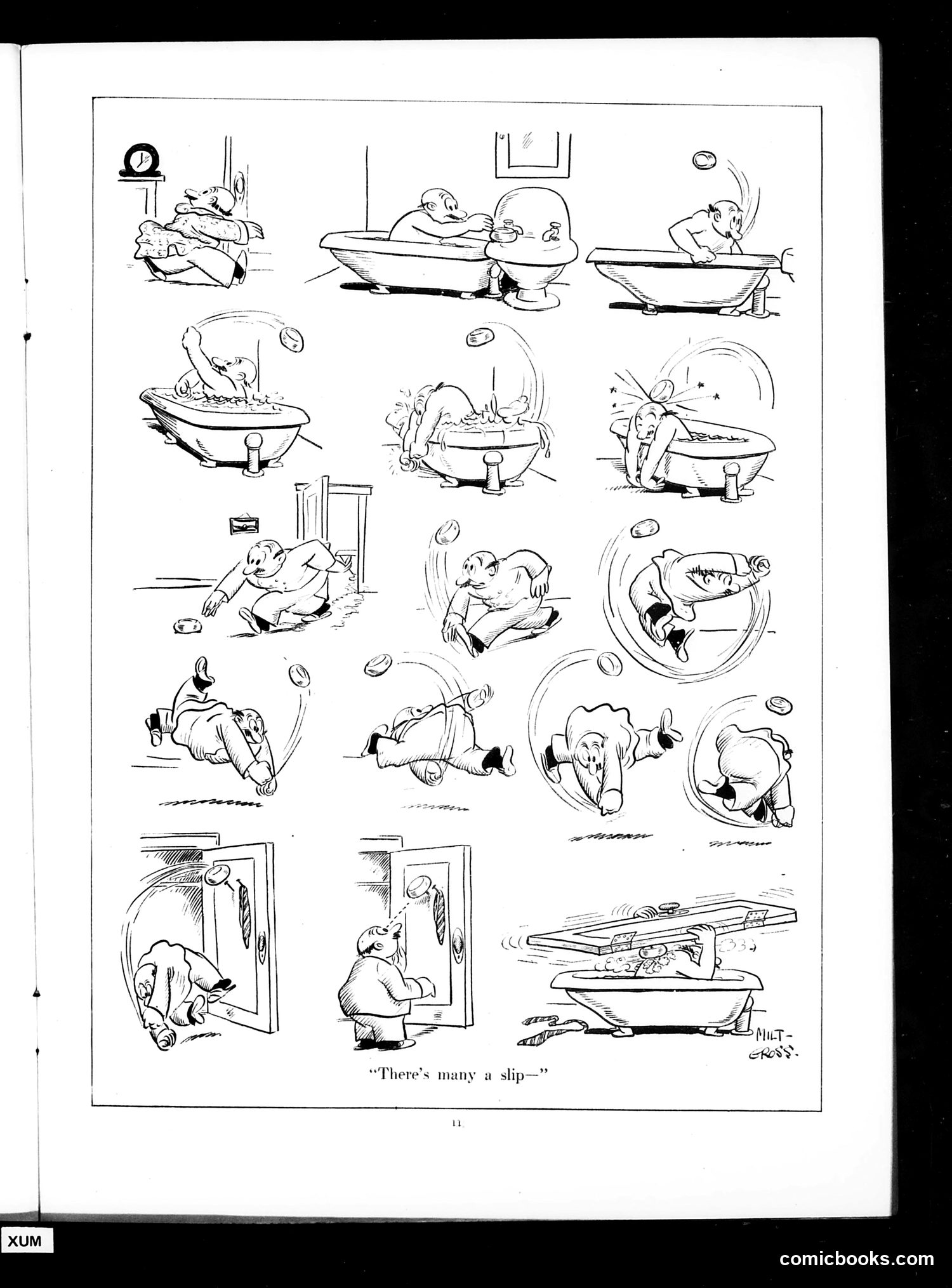
This is a visual gag sequence showing a character repeatedly slipping and falling—in bathtubs, while running, jumping rope, and entering/exiting doorways. The title "There's many a slip" is a play on the common phrase "there's many a slip 'tween cup and lip," meaning plans often fail unexpectedly. The cartoon uses slapstick humor depicting various domestic mishaps, likely resonating with early 20th-century audiences familiar with physical comedy. The numbered panel in the upper left suggests this may be part of a series or instructional sequence. The repeated bathtub scenes and bathroom door accidents emphasize the vulnerability of the home as a place of danger—a common satirical theme in Judge magazine, which frequently lampooned domestic life and human clumsiness.
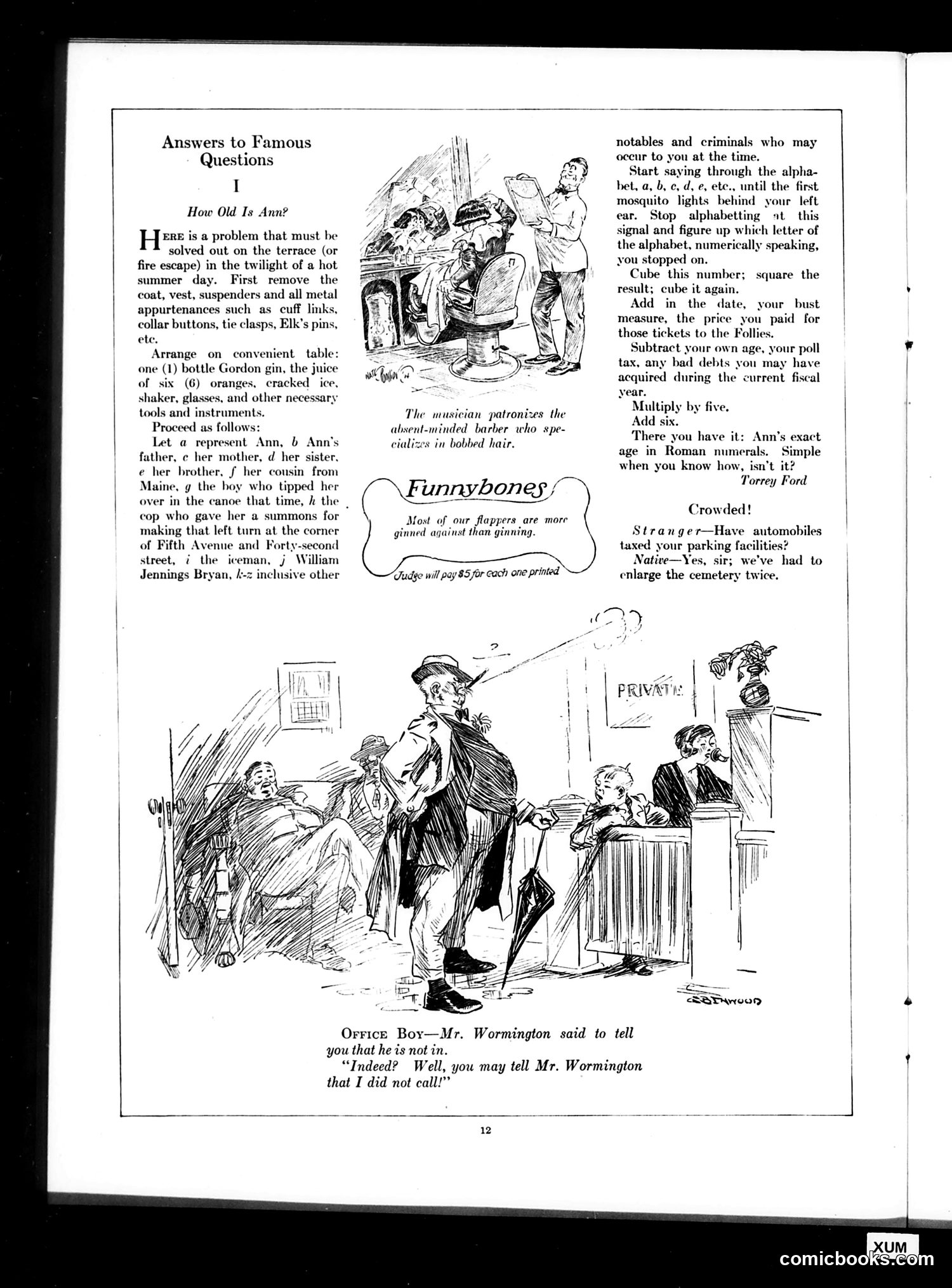
This page contains three distinct pieces of satire: **"How Old Is Ann?"** is a mock-serious mathematical puzzle satirizing the "flapper" culture of the 1920s. The elaborate formula for calculating a young woman's age—involving gin, oranges, and references to William Jennings Bryan—mocks both the era's obsession with youth and the absurdity of jazz-age logic. "Ann" likely represents the stereotypical flapper. **"Funnybones"** is a brief quip: "Most of our flappers are more ginned against than ginning"—wordplay on Shakespeare, suggesting young women are victims of alcohol culture rather than its perpetrators. **The cartoon** depicts an office scene where a visitor seeks Mr. Wormington, who is unavailable. The receptionist says he "is not in," prompting the visitor to request: "Tell him I did not call." This is a reversal joke—the caller wants credit for *not* visiting, suggesting either social etiquette games or avoiding unwanted contact. All three pieces reflect 1920s concerns: prohibition-era drinking, changing gender roles, and social pretense.
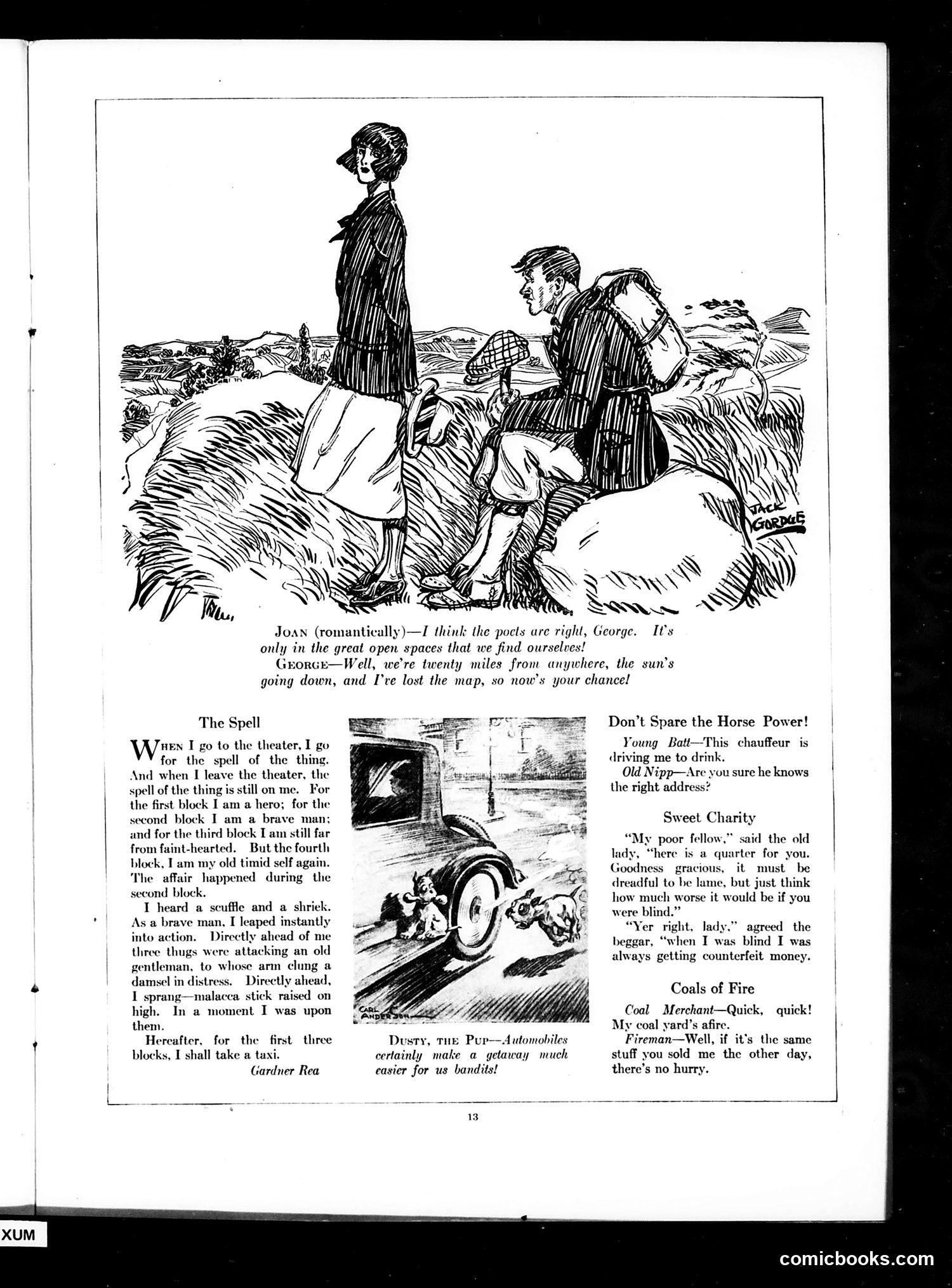
This page contains several satirical humor pieces typical of early 20th-century American comedy: **Main Cartoon (top):** A couple lost in the countryside—the woman romantically quotes poets about finding oneself in "great open spaces," while the man reveals the prosaic truth: they're twenty miles from anywhere, it's getting dark, and he's lost the map. The satire mocks romantic idealism versus practical reality. **"The Spell":** A man describes how theater makes him feel brave for three blocks afterward, but by the fourth block he's cowardly again—even stopping to help someone being mugged. The joke is on his fragile confidence and self-awareness of his own timidity. **Other brief jokes satirize:** - Automobiles enabling getaways for criminals - Careless chauffeurs - A beggar's ironic preference for blindness (to avoid counterfeit money) - A coal merchant's dishonesty (implying the "fire" is his comeuppance) The page is primarily humor/satire without clear political content, reflecting Judge's typical focus on social observation and urban American life.
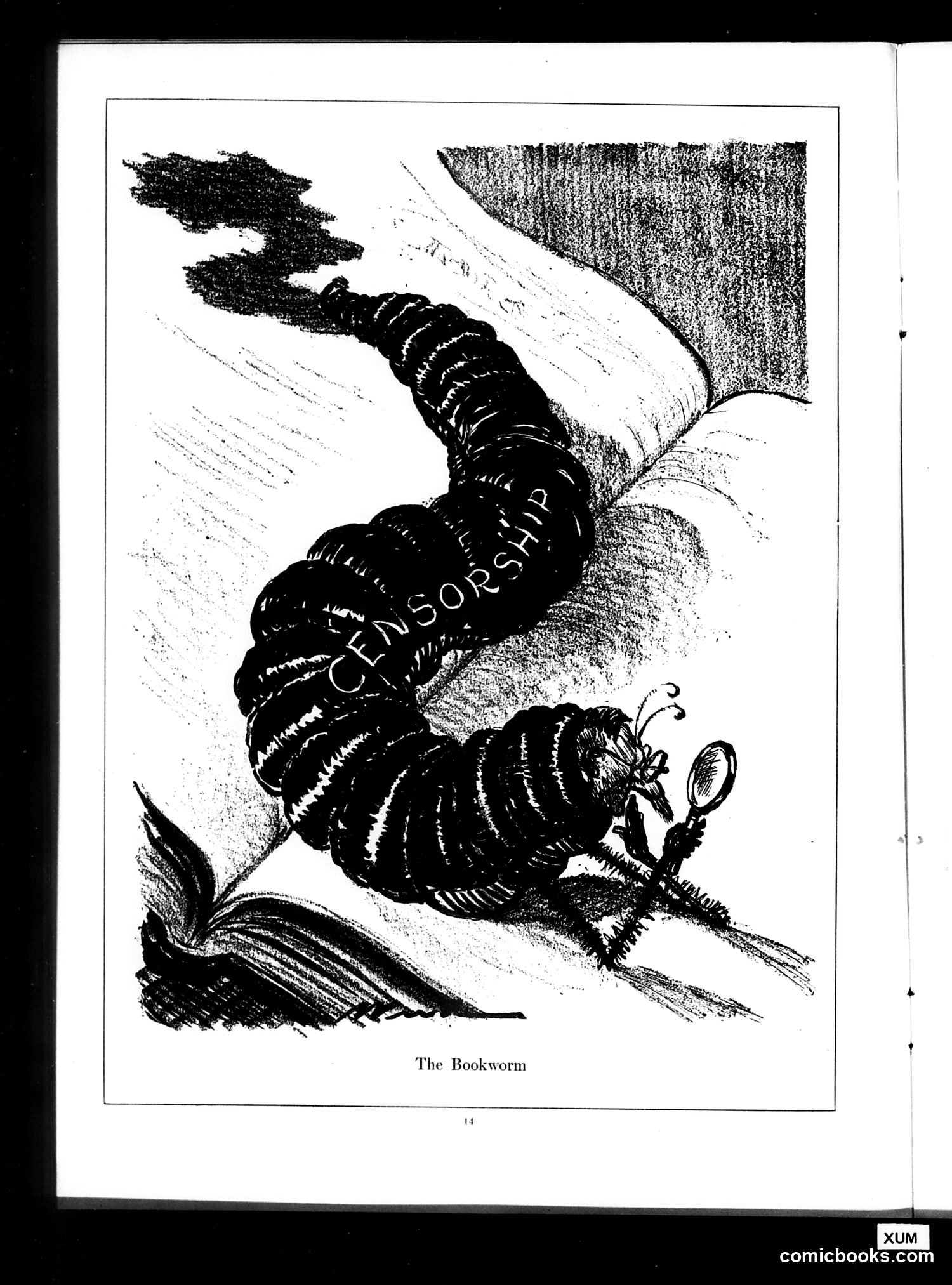
This is a satirical illustration depicting a worm character examining a book through a magnifying glass. The worm's body is labeled "CENSORSHIP," indicating this is a commentary on censorship of literature. The cartoon appears to criticize censorship by portraying it as a parasitic creature—a bookworm that damages books rather than genuinely reads them. The worm's use of a magnifying glass suggests it scrutinizes content obsessively, while the "CENSORSHIP" label makes explicit that the artist equates aggressive censorship with literary destruction. The artistic style and Judge magazine's satirical mission suggest this critiques either governmental or institutional book censoring efforts, though the specific historical context remains unclear without additional publication date information.
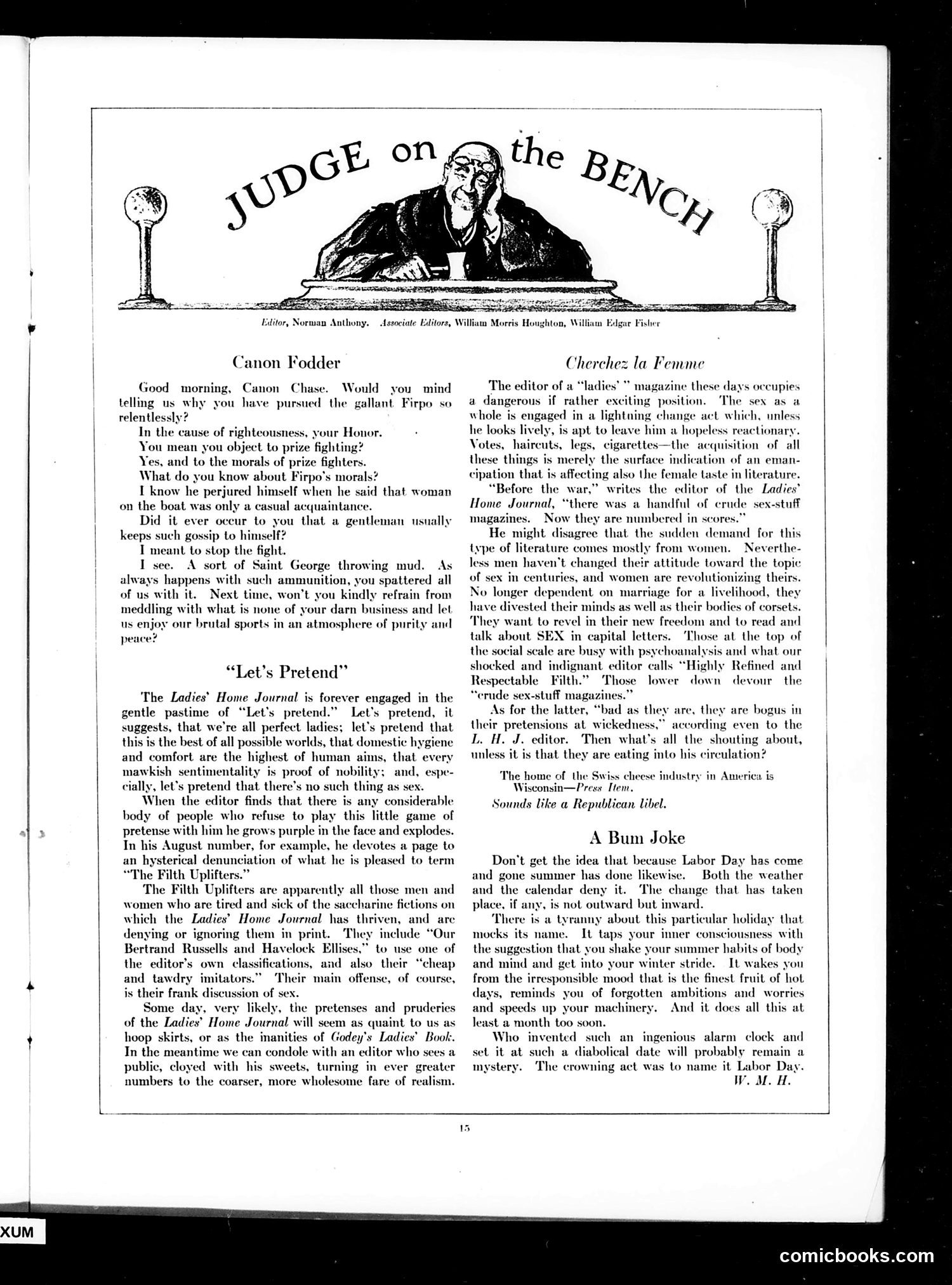
This page contains editorial commentary on contemporary social debates rather than a single cartoon. The main illustration shows a judge at his bench presiding over the arguments below. **"Canon Fodder"** satirizes a clergyman (Canon Chase) who objects to prize fighting and boxer Luis Firpo's morality, while simultaneously spreading gossip about Firpo's personal life. The satire: the Canon practices the very moral hypocrisy he preaches against—spreading rumors while claiming righteousness. **"Let's Pretend"** and **"Cherchez la Femme"** both critique the *Ladies' Home Journal* editor for denouncing "Filth Uplifters"—writers discussing sex frankly—while his magazine previously thrived on saccharine sentimentality. The satire: women's liberation and demand for honest discussion of sexuality represents genuine social change the editor refuses to acknowledge, making his moralistic posturing obsolete. The broader point: post-WWI America was experiencing rapid social change, especially regarding women's freedom and attitudes toward sex, which conservative publications resisted.
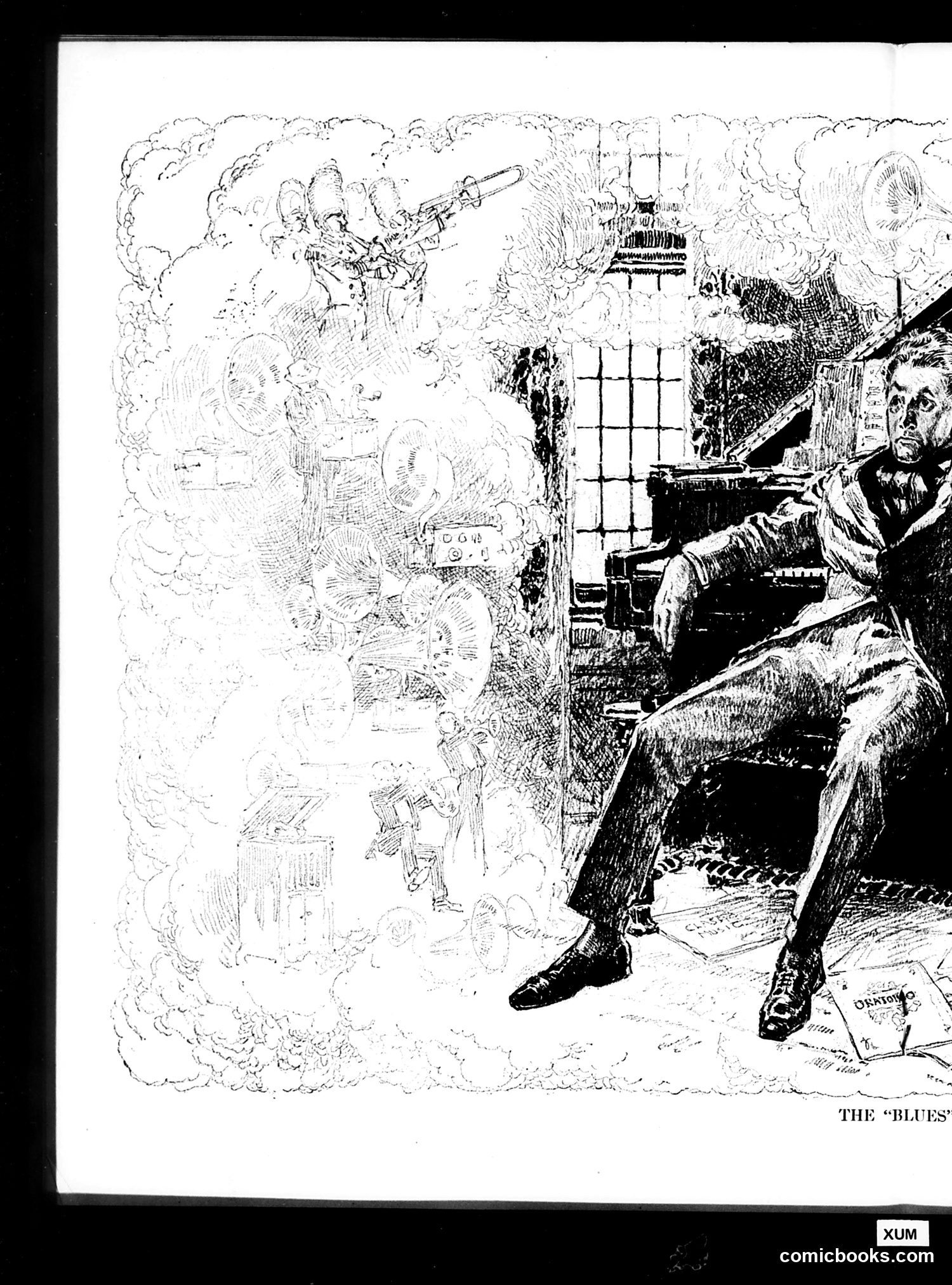
This satirical cartoon depicts a well-dressed man sitting in what appears to be a comfortable interior space, looking despondent or melancholic. The title "THE 'BLUES'" refers to a state of depression or sadness. The cartoon likely satirizes a wealthy or upper-class figure suffering from emotional distress despite material comfort—a common Judge magazine theme mocking the afflictions of the privileged classes. The contrast between his fine clothing and furnishings (visible window, furniture) and his obvious unhappiness suggests the satire: that money and status cannot cure depression or existential malaise. The ethereal, cloud-like imagery on the left side may represent his troubled thoughts or emotional state. Without additional text, the specific target remains unclear, but this appears to be social commentary on the psychological struggles of the well-to-do.
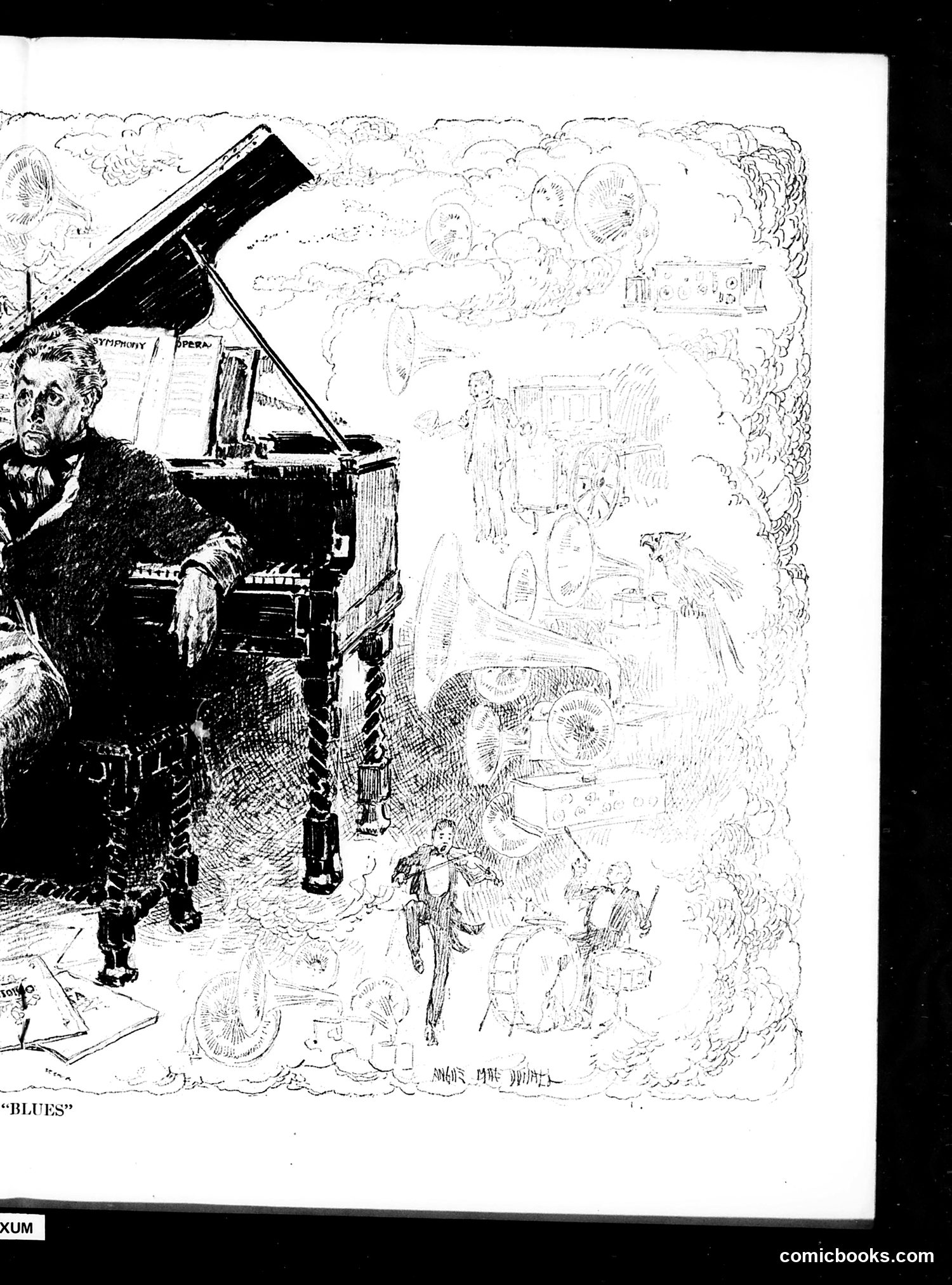
This cartoon titled "Blues" depicts a melancholic musician at a grand piano, appearing despondent or troubled. The figure is rendered in heavy cross-hatching, emphasizing shadows and emotional darkness. The surrounding scene shows what appears to be concert halls or opera houses in the background, suggesting the classical music world. The satire likely critiques the emotional toll of professional musicianship or the "tortured artist" stereotype — the contrast between the grandeur of concert venues and the artist's apparent depression or creative struggles. The title "Blues" reinforces this theme of sadness, possibly punning on both the musical genre and the emotional state. Without clearer OCR text or visible signatures identifying the cartoonist or specific subject, the exact satirical target remains somewhat unclear, though it likely comments on artistic melancholy or the music industry's pressures.
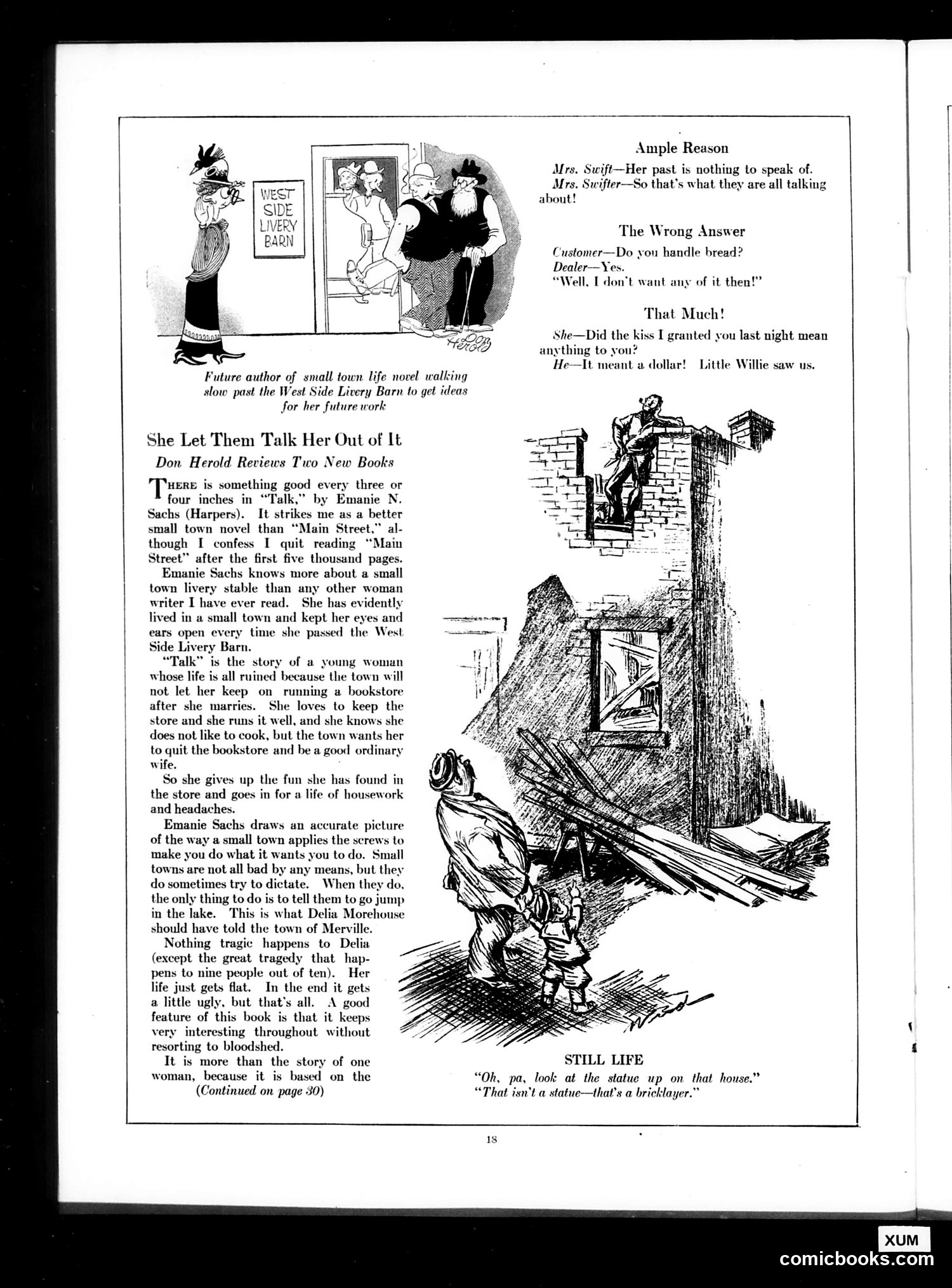
This page contains several short humor pieces and a book review typical of early 20th-century American satirical magazines. **The cartoons** mock small-town social conventions and propriety through brief jokes: a woman concerned about gossip; a baker who won't sell bread; a couple's kiss witnessed by a child; and figures observing a bricklayer, mistaking him for a statue. **The main feature** is Don Herold's review of Emanie N. Sachs's novel "Talk," comparing it favorably to Sinclair Lewis's "Main Street." Herold praises Sachs's detailed knowledge of small-town life, particularly livery stables. The novel's plot—a woman forced to abandon her bookstore after marriage to become a "good ordinary wife"—satirizes small-town social pressure and conformity. Herold's point: small towns enforce rigid expectations, especially on women, crushing individuality. The book's strength is depicting this social coercion realistically without melodrama. The implicit critique targets narrow-minded, controlling small-town culture—a common Progressive-era theme.
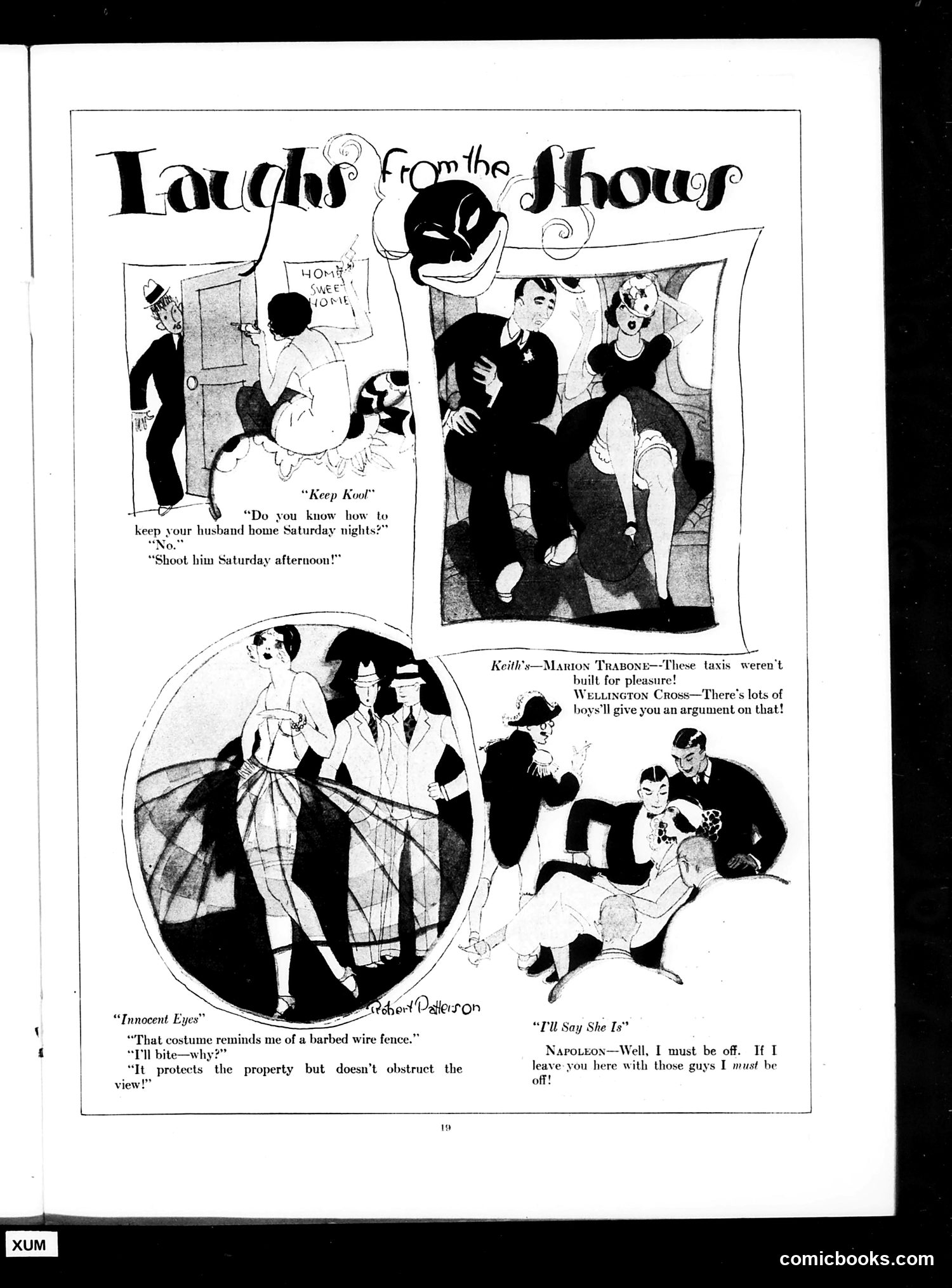
This page collects theatrical humor sketches from contemporary Broadway shows, not political cartoons. Each vignette satirizes domestic life and social situations of the 1920s era: **"Keep Kool"**: Dark humor about marriage—a wife's solution to keeping her husband home Saturday nights is shooting him (playing on marital discord). **"Keith's/Wellington Cross"**: References to theaters and taxi companies, joking that taxis weren't designed for pleasure trips but rather arguments will result from using them. **"Innocent Eyes"**: A woman's costume resembles a barbed wire fence—she protests it "protects property" while obstructing the view, likely satirizing immodest or restrictive fashion. **"I'll Say She Is"**: A man (labeled "Napoleon") must leave his date with other men, joking he can't trust her alone with them. The humor targets 1920s social anxieties: marriage stability, modern transportation, women's fashion, and dating propriety.
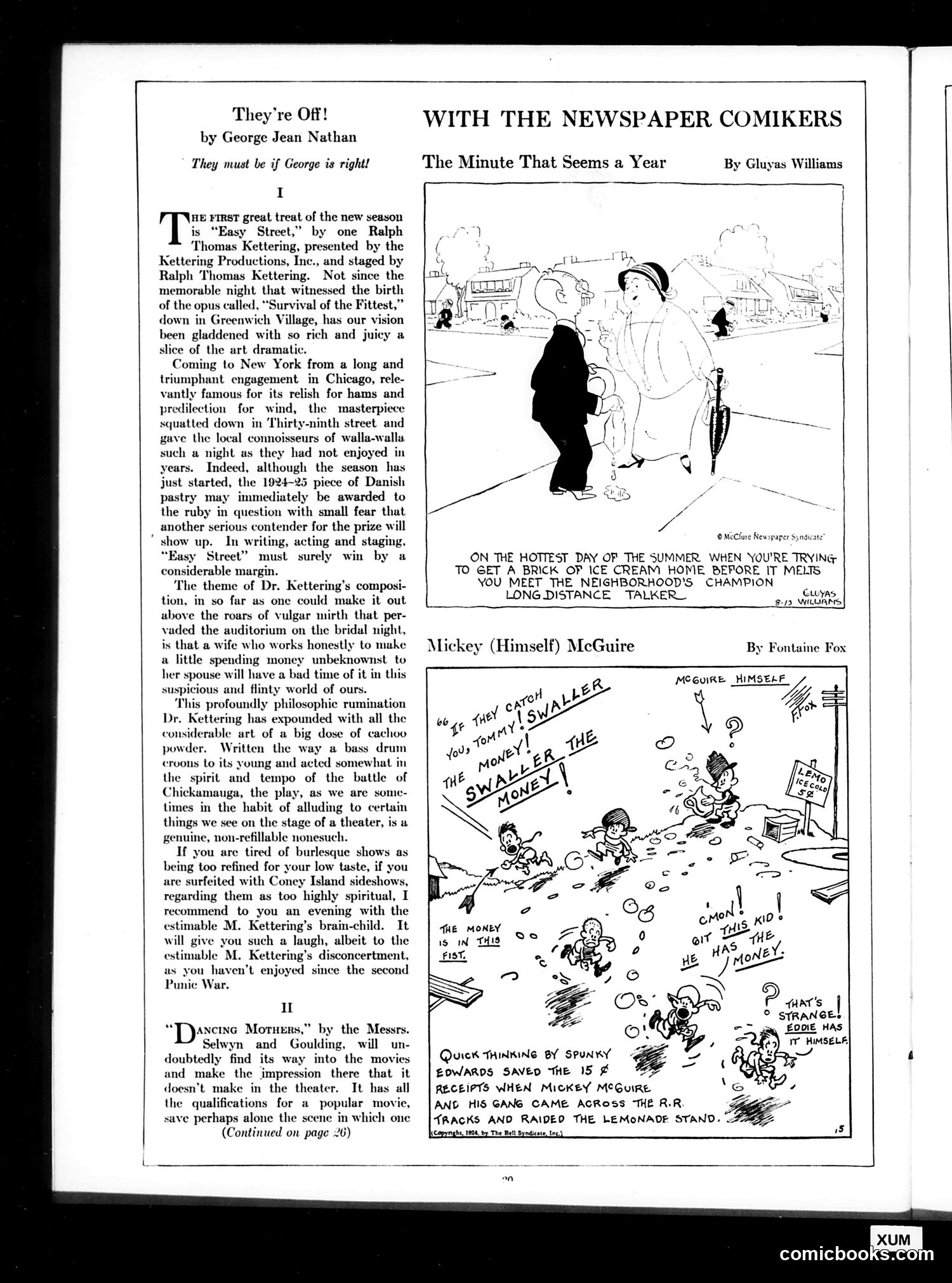
This 1924-25 page contains theatrical criticism and comic strips. **Theater Review Section:** George Jean Nathan satirizes playwright Ralph Thomas Kettering's new play "Easy Street"—which Kettering both wrote and directed. Nathan's tone is heavily sarcastic, mockingly praising the work as a masterpiece while describing it as crude (comparing it to "burlesque shows" and "Coney Island sideshows"). The play's premise—a wife secretly earning money faces marital trouble—permits Nathan to ridicule both the play's moral messaging and Kettering's theatrical pretensions. This is insider theater criticism lampooning a self-important amateur dramatist. **Comic Strips:** Two strips appear: Gluyas Williams' "The Minute That Seems a Year" depicts the relatable annoyance of encountering a talkative neighbor while rushing to get melting ice cream home. Fontaine Fox's "Mickey (Himself) McGuire" shows children rescuing money from their lemonade stand when a gang raids it after crossing railroad tracks. Both feature ordinary neighborhood life and juvenile adventure—typical Judge humor of the era.
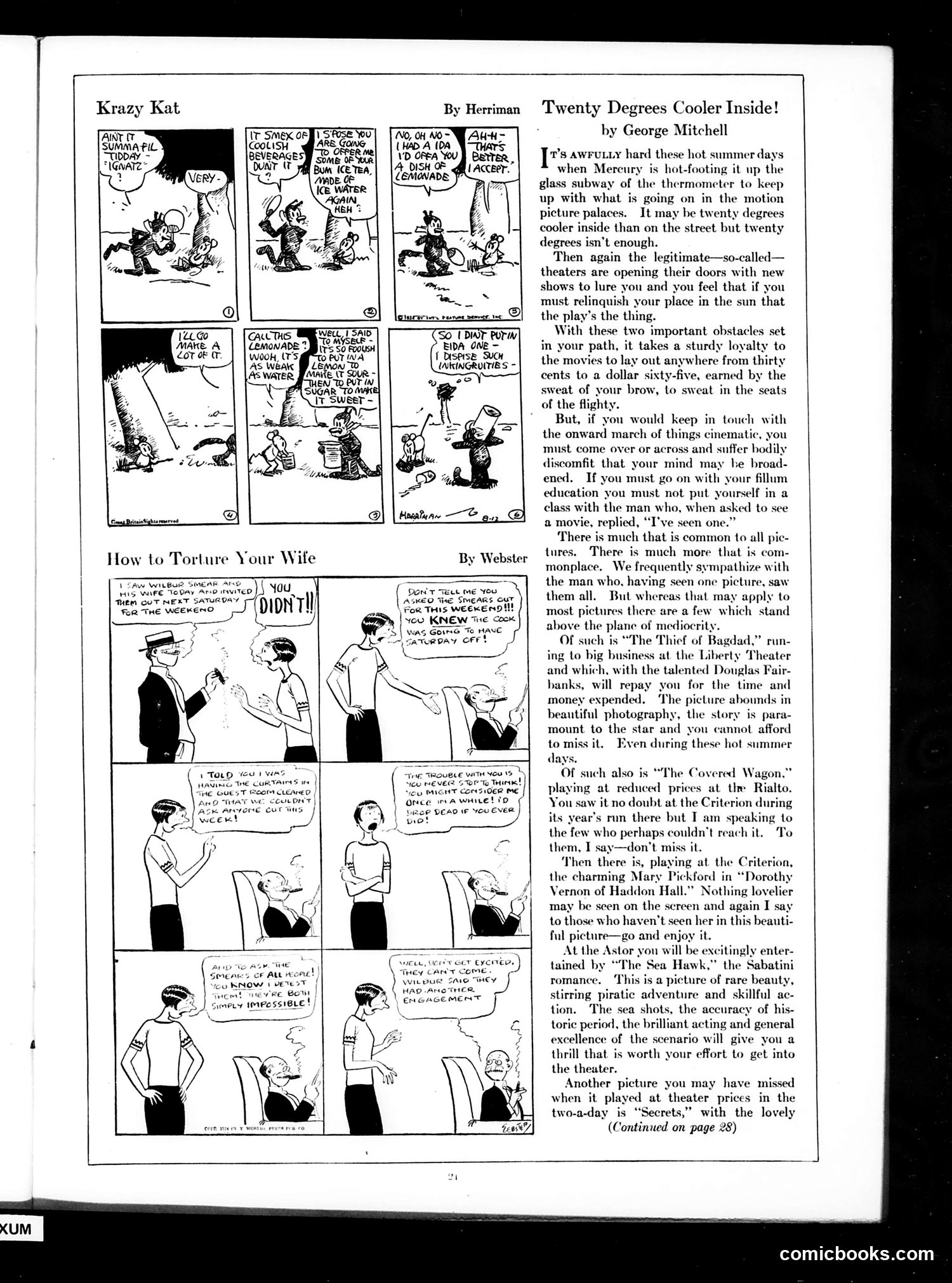
**"Krazy Kat"** by Herriman is a surreal comic strip featuring a cat character in typical anarchic situations—here involving ice, heat, and nonsensical dialogue. The humor relies on absurdist logic and visual gags rather than narrative coherence. **"How to Torture Your Wife"** by Webster is a domestic satire showing a husband deliberately antagonizing his wife through petty provocations: contradicting her cooking knowledge, reminding her of past mistakes, and generally gaslighting her. The joke is presented as humorous marital conflict, though by modern standards it reads as depicting emotional abuse. **"Twenty Degrees Cooler Inside!"** by George Mitchell is a film critic's column recommending current movies as summer entertainment—"The Thief of Bagdad" (with Douglas Fairbanks), "The Covered Wagon," Mary Pickford's "Dorothy Vernon of Haddon Hall," and "The Sea Hawk." The piece argues cinema-going is worth the expense and discomfort even in hot weather, positioning movies as culturally essential.
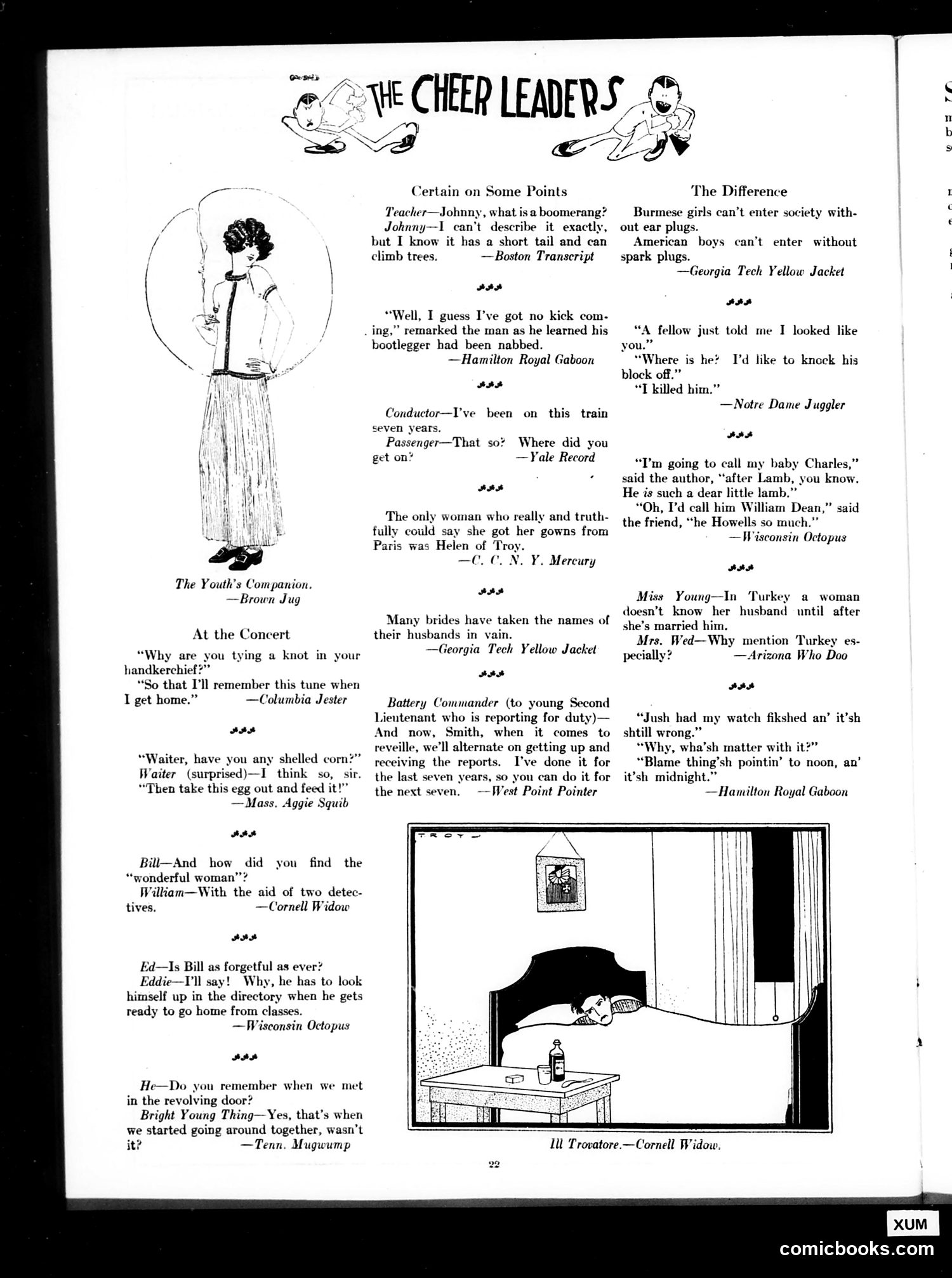
This page collects humorous quips from college humor magazines and newspapers, arranged around a single illustration of a fashionable young woman. The content reflects 1920s social attitudes. **Main themes:** The jokes mock contemporary social conventions and gender dynamics. References to "bootleggers" and "spark plugs" allude to Prohibition-era culture. Several jokes play on women's behavior—one contrasts Burmese and American courtship rituals, another jokes that Turkish women don't know their husbands before marriage (implying arranged marriages are universal), and another mocks newlyweds taking husbands' names "in vain." **The humor style** relies on puns, wordplay (naming a child after Charles Lamb/"dear little lamb"), and absurdist scenarios (a drunk man blaming his watch pointing at noon when it's midnight). The page represents typical college periodical humor of the era—lighthearted, socially observant, and reflecting contemporary attitudes toward courtship, marriage, technology, and modern life.
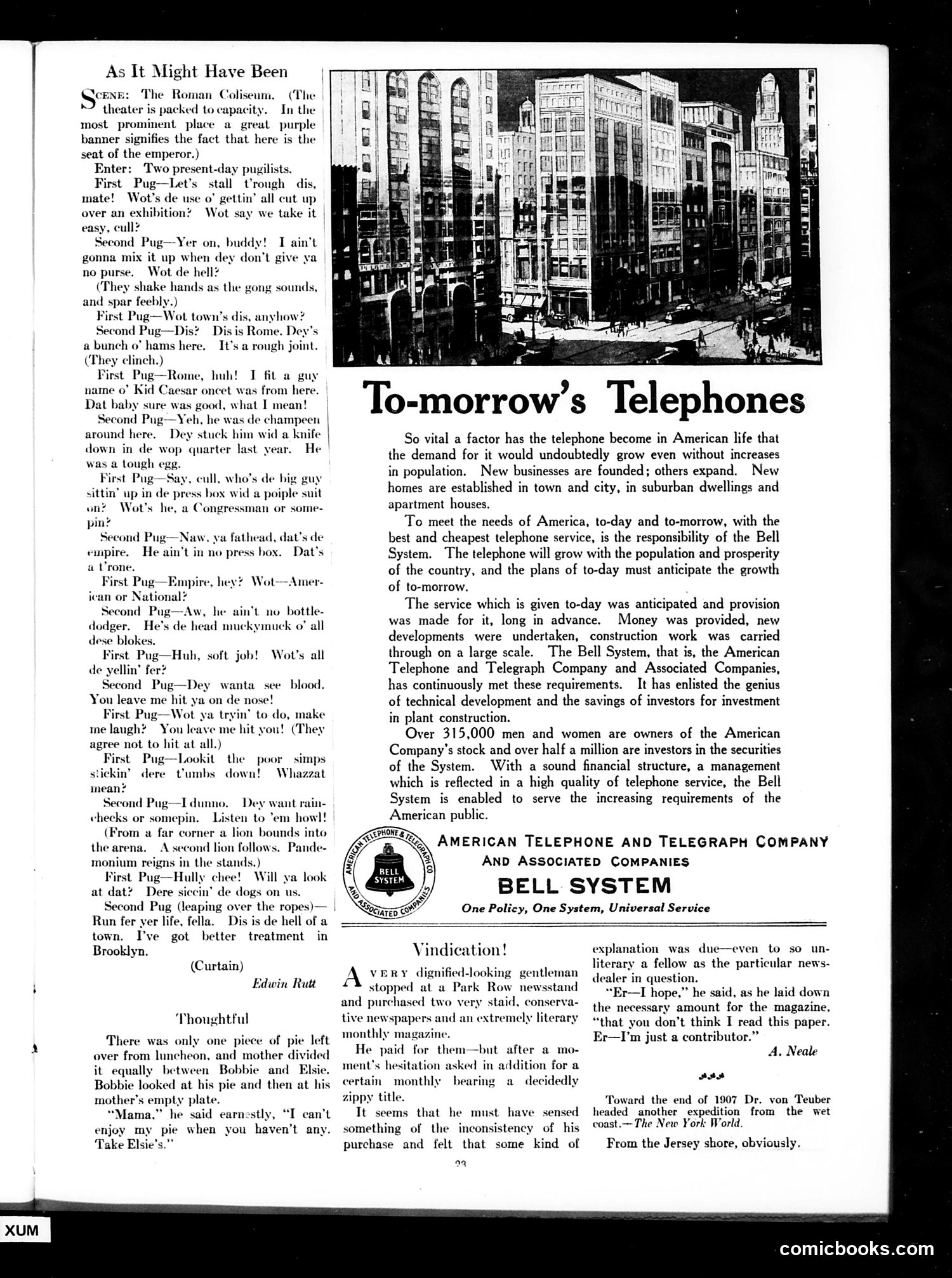
**The Cartoon ("As It Might Have Been"):** This satirical sketch imagines ancient Rome's Coliseum as if modern 1920s boxers were performing there. Two fighters use period slang ("wot," "cull," "hully chee") while deliberately avoiding fighting—they won't engage without payment. The joke mocks both modern prizefighters' mercenary attitudes and deglamorizes ancient spectacles. When lions are released (mimicking historical Roman executions), the boxers flee in terror. The satire suggests modern "tough guys" are cowards compared to historical gladiators, and that commercialism has corrupted even combat sports. **The Advertisement:** The page's main content is a Bell System advertisement celebrating the telephone's vital role in American life and promoting the company's infrastructure investment and shareholder base—propaganda positioning the monopoly as essential public service. **"Thoughtful":** A brief moral anecdote about a child's selflessness, contrasting with the cynical boxing satire above.
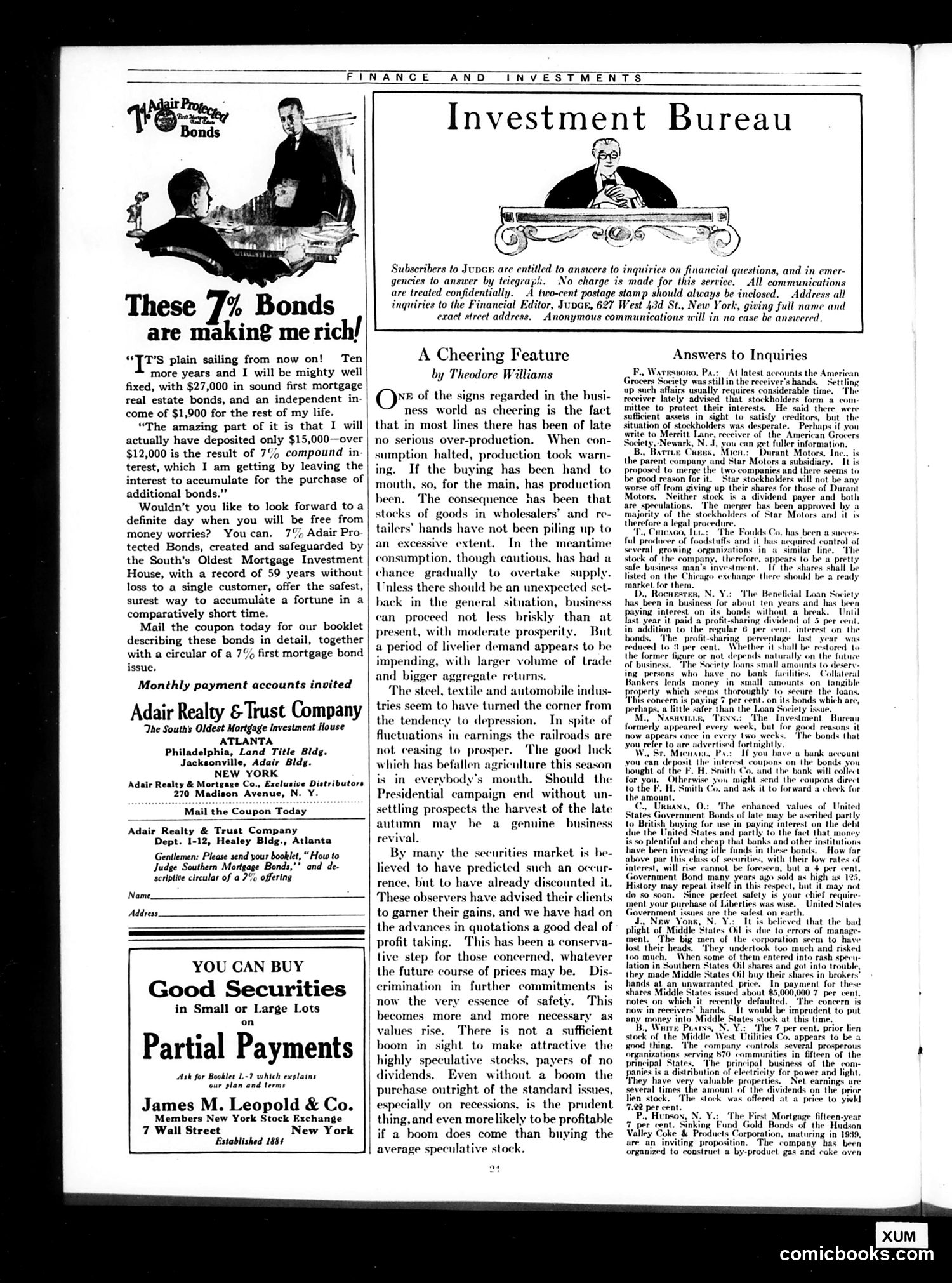
This is primarily a **finance and investment advertising page** from Judge magazine, not a political cartoon. The main visual content shows an advertisement for Adair Realty & Trust Company's 7% bonds. A well-dressed man is depicted confidently stating he'll become wealthy through compound interest on a $15,000 investment, accumulating to $27,000 over ten years—with $12,000 coming from interest alone. **The satire/point**: The image implicitly mocks the optimism of small investors who believed bond investments offered guaranteed, effortless wealth. The man's confident expression and the mathematical promise exemplify the kind of financial fantasy that would have seemed appealing during prosperous times, yet potentially unrealistic. The accompanying article by Theodore Williams discusses business optimism—steel, textiles, automobiles, and railroads showing recovery; agriculture doing well. He advises caution despite positive signs, recommending investors "garner their gains" rather than chase further profits. **Historical context**: This appears pre-1929, when such confident investment pitches were common before the market crash exposed the dangers of over-optimism and poorly-secured financial instruments.
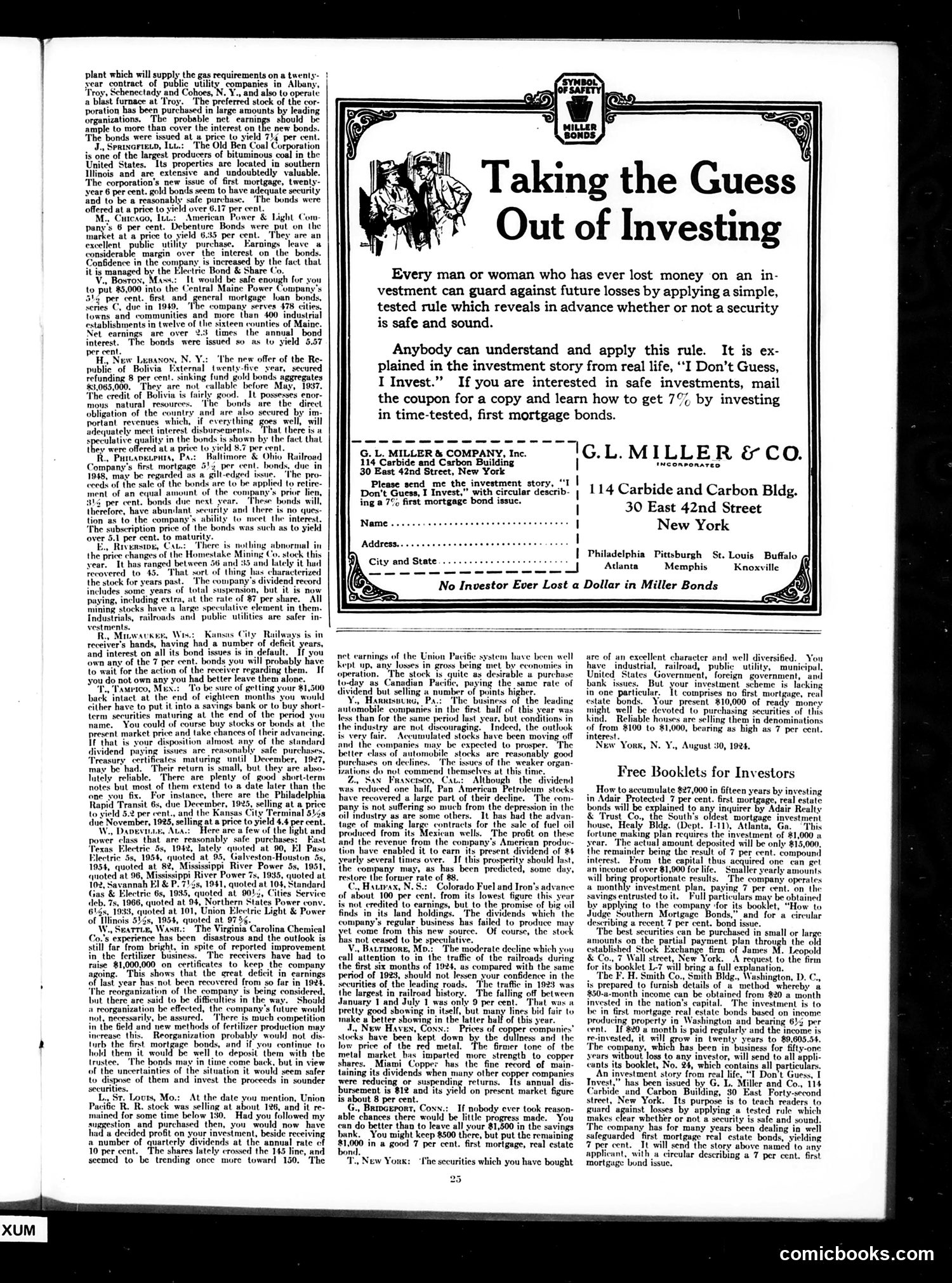
This page is primarily **advertising content** for G.L. Miller & Company, an investment bond firm. The main cartoon shows two figures (appears to be an older investor and younger person) with the headline "Taking the Guess Out of Investing." The advertisement promotes Miller Bonds as a safe investment vehicle, contrasting them with risky speculation. The bold claim "No Investor Ever Lost a Dollar in Miller Bonds" appears at bottom—a guarantee meant to appeal to readers who'd suffered losses in volatile stock markets. The left column contains testimonials from various cities endorsing different railroad, utility, and coal company bonds as sound investments. This represents typical 1920s-era financial advertising targeting individual investors. The overall message: apply rational analysis (the "simple, tested rule") rather than speculation ("guessing") when investing. The satire is subtle—the ad itself is selling safety as a product to anxious investors.
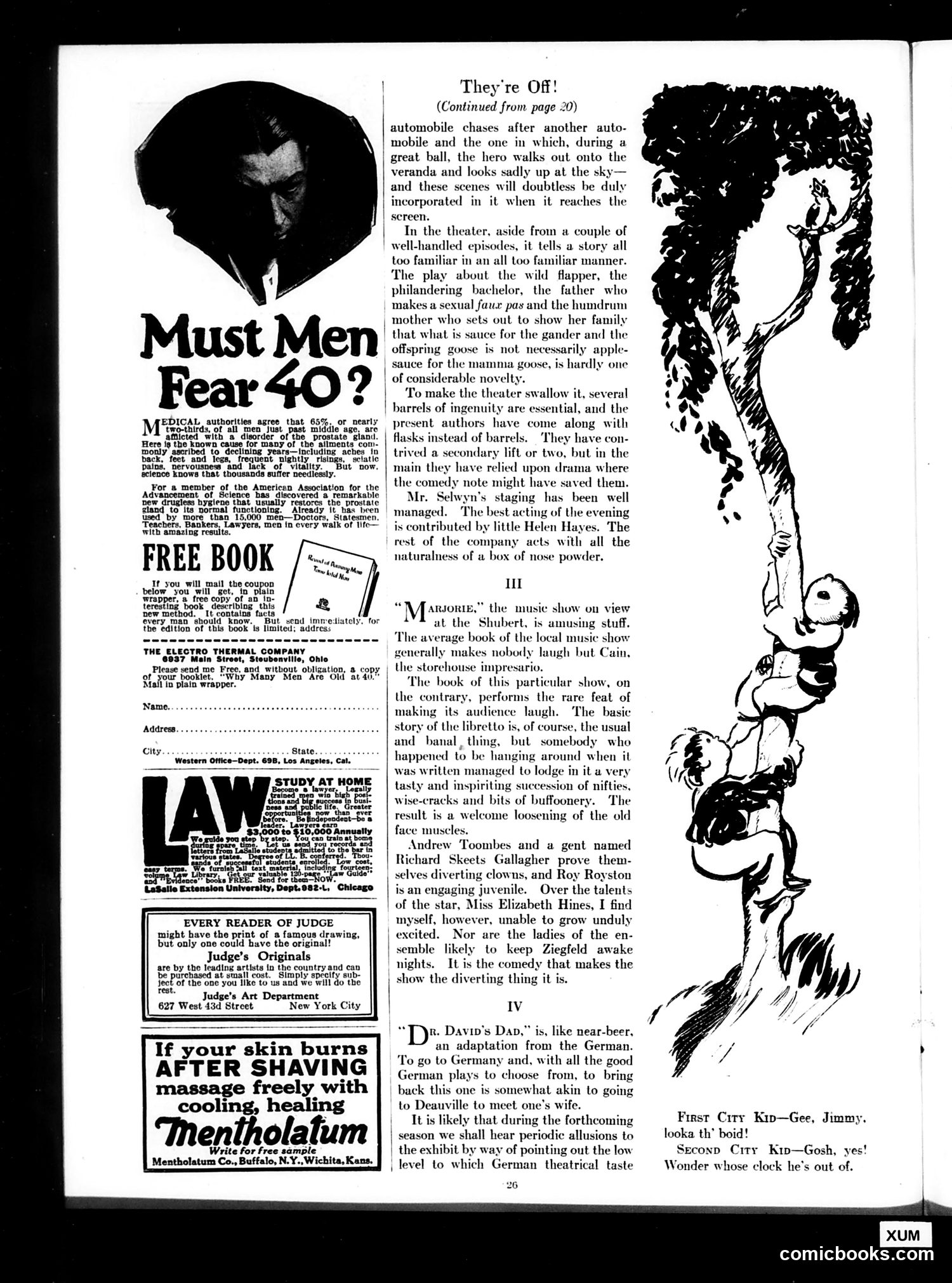
This page is primarily **advertising and entertainment reviews**, not political satire. The main content includes: **Advertisements:** A medical device company ("Electro Thermal Company") promoting a book titled "Why Many Men Are Old at 40"—a dubious health pitch claiming a "drugless hygiene" treatment for aging men. This represents early 20th-century quack medicine marketing targeting male anxieties about aging and virility. **Theater Reviews:** The "They're Off!" section critiques contemporary Broadway plays, including one about a "wild flapper" (1920s young woman) and moral double standards between genders. The reviewer dismisses the plot as familiar and relies too heavily on staged spectacle rather than comedy. **Other Ads:** Judge's original artwork for sale, shaving cream, and artist services. The page reflects 1920s concerns: anxiety about aging masculinity, the "New Woman" (flappers challenging social norms), and popular entertainment trends. It's largely a commercial publication snapshot rather than satirical commentary.
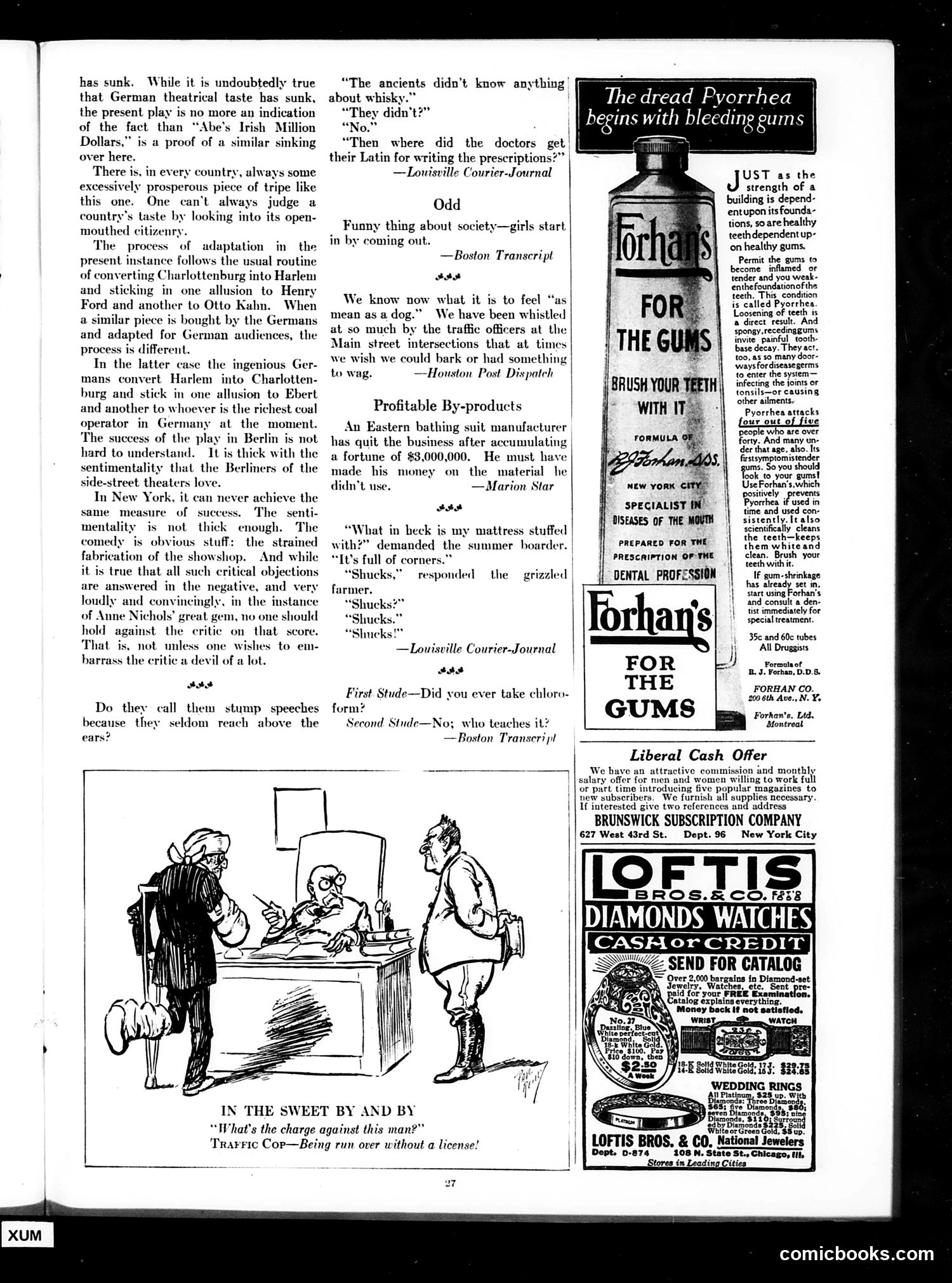
This page from *Judge* magazine contains satirical commentary on theater and culture, plus period advertisements. The main cartoon depicts a traffic cop arresting a hit-and-run driver, with the joke being the absurdist charge: "Being run over without a license!" This satirizes bureaucratic over-regulation—the victim is blamed for not having proper paperwork while being struck by a vehicle. The text discusses theatrical adaptation, contrasting how American plays (like "Abe's Irish Million Dollars") and German plays swap locations and local references when imported—Harlem becomes Charlottenburg, Henry Ford becomes Ebert. The satire criticizes how shallow commercial theater relies on simple local substitutions rather than genuine adaptation. The "Odd" section contains brief humorous observations about society and human behavior—typical magazine filler humor from this era. The advertisements (Forhan's toothpaste, Loftis watches, Brunswick Subscription Company) are standard early 20th-century product promotions, not satirical content.
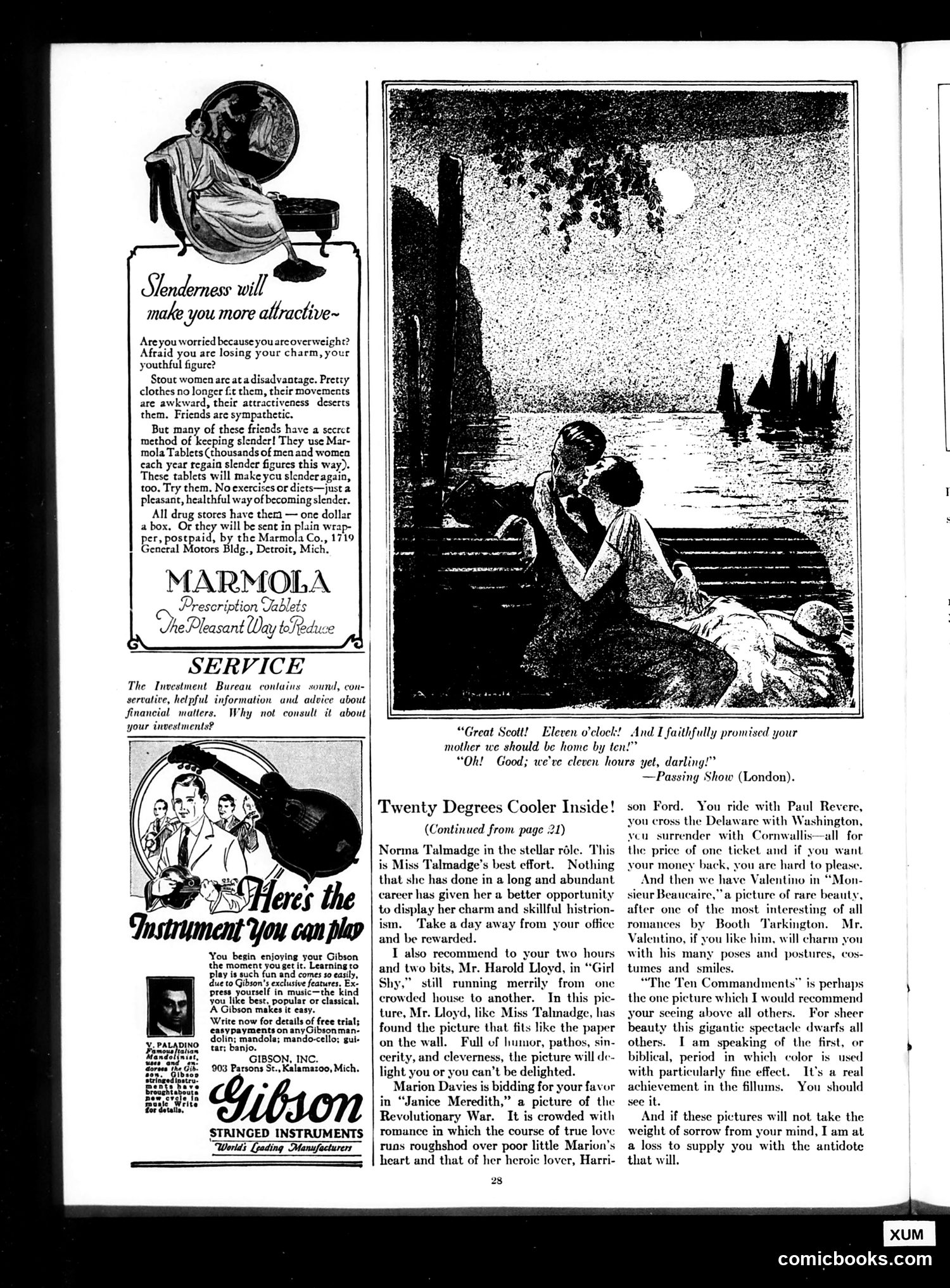
This page combines advertisements and entertainment reviews typical of 1920s Judge magazine. **The Marmola Tablets Ad** (left) satirizes contemporary weight-loss culture by promising slenderness makes women "more attractive." It exploits female insecurity about appearance and aging, suggesting overweight women lose charm and have "awkward" movements. The ad peddles diet pills as an easy alternative to exercise, reflecting the era's dubious patent medicine marketing. **The Illustration** (right) appears unrelated to specific satire—a romantic scene with dialogue about returning home late, likely accompanying a separate story. **The Review Section** discusses current films: Norma Talmadge, Harold Lloyd, and Rudolph Valentino—major silent film stars. The reviewer recommends "The Ten Commandments" as particularly visually spectacular, reflecting the era's fascination with epic filmmaking. The page is primarily **commercial content**—ads promoting consumer goods (diet pills, musical instruments, financial services) alongside entertainment coverage, which was Judge's business model.
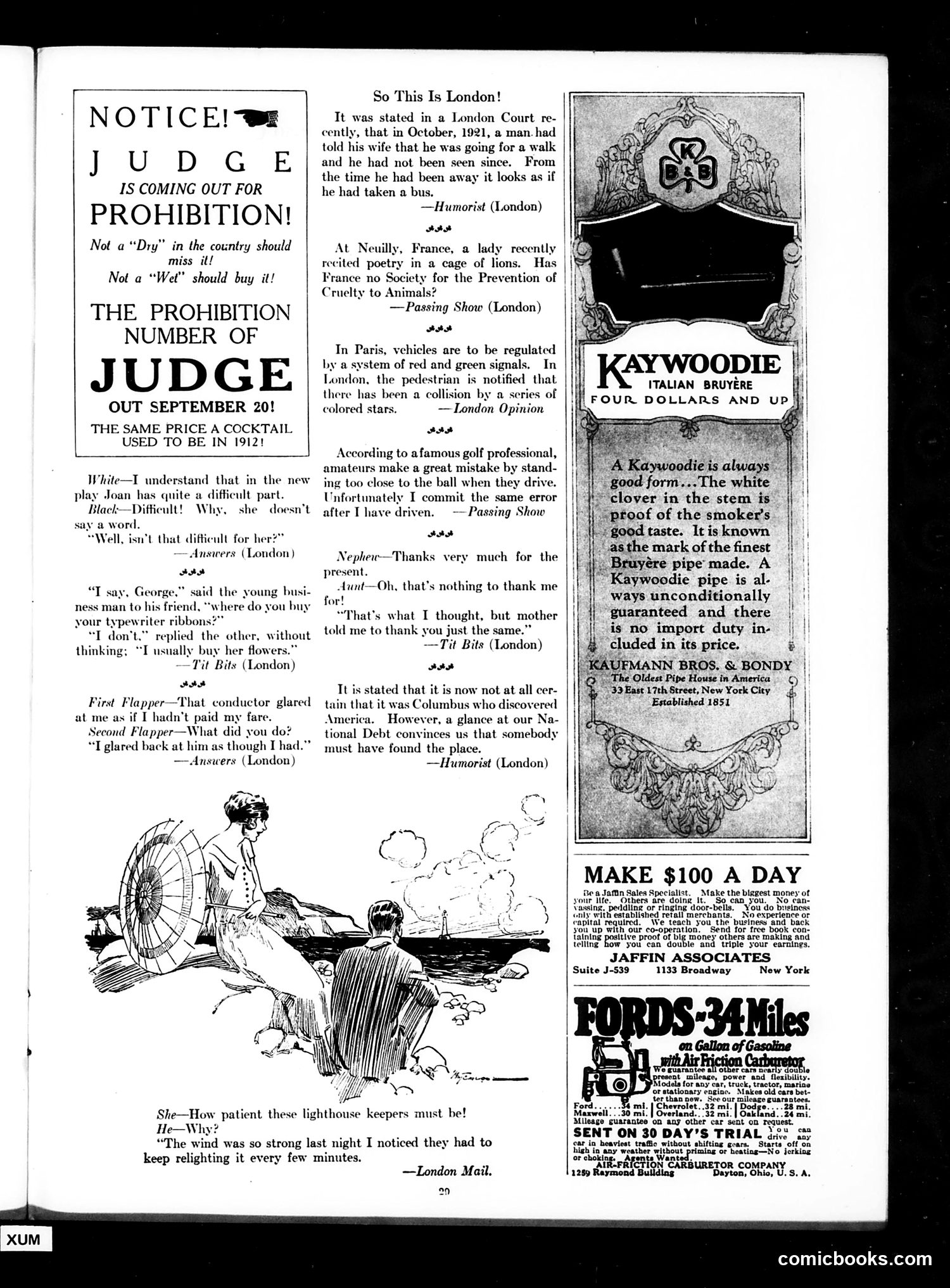
This page from Judge's Prohibition issue (September 1921) contains British humor excerpts and American advertisements. ## The Cartoons/Jokes: The page primarily features **reprinted British jokes** from London publications (Humorist, Passing Show, Tit Bits, Answers, London Mail). These are brief, domestic comedies—a man disappearing on a walk (possibly taken a bus), lighthouse keepers relighting in wind, flapper girls exchanging quips about conductors and flowers. ## The Satire: The page's satirical thrust comes from **Judge's banner**: it announces the magazine is "coming out for PROHIBITION" on September 20th, with a cocktail-price cover cost—mocking prohibition's approach by pricing the issue at what a 1912 cocktail cost. This is ironic commentary on the impending alcohol ban. ## Context for Modern Readers: In 1921, Prohibition (alcohol ban) was imminent (begins January 1920). Judge presents this as a celebratory moment while reprinting lighthearted British humor—seemingly incongruous content that underscores how American culture was absorbing this massive social change. The advertisements (Kaywoodie pipes, Ford cars) reflect 1920s consumer culture.
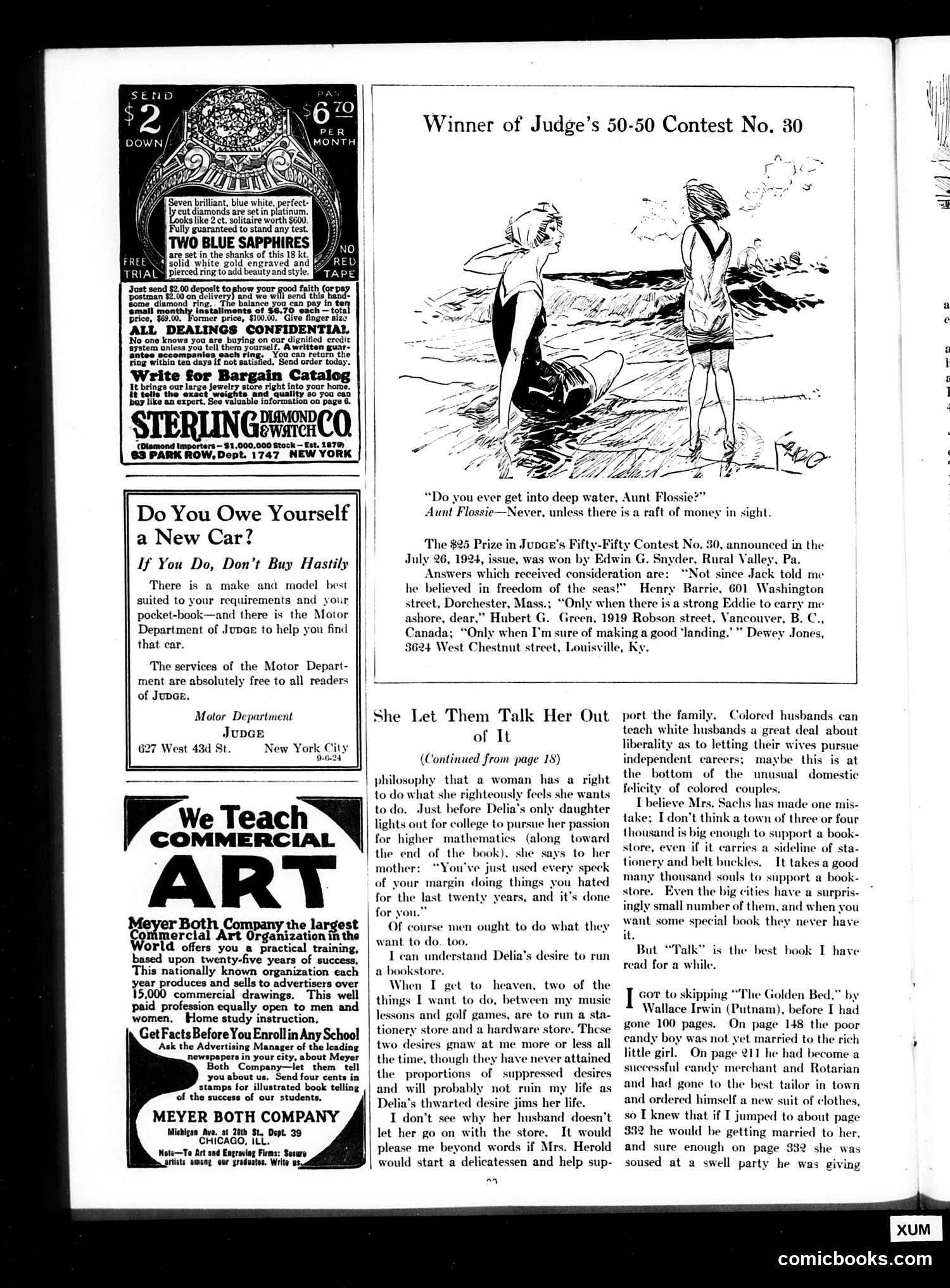
This page from Judge (dated July 26, 1924) contains a cartoon contest winner and advertisements. ## The Cartoon The top illustration shows two women at a beach. The caption quotes "Aunt Flossie" saying she never goes into deep water "unless there is a raft of money in sight." This is the winning entry in Judge's "Fifty-Fifty Contest No. 30"—a humor competition where readers submitted witty one-liners. The joke reflects 1920s attitudes toward wealth: Aunt Flossie won't risk herself (go into deep water) without financial security/protection (a "raft of money"). It's gentle satire about cautious, money-conscious behavior, typical of Judge's light social humor. ## Context The other contest answers show similar themes—women needing male support or financial security for activities. The surrounding ads (jewelry, automobiles, commercial art training) target affluent readers interested in consumer goods and self-improvement during the prosperous 1920s.
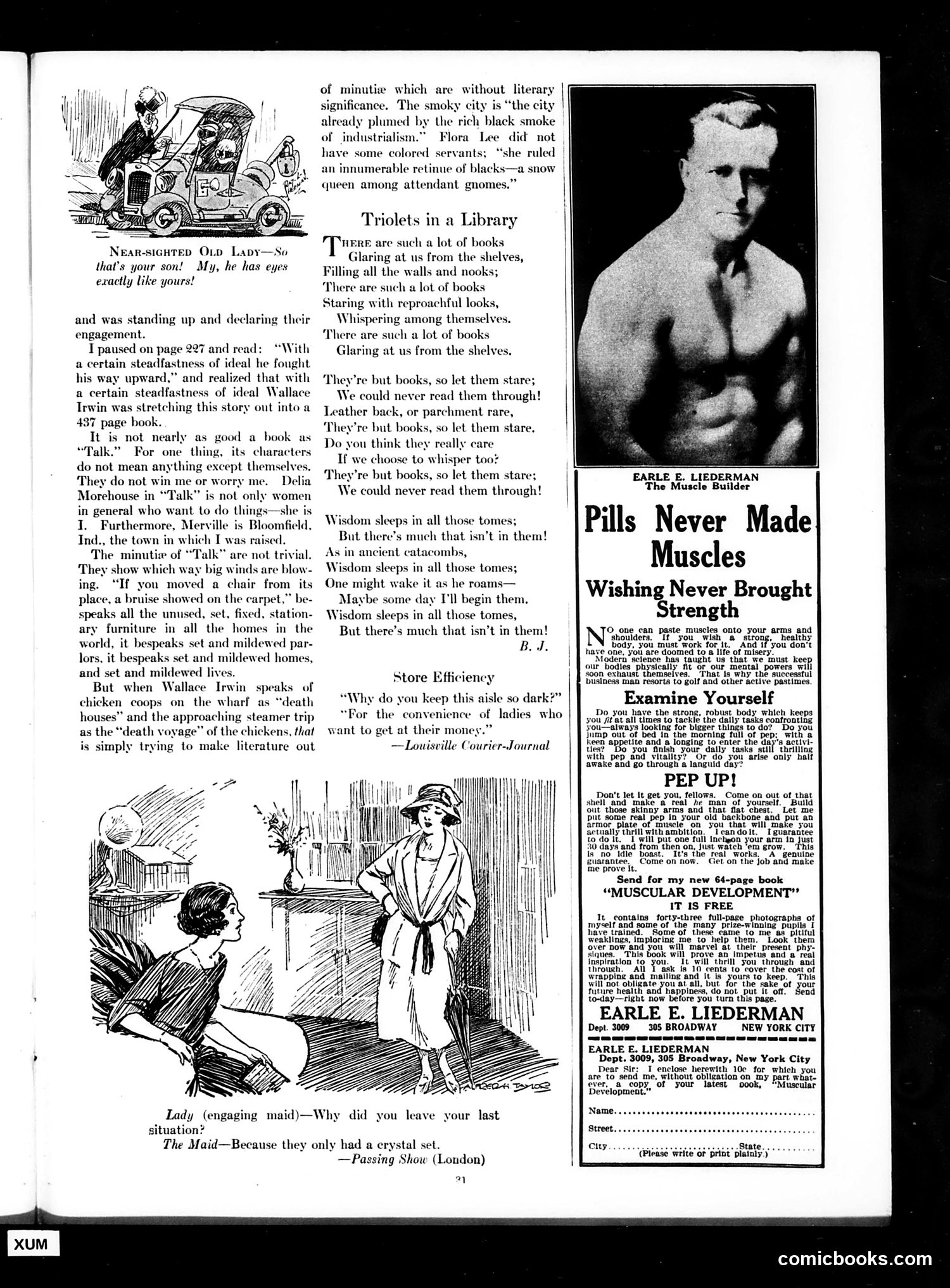
This page contains literary criticism, humorous anecdotes, and advertising typical of early-20th-century Judge magazine. **Main cartoon (top left)**: A "near-sighted old lady" compliments a woman on her son's eyes, saying they're "exactly like yours"—implying the child resembles the woman rather than a father figure. This is a mild sexual innuendo joke about paternity. **Literary content**: The page reviews Wallace Irwin's 437-page novel, criticizing it for over-extending a simple story and using pretentious language (describing chicken coops as "death houses"). A brief poem, "Triolets in a Library," humorously addresses unread books gathering dust. **Bottom cartoon**: A store clerk explains keeping an aisle dark "for the convenience of ladies who want to get at their money"—a sexist joke implying women cannot resist shopping impulses in poor lighting. **Right side**: A Earle E. Liederman advertisement for muscle-building courses, typical of early 1900s fitness marketing promising strength through exercise rather than "pills."
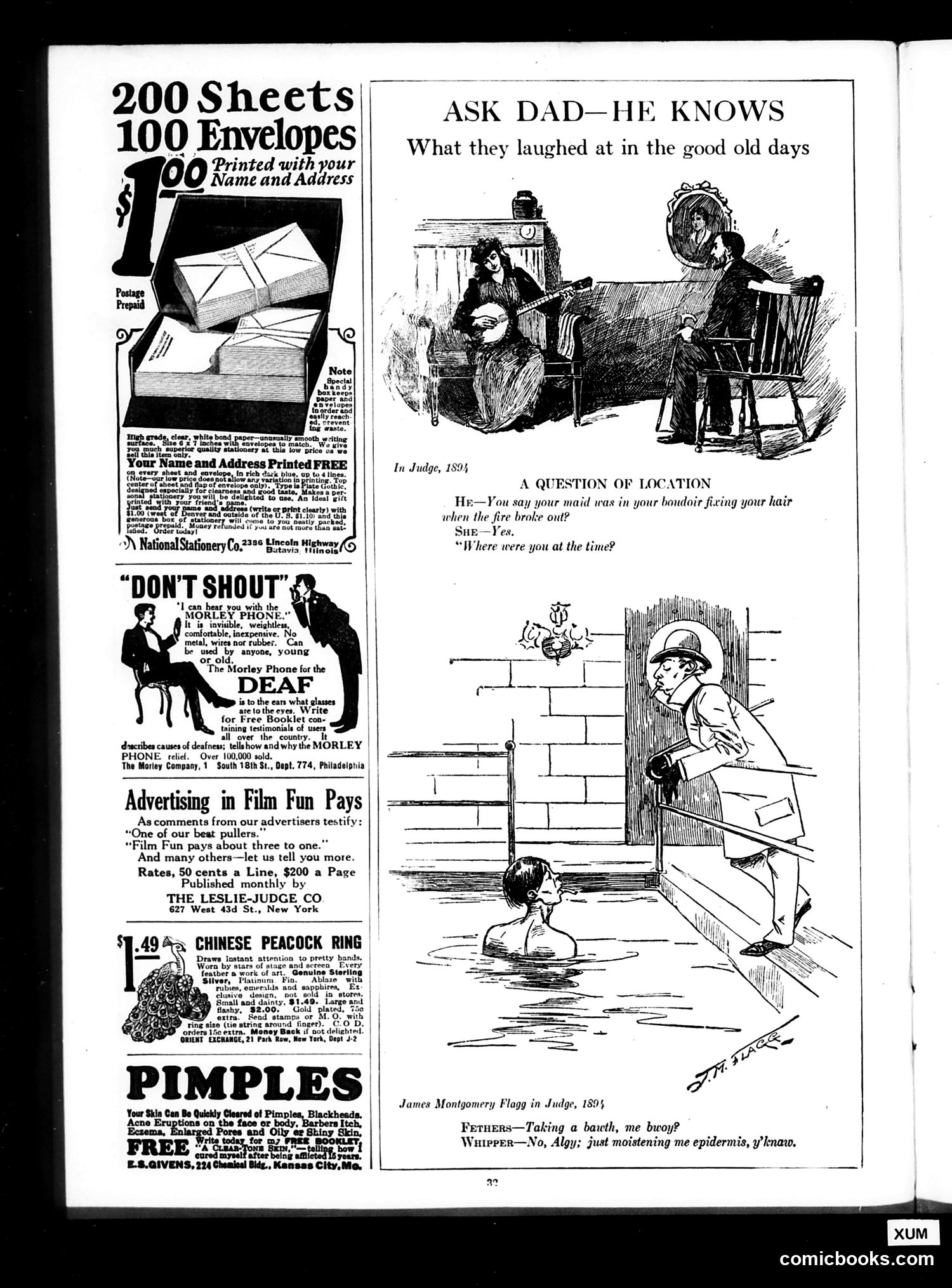
This page features two period humor cartoons from Judge magazine (1894), drawn by James Montgomery Flagg, a prominent illustrator of the era. **"A Question of Location"**: A husband questions his wife about a fire in her boudoir. She claims her maid was fixing her hair when it started, but when asked where *she* was, she admits she was in her boudoir too—the humor being the implied impropriety of the situation and her evasive answer. **The Pool Scene**: Two men discuss bathing; one claims to be "moistening [his] epidermis" rather than actually bathing. The joke mocks affected, pretentious speech—using fancy vocabulary ("epidermis" for skin) to describe simple activities, typical of upper-class affectation that Judge frequently satirized. Both jokes rely on Victorian-era social anxieties: propriety, class pretension, and double meanings. The page's title "Ask Dad—He Knows" frames these as old-fashioned humor types. The surrounding advertisements (stationery, hearing aids, rings, acne treatments) are typical period magazine filler.
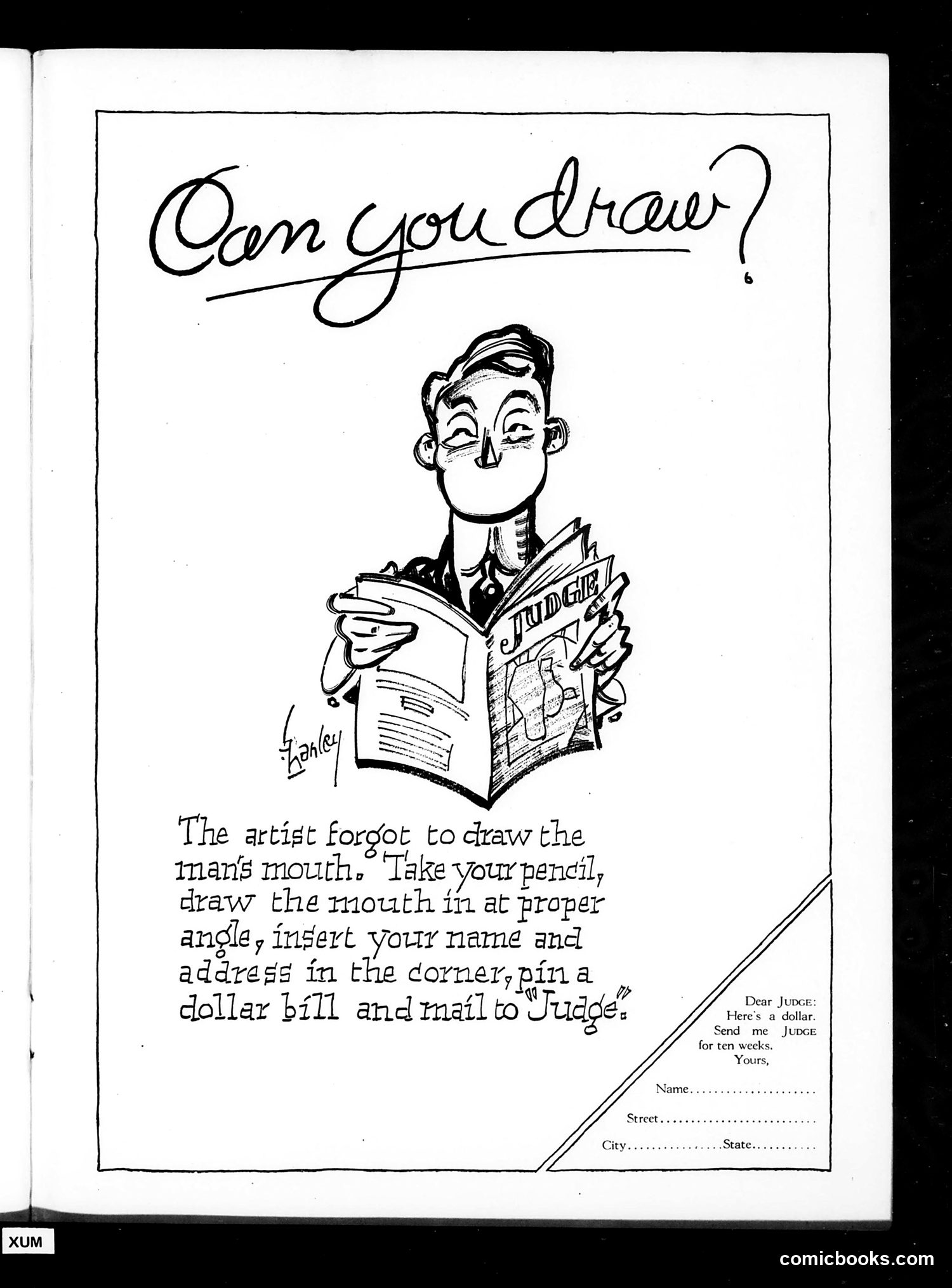
This is an interactive contest page from *Judge* magazine. The cartoon shows a man reading a publication labeled "JUDGE," but the artist deliberately omitted his mouth. The joke/contest works like this: readers were invited to complete the drawing by adding the man's mouth at the proper angle using their pencil. They then signed their name, included their address, enclosed a dollar bill, and mailed the completed artwork to *Judge* magazine. This was a common early 20th-century magazine engagement strategy—combining reader participation with a small monetary contribution. It's essentially a paid drawing contest disguised as a humorous interactive activity. The "Dear Judge" note on the right corner shows the expected submission format.
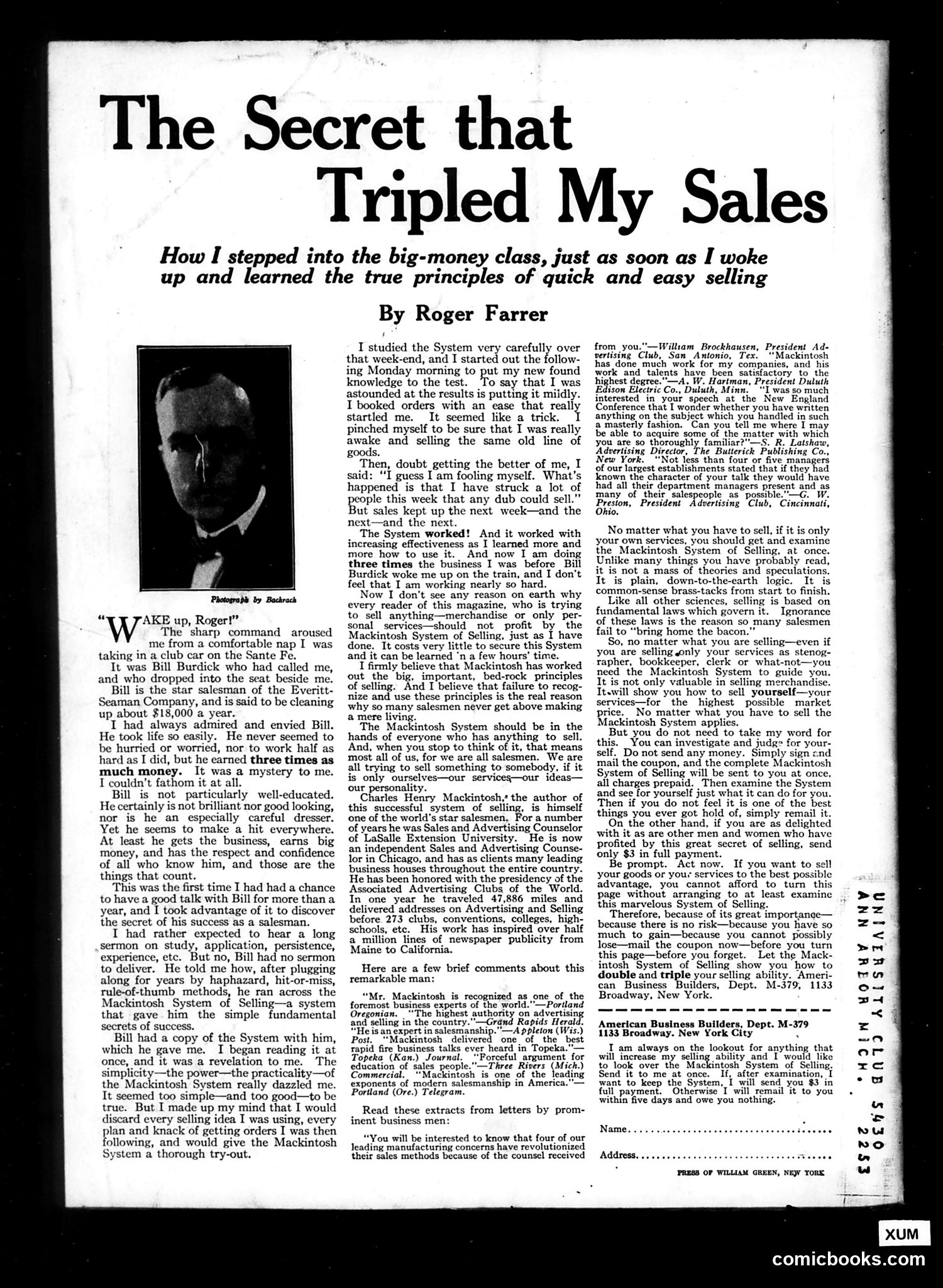
This is **not a cartoon or satirical content**—it's a **full-page advertisement** disguised as editorial copy, a common early 20th-century marketing technique called "advertorial." The piece presents a fictional narrative by "Roger Farrer" describing how he learned the "Mackintosh System of Selling" from a successful salesman named Bill Burdick. The story follows a familiar bootstrap narrative: Farrer was struggling, discovered a simple system, applied it, and tripled his income. **The satire/humor likely lies in Judge magazine's publication of this transparent sales pitch.** For modern readers, it exemplifies: - Early advertising deception (blurring editorial and advertising) - Predatory sales systems promising easy riches - The timeless appeal of "secrets" to quick success - The classic con structure: testimonial + proof of results + call to order The photographic portrait of "Bachrach" and reader response card at bottom confirm this was monetized advertising, not genuine editorial commentary. Judge's readers would have recognized the formula as both comedic and cynical.

I can see this is a page from *Judge* magazine (visible at bottom), but the image is almost entirely black with only a white margin strip on the left side visible. The OCR text only shows "comicbooks.com" at the bottom, which appears to be a modern watermark rather than original content. I cannot reliably identify any cartoons, figures, caricatures, political references, or satirical content from this image due to the extreme darkness and lack of visible detail. The page may be damaged, poorly scanned, or corrupted. To provide accurate historical analysis as requested, I would need a clearer, more legible version of the source material.