
Judge, 1924-09-06 · page 20 of 37
Judge — September 6, 1924 — page 20: what you’re looking at
What you’re looking at
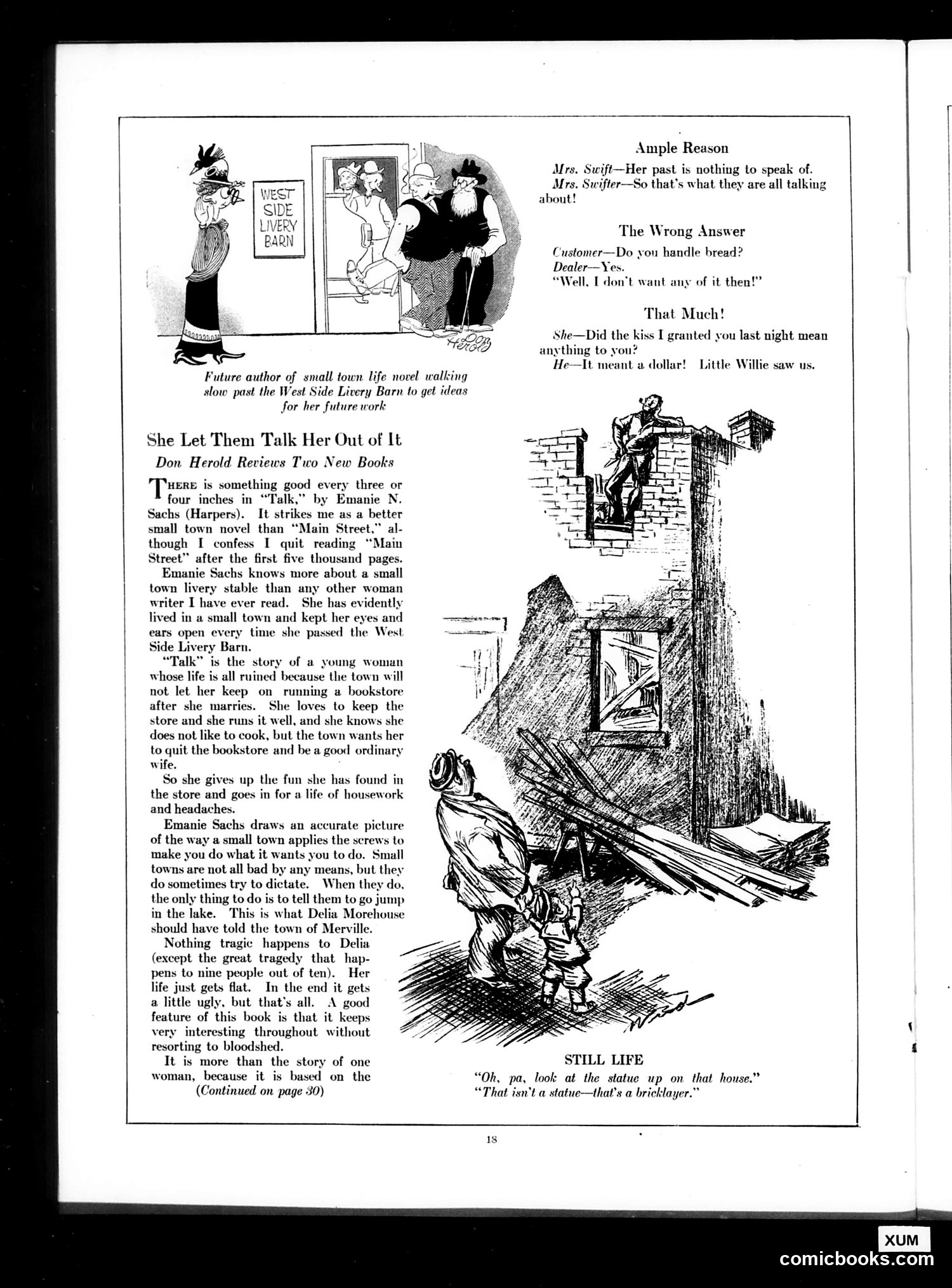
This page contains several short humor pieces and a book review typical of early 20th-century American satirical magazines. **The cartoons** mock small-town social conventions and propriety through brief jokes: a woman concerned about gossip; a baker who won't sell bread; a couple's kiss witnessed by a child; and figures observing a bricklayer, mistaking him for a statue. **The main feature** is Don Herold's review of Emanie N. Sachs's novel "Talk," comparing it favorably to Sinclair Lewis's "Main Street." Herold praises Sachs's detailed knowledge of small-town life, particularly livery stables. The novel's plot—a woman forced to abandon her bookstore after marriage to become a "good ordinary wife"—satirizes small-town social pressure and conformity. Herold's point: small towns enforce rigid expectations, especially on women, crushing individuality. The book's strength is depicting this social coercion realistically without melodrama. The implicit critique targets narrow-minded, controlling small-town culture—a common Progressive-era theme.
📄 Transcribed text from this page (OCR, searchable)
Machine-transcribed from the original scan — historical spelling and the odd misread are preserved.
Ample Reason Mrs, Swift—Her past is nothing to speak Mrs. Swifter—So that's what they are all talking about! The Wrong Answer Customer—Do you handle bread? Dealer—Yes. “Well, [don't want any of it then!” That Much! She—Did the kiss I granted you last night mean anything to you? He—It meant a dollar! Little Willie saw us. | Future author of small town life novel walking | slow past the West Side Livery Barn to get ideas for her future work She Let Them Talk Her Out of It Don Herold Reviews Two New Books Tue is something good every three or four inches in “Talk,” by Emanie N. Sachs (Harpers). It strikes me as a better small town novel than “Main Street,” al- though I confess I quit reading “Main Street” after the first five thousand pages. Emanie Sachs knows more about a small town livery stable than any other woman writer I have ever read. She has evidently lived in a small town and kept her eyes and ears open every time she passed the West Side Livery Barn. | “Talk” is the story of a young woman | whose life is all ruined because the town will not let her keep on running a bookstore after she marries. She loves to keep the store and she runs it well, and she knows she does not like to cook, but the town wants her | to quit the bookstore and be a good ordinary wife. So she gives up the fun she has found in the store and goes in for a life of housework and headaches. Emanie Sachs draws an accurate picture of the way a small town applies the screws to make you do what it wants you to do. Small towns are not all bad by any means, but they do sometimes try to dictate. When they do, the only thing to do is to tell them to go jump in the lake. This is what Delia Morehouse should have told the town of Merville. Nothing tragic happens to Delia (except the great tragedy that hap- pens to nine people out of ten). Her life just gets flat. In the end it gets a little ugly, but that’s all. A good feature of this book is that it keeps very interesting throughout without \ resorting to bloodshed. 4 It is more than the story of one STILL LIFE woman, because it is based on the “Oh, pa, look at the statue up on that house.” (Continued on page 30) “That isn’t a statue—that’s a bricklayer.” comicbooks.com