
Judge, 1924-09-06 · page 4 of 37
Judge — September 6, 1924 — page 4: what you’re looking at
What you’re looking at
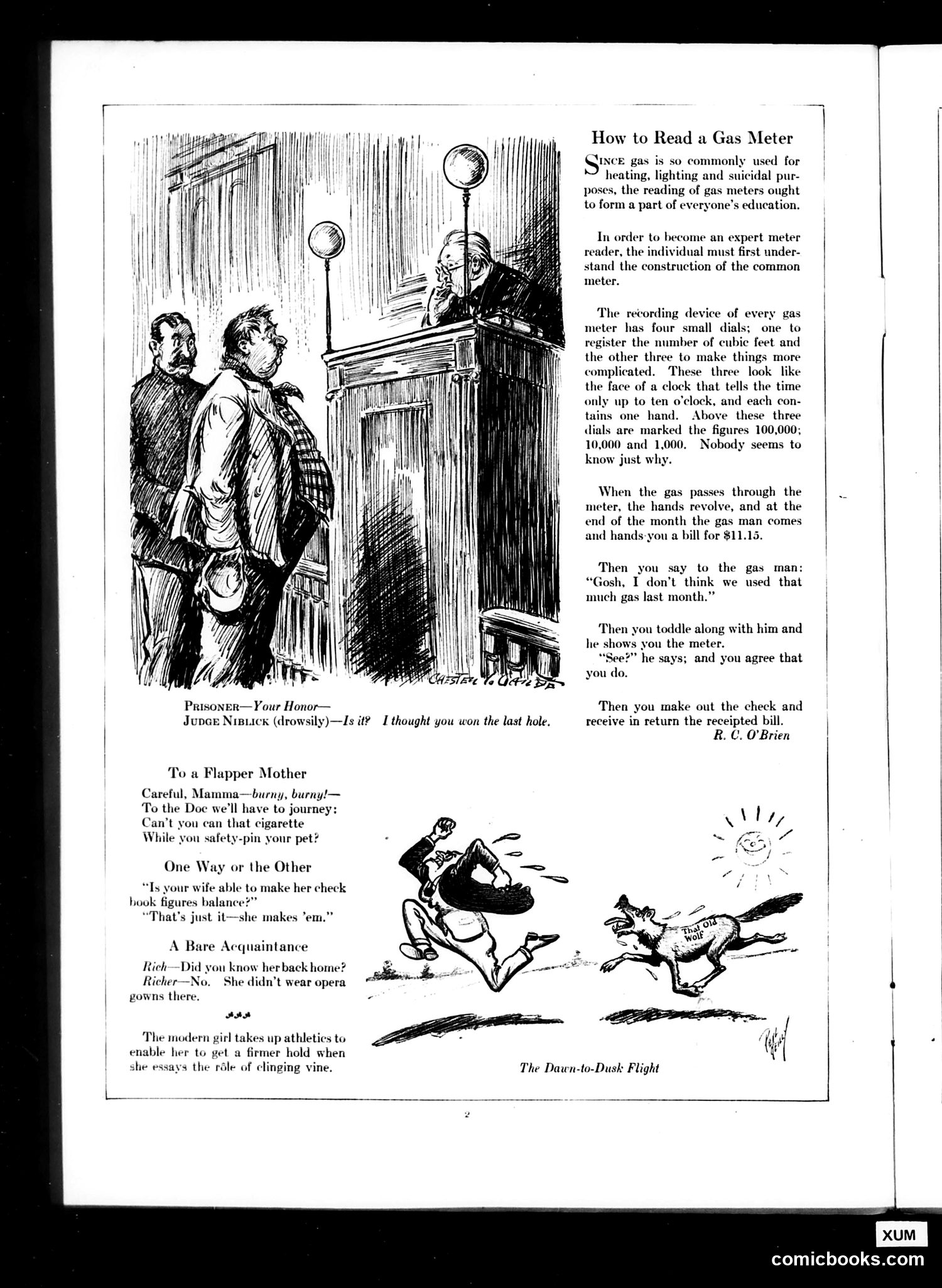
**Main Feature: "How to Read a Gas Meter"** This instructional piece satirizes the gas company's billing practices. The humor lies in the gap between meter readings and actual consumption—the gas man shows a bill for $11.13, the customer protests they didn't use that much gas, but they're shown the meter and comply anyway. The satire targets how consumers are essentially powerless against utility company charges, unable to verify or dispute readings. **Supporting Humor Pieces:** - "To a Flapper Mother": Mocks anxious mothers warning daughters against smoking while traveling - "One Way or the Other": Jokes about women's accounting abilities - "A Bare Acquaintance": Social satire about class pretension **Minor Cartoon:** "The Dawn-to-Dusk Flight" depicts comedic chaos—unclear if referencing a specific aviation event or simply generic slapstick.
📄 Transcribed text from this page (OCR, searchable)
Machine-transcribed from the original scan — historical spelling and the odd misread are preserved.
Prisoner—Your Honor— Jupae Nisuick (drowsily)—Is it? To a Flapper Mother Careful, Mamma—burny, burny!— To the Doc we'll have to journey: Can't you can that cigarette While you safety-pin your pet? One Way or the Other “Is your wife able to make her check hook figures balance?” “That's just it—she makes ’em.”” A Bare Acquaintance Rich—Did you know her back home? Richer—No. She didn’t wear opera gowns there, ery The modern girl takes up athletics to enable her to a firmer hold when she essays the rdle of clinging vine. I thought you won the last hole. How to Read a Gas Meter \CE gas is so commont \ S heating, lighting and s poses, the reading of gas meters ought to form a part of everyone's education. In order to become an expert meter reader, the individual must first under- stand the construction of the common meter. The recording device of every gas meter has four small dials; one to register the number of cubic feet and the other three to make things more complicated. These three look like the face of a clock that tells the time only up to ten o'clock, and each con- tains one hand. Above these three dials are marked the figures 100,000; 10,000 and 1,000. Nobody seems to know just why. When the gas passes through the meter, the hands revolve, and at the end of the month the gas man comes and hands-you a bill for $11.15. Then you say to the gas man: “Gosh, T don’t think we used that much gas last month.” Then you toddle along with him and you the meter. s; and you agree that you do. Then you make out the check and receive in return the receipted bill. R. C. O’Brien \\ly 4 comicbooks.com