
A complete issue · 36 pages · 1924
Judge — May 3, 1924
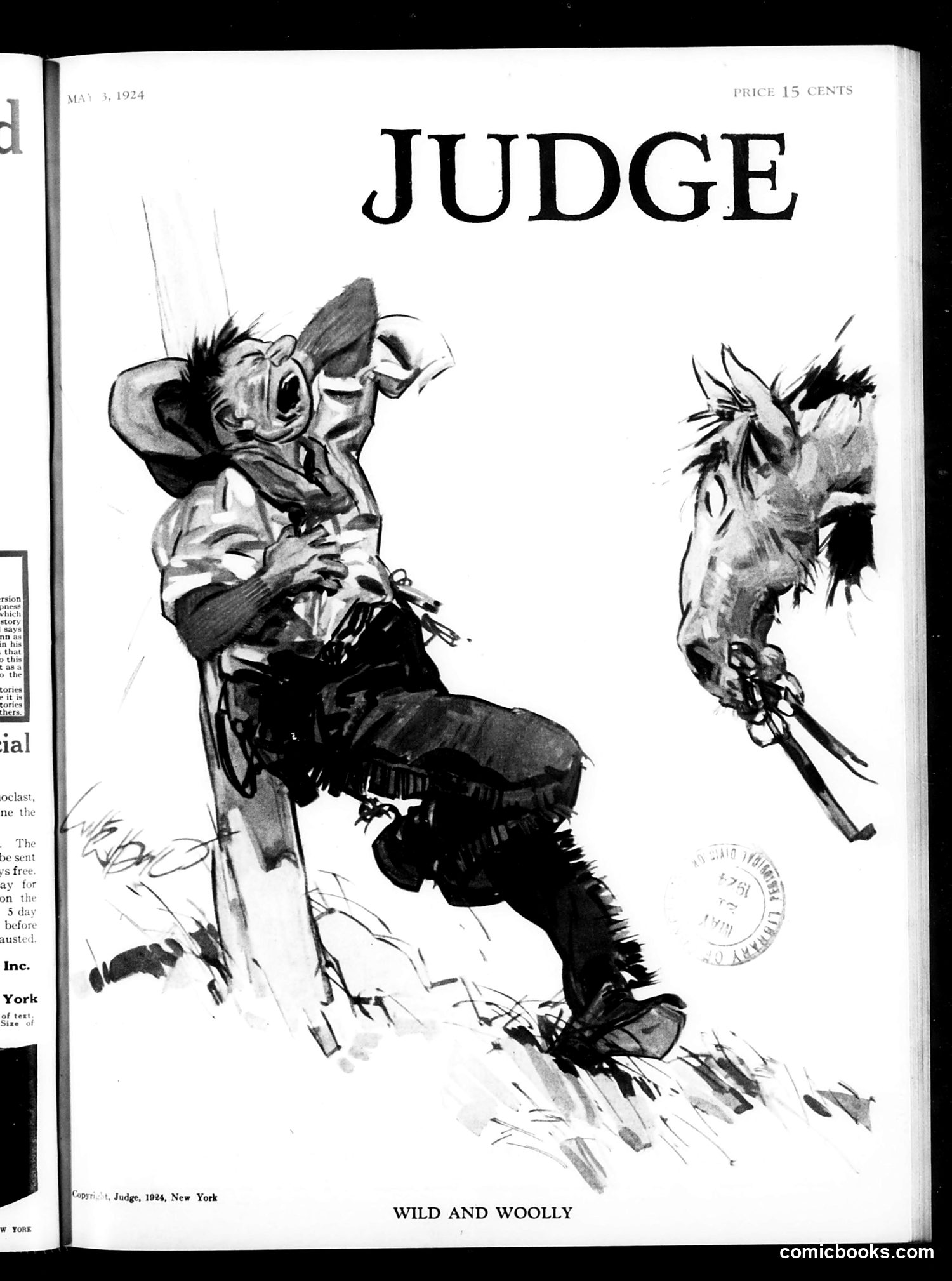
This cartoon depicts a grotesquely exaggerated figure with animalistic features—wild hair, prominent teeth, and unkempt appearance—being ejected or expelled forcefully. The title "Wild and Woolly" suggests untamed, rough behavior. Without additional context from the magazine's other content or contemporary events, I cannot definitively identify which specific political figure or social group this caricature targets. However, the style is consistent with 1920s satirical commentary on immigration, labor radicalism, or criminal elements portrayed as "dangerous outsiders" needing expulsion. The exaggerated, dehumanizing features reflect common propaganda tactics of the era. The exact referent—whether a specific person, ideology, or group—remains unclear without supporting text from the issue.
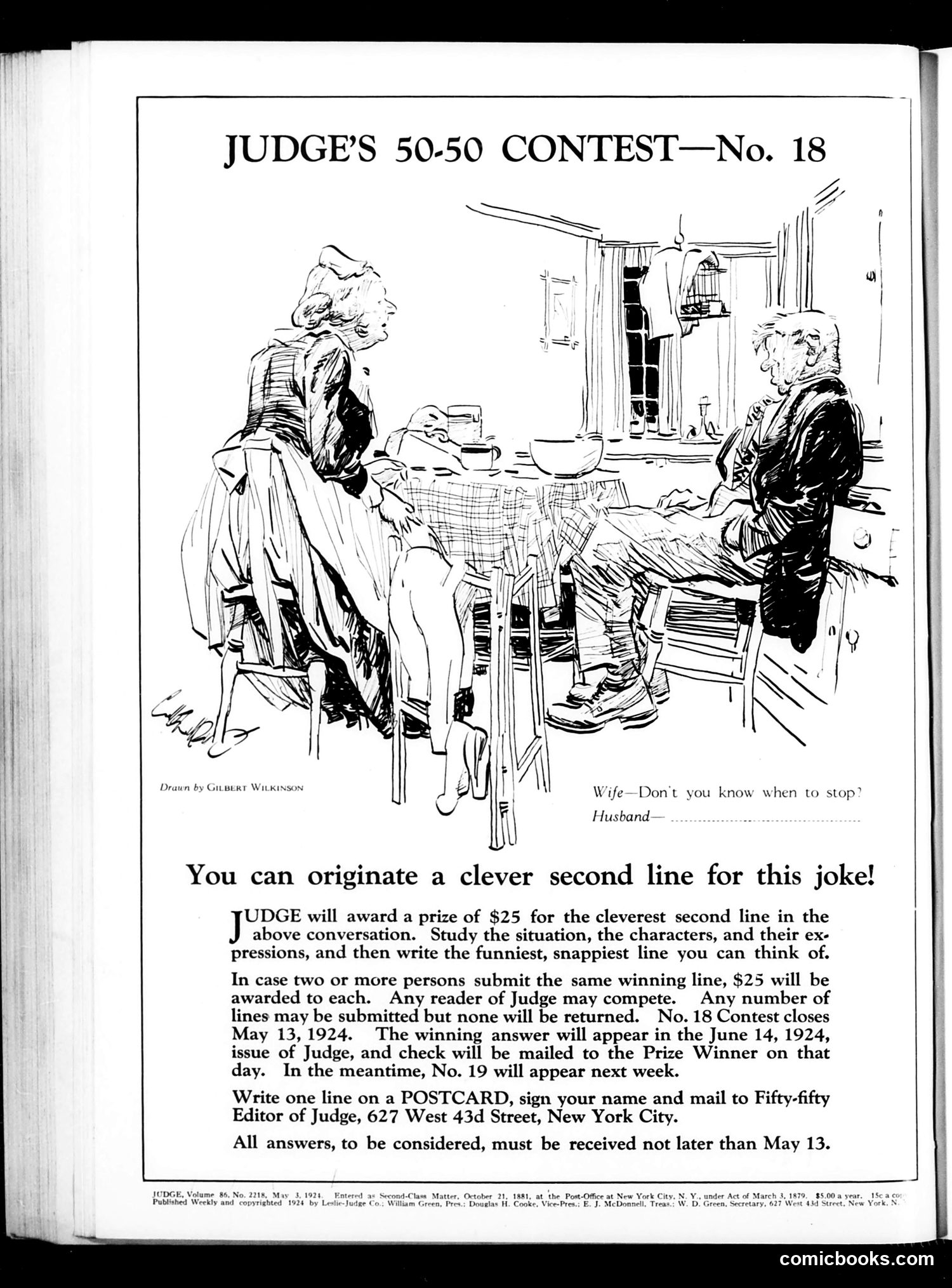
This page features a domestic humor cartoon by Gilbert Wilkinson showing a married couple at home. The wife stands holding what appears to be clothing or fabrics, while the husband sits relaxed. The wife asks: "Don't you know when to stop?" and the husband's response is left blank for readers to complete. The joke likely plays on common marital tensions of the 1920s—perhaps about the wife's shopping habits, the husband's drinking or smoking, or excessive talking. The contest invites readers to supply the husband's witty comeback, with a $25 prize for the cleverest line. This reflects Judge magazine's typical middle-class domestic humor, where gender dynamics and marriage provided standard comedic material for the era.
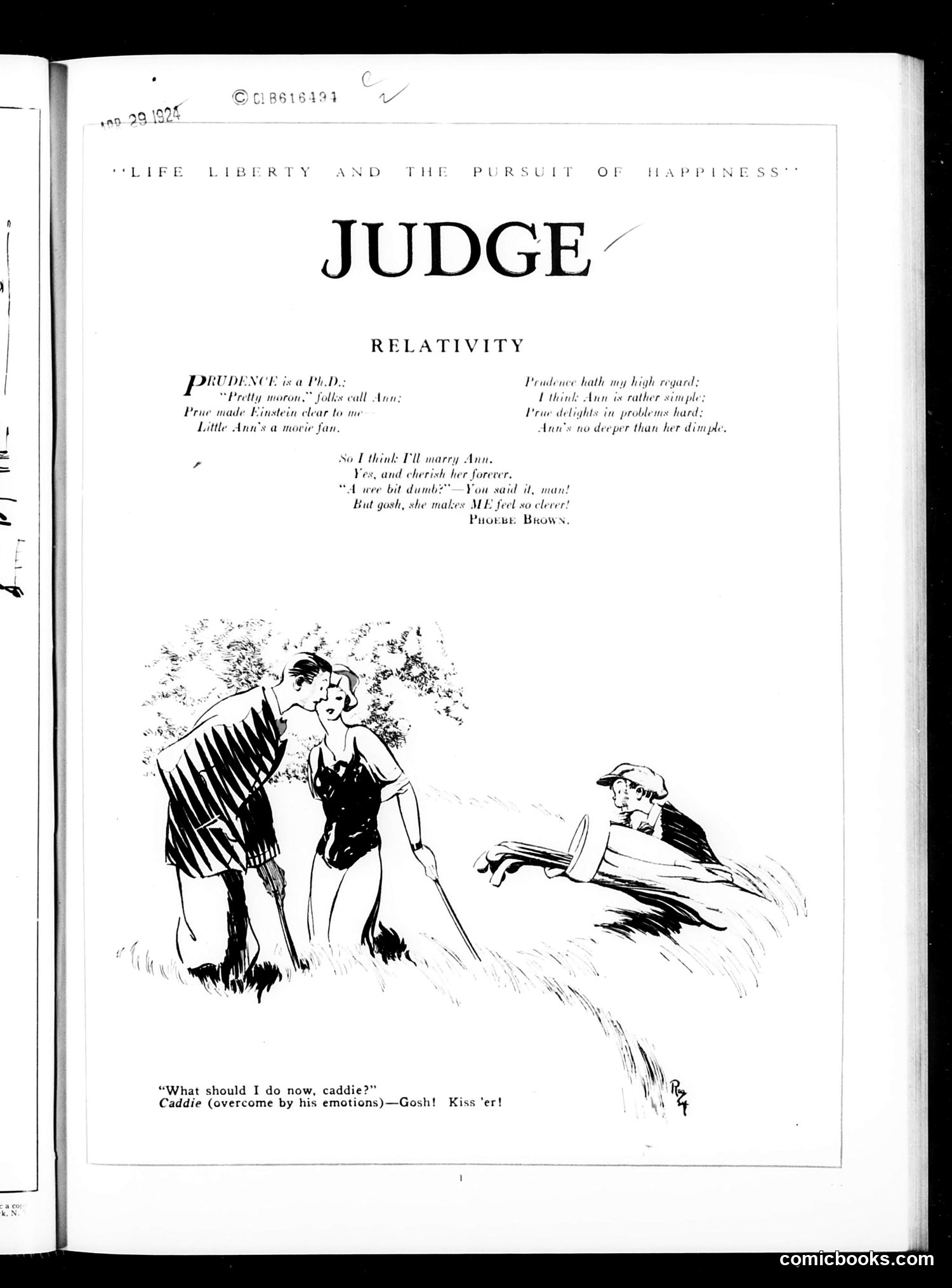
This cartoon satirizes changing social attitudes about romance and marriage eligibility. The title "Relativity" references Einstein's famous theory, suggesting that standards of acceptability are relative rather than absolute. The sketch shows a woman (labeled "Prudence") with a Ph.D. being evaluated by a man. The dialogue presents the contradiction: she's intellectually accomplished ("Pretty matron," Einstein-level intellect), yet this makes her seem "undumb" as marriage material. The concluding joke—where the caddie romantically overcomes his doubts and embraces her—mocks how men prioritize emotional appeal over intellectual equality. The satire criticizes society's expectation that educated women should suppress their accomplishments to appear more desirable as partners.
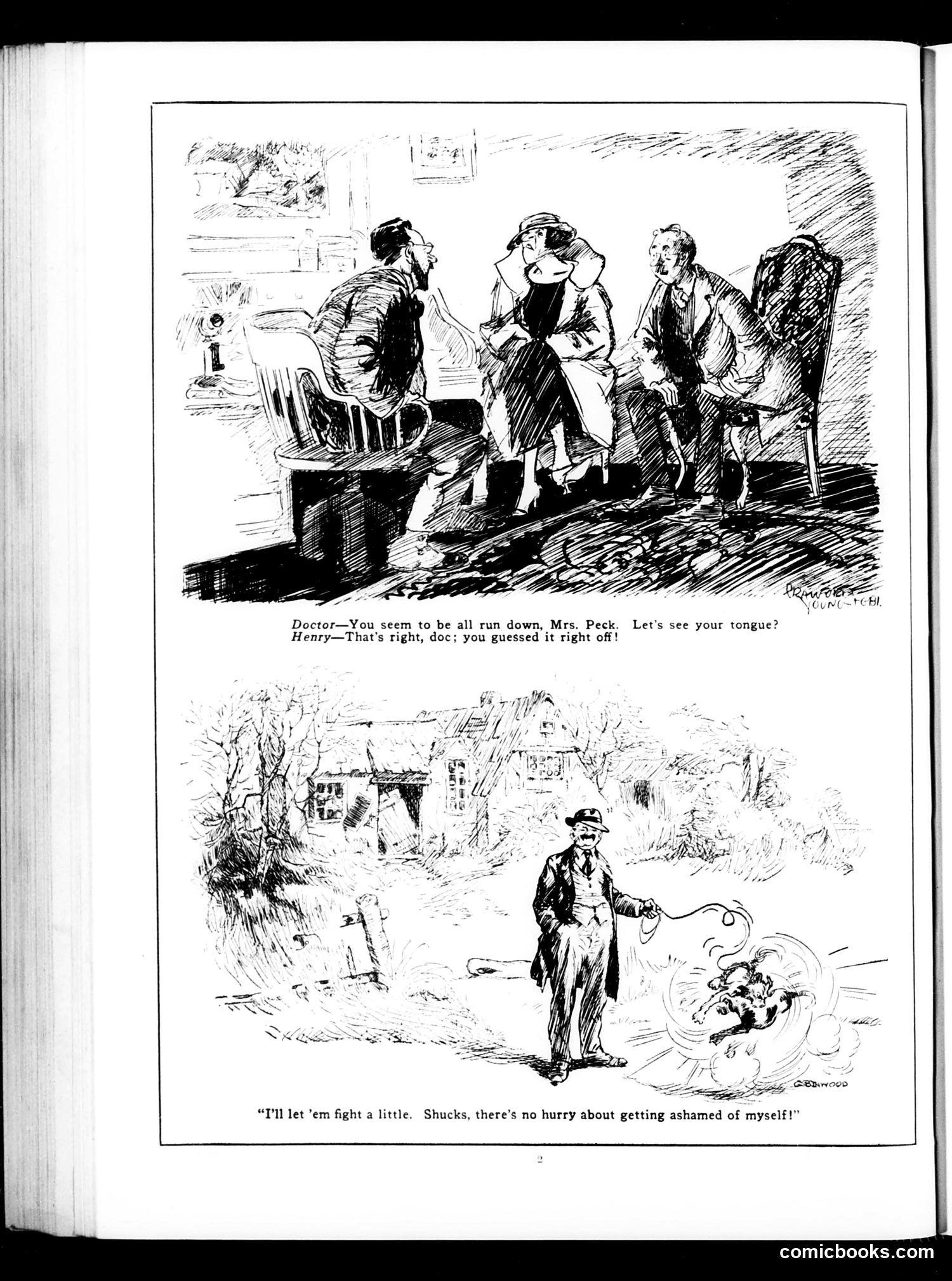
**Top cartoon:** A doctor examines a patient (Mrs. Peck) while her husband Henry watches. The doctor says he "guessed it right off" upon examining her tongue—a standard medical diagnostic procedure of the era. The joke appears to be about Henry's confident diagnosis preceding the professional one, suggesting amateur medical presumption or a wife's obvious ailment. **Bottom cartoon:** A man tells another (Shucks) he'll "let 'em fight a little" with "no hurry about getting ashamed of myself." The rural setting and casual attitude toward fighting suggest this satirizes working-class masculinity and honor culture—perhaps mocking the willingness to engage in petty brawls without social consequence. Both cartoons employ gentle social satire typical of Judge's humor targeting everyday American character types.
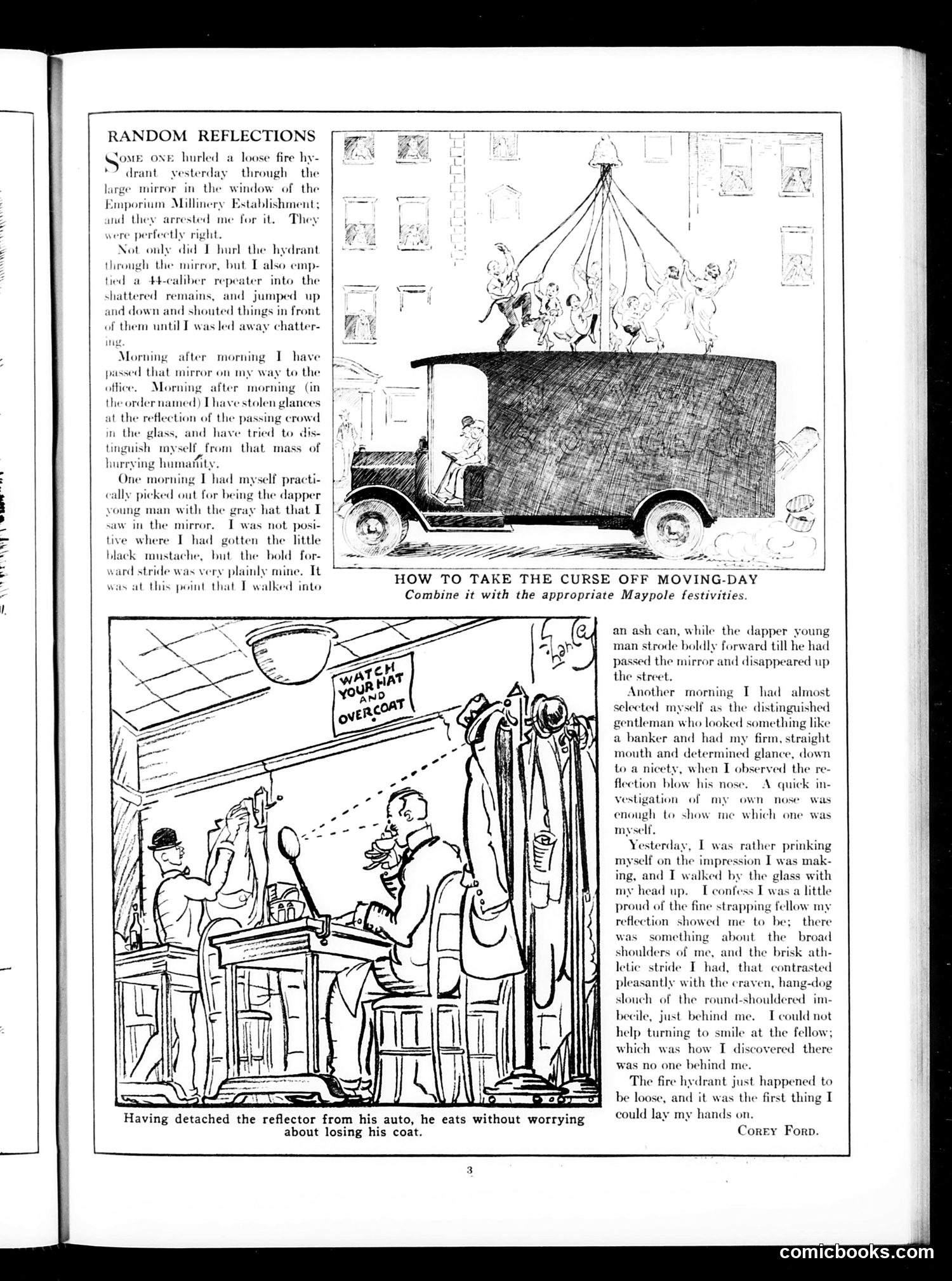
This page contains a humorous essay titled "Random Reflections" by Corey Ford about encountering one's own reflection in mirrors and storefront windows while moving through the city. The accompanying cartoons illustrate the awkward moments of self-recognition. The top cartoon shows a moving van with children playing underneath a maypole-like structure, captioned "How to Take the Curse Off Moving-Day." The bottom cartoon depicts a man removing a reflector from his car in what appears to be a clothing store or tailor shop, captioned about detaching the reflector before eating without worrying about losing his coat. The humor relies on self-deprecating observations about vanity and the mishaps of urban life—there's no identifiable political content or caricature on this page. It's primarily social satire about everyday human behavior.
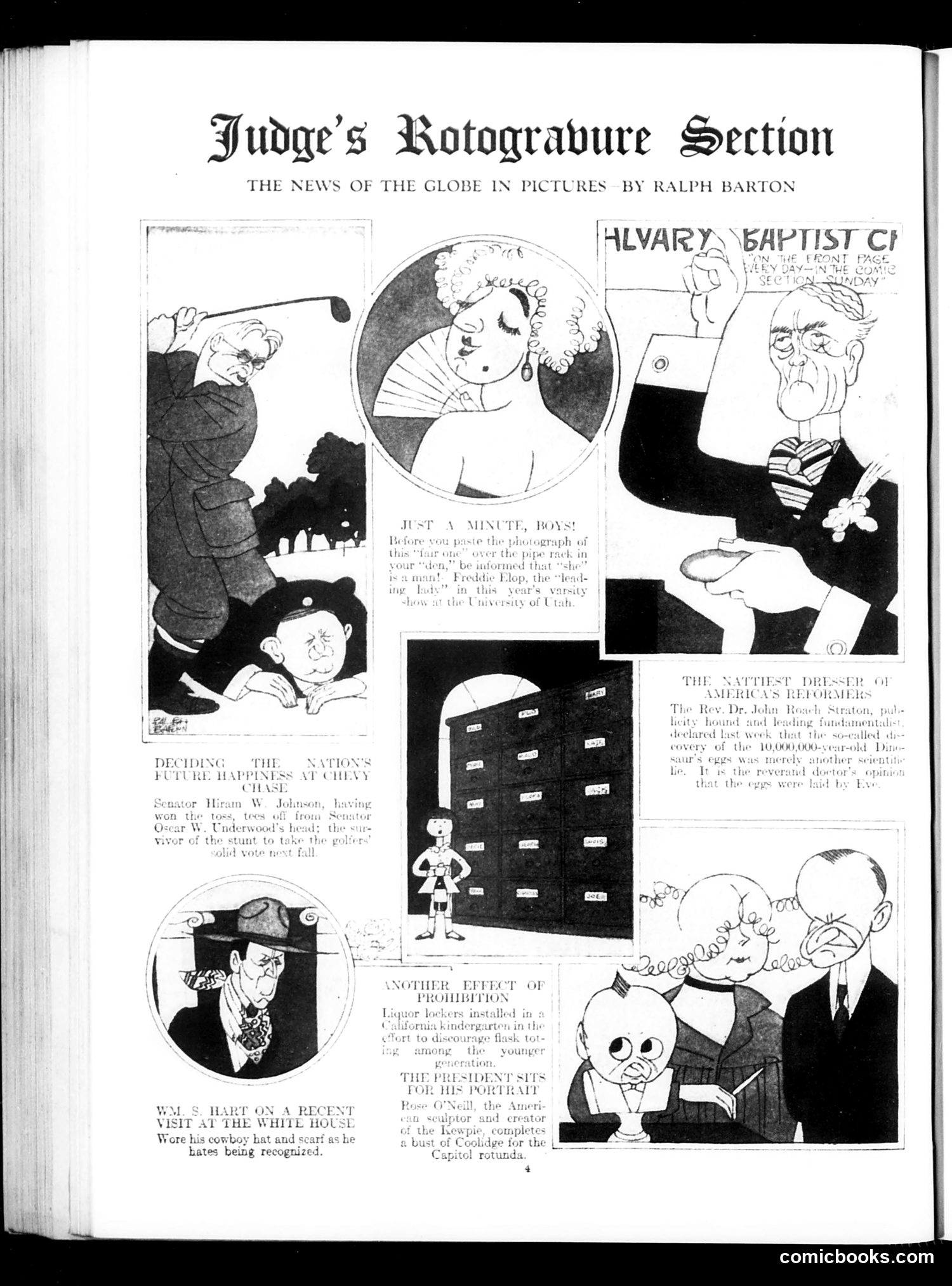
This satirical page from *Judge* magazine features several political cartoons from the Prohibition era: **Top left**: Senator Hiram W. Johnson and Oscar W. Underwood are caricatured debating who'll receive the Republican presidential nomination—depicted as a golf competition where the winner takes the "golfers' old vote next fall." **Center**: A woman labeled "Freddie Flop, the 'lending lady'" represents varsity show entertainment at University of Utah. **Right side**: Rev. Dr. John Roach Straton, a fundamentalist minister, is mocked for claiming dinosaur eggs were "lost by Eve"—satirizing anti-evolution religious arguments. **Bottom**: "Another Effect of Prohibition" shows liquor lockers installed in a kindergarten to discourage flask-toting. WM. S. Hart's White House visit is also referenced. The page satirizes 1920s political debates, religious fundamentalism, and Prohibition-era concerns.
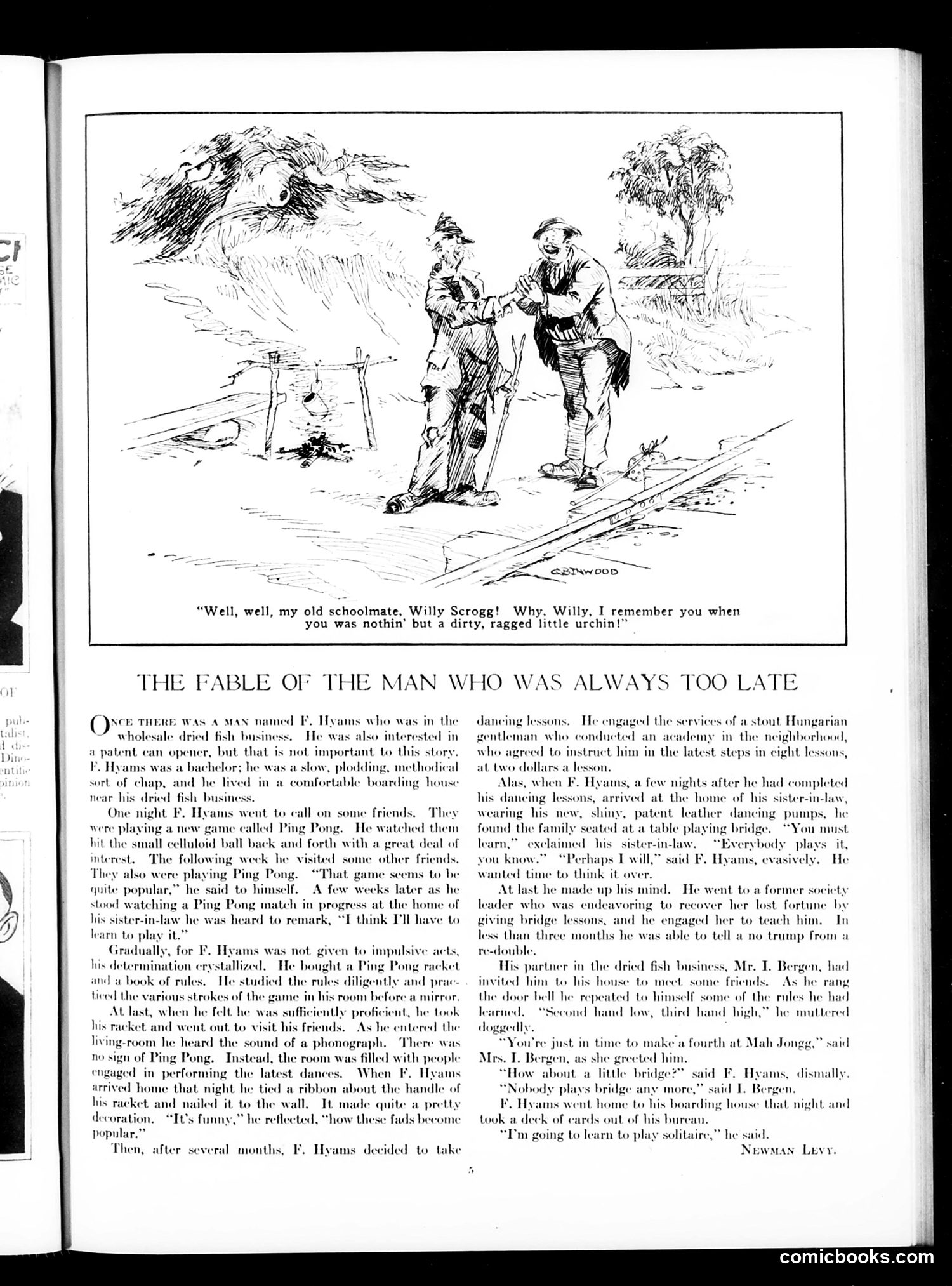
This is a satirical story illustrated by Corwood about F. Hyams, a slow, methodical dried-fish businessman perpetually chasing social trends—always arriving just after they've passed. The narrative follows his repeated pattern: he observes Ping-Pong becoming popular, studies it carefully, then arrives to find people dancing instead. Later, he laboriously learns bridge only to discover Mah-Jongg has replaced it as the fashionable game. The top cartoon shows Hyams reuniting with a childhood schoolmate, contrasting their social trajectories. The satire targets a recognizable type: the uncool, risk-averse social climber who methodically pursues respectability but lacks intuition or spontaneity. By the time he masters each fad through diligent study, society has moved on. The joke—that he ultimately resigns himself to learning solitaire—suggests some people are simply destined to remain outsiders, regardless of effort.
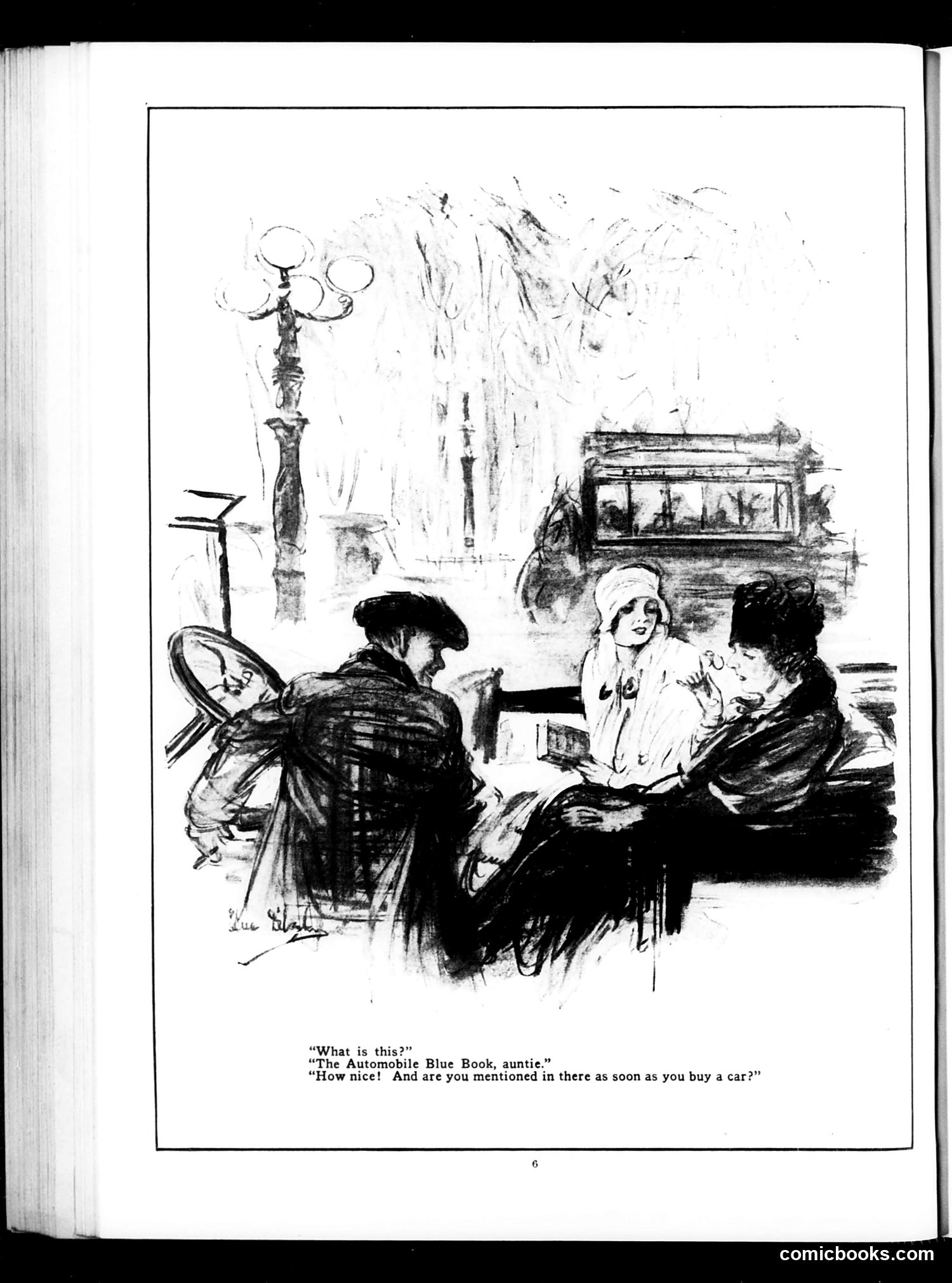
This is a humorous cartoon satirizing the *Automobile Blue Book*, an early automotive industry directory listing car owners. The joke hinges on social vanity: an older woman (likely representing a traditional, upper-class perspective) assumes that purchasing a car automatically grants one entry into this prestigious registry—as though buying an automobile instantly elevates one's social status enough to be documented in an official publication. The satire mocks both the nouveau riche's aspirations and the commercial machinery that caters to them. The young person's response (implied by the aunt's question) suggests this is exactly what attracts buyers: the promise of social recognition and status symbol acquisition through car ownership during the automobile boom era.
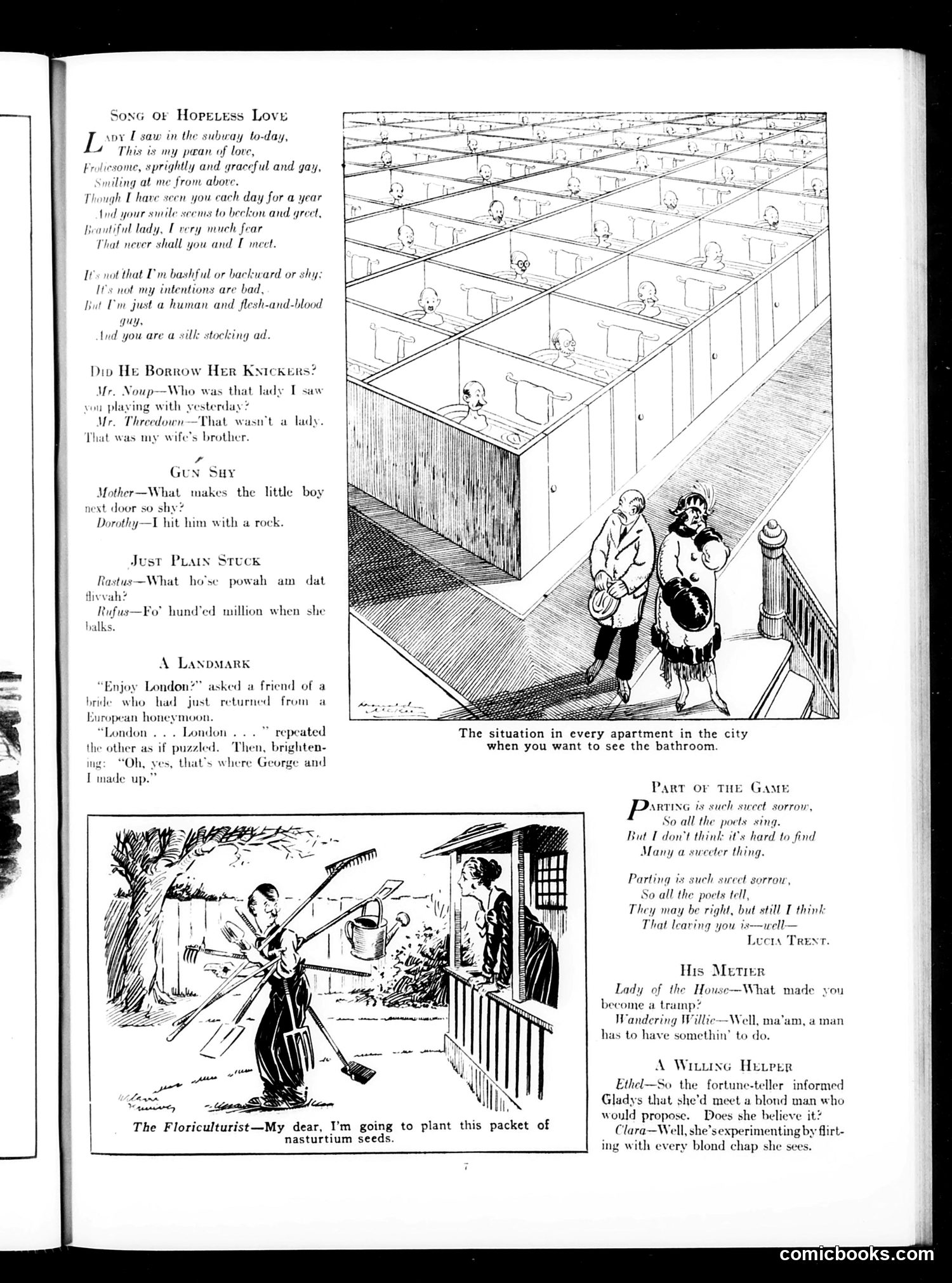
This page presents several short humorous pieces satirizing early 20th-century urban life and social conventions. The main cartoon depicts cramped apartment living—a grid of tiny bathroom stalls—mocking the absurdity of crowded city housing where privacy is nonexistent. The caption notes this reflects "the situation in every apartment in the city when you want to see the bathroom," a jab at urban overcrowding. Other pieces mock contemporary social situations: a man's unrequited love for a subway advertisement ("silk stocking ad"), gender confusion about a cross-dressing man mistaken for a lady, class dynamics with a "tramp" character, and romantic clichés about parting being "sweet sorrow." The floriculturist cartoon plays on horticultural pretension. Overall, the page uses gentle satire targeting urban congestion, advertising's invasiveness, class markers, marriage, and the gap between romantic poetry and mundane reality—typical Judge magazine fare poking fun at modern American social anxieties.
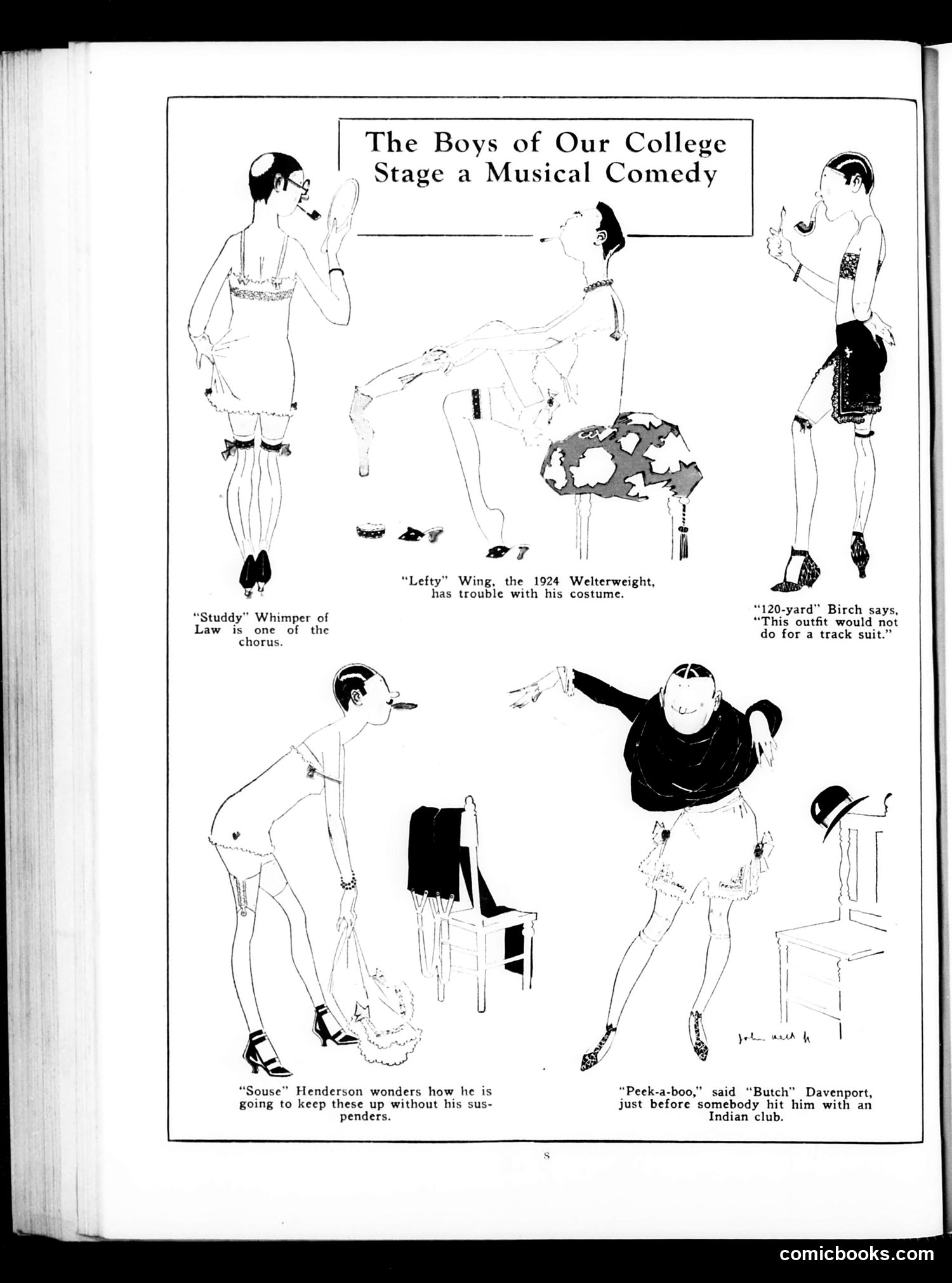
This Judge satirical page lampoons a college theatrical production by depicting male students in women's chorus costumes—a common practice in early 20th-century college shows where men performed female roles. The humor derives from the physical awkwardness of athletic young men (identified by sports nicknames like "Lefty" Wing, a boxer, and "120-yard" Birch, an athlete) squeezed into revealing female costumes. Each caption highlights a specific comedic complaint: costume malfunctions, wardrobe insufficiency for athletic builds, and the general indignity of wearing such attire. The cartoonist satirizes both the absurdity of cross-dressing theatrical traditions and the contrast between masculine college athletes and feminine performance costumes. This reflects contemporary attitudes toward theatrical gender performance and college culture circa the 1920s.
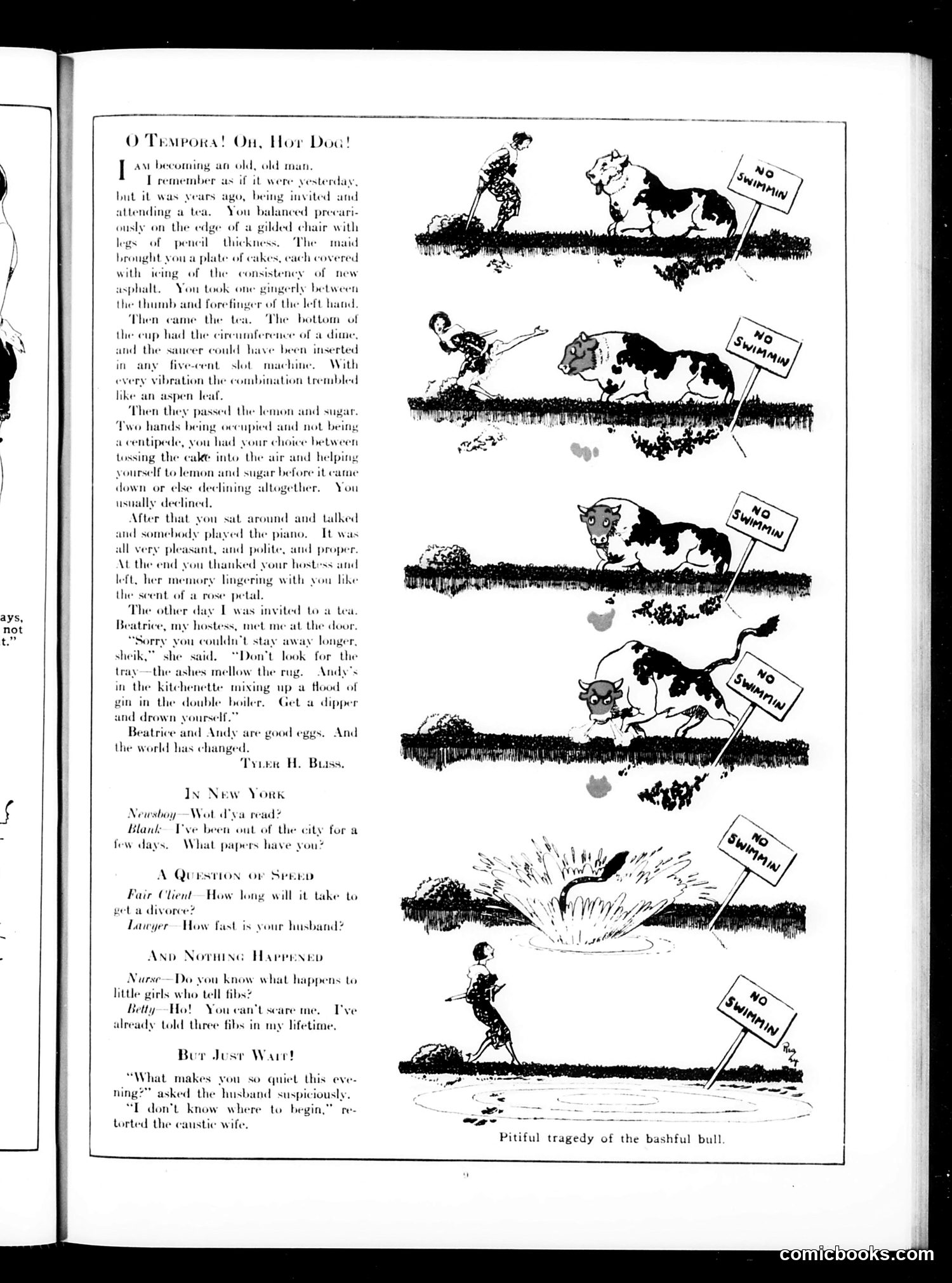
This page contains several short humor pieces and a comic strip about a "bashful bull." **The main story, "O Tempora! On, Hot Dow!"** contrasts old-fashioned tea etiquette with modern (1920s) informality. The narrator recalls attending a formal Victorian tea with delicate cups and careful behavior. He's then invited to a modern tea by "Beatrice and Andy," where the hostess apologizes for mess, mentions ashes on the rug, and the host is "mixing up a flood of gin in the double boiler"—a reference to Prohibition-era illegal alcohol production. The satire mocks how drastically social customs changed, particularly around propriety and alcohol consumption. **The remaining items are brief comic exchanges** about divorce speed, children's lying, and marital discord—typical magazine filler humor. **The illustrated strip** shows a bull repeatedly charging a "No Swimming" sign and being knocked back, ending in an explosion. The caption "Pitiful tragedy of the bashful bull" suggests ironic humor—the bull is anything but bashful, aggressively attacking the sign.
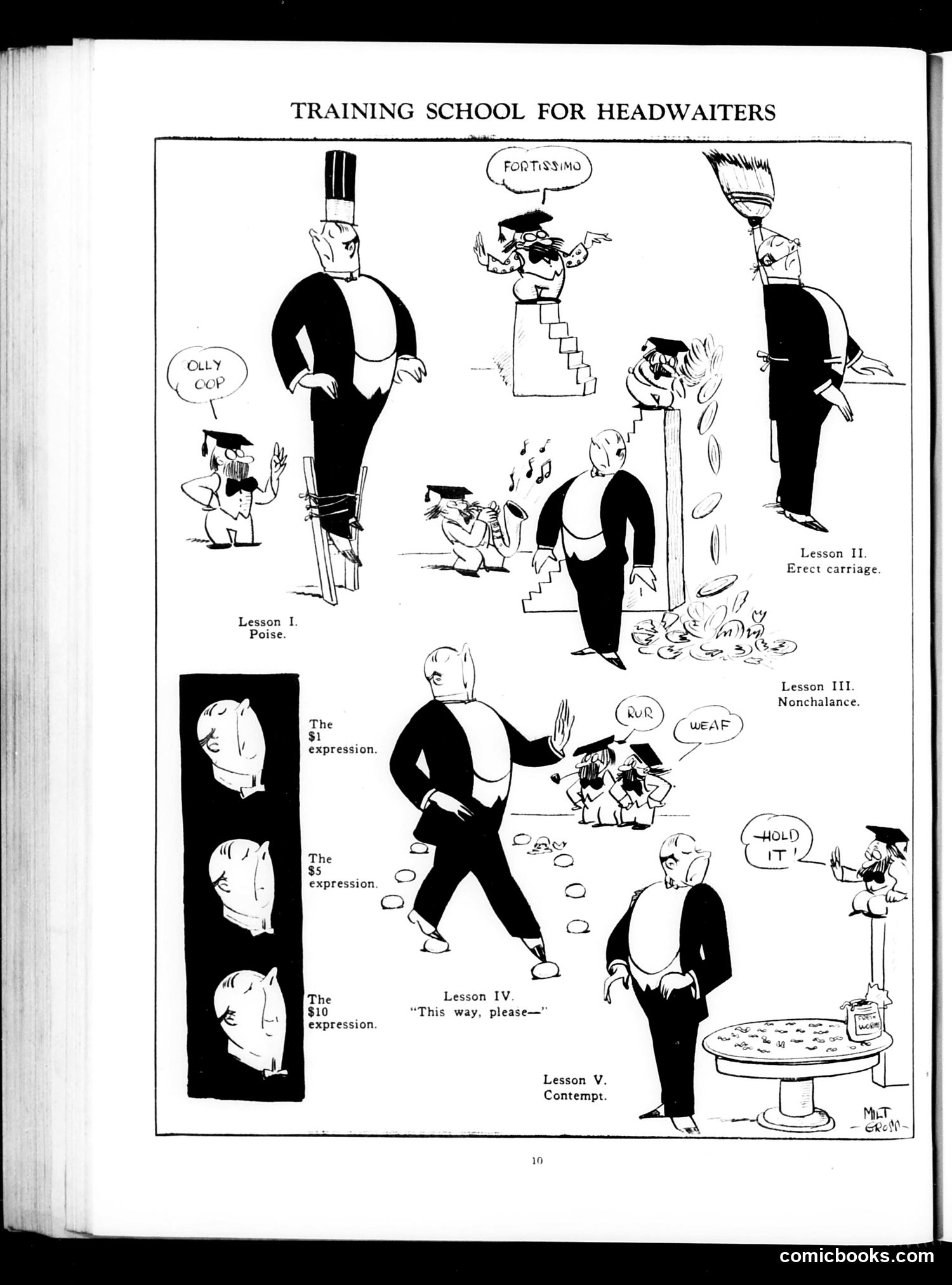
This satirical cartoon mocks the exaggerated mannerisms and class pretensions of headwaiters in upscale restaurants. It presents five "lessons" teaching the stereotypical behaviors expected of the profession: proper posture and poise, maintaining a dignified demeanor ("erect carriage"), projecting practiced nonchalance, directing patrons with affected courtesy ("This way, please"), and most pointedly, displaying open contempt toward customers. The humor lies in exposing the headwaiter as a performer mastering theatrical affectation and barely-concealed disdain for those he serves—suggesting that restaurant hierarchy and snobbery were readily apparent to contemporary diners. The facial expressions panels emphasize how the "contempt" expression correlates with different price tiers, implying the attitude scales with the restaurant's pretension.
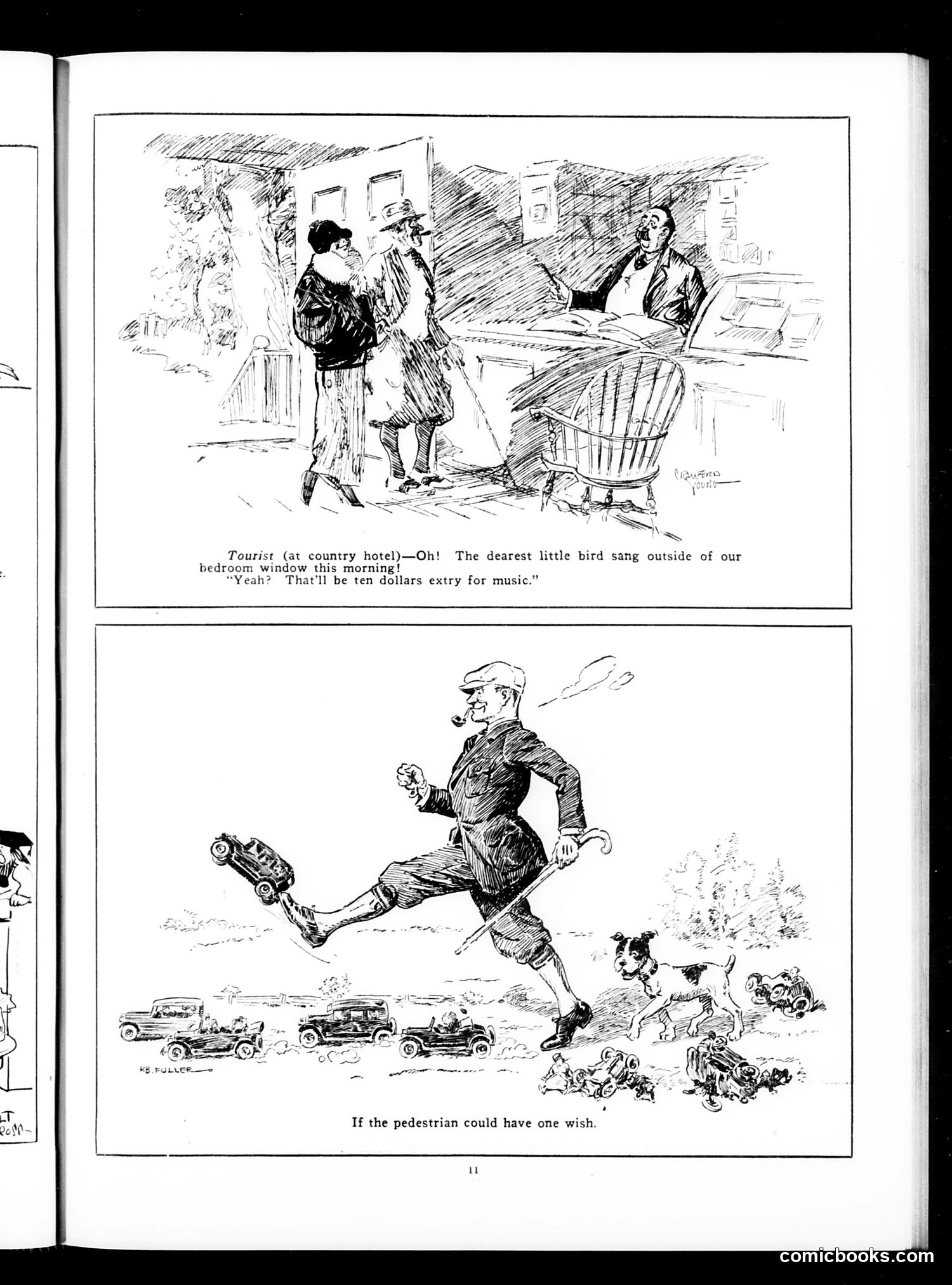
**Top cartoon:** A tourist at a country hotel complains about a bird singing outside their bedroom window. The hotel clerk responds by charging an extra ten dollars "for music." This satirizes rural innkeepers' greed and opportunism—extracting fees for every possible amenity, even natural occurrences beyond their control. It mocks both their penny-pinching entrepreneurship and tourists' tendency to complain about minor inconveniences. **Bottom cartoon:** Titled "If the pedestrian could have one wish," it depicts a man gleefully kicking toy automobiles while dogs attack toy cars. This reflects early 20th-century frustration with automobiles—vehicles that were still relatively new, dangerous, and represented an intrusive modern threat to pedestrians and traditional street life. The cartoon expresses the common person's fantasy of revenge against the automobile age.
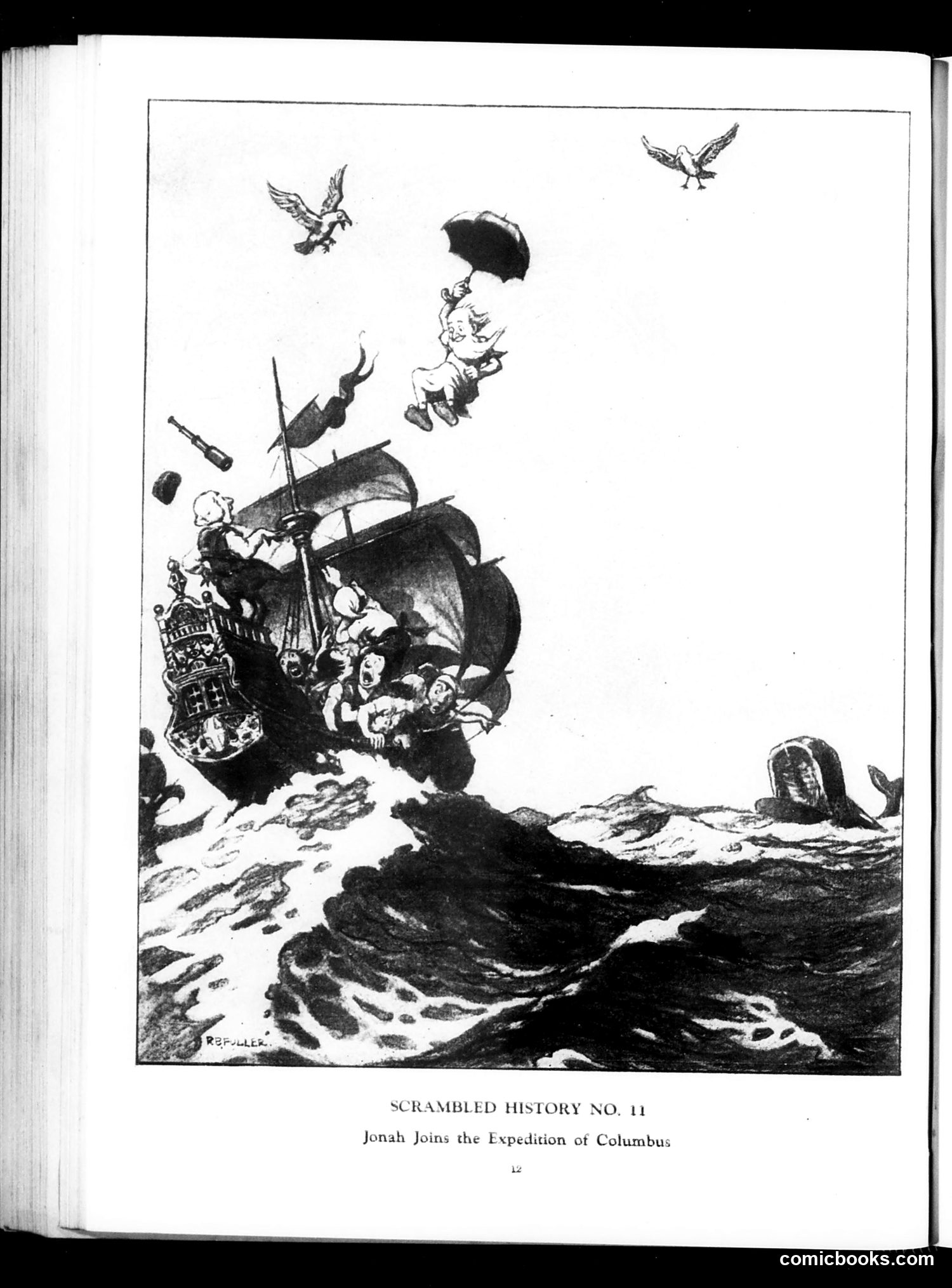
This is a humorous illustration from Judge magazine's "Scrambled History" series, which reimagined biblical and historical figures in anachronistic situations. The cartoon depicts the biblical figure Jonah (famous for being swallowed by a whale) joining Columbus's 1492 voyage. The joke appears to be visual wordplay: Jonah's story involves a large sea creature, making him a comically apt companion for an ocean expedition. The illustration shows a crowded ship with multiple figures, including what appears to be Jonah with an umbrella, floating above amid chaos and birds, suggesting the absurdity of mixing biblical narrative with historical exploration. The satire relies on the audience's familiarity with both the Jonah whale story and Columbus mythology, creating humor through incongruous combinations—a trademark approach of Judge's "Scrambled History" series.
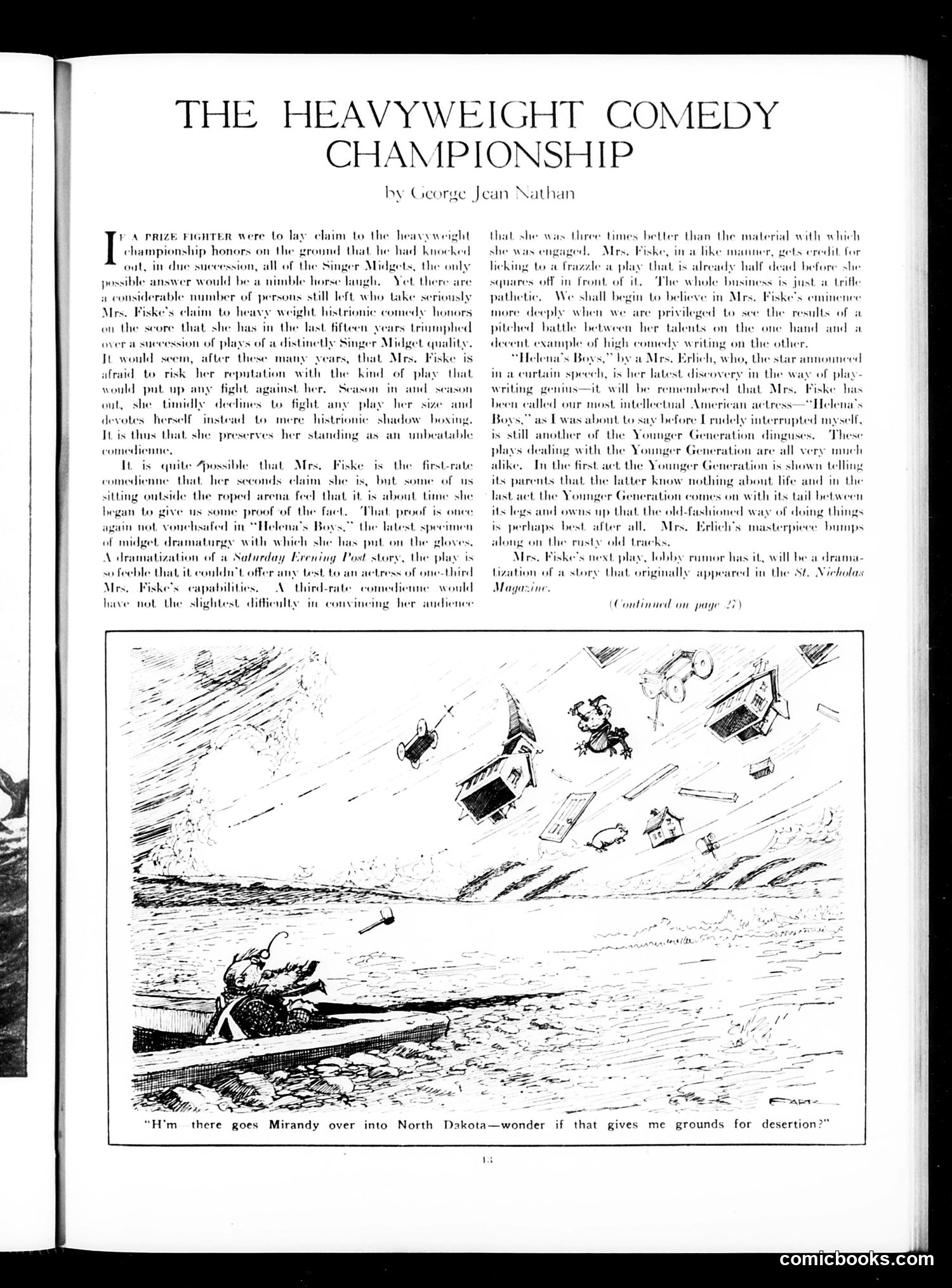
This is critic George Jean Nathan's review of actress Mrs. Fiske's theatrical career. Nathan uses boxing metaphors to argue that Fiske, while talented, has avoided challenging material—fighting only "Singer Midget" quality plays (lightweight opponents) rather than serious dramatic work. The cartoon below depicts a domestic quarrel, illustrating the weak comedic material Nathan criticizes. His point: Fiske preserves her unbeaten reputation through selective, easy roles rather than risking it against genuinely excellent plays. He demands proof of her claimed eminence by seeing her tackle substantial comedy. The review also mocks the "Younger Generation" plays (likely referencing 1920s drama about rebellious youth), calling them formulaic. Nathan's satire targets not just Fiske but lazy theatrical production that lets stars shine through sheer talent rather than quality writing.
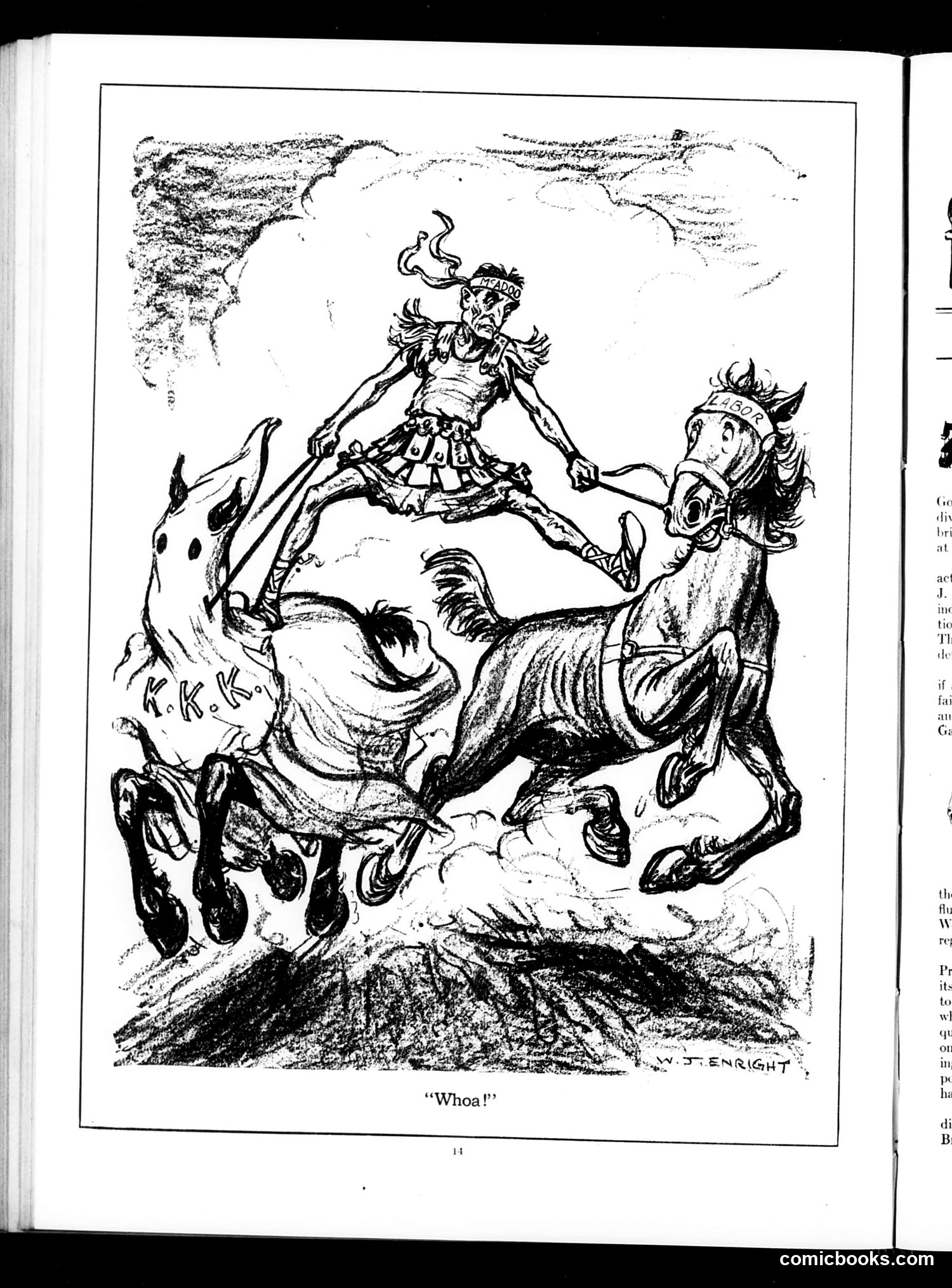
This cartoon depicts a dramatic scene with two figures riding horses that appear startled or rearing up. The central figure standing/leaping above wears classical or theatrical costume with a crown-like headpiece and appears to be a caricatured performer or political figure. The signature reads "F. Enright." The title "Whoa!" suggests loss of control. The horses bear what appear to be initials ("K.K." visible on one), likely referencing organizations or entities of the era. Without clearer context from surrounding text, the specific political reference remains unclear, though the cartoon appears to satirize some form of chaos, mismanagement, or loss of control among particular groups or institutions during this Judge magazine period.
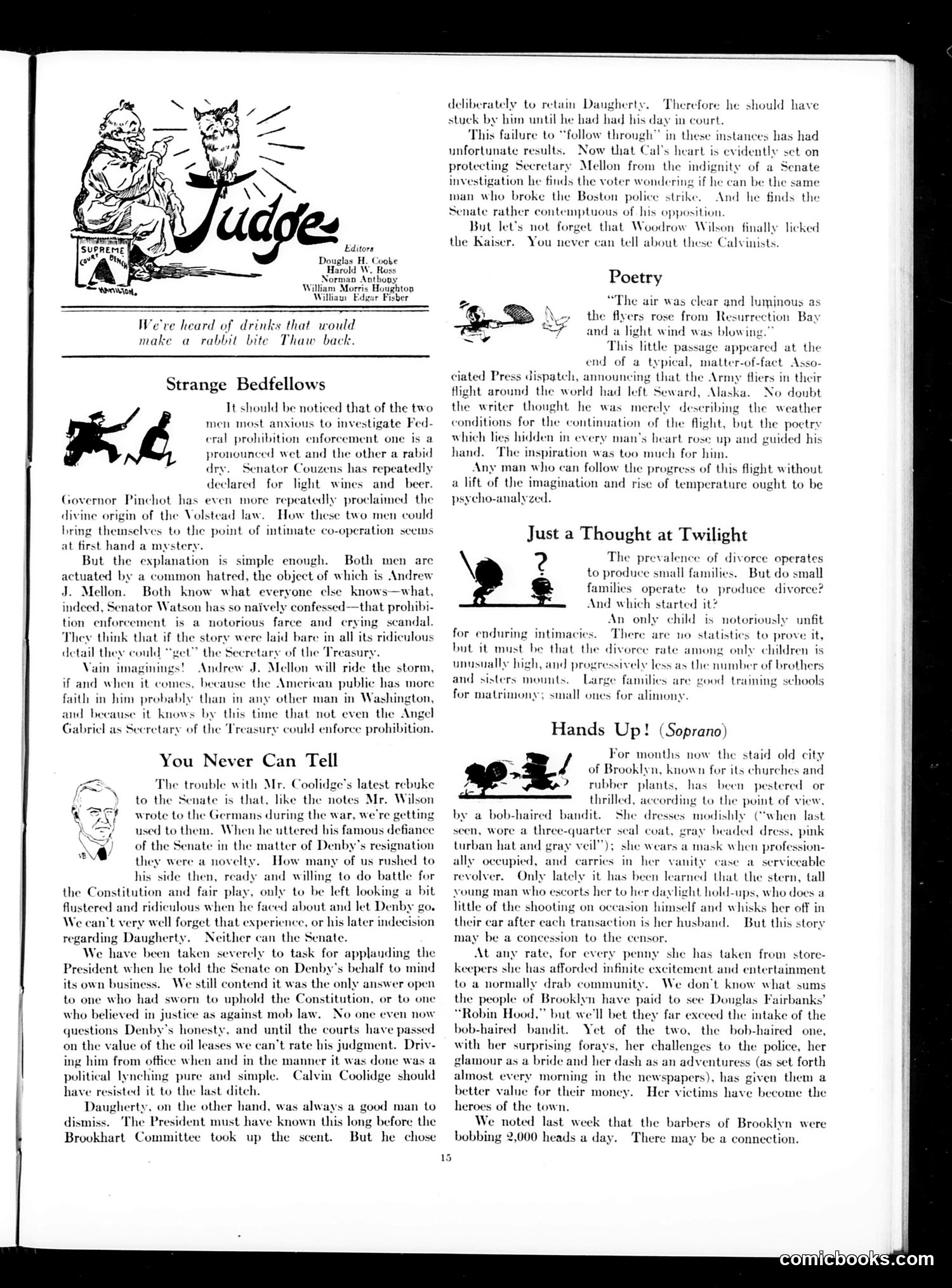
## Main Articles **"Strange Bedfellows"** critiques an unlikely alliance between Senator Couzens (a "wet"—pro-alcohol) and Governor Pinchot (a "dry"—Prohibition supporter) investigating federal Prohibition enforcement. Their shared target is Secretary of Treasury Andrew J. Mellon, whom they blame for the scandal of failed enforcement. The satire suggests their cooperation, despite opposing views on Prohibition itself, reveals how thoroughly Mellon has bungled the policy. **"You Never Can Tell"** attacks President Coolidge's inconsistency. He initially defended Secretary Denby against Senate investigations (supporting executive power), then reversed course and forced Denby's resignation—undermining his own constitutional argument. Now Coolidge opposes investigating Secretary Mellon, appearing hypocritical. The piece suggests voters cannot trust his principles. Both pieces reflect 1920s Prohibition-era politics and internal Republican Party conflicts over enforcement failures and executive authority.
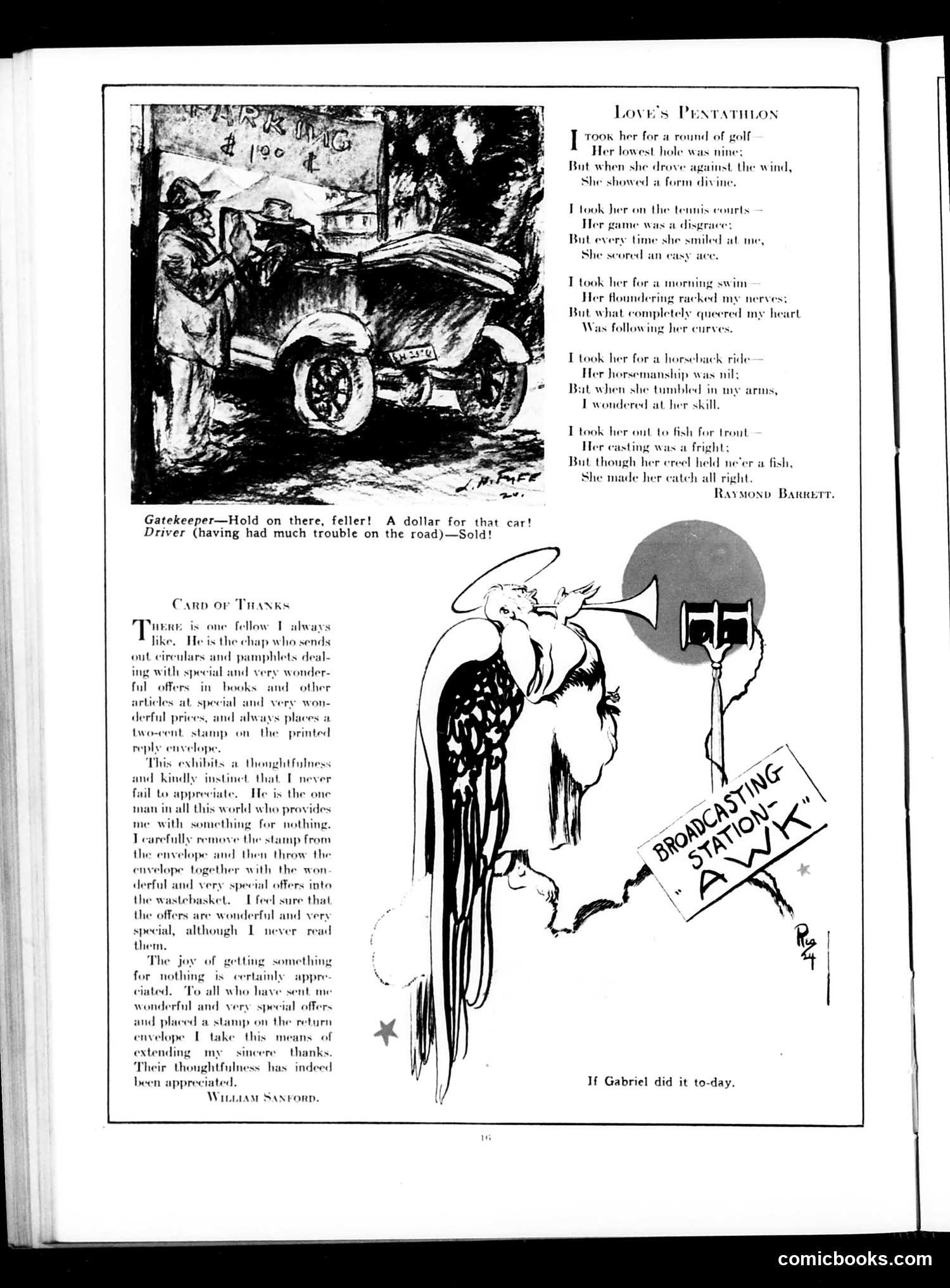
**"Love's Pentathlon"** is a humorous poem by Raymond Barrett about courtship. It catalogs five athletic activities where the narrator's romantic interest performs poorly—terrible golf, weak tennis, awkward swimming, poor horsemanship, bad fishing—yet each incompetence charms him because of her physical attractiveness ("following her curves," tumbling into his arms). The satire mocks shallow male attraction: her actual skills are irrelevant compared to her appearance and femininity. **The car cartoon** is a simple joke: a gatekeeper demands a dollar toll; a driver who's had car trouble agrees to sell the car itself for a dollar rather than pay the toll—suggesting the vehicle is worthless after breaking down repeatedly. **"Card of Thanks"** by William Sanford satirizes direct-mail marketing. He praises the one advertiser who includes a return stamp, not from gratitude but because he steals the stamp, discards the junk mail unread, and profits from the "gift." The closing line suggests even the archangel Gabriel couldn't get away with this shameless behavior today.
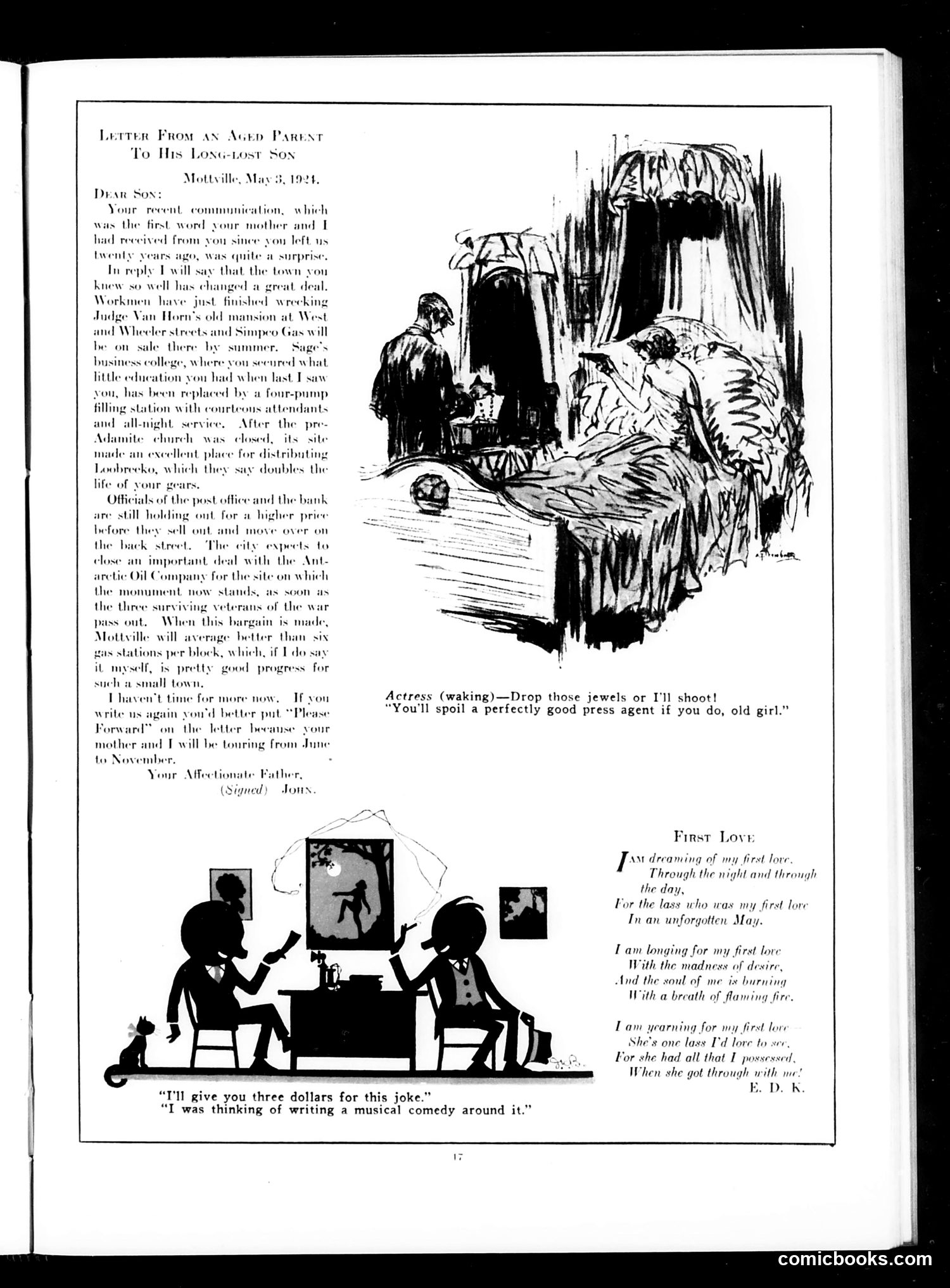
**Main Letter Cartoon**: This satirizes small-town commercialism and progress. A father writes his long-absent son about how their town "Mottville" has been transformed—historic landmarks (Judge Van Horn's mansion, the old church) demolished and replaced entirely by gas stations and filling stations. The satire targets the era's uncritical embrace of commercial development: the father boasts that the town now has "better than six gas stations per block," treating this as genuine achievement. The joke is that what he considers progress—replacing civic and historical buildings with fuel stations—actually represents cultural loss and the homogenization of American towns during the 1920s industrial boom. **Lower Cartoons**: - An actress and man discuss a jewel theft; he warns shooting will harm her "press agent"—satirizing Hollywood's obsession with publicity over substance. - A two-panel joke about someone pitching a "musical comedy" based on a simple joke, mocking show-business pretension and the era's formulaic entertainment production.
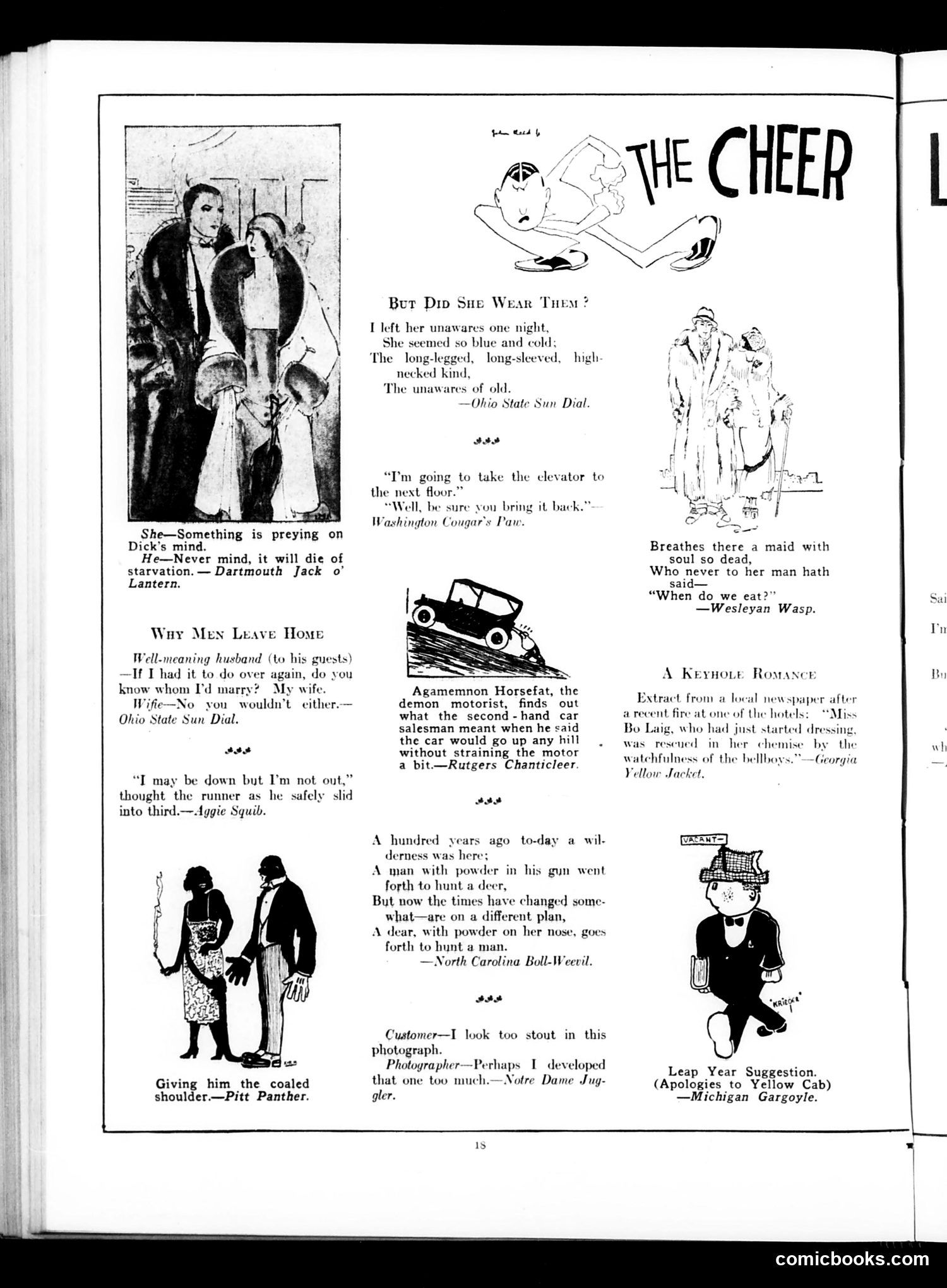
This page collects brief jokes and humorous anecdotes from college newspapers, organized by topic. The satire targets early 20th-century social conventions and gender dynamics: **"Why Men Leave Home"** mocks marital discontent—a husband jokes he wouldn't marry his wife again, but she delivers a cutting retort, suggesting wives' dissatisfaction with marriage. **"Bet Did She Wear Them?"** jokes about abandoned clothing, implying infidelity or impropriety. **"A Hundred Years Ago"** contrasts frontier hunting with modern courtship: men once hunted deer with guns; now women "hunt men" using cosmetics ("powder on her nose"). This satirizes women's increasing agency in dating and use of makeup. **"Leap Year Suggestion"** references the tradition where women propose to men during leap years—inverting normal courtship roles for comic effect. **"A Keyhole Romance"** depicts a woman's vanity and materialism in relationships. Overall, these jokes reflect 1920s anxiety about shifting gender roles and women's growing social independence.
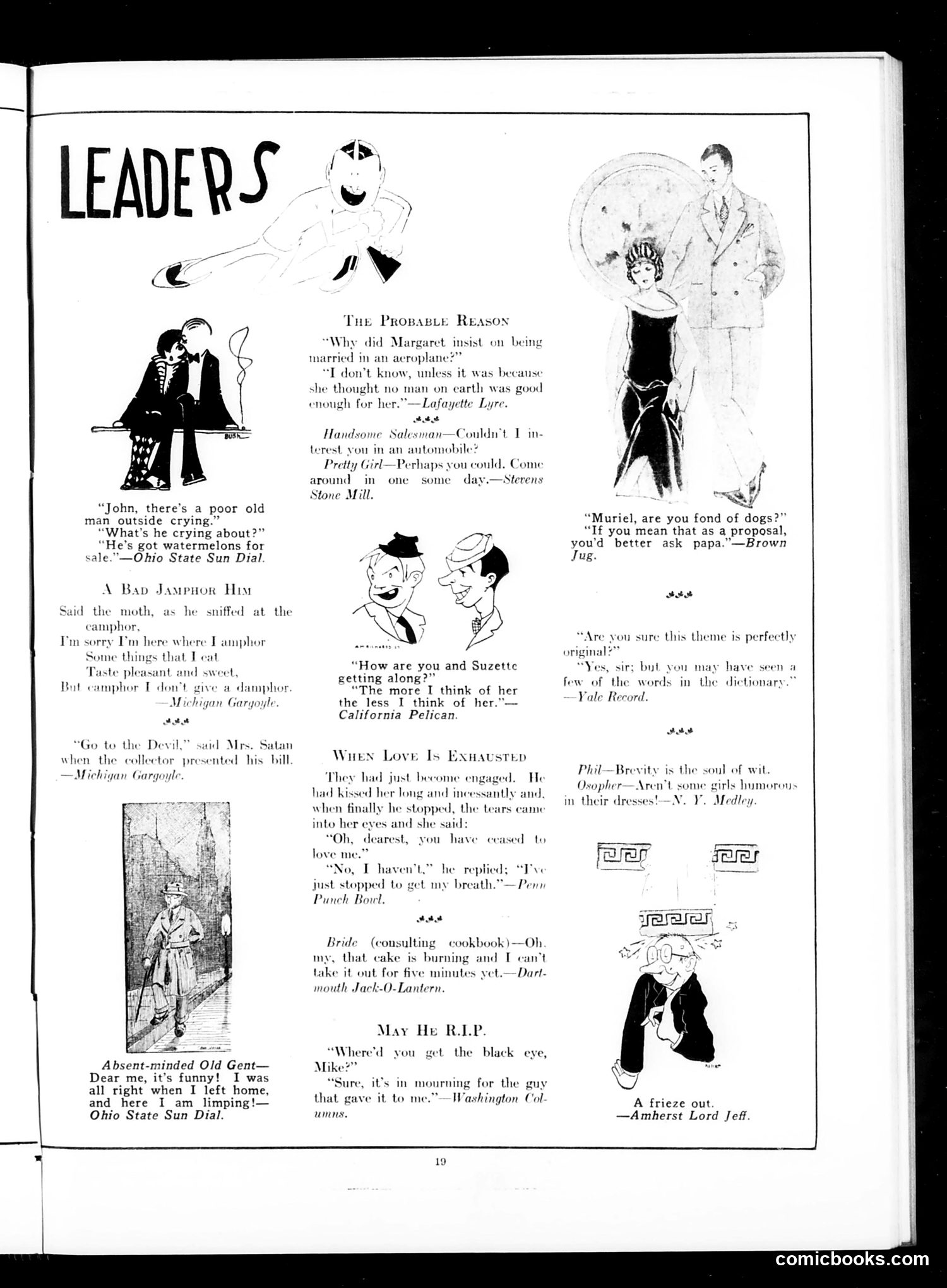
This page from *Judge* magazine collects brief humorous anecdotes and jokes from college humor publications, organized under the heading "Leaders." The content consists entirely of **short jokes and witticisms** rather than political cartoons. They cover standard early-20th-century collegiate humor topics: romantic misunderstandings (a man proposing via dog ownership; an engaged couple exhausted from kissing), absent-mindedness, domestic mishaps (a bride burning cake), and wordplay (a moth punning about camphor). The accompanying illustrations are simple line drawings accompanying these gags—a hockey player, a man in a suit, couples, and a figure labeled "A frieze out." **The satire is minimal and social rather than political.** These are generic, gentle jokes likely targeting college-aged readers of *Judge's* affiliated campus publications. There are no identifiable political figures or specific historical references—just relatable scenarios meant to amuse with mild absurdity and puns typical of period humor magazines.
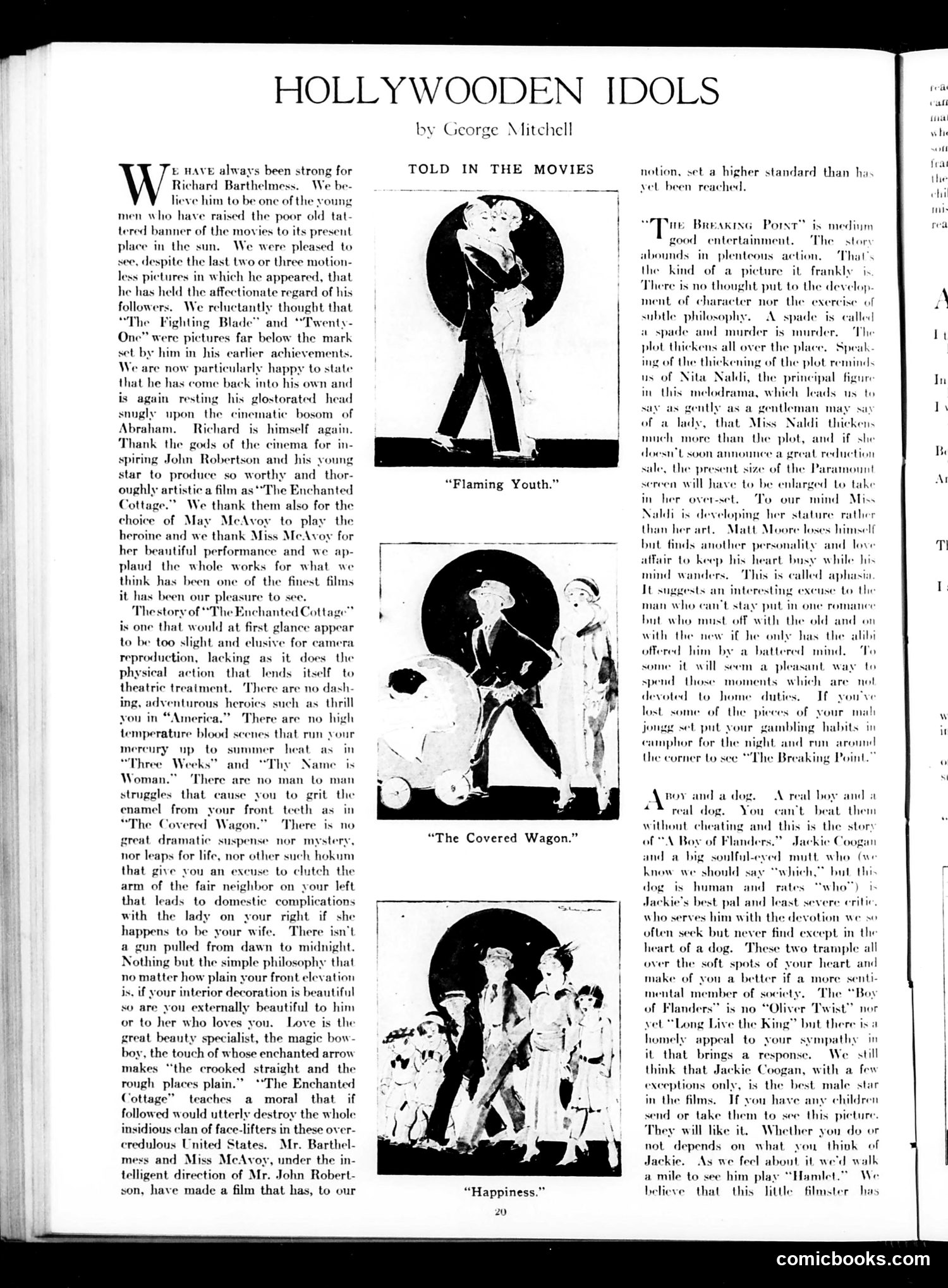
This page from Judge magazine contains film criticism by George Mitchell praising actor Richard Barthelmess and reviewing several contemporary movies. Mitchell celebrates Barthelmess's return to form in "The Enchanted Cottage," praising its subtle moral philosophy—that inner beauty makes one externally beautiful—over action-heavy spectacles. He contrasts it favorably with violent films like "America" and "The Covered Wagon." The reviews of other films are less kind. "The Breaking Point" is dismissed as formulaic melodrama, with criticism directed at actress Nita Naldi, whose physical presence apparently overwhelms the Paramount screen. "The Covered Wagon" and "Happiness" receive brief mentions. The critique reflects 1920s cultural anxieties about cinema's artistic legitimacy, with Mitchell championing character-driven narratives and moral lessons over sensationalism and physical action.
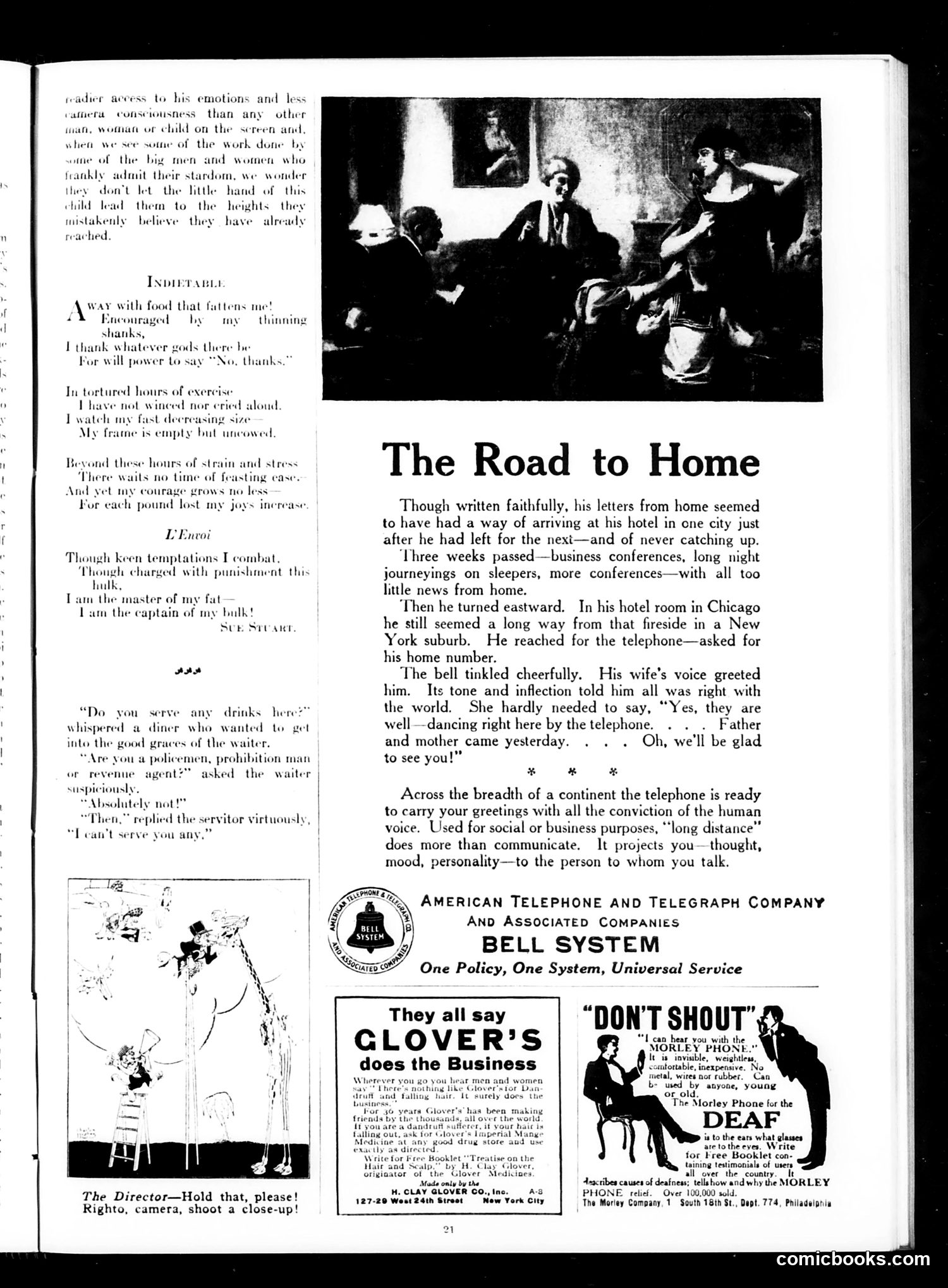
This page centers on a Bell System telephone company advertisement disguised as a sentimental short story. The narrative depicts a traveling businessman in Chicago who feels disconnected from his New York family after three weeks of business travel. When he calls home, his wife's warm voice and news that parents are visiting emotionally reconnects him across the continent. The satire is gentle: Bell System uses emotional appeal rather than technical specifications to market long-distance calling. The accompanying advertisements below—for Clover's patent medicines, hair products, and the "Morley Phone for the Deaf"—represent typical Judge magazine commercial content from this era (likely 1920s-1930s based on style). The poem "Indictable" on the left mocks prohibition-era dining customs. The page demonstrates how advertisements infiltrated magazines by wrapping commercial messages in human-interest storytelling, a marketing technique modern readers would recognize as advertorial content.
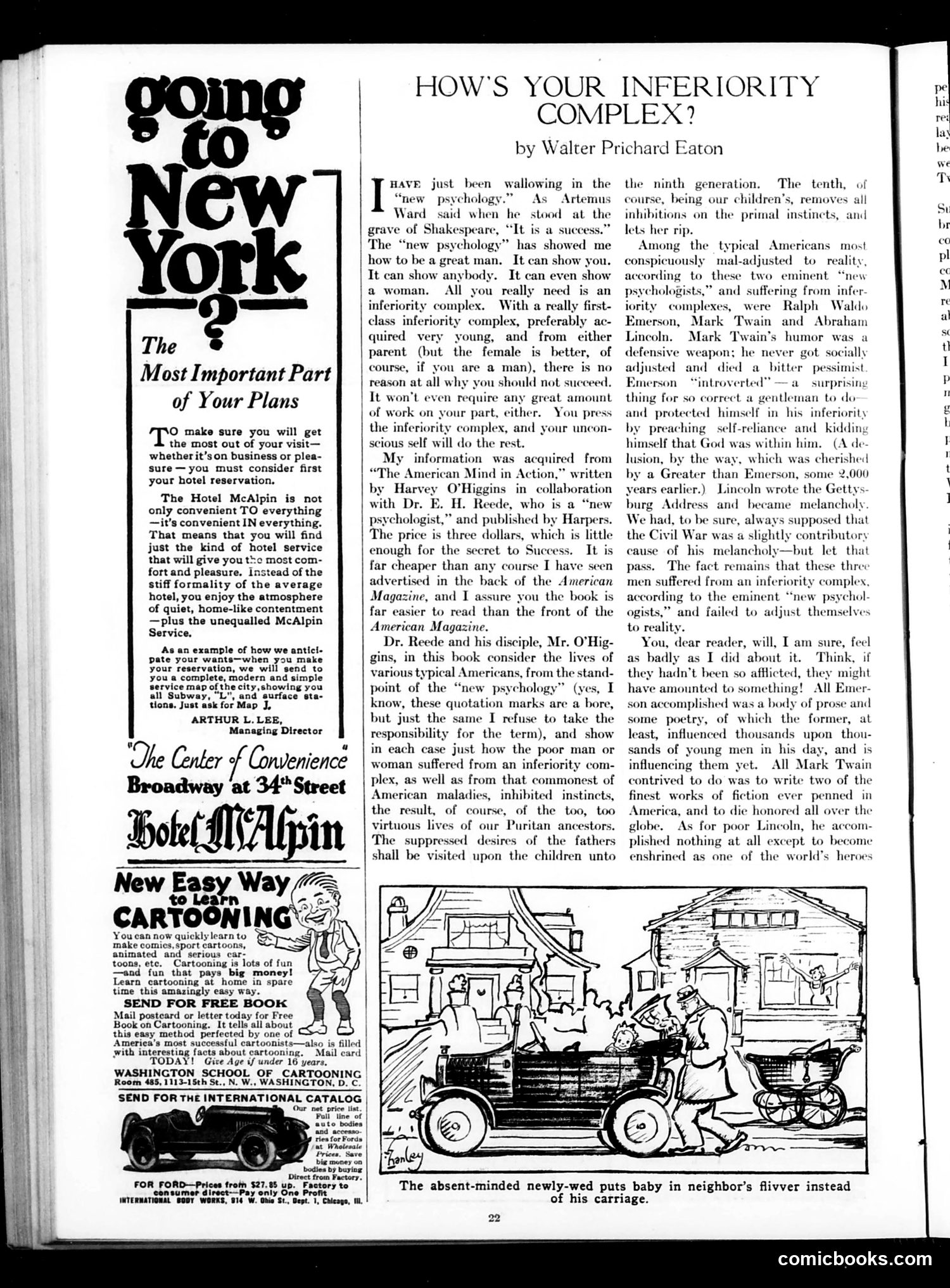
This page combines editorial commentary on the "new psychology" fad of the 1920s with period advertising and a cartoon. **The Main Article** ("How's Your Inferiority Complex?" by Walter Prichard Eaton) satirizes the popular psychology movement, particularly books like "The American Mind in Action" by Dr. E.H. Reede and O'Higgins. Eaton mocks how psychoanalysis promised easy success by simply identifying an inferiority complex—a concept popularized by Adler's psychology. He notes the book costs three dollars and is easier to read than *American Magazine* itself, poking fun at the oversimplification of complex psychological theory into pop-psychology self-help. **The Cartoon** shows an absent-minded newlywed placing a baby in a neighbor's car instead of his own carriage—a visual joke about scattered domesticity, likely playing on the theme of unconscious behavior the article discusses. **The Advertisements** promote the Hotel McAlpin, cartooning courses, and Ford auto bodies—typical 1920s consumer offerings positioning themselves as solutions to modern life's problems.
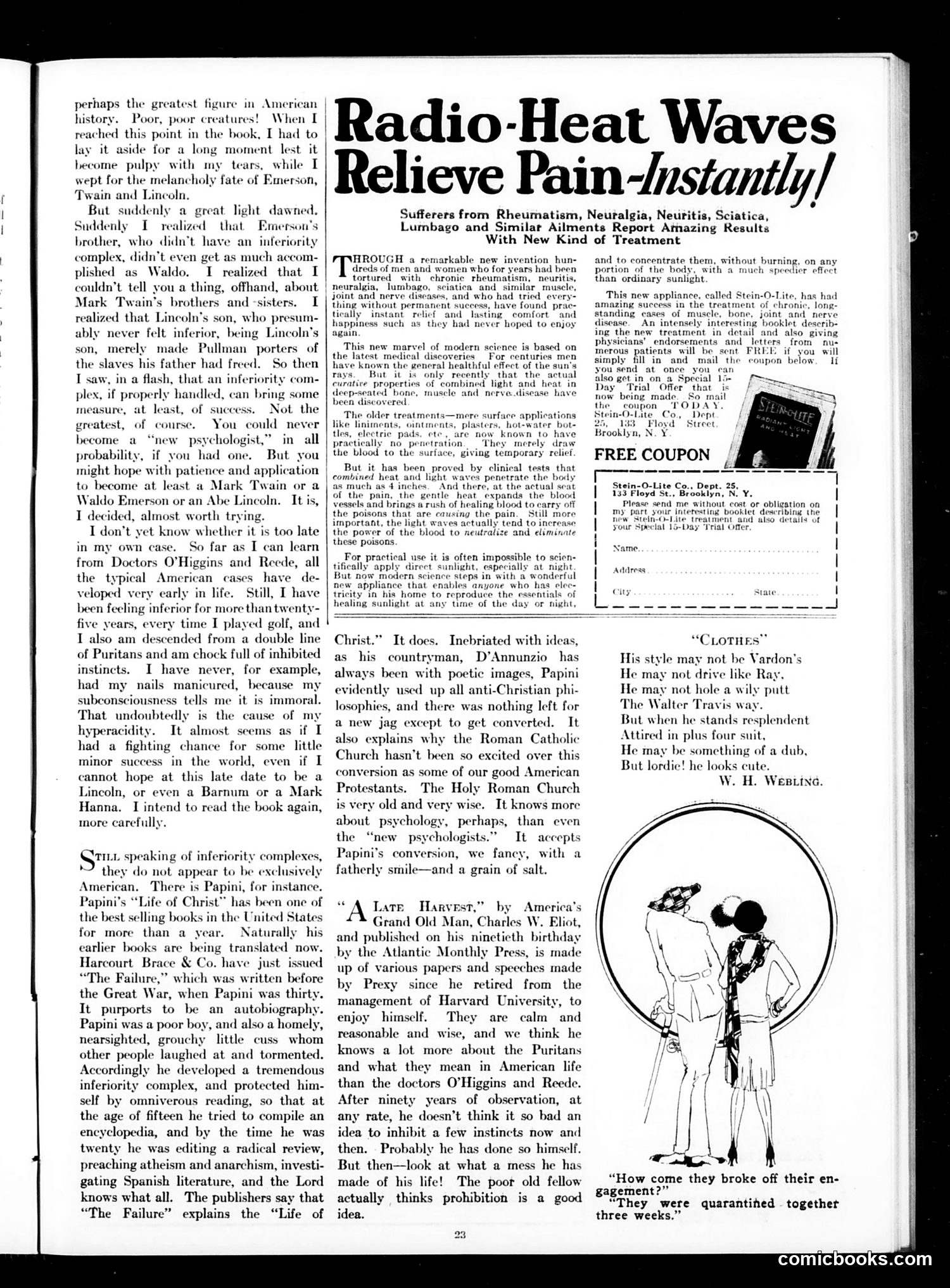
This page from Judge magazine contains two main elements: a lengthy satirical essay about inferiority complexes, and a period advertisement. **The Essay's Point:** The author mockingly discusses how American figures like Lincoln, Emerson, and Twain supposedly owed their success to inferiority complexes that drove ambition. He then references Italian author Giovanni Papini's autobiography "The Failure" as evidence that inferiority complexes aren't uniquely American—Papini was an unattractive, mocked boy who channeled his neuroses into prolific writing (atheist reviews, radical philosophy) before later converting to Catholicism and achieving mainstream success with his "Life of Christ." The satire critiques pop-psychology trends of the 1920s-30s that pathologized normal human insecurity while paradoxically celebrating it as a driver of achievement. **The Advertisement:** The "Radio-Heat Waves" ad exemplifies period medical quackery—claiming radio waves cure rheumatism and neuralgia instantly, a common fraudulent medical claim of that era. The small cartoon jokes about broken engagements caused by quarantine, likely referencing pandemic-era relationship difficulties.
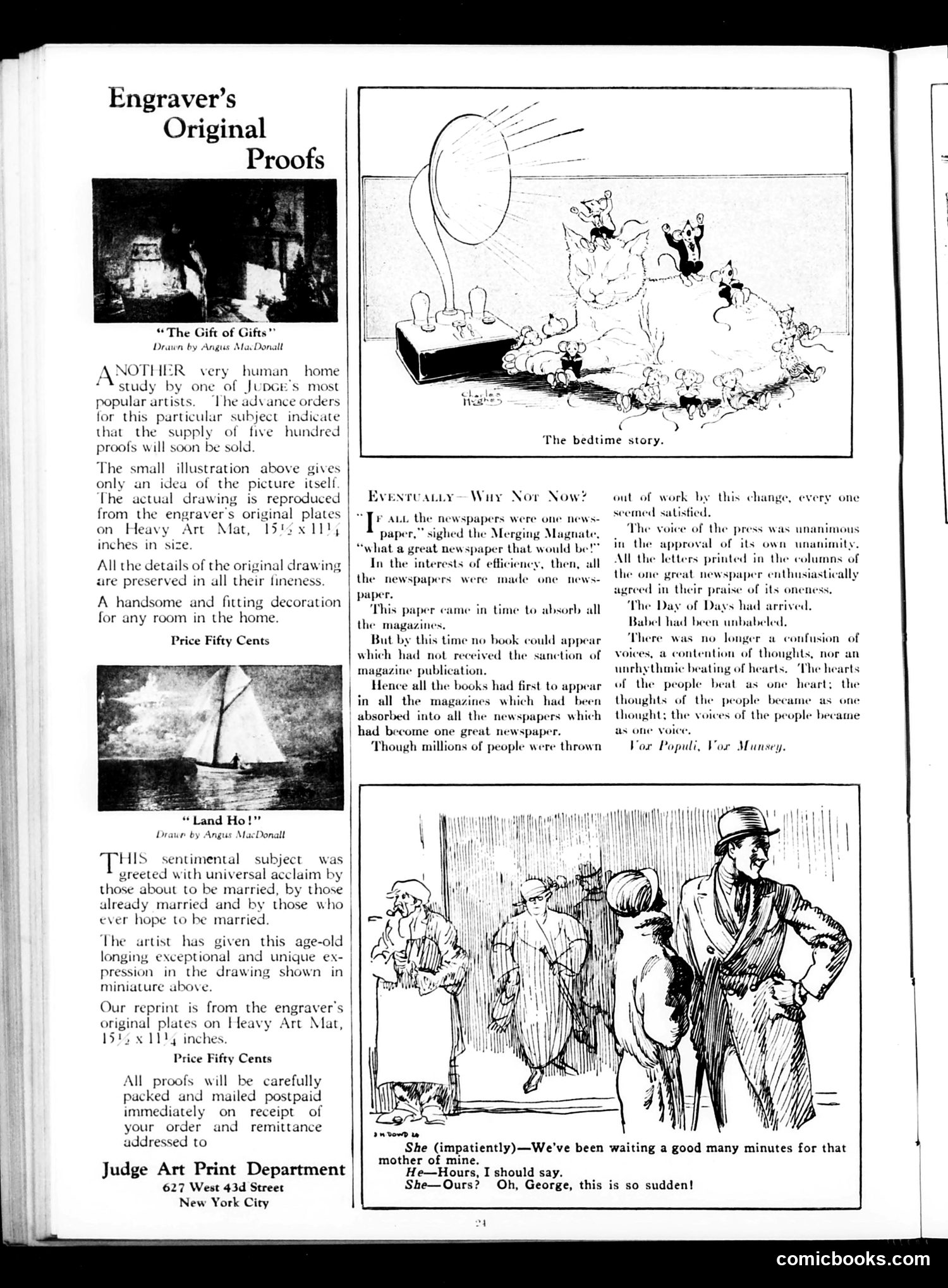
This page contains two sections: advertisements for engraved art prints and a satirical comic strip. **The Art Prints** are marketing Judge magazine's reproductions of sentimental domestic scenes ("The Gift of Gifts," "Land Ho!") priced at fifty cents each. **The Main Satire: "Eventually—Why Not Now?"** critiques media consolidation. The premise: if all newspapers merged into one, then all magazines would be absorbed into it, then all books would require magazine (and thus newspaper) approval before publication. The satire mocks this monopoly's supposed "efficiency"—millions lose jobs, but everyone celebrates unanimity: "no longer a confusion of voices." The final panel shows a couple where the woman complains about waiting for her mother; the man's joke about timing ("Hours...Ours?") contrasts the strip's dystopian vision with mundane reality. **The target**: likely Frank Munsey's 1911 consolidation of American newspapers and magazines, which Judge satirizes as dangerous groupthink disguised as progress. The satire warns that media monopoly eliminates independent thought.
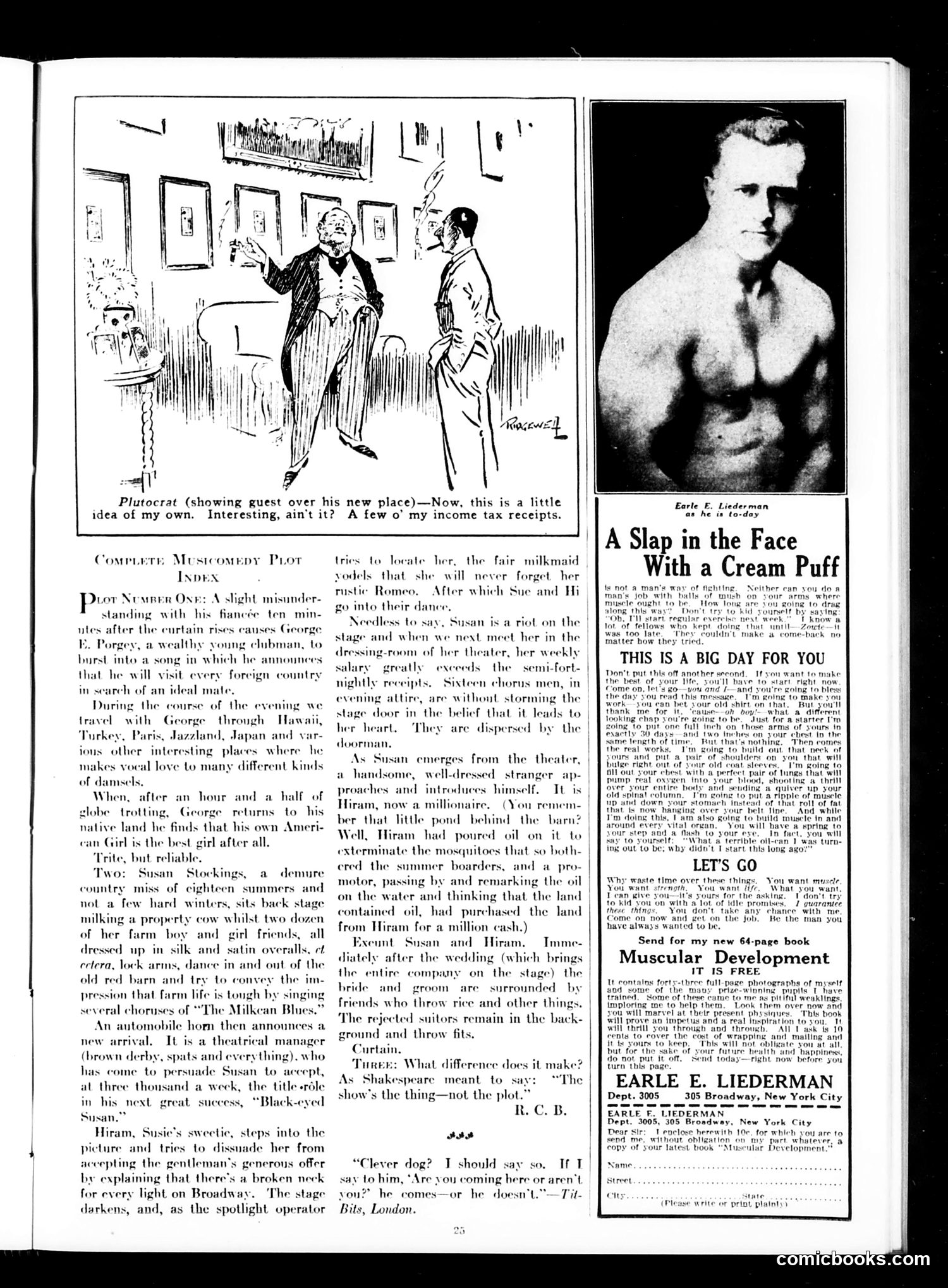
This page contains a theatrical plot summary and advertisements rather than political satire. **Left side:** "A Complete Mushroom Plot" describes a Broadway musical comedy. A wealthy young man (George E. Porgey) searches the globe for an ideal wife, discovers American women are best, and the subplot follows Susan Stockings from farm girl to Broadway star. She's courted by a theatrical manager offering a role in "Black-eyed Susan," but her sweetheart Hiram (who strikes oil and becomes a millionaire) wins her back. The satire is purely theatrical—mocking predictable operetta plots and their sentimental resolutions ("trite, but reliable"). **Top cartoon:** Shows a wealthy "Plutocrat" proudly displaying his apartment to a guest, explaining his decorations are "income tax receipts"—a joke about showing off one's financial burden ironically, likely referencing early 20th-century income tax discussions. **Right side:** Large advertisement for Earle E. Liederman's "Muscular Development" book, featuring a shirtless bodybuilder—typical fitness advertising of the era. The page is primarily entertainment and advertising rather than political commentary.
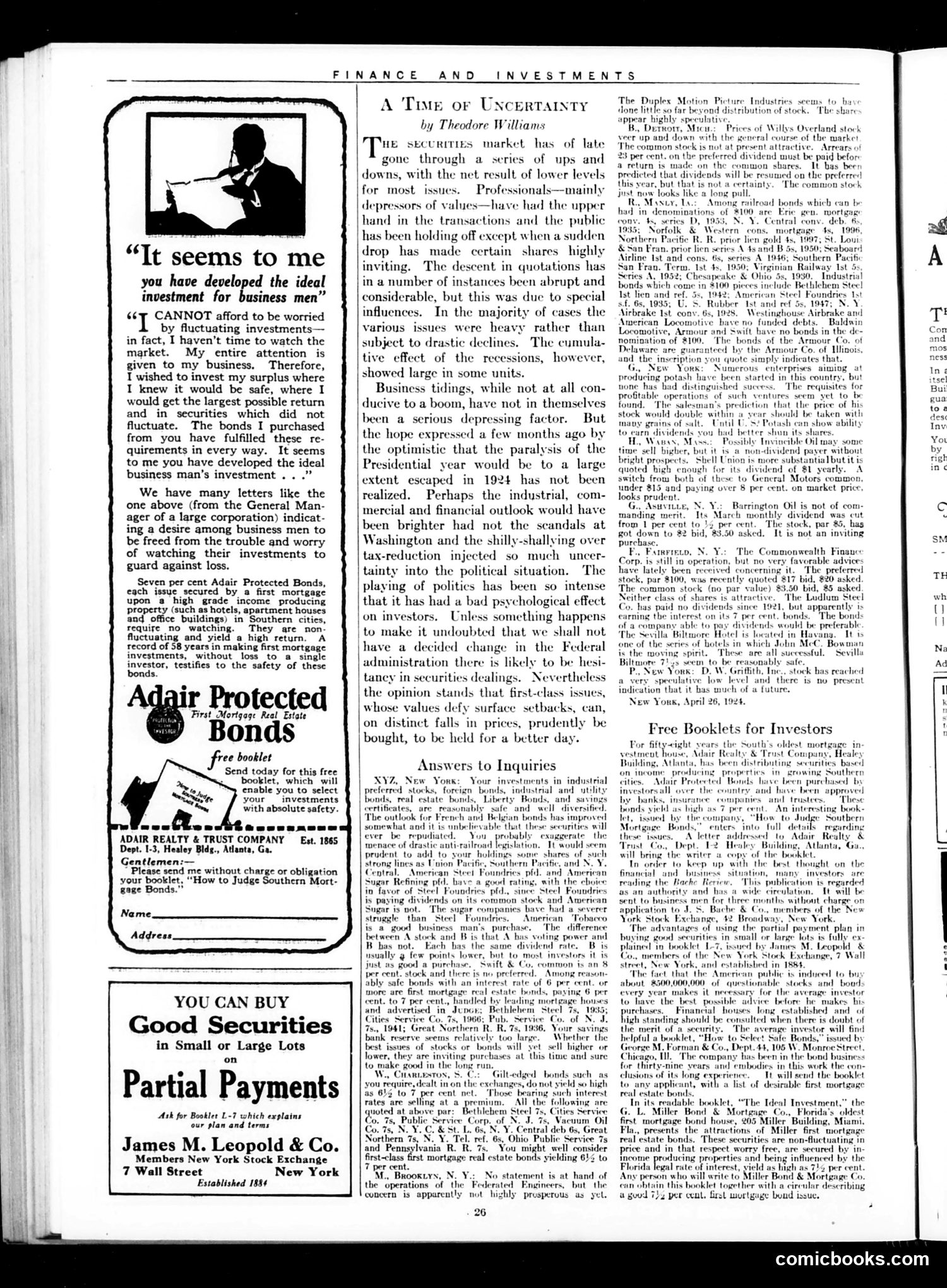
This page from *Judge* magazine combines financial advertising with commentary on 1924 market uncertainty. **The Main Cartoon/Quote:** The large illustrated quote shows a satisfied businessman endorsing "Adair Protected Bonds"—a real estate investment product. This advertorial format was common in early-20th-century magazines, blurring editorial and advertising content. **The Political Context:** Theodore Williams's article references "scandals at Washington" and "shilly-shallying over tax-reduction," likely alluding to the Teapot Dome scandal (1921-1924) and Calvin Coolidge's conservative fiscal policies. These political uncertainties supposedly deterred investors from stock markets. **The Satire/Point:** The juxtaposition suggests irony—while markets fluctuate due to political chaos, conservative bond investments (backed by tangible property) offer safety. The article advocates for "first-class issues" as reliable alternatives to volatile stocks during uncertain times. **For Today's Context:** This reflects 1920s investor anxiety over government scandals and economic policy—concerns that feel surprisingly modern.
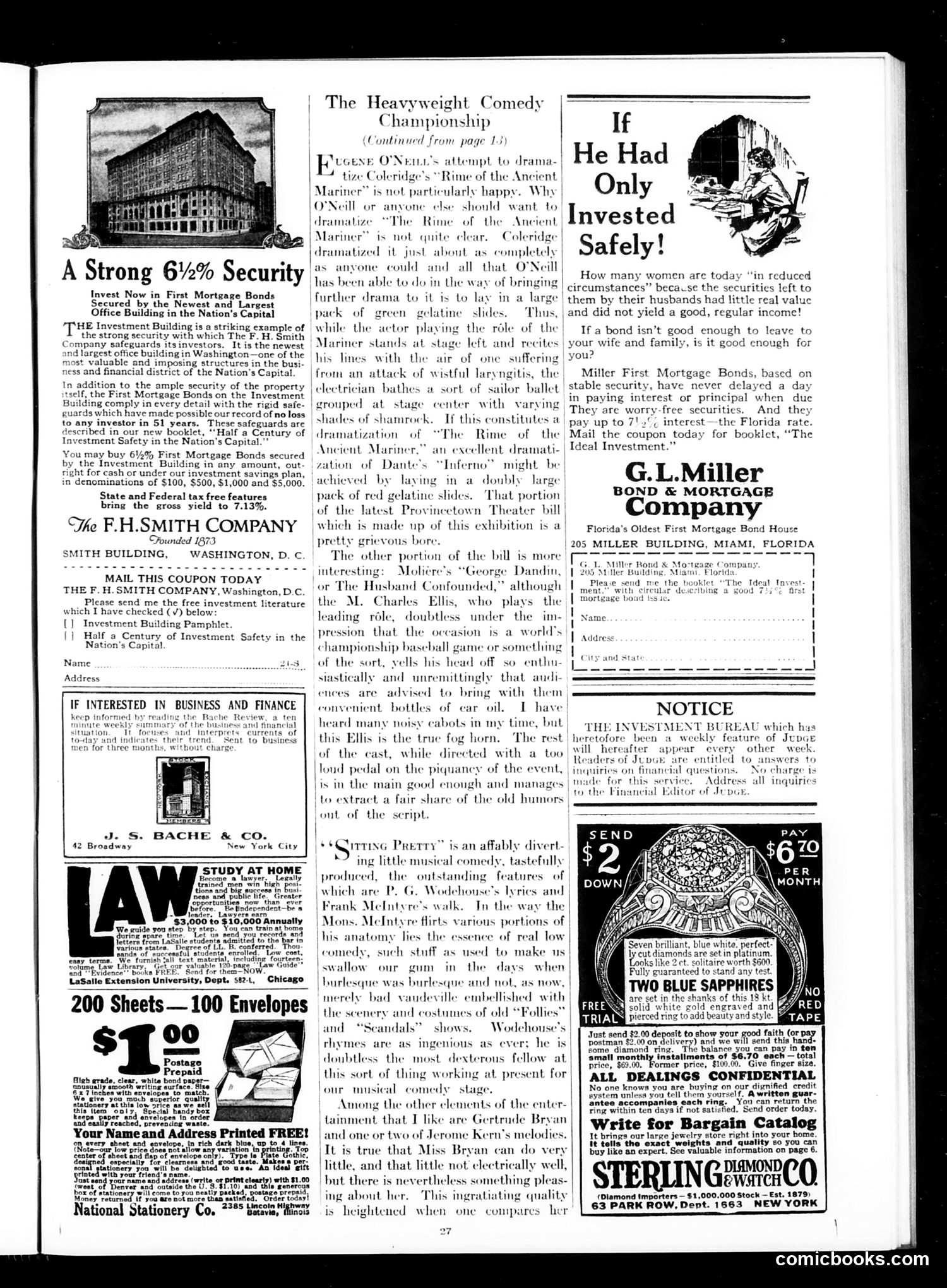
This page is primarily **advertising and financial content**, not satirical cartoons. The main feature is an investment promotion for F.H. Smith Company's First Mortgage Bonds, secured by Washington D.C.'s newly constructed Investment Building. The ad emphasizes safety and a 51-year track record of investor protection, offering bonds at 7.13% yield with tax advantages. The page includes period advertisements for legal correspondence courses, printed stationery, and jewelry. At the top is a theater review column discussing Eugene O'Neill's dramatization of Coleridge's "The Rime of the Ancient Mariner" and Molière's "George Dandin," critiquing theatrical productions. The review is entertainment journalism rather than political satire. There is **no discernible political cartoon or satirical commentary** on this page—it represents typical 1920s-era Judge magazine content mixing light theater criticism with financial advertising.
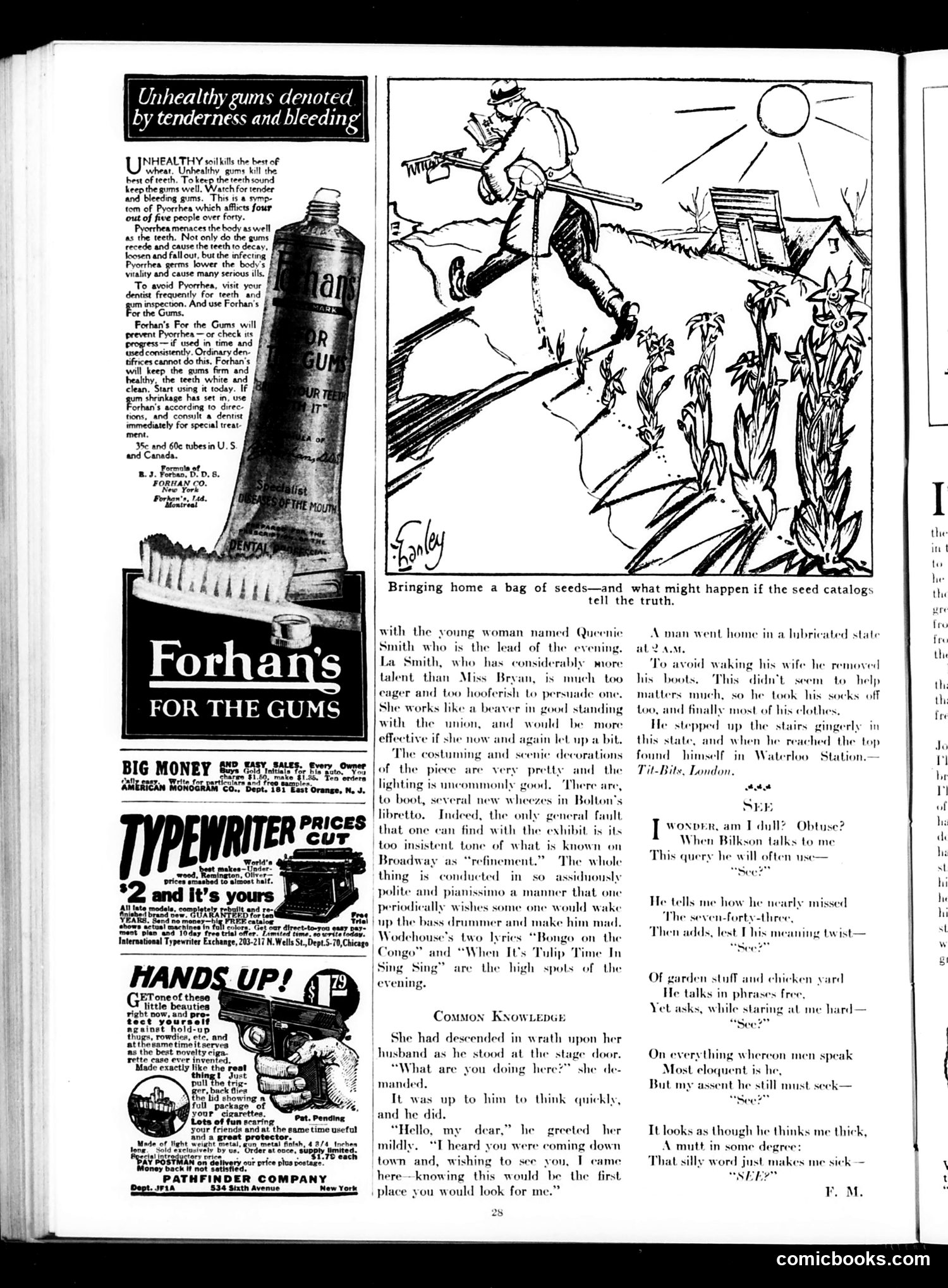
This Judge magazine page is primarily **advertising**, not political satire. The main content features: **Forhan's For the Gums advertisement**: A toothpaste/gum treatment product claiming to prevent pyorrhea (gum disease), which was presented as a serious health threat affecting "four out of five people over forty." The ad uses health-scare messaging typical of early 20th-century patent medicine marketing. **The cartoon** (top right) depicts a farmer discovering oversized vegetables from seed catalogs—satirizing the exaggerated claims in seed advertisements that promise unrealistic results. **Secondary ads** for typewriters, novelty cigarette lighters, and other products occupy the lower portion. The magazine also includes **humorous short stories and verses** about romantic mishaps and social awkwardness, with no clear political content. This appears to be a general-interest humor and advertising publication rather than political commentary.
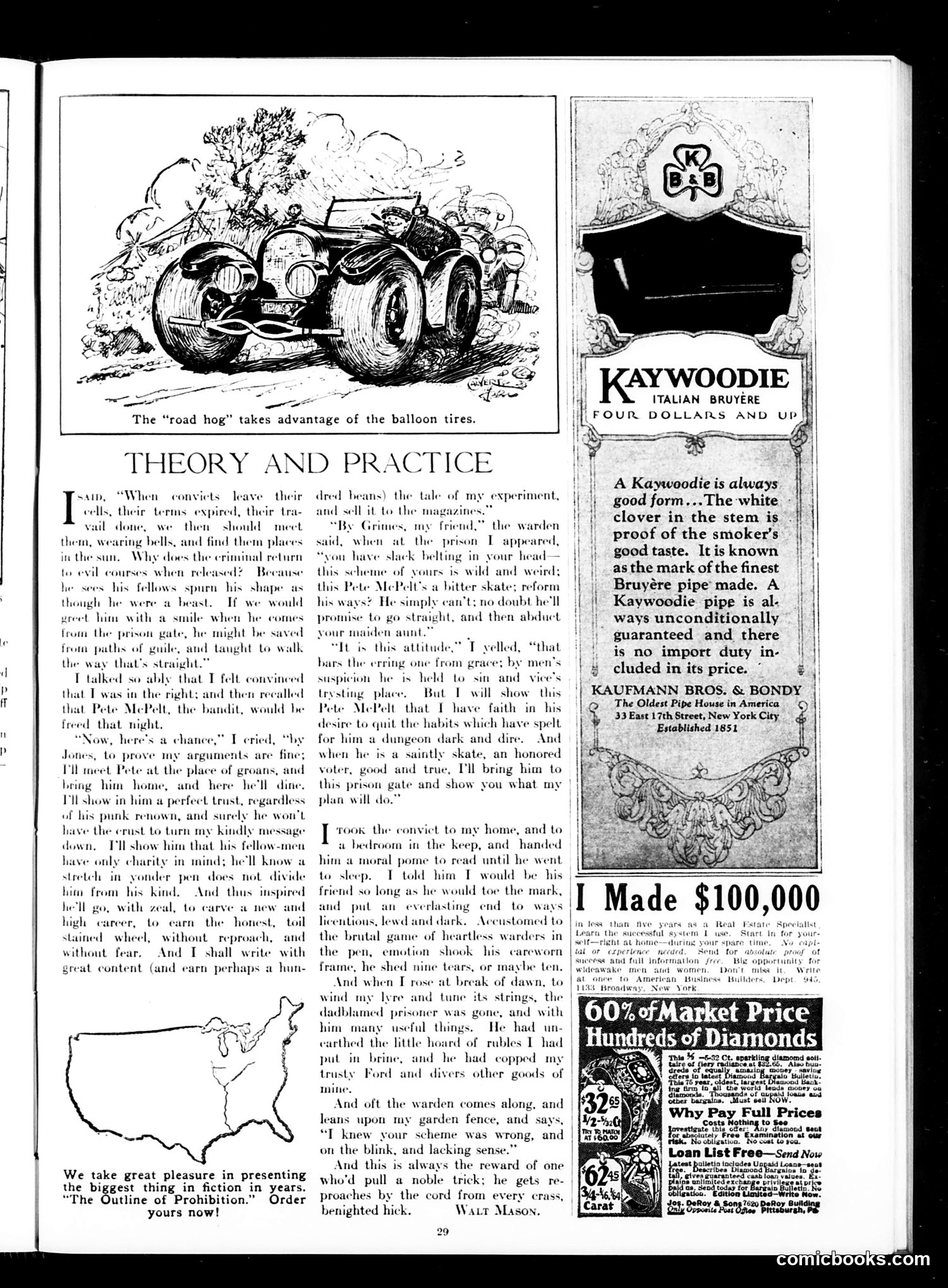
This page from *Judge* contains a satirical story called "Theory and Practice" by Walt Mason, illustrated with a cartoon of a reckless driver ("road hog") at the top. **The Cartoon & Story's Point:** The narrative mocks naive criminal rehabilitation idealism. A well-meaning reformer befriends Pete McPelt, a released convict, offering trust and moral guidance to prove convicts can reform. Despite the narrator's faith and efforts—lending him money, a car, moral instruction—McPelt steals from him and disappears. The story satirizes the gap between optimistic *theory* (criminals deserve redemption) and harsh *practice* (ex-convicts reoffend). **The "Road Hog" Cartoon:** The illustration shows a reckless driver taking advantage of new balloon tire technology to drive wildly, likely referencing contemporary concerns about dangerous driving behavior—a separate but related social commentary on irresponsibility. **For Modern Readers:** This reflects early 20th-century debate over prison reform and whether rehabilitation was realistic, using humor to suggest optimists underestimated criminal recidivism.
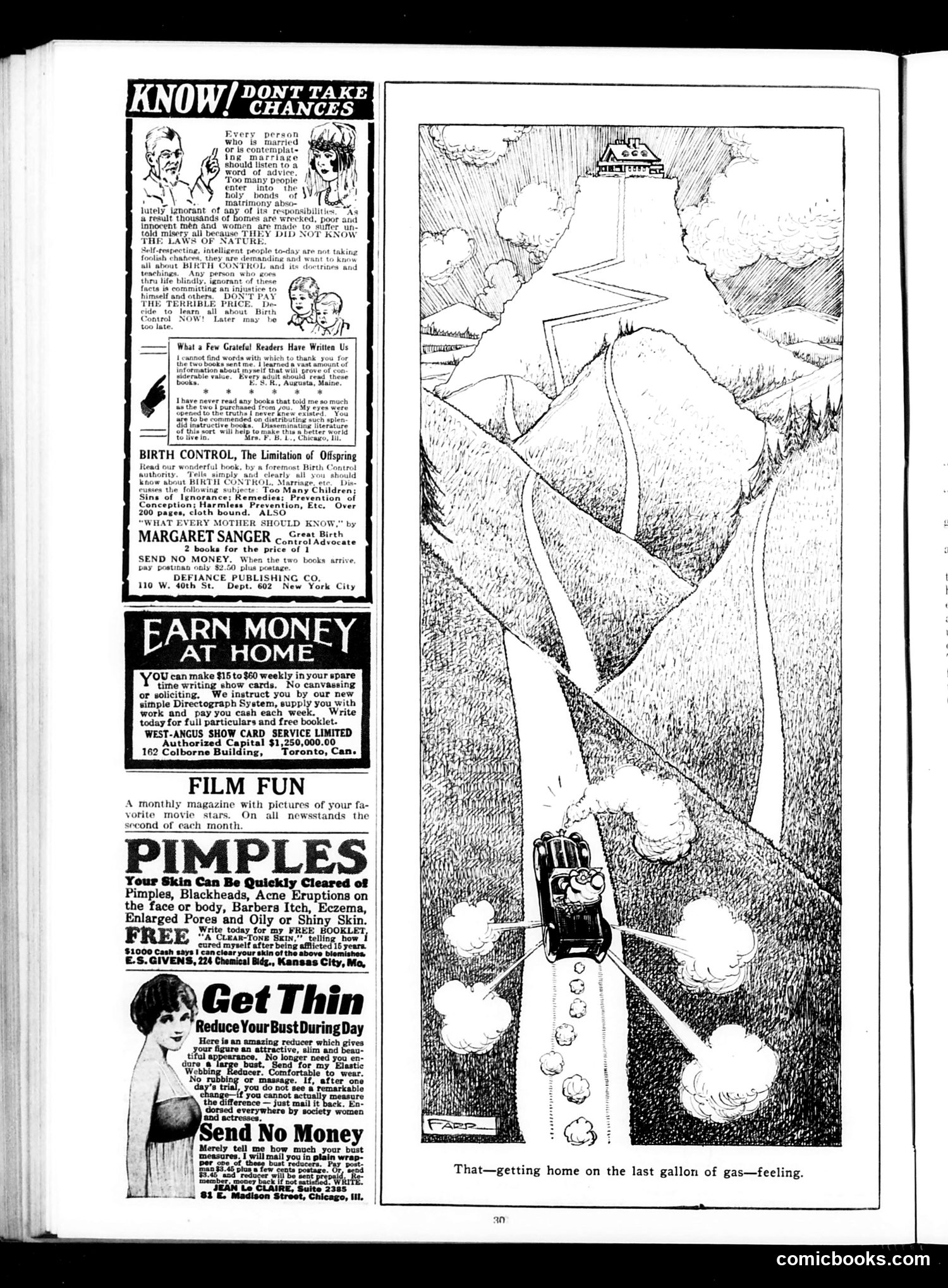
This page from *Judge* magazine is primarily **advertising**, not political satire. The left column contains various commercial advertisements for products and services typical of the early 20th century: birth control information (referencing Margaret Sanger, the birth control advocate), mail-order show card work, a movie magazine, acne treatments, and bust-reduction garments. The right side features a single illustration—an **automotive cartoon** showing a car nearly out of gas, struggling to climb a hill toward home. The caption reads: "That—getting home on the last gallon of gas—feeling." This is **not political satire** but rather humorous commentary on the common motorist experience: the anxiety of running low on fuel before reaching one's destination. It reflects early automobile culture and the practical concerns of car owners in an era when gas stations were less ubiquitous. The page demonstrates *Judge*'s mix of advertising revenue and light comedic content rather than sustained political commentary.
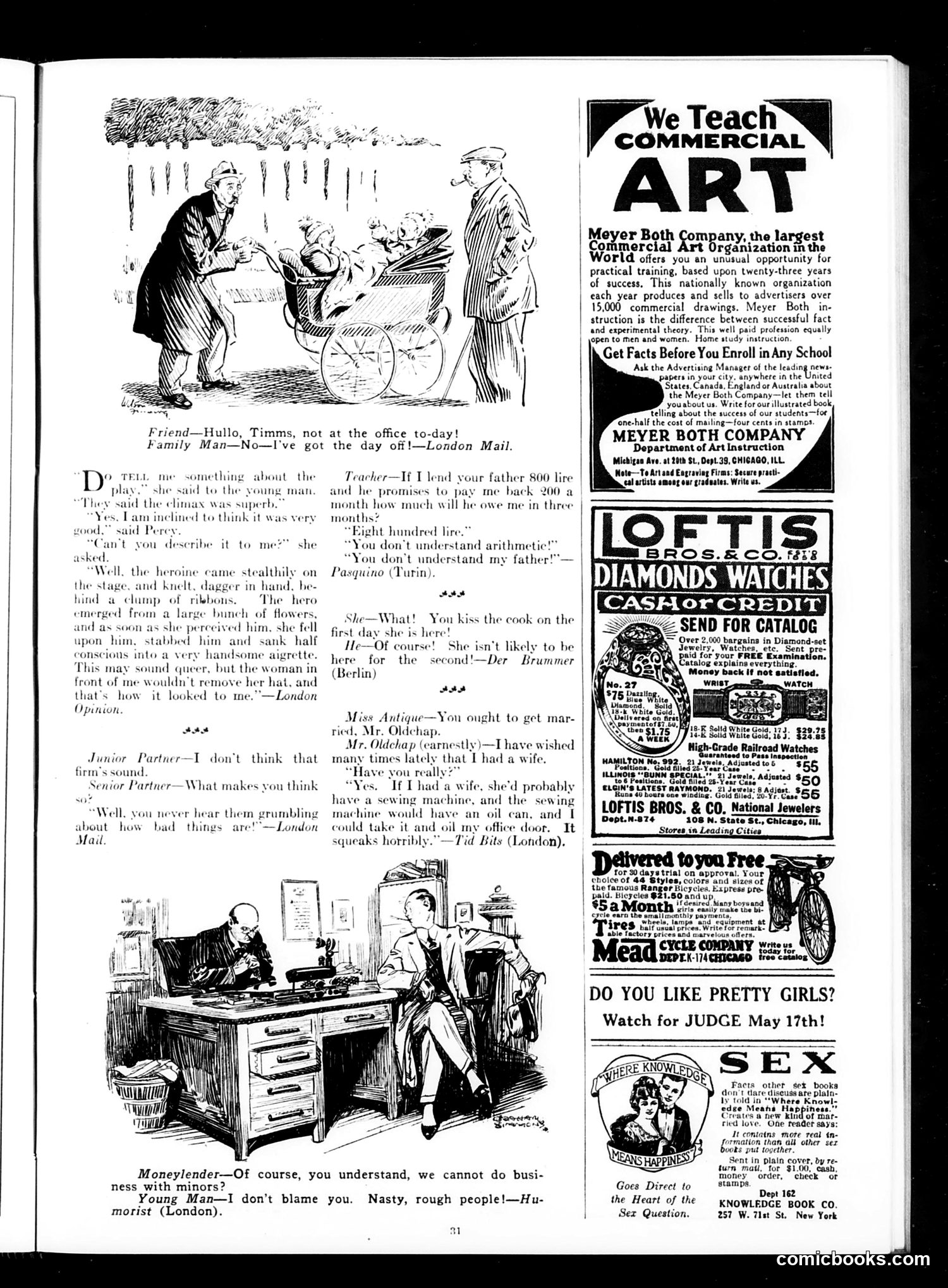
This is a page of **humorous anecdotes and advertisements** rather than political cartoons. The jokes are brief, wry observations about everyday social situations circa 1910s: **Notable jokes:** - A man claims he skipped work as a "family man" with the day off - A woman couldn't see a stage climax because a theatergoer's hat blocked the view - A schoolteacher lends money to a student's father, who'll still owe money after three months (the student misunderstands arithmetic) - A man kisses the new cook on her first day so she'll likely quit before day two - An elderly bachelor wishes he had a wife to oil his squeaky office door **The humor relies on:** misunderstandings, domestic irony, and mild cynicism about marriage and social behavior—typical of period humor magazines. **Advertisements** dominate the right side, including commercial art instruction (Meyer Roth Company), diamond watches, bicycles, and "knowledge books"—typical early-20th-century mail-order commerce.
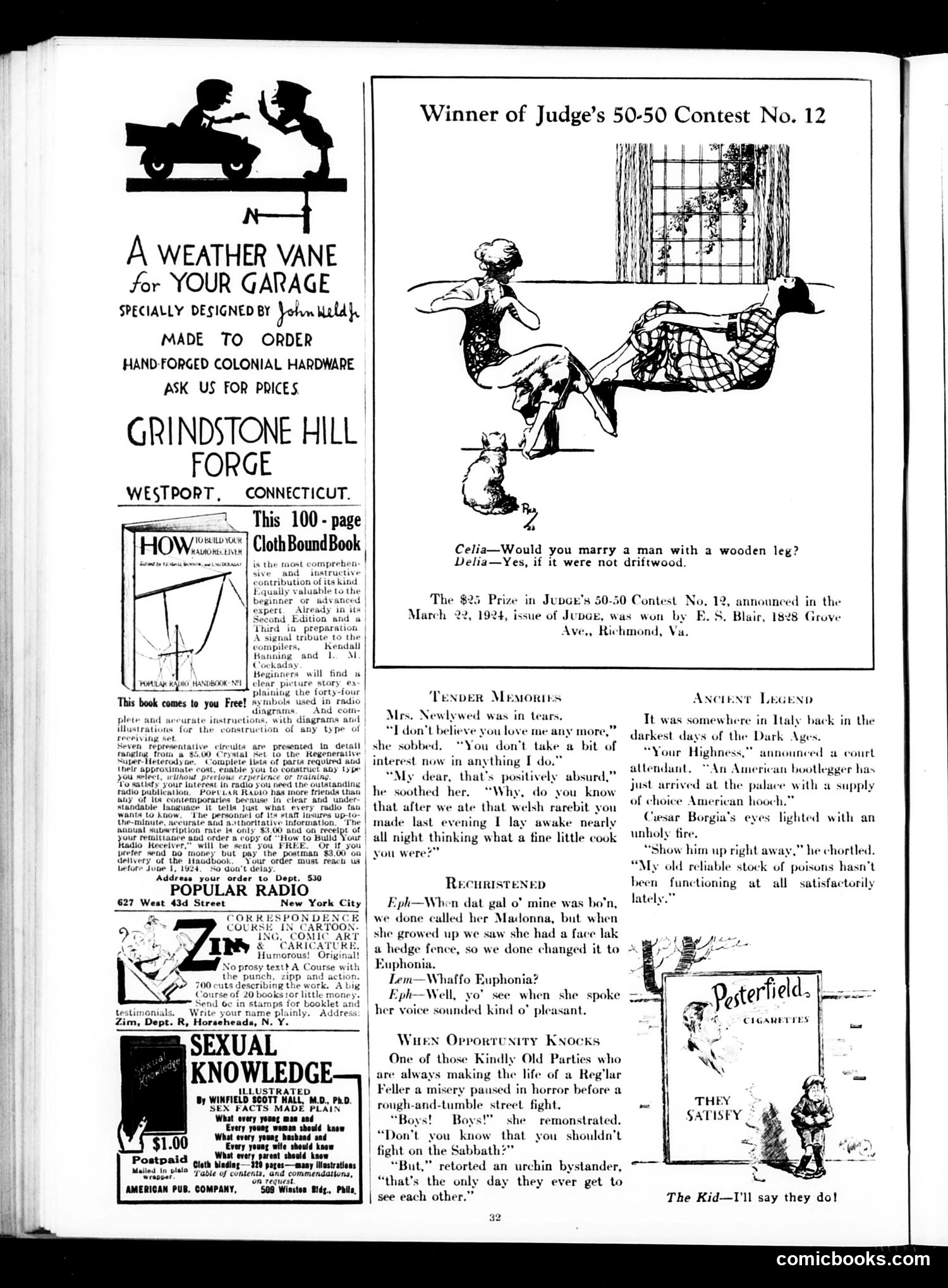
This page from Judge (a 1920s satirical magazine) contains primarily **advertisements and humorous short jokes** rather than political cartoons. The main content includes: **Advertisements:** A weather vane by John Weld, a "How to Build Radio" handbook, and a "Sexual Knowledge" book—typical commercial pitches for the era. **Humor sections:** - **"Tender Memories"**: A newlywed wife tearfully accuses her husband of not loving her anymore; he dismissively reassures her by recalling she's a good cook—satirizing marital indifference and male emotional neglect. - **"Rechristened"**: A joke about renaming a girl from "Madonna" to "Euphonia" because her face resembled a hedge fence—crude physical humor about female appearance. - **"When Opportunity Knocks"**: An elderly woman scolds boys fighting, saying they shouldn't fight on the Sabbath; they reply it's the only day they see each other—satirizing religious prudishness versus street poverty. - **"Ancient Legend"**: Anachronistic joke presenting Cesare Borgia ordering poison supplies, suggesting the bootlegger (from Prohibition era) is a timeless criminal type. The humor reflects early 20th-century attitudes toward domesticity, class, and religion.
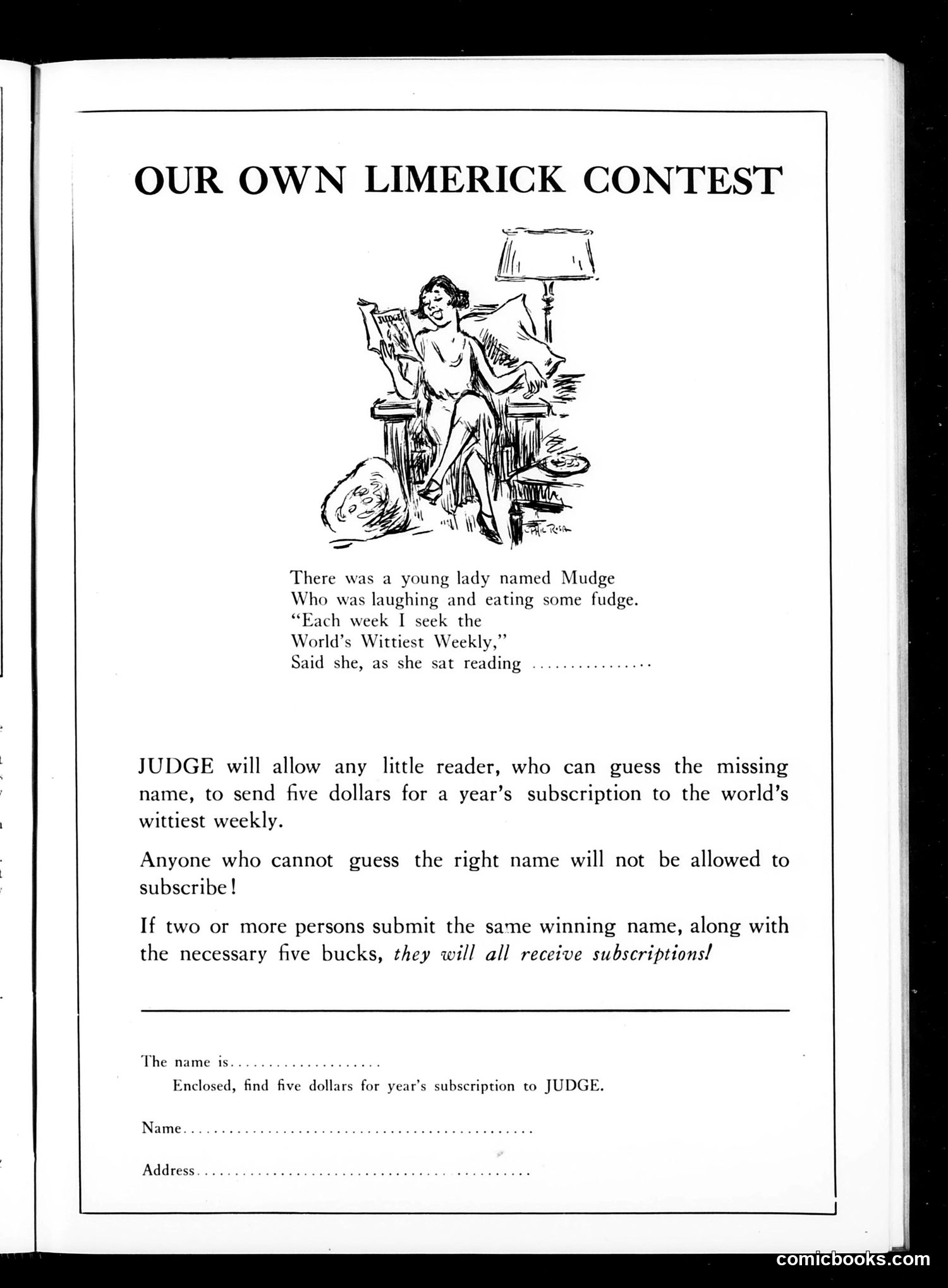
This is a self-promotional contest page for *Judge* magazine itself. The limerick features a young woman named Mudge who reads "the World's Wittiest Weekly"—the missing word readers must guess is presumably "Judge." The contest is a subscription-acquisition scheme: readers submit five dollars and their guess at the missing publication name. The satirical wit lies in *Judge* essentially advertising itself as "the world's wittiest weekly" and inviting readers to pay for the privilege of proving they can complete that boast. The language—prohibiting those who guess wrong from subscribing—adds humorous arrogance to the pitch. This reflects late 19th/early 20th-century magazine marketing tactics, where humor magazines relied on reader subscriptions and used contests as both entertainment and revenue generators.
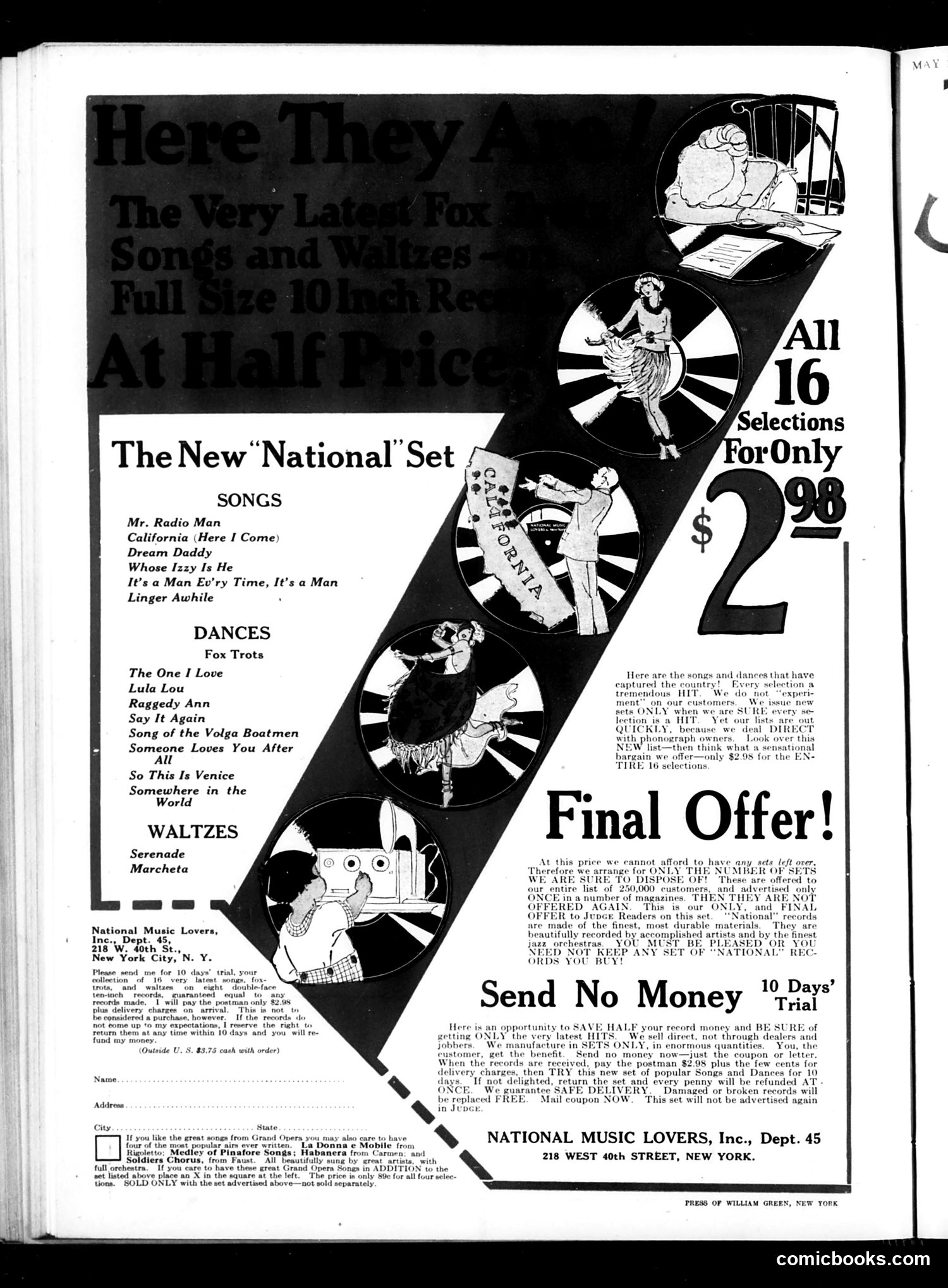
This is not a political cartoon but a full-page advertisement for "National Music Lovers, Inc." selling phonograph record sets. The page promotes "The New 'National' Set" — a collection of 16 songs and dances (fox trots, waltzes) on records, priced at $2.98. The decorative art features stylized illustrations of performers and dancers in 1920s Art Deco style, typical of period advertising design. **The "satire"** (if any) is subtle: the ad's aggressive sales language ("Final Offer!" "Send No Money") and claims about manufacturing superiority parody the hyperbolic marketing tactics common in early 20th-century mail-order advertising. The "10 Days' Trial" offer was a standard direct-sales tactic of the era. The song titles ("Mr. Radio Man," "California Here I Come") reflect popular contemporary jazz-era music. This page represents Judge magazine's revenue model — satirical content subsidized by advertising.