
Judge, 1924-05-03 · page 17 of 36
Judge — May 3, 1924 — page 17: what you’re looking at
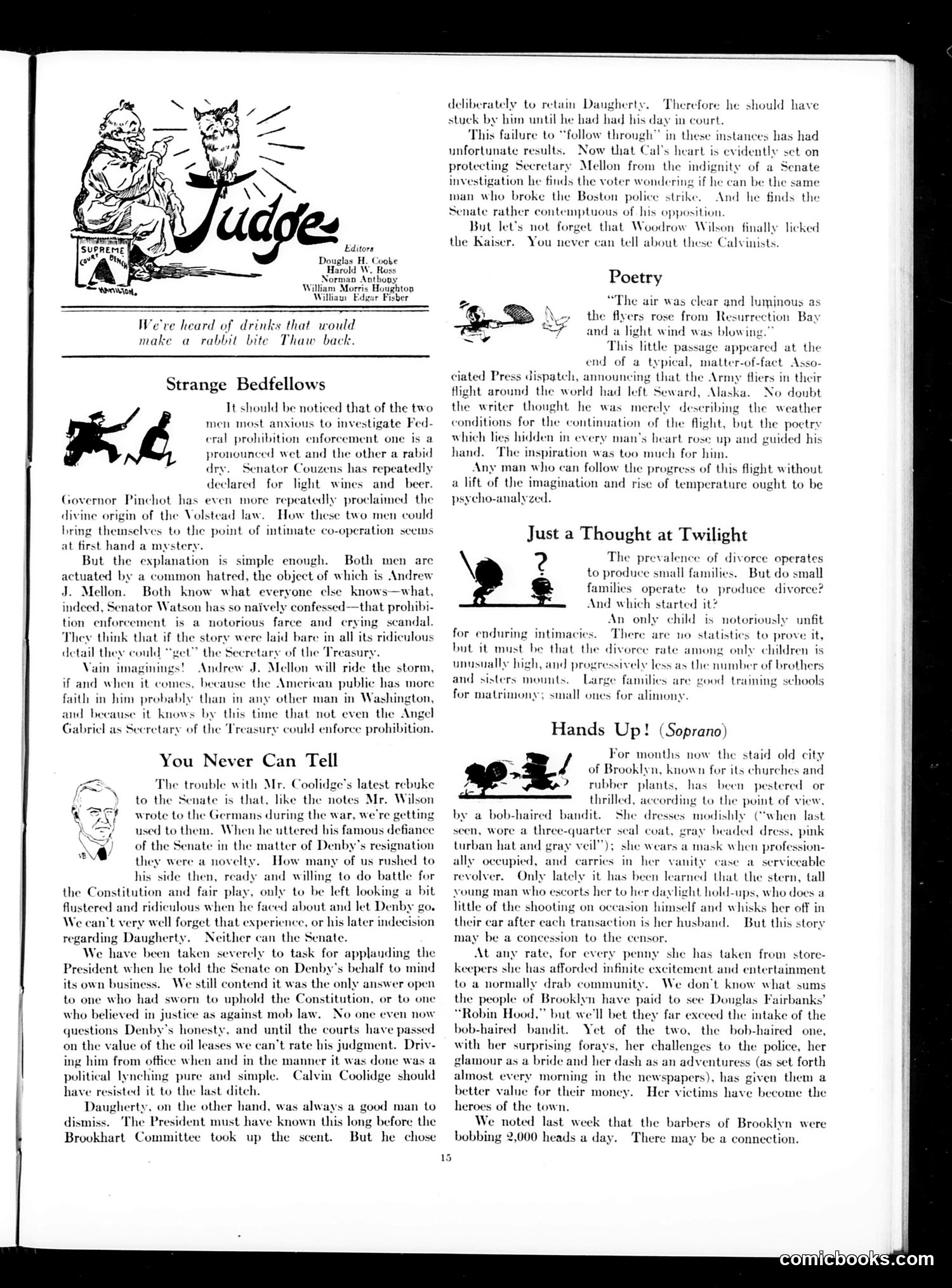
What you’re looking at
## Main Articles **"Strange Bedfellows"** critiques an unlikely alliance between Senator Couzens (a "wet"—pro-alcohol) and Governor Pinchot (a "dry"—Prohibition supporter) investigating federal Prohibition enforcement. Their shared target is Secretary of Treasury Andrew J. Mellon, whom they blame for the scandal of failed enforcement. The satire suggests their cooperation, despite opposing views on Prohibition itself, reveals how thoroughly Mellon has bungled the policy. **"You Never Can Tell"** attacks President Coolidge's inconsistency. He initially defended Secretary Denby against Senate investigations (supporting executive power), then reversed course and forced Denby's resignation—undermining his own constitutional argument. Now Coolidge opposes investigating Secretary Mellon, appearing hypocritical. The piece suggests voters cannot trust his principles. Both pieces reflect 1920s Prohibition-era politics and internal Republican Party conflicts over enforcement failures and executive authority.
📄 Transcribed text from this page (OCR, searchable)
Machine-transcribed from the original scan — historical spelling and the odd misread are preserved.
o] Editors Douglas H. Cooke Harold W. Ross Norman Anthopy William Morris Houghton Williaus Edgar Fisber We've heard of drinks that would make a rabbit bite Thaw back. Strange Bedfellows It should be noticed that of the two men most anxious to investigate Fed- cral prohibition enforcement one is a pronounced wet and the other a rabid dry. Senator Couzens has repeatedly for light wines and beer. Governor Pinchot has even more repeatedly proclaimed the divine origin of the Volstead law. How these two men could bring themselves to the point of intimate co-operation seems at first hand a mystery. But the explanation is simple enough. actuated by a common hatred, the object of which is Andrew J. Mellon. Both know what everyone else knows—what, indeed, Senator Watson has so naively confessed—that prohibi- tion enforcement is a notorious farce and erying scandal. They think that if the story were laid bare in all its ridiculous detail they could “get” the Secretary of the 1 Vain imaginings! Andrew J. Mellon will ride the storm, if and when it comes, because the American publie has more faith in him probably than in any other man in Washington, use it knows by this time that not even the Angel as Secretary of the Treasury could enforce prohibition. You Never Can Tell The trouble with Mr. Coolidge’s latest rebuke to the Senate is that, like the notes Mr. Wilson wrote to the Germans during the war, we're getting used to them. When he uttered bis famous defiance of the Senate in the matter of Denby’s resignation they were a novelty. How many of us rushed to his side then, ready and willing to do battle for the Constitution and fair play, only to be left looking a bit flustered and ridiculous when he faced about and let Denby go. We can’t very well forget that experience, or his later indecision regarding Daugherty. Neither can the Senate. We have been taken severely to task for applauding the President when he told the Senate on Denby’s behalf to mind its own business. We still contend it was the only answer open to one who had sworn to uphold the Constitution, or to one who believed in justice as against mob law. No one even now questions Denby’s honesty, and until the courts have passed on the value of the oil le ant rate his judgment. Driv- ing him from oftice when and in the manner it was done was a political lynching pure and simple. Calvin Coolidge should have resisted it to the last ditch. Daugherty, on the other hand, was alwi dismiss. Brookhart Committee took up the scent. declared Both men are asury. and be ses we sa good man to The President must have known this long before the But he chose deliberately to retain Daugherty. Therefore he should have stuck by him until he had had his day in court. This failure to “follow through” in these instances has had unfortunate results. Now that Cal's heart is evidently set on protecting Secretary Mellon from the indignity of a Senate investigation he finds the voter wondering if he can be the same man who broke the Boston police strike. And he finds the Senate rather contemptuous of his opposition But let’s not forget that Woodrow Wilson finally licked the Kaiser. You never can tell about these Calvinists. Poetry “The air was clear and luminous as the flyers rose from Resurrection Bay and a light wind was blowing.” This little passage appeared at the end of a typical, matter-of-fact Asse ciated Press dispatch, announcing that the Army fliers in their flight around the world had left Seward, Alaska. No doubt the writer thought he was merely describing the weather conditions for the continuation of the flight, but the poetry which lies hidden in every man’s beart rose up and guided his hand. The inspiration was too much for him. Any man who can follow the progress of this flight without a lift of the imagination and rise of temperature ought to be psycho-analyzed. Just a Thought at Twilight \ 2 The prevalence of divorce operates ¢ to produce small families. But do small families operate to produce divorce? And which started it? An only child unfit for enduring intimacies. There are uo statistics to prove it, but it must be that the divorce unusually high, and prog La small ones for alimony. is notoriously rate among only children is ressively less as the number of brothers and sisters mounts. for matrimony amilies are good training schools Hands Up! (Soprano) For months now the staid old city of Brooklyn, known for its churches and rubber plants, has been pestered or thrilled, according to the point of view. by a bob-haired bandit. She dresses modishly (“when last seen, wore a three-quart at, gray beaded dress, pink turban hat and gray veil”); she wears a mask when profe: ally occupied, and carries in her vanity case a serviceable revolver. Only vy it has been learned that the stern, tall young man who escorts her to her daylight hold-ups, who does a little of the shooting on occasion himself and whisks her off in their car after each transaction is her husband. But this story may be a concession to the censor. At any rate, for every penny she has taken from store- keepers she has afforded infinite excitement and entertainment to a normally drab community. We don’t know what sums the people of Brooklyn have paid to see Douglas Fairbanks’ “Robin Hood,” but we'll bet they fi ed the intake of the bob-haired bandit. Yet of the two, the bob-haired one, with ber surprising forays, her challenges to the police, her glamour as a bride and her dash as an adventuress set forth almost every morning in the newspapers), has given them a better value for their money. Her victims have become the of the town. noted last week that the barbers of Brooklyn were bobbing 2,000 heads a day. There may be a connection. ion-