
Judge, 1924-05-03 · page 25 of 36
Judge — May 3, 1924 — page 25: what you’re looking at
What you’re looking at
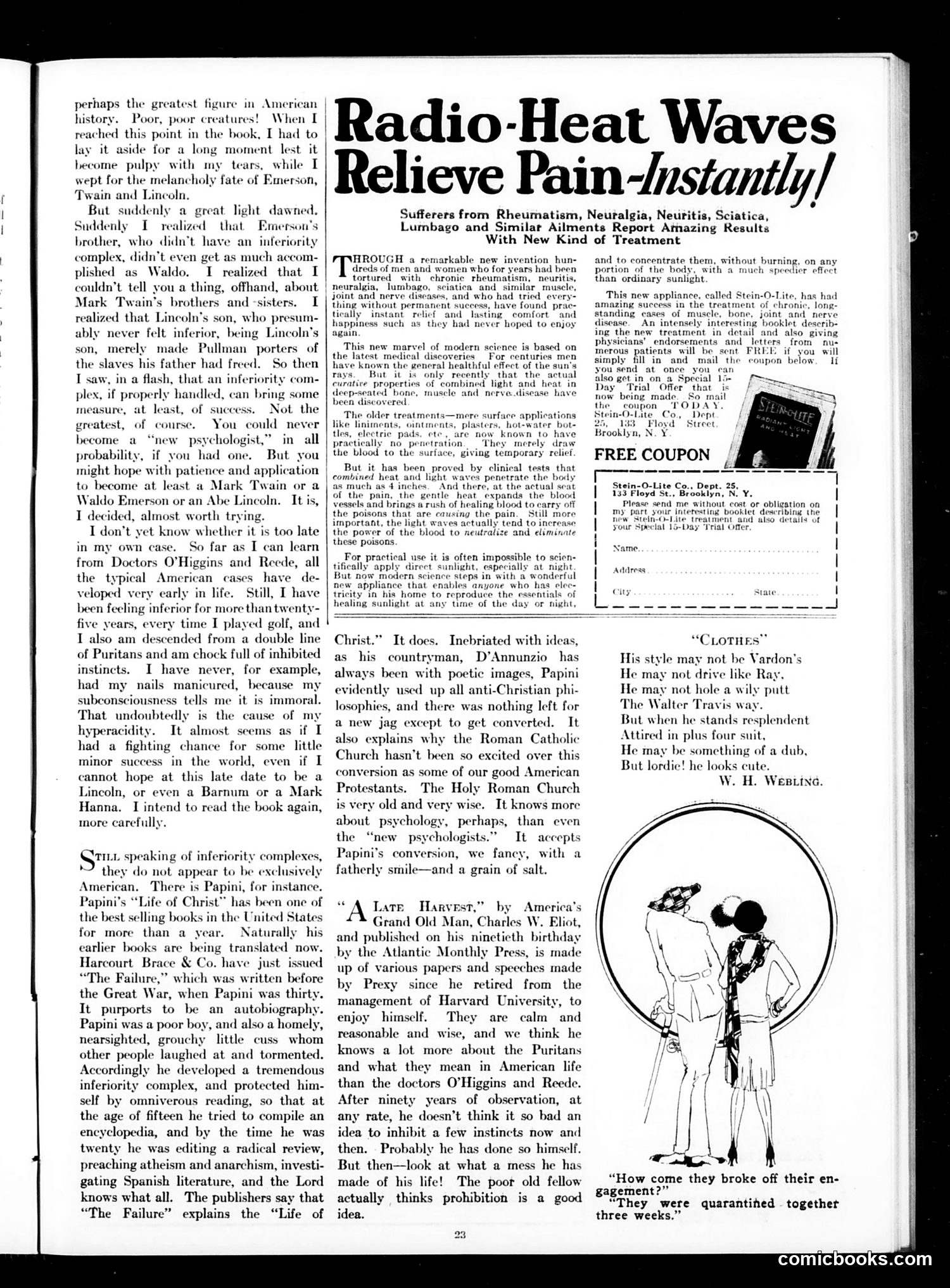
This page from Judge magazine contains two main elements: a lengthy satirical essay about inferiority complexes, and a period advertisement. **The Essay's Point:** The author mockingly discusses how American figures like Lincoln, Emerson, and Twain supposedly owed their success to inferiority complexes that drove ambition. He then references Italian author Giovanni Papini's autobiography "The Failure" as evidence that inferiority complexes aren't uniquely American—Papini was an unattractive, mocked boy who channeled his neuroses into prolific writing (atheist reviews, radical philosophy) before later converting to Catholicism and achieving mainstream success with his "Life of Christ." The satire critiques pop-psychology trends of the 1920s-30s that pathologized normal human insecurity while paradoxically celebrating it as a driver of achievement. **The Advertisement:** The "Radio-Heat Waves" ad exemplifies period medical quackery—claiming radio waves cure rheumatism and neuralgia instantly, a common fraudulent medical claim of that era. The small cartoon jokes about broken engagements caused by quarantine, likely referencing pandemic-era relationship difficulties.
📄 Transcribed text from this page (OCR, searchable)
Machine-transcribed from the original scan — historical spelling and the odd misread are preserved.
perhaps the greatest figure in American history. Poor, poor creatures! When I reached this point in the book, I had to lay it aside for a long moment lest it become pulpy with my tears, while T wept for the melancholy fate of Emerson, Twain and Lincoln. But suddenly a great light dawn Suddenly I that brother, who didn’t have an inferiority complex, didn’t even get as much accom- plished as Waldo. I realized that I couldn’t tell Mark Twain’s brothers and -sisters. I realized that Lincoln’s son, who presum- ably never felt inferior, son, merely realized Emerson's being Lincoln's made Pullman porters of the slaves his father had freed. So then I saw, ina flash, that an inferiority com- plex, if properly handled, measure, at least, greatest, of an bring some Not the could never of success. course. You become a “new psychologist,” in all probability, if you had one. But you inight hope with patience and application to become at least a Mark Twain or a Waldo Emerson or an Abe Lincoln. It is, I decided, almost worth trying. I don’t yet know whether it is too late in my own case. So far as IT can learn from Doctors O'Higgins and Reede, all the typical American cases have de- veloped very early in life. Still, I have been feeling inferior for more thantwenty- fiv rs, every time I played golf, and I also am descended from a double line of Puritans and am chock full of inhibited instincts. I have never, for example, had my nails manicured, because my subconsciousness tells me it is immoral. That undoubtedly is the cause of my hyperacidit It almost seems as if I had a fighting chance little minor success in the world, even if I cannot hope at this late date to be a Lincoln, or even a Barnum or a Mark Hanna. I intend to read the book again, more carefully. for some STILL speaking of inferiorit they do not appear to be exclusively American, There is Papini, for instance. Papini’s “Life of Christ” has been one of the best selling books in the United States for more than a year. Naturally his earlier books are being translated now. Harcourt Brace & Co. have just issued “The Failure,” which was written before the Great War, when Papini was thirty. It purports to be an autobiography. Papini was a poor boy, and also a homely, nearsighted, grouchy little cuss whom other people laughed at and tormented. Accordingly he developed a tremendous inferiority complex, and protected him- self by omniverous reading, so that at the age of fifteen he tried to compile an ‘yclopedia, and by the time he was twenty he was editing a radical review, preaching atheism and anarchism. gating Spanish literature, and the Lord knows what all. The publishers say that “The Failure” explains the “Life of complexes, ‘ou a thing, offhand, about | Radio-Heat Waves Relieve Pain-/nstantly/ Sufferers from Rheumatism, Neuralgia, Neuri' Lumbago and 8, Sciatica, lar Ailments Report Amazing Results With New Kind of Treatment HROUGH a remarkable new dreds of men and wom rs had been ed with chronic rheumatism, neuritis, mbago, sciatica and similar muscle, joint and’ nerve dise nd who had tried every- thing without per have found pra instant relief and lasting comfort and ppiness such as they had never hoped to enjoy again vention hun- est_ medical discoverie: nown the general healthful eff it curative propert deep- ted be been discovered The older treatments—me like liniments, ointinen| tles, electric pads, etc practically no_penet the blood to the surfs . hot-water bot- » now known to have They merely draw , giving temporary’ re But it has been proved by clinical tests t combined heat and light trate the body as much as 4 inchy And the at the actual seat of the pain, the gentle heat expands the blood vessels and brings a rush of healing blood to carry off the poisons that are causing the pain. Still more important, the light. waves actually tend to increa: the power of the blood to neutralize and eliminate these poisons. For practical use it is often impossible to scien tifically apply direct sunlight, especially at night But now modern science steps in with a wonderful new appliance that enables anyone who has clec- y in his home to reproduce the essenti ig sunlight at any time of the day or to concentrate them, without burning, on any portion of the body, with a much speedier effect than ordinary sunlight This new amazing success in the treatm standing cases of muscle, bone, joint and’ nerve disease. An intensely interesting booklet deserib- ing the new treatment in de d-also giving physicians’ endorsements and letters from nue merous patients will be sent FREE if you will simply fill in and mail the coupon below. If you send at once you can also get in on_a Special 1s 1 Offer that is wz made. So mail coupon ‘TODAY, Stein-0-Lite Co, Dept 133 Floyd Street Brooklyn, N. Y FREE COUPON ein-O-Lite, has had nt of chronic, long- =e] Stein-O-Lite Co., Dept. 25, 133 Floyd St., Brooklyn, N.Y. Please send me without cost or obligation on my part your interesting booklet describing the hew Stein-O-Lite treatment and also details ¢ your Special 15-Day ‘Trial Offer. Name. Address Christ.” as_ his It does. Inebriated with ideas, countryman, D’Annunzio has always been with poetic images, Papini evidently used up all anti-Christian phi- losophies, and there was nothing left for a new jag except to get converted. It also explains why the Roman Catholic Church hasn't been so excited over this conversion as some of our good American Protestants. The Holy Roman Church is very old and very wise. It knows more about psychology, perhaps, than the “new psychologists.” It Papini’s conversion, with a fatherly smile—and a grain of salt. even ecopts we fancy, Late Harvest,” by America’s Grand Old Man, Charles W. Eliot, and published on his ninetieth birthday by the Atlantic Monthly Press, is made up of various papers and speeches made by Prexy he retired from the management of Harvard University, to enjoy himself. They are calm and reasonable and wise, and we think he knows a lot more about the Puritans and what they mean in American life than the doctors O'Higgins and Reede. After ninety years of observation, at any rate, he doesn’t think it so bad an idea to inhibit a few instincts now and then. Probably he has done so himself. But then—look at what a mess he has made of his life! The poor old fellow actually thinks prohibition is a good idea. since 23 His style may not be Vardon’s He may not drive like Ray, He may not hole a wily putt The Walter T But when he stands resplendent Attired in plus four suit, He may be something of a dub, But lordie! he looks cute. W. H. Wesitna. vis W “How come they broke off their en- gagement?” “They were quarantined together three weeks.” comicbooks.com