
A complete issue · 36 pages · 1924
Judge — March 22, 1924
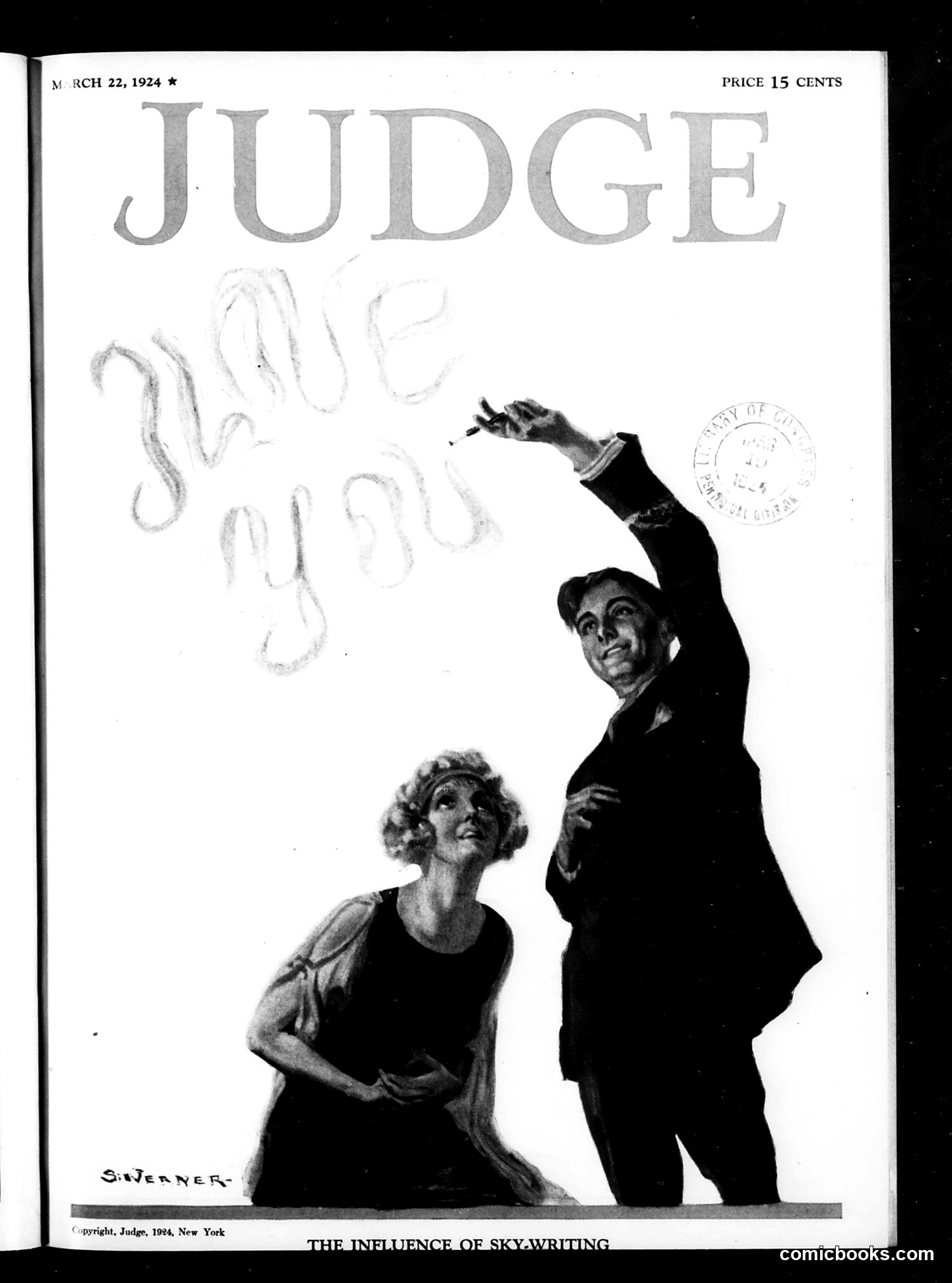
This March 22, 1924 *Judge* cartoon satirizes the newly emerging phenomenon of sky-writing—advertising messages written in the sky by aircraft. The illustration shows a man reaching upward to write in the sky while a woman gazes up in wonder, both seemingly mesmerized. The satire appears to critique how this novel advertising medium captures public attention and imagination. The title suggests sky-writing's powerful psychological "influence" over viewers. The couple's upward gazes and the man's stretching gesture convey almost hypnotic fascination with this new technology. This reflects 1924 anxieties about modern advertising's growing invasiveness—even reaching into the skies above—and its power to captivate and manipulate the public consciousness during an era of rapid technological change.
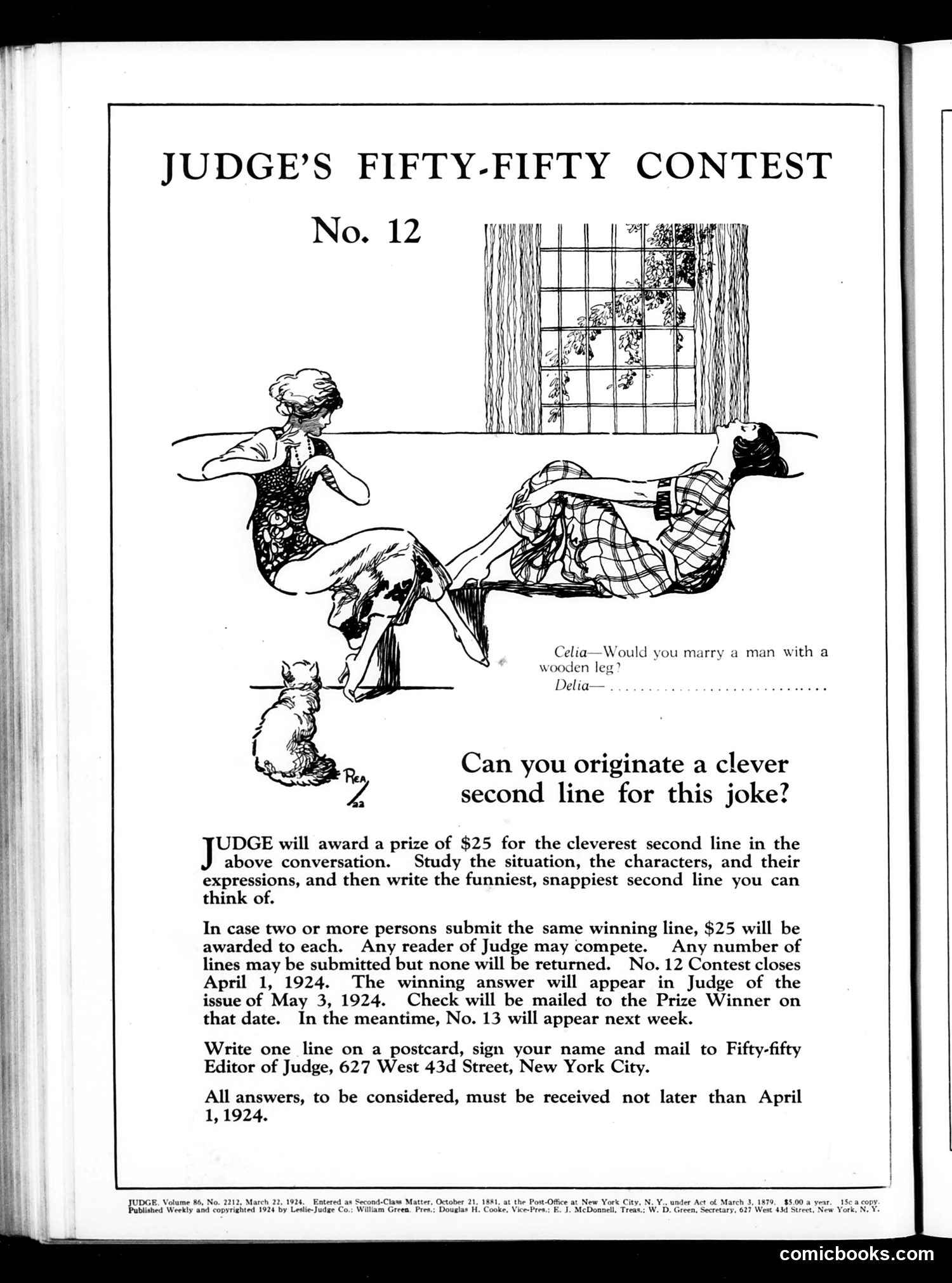
This page presents a humor contest asking readers to complete a joke. The illustration shows two women in 1920s attire engaged in conversation, with a cat nearby. **The Setup:** - **Celia** asks: "Would you marry a man with a wooden leg?" - **Delia's** response is blank, waiting for reader submissions. **The Context:** This is a "fill-in-the-blank" joke format typical of 1920s humor magazines. The joke plays on the ambiguity of "wooden leg"—it could mean a prosthetic limb or be interpreted as a euphemism or insult. Readers were invited to submit clever punchlines, with the winner receiving $25. **For Modern Readers:** The humor relies on the era's comedic sensibilities around physical disability and wordplay—concepts that would be considered in poor taste by contemporary standards. This represents the magazine's interactive engagement with its readership.
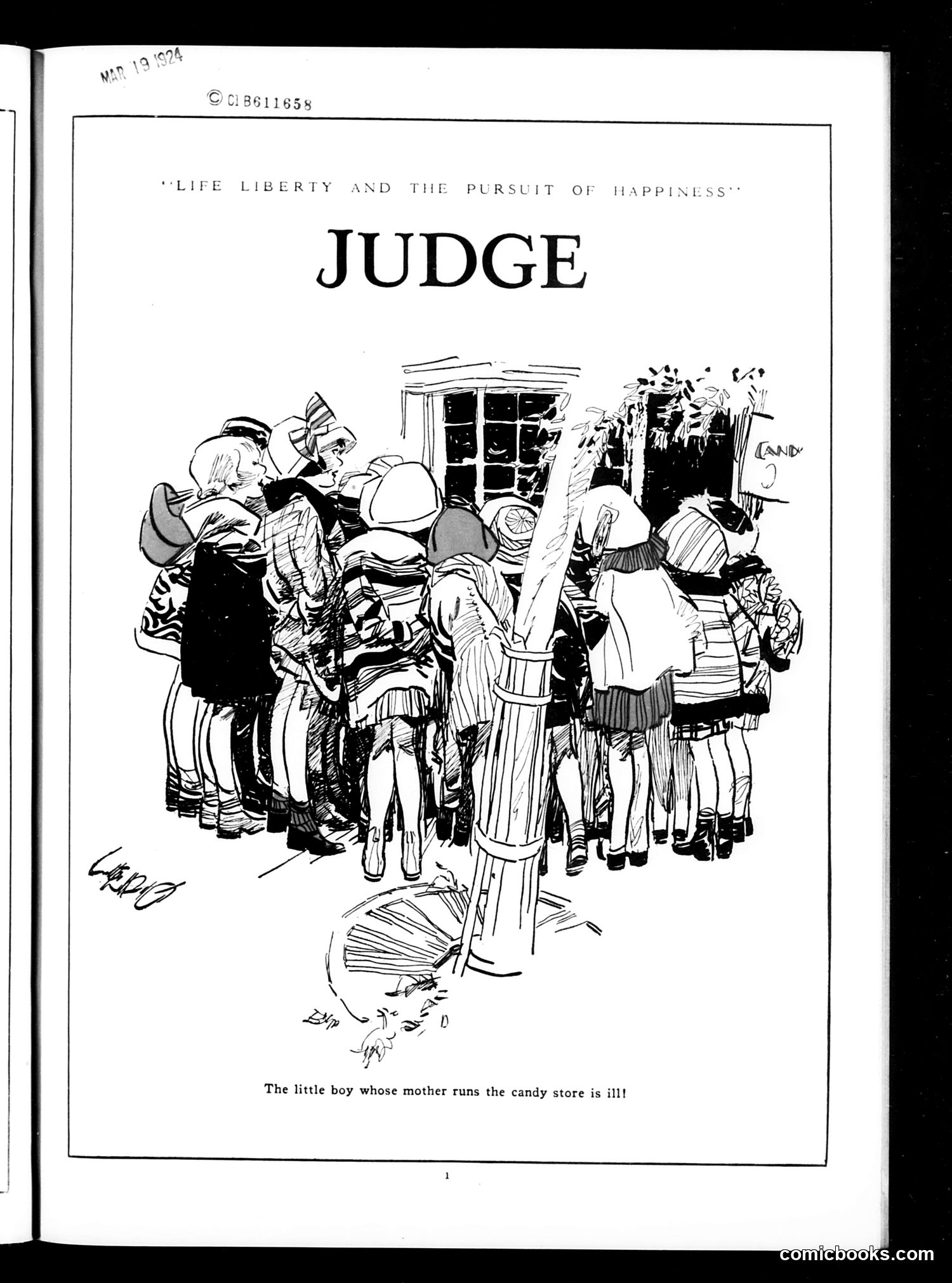
**Title and Theme:** "Life Liberty and the Pursuit of Happiness" — a reference to the Declaration of Independence — frames this satirical piece titled "JUDGE." **The Image:** Shows a group of children gathered around a large wooden post or pole, viewed from above. The illustration style is typical early-20th-century satirical cartooning. **The Joke:** The caption reads "The little boy whose mother runs the candy store is ill!" This appears to be social satire about childhood privilege and commerce. The gathered children likely represent the community's concern—or more likely, their selfish interest in accessing the candy store now that the proprietor's son is ill, implying they depend on his mother's business for treats. The satire targets either childhood materialism or the community's superficial sympathies.
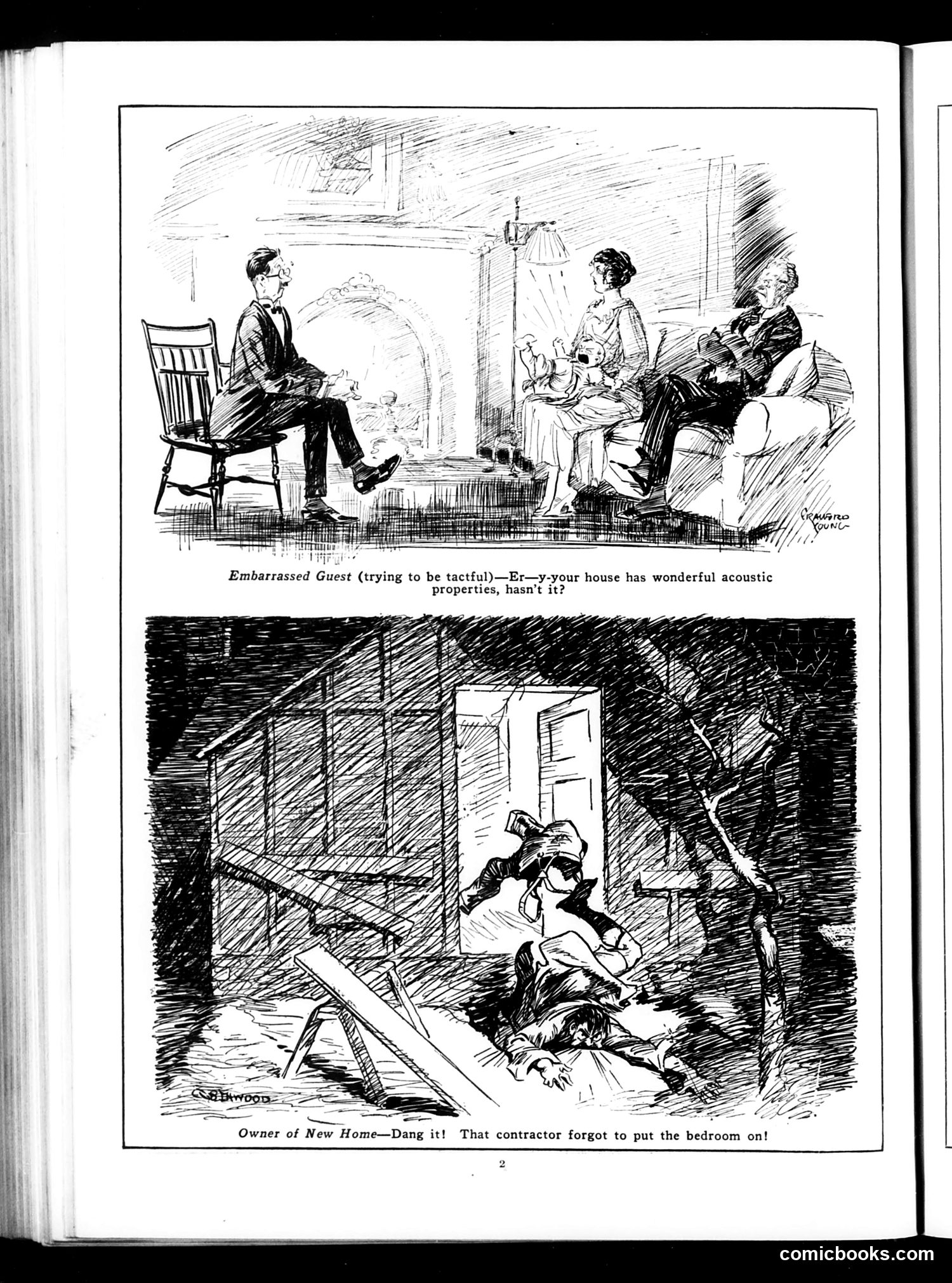
**Top cartoon:** An embarrassed guest attempts tactful small talk at a social gathering, commenting on the house's "wonderful acoustic properties." The joke is that the guest has overheard private conversation—likely embarrassing or indiscreet remarks—through thin walls, making the comment a pointed (if polite) criticism of poor soundproofing. **Bottom cartoon:** A homeowner curses a contractor who completed a new house but forgot to construct the bedroom. The family is shown literally sleeping outdoors in makeshift conditions. This satirizes shoddy or incompetent construction work and contractor negligence. Both cartoons target domestic frustrations common to early 20th-century American homeowners: poor construction quality and building defects. They're straightforward domestic humor rather than political satire.
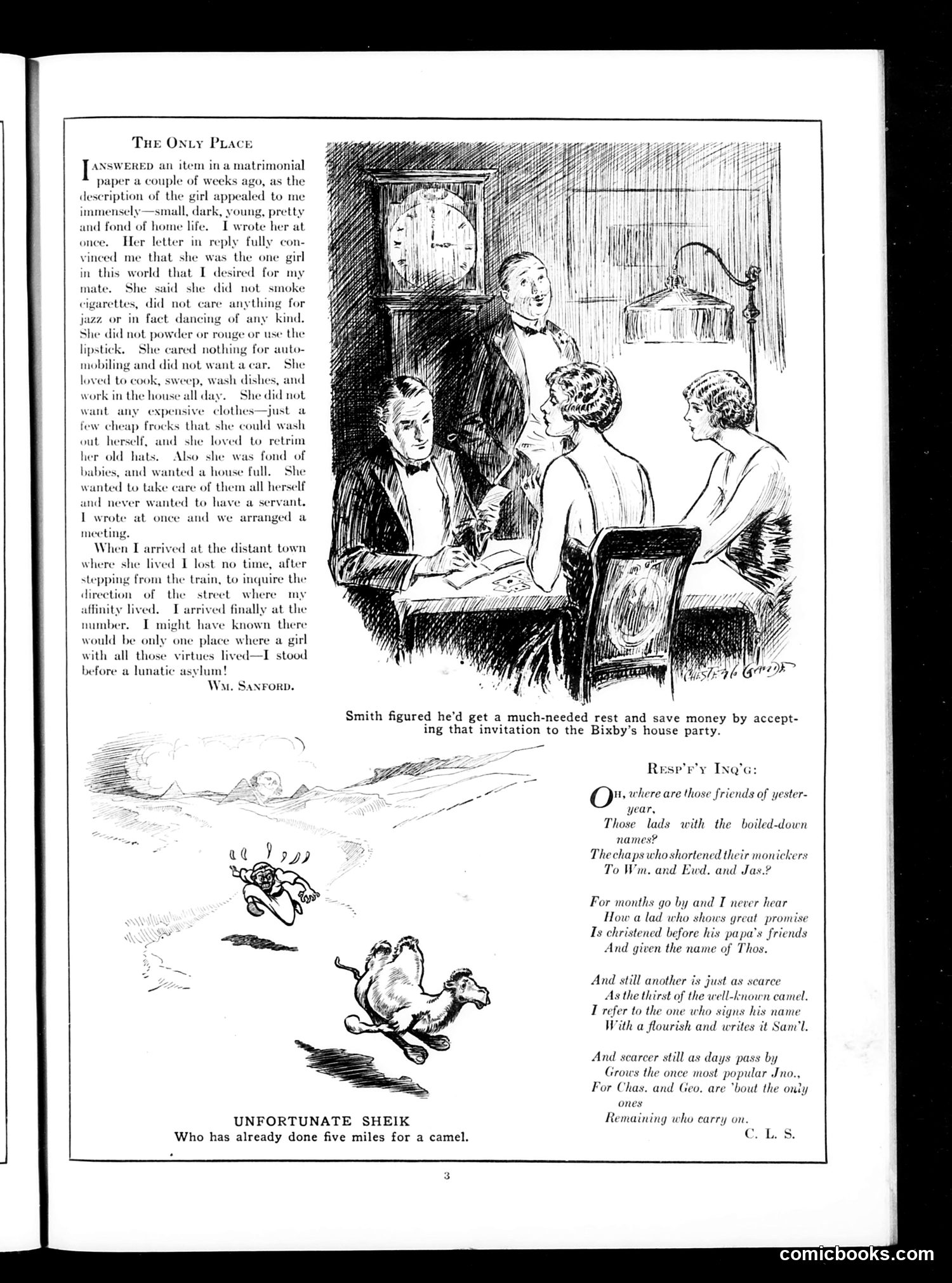
**"The Only Place"** story describes a man seeking an ideal wife—describing virtues like not smoking, dancing, or wanting servants. The accompanying illustration shows a domestic scene with four people and a clock, depicting his search for this paragon. **"Unfortunate Sheik"** is a visual gag showing a camel that has already traveled five miles for a camel—likely satirizing contemporary fascination with exotic "sheik" culture (popular in the 1920s following Rudolph Valentino films). **"Resp't'y Inq'g"** is a reader inquiry section asking about friends with nicknames shortened from longer names (Wm., Evelyn, Jax), apparently tracking the disappearance of men named Theo, Chas, and Geo. The page combines domestic humor, exotic satire, and reader correspondence typical of Judge's satirical format.
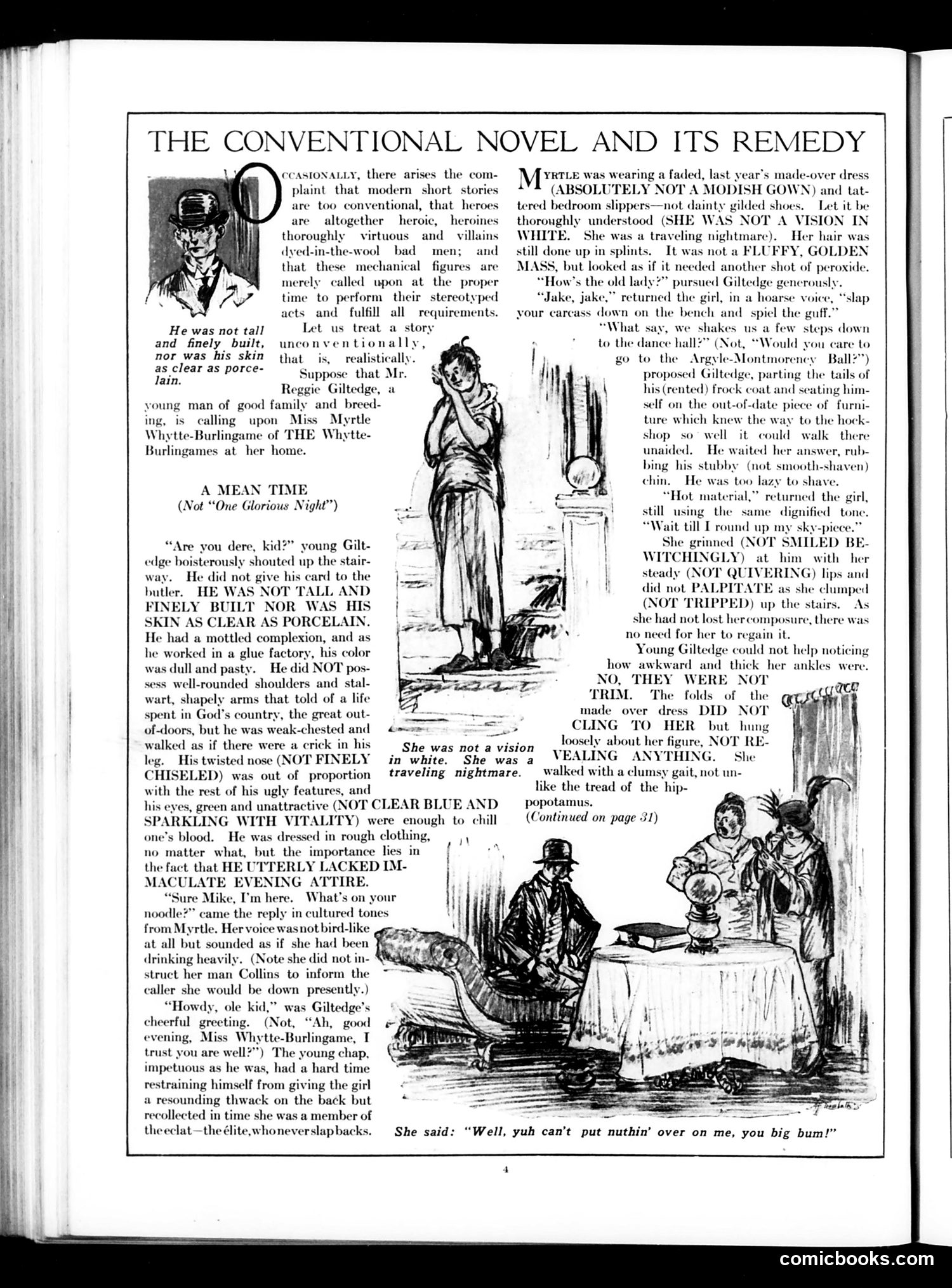
This satirical piece critiques formulaic fiction of the era. The article mocks stock literary characters—the conventionally handsome hero, the virtuous heroine in white—arguing they lack authenticity and vitality. The accompanying illustrations contrast idealized romance with reality. One sketch shows a woman in "traveling nightgown" (unflattering garb), not the glamorous figure promised by novels. Another depicts a crude, working-class man named Giltedge—"not tall and finely built" but rather crude and inarticulate—challenging romantic stereotypes. The satire suggests that real people and relationships are messier, less genteel, and more interesting than conventional fiction portrays. The piece advocates for more honest, unglamorous characterization in literature—a modernist impulse questioning Victorian literary conventions.
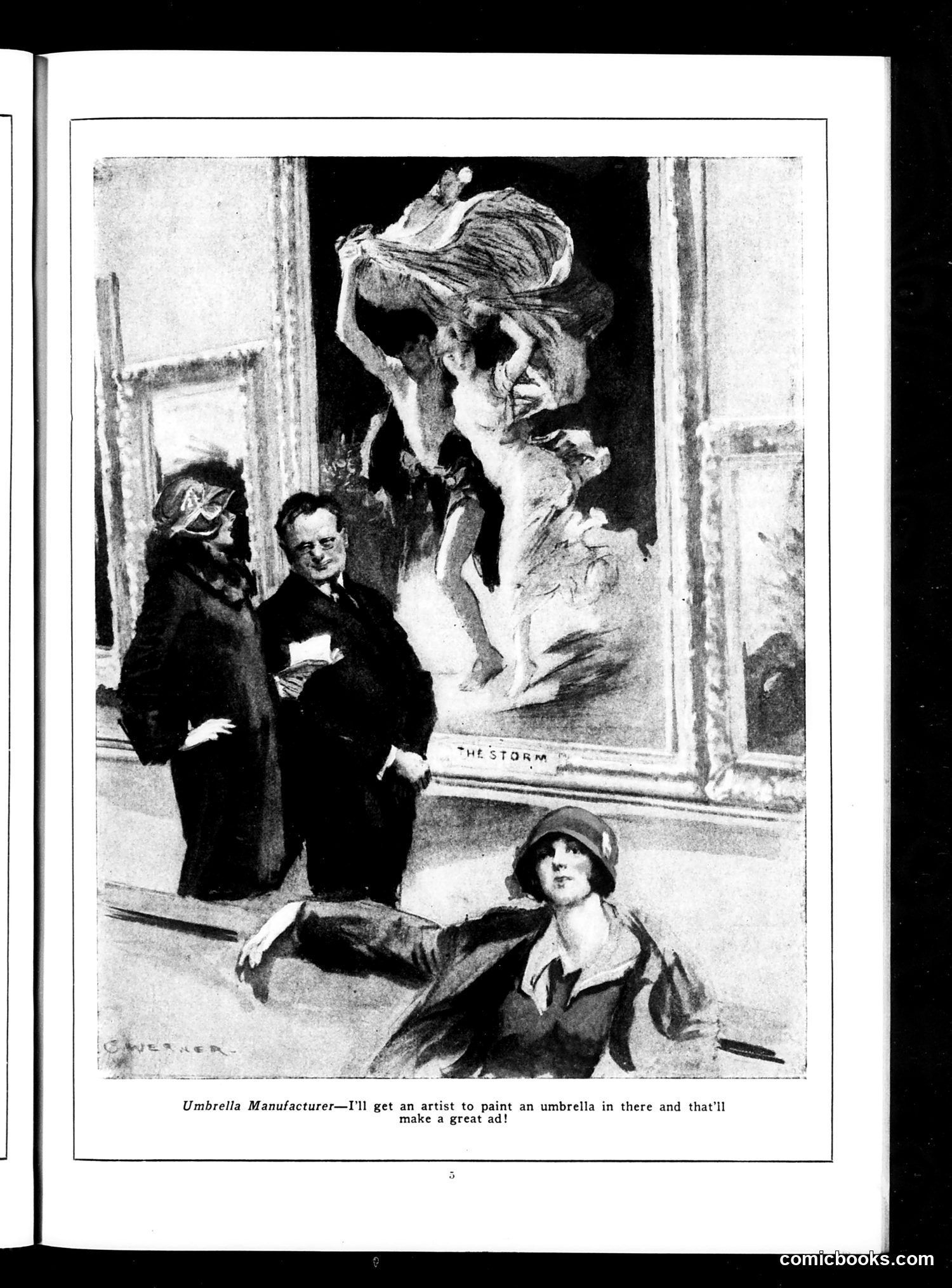
This cartoon satirizes deceptive advertising practices. An umbrella manufacturer observes a storefront window display featuring an artistic painting titled "The Storm" (visible on the frame). The manufacturer suggests inserting an umbrella into the existing artwork to create an advertisement, exploiting the painting's dramatic appeal without paying for legitimate artistic promotion. The joke targets manufacturers' attempts to co-opt fine art for commercial gain—essentially hijacking an established artwork to sell products. The well-dressed businessmen contrasted with the lower-class figure observing the scheme suggests commentary on class dynamics and corporate opportunism. This reflects Progressive Era concerns about commercialism's encroachment on culture and art's commodification during the early twentieth century.
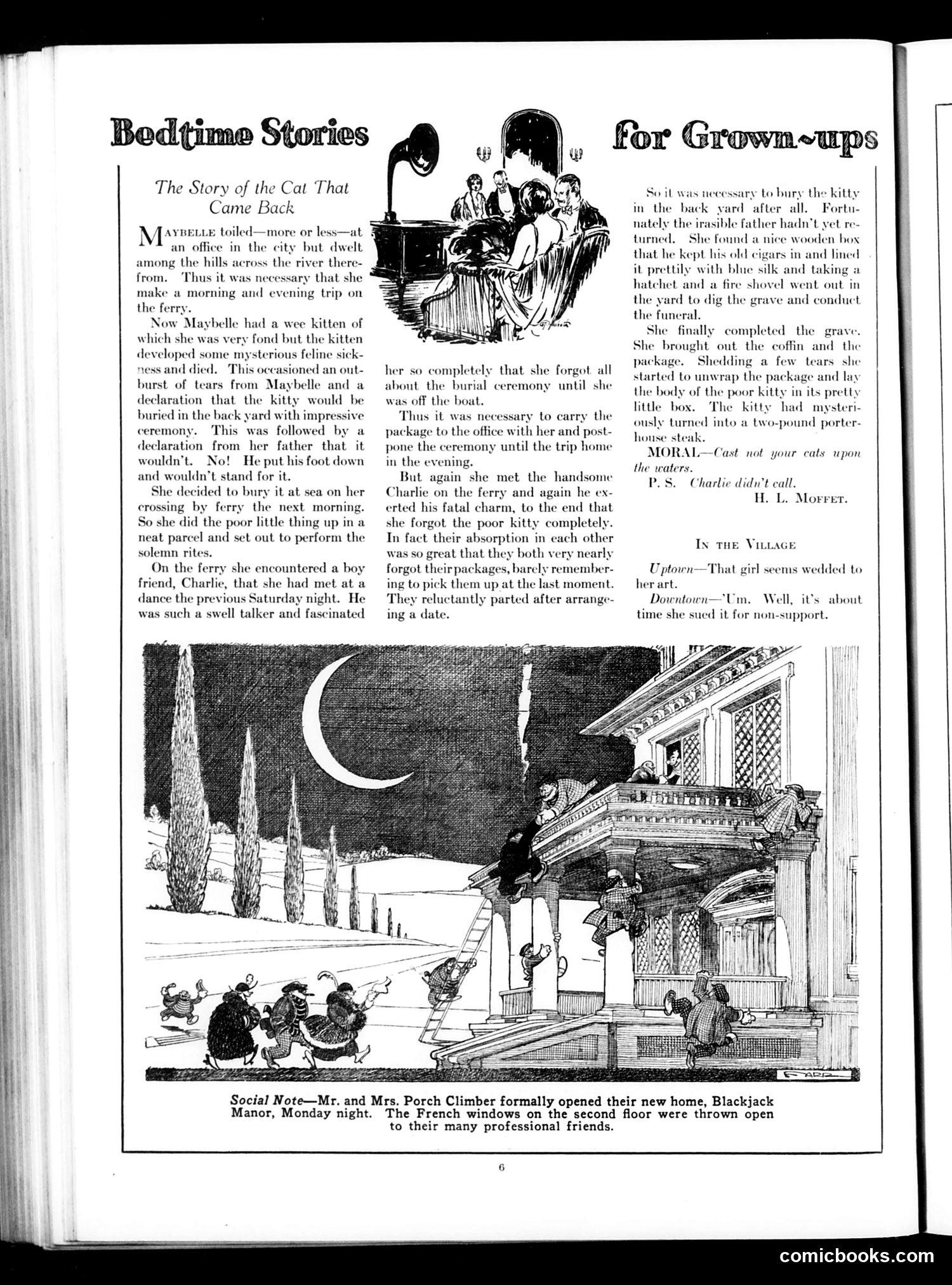
This humorous tale mocks romantic distraction and absent-mindedness. Maybelle intends to bury her dead kitten at sea but becomes so enchanted by a boy named Charlie on the ferry that she forgets—twice. She carries the wrapped package around all day, finally burying it in the backyard that evening without checking its contents. The punchline: the "kitten" has mysteriously become a two-pound porter-house steak, implying someone substituted the package while she was distracted by romance. The moral, "Cast not your cats upon the waters," is a joking inversion of the biblical phrase about casting bread upon waters. The page also includes a social note mocking "Porch Climber"—slang for social climbers seeking status—and a brief joke about a woman artist suing for "non-support," playing on alimony humor common to the era.
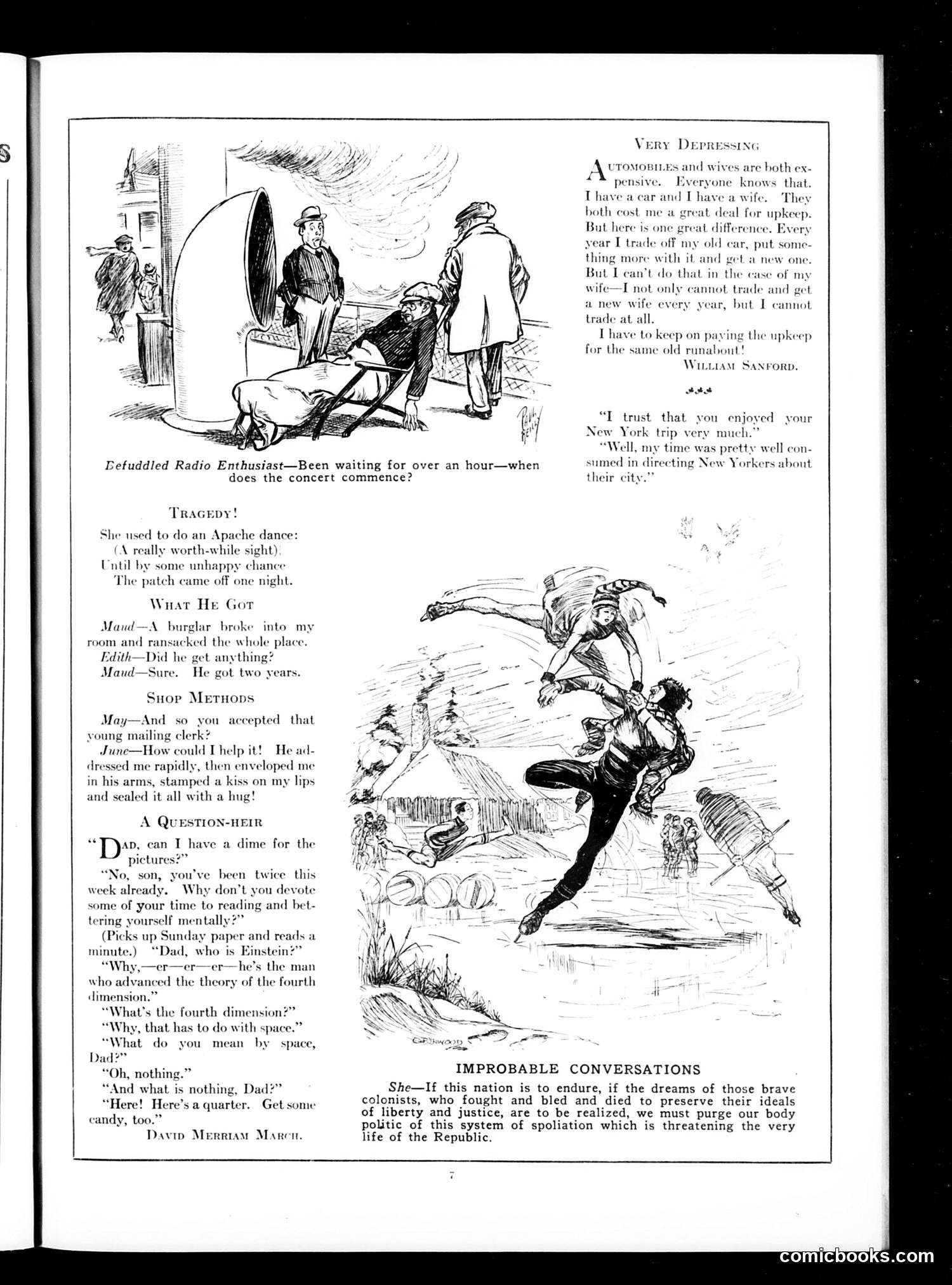
This page contains several satirical pieces mocking early 20th-century American life: **"Very Depressing"** criticizes the permanence of marriage by comparing wives to automobiles—men can trade in old cars yearly but are stuck with wives forever. The humor relies on treating marriage as a financial burden equivalent to vehicle maintenance. **"Befuddled Radio Enthusiast"** jokes about early radio technology's unreliability, mocking impatient listeners waiting for concerts that fail to materialize. The remaining pieces are brief humorous vignettes: a woman losing her Apache dance costume, a burglar getting imprisoned, a clerk's romantic advances using postal terminology, and a father's hypocritical parenting (reading newspapers while denying his son money for pictures). **"Improbable Conversations"** presents a father-son exchange about Einstein and the fourth dimension, satirizing adults' shallow understanding of modern physics. The closing editorial statement warns against "spoliation" (exploitation) threatening the Republic, suggesting the magazine mixed light satire with progressive political commentary.
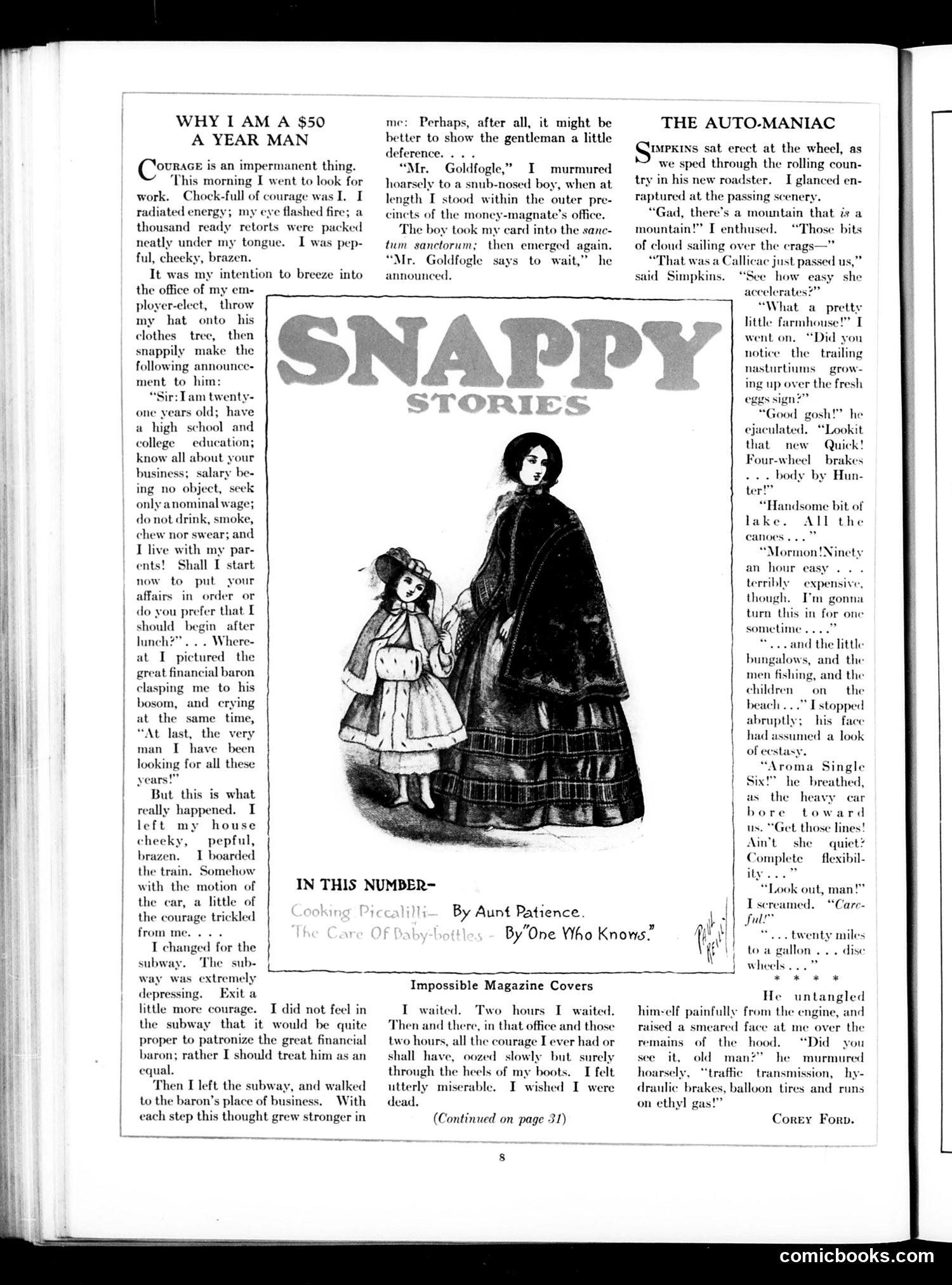
This page contains two satirical stories from Judge magazine: **"Why I Am a $50 A Year Man"** mocks job-seeking desperation. A young man enters the workforce with inflated confidence, planning to demand minimal wages while boasting of his qualifications. However, as he travels toward his potential employer's office—first by train, then subway—his courage literally diminishes with each step. By the time he arrives to meet "Mr. Goldfogle" (likely a Jewish surname, suggesting early 20th-century immigrant business figures), he's reduced to meek deference. The satire targets both the absurdity of overconfident youth and the humbling reality of job markets where desperation trumps bravado. **"The Auto-Maniac"** satirizes automobile enthusiasts who are so obsessed with cars' mechanical features that they ignore natural scenery. While the narrator attempts romantic observations about mountains and farmhouses, his companion Simpkins only notices passing automobiles and their specifications—ultimately crashing due to distraction. The satire reflects 1910s-era anxiety about technology's grip on modern attention.
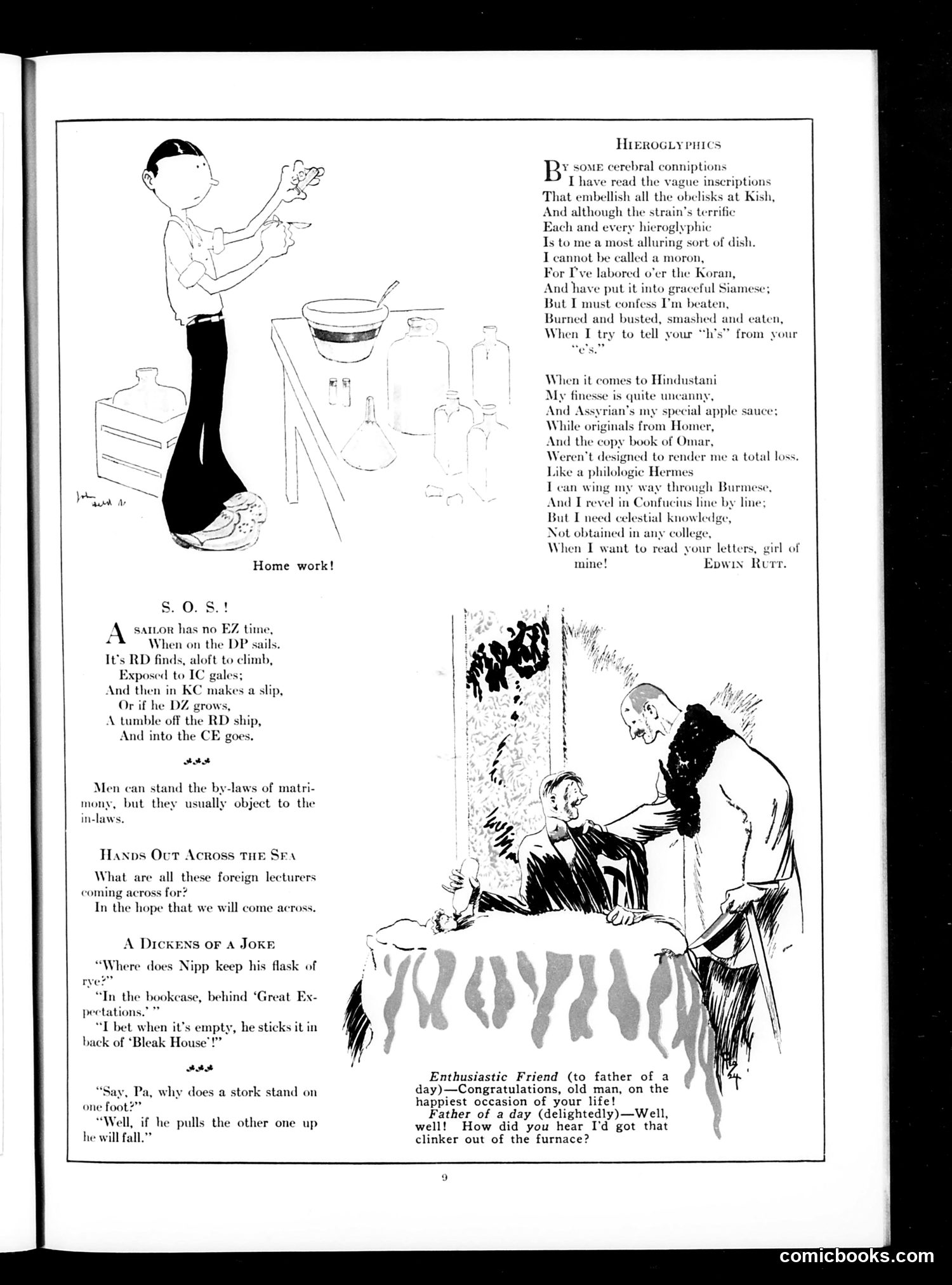
This page contains multiple short humorous pieces typical of early-20th-century American satirical magazines. **"Hieroglyphics"** (Edwin Rutt poem): A scholar boasts of mastering ancient languages—Koran, Hindustani, Assyrian, Homer, Omar, Burmese, Confucius—yet confesses he cannot distinguish between letters in his girlfriend's handwriting. The joke satirizes pedantic intellectualism: academic erudition means nothing in practical romantic matters. **"S.O.S."**: Nautical wordplay using abbreviated sailing terms (DP sails, RD, IC gales, KC, DZ, CE) to describe a sailor's dangerous life. It's a coded complaint about maritime hardships. **"Hands Over Across the Sea"**: A brief joke about foreign lecturers visiting America, hoping audiences will "come across" (spend money). **"A Dickens of a Joke"**: Wordplay using Charles Dickens novel titles ("Great Expectations," "Bleak House") to joke about hiding an empty liquor flask. The bottom cartoon depicts congratulating a father on his newborn, mistakenly calling it "the happiest occasion of your life"—the joke being fatherhood is typically viewed as burdensome rather than joyful.
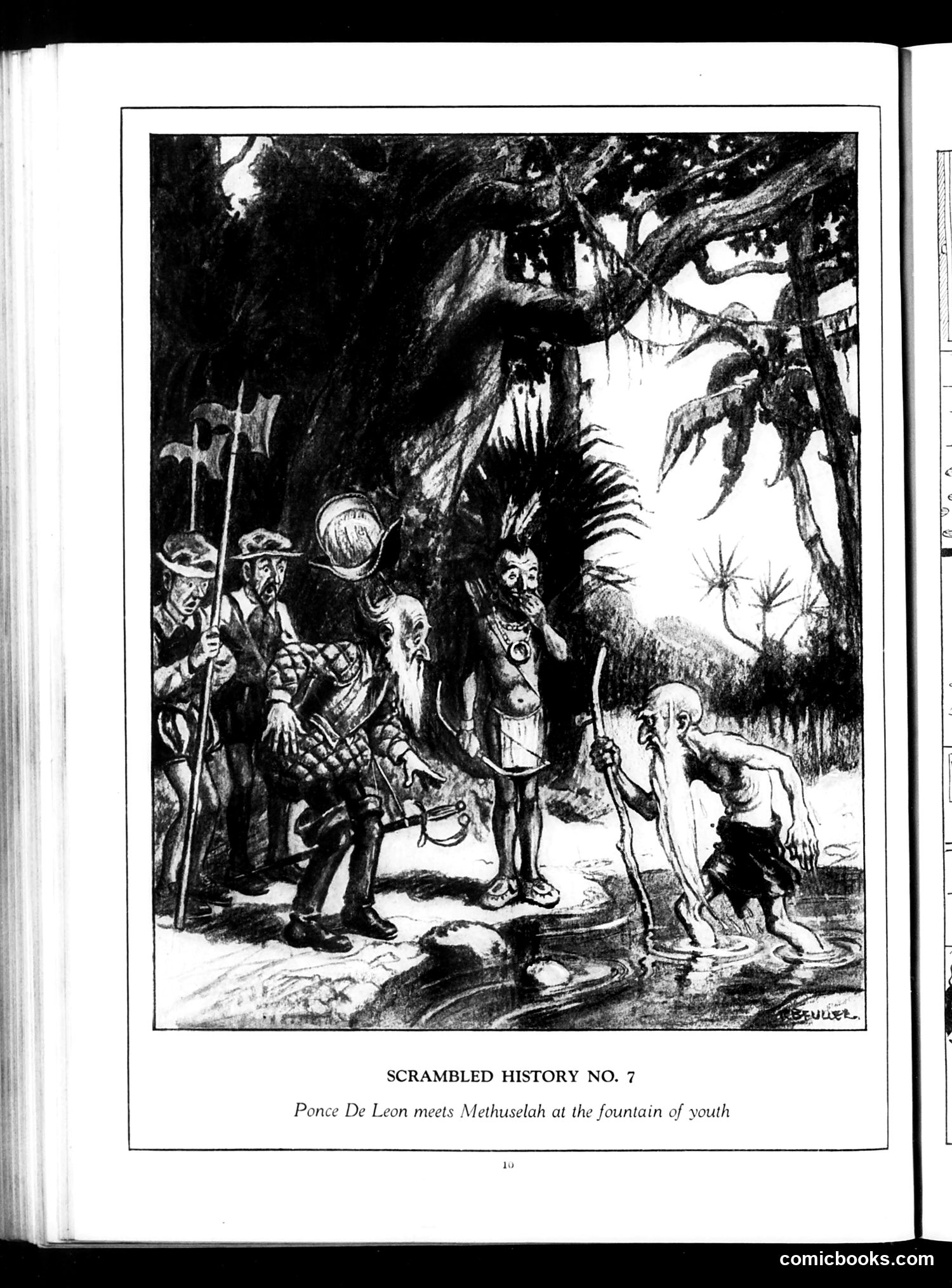
This satirical cartoon depicts the historical explorer Ponce de León (shown in armor on the left with soldiers) encountering the biblical figure Methuselah (the extremely aged man on the right) at the legendary Fountain of Youth. The joke conflates two famous quests for longevity: Ponce de León's legendary (though historically inaccurate) search for a fountain of youth in Florida, and Methuselah, known in the Bible as humanity's oldest person. By showing these two figures meeting at the fountain, the cartoon humorously suggests the fountain's ineffectiveness—if even Methuselah is still aged and withered despite supposedly finding it, the fountain clearly doesn't work. The "Scrambled History" title indicates this is intentionally anachronistic and absurdist humor mixing historical and biblical figures.
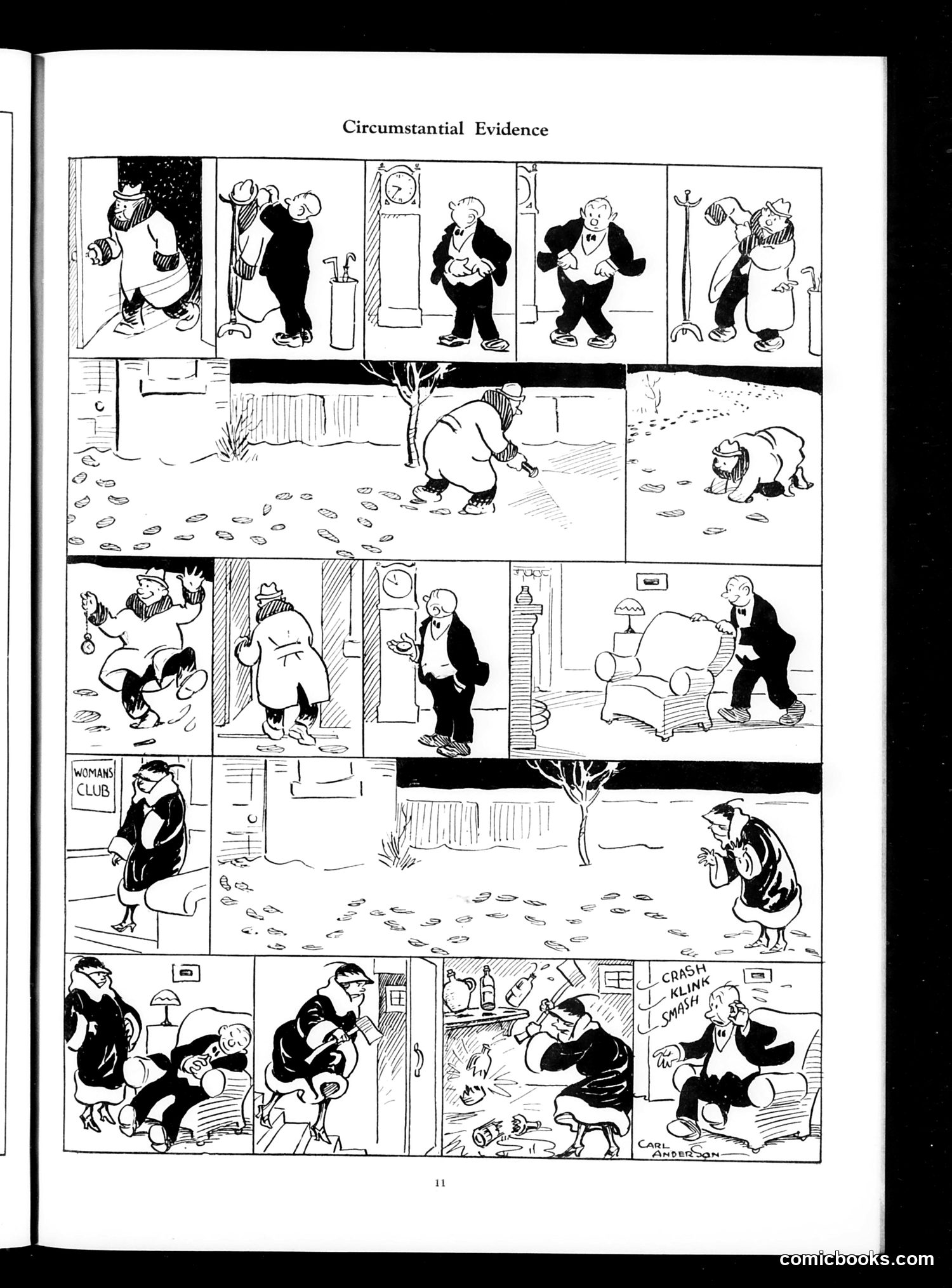
This Judge cartoon satirizes a detective or legal investigation based on circumstantial clues. The narrative follows a man in formal attire who is tracked through various locations—a bathroom, outdoor area, and home interior—by the trail of footprints he leaves behind. The humor derives from the absurdity of "circumstantial evidence": each panel shows investigators finding more footprints and physical traces, building what appears to be an airtight case against the suspect. However, the footprints alone prove nothing definitively about his guilt or innocence—hence "circumstantial." The final panels show the man's increasingly panicked reactions as evidence accumulates against him, mocking how circumstantial clues can create false conviction in the minds of both investigators and the accused, regardless of actual culpability. This satirizes flawed criminal justice logic.
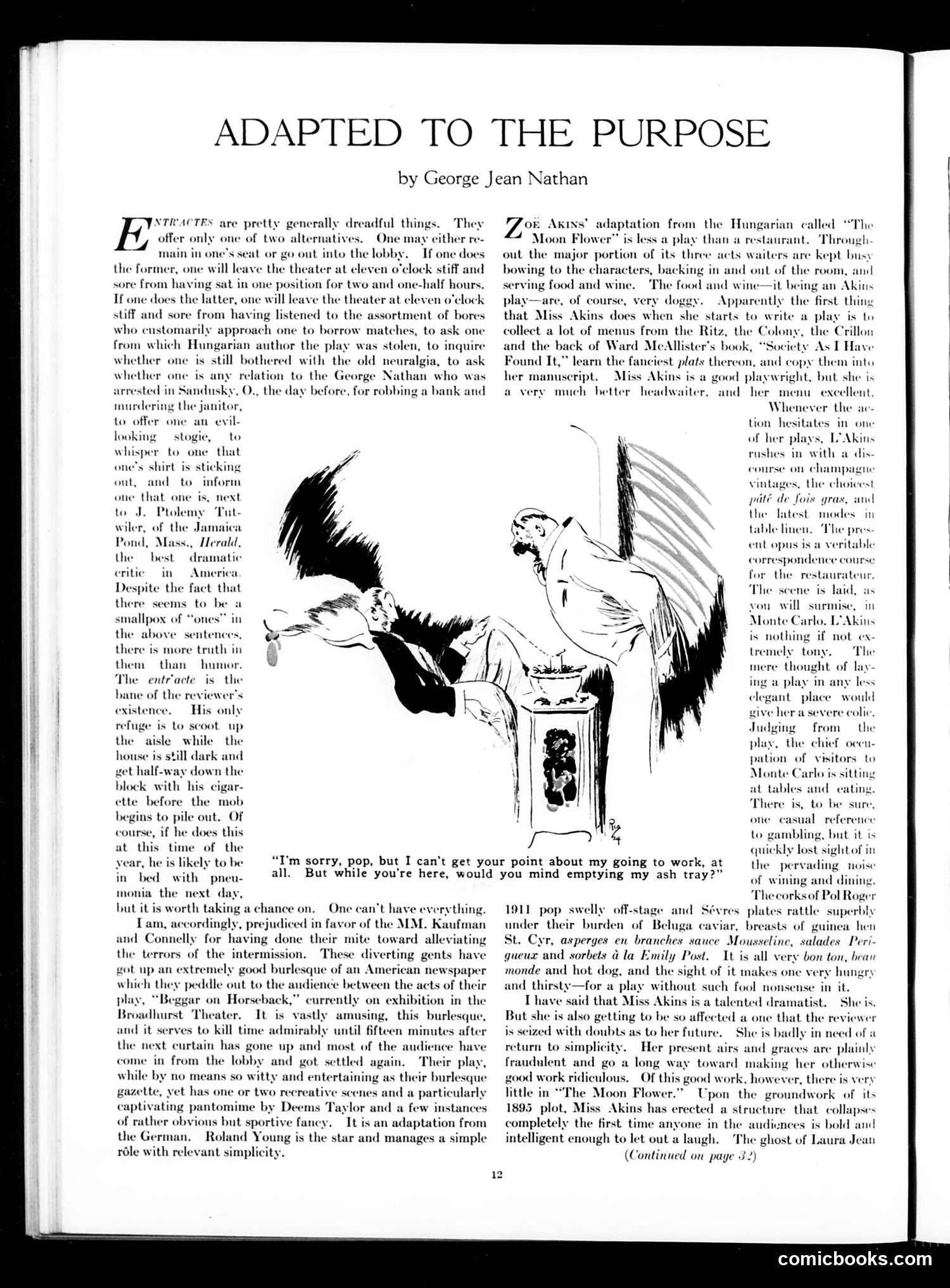
This page contains theatre criticism by George Jean Nathan, a prominent early 20th-century drama critic. The main cartoon depicts an intermission scene where a character complains to his father ("pop") about work while asking him to empty an ashtray—illustrating Nathan's point about intermissions as tedious social obligations where theatre-goers encounter annoying strangers. Nathan reviews two plays: "Beggar on Horseback" (adapted from German, starring Roland Young), praised for its clever newspaper burlesque that entertainingly fills intermission time; and a play by Zoe Akins adapted from Hungarian, which Nathan satirizes as essentially a restaurant setting. He mocks Akins for filling her plays with menus from fancy establishments (Ritz, Colony, Crillon) and descriptions of expensive foods and wines rather than substantive drama. The satire targets both Akins's reliance on luxury-brand name-dropping and the vapidity it suggests about her playwriting.
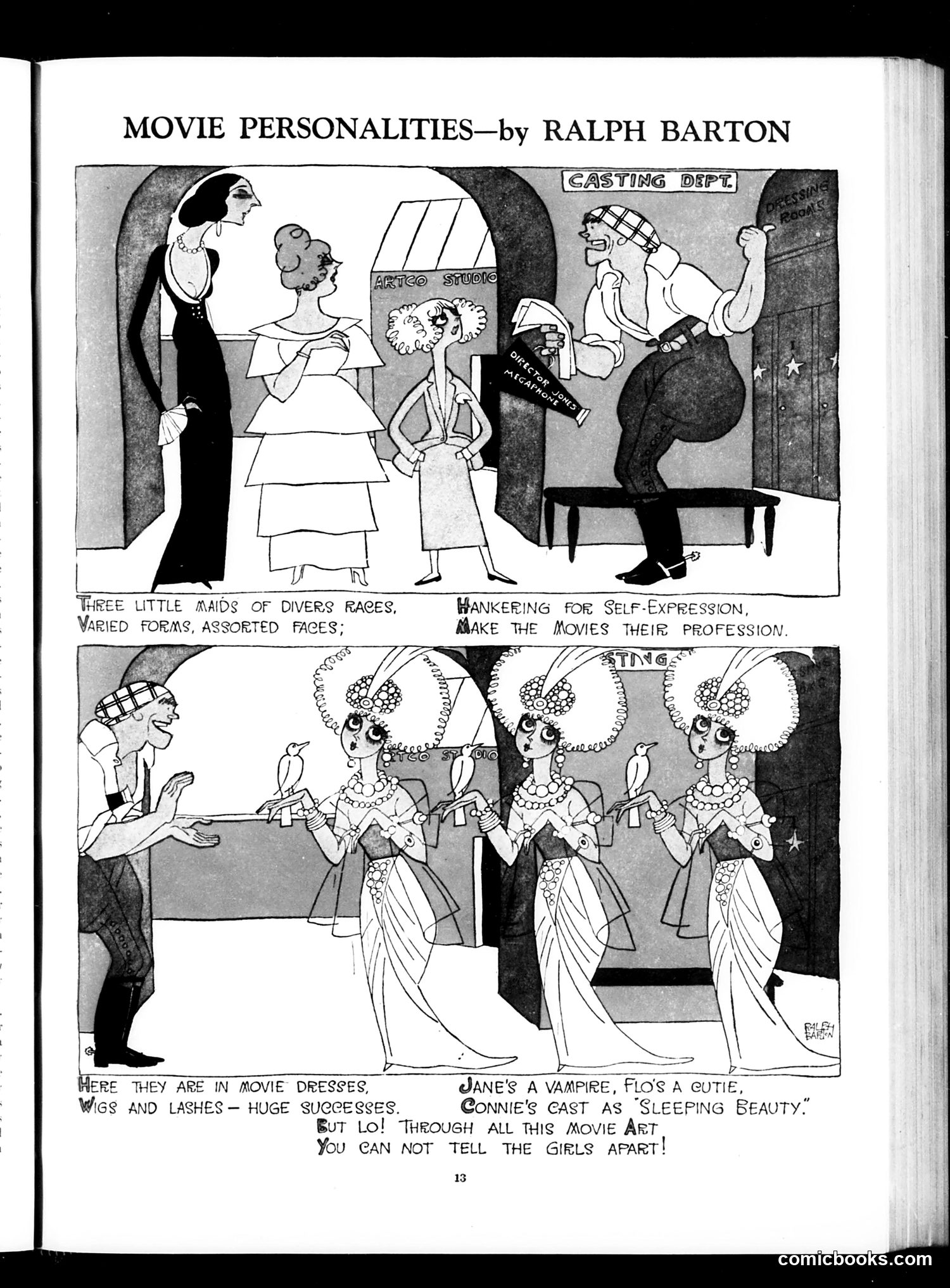
This Ralph Barton cartoon satirizes early 1920s film casting and makeup practices. The joke depicts three young actresses (Jane, Flo, and Connie) auditioning at a movie studio's casting department. Despite being cast in wildly different roles—a vampire, a "cutie," and Sleeping Beauty—the cartoon's punchline is that heavy movie makeup and wigs make all three actresses look identical. The satire targets the film industry's reliance on costume and cosmetics rather than genuine acting talent or distinctive performer personalities. The exaggerated wigs, false lashes, and elaborate movie dresses essentially erase individual identity, reducing actresses to interchangeable products. This reflects contemporary criticism of Hollywood's standardization of beauty and the era's obsession with visual spectacle over substance.
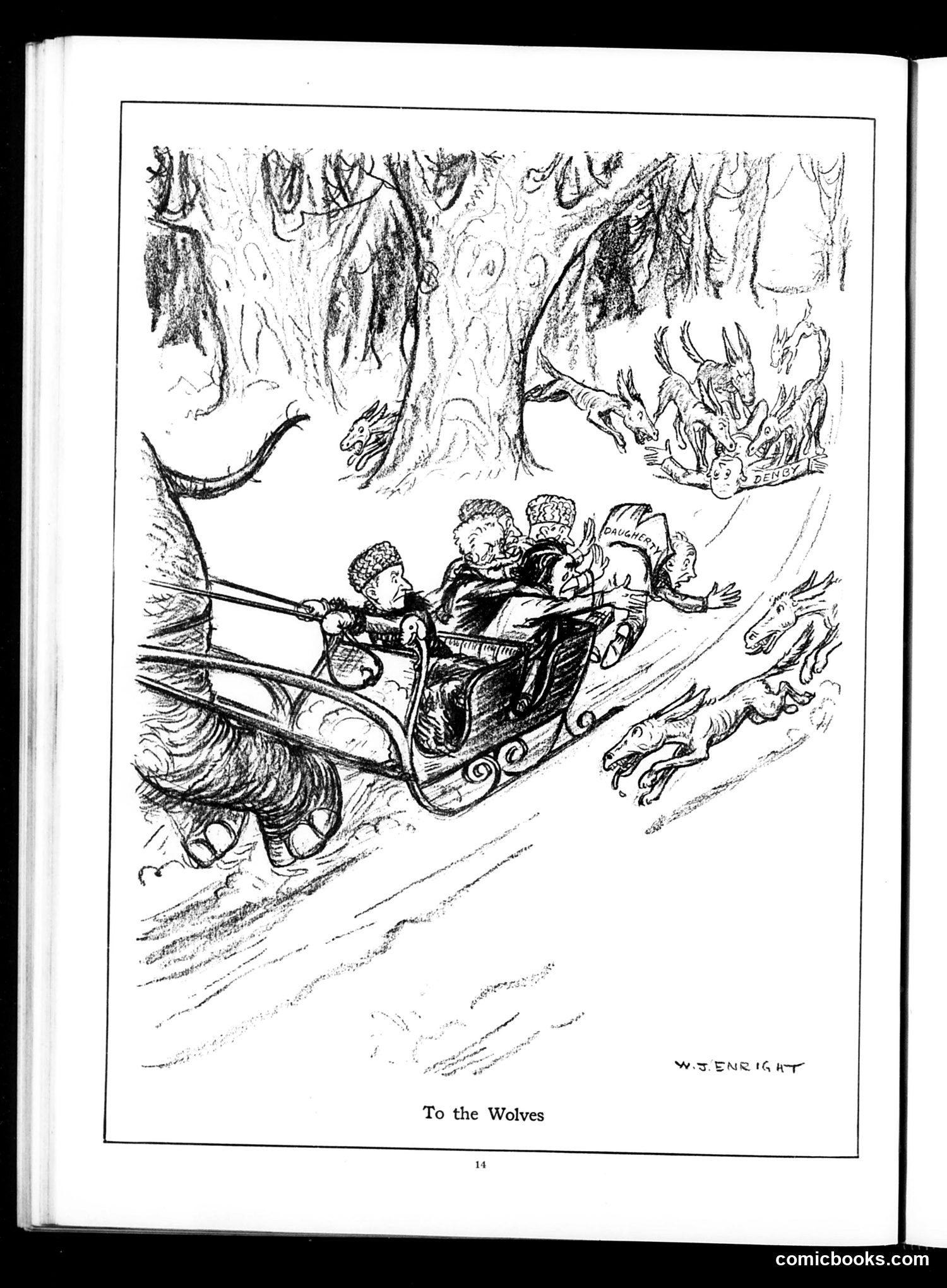
This cartoon by W.T. Enright depicts a sleigh carrying several figures being pursued by wolves through a snowy forest. The passengers appear to be political or public figures being "thrown to the wolves"—a common metaphor for being sacrificed or abandoned by allies. Without clear identification of the specific figures or the publication date, the exact political situation remains unclear. However, the composition suggests commentary on betrayal or scapegoating of government or business leaders. The wolves represent public backlash, enemies, or consequences catching up with those in the sleigh. The title's directness suggests this was likely a timely reference to a contemporary scandal or political upheaval that Judge's readers would have immediately recognized.
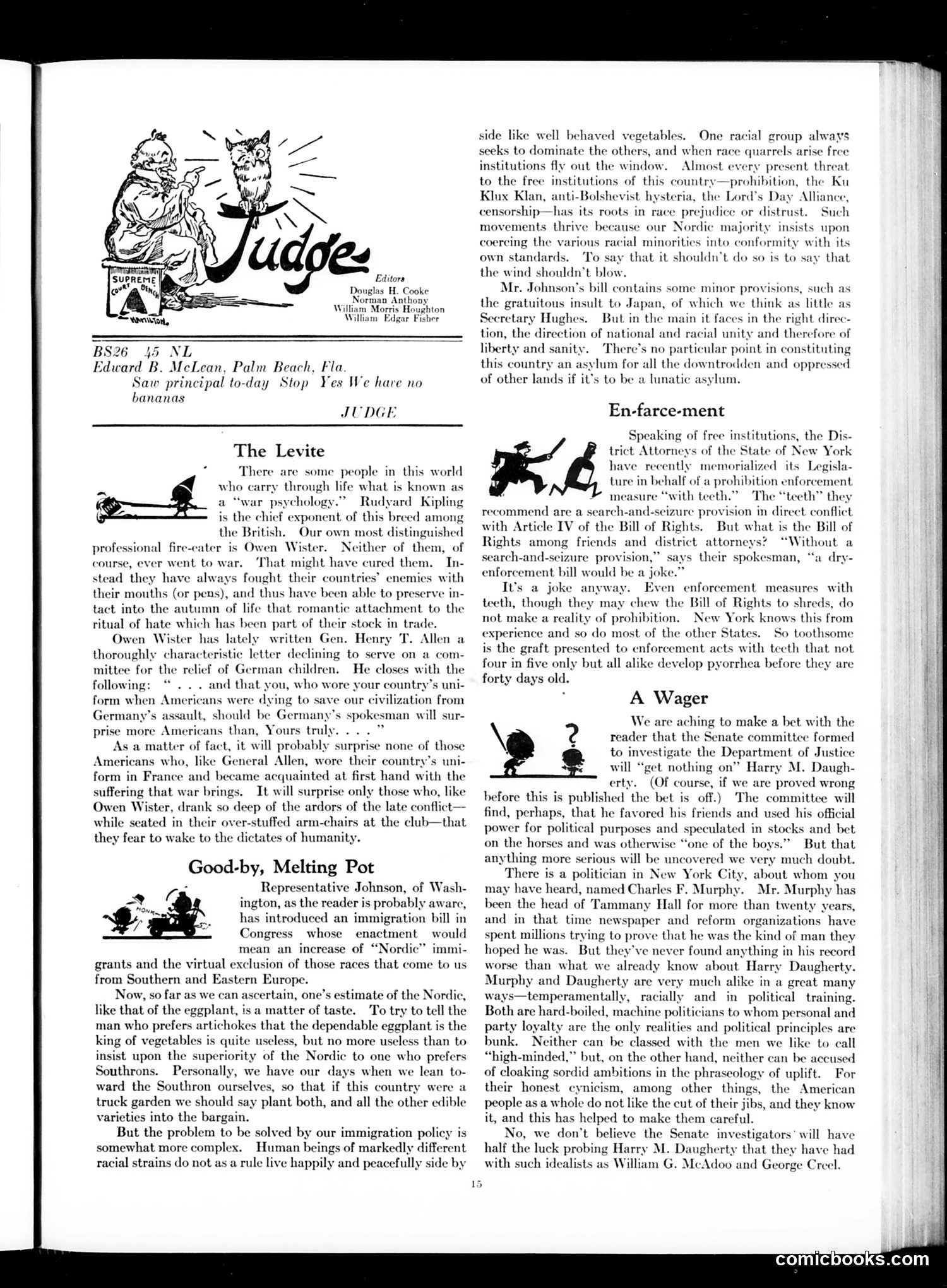
This page contains three distinct opinion pieces criticizing American political figures and policies circa early 1920s. **"The Levite"** attacks writer Owen Wister for refusing to aid German children post-WWI. The satire is that Wister—who never actually fought—maintains aggressive "war psychology" from his armchair, while General Allen, who *did* serve in France, shows humanity. The implication: armchair warmongers lack the moral wisdom of actual veterans. **"Good-by, Melting Pot"** discusses Representative Johnson's immigration bill favoring "Nordic" (Northern European) immigrants while excluding Southern and Eastern Europeans. The cartoon satirizes this as absurd—comparing racial preferences to vegetable preferences. However, the author paradoxically endorses the bill's direction, arguing that racial diversity causes social conflict (citing the KKK, Prohibition, anti-Bolshevism as race-based problems), so restricting immigration toward "unity" makes practical sense. The final section **"En-forcement"** briefly mocks Senate investigations into the Department of Justice. The humor relies on 1920s context: immigration debates, nativism, and post-war attitudes.
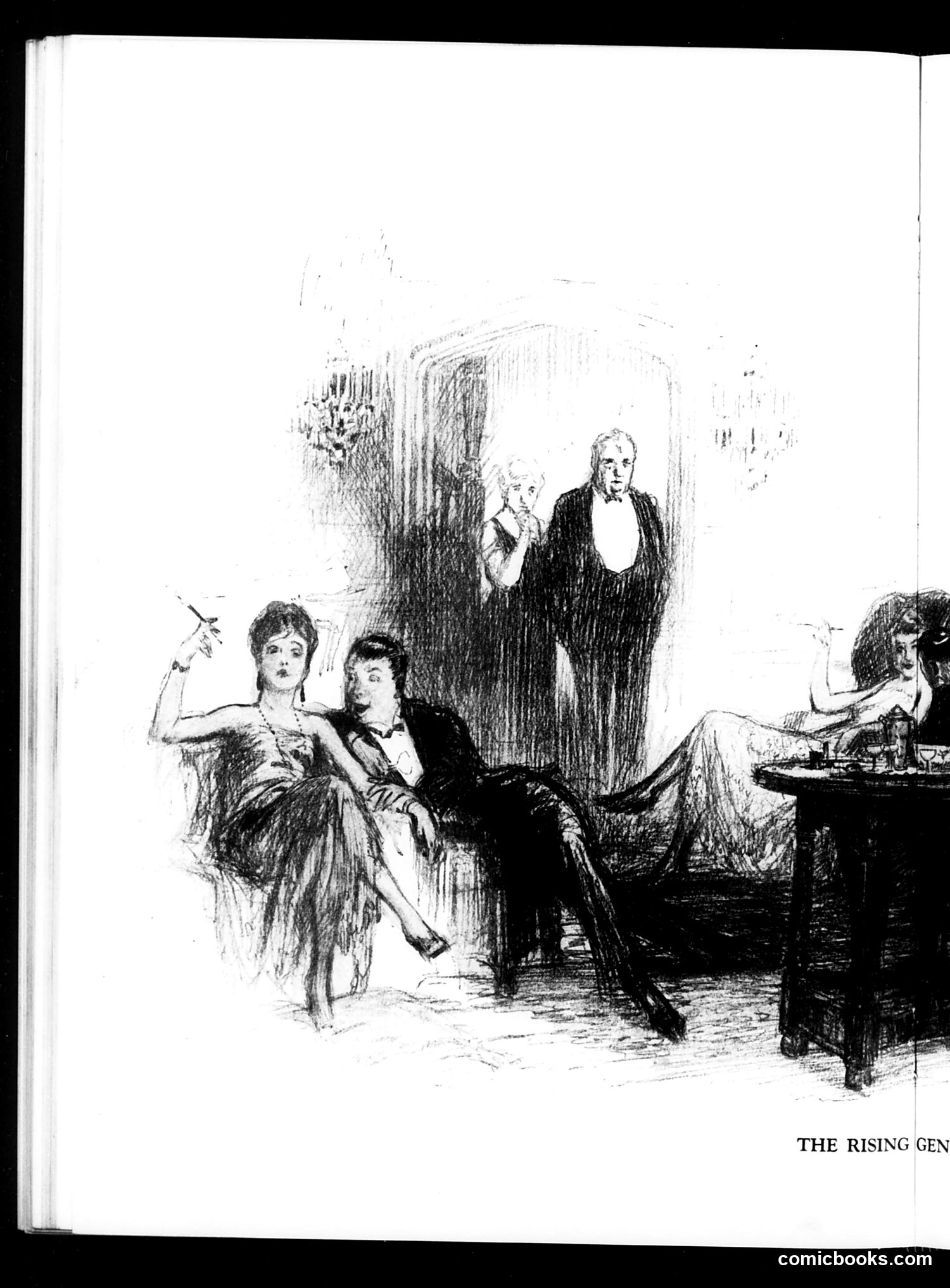
This appears to be a satirical illustration titled "The Rising Gen[eration]" from *Judge* magazine. The sketch depicts an indoor social scene with multiple figures in late 19th or early 20th-century dress. The cartoon likely satirizes contemporary youth culture or social behavior of the era. A woman on the left holds what appears to be a cigarette or similar object—a detail suggesting commentary on "modern" or scandalous female behavior for the time. The gathering suggests a parlor or social club setting, with well-dressed men and women in poses suggesting leisure, indulgence, or questionable conduct. Without additional context or visible captions, the specific social critique remains unclear, though "rising generation" typically refers to young people and their perceived moral or behavioral departures from previous standards—a common satirical target in period magazines.
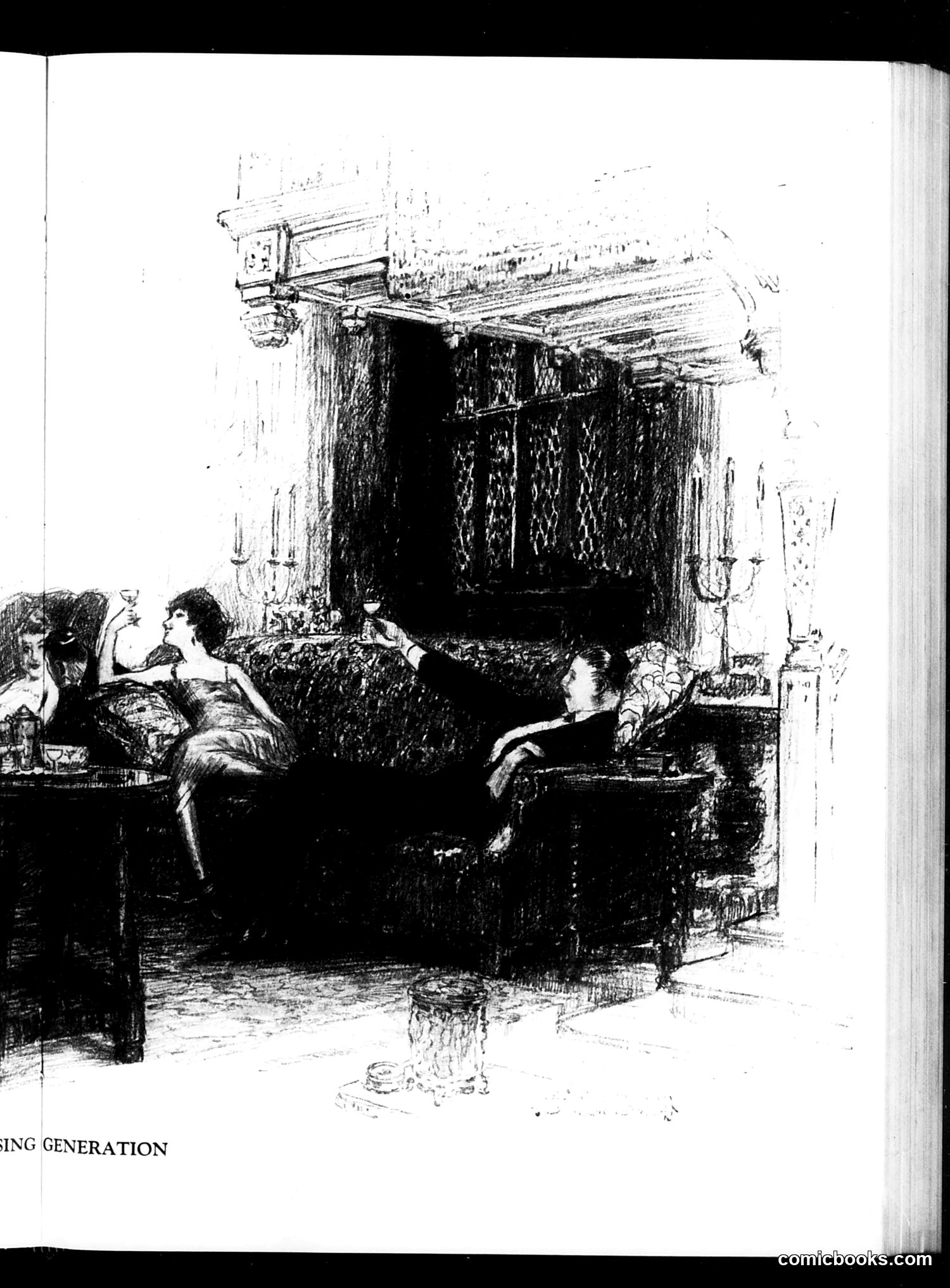
This appears to be a sketch from *Judge* magazine showing an elegant interior scene with several figures in formal dress gathered in what looks like a parlor or drawing room. The visible text fragment reads "SING GENERATION" (likely part of a larger title). The sketch depicts what appears to be a social gathering of the upper class, with figures seated and reclining on furniture. The detailed crosshatching and period dress suggest this is satirizing contemporary high society or elite social customs. However, without the complete caption or title visible on this page, I cannot definitively identify which specific social commentary or satirical point the cartoonist intended. The partial text makes it difficult to determine the exact subject of satire—whether it concerns generational attitudes, social pretension, or another contemporary issue.
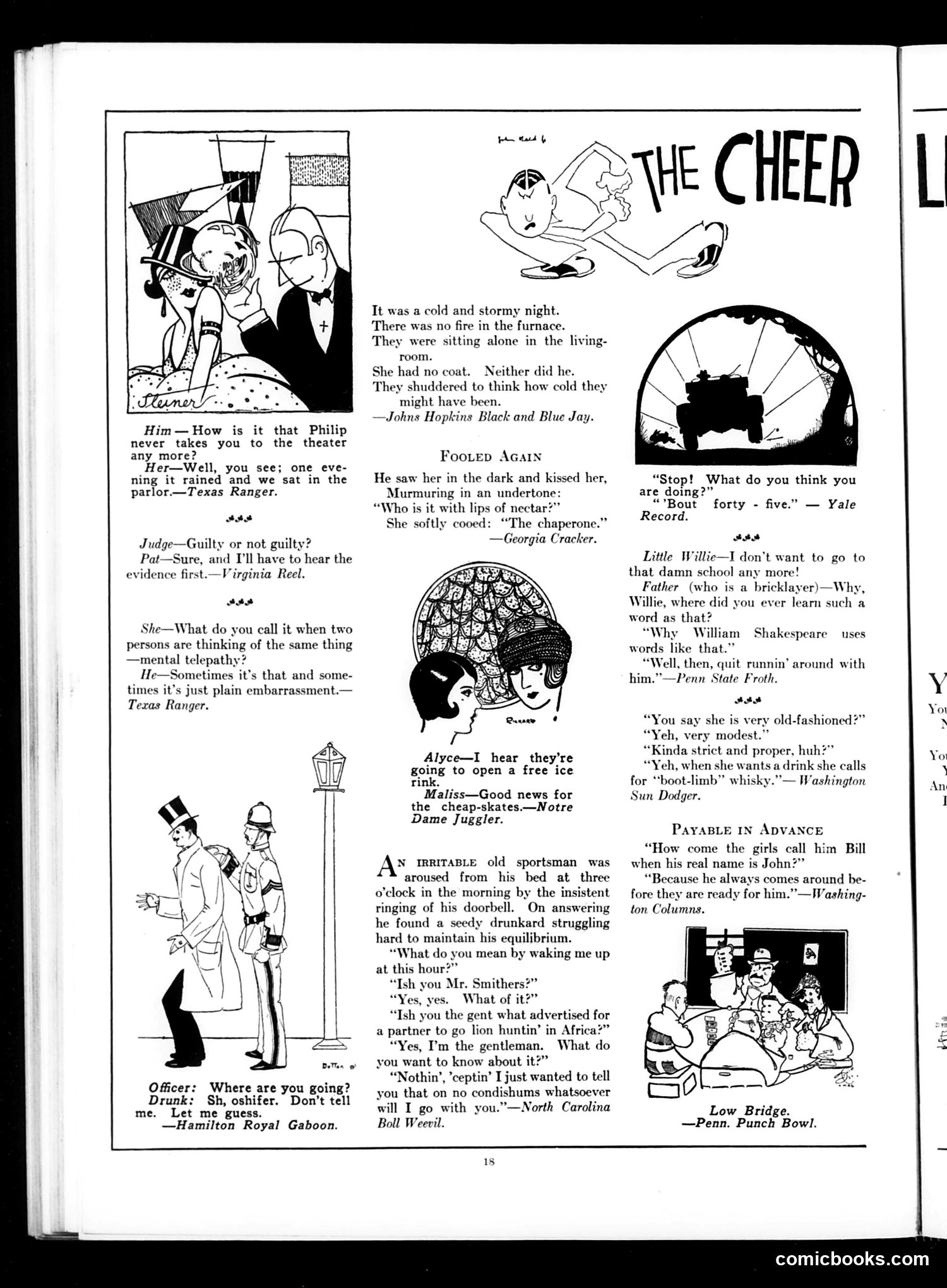
This is a collection of brief humorous anecdotes and jokes typical of early 20th-century American humor magazines. The page satirizes courtship, social embarrassment, and class dynamics: **Key themes:** - **Courtship rituals**: Multiple jokes about romantic encounters—a couple avoiding theater after discovering parlor intimacy is cheaper, a man kissing a woman in darkness only to discover she's a chaperone. - **Class comedy**: References to "cheap-skates" enjoying free ice rinks, a drunkard confronting a wealthy sportsman about an Africa hunting expedition, and a working-class father (bricklayer) shocked by his son's profanity. - **Gender/propriety**: An "old-fashioned" woman who must disguise her drinking by calling whisky "boot-limb," and a man named Bill whom girls pursue strategically. The humor relies on period-specific social anxieties: dating conventions, class distinctions, prohibition-era alcohol references, and rigid Victorian propriety. Most jokes involve mild embarrassment or deflating pretension rather than sharp political satire.
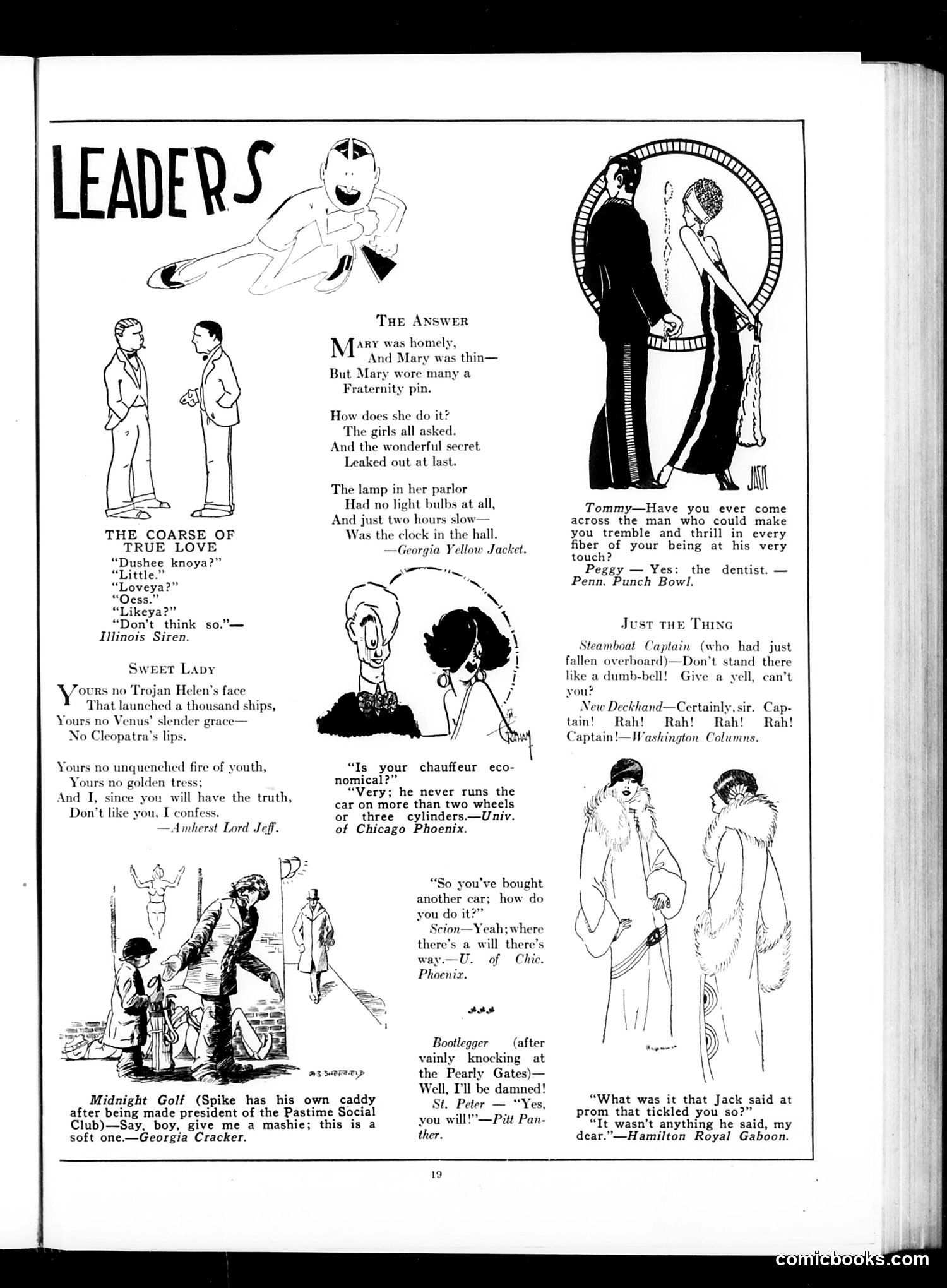
This page from *Judge* magazine collects humorous quips and cartoons from college humor publications, organized around the theme of "Leaders" (likely referring to social influence or romantic appeal). The jokes mock 1920s college culture and social pretension: - **"The Coarse of True Love"** satirizes insincere courtship, with a man admitting he doesn't actually like his partner—subverting romantic poetry. - **"The Answer"** reveals an ugly woman's popularity: she seduces men using darkness (no lightbulbs, slow clock) to hide her appearance—a sharp critique of deception in dating. - **Bootlegger joke** references Prohibition-era illegal alcohol sales, suggesting moral hypocrisy. - **Car ownership joke** likely mocks wealth-obsessed youth using credit/loans ("where there's a will there's a way"). - **Chauffeur joke** pokes fun at nouveau riche pretension—the wealthy employer doesn't notice his driver is reckless. The cartoons emphasize cynicism about romance, materialism, and class performance among young Americans in the Jazz Age.
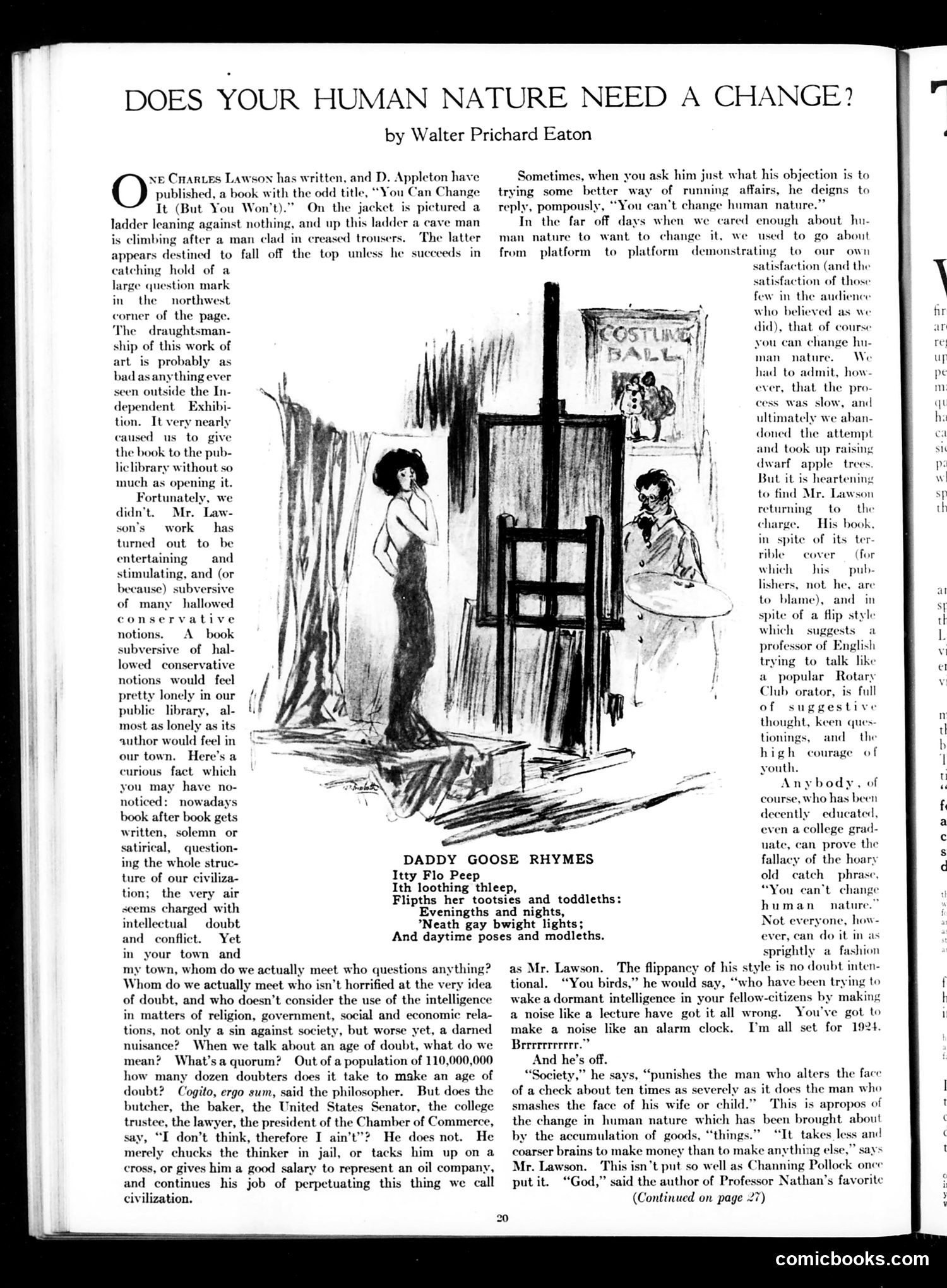
This page from *Judge* magazine contains an essay by Walter Prichard Eaton reviewing Charles Lawson's book "You Can't Change It (But You Won't)." **The Main Argument:** Eaton satirizes conservative resistance to social change. He notes that while intellectual circles debate reform and doubt, ordinary people—butchers, bankers, senators—remain hostile to questioning and innovation. When challenged about resisting change, they invoke the cliché: "You can't change human nature." **The Satire:** Eaton mocks this excuse, arguing that educated people *can* prove human nature is changeable. He praises Lawson's book for championing this unpopular idea, though he ridicules its terrible cover design (showing a caveman chasing a suited man up a ladder toward a question mark). **The Broader Point:** The essay attacks how power structures suppress intellectual progress by imprisoning or co-opting thinkers while the general population remains complacently conservative—perpetuating what Eaton calls "this thing we call civilization." The small "Daddy Goose Rhymes" cartoon appears unrelated filler content.
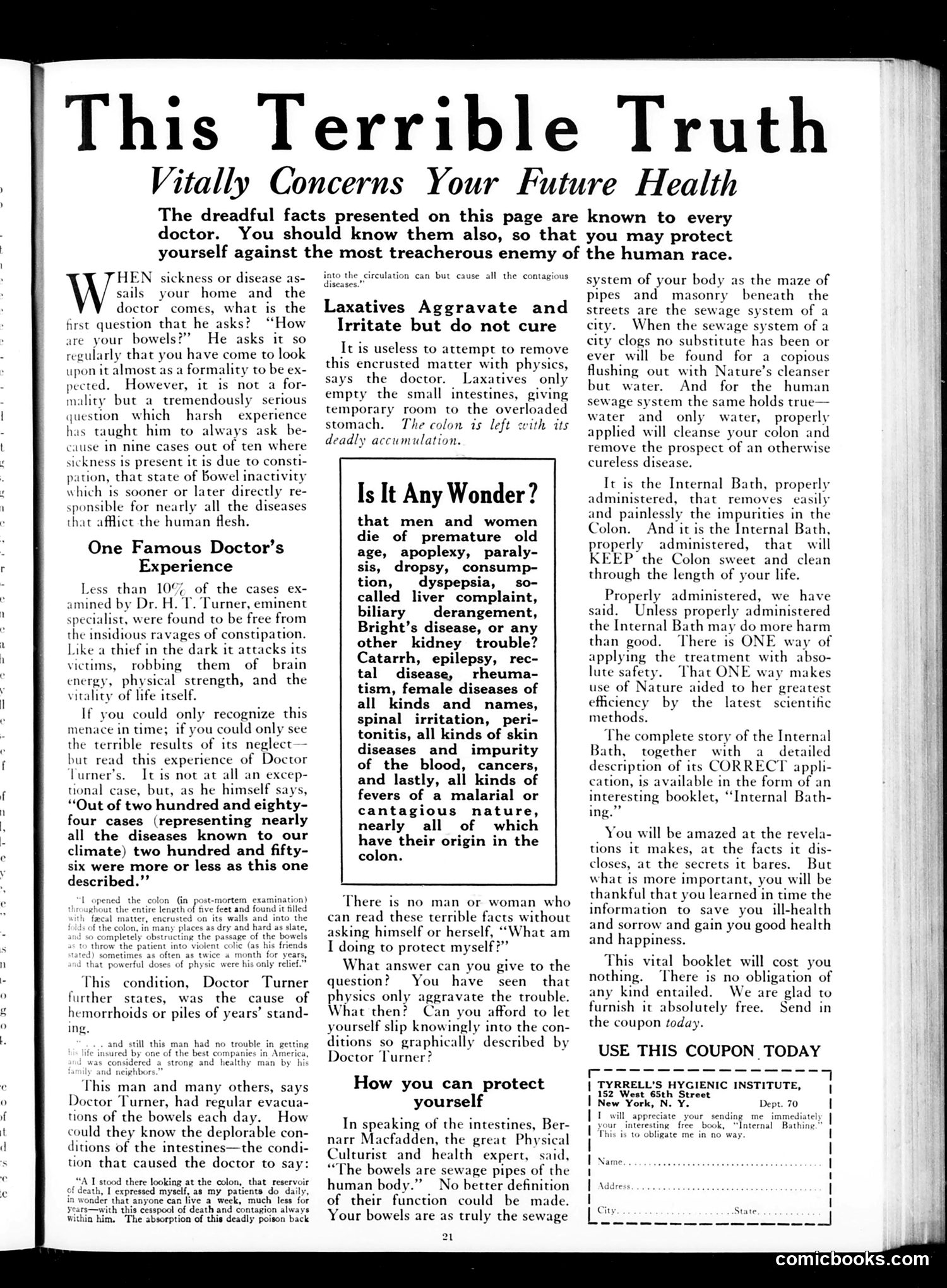
This page is **not a cartoon** but rather **health advertising disguised as editorial content**—a common early 20th-century marketing tactic. The piece promotes the "Internal Bath," a commercial bowel-cleansing treatment, by citing "Doctor Turner's" supposed medical findings about constipation causing disease. The rhetoric is deliberately alarming: constipation is portrayed as a "cesspool of death," responsible for nearly every illness imaginable (cancer, epilepsy, paralysis, etc.). **Key context moderns should recognize:** 1. **Medical misinformation**: The claims lack scientific basis; constipation doesn't cause most listed diseases. 2. **Fear-based marketing**: By terrifying readers about bodily "toxins," the ad sells a product (coupon visible at bottom for Tyrrell's Hygienic Institute). 3. **Historical pattern**: This reflects early-1900s "autointoxication" pseudoscience—a debunked theory that toxins from bowels poisoned the body. 4. **Credibility manipulation**: Citing a named "specialist" lends false authority; no verification was required. Modern readers would recognize this as predatory health marketing exploiting legitimate medical concerns.
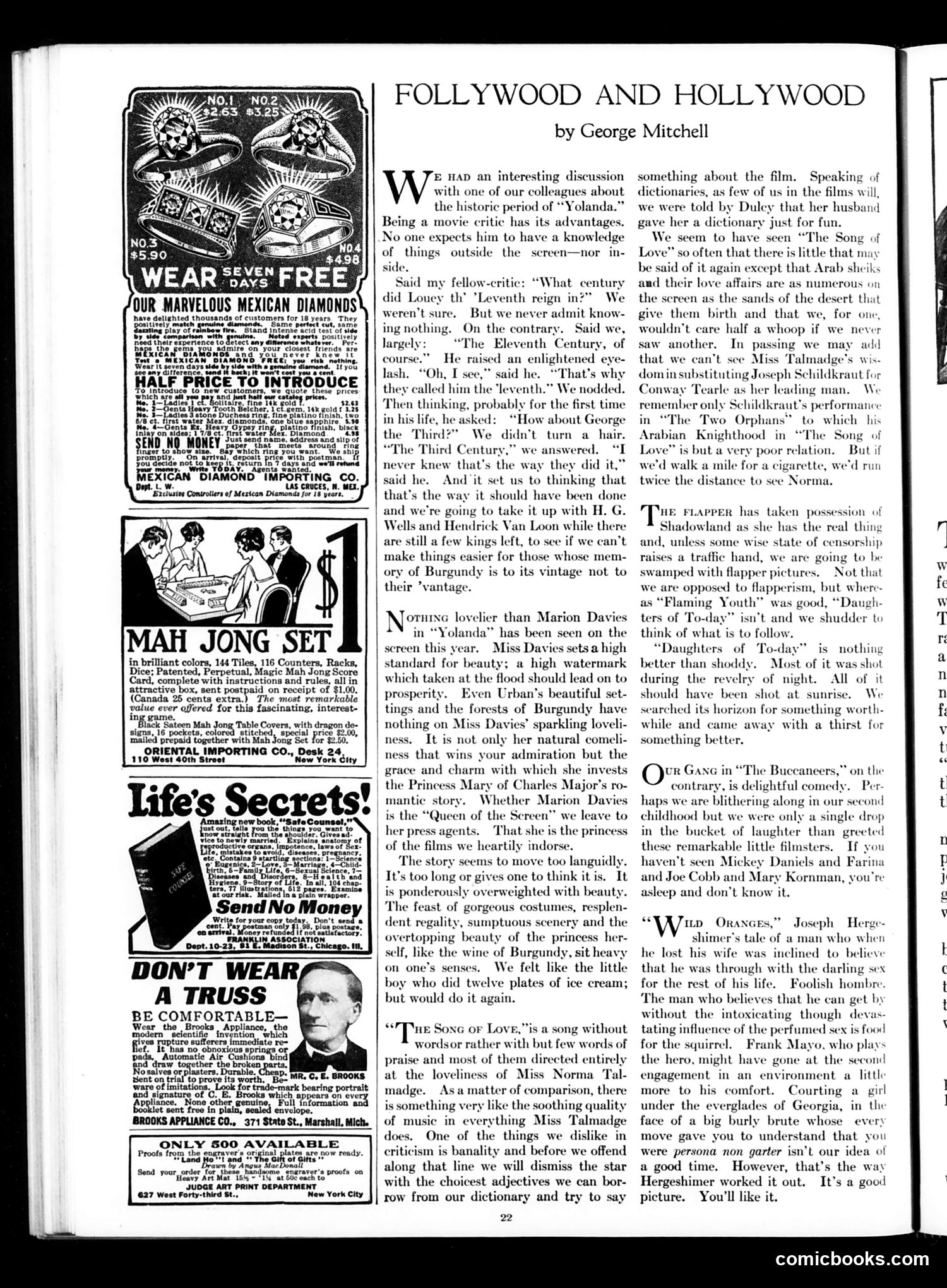
This page is primarily a **film criticism essay** by George Mitchell, not a political cartoon. The article discusses two 1920s movies: "Yolanda" (starring Marion Davies) and "The Song of Love." The satire is **intellectual rather than visual**. Mitchell mocks movie critics' pretentiousness by describing how he and a colleague fabricated answers about historical periods in "Yolanda," confidently inventing dates ("The Eleventh Century" for King Louis) rather than admitting ignorance. The joke is that film critics are expected to know nothing outside cinema and can bluff their way through. Davies receives praise for beauty and grace, though the film is criticized as overly long and "ponderously overweighted with beauty." The **surrounding advertisements** (Mexican diamonds, Mah Jong sets, trusses) are typical Judge magazine filler, unrelated to the article's content.
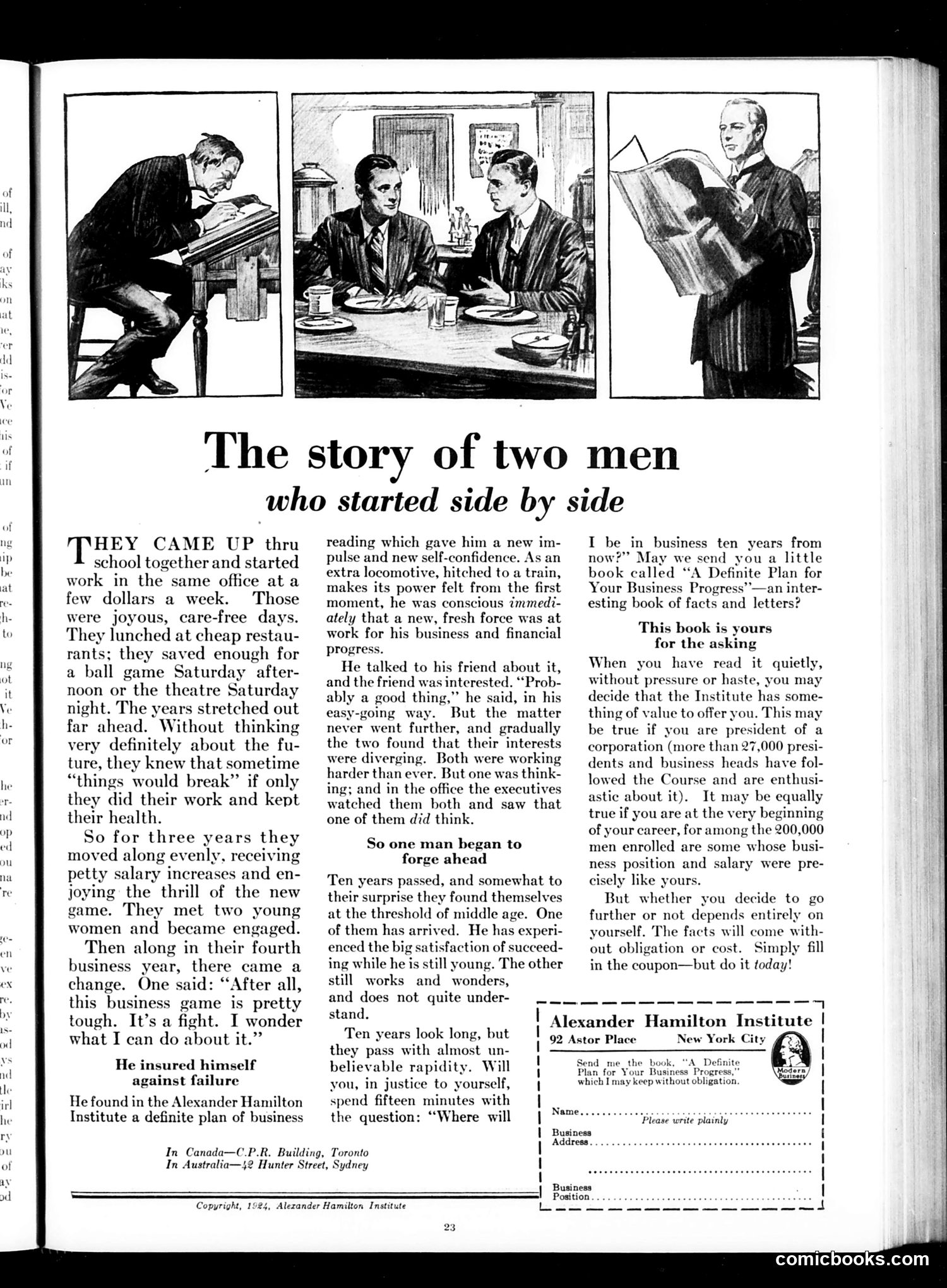
This is **advertising content**, not satire. The page promotes the Alexander Hamilton Institute's business correspondence courses through a morality tale. **The narrative:** Two young men begin their careers identically—same office, same modest salary, same aspirations. At a critical moment (their fourth year), one becomes discouraged by the difficulty of business. He enrolls in the Institute's self-improvement program, gaining confidence and "fresh force." His friend shows initial interest but never commits. **The point:** Ten years later, the first man has succeeded and risen to prominence, while the second remains stalled and confused, still "wondering." **For modern readers:** This reflects early 20th-century self-help marketing that equated self-education with moral character and business success. The implicit message—that failure results from lack of initiative rather than circumstance—was common in 1924. The Institute positions its course as the difference between advancement and stagnation, appealing to ambitious men's anxieties about their future prospects.
This page from Judge magazine consists primarily of **financial advertisements and investment advice**, not political satire. The main content is Theodore Williams's article "Hysteria Once More," which criticizes irrational stock market behavior following the Teapot Dome oil scandal. **The Central Argument:** Williams argues that the securities market overreacted to the Washington oil scandal (Teapot Dome), with investors irrationally selling shares of companies unrelated to the scandal. He characterizes this as "hysteria"—mob behavior driven by unreliable tips from unnamed sources ("Tom, Dick and Harry") rather than sound analysis. **The Satire's Target:** The piece mocks ordinary speculators' dependence on hearsay and their tendency toward panic selling, contrasting this with rational, informed investment. Williams also critiques proposed tax legislation, warning that poorly designed policy could harm business confidence. **Context:** This reflects post-Teapot Dome era (early 1920s) anxiety about corporate corruption and market volatility. The numerous investment booklets advertised throughout suggest a lucrative market in financial education for anxious middle-class savers.
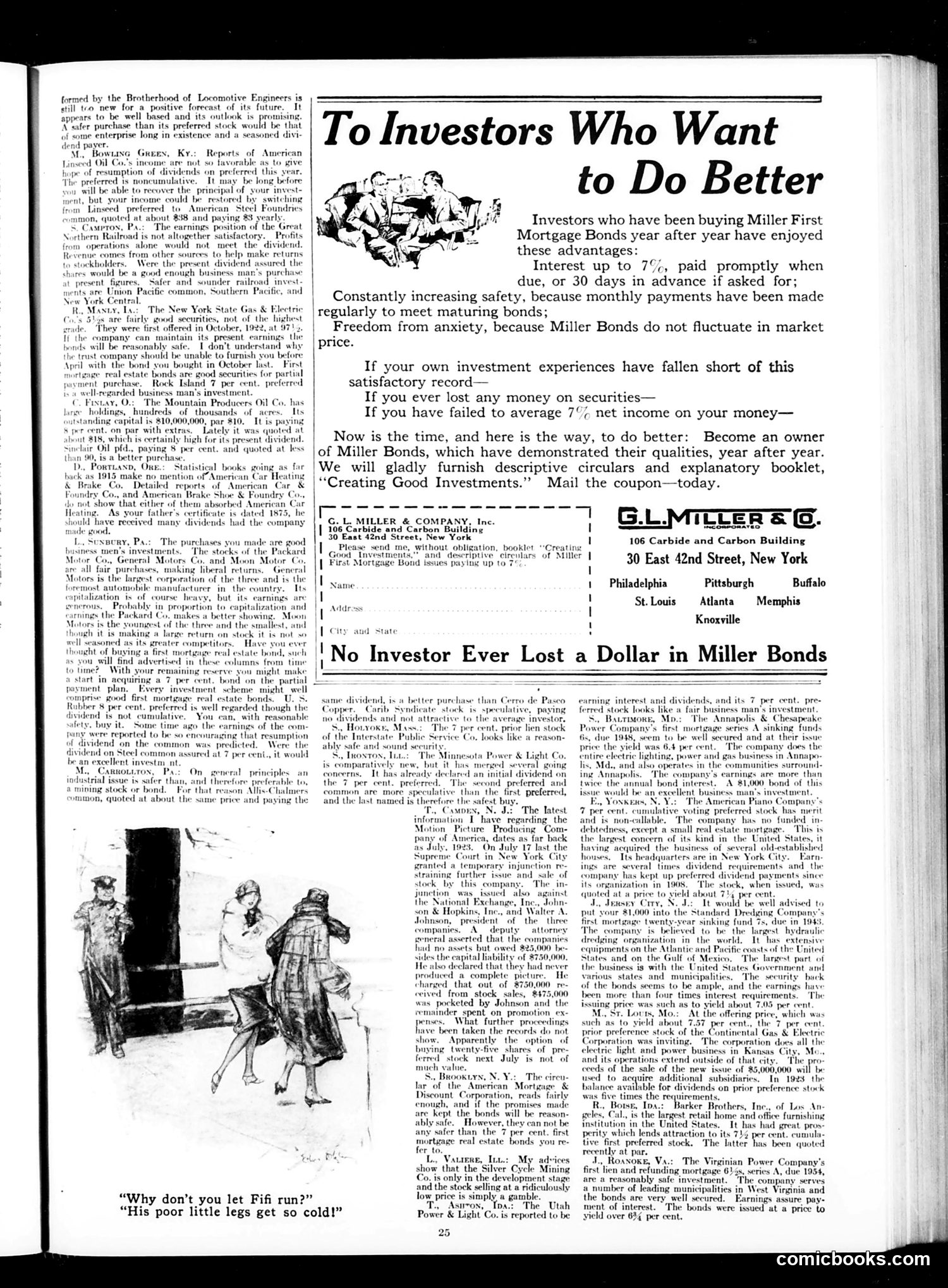
This page is primarily a **financial advertisement** for Miller Bonds, disguised as an investment advice column. The bulk of the page consists of reader letters asking about securities, with responses recommending Miller Bonds as superior alternatives. The **cartoons at bottom left** show a child and adult in winter clothing. The caption—"Why don't you let Fifi run?" / "His poor little legs get so cold!"—is a non-sequitur joke unrelated to the investment content, typical of Judge's filler humor. **The actual satire** is subtle: the page juxtaposes anxious investor questions about volatile stocks and uncertain returns against reassuring testimonials that "No Investor Ever Lost a Dollar in Miller Bonds." This was a common advertising approach during the 1920s boom era, when bond investments were marketed as safe havens against stock market speculation. The page reflects pre-1929 Crash confidence in fixed-income securities and skepticism toward riskier equities—a view that would be devastated within years.
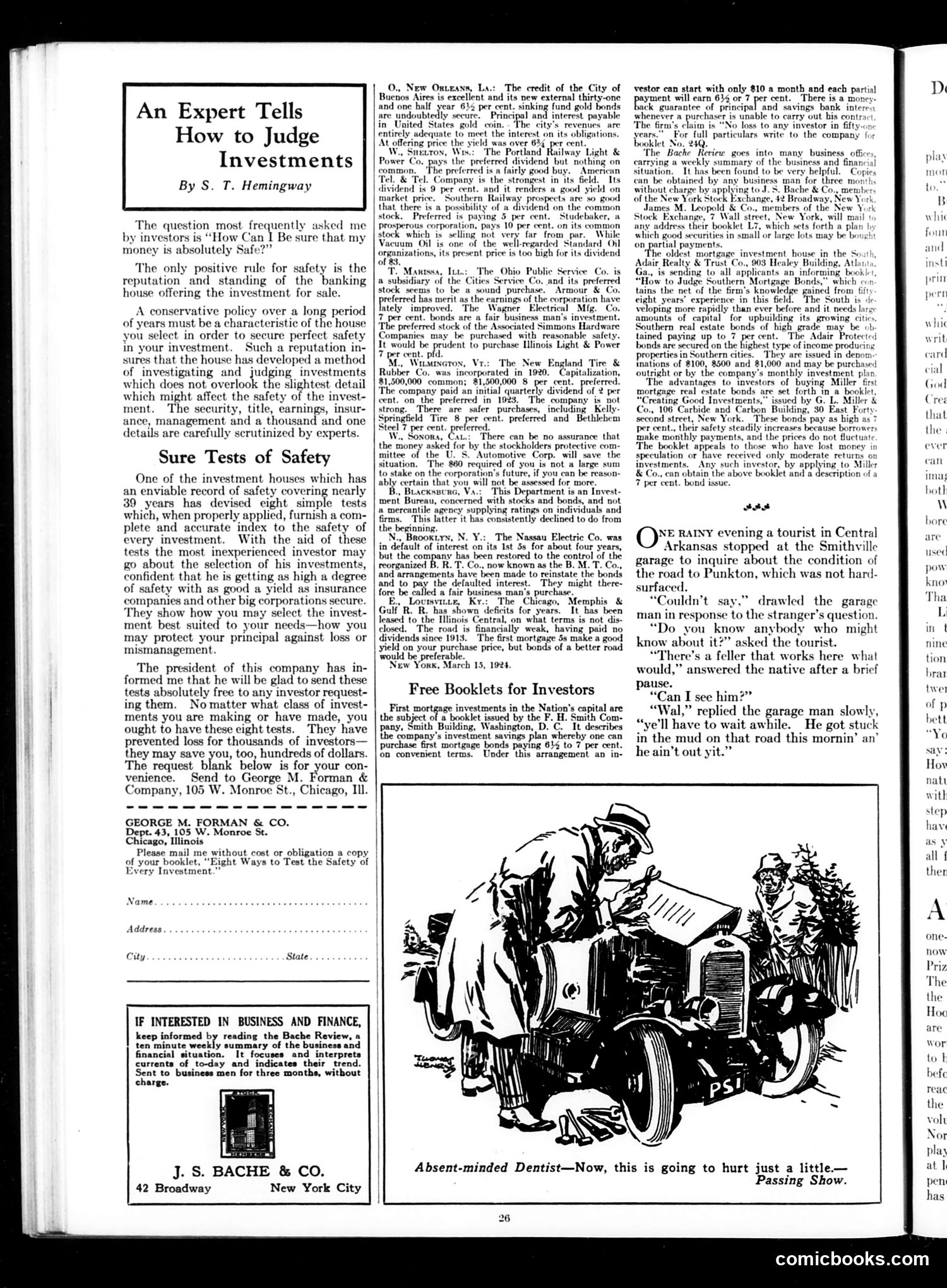
This page contains primarily **financial and investment advertising** rather than political satire. The main content is an article by S. T. Hemingway promoting George M. Forman & Co.'s investment-testing services, addressed to readers seeking safe places for their money. The **single cartoon** at bottom depicts an absent-minded dentist arriving at a garage instead of his office, about to cause damage with his car. The caption reads: "Absent-minded Dentist—Now, this is going to hurt just a little.—Passing Show." This is a light domestic humor piece playing on the dentist's cluelessness and the double meaning of "hurt." The page reflects the **1920s investment climate**—with advertisements for bonds, stocks, and financial advisory services—targeting middle-class investors seeking reliable returns. The detailed investment guidance suggests post-WWI economic uncertainty and growing demand for professional financial vetting services.
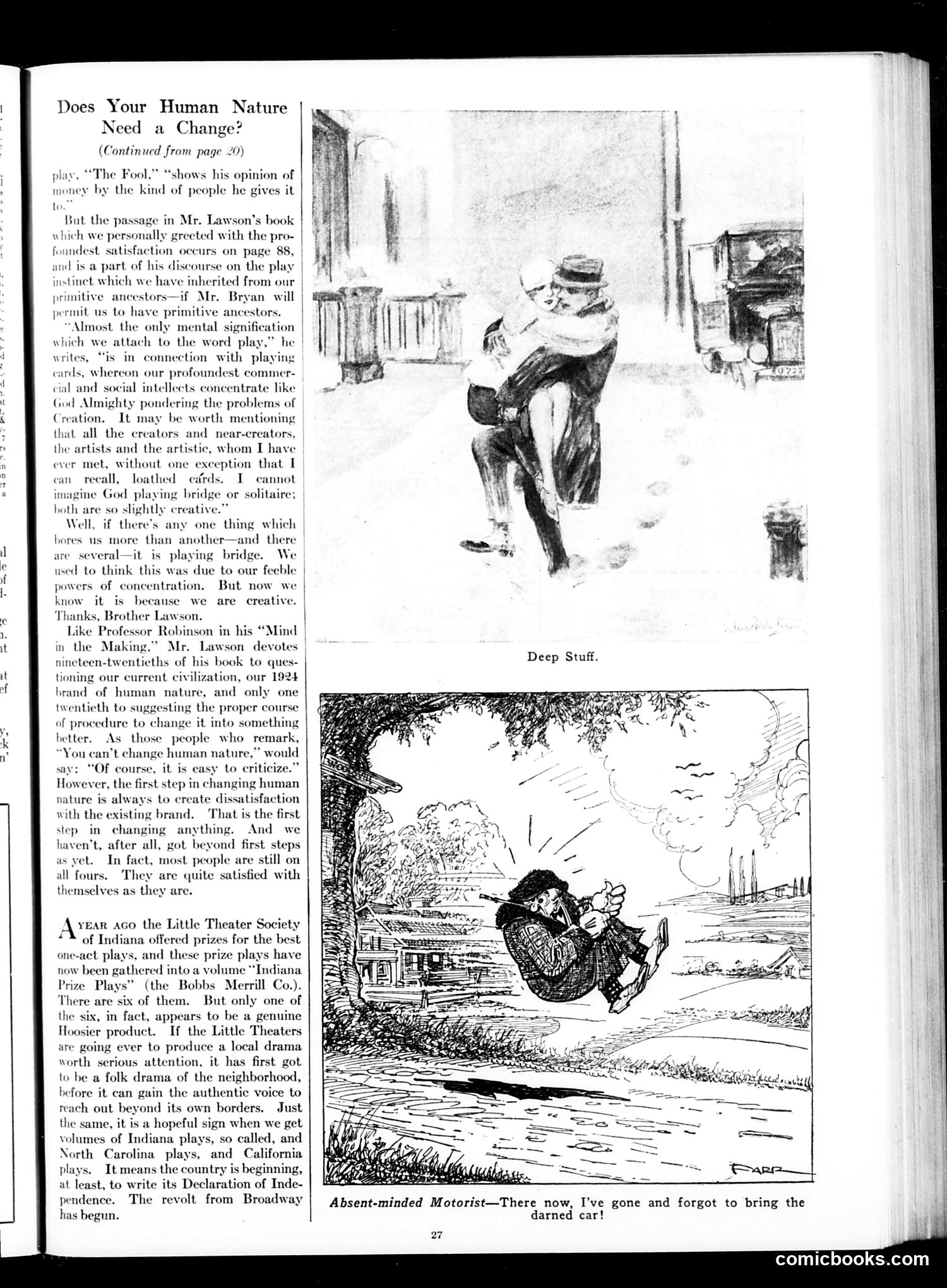
This page contains two distinct pieces. The upper section is editorial commentary discussing books by Mr. Lawson and Professor Robinson about human nature and civilization—arguing that creativity (not feeble concentration) explains why intelligent people dislike card games like bridge. The bottom cartoon, titled "Deep Stuff," depicts an "absent-minded motorist" who has arrived somewhere (appears to be a rural destination) and forgotten to bring his car with him. The humor is straightforward physical comedy: the joke is on the motorist's absent-mindedness—he's traveled to a location where one needs an automobile, yet left the car behind. This reflects early 1920s automobile culture, when car ownership was becoming common enough that forgetting one's vehicle would be absurd rather than impossible. The satire gently mocks the growing dependence on automobiles and the ditzy behavior of motorists.
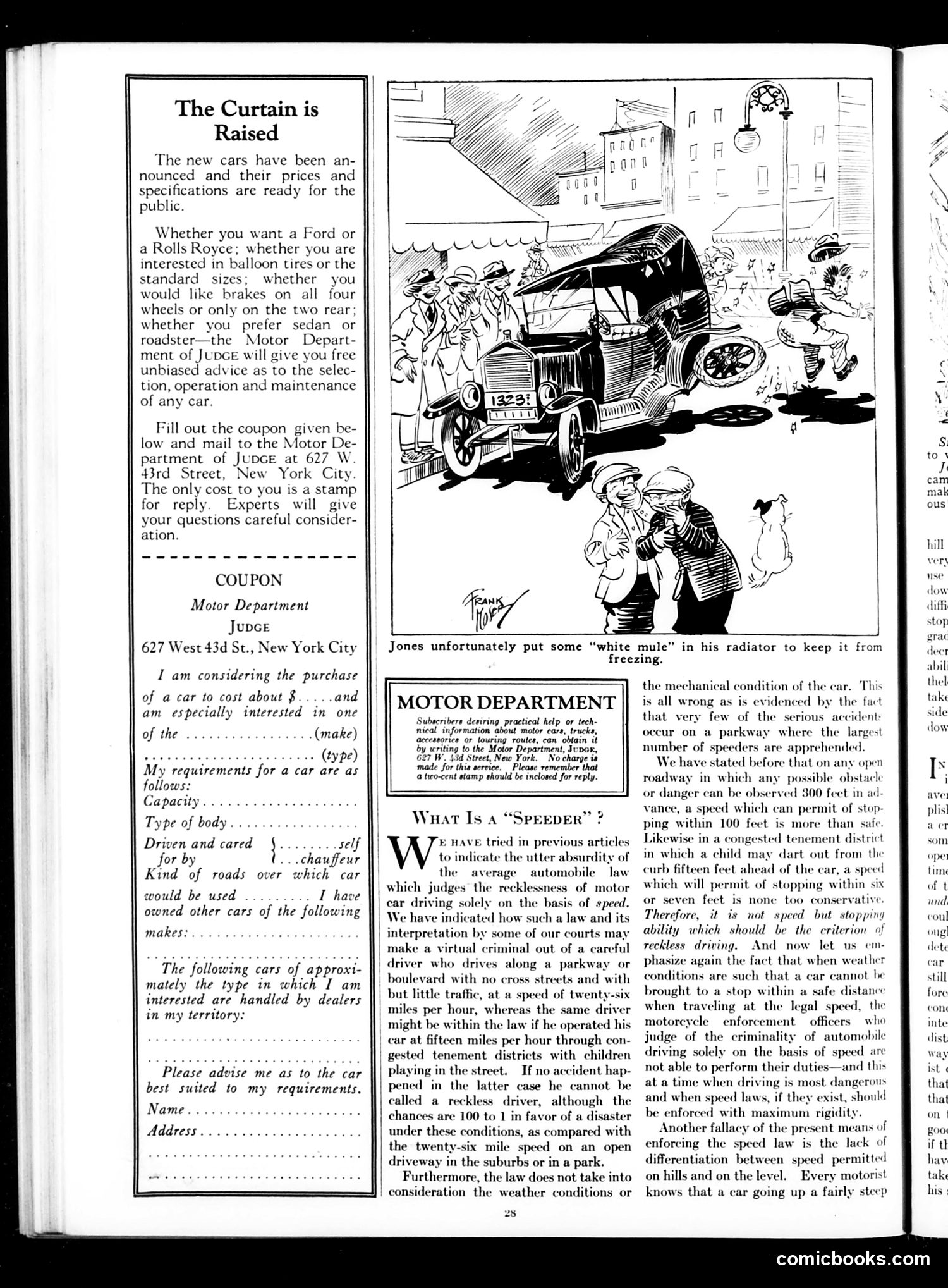
This Judge magazine page combines automotive advertising with social commentary on traffic safety laws. **The Main Cartoon:** Shows a car accident on a city street with a caption about "Jones" putting "white mule" (moonshine whiskey) in his radiator to prevent freezing—a joke about Prohibition-era bootleggers repurposing alcohol for non-drinking purposes. **The "Speeder" Article:** The satirical content critiques speed-limit laws as illogical and counterproductive. The author argues that judges cars solely by miles-per-hour, ignoring actual danger. A careful driver at 26 mph on an empty parkway faces arrest while a reckless driver at 15 mph through crowded tenement streets may avoid prosecution. The piece advocates measuring safety by "stopping ability" rather than speed—a genuinely progressive traffic safety argument for the 1920s. **Context:** This reflects Prohibition-era tensions and emerging debates about automobile regulation in rapidly motorizing America.
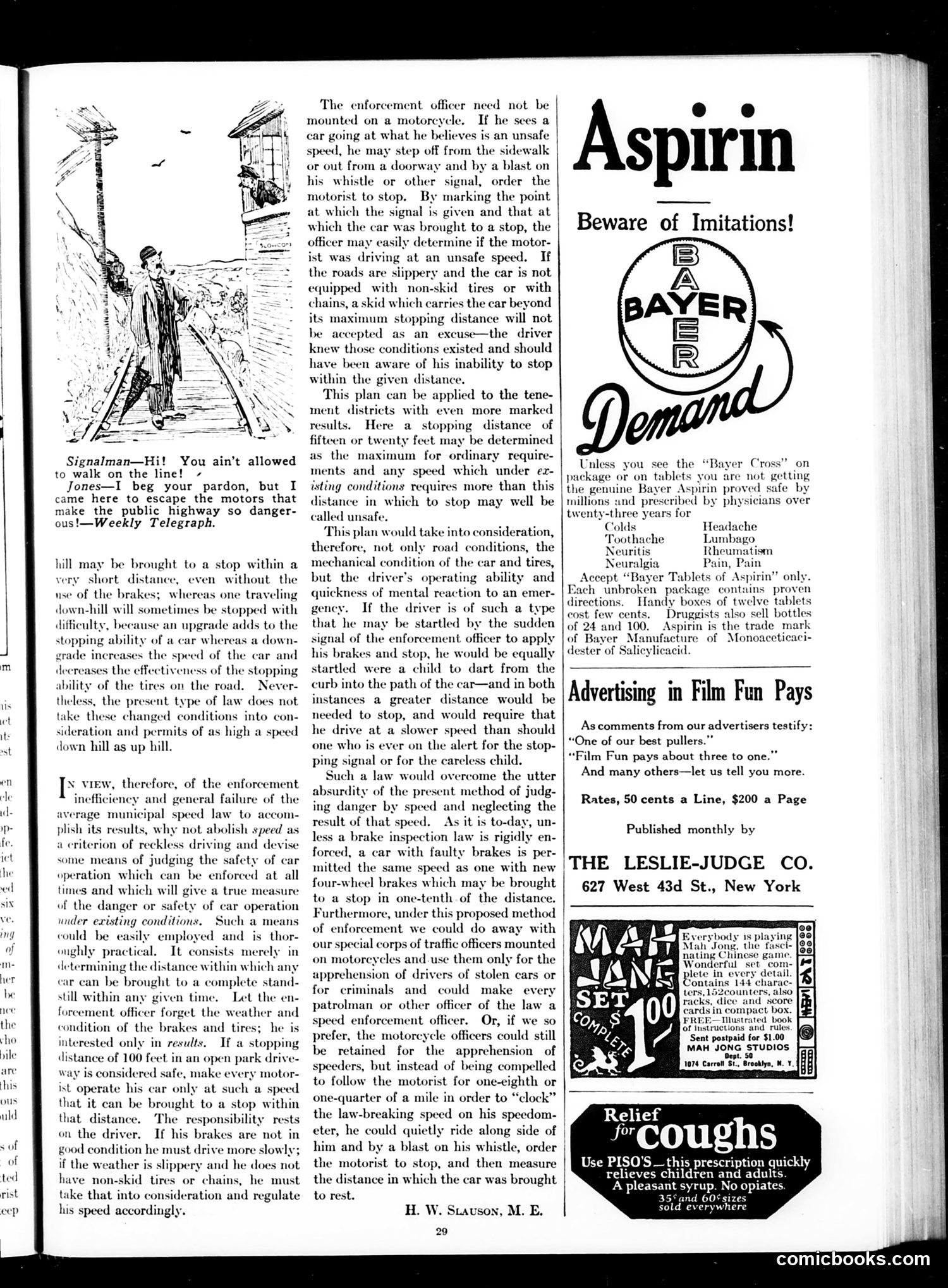
This page contains a **practical safety editorial** rather than a political cartoon. The main content discusses automobile speed enforcement, arguing that current speed-limit laws are ineffective and dangerous. ## The Argument: The piece critiques 1920s-era municipal speed laws, noting they don't account for road conditions, vehicle maintenance, or driver ability. The author proposes a solution: enforce a **maximum stopping distance** rather than absolute speed limits. An officer would signal a driver to stop and measure whether the car halts within a predetermined safe distance (100 feet for open roads, 15-20 feet in tenements). ## The Joke Caption: The cartoon shows a railroad signalman stopping a pedestrian, with "Jones" replying he walked on the tracks to escape dangerous motor vehicles on public highways—suggesting cars pose greater danger than trains. ## Historical Context: This reflects early-20th-century anxiety about **automobiles as public hazards**, before standardized traffic laws existed. The practical proposal reveals how driving safety was then understood as primarily an individual driver's responsibility rather than a systematic infrastructure problem.
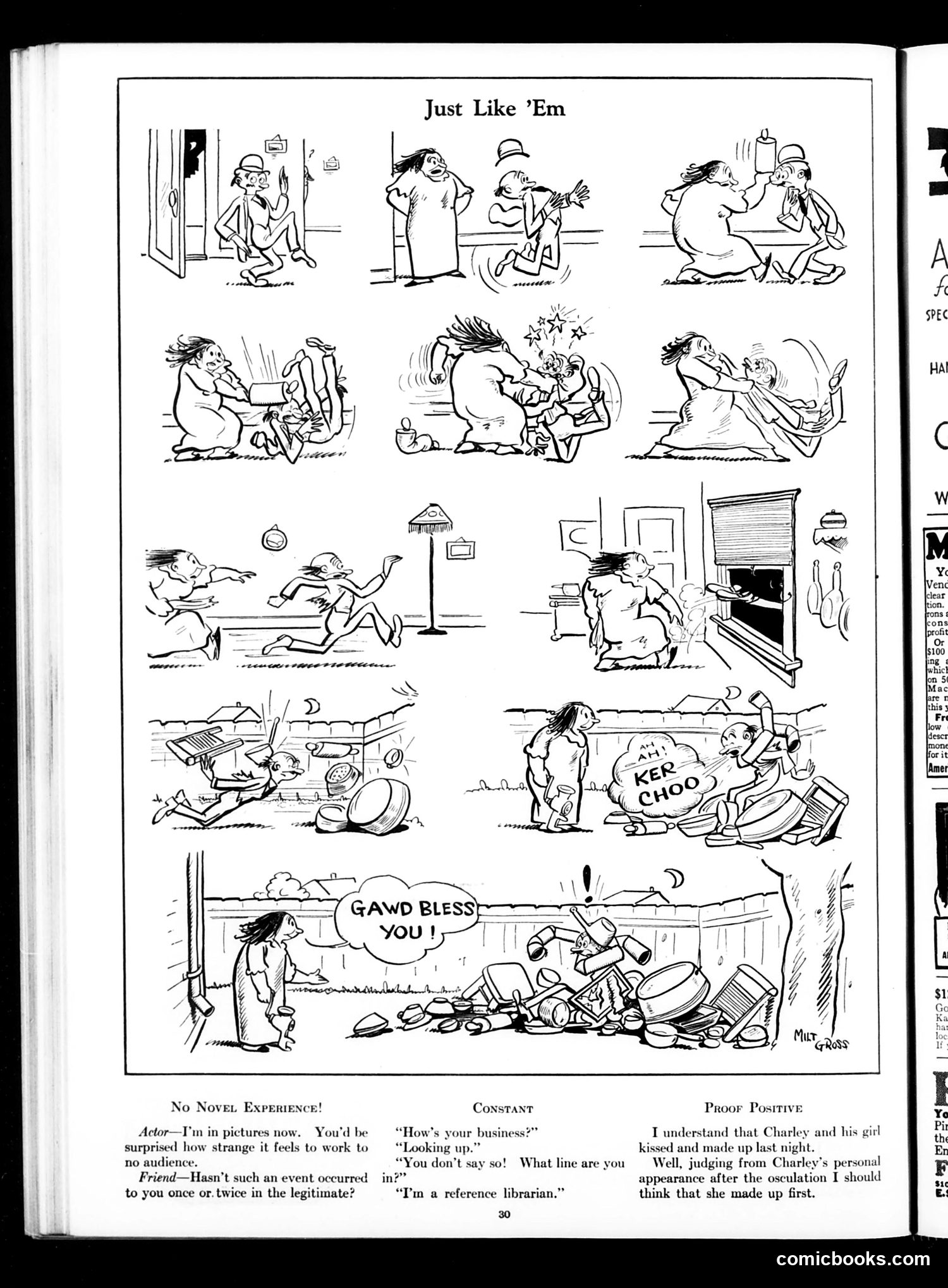
This multi-panel comic satirizes human behavior through exaggerated physical comedy. The title suggests people behave consistently across different situations. The page shows a character (appears to be a man) causing chaos in various settings—at home, in public, with authority figures—through clumsy, destructive antics. Each panel depicts him creating mayhem: breaking dishes, fighting, knocking things over, and generally causing destruction. Below are three brief joke captions: 1. **"No Novel Experience"**: An actor discusses working in silent pictures without a live audience—a reference to the emerging film industry. The friend finds this unremarkable. 2. **"Constant"**: A jobseeker claims to be "looking up" in business; he's a reference librarian—a joke about a modest, unglamorous profession. 3. **"Proof Positive"**: A gossip joke about a couple kissing and making up, with the implication that the woman's makeup needed reapplication afterward. The humor relies on physical comedy, wordplay, and social observations typical of 1920s-era Judge magazine satire.
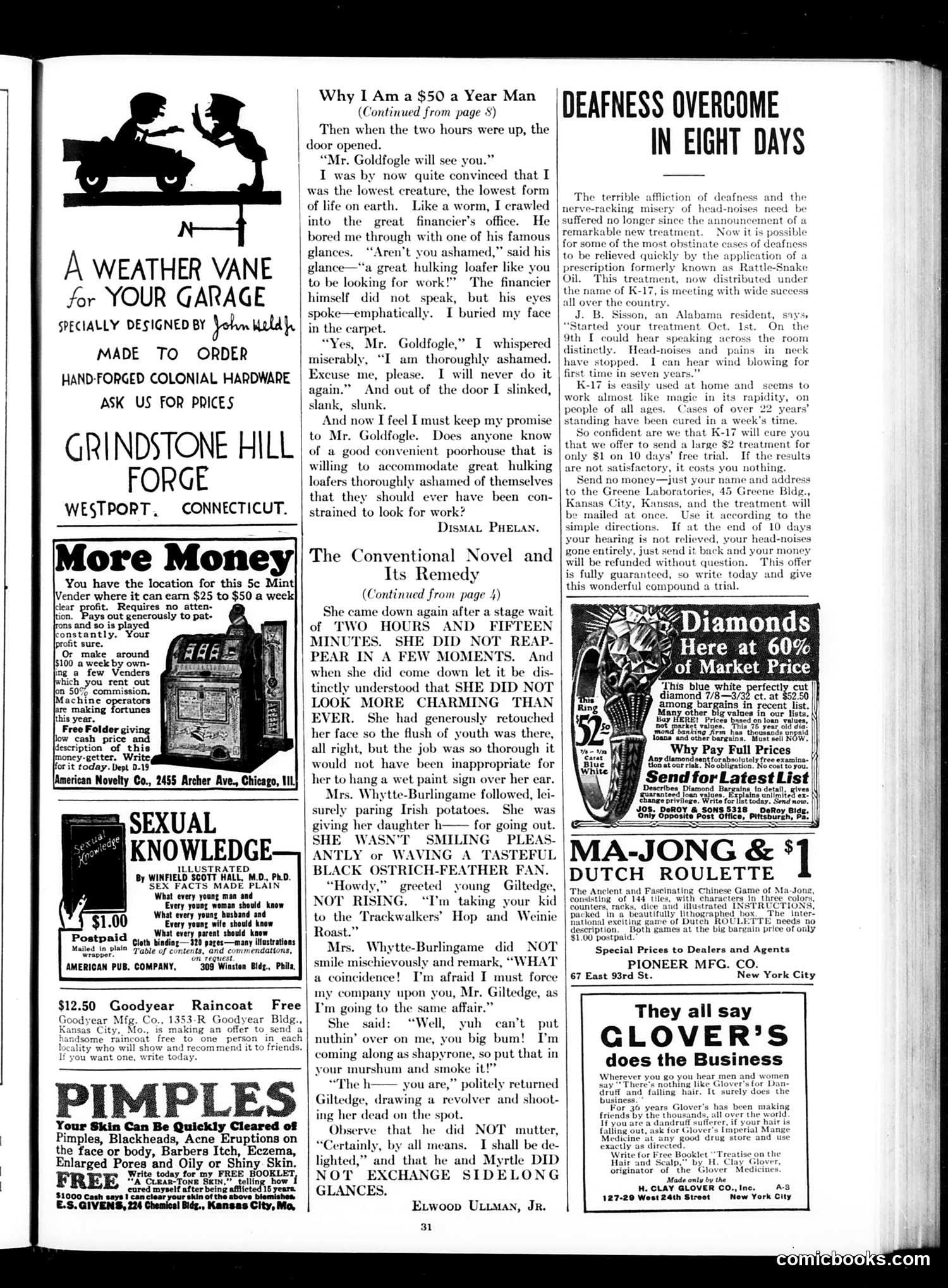
This page from *Judge* magazine contains mostly **advertisements** and serialized fiction rather than political satire. The notable content includes: **"Why I Am a $50 a Year Man"** (top right): A humorous short story about a desperate job-seeker humiliated by a wealthy financier named Goldfogle. The satire mocks the severe power imbalance between capital and labor—the financier communicates only through intimidating glances, reducing the job-seeker to abject shame. It's social commentary on class anxiety and economic desperation during what appears to be the early 20th century. **"The Conventional Novel and Its Remedy"** (center right): A satirical parody of melodramatic romance fiction conventions, mocking the unrealistic tropes (women becoming more beautiful after waiting, smiling mysteriously, waving ostrich fans). The ending subverts expectations darkly—instead of romance, the suitor shoots the mother dead. The rest consists of period advertisements for dubious remedies (acne cures, sexual knowledge books, raincoats) typical of era publications.
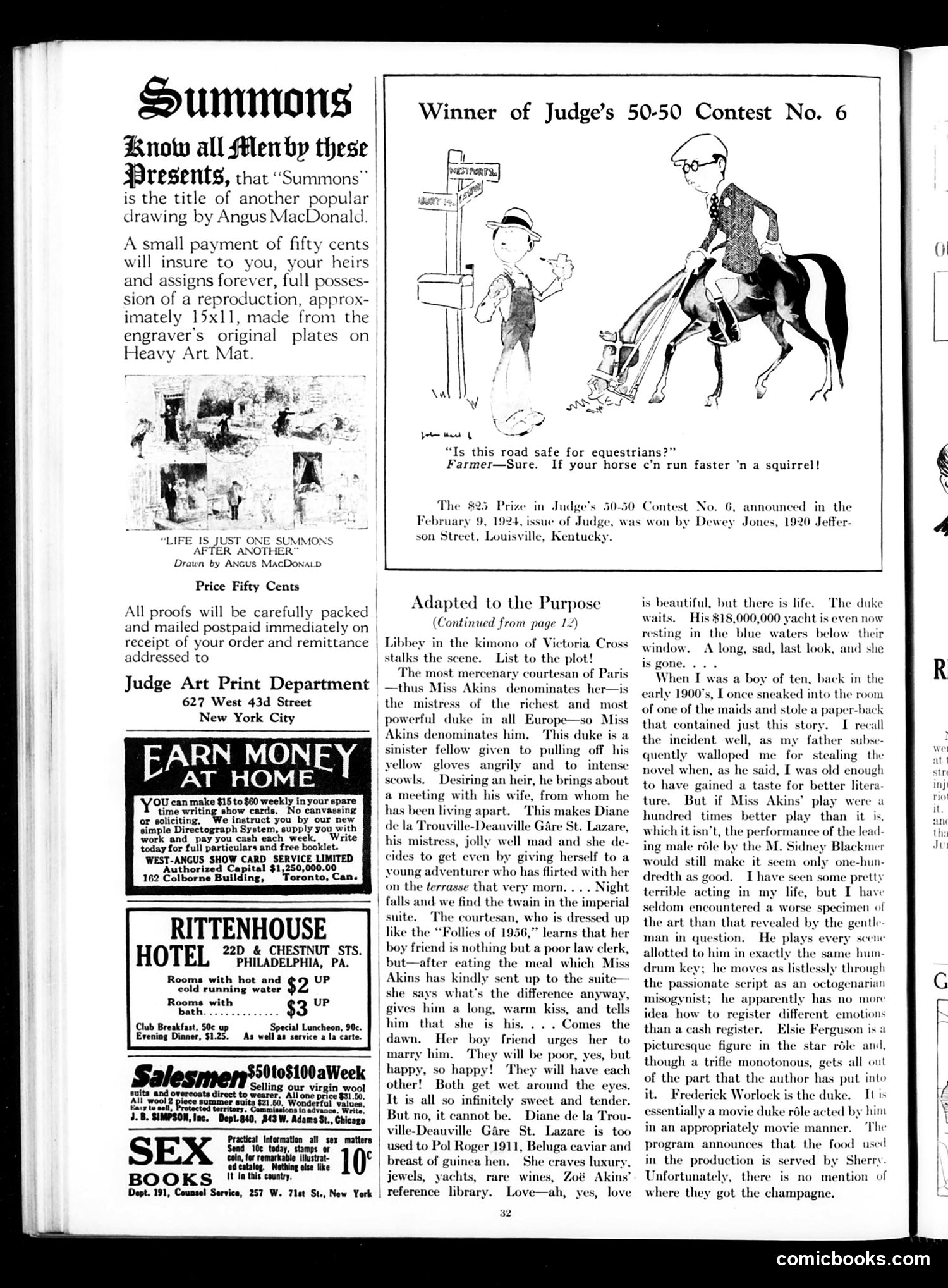
This page primarily showcases **advertising and a contest-winning cartoon** rather than political satire. The main cartoon depicts a rural farmer on horseback being asked if a road is safe for equestrians. His reply—that the horse can run faster than a squirrel—is a humorous non-answer, suggesting the road is actually quite dangerous (hence needing a fast horse to survive it). The joke relies on early 20th-century rural American stereotypes of farmers as simple-minded or evasive. The text discusses a film review of "Adapted to the Purpose," describing a melodramatic plot involving a Parisian courtesan, a wealthy duke, and a poor law clerk—typical of 1920s cinema. The reviewer critiques the film's predictable, overwrought narrative. The remainder of the page consists of vintage advertisements for various services: art reproductions, mail-order income schemes, hotels, and correspondence courses—typical of Judge magazine's revenue model during this era.
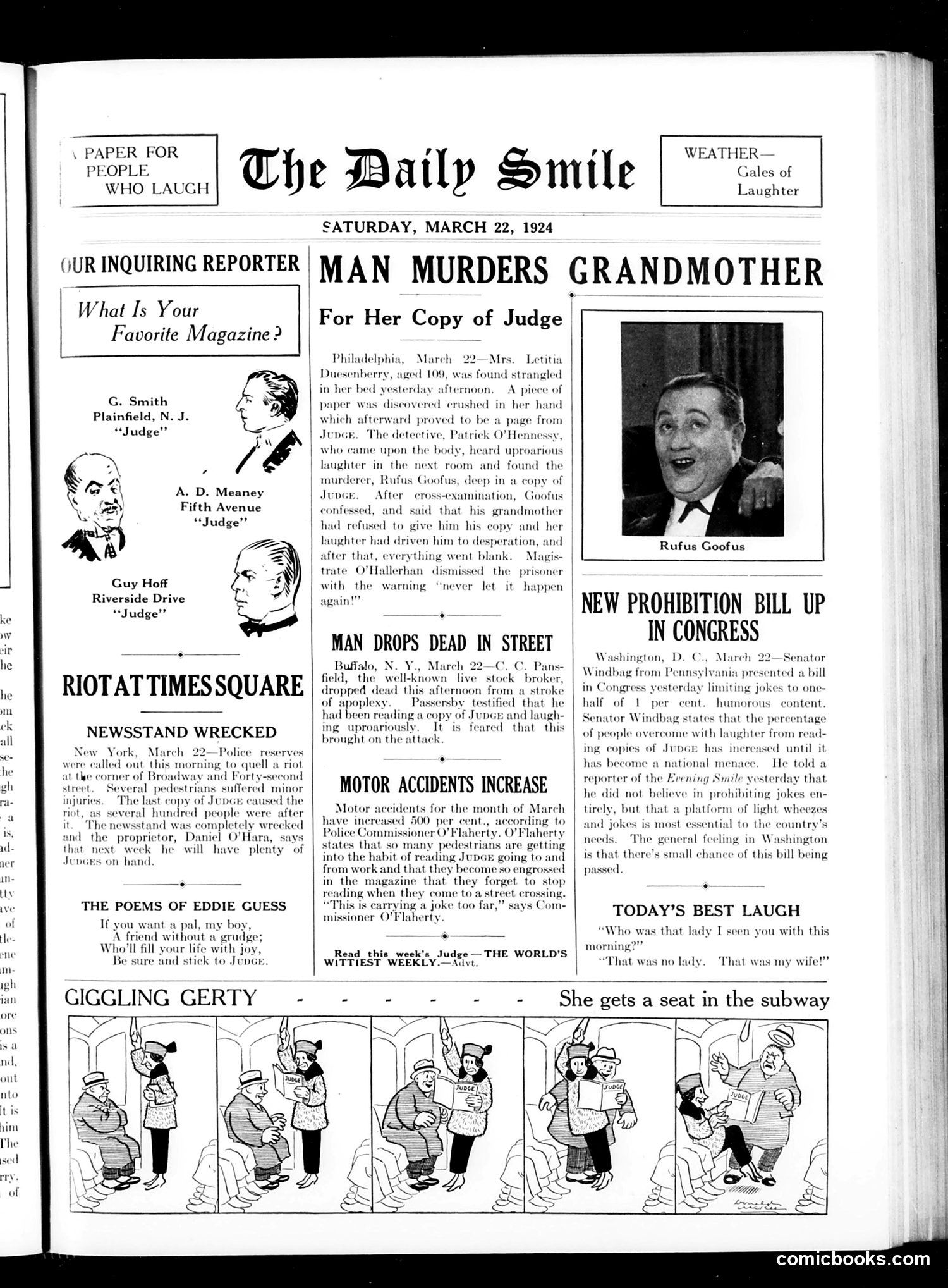
This is a self-promotional satire celebrating Judge magazine's comedic power. The entire page humorously exaggerates Judge's appeal to absurd extremes: **Main jokes:** - A man murders his grandmother for refusing to share her copy of Judge - A stock broker dies laughing while reading it - Motor accidents spike because pedestrians are too engrossed reading Judge to watch traffic - A senator proposes legislation limiting jokes to half of 1 percent because Judge-induced laughter has become a "national menace" **The satire:** Judge mock-seriously presents its own magazine as dangerously hilarious—so funny it causes death, crime, and congressional alarm. The recurring character "Rufus Goofus" appears as the murderer. **"Giggling Gerty"** (bottom comic strip) shows a woman securing a subway seat through aggressive behavior—unrelated satirical humor typical of the era. The page is entirely advertisement disguised as news, using hyperbole to convince readers that Judge is unmissably entertaining.
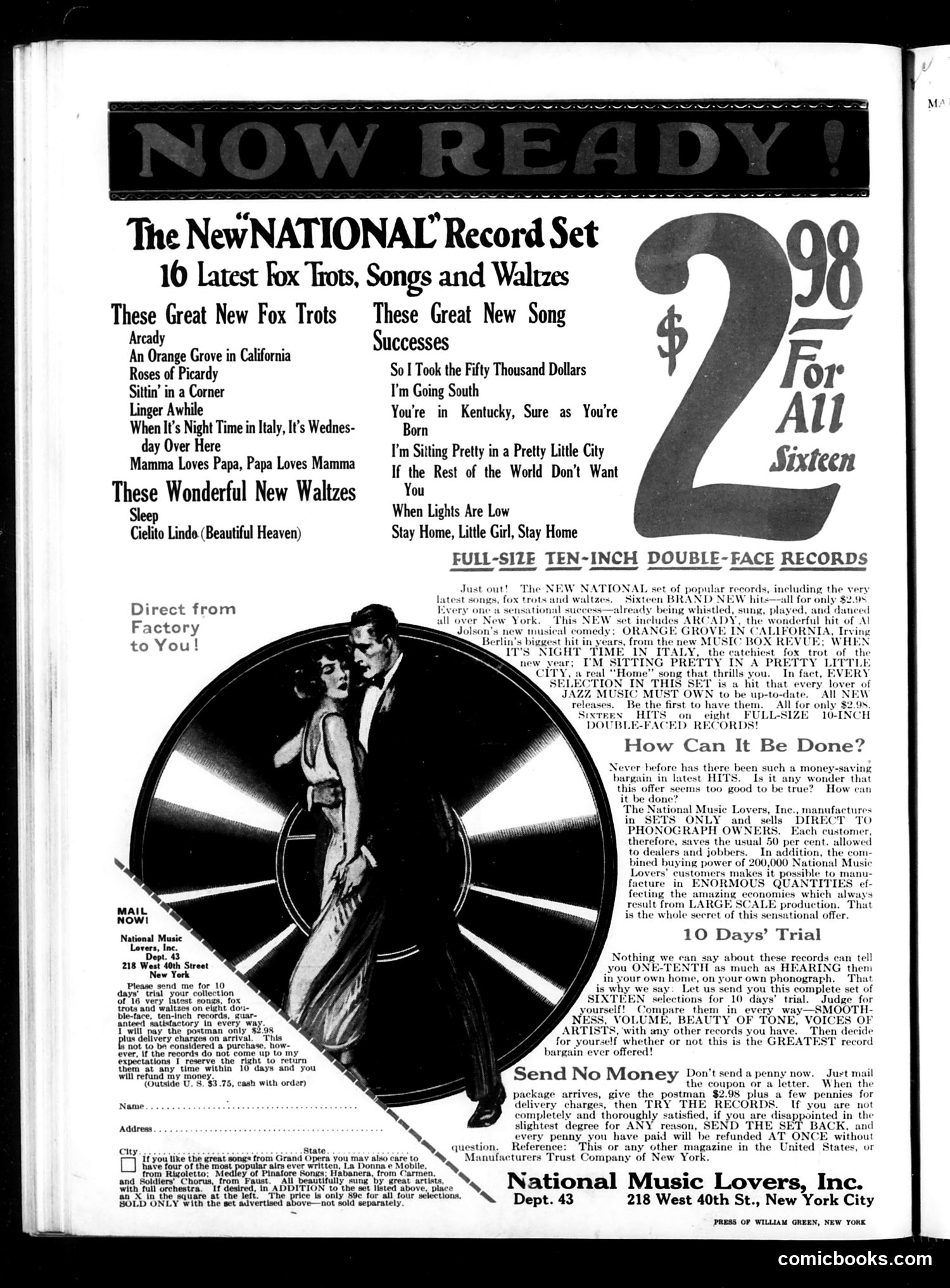
This is primarily a **mail-order advertisement**, not a satirical cartoon. It promotes National Music Lovers, Inc.'s gramophone record set—16 popular songs on eight double-sided records for $2.98. The central image shows a couple dancing beside an oversized phonograph record, reflecting 1920s popular culture. The songs listed (fox trots, waltzes, jazz numbers) represent the era's dance music trends. The advertisement emphasizes the novelty of **direct factory-to-consumer sales**, bypassing middlemen to offer savings. The "10 Days' Trial" offer and "Send No Money" pitch were aggressive early mail-order tactics designed to overcome consumer skepticism about buying unseen products. The page reflects Depression-era marketing: emphasizing bargains, direct distribution, and risk-free trials. The classical opera option mentioned shows attempts to appeal to middlebrow cultural aspirations. This is a commercial document, not editorial satire—typical Judge magazine filler content.