
Judge, 1924-03-22 · page 14 of 36
Judge — March 22, 1924 — page 14: what you’re looking at
What you’re looking at
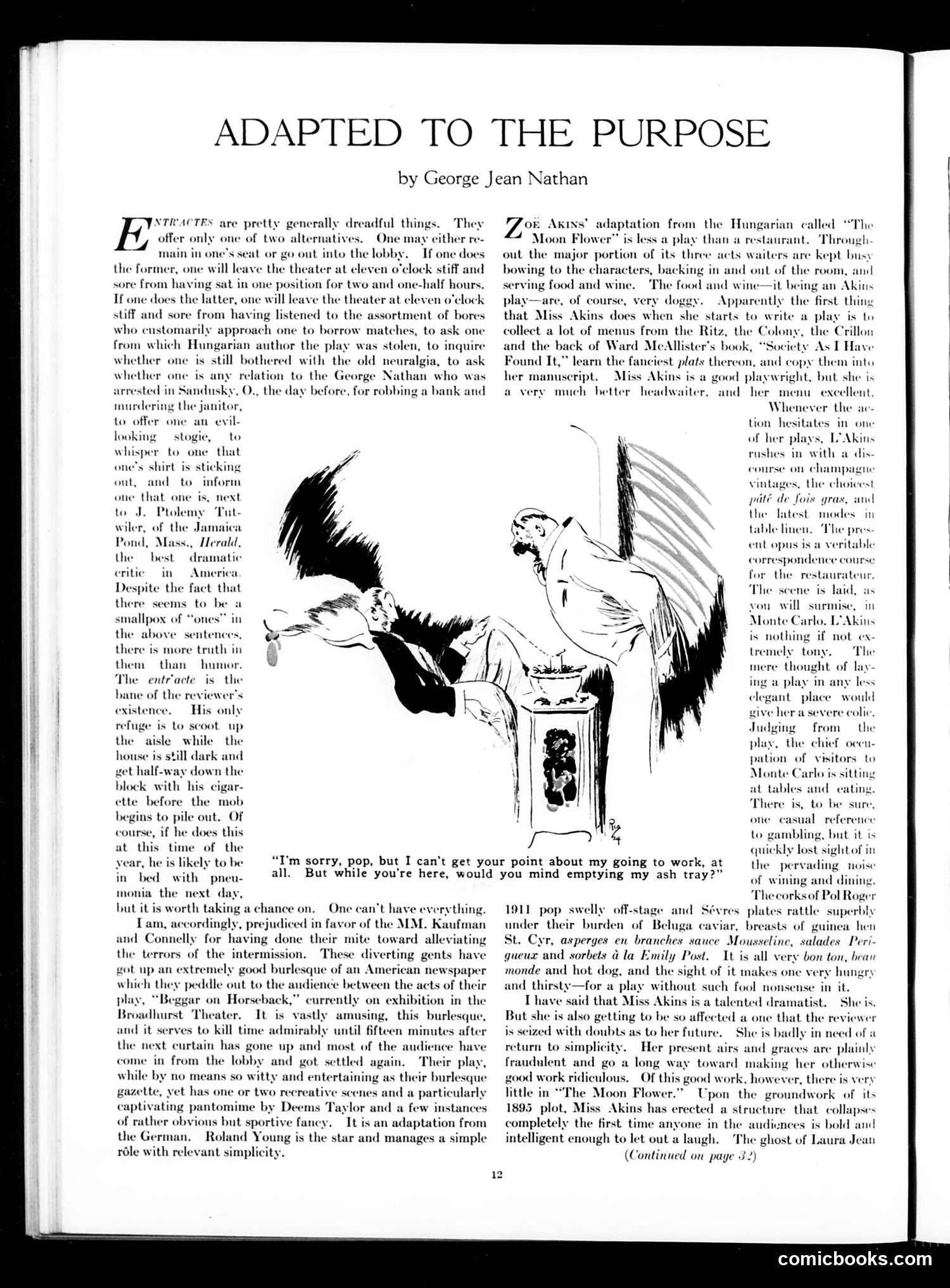
This page contains theatre criticism by George Jean Nathan, a prominent early 20th-century drama critic. The main cartoon depicts an intermission scene where a character complains to his father ("pop") about work while asking him to empty an ashtray—illustrating Nathan's point about intermissions as tedious social obligations where theatre-goers encounter annoying strangers. Nathan reviews two plays: "Beggar on Horseback" (adapted from German, starring Roland Young), praised for its clever newspaper burlesque that entertainingly fills intermission time; and a play by Zoe Akins adapted from Hungarian, which Nathan satirizes as essentially a restaurant setting. He mocks Akins for filling her plays with menus from fancy establishments (Ritz, Colony, Crillon) and descriptions of expensive foods and wines rather than substantive drama. The satire targets both Akins's reliance on luxury-brand name-dropping and the vapidity it suggests about her playwriting.
📄 Transcribed text from this page (OCR, searchable)
Machine-transcribed from the original scan — historical spelling and the odd misread are preserved.
ADAPTED TO THE PURPOSE by George Jean Nathan NTRACTES are pretty generally dreadful things. ‘They offer only one of two alternatives. One may cither re- main in one’s seat or go out into the lobby. the former, one will sore from havit If one does the theater at eleven o'clock stiff and sat in one position for two and one-half hours. If one does the latter, one will leave the theater at eleven o'clock stiff and sore from having listened to the assortment of bores who customarily approach one to borrow matches, to ask one from which Hungarian author the play was stolen, to inquire whether one is still bothered with the old neuralgia, to ask is any relation to the han who was arrested in Sandusky, O., the day before, for robbing a bank and whether one murdering the janitor, to offer one an evil- looking — stogie, — to whisper to one that one’s shirt is sticking out, and to inform one that one is, next to J. Ptolemy wiler, of the Jamaica Pond, Mass., Herald, the best dramatic critic in America Despite the fact that there seems to be a smallpox of “ones” in the above sentences, there is more truth in than humor. The entracte is tl bane of the reviewer's existence. — His only refuge is to scoot up the aisle while the house is still dark and get half-way down the block with his cigar- ette before the mob begins to pile out. Of , if he does this time of the ar, he is likely to be in bed with pneu- monia the next day, but it is worth taking a chance on, One can’t have everything. Tam, accordingly, prejudiced in favor of the MM. Kaufman and Connelly for having done their mite toward alleviating the terrors of the intermission. These diverting gents have got up an extremely good burlesque of an American newspaper which they peddle out to the audience between the acts of their play, “Beggar on Horseback,” currently on exhibition in the Broadhurst Theater. It is vastly amusing, this burlesque, and it serves to kill time admirably until fifteen minutes after the next curtain has gone up and most of the audience have in from the lobby and got settled again. while by no means so witty and entertainin, them cour’ come Their p! their burlesque s Taylor and a few instances of rather obvious but sportive fancy. It is an adaptation from the German, Roland Young is the star and manages a simple role with relevant simplic “I'm sorry, pop, but I can’t get your point about my going to work, at the all. But while you're here, would you mind emptying my ash tray?” Ze AKINs’ ation from the Hungarian called “The Moon s less a play than a restaurant. ‘Through out the major portion of its three acts waiters are kept busy bowing to the characters, backing in and out of the room, and serving food and wine. it being an Akins play—are, Apparently the first thing that Miss Akins does when she starts to write a play is to collect a lot of menus from the Ritz, the Colony, the Crillon and the back of Ward McAllister’s book, “Society As I Have Found It,” learn the fanciest plats thereon, and copy them into her manuscript. Miss Akins is avery much. better The food and wine of course, very doggy. ood playwright, but she is and her menu excellent. Whenever the ac- tion hesitates in one of her plays, L’Akins rushes in with a dis- course on champagne vintages, the choicest headwaite: padté de fois gras, and the latest table linen, modes in The pres ent opus is a veritable correspondenc for the restaur: The scene is laid, as you will surmise, in Monte Carlo. L’Akins is nothing if not ex- tremely tony. — The thought of lay- ing a play in any less mere elegant place would give her a severe colic. from — the play, the chief oceu- pation of visitors to Monte at tables and eating. There is, to be one casual reference to gambling, but it is quickly lost sightof in Carlo is sitting sure, pervading noise of wining and dining. ‘Thecorksof Pol Roger 1911 pop swelly off-stage and Sévres plates rattle superbly under ge burden of Beluga r, bre St. Cyr, asperges en branches sauce Mousseline, salades Peri- gueux Rd sorbets dla Emily P It is all very bon ton, bean monde and hot dog, and the sight of it makes one very hungry and thirsty—for a play without such fool nonsense in it. T have said that Miss Akins is a talented dramatist. She is. But she is also getting to be so affected a one that the reviewer is seized with doubts as to her future. return to simplicity. sts of guinea hen She is badly in need of a Her present airs and graces are plainly fraudulent and go a long way toward making her otherwise good work ridiculous. Of this good work, however, there is very little in “The Moon Flower.” Upon the groundwork of its 1895 plot, Miss Akins has erected a structure that collapses completely the first time anyone in the audiences is bold and intelligent enough to let out a laugh. The ghost of Laura Jean (Continued on page 32) comicbooks.com