
Judge, 1924-03-22 · page 17 of 36
Judge — March 22, 1924 — page 17: what you’re looking at
What you’re looking at
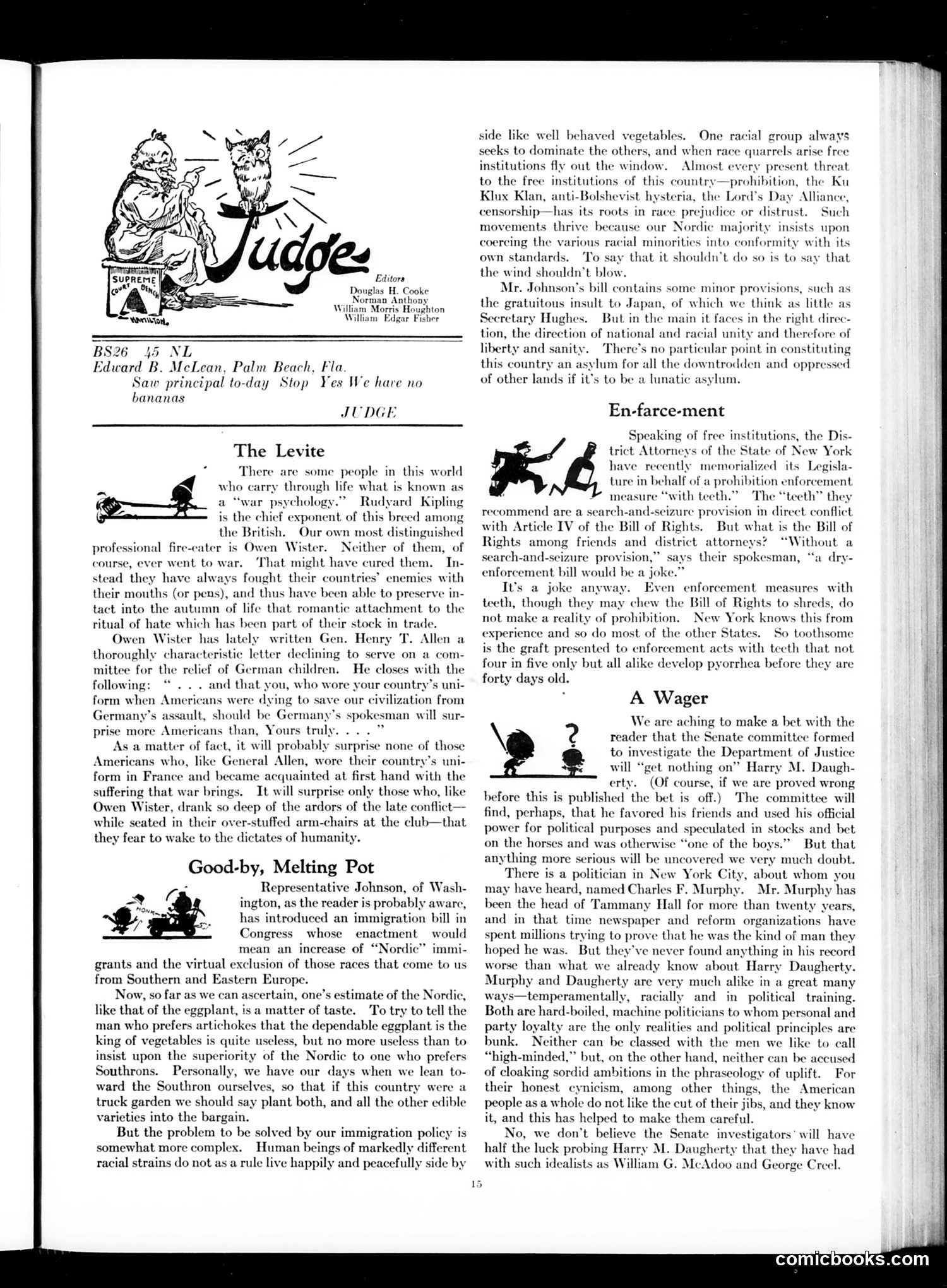
This page contains three distinct opinion pieces criticizing American political figures and policies circa early 1920s. **"The Levite"** attacks writer Owen Wister for refusing to aid German children post-WWI. The satire is that Wister—who never actually fought—maintains aggressive "war psychology" from his armchair, while General Allen, who *did* serve in France, shows humanity. The implication: armchair warmongers lack the moral wisdom of actual veterans. **"Good-by, Melting Pot"** discusses Representative Johnson's immigration bill favoring "Nordic" (Northern European) immigrants while excluding Southern and Eastern Europeans. The cartoon satirizes this as absurd—comparing racial preferences to vegetable preferences. However, the author paradoxically endorses the bill's direction, arguing that racial diversity causes social conflict (citing the KKK, Prohibition, anti-Bolshevism as race-based problems), so restricting immigration toward "unity" makes practical sense. The final section **"En-forcement"** briefly mocks Senate investigations into the Department of Justice. The humor relies on 1920s context: immigration debates, nativism, and post-war attitudes.
📄 Transcribed text from this page (OCR, searchable)
Machine-transcribed from the original scan — historical spelling and the odd misread are preserved.
Editora Douglas H. Cooke Norman Anthony William Morris Ho: William Edgar Edward B. McLean, Palm Beach, Fla Saw principal to-day Stop Yes We have no bananas JUDGE The Levite There are some people in this world who carry through life what is known as a “war psychology.” Rudyard Kipling is the chief exponent of this breed among the British. Our own most distinguished professional fire-eater is Owen Wister. Neither of them, of course, ever went to war. That might have cured them. In- stead they have always fought their countries’ enemies with their mouths (or pens), and thus have been able to preserve in- tact into the autumn of life that romantic attachment to the ritual of hate which has been part of their stock in trade. Owen Wister has lately written Gen. Henry T. Allen a thoroughly characteristic letter declining to serve on a com- mittee for the relief of German children. He closes with the following: “.. . and that you, who wore your country’s uni- form when Americans were dying to save our civilization from Germany's assault, should be Germany's spokesman will sur- prise more Americans than, Yours truly. ‘As a matter of fact, it will probably surprise none of those Americans who, like General Allen, wore their country’s uni- form in France and became acquainted at first hand with the suffering that war brings. It will surprise only those who, like Owen Wister, drank so deep of the ardors of the late conflict— while seated in their over-stuffed arm-chairs at the club—that they fear to wake to the dictates of humanity. ‘Good: by, Melting Pot Representative Johnson, of Wash- ington, as the reader is probably aware, has introduced an immigration bill in Congress whose enactment would mean an increase of “Nordic” immi- grants and the virtual exclusion of those races that come to us from Southern and Eastern Europe. Now, so far as we can ascertain, one’s estimate of the Nordic, like that of the eggplant, is a matter of taste. To try to tell the man who prefers artichokes that the dependable eggplant is the king of vegetables is quite useless, but no more useless than to insist upon the superiority of the Nordic to one who prefers Southrons. Personally, we have our days when we lean to- ward the Southron ourselves, so that if this country were a truck garden we should say plant both, and all the other edible varieties into the bargain. But the problem to be solved by our immigration policy is somewhat more complex. Human beings of markedly different racial strains do not as a rule live happily and peacefully side by side like well behaved vegetables. One racial group always seeks to dominate the others, and when race quarrels arise free institutions fly out the window. Almost every present threat to the free institutions of this country—prohibition, the Ku Klux Klan, anti-Bolshevist hysteria, the Lord’s Day Alliance, censorship—has its roots in race prejudice or distrust. Such movements thrive our Nordic majority insists upon coercing the various racial minorities into conformity with its own standards. To say that it shouldn't do so is to say that the wind shouldn't blow. Mr. Johnson’s bill contains some minor provisions, such as the gratuitous insult to Japan, of which we think as little as Secretary Hughes. But in the main it faces s in the right direc- tion, the direction of nati and therefore of liberty and sanity. ‘There’s no particular point in constituting this country an asylum for all the downtrodden and oppressed of other lands if it’s to be a lunatic asylum. because En-farce-ment Speaking of free institutions, the Dis- trict Attorneys of the State of New York have recently memorialized its Legisla- ture in behalf of a prohibition enforcement measure “with teeth.” The “teeth” they recommend are a search-and-seizure provision in direct conflict with Article IV of the Bill of Rights. But what is the Bill of Rights among friends and distri torne: “Without a search-and-scizure provision,” says their spokesman, enforcement bill would be a jok It’s a joke anyway. Even enforcement measures with teeth, though the chew the Bill of Rights to shreds, do not make a reality of prohibition. New York knows this from experience and so do most of the other States. So toothsome is the graft presented to enforcement acts with teeth that not four in five only but all alike develop pyorrhea before they are forty days old. A Wager reader that the $ ate committee formed to investigate the Department of Justice will “get nothing on” Harry M. Daugh- erty. (Of course, if we are proved wrong before this is published the bet is off.) The committee will find, perhaps, that he favored his friends and used his official power for political purposes and speculated in stocks and bet on the horses and was otherwise “one of the boys.” But that anything more serious will be uncovered we very much doubt. There is a politician in New York City, about whom you may have heard, named Charles F. Murphy. Mr. Murphy has been the head of Tammany Hall for more than twenty and in that time newspaper and reform or; spent millions trying to prove that he was the kind of man they hoped he was. But they’ve never found anything in his record worse than what we already know about Harry Daugherty. Murphy and Daugherty are very much alike in a great many ways—temperamentally, racially and in political training. Both are hard-boiled, machine politicians to whom personal and party loyalty are the only realities and political principles are bunk. Neither can be classed with the men we like to call “high-minded,” but, on the other hand, neither can be accused of cloaking sordid ambitions in the phraseology of uplift. For their honest cynicism, among other things, the American people as a whole do not like the cut of their jibs, and they know it, and this has helped to make them careful. No, we don’t believe the Senate investigators’ will have half the luck probing Harry M. Daugherty that they have had with such idealists as William G. McAdoo and George Creel. \ Ps We are ac hing to make a bet with the nizations comicbooks.com