
A complete issue · 36 pages · 1923
Judge — August 4, 1923
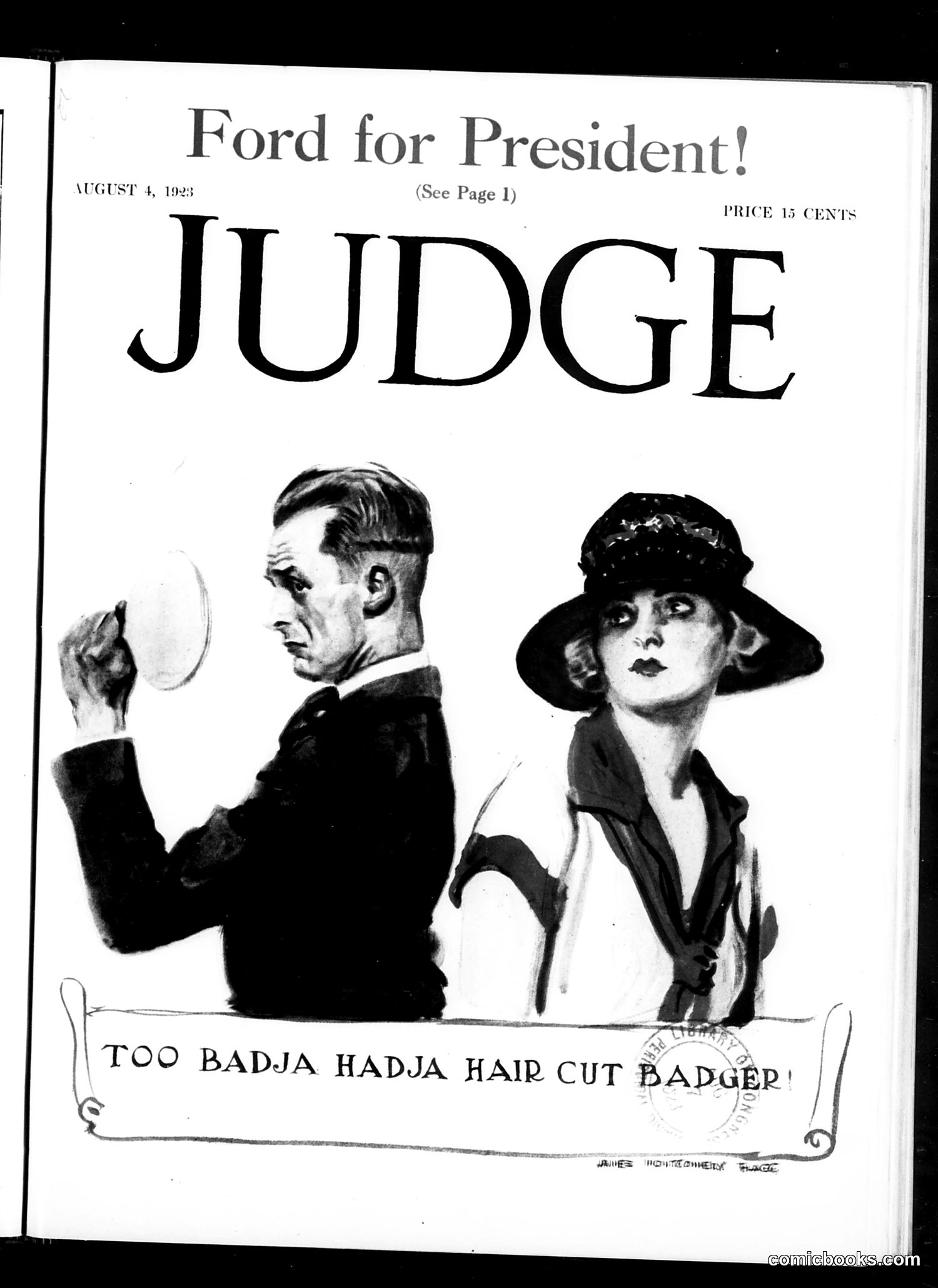
This satirical cover mocks Henry Ford's potential presidential candidacy. The headline "Ford for President!" (with reference to page 1) combines with the cartoon's caption "Too Badja Hadja Hair Cut Badger" — a play on words mocking Ford's well-known, distinctive hairstyle and appearance. The cartoon depicts two figures: a man in profile (likely representing Ford) examining a mirror, and a woman. The satire suggests Ford's vanity and unfitness for office, using his recognizable physical appearance as the basis for ridicule. This reflects 1920s political discourse when Ford, the automobile magnate, was seriously discussed as a presidential possibility, though he never formally ran. The magazine used personal mockery typical of period political satire.
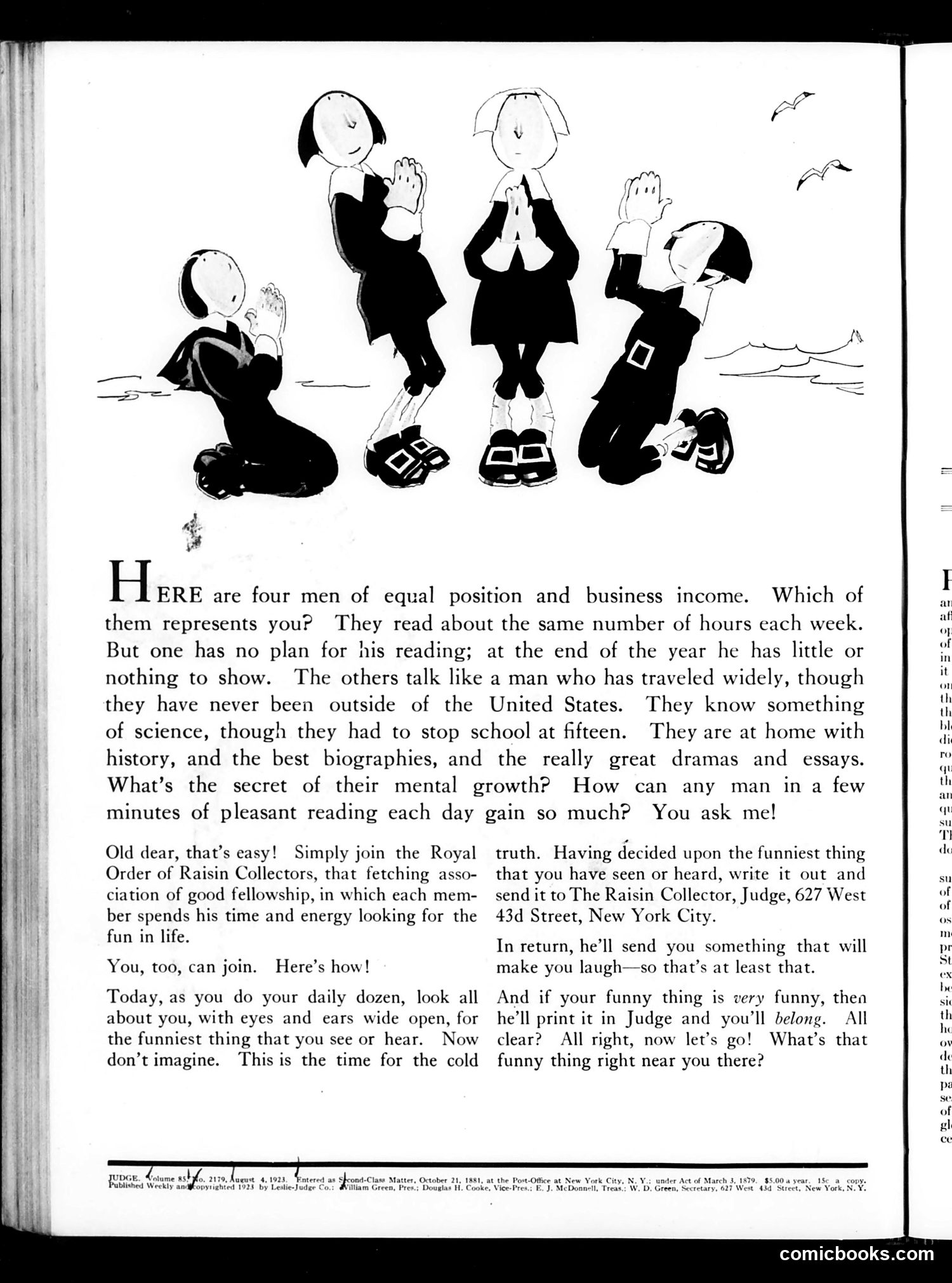
This page features an illustrated puzzle rather than political satire. Four identically-dressed men in business suits are shown in different poses—sitting, standing, and kneeling—with the accompanying text posing a riddle about which figure represents "you." The puzzle contrasts two types of men with equal income and reading time: one lacks intellectual development, while the others have cultivated knowledge through reading history, biographies, and drama despite limited formal education. The "joke" concludes by promoting Judge magazine's "Royal Order of Raisin Collectors"—a humorous club encouraging readers to submit funny observations for publication. This appears to be an advertisement disguised as entertainment, inviting reader participation and subscription. The cartoon illustrates the magazine's philosophy about self-improvement through reading and intellectual engagement.
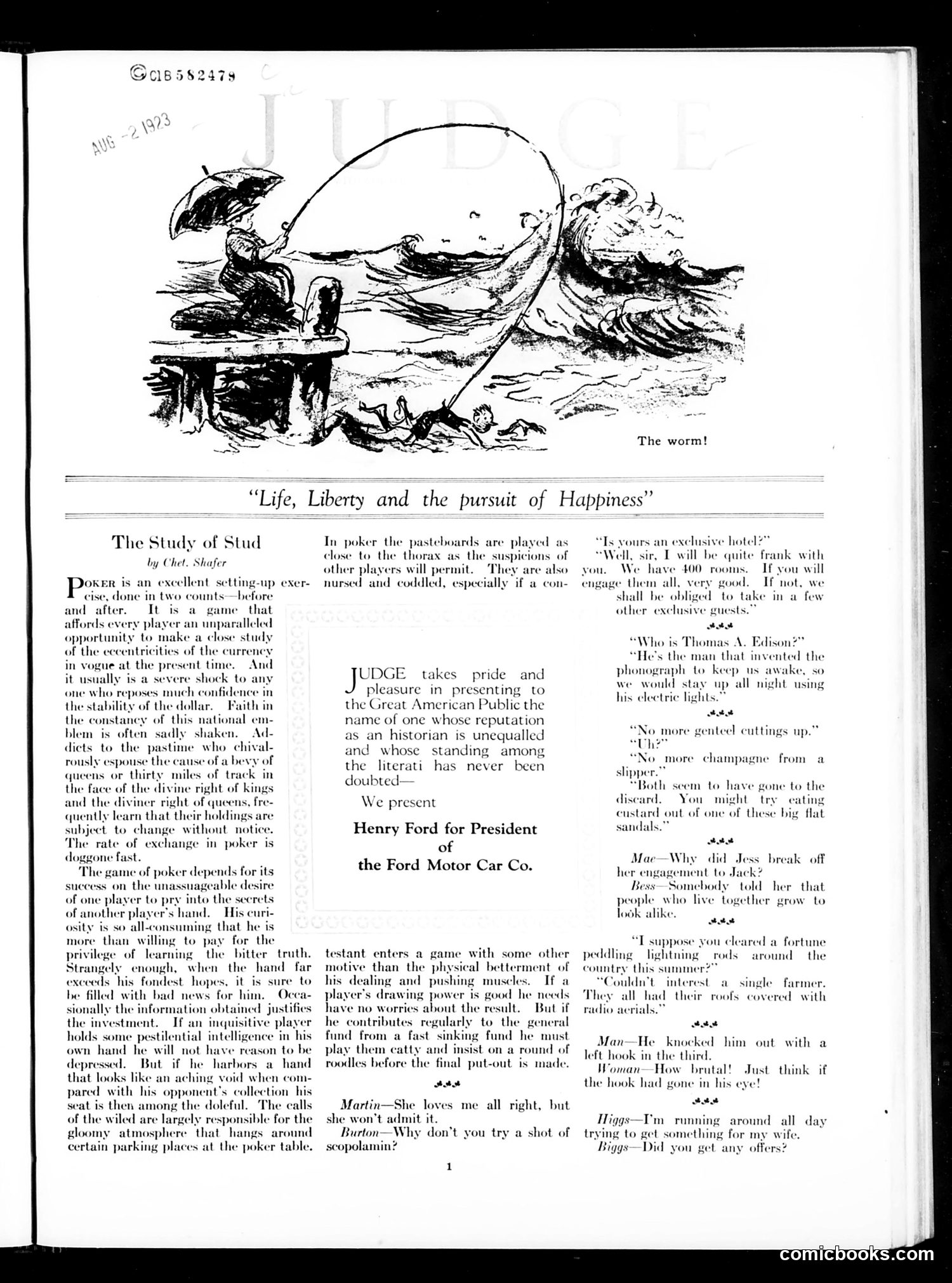
The page's main cartoon depicts a figure fishing with an unusually long rod and line, catching what appears to be a large worm or fish labeled "The worm!" This is visual satire about poker—specifically, the text article "The Study of Stud" explains how poker players deceive each other. The cartoon likely illustrates the deceptive nature of the game: skilled players "fish" for information about opponents' hands through bluffing and manipulation. The "worm" caught represents either an unsuspecting victim or the hidden truth players attempt to extract. Below the cartoon, an advertisement promotes "Henry Ford for President of the Ford Motor Car Co."—humorously treating Ford's company leadership as if it were a political office. The page demonstrates Judge's characteristic blend of political commentary and social humor targeting turn-of-the-century American culture.
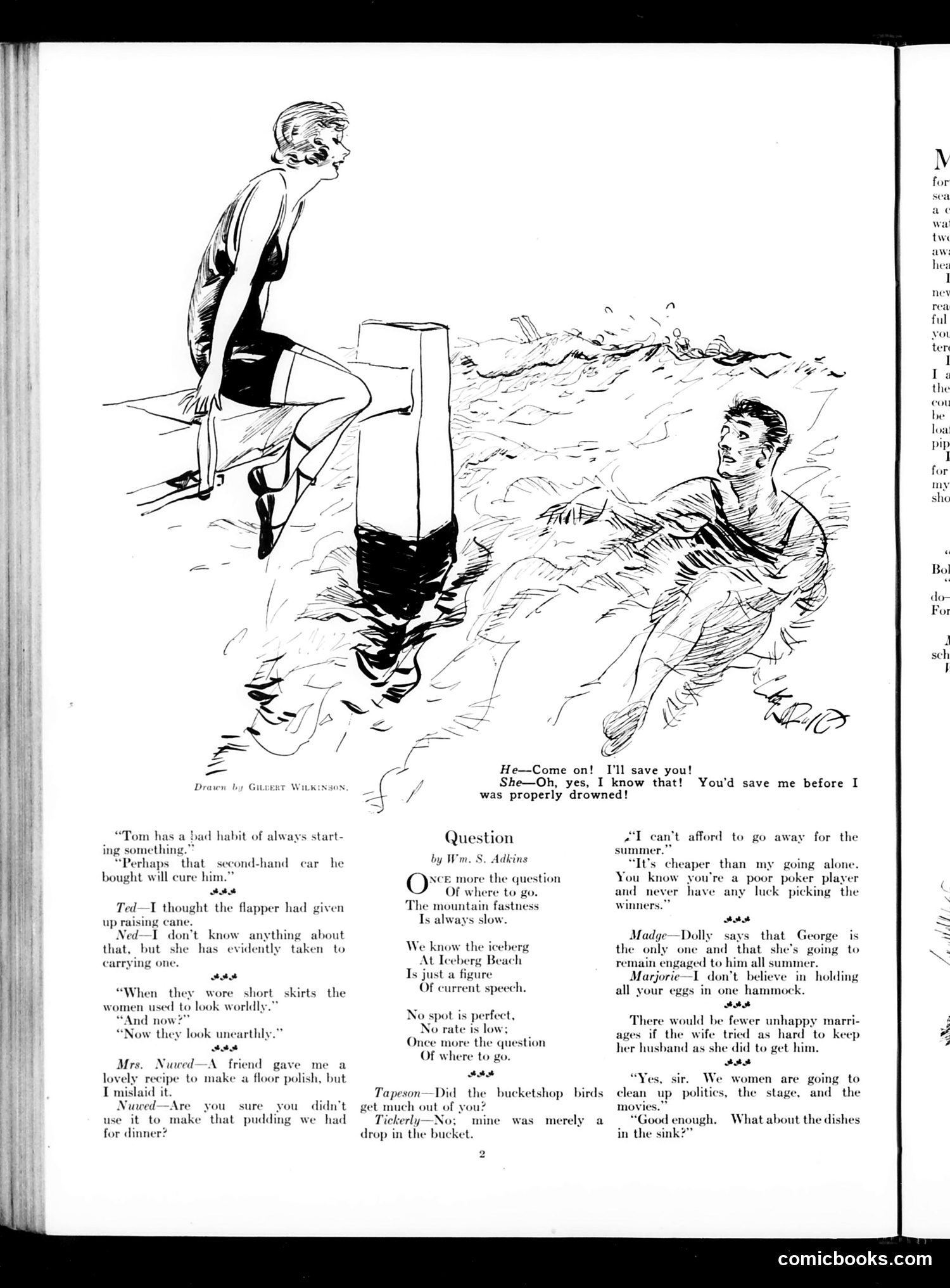
**Main Cartoon (top):** Drawn by Gilbert Wilkinson, this depicts a rescue scene at a beach. One figure sits on a post calling "He—Come on! I'll save you!" while another appears to be drowning. The woman responds skeptically: "She—Oh yes, I know that! You'd save me before I was properly drowned!" This satirizes male heroics and chivalry—mocking the assumption that women need or want rescuing. The joke suggests men rush to "save" women prematurely or unnecessarily, playing up their own importance. **Lower Section:** Titled "Question" by Wm. S. Adkins, this appears to be humorous dialogue about marriage, poker, and domestic life—typical Judge magazine content mixing social commentary with light domestic satire. The overall tone reflects early-to-mid 20th century attitudes toward gender relations and marital dynamics.
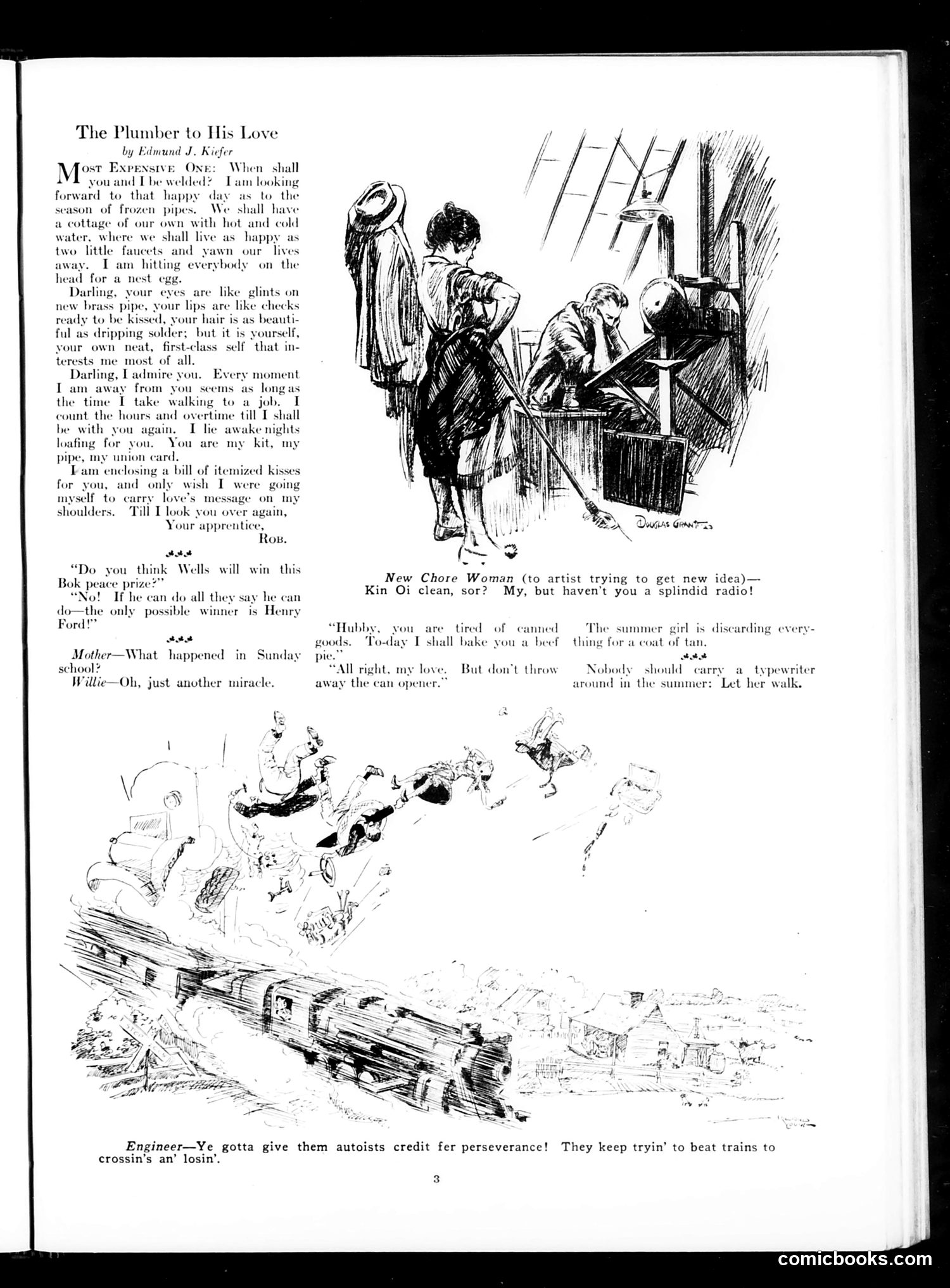
This page contains a romantic poem by Edmund J. Kiefer addressing a plumber's beloved, celebrating humble domestic life with "hot and cold water" and "two little faucets." The accompanying sketch shows a plumber working while a woman watches—visualizing this working-class romance. Below are several brief humorous vignettes mocking various social types: a discussion about Henry Ford automobiles, a mother-son exchange about Sunday miracles, and commentary on modern women (a "New Chore Woman" wanting a radio, a summer girl discarding clothes for a tan, a typewriter-carrying woman). The bottom cartoon satirizes autoists attempting to race trains, credited to an "Engineer." Overall, the page humorously critiques contemporary American social pretensions and the emerging consumer culture of the early 20th century.
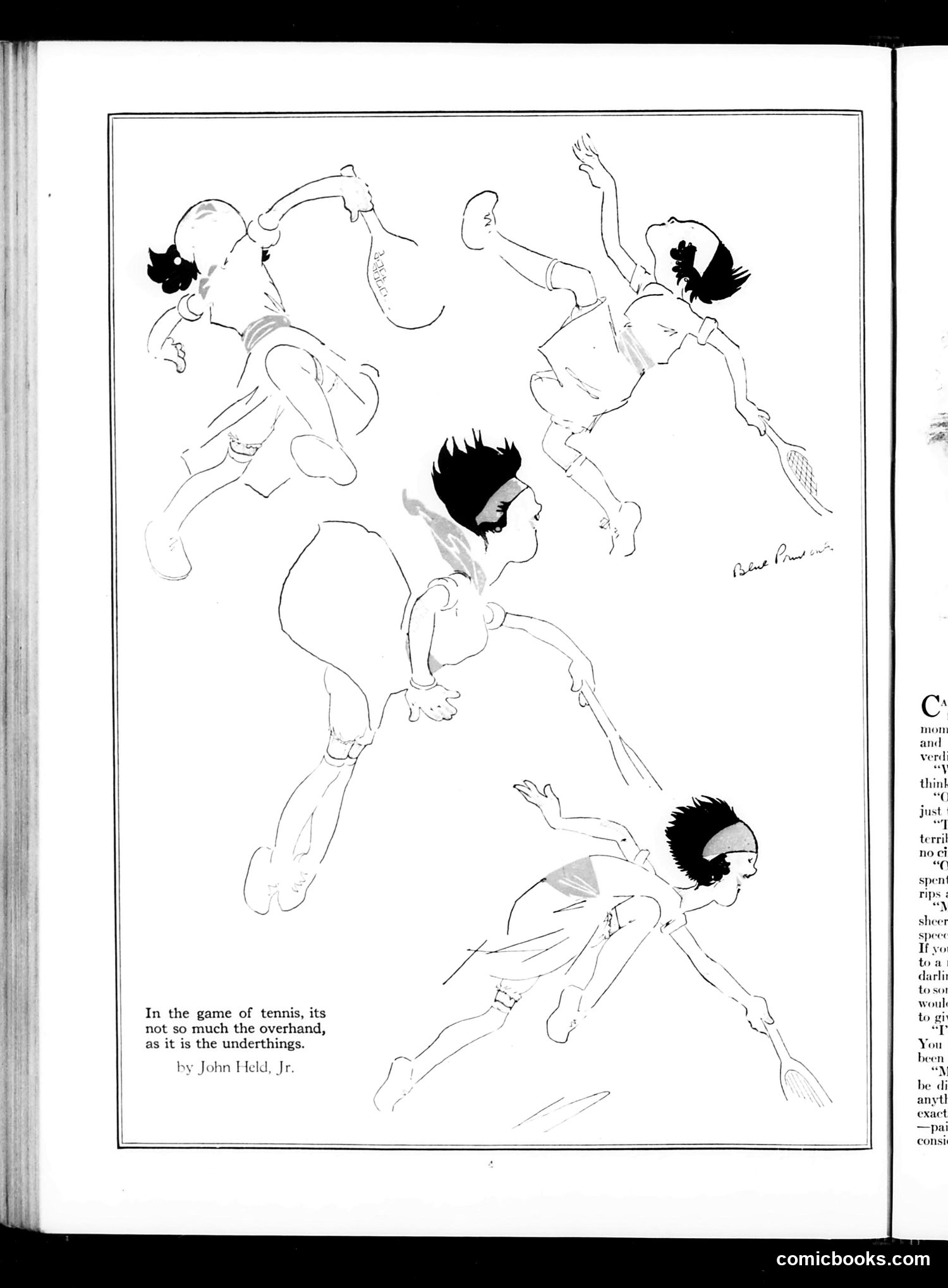
This page from *Judge* magazine features an illustration by an artist (signature visible) accompanying an article titled "In the game of tennis, its not so much the overhand, as it is the underthings" by John Held, Jr. The cartoon depicts four figures in dynamic tennis poses with exaggerated movements. The humor appears to play on a double entendre: while ostensibly about tennis technique ("underhand" vs. "overhang"), the title puns on "underthings" (undergarments). The illustrated figures—rendered in Held's characteristic style with bold black hair—seem designed to showcase athletic movement while the wordplay suggests the satire focuses on what players wear beneath their tennis attire, reflecting *Judge*'s typical risqué humor about fashion and bodily display during this era.
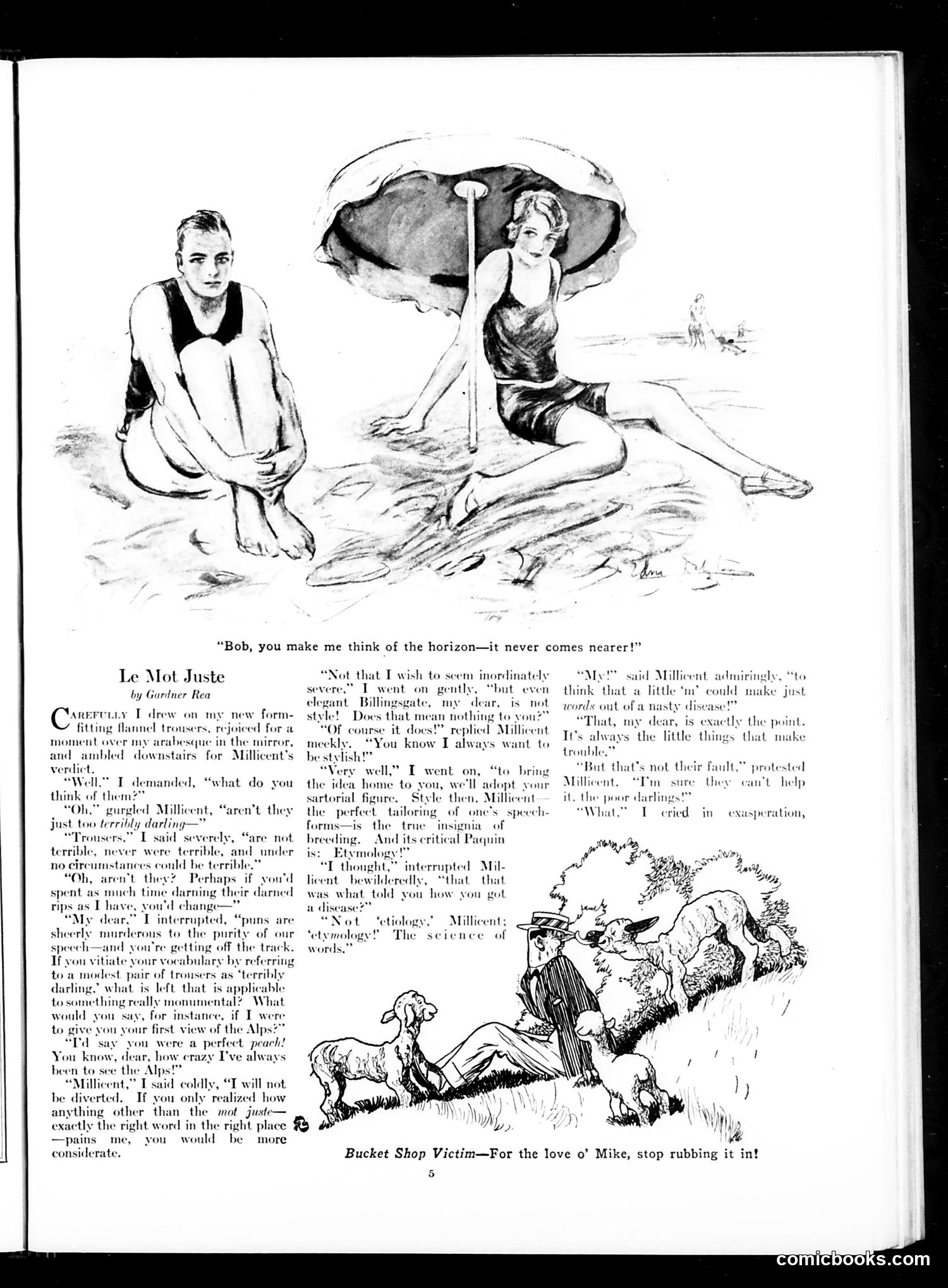
This page contains two separate pieces from *Judge* magazine: **"Le Mot Juste"** (top): A domestic comedy sketch about a boyfriend showing off new trousers to his girlfriend Millicent. She uses the word "terrible" casually ("just too terribly darling"), which he pedantically corrects—arguing that precise vocabulary ("the mot juste," French for "the right word") is essential to proper speech and social breeding. The satire mocks his pretentious obsession with linguistic exactitude while she's simply making conversation. It's gentle satire of masculine pedantry and class-consciousness around "refined" speech. **"Bucket Shop Victim"** (bottom): A brief cartoon showing what appears to be a man being rubbed/beaten by others, with the caption suggesting financial loss ("bucket shop" was slang for illegal gambling operations dealing in stocks). The joke's specific context is unclear without more historical detail about this particular victim or scandal. Both pieces reflect early 20th-century preoccupations with propriety, class markers, and financial schemes targeting ordinary people.
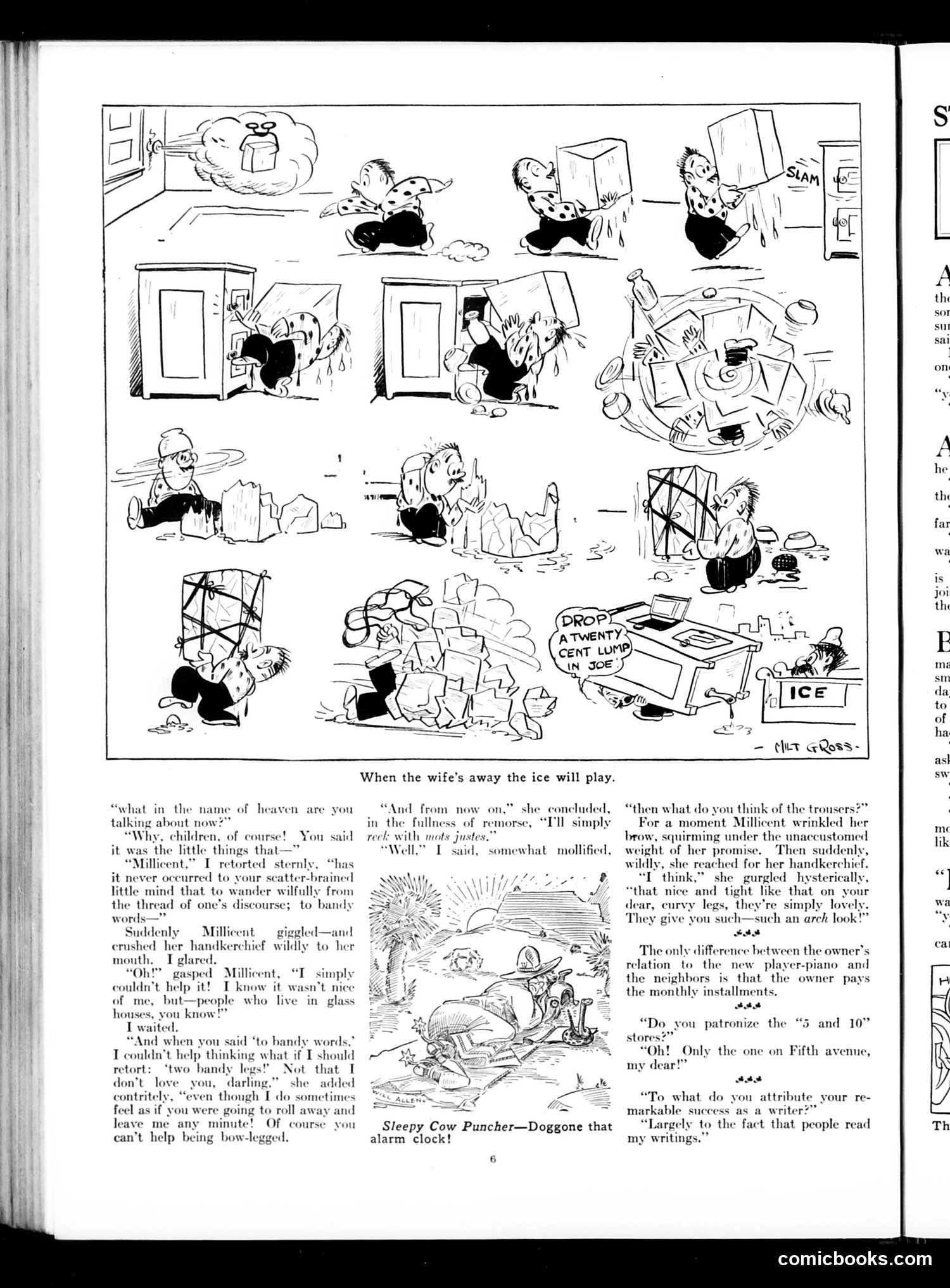
This page contains multiple satirical pieces typical of early 20th-century Judge magazine humor. **Top Comic Strip ("When the wife's away the ice will play"):** Depicts a man creating chaos with ice deliveries while his wife is absent—a visual gag about domestic misbehavior and the "man of the house" abandoning propriety. **Middle Dialogue Section:** Features a couple, Millicent and her husband, in a marital squabble. She's giggling uncontrollably at double entendres (his lectures about "wandering from discourse" and "bandy words" trigger her to think of "bandy legs"). The satire mocks both her frivolous humor and his pompous, pedantic speech patterns. It's genteel domestic comedy poking fun at pretentious intellectual posturing. **"Sleepy Cow Puncher" cartoon:** A visual gag about an alarm clock. **Bottom vignettes:** Brief satirical observations about player-pianos, five-and-dime stores, and authorial success—social commentary on consumerism and vanity. The overall tone reflects Judge's target audience: educated, urban middle-class readers amused by domestic situations and mild social critique.
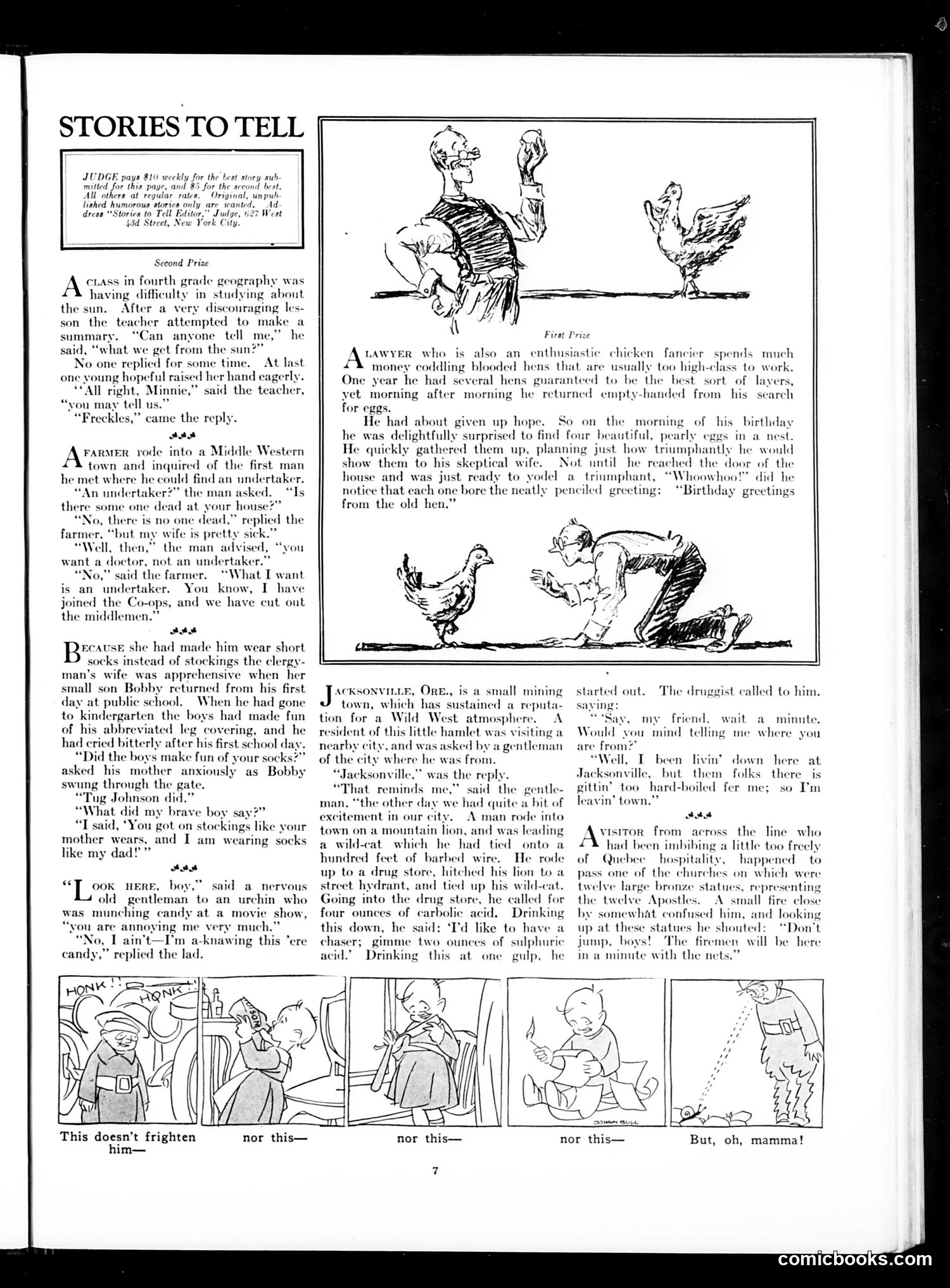
This page collects humorous short stories and jokes typical of early 20th-century American humor magazines. The content reflects period attitudes and concerns: **The stories include:** - A schoolroom joke about "freckles" as the sun's gift—simple children's humor - A farmer seeking an "undertaker" (not for death, but to eliminate middlemen from his Co-operative)—satirizing the Co-op movement's rhetoric - A clergy boy defending his short socks against peer mockery—mild class commentary - A chicken fancier receiving eggs as birthday gifts—absurdist humor - A Jacksonville, Oregon resident claiming to be from a "Wild West" town, then describing an exaggerated tall tale about a man drinking carbolic and sulphuric acid—frontier mythology humor The final comic strip shows a child unafraid by various urban/industrial sights, but frightened by his mother—domestic humor about parental authority. The overall tone is genteel, family-friendly satire aimed at middle-class readers, with no overtly political content visible on this page.
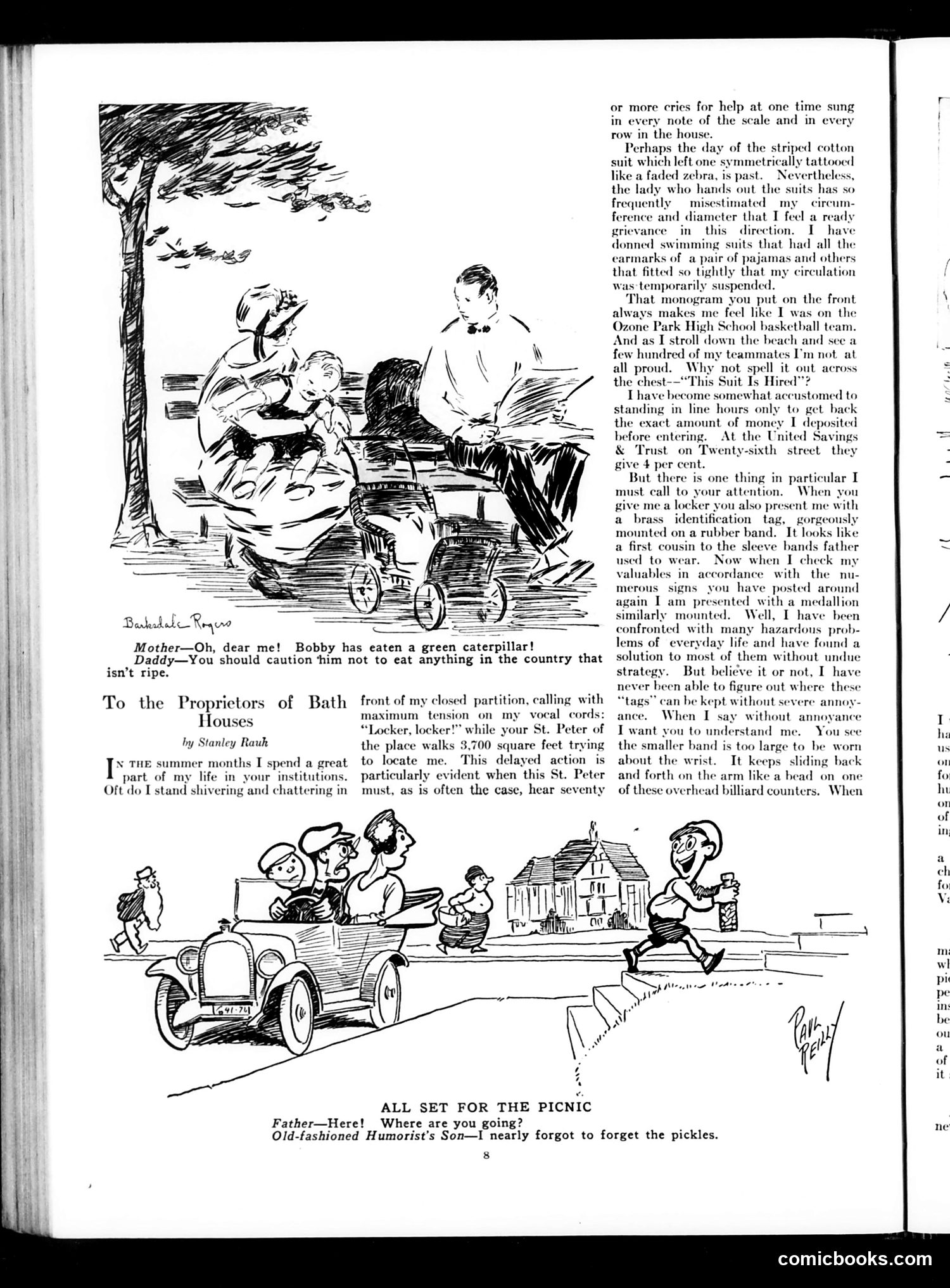
This page contains two separate humorous pieces. The top cartoon shows a mother discovering her son has eaten a green caterpillar, with the father cautioning against eating unidentified country items—a simple domestic joke about childhood mischief. The bottom cartoon, titled "All Set for the Picnic," depicts an old-fashioned father nearly forgetting the pickles before departing in an early automobile. This is gentle satire of the era's rapid modernization: while automobiles represent technological progress, family picnicking traditions (like remembering pickles) remain unchanged. The humor lies in this contrast between modern transportation and traditional domestic concerns. The accompanying essay appears to discuss bath houses and lockers, though the specific satirical target is unclear from this excerpt alone.
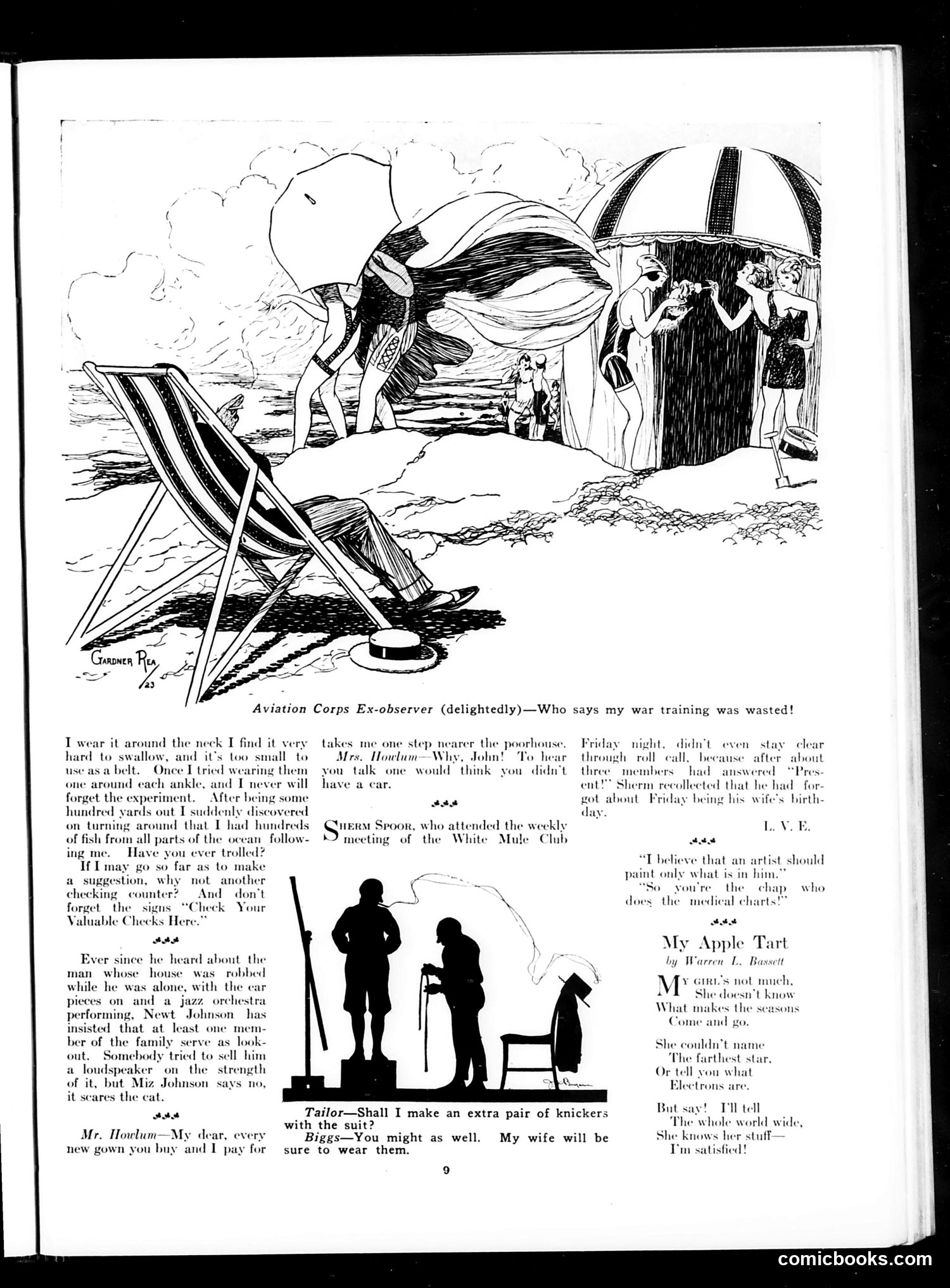
This page contains several satirical pieces reflecting post-WWI American life: **Main Cartoon**: An Aviation Corps observer, now a civilian, demonstrates how his military neck-scarf serves multiple purposes (belt, ankle-wear). The joke: his "war training wasn't wasted" because he's found practical uses for military gear—satirizing returning soldiers' attempts to justify their service in ordinary life. **Other Humor Pieces**: Brief anecdotes about middle-class life, including a wife's extravagant spending on dresses (blamed on her husband's car ownership), suggestions for adding a "checking counter" (unclear reference), and jokes about home security and tailoring. **"My Apple Tart"**: A romantic poem celebrating a girlfriend who lacks education but "knows her stuff"—likely a satirical jab at intellectualism or women's education, valuing practical knowledge over learning. The page reflects 1920s concerns: post-war adjustment, consumer culture, and gender roles. The humor targets both returning soldiers and middle-class anxieties about modernity and women's roles.
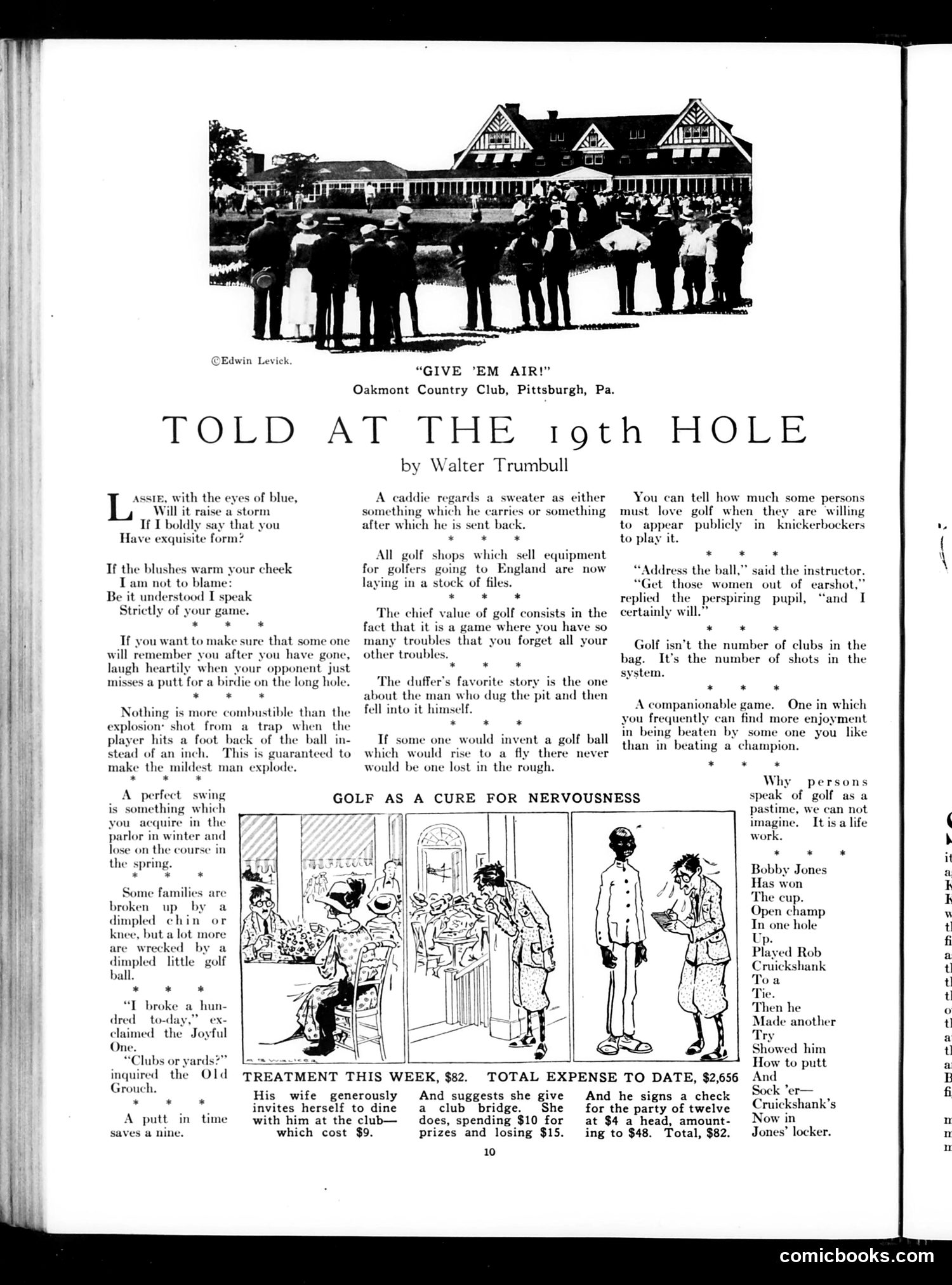
This page contains humorous golf anecdotes and a satirical cartoon by Walter Trumbull, written for an early 20th-century American audience. The cartoon "Golf as a Cure for Nervousness" depicts a man undergoing treatment for anxiety—spending $82 weekly while his wife exploits the situation, dining at expensive club bridges and charging him $48 for parties. His total expense reaches $2,656, with the "cure" clearly worsening his finances. The surrounding text mocks golf culture: golfers' obsession with the sport (wearing ridiculous knickerbockers publicly), their terrible play despite expensive equipment, and their petty obsessions. References to Bobby Jones (contemporary golf champion) and specific clubs like Oakmont in Pittsburgh ground the satire in recognizable contemporary figures and venues. The humor targets both golf's pretensions and how it exposes human nature—temper tantrums over missed putts, self-deception about ability, and financial recklessness disguised as leisure.
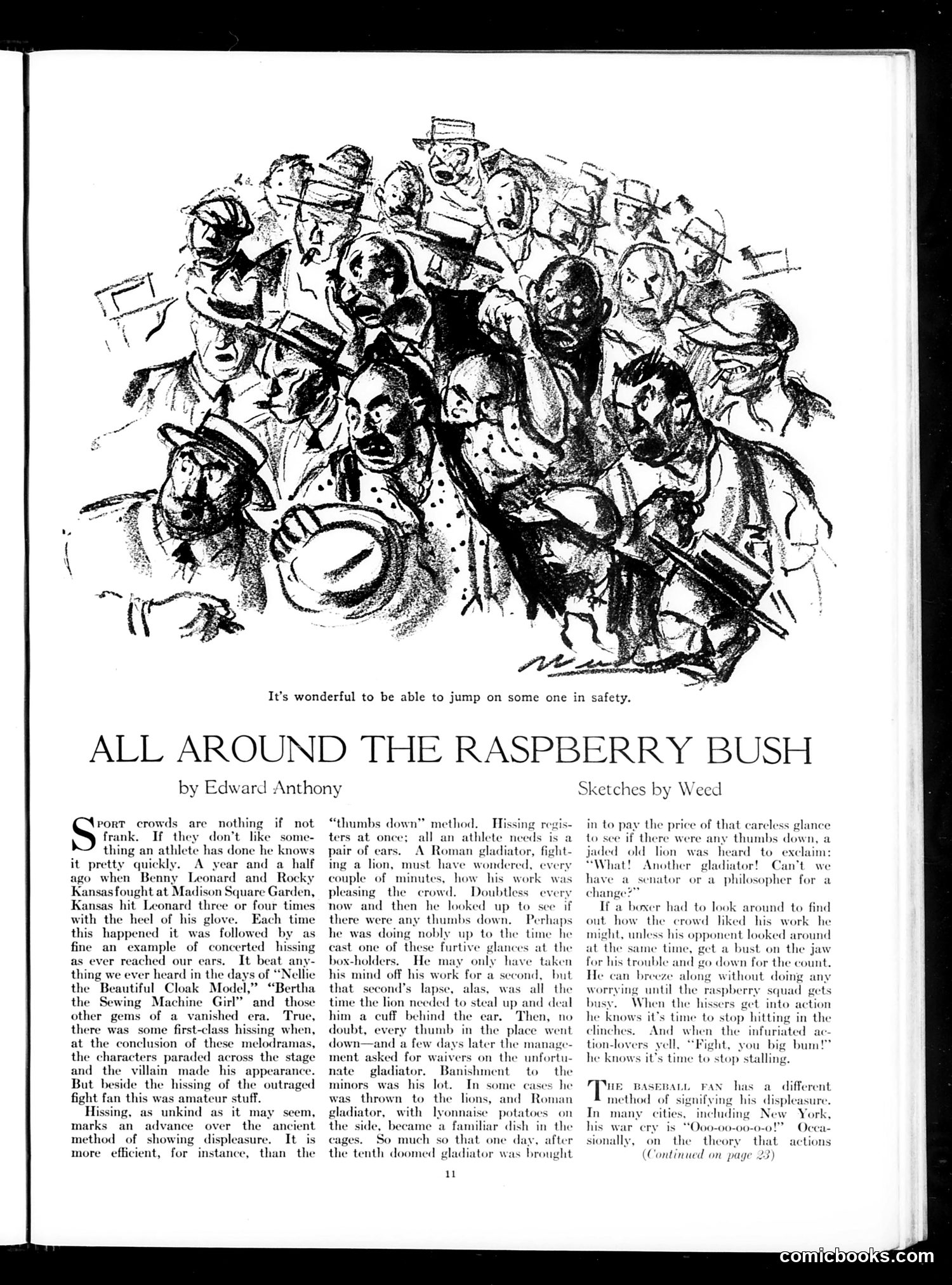
This article satirizes how sports crowds express disapproval—specifically the practice of "hissing" at boxing matches. The cartoon depicts rowdy spectators at a sporting event, emphasizing the collective nature of crowd jeering. **The Satire:** Author Edward Anthony compares modern crowd hissing to the Roman "thumbs down" method, arguing hissing is more efficient feedback. He references a specific boxing match where Benny Leonard fought Rocky Kansas at Madison Square Garden, with Kansas repeatedly hitting Leonard with the heel of his glove, triggering loud crowd hissing. **The Point:** The piece humorously suggests that immediate, vocal crowd disapproval (hissing and heckling) is actually an *improvement* over passive Roman methods—it gives athletes instant, unmistakable feedback. The comparison to gladiators who couldn't hear crowd disapproval until too late is tongue-in-cheek. The article concludes by noting baseball fans have different methods ("Ooo-oo-oo!"), setting up continued commentary on page 23.
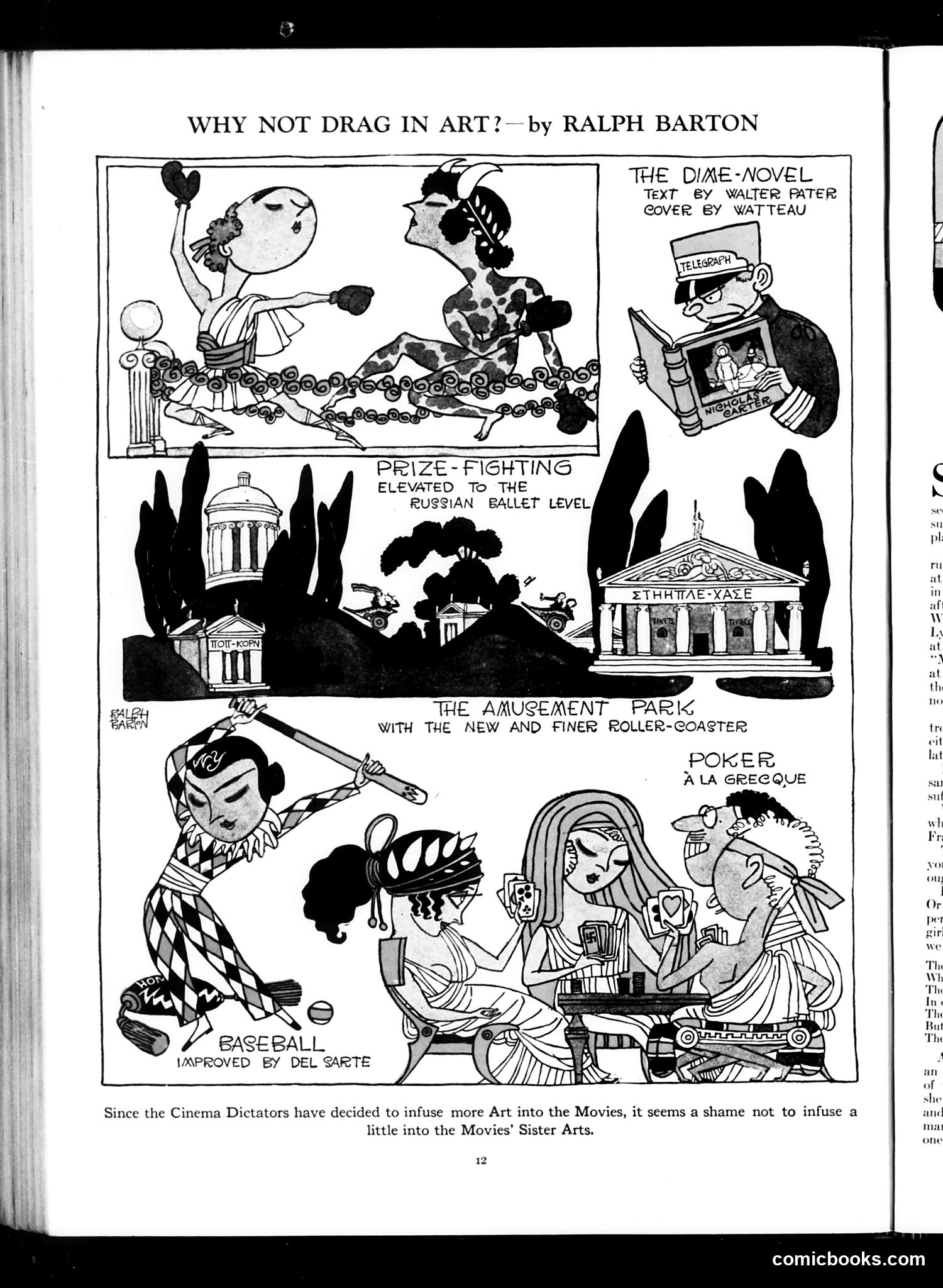
Ralph Barton's cartoon satirizes the 1920s trend of adding "high art" to popular entertainment. The caption references cinema directors infusing art into movies, then sarcastically asks why other entertainments shouldn't do the same. Each panel mocks this pretension by pairing lowbrow activities with famous artists or sophisticated styles: a dime novel with Walter Pater's ornate prose; prize-fighting reimagined as Russian ballet; baseball "improved" by Delsarte (a movement theorist); and poker played "à la Grecque" (in the Greek manner). The joke: applying elite artistic treatment to vulgar entertainment is absurd. It's cultural snobbery taken to ridiculous extremes. The cartoon criticizes both cinema's pretentious artistic aspirations and, implicitly, the arbitrariness of class-based taste distinctions—what's "art" versus "entertainment" is arbitrary and subjective.
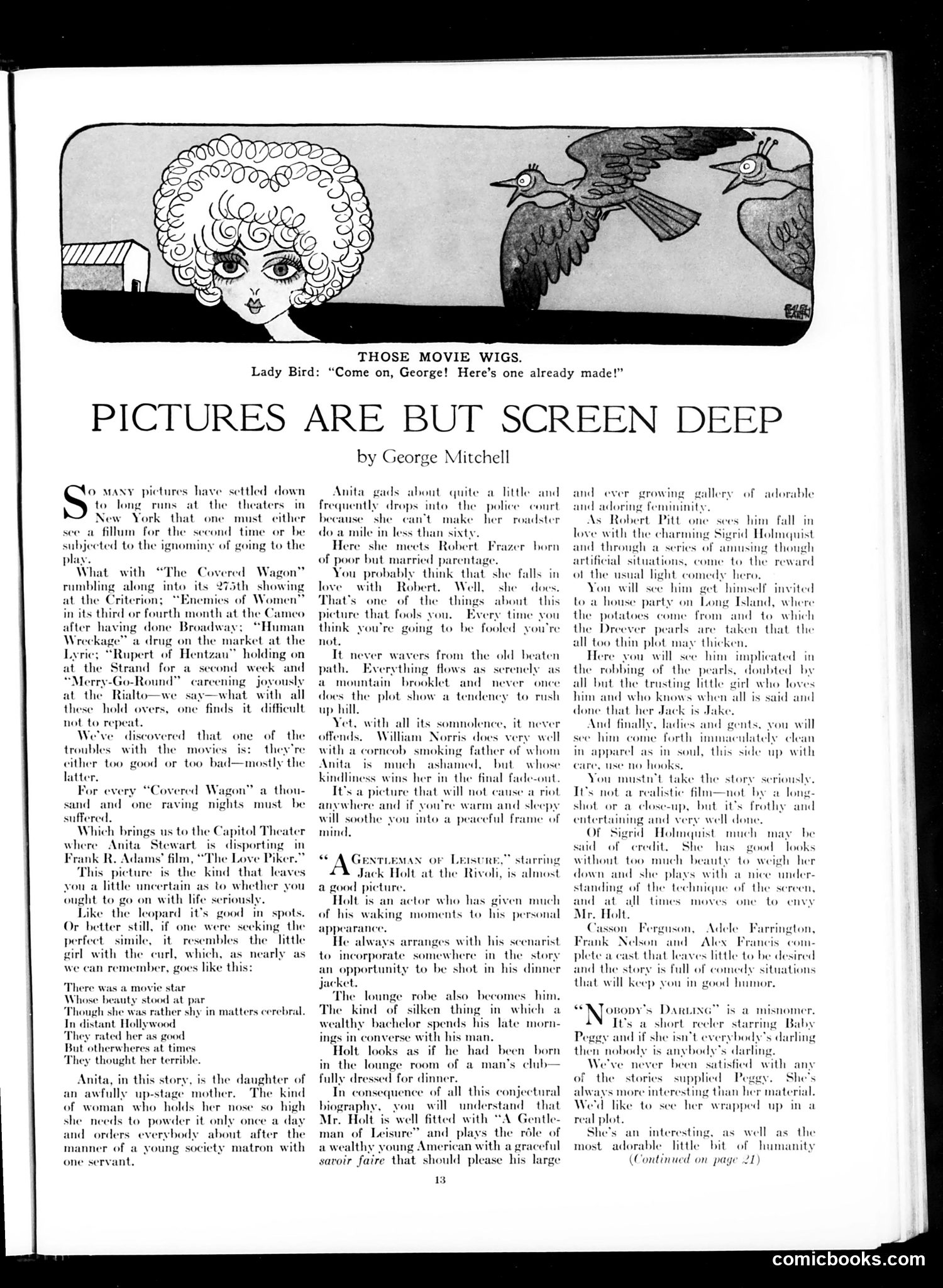
The cartoon at the top depicts **Lady Bird Johnson** urging "George" (President Lyndon B. Johnson) to adopt an elaborate curled wig, with the caption implying he should create one "already made." This is satirizing the **artificiality of political image-making** — suggesting political figures adopt fake, pre-fabricated personas rather than being authentic. The accompanying article reviews several silent films running long theatrical engagements in New York (1920s), critiquing them as predictable and emotionally shallow. The satire here parallels the cartoon's theme: just as politicians wear metaphorical "wigs" to appear appealing, movies present false surfaces ("pictures are but screen deep") lacking genuine substance. The piece mocks how films and public figures prioritize surface appearance and comfort over meaningful content or character development—a critique of superficiality in both entertainment and politics.
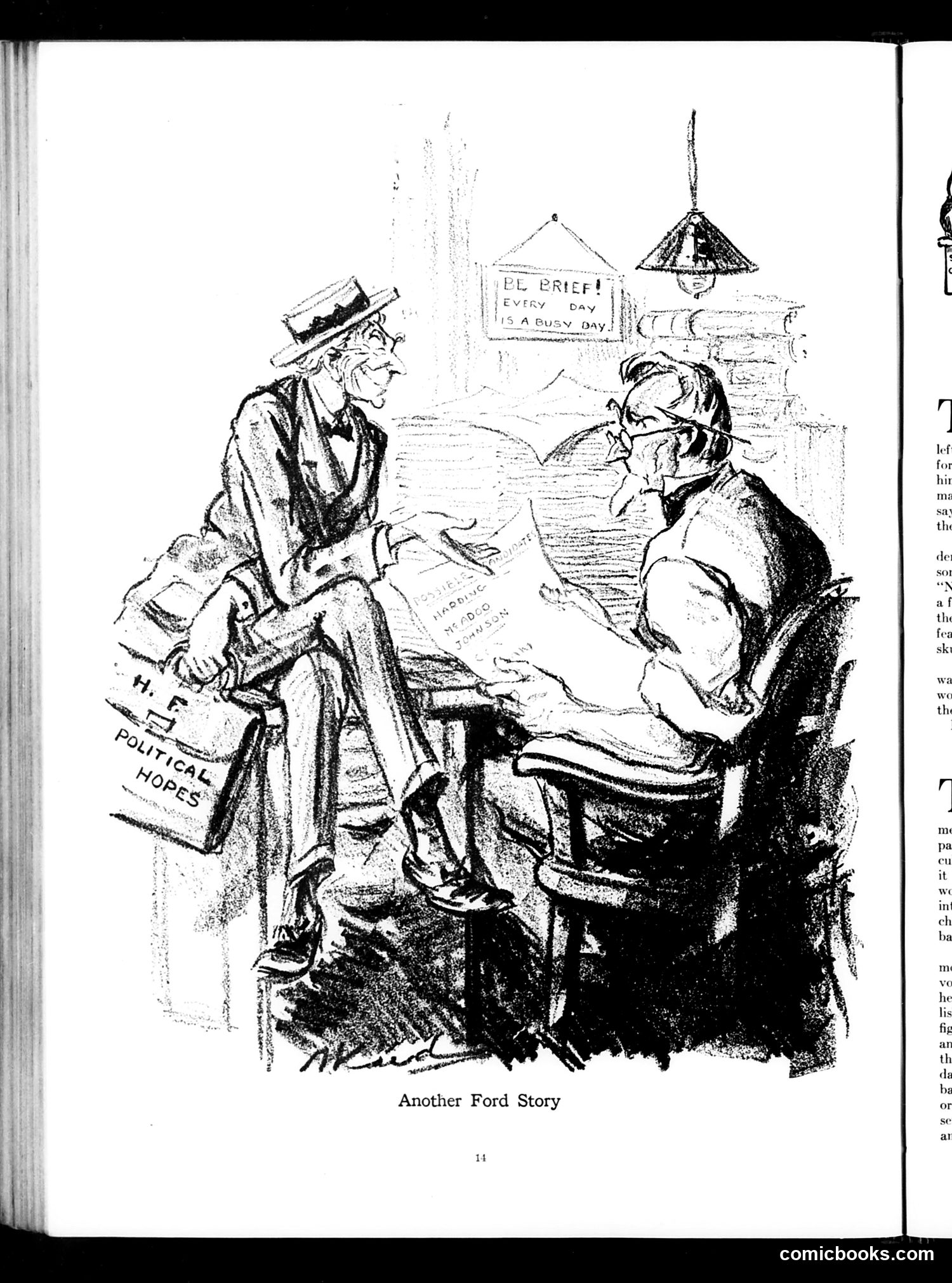
This cartoon depicts two figures in what appears to be an office setting, with papers scattered about labeled "POLITICAL HOPES." The standing figure on the left carries a briefcase marked similarly, while the seated figure on the right appears to be receiving or reviewing documents. The title "Another Ford Story" suggests this references Henry Ford, the automobile industrialist. The cartoon likely satirizes Ford's political ambitions or involvement in public affairs during the early 20th century. The sign visible in the background reads "P.L. BRIEF! EVERY DAY IS A BUSY DAY!" Without clearer context or dates, the specific political situation being mocked remains unclear, but the cartoon appears to mock Ford's ventures beyond automobile manufacturing, possibly his political aspirations or public statements.
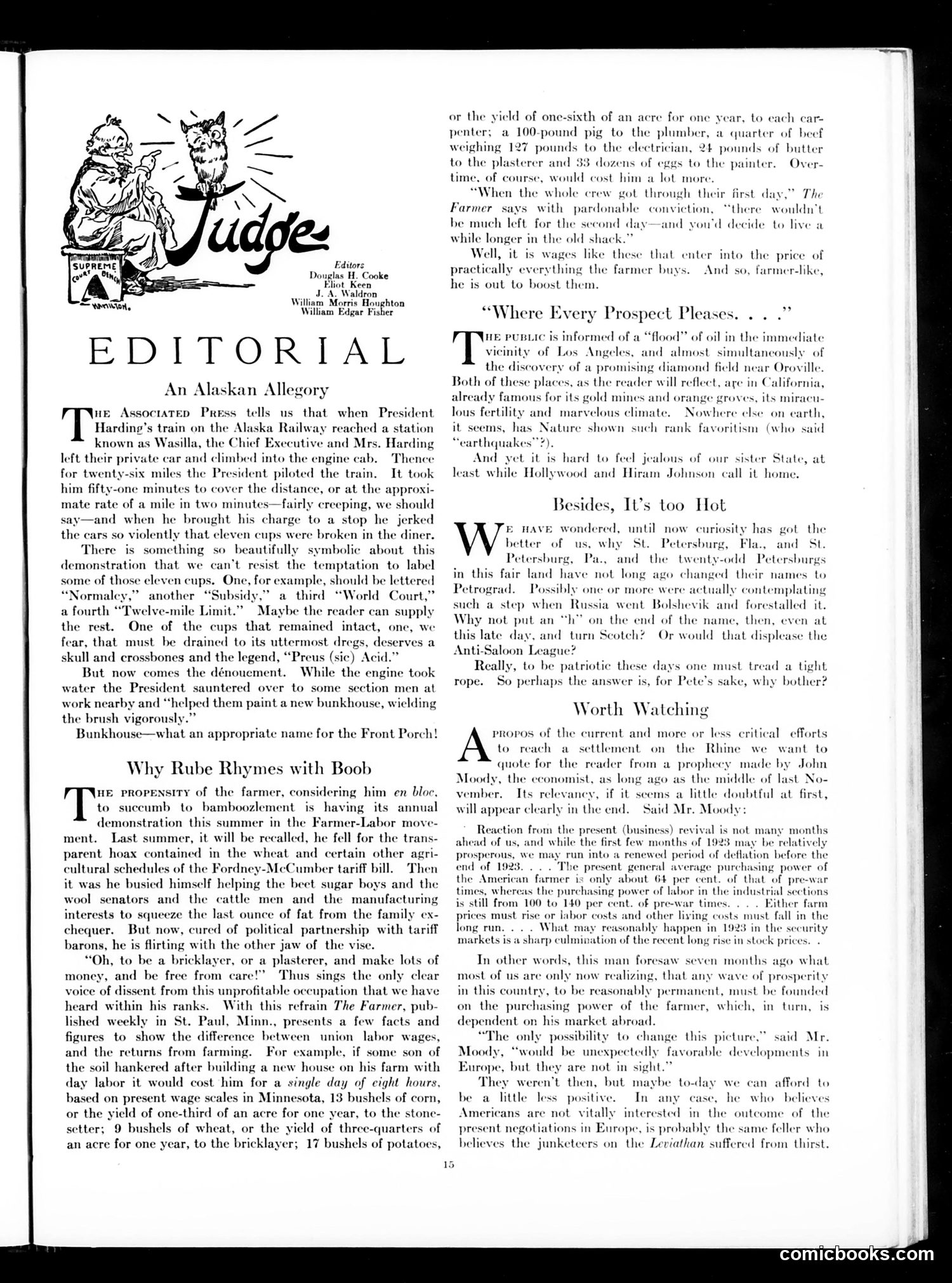
This editorial page satirizes President Warren G. Harding's Alaska trip and his inconsistent farm policies. **"An Alaskan Allegory"** uses Harding piloting a train as metaphor: he jerked it so violently that eleven cups broke in the dining car. The editor labels these cups symbolically—"Normalcy," "Subsidy," "World Court," "Twelve-mile Limit"—representing Harding's campaign promises and policies he's bungled or abandoned. The punchline: while the engine takes water, Harding helps paint a bunkhouse, which Judge sardonically calls "an appropriate name for the Front Porch"—mocking his do-nothing presidency conducted from his front porch. **"Why Rube Rhymes with Boob"** attacks Harding's flip-flopping on farmer support. Last summer he backed the Fordney-McCumber tariff benefiting farmers; now he's abandoning them. The piece uses wage-comparison data from *The Farmer* magazine showing construction workers earn far more than farmers—exposing how farm costs inflate while farm income stagnates, yet Harding offers no support. The satire targets perceived presidential incompetence and betrayal of rural constituencies.
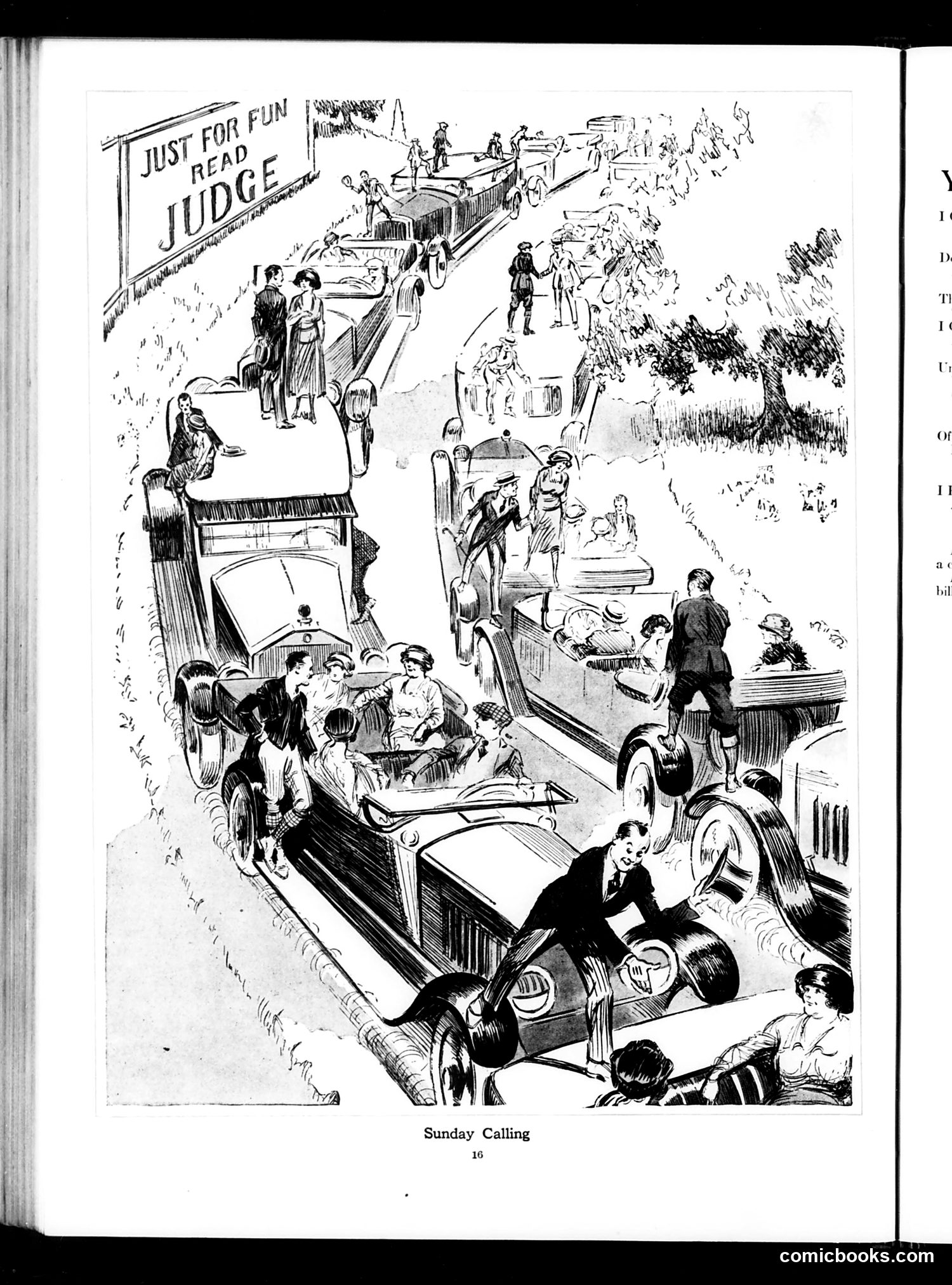
This satirical cartoon depicts **automobiles as a new social disruption** to Sunday leisure activities. The image shows a chaotic scene where multiple cars have invaded what appears to be a park or countryside gathering spot, crowding out pedestrians and disrupting traditional Sunday social customs. The humor targets the **automobile's disruptive effect on established social rituals**—people who once gathered peacefully are now overwhelmed by vehicles and their drivers. The "Just for Fun" banner and "Judge" masthead suggest this is satirizing middle-class Sunday recreation being upended by automotive culture. This likely dates from the **early automotive era** (1910s-1920s) when cars were becoming common enough to dramatically alter public spaces and social patterns, creating tension between traditional and modern leisure.
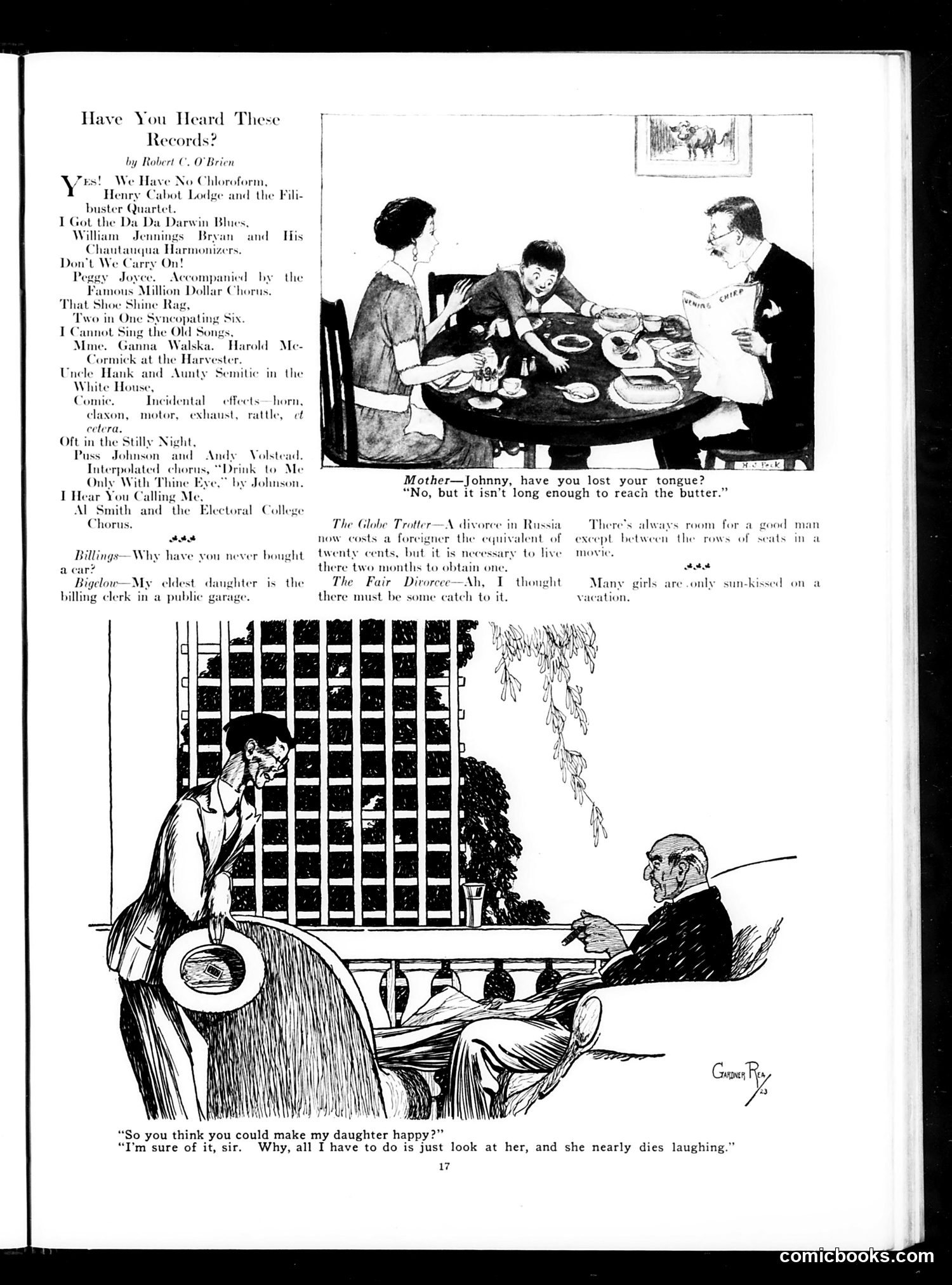
This page from *Judge* magazine is a humor column mixing satirical song parodies with jokes and a cartoon. **The "Records" section** mocks contemporary political figures through fake song titles. "We Have No Chloroform" references Henry Cabot Lodge's filibustering in Congress. "Da Da Darwin Blues" targets William Jennings Bryan, who opposed evolution. "Al Smith and the Electoral College Chorus" likely refers to Al Smith's 1928 presidential loss. These are topical jabs at recognizable public figures of the era. **The jokes** include one about divorce costs in Russia (then Soviet Union), a crack about a man's ability to make women laugh, and wordplay about automobiles. **The main cartoon** (signed by artist Cesare Fox) depicts a suitor meeting a girl's father, claiming he can make her happy simply by his appearance, which amuses her greatly. It's a standard romantic comedy setup satirizing either shallow courtship or vanity. The overall tone is light political and social satire typical of *Judge's* approach.
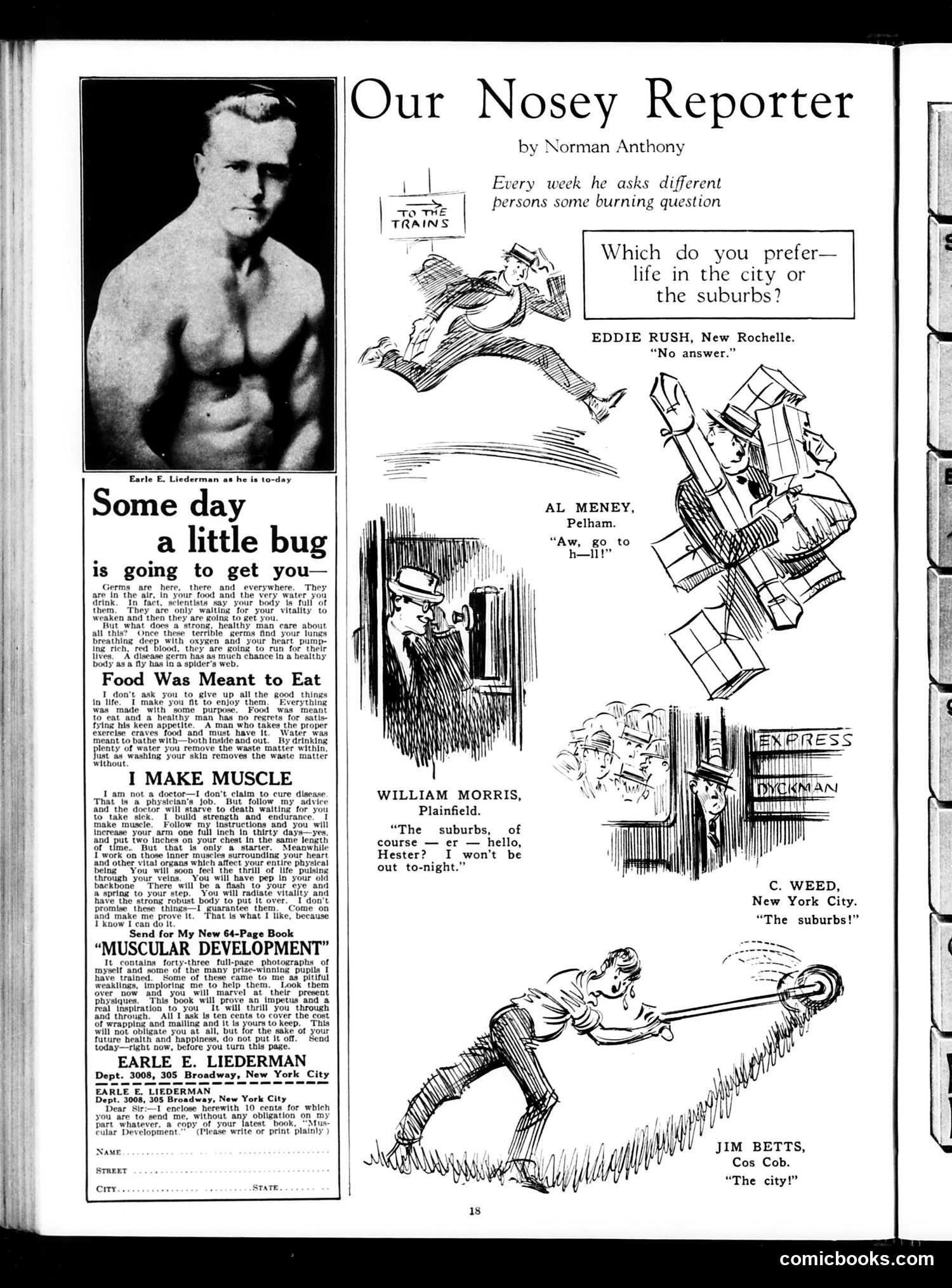
This page features a humor column by Norman Anthony where a street reporter asks New York area residents whether they prefer city or suburban life. The responses satirize common attitudes of the era: **The Joke:** Each respondent's answer ironically contradicts their actual circumstances or reveals hypocrisy: - **Eddie Rush** (New Rochelle) won't commit to an answer - **Al Meney** (Pelham) dismissively says "go to hell" - **William Morris** (Plainfield) claims preference for suburbs but is clearly calling his wife to say he won't come home that night—suggesting marital discord or that he prefers city nightlife - **C. Weed** (NYC) enthusiastically endorses suburbs despite living in the city - **Jim Betts** (rural area) depicts the "country life" as backbreaking labor **The satire** mocks the era's romanticized suburban ideal versus reality—people claiming to want suburban domesticity while their actual behavior reveals they either avoid home life, prefer urban vices, or find rural/suburban existence physically exhausting. It's social commentary on the gap between lifestyle aspirations and lived experience.
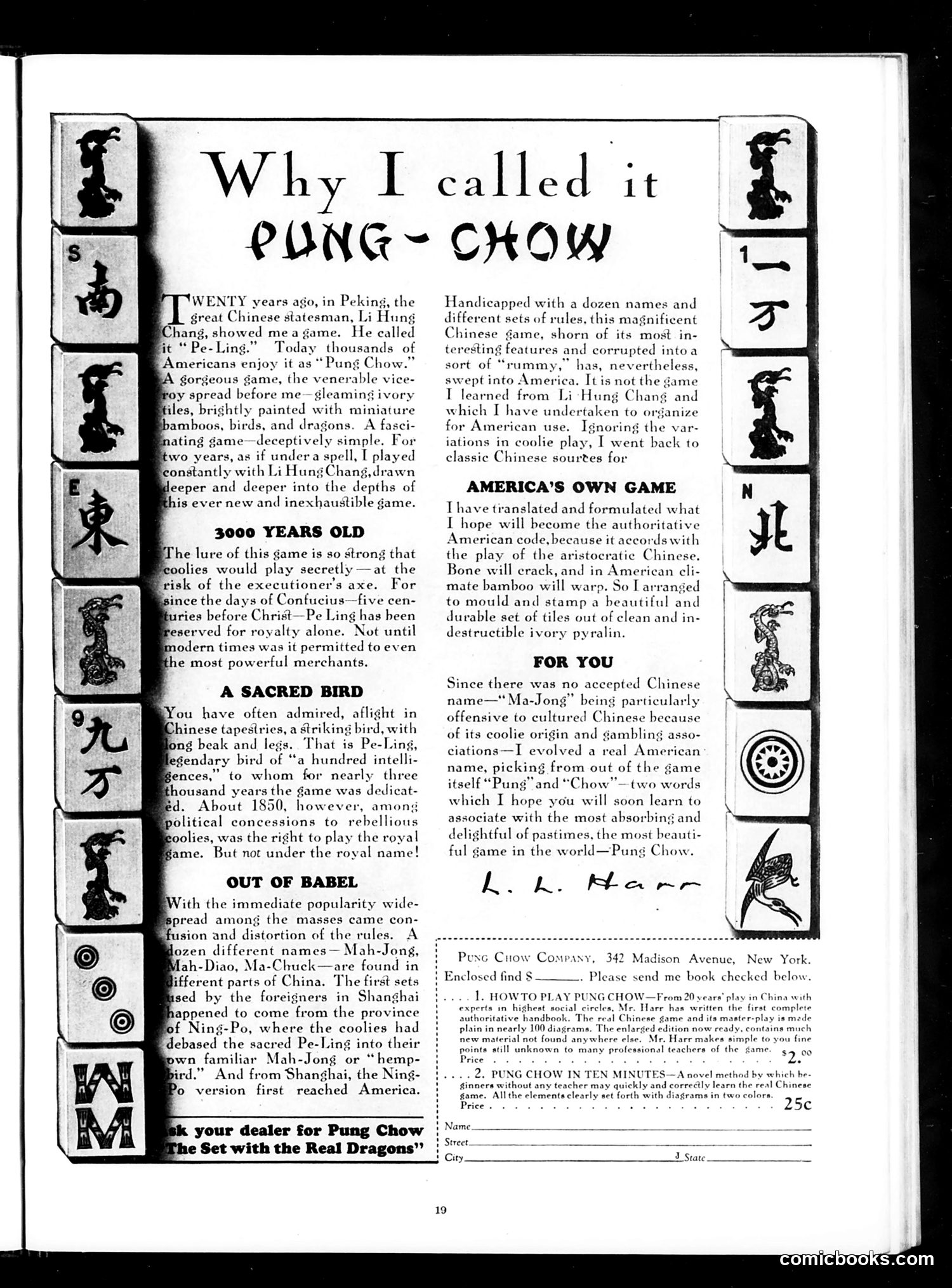
This is primarily **advertising copy**, not satire. L.L. Harr, apparently an American who played Mahjong with Chinese statesman Li Hung Chang in Peking twenty years prior, is marketing an "Americanized" version of the ancient Chinese game. The narrative claims Mahjong had been corrupted through mass popularity and regional variations ("out of Babel"), losing its aristocratic authenticity. Harr positions himself as restoring the "real" game by creating an authoritative American code using ivory pyralin tiles and giving it an English name drawn from game terminology itself: "Pung Chow." The framing—emphasizing the game's 3,000-year history, sacred associations with the Pe-Ling bird, and royal exclusivity—serves to legitimize his product as the authentic version for American consumers. The ornamental Chinese characters bordering the page reinforce this cultural authority. This reflects early 20th-century American commercialization of Asian culture through claims of "purity" and expert insider knowledge.
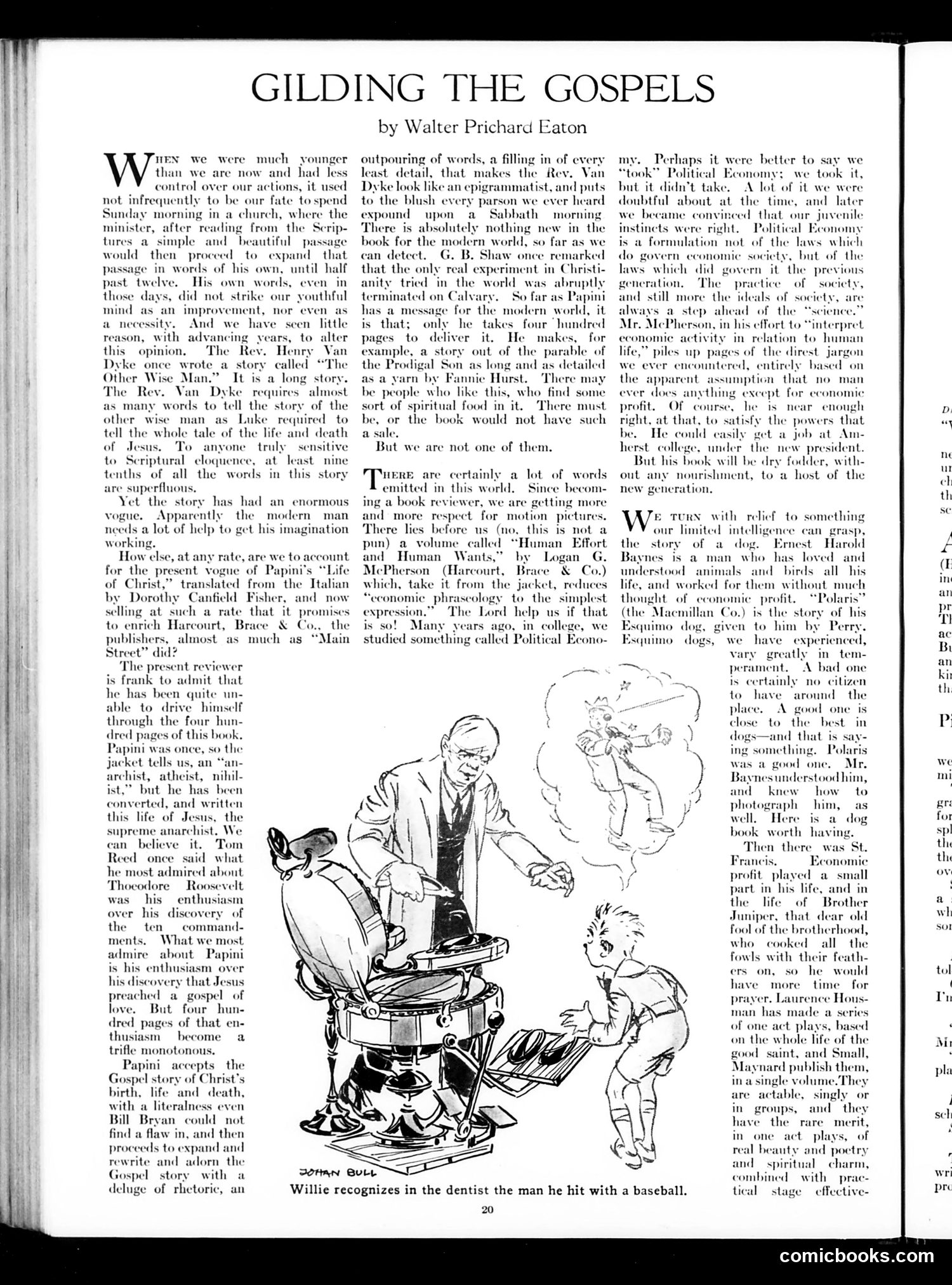
This is a book review essay criticizing Giovanni Papini's *Life of Christ* (recently translated to English by Dorothy Canfield Fisher). Eaton argues that Papini—a converted anarchist and atheist—has unnecessarily inflated a simple spiritual message with four hundred pages of flowery rhetoric, making Jesus's straightforward gospel of love tediously verbose. The essay draws parallels to Rev. Henry Van Dyke's equally long story "The Other Wise Man," suggesting modern readers need excessive elaboration to engage imagination. Eaton contrasts this with the economical eloquence of Scripture itself and makes a sardonic jab at economic textbooks that claim to "simplify" but remain incomprehensible. The cartoon shows a man recognizing someone (a dentist) he previously struck with a baseball, illustrating an unrelated anecdote about consequences. The page mocks both religious and economic writing for obscuring simple truths through verbosity.
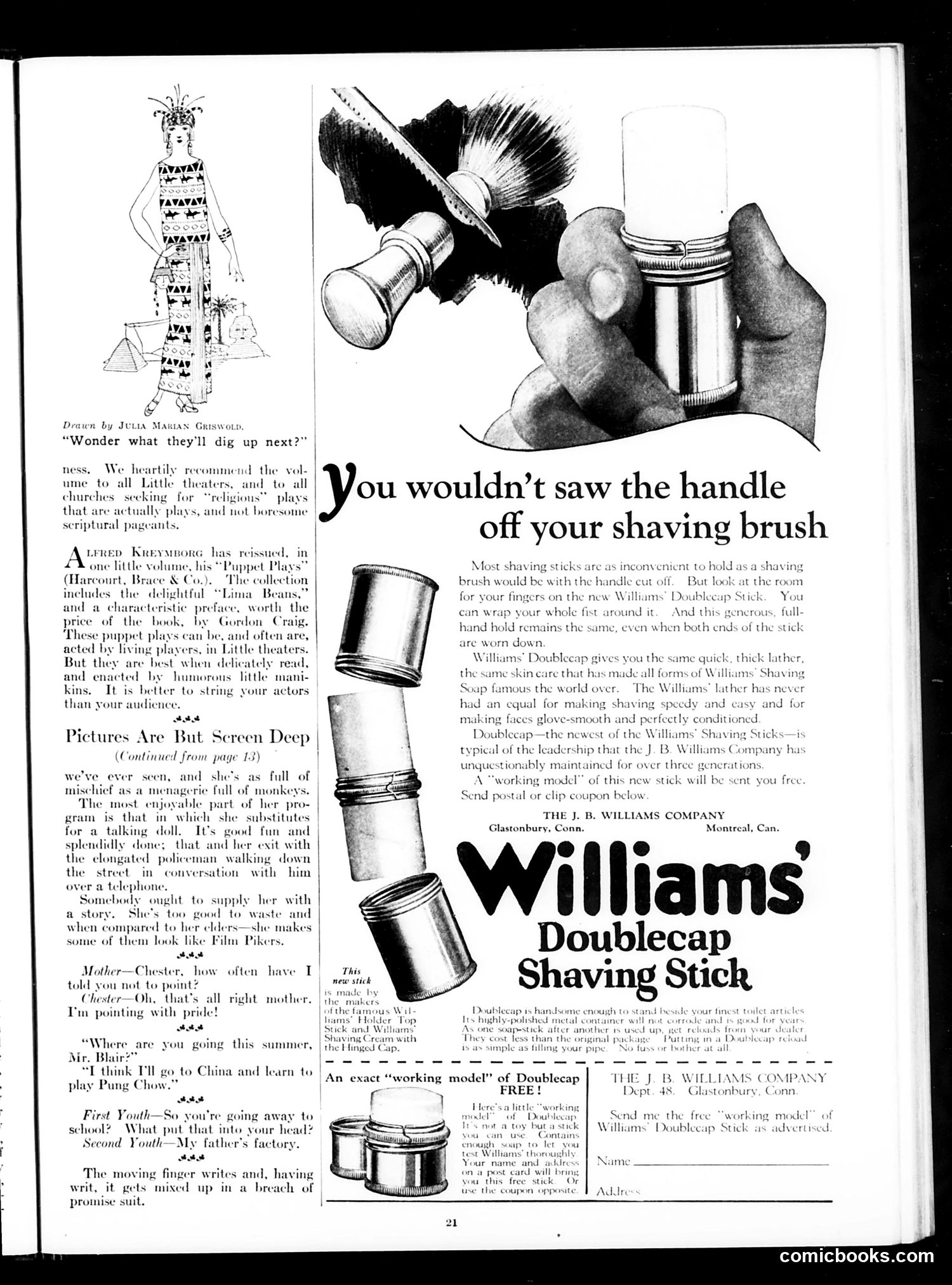
This page contains **primarily advertising** rather than political satire. The dominant content is a Williams' Doublecap Shaving Stick advertisement occupying the right half of the page. The cartoon at top left, drawn by Julia Marian Griswald, shows a figure composed of stacked geometric shapes with the caption "Wonder what they'll dig up next?" This appears to be **social satire about archaeological discoveries or ancient artifacts**, though the specific reference is unclear without additional context. The remainder consists of brief humorous anecdotes and a book review discussing puppet plays and silent film actresses—typical light entertainment content for Judge magazine. The shaving brush advertisement uses comparative humor ("You wouldn't saw the handle off your shaving brush") to highlight product design advantages, a marketing approach typical of 1920s consumer advertising in magazines. This represents the magazine's reliance on advertising revenue rather than pure editorial content.
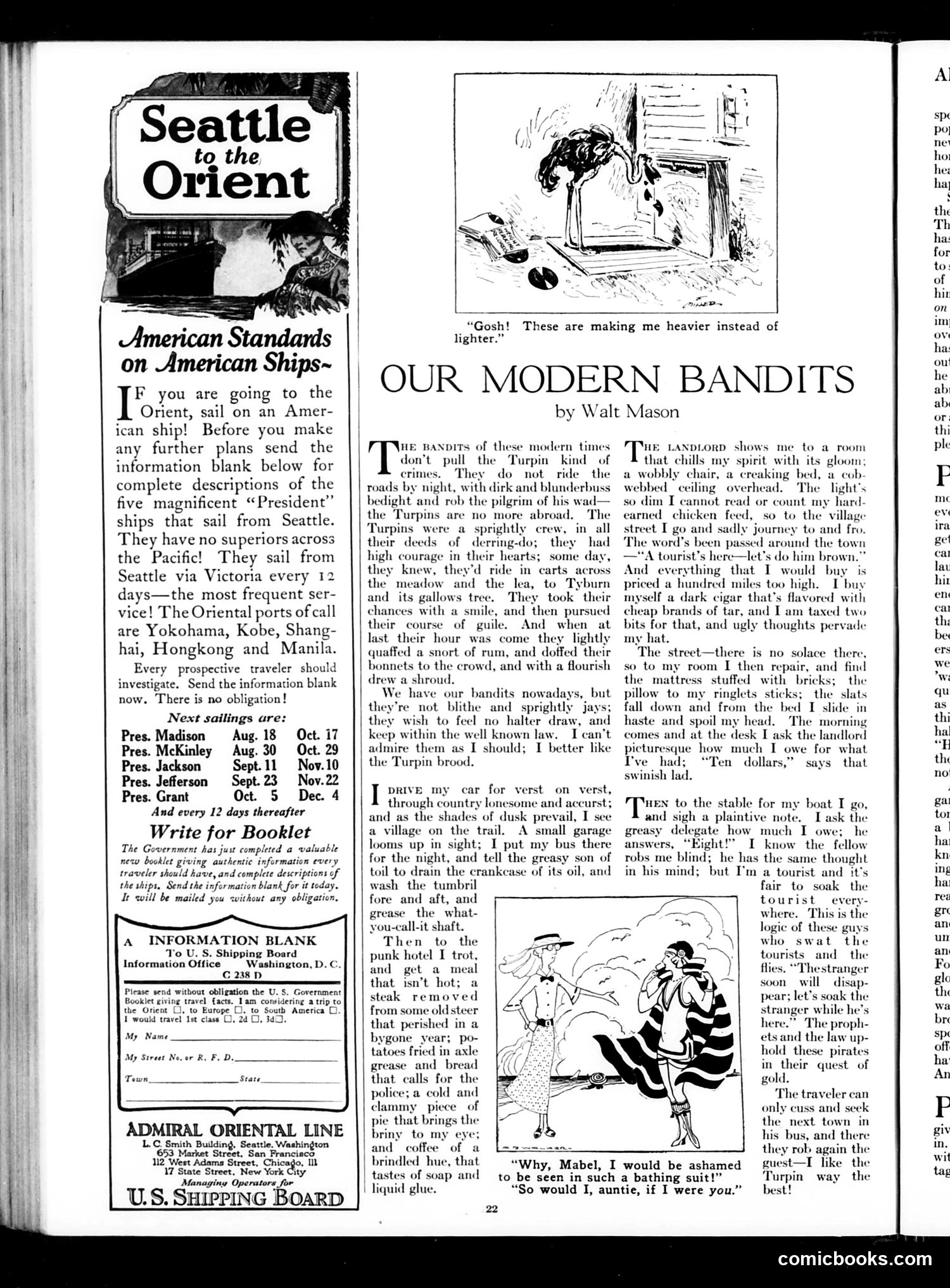
This page combines advertising for U.S. shipping lines with a satirical poem about contemporary tourism exploitation. **The Advertisement** (left) promotes the "President" ships sailing from Seattle to Oriental ports, emphasizing American vessels and government backing—reflecting post-WWI efforts to boost American maritime commerce. **The Satire** (right) contrasts old-fashioned highwaymen (like the historical Dick Turpin) with modern-day "bandits"—small-town merchants and innkeepers who systematically overcharge tourists. Mason's narrator drives through rural America, where locals conspire to exploit him through inflated prices and poor service. The poem's point: these petty swindlers lack the romantic audacity of historical outlaws; they're merely greedy and dishonorable. The accompanying cartoon illustrates this theme, showing a woman being weighed down—humorously suggesting that tourist traps literally make visitors "heavier" through excessive expenditure rather than nourishment. This reflects early 20th-century concerns about price gouging in rural tourism.
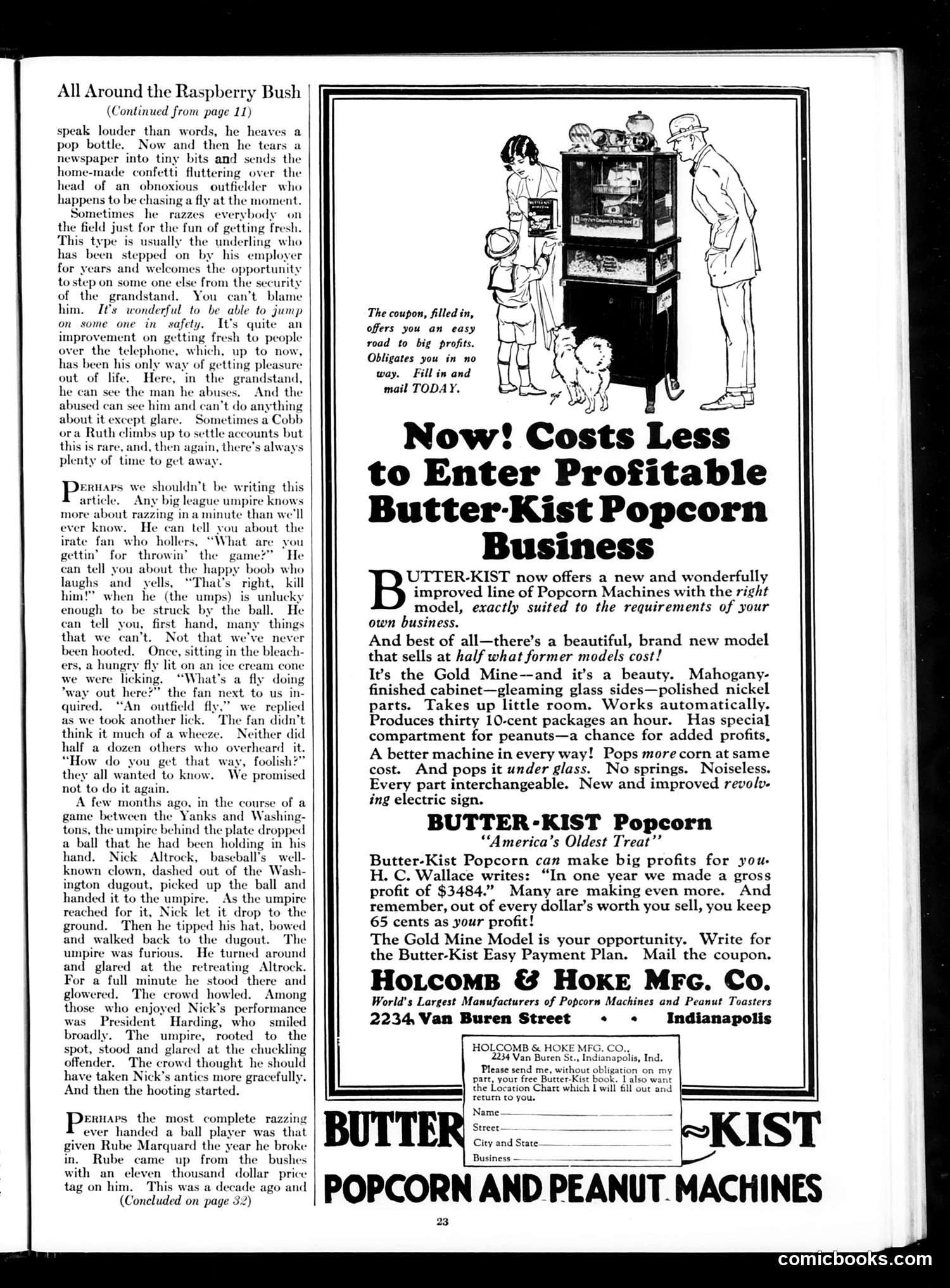
This page contains two distinct elements: **Main Article:** A humorous essay about baseball spectators and heckling. It describes fans who jeer players and umpires from the safety of the grandstand—people of low status who enjoy the rare opportunity to insult authority figures without consequence. The piece references specific incidents, including one involving baseball player/comedian Nick Altrock pranking an umpire (which President Harding apparently witnessed and enjoyed), and mentions pitcher Rube Marquardt being heavily criticized early in his career. **Advertisement:** The bulk of the page is a Butter-Kist Popcorn machine advertisement, aimed at entrepreneurs. It promotes an affordable new "Gold Mine" model popcorn machine as a profitable small business opportunity, featuring an easy-payment plan. The contrast between satirical sports commentary and commercial promotion is typical of Judge's format during this era.
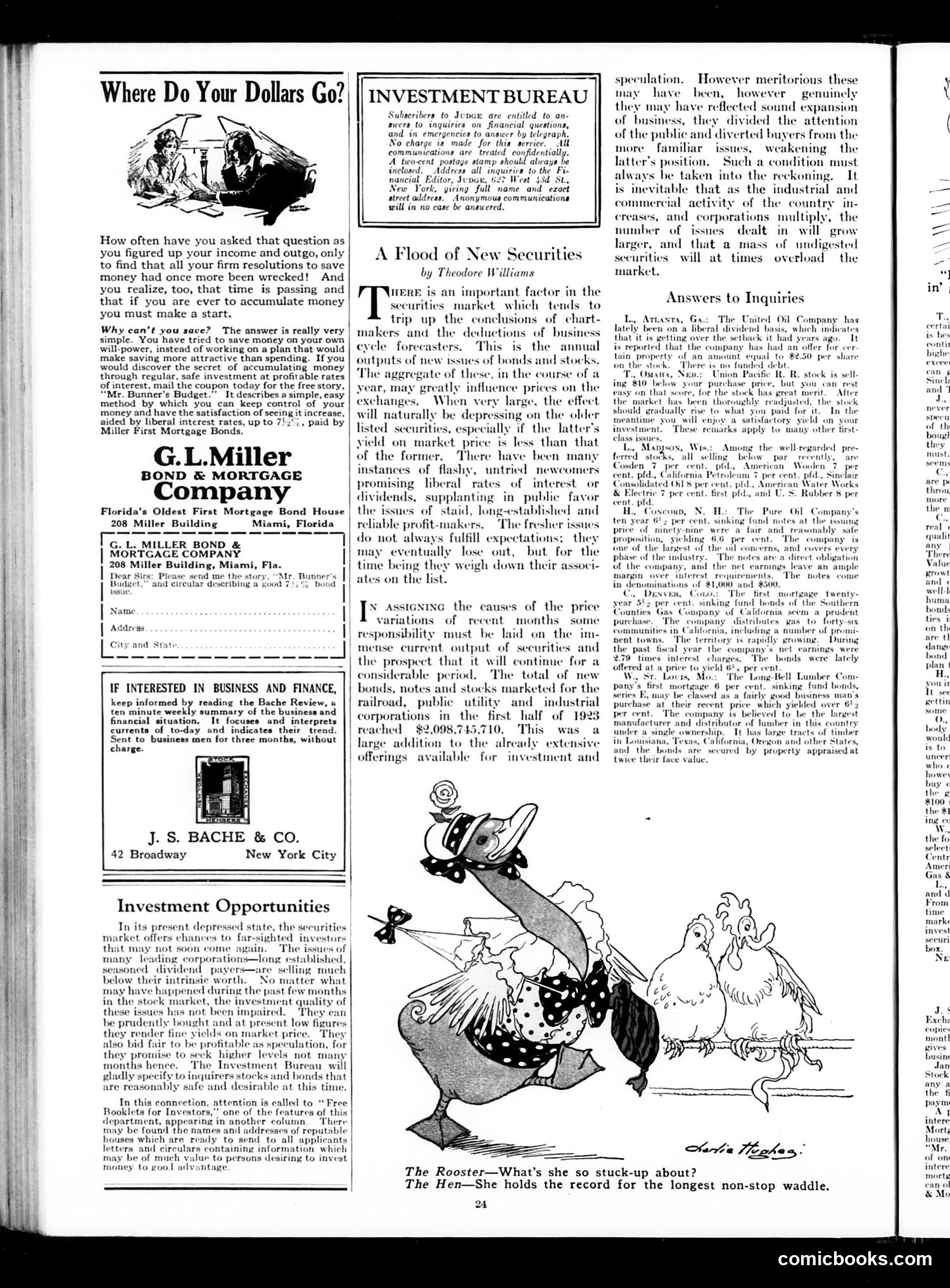
This page primarily contains **investment advertising and financial advice**, typical of 1920s prosperity-era publications. The main cartoon—"The Rooster" and "The Hen"—is a whimsical, non-political illustration showing a rooster flying with a fishing rod while a hen waddles below. The caption jokes that the hen holds the record for "longest non-stop waddle." This is simple visual humor with no political satire. The substantive content includes articles on securities markets and advertisements for investment services (G.L. Miller Bond & Mortgage Company, J.S. Bache & Co., and an Investment Bureau). These promote purchasing bonds and stocks during the economically depressed period mentioned—likely the post-1920 recession. The "Where Do Your Dollars Go?" feature addresses personal finance management and saving discipline, encouraging readers to invest in bonds offering 7.5% returns rather than spend impulsively. **There is no political satire or caricature on this page.** It's primarily financial promotion aimed at middle-class readers seeking investment guidance.
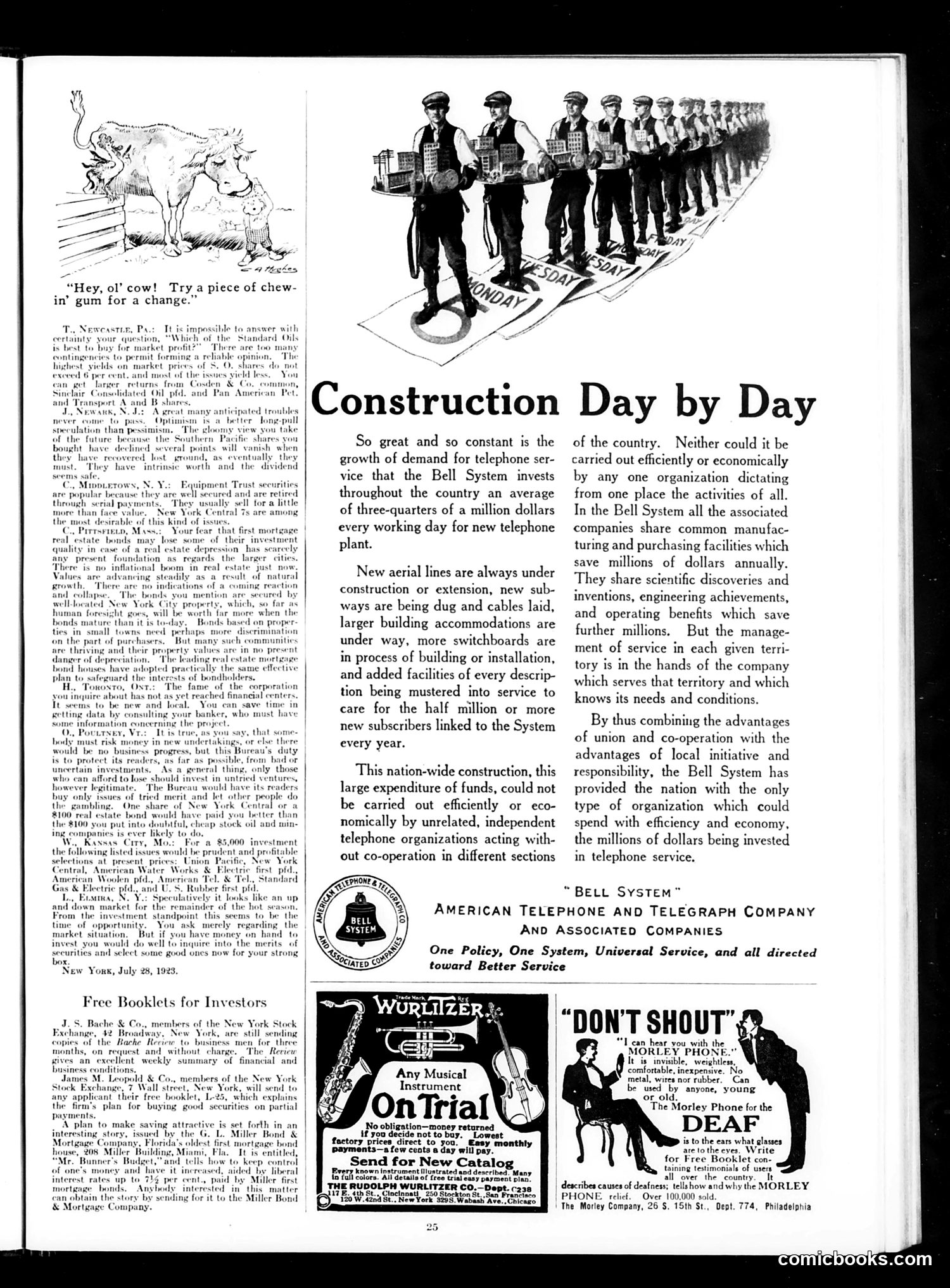
This page contains a small cartoon and primarily consists of financial advice columns and advertisements. **The Cartoon (upper left):** Shows a cow being offered chewing gum by a figure, with the caption "Hey, ol' cow! Try a piece of chew-in' gum for a change." This appears to be gentle animal humor—treating the cow as if it might enjoy human products—rather than political satire. **Main Content:** The bulk of the page features financial advice from "The Investor's Bureau," addressing stock market questions from readers in various cities (Newcastle PA, Middlebury NY, Poultney VT, etc.). Topics include Standard Oil shares, transport bonds, and real estate investments. **Advertisements:** Include a Wurlitzer musical instrument promotion ("On Trial"), a "Don't Shout" Worley Phone for the deaf, and Bell System/AT&T corporate messaging about telephone infrastructure investment. **Context:** This represents typical Judge magazine content from this era—mixing light humor with serious financial guidance and corporate advertising, reflecting post-WWI American business culture.
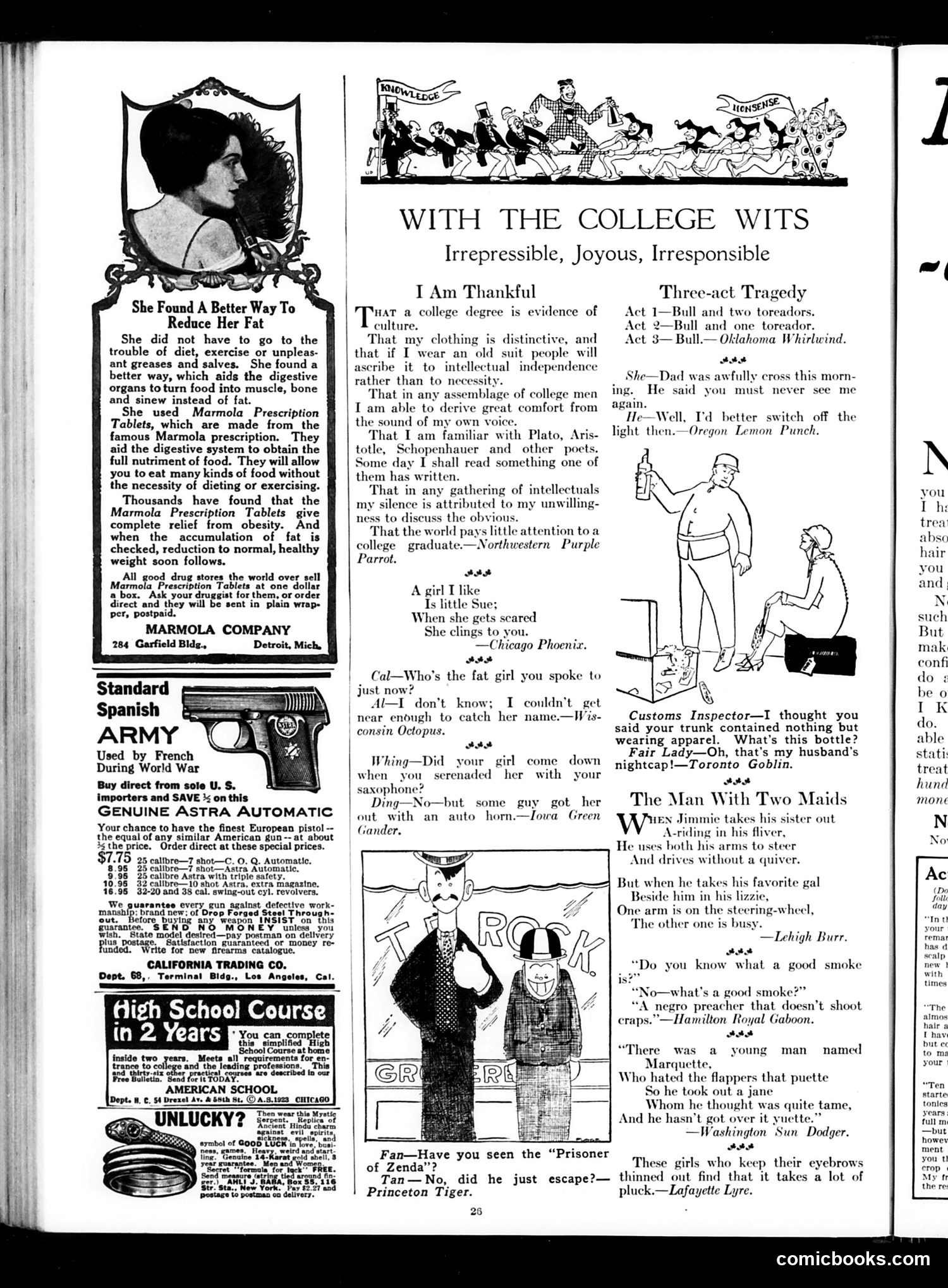
This page from *Judge* is primarily **humorous content for college students** rather than political satire. The main feature, "With the College Wits," collects jokes and witty observations from various college newspapers. **Key content:** The title section parodies pretentious college graduates who claim intellectual sophistication while admitting they haven't actually read the philosophers they name-drop (Plato, Aristotle, Schopenhauer). It mocks the assumption that wearing shabby clothes signals "intellectual independence" rather than poverty. **The jokes** are typical college humor: romantic mishaps ("A girl I like / Is little Sue"), misunderstandings about instruments and automobiles, and slapstick scenarios. "Three-act Tragedy" is a darkly comic bullfighting joke—each act loses a character until only the bull remains. **The advertisements** (Marmola diet pills, Astra pistols, high school courses) reflect 1920s consumer culture and mail-order sales. Overall, this reflects the Jazz Age college experience—lighthearted, self-aware about academic pretensions, focused on dating and social life rather than serious political commentary.
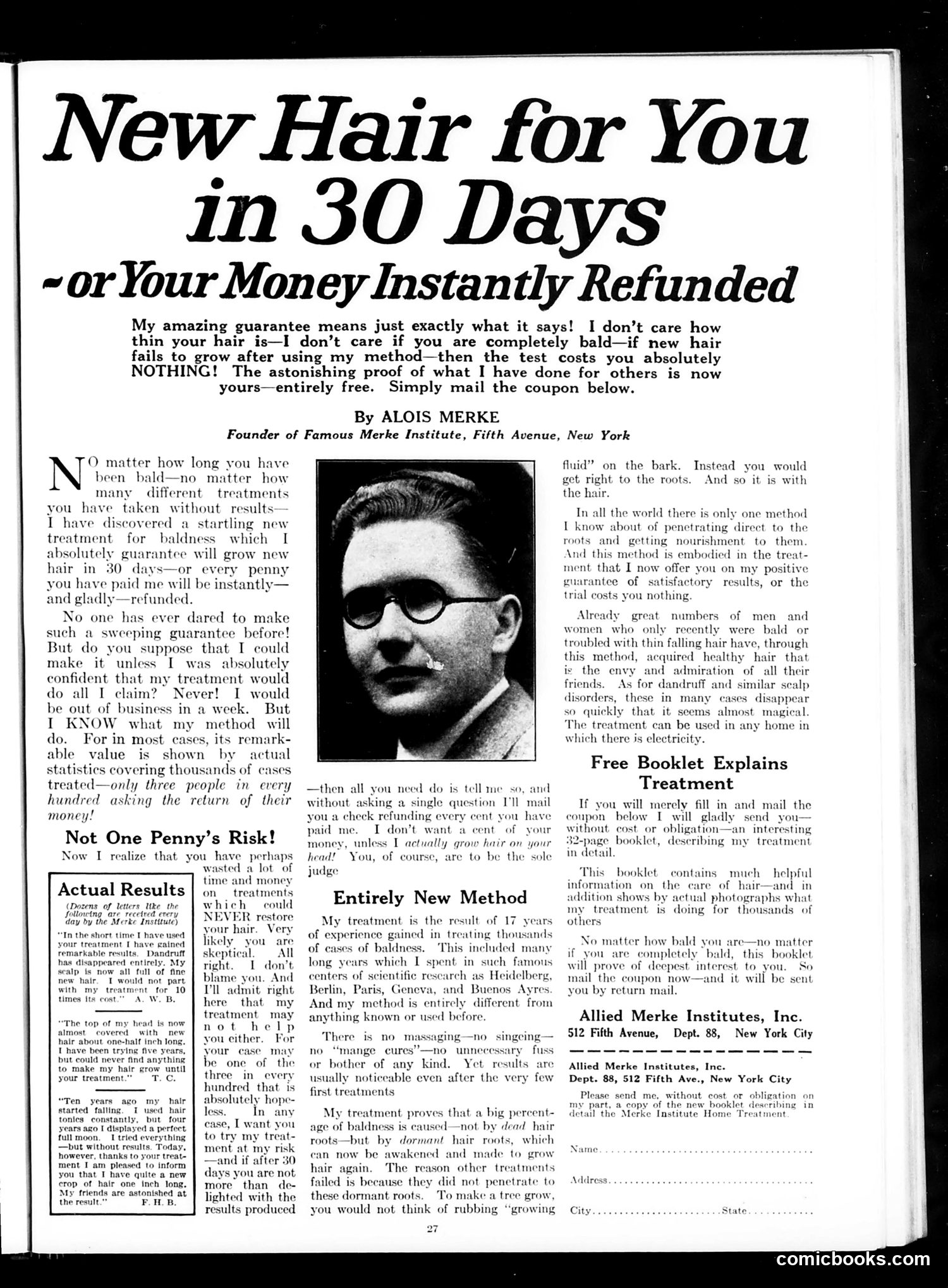
This is a **full-page advertisement**, not a satirical cartoon. It promotes Alois Merke's hair-growth treatment, claiming to regrow hair in 30 days or offer "instant refund." **Key elements:** The ad uses classic early-20th-century marketing tactics: bold guarantees ("Not One Penny's Risk!"), testimonials from alleged satisfied customers, and appeals to male vanity about baldness. The man pictured wearing dark sunglasses appears to be Merke himself, lending authority. **The pitch's absurdity** (from a modern perspective) lies in its confidence: the method supposedly works on "completely bald" people, costs nothing to test, and only 3 in 100 ask for refunds. Merke claims 17 years of research in European scientific centers and a revolutionary "dormant hair root" theory—yet provides no actual scientific mechanism. This represents the pre-FDA era when such extravagant health claims faced minimal regulation. For Judge's satirical audience, the ad's presence may have been ironic commentary on gullible consumers, though the ad itself reads entirely earnest.
This page is primarily **advertisements interspersed with brief humorous anecdotes** rather than political cartoons. The humor section contains four short jokes: 1. **Kansas City Star**: A rural man complains about his neighbor's fiddle-playing interrupting courtship visits—the man keeps playing until "Home, Sweet Home," driving the suitor away. 2. **Minneapolis Tribune**: A boy explains why Mr. Benson "stole" an umbrella—he overheard Benson tell his sister he'd have to steal one because he didn't have one. 3. **Unnamed**: A shy clergyman ("curate") sits next to a deaf duchess at dinner; when she asks his name, the wordplay suggests he says "Jinks" but she mishears it as fishing-related patter. 4. **London Opinion**: A fisherman defends poor fishing results—he can't expect fish to volunteer themselves just because he had vacation time. The ads promote weight-loss treatments, patent services, and Horsford's Acid Phosphate drink. The cartoons are gentle domestic/social humor with no clear political content.
This page combines satirical cartoons with period advertisements. The left side features a series of comic strips mocking retail store displays and customer service. One cartoon shows shopwalkers dressed in elaborate ethnic costumes (including what appears to be Russian embroidery and Scottish dress), satirizing the suggestion that stores should have employees wear "appropriate costumes for the various departments"—a jest about impractical retail fashion. Below this are humorous anecdotes from international publications (Le Rire, Pearson's Weekly, Chicago Herald) about everyday absurdities: government inefficiency, mistaken taxi colors, and cooking mishaps. The right side contains period advertisements: **Forhan's For The Gums** (a toothpaste addressing pyorrhea/gum disease), and **Gibson Master-Tone Tenor Banjo** (marketed as "Easy to Play / Easy to Pay"). The overall page reflects early-20th-century American humor and consumer culture, mixing social satire with commercial appeals targeting middle-class readers concerned with health, music, and proper retail experiences.
This page from **Judge** (an American satirical magazine) is primarily **advertising and humor content** rather than political cartooning. **Key content:** The advertisements promote health products (a "Digestible Brainy Diet" with dubious medical claims), diamond rings, and entertainment including "George White's Scandals" theater production. **The humor pieces** are short, domestic jokes extracted from various international sources (marked as from *London Tit-Bits*, *Fliegende Blaetter* Munich, *Boston Transcript*, *Los Angeles Times*, etc.). They focus on everyday situations: couples at the beach, children's observations, marital misunderstandings, and social situations—typical early 20th-century light humor. One joke references **Lloyd George** (British Prime Minister), showing the magazine's international awareness, but this is incidental to the satire. The cartoons illustrating these jokes are small, generic line drawings typical of the era's magazine filler content. **Overall:** This is a standard mixed-content magazine page blending advertising with reprinted light humor—not primarily satirical commentary on contemporary politics or social issues.
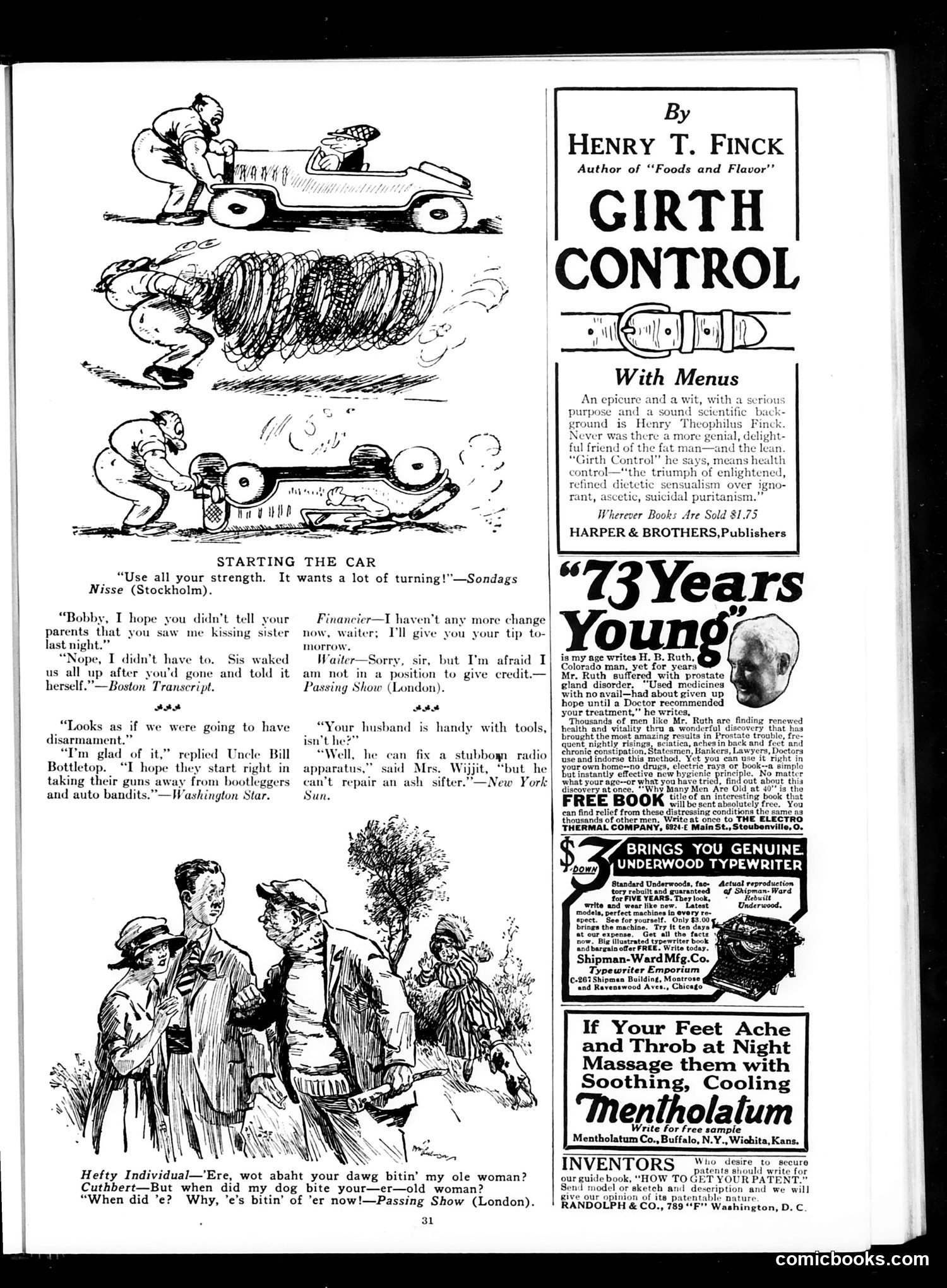
This page combines humor comics with period advertisements. The "Starting the Car" cartoon depicts the physical effort required to hand-crank early automobiles—a common struggle before electric starters became standard. The visual gags show people straining with the crank mechanism, satirizing the inconvenience of 1920s car technology. The scattered joke captions below reference mundane domestic situations: infidelity, financial troubles, marital bickering, bootleggers, and disarmament—reflecting post-WWI American concerns. The lower cartoon shows a working-class British exchange about a dog bite, using period dialect humor. The page is primarily **advertising real estate**, promoting Henry T. Finck's diet book "Girth Control," alongside ads for typewriters, medical treatments for prostate problems, and foot cream. These ads reveal what concerned readers: weight management, typing efficiency, and various health ailments. The medical ads particularly suggest widespread concern about male sexual/urinary dysfunction during this era.
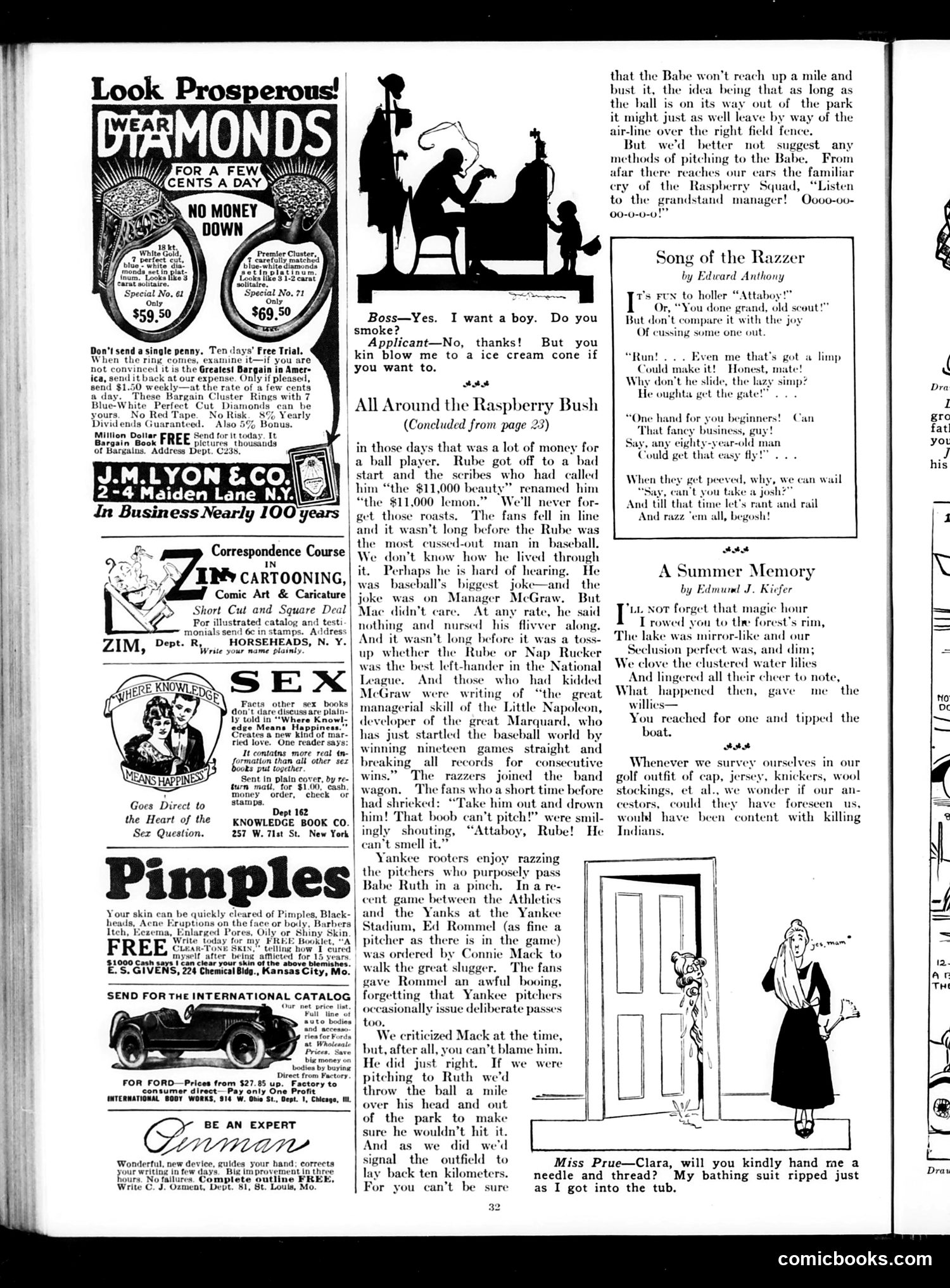
This page contains **baseball-themed humor and advertising** typical of early 20th-century American magazines. The main cartoon depicts a **boss and job applicant**, with text about wanting "a boy" who doesn't smoke—a period workplace scenario. The adjacent article "All Around the Raspberry Bush" discusses **Rube Marquard**, a pitcher for the New York Giants, and the practice of fans "razzing" (heckling) players. It recounts how fans initially mocked Marquard as a failure ("the $11,000 lemon") but later cheered him after he won 19 consecutive games, demonstrating the fickleness of baseball crowds. "Song of the Razzer" celebrates fan heckling as entertainment. "A Summer Memory" is a sentimental poem about a rowing trip. The **advertisements** promote diamonds, correspondence cartooning courses, and medical treatments—typical early-1900s magazine fare. The humor throughout assumes readers' familiarity with baseball players and stadium culture of that era.
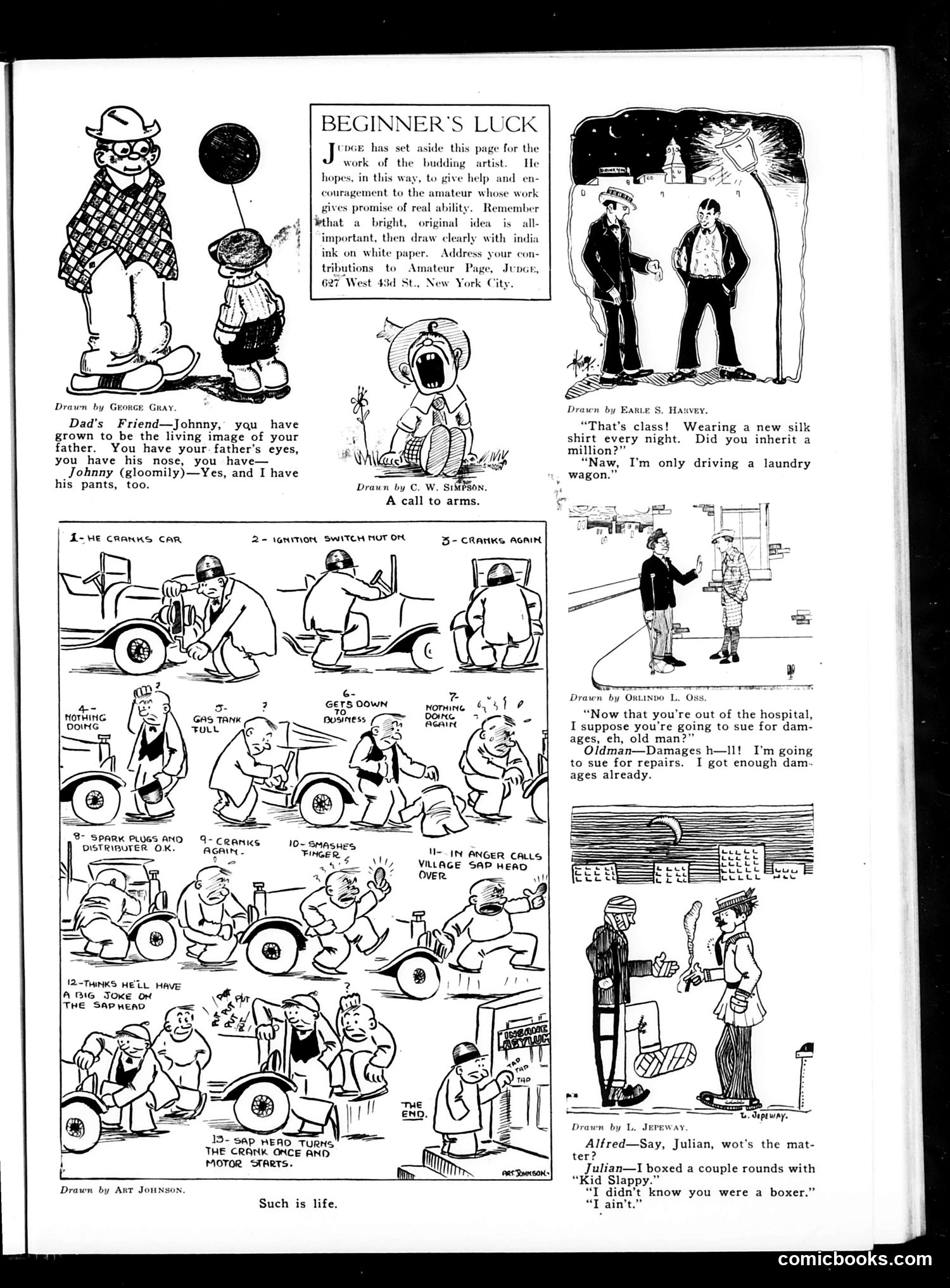
This is a "Beginner's Luck" page showcasing amateur cartoonists' work submitted to *Judge* magazine. The page contains several unrelated humorous strips and single-panel jokes: **"Dad's Friend"**: A child's joke about inheriting his father's unflattering physical features—and embarrassingly, his old pants. **"That's Class!"**: Social satire about conspicuous consumption; a man wears a new silk shirt nightly, claiming wealth, but admits he only drives a laundry wagon (working-class job), so his "luxury" is actually laundry company property. **"A Call to Arms"**: A slapstick sequence about repeatedly trying to start a hand-crank automobile—a common frustration of early 1900s cars requiring multiple attempts, physical effort, and patience. **"Now That You're Out"**: Dark humor about an accident victim more concerned with suing for car repairs than personal damages. **"Alfred"**: A boxer joke playing on regional dialect ("wot's" = "what's"; "ain't"). These represent typical early-20th-century American humor: slapstick, class observation, and working-class struggles with new technology.
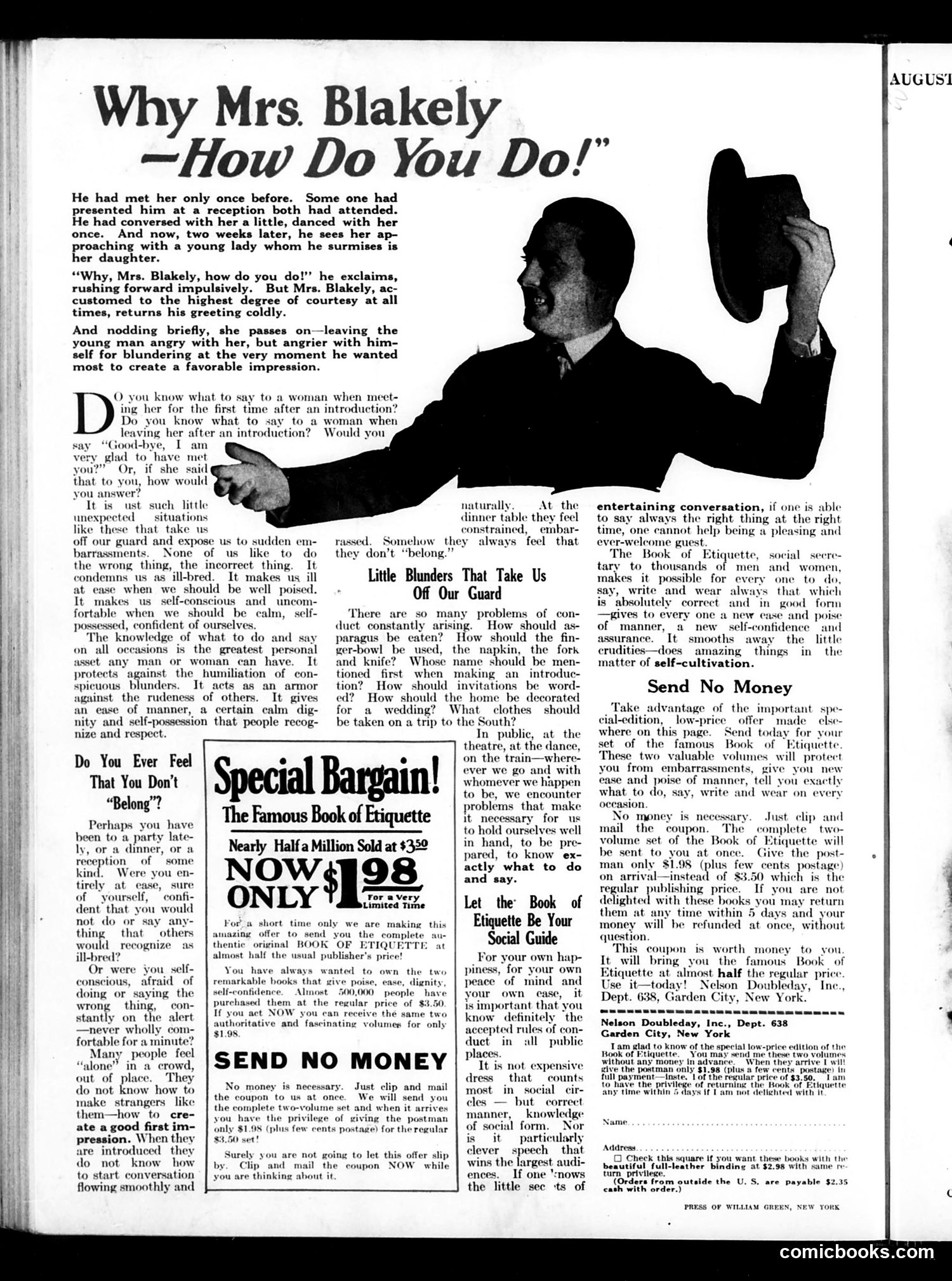
This page from *Judge* magazine presents an etiquette lesson wrapped in social anxiety. The opening narrative depicts a man awkwardly greeting Mrs. Blakely, whom he barely knows, then leaving "angry with her, but angrier with himself"—illustrating how social missteps damage confidence and reputation. The surrounding text addresses a widespread early-20th-century concern: **fear of not "belonging"** in polite society. It describes how uncertainty about proper conduct (which fork to use, how to greet acquaintances, what to wear) causes embarrassment and self-consciousness. The solution offered is "The Famous Book of Etiquette"—a bestseller being advertised at a discount price. This represents the era's commercialization of social anxiety: insecurity about manners was a profitable market. The satire is gentle: *Judge* mocks how anxiously Americans pursued "correct" behavior as a marker of respectability and class status, while simultaneously offering to sell them the solution.