
Judge, 1923-08-04 · page 13 of 36
Judge — August 4, 1923 — page 13: what you’re looking at
What you’re looking at
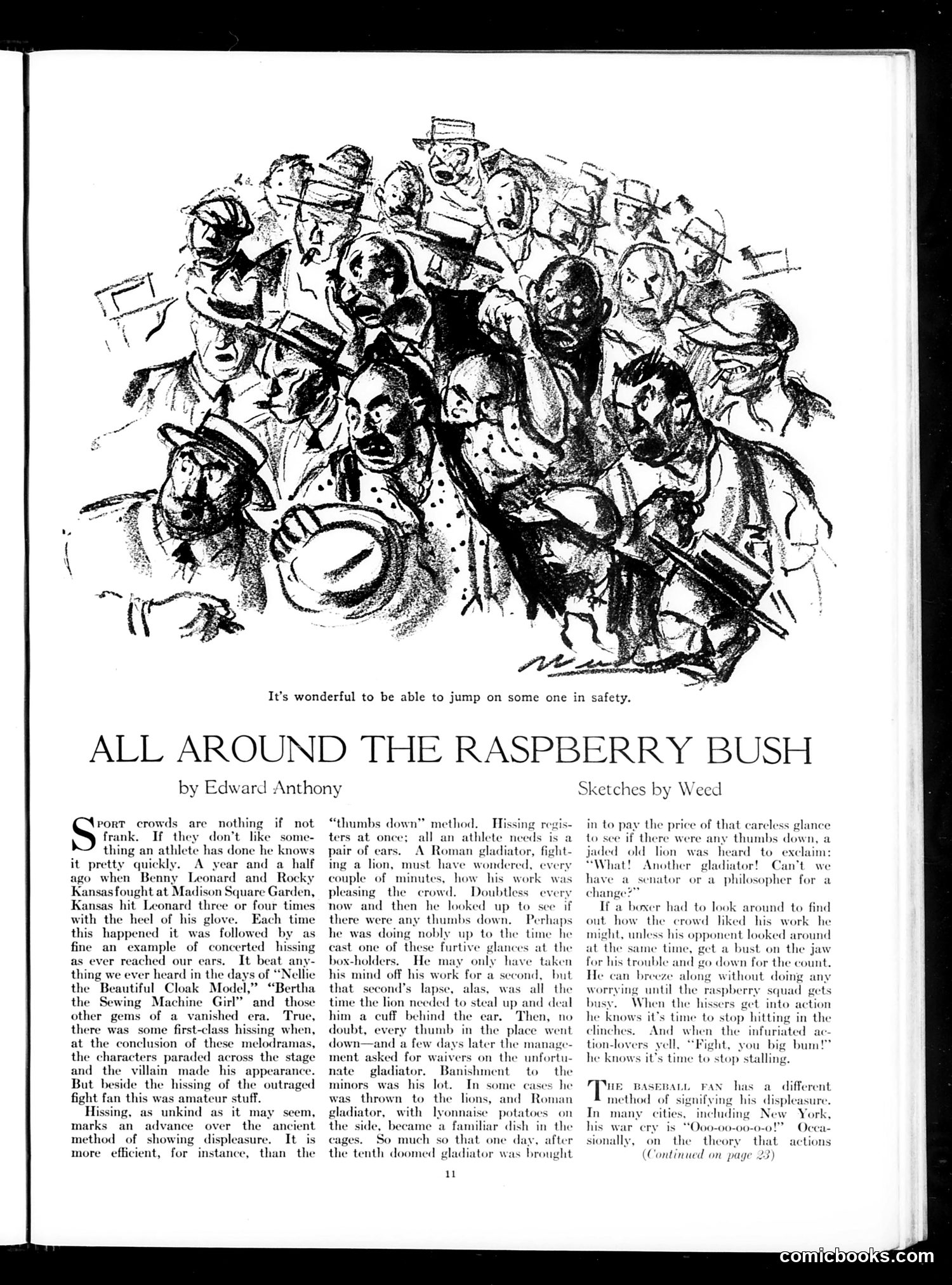
This article satirizes how sports crowds express disapproval—specifically the practice of "hissing" at boxing matches. The cartoon depicts rowdy spectators at a sporting event, emphasizing the collective nature of crowd jeering. **The Satire:** Author Edward Anthony compares modern crowd hissing to the Roman "thumbs down" method, arguing hissing is more efficient feedback. He references a specific boxing match where Benny Leonard fought Rocky Kansas at Madison Square Garden, with Kansas repeatedly hitting Leonard with the heel of his glove, triggering loud crowd hissing. **The Point:** The piece humorously suggests that immediate, vocal crowd disapproval (hissing and heckling) is actually an *improvement* over passive Roman methods—it gives athletes instant, unmistakable feedback. The comparison to gladiators who couldn't hear crowd disapproval until too late is tongue-in-cheek. The article concludes by noting baseball fans have different methods ("Ooo-oo-oo!"), setting up continued commentary on page 23.
📄 Transcribed text from this page (OCR, searchable)
Machine-transcribed from the original scan — historical spelling and the odd misread are preserved.
It’s wonderful to be able to jump on some one in safety. ALL AROUND THE RASPBERRY BUSH by Edward Anthony porT crowds are nothing if not frank. If they don’t like some- thing an athlete has done he knows it pretty quickly. A year and a half ago when Benny Leonard and Rocky kK fought at Madison Square Garden, Kansas hit Leonard three or four times with the heel of his glove. Each time this happened it was followed by fine an example of concerted hissing as ever reached our ears. It beat any- thing wi heard in the days of “Nellie the Beautiful Cloak Model,” “Bertha the Sewing Machine Girl” and_ those other gems of a vanished era. True, there was some first-class hissing when, at the conclusion of these melodramas, the characters paraded across the stage and the villain made his appearance. But beside the hissing of the outraged fight fan this was amateur stuff. Hissing, as unkind as it 1 marks an advance over the method showing displeasure. more efficient, for instance, than ancient It is the “thumbs down” method. Hissing regis- ters at once; all an athlete needs is a pair of ears. A Roman gladiator, fight- ing a lion, must have wondered, every couple of minutes, how his work w pleasing the crowd. Doubtless ¢ now and then he looked up to see if there were any thumbs down. Perhaps he was doing nobly up to the time he cast one of these furtive glances at the box-holders. He may only have taken his mind off his work for a second, but that second’s lapse, alas, was all the time the lion needed to steal up and deal him a cuff behind the ear. Then, no doubt, every thumb in the place went down—and a few vs later the man: ment asked for waivers on the unfortu- g or. Banishment to the his lot. In some cases he Roman gladiator, with lyonnaise potatoes on th became a familiar dish in the cages. So much so that one day, after the tenth doomed gladiator was brought minors, vas thrown to the lions, and 1 Sketches by Weed in to pay the price of that carcless glance f there were any thumbs down, 2 old lion was heard to im: ut! Another gladiator! Cant we senator or a philosopher for a change?” If a boxer had to look around to find out how the crowd liked his work he might, unless his opponent looked around at the same time, get a bust on the j for his troubl go down for the e He can breeze along without doing any worrying until the raspberry squad gets busy. When the hiss he knows it’s time to stop hitti clinches. And when the infur tion-lovers yell, “Fight, you big bum!" he knows it’s time to stop stalling. TT BASEBALL FAN has a_ different method of signifying his displeasure. In many cities, including N York, his war cry is “Ooo-00-00-0-0!” —Ocea- sionally, on the theory that actions (Continued on page 23)