
Judge, 1923-08-04 · page 17 of 36
Judge — August 4, 1923 — page 17: what you’re looking at
What you’re looking at
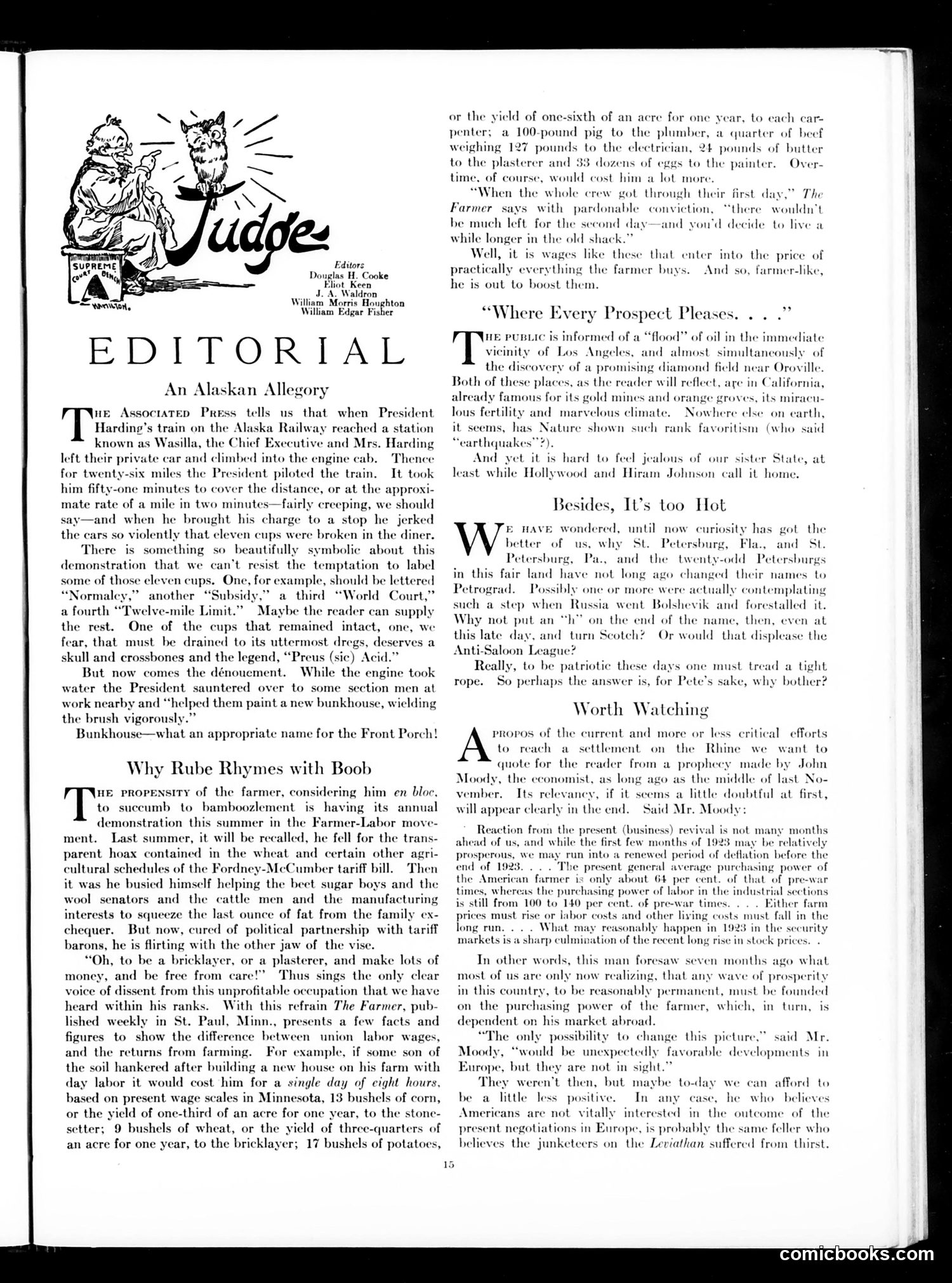
This editorial page satirizes President Warren G. Harding's Alaska trip and his inconsistent farm policies. **"An Alaskan Allegory"** uses Harding piloting a train as metaphor: he jerked it so violently that eleven cups broke in the dining car. The editor labels these cups symbolically—"Normalcy," "Subsidy," "World Court," "Twelve-mile Limit"—representing Harding's campaign promises and policies he's bungled or abandoned. The punchline: while the engine takes water, Harding helps paint a bunkhouse, which Judge sardonically calls "an appropriate name for the Front Porch"—mocking his do-nothing presidency conducted from his front porch. **"Why Rube Rhymes with Boob"** attacks Harding's flip-flopping on farmer support. Last summer he backed the Fordney-McCumber tariff benefiting farmers; now he's abandoning them. The piece uses wage-comparison data from *The Farmer* magazine showing construction workers earn far more than farmers—exposing how farm costs inflate while farm income stagnates, yet Harding offers no support. The satire targets perceived presidential incompetence and betrayal of rural constituencies.
📄 Transcribed text from this page (OCR, searchable)
Machine-transcribed from the original scan — historical spelling and the odd misread are preserved.
Editors Douglas H. Cooke Eliot Keen J. A, Waldron William Morris Houghton William Edgar Fisher EDITORIAL An Alaskan Allegory ne Associatep Press tells us that Harding’s train on the Alaska Railwa known as Wasilla, the Chief Executive and Mrs. Harding left their private car and climbed into the engine cab. Thence for twenty-six miles the President piloted the train. It took him fifty-one minutes to cover the distance, or at the approxi- mate rate of a mile in two minutes—fairly creeping, we should say—and when he brought his charge to a stop he jerked the cars so violently that eleven cups were broken in the diner. There is something so beautifully symbolic about this demonstration that we can’t resist the temptation to label some of those cleven cups. One, for example, should be lettered “Normale) another “Subsidy,” a third “World Court,” a fourth “Twelve-mile Limit.” Maybe the reader can supply the rest. One of the cups that remained intact, one, we fear, that must be drained to its uttermost dregs, deserves a skull and crossbones and the legend, “Preus (sic) Acid.” But now comes the dénouement. While the engine took water the President sauntered over to some section men at work nearby and “helped them paint a new bunkhouse, wielding the brush vigorously.” Bunkhouse—what an appropriate name for the Front Porch! when Presi y reached a sta Why Rube Rhymes with Boob ity of the to demonstration this Last summer, it will be recalled, he fell for the trans- HE PROP! to succumb farmer, considering him en bloc, bamboozlement is having its annual summer in the Farmer-Labor move- ment. parent hoax contained in the wheat and certain other agri- cultural schedules of the Fordney-McCumber tariff bill. Then it was he busied himself helping the bect sugar boys and the wool senators and the cattle men and the manufacturing interests to squeeze the last ounce of fat from the family ex- chequer. But now, cured of political partnership with tariff barons, he is flirting with the other jaw of the vise. ‘Oh, to be a bricklayer, or a plasterer, and make lots of money, and be free from care!” Thus sings the only clear voice of dissent from this unprofitable occupation that we have heard within his ranks. With this refrain The Farmer, pub- lished weekly in St. Paul, Minn., presents a few facts and figures to show the difference between union labor wages, and the returns from farming. For example, if some son of the soil hankered after building a new house on his farm with day labor it would cost ‘him for a single day of cight hours, based on present wage scales in Minnesota, 13 bushels of corn, or the yield of one-third of an acre for one year, to the stone- setter; 9 bushels of wheat, or the yield of three-quarters of an acre for one year, to the bricklayer; 17 bushels of potatoes, or the yield of one-sixth of an acre for one year, to each care penter; a 100-pound pig to the plumber, a quarter of be weighing 127 pounds to the elec ician, 24 pounds of butter to the plasterer and 33 dozens of « gs to the painter. Over- time. of course, would cost him a lot more. “When the whole crew got through their first day,” The Farmer says with pardonable conviction, “there wouldn't be much left for the second day while longer in the old shack.” Well, it is wages like these that enter into the price of practically everything the farmer buys. And so, farmer-like, he is out to boost them. and you'd decide to live a “Where Every Prospect Pleases. . . . HE PUBLIC is informed of a “flood” of oil in the immediate vicinity of Los Angeles, and almost simultancously of J the discovery of a promising diamond field near Oroville. Both of these places, as the reader will reflect, ape in California, already famous for its gold mines and orange groves, its miracu- lous fertility and marvelous climate. it, seems, has Nowhere else on earth, Nature shown such rank favoritism (who said “earthquakes’’?). And yet it is hard to feel j least while Hollywood alous of our sister State, at and Hiram Johnson call it home. Besides, It’s too Hot E HAVE V better of Petersburg, 1 the St. wondered, until now curiosity has got us, why St. Fla., the twenty-odd Petersburg, and and in this fair land have not long Petrograd. Petersburgs ago changed their names to Possibly one or more were actually contemplating such a step when Russia went Bolshevik and forestalled it. loon League? Really, to be patriotic these days one must tread a tight rope. So perhaps the answer is, for Pete’s sake, why bother? Worth Watching propos of the current and more or less critical efforts to settlement the Rhine want quote for the reader from a prophecy made by reach a on we to Moody, the economist, as long ago as the middle of | vember, Its relevancy, if it seems a little doubtful at first, will appear clearly in the end. Said Mr. Moody: Reaction from the present (business) revival is not many months ahead of us, and while the first few months of 1 may be relatively d period of deflation before the ul average purchasing power of the an farmer is only about 64 per cent. of that of pre-war times, whereas the purchasing power of labor in the industrial sections is still from 100 to 140 per cent. of pre-war times r farm prices must rise or labor costs and other living costs must fall in the long run. . . . What may reasonably happen in 1923 in the sec markets is a sharp culmination of the recent long rise in stock price: In other words, this man foresaw seven months ago what most of us are only now realizing, that any wave of prosperity in this country, to be reasonably permanent, must be founded on the purchasing power of the farmer, which, in turn, is dependent on his market abroad. “The only possibility to change this picture Europe, said Mr. ‘would be unexpectedly favorable developments. in but they are not in sight.” They weren't then, but maybe to-day we can afford to little In any he who Americans are not vitally interested in the outcome of the present negotiations in Europe, is probably the same feller who believes the junketeers on the Leviathan suffered from thirst. be a less positive. case, believes 15 comicbooks.com