
Judge, 1923-08-04 · page 22 of 36
Judge — August 4, 1923 — page 22: what you’re looking at
What you’re looking at
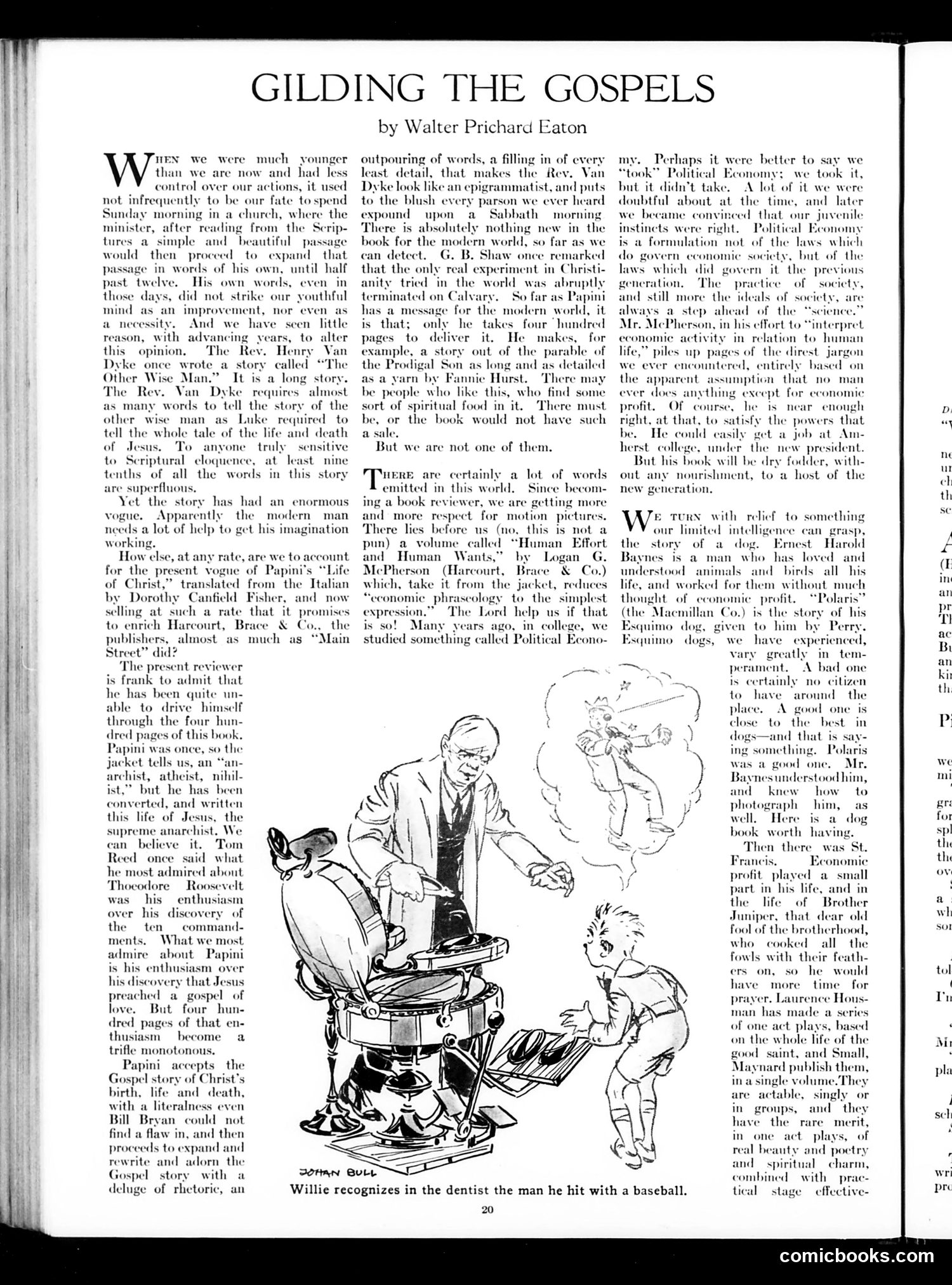
This is a book review essay criticizing Giovanni Papini's *Life of Christ* (recently translated to English by Dorothy Canfield Fisher). Eaton argues that Papini—a converted anarchist and atheist—has unnecessarily inflated a simple spiritual message with four hundred pages of flowery rhetoric, making Jesus's straightforward gospel of love tediously verbose. The essay draws parallels to Rev. Henry Van Dyke's equally long story "The Other Wise Man," suggesting modern readers need excessive elaboration to engage imagination. Eaton contrasts this with the economical eloquence of Scripture itself and makes a sardonic jab at economic textbooks that claim to "simplify" but remain incomprehensible. The cartoon shows a man recognizing someone (a dentist) he previously struck with a baseball, illustrating an unrelated anecdote about consequences. The page mocks both religious and economic writing for obscuring simple truths through verbosity.
📄 Transcribed text from this page (OCR, searchable)
Machine-transcribed from the original scan — historical spelling and the odd misread are preserved.
GILDING THE GOSPELS NEN we were much younger \ V than we are now and had less control over our actions, it used not infrequently to be our fate to spend Sunday morning in a church, where the minister, after reading from the Scrip tures a simple and beautiful passage would) then proceed to expand that passage in words of his own, until half past twelve. His own words, even in those days, did not strike our youthful mind as an improvement, nor ¢ a necessity. And we hi reason, with advancing years, to alter this opinion. The Rev. Henry Van Dyke once wrote a story called “The Other Wise Man.” It is a long story. The Rev. Van Dyke requires almost as many words to tell the story of the other wise man as Luke required to tell the whole tale of the life and death of Jesus. To anyone truly sensitive to Scriptural eloquence, at’ least’ nine tenths of all the words in this story are superfluous. Yet the story has had an enormous vogue. Apparently the modern) man needs a lot of help to get his imagination working. How else, at any rate, are we to account for the present vogue of Papini’s “Li of Christ,” translated from the Italian by Dorothy Canfield Fisher, and now selling at such » that it promises to enrich Harcourt, Brace Co., the publishers, almost as much as “Main Street” did? The present reviewer is frank to admit that he has been quite un- able to drive himself through the four hun- dred pages of this book. Papini was once, so the ket tells us, an “an- chist, atheist, nihil- ist,” but he has been converted, and written this life of Jesus, the supreme anarchist. We can believe it. Tom Reed once said what he most admired about Thoeodore Roosevelt was his _ enthusiasm over his discovery of the ten mmand~ ments. What we most admire about Papini is his enthusiasm over his discovery that Jesus preached a gospel of love. But four hun- dred pages of that en- thusiasm become a trifle monotonous. Papini accepts the Gospel story of Christ’s birth, life and death, with a literalness even Bill Bryan could not find a flaw in, and then proceeds to expand and rewrite and adorn the Gospel story with a deluge of rhetoric, an en as ve seen little by Walter Prichard Eaton outpouring of words, a filling in of every least detail, that makes the Rev. Van Dyke look like an epigrammatist, and puts to the blush every parson we ever heard expound — upon Sabbath morning There is absolutely nothing new in the book for the modern world, so far as we can detect. G. B. Shaw once remarked that the only real experiment in Christi- anity tried in the world was abruptly terminated on Calvary, So far as Papini has a message for the modern world, it is that; only he takes four “hundred pages to deliver it. He makes, for example, a story out of the parable of the Prodigal Son as long and as « as a yarn by Fannie Hurst. There may be people who like this, who find some sort of spiritual food in it. There must be, or the book would not have such a sale, But we are not one of them. TTuene are certainty a lot of words mitted in this world. Since becom- ing a book reviewer, we are getting more and more respect for motion pictures. There lies before us (no, this is not a pun) a volume ¢: Human Effort and Human Wants,” by Logan G. McPherson (Harcourt, Brace & Co.) which, take it from the jacket, reduces “economic phraseology to the simplest expression.” The Lord help us if that is so! Many years ago, in college, we studied something called Political Econo- Willie recognizes in the dentist the man he hit with a baseball. tical stage 20 my. Perhaps it were better to say we “took” Political Economy: we took it, but it didn’t take. A lot of it we were doubtful: about at the time, and we became convinced that our instincts were right. Political . is a formulation not of the laws which do govern economic society, but of the laws which did govern it’ the previous generation, The practice of — society, and still more the ideals of society, always a step ahead of the “scienc Mr. McPherson, in his effort to “interpre economic activity in relation to human life,” piles up pages of the direst jargon we ever encountered, entirely based on the apparent assumption that no man ever does anything except for economic profit. Of course, he is near cnough right, at that, to satisfy the powers that be. He could easily get a job at Am- herst. college, under the new president. But his book will be dry fodder, with- out any nourishment, to a host of the new generation, W TURN with relief to something our limited intellige an grasp, nest. Harold the story of a dog. I Baynes is a man who has loved and understood animals and= birds all his life, and worked for them without much thought of economic profit. “Polaris” (the Macmillan Co.) is the story of his Esquimo dog, given to him by Perry. Esquimo dogs, we have i sneed, ly in tem. A bad one is certainly no citizen to have around the place. A good one is close to the best in dogs—and that is say ing something. Polaris was a good one, Mr. Baynesunderstoodhim, and knew how to r him, as well, Here is a) dog book worth havin Then there was St. Fr: Zconomic profit. played a small part in his life, and in the life of — Brother Juniper, that dear old fool of the brotherhood, who cooked all the fowls with their feath- ers on, so he would have more time for I r. Laurence Hous- man has made a series of one act plays, based on the whole life of the good saint, and Small, Maynard publish them ina single volume.Th are actable, singly or in groups, and. they have the rare merit, in one act. plays, of real beauty and poctry ands} combines iis. comicbooks.com ul