
A complete issue · 37 pages · 1923
Judge — June 30, 1923
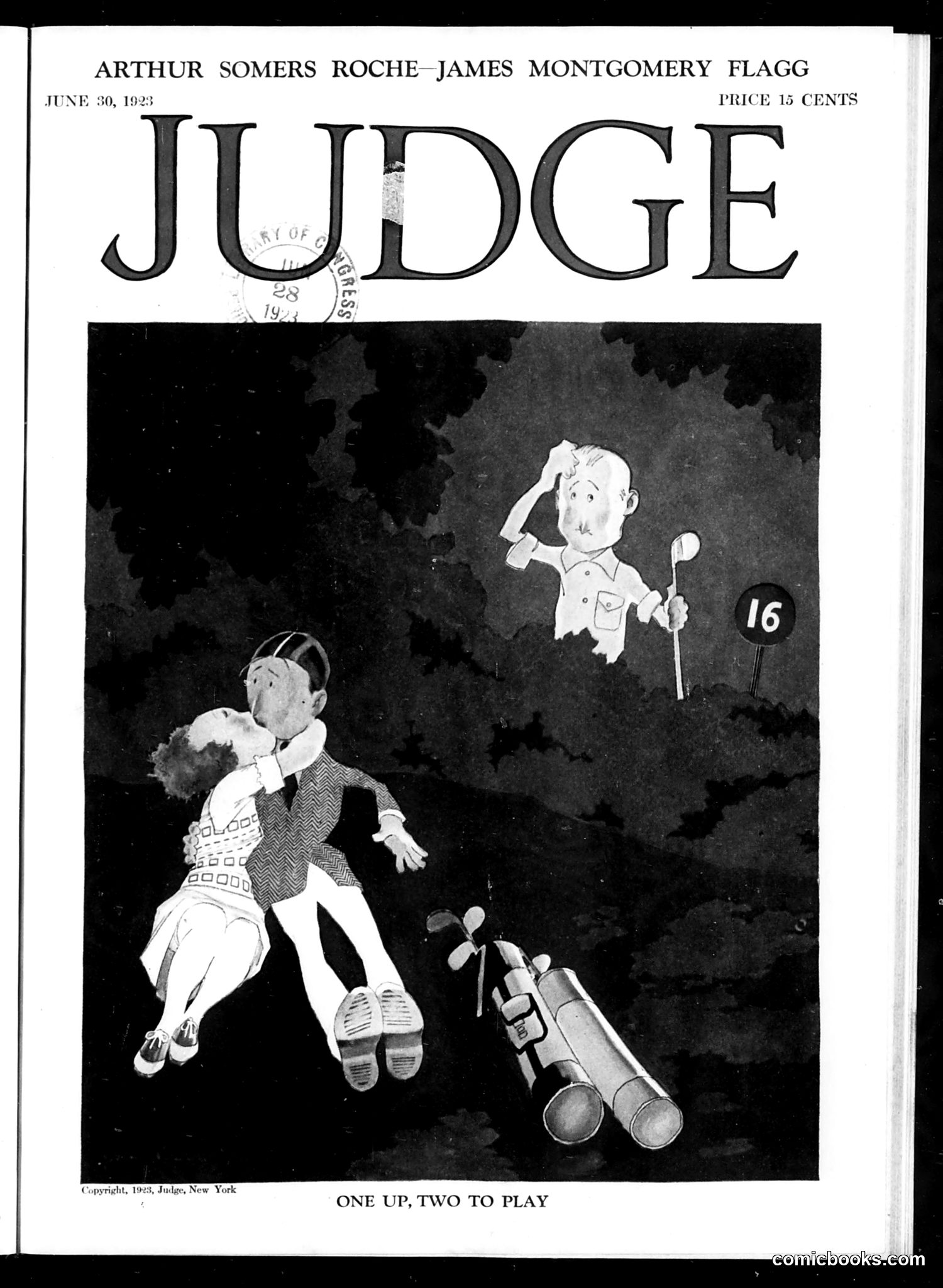
This cover illustrates a golf joke titled "One Up, Two to Play." The cartoon depicts two golfers mid-game: one player (lower left) has just hit his shot and appears concerned, while the other (upper right) reacts with alarm—his ball is heading directly toward him. The golf bag and numbered flag (16) indicate the hole number. The humor is visual rather than political: it plays on the awkwardness of golf when one player's shot endangers the other. This reflects golf's popularity as a leisure activity among the American middle and upper classes in the 1920s. The magazine, priced at 15 cents, targeted educated readers with this kind of genteel, sport-based humor typical of the era.
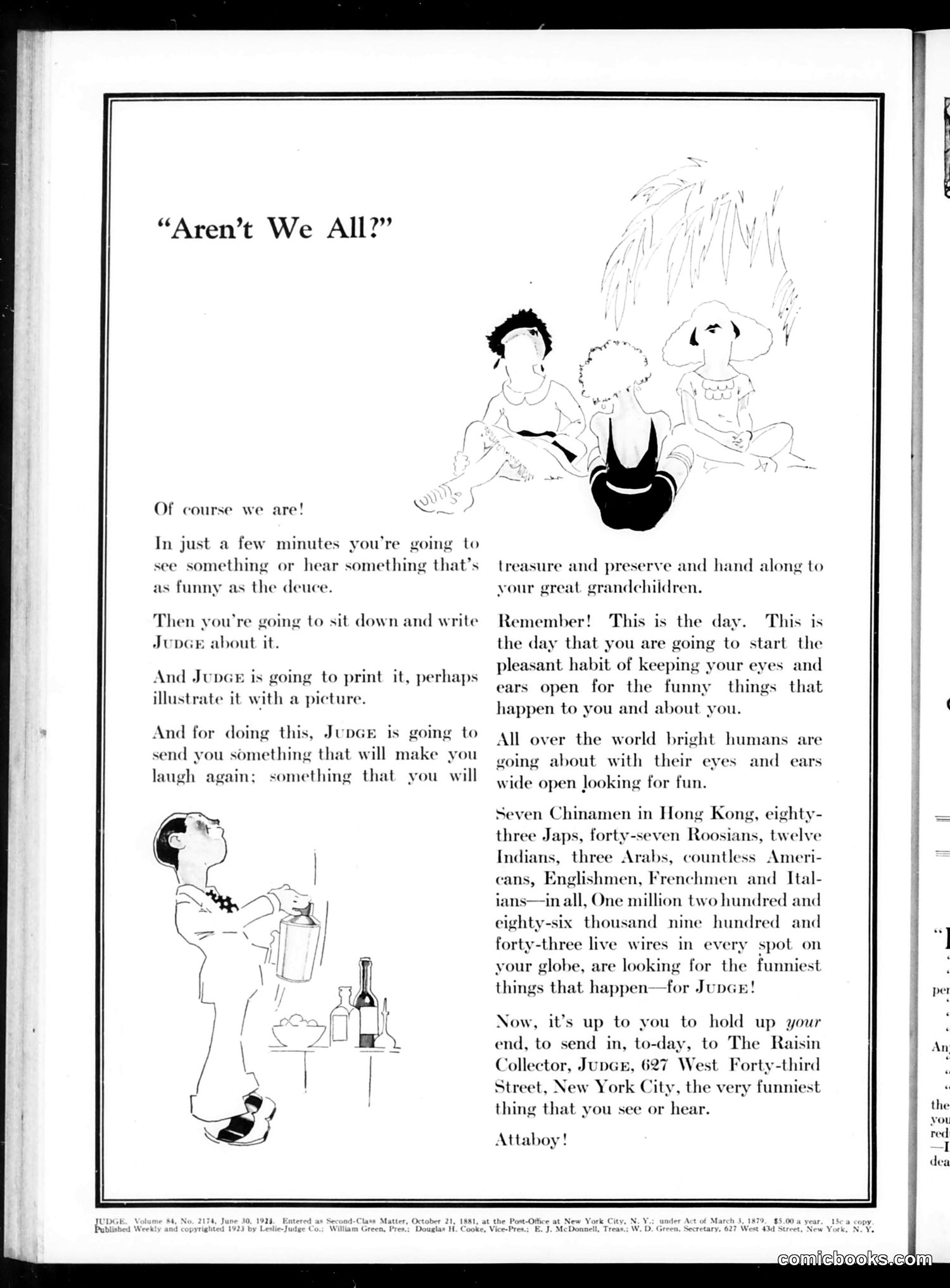
This page promotes Judge magazine's humor-collection initiative. The title "Aren't We All?" invites readers to submit funny observations to "The Raisin Collector, JUDGE" at a New York address. The content encourages readers worldwide to notice and report amusing incidents from daily life. The cartoon shows a figure looking upward, apparently describing something humorous they've witnessed. The satire appeals to readers' vanity—suggesting that millions globally are seeking funny moments, implying readers should contribute their own observations for publication. The "Raisin Collector" nickname suggests Judge collects small, concentrated bits of humor (like dried grapes). This appears to be a reader-engagement campaign, encouraging audience participation while gently mocking the universal human tendency to seek and share amusing experiences.
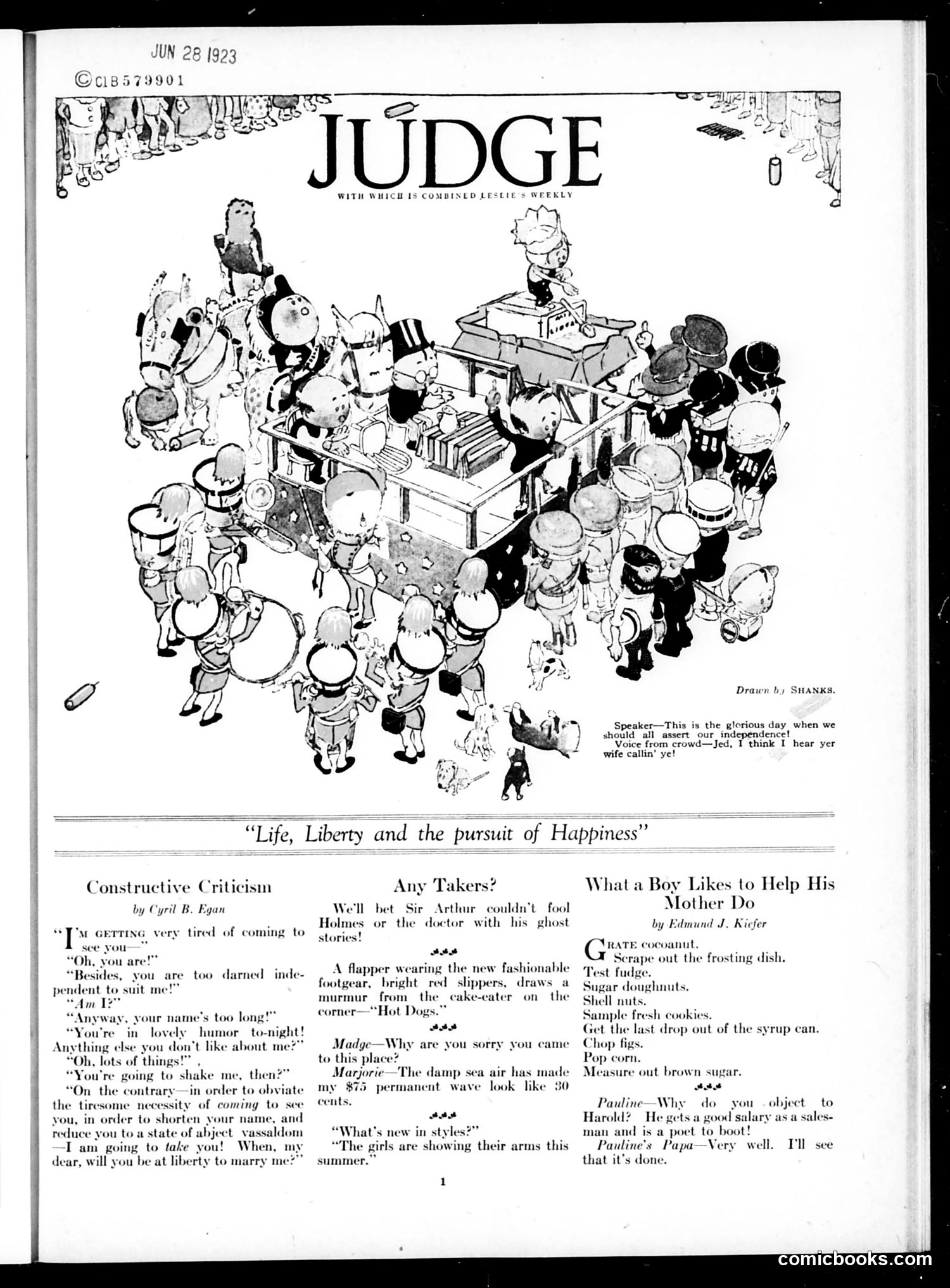
The main cartoon depicts a crowded street scene with diverse figures—men, women, and children in period dress—gathered around what appears to be a public speaker or authority figure. The caption emphasizes "Life, Liberty and the pursuit of Happiness," directly referencing the Declaration of Independence. The speaker's dialogue about "asserting our independence" while a crowd member yells about a wife suggests satirical commentary on American independence rhetoric versus domestic reality. This likely mocks the disconnect between grand patriotic ideals and ordinary citizens' mundane life struggles, particularly gender relations. The style and composition parody how Americans invoke founding principles while dealing with petty personal conflicts rather than genuine independence issues.
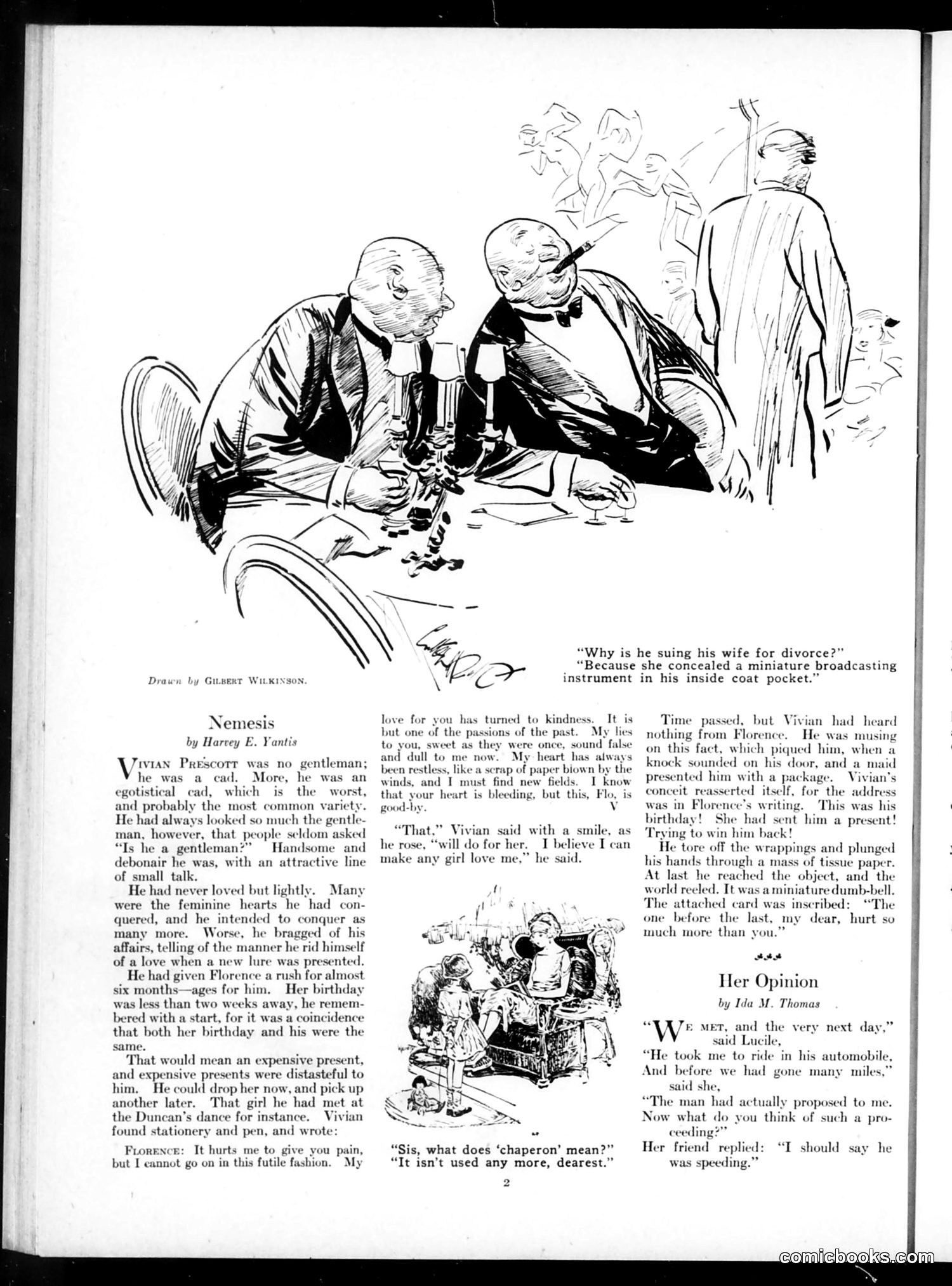
The top cartoon illustrates a divorce proceeding joke. Two bald men in formal dress dine together while others converse in the background. The caption reads: "Why is he suing his wife for divorce?" Answer: "Because she concealed a miniature broadcasting instrument in his inside coat pocket." This satirizes the emerging technology of radio broadcasting in the early 20th century. The joke plays on anxieties about new communication devices enabling surveillance or eavesdropping—a wife secretly recording her husband's conversations. The humor derives from the absurdity of hiding broadcasting equipment in clothing and the marital discord such deception might cause. Below are two unrelated short stories: "Nemesis" by Harvey E. Yantis and "Her Opinion" by H. M. Thomas, typical serialized fiction found in Judge magazine.
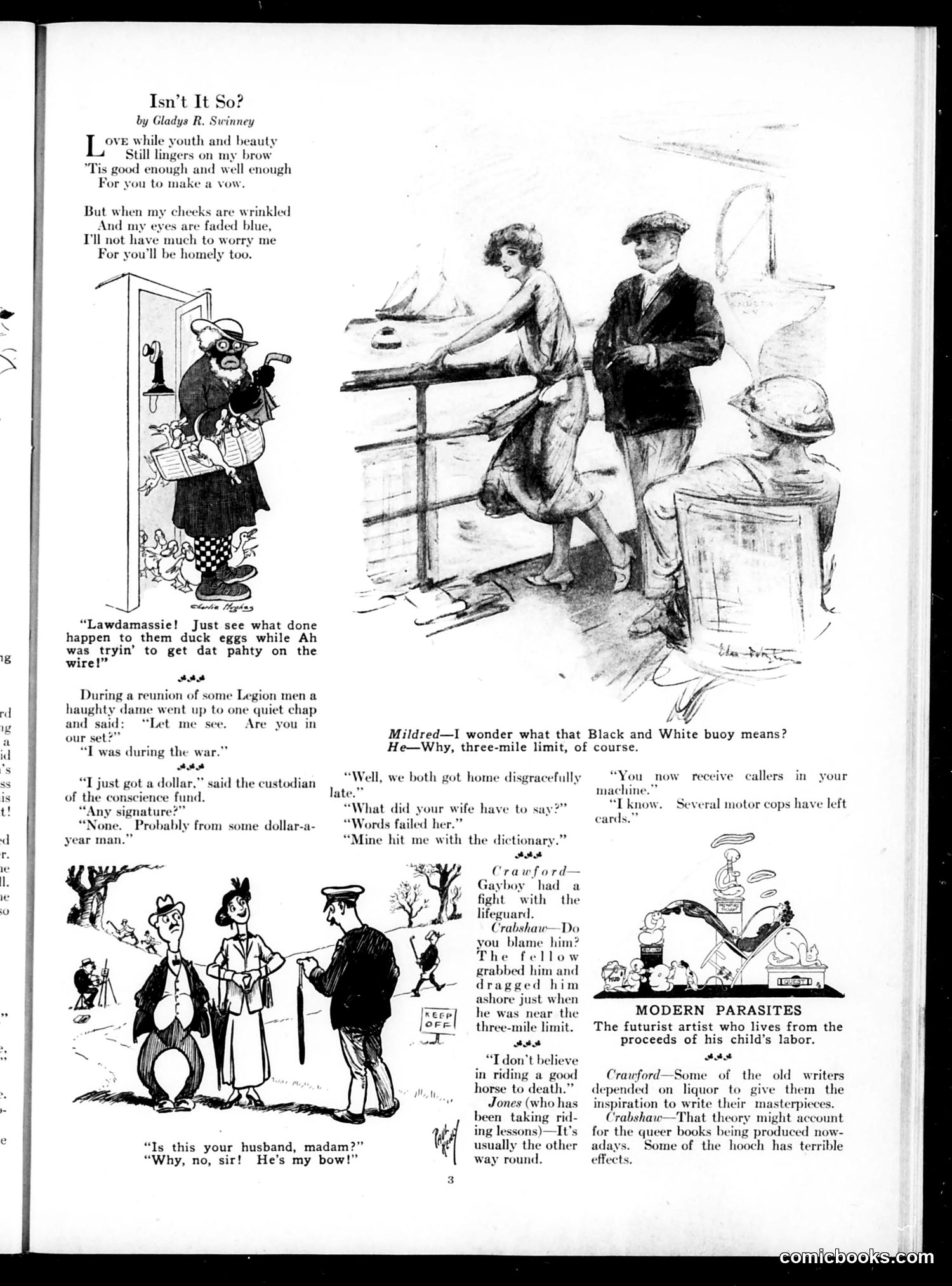
This page contains multiple satirical cartoons and humorous pieces typical of early 20th-century American humor: **"Isn't It So?"** - A poem by Gladys R. Swinney about aging love, paired with a custodian character, likely satirizing sentimental romance writing. **Legion Reunion Jokes** - Brief anecdotes about World War I veterans, poking fun at their post-war experiences and financial circumstances ("just got a dollar"). **The main cartoon** depicts a couple fishing while discussing their marital troubles in coded language ("Black and White buoy," "motor cops"). The humor relies on double entendre and understated communication about infidelity. **"Modern Parasites"** - A satirical caption criticizing artists who profit from their children's labor rather than developing legitimate talent. The page reflects post-WWI American culture: veteran experiences, marital discord, and artistic pretension were popular satirical targets.
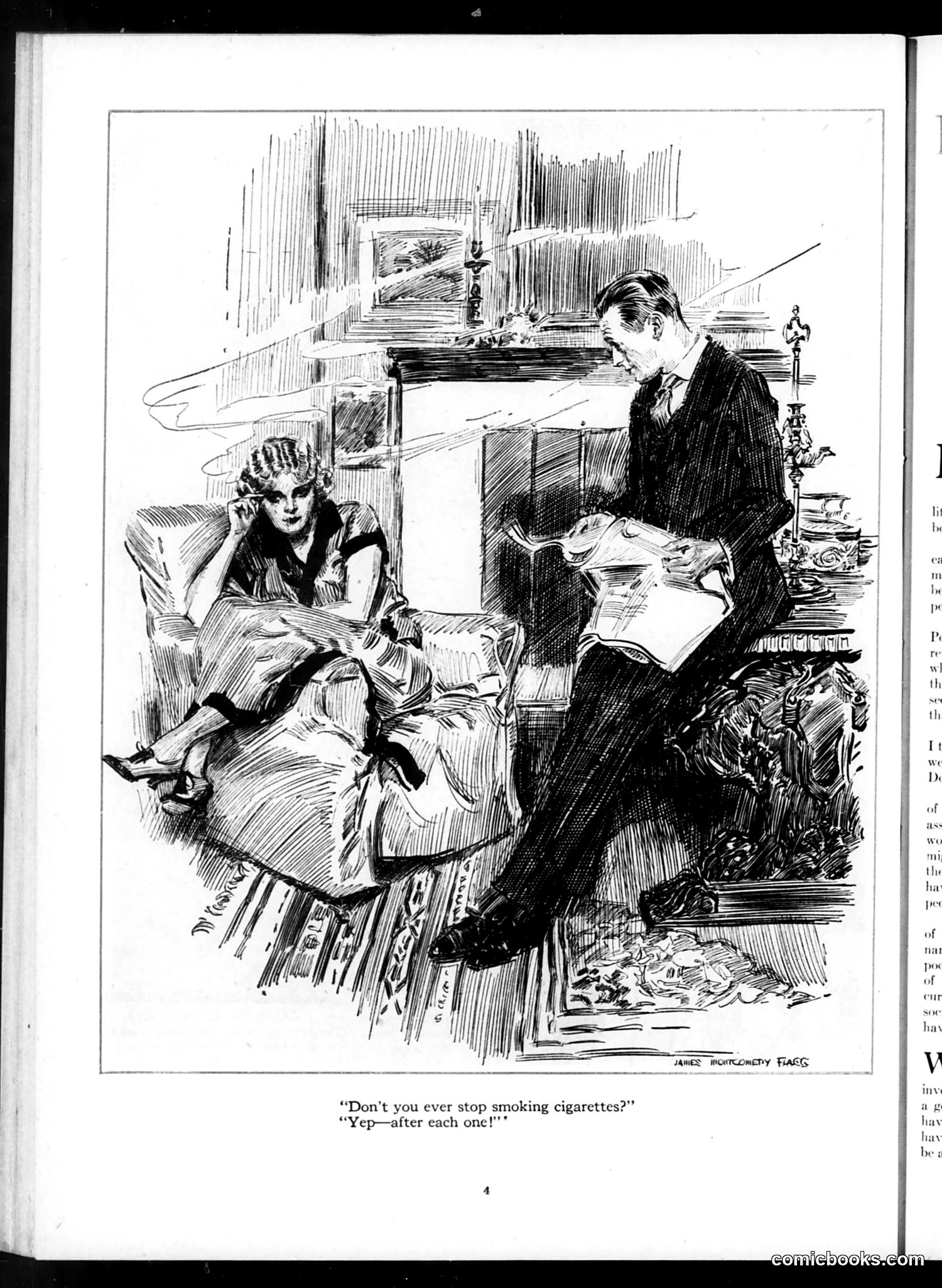
This cartoon by James Montgomery Flagg depicts a domestic scene between a man and woman, likely a husband and wife. The woman is reclining on a sofa while the man stands nearby holding papers. The humor is straightforward and non-political: it's a joke about smoking habits in relationships. When the man asks "Don't you ever stop smoking cigarettes?" the woman replies "Yep—after each one!" This is social satire about domesticity and habits rather than political commentary. It reflects early 20th-century attitudes toward women smoking—then still relatively controversial—and the gentle marital comedy of spouses annoying each other. The cartoon uses this relatable domestic scenario to create humor through the woman's clever, evasive answer.
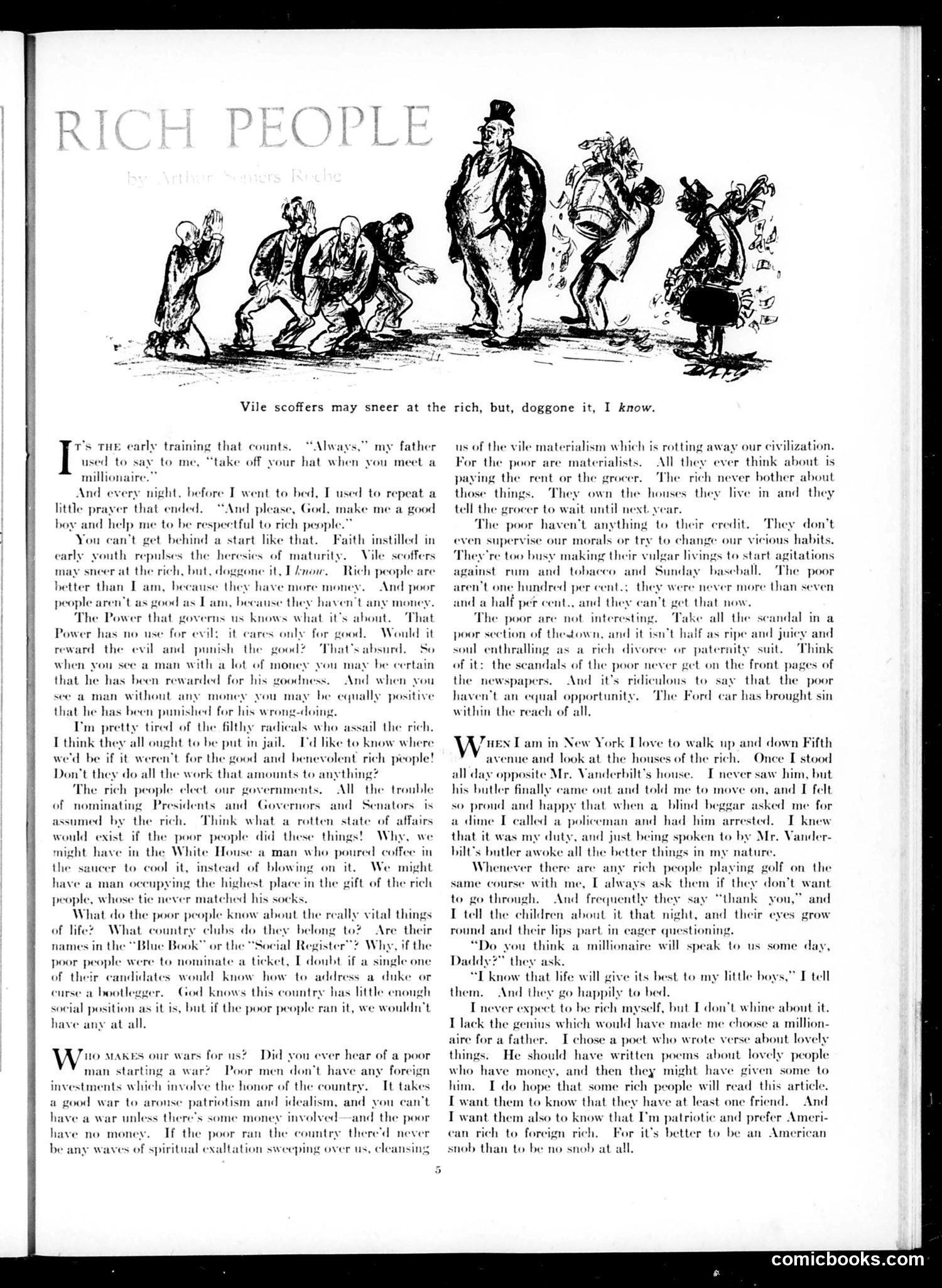
This satirical essay mocks the wealthy's self-serving logic about their own superiority. The accompanying cartoon depicts various figures of wealth and status, illustrating the author's ironic argument. The satire targets the rich's claim that wealth proves moral virtue—that God rewards goodness with money and punishes poverty. Stringer ridicules this theology, pointing out that the wealthy control government, set social standards, and monopolize scandal (their divorces and affairs are "juicy" newspaper fodder, while poor people's troubles are ignored). He exposes the absurdity of wealthy assumptions: that poor people lack judgment, that rich people naturally govern better, and that poverty indicates moral failure. The essay's heavy irony—praising the rich while describing their actual privilege and self-dealing—reveals how the wealthy justify inequality through circular moral reasoning. This reflects early 20th-century Progressive-era critique of unexamined class privilege and the myth of meritocracy.
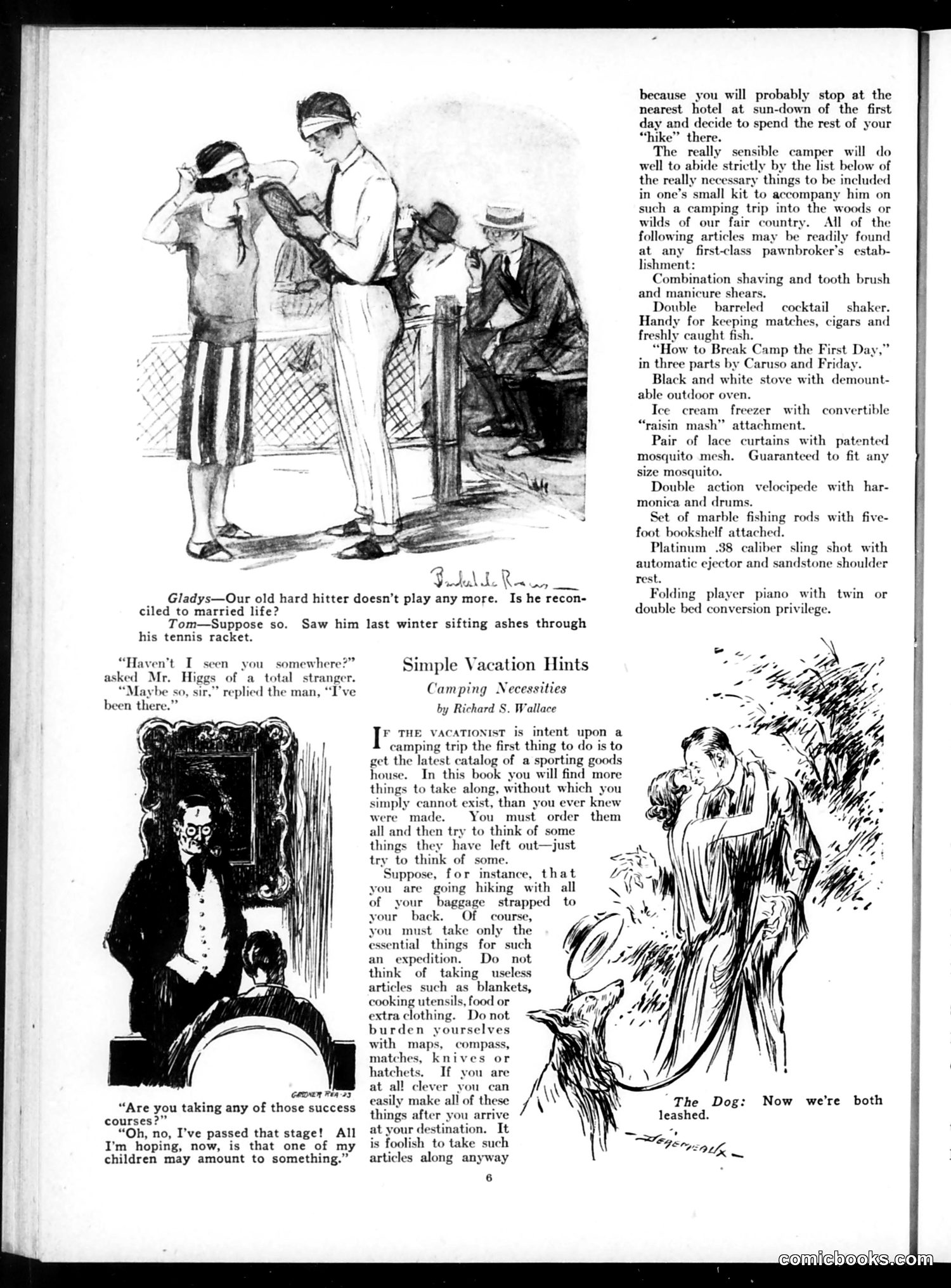
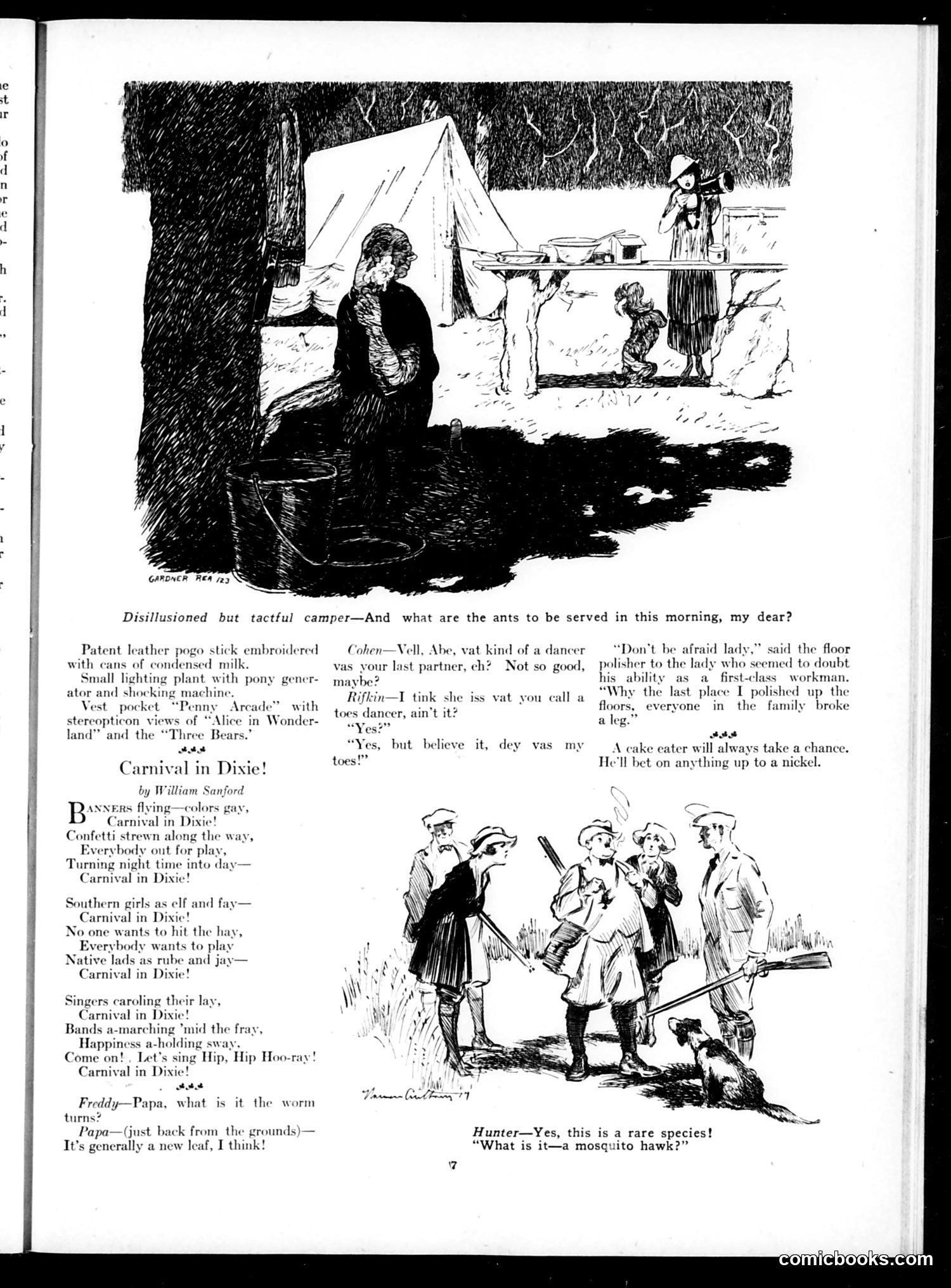
This page satirizes the disconnect between camping ideology and reality. The main article "Simple Vacation Hints: Camping Necessities" by Richard S. Wallace mocks the American obsession with consumer goods and overcomplicated preparation. The satire works by suggesting absurdly impractical items as "camping essentials"—a double-barreled cocktail shaker, folding player piano, lace curtains with mosquito mesh, and marble fishing rods. The joke is that manufacturers convince consumers they need elaborate equipment for simple activities. The punch line reveals the hypocrisy: the author notes that sensible campers will abandon their hiking plans at the first hotel at sundown, making all elaborate gear pointless. The accompanying cartoons about marriage ("hard hitter doesn't play anymore") and success courses mock everyday American aspirations with gentle irony typical of Judge's satirical approach. This critiques early 20th-century consumer culture and the gap between marketed adventure fantasies and actual behavior.
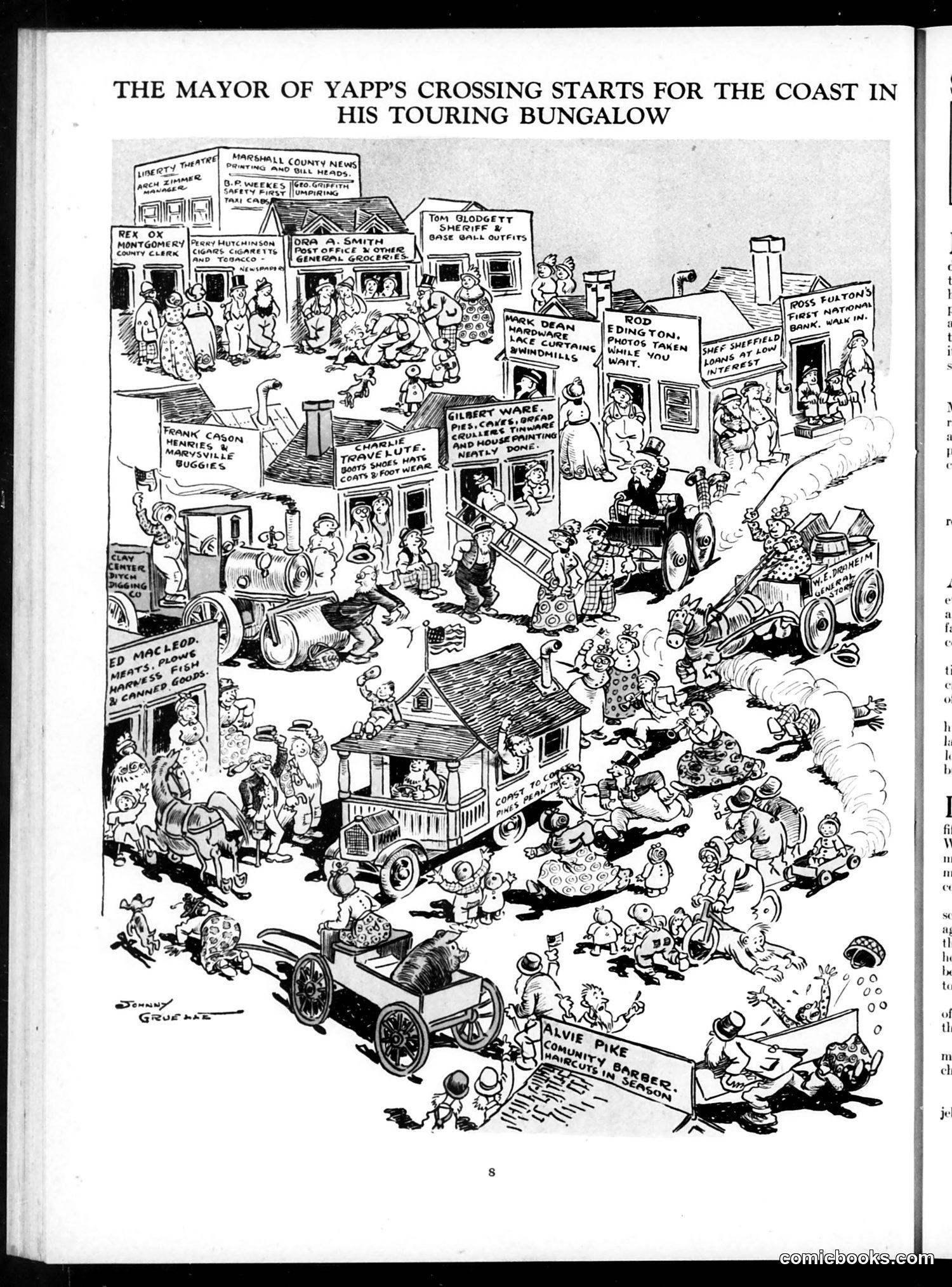
This is a whimsical satirical cartoon depicting a small-town mayor embarking on a cross-country trip in an elaborate "touring bungalow" (a mobile house-vehicle). The humor comes from the chaos this simple journey creates in the fictional town of "Yapp's Crossing." The cartoon labels various townspeople and local businesses—the sheriff, postmaster, barber, general store owner, etc.—all seemingly mobilized by or involved in the mayor's departure. The satire mocks small-town life: the way a single notable event disrupts the entire community, the prominence of local characters and establishments, and the spectacle surrounding even mundane activities like a vacation trip. The exaggerated scale and frenetic activity suggest that the mayor's touring vehicle—a novelty at the time—represents progress or modernity invading rural America, causing considerable commotion.
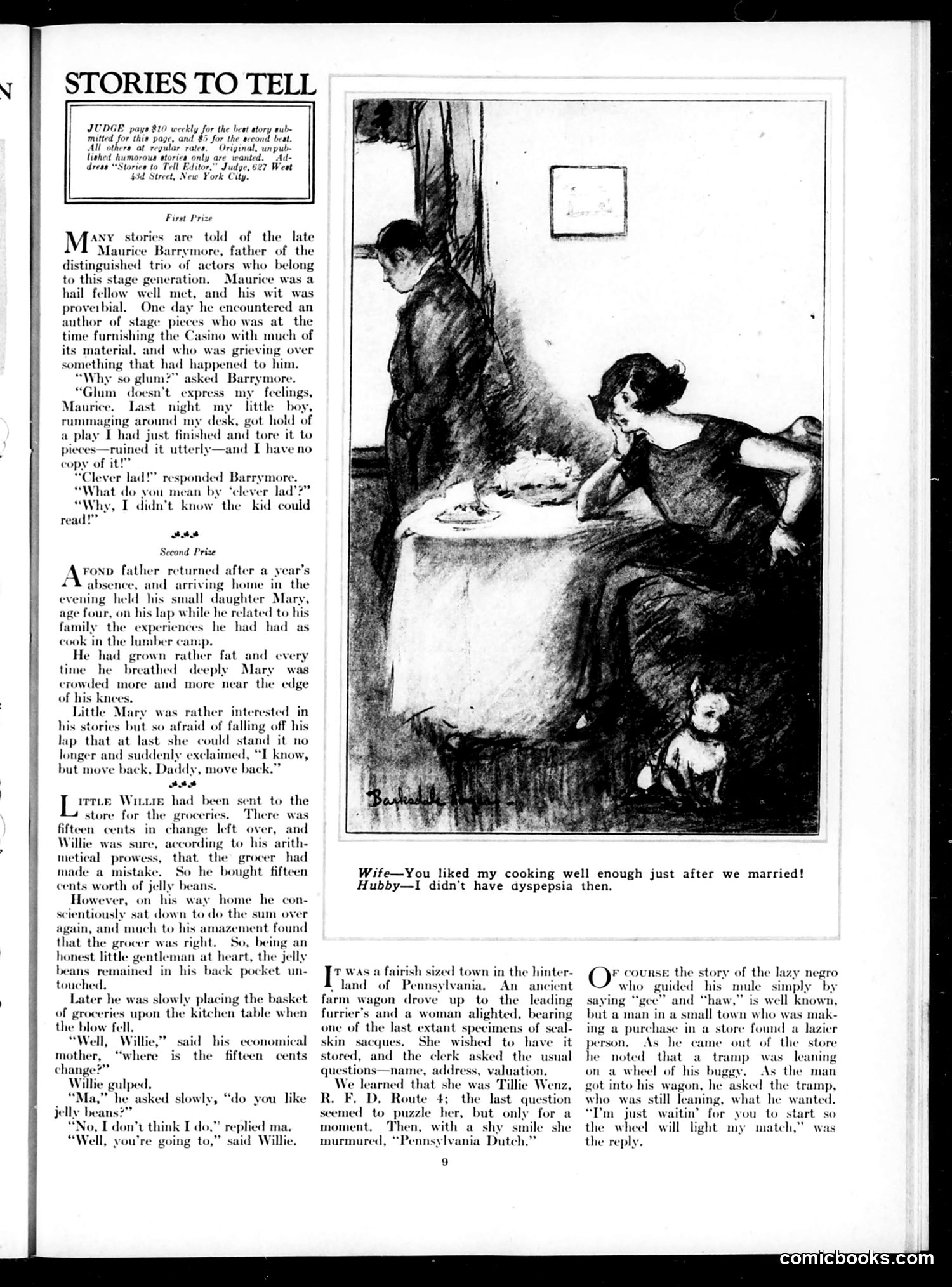
This page from *Judge* magazine contains three humorous anecdotes (short stories) submitted by readers, competing for prize money. The content reflects early 20th-century American social attitudes: **The cartoons/illustrations** show domestic scenes: a man and woman at a table (accompanying a marriage joke about the wife's cooking declining), and a scene from the stories. **Key satirical points:** 1. **Maurice Barrymore anecdote**: Wit-based humor about a playwright whose manuscript is destroyed—the joke hinges on class assumptions (a child who can read is "clever"). 2. **Marriage joke**: Husband blames his digestive illness ("dyspepsia") for no longer praising her cooking—implies wives' cooking quality hasn't changed, only his tolerance has. 3. **Ethnic/racial humor**: References to "lazy negro" and "Pennsylvania Dutch" character types reflect period stereotyping that modern readers would recognize as offensive. 4. **Honest boy story**: Values childhood honesty in returning found money. The page illustrates how *Judge* solicited humor from ordinary readers while normalizing racial and ethnic caricatures typical of the era.
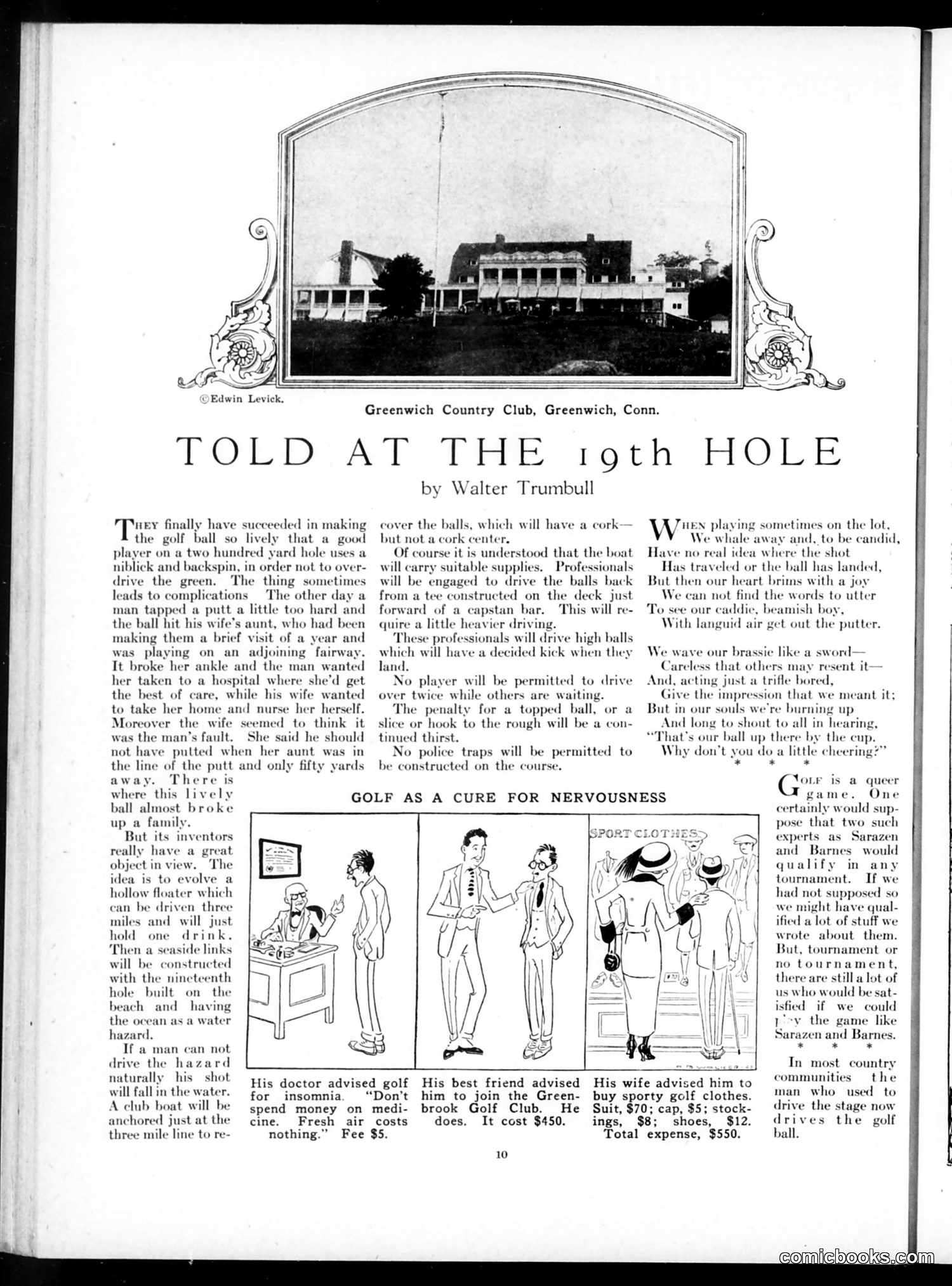
This page satirizes golf culture among the wealthy in 1920s America, specifically targeting the Greenwich Country Club set. The main article presents three absurdist scenarios about an increasingly "lively" golf ball—one that's so powerful it causes injuries and nearly breaks up a family, prompting darkly comic solutions like anchoring boats three miles away to retrieve balls. The cartoon strip below, "Golf as a Cure for Nervousness," mocks the supposedly therapeutic claims of golf while showing three scenarios where a man is advised to take up the sport: by his doctor (for insomnia), his friend (who profits by recruiting him to an expensive club costing $450), and his wife (whose "sporty" outfit recommendations cost $550 total). The satire attacks both the commercialization of golf among the upper class and the dubious health claims used to justify the expensive hobby. The closing joke notes that former stage drivers now work as golf caddies—a commentary on changing American labor and class mobility.
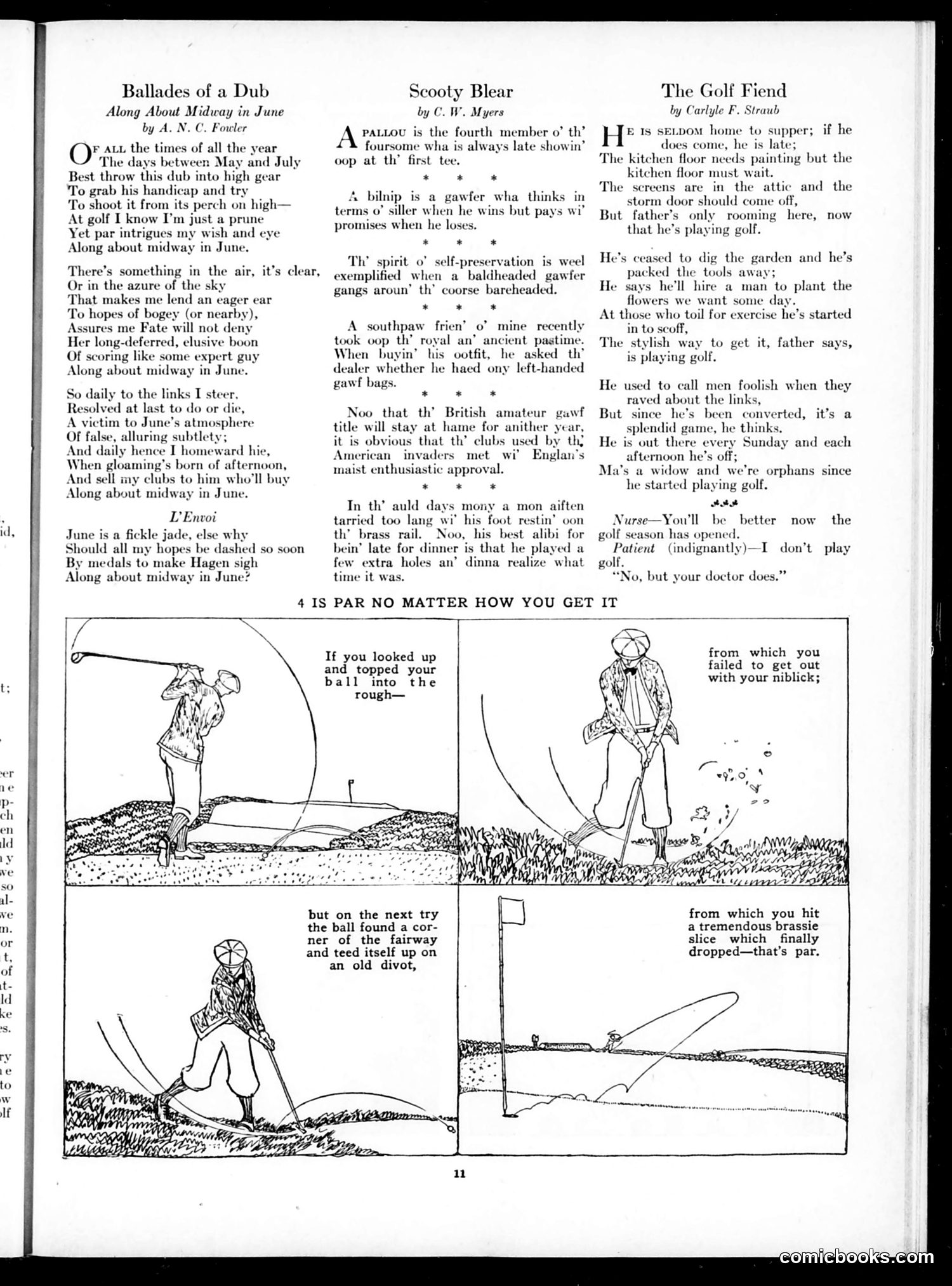
This page contains three humorous pieces about golf from Judge magazine, reflecting early 20th-century American attitudes toward the sport. **"Ballades of a Dub"** is a lighthearted poem mocking amateur golfers who become obsessed with the game each June, despite their poor abilities ("I'm just a prune"). The joke is self-deprecating—the speaker keeps returning to golf despite consistently failing. **"Scooty Blear"** offers Scottish-dialect golf slang and observations. It pokes fun at various golfer types: chronic latecomers, those who brag about wins but renege on bets, and those who copy equipment fads. **"The Golf Fiend"** satirizes how golf consumes a man's attention, neglecting home responsibilities—the kitchen needs painting, he's abandoning gardening, abandoning his wife ("Ma's a widow"). The final cartoon panel humorously illustrates that getting par doesn't require skill—just lucky bounces. Overall, the satire targets golf's grip on middle-class men's leisure time and the sport's pseudo-sophisticated culture among amateurs.
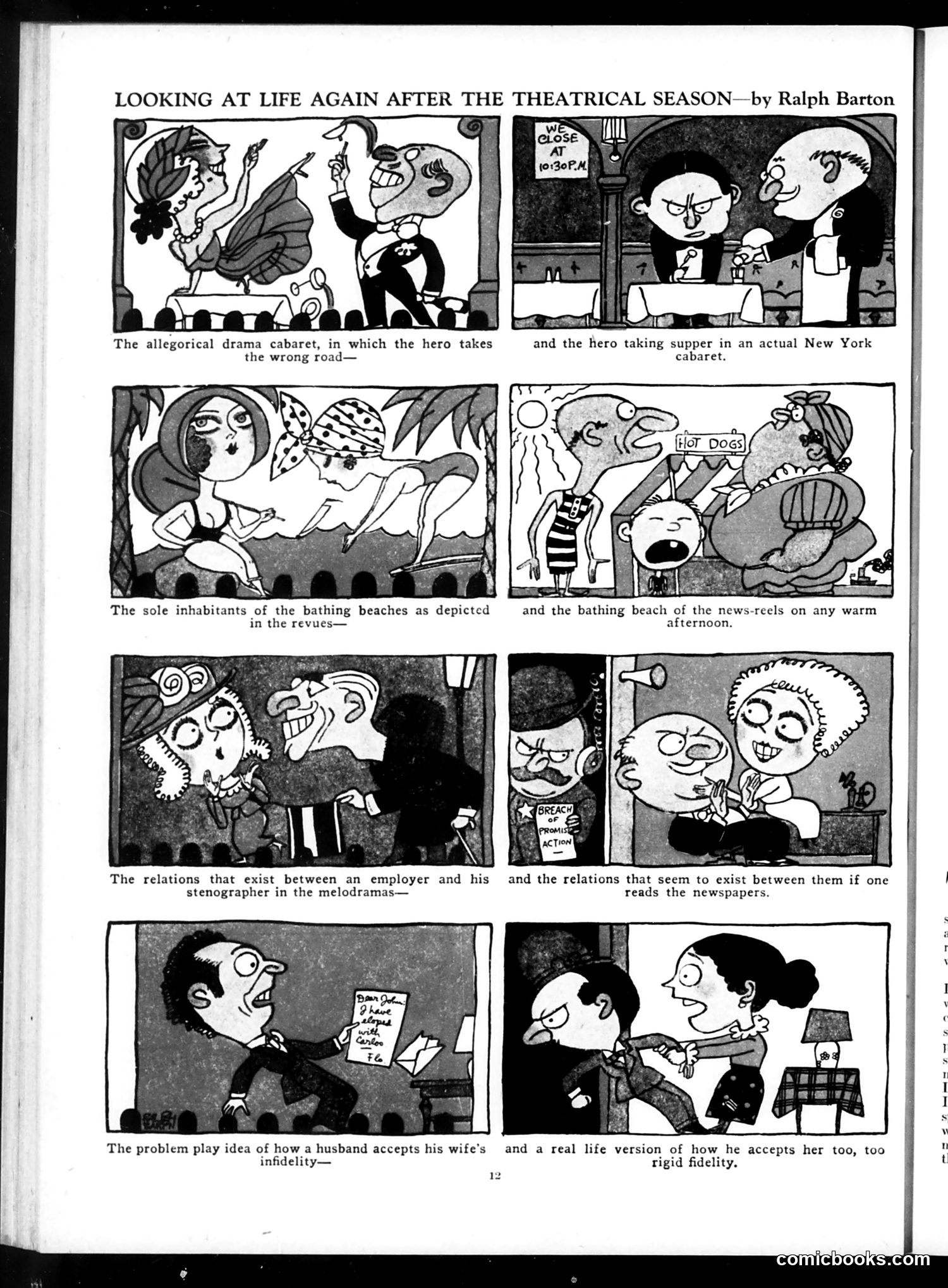
This satirical comic by Ralph Barton contrasts theatrical fantasies with mundane reality. Each pair of panels compares how Broadway shows dramatize life versus how things actually occur: 1. **Cabarets**: Stage versions feature glamorous, melodramatic encounters; real cabarets show ordinary diners. 2. **Beaches**: Revues depict scantily-clad, exclusive bathing; newsreels show crowded public beaches. 3. **Office relations**: Melodramas portray employers and stenographers in romantic tension; newspapers suggest sordid affairs. 4. **Marriage**: Problem plays show husbands nobly accepting infidelity; reality depicts rigid, conventional spouses. The satire targets how theatrical productions sensationalize everyday life, presenting exaggerated vice, romance, and drama where actuality offers mundane domesticity and social convention. Barton mocks both theatrical excess and the public's appetite for such fantasies.
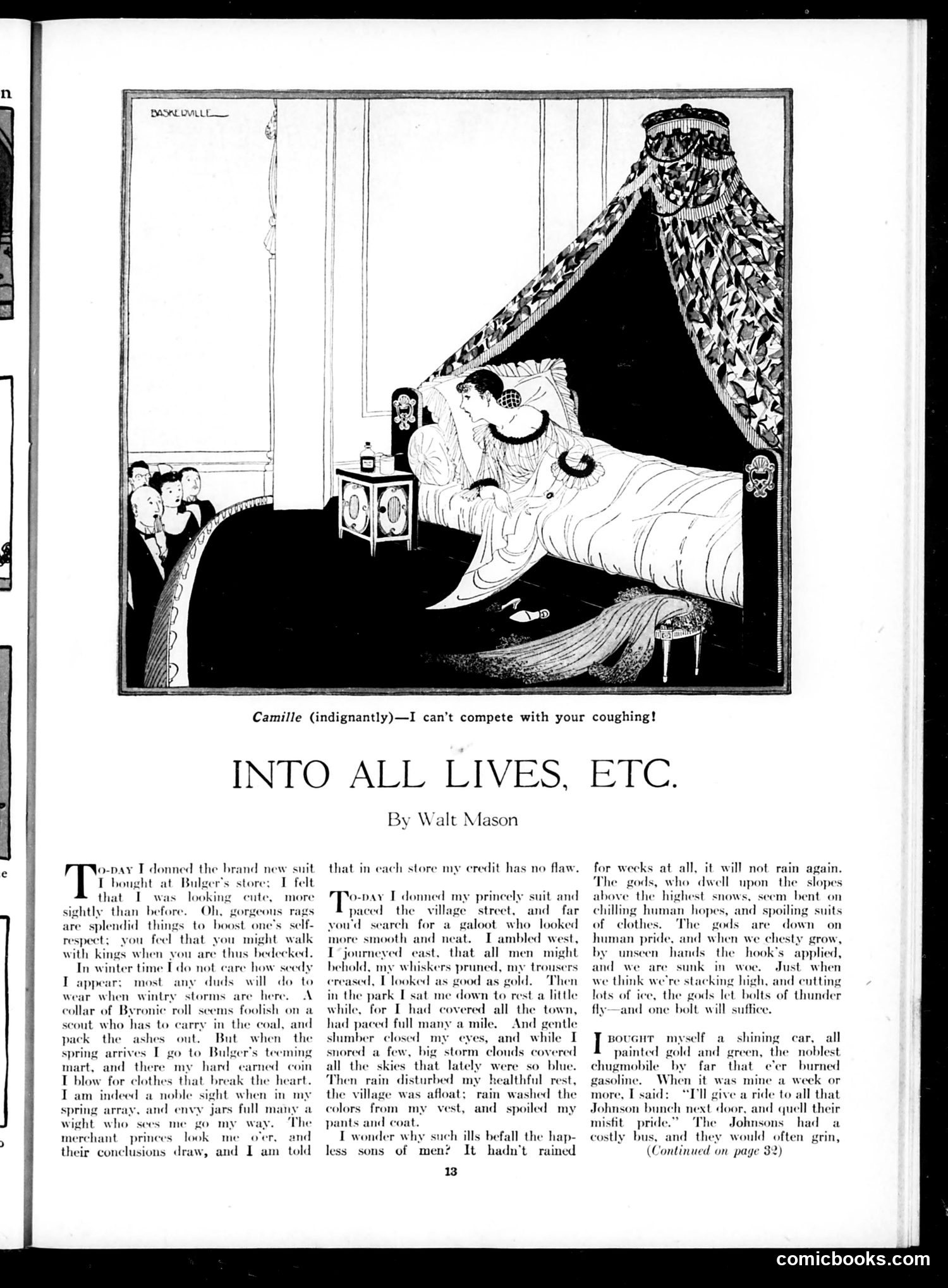
This page contains a **cartoon and the beginning of a humorous story** by Walt Mason, a popular early 20th-century humorist. **The Cartoon:** Shows a woman named Camille in bed complaining indignantly to a man that she "can't compete with your coughing!" — a domestic humor joke about annoying bedroom habits. **The Story "Into All Lives, Etc.":** Mason satirizes human vanity and the arbitrary cruelty of fate. The narrator buys a fancy new suit and spends days proudly displaying it around town—only to have a sudden rainstorm ruin it completely. He then buys a shiny car, boasting about giving rides to impress his neighbors, the Johnsons (who own a rival car). **The Satire:** Mason mocks how people invest emotional energy in material possessions and social competition, only to be humbled by circumstances beyond their control. The repeated pattern—pride followed by disaster—suggests life's fundamental unfairness. The "gods" actively seem to punish human arrogance, a theme reflecting common early-20th-century anxieties about status and consumer culture.
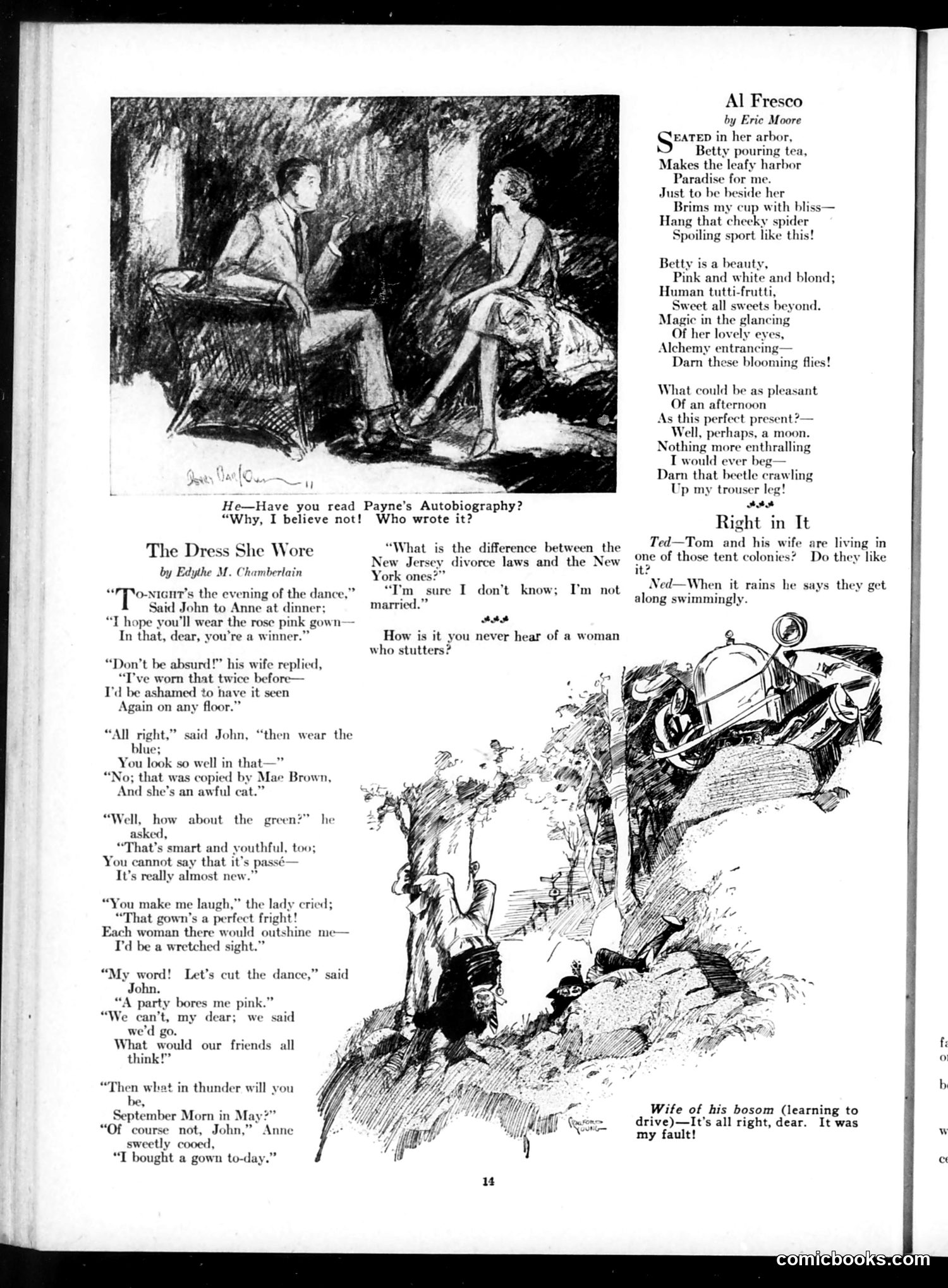
This page contains three separate pieces of light humor typical of early 20th-century Judge magazine: **"The Dress She Wore"** presents a marital comedy: a husband suggests his wife wear various gowns to a dance, but she dismisses each as previously worn or unfashionable. She finally reveals she bought a new gown—the expected punchline being her extravagance. The satire targets women's concern with appearance and fashion, a common theme mocking domestic consumption. **"Al Fresco"** is a romantic poem undercut by pragmatic interruptions: a man enjoys courting his sweetheart outdoors until insects disrupt the mood. The humor lies in the clash between sentimental idealization and crude reality. **"Right in It"** contains two brief jokes: one about tent-colony living during rainy weather (unclear historical reference, likely Depression-era), and another about a woman learning to drive, accepting blame for an accident—possibly satirizing either female drivers or marital dynamics. The page reflects period attitudes toward gender, consumption, and domesticity through gentle satire rather than sharp social critique.
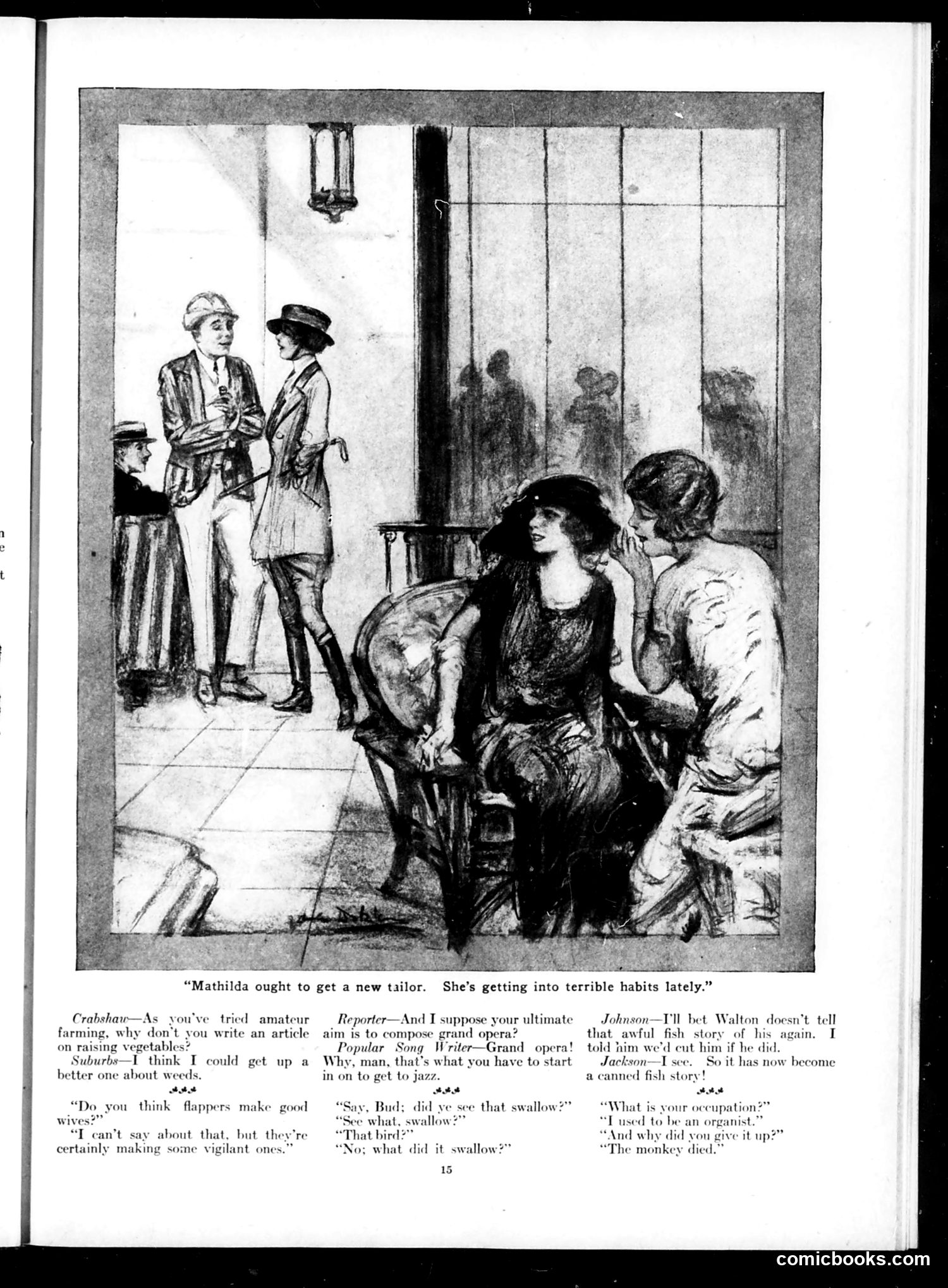
This page contains multiple cartoon vignettes satirizing 1920s American culture and social types. The main illustration shows a woman ("Mathilda") in fashionable attire being criticized for adopting "terrible habits"—likely referring to the "flapper" lifestyle (short skirts, cosmetics, smoking, drinking) that conservative society disapproved of. The dialogue snippets mock various social pretensions: an amateur farmer, a popular song writer aspiring to compose grand opera (viewed as pretentious), and men discussing "flappers" as wives. There's also wordplay about "jazz" and "canned fish stories" (exaggerated tales). The final exchanges are simple jokes: one about a bird swallowing something, another about an organist whose act depended on a performing monkey. Overall, the page satirizes 1920s social anxieties—class ambitions, changing gender roles with the "new woman," and middlebrow cultural aspirations—through gentle ridicule typical of Judge magazine's approach to American society.
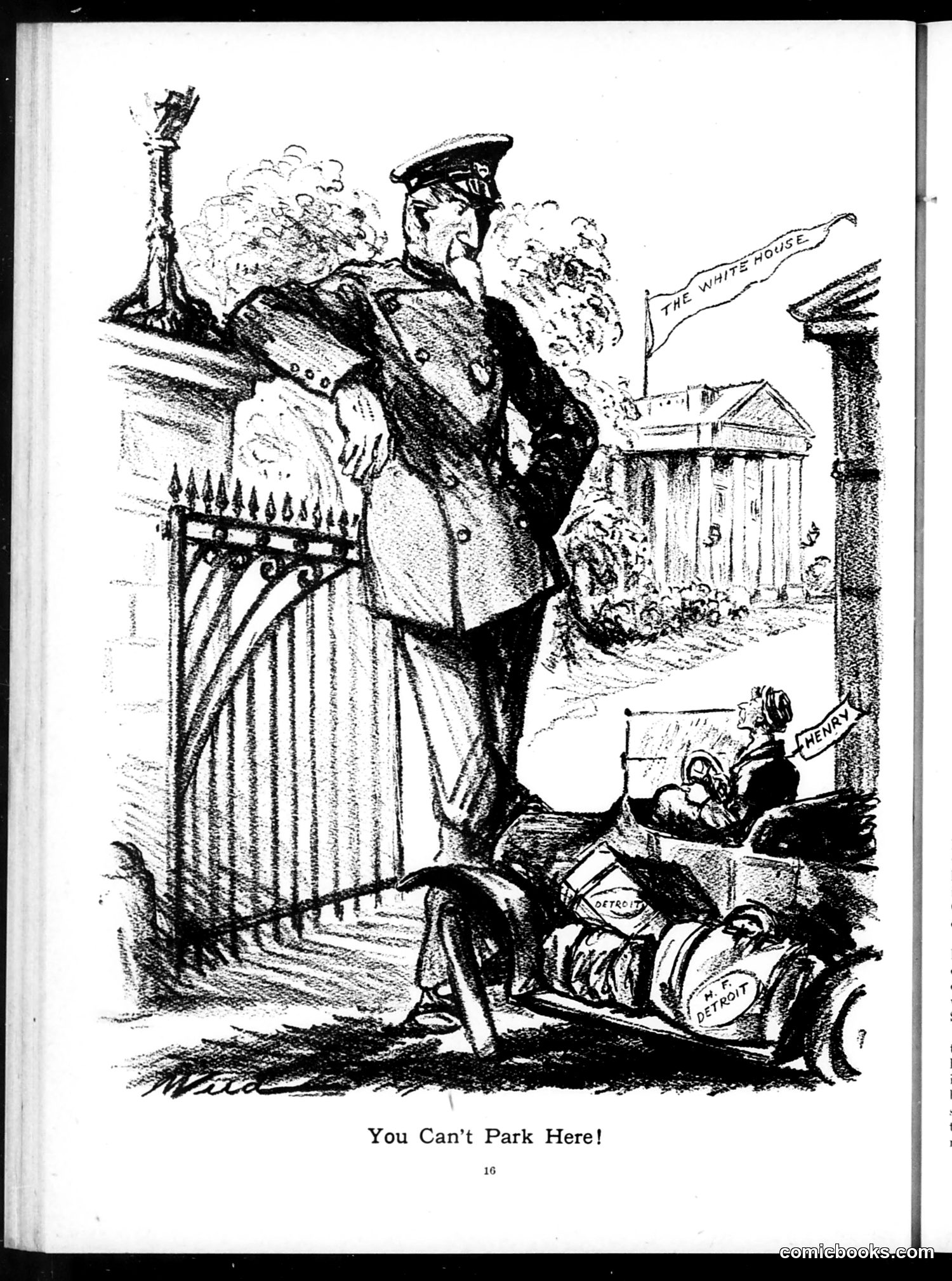
This political cartoon satirizes executive overreach at the White House. A stern uniformed guard blocks vehicles labeled "Detroit," "Chicago," and what appears to be other American cities from entering the White House grounds. The guard's authoritative stance and the "No Parking" message suggest the cartoon criticizes a president's attempt to prevent or control access by representatives from major American cities—likely referring to a specific historical conflict between a president and municipal or industrial interests. The cartoon appears to critique excessive presidential authority in excluding legitimate civic actors from the seat of government. Without seeing the publication date, the specific president involved remains unclear, though the early 20th-century style suggests this addresses a Progressive Era controversy.
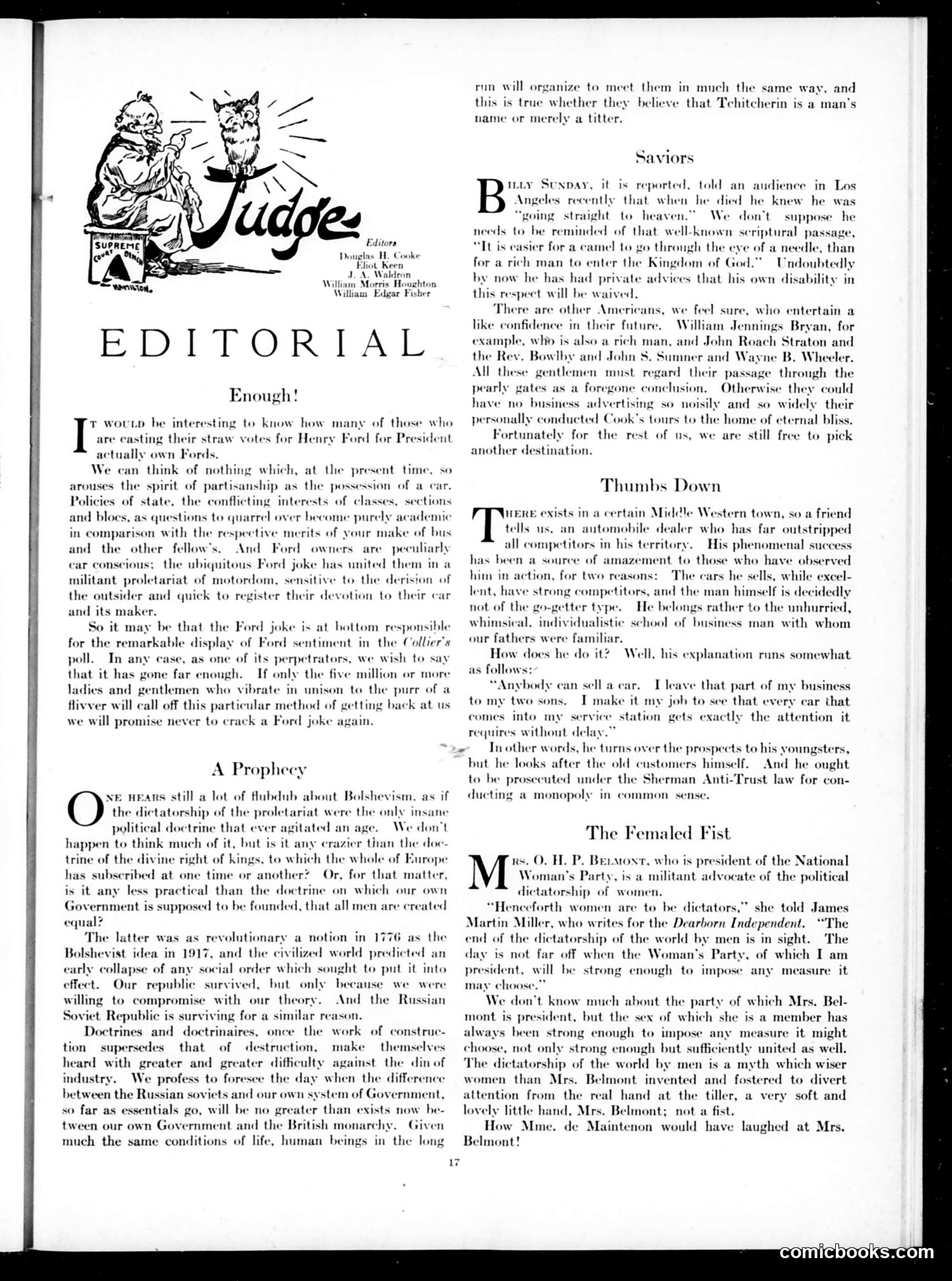
This page contains three editorial pieces satirizing American politics and society circa the 1920s: **"Enough!"** attacks the cultural obsession with Ford automobiles and the "Ford joke," suggesting this sentiment artificially inflates Henry Ford's support for president. The editors claim Ford owners' car-consciousness has become a substitute for serious political debate. **"A Prophecy"** compares Bolshevism to earlier revolutionary doctrines like 1776 democracy, arguing that practical concerns eventually neutralize ideological differences. It suggests Soviet and American systems will eventually converge. **"Saviors"** mocks wealthy evangelicals—including William Jennings Bryan, John Roach Straton, and Wayne B. Wheeler—for their ostentatious religious piety and self-promotion as moral authorities, while implying their wealth contradicts Christian teachings about entering heaven. The cartoon at top shows a judge figure with a cat, likely representing editorial authority/judgment over current affairs.
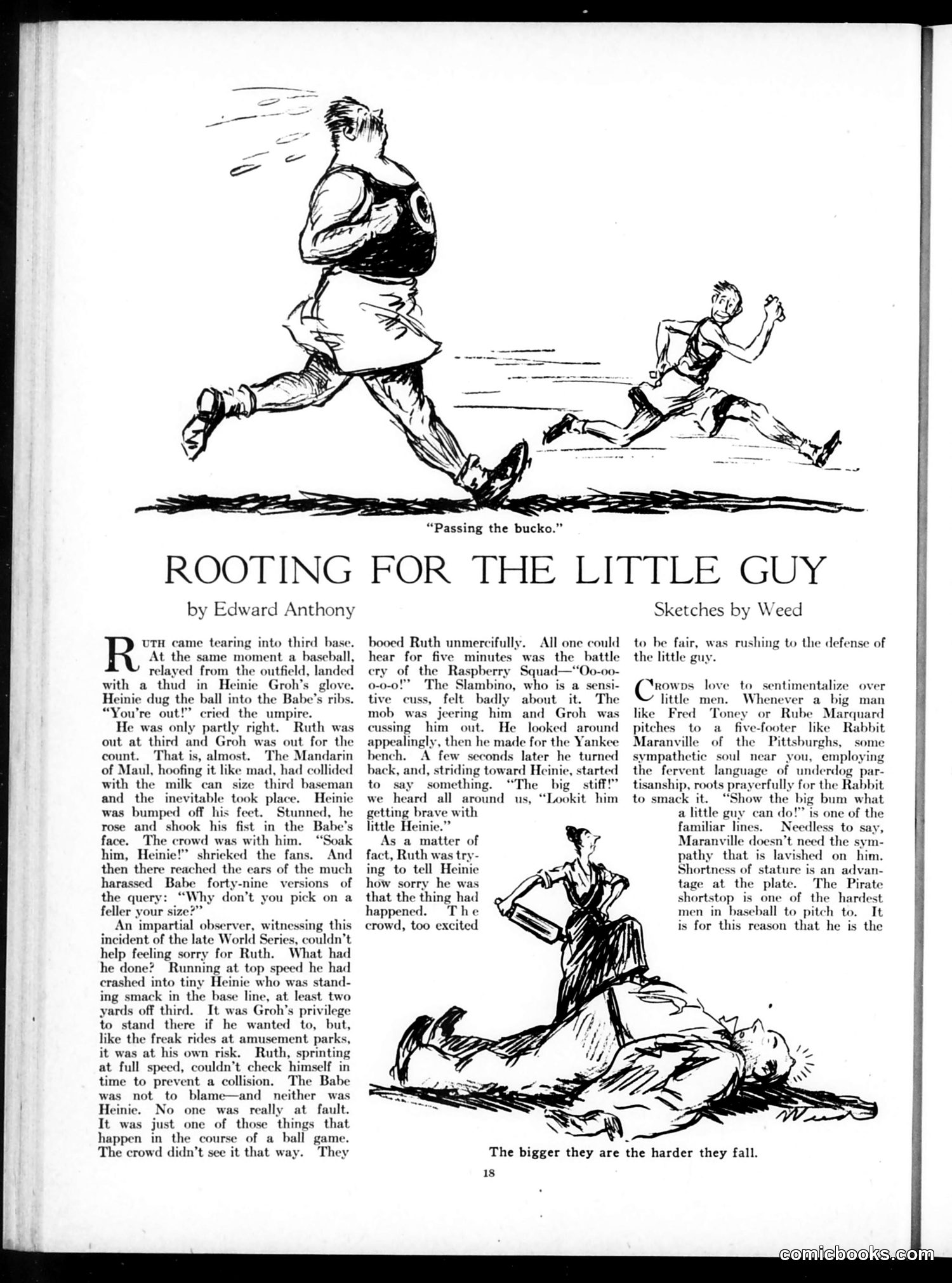
This 1920s sports story satirizes crowd sentiment at baseball games, specifically referencing an incident from the World Series involving Babe Ruth and third baseman Heinie Groh. **The narrative:** Ruth, running at full speed, collides with the much smaller Groh while attempting to reach third base. Though neither player is truly at fault—it's simply an accident of the game—the crowd boos Ruth mercifully and cheers for Groh. **The satire's point:** The piece critiques how spectators romanticize underdogs and automatically root *against* larger, more dominant players. The author argues this sentiment is irrational: Ruth wasn't deliberately aggressive, and Groh (a skilled shortstop) doesn't need sympathy. The crowd's bias toward "the little guy" obscures the actual fairness of the situation. The accompanying sketch humorously illustrates this dynamic—a large player bowling over a smaller opponent while crowds cheer the underdog.
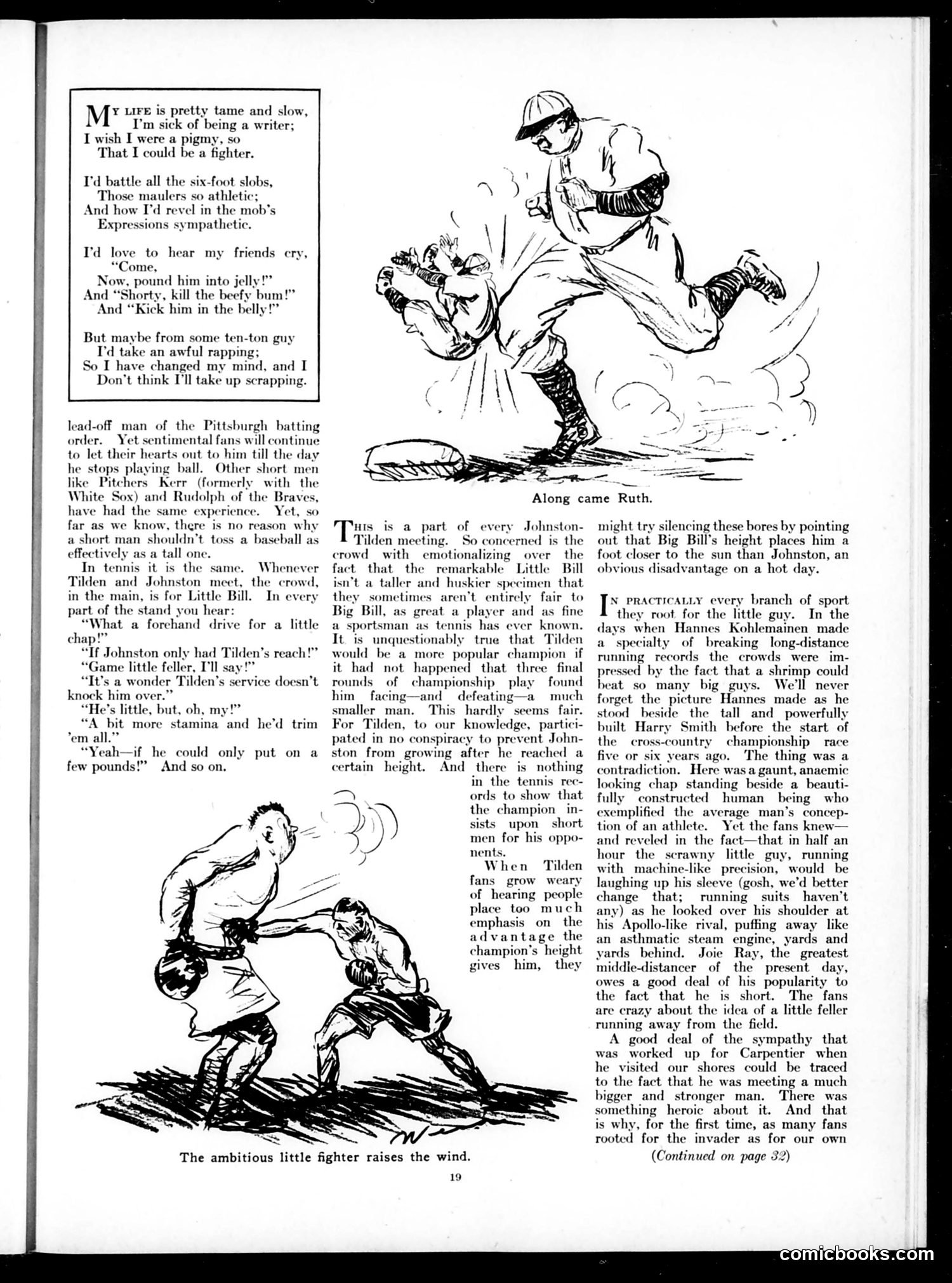
This page discusses the public's affection for undersized athletes, using tennis champion **Bill Johnston** (the "Little Bill") as the primary example. Johnston competed against the taller **Big Bill Tilden** in championship matches. The satirical argument is that crowds emotionally favor Johnston despite his disadvantage, expressing sympathy ("pound him into jelly!") rather than fairly evaluating both players' skills. The author notes this bias appears across sports—fans loved Finnish runner **Hannes Kohlemainen** for beating larger competitors, and favor shorter distance runner **Joie Ray**. The accompanying verse mocks someone wishing to be a "pigmy" fighter to battle "six-foot slobs," only to reconsider when imagining retaliation from a "ten-ton guy." **The satire**: Judge critiques how spectators romanticize underdogs based on physical size rather than athletic merit, making irrational judgments that may unfairly diminish greater competitors' accomplishments.
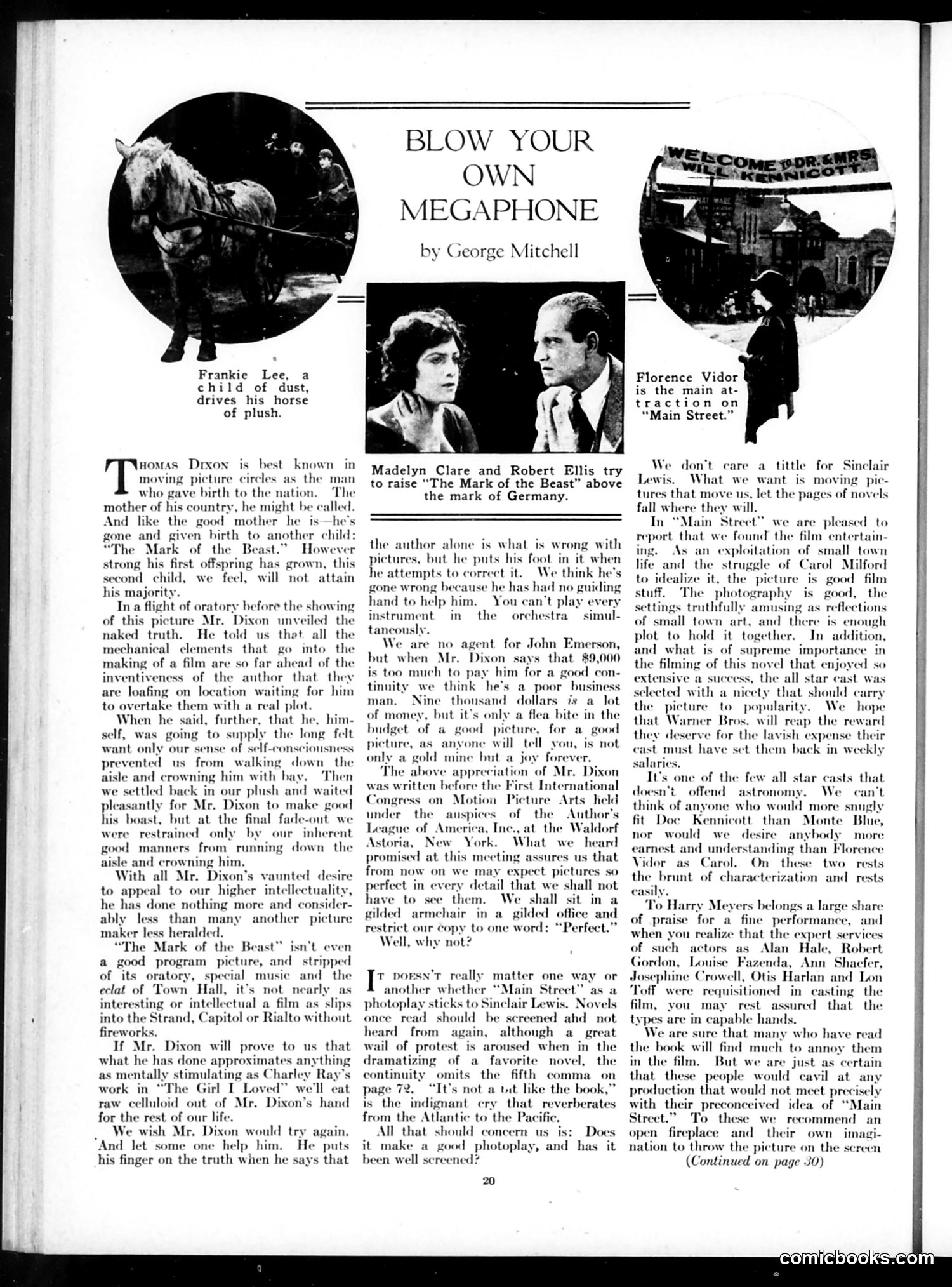
This is a film review criticizing director Thomas Dixon's movie "The Mark of the Beast." The article argues that Dixon, famous for *Birth of a Nation*, relies too heavily on spectacle and oratory while neglecting storytelling fundamentals. **The Satire:** The title mocks Dixon's self-promotion—his tendency to "blow his own megaphone" about his films. The review contends that despite Dixon's intellectual pretensions and technical ambitions, the film fails because he attempts to do everything himself without collaborators. The critic specifically criticizes Dixon's rejection of paying screenwriter John Emerson $9,000, arguing this penny-pinching undermines the production. **The Point:** Judge argues that filmmaking requires teamwork—you "can't play every instrument in the orchestra simultaneously." The review also attacks literary purists who obsess over minor details (like a missing comma in a novel) rather than judging whether a film works as cinema on its own terms.
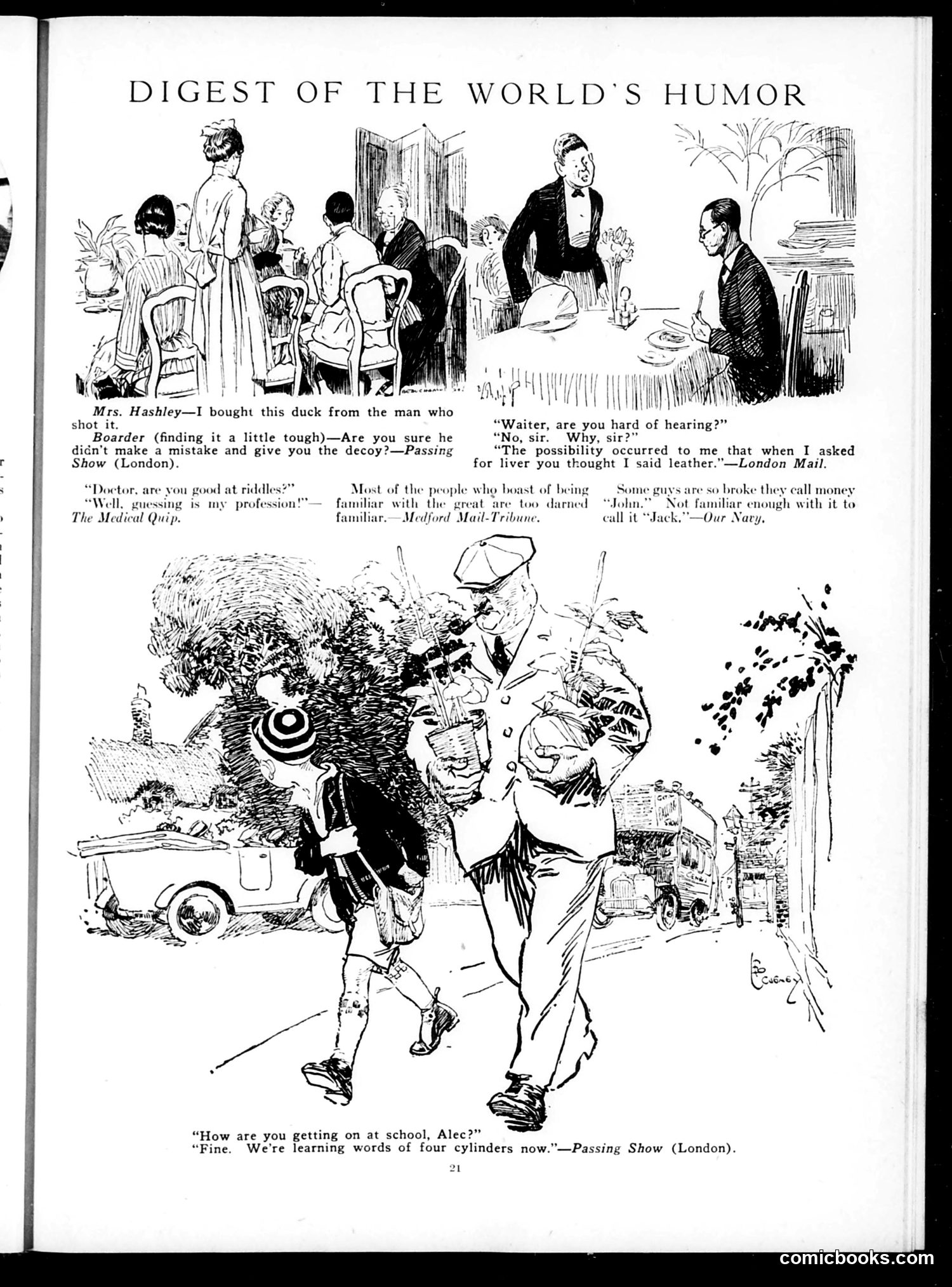
This page collects brief humorous anecdotes and jokes from various sources, arranged with accompanying illustrations. The jokes target everyday situations and absurdities: **Top section:** A domestic joke about a tough duck (possibly a decoy instead of real game), a waiter mishearing "liver" as "leather," and a doctor who specializes in riddles. **Bottom illustration:** A man struggling to carry an enormous potted plant, captioned with a school conversation about learning "words of four cylinders"—a joke about automobiles and modern technology, suggesting the child is learning about cars rather than traditional subjects. This reflects early 20th-century anxiety about how cars were changing society and education. The page exemplifies Judge's format of reprinting international humor ("Passing Show," "London Mail") alongside original content, presenting genteel, family-friendly wit typical of the era's middlebrow entertainment.
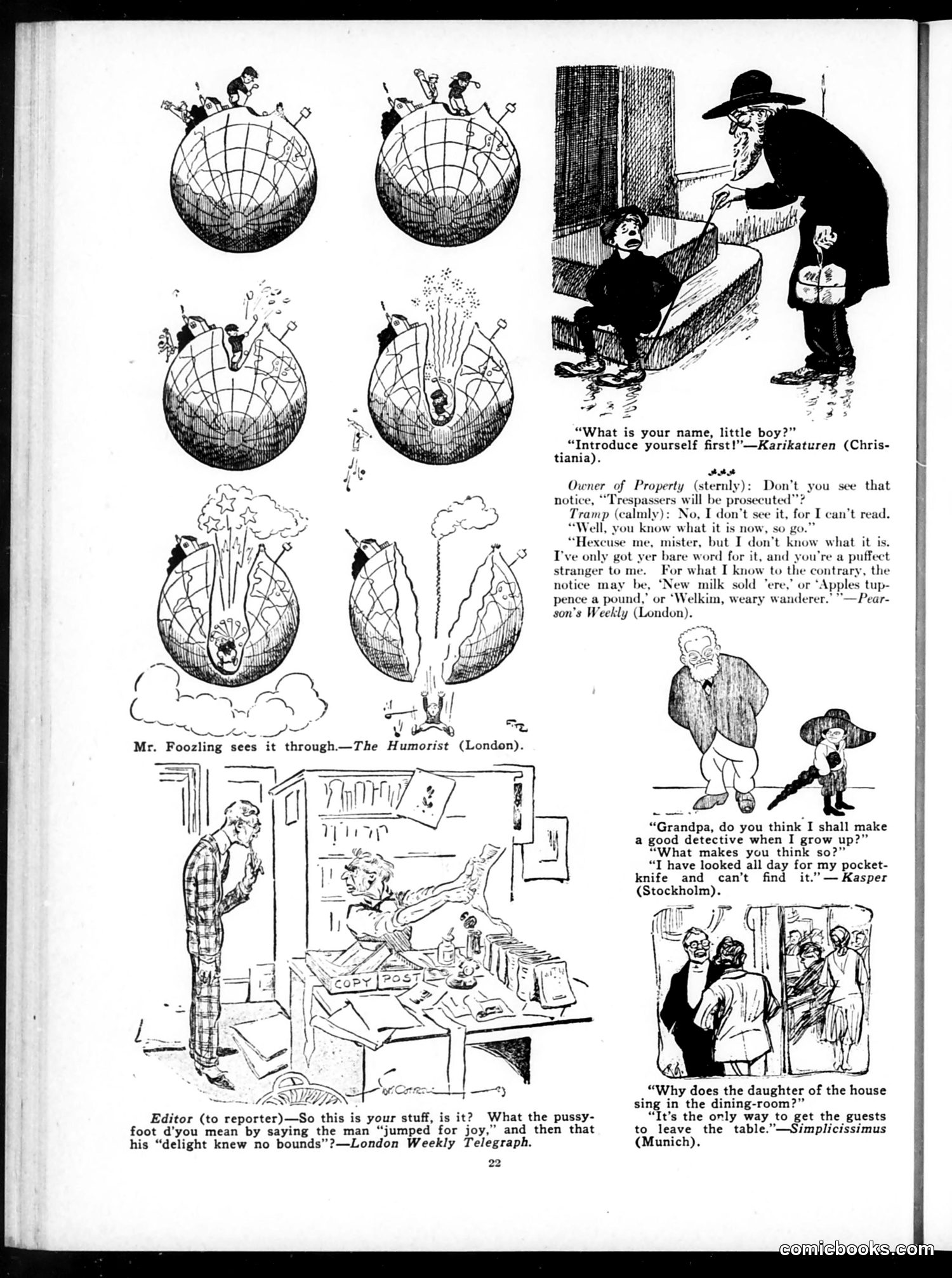
This page reprints satirical cartoons and jokes from various European humor magazines, reflecting early 20th-century social comedy. **Key content includes:** - **Globe diagrams** ("Mr. Foozling sees it through"): Appears to satirize someone's naive or distorted understanding of geography or world affairs. - **Trespassing joke**: Mocks a property owner's contradictory logic—posting a "No Trespassing" sign is meaningless to someone who can't read it. - **Editorial cartoon**: An editor ridicules a reporter for using contradictory phrases ("jumped for joy" + "delight knew no bounds"), satirizing sloppy writing. - **Child detective joke**: A grandfather finds humor in his grandson's inability to locate his own pocket-knife, questioning whether this demonstrates detective skills. - **Dinner party joke**: A hostess's daughter sings deliberately poorly to drive guests away—dark humor about social obligation. The cartoons share common themes: incompetence, logical absurdity, and social awkwardness. They're reprinted from publications across Europe (London, Munich, Stockholm, Christiania), showing the magazine's international reach.
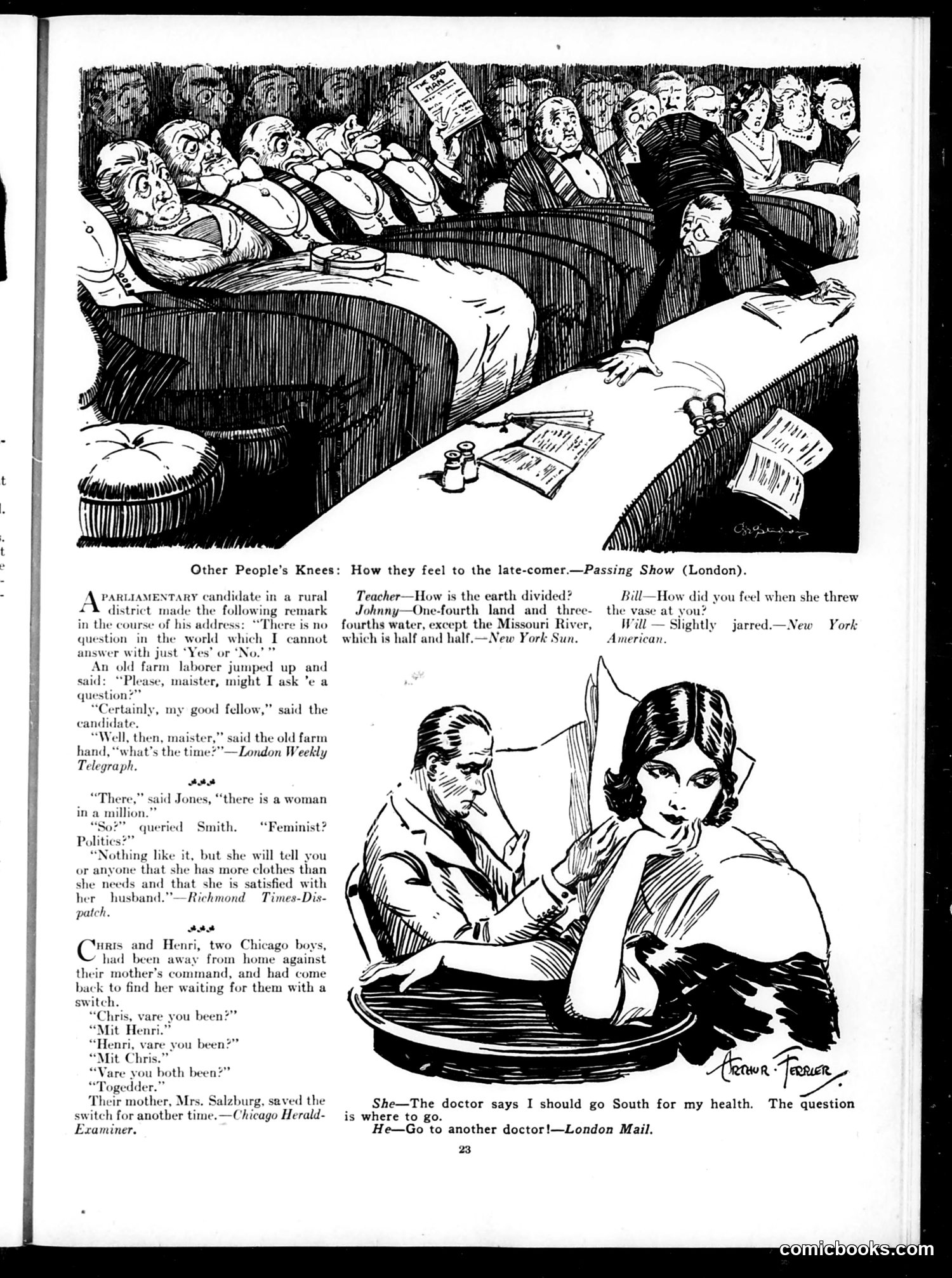
This page collects brief humorous anecdotes and two cartoons typical of early 20th-century satirical magazines. The top cartoon depicts a crowded theater or social venue where late arrivals must squeeze past seated patrons—the joke being the discomfort and annoyance on everyone's faces. The text includes six short jokes addressing social conventions: 1. A politician's overconfidence is punctured when asked "what's the time?"—something unanswerable with yes/no 2. A woman praised for wanting fewer clothes and being satisfied with her husband (satirizing feminist demands for autonomy) 3. Chicago immigrant children (German-accented "Chris" and "Henri") evade punishment through circular alibis 4. A teacher-student joke about geography 5. A husband's "jarred" pun about his wife throwing a vase 6. A wife's health dilemma receives doctor-shopping advice The humor relies on wordplay, immigrant dialect comedy, and commentary on gender roles and marriage—reflecting period attitudes. The page number indicates this is from an archived publication.
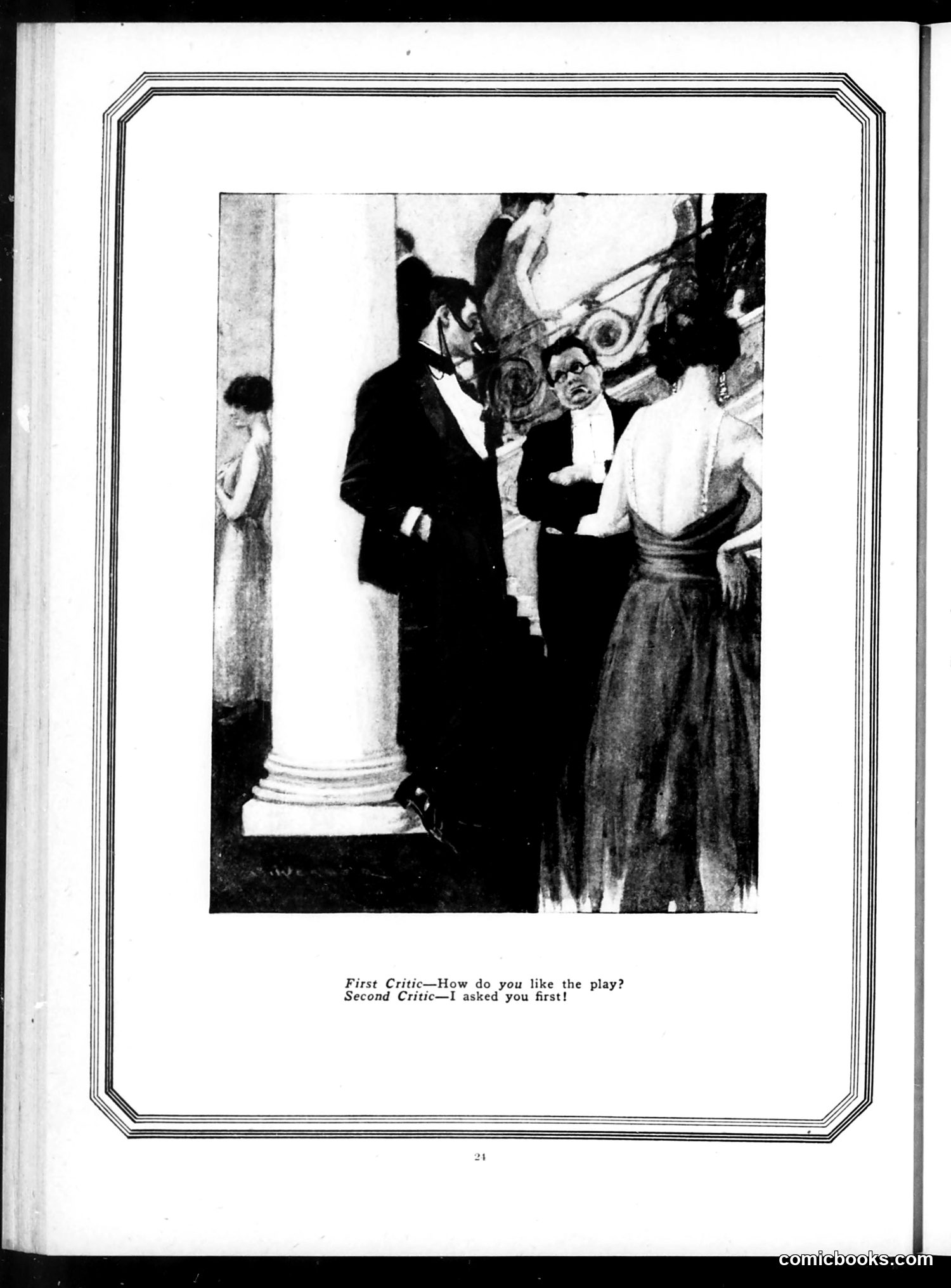
This is a humorous cartoon about theater criticism. Two men in formal evening wear are depicted at what appears to be an intermission or social gathering at a theater (note the classical column). The joke relies on a common social awkwardness: each critic is asking the other for their opinion of the play, but neither wants to commit to a judgment first. The "Second Critic" cheekily points out that the "First Critic" asked the question first, implying they're both reluctant to give an honest assessment—possibly because they didn't understand it, didn't like it, or fear contradicting the other's opinion. It's satire on the pretension and insecurity of theater critics trying to appear knowledgeable while actually uncertain about what they've witnessed.
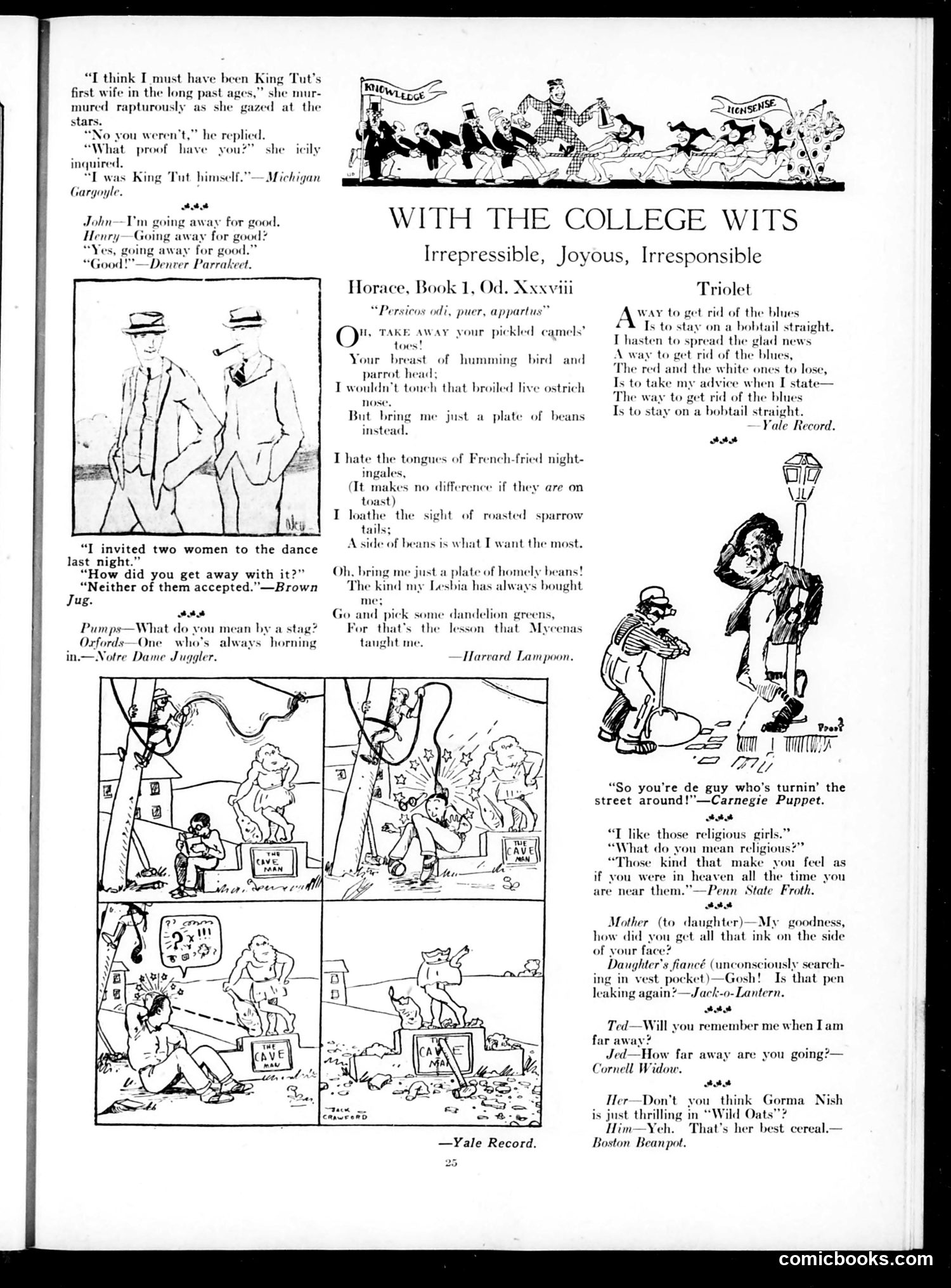
This page collects humorous quips and cartoons from college humor magazines (Yale Record, Harvard Lampoon, etc.), showcasing wit aimed at a collegiate audience circa 1920s. **Main content:** A four-panel comic about dormitory life shows students engaged in casual mischief—appearing to conduct experiments or pranks with various household items and contraptions. The humor relies on visual absurdity rather than specific contemporary reference. **The jokes throughout** target college-life themes: romantic rejections ("Neither accepted"), wordplay on shoe types (Oxfords "horning in"), and adolescent social situations. A Horace parody humorously insists on preferring simple beans to exotic French delicacies—likely mocking pretentious dining. **The satire** gently ridicules college students as irresponsible but good-natured—their "joyous irresponsibility" is the stated theme. References to "bobtail" wagons and period slang suggest transportation and courtship humor specific to the era. Overall, this represents lighthearted collegiate humor with no serious political content.
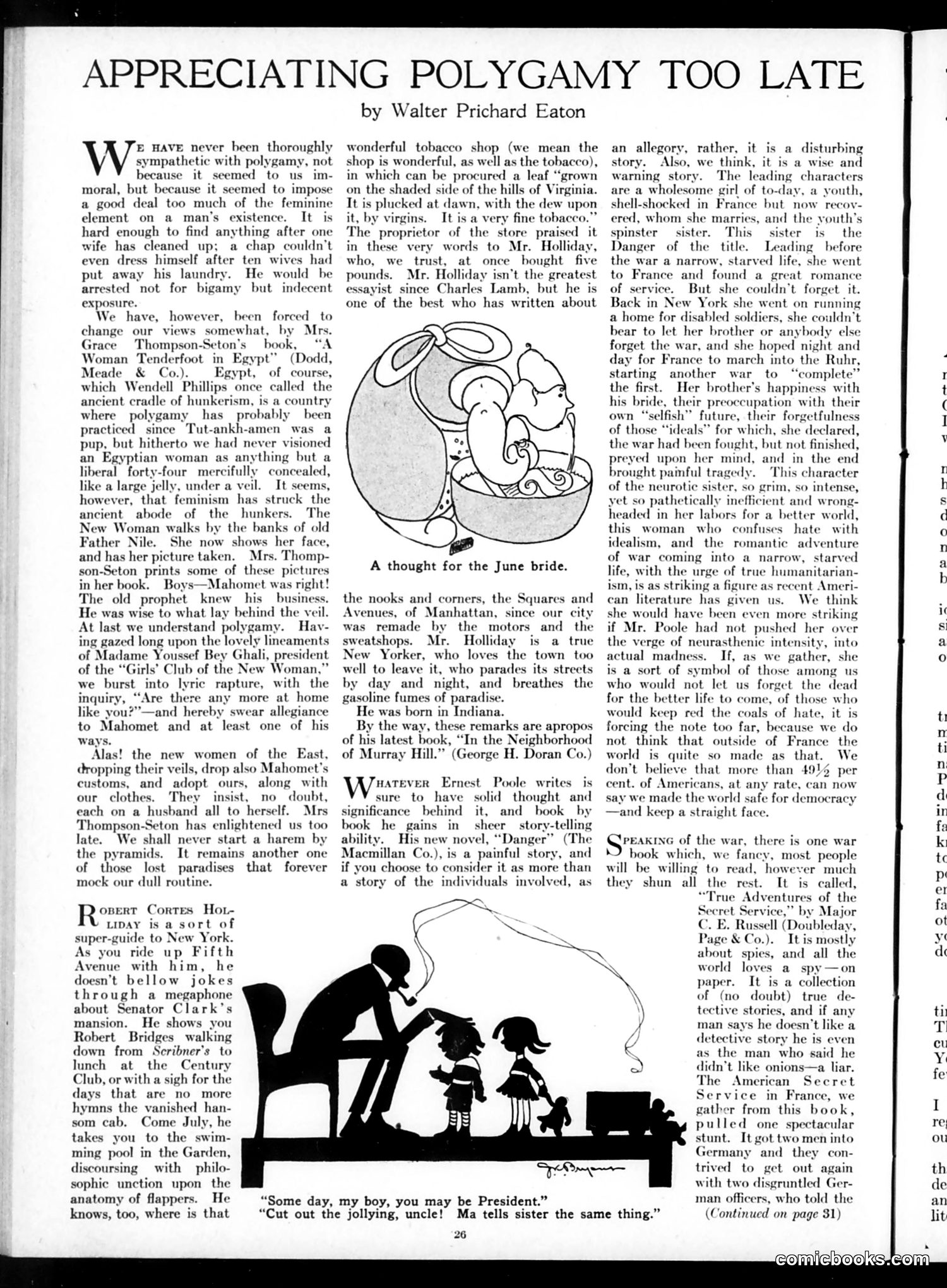
This page contains satirical commentary on early 20th-century social changes, centered on three separate articles and illustrations. ## Main Satire: "Appreciating Polygamy Too Late" The lead article mocks the "New Woman" movement in Egypt. The author initially opposes polygamy for practical reasons (wives create domestic chaos), but after seeing photographs of modern Egyptian women—specifically "Mad Youssef Bey Ghali, president of the 'Girls' Club of the New Woman'"—he humorously reverses his position, declaring allegiance to Mahomet. The joke: these liberated Egyptian women have abandoned traditional veiling and adopted Western customs, meaning they now demand exclusive husbands rather than accepting polygamy. The satire targets the irony that feminism and modernization eliminate the very arrangement the author had (jokingly) come to appreciate. ## Secondary Cartoons One illustration shows an adult bending to children with the caption about "Presidential" behavior—likely social commentary on authority figures. The reviews of books by Thompson-Seton, Holliday, and Poole are straightforward literary notices, not satirical.
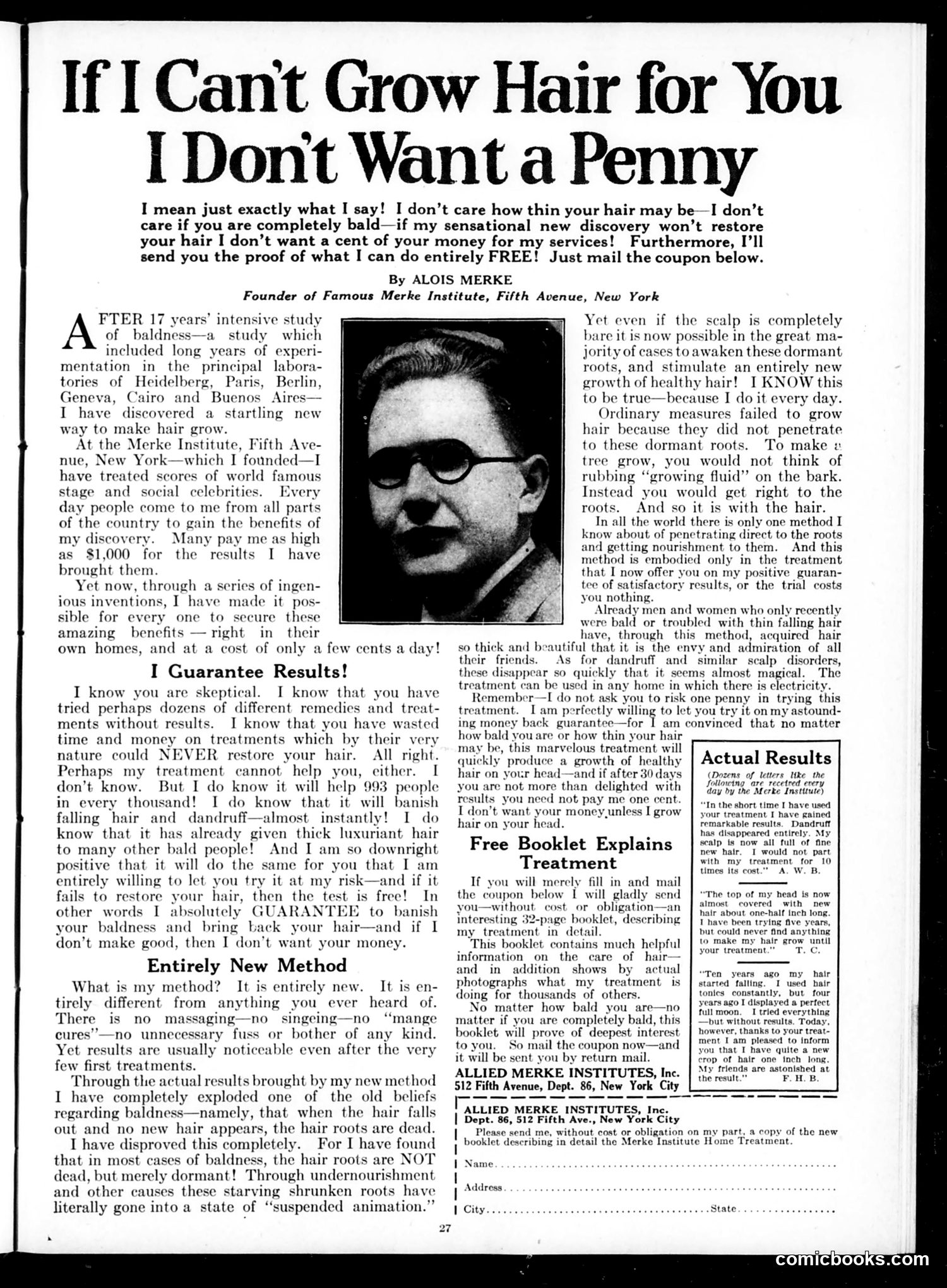
This is a **hair-loss treatment advertisement** disguised as editorial content in *Judge* magazine—a common early 20th-century advertising practice. **The Figure:** Alois Merke, founder of the "Merke Institute" on Fifth Avenue, New York, presents himself as a legitimate scientist who studied baldness in major European laboratories (Heidelberg, Paris, Berlin, Geneva, Cairo, Buenos Aires). **The Sales Pitch:** Merke claims a revolutionary "entirely new method" that awakens "dormant" hair roots through direct nourishment—unlike traditional massage or "mange cures." He guarantees results or refunds money, and offers a free booklet. **Why This Matters:** This exemplifies early 20th-century **dubious medical advertising**. The pseudo-scientific language ("suspended animation," European credentials) and money-back guarantees were common tactics before FDA regulation. The ad exploits widespread baldness anxiety while making unverifiable claims. Modern readers should recognize this as the ancestor of today's unproven hair-loss remedies.
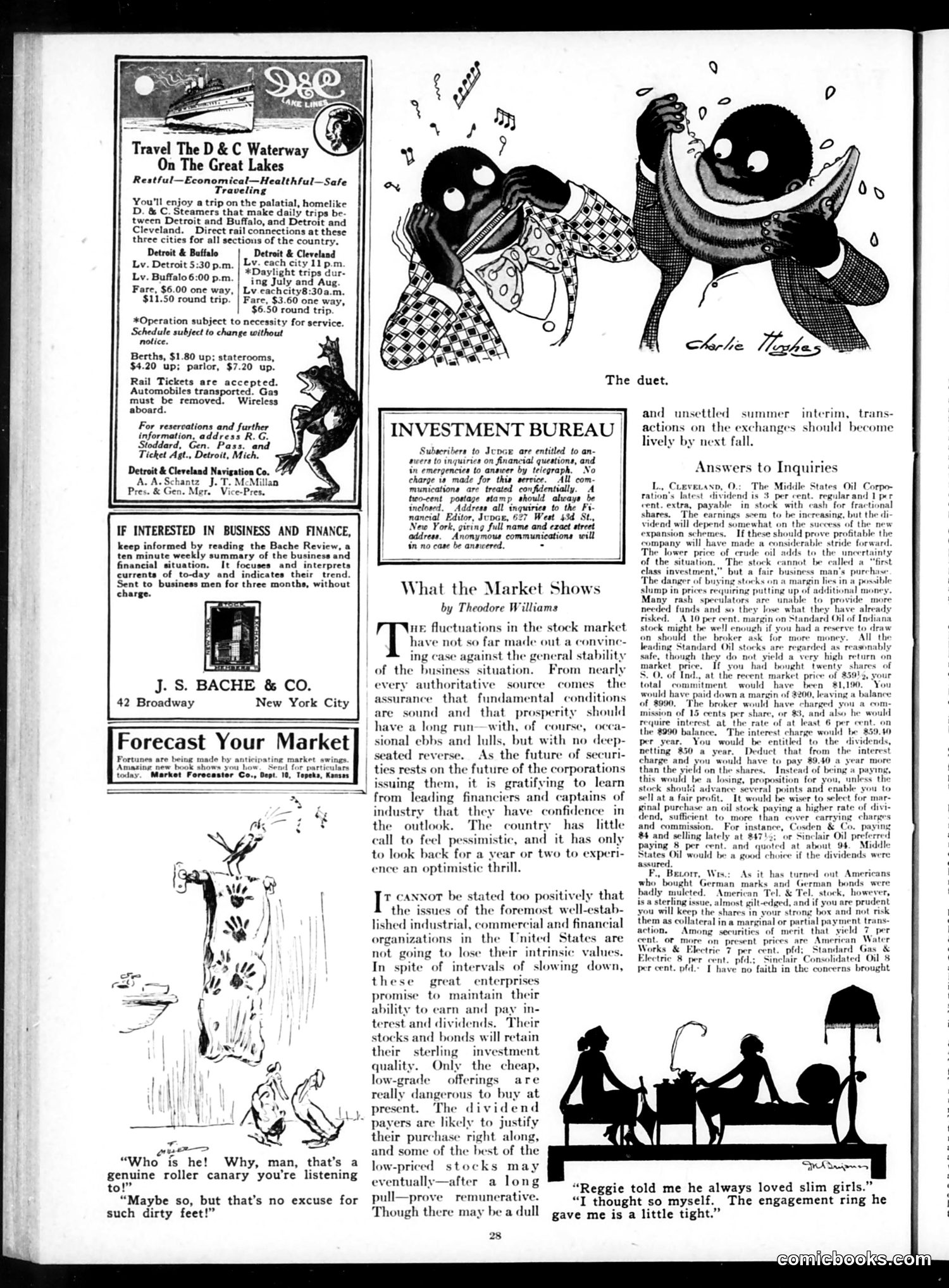
This page from Judge magazine (a satirical weekly) contains mostly **advertisements and financial advice columns**, not political satire. The main content includes: **Advertisements:** Steamship travel on the Great Lakes, investment services from J.S. Bache & Co., and market forecasting services. **Financial Column:** Theodore Williams discusses stock market stability, arguing that fundamental business conditions remain sound despite market fluctuations. He reassures readers that major corporations will maintain dividends and that only "cheap, low-grade offerings" are risky. **Cartoons:** Two unrelated gags—one showing a "roller canary" (appears to be a bird with dirty feet), another showing silhouettes of people on a bench with the caption about an engagement ring being "a little tight." The page reflects Judge's dual nature as both humor magazine and business publication, targeting affluent readers interested in investment opportunities during what appears to be a prosperous economic period.
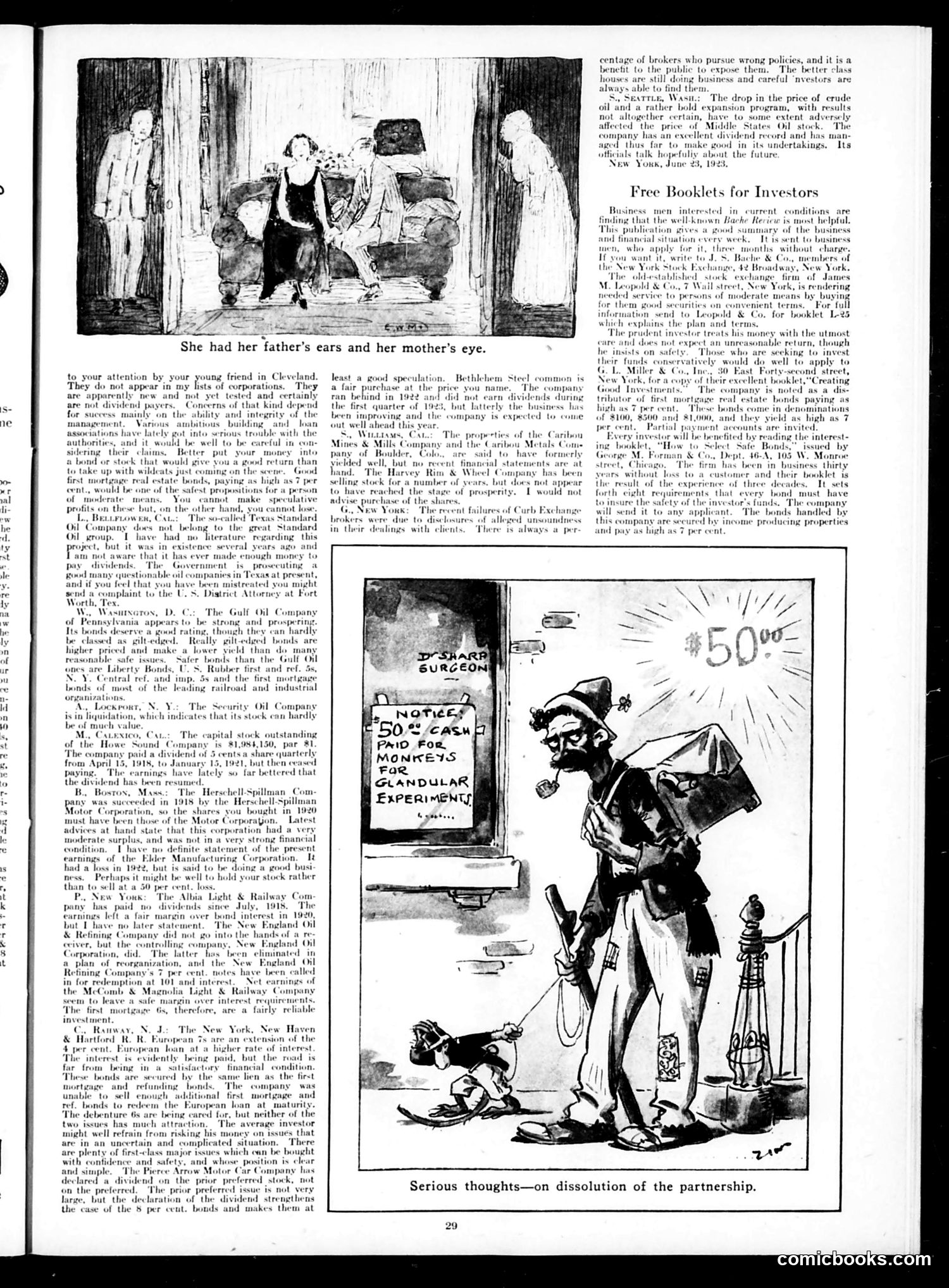
This page contains financial advice columns alongside a satirical cartoon about business partnerships. **The Cartoon:** "Serious thoughts—on dissolution of the partnership" depicts a sharp surgeon operating on a business partnership, treating it like a medical patient. The surgeon is cutting apart two figures representing partners, with one lying on an operating table. The $50 sign and notice about payment suggest commentary on the financial costs and complications of dissolving business partnerships—a topical concern during this era of corporate reorganizations. **The Text:** Beneath the artwork, financial advice columns address investors about various stocks and bonds—discussing oil companies, railways, and manufacturing concerns. Writers caution readers about speculative investments, questionable dividends, and corporate failures (mentioning specific companies like Security Oil Company in liquidation). **The Satire:** The juxtaposition suggests that dissolving unprofitable or troubled partnerships requires drastic financial "surgery," treating partnership dissolution as both medically necessary and expensive—a dark joke about business failures common during economic uncertainty.
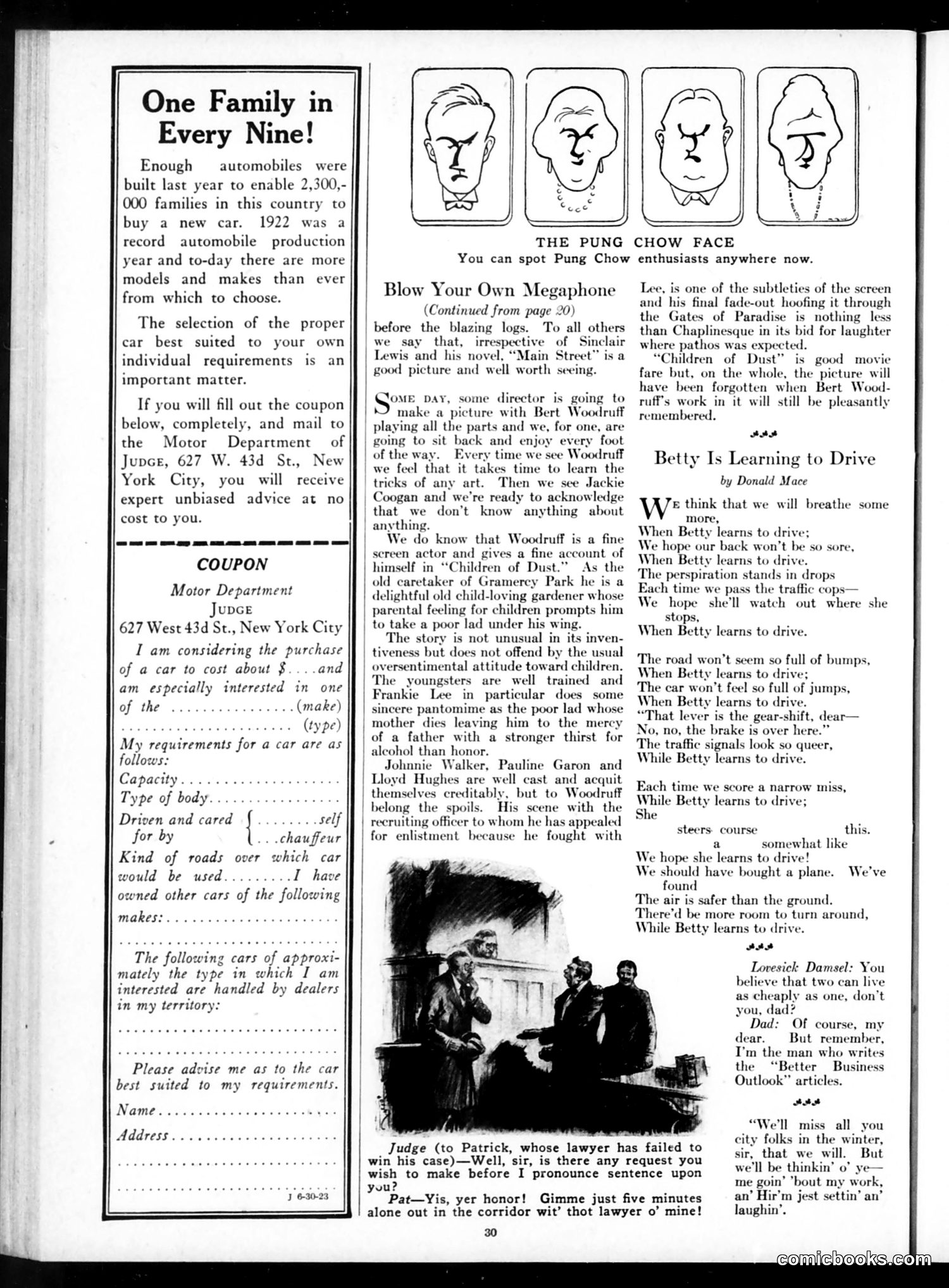
This page from Judge (a satirical weekly) contains three distinct sections: **"One Family in Every Nine"** is an automobile advertisement masquerading as editorial content—a sales pitch touting 1922's record car production and offering free expert advice to potential buyers. **"The Pung Chow Face"** appears to be a racial caricature feature identifying enthusiasts of what seems to be an ethnic stereotype or fashion trend, though the specific reference is unclear from visible text. **"Betty Is Learning to Drive"** is a humorous poem satirizing the anxiety of being a passenger while a novice female driver learns—playing on contemporary anxieties about women drivers, with repeated references to dangerous near-misses and masculine discomfort. This reflects 1920s gender attitudes where women driving was still novel enough to be comedic material. The cartoon showing a judge and Irishman ("Pat") is a brief ethnic joke playing on Irish-American stereotypes and legal system incompetence.
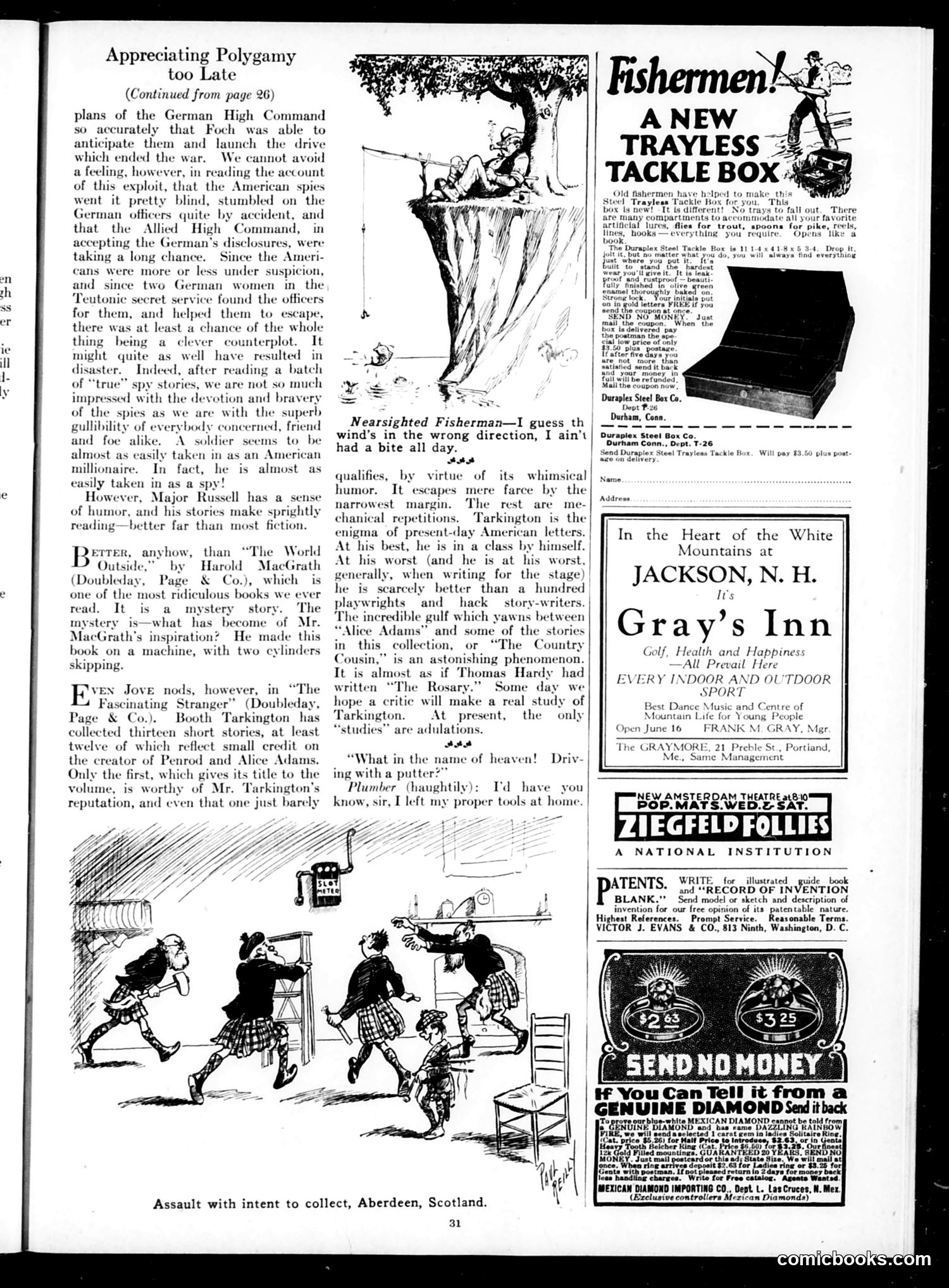
This page mixes literary criticism with advertisements and cartoons, typical of *Judge* magazine's format. The main satirical cartoons are: 1. **"Nearsighted Fisherman"** (top right)—A simple joke about a fisherman having no luck, blamed on wind direction, with visual irony showing him in obvious distress. 2. **"Assault with intent to collect, Aberdeen, Scotland"** (bottom)—Shows a bill collector chasing townspeople with a club. The dark humor mocks debt collection practices, suggesting aggressive pursuit of payment is practically violent. The literary section criticizes authors like Booth Tarkington, whose inconsistent quality the reviewer finds baffling—praising *Alice Adams* while dismissing his other stories as mechanical. The advertisements (tackle box, resort, theater, diamond scheme) represent typical period marketing, some appearing dubious to modern eyes (the "genuine diamond" offer).
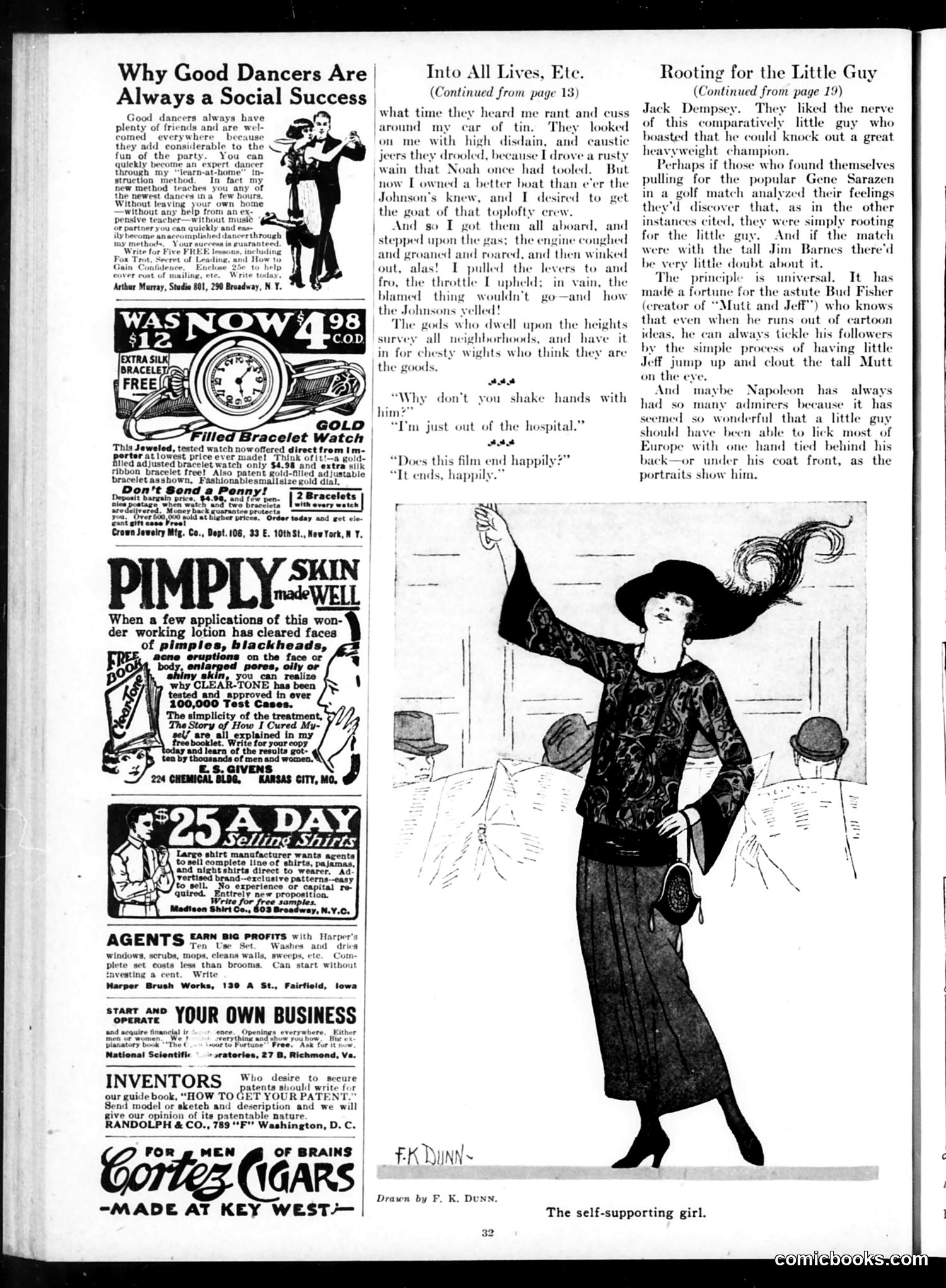
This page contains mostly **advertising** alongside two short humor pieces and an illustration. The main cartoon by F. K. Dunn shows "The self-supporting girl"—a young woman juggling multiple hats while appearing confident and independent. This likely satirizes the modern woman of the era (appears to be 1920s) who was entering the workforce and managing her own affairs, a social shift that both fascinated and unsettled contemporary audiences. The text pieces discuss dance as social currency and include a sports commentary about fans rooting for underdogs—specifically mentioning boxer Jack Dempsey and golf player Gene Sarzen. The author argues people instinctively favor smaller/weaker competitors, citing cartoonist Bud Fisher's "Mutt and Jeff" (where small Jeff repeatedly punches tall Mutt) as proof this principle sells. The numerous advertisements—for watches, skin cream, shirts, patent services—reflect early 20th-century consumer culture targeting aspiring entrepreneurs and self-improvers.
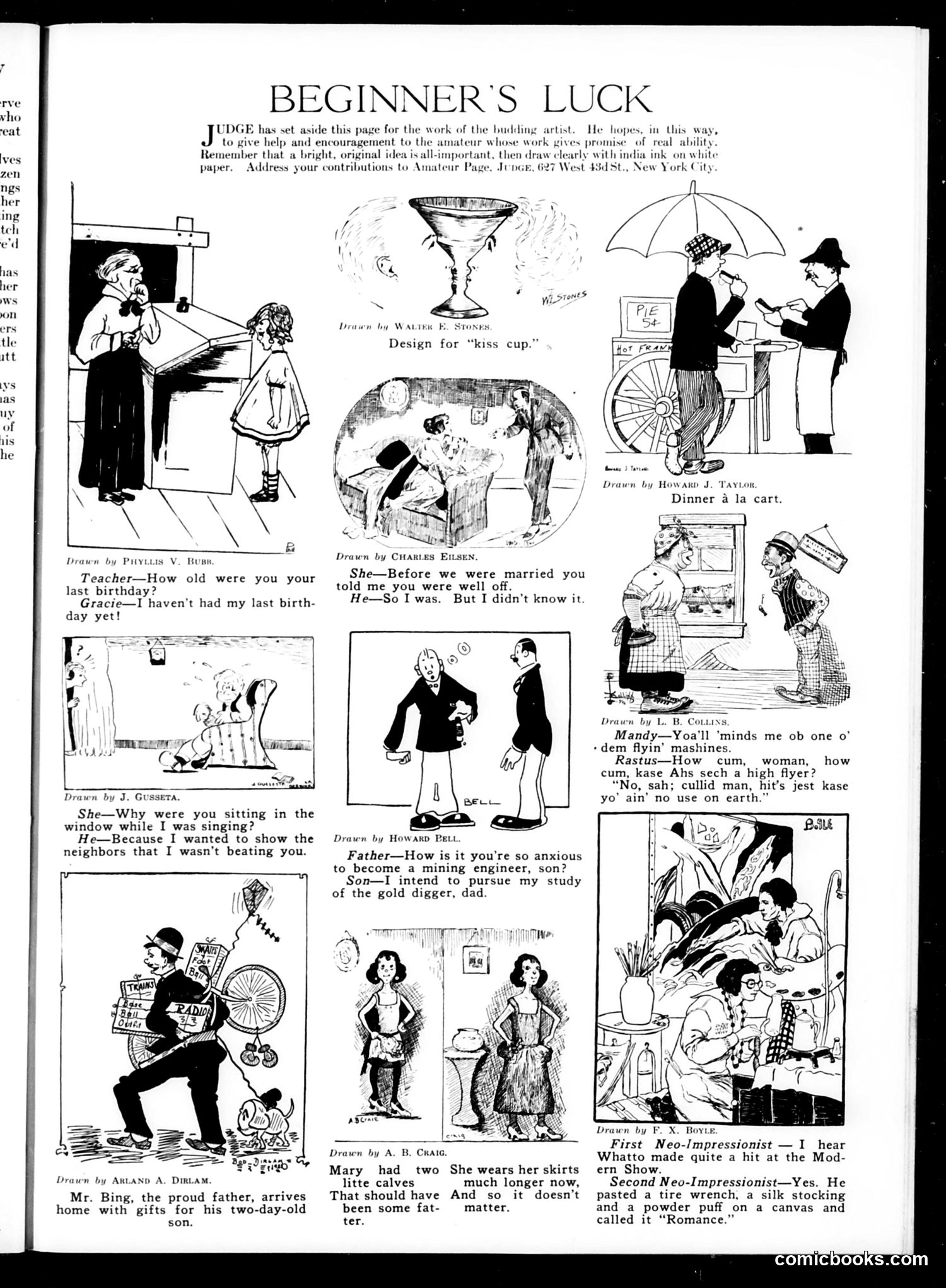
This is a collection of short joke comics showcasing amateur artwork for Judge's "Beginner's Luck" feature, which published promising amateur cartoonists. The jokes employ period-typical humor: a child's logical literalism about birthdays; domestic humor about spousal abuse (darkly joking a husband beats his wife); a new father's pride; financial irony about being "well off" before marriage; a "gold digger" pun about pursuing mining engineering; fashion commentary on hemlines; racist dialect humor featuring Black characters ("Mandy," "Rastus") in a flying machine joke; and satire of modern art pretension (Neo-Impressionism), mocking avant-garde artists for creating meaningless assemblages. The artwork varies in quality, reflecting the amateur status. The page encourages submissions to Judge's Amateur Page at their New York address.
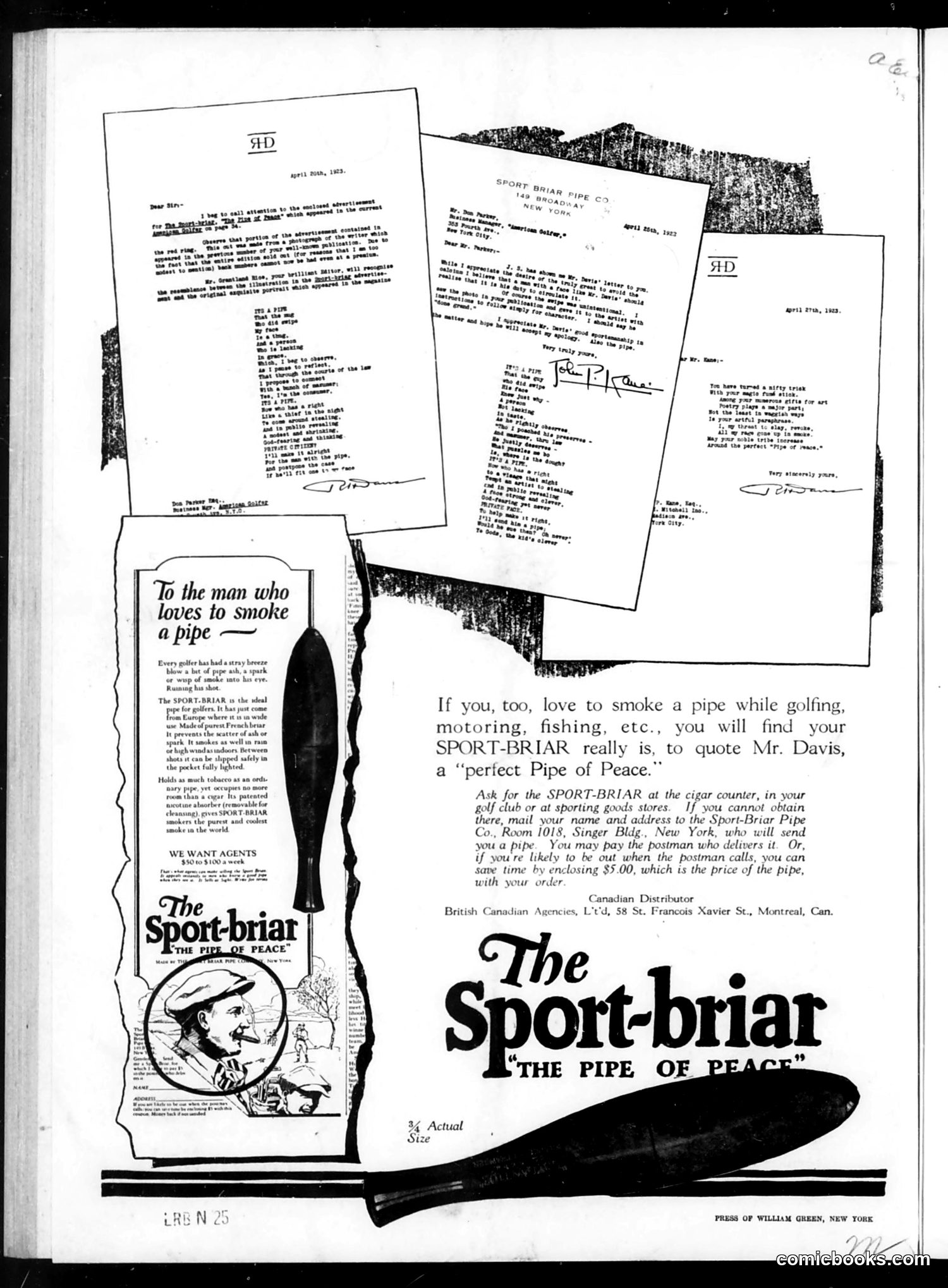
This page is primarily a **vintage product advertisement**, not political satire. It promotes the "Sport-Briar" pipe, marketed as "The Pipe of Peace"—positioned as ideal for outdoor activities like golfing, fishing, and motoring. The advertisement addresses a practical complaint: pipe smokers lose ash and sparks into their eyes during recreational activities. The Sport-Briar claims to solve this problem through superior design. The page includes promotional letters (dated April 1923) praising the product, an agent recruitment appeal ("WE WANT AGENTS"), and distribution information for both U.S. and Canadian markets. A vintage illustration shows a sportsman smoking contentedly. **For modern readers:** This represents early 20th-century product marketing in *Judge* magazine, when tobacco advertising in periodicals was standard and unrestricted. The "peace" branding reflects contemporary marketing rhetoric normalizing smoking in leisure contexts.
I can see this is a blank or nearly blank page from Judge magazine. The page appears to be mostly white space with minimal visible content or text. There are binding marks visible on the left edge and some page markings, but no discernible cartoon, illustration, or substantive text content that would allow me to identify figures, political references, or satirical intent. This may be a title page, an advertisement page, or a page where the original content has faded or failed to reproduce clearly in this scan. Without visible cartoon artwork or readable text, I cannot provide the historical context or explanation you've requested.