
Judge, 1923-06-30 · page 28 of 37
Judge — June 30, 1923 — page 28: what you’re looking at
What you’re looking at
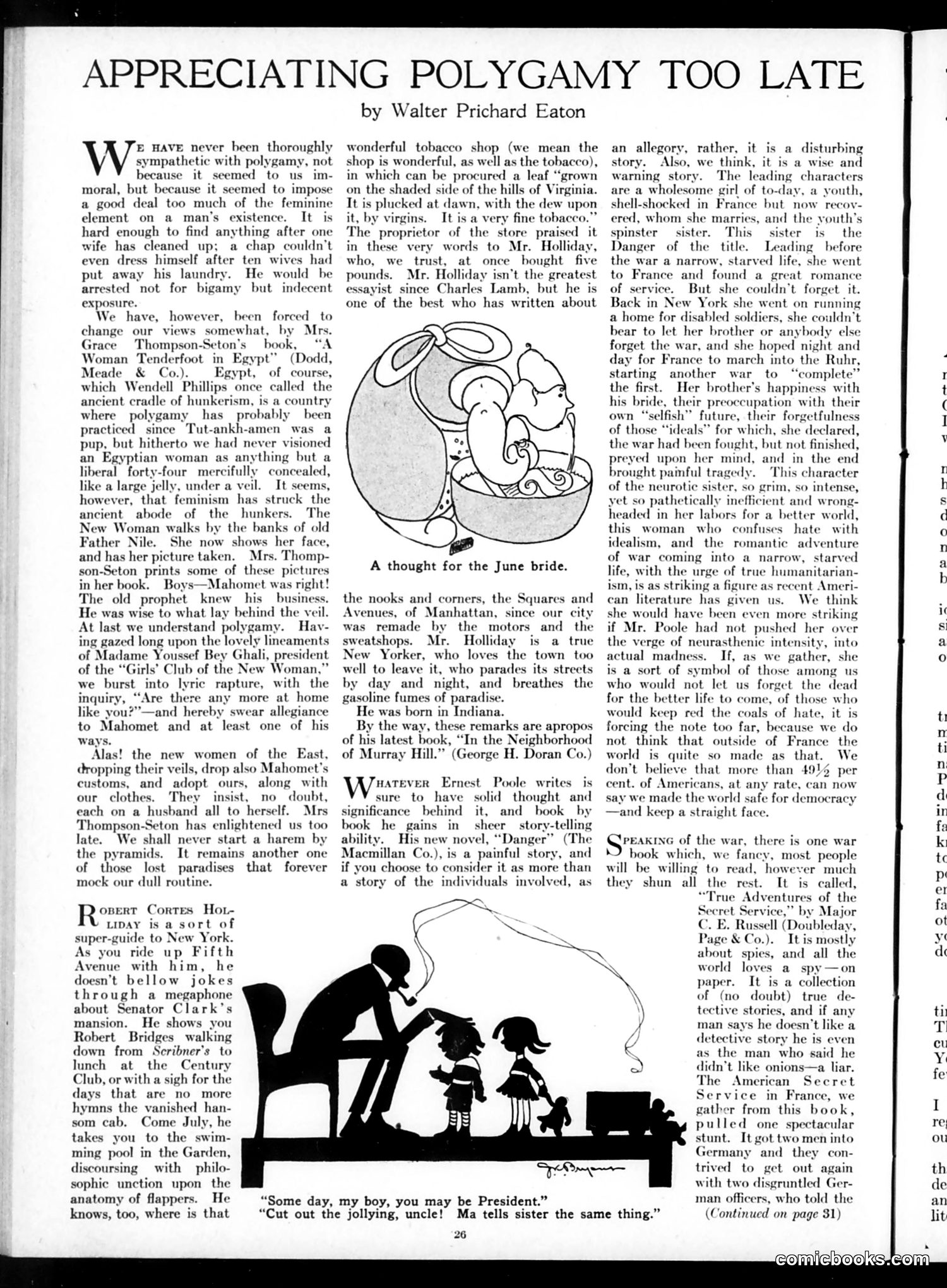
This page contains satirical commentary on early 20th-century social changes, centered on three separate articles and illustrations. ## Main Satire: "Appreciating Polygamy Too Late" The lead article mocks the "New Woman" movement in Egypt. The author initially opposes polygamy for practical reasons (wives create domestic chaos), but after seeing photographs of modern Egyptian women—specifically "Mad Youssef Bey Ghali, president of the 'Girls' Club of the New Woman'"—he humorously reverses his position, declaring allegiance to Mahomet. The joke: these liberated Egyptian women have abandoned traditional veiling and adopted Western customs, meaning they now demand exclusive husbands rather than accepting polygamy. The satire targets the irony that feminism and modernization eliminate the very arrangement the author had (jokingly) come to appreciate. ## Secondary Cartoons One illustration shows an adult bending to children with the caption about "Presidential" behavior—likely social commentary on authority figures. The reviews of books by Thompson-Seton, Holliday, and Poole are straightforward literary notices, not satirical.
📄 Transcribed text from this page (OCR, searchable)
Machine-transcribed from the original scan — historical spelling and the odd misread are preserved.
APPRECIATING POLYGAMY TOO LATE E HAVE never been thoroughly sympathetic with polygamy, not because it seemed to us im- moral, but because it seemed to impose a good deal too much of the feminine element on a man’s existence. It is hard enough to find anything after one wife has cleaned up; a chap couldn't even dress himself after ten wives had put away his laundry. He would be arrested not for bigamy but indecent exposure. have, however, been forced to » our views somewhat, by Mrs. Thompson-Seton’s book, “A Woman Tenderfoot in Egypt” (Dodd, Meade & Co.). Egypt, of course, which Wendell Phillips once called the ancient cradle of hunkerism, is a country where polygamy as probably been practiced since Tut-ankh-amen was a pup, but hitherto we had never visioned an Egyptian woman as anything but a liberal forty-four mercifully concealed, like a large jelly, under a veil. It seems, however, that feminism has struck the ancient abode of the hunkers. The New Woman walks by the banks of old Father Nile. She now shows her face, and has her picture taken. Mrs. Thomp- son-Seton prints some of these pictures in her book. Boys—Mahomet was right! The old prophet knew his _ business. He was wise to what lay behind the veil. At last we understand polygamy. Hav. ing gazed long upon the lovely lineaments of Mad Youssef Bey Ghali, president of the “Girls’ Club of the New Woman,” we burst into lyric rapture, with the inquiry, “Are there any more at home and hereby swear allegiance to Mahomet and at least one of his ways. Alas! the new women of the East, dropping their veils, drop also Mahomet's customs, and adopt ours, along with our clothes. They insist, no doubt, each on a husband all to herself. Mrs Thompson-Seton has enlightened us too late. We shall never start a harem by the pyramids. It remains another one of those lost paradises that forever mock our dull routine. Re Cortes Ho1- Lipay is a sort of super-guide to New York. As you ride up Fifth Avenue with him, he doesn't bellow jokes through a megaphone about Senator Clark’s mansion. He shows you Robert Bridges walking down from Scribner's to lunch at the Century Club, or with a sigh for the days that are no more hymns the vanished han- som cab, Come July, he takes you to the swim- ming pool in the Garden, discoursing with _ philo- sophic unction upon the anatomy of flappers. He knows, too, where is that “Cut out the jollying, uncle! by Walter Prichard Eaton wonderful tobacco shop (we mean the shop is wonderful, as well as the tobacco), in which can be procured a leaf “grown on the shaded side of the hills of a. It is plucked at dawn, with the dew upon it, by virgins. It is a very fine tob : The proprietor of the store pr: in these very words to Mr. Holliday who, we trust, at once bought five pounds. Mr. Holliday isn’t the greatest essayist since Charles Lamb, but he is one of the best who has written about A thought for the June bride. the nooks and corners, the Squares and Avenues, of Manhattan, since our city was remade by the motors and the sweatsho| Mr. Holliday is a true New Yorker, who loves the town too well to leave it, who parades its streets by day and night, and breathes the gasoline fumes of paradise. He was born in Indiana. By the way, these remarks are apropos of his latest book, “In the Neighborhood of Murray Hill.” (George H. Doran Co.) HATEVER Ernest Poole writes is sure to have solid thought and significance behind it, and book by book he gains in sheer story-telling ability. His new novel, “Danger” (The Macmillan Co.), is a painful story, and if you choose to consider it as more than a story of the individuals involved, as “Some day, my boy, you may be President.” 26 an allegory, rather, it is a disturbing story. Also, we think, it is a wise and warning story. The leading characters are a wholesome girl of to-day, a youth, shell-shocked in France but now recov- ered, whom she marries, and the youth’s spinster sister. This sister is the Danger of the title. Leading before the war a narrow, starved life, she went to France and found a great romance of service. But she couldn't forget it. Back in New York she went on running a home for disabled soldiers, she couldn't bear to let her brother or anybody else forget the war, and she hoped night and day for France to march into the Ruhr, starting another to “complete” the first. Her brother's happiness with his bride, their preoccupation with their own “selfish” future, their forgetfulness of those “ideals” for which, she declared, the war had been fought, but not finished, preyed upon her mind, and in the end brought painful tragedy. This character of the neurotic sister, so grim, so intense, yet so pathetically inefficient and wrong- headed in her labors for a better world, this woman who confuses hate with idealism, and the romantic adventure r coming into a narrow, starved sith the urge of true humanitarian- ism, is as striking a figure as recent Ameri- can literature has given us. We think she would have been even more striking if Mr. Poole had not pushed her over the verge of neurasthenic intensity, into actual madness. If, as we gather, she is a sort of symbol of those among us who would not let us forget the dead for the better life to come, of those who would keep red the coals of hate, it is forcing the note too far, because we do not think that outside of France the world is quite so made as that. We don’t believe that more than 4914 per cent. of Americans, at any rate, can now say we made the world safe for democracy —and keep a straight face. PEAKING of the war, there is one war ‘SD book which, we fancy, most people will be willing to read, however much they shun all the rest. It is called, “True Adventures of the Secret Service,” by Major C. E. Russell (Doubleday, Page & Co.). It is mostly about spies, and all the world loves a spy —on paper. It is a collection of (no doubt) true de- tective stories, and if any man s he doesn’t like a detec! story he is even as the n who said he didn’t like onions—a liar. The American Secret Service in France, we gather from this book, pulled one spectacular stunt. It got two men into Germany and they con- trived to get out again with two disgruntled Ger- man officers, who told the Ma tells sister the same thing.” (Continued on page 31)