
Judge, 1923-06-30 · page 22 of 37
Judge — June 30, 1923 — page 22: what you’re looking at
What you’re looking at
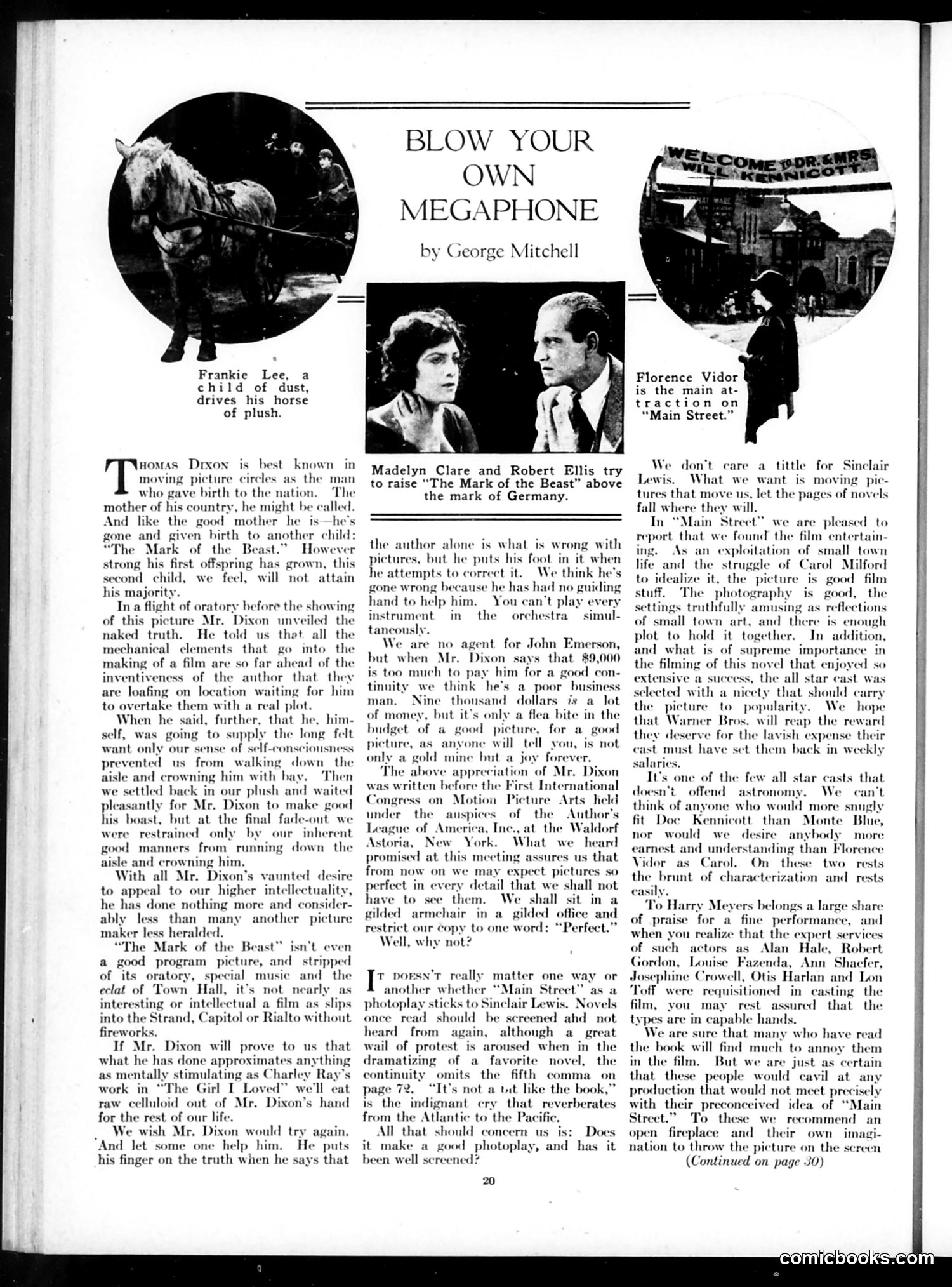
This is a film review criticizing director Thomas Dixon's movie "The Mark of the Beast." The article argues that Dixon, famous for *Birth of a Nation*, relies too heavily on spectacle and oratory while neglecting storytelling fundamentals. **The Satire:** The title mocks Dixon's self-promotion—his tendency to "blow his own megaphone" about his films. The review contends that despite Dixon's intellectual pretensions and technical ambitions, the film fails because he attempts to do everything himself without collaborators. The critic specifically criticizes Dixon's rejection of paying screenwriter John Emerson $9,000, arguing this penny-pinching undermines the production. **The Point:** Judge argues that filmmaking requires teamwork—you "can't play every instrument in the orchestra simultaneously." The review also attacks literary purists who obsess over minor details (like a missing comma in a novel) rather than judging whether a film works as cinema on its own terms.
📄 Transcribed text from this page (OCR, searchable)
Machine-transcribed from the original scan — historical spelling and the odd misread are preserved.
Frankie Lee, a child of dust, drives his horse of plush. Homas Drxon is best moving picture circle: who gave birth to the 1 mother of his country, he mig! And like the good mother he is gone and given birth to another child: “The Mark of the Beast.” However strong his first offspring has grown, this second child, we feel, will not attain his majority. Ina flight of oratory before the showing of this picture Mr. Dixon unveiled the naked truth. He told us thet all the mechanical elements that into. the making of a film are so far ahead of the inventiveness of the author that they afing on location waiting for him to overtake them with a real plot. When he said, further, that he, him- self, was going to supply the long. felt want only our sense of self-consciousness nted us from walking down the 1 crowning him with bay. Then settled back in our plush and waited pleasantly for Mr. Dixon to make good his boast, but at the final fade-out we were restrained only by our inherent good manners from running down the aisle and crowning him. With all Mr. Dixon’s vaunted desire to appeal to our higher intellectuality, he has done nothing more and consider- ably less than many another picture maker less heralded. “The Mark of the a good program pictu of its oratory, spec music and the eclat of Town Hall, it’s not nearly as interesting or intellectual a film as slips into the Strand, Capitol or Rialto without fireworks. If Mr. what he known go we * isn't even . and. stripped Dixon will prove to us that done approximates anything as mentally stimulating as Charley Ray’s work in 1 TI Loved” we'll eat raw celluloid out of Mr. Dixon’s hand for the rest of our life. _. We wish Mr. Dixon would try again. ‘And let ‘some one help him. He puts his finger on the truth when he says that BLOW YOUR OWN MEGAPHONE by George Mitchell Madelyn Clare and Robert Ellis try to raise “The Mark of the Beast” above the mark of Germany. » author alone is what is wrong with tures, but he puts his foot in it when he attempts to correct it. We think } gone wrong because he had no guidin, hand to help him. You can’t play every instrument in’ the orchestra — simul- taneously. We are no agent for John Emerson, but when Mr. Dixon says that $9,000 is too much to pay him for a good con- tinuity we think he’s a poor. business man. Nine thousand dollars i lot of money, but it’s only a flea bite in the budget of a good picture, for a good picture, as anyone will tell you, is not only a gold mine but a joy forever. The above appreciation of Mr. Dixon was written before the First International Congress on Motion Picture Arts held under the auspi of the Author's League of Ame t the Waldorf Astoria, New heard us that from now on we m tures so perfect in every detail that we shall not have to see them. We shall sit in a gilded armchair in a gilded office and restrict our Copy to one word: “Perfect.” Well, why not? atter one ain Street” as a lair Lewis. Novels reened ahd not Ithongh a great T DOESN'T ree another whether * phot once read should heard from agai wail of protest is aroused when in th dramatizing of a favorite novel, the continuity omits the fifth comma on page 72, “It’s not a tt like the boc is the indignant cry that reverberates from the Atlantic to the Pacific. All that should concern us is: Does it make a good photoplay, and has it been well screened? 20 Florence Vidor is the main at- traction on “Main Street.” We don't care a tittle for Sinclair Lewis. What we want is moving pic- tures that move us, let the pages of novels fall where they will. In “Main Street” we are p! report that we found the film ente As an exploitation of small t nd the struggle of Carol Mil to idealize it, the picture is good. film stuff. The photography is good, the settings truthfully amusing as reflections of small town art, and there is enough plot to hold it together. In i and what is of supreme i the filming of this novel that enjoyed so extensive a success, the all star cast was selected with a nicety that should carry the picture to popularit We hope that Warner Bros. will reap the reward deserve for the lavish expense their ast. have set them back in weekly life It’s one of the few all star nd astronomy. think of me who would more snugly fit Doe micott. than Monte Blue, nor would we desire anybody more earnest and understanding than Florence Vidor as Carol. On these two rests the brunt of characterization and_ rests easily. To Harry Meyers by gs a large share of praise for a fine performance, a when you realize that the expert services of such actors as Alan Hale, Robert Gordon, Louise Fazenda, Ann Shaefer, Josephine Crowell, Otis Harlan and Lon Toff were requisitioned in’ ea the film, you may rest assured types are in capable hands. We are sure that many who have read the book will find much to annoy them in the film. But we are just as certain that these people would cavil at any production that would not meet precisely with their preconceived idea of “Main Street.” To these we recommend an open fireplace 1 their own imagi- nation to throw the picture on the screen (Continued on page 30) doesn’t ¢