
Judge, 1923-06-30 · page 11 of 37
Judge — June 30, 1923 — page 11: what you’re looking at
What you’re looking at
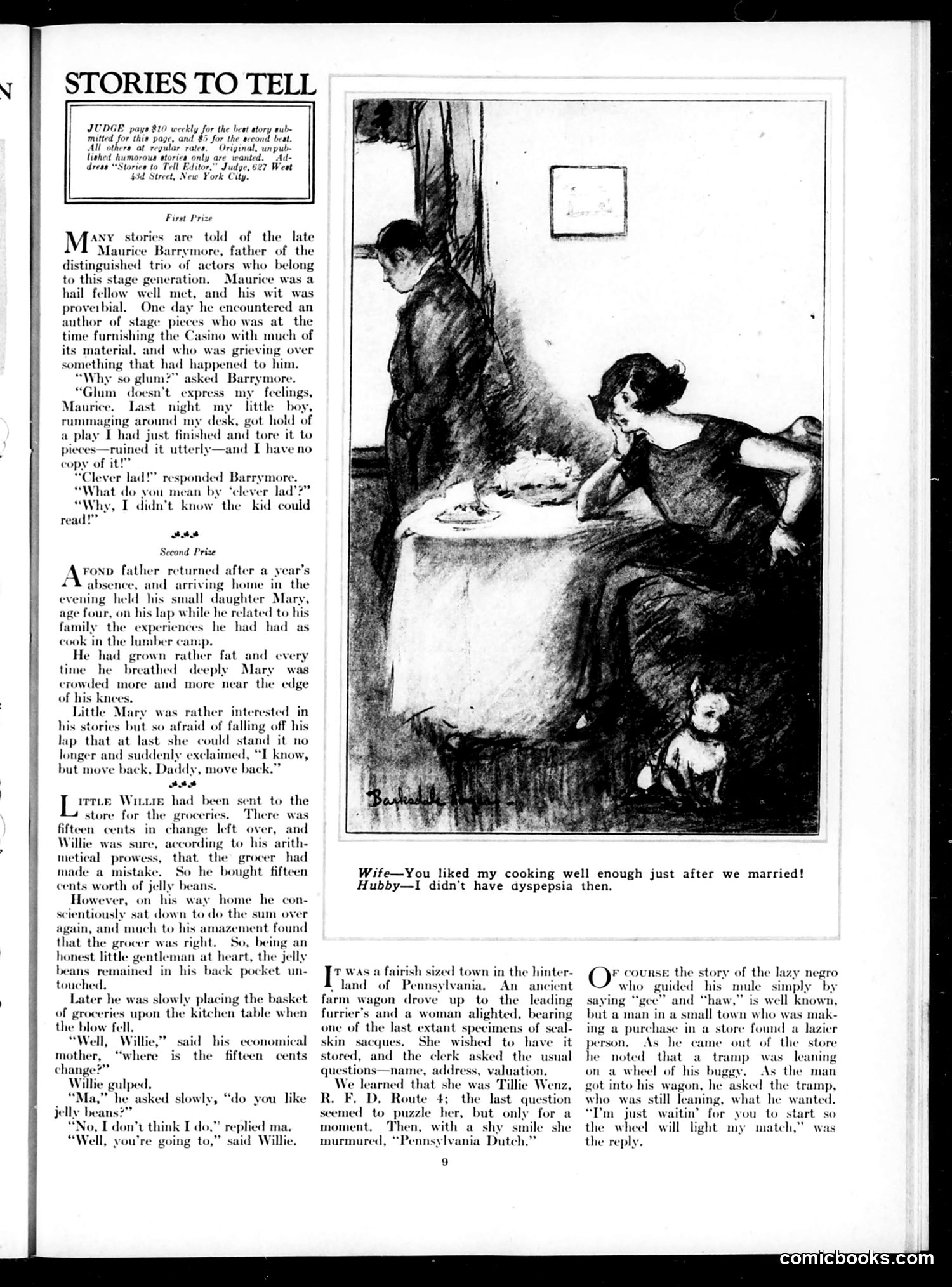
This page from *Judge* magazine contains three humorous anecdotes (short stories) submitted by readers, competing for prize money. The content reflects early 20th-century American social attitudes: **The cartoons/illustrations** show domestic scenes: a man and woman at a table (accompanying a marriage joke about the wife's cooking declining), and a scene from the stories. **Key satirical points:** 1. **Maurice Barrymore anecdote**: Wit-based humor about a playwright whose manuscript is destroyed—the joke hinges on class assumptions (a child who can read is "clever"). 2. **Marriage joke**: Husband blames his digestive illness ("dyspepsia") for no longer praising her cooking—implies wives' cooking quality hasn't changed, only his tolerance has. 3. **Ethnic/racial humor**: References to "lazy negro" and "Pennsylvania Dutch" character types reflect period stereotyping that modern readers would recognize as offensive. 4. **Honest boy story**: Values childhood honesty in returning found money. The page illustrates how *Judge* solicited humor from ordinary readers while normalizing racial and ethnic caricatures typical of the era.
📄 Transcribed text from this page (OCR, searchable)
Machine-transcribed from the original scan — historical spelling and the odd misread are preserved.
STORIES TO TELL JUDGE pays 810 weekly for the best story aub- mitted for this page, and 85 for the accond beat. All others at regular rates.” Original, unpub- lished humorous atories only are wanted. Ad. dress “Stories to Tell Editor,” Judge, 627 Wet 43d Street, New York City. First Prize ANY stories are told of the late Maurice Barrymore, father of the distinguished trio of actors who belor to this stage generation. Maurice we a hail fellow well met, and his wit was proverbial. One day he encountered an author of stage pie who was at the time furnishing the Casino with much of its material, and who was grieving over happened to him, ?* asked Barrymore. n't express my feeling: night’ my little boy, ng around my d got hold of T had just finished and tore it to pieces—ruined it utterly—and I have no copy of it! “Clever lad!" responded Barry “What do you mean by ‘clever lad’? “Why, I didn’t know the kid could read!" sae Second Prize FoND father returned after a year’s fA absence, and arriving home in the evening held his small daughter Ma age four, on his lap while he related to hi family the experiences he had had as cook in the lumber camp. He had grown rather fat and every time he breathed deeply Mary was crowded more and more near the edge | of his knees. Little Mary was rather interested in his stories but so afraid of falling off his lap that at last she could stand it no longer and sudde ‘I know, but move back, I “k.” ite Witure had been sent to the store for the groceries. There was fifteen cents in change left over, and Willie was sure, according to his arith- that the grocer had made a mistake. So he bought fifteen Wife—You liked my cooking well enough just after we married! cents worth of jelly beans. Hubby—I didn’t have dyspepsia then. However, on his way home he con- scientiously sat down to do the sum over again, and much to his z ment found that the grocer was right. So, being an honest little gentleman at heart, the jelly beans remained in his back pocket un- T was a fairish sized town in the hinter- Or course the story of the lazy negro touched. t land of Pennsylvania. An who guided his mule simply by Later he was slowly placing the basket farm wagon drove up to_ the saying “gee” and “haw,” is well known, of groceries upon the kitchen table when furrier’s and a woman alighted, bearing but a man ina small town who was 1 the blow fell. one of the last extant specimens of seal- ing a purchase in a store found a | “Well, Willie,” said his economical skin sacques. She wished to have it person. As he came out of the s mother, “where is the fifteen cents stored, and the clerk asked the usual he noted that a tramp was | change?” questions—name, address, valuation. on a wheel of his bugg: As the man Willie gulped. We learned that she was Tillie Wenz, got into his wagon, he «the tramp, “Ma,” he asked slowly, “do you like R. F. D. Route 4; the last question who was still leaning, what he wanted. jelly beans?” seemed to puzzle her, but only for a “I’m just’ waitin’ for you to start so No, I don’t think T de moment. Then, with a shy smile she the wheel will light my match,” was “Well, you're going te murmured, “Pennsyly Dutch.” the reply. metical prowess, 9