
Judge, 1923-06-30 · page 21 of 37
Judge — June 30, 1923 — page 21: what you’re looking at
What you’re looking at
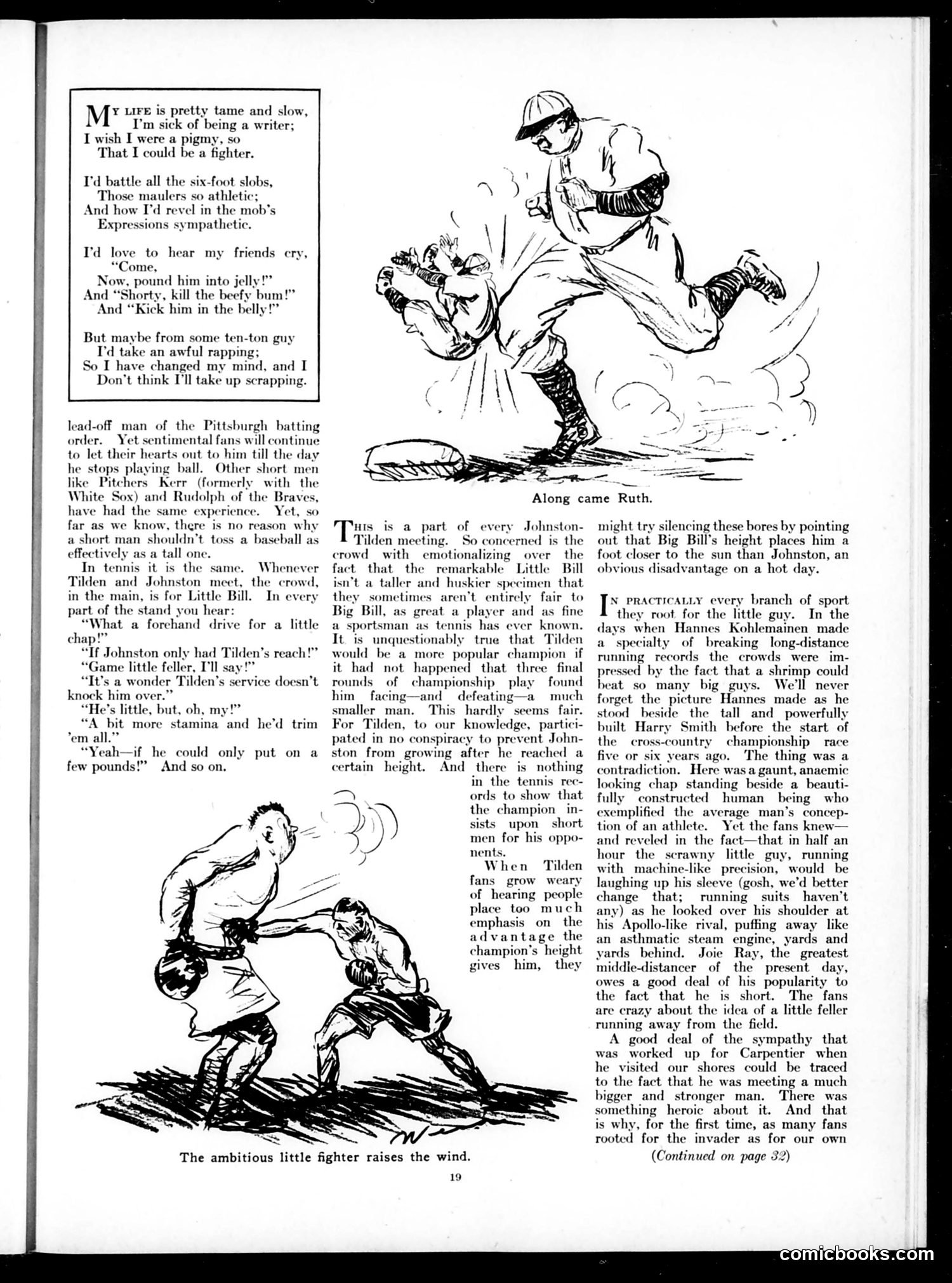
This page discusses the public's affection for undersized athletes, using tennis champion **Bill Johnston** (the "Little Bill") as the primary example. Johnston competed against the taller **Big Bill Tilden** in championship matches. The satirical argument is that crowds emotionally favor Johnston despite his disadvantage, expressing sympathy ("pound him into jelly!") rather than fairly evaluating both players' skills. The author notes this bias appears across sports—fans loved Finnish runner **Hannes Kohlemainen** for beating larger competitors, and favor shorter distance runner **Joie Ray**. The accompanying verse mocks someone wishing to be a "pigmy" fighter to battle "six-foot slobs," only to reconsider when imagining retaliation from a "ten-ton guy." **The satire**: Judge critiques how spectators romanticize underdogs based on physical size rather than athletic merit, making irrational judgments that may unfairly diminish greater competitors' accomplishments.
📄 Transcribed text from this page (OCR, searchable)
Machine-transcribed from the original scan — historical spelling and the odd misread are preserved.
Y LIFE is pretty tame and slow, I'm sick of being a writer; I wish I were a pigmy, so That I could be a fighter. Td battle all the six-foot slobs, Those maulers so athletic; And how I'd revel in the mob’s Expressions sympathetic. I'd love to hear my friends ery, “Come, Now, pound him into jelly!” And “Shorty, kill the beefy And “Kick him in the belly!” But maybe from some ten-ton guy I'd take an awful rapping; So I changed my mind, and I Don't think I'll take up scrapping. lead-off man of the Pittsburgh batting order. Yet sentimental fans will continue to let their hearts out to him till the day he stops playing ball. Other short men like Pitchers Kerr (formerly with the White Sox) and Rudolph of the Braves, have had the same experience. Yet, so far as we know, there is no reason why shouldn’t toss a baseball as as a tall onc In tennis it is the same. Whenever Tilden and Johnston meet, the crowd, in the main, is for Little Bill. In every part of the stand you } »hnston only had Tilden’s reach!” ame little feller, I'll if a wonder Tilden knock him over.” “He's little, but, oh, my!” “A bit more stamina and he'd trim “em all.” “Yeah—if he could only put on a few pounds!” And so on, rvice doesn’t Along came Ruth. "Ts is a part of every Johnston- Tilden meeting. So concerned is the crowd with emotionalizing over the fact. that the remarkable Little Bill isn’t a taller and huskier specimen that they sometimes aren't entirely fair to Big Bill, as gi das fine a sportsman as te r known. It is unquestionably true that Tilden would be a more popular champion if it had not happened that three final rounds of championship play found him facing—and defeating—a_ = much smaller man. This hardly seems fai For Tilden, to our knowledge pated in no conspiracy to prevent John- ston from growing after he reached a certain height. And there is nothing in the tennis re ords to show th the champion_ in- sists upon short men for his oppo- nents. When Tilden fans grow weary of hearing people place too much emphasis on the advantage the champion’s height gives him, they D The ambitious little fighter raises the wind. 19 might try silencing these bores by pointing out that Big Bill’s height places him a foot closer to the sun than Johnston, an obvious disadvantage on a hot day. PRACTICALLY every branch of sport they root for the little guy. In the s when Hannes Kohlemainen made a specialty of breaking long-distance running records the crowds were im- pressed by the fact that a shrimp could beat so many big guys. We'll never forget the picture Hannes made as he stood beside the ll and powerfully built Harry Smith before the start of the cross-country championship — race five or six years ago. The thing was a contradiction. Here was a gaunt, anaemic looking chap standing beside a beauti- fully constructed human being who exemplified the average man’s concep- tion of an athlete. Yet the fans knew— and reveled in the fact—that in half an hour the scrawny little guy, running with machin precision, would be laughing up his sleeve (gosh, we’d better change that; running suits haven't any) as he looked over his shoulder at his Apollo-like rival, puffing y like an asthmatic steam engine, yards and yards behind. Joie Ray, the greatest middle-distancer of the present day, owes a good deal of his popularity to the fact that he is short. The fans about the idea of a little feller running away from the field. A good deal of the sympathy that worked up for Carpentier when he visited our shores could be traced to the fact that he was meeting a much bigger and stronger man. There was something heroic about it. And that is why, for the first time, as many fans rooted for the invader as for our own (Continued on page 32)