
A complete issue · 36 pages · 1923
Judge — April 7, 1923
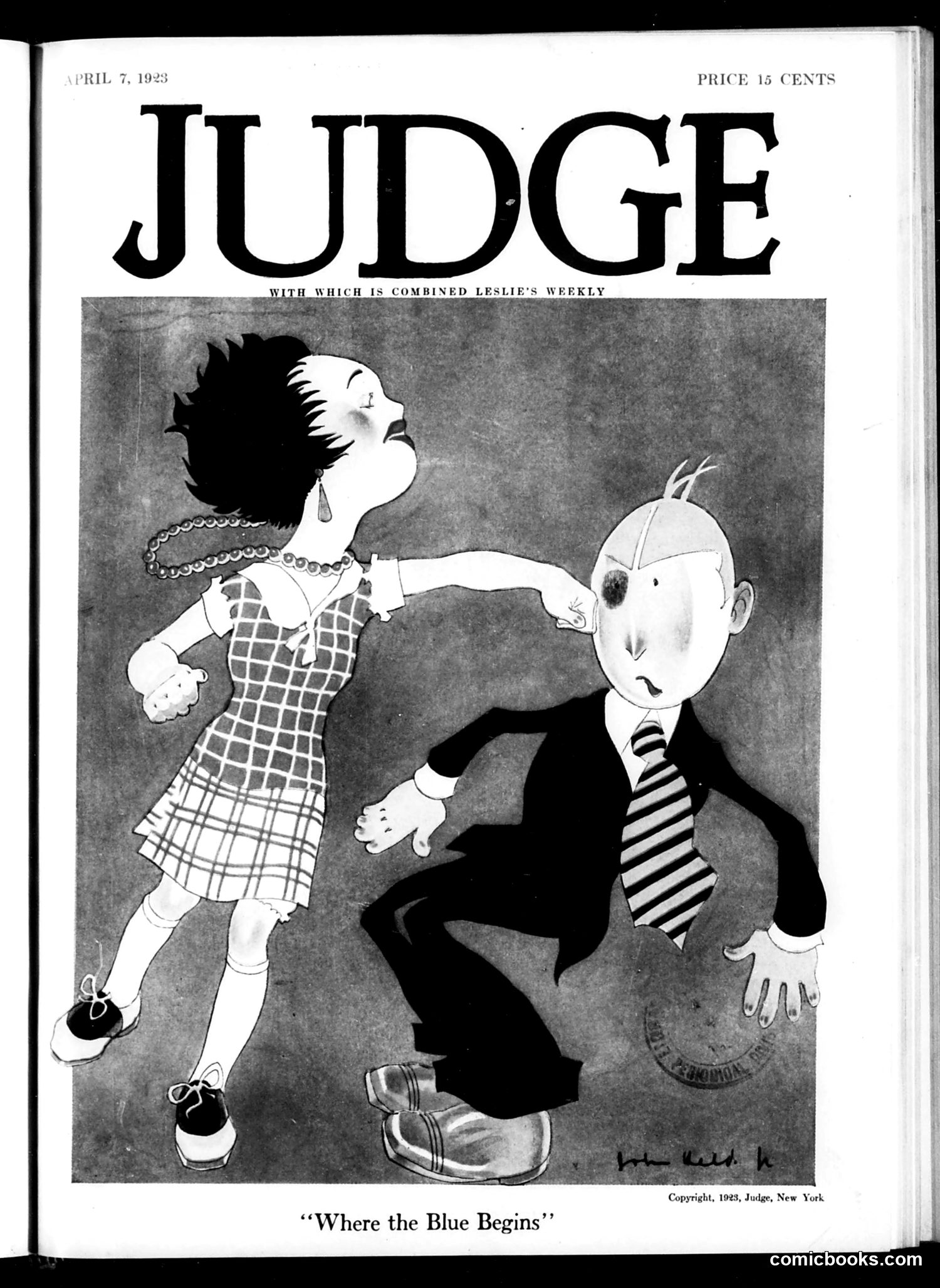
This cartoon illustrates a flirtation scene titled "Where the Blue Begins," depicting a woman in a checkered dress playfully striking a man's head. The man appears comically dazed or confused by her attention. The title likely references a 1922 novel by Louis Bromfield called "Where the Blue Begins," a satirical work about a dog navigating human society. The cartoon appears to satirize modern courtship rituals of the 1920s—the "Jazz Age"—when women had gained more social freedom and romantic initiative following women's suffrage. The exaggerated, cartoonish style typical of Judge magazine uses physical comedy and caricature to mock contemporary dating dynamics and changing gender roles during this progressive era.
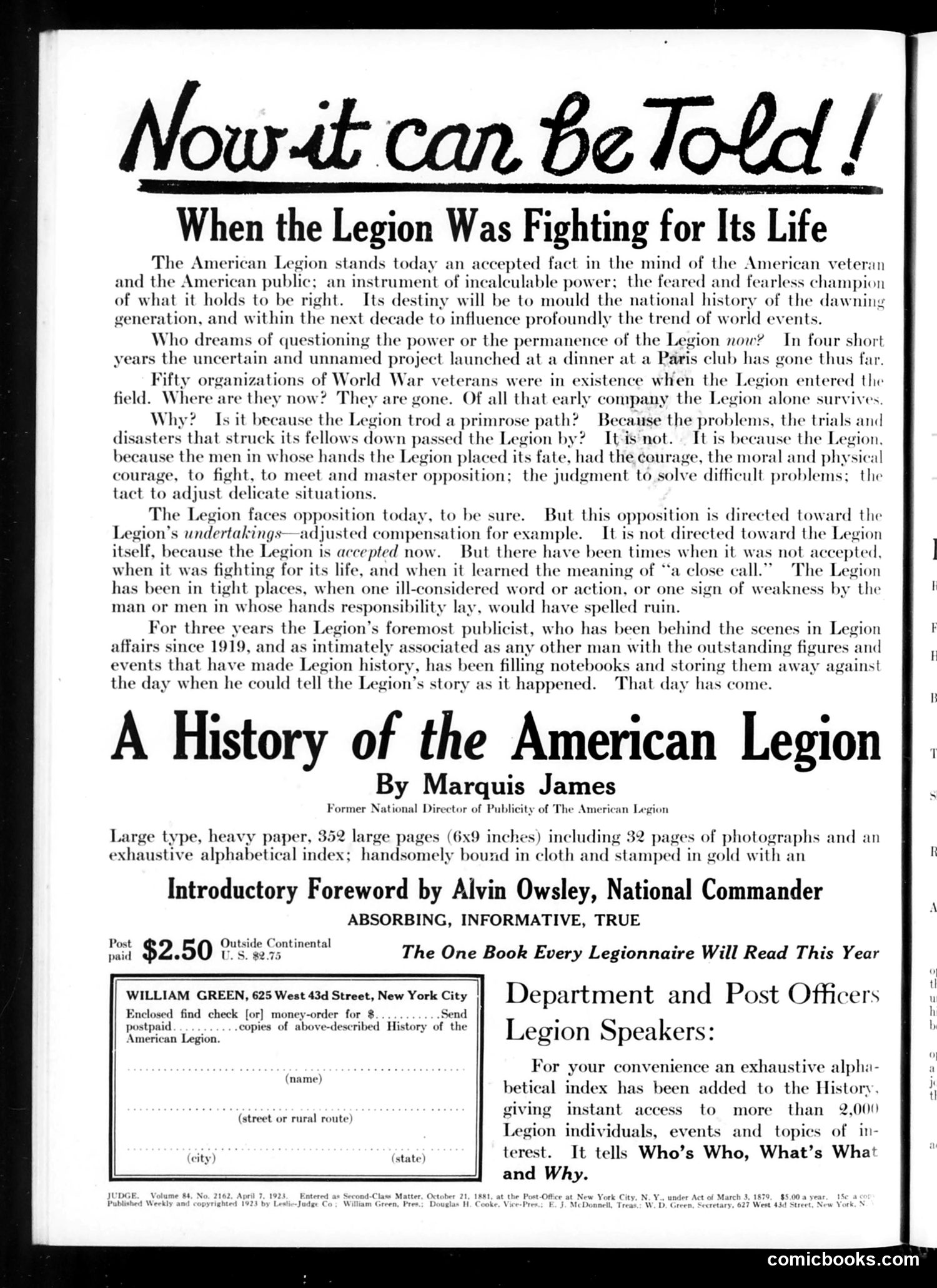
This page is primarily **advertising, not satire or cartoon content**. It promotes "A History of the American Legion" by Marquis James, the Legion's former national publicity director. The text is promotional copy emphasizing the Legion's establishment power and permanence among veteran organizations. It claims the Legion survived where fifty other WWI veteran groups disappeared, attributing this to strong leadership and the "courage" of its members to face opposition. The page includes an order form for the book ($2.50 postpaid) and advertises that an "exhaustive alphabetical index" makes it useful for "Legion Speakers" needing reference material on "Who's Who, What's What and Why." There is **no political satire or cartoon present**—this is a straightforward institutional promotion typical of early 1920s magazine advertising.
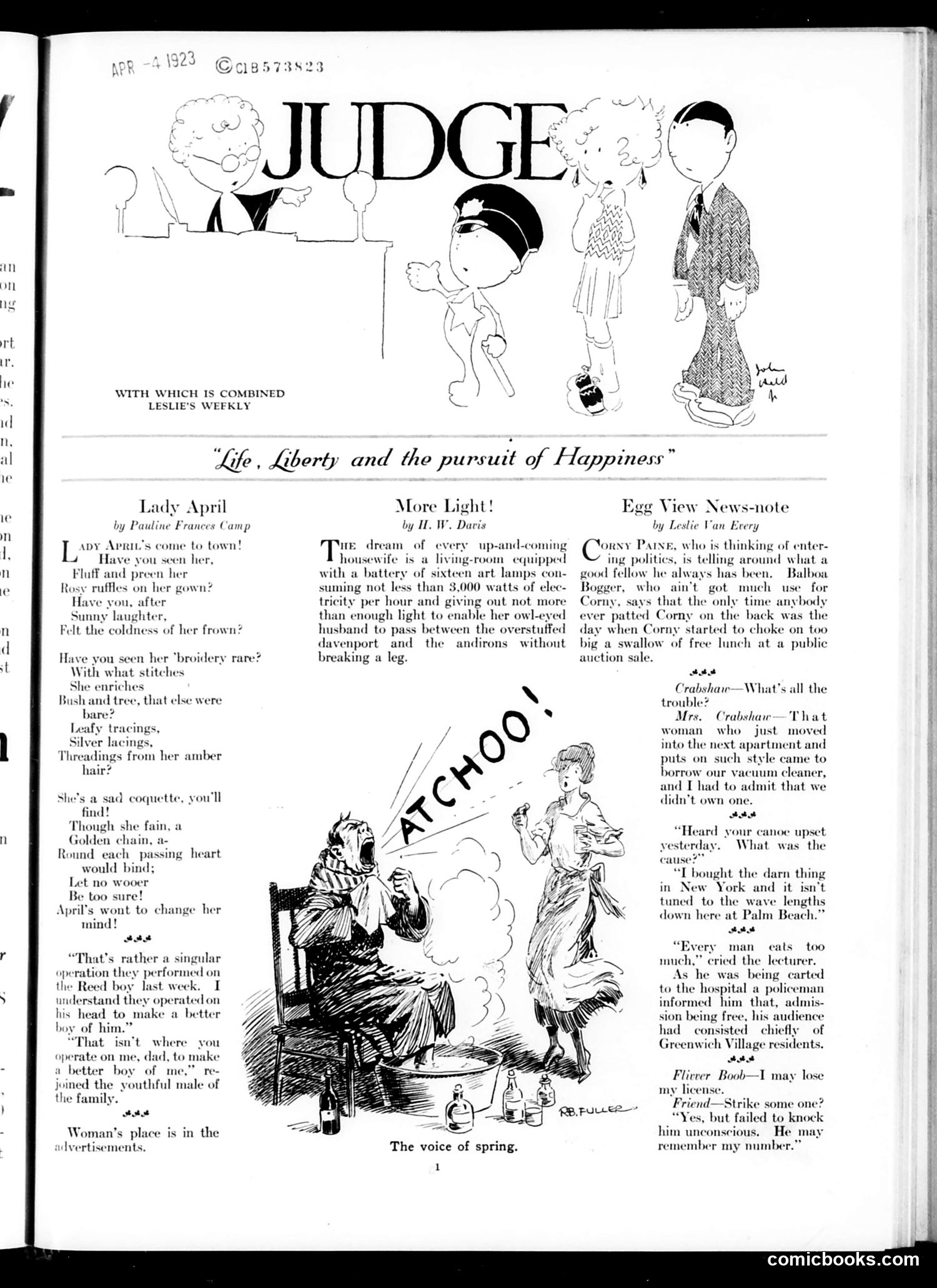
This page contains three separate humor pieces rather than a unified political cartoon. **"Lady April"** is a nostalgic poem about a woman's return to town, celebrating her fashionable appearance and embroidery skills—typical 1920s domestic humor. **"More Light!"** satirizes housewives' desire for bright living rooms, mocking the impracticality of husbands needing to navigate around excessive lighting fixtures. **"The voice of spring"** (the large illustration) depicts a woman being startled by a "ACHOO!"—likely satirizing spring allergies or the season's disruptions to comfort. **"Egg View News-note"** contains brief gossipy anecdotes about local society figures, including references to politics and a canoe accident. The humor is gentle, domestic-focused satire typical of 1920s Judge magazine, targeting middle-class family life rather than serious political commentary.
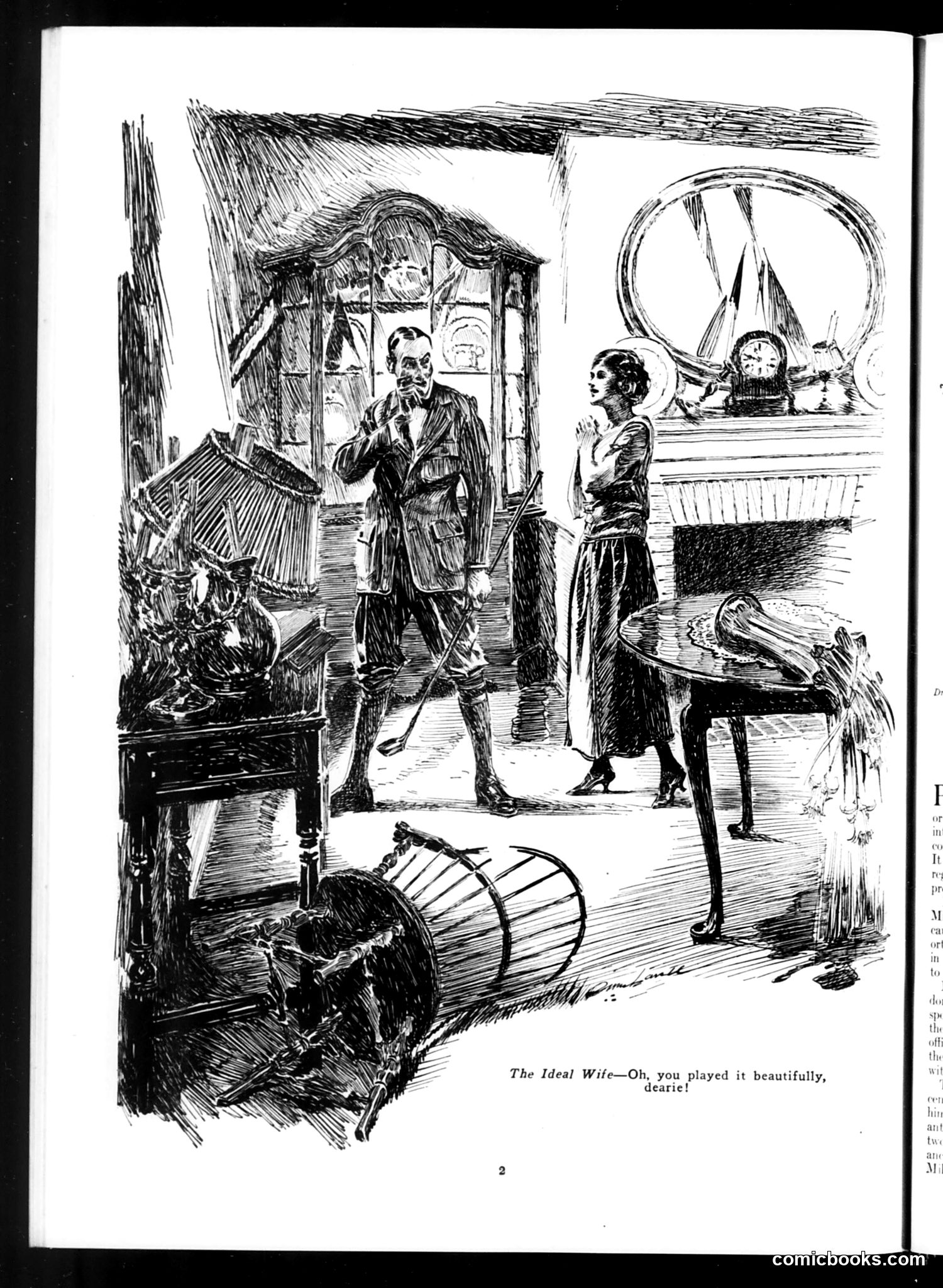
This appears to be a domestic comedy sketch from Judge magazine, likely early-to-mid 20th century based on the art style and clothing. The cartoon depicts a woman playing what seems to be a mechanical musical instrument (possibly a barrel organ or player piano) in an ornate interior, while a man praises her: "Oh, you played it beautifully, dearie!" The satire targets idealized notions of wives as passive entertainers for their husbands' amusement. The woman is literally operating a mechanical device—suggesting wives were expected to perform on command like automatons rather than as autonomous individuals. The caption's patronizing tone ("dearie") underscores the condescension embedded in such gender expectations. This reflects early 20th-century critiques of women's limited domestic roles.
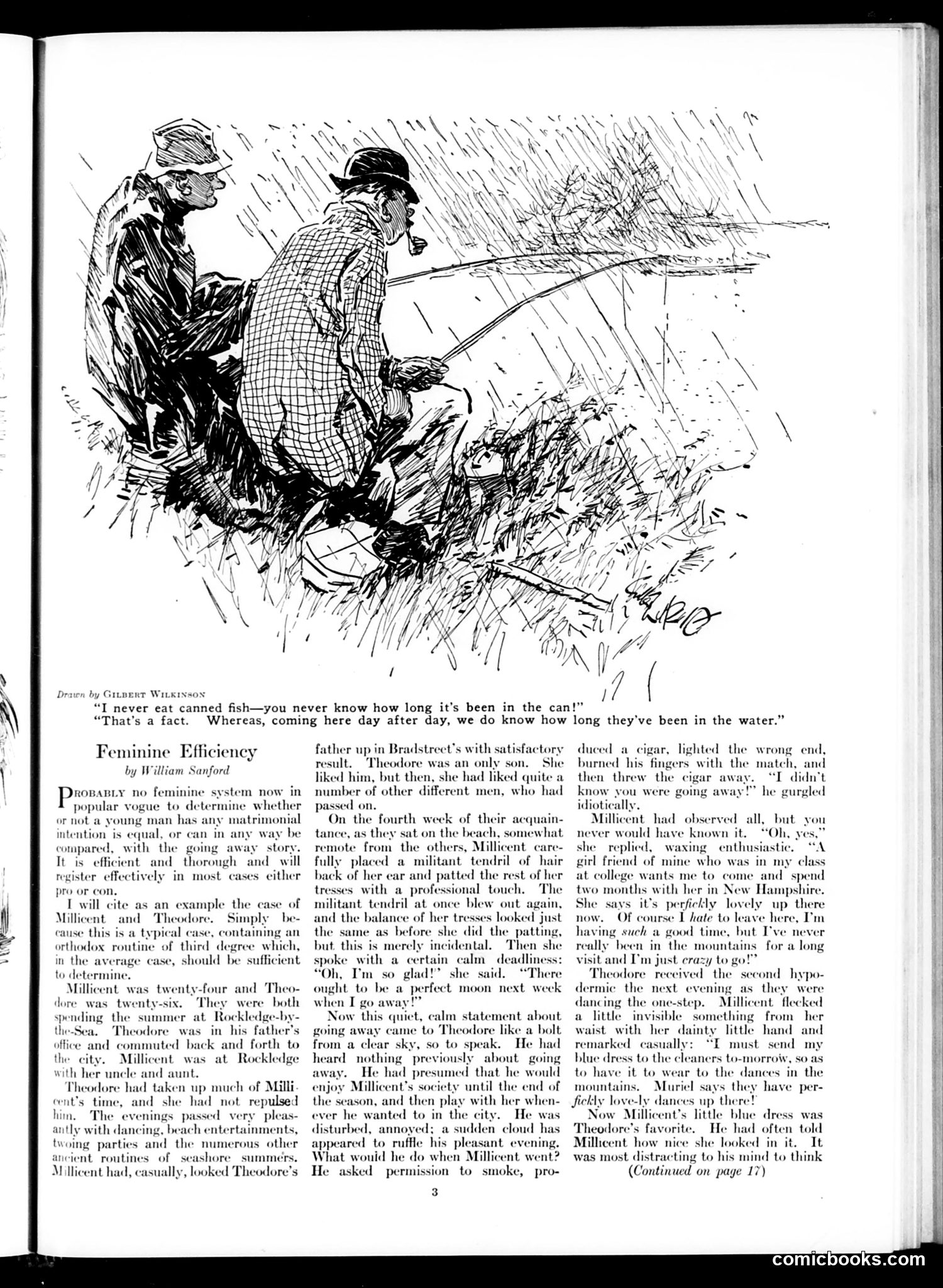
This page contains a short story titled "Feminine Efficiency" illustrated by Gilbert Wilkinson, not a political cartoon. The story satirizes early 20th-century gender roles and romantic expectations. The illustration shows two men fishing, introducing a narrative about a young woman named Millicent who challenges social conventions. The story mocks the "modern woman" trope: Millicent efficiently manages multiple suitors simultaneously—dating Theodore, smoking cigarettes (scandalous for women then), and maintaining independence rather than passively awaiting marriage. The satire targets both the "new woman" who rejected traditional femininity and male assumptions about female behavior. The fishing scene's caption—about not knowing how long canned fish has been stored—ironically parallels uncertainty about women's true intentions and reliability, reflecting period anxieties about changing gender dynamics.
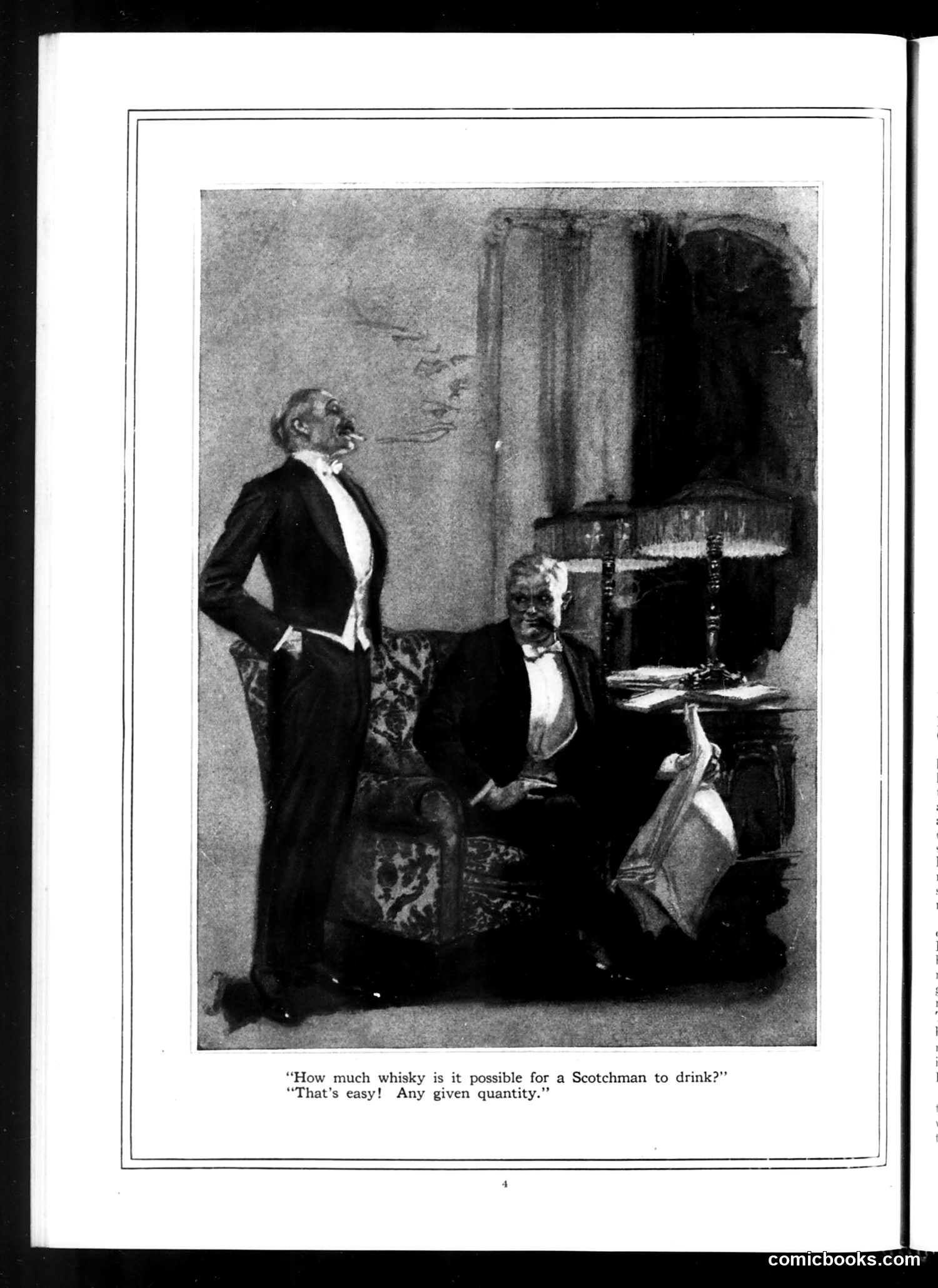
This cartoon presents a joke about Scottish drinking capacity. Two well-dressed men in formal attire—one standing, one seated—discuss whisky consumption. The standing man asks, "How much whisky is it possible for a Scotchman to drink?" The seated man replies, "That's easy! Any given quantity." The satire plays on a common stereotype about Scottish people and alcohol consumption, particularly whisky. The joke's premise is that a Scotsman has an unlimited capacity to drink whisky—whatever amount is offered, he'll drink it. This relies on ethnic stereotyping common in early-to-mid 20th century American humor magazines like *Judge*. The formal setting and dress contrast humorously with the crude subject matter, typical of the magazine's satirical approach.
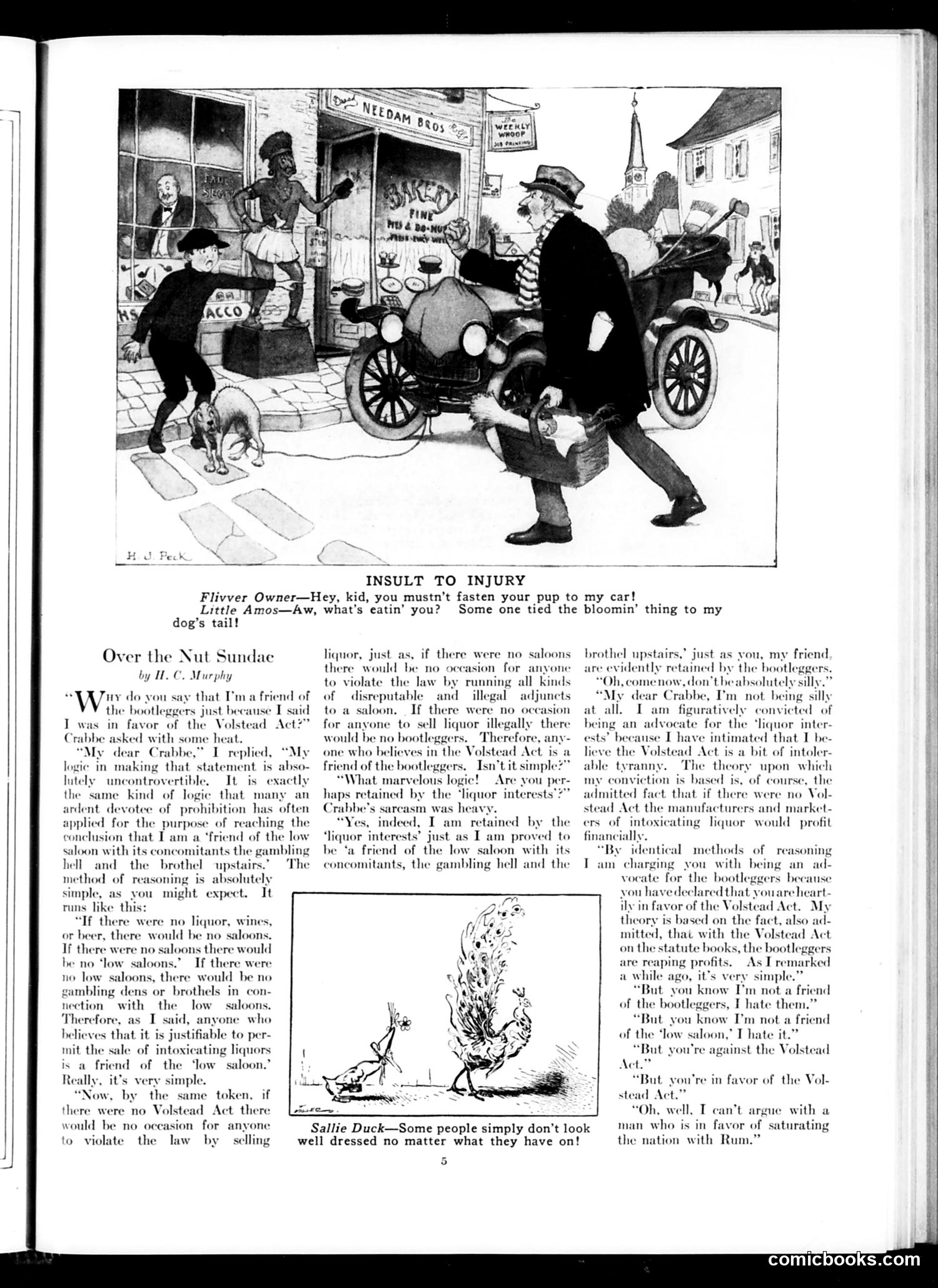
This *Judge* magazine page satirizes Prohibition-era debate through two cartoons: **"Insult to Injury"** (top): A man complains that a child tied a dog to his car. The joke plays on the absurdity of minor grievances amid larger social chaos—likely reflecting how Prohibition created bigger problems (bootlegging, crime) than the drinking it aimed to prevent. **"Over the Nut Sundae"** (main article): Two men debate the Volstead Act (Prohibition law, 1920-1933). One uses circular logic to argue that opposing Prohibition makes one a "friend of bootleggers"—just as supporting it makes one a "friend of bootleggers" (since they profit from illegality). The satire mocks both sides' flawed reasoning and suggests Prohibition's unintended consequence: enriching criminals rather than eliminating vice. The piece critiques how Prohibition created paradoxes: banning alcohol didn't eliminate saloons, gambling, or brothels—it just criminalized them.
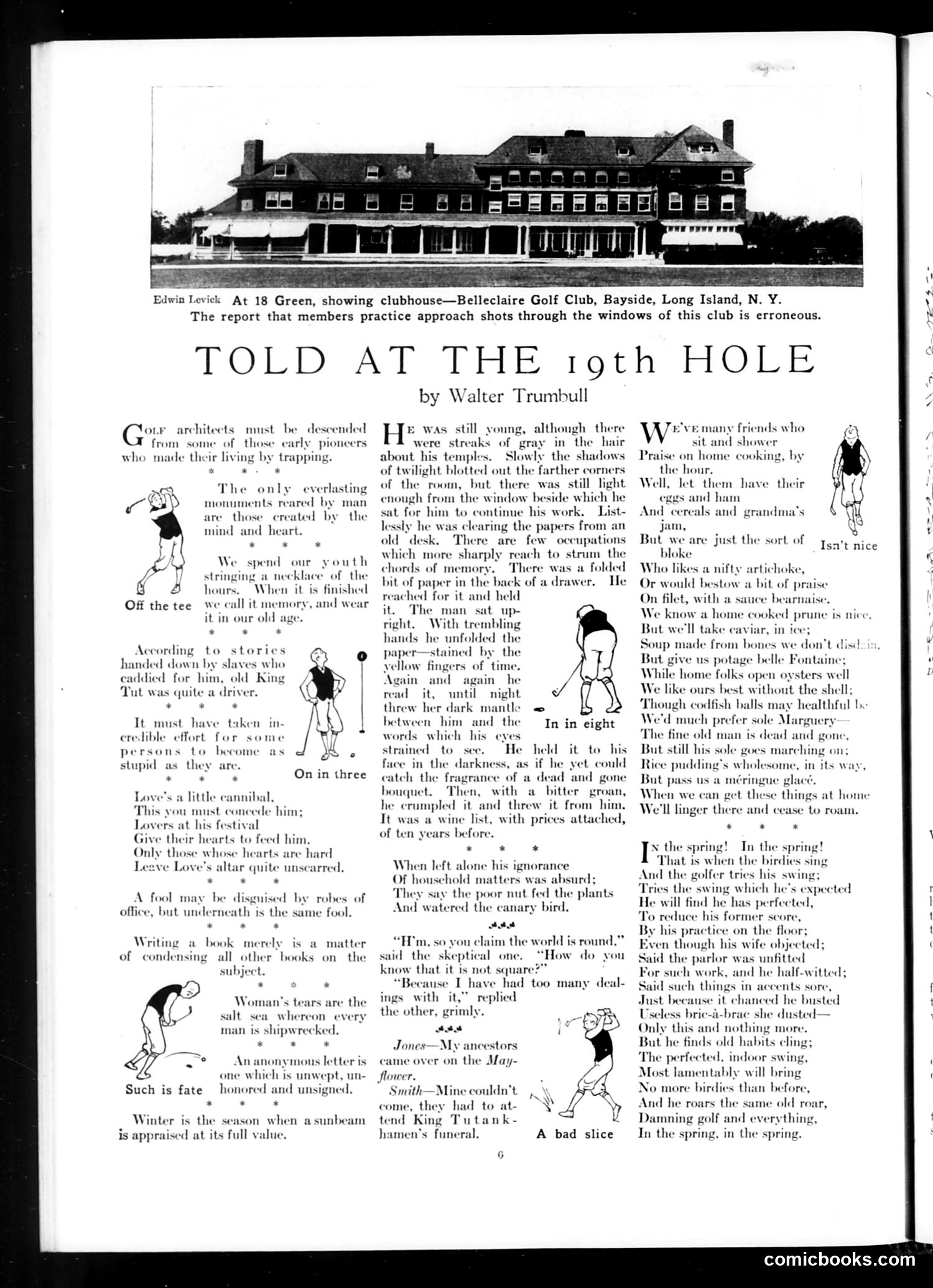
This page from **Judge** magazine contains two main elements: **The Photograph & Caption**: The top shows the Belleclaire Golf Club on Long Island, with a humorous caption claiming members *don't* practice approach shots through the clubhouse windows—a joking denial implying they actually do, mocking both the club's apparent lack of discipline and the absurdity of such behavior. **"Told at the 19th Hole" by Walter Trumbull**: This is a collection of golf-club gossip, light verse, and one-liners typical of early 20th-century humor magazines. The content includes: - Philosophy about life and love (mostly cynical) - A sentimental short story about a man finding an old wine list - Joke exchanges about ancestry and household incompetence - Satirical verse about pretentious food preferences **The Point**: The satire gently mocks upper-class golf club culture—their pretensions, gossip, romantic failures, and affectations around fine dining. The illustrations show golfers in various states of incompetence or distress, reinforcing the clubhouse setting where such tales are exchanged. It's genteel, era-appropriate satire of leisure-class stereotypes.
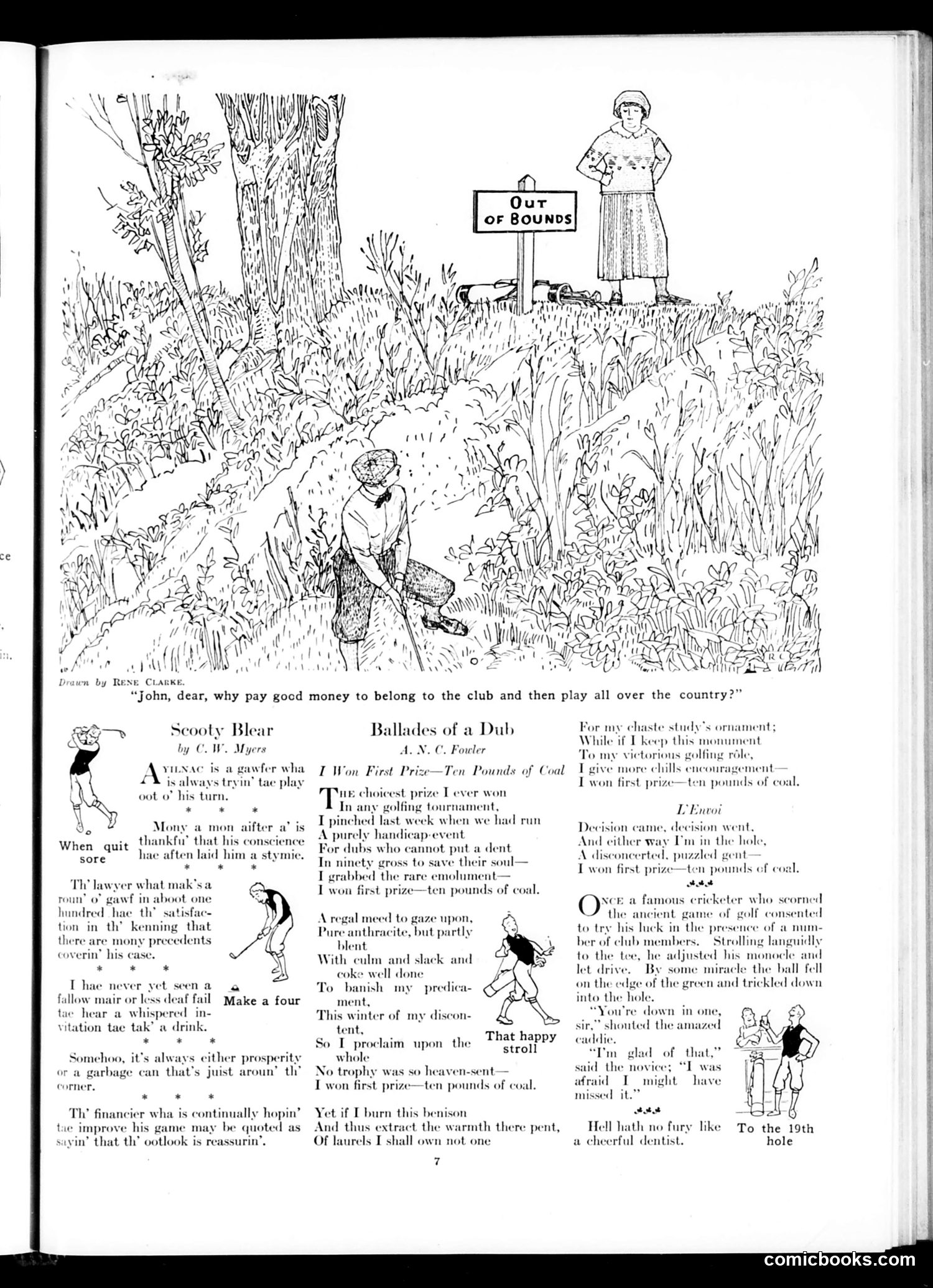
This page from *Judge* magazine contains Scottish-themed golf humor typical of early 20th-century American satire. **"Out of Bounds"** (top cartoon): A woman stands at a property boundary sign while a man plays golf illegally on private land. The caption jokes that club members pay membership fees but then ignore rules by playing everywhere. It satirizes wealthy golfers' entitlement. **"Scooty Blears" and "Ballades of a Dub"**: These poems mock amateur golfers ("dubs") through Scottish dialect. One speaker won "ten pounds of coal" as a tournament prize—a comedic letdown. Another poem features a famous cricketer who accidentally makes an impressive golf shot, then admits he might have missed it anyway. The humor targets both incompetent players and false modesty. The scattered prose snippets mock lawyers, prosperity-seekers, and self-deluding amateur golfers who rationalize poor play. **Context**: Golf was increasingly popular among the American wealthy during this era, making it rich satire territory for mocking class pretension and amateur incompetence.
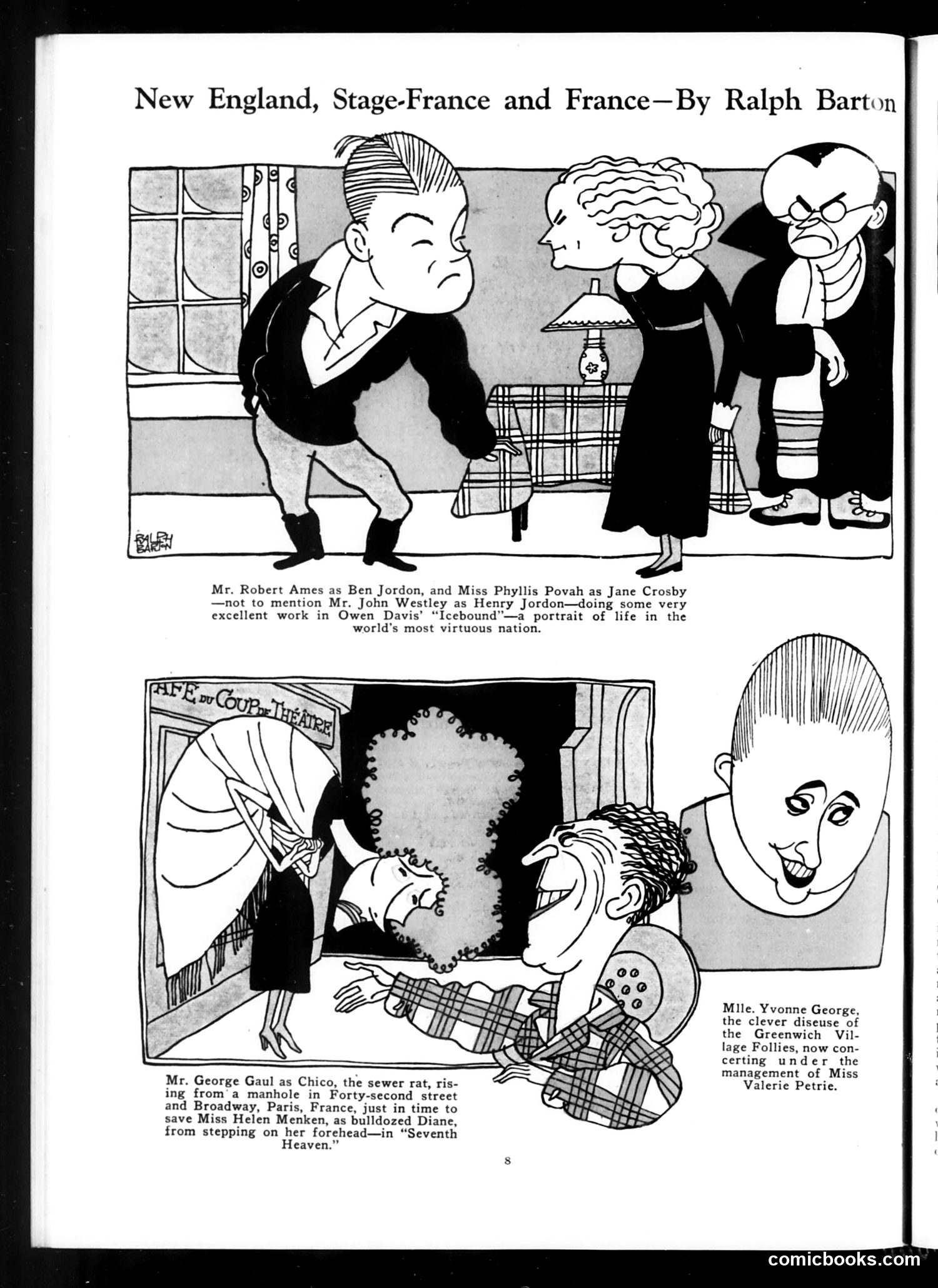
This page reviews theatrical productions, using caricature to satirize American theatrical life. The top cartoon mocks "Icebound," an Owen Davis play about New England virtue, showing exaggerated American characters in a stuffy domestic scene. The title's wordplay ("Stage-France") suggests American theater pretentiously aping French sophistication. The bottom cartoon ridicules "Seventh Heaven," a popular play set in Paris. It depicts actor George Gaul as "Chico, the sewer rat" in absurdly melodramatic terms—rising from a Parisian manhole to rescue a damsel. The exaggerated description ("bulldozed Diane") and crude characterization mock both the plot's implausibility and Americans' romanticized view of France. Barton's satire targets American theater's simultaneous obsession with New England morality and Parisian glamour, presenting both as equally ridiculous.
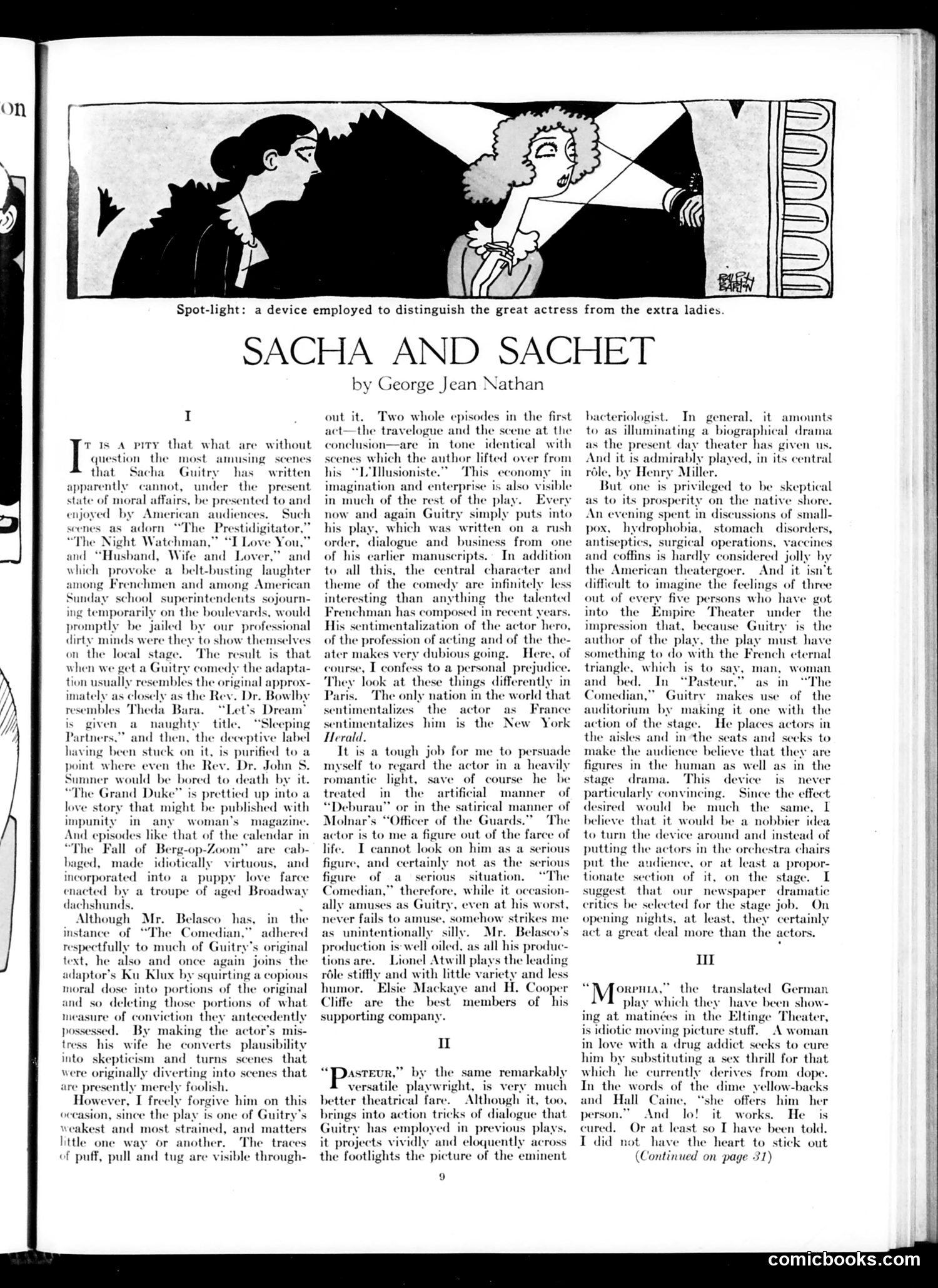
The cartoon at the page's top depicts a theatrical spotlight scene, illustrating the caption's joke: a spotlight device supposedly distinguishes "the great actress from the extra ladies." The image shows a woman on the left (likely representing the celebrated actress) highlighted against supporting performers, making a satirical point about star power and theatrical hierarchy. The accompanying article by George Jean Nathan discusses adaptations of French playwright Sacha Guitry's works for American audiences. Nathan criticizes how Guitry's original French comedies—containing morally questionable content—are heavily censored for American presentation. He notes that adapters, including David Belasco, remove or sanitize risqué scenes to satisfy American moral standards and avoid censorship. Nathan's tone is sardonic about this prudish adaptation process, suggesting American audiences lose the original plays' wit and authenticity through excessive bowdlerization.
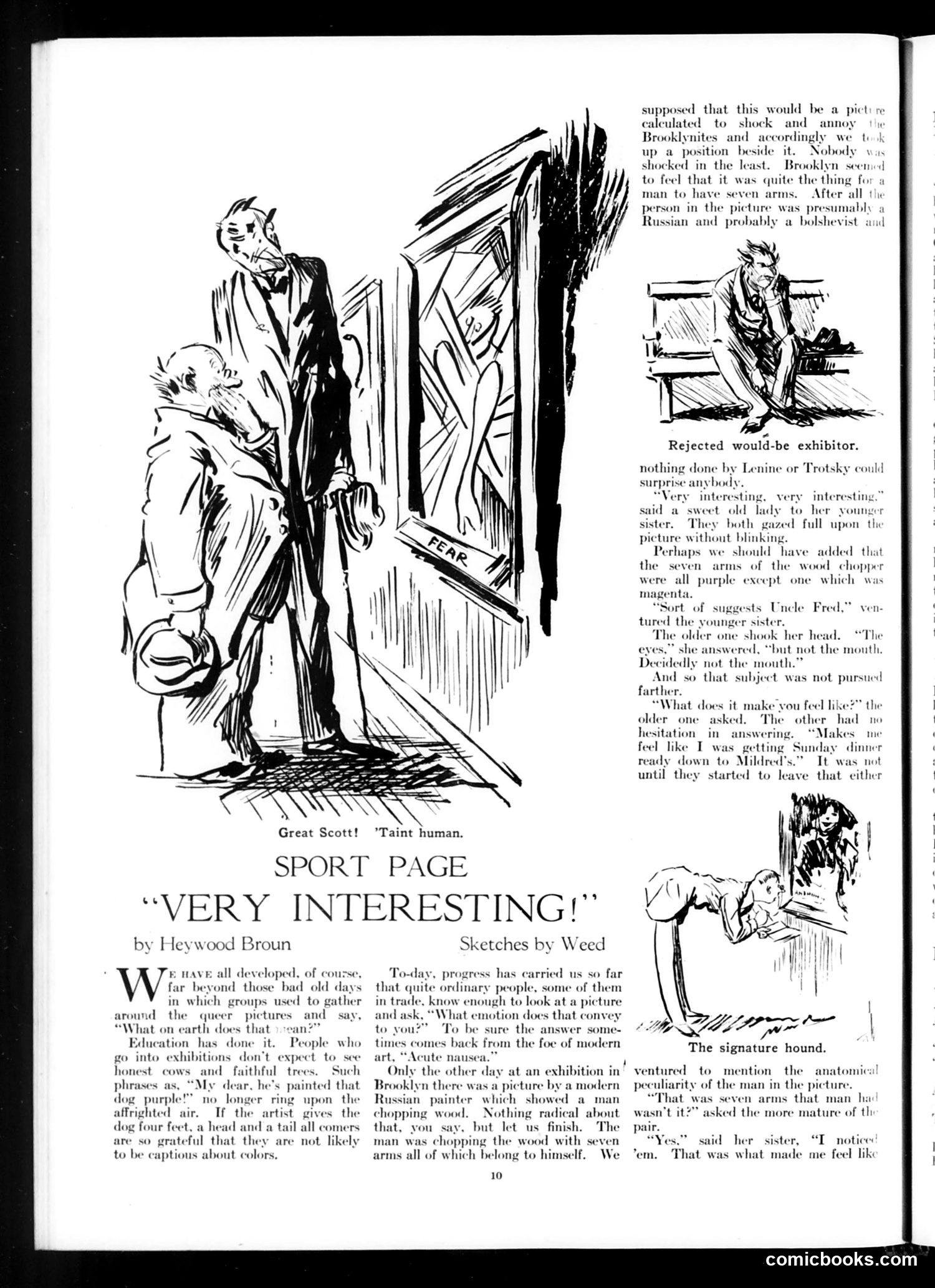
This Heywood Broun piece satirizes how early 20th-century audiences had become so conditioned to accept avant-garde modernism that they'd accept absurdity without question. The cartoon depicts a picture by a Russian modernist painter showing a man chopping wood—with **seven arms, all purple except one magenta**. Rather than shock Brooklyn viewers as the author expected, ordinary people simply accept it as artistic expression, muttering "Very interesting." The joke: post-WWI sophistication about modern art (and perhaps Russian Bolshevism, mentioned explicitly) has made people intellectually lazy. They won't criticize obvious nonsense because they've been trained to believe that's unsophisticated. Two elderly ladies examine the painting seriously, only casually remarking about the anatomical impossibility as they leave—not as a criticism, but as an afterthought. Broun mocks both pretentious modern art and the public's uncritical deference to it.
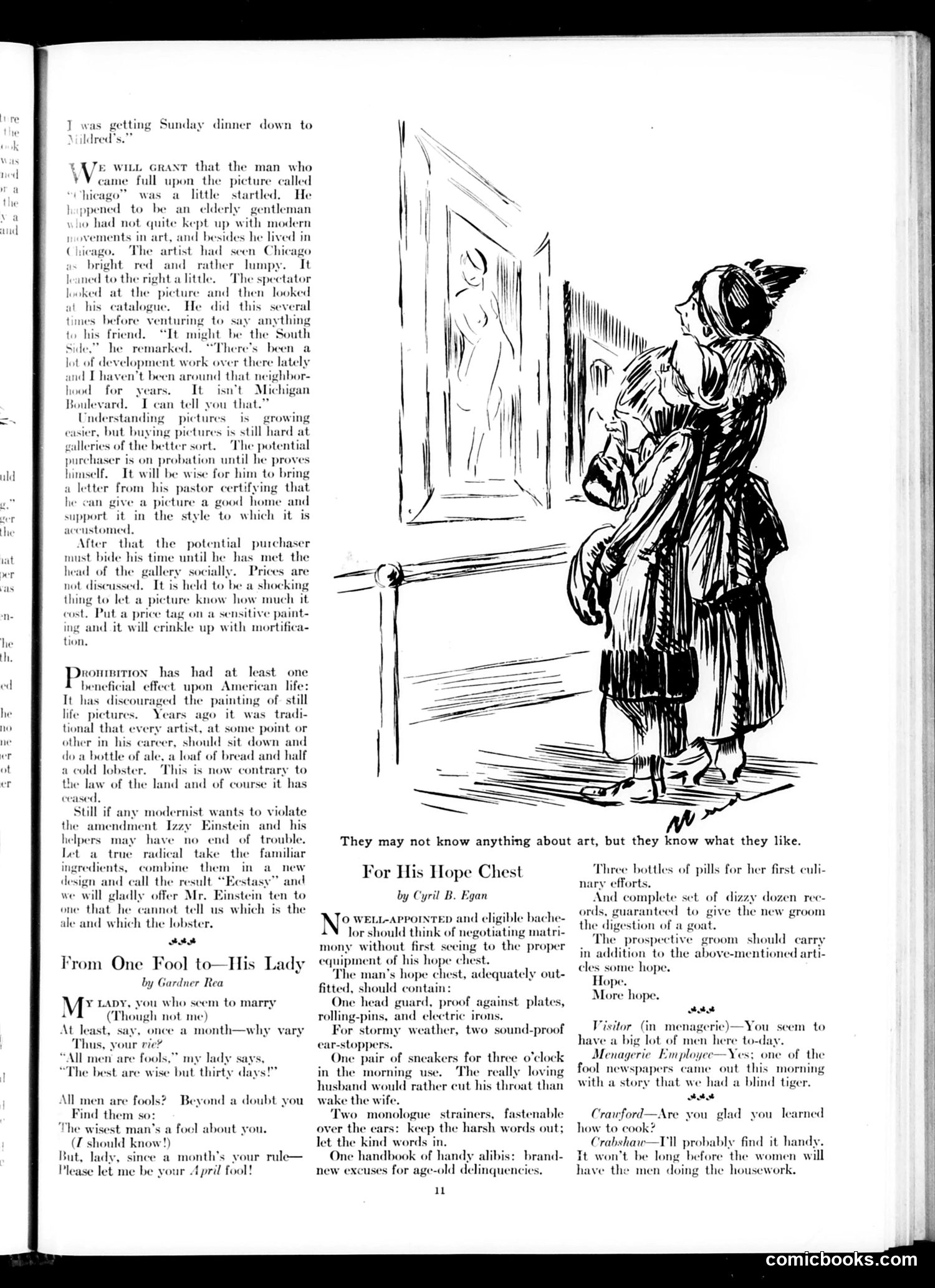
This page contains several satirical pieces targeting early 20th-century American social conventions: **Main Cartoon (top right):** Shows a woman examining an abstract/modernist painting. The caption "They may not know anything about art, but they know what they like" satirizes newly wealthy art collectors—likely nouveaux riches from Chicago—who lack formal taste but presume to judge art. The elderly gentleman's confused reaction to the artist's "bright red and rather lumpy" depiction of Chicago mocks both modernist abstraction and provincial art appreciation. **"For His Hope Chest":** A tongue-in-cheek guide for bachelors entering marriage. It mocks domesticity through absurdist items: "ear-stoppers" to muffle wives' voices, "monologue strainers" to filter women's speech, "pills for her first culinary efforts." The satire targets gender tensions and the adjustment required of men entering married life. **"From One Fool to—His Lady":** A poem playing on the proverb that all men are fools, with romantic wordplay about being an "April fool" for love. The overall theme emphasizes the gap between aspirational behavior and reality in American society.
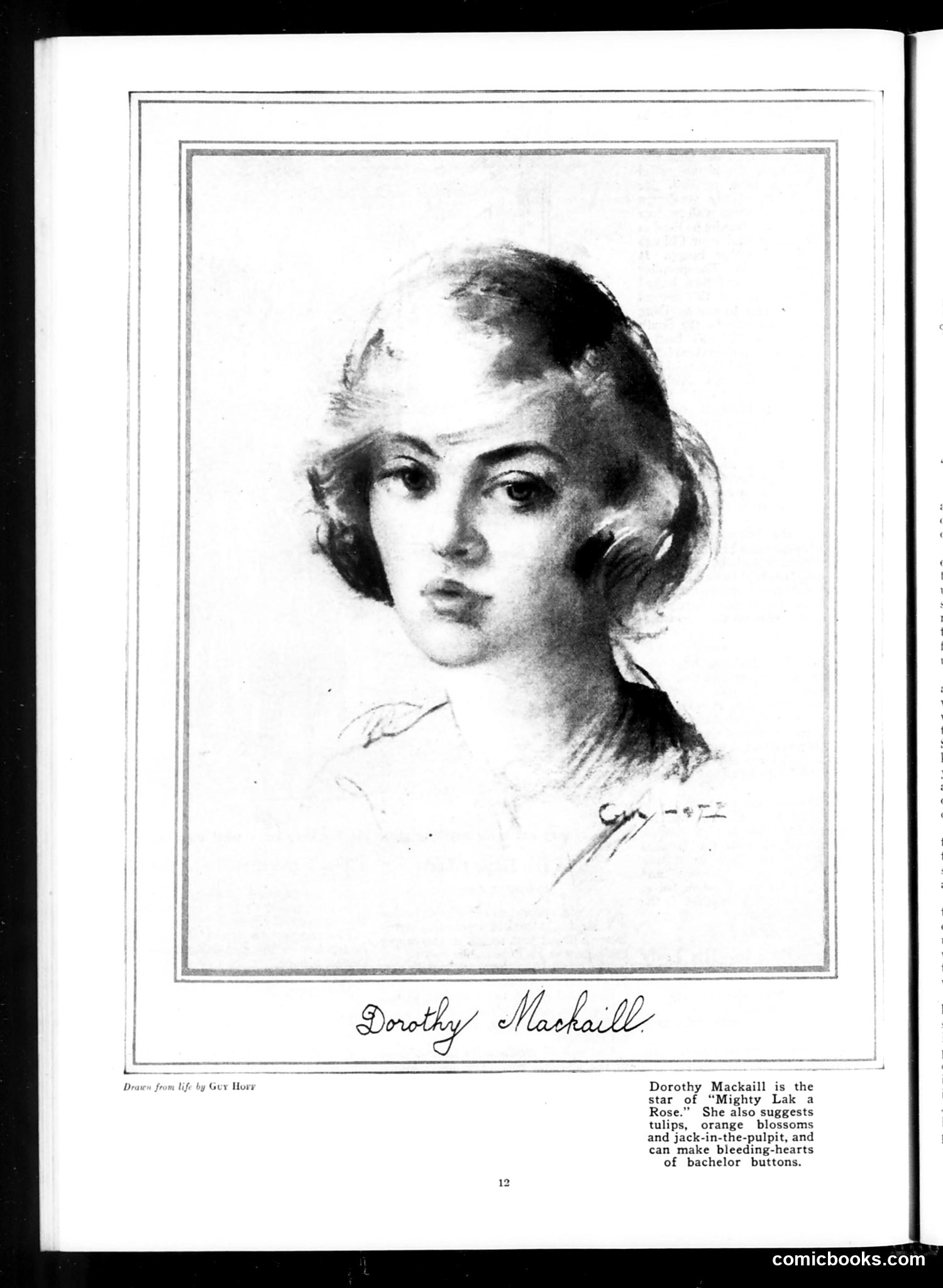
This is a portrait page rather than a political cartoon. It features a pencil sketch of Dorothy Mackaill, an actress who starred in the film "Mighty Lak a Rose." The accompanying text is promotional rather than satirical, describing her beauty in floral metaphors—comparing her to tulips, orange blossoms, and jack-in-the-pulpit flowers, and joking that she can make "bleeding-hearts of bachelor buttons" (playing on flower names to suggest her romantic appeal). The sketch is credited to artist Guy Hore. This appears to be entertainment coverage typical of Judge magazine's celebrity content, showcasing Hollywood talent rather than delivering political or social satire.
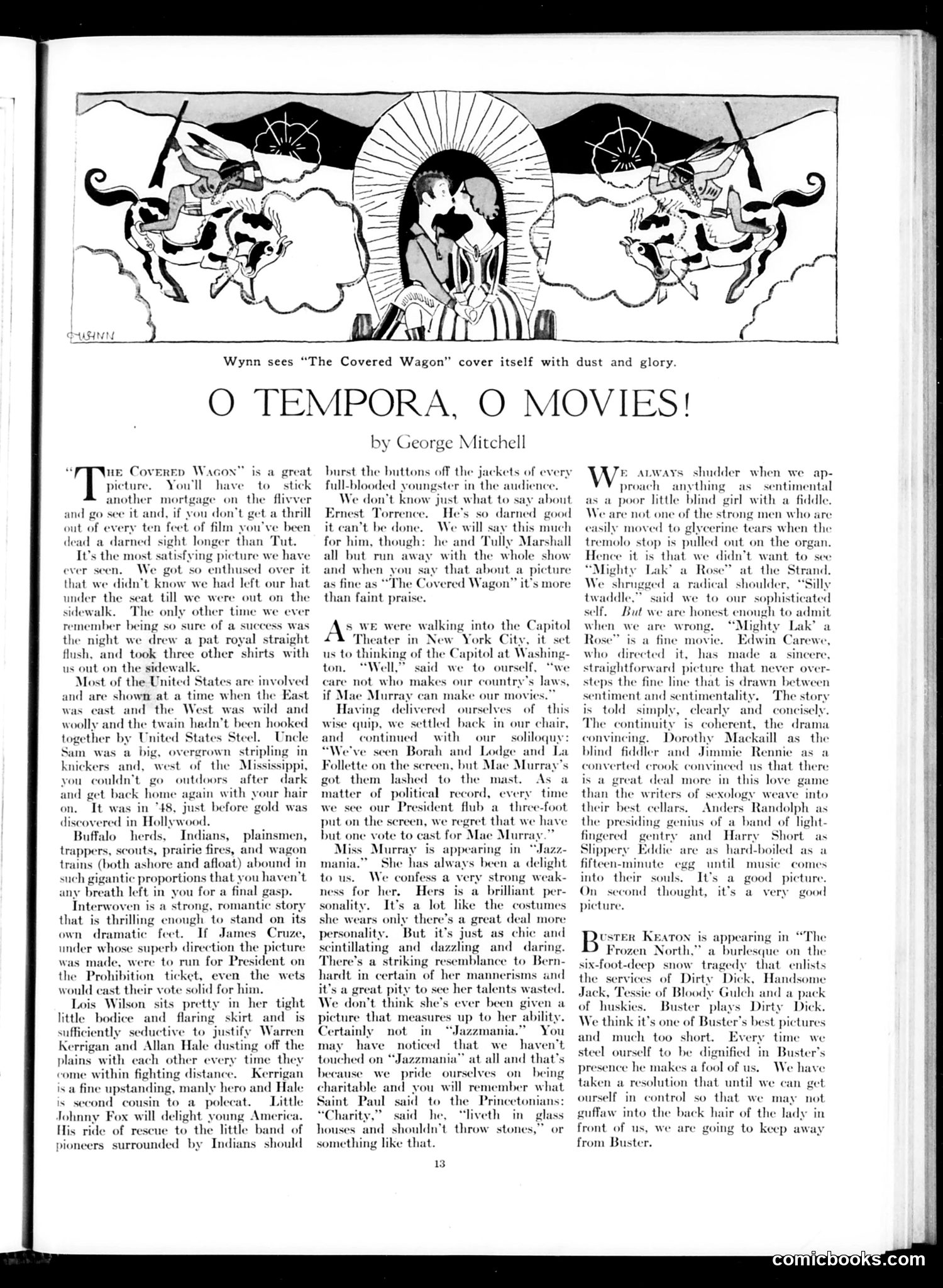
This is a movie review column by George Mitchell titled "O Tempora, O Movies!" The cartoon header shows a woman (likely actress Mae Murray) surrounded by cherubs, celebrating her appearance in films. The piece reviews three pictures: *The Covered Wagon* (a major Western epic), *Jazzmania* (featuring Mae Murray), and *The Frozen North* (featuring Buster Keaton). **Key satire**: Mitchell makes a jest comparing Mae Murray's influence on American culture to that of Congress itself—he'd rather have her make movies than politicians make laws. This reflects how influential silent films and their stars were in the 1920s. **The jokes rely on**: knowing these were current, celebrated films and stars; understanding that *The Covered Wagon* was a prestigious prestige picture; recognizing Mae Murray as a major star whose talent Mitchell felt was underutilized. The tone is lighthearted movie criticism using exaggeration and wordplay typical of Judge's satirical style.
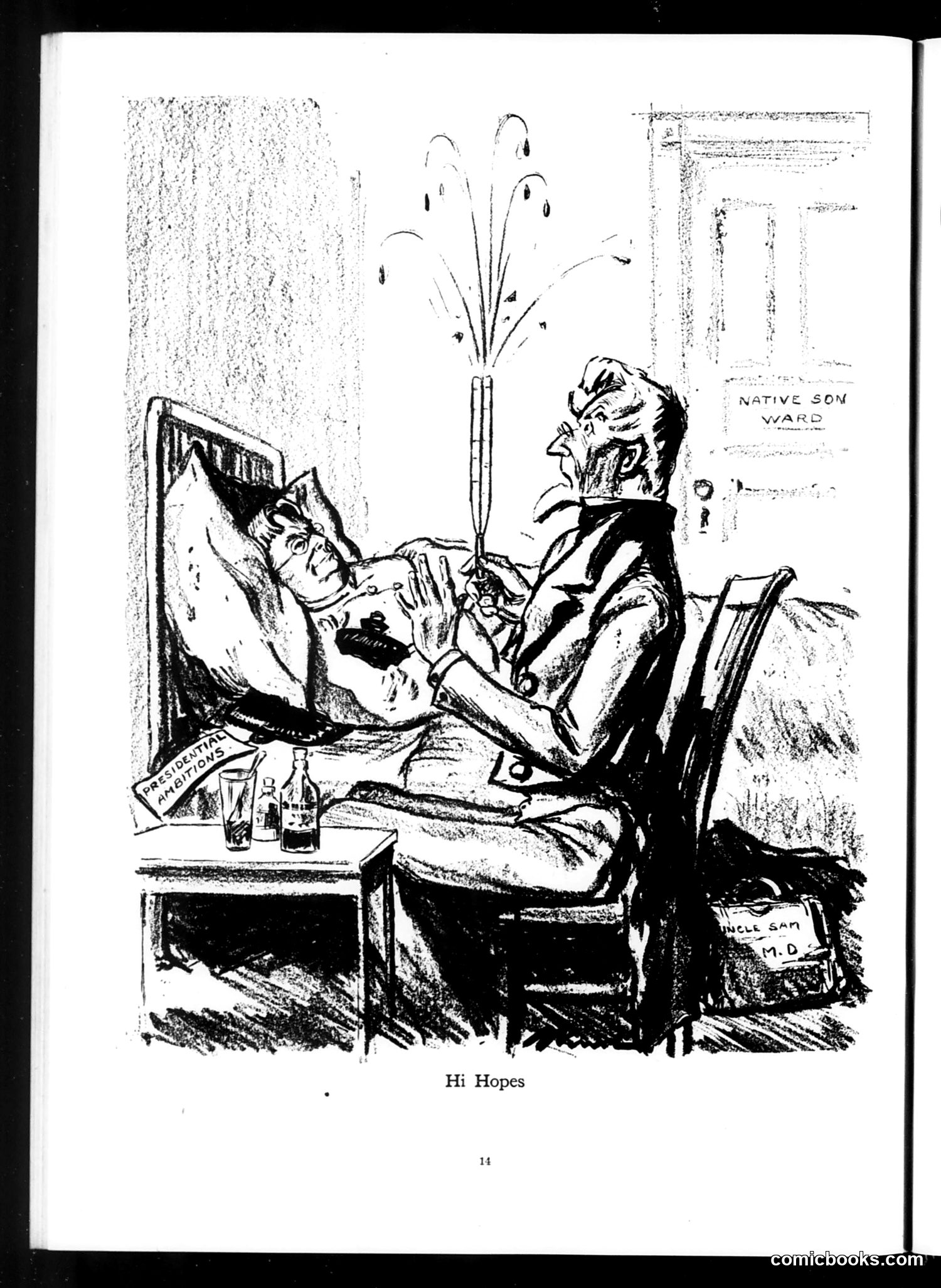
This political cartoon depicts two caricatured figures in what appears to be a hospital or medical setting. The figure on the left, labeled "NATIVE SON WARD," lies in bed holding flowers, while a stern-faced man sits beside him. A decorative plant with fireworks-like bursts tops the nightstand between them. The cartoon's title, "Hi Hopes," suggests optimistic expectations. The "Native Son Ward" label likely references political patronage or ward politics—a system where political machines controlled urban districts. The caricatures and exaggerated features appear designed for satirical ridicule, though without clearer date context or additional identifying labels, the specific political figures or contemporary situation being mocked remain unclear. The overall tone suggests mockery of political pretension or failed expectations.
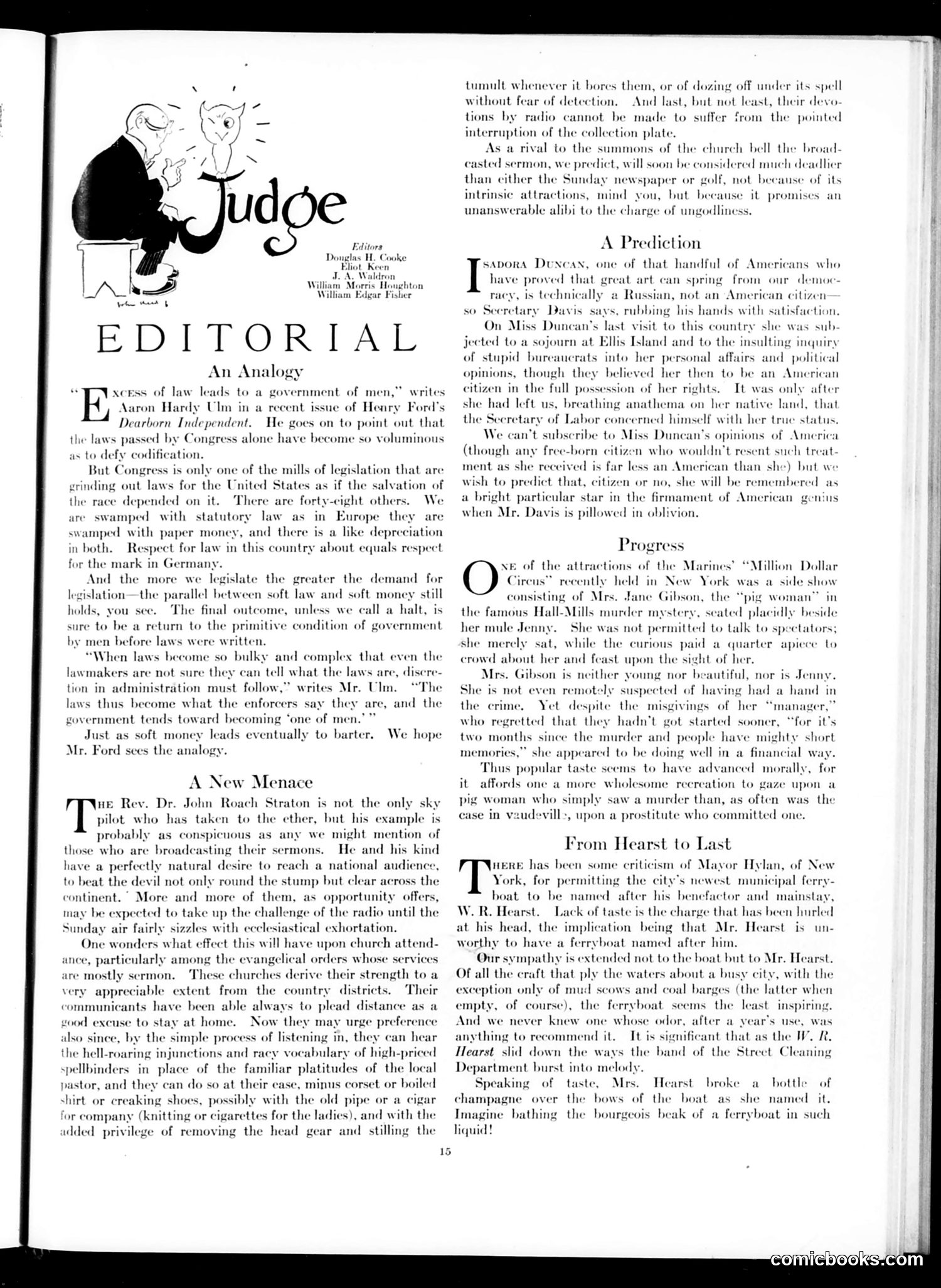
The page contains three editorial pieces rather than political cartoons. The small illustration shows a judge figure, the magazine's mascot. **"An Analogy"** compares excessive legislation to inflation: just as too much paper money loses value, too many laws become unenforceable and lead to government by administrative discretion rather than law. The piece, citing Henry Ford's *Dearborn Independent*, argues that Congress and state legislatures have created such legal complexity that enforcement becomes arbitrary. **"A New Menace"** satirizes radio broadcasts of religious sermons as a threat to church attendance. It mocks how listeners can now hear sermons at home in comfort—avoiding collection plates, sitting through boring sections, even dozing off—while claiming they've fulfilled their religious duty. The satire targets both radio technology's disruption of traditional institutions and congregants' hypocrisy. **"A Prediction"** defends Russian-American dancer Isadora Duncan against bureaucratic harassment at Ellis Island, praising her artistic achievements while criticizing U.S. government officials' suspicion of foreign artists. These pieces reflect 1920s Progressive-era anxieties about government overreach, technological disruption, and nativism.
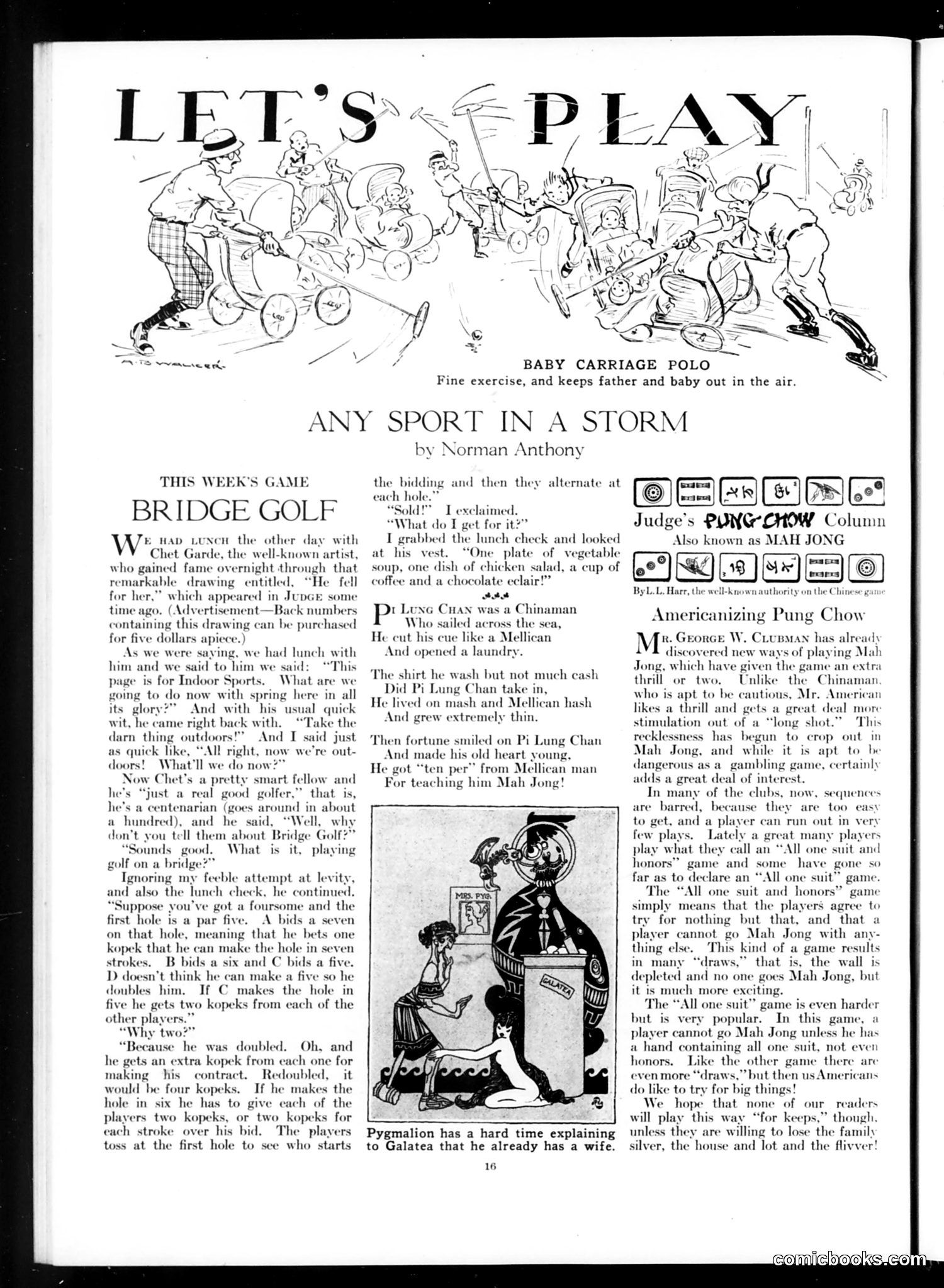
This 1920s Judge magazine page satirizes three trends: 1. **"Bridge Golf"**: A humorous article mocking the craze for combining card-game betting mechanics (from Contract Bridge) with golf. The joke reflects how Americans obsessively gambled on leisure activities during the Prohibition era. 2. **"Baby Carriage Polo"**: The illustrated header satirizes the fad for bizarre sporting hybrids—absurdist commentary on how wealthy Americans invented increasingly frivolous "sports." 3. **"Americanizing Pung Chow" / Mah Jong**: The serious content warns that Americans are corrupting the Chinese game Mah Jong by introducing reckless gambling and high-stakes betting, stripping away its strategic skill. The column expresses gentle concern about American excess replacing Eastern restraint—a common Progressive-era anxiety about national character. The overall message: modern American leisure culture is obsessed with novelty, gambling, and excess, even trivializing ancient traditions. The satire is affectionate but pointed social criticism.
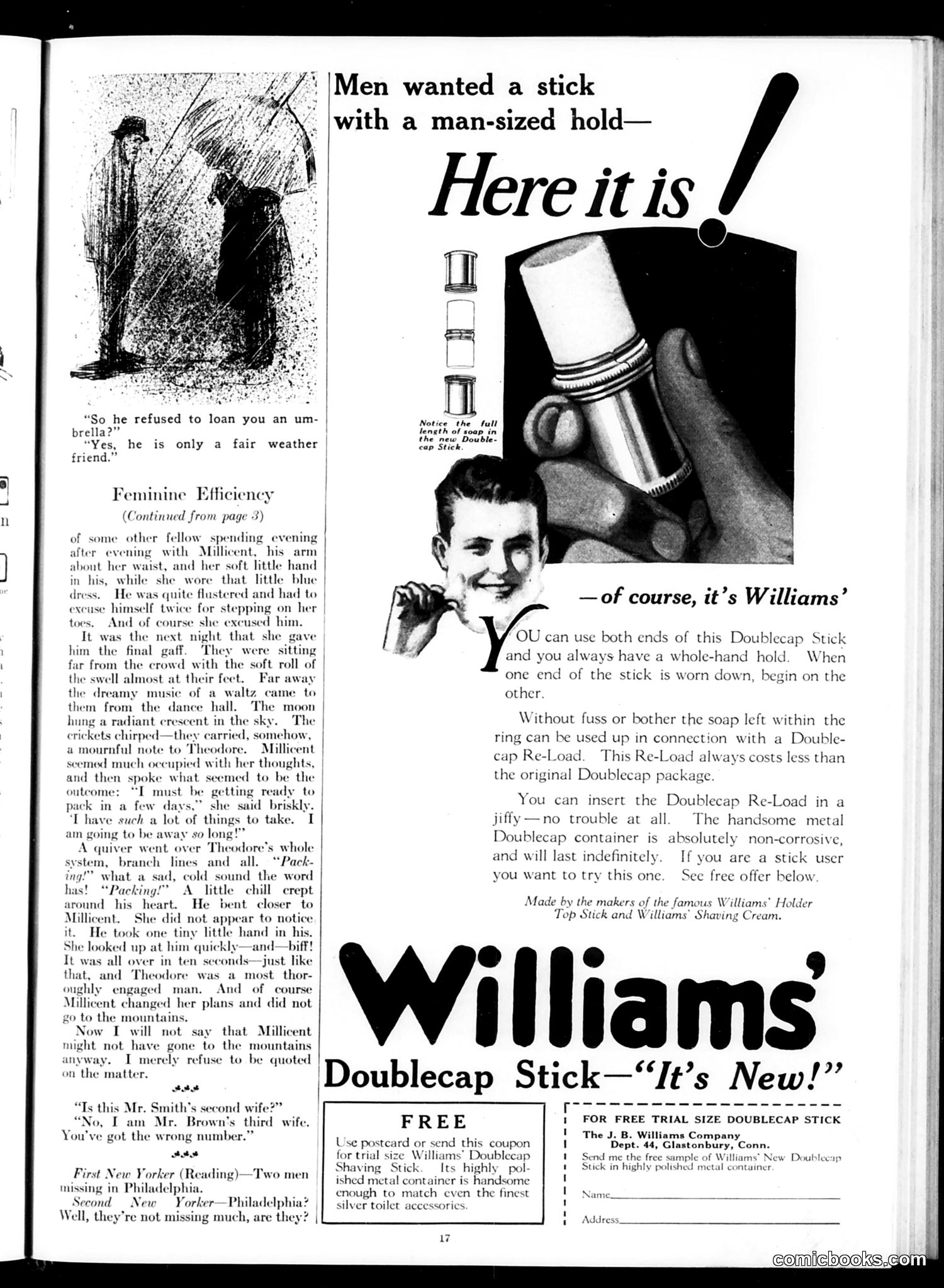
This page contains two distinct elements: **The Cartoon/Story ("Feminine Efficiency"):** A comedic narrative about Theodore, a man romantically pursuing a woman named Millicent. The humor relies on early-20th-century gender role reversals: Millicent, presented as unusually assertive and manipulative for her era, orchestrates their relationship, makes Theodore jealous deliberately, and ultimately dominates him—even physically striking him ("biff!"). The satire mocks both sentimental romance and suggests anxiety about women's increasing independence and agency. **The Advertisement:** The bulk of the page promotes Williams' Doublecap Shaving Stick, a grooming product with a two-sided design. The ad emphasizes practicality and durability, offering a free trial. This represents typical early-20th-century advertising in magazines like *Judge*. The juxtaposition is typical for *Judge*: satirical editorial content sharing space with commercial messaging, both targeting the same male readership.
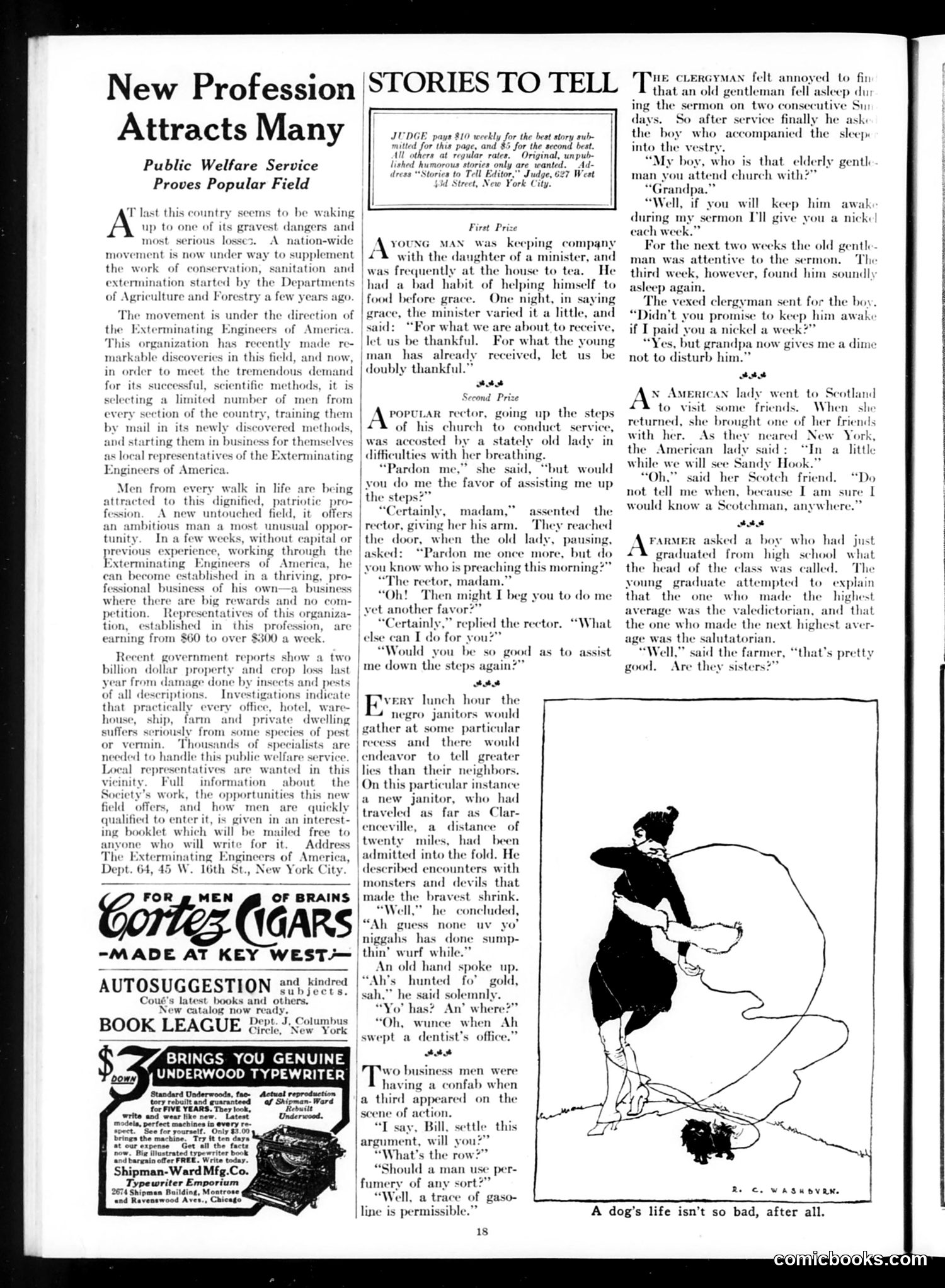
This page contains a single cartoon by E.C. Osborne (signed lower right) depicting a woman fishing while a dog appears to have caught something in the water. The joke appears to be a visual pun: the woman is fishing for what looks like ordinary catches, but the dog—positioned below—has apparently snagged something more valuable or unexpected, suggesting the dog's "luck" in life exceeds expectations. The cartoon's title suggests ironic commentary: despite dogs' generally subordinate social position, they sometimes stumble upon good fortune. This reflects early-20th-century American humor's frequent use of animals to humorously comment on human conditions—here, suggesting that even humble creatures occasionally enjoy unexpected advantages. The accompanying text consists primarily of short humorous stories submitted to Judge's "Stories to Tell" competition, unrelated to the cartoon.
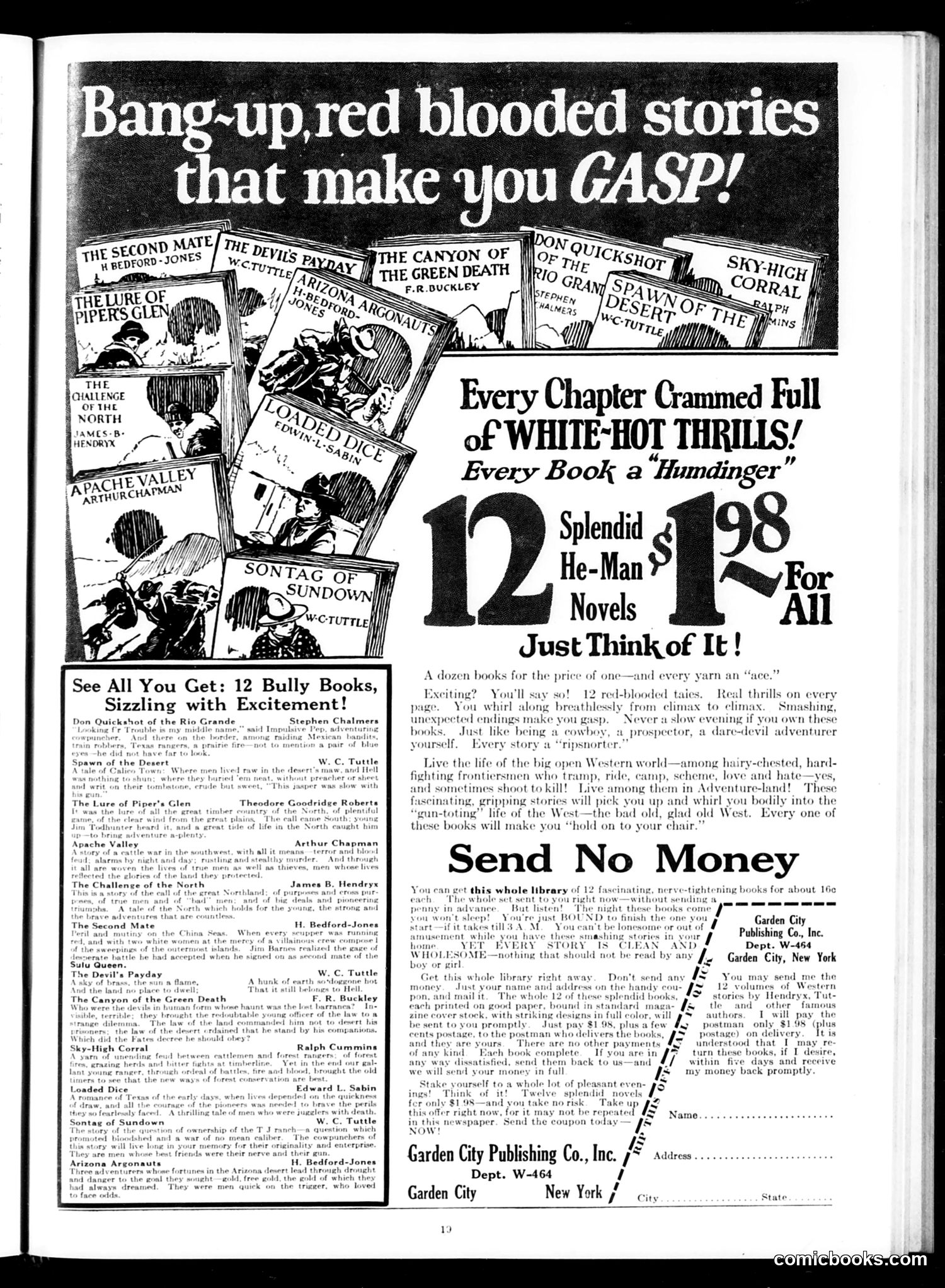
This page is primarily a **mail-order book advertisement**, not political satire. It promotes a collection of 12 Western adventure novels for $1.98—marketed as "bang-up, red blooded stories" featuring cowboys, frontier violence, and "the gun-toting life of the West." The titles visible (like "Apache Valley," "Spawn of the Desert," "Canyon of the Green Death") represent the pulp Western genre popular in early 20th-century America. The ad emphasizes thrills, action, and masculine adventure—appeals typical of cheap fiction marketed to working-class readers. The "Send No Money" pitch (pay only when delivered) was a common direct-mail marketing tactic of the era, reducing purchase barriers. **No specific political figures or satire are evident.** This appears to be a commercial advertisement placed in Judge magazine, likely from the 1920s-30s based on style. It reflects period attitudes toward mass-market entertainment and consumer mail-order culture rather than making satirical commentary.
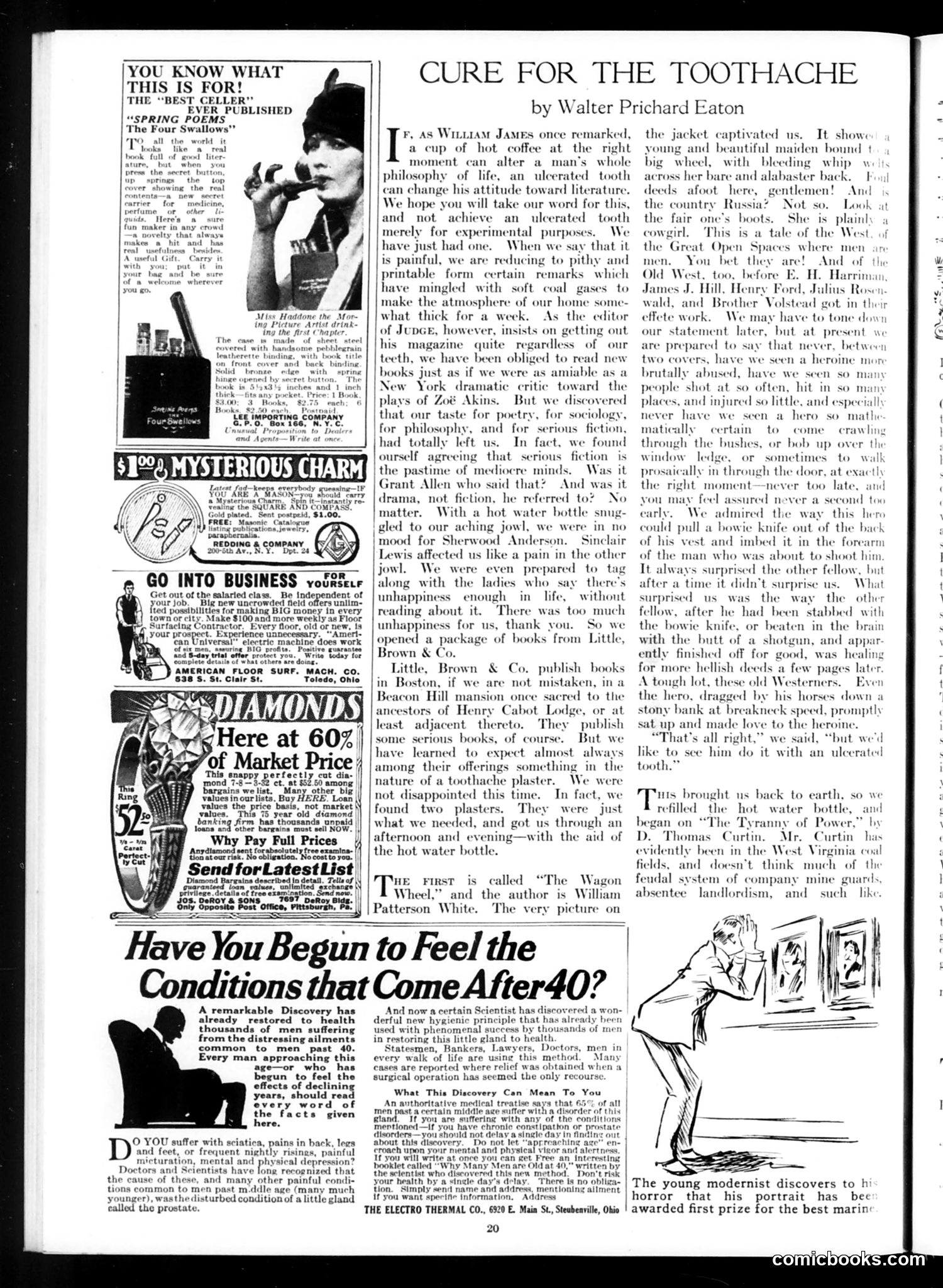
This page contains primarily **advertisements and book reviews**, not political cartoons. The main editorial content is "Cure for the Toothache" by Walter Pritchard Eaton, a humorous essay about how a severe toothache affected the editor's ability to appreciate literature and philosophy. Eaton notes that pain destroyed his taste for serious fiction and philosophy—he could only stomach light "toothache plasters" (escapist reads) from publisher Little, Brown & Co. He specifically mentions finding relief in "The Wagon Wheel" by William Patterson White. The page is dominated by **period advertisements**: a diamonds sale, a floor-surfacing machine business opportunity, a mysterious charm product, and a medical ad for prostate treatment targeting men over 40. The small illustration in the upper left appears to be a woman in fashionable 1920s attire, likely promoting the "Spring Poems" publication mentioned. This is a typical Judge magazine page mixing light satirical commentary with commercial advertisements.
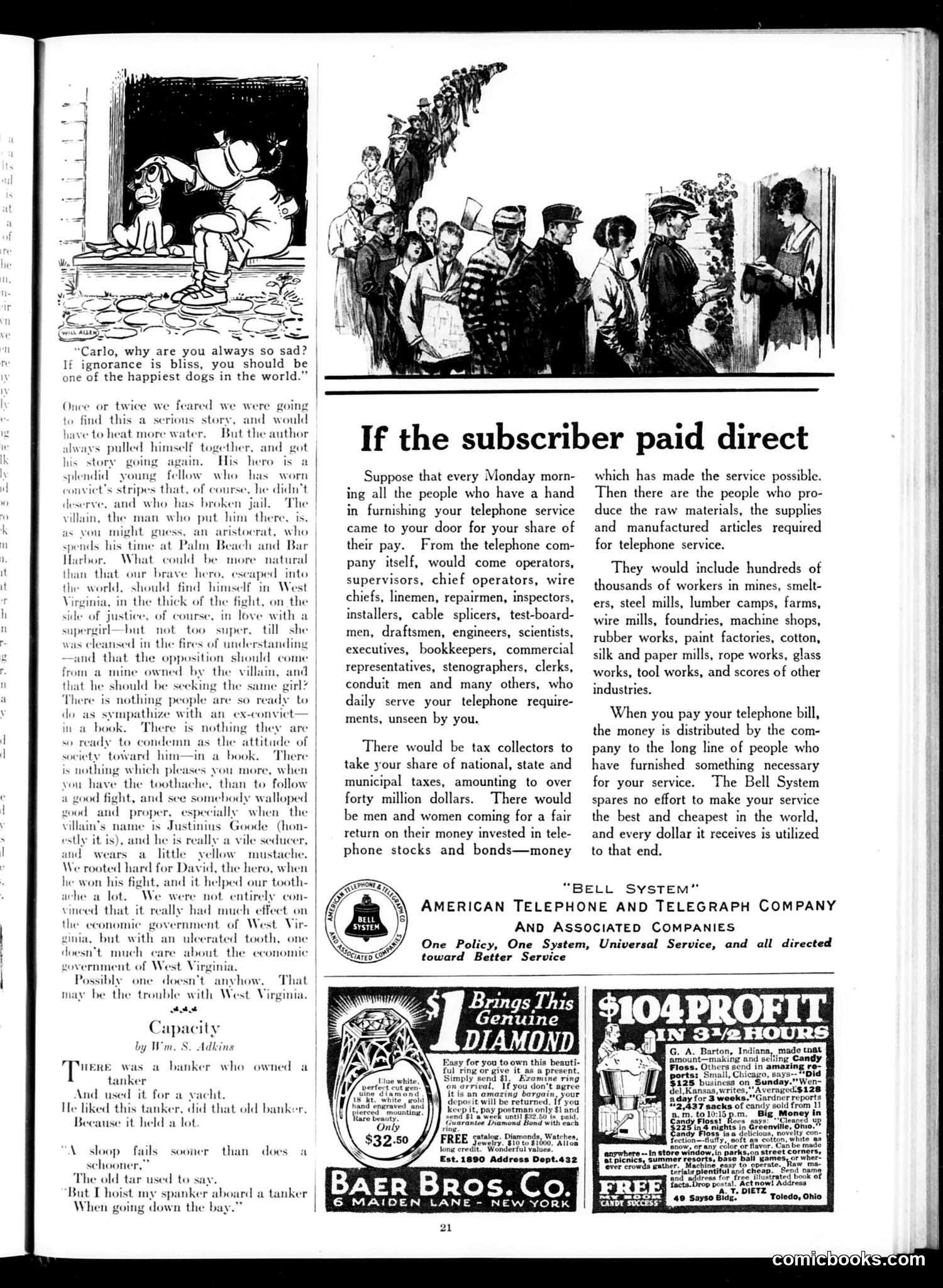
This page contains two distinct sections: **Upper Content:** A literary discussion (appears to be a book review) about a serialized story featuring "Carlo," an ex-convict protagonist in West Virginia fighting against an aristocratic villain named "Justinius Goode." The satirical point critiques readers' emotional investment in melodramatic fiction—we root for the hero and against injustice *in stories*, yet remain indifferent to real economic and social problems. The joke: we enjoy moral clarity in fiction that doesn't translate to action in real life. **Lower Content:** A Bell System (AT&T) corporate advertisement disguised as public education. It argues that when you pay your phone bill, the money flows to thousands of workers and industries—mines, steel mills, farms, factories. The implicit message: support the telephone monopoly because it supports America's entire industrial base. This is Depression-era corporate propaganda defending monopolistic practices as economically beneficial. The page also includes period advertisements for diamonds and a profit scheme.
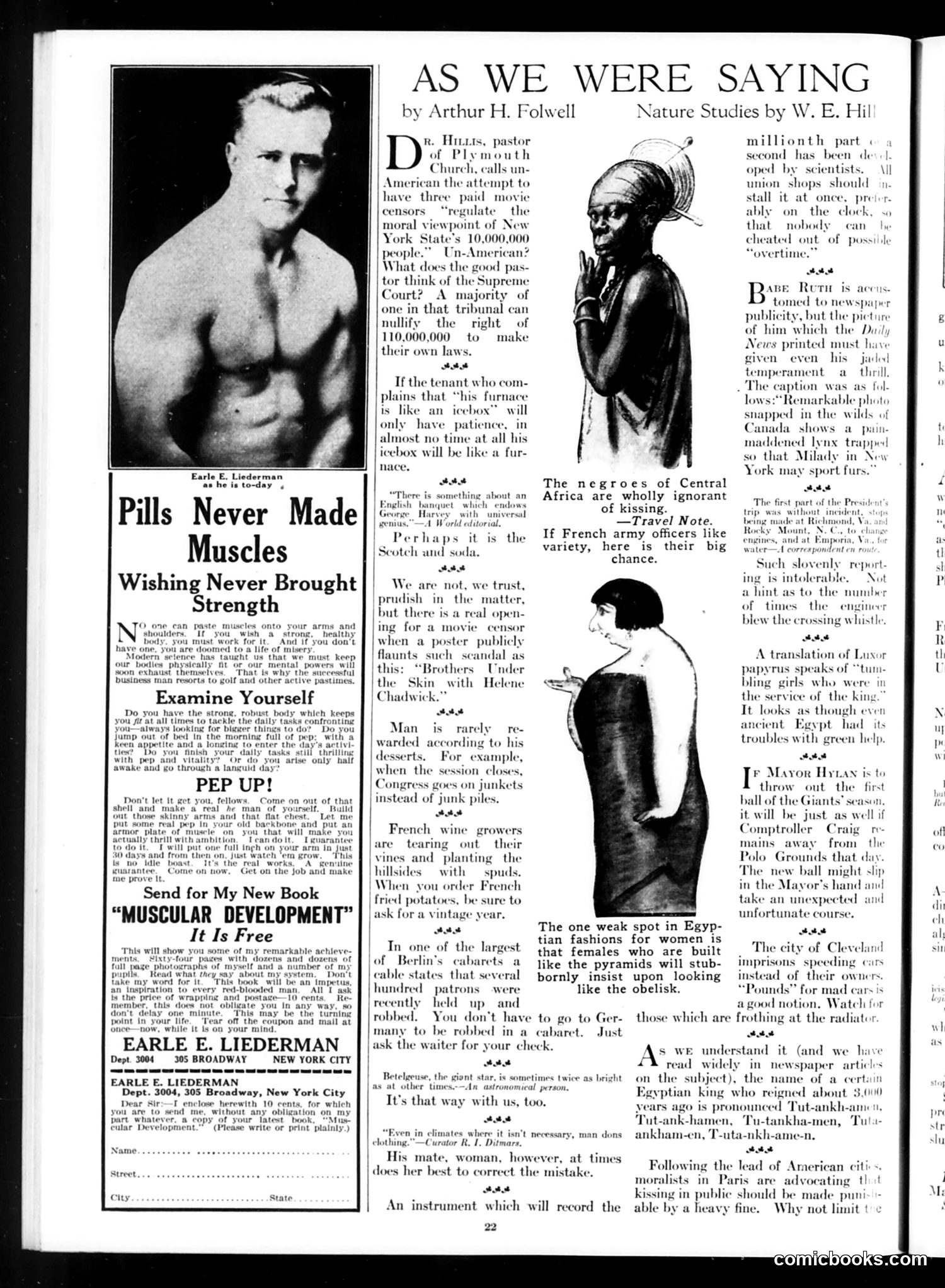
This Judge magazine page combines **satirical commentary** with **period advertising**. The left side features **Earle E. Liederman's bodybuilding advertisement**—a common early 20th-century pitch promising muscle development through mail-order courses, exploiting male insecurity about physical weakness. The right side, "As We Were Saying," contains short satirical observations on contemporary issues: - **Rev. Lyman Abbott's censorship complaints**: Mocked as hypocritical—if he opposes movie censorship, why does he accept Supreme Court power? - **Workplace abuse**: A joke about landlords and tenants reflects real housing struggles - **Prohibition-era humor**: References to "Scotch and soda" and wine-growing regulations - **Political corruption**: Congress taking junkets instead of addressing serious issues - **Cabaret robberies in Berlin**: Satirizes wartime economic chaos and corrupt service industries - **Mayor Hylan's baseball appearance**: A dig at the NYC mayor's public relations stunts The satire targets hypocrisy, workplace exploitation, government waste, and urban corruption—issues recognizable to modern readers, though specific references (Hylan, Liederman) require historical knowledge.
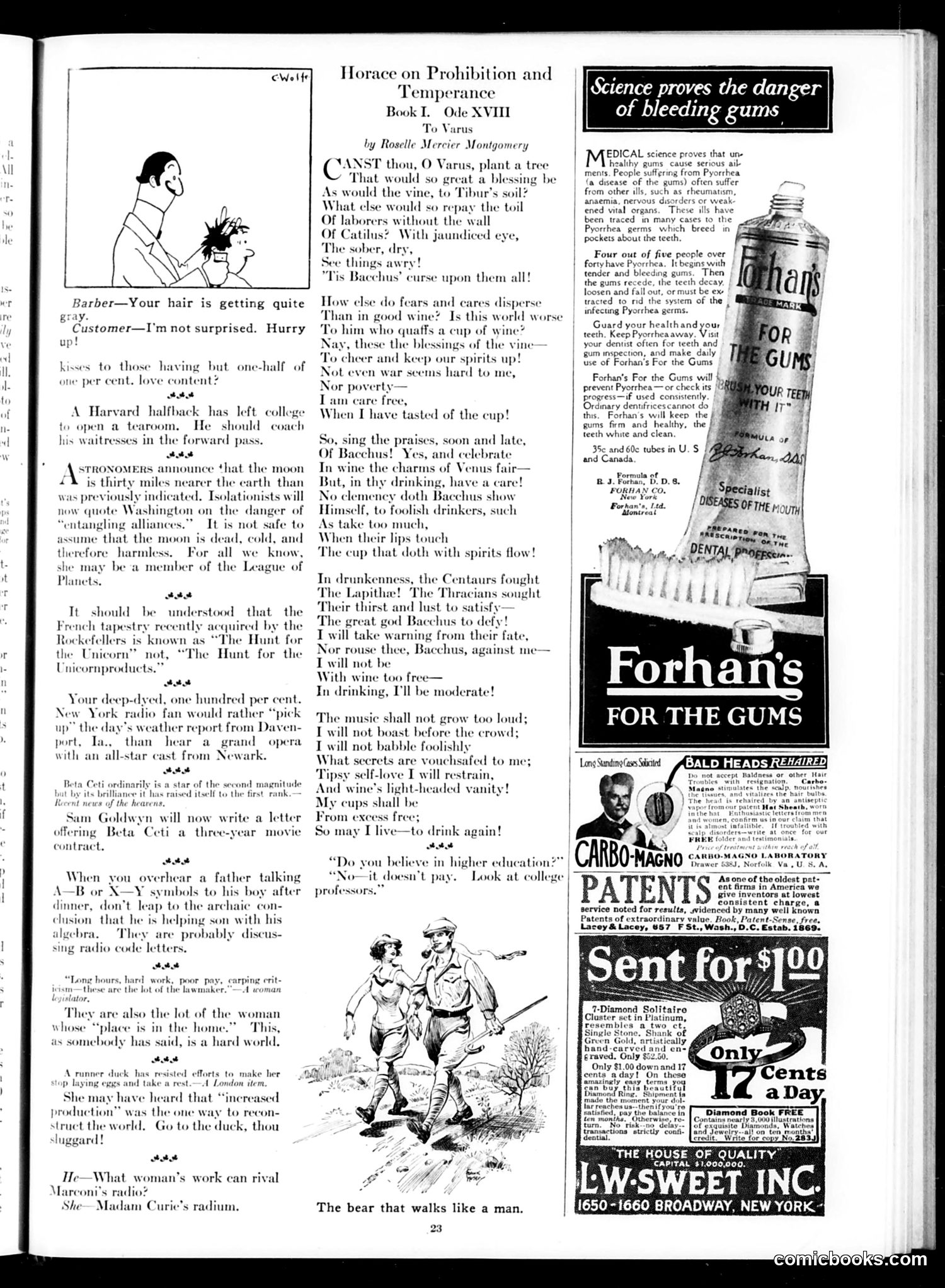
This page presents three distinct content types: **Left side: Miscellaneous satirical jokes** mocking contemporary figures and trends—a Harvard athlete opening a tearoom, astronomers' moon distance claims, the Rockefellers' French tapestry acquisition, and radio culture. These are brief, topical jabs at 1920s-30s American society. **Center: "Horace on Prohibition and Temperance,"** a poem by Roselle Mercier Montgomery that adapts Horace's classical ode to debate alcohol. It argues wine brings joy and relief from care, but warns against excess and drunkenness—reflecting the Prohibition era's temperance debates. The poem ultimately advocates moderation rather than total abstinence. **Right side: Advertisements** for Forhan's toothpaste (emphasizing gum health), patent medicines, costume jewelry, and L.W. Sweet Inc. These ads promise health and status to consumers. The page's central tension reflects 1920s-30s America: classical wisdom versus modern scientific medicine, indulgence versus restraint, and consumer culture's rise.
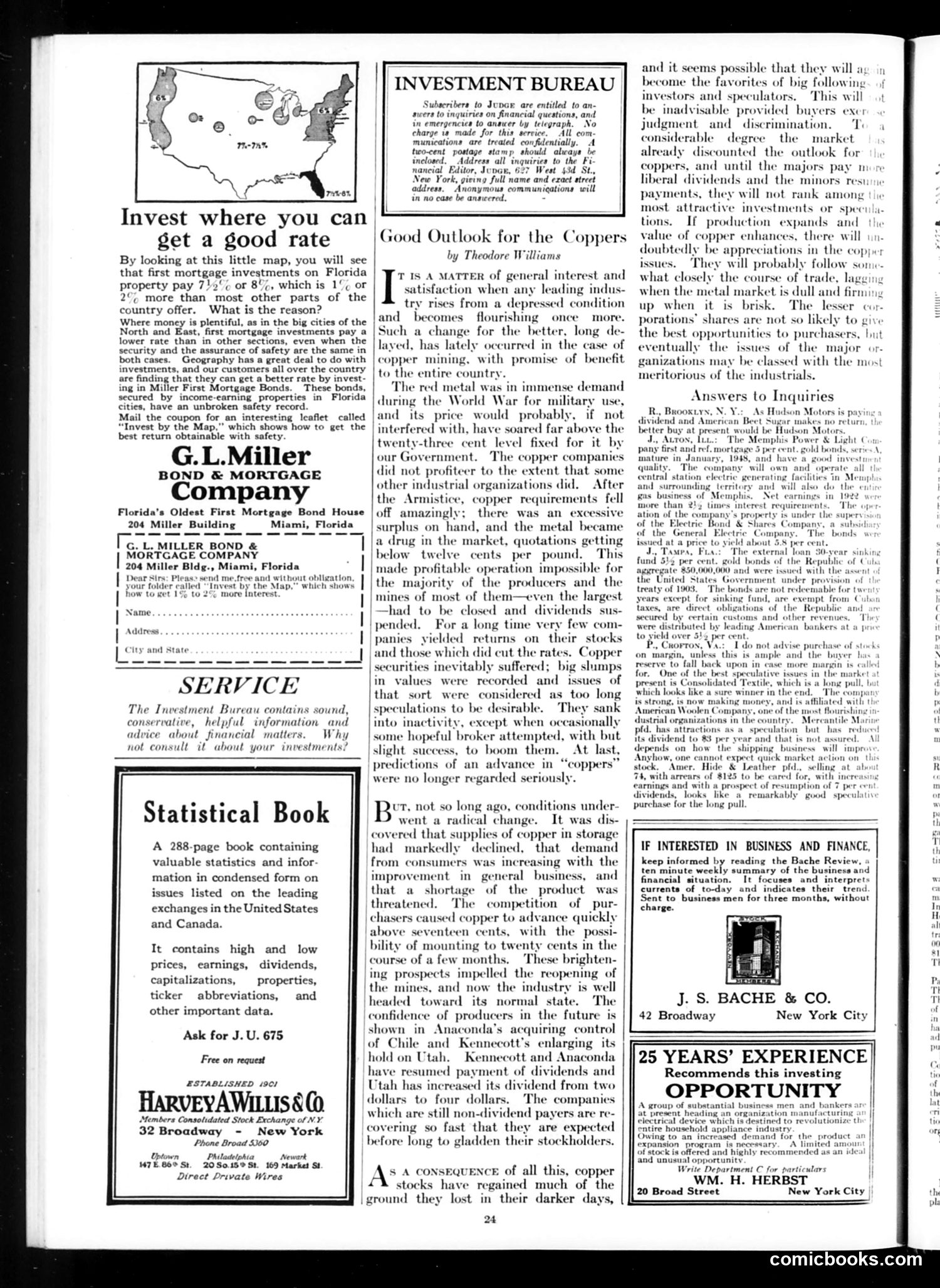
This page is primarily **advertising and financial advice**, not political satire. It contains: **The Map Cartoon:** A simple U.S. map showing Florida highlighted, illustrating G.L. Miller's investment pitch that Florida mortgage bonds pay higher returns (7.5-8%) than Northern investments—a geographic arbitrage argument. The visual implies savvy investors should look south. **Main Content:** Articles promoting copper stock investments and Florida real estate bonds, plus advertisements for financial services. Theodore Williams' copper article argues the metal industry, depressed post-WWI when military demand ended, is now recovering—making copper stocks attractive. **Context:** This reflects the 1920s investment boom and Florida's real estate speculation bubble (which would crash in 1926). The page targets middle-class investors seeking higher returns than available in established Northern markets, promoting both geographic diversification and sector recovery plays. No political figures or satire are present—this is straightforward financial promotion masquerading as editorial content.
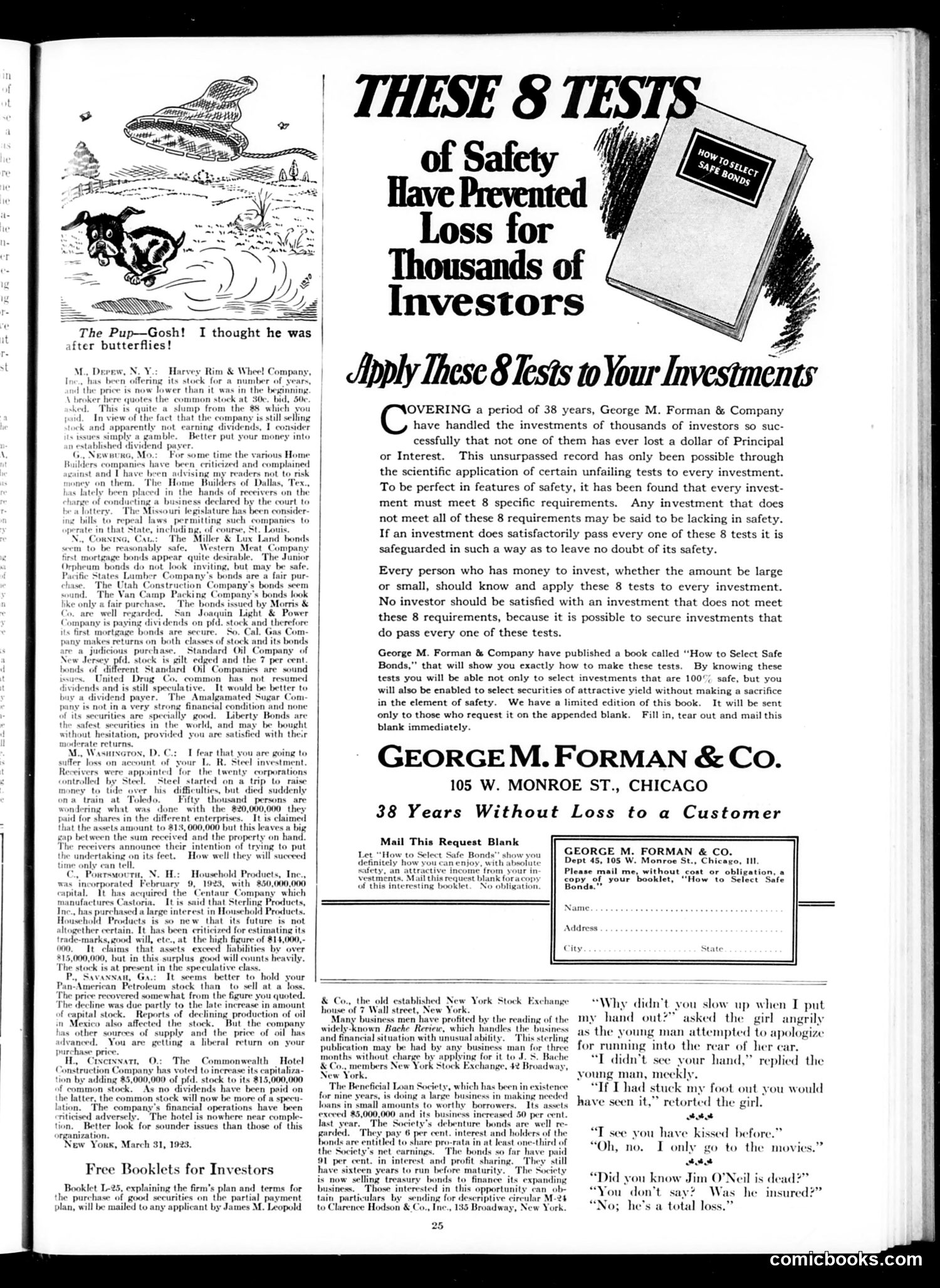
This page is primarily **advertising**, not political satire. The dominant content is a full-page advertisement for George M. Forman & Company, an investment advisory firm. The small cartoon at top left shows a dog chasing something, with the caption "Gosh! I thought he was after butterflies!" This appears unrelated to the investment advertisement below it—likely a filler cartoon from a different section of the magazine. The main advertisement promotes Forman & Company's claimed "38 Years Without Loss to a Customer" through application of "8 tests of safety" for evaluating investments. The firm offers a free booklet titled "How to Select Safe Bonds" to interested investors. The surrounding text consists of investment advice columns discussing various stocks and bonds—typical financial journalism of the era when stock market investing was becoming more accessible to middle-class Americans. **Context for modern readers**: This reflects the pre-1929 stock market environment when investment advice heavily emphasized "safety" and "scientific" evaluation methods—claims that would be tested catastrophically by the approaching Great Depression.
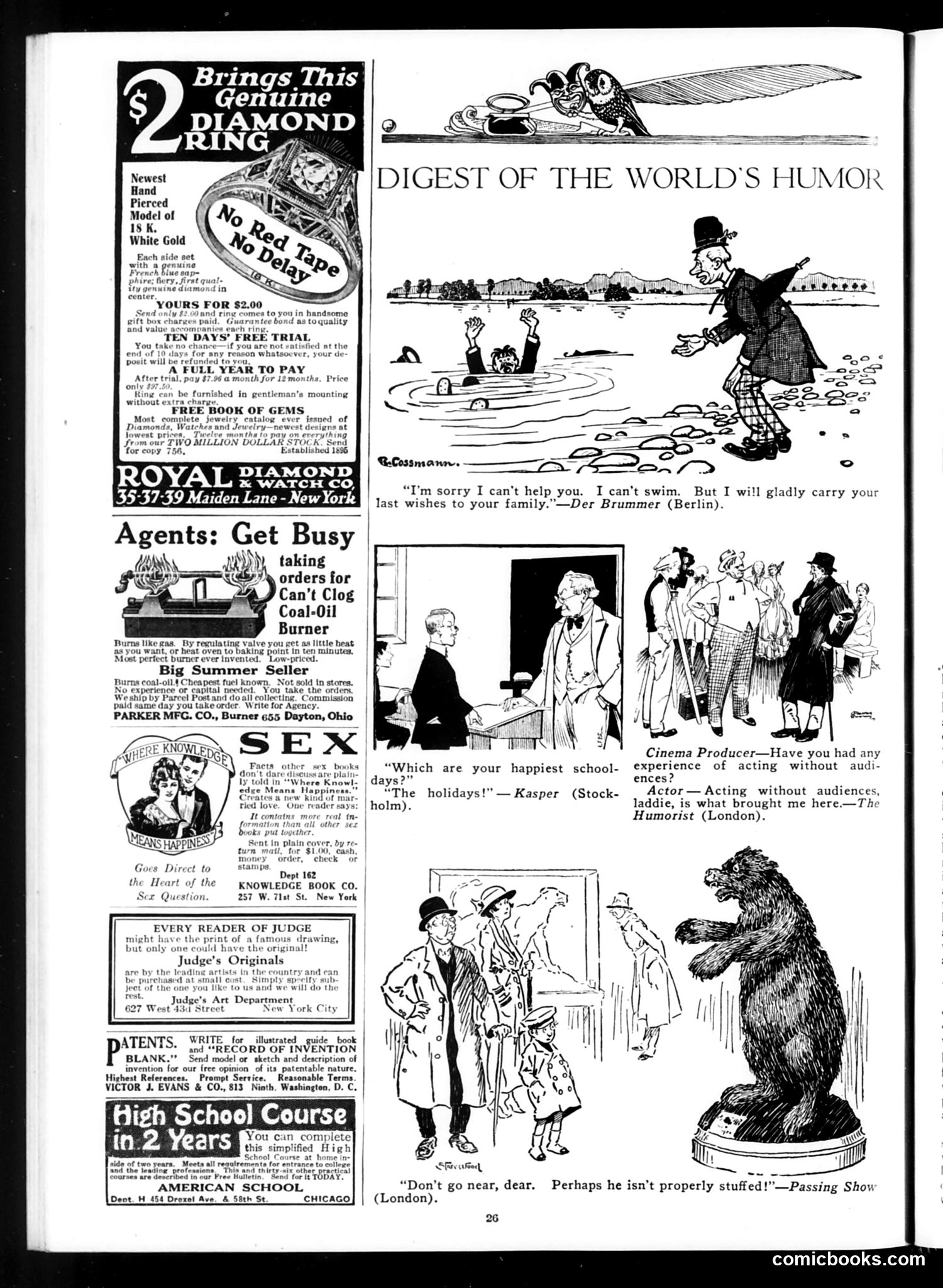
This page features a "Digest of the World's Humor"—reprinting jokes and cartoons from international publications like *Der Brummer* (Berlin), *Kasper* (Stockholm), and *Passing Show* (London). The cartoons are brief, genteel gags typical of early 20th-century humor: 1. **Drowning man joke**: A non-swimmer offers to deliver the victim's final wishes to his family—dark but polite humor. 2. **School holidays joke**: A student says his happiest school days are the holidays—a relatable complaint about education. 3. **Actor anecdote**: An actor admits he acts without audiences because he couldn't find work—self-deprecating show-business humor. 4. **Taxidermied bear**: A woman warns her companion away from a stuffed bear, joking it might not be properly preserved—visual gag playing on uncertainty. The page is primarily advertising (diamond rings, coal-oil burners, correspondence schools, patents), with humor content filling gaps—typical Judge magazine layout.
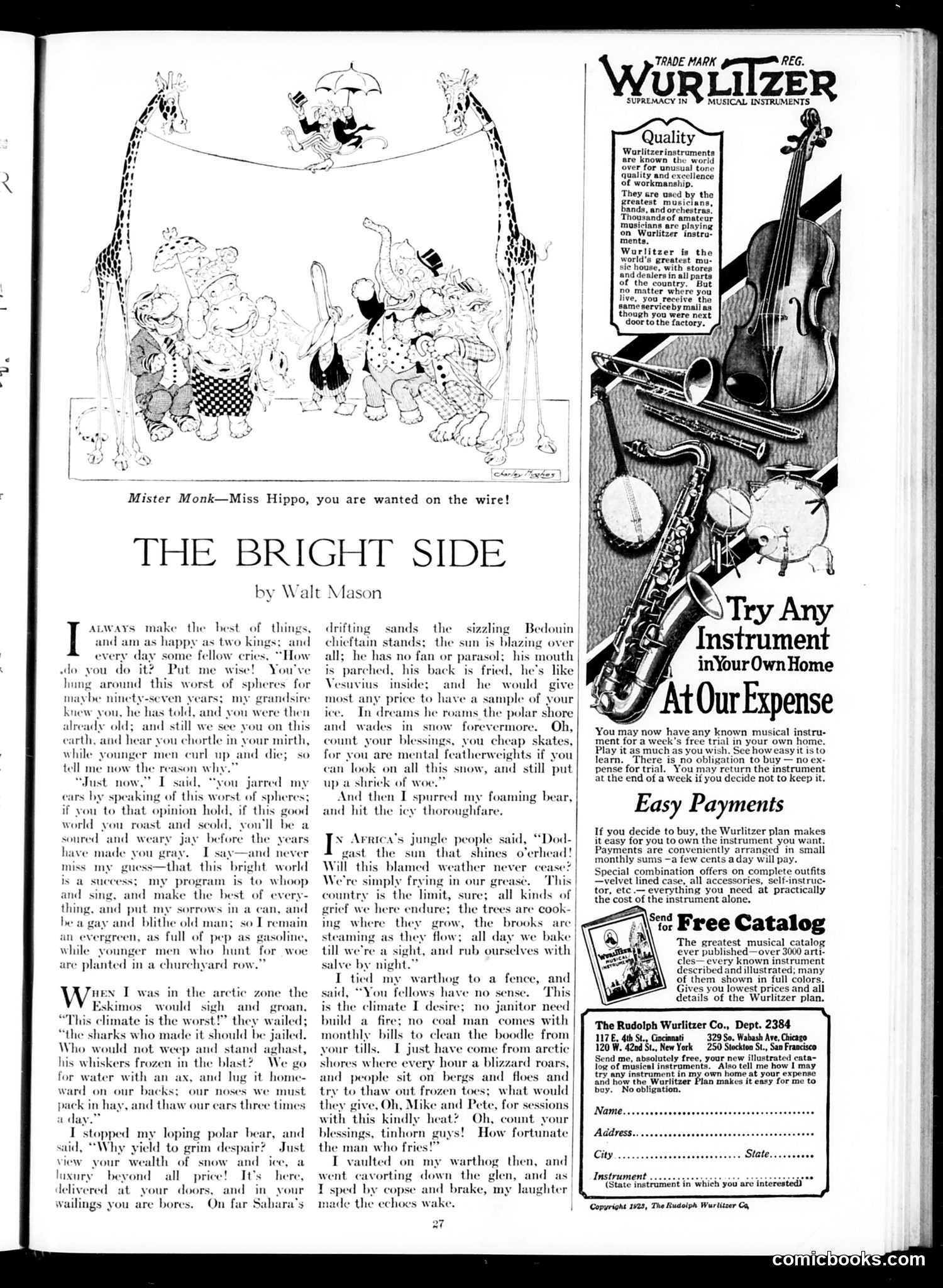
This page contains a humorous poem by Walt Mason (a popular American humorist of the early 20th century) advocating optimism and gratitude. The narrative voice travels to harsh climates—Arctic zones and the Sahara Desert—encountering people complaining about their conditions. He repeatedly reframes their suffering: Arctic cold is luxury compared to desert heat; Bedouins would trade anything for ice; desert dwellers should appreciate not needing heating fuel. **The cartoon at top** shows anthropomorphic animals (appears to include a hippo and monk) in a domestic scene receiving a telephone call—a humorous domestic vignette unrelated to the poem. **The satire**: Mason mocks perpetual complainers, suggesting their misery is self-inflicted pessimism. The message—count your blessings by comparing yourself to worse-off people—reflects early 20th-century American optimism and self-help philosophy. The Wurlitzer musical instrument advertisement occupies the right side, typical of Judge magazine's revenue model.
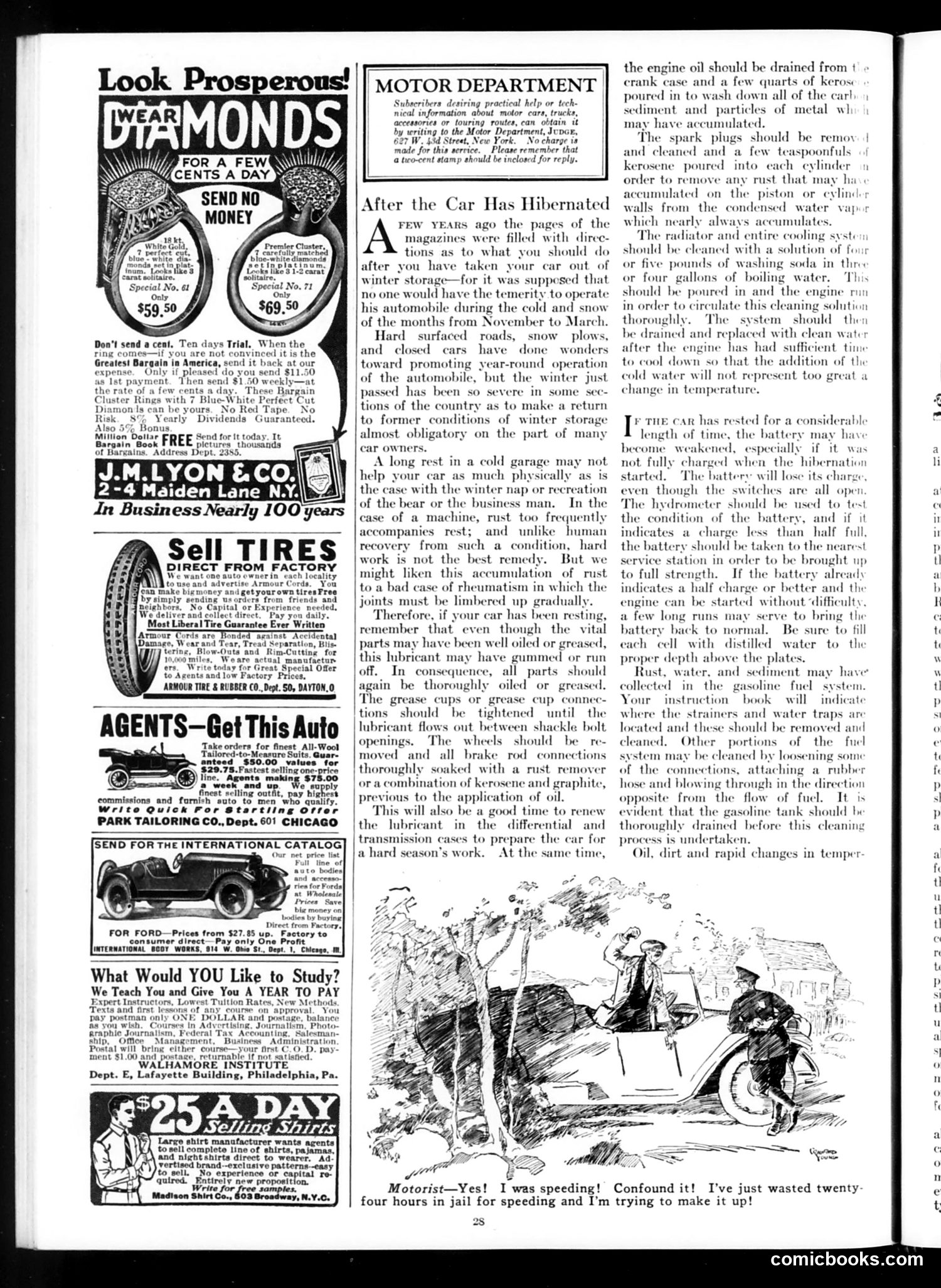
This is primarily an **advertising page** from Judge magazine with a single cartoon at the bottom. ## The Cartoon The cartoon depicts a motorist speaking to a police officer, joking that he's been in jail 24 hours for speeding and is "trying to make it up" by speeding again. The humor is dark/cynical—the driver's response to punishment is to commit the same offense repeatedly, suggesting motorists ignored traffic laws despite legal consequences. ## Context This reflects 1920s concerns about automobile safety and reckless driving. As cars became common, speeding and traffic violations were serious public issues. The cartoon satirizes driver attitudes: rather than deterring dangerous behavior, legal penalties seemed pointless to some motorists who viewed speed limits as mere inconveniences. ## The Advertisements The page is dominated by mail-order ads typical of the era: diamond rings, tires, shirts, automobiles, and correspondence courses—reflecting Depression-era economic anxiety and the direct-marketing boom. The "Motor Department" header indicates Judge offered automotive advice to readers, reflecting the magazine's diverse content mix of satire, practical information, and advertising.
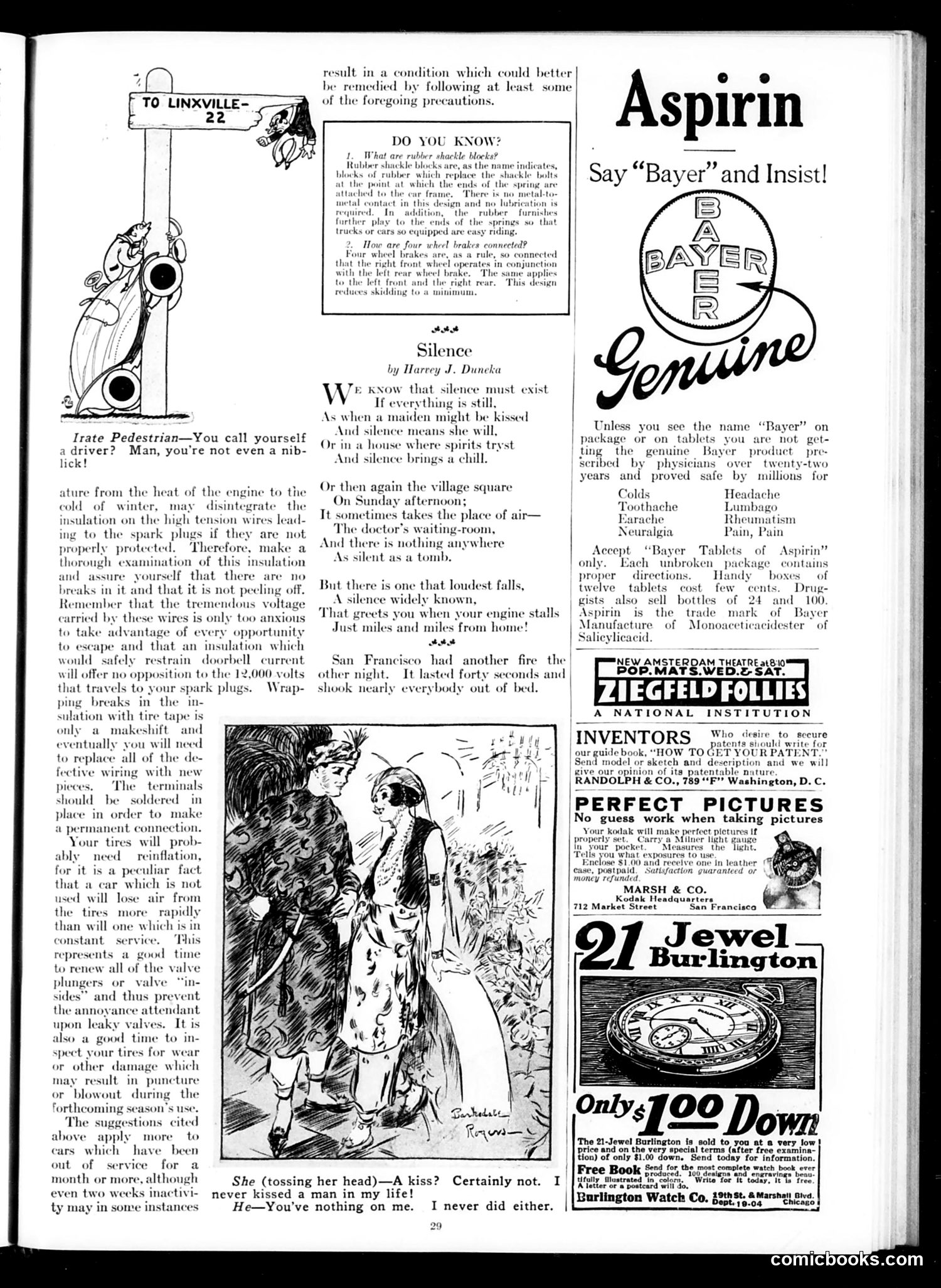
This page mixes editorial content with advertising. The main cartoon shows an "irate pedestrian" insulting a driver, using golf terminology ("niblic") as a joke—suggesting the driver is so bad he'd be better at golf than driving. The poem "Silence" by Harvey J. Duneka plays on the word's multiple meanings (peaceful quiet, romantic silence, medical waiting rooms) before the punchline: the worst silence is when your car engine stalls miles from home—a relatable 1920s concern about automobile reliability. The page is dominated by vintage advertising: Bayer Aspirin emphasizes brand authenticity ("Say 'Bayer' and Insist!"), warning consumers about generic imitations; a Burlington Watch company ad; and notices for inventors and photography products. The couple's dialogue at bottom is flirtatious banter about kissing—likely a romantic cartoon (not fully visible).
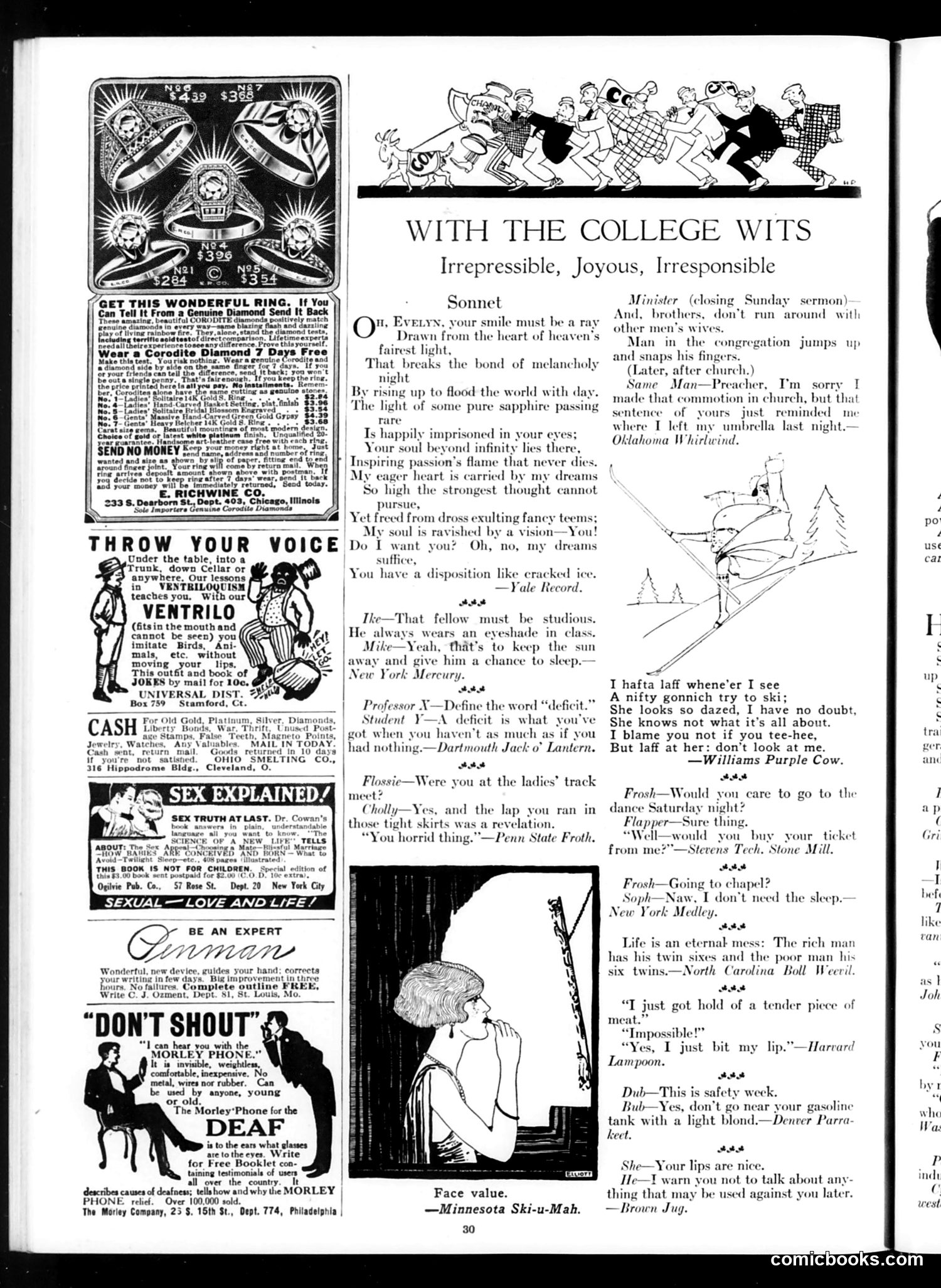
This page presents humorous college-themed content typical of 1920s satirical magazines. The main feature, "With the College Wits," collects brief jokes and quips attributed to various college publications (Yale Record, Dartmouth Jack o'Lantern, Penn State Froth, etc.). The humor targets recognizable college stereotypes: distracted scholars, flirtatious coeds in fashionable "tight skirts," eager freshmen, and worldly sophomores. One joke mocks religious hypocrisy—a man jumps up during a sermon about avoiding "other men's wives," then later admits the preacher's words merely reminded him he'd left his umbrella behind. The page also features period advertisements for novelty items (ventriloquism lessons, the "Morley Phone" hearing device) and diamond rings—common mail-order pitches in early 20th-century magazines. The satirical tone is lighthearted rather than biting; the jokes celebrate youthful irreverence and social awkwardness rather than critiquing serious issues. This reflects Judge's audience: educated, middle-class readers amused by collegiate campus life.
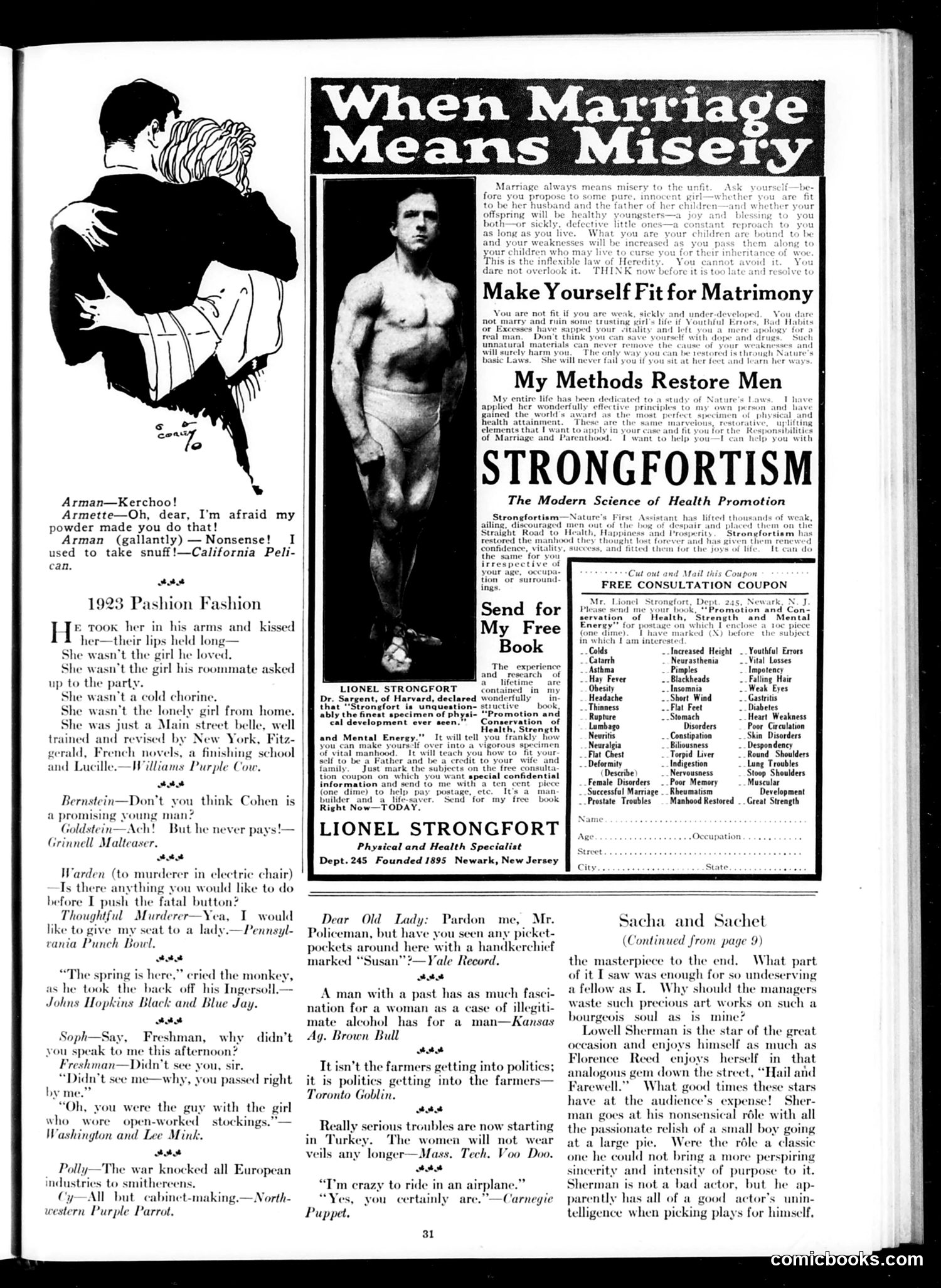
This page from *Judge* magazine contains several brief jokes and a substantial advertisement, typical of 1920s satirical humor. **The Cartoons/Jokes:** Most are brief, punny one-liners about courtship, marriage, and social life—common *Judge* fare. The "1923 Fashion" poem satirizes modern women who are "Main street belles" revised by New York novels and French fiction, suggesting women are adopting artificial urban sophistication. **The Main Advertisement:** Lionel Strongfort's "Strongfortism" is a health-promotion scheme promising to cure dozens of ailments (impotency, baldness, weak eyes, etc.) through physical culture methods. This represents early 20th-century pseudo-scientific fitness marketing—promising miraculous physical restoration to insecure men. **The Satire:** The juxtaposition is revealing: marriage requires physical fitness and health; unfit men cannot be husbands. The advertisement exploits anxiety about masculinity and matrimonial worthiness—common advertising tactics of the era targeting male insecurity.
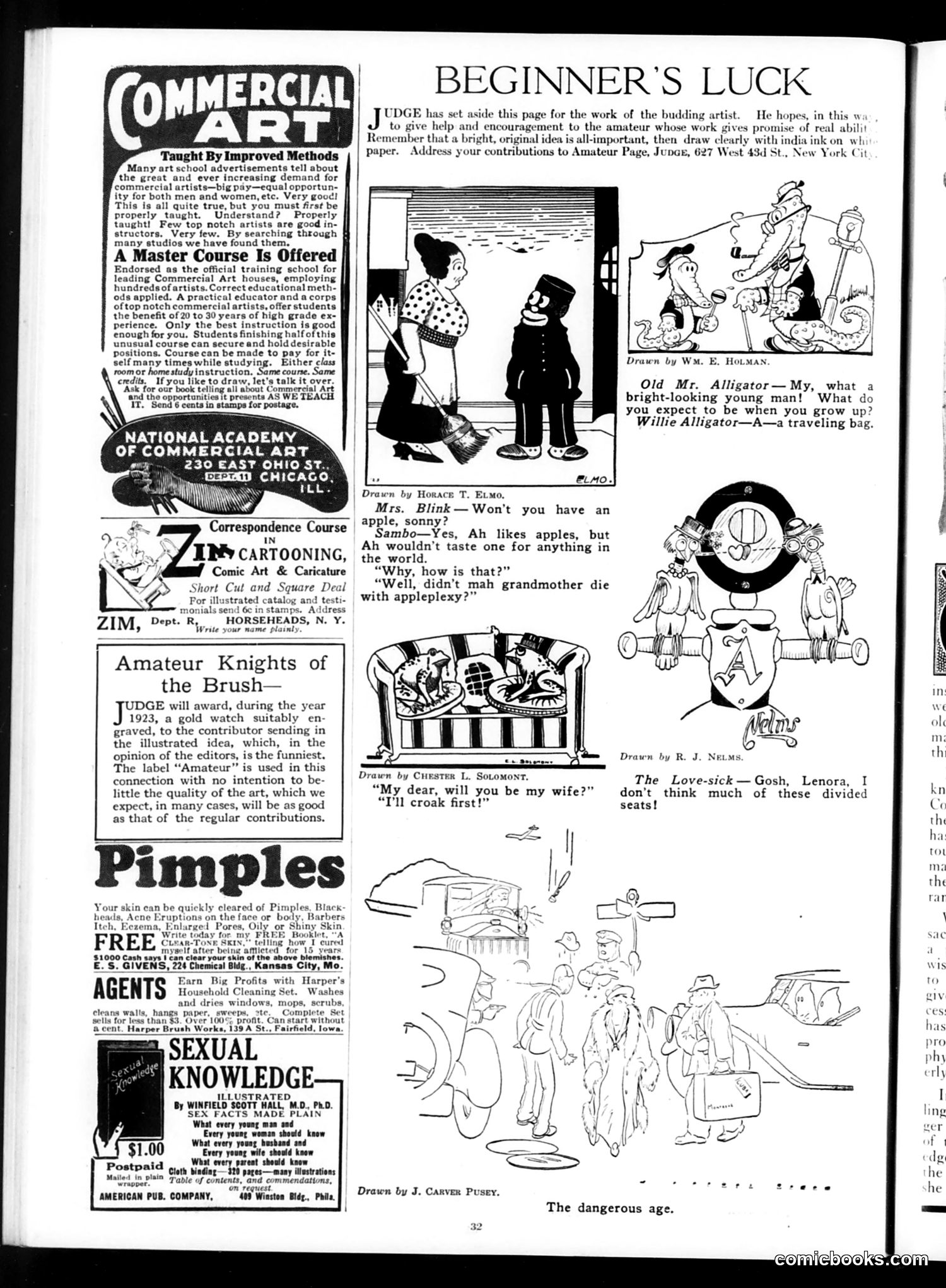
This page showcases amateur cartoons submitted to *Judge* magazine's contest for unpaid contributors. The cartoons employ simple, dated humor: **"Mrs. Blink"** (by Horace T. Elmo) relies on a racial stereotype—a Black character named "Sambo" makes a pun on "appleplexy" (apoplexy), claiming his grandmother died from it, so he won't eat apples. The joke trades on both wordplay and offensive racial caricature common to early-1920s publications. **"My Dear, Will You Be My Wife?"** (by Chester L. Solomont) uses a straightforward domestic joke: a woman threatens to "croak" (die) rather than marry. **"Willie Alligator"** plays on the visual pun of a suitcase resembling an alligator. **"The Love-sick"** (by J. Carver Purdy) jokes about divided car seats being unromantic. The page primarily functions as an **advertising section** promoting art schools and correspondence courses, with cartoons serving as filler content for amateur submissions.
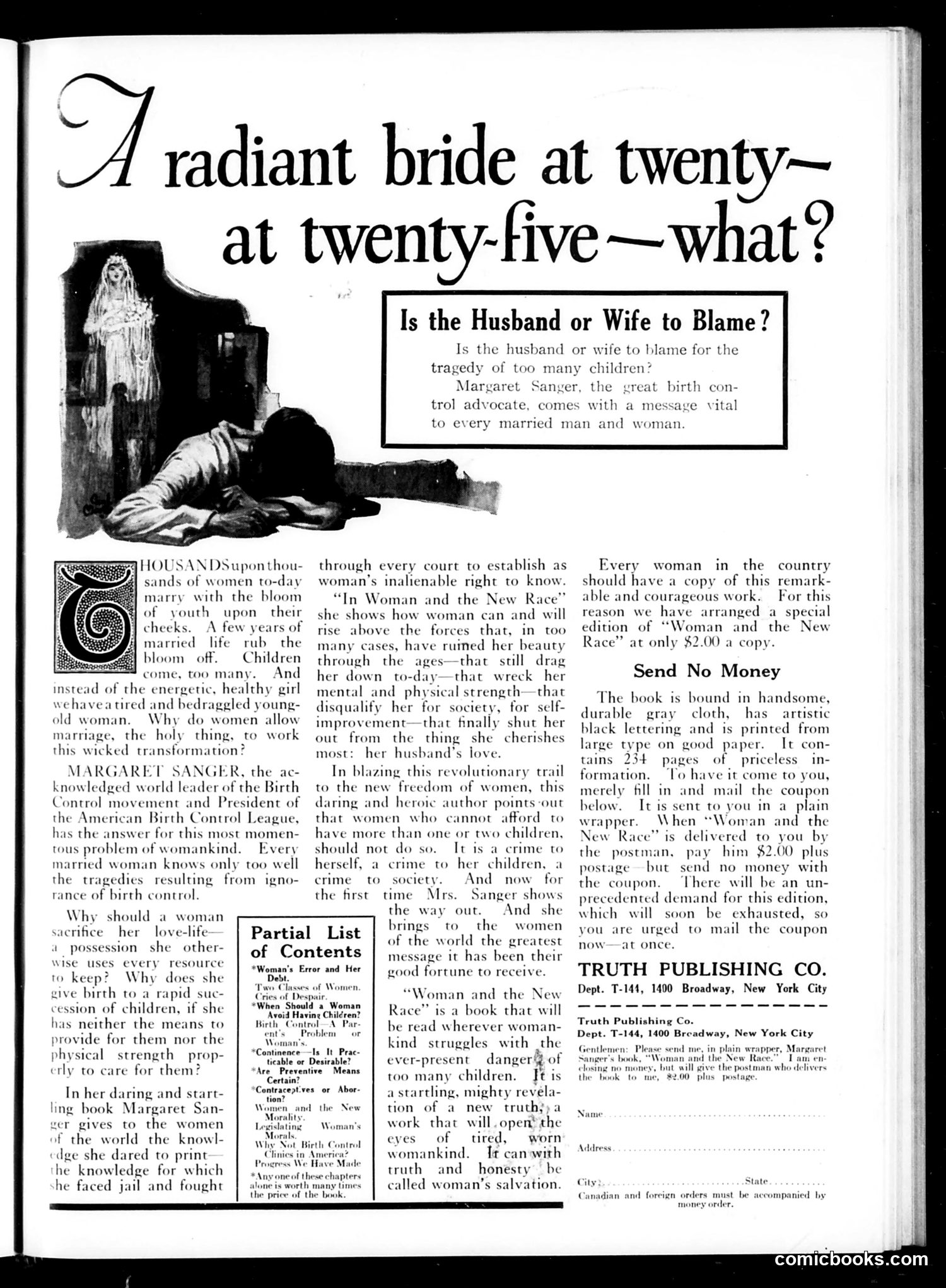
This page advertises Margaret Sanger's birth control advocacy book "Woman and the New Race" (circa 1920s). The illustration depicts a young bride transforming into an exhausted, aged woman—the visual argument: repeated pregnancies destroy women's health and beauty. **The satire's point:** The page ironically frames birth control as women's "salvation" while the accompanying illustration shows the physical toll of uncontrolled childbearing. Sanger, identified as president of the American Birth Control League, argues that women having "too many children" constitutes a "crime to society" and robs them of their husband's love and their own potential. **Historical context:** This reflects 1920s progressive reform debates. Sanger's radical message—that women should control their own reproduction—challenged religious and conservative opposition to contraception. The "Send No Money" mail-order pitch was typical advertising of the era. **Modern relevance:** What seems obvious today (reproductive choice) was genuinely controversial then, making this simultaneously a sincere reform advertisement and inadvertently revealing how recently women's bodily autonomy was contested.
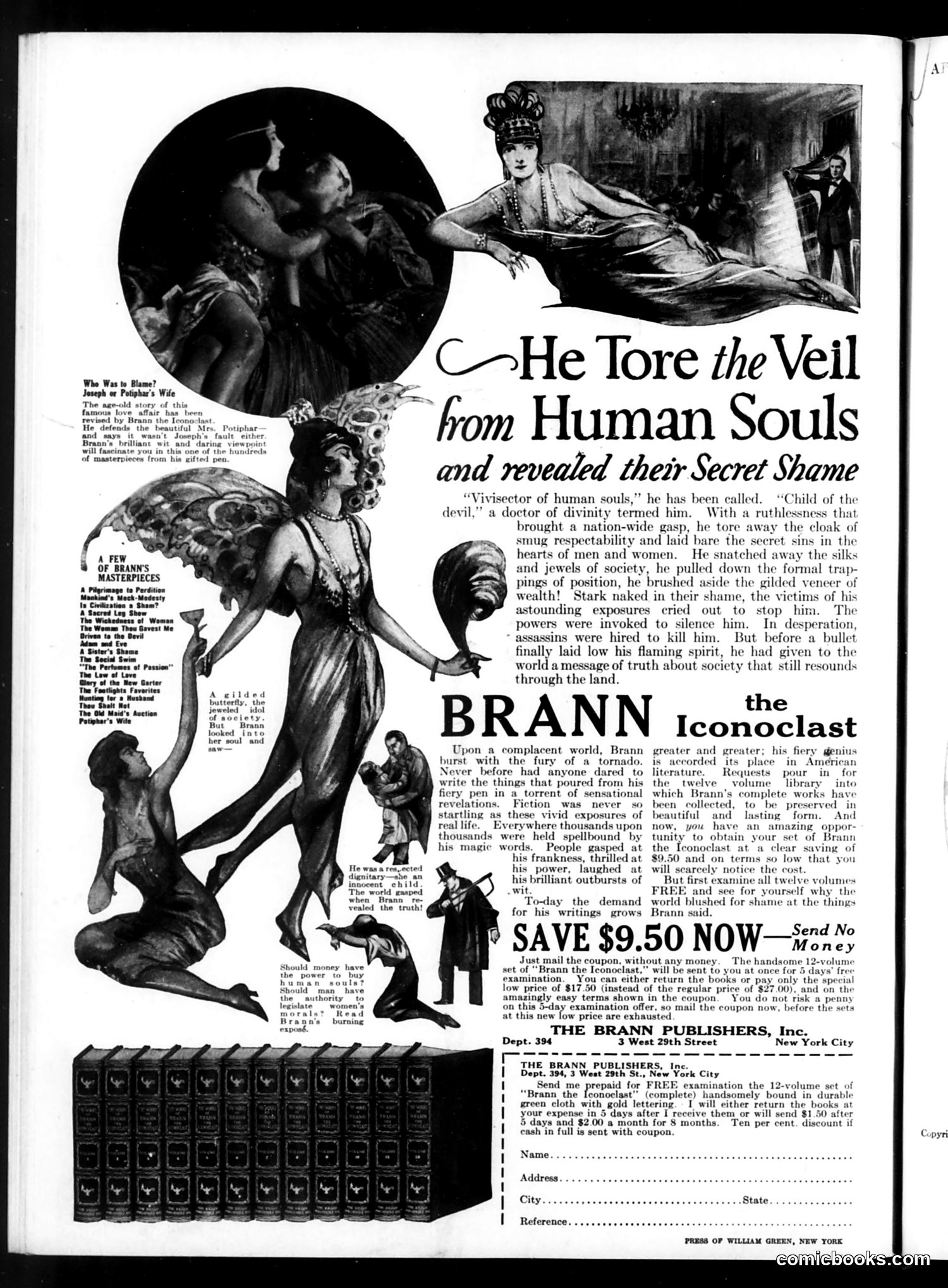
This page is primarily a **book advertisement**, not political satire. It promotes a 12-volume collected works of **William Cowper Brann**, a real American journalist and social critic (1855-1898) known for exposing corruption and hypocrisy. The copy presents Brann as a fearless truth-teller who "tore the veil from human Souls" by publicly attacking respected institutions and individuals for their hidden moral failings. The dramatic imagery—with figures recoiling in shame—illustrates his reputation for harsh, unflinching social criticism that scandalized respectable society. The advertisement emphasizes Brann's fearlessness ("powers were invoked to silence him") and positions his collected writings as valuable social commentary. The offer ($9.50 savings, 5-day free examination) was typical early-20th-century direct-mail marketing aimed at educated readers interested in muckraking social criticism.