
Judge, 1923-04-07 · page 11 of 36
Judge — April 7, 1923 — page 11: what you’re looking at
What you’re looking at
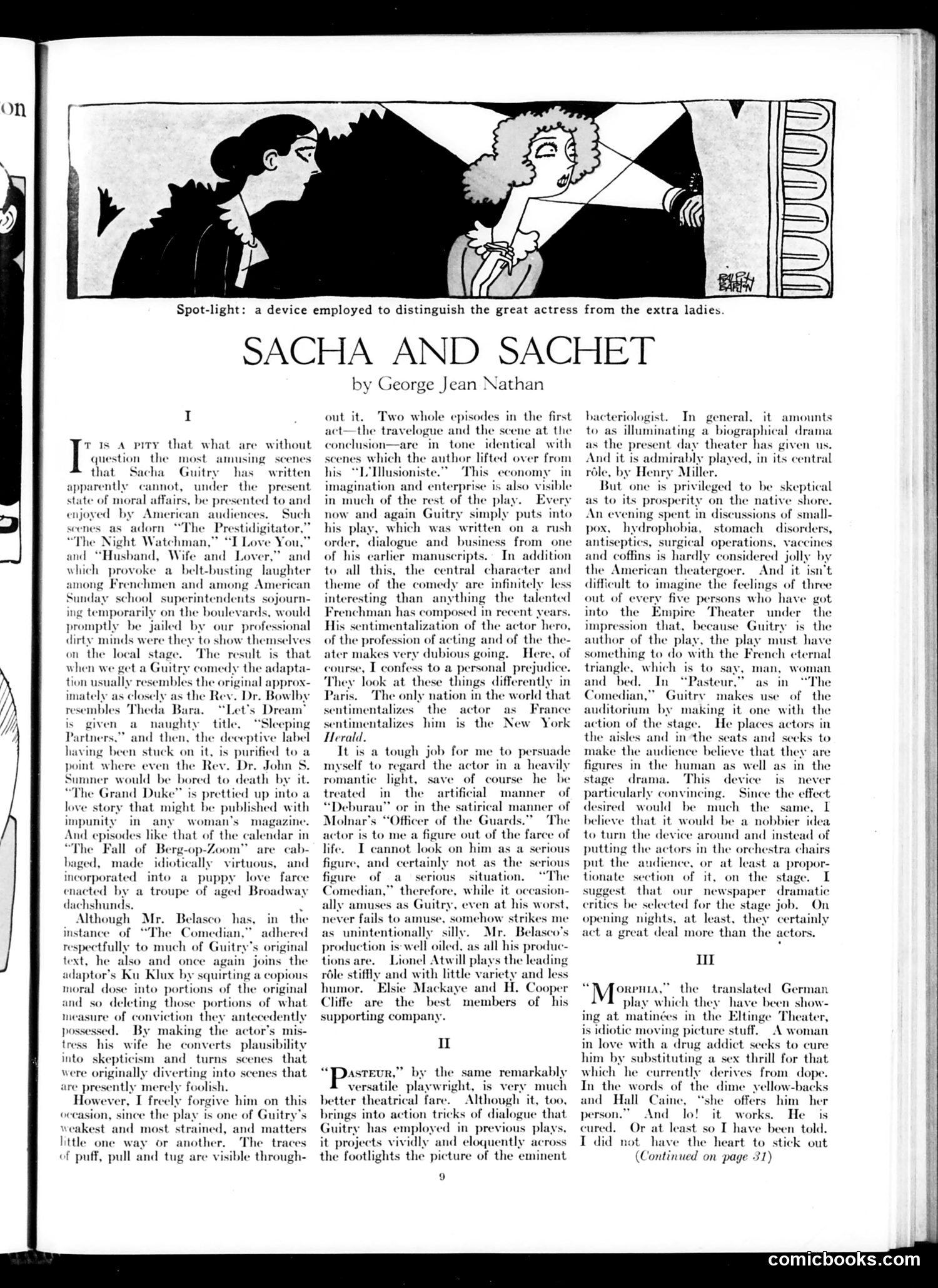
The cartoon at the page's top depicts a theatrical spotlight scene, illustrating the caption's joke: a spotlight device supposedly distinguishes "the great actress from the extra ladies." The image shows a woman on the left (likely representing the celebrated actress) highlighted against supporting performers, making a satirical point about star power and theatrical hierarchy. The accompanying article by George Jean Nathan discusses adaptations of French playwright Sacha Guitry's works for American audiences. Nathan criticizes how Guitry's original French comedies—containing morally questionable content—are heavily censored for American presentation. He notes that adapters, including David Belasco, remove or sanitize risqué scenes to satisfy American moral standards and avoid censorship. Nathan's tone is sardonic about this prudish adaptation process, suggesting American audiences lose the original plays' wit and authenticity through excessive bowdlerization.
📄 Transcribed text from this page (OCR, searchable)
Machine-transcribed from the original scan — historical spelling and the odd misread are preserved.
Spot-light: a device employed to distinguish the great actress from the extra ladies. SACHA AND SACHET I Tas A pity that what are without I question the most amusing scenes that Sacha Guitry has written vy cannot, under the present state of moral affairs, be presented to and y American audiences. Su as adorn “The Prestidigitator. Night Watchman,” “I Love You,” and “Husband, Wife and Lover,” and voke a belt-busting laughter among Frenchmen and among American Sunday school superintendents sojourn- ing temporarily on the boulevards, would promptly be jailed by our professional dirty minds were they to show themselves The result is that medy the adapta- the original approx- the Rev. Dr. Bowlby ed enje scenes which pi on the local stage. when we get tion usually rese imately as closely resembles The Bara. ets Dri is given a naughty title, “Sleeping Partners,” and then, the deceptive label having been stuck on it, is purified to a point where even the Rey. Dr. John S. Sumner would be bored to death by it. “The Grand Duke” is prettied up into a love story that might be published with impunity in any woman's magazine. And episodes like that of the calendar in “The Fall of Berg-op-Zoom” are cal baged, made idiotically virtuous, incorporated into. a puppy love enacted by a troupe of aged Bre dachshunds. ‘ Although Mr. Belasco has, in’ the instance of “The Comedian,” adhered respectfully to much of Guitry’s original text, he also and once again joins the adaptor’s Ku Klux by squirting a copious moral dose into portions of the original and so deleting those portions of what measure of conviction they antecedently By making the actor's mis- tress his wife he converts plausibility into skepticism and turns scenes that were originally diverting into scenes that are presently merely foolish, However, I freely forgive him on this sion, since the play is one of Guitry’s est and most strained, and matters ttle one way or another. The traces 00€ of puff, pull and tug are visible through- by George Jean Nathan out it. Two whole episodes in the first act—the travelogue and the scene at the conclusion—are in tone identical with which the author lifted over from his “L'Ilusioniste.” ‘This i imagination and enterprise in much of the rest of the play : now and again Guitry simply puts into his play, which was written on a rush order, dialogue and business from one of his earlier manuscripts.. In addition to all this, the central character and theme of the comedy are infinitely interesting than anything the talented Frenchman has composed in recent years. His sentimentalization of the actor he of the profession of acting and of the the- ater makes very dubious going. Here, of course, I confess to a personal prejudice. They look at these things differently in scene: » less Paris. The only nation in the world that sentimentalizes the actor as France sentimentalizes him is the New York Herald. It is a tough job for me to persuade myself to regard the actor in a heavily romantic light, save of course he be treated in the artificial manner of “Deburau” or in the satirical manner of Molnar’s “Officer of the Guards.” The actor is to me a figure out of the farce of life. I cannot look on him as a serious figure, and certainly not as the serious figure of a serious — situation. The Comedian,” therefore, while it occasion- ally amuses as Guitry, even at his worst, never fails to amuse, somehow strikes me as unintentionally silly. Mr. Belasco’s production is-well oiled, as all his produc- tions are. Lionel Atwill plays the leading role stiffly and with little variety and less humor. Elsie Mackaye and H. Cooper Cliffe are the best members of his supporting company. Il “Posteus.” by the same remarkably versatile playwright, is very much better theatrical . Although it, too, brings into action tricks of di © that Guitry has employed in previous plays, it projects vividly and eloquently across the footlights the picture of the eminent 9 hacteriologist. In. g 1, it) amounts to as illuminating a biographical drama as the present day theater has given us. And it is admirably played, in its central role, by Henry Miller. But’ one is privileged to be skeptical as to its prosperity on the native shore. An evening spent in discussions of small- pox, hydrophobia, stomach disorders, antiseptics, surgical operations, vaccines and coffins is hardly considered jolly by the American theatergoer, And. it isn't difficult to imagine the feelings of three out of every five persons who have got into the Empire Theater under the impression that, because Guitry is the author of the play, the play must have something to do with the French eterr triangle, which is to man, wor and bed. In “Pasteur,” as in he Comedian,” Guitry makes use of the auditorium by making it one with the action of the stage. He places actors in the aisles and in the seats and secks to make the audience believe that they are figures in the human as well as in the stage drama. This de is ne particularly convincing. Since the ef <d would be much the same, I e that it would be a nobbier idea to turn the device around and instead of putting the actors in the orchestra chairs put the audience, or at least a proy tionate section of it, on the stage. I suggest that our newspaper dramatic critics be selected for the stage job. On opening nights, at least, they certainly act a great deal more than the actors. 1 lr “Mow: the translated German play which they » been show- ing at matinées in the Eltinge Theater, is idiotic moving picture stuff. A woman in love with a drug addict seeks to cure him by substituting a sex thrill for that which he currently derives from dope. In the words of the dime yellow-backs and Hall Caine, “she offers him her person.” And lo! it) works. He is cured, Or at least so I have been told. I did not have the heart to stick out (Continued on page 31) comicbooks.com