
Judge, 1923-04-07 · page 17 of 36
Judge — April 7, 1923 — page 17: what you’re looking at
What you’re looking at
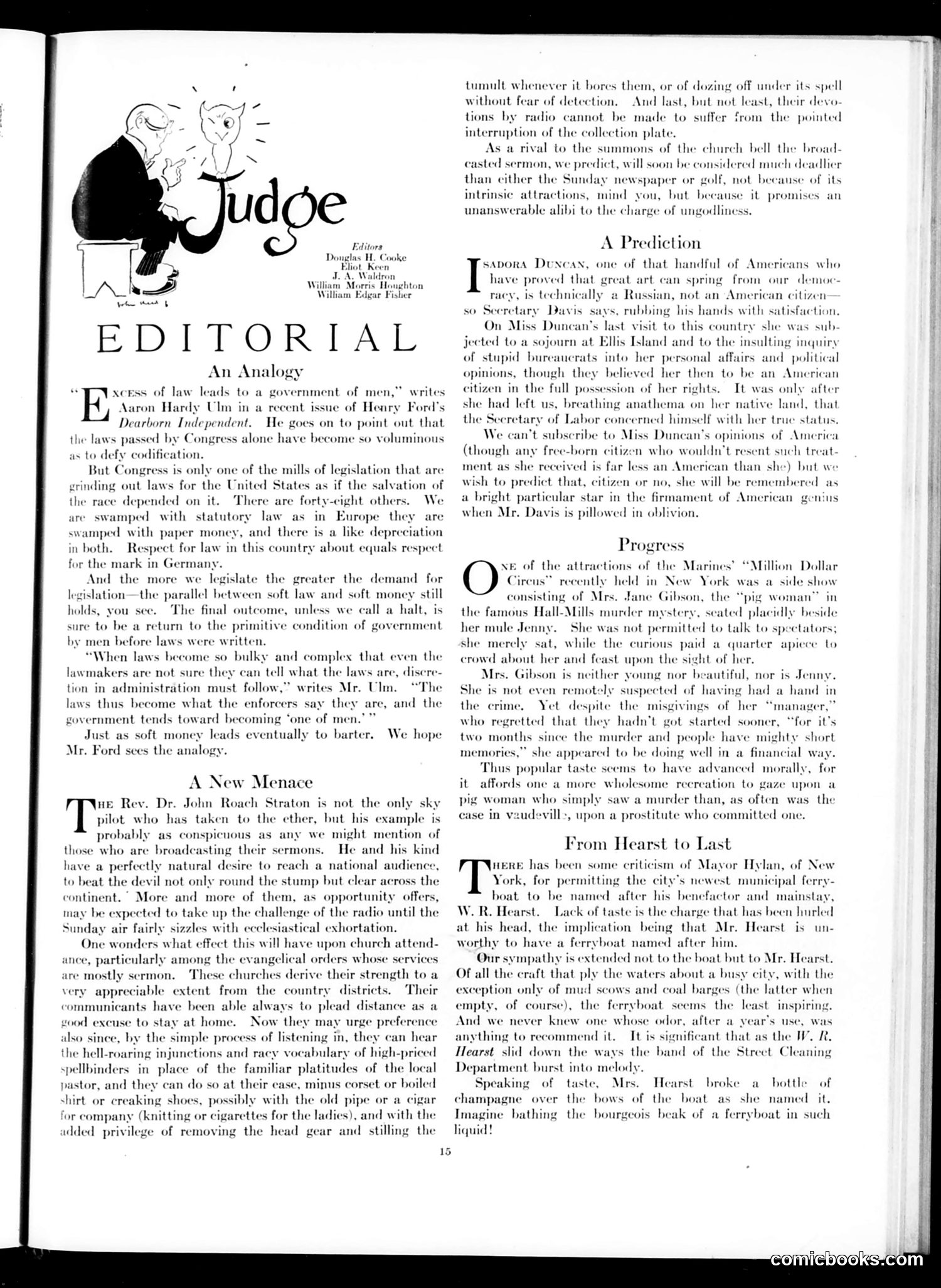
The page contains three editorial pieces rather than political cartoons. The small illustration shows a judge figure, the magazine's mascot. **"An Analogy"** compares excessive legislation to inflation: just as too much paper money loses value, too many laws become unenforceable and lead to government by administrative discretion rather than law. The piece, citing Henry Ford's *Dearborn Independent*, argues that Congress and state legislatures have created such legal complexity that enforcement becomes arbitrary. **"A New Menace"** satirizes radio broadcasts of religious sermons as a threat to church attendance. It mocks how listeners can now hear sermons at home in comfort—avoiding collection plates, sitting through boring sections, even dozing off—while claiming they've fulfilled their religious duty. The satire targets both radio technology's disruption of traditional institutions and congregants' hypocrisy. **"A Prediction"** defends Russian-American dancer Isadora Duncan against bureaucratic harassment at Ellis Island, praising her artistic achievements while criticizing U.S. government officials' suspicion of foreign artists. These pieces reflect 1920s Progressive-era anxieties about government overreach, technological disruption, and nativism.
📄 Transcribed text from this page (OCR, searchable)
Machine-transcribed from the original scan — historical spelling and the odd misread are preserved.
Eliot, Keen A. Waldron Houghton Fisher Veh ane EDITORIAL An Analogy “s xcess of law leads to a government of men,” writes K Aaron Hardy Ulm in a recent issue of Henry Ford's Dearborn Independent. He goes on to point out that the laws passed by Congress alone have become so voluminous as to defy codification. But Congress is only one of the mills of legisl grinding out laws for the United States as if th There are forty-eight others. V are swamped with statutory law as in Europe they are swamped with paper money, and there is a like depreciation in both. Respect for law in this country about equals respect for the mark in Germany. And the more we legislate the greater the demand for the parallel between soft law and soft money still The final outcome, unless we call a halt, is ion that are f salvation the race depended on it. I tion holds, you see. sure to be a return to the primitive condition of government by men before laws were written. “When laws become so bulky lawmakers are not sure they can tell what the laws are, disere- tion in administration must follow,” writes Mr. Ulm. ‘The laws thus become what the enforcers say they are, and the of men.” nd complex that even the government tends toward becoming ‘or Just as soft money leads eventually to barter. Mr. Ford sees the analog A New Menace ne Rev. Dr. John Roach Straton is not the only sky pilot who has taken to the ether, but his example is any we might mention of He and his kind mal audience, uous ¢ probably as consp' those who are broadcasting their sermons. have a perfectly natural desire to reach a nati to beat the devil not only round the stump but clear across the continent.’ More and more of them, as opportunity offers, may be expected to take up the of the radio until the Sunday air fairly sizzles with e exhortation, One wonders what effect this wil » upon church attend- ance, particularly among the evangelical orders whose services ure mostly sermon. ‘These churches derive their strength to a very appreciable extent from the country districts. Their communicants have been able always to plead distance as a good excuse to stay at home. Now they may urge preference - the simple process of listening in, the , vocabulary of high-pric platitudes of the local ase, minus corset or boiled the hell-roaring injunctions and rac spellbinders in. place of the fami pastor, and they can do so at their shirt or creaking shoes, possibly with the old pipe or a cigar or company (knitting or cigarettes for the ladies), and with the ded privilege of removing the head gear and stilling the tumult whenever it bores them, or of dozing off under its spell And last, but not least, their devo without fear of detection. tions by radio cannot be made to suffer from the pointed interruption of the collection plate. As a rival to the summons of the church bell the broad- casted sermon, we predict, will soon be considered much deadlier than either the Sunday newspaper or golf, not bec intrinsic attractions, mind you, but because it promises an unanswerable alibi to the charge of ungodliness. A Prediction sapora Duncan, one of that handful of Americans who have proved that great art can spring from our democ- Russian, not an American citizen ys. rubbing his hands with satisfaction. . is technica so Secretary Davis On Miss Duncan's last visit to this country she was sub jected to a sojourn at Ellis Island and to the insulting inquiry rs and political 1 American after her personal aff: of stupid bureaucrats int her then to be a It was only citizen in the full possession of her rights. she had left us, breathing anathema on her native land, that sretary of Labor concerned himself with her true status. We can’t subscribe to Miss Duncan's opinions of America (though any free-born citizen who wouldn't resent such treat- ment as she received is far less an American than she) but we rememby . citizen or no, she will t wish to predict thi a bright particular star in the firmament of American genius when Mr. Davis is pillowed in oblivion. Pre NE of the Cirens” rec actions of the Marines’ “Million Dollar consisting of Mrs. J ntly held in New re Gibson, the the famous Hall-Mills murder mystery, seated placidly beside She was not permitted to talk to spectators; 2reSs York was a side show pig woman” in her mule Jenny. she merely sat, while the curious paid a quarter apiece to crowd about her and feast upon the sight of her. Mrs. Gibson is neither young nor beautiful, nor is Jenny. She is not even remotely suspected of having had a hand in the crime. Yet despite the misgivings of her “manager,” who regretted that they hadn't got started sooner, two months since the murder and people have mighty short al way. or it’s memories,” she appeared to be doing well in a financ © advanced morally, for Thus popular taste seems to he it affords one a more wholesome recreation to gaze upon a man who simply saw a murder than, as often was. the pig w case in vaudevill>, upon a prostitute who committed one. Irom Hearst to Last HERE has been some criticism of Mayor Hylan, of New I York, for permitting the city’s newest municipal fe boat to be named after his benefactor and mainsta W. R. Hearst. Lack of taste is the charge that has been hurk at his head, the implica being that Mr. He: worthy to have a ferryboat named after him. Our sympathy is extended not to the boat but to Mr. Hearst. Of all the craft that ply the waters about a busy city, with the exception only of mud scows and coal barges (the latter when empty, of course), the ferryboat seems the t inspiring. And we never knew one whose odor, after a year’s use, was anything to recommend it. It is significant that as the W. R. Hearst slid down the ways the band of the Street Cleaning Department burst into melody. peaking of taste, Mrs. Hearst broke a bottle of champagne over the bows of the boat as she named. it. g the bourgeois beak of a ferryboat in such ion Imagine bathi liquid!