
A complete issue · 36 pages · 1923
Judge — March 3, 1923
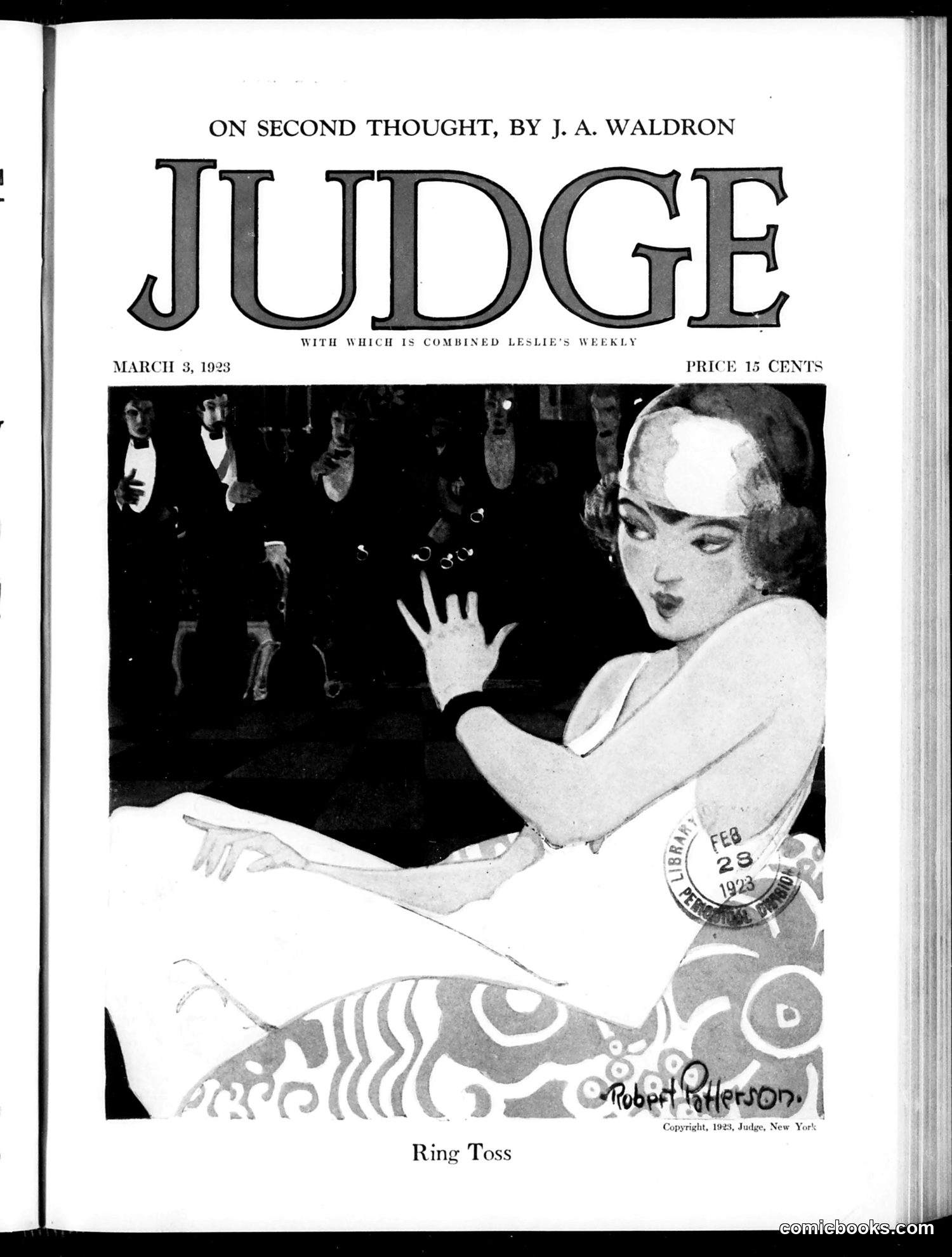
This illustration, credited to Robert Hilliard, depicts a woman in 1920s attire performing a parlor game or carnival activity called "ring toss." The image appears to be a lighthearted social commentary on leisure activities and entertainment of the era, likely aimed at upper-class audiences familiar with such games at parties or social gatherings. The title "On Second Thought, by J.A. Waldron" suggests accompanying editorial commentary, though that text isn't visible here. Without the article, the specific satirical point remains unclear—it may comment on fashion, social pretension, or simply illustrate contemporary entertainment trends. The illustration serves as typical Judge magazine content: social observation through humor targeting its educated, affluent readership.
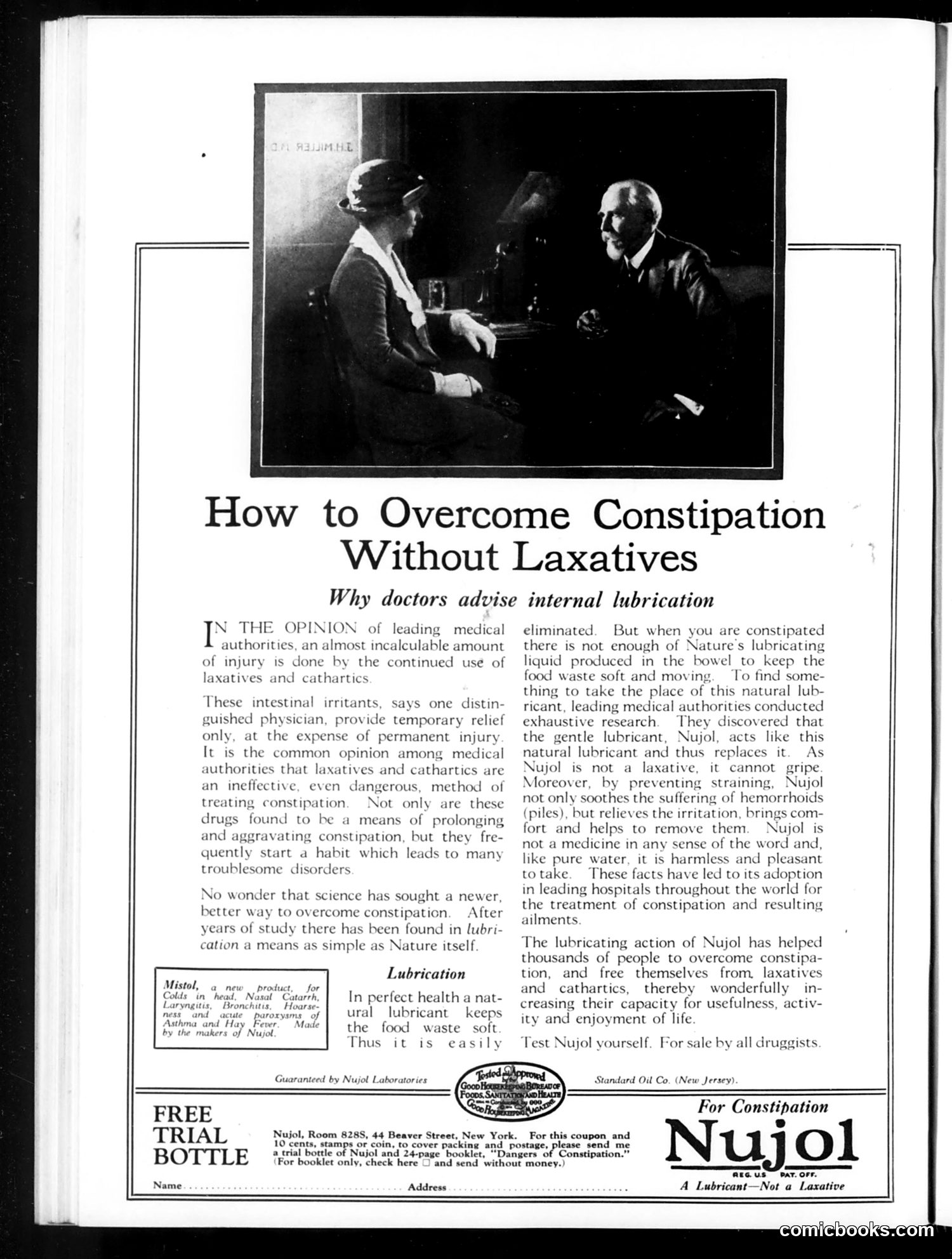
This page is primarily **advertising, not satire or political content**. It's a Nujol product advertisement for treating constipation without laxatives, occupying the full page. The image shows two men in what appears to be a medical consultation—likely a doctor and patient, though neither is caricatured or identified. The advertisement emphasizes that leading medical authorities recommend "internal lubrication" rather than harsh laxatives, positioning Nujol as a gentler alternative that acts like a natural intestinal lubricant. The text criticizes traditional laxatives as harmful and promotes Nujol's approach. A free trial coupon appears at the bottom. There is **no political satire, social commentary, or identifiable figures**—this is straightforward vintage pharmaceutical advertising using medical authority as selling point.
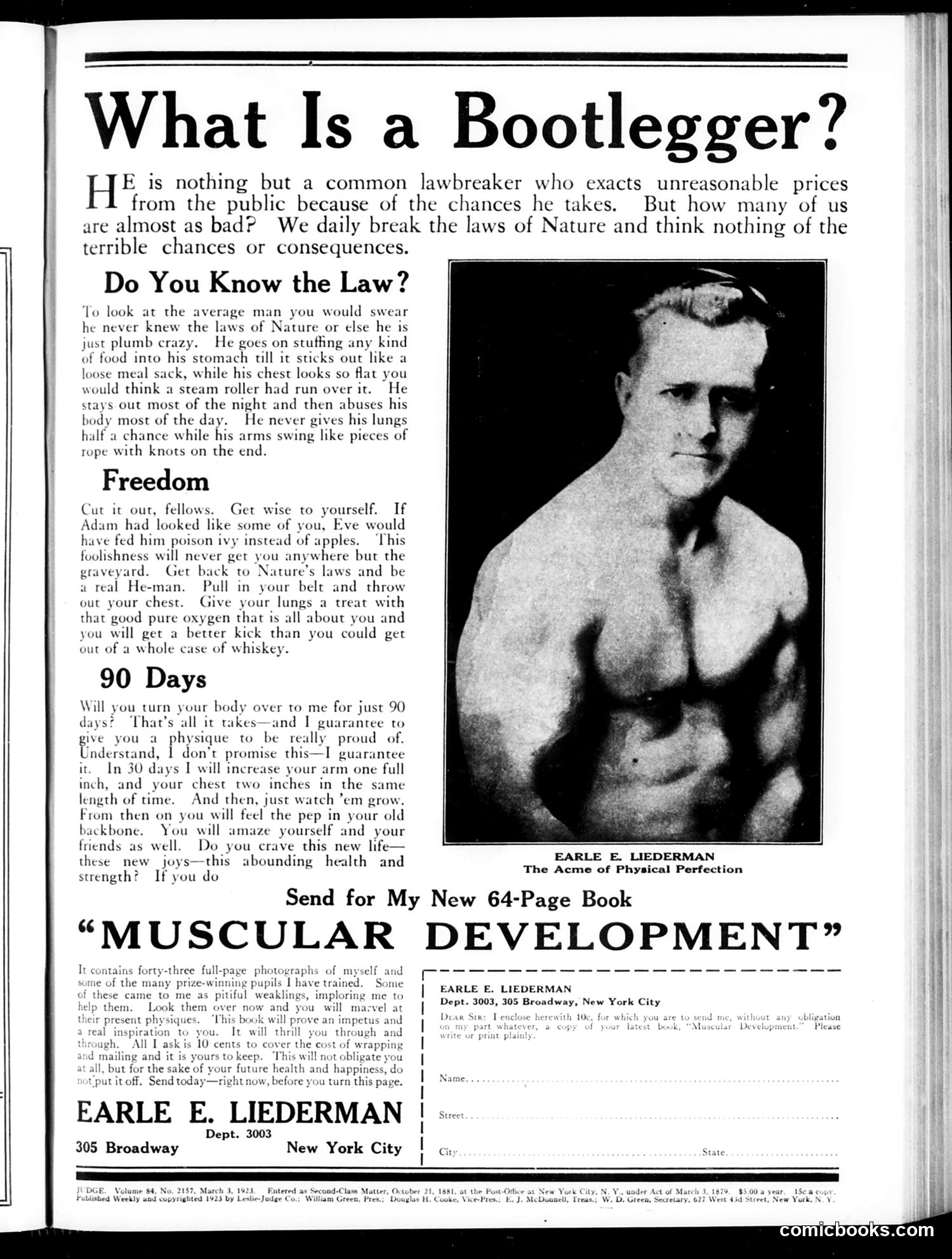
This page is primarily an advertisement disguised as social commentary. The headline attacks bootleggers (illegal alcohol sellers during Prohibition), calling them lawbreakers who exploit the public. However, the irony is sharp: the article then accuses *ordinary citizens* of similarly breaking Nature's laws through gluttony, lack of exercise, and bodily abuse. The pivot point is "Freedom"—a sarcastic call to abandon excess and return to natural living. This sets up the real pitch: Earle E. Liederman's "Muscular Development" book and physical training program, promising dramatic body transformation in 90 days. The photograph shows Liederman himself as proof. This is essentially a health/fitness ad using Prohibition-era anti-bootlegger rhetoric as a hook to sell personal improvement through exercise—a clever rhetorical sleight equating moral and physical reformation.
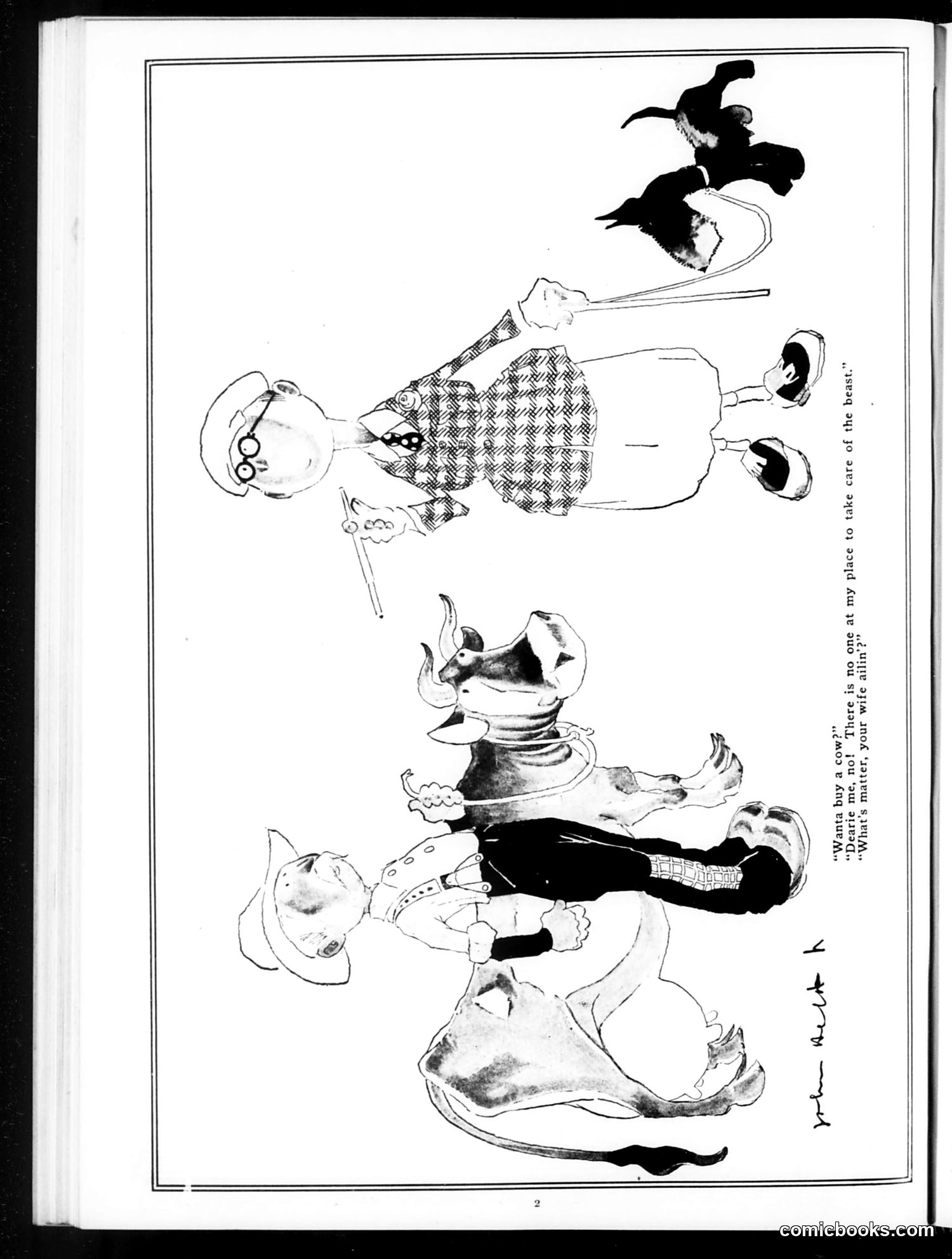
This appears to be a satirical cartoon about wealth disparity and greed, likely from the early 20th century based on the art style. The image shows a wealthy, rotund gentleman (wearing glasses and patterned clothing) being attended to by multiple servile figures. One figure holds an umbrella over him; others appear to be his servants or subordinates in various poses of submission or service. The caption references "want buy a cow?" with a punch line about "There is no one at my place to take care of the brute. What matter, your wife ain't." The satire mocks wealthy industrialists who accumulate excessive servants and possessions while treating their dependents—particularly wives—as merely another commodity or burden to manage. It critiques both conspicuous consumption and marital exploitation among the elite.
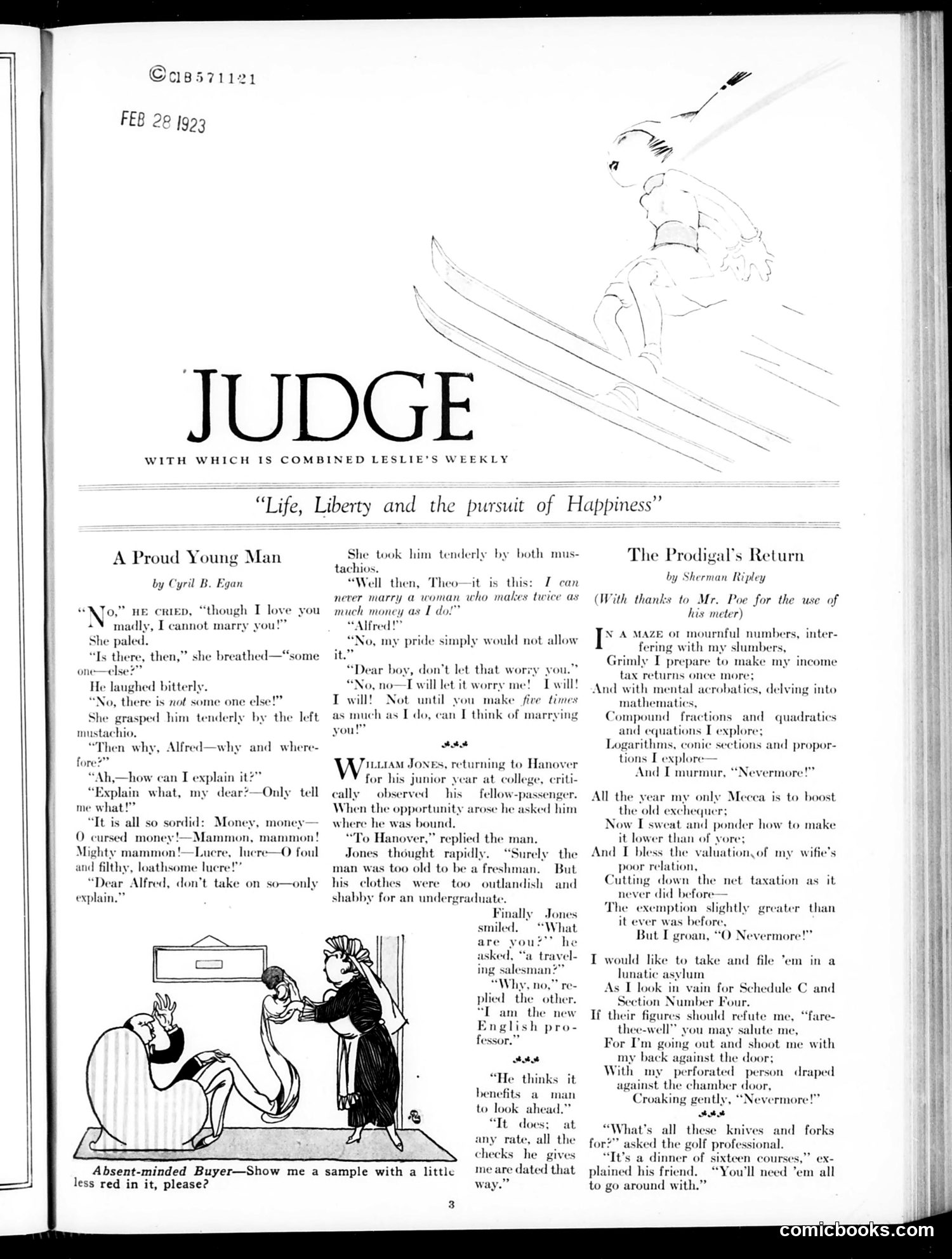
This February 28, 1923 page contains three stories and one cartoon. The main cartoon, "Absent-minded Buyer," depicts a man and woman in a shop, with the woman holding fabric. The joke plays on the husband's inattention to shopping—a common domestic satire trope of the era. The three stories—"A Proud Young Man," "The Prodigal's Return," and a William Jones narrative—are typical Judge humor: romantic misunderstandings, class anxieties, and financial worries. The Jones story mocks undergraduate pretension and new academic titles. The satire reflects 1920s concerns: marriage dynamics, economic status, and educational vanity. The content aims at middle-class readers through relatable domestic scenarios rather than explicit political commentary. The overall tone is light social mockery rather than sharp political critique.
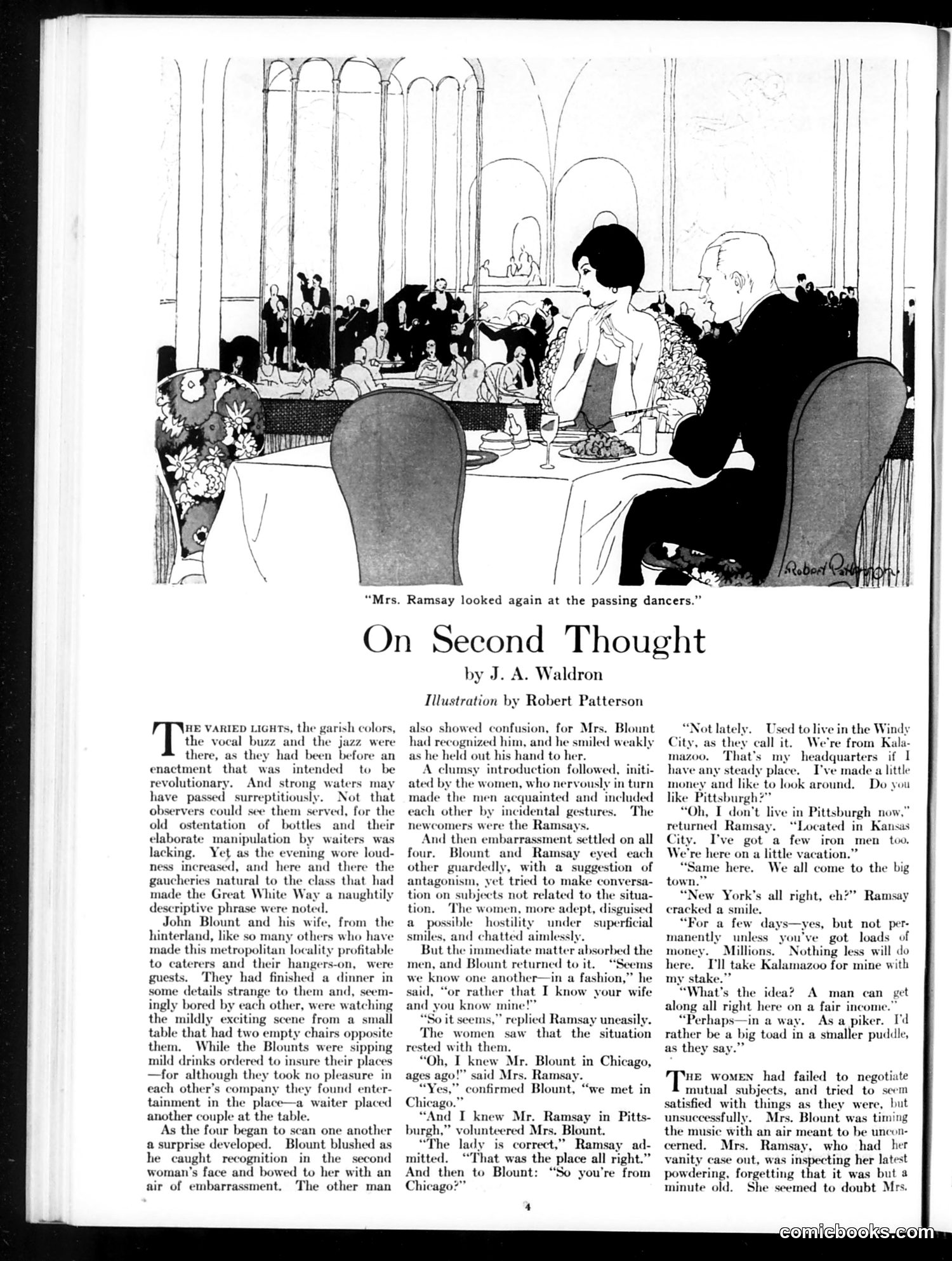
This page contains a short story illustrated by Robert Patterson, not a political cartoon. The illustration depicts a formal dinner scene where Mrs. Ramsay observes passing dancers at what appears to be an upscale venue. The story concerns social embarrassment among the upper class. Mrs. Ramsay encounters an acquaintance, Mr. Blount, whom she hadn't recognized initially. The narrative explores awkward moments of mistaken identity and the conversational difficulties that follow—characters attempting to recover from social missteps while maintaining propriety. The illustration captures the elegant setting and the moment of Mrs. Ramsay's second glance, emphasizing the refined but socially fraught atmosphere typical of early 20th-century upper-class gatherings depicted in Judge magazine's satirical fiction.
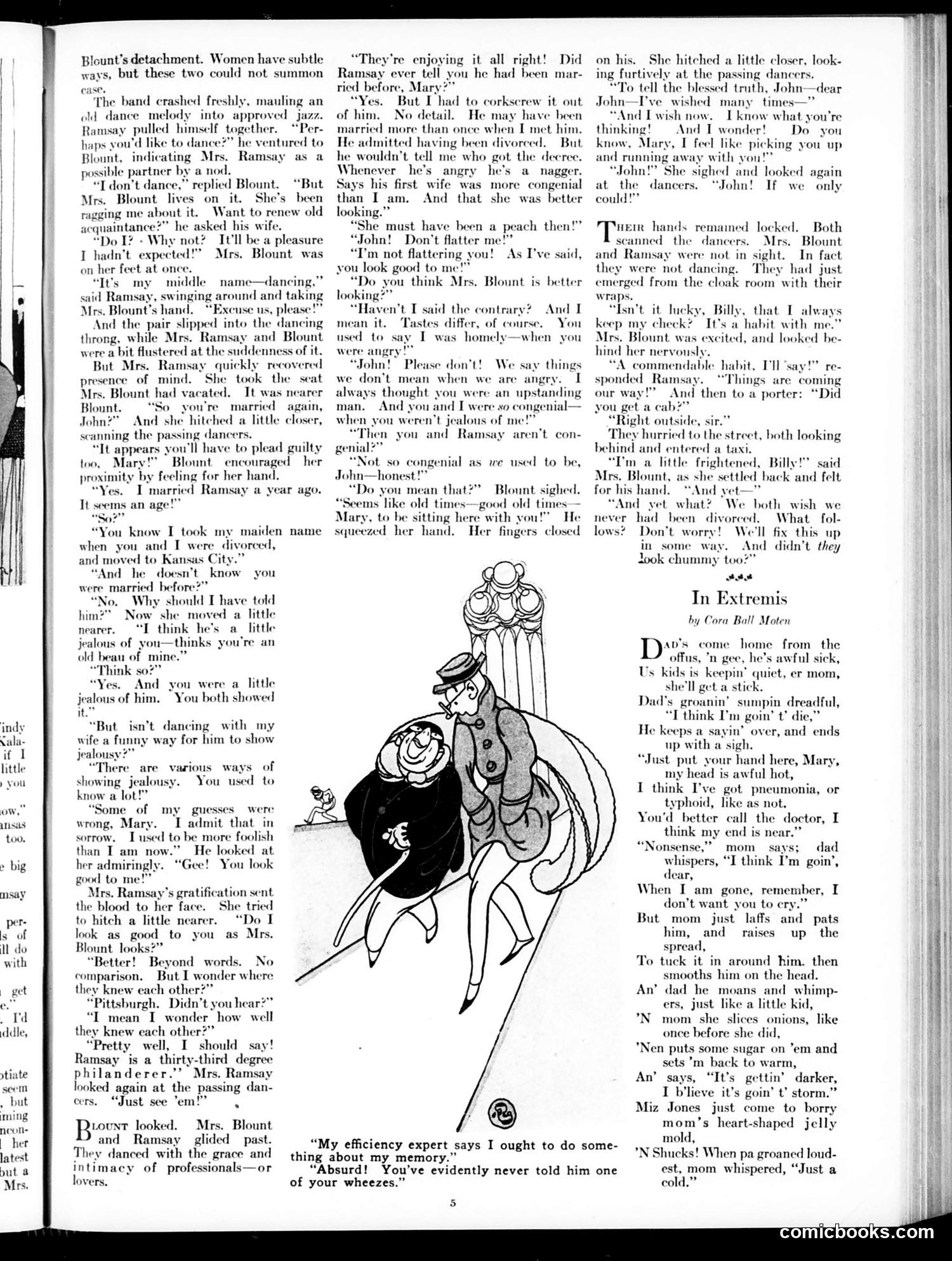
This page depicts a satirical domestic scene about infidelity and rekindled romance. The main narrative (left column) shows a man named John dancing with Mrs. Blount while his current wife, Mrs. Ramsay, sits nearby. Mrs. Ramsay then dances with Mr. Blount, leading to flirtation between the two ex-spouses. The satire targets the casual hypocrisy of upper-class social life: married couples entertaining affairs under the guise of normal social dancing. The dialogue reveals that John and Mary were previously divorced, remarried to other people, yet still harbor romantic feelings. The "efficiency expert" caption (bottom) mocks John's excuse about poor memory—implying he conveniently forgets past romantic entanglements. The cartoon critiques how respectable society enables infidelity through polite social conventions, where intimate reconnections occur openly on dance floors without scandal.
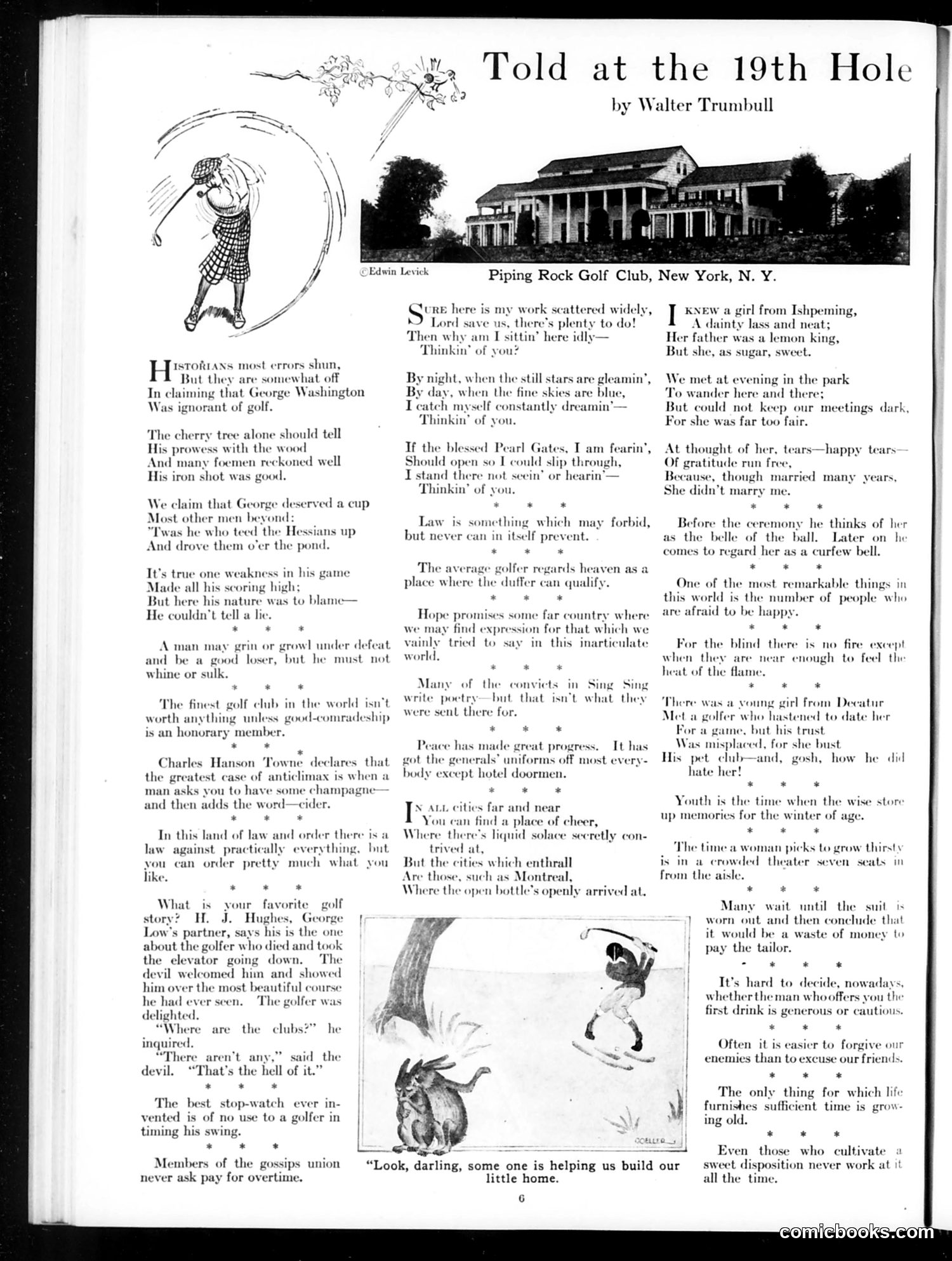
This page from *Judge* magazine collects humorous anecdotes and brief poems centered on golf, presented as stories told at a golf club's 19th hole (the bar). The content includes: **Main humor:** - A satirical poem claiming George Washington was skilled at golf, with puns ("teed the Hessians up / And drove them o'er the pond") - Golf-specific jokes mocking duffers' delusions (thinking heaven is where bad golfers can qualify) - A dark joke about a golfer who dies and finds hell has no golf clubs ("That's the hell of it") - Social commentary disguised as aphorisms (about honesty, sportsmanship, and modern life) **The satire targets:** - Golfers' pretentiousness and self-delusion - Romantic sentimentality (poems about longing and lost love) - Prohibition-era hypocrisy (jokes about "liquid solace" in cities like Montreal) - Marriage as mundane ("curfew bell") The overall tone is lighthearted mockery of upper-class golf culture and romantic conventions.
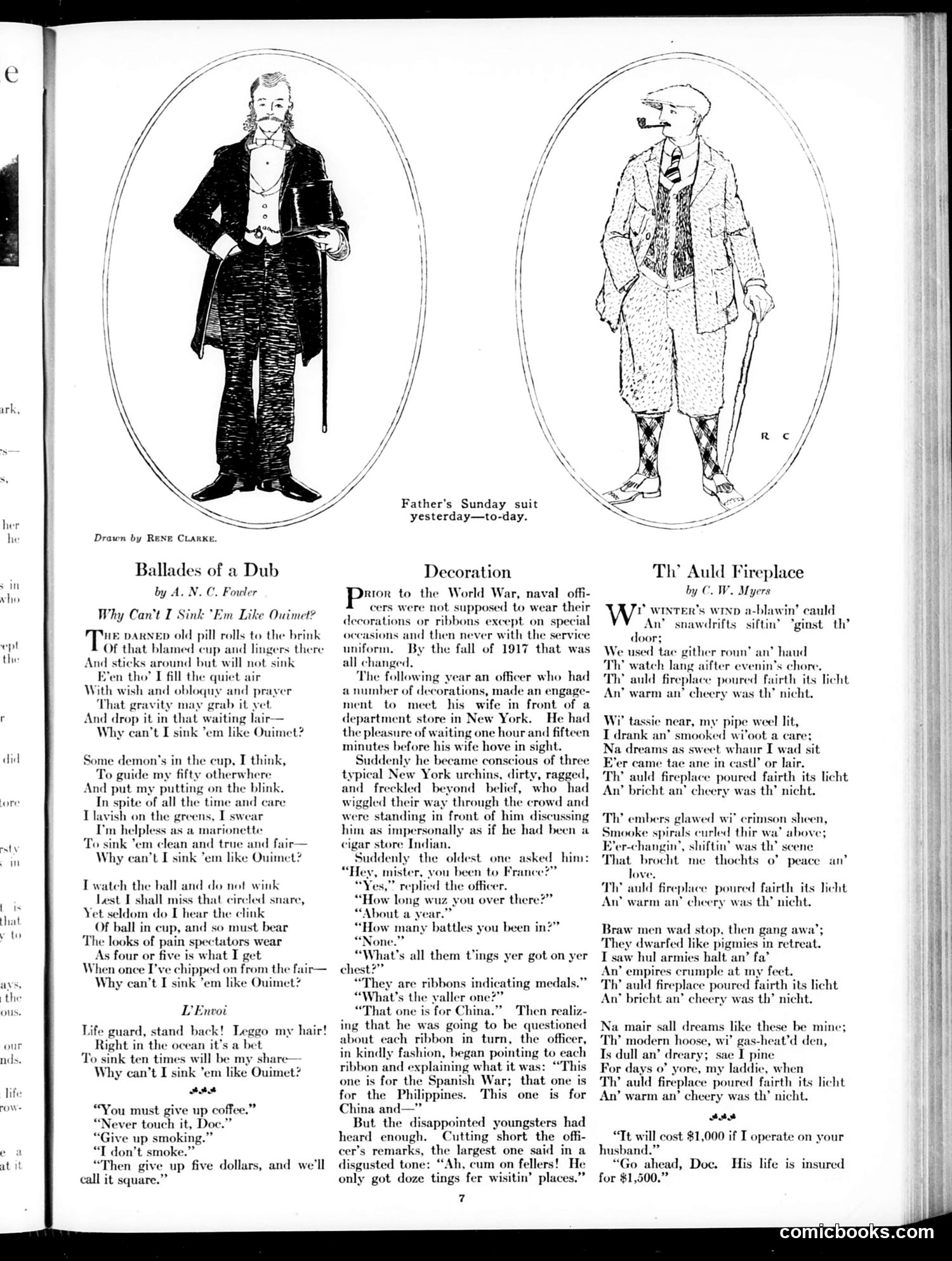
This page contains three distinct pieces of satirical content: **"Ballades of a Dub"** (left): A humorous poem about a golfer's frustration with putting, repeatedly asking "Why can't I sink 'em like Ouimet?" Francis Ouimet was a famous American golfer of this era, making him the reference point for golfing excellence. The satire mocks amateur golfers' inability to match professional skill. **"Decoration"** (center): This satirizes post-WWI social pretension. An officer wearing war medals meets three street urchins who interrogate him about his decorations. The joke's punchline—the boys dismissing his medals as merely "tings fer wisitin' places"—mocks both the officer's vanity in displaying them and the children's irreverent deflation of military glory. **"Th' Auld Fireplace"** (right): A sentimental Scottish-dialect poem about nostalgic memories by a fireplace, unrelated to satire. The page mixes humor targeting middle-class aspirations (golf, military prestige) with sentimental verse.
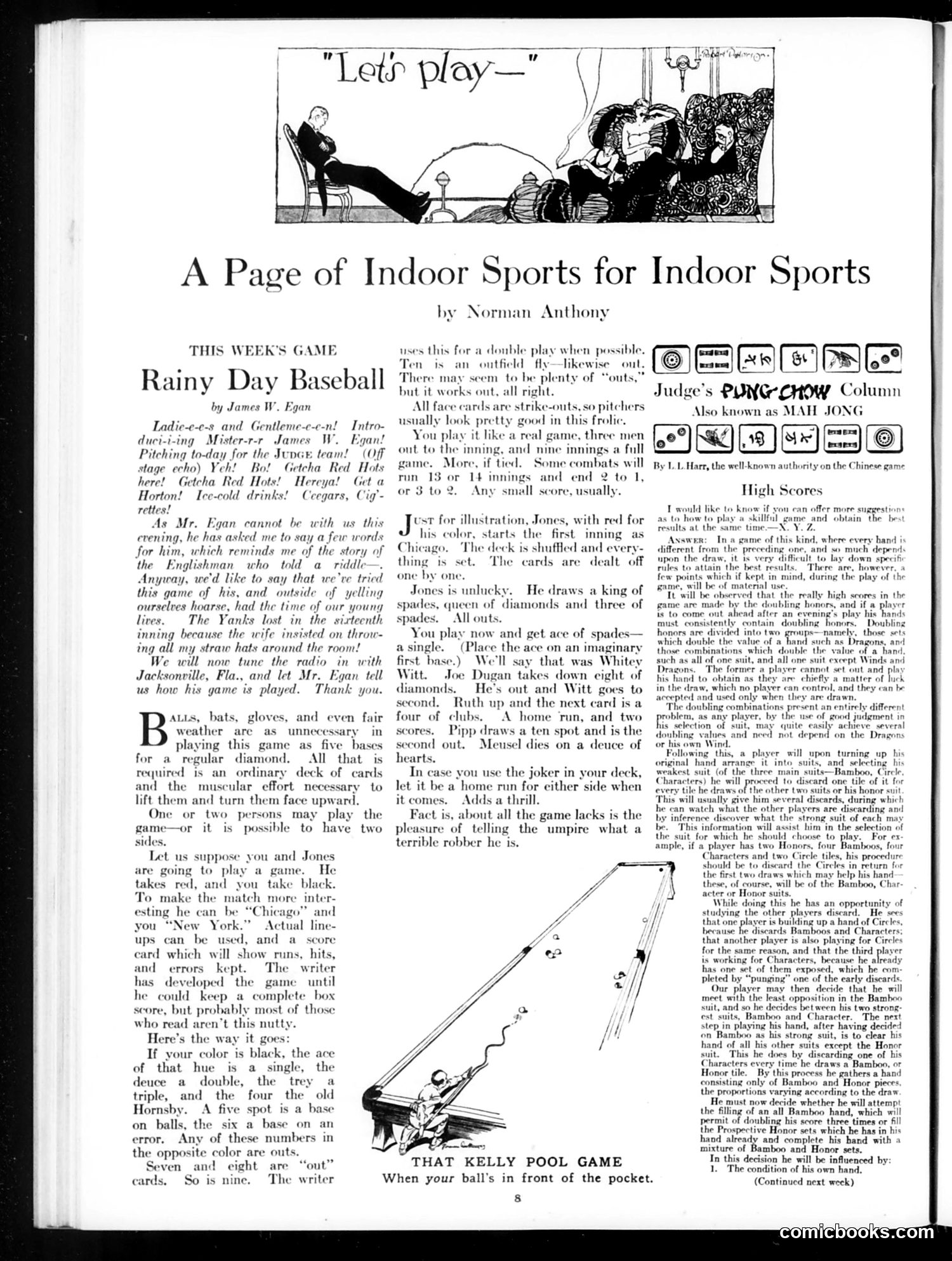
This is a humorous instructional page about "Rainy Day Baseball," a card game invented by James W. Egan for playing baseball indoors without equipment. The satire lies in the elaborate setup: the author treats a simple card game with the gravitas of professional baseball, complete with stadium announcer patter ("Ladie-e-e-s and Gentleme-e-c-n!"), references to real players like Babe Ruth and Joe Dugan, and actual baseball terminology applied to card values. The joke mocks both Americans' obsession with baseball and the lengths people go to replicate it indoors during bad weather. By presenting ridiculous rules—where face cards are "outs," a joker becomes a home run—the page satirizes the earnestness with which people adopt such trivial pastimes. The accompanying pool game illustration serves a similar purpose: making leisure activities the subject of mock-serious attention.
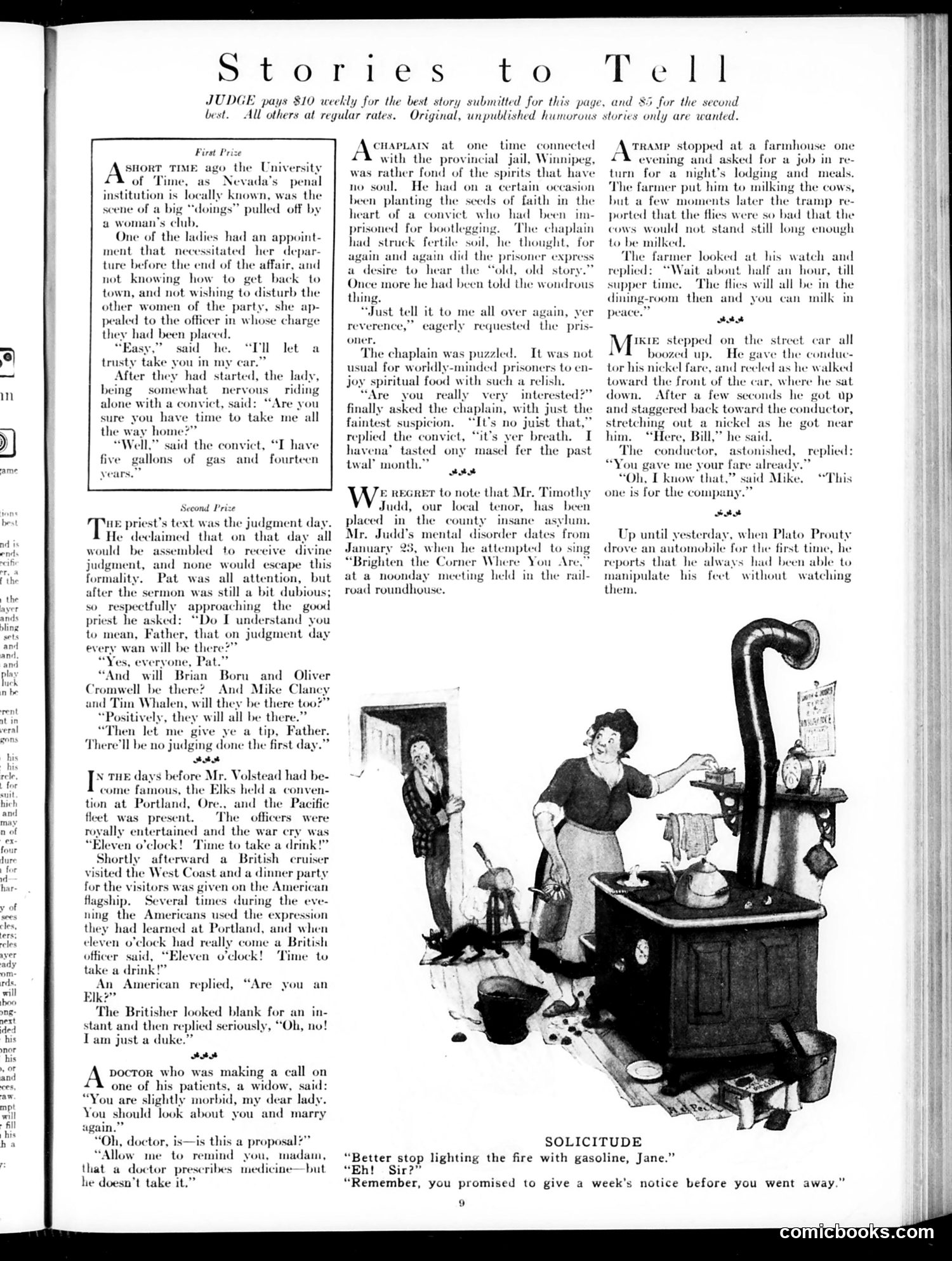
This page contains three separate humorous short stories from Judge magazine's "Stories to Tell" section, which paid writers for original comic anecdotes. **The cartoons and jokes illustrate:** 1. **First story**: A chaplain repeatedly tells a prisoner the gospel story, assuming spiritual interest—until the prisoner admits he's actually interested in the chaplain's alcohol-tinged breath, not the message. 2. **Second story**: A tramp claims flies prevent him from milking cows; the farmer suggests waiting until supper when "the flies will all be in the dining-room"—implying the family will eat them. 3. **Third story** (partial): A priest discusses judgment day; a parishioner named Pat asks whether everyone will attend, then requests a "tip" about something—the text cuts off. The accompanying illustration labeled "SOLICITUDE" shows a domestic scene with someone fighting a fire with gasoline and promises about giving notice before leaving—visual gags about people's poor judgment. These represent early 20th-century working-class and rural humor, emphasizing misunderstandings, double meanings, and clever wordplay.
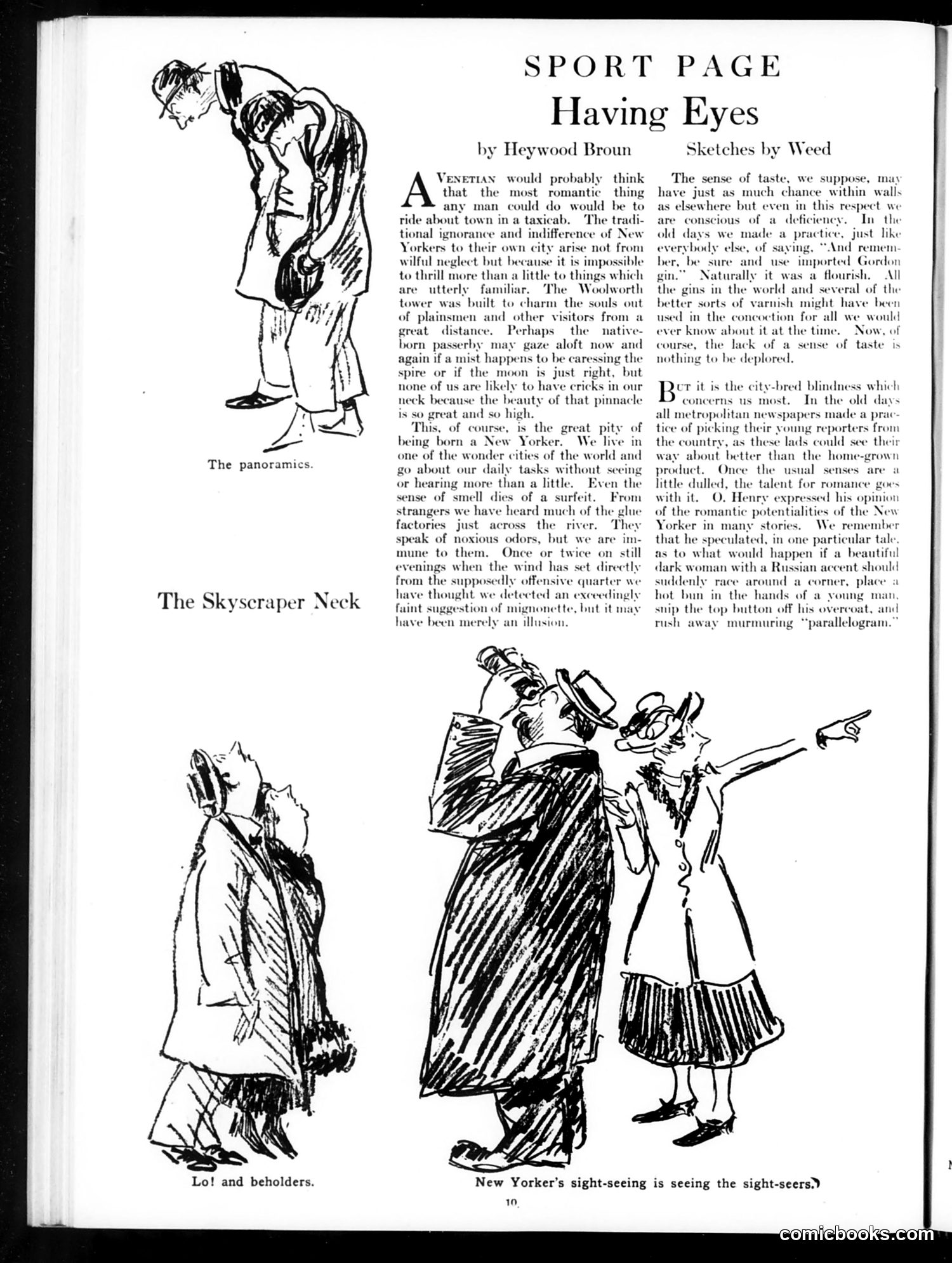
This is a humorous essay by Heywood Broun with accompanying sketches titled "Having Eyes," satirizing New Yorkers' notorious indifference to their own city's attractions. **The Main Point:** Native New Yorkers are so accustomed to famous landmarks (like the Woolworth Tower, referenced as a marvel meant to impress visitors) that they've become completely blind to them. Broun argues this urban numbness extends to all senses—smell (glue factories across the river), taste, and sight—making city-dwellers immune to experiences that would astound outsiders. **The Satire:** The piece mocks New York's assumed sophistication while suggesting it actually breeds apathy. Broun notes newspapers once hired country reporters precisely because they could *see* things; once dulled by city life, "the talent for romance goes with it." He references O. Henry's stories about how a beautiful stranger would go unnoticed by a blasé New Yorker. **The Sketches:** Show tourists ("Lo! and beholders") looking up in wonder, contrasted with the indifferent "Skyscraper Neck" posture of locals ignoring their surroundings—visual proof of the essay's thesis about urban blindness.
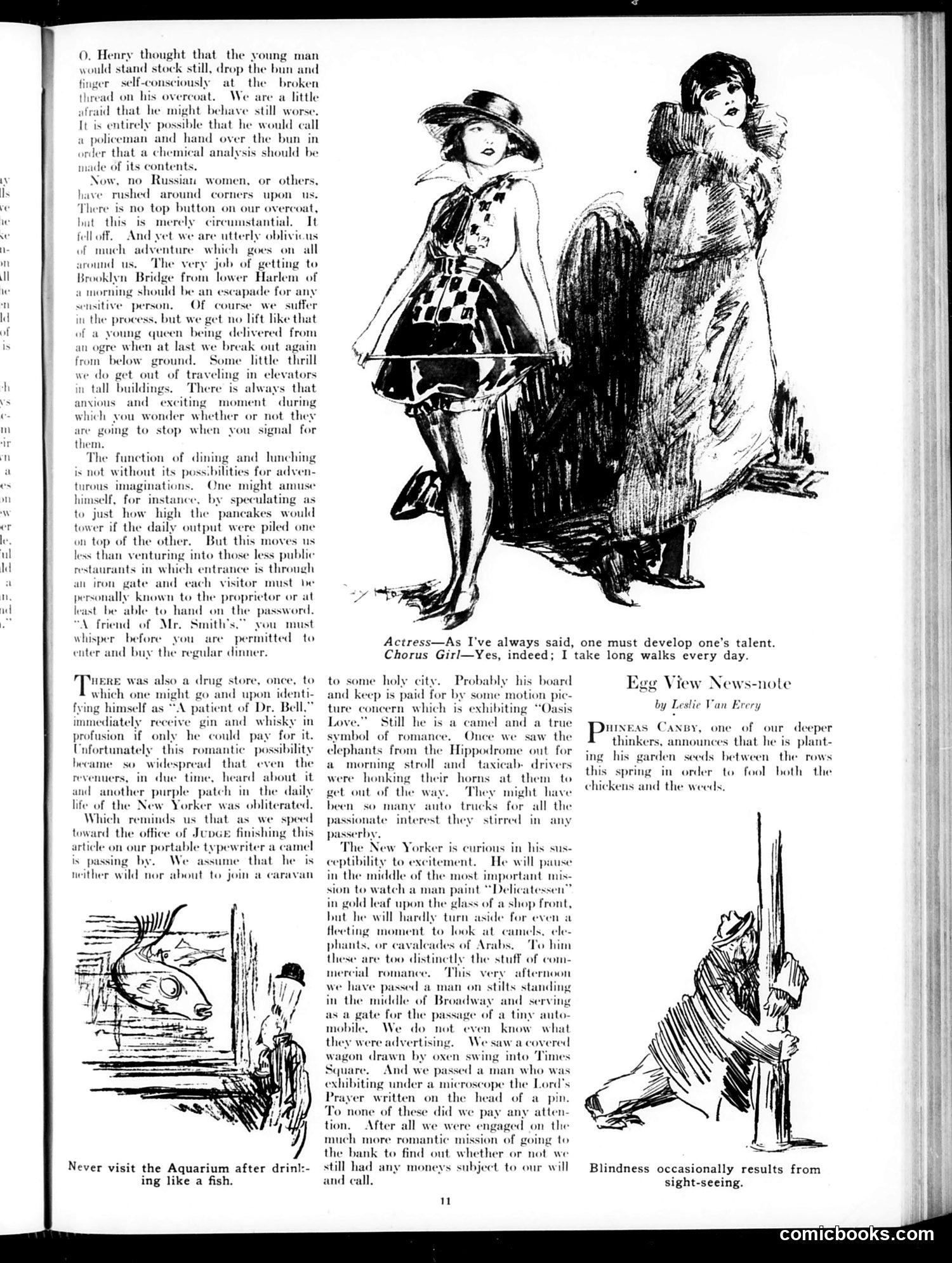
This page contains satirical social commentary about New York City life and romantic adventure, written in the style of O. Henry references. **Main Content:** The article observes that modern New Yorkers experience little genuine adventure compared to O. Henry's literary characters. The author notes New Yorkers have become *desensitized* to spectacle—they'll pause to watch someone hand-lettering a "Delicatessen" sign but ignore camels, elephants, or covered wagons in Times Square. **The Satire:** The piece mocks urban jadedness and commercialization. Even exotic animals and displays are dismissed as mere "commercial romance" rather than genuine wonder. **The Cartoon:** The illustration shows two women discussing talent development—the actress claims one "must develop one's talent," while the chorus girl credits "long walks every day." This satirizes chorus girls' reputation for using their appearance rather than actual skill. **Side Jokes:** Small illustrated quips mock visiting aquariums while drunk and the disconnect between romantic aspirations and mundane urban reality.
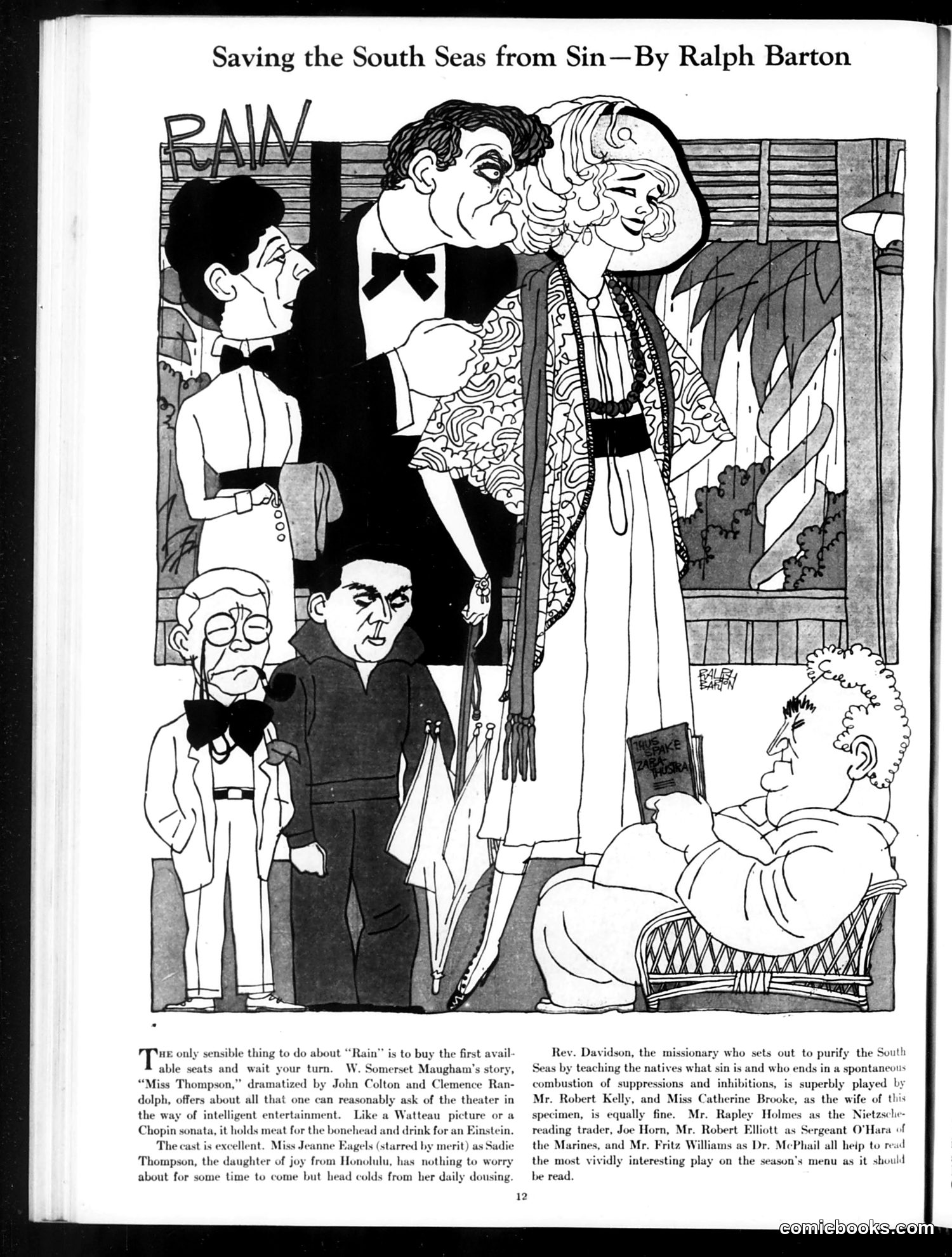
This is Ralph Barton's satirical cartoon about the theatrical production of "Rain," W. Somerset Maugham's famous play adapted by John Colton and Clemence Randolph. The story centers on a missionary (Rev. Davidson) attempting to "purify" the South Seas by teaching natives about sin—a concept they didn't previously understand. The satire targets missionary hypocrisy: the reverend's crusade to eliminate "sin" through education ironically introduces depravity to innocent populations. The cartoon depicts fashionable theater-goers surrounding the play's cast, including the famous role of Sadie Thompson, a prostitute. Barton's joke: buying theater tickets and waiting your turn to see "Rain" is the "sensible thing"—because the play's scandalous content offers more entertainment than any moral instruction. The satire mocks both missionary zeal and the theater-going public's appetite for titillating subject matter dressed up as serious art.
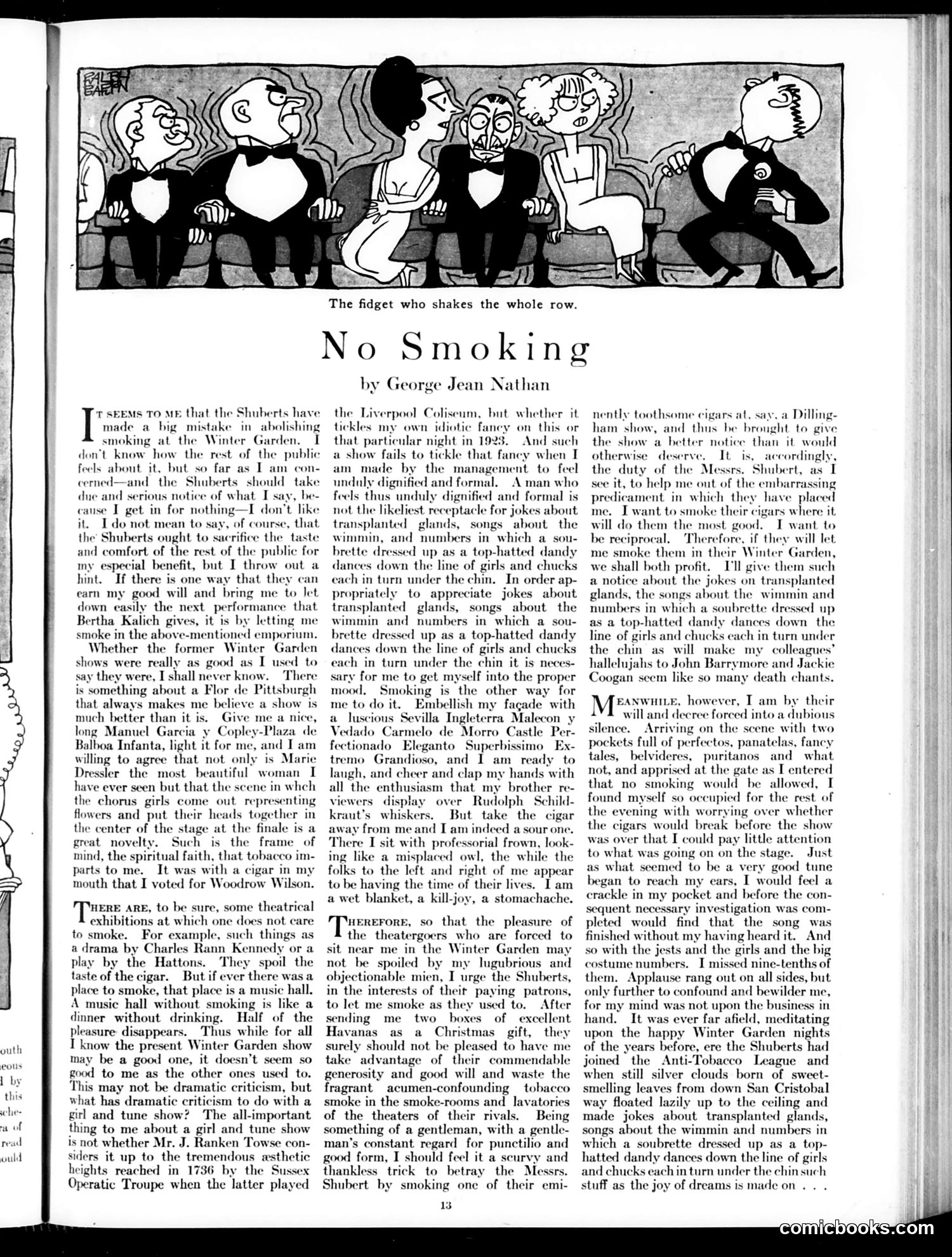
The cartoon depicts five men in formal evening wear seated together, with the caption "The fidget who shakes the whole row." **Context:** This is a humorous essay by theater critic George Jean Nathan complaining about the Shuberts' (major theater owners) decision to ban smoking at the Winter Garden theater. Nathan argues that smoking cigars enhances his enjoyment of musical comedies and vaudeville shows featuring "girls and chucks" dancing and "wimmin" songs. **The satire:** Nathan ironically frames his complaint as a serious matter affecting public taste and theater management, while actually making a selfish argument: he won't enjoy shows without smoking and will become a killjoy to fellow patrons (as illustrated). He supports this with absurdly grandiose language about specific cigar brands, undermining his own credibility. **The point:** The cartoon and essay mock theatergoers whose personal habits override others' comfort—a self-aware critique of the author's own obliviousness to how his smoking would annoy neighbors.
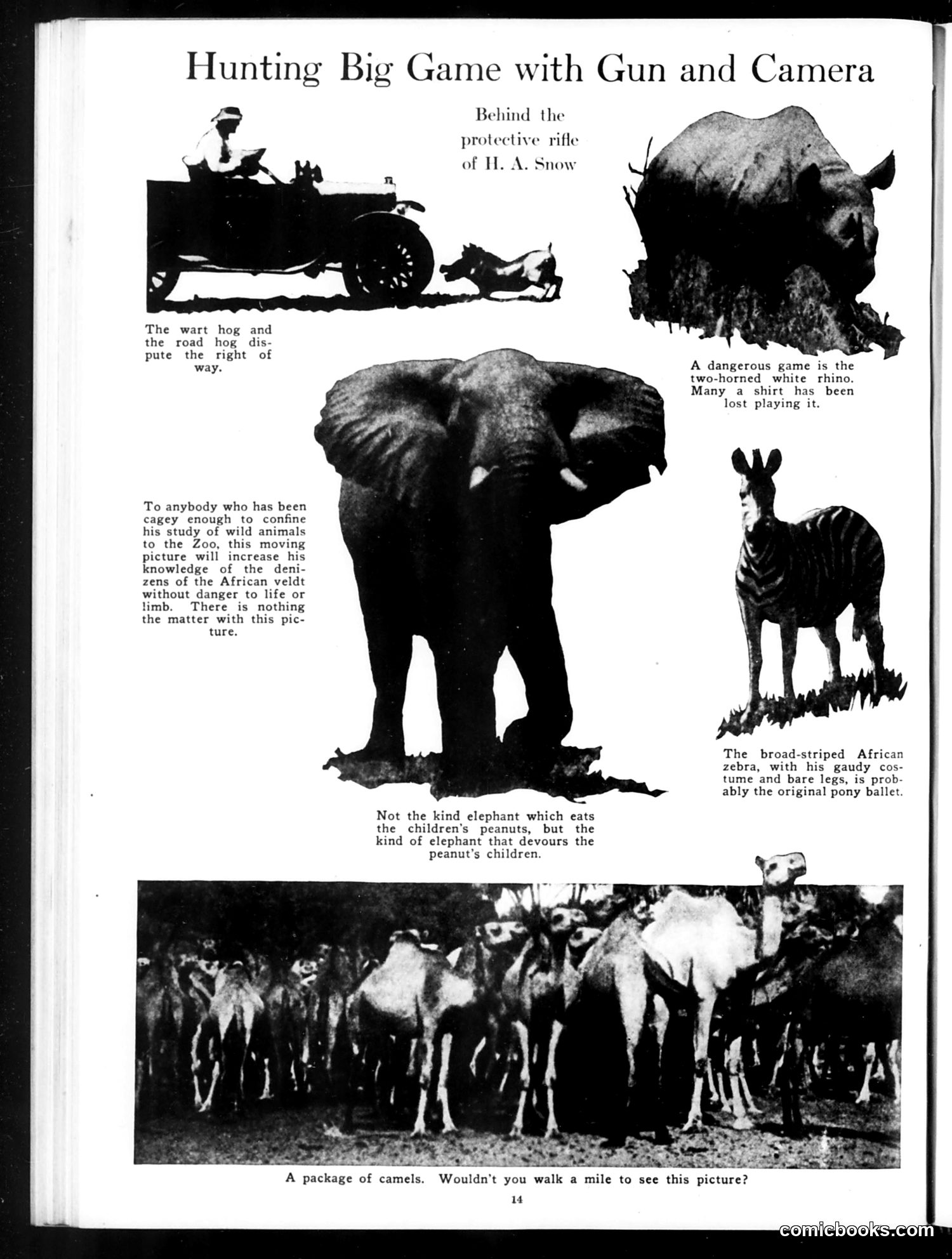
This page showcases wildlife photography from African expeditions, presented with humorous captions. The content celebrates naturalistic documentation of dangerous animals—elephants, rhinos, zebras, and camels—as an alternative to zoo study. The humor is genteel and tongue-in-cheek: comparing wart hogs to "road hogs" (reckless drivers), joking that rhino-hunting costs hunters their shirts, and suggesting the zebra resembles a "pony ballet" performer. A caption credits photographer H.A. Snow's "protective rifle," acknowledging the actual danger of the expedition. The page reflects early-20th-century American fascination with exotic wildlife and adventure narratives. It's not satirizing politics or current events, but rather celebrating exploration and photography as entertainment for armchair travelers—readers who'd "walk a mile" to see such pictures without personal risk.
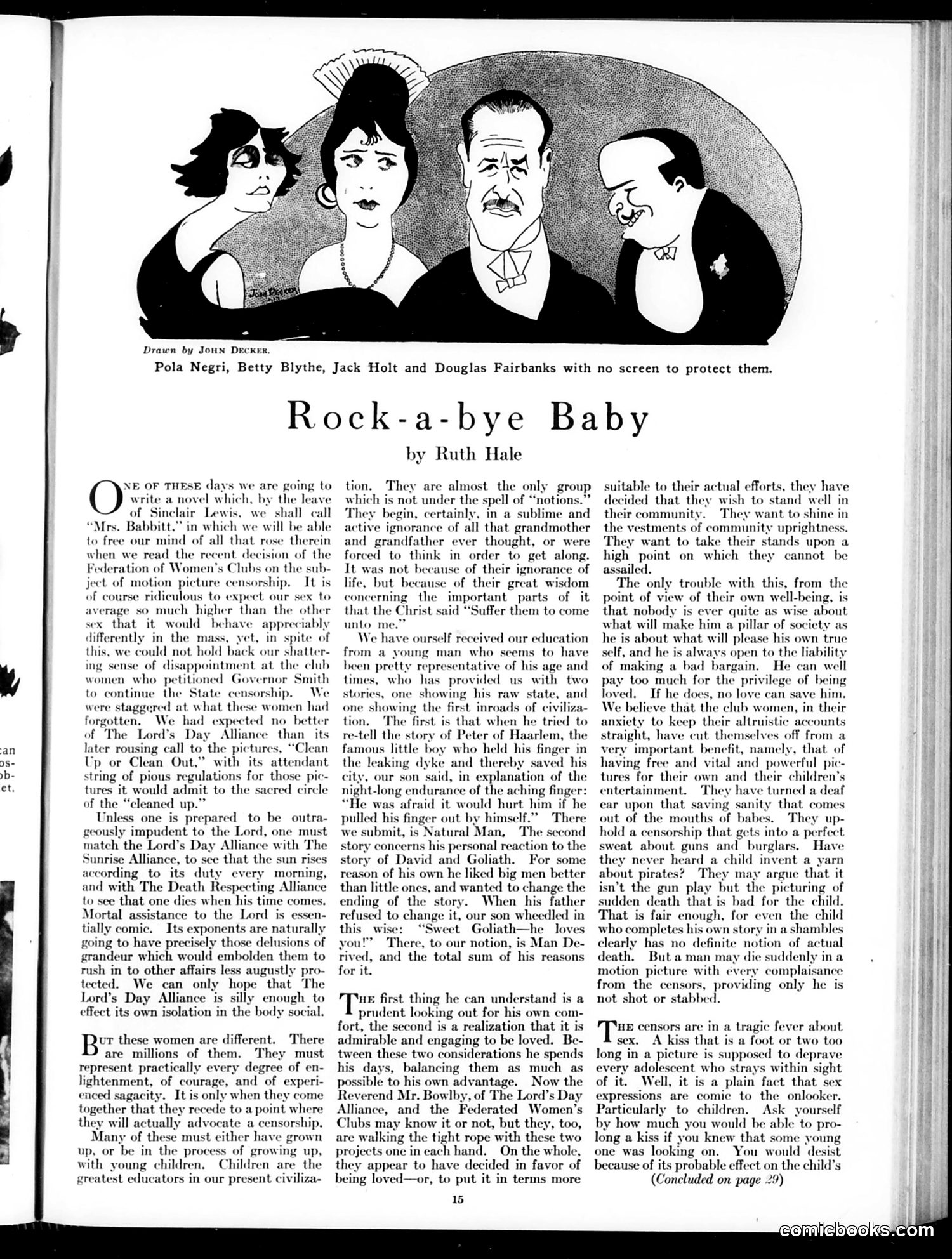
This page satirizes women's censorship efforts in early 1920s cinema. The cartoon caricatures four famous silent film stars—Pola Negri, Betty Blythe, Jack Holt, and Douglas Fairbanks—depicted without "screen to protect them," meaning vulnerable to censorship scrutiny. Ruth Hale's accompanying essay mocks the Federation of Women's Clubs for petitioning Governor Smith to maintain state film censorship. Hale argues these women contradict themselves: they claim moral superiority yet advocate restricting freedom. She sarcastically compares such moral policing to absurd organizations like "The Death Respecting Alliance." The satire's core: women reformers, many raising children, ironically demand censorship while children themselves—unconstrained by social conventions—naturally understand morality better than rigid rules allow. Hale uses anecdotes of children's innocent wisdom to suggest censorship reflects adult hypocrisy, not genuine moral education.
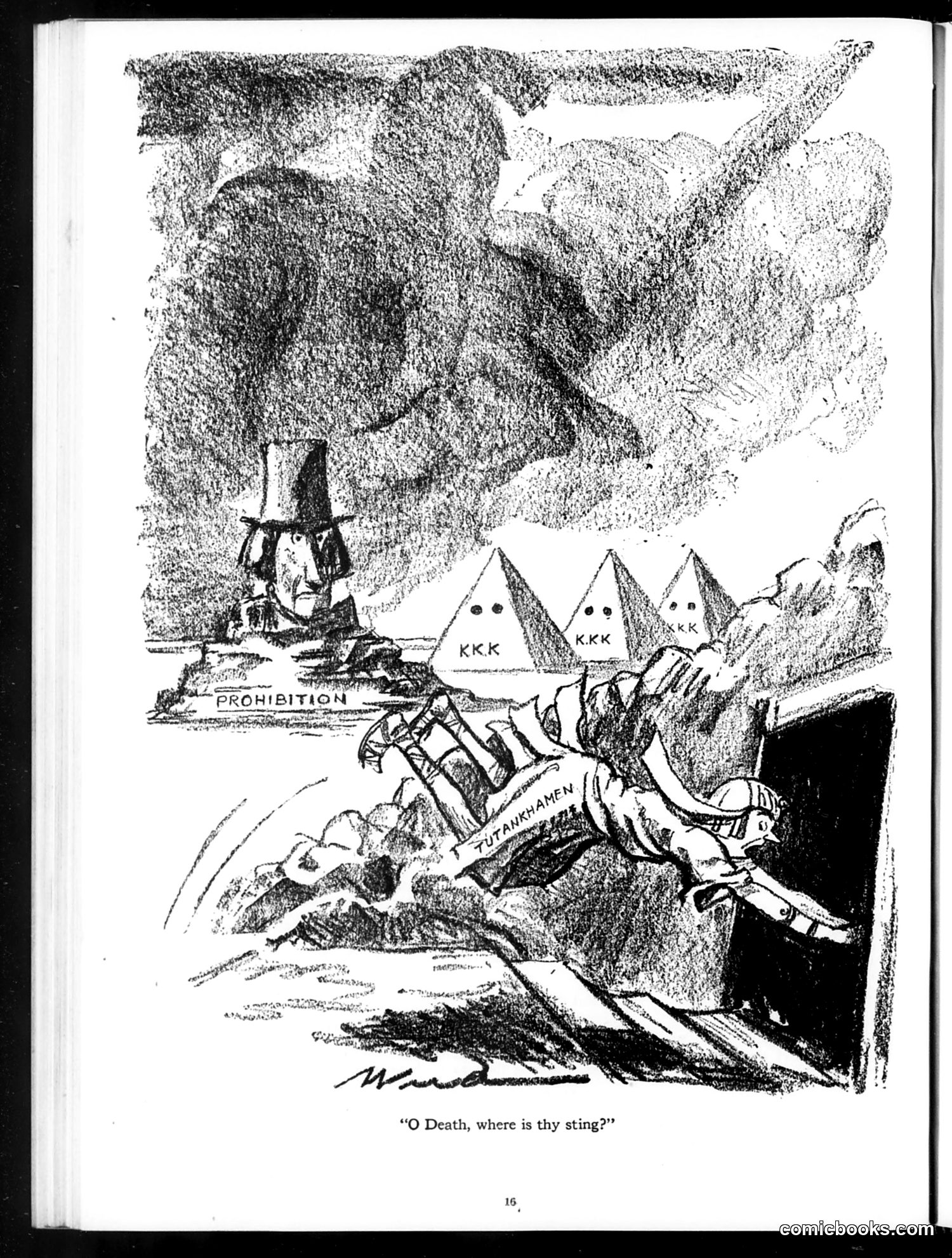
This political cartoon satirizes the Ku Klux Klan during Prohibition era America. The skeleton figure labeled "PROHIBITION" stands guard over KKK tents marked with the organization's initials. In the foreground, a figure labeled "TURKISH AMEN" (likely representing Turkey or Ottoman interests) appears to be attacking or stabbing the skeleton. The cartoon's title—a biblical reference to death's powerlessness—suggests the cartoonist is ironically mocking either Prohibition or the KKK as ineffectual or doomed. The juxtaposition implies these entities threaten each other, possibly commenting on how Prohibition and KKK activities were contemporary social forces competing for American attention and power during the 1920s-30s.
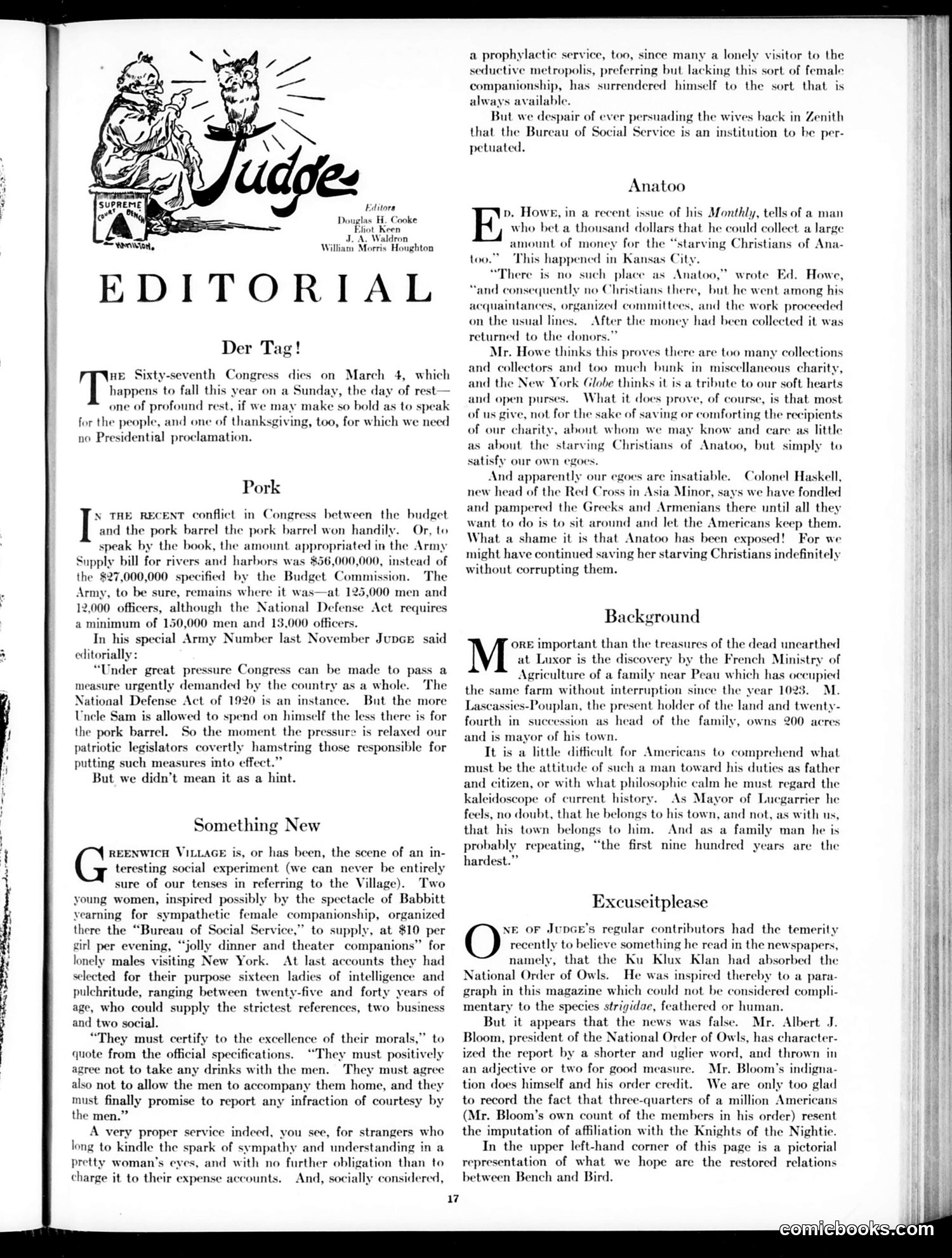
This page from Judge (a major American satirical weekly) contains three editorial commentaries: **"Der Tag!"** mocks Congress's impending adjournment on March 4, 1913, as a day of "rest" the American people should celebrate—suggesting Congress accomplishes little of value. **"Pork"** criticizes Congressional spending priorities. Despite the National Defense Act requiring 150,000 military personnel, Congress appropriated $56 million for "rivers and harbors" (pork-barrel spending) instead of defense funds. Judge had previously warned that once urgent pressure for necessary spending relaxes, legislators secretly redirect funds to local projects benefiting their districts. **"Something New"** satirizes Greenwich Village's "Bureau of Social Service"—an escort service charging $10 per evening for "jolly dinner and theater companions" for lonely men. Judge mocks the moral pretense (companions must certify their virtue and avoid drinks) while suggesting the service is actually prostitution. The piece jokes that wives back home in "Zenith" (Sinclair Lewis's fictional Midwest city) would never accept this arrangement. These editorials exemplify Judge's tradition of mocking government inefficiency, hypocrisy, and urban social phenomena.
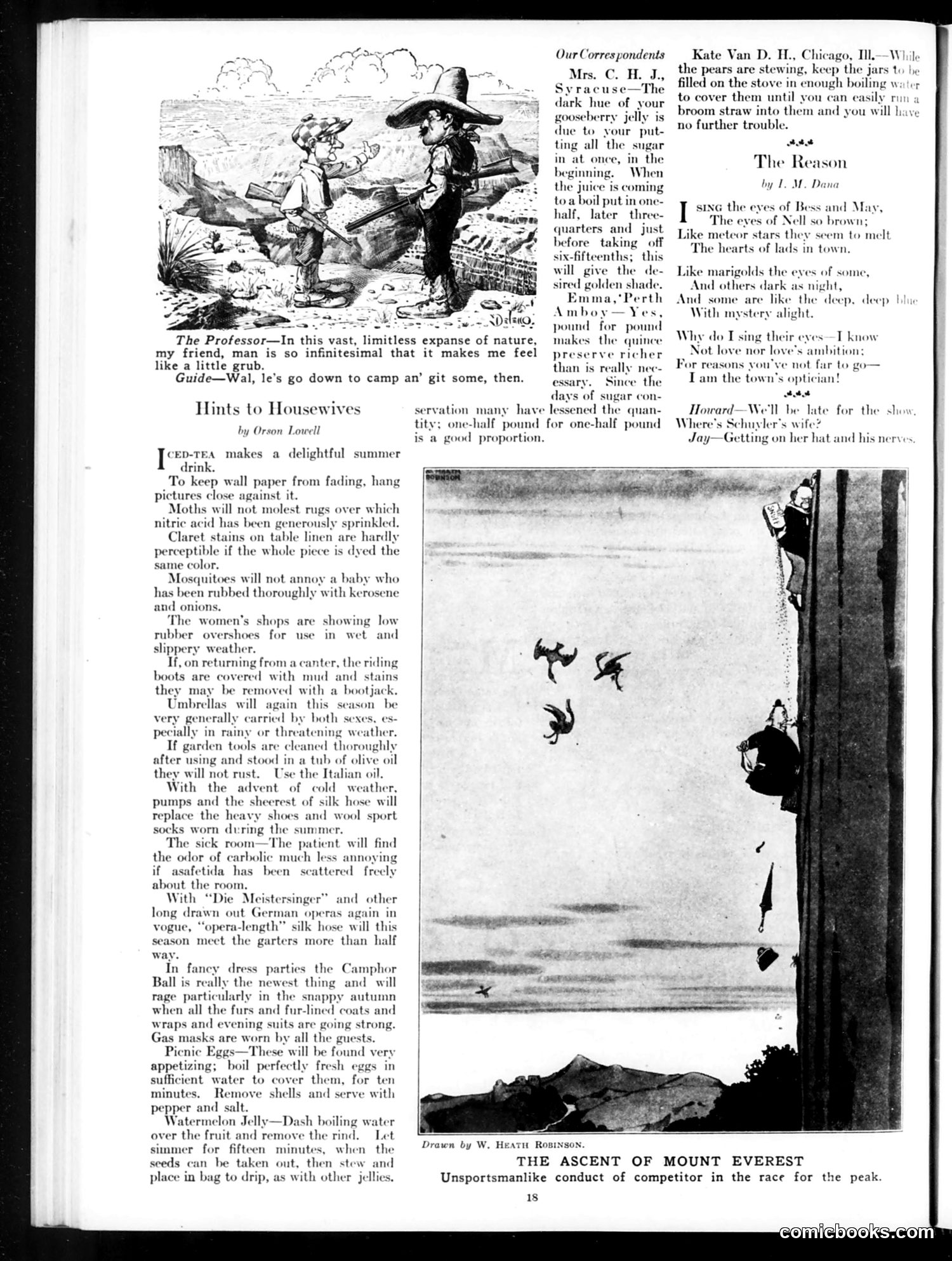
This page mixes practical household advice with satirical content typical of early 20th-century American humor magazines. **The main cartoon** ("The Ascent of Mount Everest," drawn by W. Heath Robinson) depicts mountaineers climbing a vertical cliff face while one figure pushes another climber downward—satirizing "unsportsmanlike conduct" in the competitive race to summit Everest. This references the real historical obsession with being "first" to reach Everest's peak, mocking how competitive ambition undermines gentlemanly sportsmanship. **"The Professor" comic** shows a pompous intellectual lecturing about man's insignificance in nature's vastness; the guide crudely responds by suggesting they catch grubs to eat—humor derived from the contrast between pretentious philosophy and practical frontier pragmatism. **"Hints to Housewives"** offers absurd domestic advice (rubbing babies with kerosene and onions to repel mosquitoes; dyeing table linens to hide stains). This satirizes earnest women's magazines by pushing their suggestions to ridiculous extremes. The page exemplifies Judge's blend of wordplay, visual satire, and mockery of contemporary pretensions across social classes.
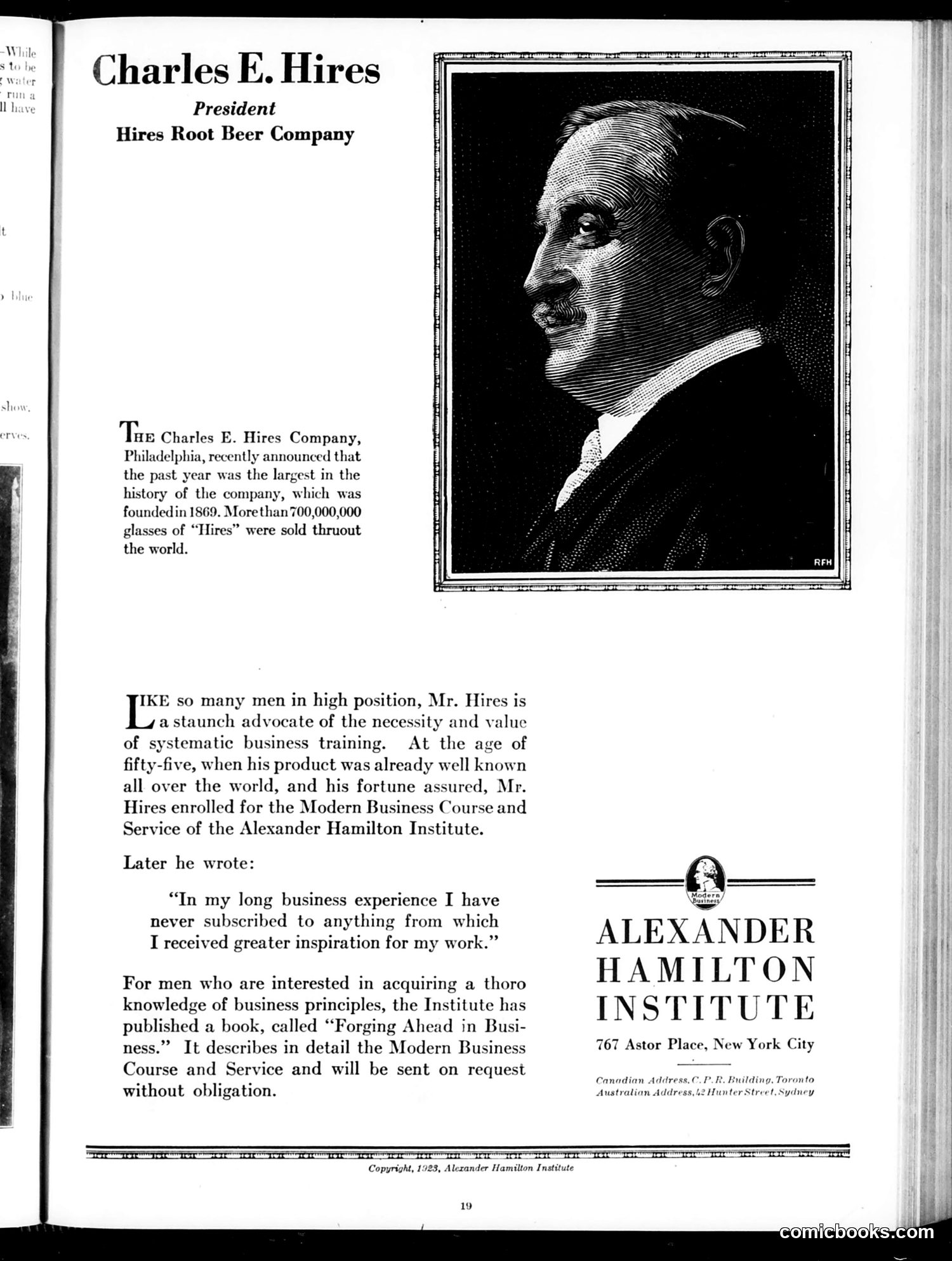
This is not a cartoon but rather **advertorial content** — a paid advertisement disguised as editorial material in Judge magazine, circa 1923. The page profiles Charles E. Hires, president of the Hires Root Beer Company, as a success story. The implicit message: even a wealthy, established businessman (his company founded 1869, selling 700 million glasses annually) recognized the value of formal business training and enrolled in the Alexander Hamilton Institute's Modern Business Course at age fifty-five. This is a **testimonial advertisement**. Hires's quoted praise ("never subscribed to anything from which I received greater inspiration") serves to endorse the Institute's business training program to Judge's affluent readership. The piece subtly argues that systematic business education remains valuable regardless of one's current success — a pitch for the Institute's correspondence course, which readers can request "without obligation." The approach exploits reader aspirations: if Hires needed this training, perhaps you do too.
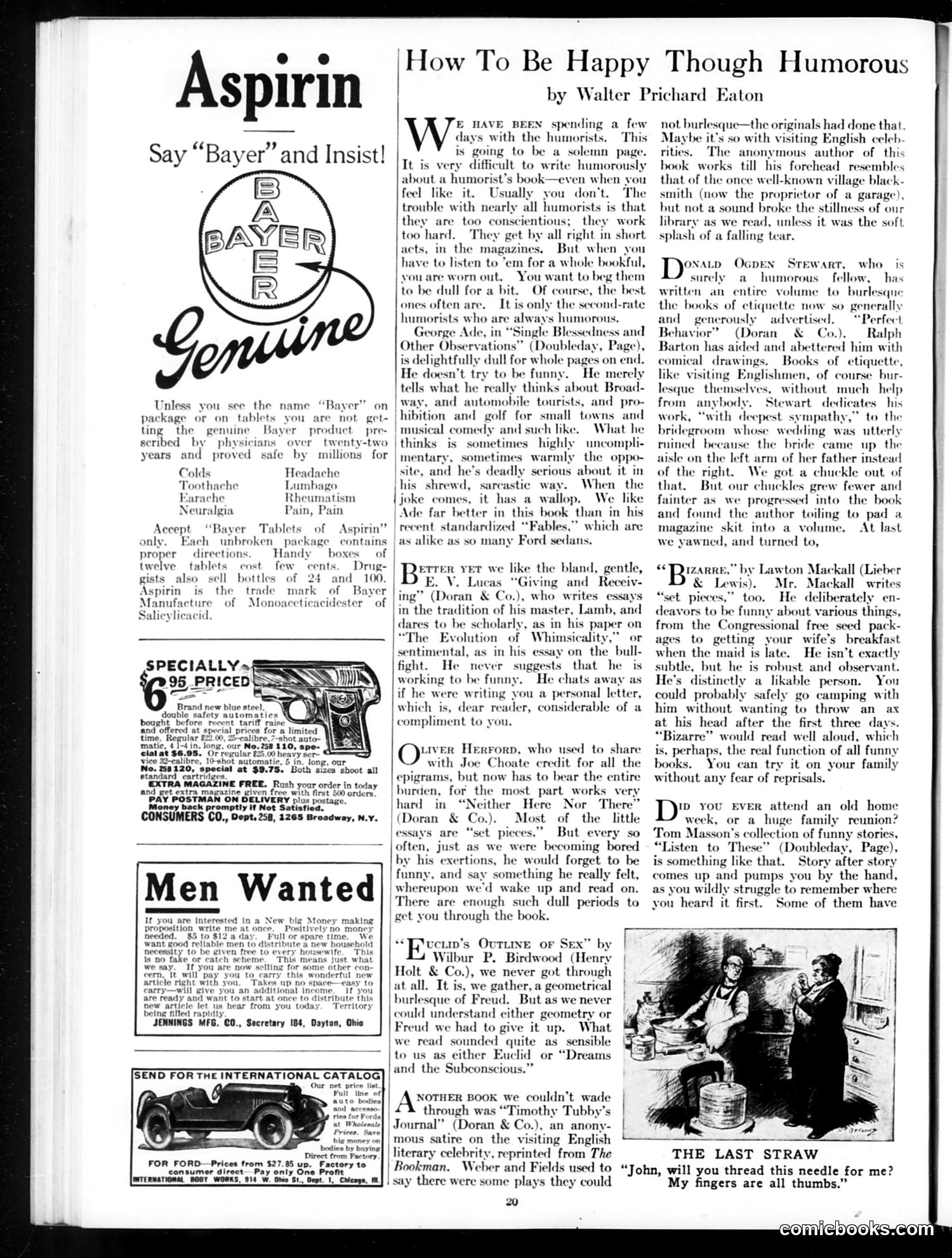
This page is primarily **advertising**, not political satire. The dominant content is a Bayer Aspirin advertisement emphasizing brand authenticity ("Say 'Bayer' and Insist!"), alongside ads for firearms, Ford automobiles, and other products. The editorial content—a book review essay by Walter Prichard Eaton titled "How To Be Happy Though Humorous"—discusses contemporary humorist authors (George Ade, E.V. Lucas, Oliver Herford). Eaton argues that the best humorists don't constantly try to be funny; rather, they write naturally about serious subjects, making humor more effective through contrast. There's **no political cartoon** visible. The single illustration at bottom ("The Last Straw") shows a domestic scene with minimal context provided on this page. The satirical point is literary/cultural, not political: criticism of "second-rate humorists" who labor too hard at jokes, versus admiration for witty writers who let humor emerge naturally from intelligent observation.
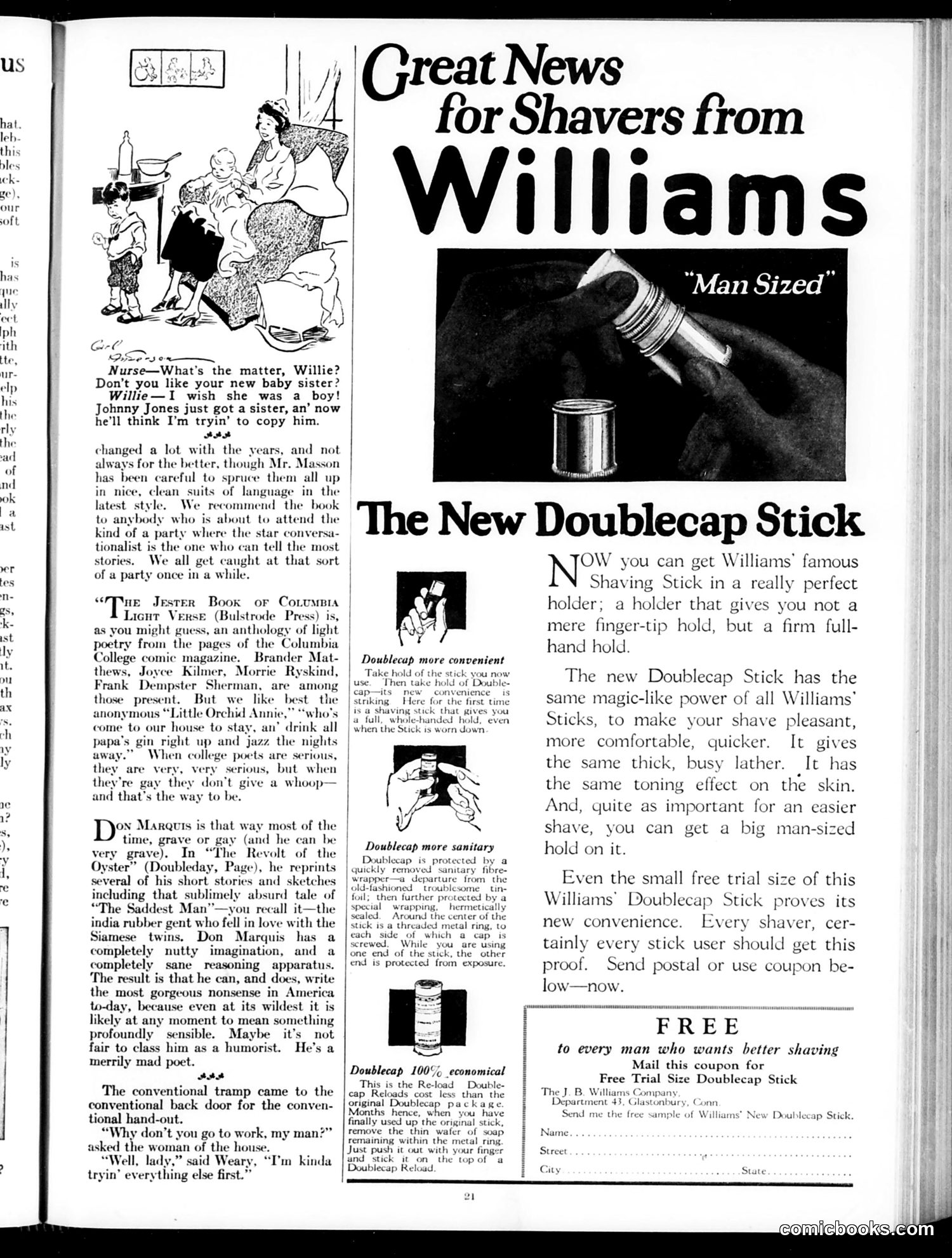
This page contains two distinct elements: **The Cartoon/Joke** (top left): A brief comic about a boy named Willie disappointed his new sibling is a sister rather than a brother. The humor reflects early-20th-century gender anxiety—Willie fears people will think he's imitating his friend Johnny Jones, who recently got a sister. It's a silly domestic joke about childhood competitiveness and social status. **The Advertisement** (majority of page): Williams' Doublecap Stick shaving cream dominates the content. This is a genuine product advertisement, not satire. The copy emphasizes convenience features (full-hand grip even as the stick wears down), sanitation (fiber wrapper replacing foil), and economy (refillable design). The inclusion of a free trial coupon and testimonial-style language was standard advertising practice of the era. The page demonstrates how Judge blended editorial cartoons with commercial advertising to sustain its business model.
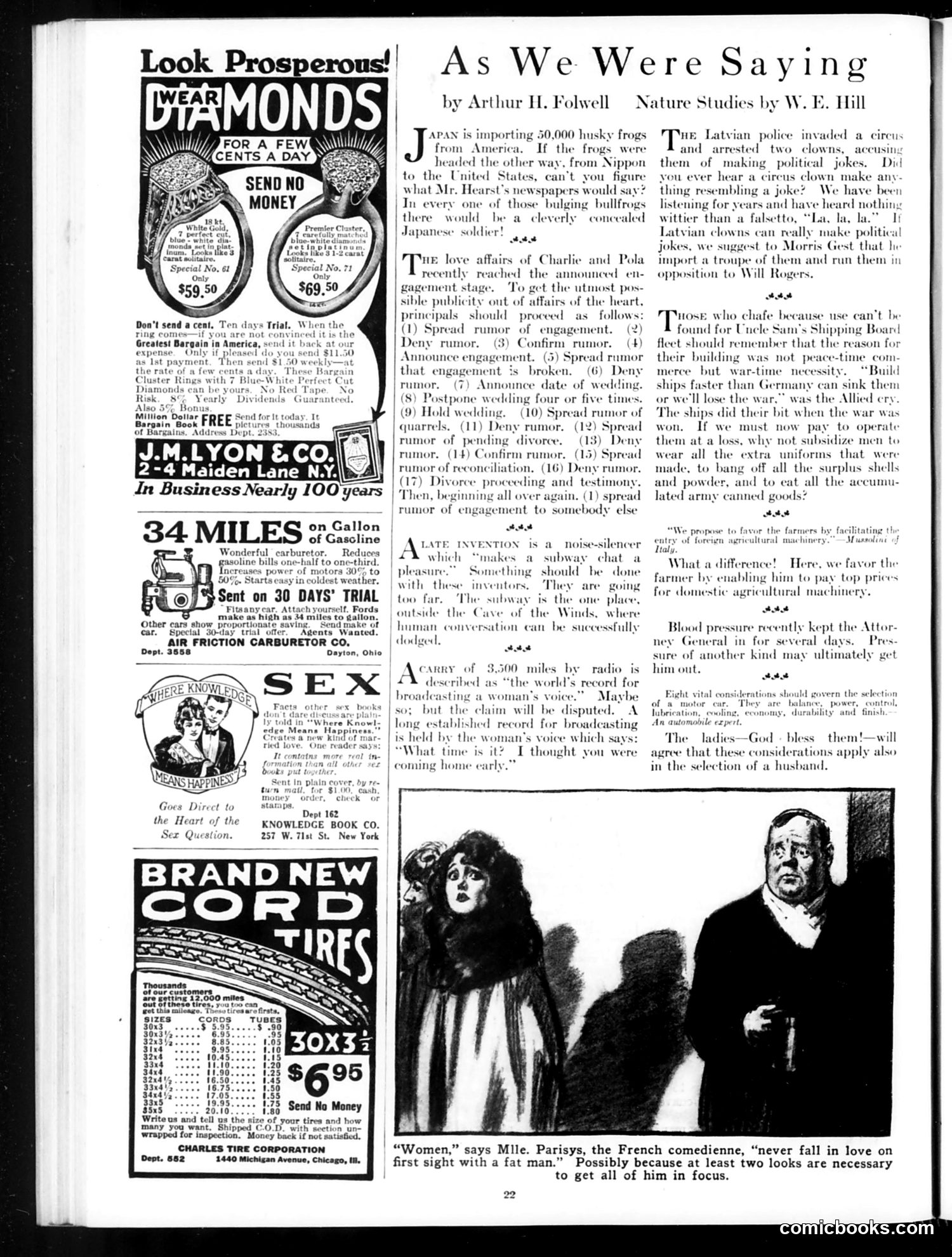
This page from Judge magazine (a satirical weekly) combines advertisements with Arthur H. Folwell's humor column "As We Were Saying" and W.E. Hill's "Nature Studies." **Main Content:** Folwell's column includes several topical jokes: Japan importing American bullfrogs (with a crack at William Randolph Hearst's sensationalism), a 16-step formula for managing Hollywood scandal publicity (mocking Charlie Chaplin and Pola Negri's publicized romance), and jokes about the New York subway, radio broadcasting, and Latvia arresting circus clowns for "political jokes." A pointed observation compares the U.S. Shipping Board's surplus fleet (wartime necessity, now costly) to subsidizing unemployed soldiers—addressing post-WWI economic tensions. Hill's cartoon caption about women and "fat men" appears to reference a radio broadcasting record. **Context:** The page reflects 1920s concerns: postwar military costs, celebrity gossip, labor unrest, and emerging mass media (radio, film). The left side features period product advertisements (diamonds, carburetors, tires), typical of Judge's revenue model.
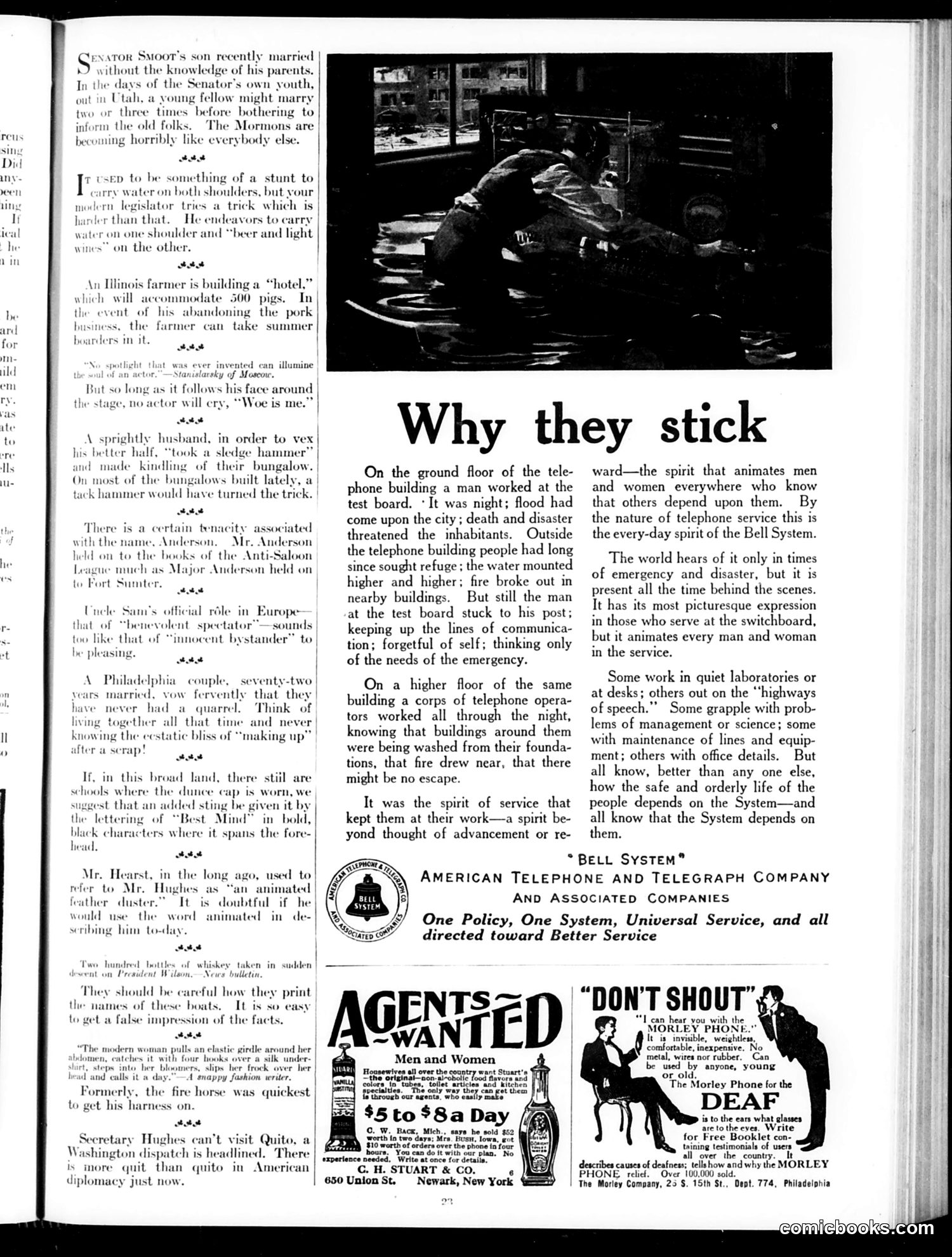
This Judge magazine page contains brief satirical commentary pieces typical of the publication's humor column format. The main content mocks Senator Smoot's son marrying without parental knowledge, contrasting Mormon practices with modern behavior. Other jokes target: a legislator attempting political compromise ("carrying water" on both shoulders while supporting beer and light wines), an Illinois farmer converting his pig farm into a hotel, and various social observations about marriage, divorce, and public figures. The large advertisement at bottom-right is unrelated satirical advertising for Stuart's products and hiring agents. The main illustrated article "Why they stick" is a serious corporate tribute to telephone company employees who remained at their posts during a flood emergency, maintaining communication lines despite danger. This appears to be **advertising content** for the Bell System telephone company, celebrating worker dedication rather than satire. The page mixes Judge's typical irreverent humor with what amounts to corporate propaganda—a notable contrast showing how publications blended editorial content with advertiser messaging.
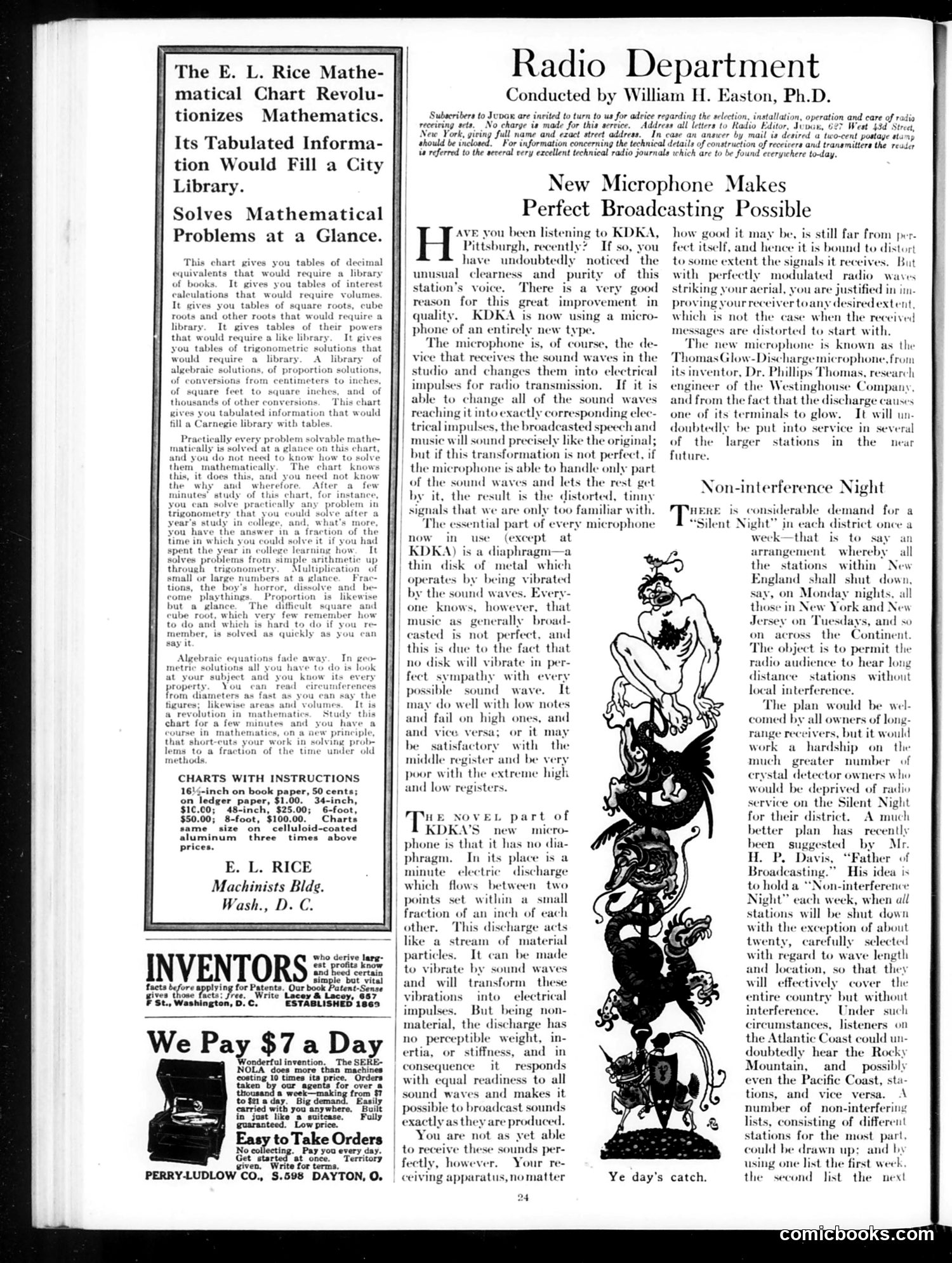
This page is primarily **advertising and radio content**, not political satire. The main cartoon—a whimsical stack of creatures (appears to include animals and figures)—illustrates the column "Ye day's catch," accompanying the **Radio Department** section on microphone technology. It's decorative rather than satirical. The bulk of the page contains: 1. **Advertisements** for the E.L. Rice Mathematical Chart (a reference tool), patent services, and a "$7 a Day" mail-order job scheme 2. **Radio Department column** by William H. Easton, Ph.D., discussing KDKA Pittsburgh's new microphone technology for clearer broadcasting The radio content explains that KDKA's improved sound quality results from adopting a new microphone using electric discharge between metal points—a technical innovation allowing more accurate sound-wave transmission. This reflects early 1920s radio broadcasting advancement. The page contains no apparent political commentary or social satire—it's a typical Judge magazine issue mixing advertisements with technical/consumer information.
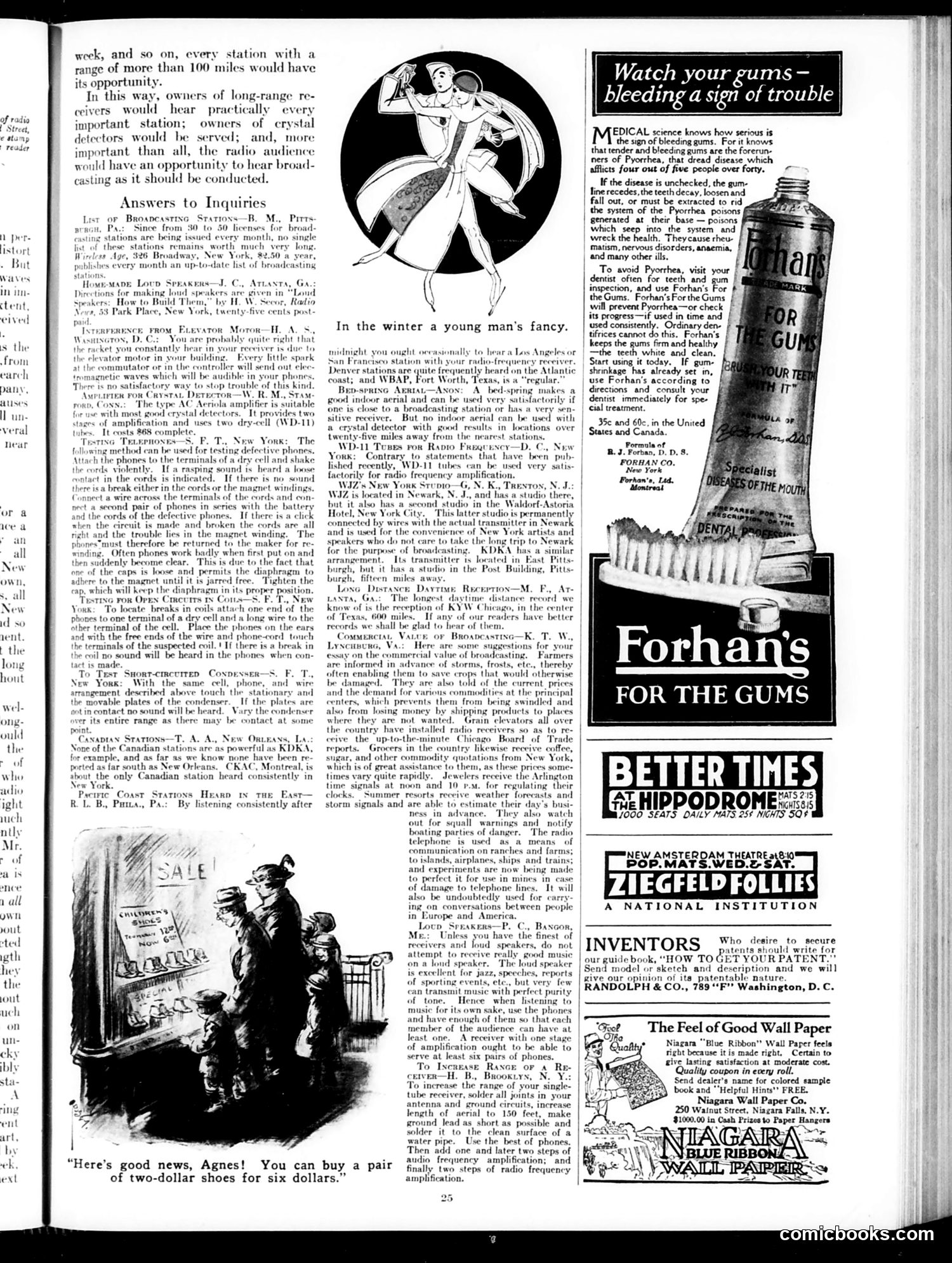
This page from *Judge* magazine contains primarily **editorial/advice content and advertisements** rather than political satire. The main cartoon (upper left) shows a couple dancing with the caption "In the winter a young man's fancy"—a lighthearted illustration accompanying the magazine's editorial content about radio broadcasting. The **dominant content is advertisements**, particularly: - **Forhan's For the Gums**: A vintage medical advertisement warning about pyorrhea (gum disease) and promoting their product as prevention/treatment. This reflects early 20th-century medical marketing when such conditions were presented as serious health threats. - **Better Times at the Hippodrome** and **Ziegfeld Follies**: Entertainment venue advertisements - **Wall paper and other consumer goods** ads typical of the era The "Answers to Inquiries" section addresses practical questions about early radio technology—reflecting the public's fascination with this new medium around the 1920s. The bottom cartoon shows someone excited about buying cheap shoes, a mild economic joke about bargain shopping. This is essentially a **regular magazine page mixing reader Q&As with commercial advertising**, not primarily satirical content.
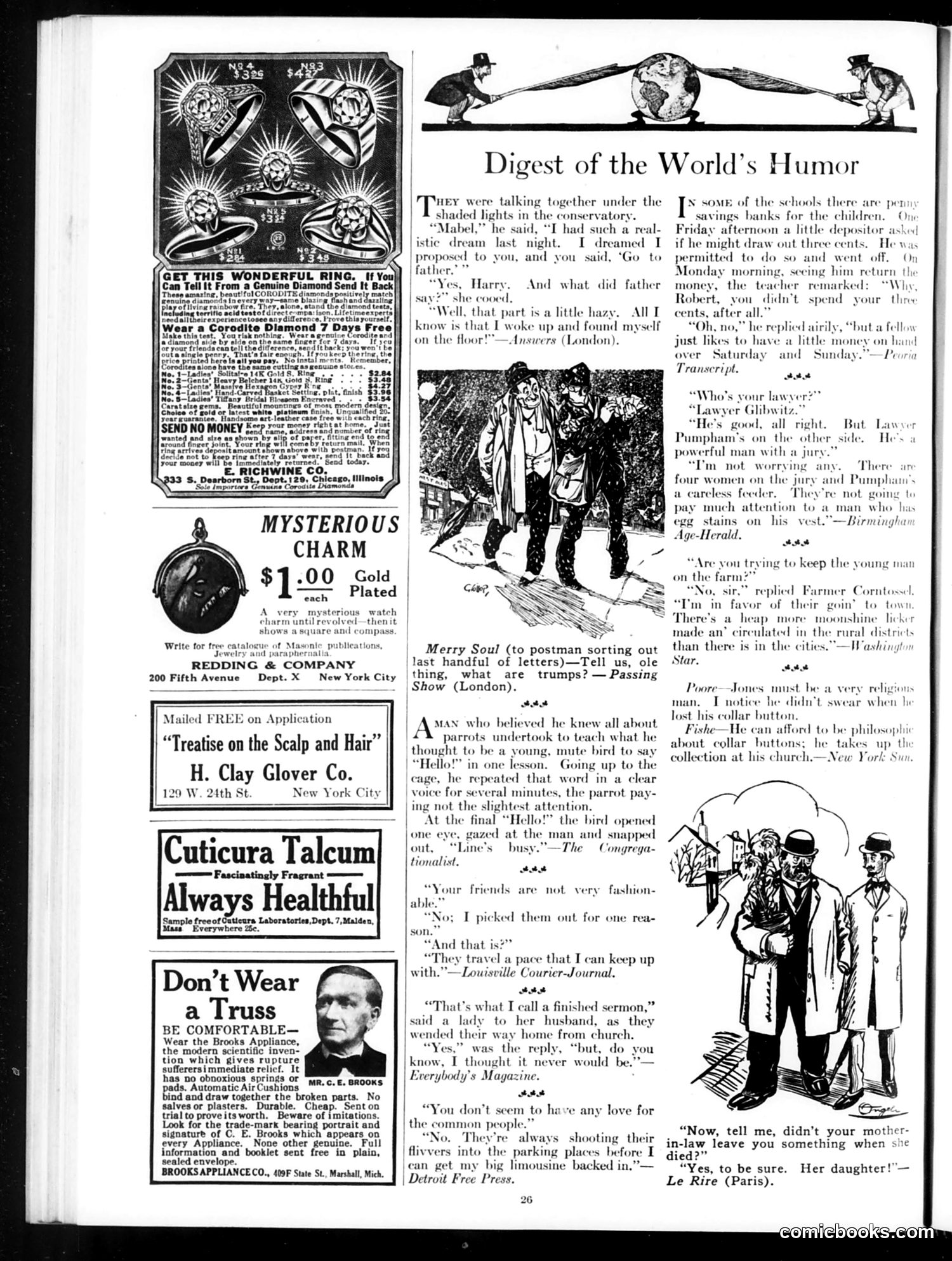
This page is primarily a humor column collecting brief jokes and anecdotes from various newspapers, rather than political cartoons. The jokes are satirical sketches of everyday life and human nature circa the 1910s-1920s. The pieces mock common social situations: a woman's illogical dream logic, confusion about card games, a failed attempt to teach a parrot, pretentious fashion choices, verbose sermons, working-class people's cars crowding wealthy neighborhoods, a lawyer's untidy appearance prejudicing juries, and rural-versus-urban migration. The two small illustrations show scenes accompanying specific jokes—one depicting a group outdoors, another showing men in formal dress. The page also contains period advertisements (trusses, talcum powder, hair treatments), typical of Judge magazine's revenue model. The humor reflects upper-middle-class perspectives mildly mocking the poor, rural people, and other social groups.
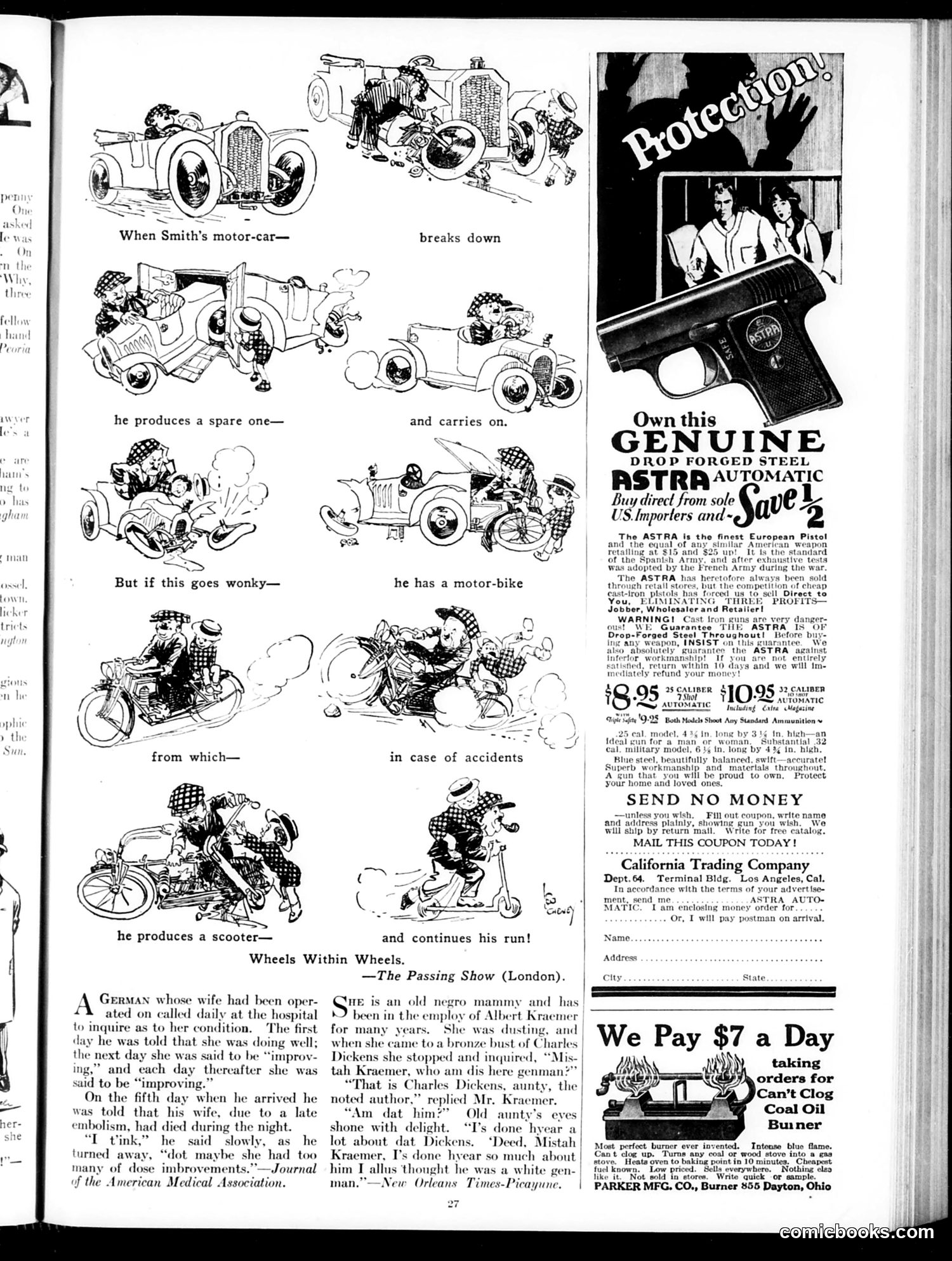
This page contains three distinct sections: **Left: "Wheels Within Wheels" Comic Strip** A humorous narrative about a man whose car repeatedly breaks down, forcing him to improvise increasingly absurd transportation solutions—from spare parts, to motor-bike, to scooter—to continue his journey. The satire mocks unreliable early automobiles and human persistence. **Center-Right: Two Brief Anecdotes** - A German immigrant's dark humor about his wife's death following repeated hospital "improvements" - A Black domestic worker's charming misunderstanding about Charles Dickens These appear designed as humor for contemporary readers, though the racial caricature is now offensive. **Right: Period Advertisements** - ASTRA automatic pistol ($8.95) - Parker Manufacturing coal-stove burner ($7/day wages) The page reflects 1920s-era American magazine culture: slapstick motoring humor, casual racial stereotyping, and direct-mail advertising targeting working-class readers with practical goods and weapons.
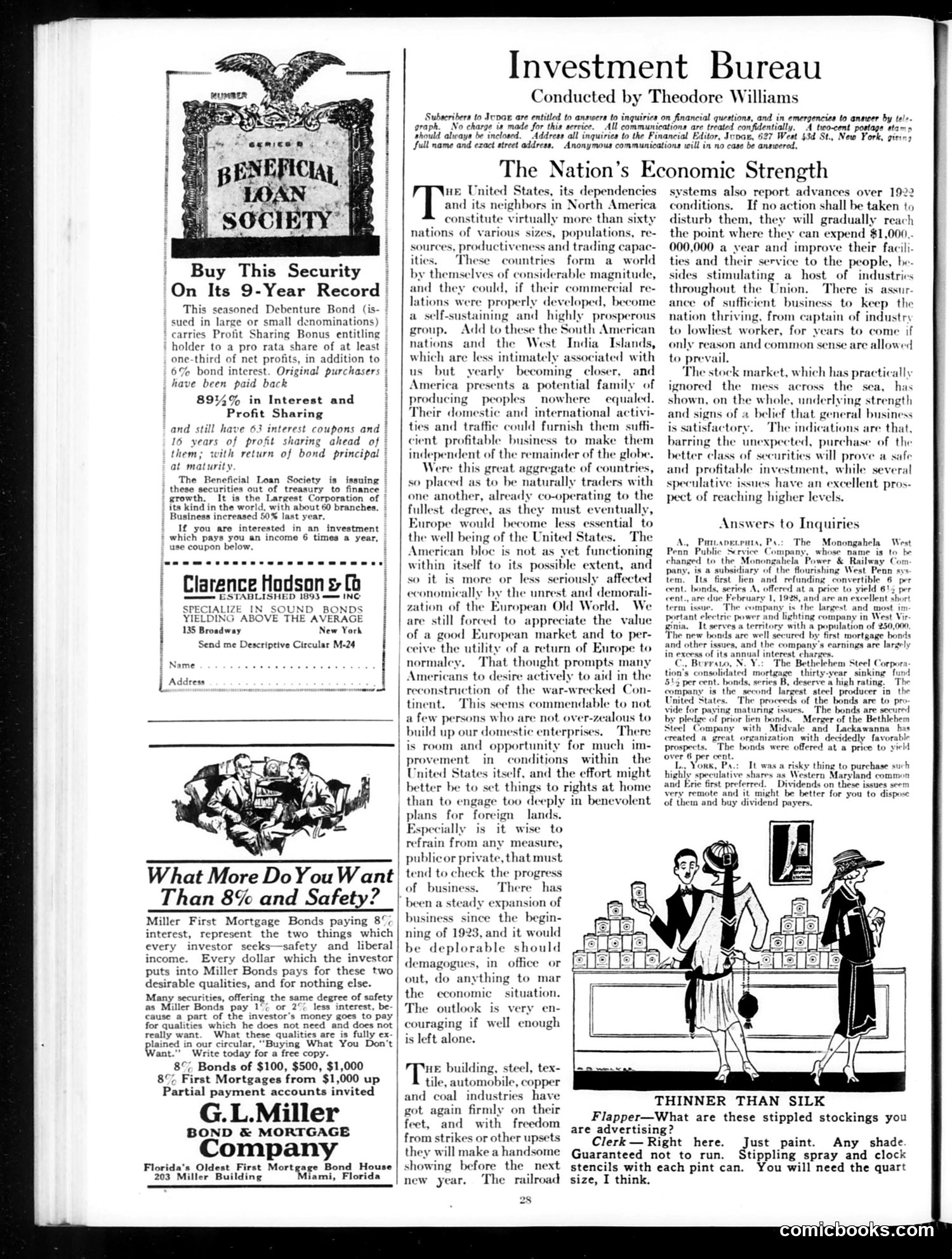
This page is primarily **financial advertising with editorial commentary**, not political satire in the traditional sense. The main article argues that the United States and the Americas form a self-sufficient economic bloc that could prosper independently of Europe. The writer contends that American business remains weakened by European economic instability and should focus inward—"refrain from any measure, public or private, that must tend to check the progress of business." The small cartoon titled "Thinner Than Silk" depicts stockings advertised as "stippled" (patterned). It's a straightforward product advertisement using the mild humor of a clerk's response—not political commentary. The surrounding advertisements (Beneficial Loan Society, Miller Bonds, etc.) promote investment securities with promises of 6-8% returns. **Context for modern readers**: This reflects post-WWI American economic isolationism and the belief that the Western Hemisphere could sustain itself without European trade—a position popular in the 1920s before the Great Depression.
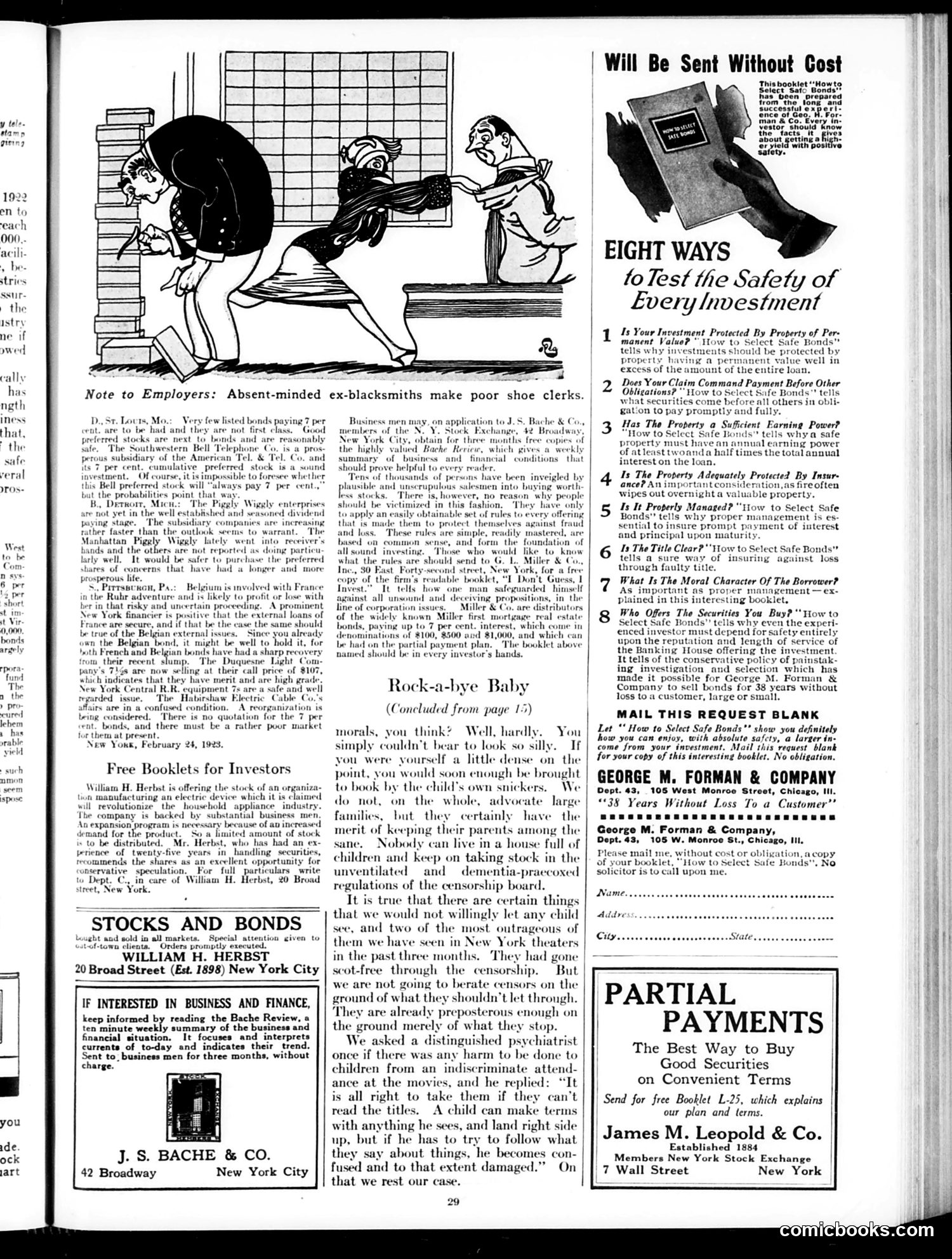
This page from *Judge* magazine (February 24, 1923) contains primarily **financial advertising and advice**, not political satire. The main cartoon—"Note to Employers: Absent-minded ex-blacksmiths make poor shoe clerks"—is a **workplace joke** depicting a disoriented former blacksmith failing at retail work. The humor relies on the idea that someone trained in one trade cannot competently perform in another, especially retail clerk work requiring attention to detail. The bulk of the page comprises **investment advertisements** and financial columns addressing stock bonds, and securities—typical 1920s fare for a magazine aimed at businessmen. Notable is the recurring theme of investment safety and vetting procedures, reflecting post-war economic concerns. The "Rock-a-bye Baby" column discusses **film censorship**, specifically defending parents' rights to take children to movies while criticizing theatrical censors for inconsistently allowing inappropriate content through. The page reflects early 1920s middle-class business culture and emerging debates about media regulation.
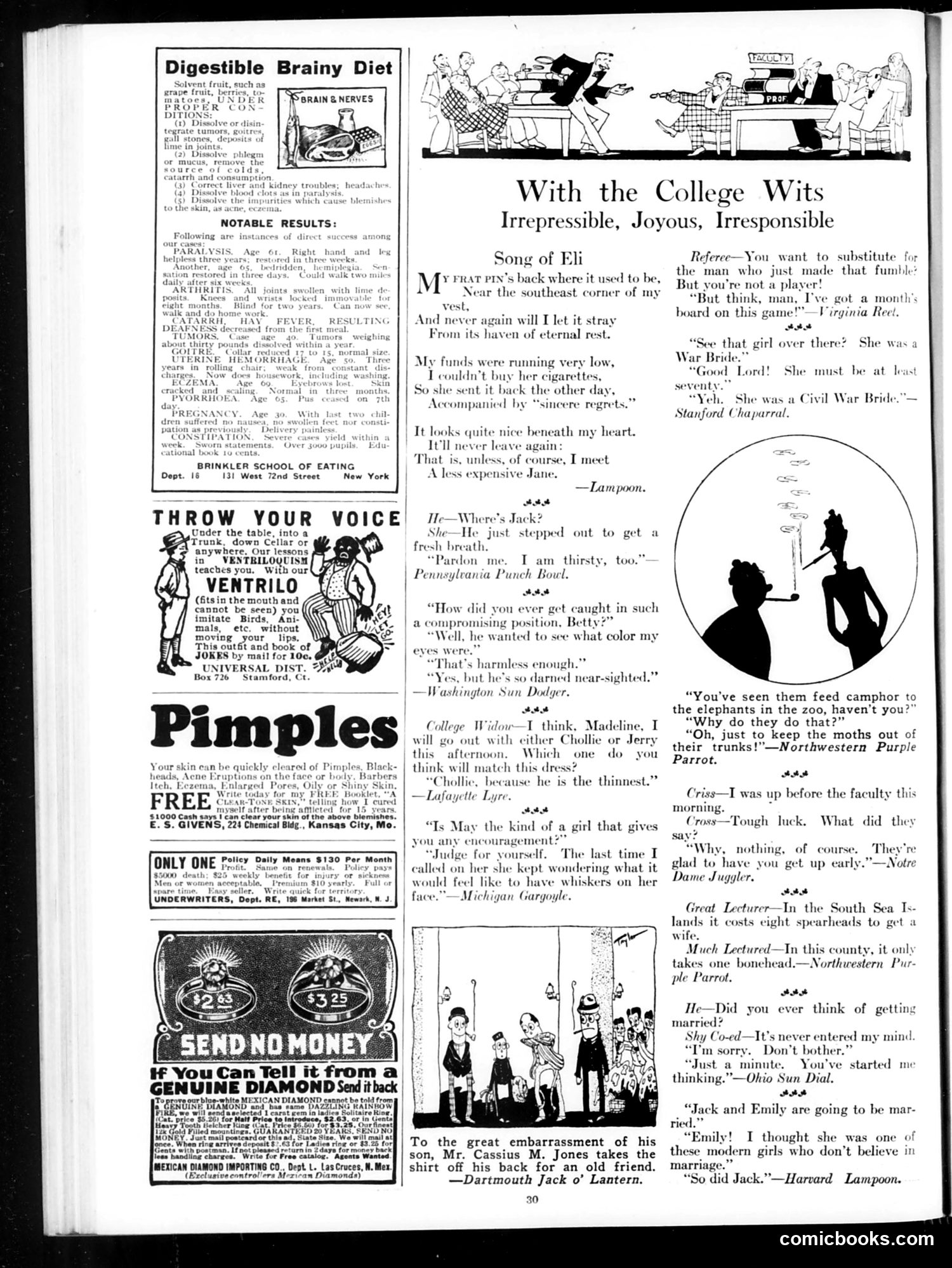
This page collects humorous anecdotes and jokes from college humor magazines, representing early 20th-century collegiate wit. The content reflects period-specific social attitudes: **Key Themes:** - **Fraternity culture**: References to frat pins as romantic tokens with emotional/financial significance - **Gender dynamics**: College women ("coeds") portrayed as calculating about romance and finances; men anxious about impressing them - **Dating conventions**: Cigarettes, gifts, and appearance as courtship markers; assumptions about women's motivations - **Social hierarchy**: References to "college widows" (older women who dated students) and class consciousness **Notable Details:** - The "War Bride" joke assumes readers know Civil War references remain contemporary enough for satire - Physical appearance jokes (whiskers, thinness) reflect period beauty standards - Money anxiety dominates romantic scenarios The advertising (diet products, ventriloquism lessons, pimple treatments) targets young readers. These jokes feel dated primarily because courtship norms, gender roles, and campus social structures have fundamentally changed.
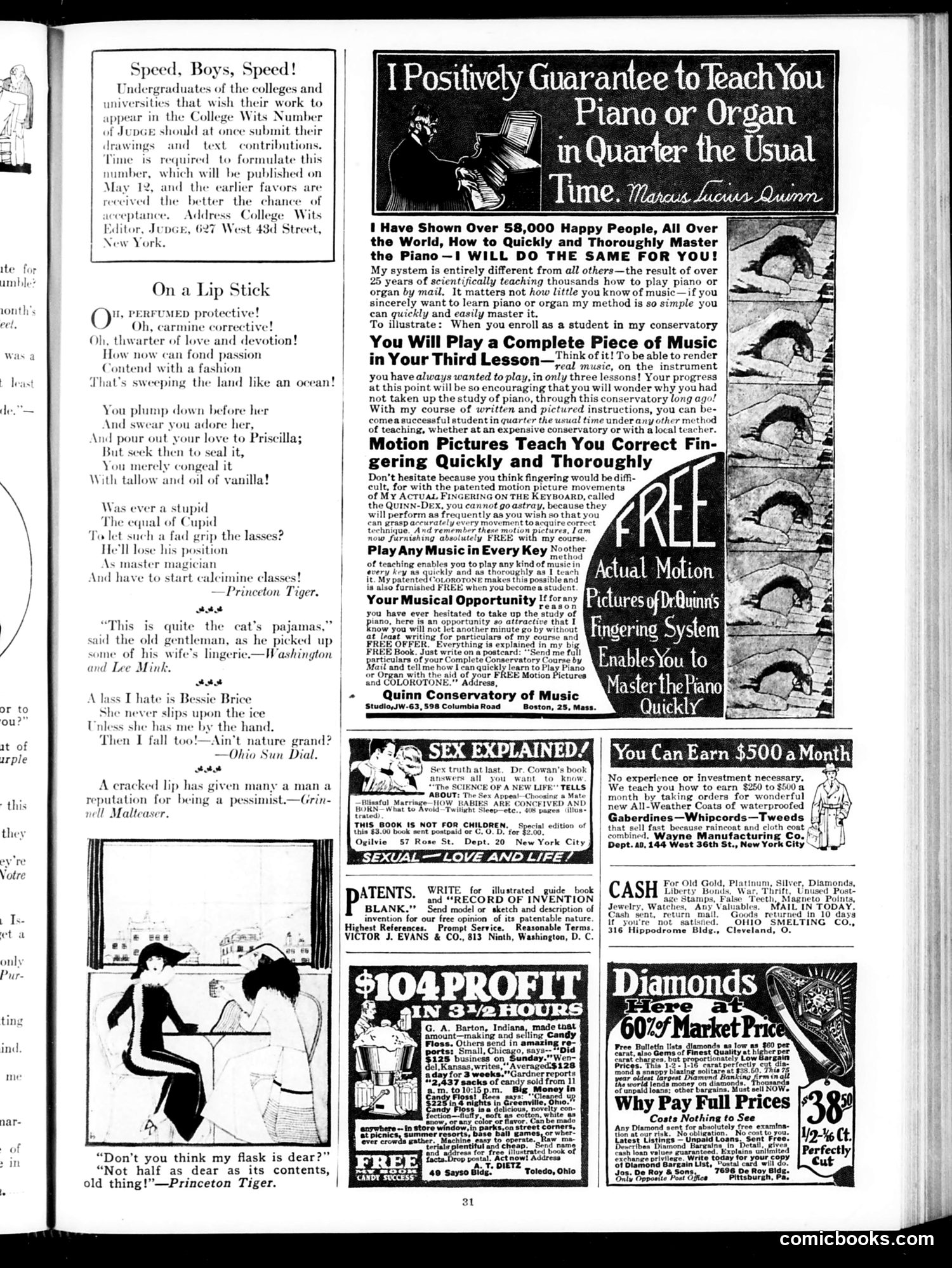
This page is primarily **advertising**, not political satire or comics requiring historical context. The left side contains light **humor pieces** (poems and jokes from college magazines like Princeton Tiger and Ohio Sun Dial) mocking contemporary social trends: lipstick as a dating obstacle, clumsy women who use men for support, and flask ownership. The dominant right side features **commercial advertisements** typical of 1920s magazines: piano/organ correspondence courses (Dr. Quinn's mail-in conservatory), sex education books, diamond sales, and money-making schemes. These ads promise quick mastery ("quarter the usual time") and financial gain—reflecting post-WWI optimism and mail-order industry expansion. The small bottom cartoon shows a couple exchanging flirtation about a flask's contents, continuing the humor section's tone about Prohibition-era social life. **Historical context for modern readers**: This page reflects 1920s consumer culture, correspondence education popularity, and cautious attitudes toward discussing sexuality openly—topics handled through discreet euphemism even in advertising.
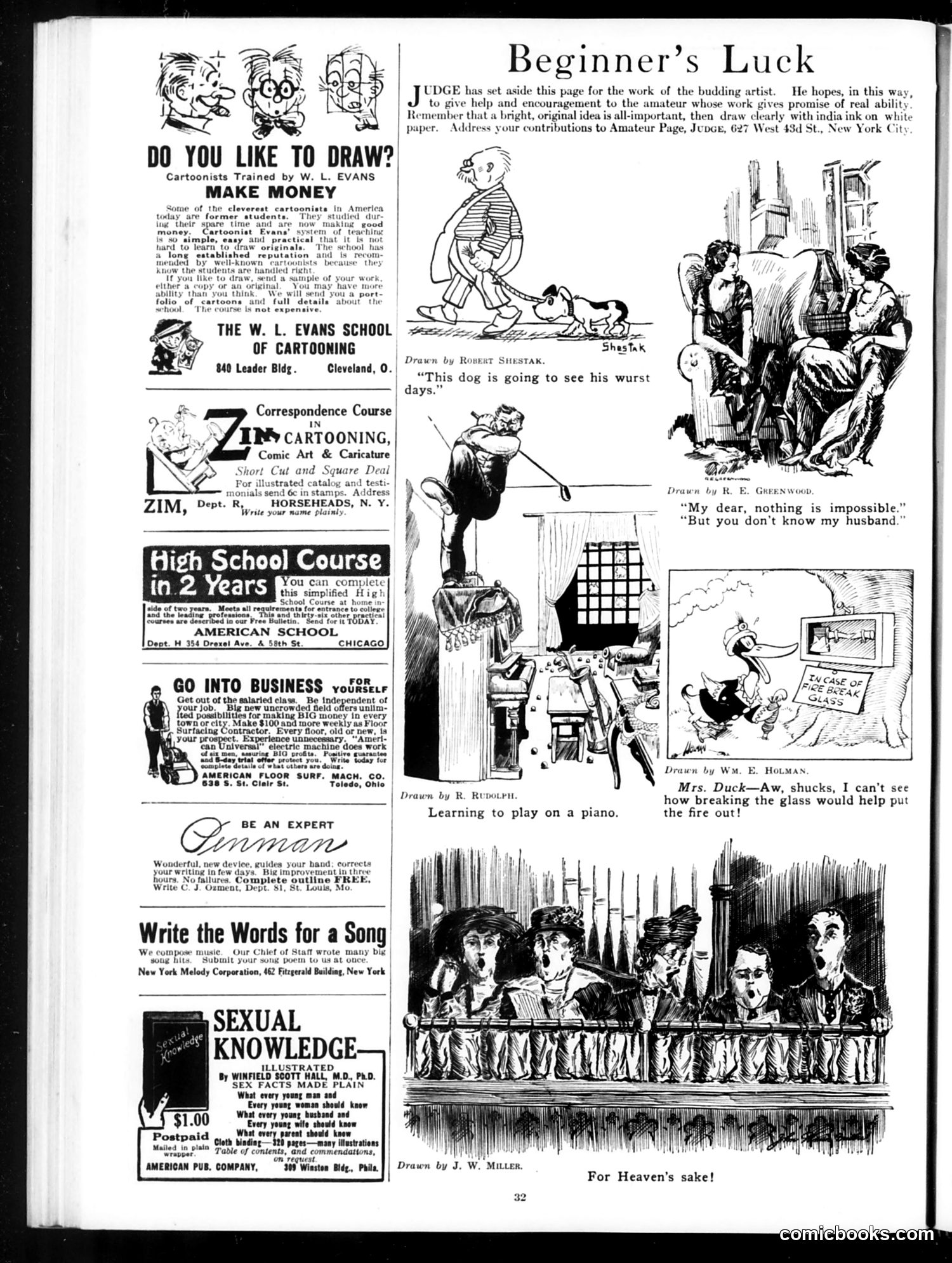
This "Beginner's Luck" page functions as **instructional advertising** rather than political satire. It collects teaching ads and amateur cartoons to encourage readers toward artistic careers. The cartoons shown demonstrate basic comic timing: a man pulling a small dog on a leash jokes about the dog seeing "wurst days" (pun on "worst"); a couple's exchange plays on marital exasperation ("nothing is impossible—but you don't know my husband"); Mrs. Duck expresses frustration at her husband's impractical suggestion to break glass to extinguish a fire; and an orchestra scene caption reads "For Heaven's sake!"—likely reacting to amateur musicianship. These gags exemplify early-20th-century domestic humor targeting middle-class anxieties: incompetent husbands, marriage frustrations, and social embarrassment. The left-side advertisements aggressively promote cartooning correspondence courses, art schools, and songwriting services—reflecting Judge's role as both satirical publication and marketplace for self-improvement schemes popular during this era.
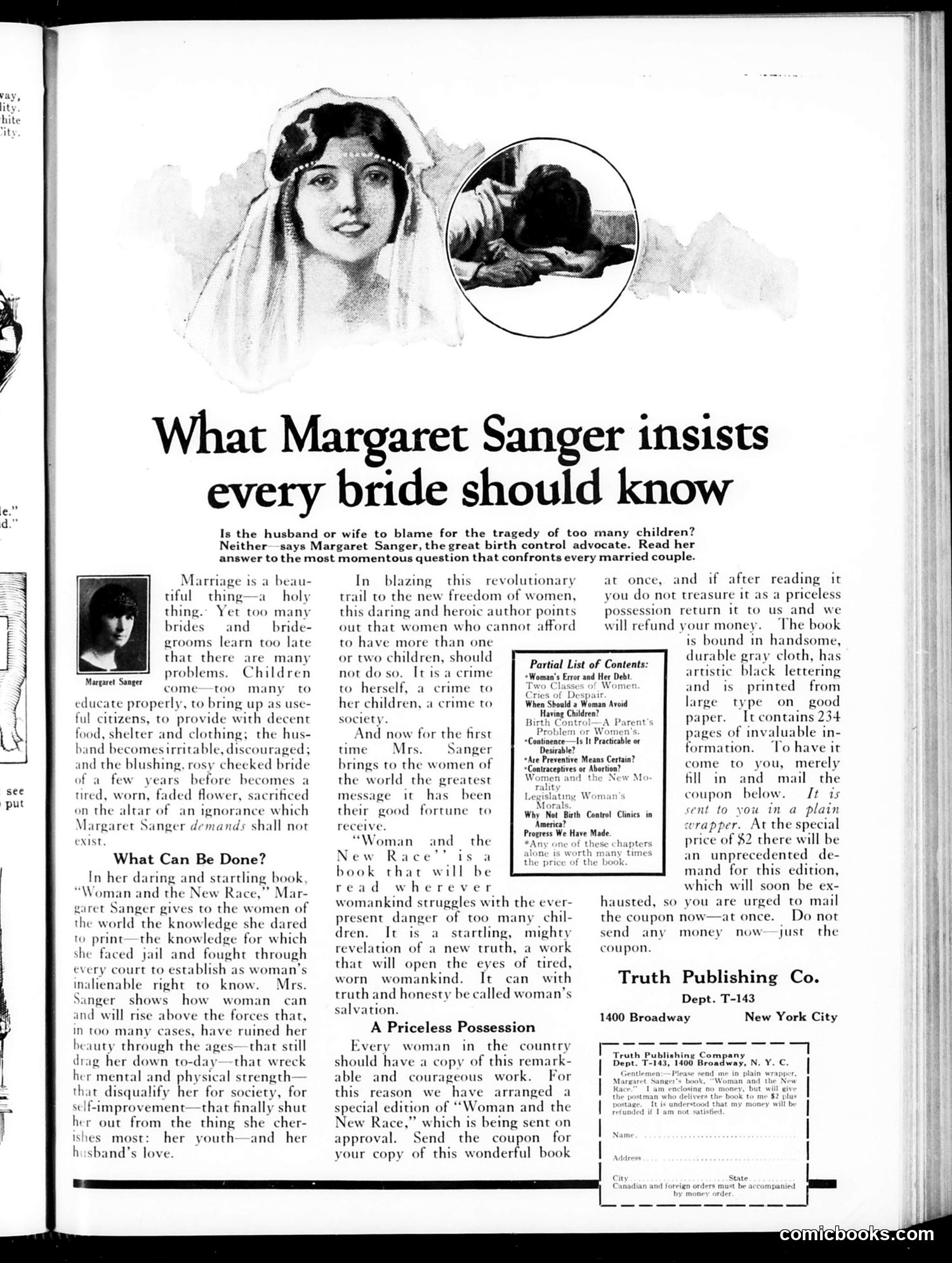
This is an advertisement disguised as editorial content, promoting Margaret Sanger's book "Woman and the New Race." Sanger was a pioneering birth control advocate who faced legal persecution for distributing contraceptive information. The "joke" or satire appears to be the framing itself: Judge magazine presents this as serious advice about marriage problems while actually promoting controversial birth control advocacy. The text claims married women are sacrificed by "ignorance"—referring to lack of access to contraception information. The circular inset image shows a woman sleeping or resting, likely illustrating the exhaustion from excessive childbearing that Sanger critiqued. For a modern reader: this reflects early 20th-century debates over reproductive rights. Sanger's message—that women shouldn't have more children than they could afford to raise—was radical at the time. The advertisement's appearance in Judge (a satirical magazine) suggests the topic was considered provocative enough to warrant this semi-ironic treatment, though the publisher clearly supports Sanger's position.
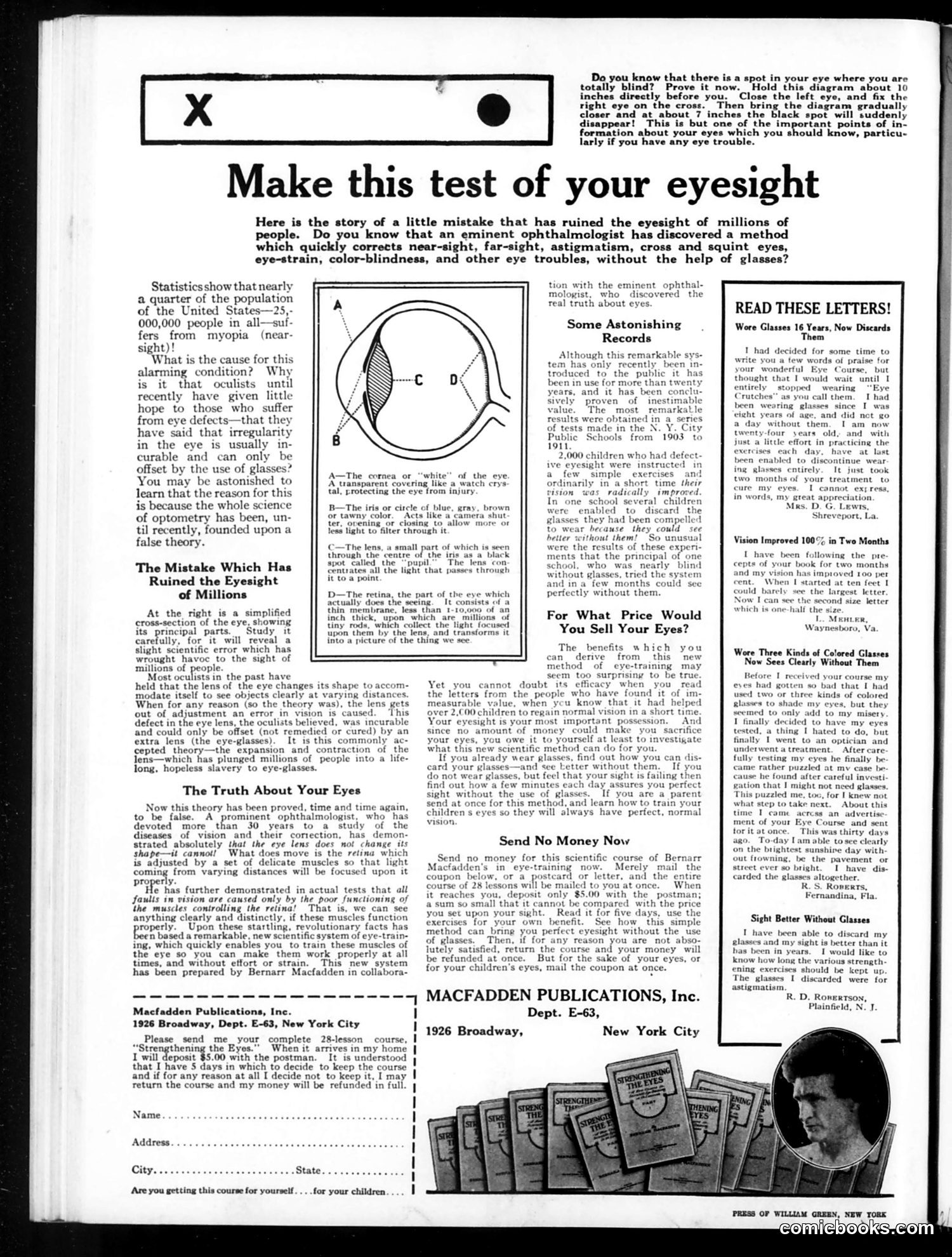
This page advertises a purported eye-correction method by Macfadden Publications, Inc., claiming an "eminent ophthalmologist" discovered exercises that can cure nearsightedness, farsightedness, astigmatism, and other vision problems without glasses. The top contains a legitimate optical illusion demonstrating the eye's blind spot. However, the surrounding text makes extraordinary medical claims unsupported by evidence, including that 2,000 New York schoolchildren improved their vision through simple exercises. Testimonial letters ("READ THESE LETTERS!") from supposed patients claim they discarded glasses after treatment—a common advertising tactic then. This is **pseudoscientific marketing**. The page exploits widespread vision problems and public frustration with glasses to sell a mail-order course. The authority-appeal ("eminent ophthalmologist") and fake testimonials are classic deceptive advertising from the 1920s era, before modern FDA regulations and consumer protection laws.