
Judge, 1923-03-03 · page 17 of 36
Judge — March 3, 1923 — page 17: what you’re looking at
What you’re looking at
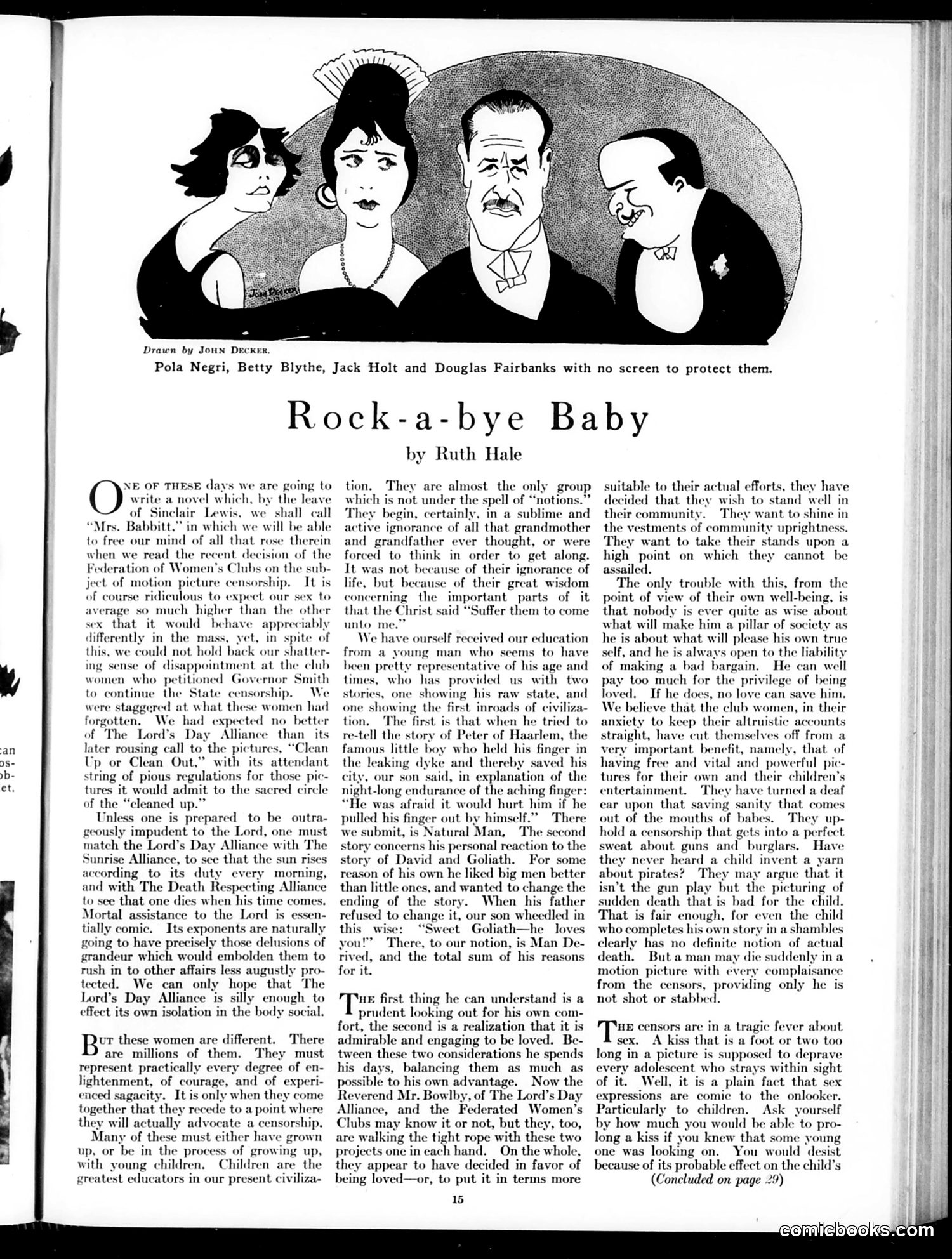
This page satirizes women's censorship efforts in early 1920s cinema. The cartoon caricatures four famous silent film stars—Pola Negri, Betty Blythe, Jack Holt, and Douglas Fairbanks—depicted without "screen to protect them," meaning vulnerable to censorship scrutiny. Ruth Hale's accompanying essay mocks the Federation of Women's Clubs for petitioning Governor Smith to maintain state film censorship. Hale argues these women contradict themselves: they claim moral superiority yet advocate restricting freedom. She sarcastically compares such moral policing to absurd organizations like "The Death Respecting Alliance." The satire's core: women reformers, many raising children, ironically demand censorship while children themselves—unconstrained by social conventions—naturally understand morality better than rigid rules allow. Hale uses anecdotes of children's innocent wisdom to suggest censorship reflects adult hypocrisy, not genuine moral education.
📄 Transcribed text from this page (OCR, searchable)
Machine-transcribed from the original scan — historical spelling and the odd misread are preserved.
Drawn by Joun Decker. Pola Negri, Betty Blythe, Jack Holt and Douglas Fairbanks with no screen to protect them. Rock-a-bye Baby NE OF THESE days we are going to write a novel which, by the leave of Sinclair Lewis, we shall call “Mrs. Babbitt.” in which we will be able to free our mind of all that rose therein when we read the recent decision of the Federation of Women’s Clubs on the sub- ject of motion picture censorship. It is rse ridiculous to expect our sex to ze so much higher than the other sex that it would behave appreciably differently in the mass, yet, in spite of this, we could not hold back our shatter- ing sense of disappointment at the club women who petitioned Governor Smith to continue the State censorship. We were staggered at what these women had forgotten. We had expected no better of The Lord’s Day Alliance than its later rousing call to the pictures, “Clean Up or Clean Out,” with its attendant string of pious regulations for those pic- tures it would admit to the sacred circle of the “cleaned up.” Unless one is prepared to be outra- geously impudent to the Lord, one must match the Lord’s Day Alliance with The Sunrise Alliance, to see that the sun rises according to its duty every morning, and with The Death Respecting Allian to see that one dies when his time comes. Mortal assistance to the Lord is essen- tially comic. Its exponents are natural! going to have precisely those delusions « grandeur which would embolden them to rush in to other affairs less augustly pro- tected. We can only hope that The Lord’s Day Alliance ‘is silly enough to effect its own isolation in the body social. B” these women are different. There are millions of them. They must represent practically every degree of en- lightenment, of courage, and of experi- enced sagacity. It is only when they come together that they recede to a point where they will actually advocate a censorship. Many of these must either have grown up, or be in the process of growing up, with young children. Children are the greatest educators in our present civiliza- of cc ave by Ruth Hale tion. They are almost the only group which is not under the spell of “notions.” They begin, certainly, in a sublime and active ignorance of all that grandmother and grandfather ever thought, or were forced to think in order to get It was not because of their ignora life, but because of their great wisdom concerning the important parts of it that the Christ said “Suffer them to come unto me. We have ourself received our education from a young man who seems to hav heen pretty representative of his age times, who has provided us with two stories, one showing his raw sta one showing the first inroads of tion. The first is that when he tried to re-tell the story of Peter of Haarlem, the famous little boy who held his finger in the leaking dyke and thereb city, our son said, in explanation of the night-long endurance of the aching finger: “He was afraid it would hurt him if he pulled his finger out by himself.” There we submit, is Natural Man, The second story concerns his personal reaction to the story of David and Goliath. For some reason of his own he liked big men better than little ones, and wanted to change the ending of the story. When his father refused to change it, our son wheedled in this wise: weet G h—he loves you!” There, to our notion, is Man De- rived, and the total sum of his reasons for it. festa first thing he can understand is a prudent looking out for his own com- fort, the second is a realization that it is admirable and engaging to be loved. Be- tween these two considerations he spends jancing them as much as ible to his own advantage. Now the Reverend Mr. Bowlby, of The Lord’s Day Alliance, and the Federated Women’s Clubs may know it or not, but they, too, are walking the tight rope with these two projects one in each hand. On the whole, they appear to have decided in favor of being loved—or, to put it in terms more suitable to their actual efforts, they have decided that they wish to stand well in their community. They want to shine in the vestments of community uprightness. They want to take their stands upon a high point on which they cannot be y trouble with this, from the sw of their own well-being, is wise about r of society as he is about what will please his own true self, and he is always open to the liability of making a bad bargain. He can well pay too much for the privilege of being loved. If he does, no love can save him. We believe that the club women, in their anxiety to keep their altruistic accounts straight, have cut themselves off from a very important benefit, namely, that of having free and vital and powerful pic- tures for their own and their children’s entertainment. They have turned a deaf ear upon that saving sanity that comes out of the mouths of babes. They up- hold a censorship that gets into a perfect sweat about guns and burglars. Have they never heard a child invent a yarn about pirates? They may argue that it isn’t the gun fy but the picturing of sudden death that is bad for the child. That is fair enough, for even the child who completes his own sto a shambles clearly has no definite notion of actual death, But a man may die suddenly ina motion picture with every complaisance from the censors, providing only he is not shot or stabbed. IHE censors are in a tragic fever about . A that is a foot or two too long in a picture is supposed to deprave adolescent who strays within sight of it. Well, it is a plain fact that sex expressions are comic to the onlooker. Particularly to children. Ask yourself by how much you would be able to pro- long a kiss if you knew that some young one was looking on. You would desist because of its probable effect on the child’s (Concluded on page 29)