
Judge, 1923-03-03 · page 12 of 36
Judge — March 3, 1923 — page 12: what you’re looking at
What you’re looking at
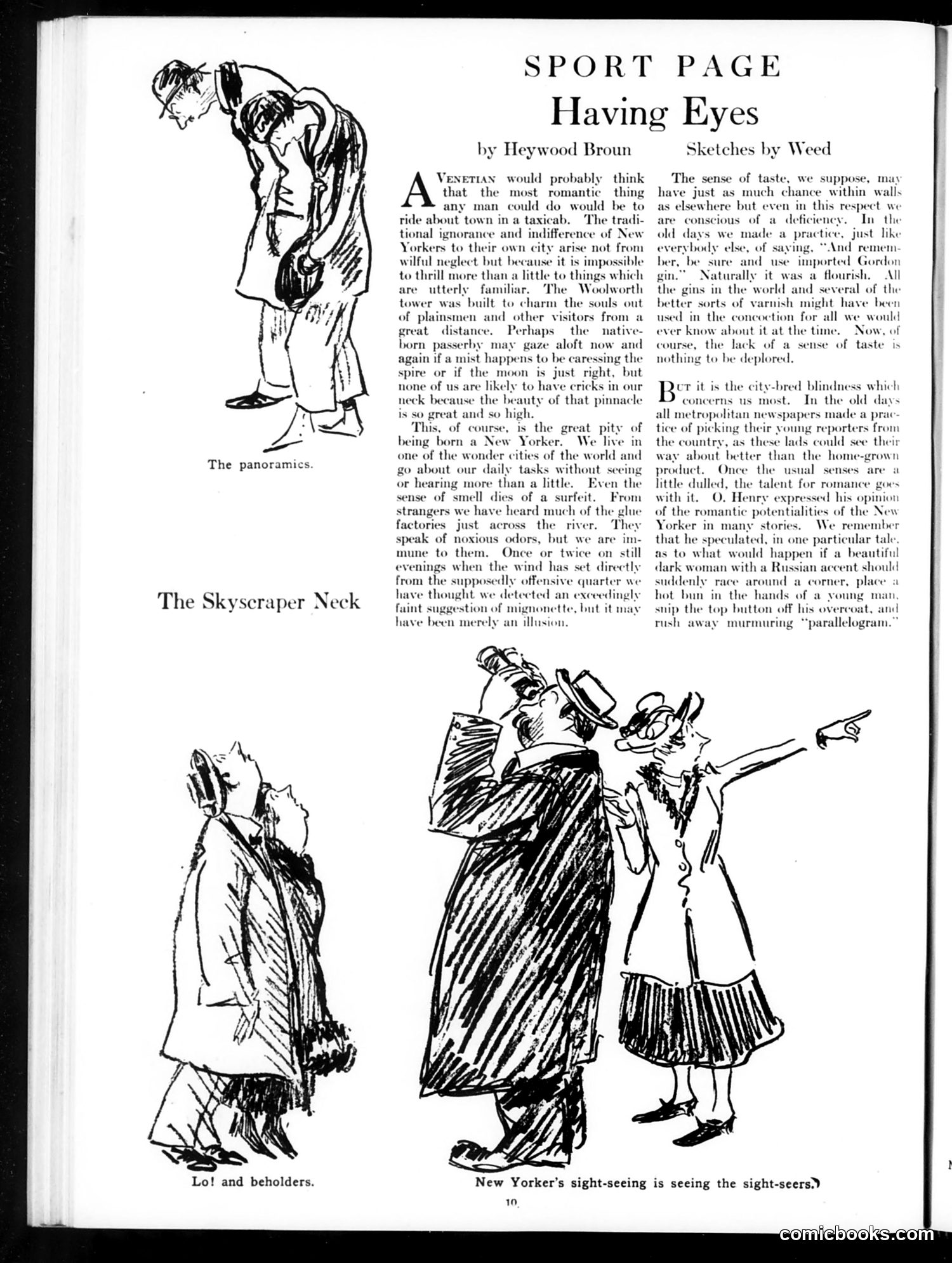
This is a humorous essay by Heywood Broun with accompanying sketches titled "Having Eyes," satirizing New Yorkers' notorious indifference to their own city's attractions. **The Main Point:** Native New Yorkers are so accustomed to famous landmarks (like the Woolworth Tower, referenced as a marvel meant to impress visitors) that they've become completely blind to them. Broun argues this urban numbness extends to all senses—smell (glue factories across the river), taste, and sight—making city-dwellers immune to experiences that would astound outsiders. **The Satire:** The piece mocks New York's assumed sophistication while suggesting it actually breeds apathy. Broun notes newspapers once hired country reporters precisely because they could *see* things; once dulled by city life, "the talent for romance goes with it." He references O. Henry's stories about how a beautiful stranger would go unnoticed by a blasé New Yorker. **The Sketches:** Show tourists ("Lo! and beholders") looking up in wonder, contrasted with the indifferent "Skyscraper Neck" posture of locals ignoring their surroundings—visual proof of the essay's thesis about urban blindness.
📄 Transcribed text from this page (OCR, searchable)
Machine-transcribed from the original scan — historical spelling and the odd misread are preserved.
The panoramics. The Skyscraper Neck Lo! and beholders. SPORT PAGE Having Eyes by Heywood Broun Venetian would probably think that the most romantic thing any man could do would be to ride about town in a t ab. The tradi- tional ignorance and indifference of Ne Yorkers to their own city arise not from wilful neglect but because it is impossible to thrill more th little to things which are utterly familiar. The Woolworth tower was built to charm the souls out of plainsmen and other visitors from a great distance. Perhaps the native- born passerby may gaze aloft now and again if a mist happens to be caressing the spire or if the moon is just right, but none of us are likely to have cricks in our neck because the beauty of that pinnacle is so great and so high. This, of course, is the great pity of being born a New Yorker. We live in one of the wonder cities of the world and go about our daily tasks without seeing or hearing more than a little. Even the sense of smell dies of a surfeit. From strangers we have heard much of the glue factories just across the river. They speak of noxious odors, but we are im- mune to them. Once or twice on still evenings when the wind has set directly from the supposed nsive quarte have thought we d dan exceeding faint suggestion of mignonette, but it may have been merely an illusion, 10. Sketches by Weed ‘The sense of taste, we suppose, may have just as much chance within’ walls as elsewhere but even in this respect we 1 deficiency. In the tice, just like are conscious of old days we made i everybody And remem her, be sure an imported Gordon gin.” Naturally it was a flourish, All the gins in the world and several of the better sorts of varnish might have been used in the concoction for all we would ever know about it at the time. Now, of course, the lack of a sense of taste is nothing to be deplored. B' T it is the city-bred blindness whic concerns us most. In the old days all metropolitan newspapers made a prac tice of picking their young reporters from the country, as these lads could see their way about better than the home-grown product. Once the usual senses little dulled, the talent for romance with it. O. Henry expressed his opin of the romantic potentialities of the N Yorker in many stor We remember that he speculated, in one particular tale as to what would happen if a beautiful dark woman with a Russian accent should suddenly race around a corner, place i hot bun in the hands of a young man snip the top button off his