
A complete issue · 36 pages · 1921
Judge — September 24, 1921
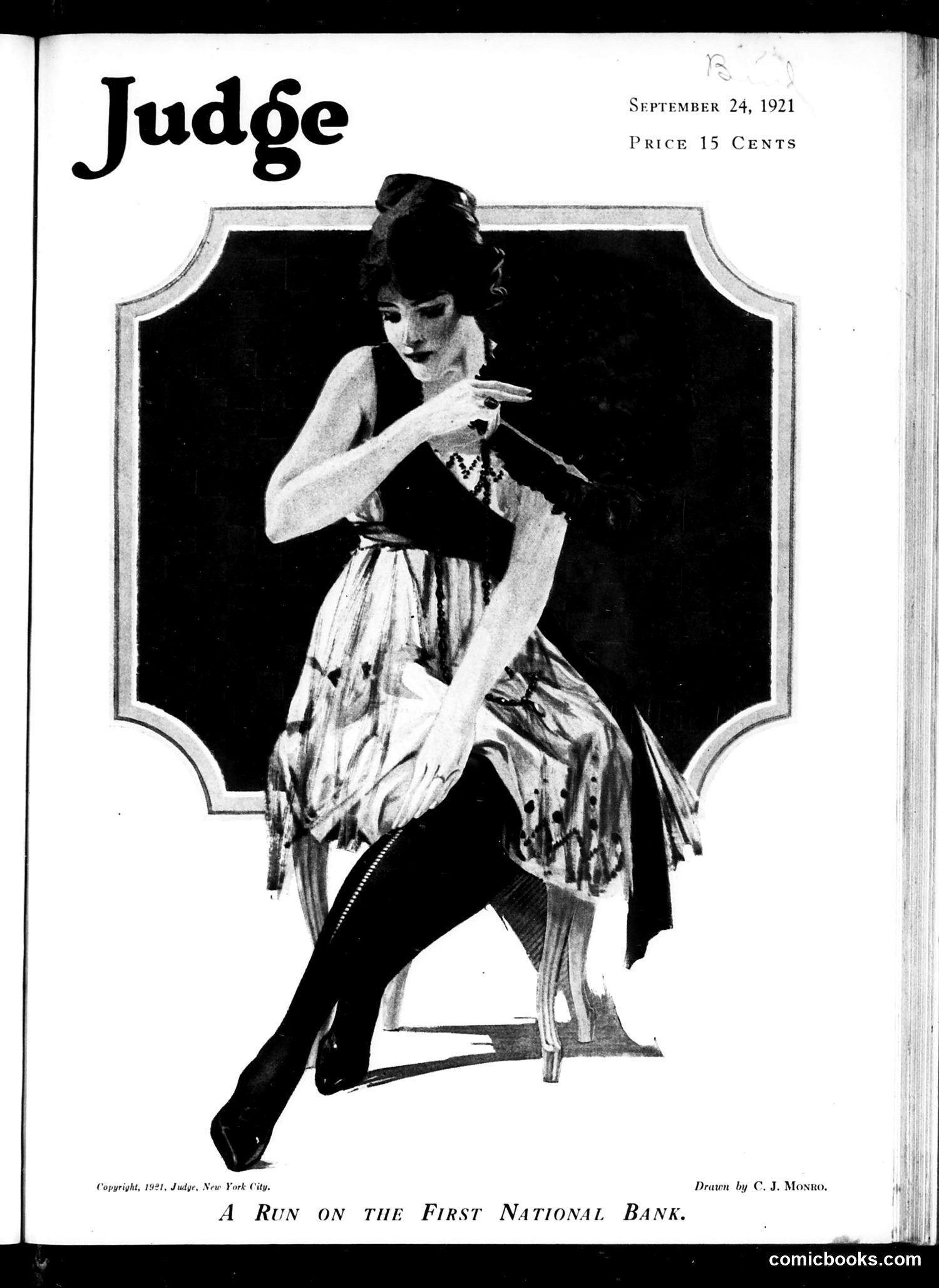
This Judge magazine cover from September 24, 1921 uses a double entendre to satirize bank runs—sudden mass withdrawals during financial panics. The illustration shows a woman in a fashionable dress and heels literally "running" away from a bank, depicted as she rushes in motion. The joke plays on the phrase "run on the bank" (a financial crisis) versus an actual person running. This visual pun was timely in 1921, during the post-WWI economic recession and financial uncertainty. The woman's stylish appearance, jewelry, and confident pose suggest she represents either the wealthy class withdrawing deposits or a commentary on frivolous spending during economic instability—common satirical targets in Judge magazine's commentary on American society.
This page is **entirely an advertisement**, not a cartoon or satirical content. It promotes Leslie's, described as "the oldest" illustrated weekly newspaper in the United States. The ad uses a metaphor comparing reading material to food—"mental palate" and "mental food"—to argue that Leslie's provides diverse, quality content ("fresh, timely, constructive, stimulating, entertaining, informative"). It boasts of prominent contributors and promises new features under "better each week" management policy. The only "figures" mentioned are generic references to "ablest and most popular writers and artists," not specific caricatures or political references. This is straightforward magazine marketing from September 24, 1921, targeting potential subscribers through their newsdealer.
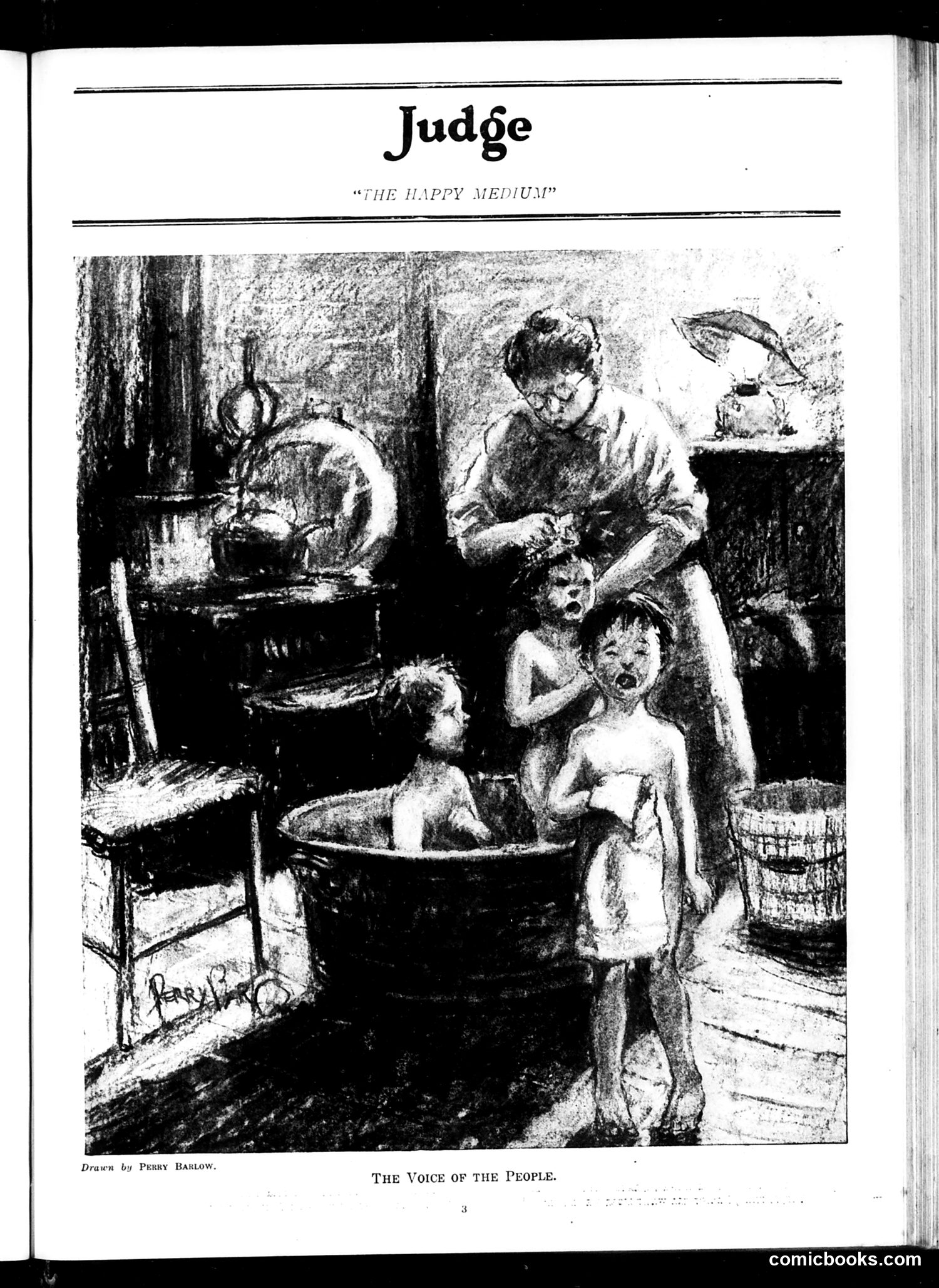
This satirical cartoon, drawn by Perry Barlow, depicts a domestic scene titled "The Voice of the People." The image shows a woman bathing two young children in a large tub while managing household tasks—visible cooking implements and a stove occupy the background. The cartoon's title "The Happy Medium" appears to satirize the concept of democratic representation or public opinion ("voice of the people"). The satire likely critiques how political compromise or policy-making supposedly represents popular will, while depicting the actual reality as domestic labor and child-rearing—suggesting the "people's voice" is drowned out by mundane household management. The specific political reference is unclear without additional context about Judge magazine's 1890s-era concerns.
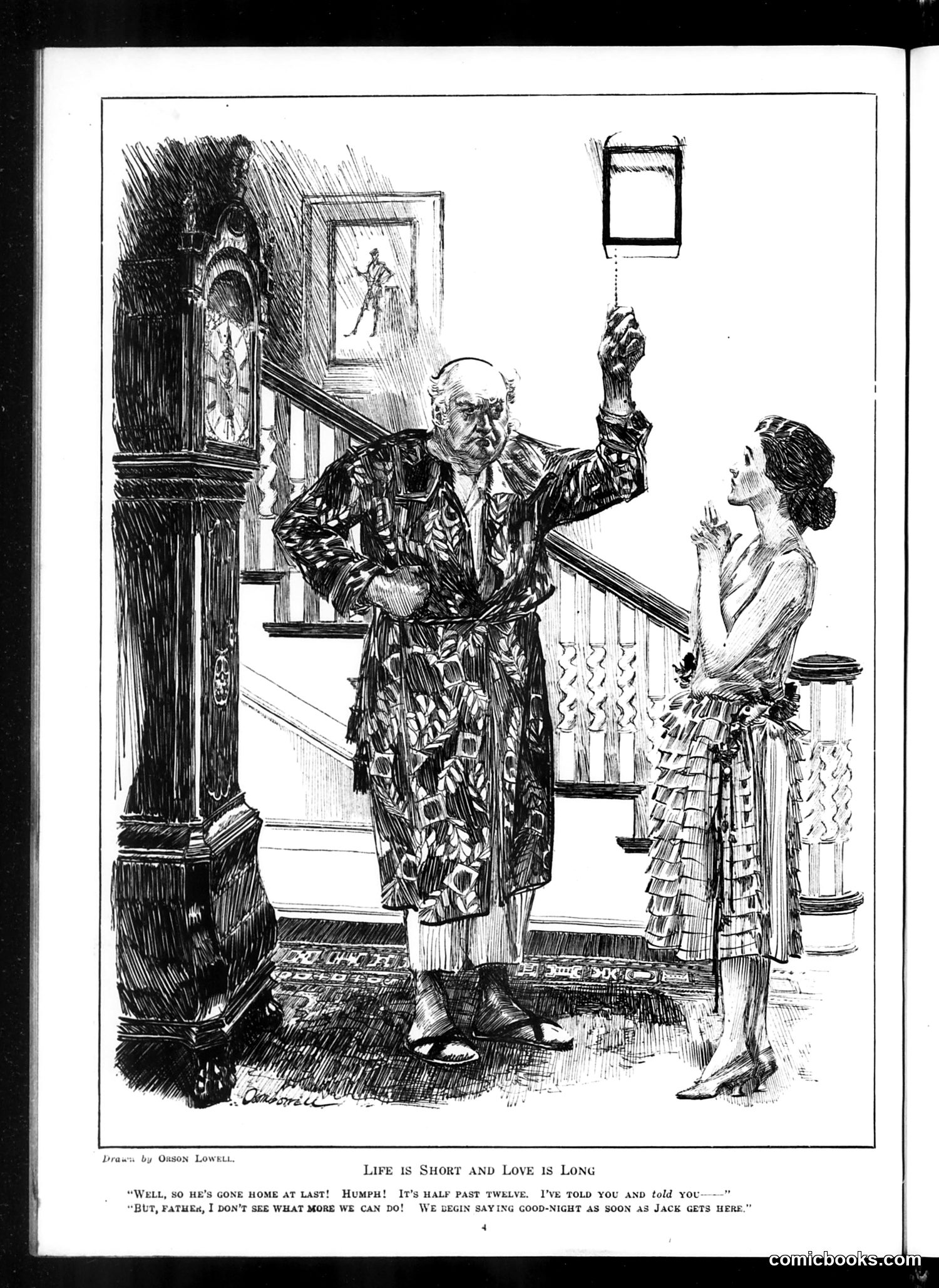
This domestic comedy sketch depicts an elderly man in ornate Asian-style robes arriving home late at night, confronted by his wife. The title suggests the husband has been out late, possibly carousing or conducting an affair. The wife's complaint—"It's half past twelve. I've told you and *told* you"—indicates a pattern of late nights. The husband's response about "saying good-night as soon as Jack gets here" suggests he's been socializing rather than working. The satire targets marital discord and the tension between husbands' social habits and wives' domestic expectations. The man's elaborate, expensive robe contrasts with the modest interior, possibly implying he spends money on personal indulgences while his wife waits at home—a common theme in Judge's commentary on upper-class behavior and gender relations.
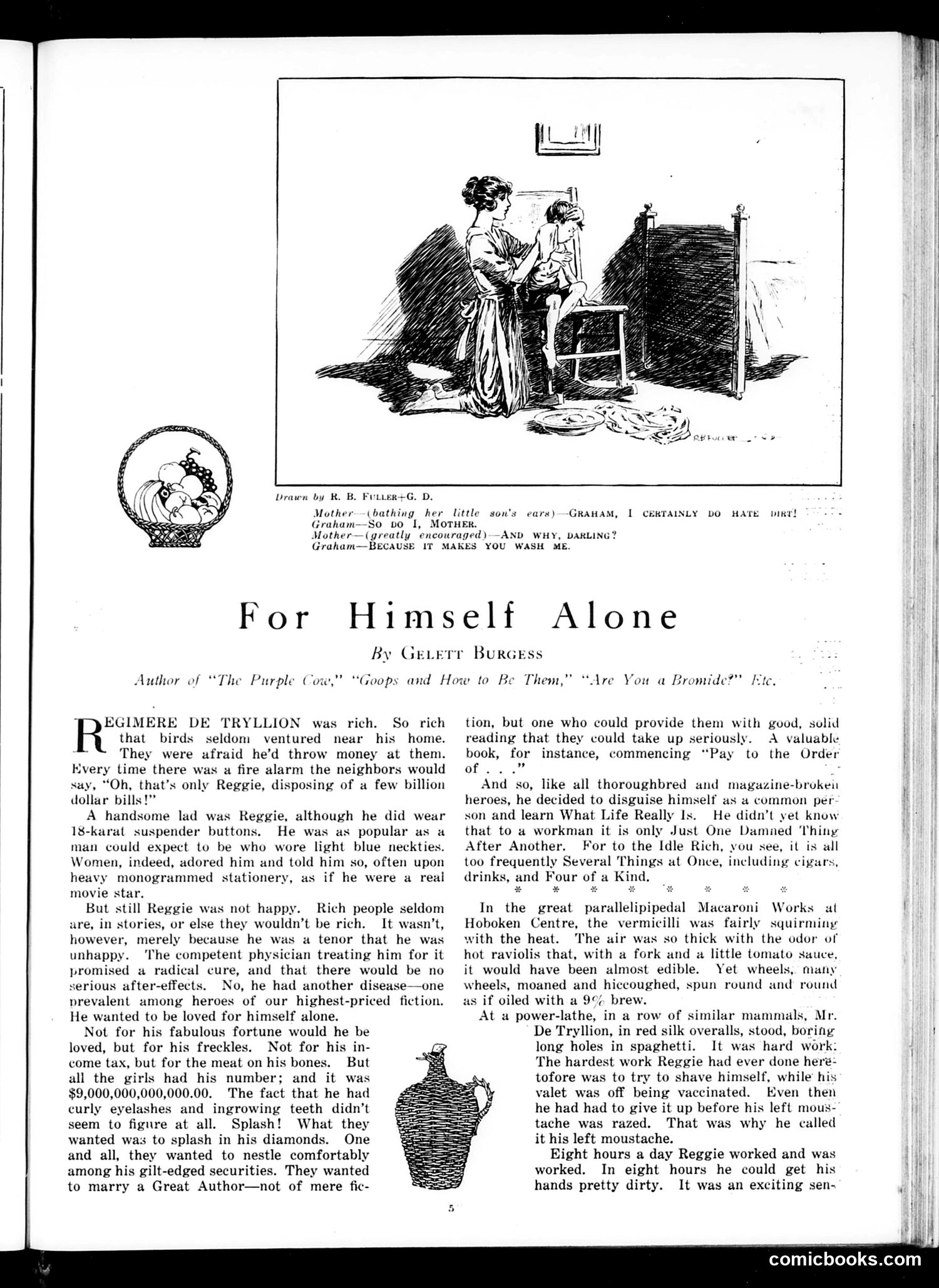
This page features a short story rather than political satire. The illustration depicts a mother bathing a young boy ("Graham") who protests getting washed because it makes him dirty afterward. The mother encourages him anyway, establishing the story's theme about a wealthy, eccentric man named Regimiere de Tryllion. The narrative satirizes the ultra-rich and literary pretension. Regimiere is so wealthy that neighbors fear he'll squander money; he's unhappy despite riches and wants to be "loved for himself alone." The story appears to mock how the wealthy pursue self-improvement through serious literature and distinguished accomplishments, ultimately finding such pursuits hollow or unsatisfying—a common Burgess theme critiquing upper-class affectation.
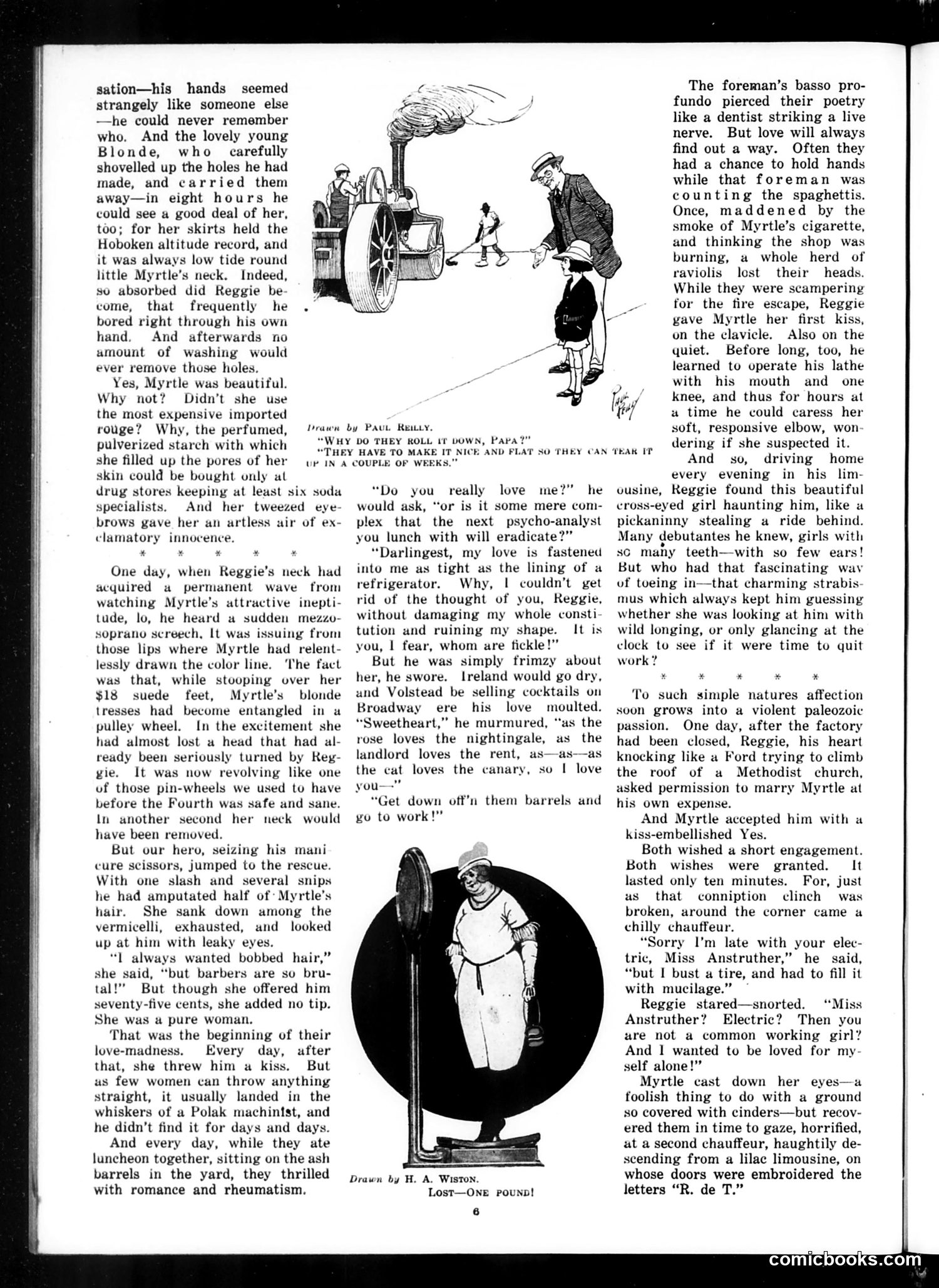
This page contains a romantic fiction story titled "Why Do They Bill It Down, Papa?" illustrated with two cartoons by Paul Reilly and H.A. Weston. The cartoons depict a working-class love story between Reggie (a factory worker/driver) and Myrtle, a cross-eyed girl. The humor derives from their courtship despite physical imperfections—her crossed eyes and his ungainly appearance. The narrative satirizes sentimental romance magazines by applying melodramatic language ("love is fastened into me as tight as the lining of a refrigerator") to ordinary working people in unglamorous industrial settings. The cartoons mock both class pretensions and the overwrought sentimentality of popular fiction, presenting genuine affection between ordinary, unpretty people as inherently comic.
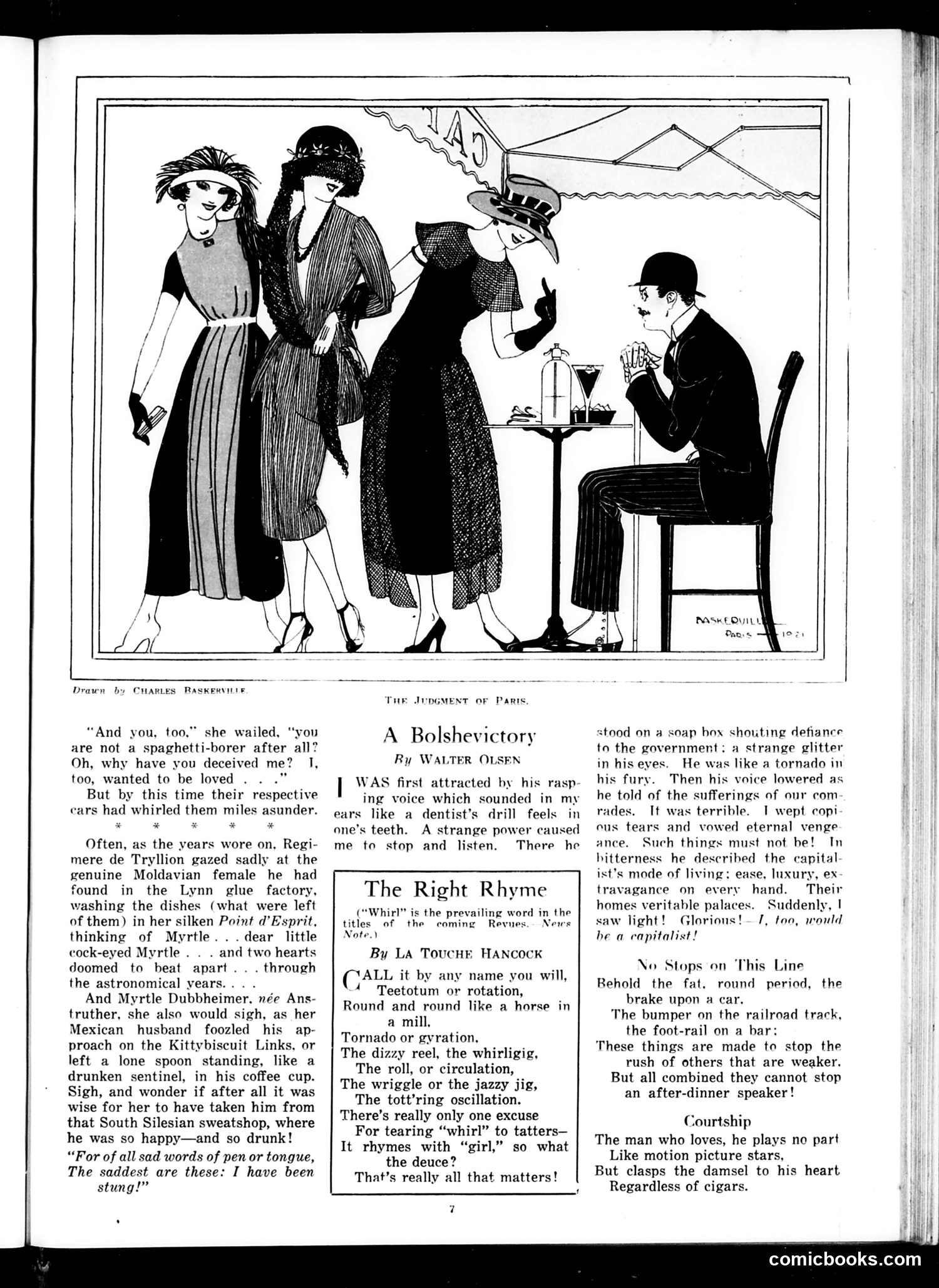
This *Judge* magazine page contains three distinct pieces of social satire: **Top Cartoon**: "The Judgment of Paris" depicts three fashionable women evaluating a seated man—a satirical take on the famous mythological judgment. The visual joke plays on romantic disappointment and class pretension among the wealthy. **"A Bolshevictory"**: This piece mocks communist rhetoric and converts. A speaker on a soapbox delivers fiery revolutionary propaganda about capitalist excess and workers' suffering. The narrator is moved to tears by tales of injustice—until the speaker's description of capitalist luxury (palaces, extravagance) makes the narrator think "I too, would be a capitalist!" The satire skewers both the hypocrisy of communist ideology and the materialistic shallowness of its converts. **Lighter Pieces**: "The Right Rhyme" jokes about theatrical revue titles overusing "whirl," while "Courtship" and "No Stops on This Line" offer brief witty observations on dating and unstoppable after-dinner speakers. The page reflects post-WWI American anxiety about Bolshevism and communist agitation.
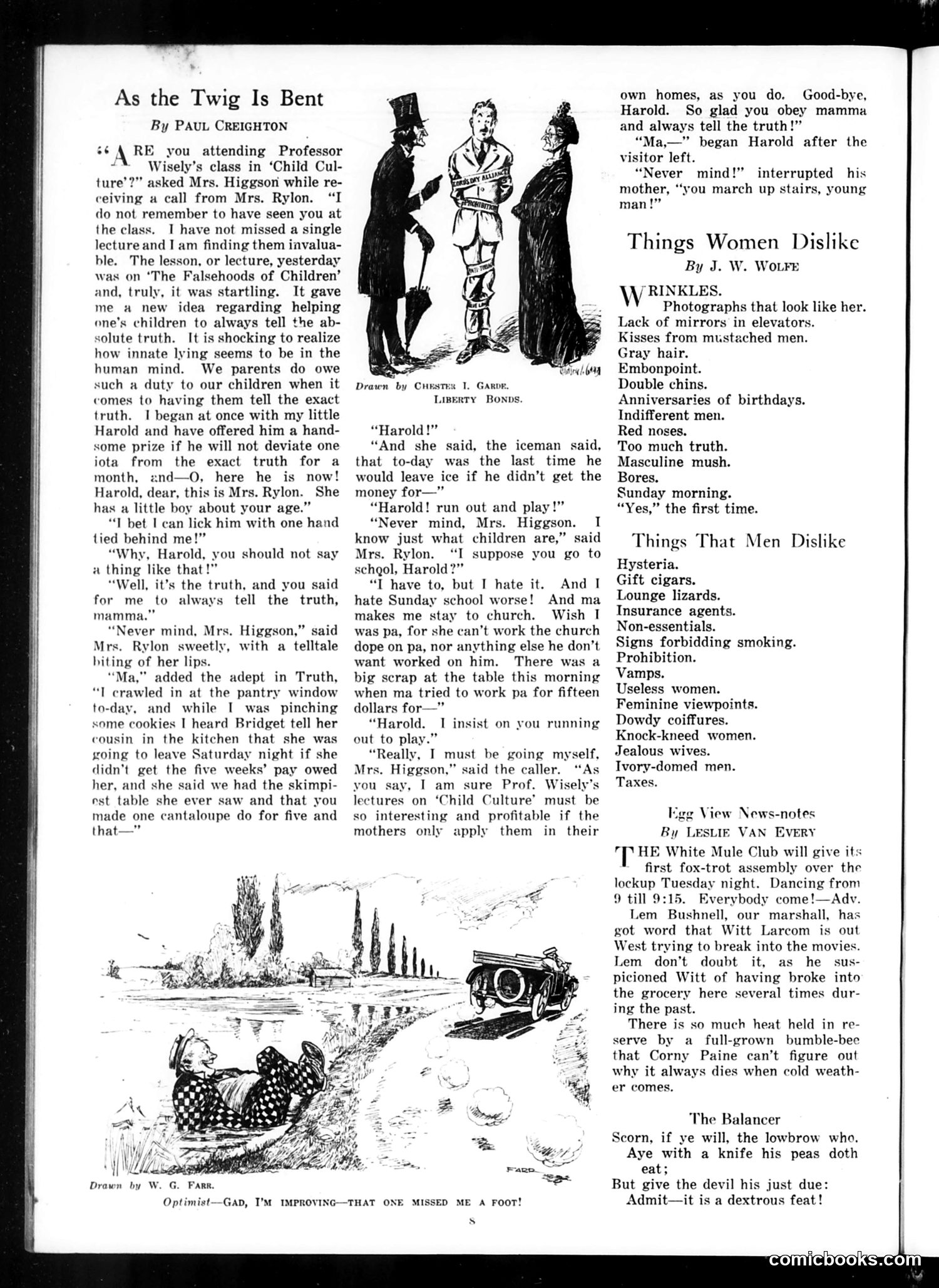
This story satirizes the unintended consequences of parenting advice about enforcing absolute truthfulness. Mrs. Higgson attends Professor Wisely's lecture on "Child Culture" and begins rewarding her son Harold for never deviating from truth—a popular early-20th-century parenting philosophy emphasizing moral development. The joke: Harold becomes brutally, socially destructive honest. When a visitor arrives, he boasts he can beat her son, then tattles on the family's household problems—the maid's complaints about wages and poor food, the iceman's threats, his parents' marital arguments. His mother, mortified, must silence him despite her stated commitment to truthfulness. The satire mocks both trendy parenting theories and their naive application. By following the lecture's advice literally, Mrs. Higgson created an insufferable child whose "truth" damages social relationships—the opposite of the intended moral development. The cartoon suggests such fashionable child-rearing methods often backfire when pursued rigidly without nuance.
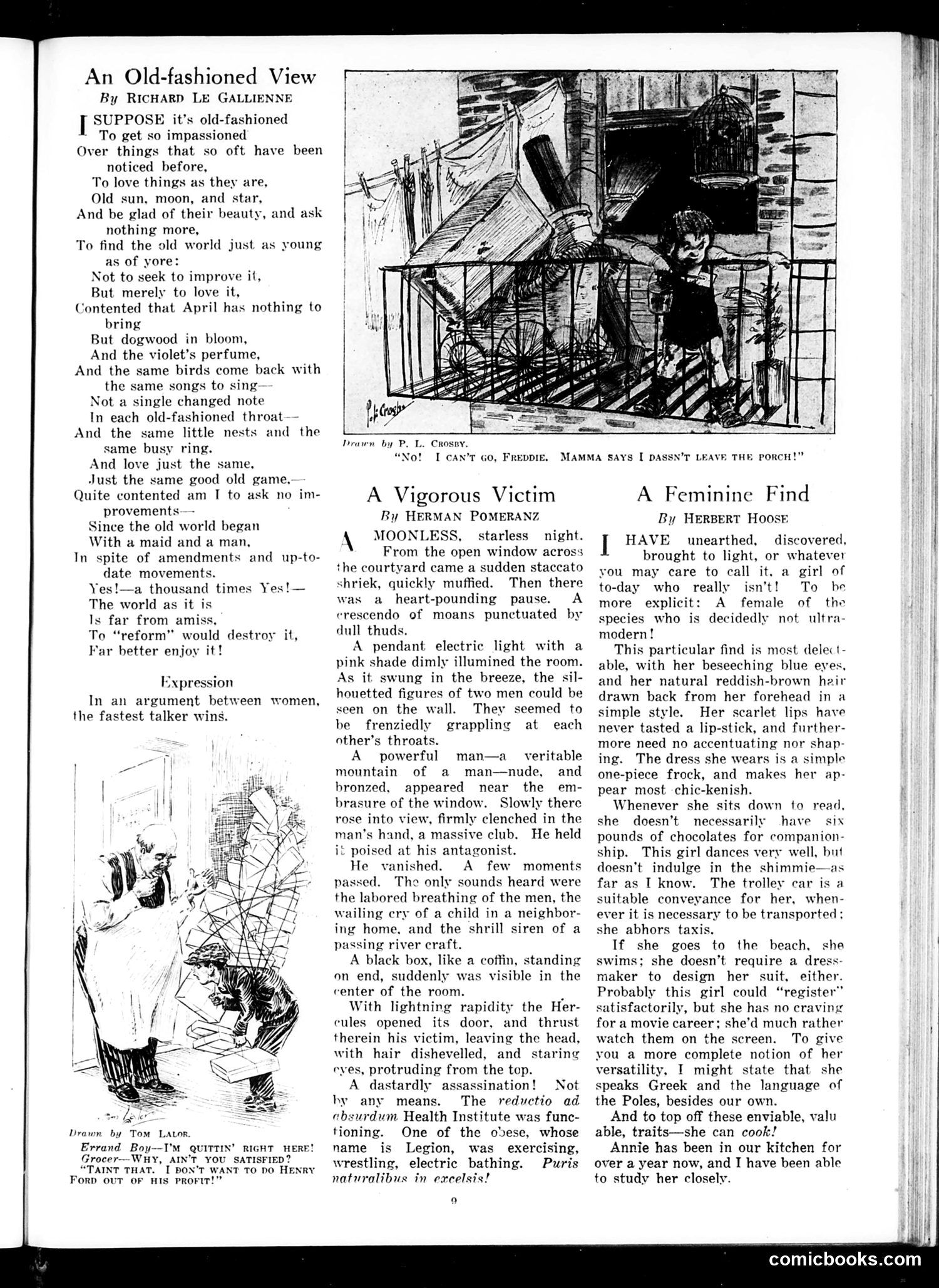
This page contains three satirical pieces reflecting early 20th-century social attitudes: **"An Old-fashioned View"** (poem by Richard Le Gallienne): A nostalgic defense of traditional values against modern "improvements." The poet argues for appreciating nature and old-fashioned romance rather than constantly seeking change—a conservative critique of the progressive era's reformist impulse. **"Expression"** (cartoon by Tom Lalor): A brief joke about women arguing, with the caption "the fastest talker wins"—reflecting period gender stereotypes about female chattiness. **"A Vigorous Victim"** (by Herman Pomeranz): Describes what appears to be a violent assault, but the twist reveals it's actually a health institute where an obese man undergoes vigorous exercise and electrical treatment—satirizing the era's somewhat brutal approaches to physical fitness. **"A Feminine Find"** (by Herbert Hoose): Celebrates a "modern" young woman who paradoxically *isn't* modern—she avoids cosmetics, doesn't dance the "shimmy," prefers trolleys to taxis, and reads instead of eating chocolates. The satire targets contemporary "ultra-modern" women while praising traditional femininity.
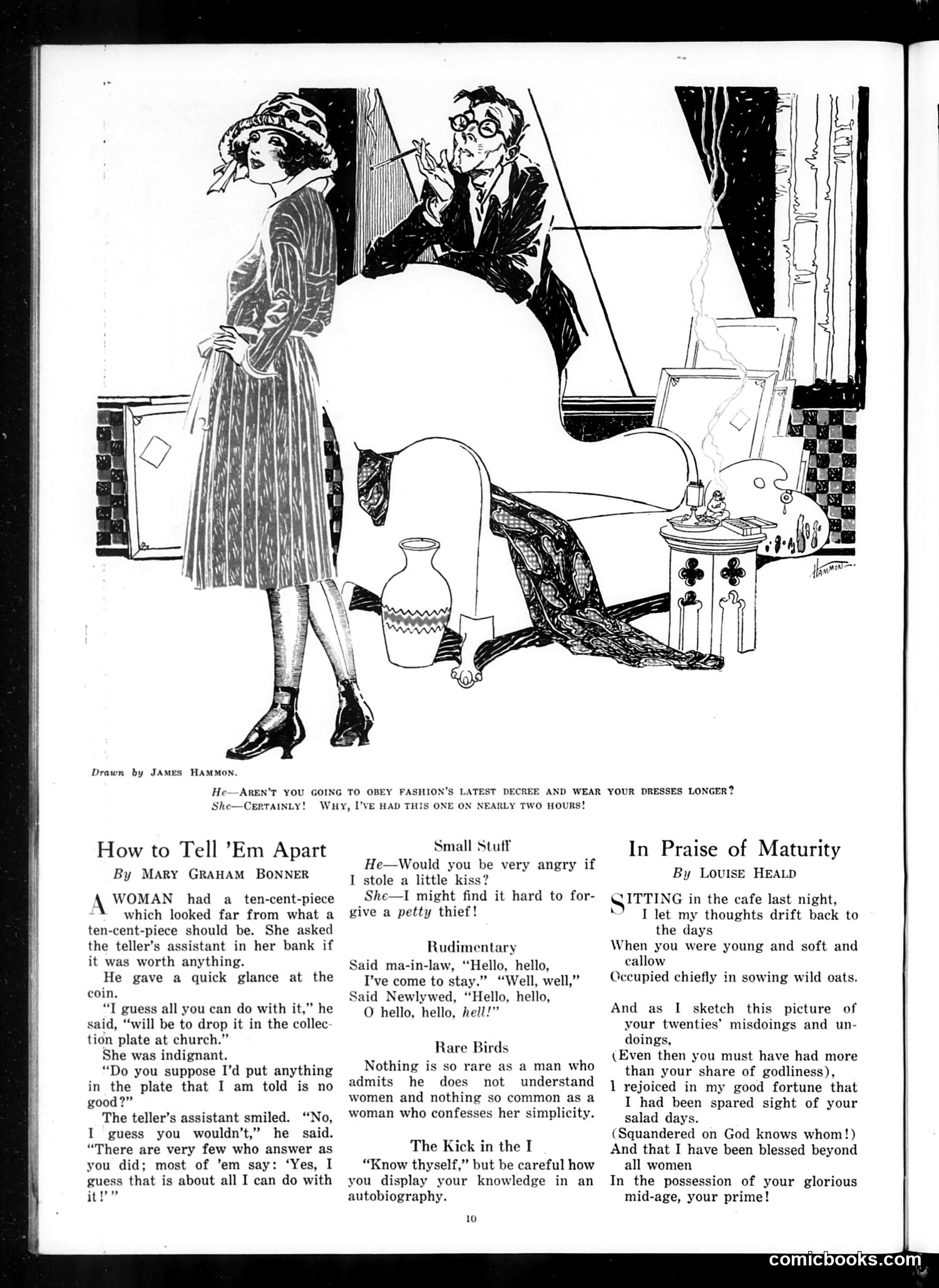
The top cartoon by James Hammon satirizes women's fashion compliance. A woman in an outdated long dress argues with a man (likely her husband) who urges her to follow "fashion's latest decree" and wear shorter dresses. She protests she's worn her current dress for nearly two hours—mocking the rapid, impractical pace of fashion changes and women's supposed slavish adherence to fleeting trends. Below are several short humorous pieces typical of Judge's format: witty one-liners about relationships, banking, and social behavior. "How to Tell 'Em Apart" contrasts moral dishonesty (donating worthless coins to church) with honesty. Other pieces joke about courtship, in-laws, and self-knowledge. The final piece, "In Praise of Maturity," celebrates middle age as superior to youthful folly and wildness, suggesting the author is grateful to have avoided seeing her partner's misspent youth. The page reflects early 20th-century concerns: fashion's absurdity, gender dynamics, and moral propriety.
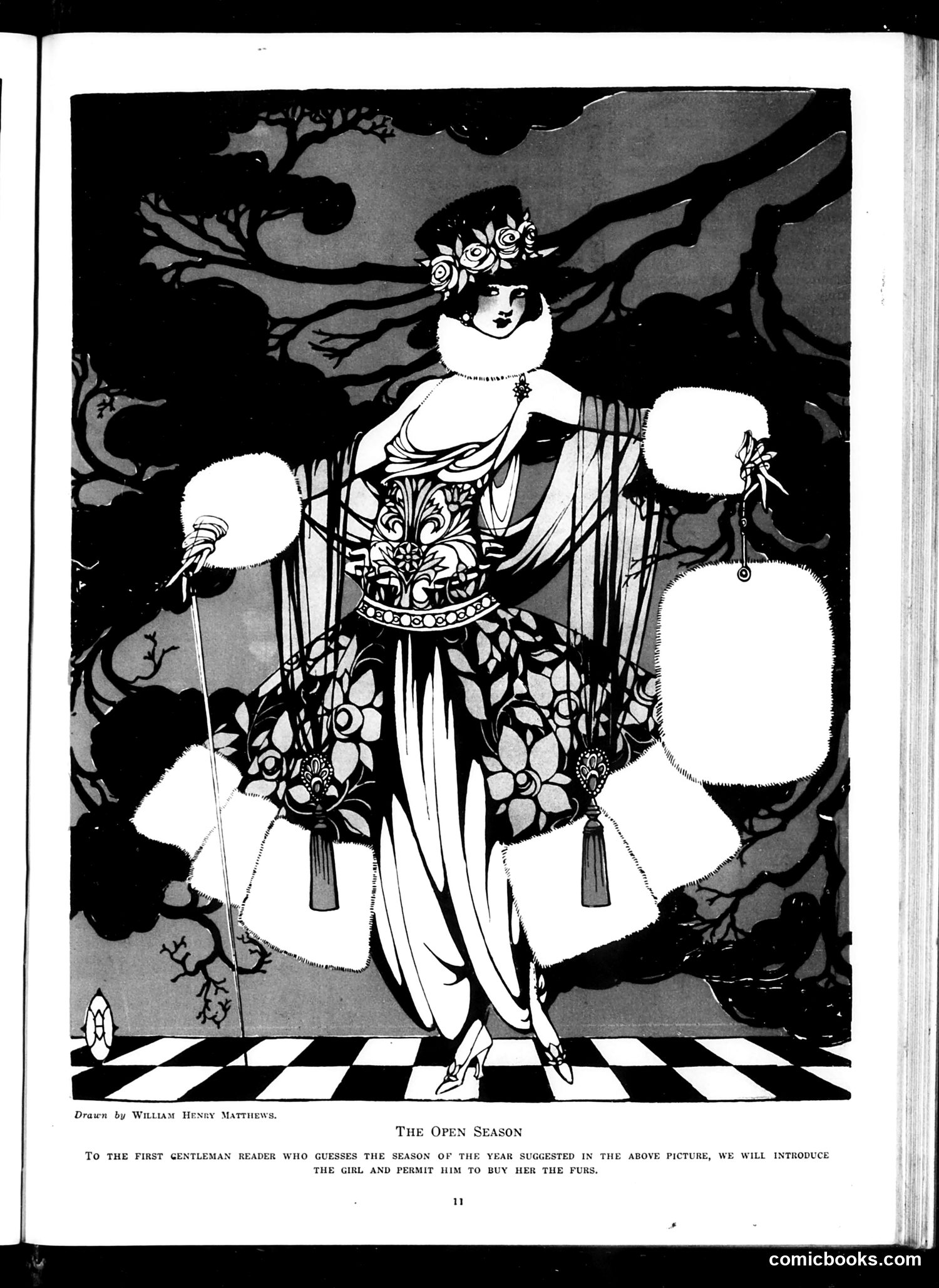
This illustration by William Henry Matthews is a visual riddle for Judge magazine readers. A fashionably dressed woman wearing an elaborate gown and floral headdress stands surrounded by three large white fur muffs (hand warmers). The satire plays on the double meaning of "open season"—literally, the hunting season when furs are obtained, and figuratively, a time when something becomes fair game. The joke suggests that winter (when women need furs) is "open season" for courting gentlemen to purchase expensive gifts for women. The text offers an incentive: the first reader correctly identifying which season the picture represents gets introduced to the girl and can buy her the furs—a humorous commentary on courtship customs and male expenditure on female fashion accessories.
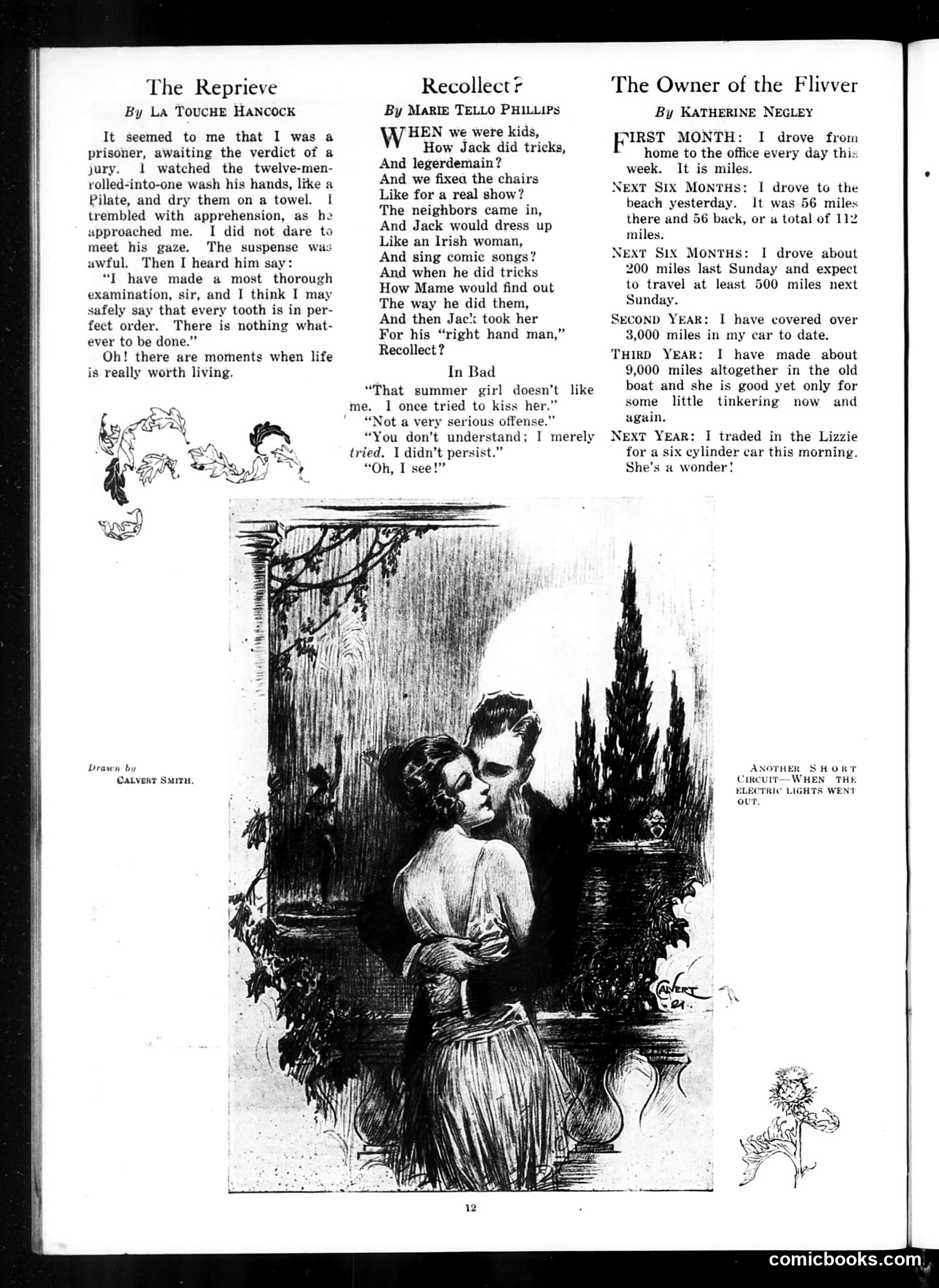
This page contains three short humorous pieces from *Judge* magazine: **"The Reprieve"** satirizes dental anxiety—a man dreads a dentist's examination like a prisoner awaiting verdict, then experiences profound relief when told his teeth are fine. The Pilate reference compares the dentist's hand-washing to ritualistic cleansing. **"Recollect"** is nostalgic humor about childhood magic shows, where a boy performs tricks for neighbors while dressed as an Irish woman. The humor lies in how easily the sister exposed his tricks, yet he still recruited her as his assistant. **"The Owner of the Flivver"** mocks car-obsessed Americans and planned obsolescence. A "flivver" (cheap car, likely a Model T Ford) owner chronicles escalating mileage over years, eventually trading it in for a six-cylinder vehicle—satirizing how quickly drivers abandon cars and constantly upgrade, treating vehicles as disposable. The large illustration appears unrelated to these texts—a romantic scene with a couple by moonlit water.
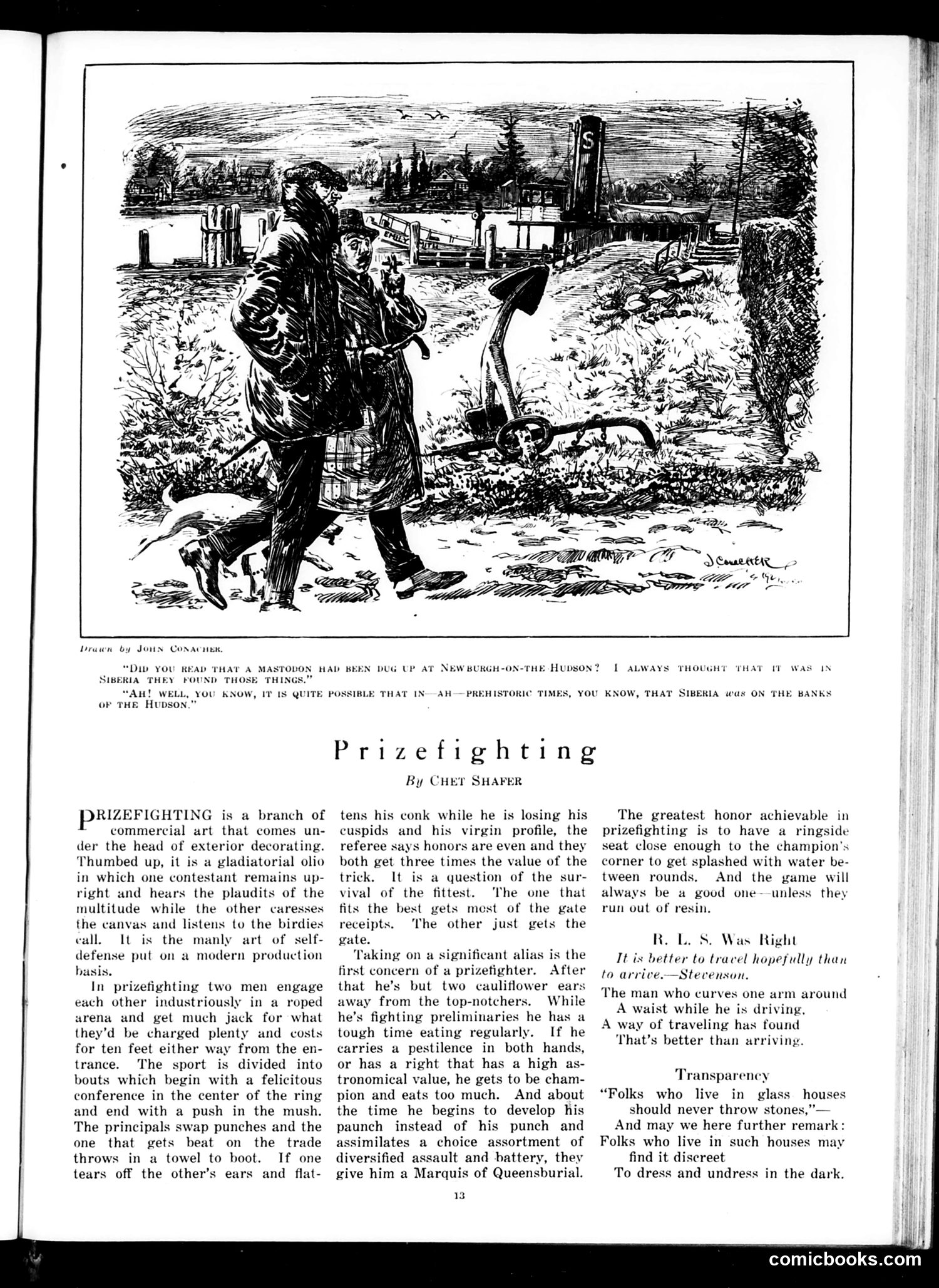
**The Cartoon (top):** A man and woman discuss a mastodon discovery at Newburgh-on-the-Hudson River. The joke plays on geographical confusion: the man initially thought such prehistoric creatures were found only in Siberia, but the woman suggests that during prehistoric times, Siberia may have extended to the Hudson River banks—a satirical jab at vague scientific knowledge or pretentious dinner-party conversation about paleontology. **"Prizefighting" Article:** A humorous essay by Chet Shaper mocking professional boxing using deliberately overwrought language ("gladiatorial olio," "commercial art"). It satirizes the sport's brutality (cauliflower ears, torn ears), the financial incentives, and the glorification of violence. The tone is cynical—boxing is portrayed as staged combat dressed up with rules and respectability ("modern production basis"). **The Poems:** Two brief comic verses mock self-help platitudes and hypocrisy—one about arriving versus traveling, another about the irony of modesty in transparent situations. The page reflects early-20th-century *Judge* magazine's satirical approach to contemporary American culture and intellectual pretension.
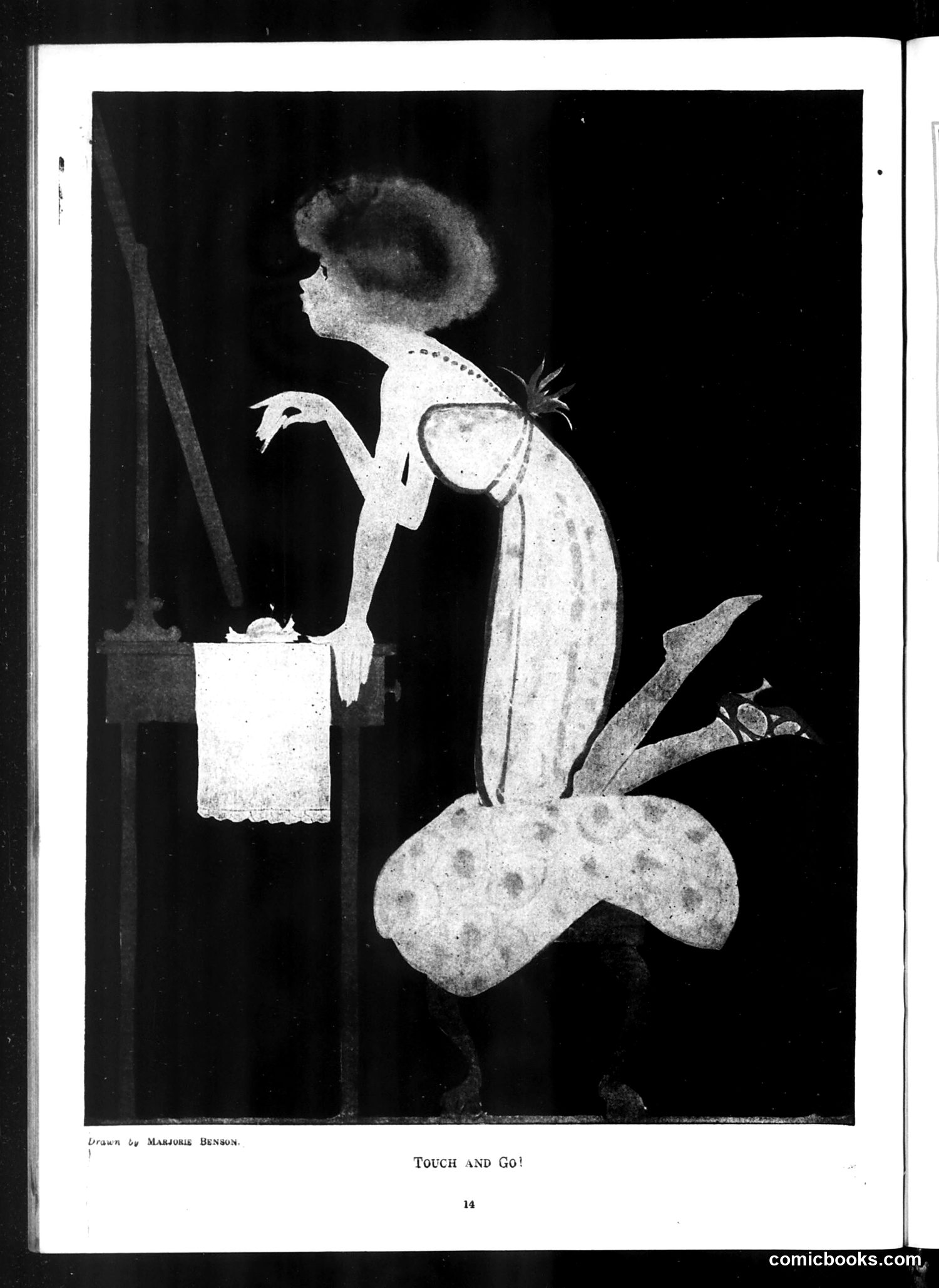
This illustration by Marjorie Benson depicts a fashionable woman in profile, styled in the Art Deco manner popular in the 1920s-30s. She wears a cloche hat and appears elegantly dressed. The satire likely comments on women's fashion or social behavior of the era—the title "Touch and Go!" suggests precariousness or instability. The large flower-like form beneath her and the delicate, almost plant-like quality of her pose may reference the "flapper" era's emphasis on women's changing social roles and independence. Without additional context about the specific Judge issue date, the exact political or social target remains unclear, though the illustration appears to critique contemporary women's fashion trends or social pretensions through its exaggerated, somewhat absurd styling.
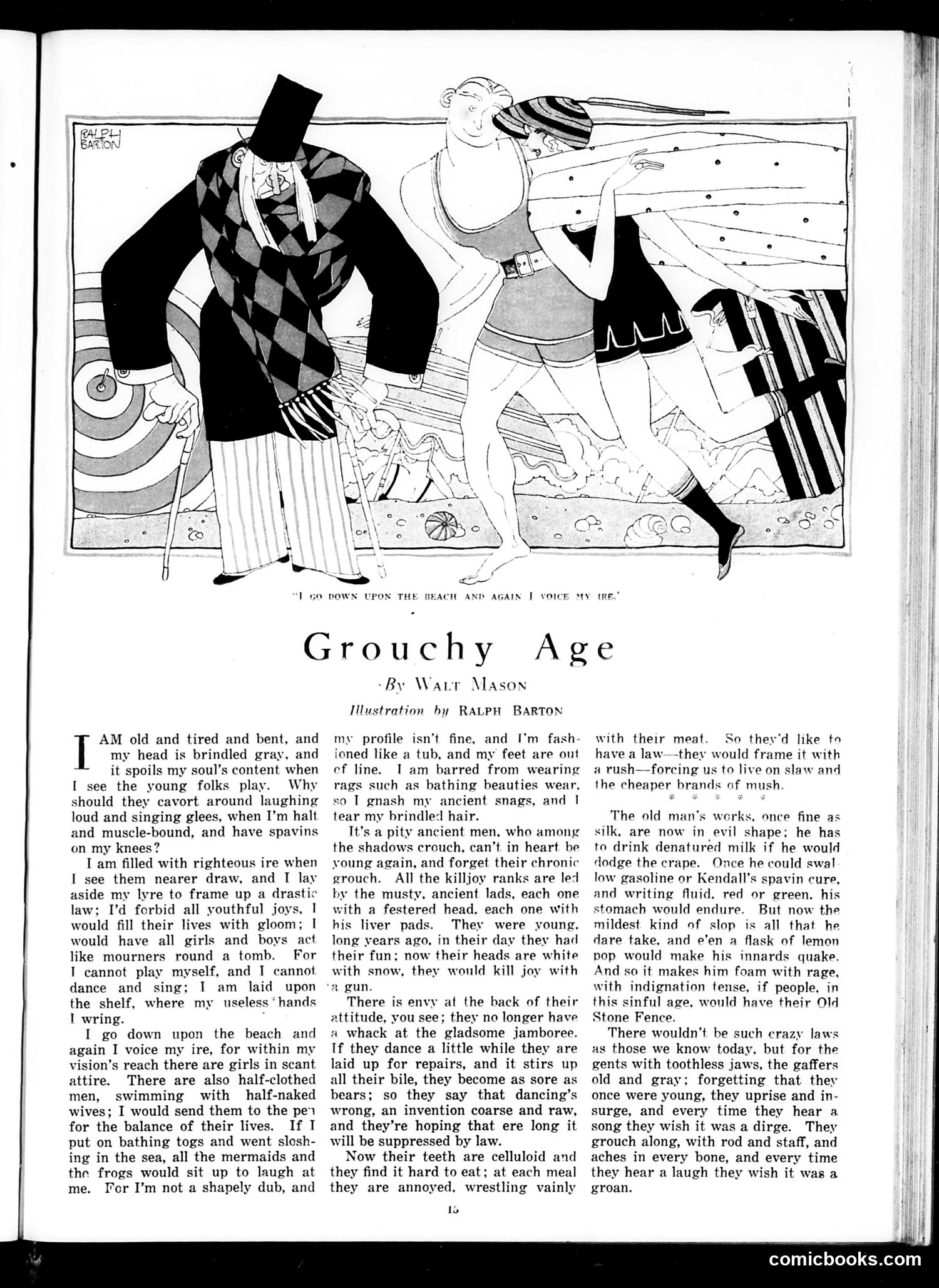
This is a satirical poem illustrated with a beach scene contrasting youth and age. The narrative voice is a bitter, elderly man who resents young people enjoying themselves—swimming, dancing, and wearing revealing beachwear—because he can no longer participate. The satire targets generational resentment: the old man wants laws to prohibit youthful pleasures since his body prevents him from indulging. Mason critiques how aging killjoys, envious of youth they've lost, impose restrictive morality on society. The poem references actual prohibition-era concerns (mentions of "Old Stone Fence" liquor and "denatured milk") while arguing that elderly men's physical decline drives their censorious attitudes. Barton's illustration emphasizes the contrast between the vigorous young woman in swimwear and the decrepit, formally-dressed old gentleman, visualizing the generation gap the text describes.
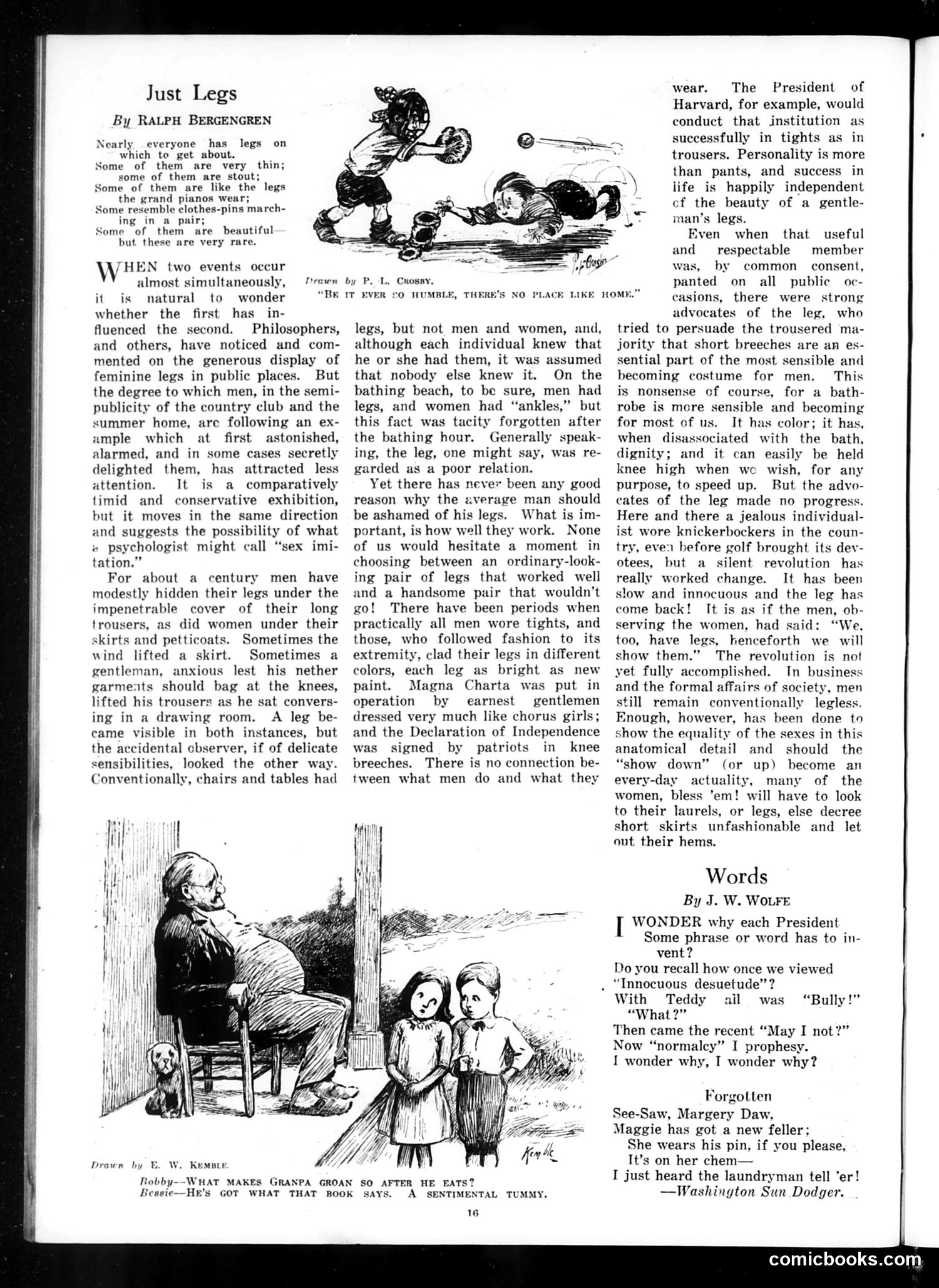
This essay satirizes the cultural taboo around displaying men's legs in public during the early 20th century. Bergengren argues that while women have increasingly shown their legs (a contemporary development), men remain conventionally "legless" in society—hiding beneath trousers despite historically wearing tights and knee breeches without shame. The piece mocks the arbitrary prudishness surrounding male legs. It suggests that function matters more than appearance, and that "personality is more than pants." The author notes some men (knickerbockers wearers, "jealous individualists") have begun rebelling against this convention, though the revolution remains "slow and innocuous." The cartoon below depicts domestic life—a grandfather figure with children—illustrating how these social conventions govern even family spaces. The satire targets Victorian-era sexual repression and arbitrary dress codes as obstacles to human comfort and equality.
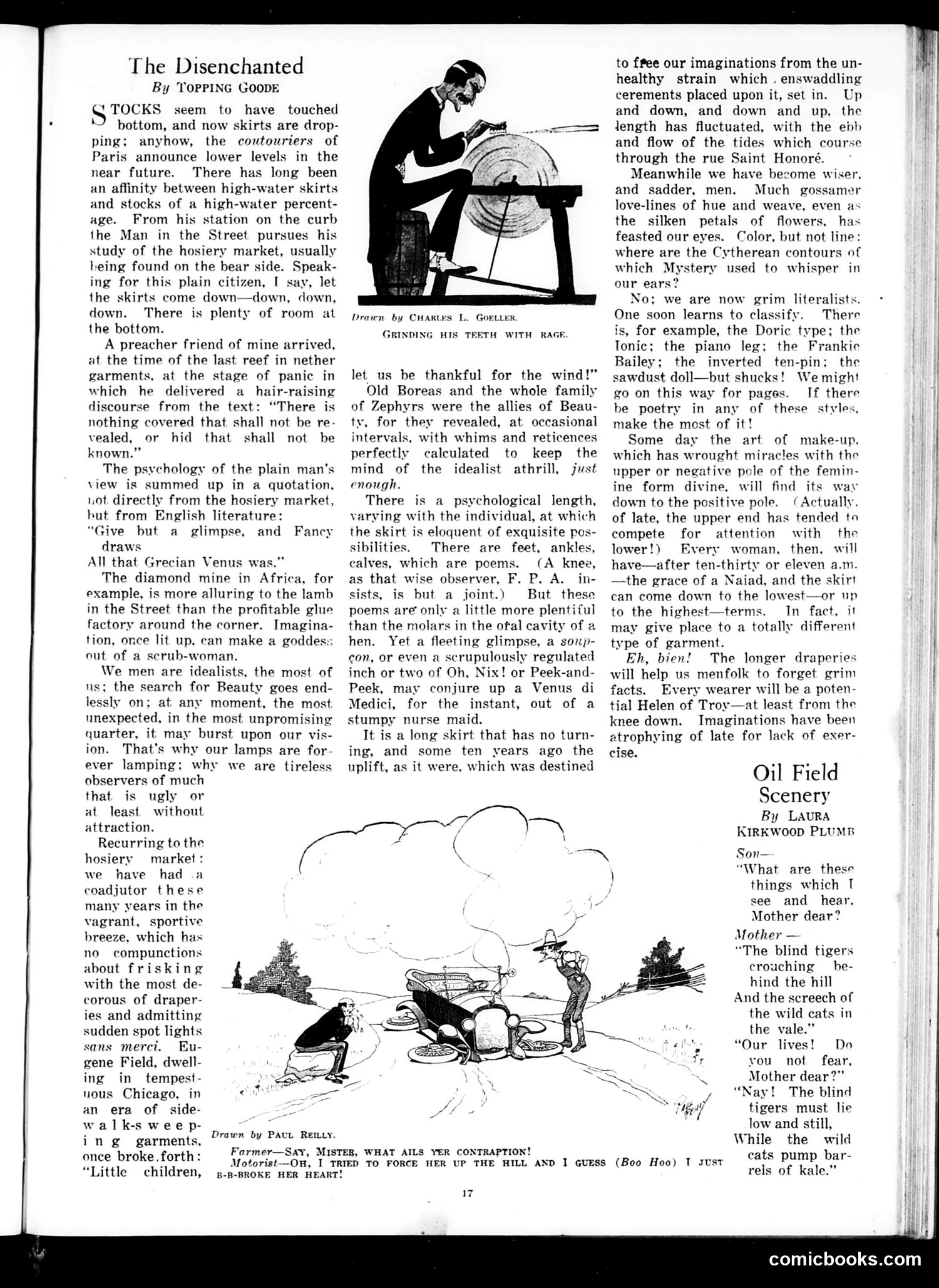
This satirical essay by Topping Goode mourns the lengthening of women's skirts—a real fashion trend of the era. The piece uses mock-philosophical language to humorously argue that shorter skirts were better because they stimulated male imagination through strategic glimpses of ankles and calves. The author claims that mystery and partial views (of women's legs) were more artistically arousing than full revelation. He references the wind as an ally in this regard, citing poet Eugene Field's gratitude for breezes that would inadvertently reveal glimpses of stockings. The accompanying cartoon depicts a farmer's romantic frustration: after forcing his horse uphill in terrible conditions, his girlfriend leaves him because he "broke her heart"—a pun on the horse's broken state. The satire mocks both male obsession with women's fashion and the pretentious intellectualization of what amounts to voyeurism dressed up in literary references and aesthetic philosophy.
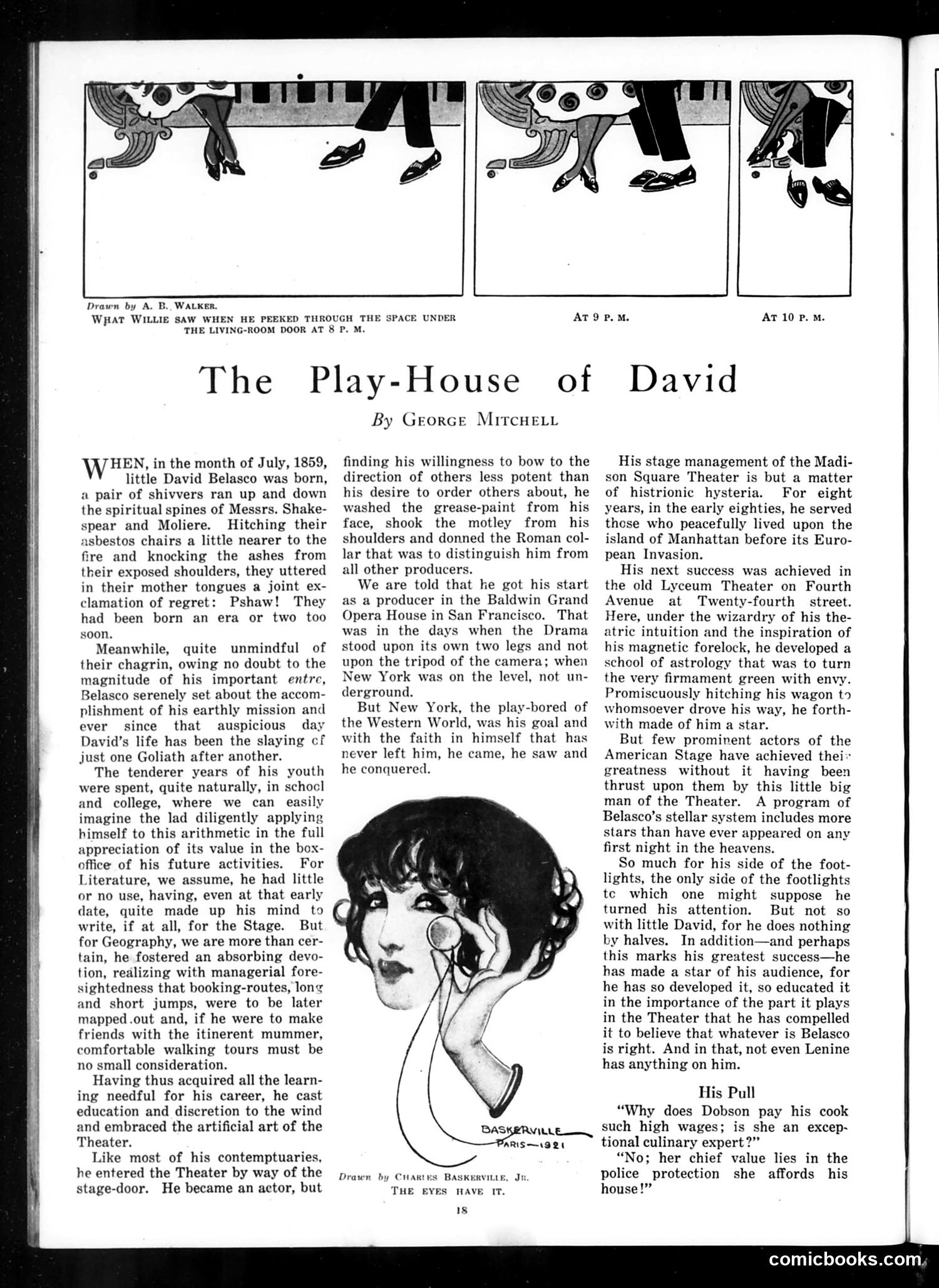
This page celebrates **David Belasco**, the famous theater producer and director (born 1859). The cartoons at top show a child ("Willie") spying under a living-room door at different times—a humorous framing device unrelated to the main article. The biographical essay is satirical praise of Belasco's theatrical dominance. It mockingly suggests Shakespeare and Moliere were outdone by his birth, and portrays him as a self-made impresario who discovered and "made" numerous stars through his "school of astrology" and "magnetic forelock" (his distinctive hair). The satire's point: Belasco's reputation for discovering talent is somewhat inflated—he's credited with creating stars simply by "hitching his wagon" to talented performers. The essay uses mock-heroic language ("slaying Goliath") and ironic comparisons to inflate his ego while subtly deflating his actual contributions. The accompanying portrait sketch by Charles Baskerville Jr. emphasizes his distinctive features, making him a recognizable figure to Judge's readers familiar with theater world gossip.
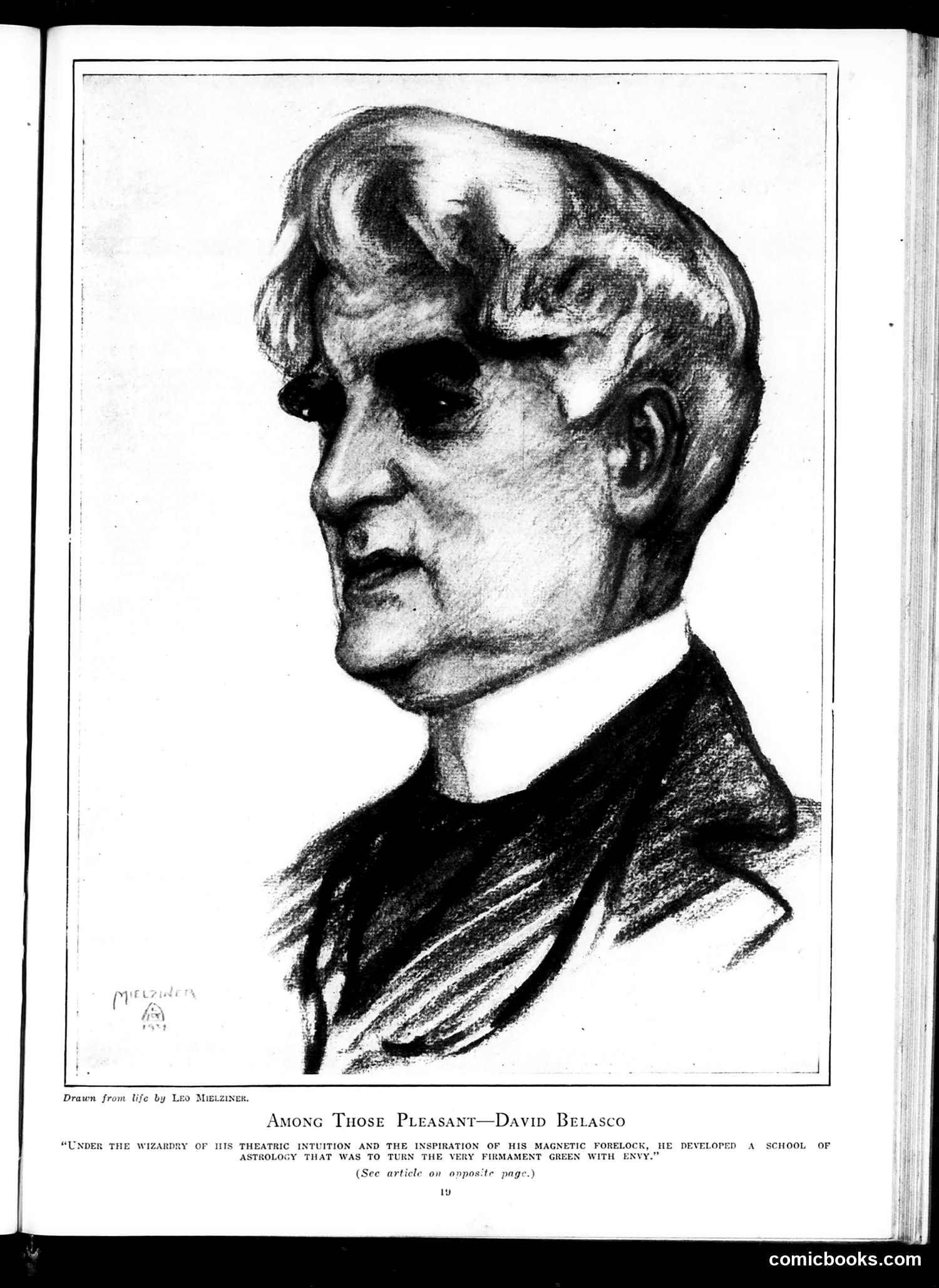
This is a portrait sketch of **David Belasco**, a prominent American theatrical producer and director of the late 19th/early 20th century. The caption is satirical, mocking his theatrical reputation and distinctive appearance—particularly his famous "magnetic forelock" (the swept-back hair visible in the profile). The satire suggests Belasco wielded almost mystical influence over theater through his "intuition" and personal magnetism, humorously comparing his theatrical methods to "astrology." The phrase about turning "the firmament green with envy" exaggerates his perceived dominance of the theatrical world. This appears to be part of a larger article about Belasco (referenced as being on the opposite page). The humor relies on readers' familiarity with Belasco as a theatrical figure known for his distinctive appearance and commanding personality in American theater.
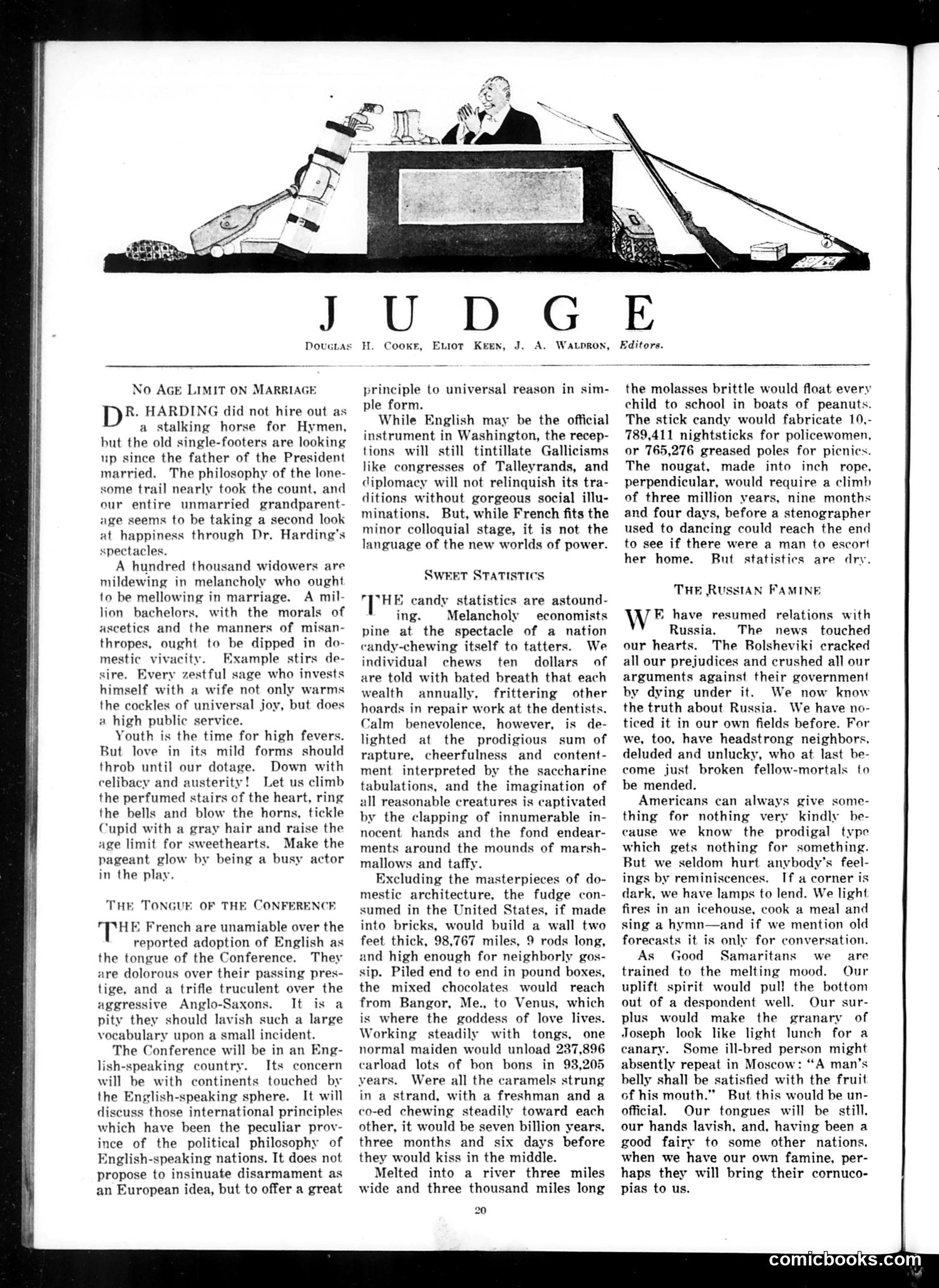
This Judge magazine page contains three distinct satirical pieces: **1. "No Age Limit on Marriage"** (with the cartoon header): References President Harding's remarriage, suggesting his example encourages older unmarried people toward matrimony. The satire advocates removing social stigma around late-life marriage. **2. "The Tongue of the Conference"**: Mocks French objections to English becoming the official language at an international conference (likely the Washington Naval Conference of 1921-22). The satire argues English is the language of modern global power, while French—though diplomatically refined—represents fading European prestige. **3. "Sweet Statistics"**: Humorous pseudo-economic analysis of American candy consumption, using absurdist calculations (chocolate piles reaching Venus, caramels requiring billions of years to chew). It satirizes both economists' gloomy moralizing and Americans' perceived excess consumption during the prosperous 1920s. The overall tone is lighthearted social commentary typical of Judge's satirical approach to contemporary politics and culture.
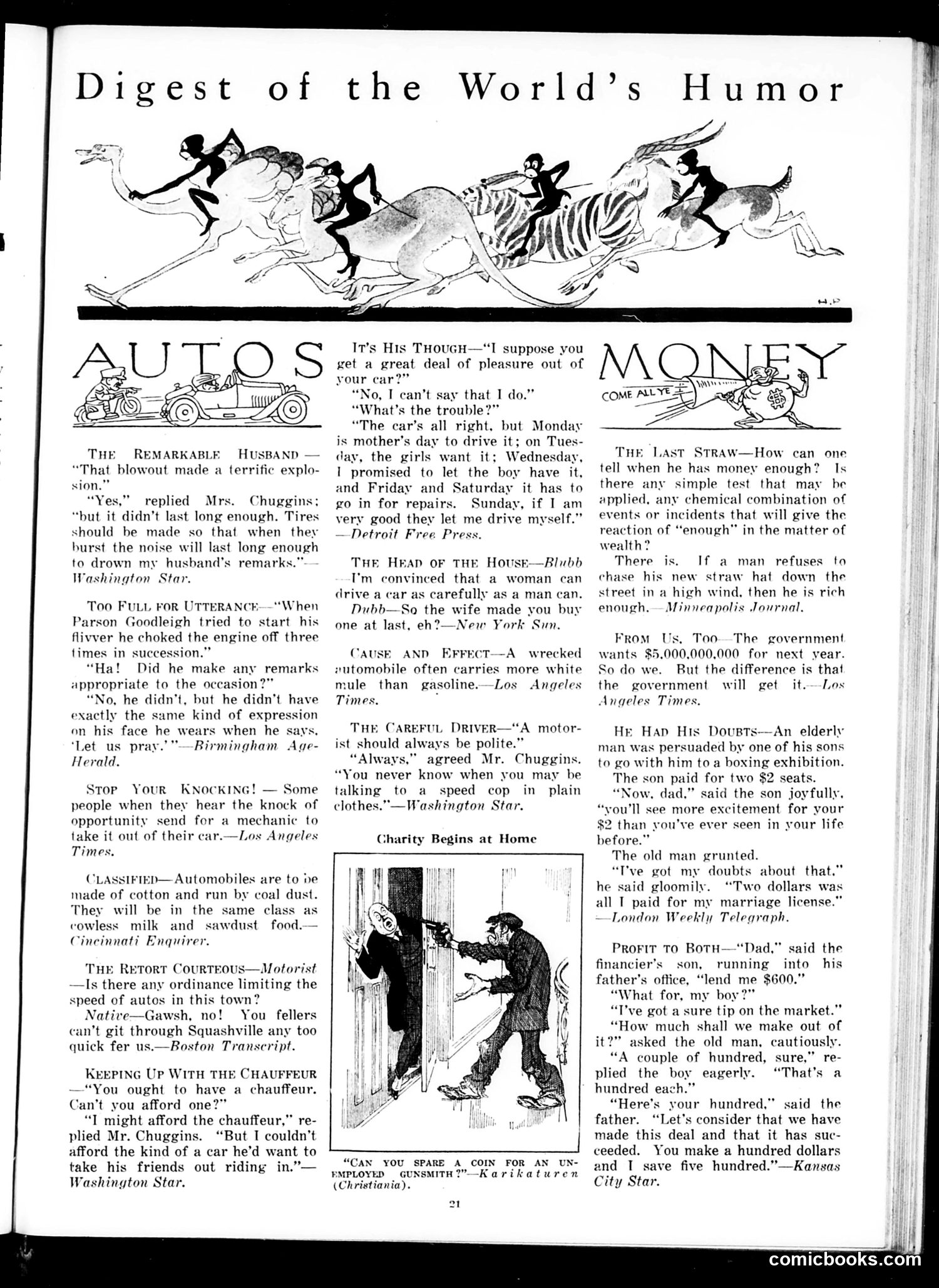
This page from Judge magazine collects brief automotive and financial humor pieces typical of the early 20th century. The satire focuses on two main targets: **Automobiles:** Multiple jokes mock the unreliability and expense of early cars. Husbands complain about sharing vehicles with wives and daughters; tire blowouts are so loud they drown out speech; cars require constant repairs. The humor reflects genuine frustration with temperamental "flivvers" (cheap cars) that required skilled operation and frequent maintenance. **Wealth and Finance:** Several pieces joke about financial anxiety during economic uncertainty. One quip suggests the government and citizens both want money they won't receive; another mocks a son's investment "tip" as merely dividing modest gains with his father. The central cartoon depicts a woman directing multiple men riding wild animals, captioned "Can you spare a coin for an unemployed gunsmith?"—suggesting labor displacement and poverty. These jokes reflect post-WWI economic anxiety and the disruptive novelty of automobile culture in American life.
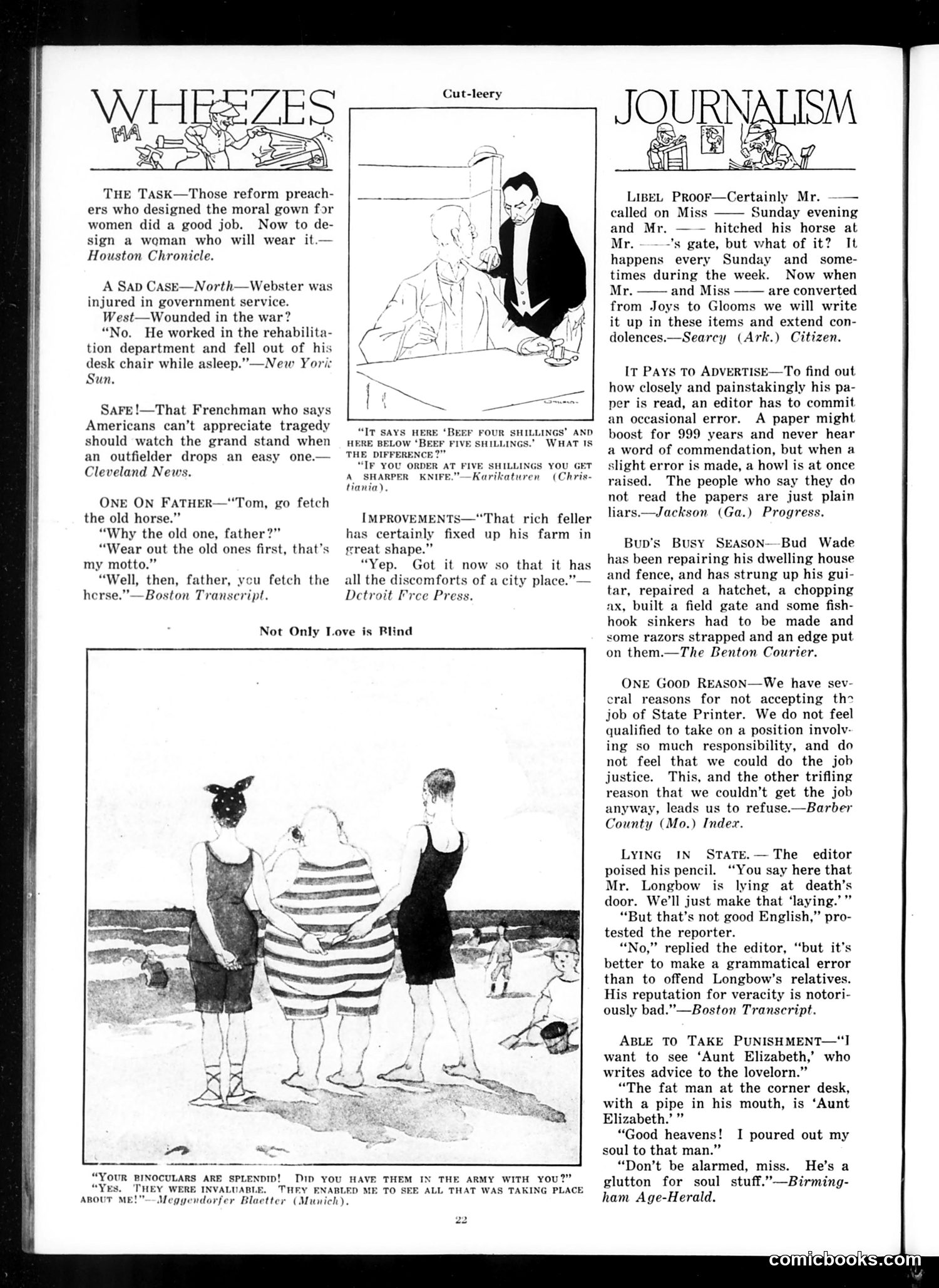
This page contains short humorous items and one cartoon, typical of Judge's satirical format. **The Main Cartoon** ("Not Only Love is Blind") shows three women in 1920s bathing suits at a beach. One boasts about binoculars that "enabled me to see all that was taking place" during wartime—the joke being that she used them to spy on romantic rivals or scandals rather than for any legitimate purpose. It's a gently mocking comment on female gossip and voyeurism. **The Text Items** are satirical quips from various newspapers about social hypocrisy and editorial practices: - Complaints about "moral" clothing designs that women won't actually wear - A joke about newspaper corrections drawing more reader attention than years of good work - Commentary on small-town gossip regarding unmarried couples - Mockery of a newspaper editor willing to print grammatical errors to avoid offending a prominent (dishonest) citizen The overall tone reflects early-20th-century mild social satire aimed at middle-class readers, poking fun at vanity, small-town morality, and journalistic compromises.
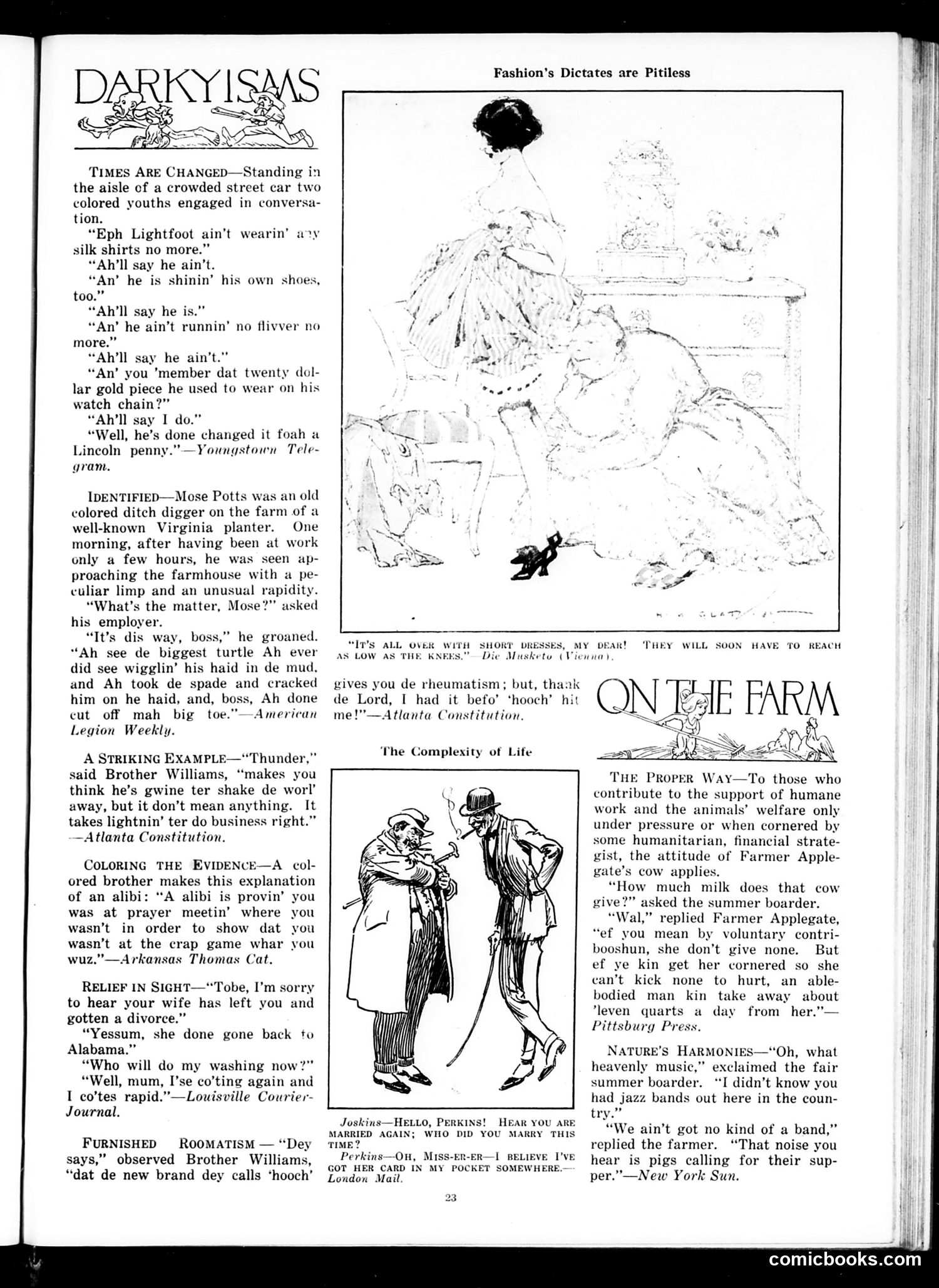
This page from *Judge* magazine contains racist humor stereotyping African Americans through dialect humor and demeaning scenarios—typical of early 20th-century American satire. The "Dark Yisaas" section presents multiple anecdotes mocking Black vernacular and situations. Key examples include two youths discussing a man's financial decline (losing silk shirts, a car, a gold watch chain); Mose Potts injuring himself while working; and Brother Williams making malapropisms about prayer meetings versus gambling. The humor relies on exaggerated dialect, portraying Black characters as ignorant, lazy, or accident-prone. The "Fashion's Dictates" illustration warns of rising hemlines, while "On the Farm" section features a condescending anecdote about an unwilling cow and a farmer's complaint about pigs. **Context for modern readers:** This represents a now-offensive comedic tradition common to the era, using racial caricature and stereotyped speech patterns as the primary source of "humor." The content reflects deeply embedded racial prejudices of the period.
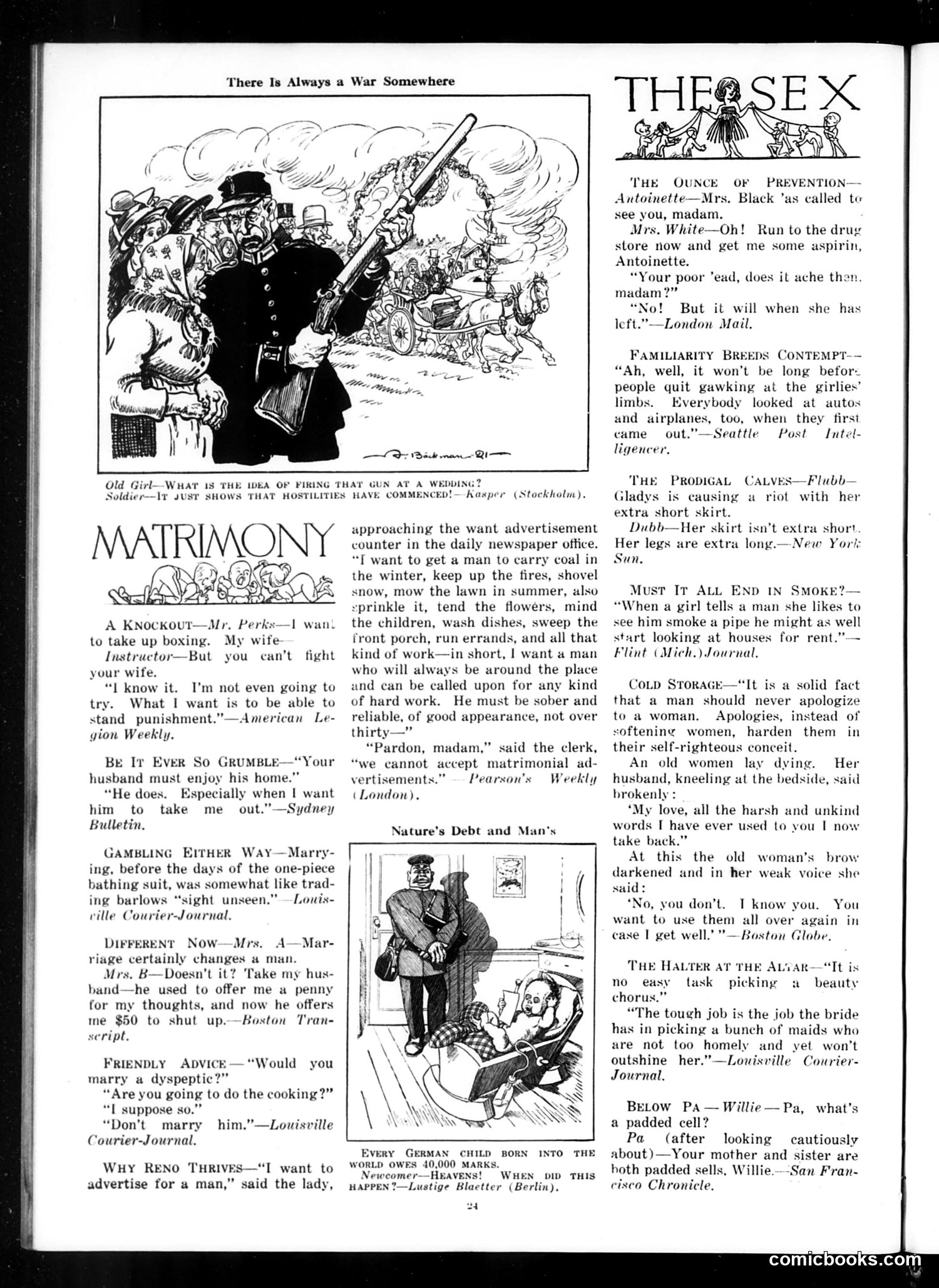
This page contains satirical shorts about **marriage and gender relations**, typical of early-20th-century humor. Key themes: **The main cartoon** (top left) shows a military officer firing a cannon at a wedding, captioned as showing "hostilities have commenced"—a joke equating marriage to warfare. **The matrimony section** collects one-liners mocking married life: a boxing instructor wants to "stand punishment" from his wife; husbands must "enjoy" being nagged; marriage is a gamble like buying unseen goods; wives silence husbands with money; women advertise for husbands as if seeking servants. **Social references** include: - "Reno" (Nevada divorce capital) - One-piece bathing suits (then-scandalous fashion) - Women's visible legs in short skirts (the "prodigal calves" joke) - Post-war attitudes toward women's changing roles **The satire's point**: Marriage is presented as mutual entrapment—husbands endure nagging wives; women seek domestic servants disguised as husbands. The humor assumes readers share cynicism about matrimony as inherently antagonistic rather than romantic.
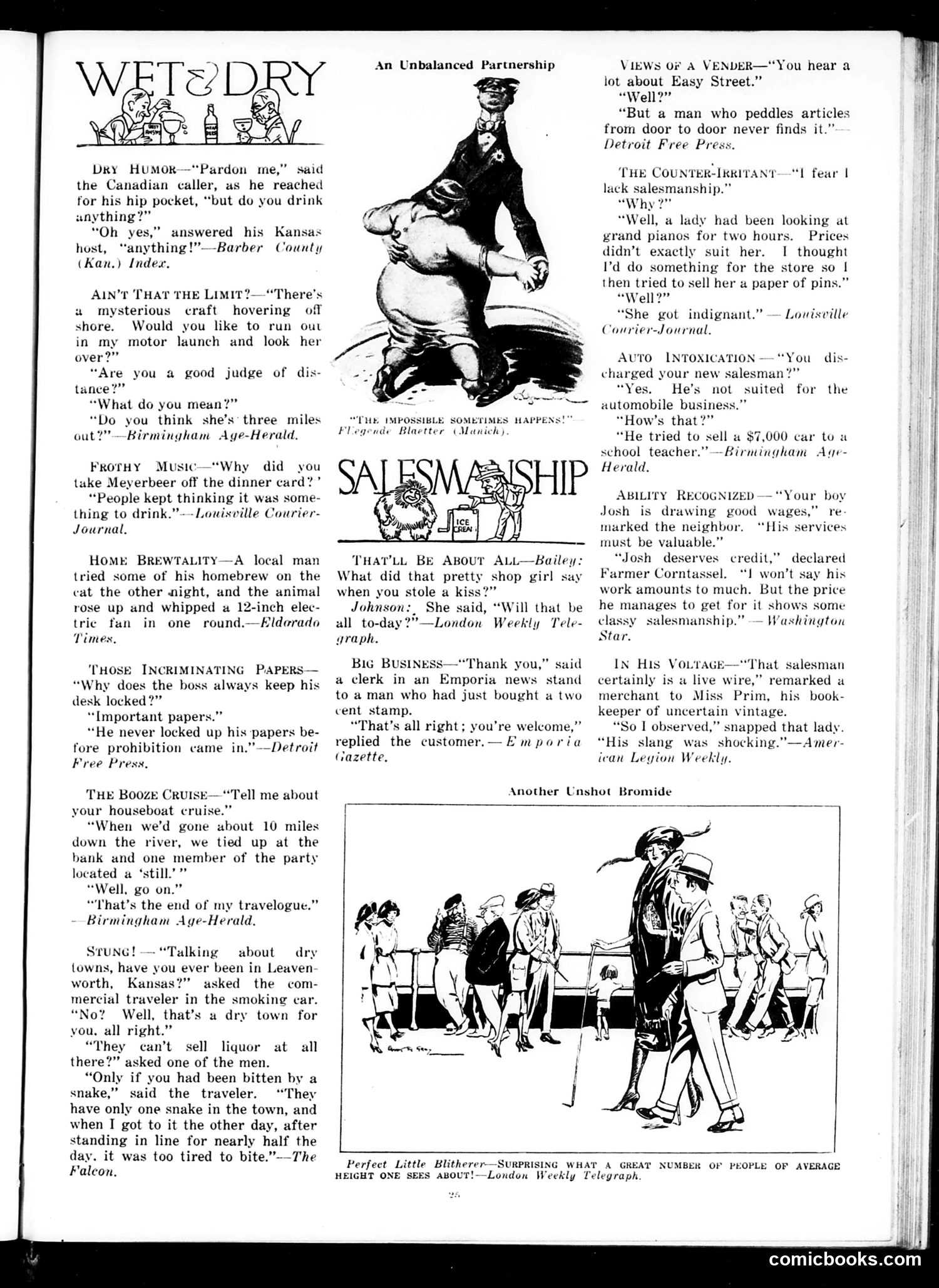
This *Judge* page satirizes **Prohibition era** America (likely 1920s). The main cartoon shows a portly man straddling a pig labeled "Salesmanship"—depicting the "unbalanced partnership" of incompetent salesmen paired with their jobs. The surrounding anecdotes mock Prohibition's absurdities: a dry town where liquor is unobtainable except via snakebite antivenom; homebrew so potent it intoxicates a cat; a houseboat trip that discovers an illegal still. Several jokes target incompetent salesmen trying to sell unsuitable products (grand piano accessories to a haggling customer; expensive cars to schoolteachers). The humor underscores how Prohibition created black markets and lawlessness while producing bumbling commercial activity. The "counter-irritant" and "auto intoxication" sections suggest sales desperation during economic strain. The bottom cartoon of a tall man among shorter figures likely references another topical curiosity or oddity. Overall, the page ridicules both Prohibition's social failure and American commercial culture's empty hustles.
The cartoon header shows a theatrical producer being dragged by a horse labeled with theatrical masks, hauling an oversized suitcase decorated with theatrical symbols — a visual joke about the chaotic "opening season" of New York theater productions. The article reviews several Broadway plays from what appears to be early 1920s. "Getting Gertie's Garter" is praised as light comedy about lingerie that audiences will enjoy. "The Mask of Hamlet" is criticized as confusing and having nothing to do with Shakespeare despite its title. "Honors Are Even" features comedian William Courtenay and is noted as "clean" — meaning free from sexual innuendo, reflecting contemporary concerns about theatrical propriety. References to "clean plays" and censorship concerns reflect moral anxieties of the era. The piece's tone is gossipy and insider-focused, typical of Judge's theatrical criticism for educated Manhattan readers.
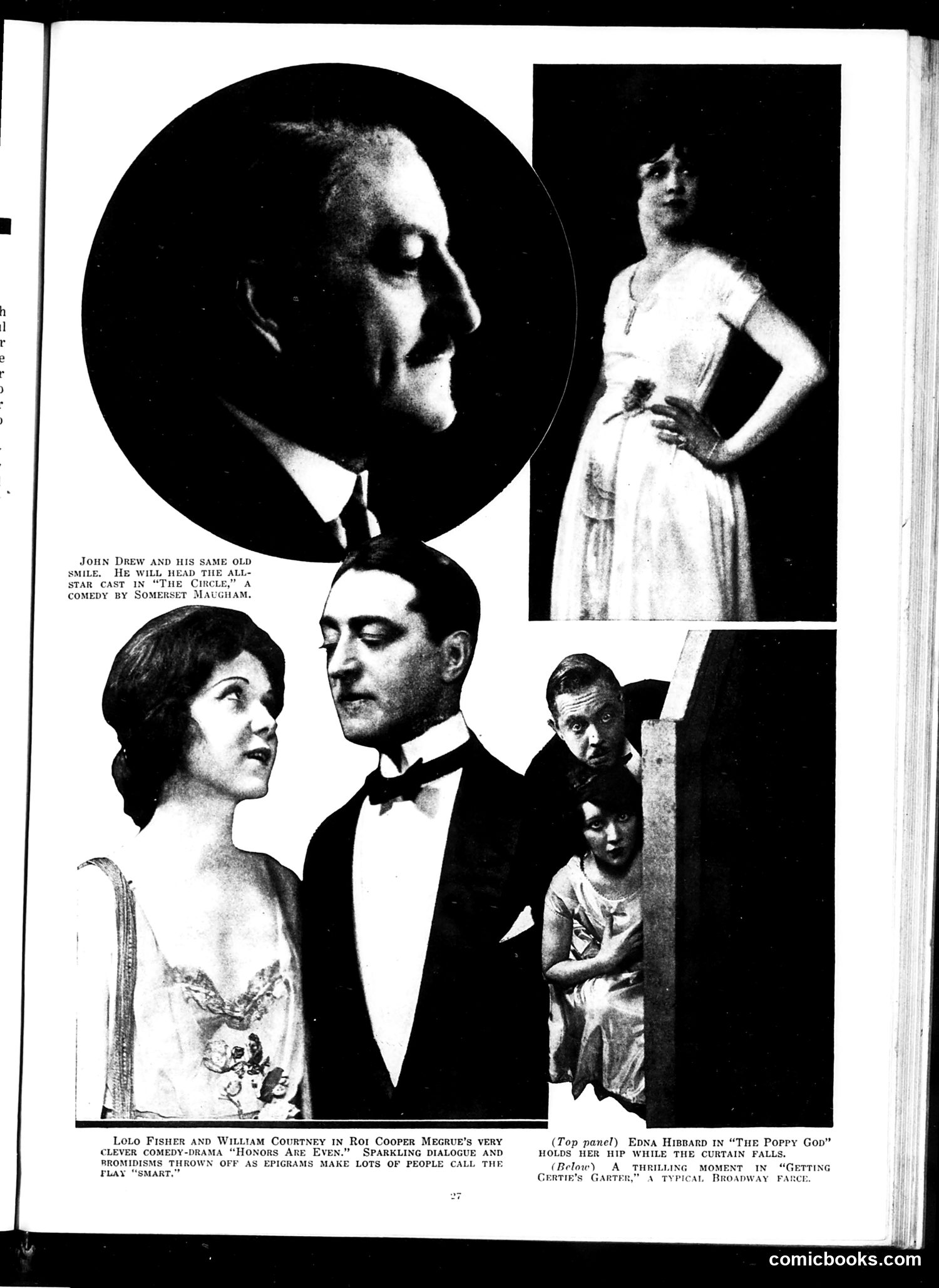
This page features theatrical reviews/commentary rather than political satire. It showcases photographs of Broadway actors in contemporary plays: **Top left (circular):** John Drew, a prominent stage actor, is noted for his consistent "same old smile" as he stars in "The Circle," a comedy by Somerset Maugham. **Top right:** Edna Hibbard in "The Poppy God," holding her hip as the curtain falls—a noted theatrical moment. **Bottom:** Lolo Fisher and William Courtney in Roy Cooper Megrue's "Honors Are Even," described as a clever comedy-drama with sparkling dialogue and epigrams that audiences call "smart." **Bottom right:** A scene from "Getting Gertie's Garter," labeled a "typical Broadway farce." The page's humor is light—poking gentle fun at theater conventions, actors' mannerisms, and the types of comedies popular with 1920s Broadway audiences. It's primarily entertainment coverage rather than social or political commentary.
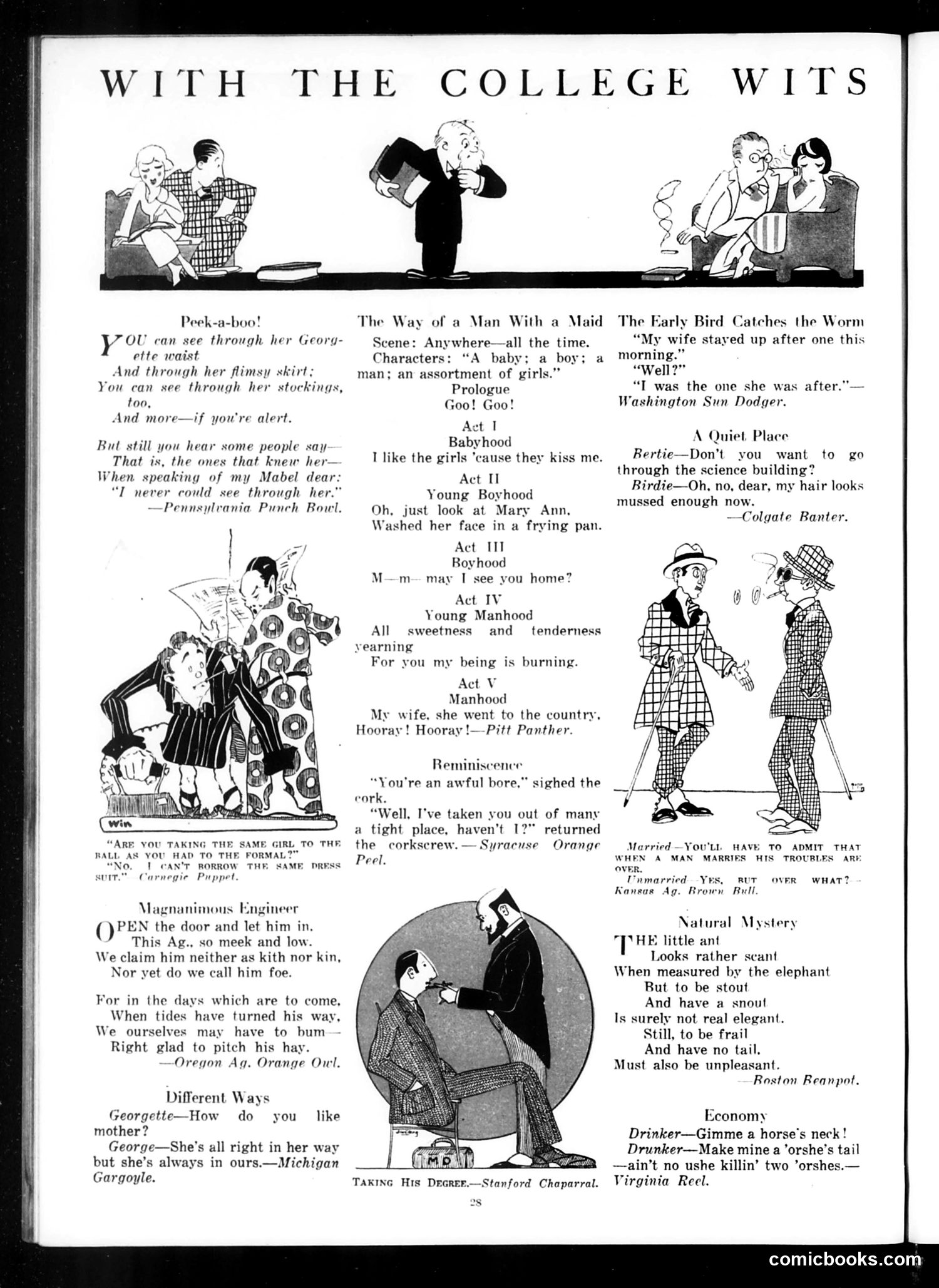
This page collects humorous short pieces and jokes supposedly from college publications, a common Judge feature. The content satirizes college life and courtship customs of the era through witty one-liners and brief sketches. Key themes include: - **Gender dynamics**: Jokes about pursuing women ("I like the girls 'cause they kiss me") - **Social propriety**: Humor about proper behavior and dating etiquette - **Physical appearance**: Comic observations about women's fashion and hairstyles - **Marriage**: Cynical quips about married life ("My wife stayed up after one this morning") The illustrations show fashionably dressed young men and women in period clothing. The overall tone mocks both youthful romantic earnestness and adult married disillusionment, reflecting early 20th-century attitudes about courtship and matrimony.
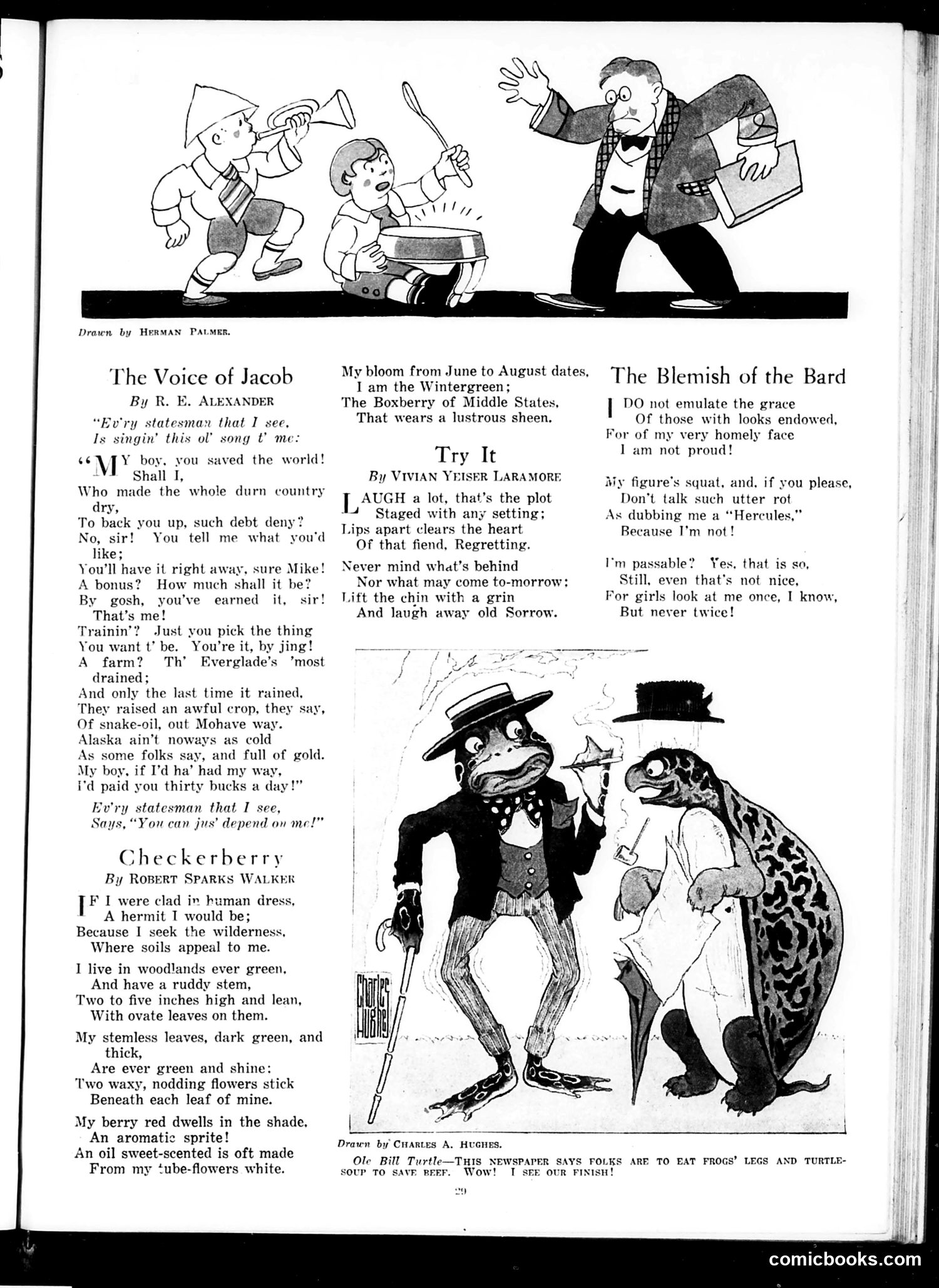
**Top Cartoon (Herman Palmer):** Depicts a politician (appearing to be a statesman or official) enthusiastically offering rewards to a soldier or war veteran, while two children play with toy instruments and weapons nearby. "The Voice of Jacob" satirizes politicians cynically exploiting returning soldiers' popularity after WWI, offering them whatever they want (bonuses, land, jobs) while making grand promises—exposing the hollow, transactional nature of patriotic rhetoric. **Bottom Cartoon (Charles A. Hughes):** Shows anthropomorphic frogs and turtles in conversation, responding to newspaper suggestions that Americans eat frog legs and turtle soup to conserve beef during wartime rationing. The animals' alarm at becoming food sources mocks the absurdity of such dietary recommendations during food shortages. **Poems:** The page includes three unrelated nature/lifestyle poems on separate topics (wintergreen plant, laughing away sorrow, physical appearance). The page reflects WWI-era concerns: veteran benefits, food rationing, and wartime sacrifice.
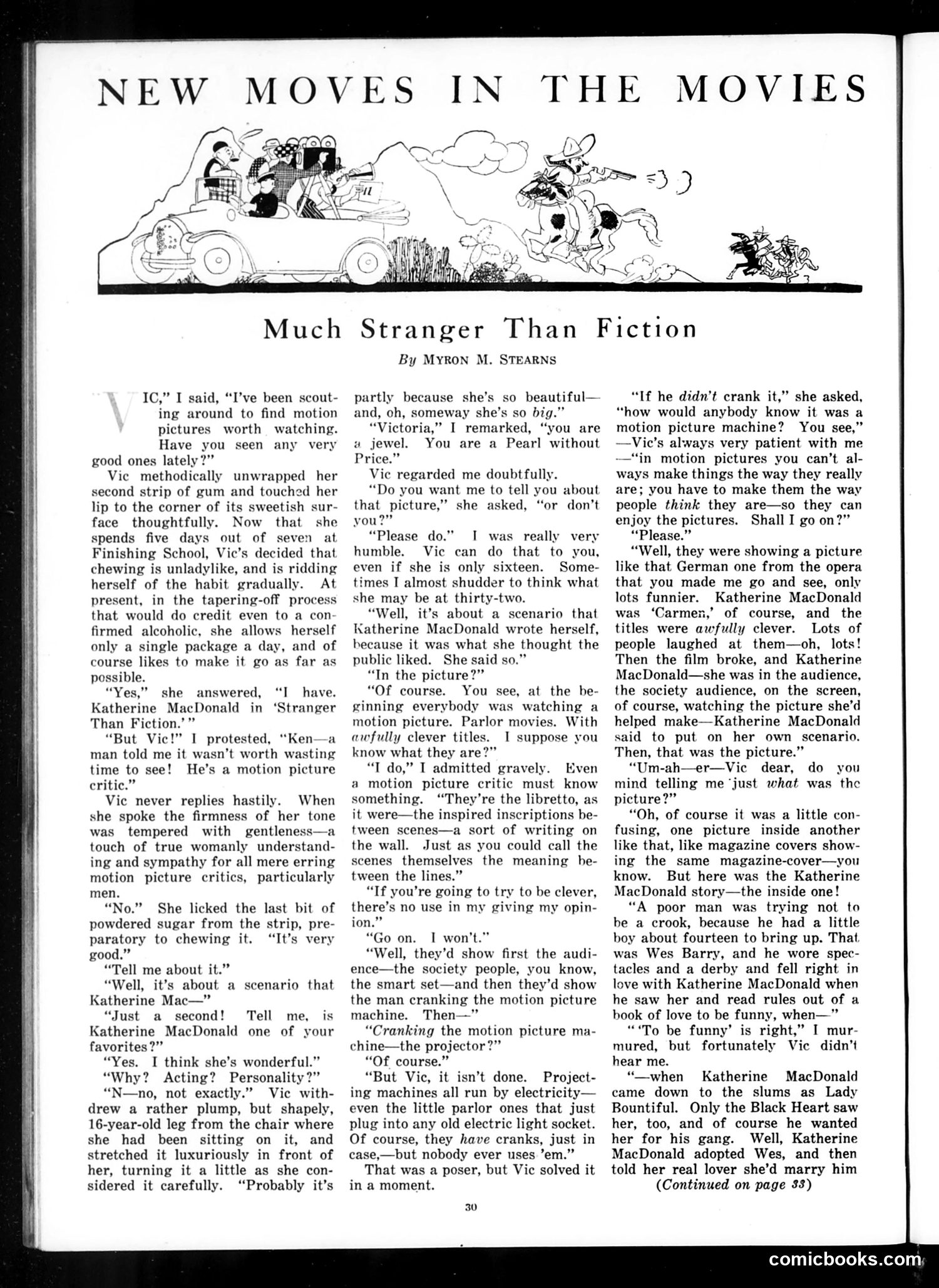
This is a humorous article about motion pictures, not a political cartoon. The piece satirizes early cinema conventions and audience expectations through a dialogue between the unnamed narrator and "Vic," a sophisticated 16-year-old girl discussing Katherine MacDonald's film "Stranger Than Fiction." The satire targets several aspects of 1920s silent film: the absurdity of "parlor movies" (films shown in drawing rooms), overly clever intertitles ("librettos"), and the disconnect between cinematic realism and audience perception. Vic makes a key point—that movies needn't depict reality accurately; audiences accept stylized versions because they *expect* them. The humor derives from Vic's superior knowledge of cinema mechanics and her patient correction of the "motion picture critic," inverting typical generational dynamics. The title's irony suggests that fictional cinema conventions are stranger than actual reality. This reflects 1920s concerns about cinema's growing cultural influence and audience sophistication during silent film's golden age.
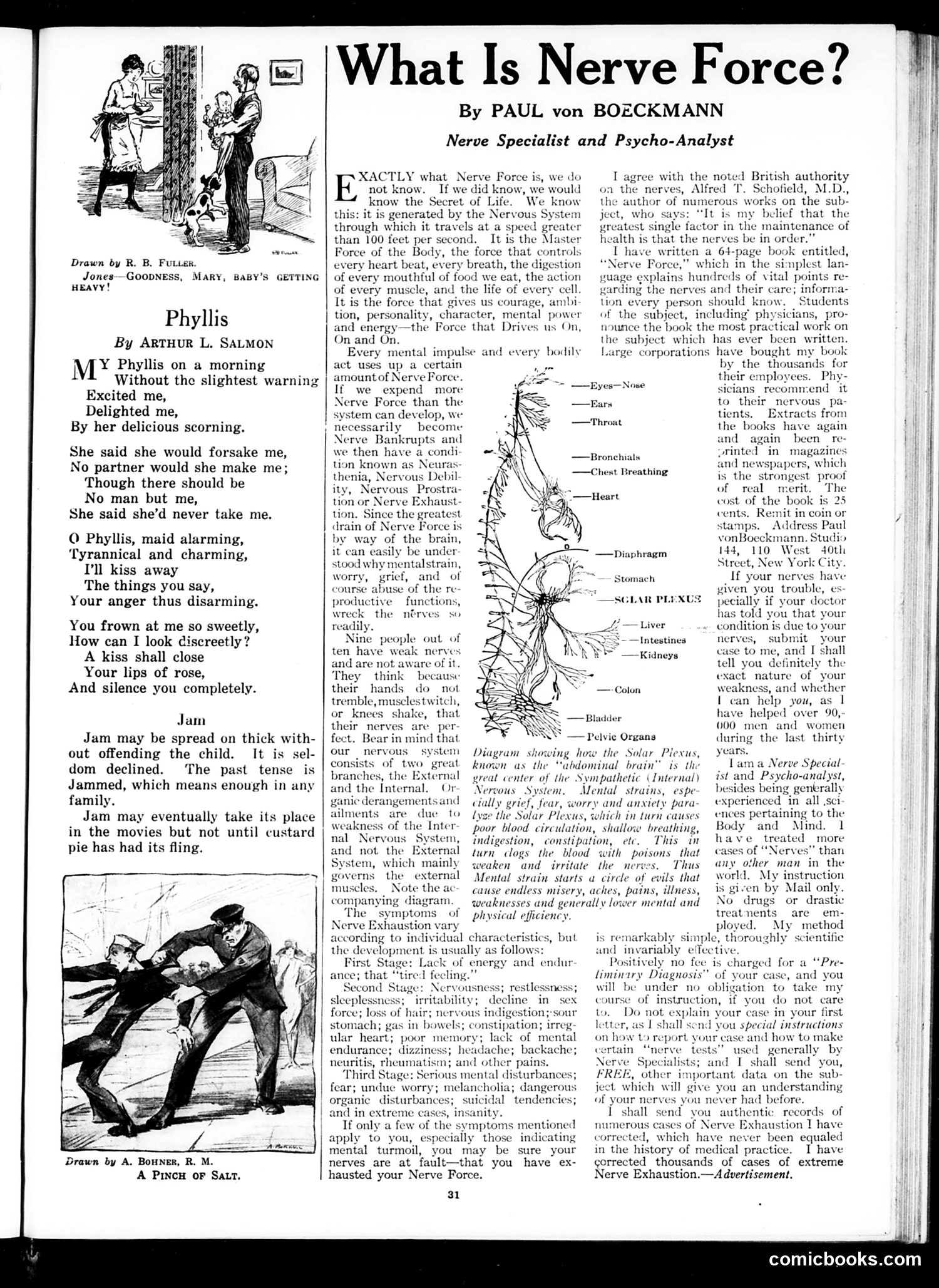
This page contains three unrelated items typical of Judge magazine's mixed content: **"Phyllis" poem**: A light romantic verse about courting a woman who playfully rejects the narrator's advances, ending with him kissing her into submission. The tone reflects early 20th-century courtship humor—playful but patronizing by modern standards. **"Jam" definition**: A humorous dictionary-style entry playing on the word "jam" (the food spread, versus "jammed" meaning crowded). It's mild observational humor about children's preferences and cinema trends. **"What Is Nerve Force?" article**: The substantive content is a pseudo-medical advertisement disguised as educational material. It promotes a dubious pseudo-scientific concept of "Nerve Force"—a supposed vital energy depleted by mental strain, worry, and sexual activity. The accompanying diagram of the nervous system lends false authority. This reflects early 20th-century "nerve exhaustion" quackery that preyed on anxious patients. The author's credentials ("Nerve Specialist and Psycho-Analyst") were largely unregulated at the time, and the promised mail-order "cure" is classic patent-medicine marketing.
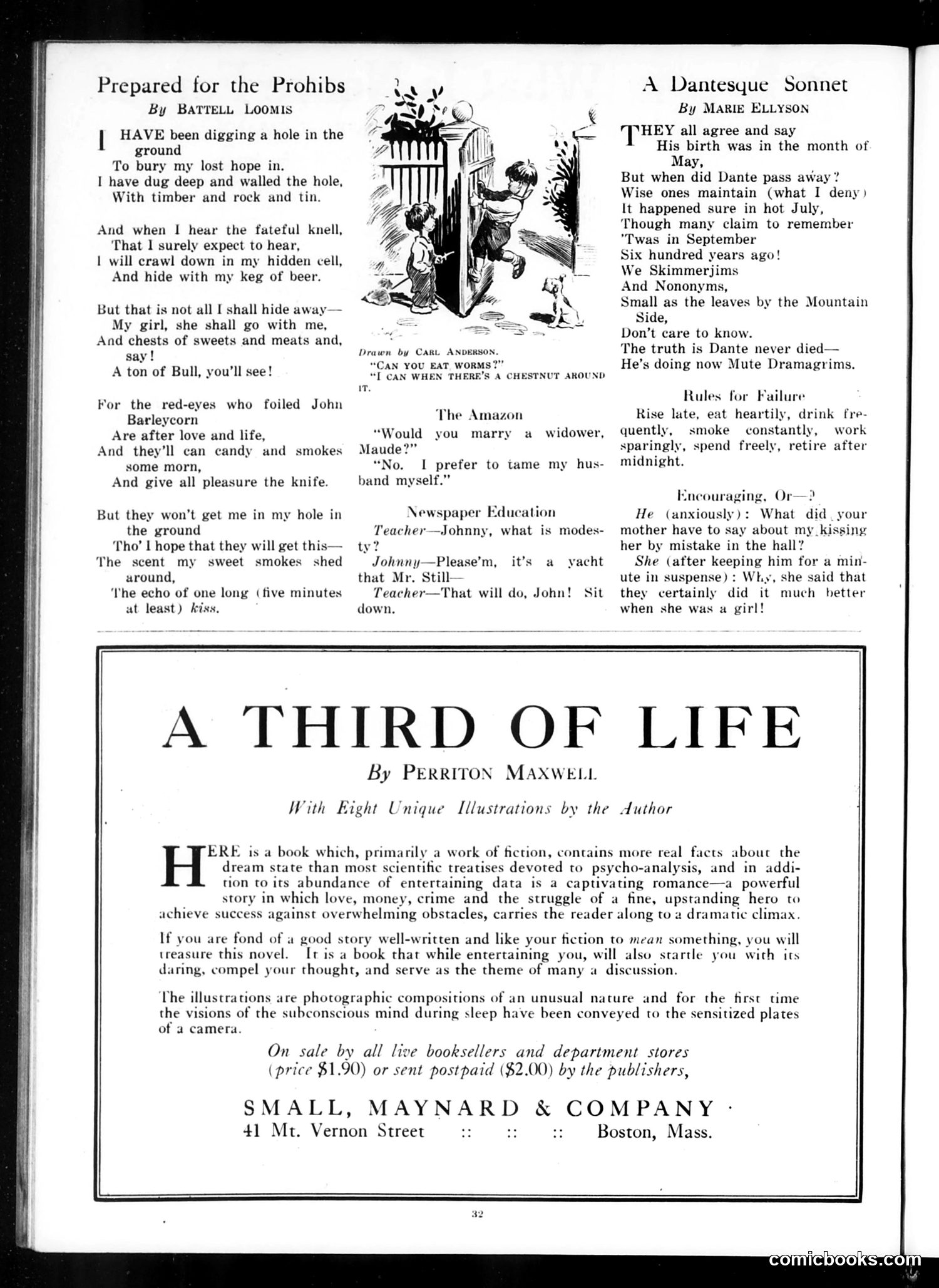
This page mixes humor with prohibition-era satire. The dominant piece, "Prepared for the Prohibs" by Battell Loomis, mocks those supporting Prohibition (the "Prohibs"). The speaker ironically declares he'll hide underground with his girlfriend, alcohol, and luxuries when prohibition enforcement arrives—a sardonic response to the imminent ban on alcohol. The cartoon by Carl Anderson showing a worm and chestnut is a visual pun about eating unpleasant things. Other brief humor pieces include wordplay about marriage, a fake definition of "modesty," and dating advice. A Dantesque sonnet playfully debates Dante's death date. The page concludes with advertising for "A Third of Life," a novel claiming to use photography to depict subconscious dreams—pseudoscientific marketing typical of the era. Overall, this reflects early 1900s American satirical magazine content: anti-Prohibition sentiment, light romantic humor, and period advertising sensibilities.
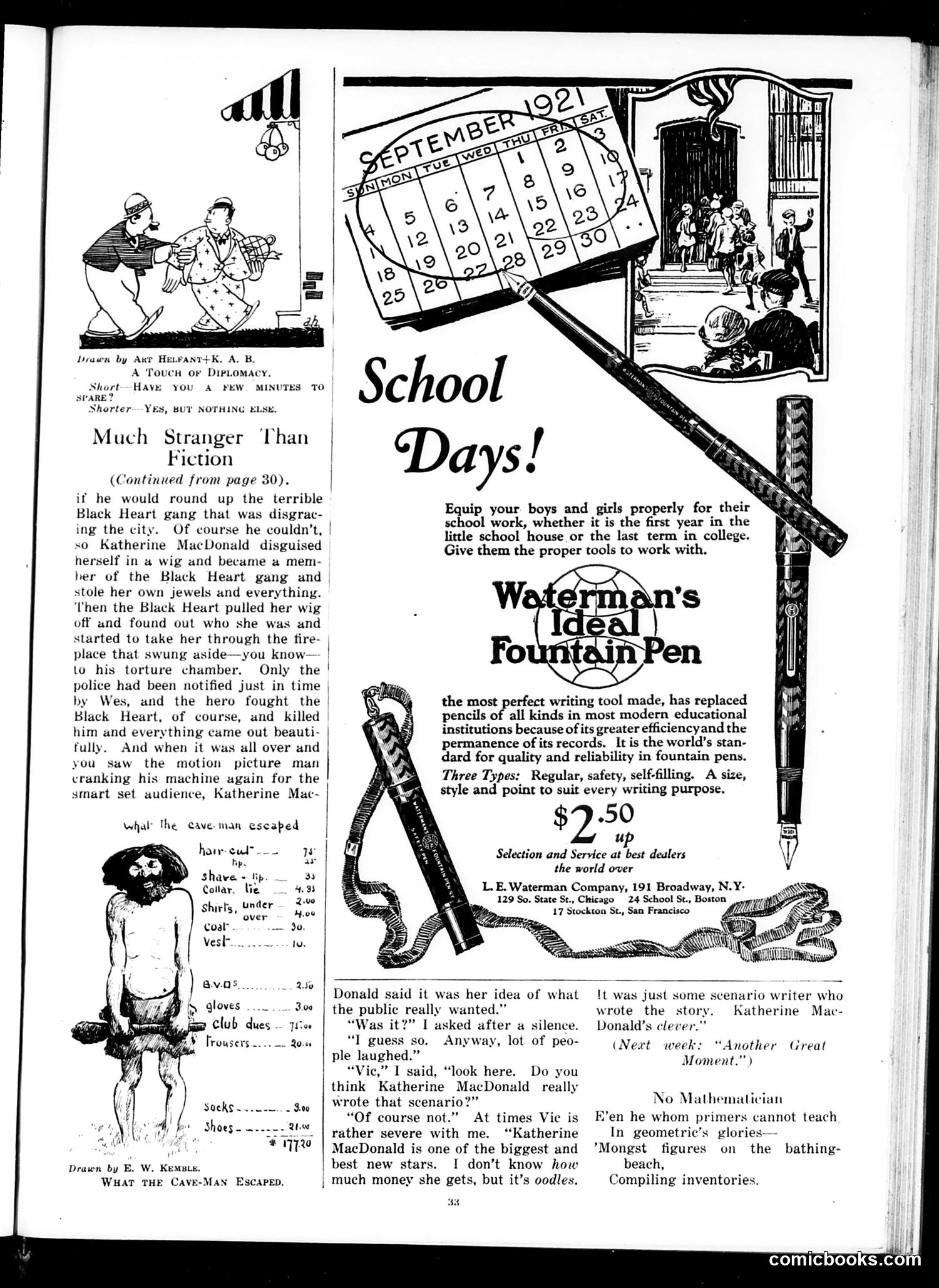
This page mixes entertainment content with advertising. The top cartoon, "A Touch of Diplomacy," shows two men in a brief exchange about spare time—a simple gag about having no leisure. The main content continues a serialized story titled "Much Stranger Than Fiction," discussing Katherine MacDonald, a real silent film actress of the era. The narrative describes a melodramatic plot involving MacDonald disguising herself in a wig to infiltrate a criminal gang ("Black Heart") and steal her own jewels—typical overwrought silent film fare. The joke critiques how absurdly contrived movie plots were: when asked if MacDonald wrote this scenario, the response is dismissive: of course not, she's just an actress, though she earns substantial money ("oodles"). The page is primarily an advertisement for Waterman's Ideal Fountain Pens, marketed for "School Days" with pricing at $2.50. A humorous cost breakdown of a "caveman" appears as filler humor.
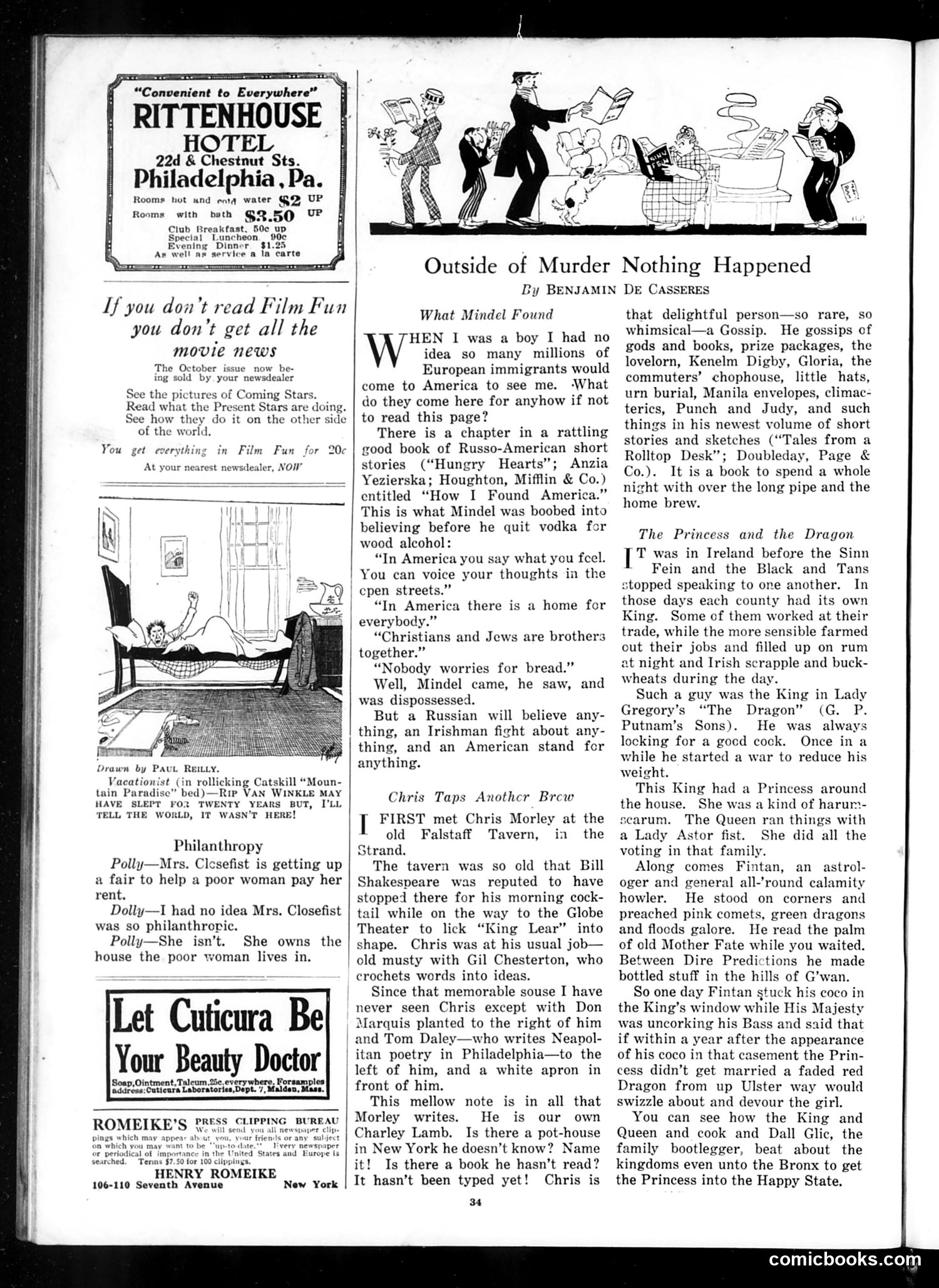
This page from *Judge* magazine contains three distinct pieces: **Main Article: "Outside of Murder Nothing Happened"** by Benjamin De Casseres offers satirical character sketches. "What Mindel Found" mocks European immigrants' disillusionment with America—they arrive believing propaganda about freedom and opportunity ("In America you say what you feel"), only to face dispossession. The piece uses Mindel's disappointment to skewer American hypocrisy. "Chris Taps Another Brew" celebrates writer Chris Morley as a witty conversationalist and gossip who frequents pubs with literary figures like Don Marquis and G.K. Chesterton—portraying him as the modern equivalent of Charles Lamb. **Sidebar Humor:** Two brief jokes mock wealthy philanthropists and vacation bragging. **Advertisements** include a hotel, movie magazine, and beauty product—typical period advertising. The satire targets immigration disillusionment and celebrates literary culture of the era.
This is not a cartoon but rather an **advertorial essay**—a page promoting advertising itself, likely from Judge magazine's editorial section. The piece uses rhetorical questions to argue that modern conveniences (automobiles, telephones, soap, window-glass) represent human progress, and that **advertising is essential to this progress**. It claims advertising guides consumers to better living and has historically enabled civilization's advancement. The satire appears **unintentional or self-aware**: the page ironically asks readers to trust advertisements while *being* an advertisement for advertising. It frames ads as objective "guides" rather than persuasive tools. This reflects early 20th-century **pro-business sentiment** and the emerging advertising industry's effort to legitimize itself as a social good rather than mere commerce. The tone assumes readers should be grateful for advertising's role in making life comfortable—a perspective that might strike modern readers as nakedly self-promotional.
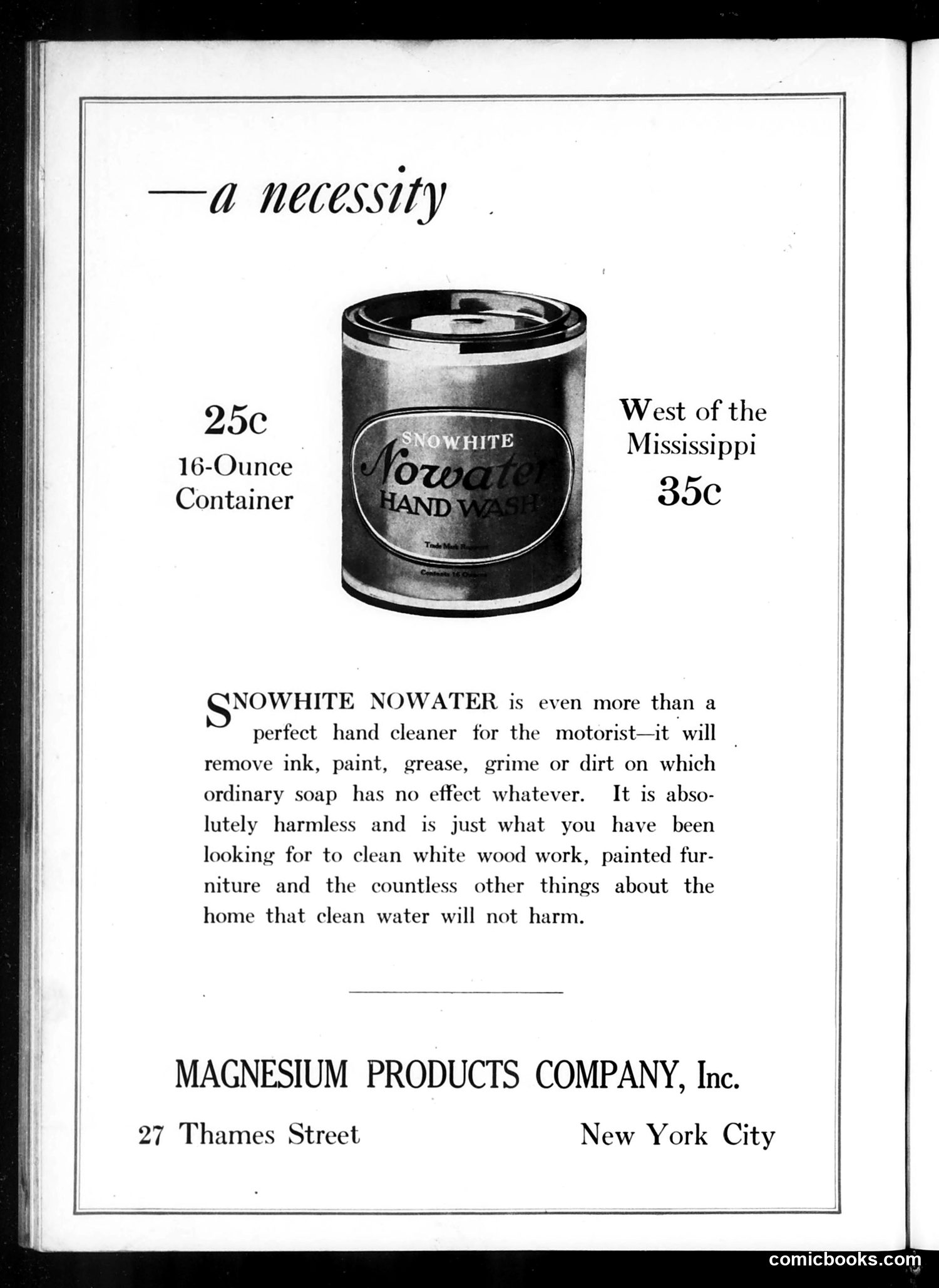
This is **not a cartoon or satire**—it's a straightforward **product advertisement** for Snowhite Nowater hand cleaner, manufactured by Magnesium Products Company in New York City. The ad promotes a cleaning product marketed as superior to ordinary soap for removing stubborn substances (ink, paint, grease, grime). It emphasizes the product is "absolutely harmless" and suitable for delicate surfaces like white woodwork and painted furniture. Pricing is regional: 25 cents for a 16-ounce container east of the Mississippi, 35 cents west. The advertisement appears in *Judge* magazine, a satirical publication, but this particular page contains only commercial advertising—no political commentary, caricatures, or jokes requiring historical context.