
Judge, 1921-09-24 · page 26 of 36
Judge — September 24, 1921 — page 26: what you’re looking at
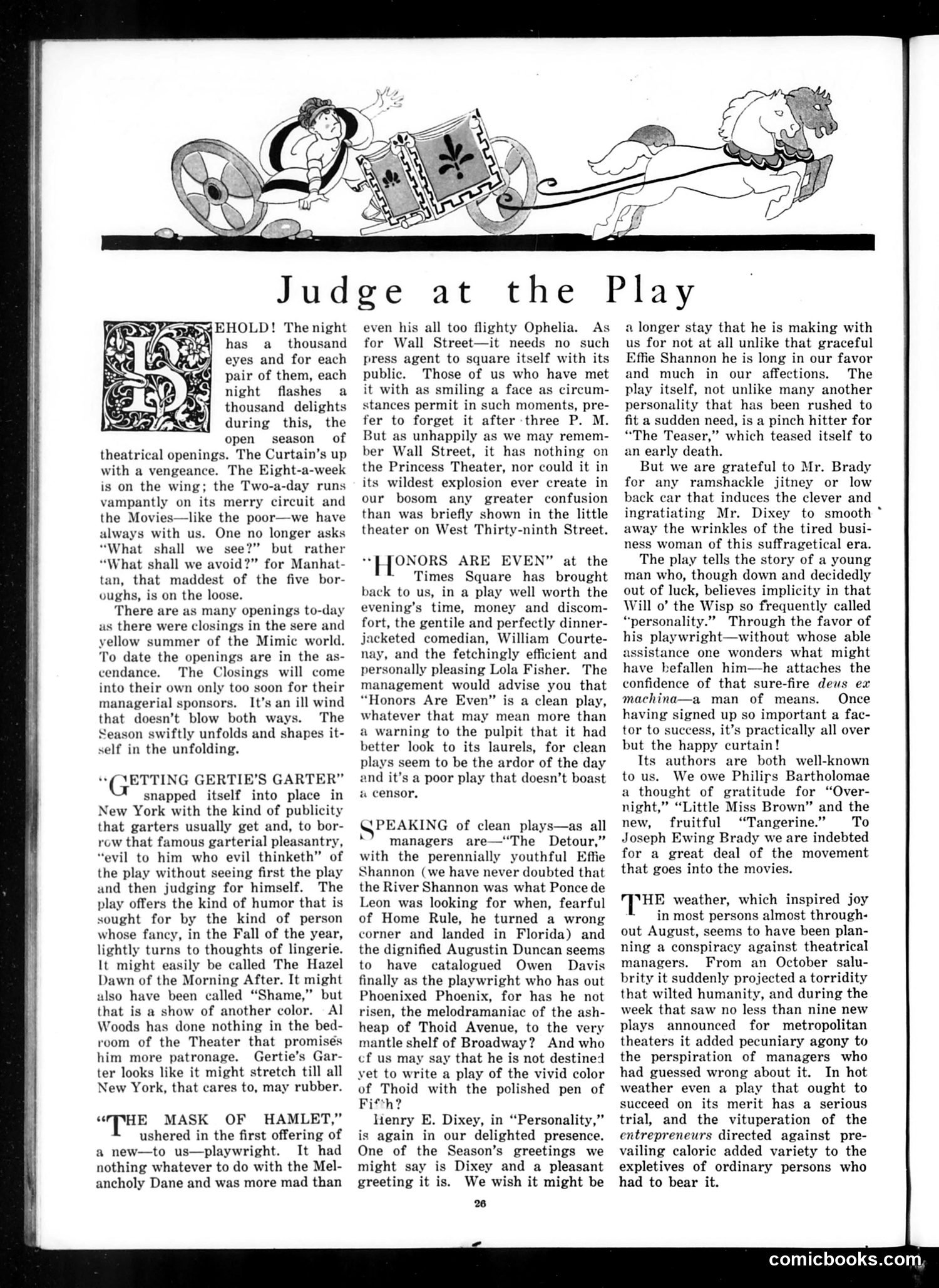
What you’re looking at
The cartoon header shows a theatrical producer being dragged by a horse labeled with theatrical masks, hauling an oversized suitcase decorated with theatrical symbols — a visual joke about the chaotic "opening season" of New York theater productions. The article reviews several Broadway plays from what appears to be early 1920s. "Getting Gertie's Garter" is praised as light comedy about lingerie that audiences will enjoy. "The Mask of Hamlet" is criticized as confusing and having nothing to do with Shakespeare despite its title. "Honors Are Even" features comedian William Courtenay and is noted as "clean" — meaning free from sexual innuendo, reflecting contemporary concerns about theatrical propriety. References to "clean plays" and censorship concerns reflect moral anxieties of the era. The piece's tone is gossipy and insider-focused, typical of Judge's theatrical criticism for educated Manhattan readers.
📄 Transcribed text from this page (OCR, searchable)
Machine-transcribed from the original scan — historical spelling and the odd misread are preserved.
Judge at the Play EHOLD! The night 4) has a_ thousand eyes and for each pair of them, each night flashes a thousand delights during this, the open season of theatrical openings. The Curtain’s up with a vengeance. The Eight-a-week is on the wing; the Two-a-day runs vampantly on its merry circuit and the Movies—like the poor—we have with us. One no longer asks shall we see?” but rather “What shall we avoid?” for Manhat- tan, that maddest of the five bor- oughs, is on the loose. There are as many openings to-day as there were closings in the sere and yellow summer of the Mimic world. To date the openings are in the as- cendance. The Closings will come into their own only too soon for their managerial sponsors. It’s an ill wind that doesn’t blow both w Season swiftly unfolds and s| self in the unfolding. “GETTING GERTIE’S GARTER” snapped itself into place in New York with the kind of publicity that garters usually get and, to bor- row that famous garterial pleasantry, “evil to him who evil thinketh” of the play without seeing first the play and then judging for himself. The play offers the kind of humor that is sought for by the kind of person whose fancy, in the Fall of the year, lightly turns to thoughts of lingerie. It might easily be called The Hazel Dawn of the Morning After. It might also have been called “Shame,” but that is a show of another color. Al Woods has done nothing in the bed- room of the Theater that promisés him more patronage. Gertie’s Gar- ter looks like it might stretch till all New York, that cares to, may rubber. “PMHE MASK OF HAMLET,” ushered in the first offering of a new—to us—playwright. It had nothing whatever to do with the Mel- ancholy Dane and was more mad than even his all too flighty Ophelia. As for Wall Street—it needs no such press agent to square itself with its publ: Those of us who have met it with as smiling a face as circum- stances permit in such moments, pre- fer to forget it after three P. M. But as unhappily as we may remem- ber Wall Street, it has nothing on the Princess Theater, nor could it in its wildest explosion ever create in our bosom any greater confusion than was briefly shown in the little theater on West Thirty-ninth Street. “} ONORS ARE EVEN” at the ' Times Square has brought back to us, in a play well worth the evening’s time, money and discom- fort, the gentile and perfectly dinner- jacketed comedian, William Courte- nay, and the fetchingly efficient and personally pleasing Lola Fisher. The management would advise you that “Honors Are Even” is a clean play, whatever that may mean more than a warning to the pulpit that it had better look to its laurels, for clean plays seem to be the ardor of the day and it's a poor play that doesn’t boast « censor, GS PEAKING of clean plays—as all \" managers are—‘The Detour,” with the perennially youthful Effie Shannon (we have never doubted that the River Shannon was what Ponce de Leon was looking for when, fearful of Home Rule, he turned a wrong corner and landed in Florida) and the dignified Augustin Duncan seems to have catalogued Owen Davis finally as the playwright who has out Phoenixed Phoenix, for has he not risen, the melodramaniac of the ash- heap of Thoid Avenue, to the very mantle shelf of Broadway? And who cf us may say that he is not destined yet to write a play of the vivid color of Thoid with the polished pen of Fifth? lienry E. Dixey, in “Personality,” is again in our delighted presence. One of the Season’s greetings we might say is Dixey and a pleasant greeting it is. We wish it might be 26 a longer stay that he is making with us for not at all unlike that graceful Effie Shannon he is long in our favor and much in our affections. The play itself, not unlike many another personality that has been rushed to fit a sudden need, is a pinch hitter for “The Teaser,” which teased itself to an early death. But we are grateful to Mr. Brady for any ramshackle jitney or low back car that induces the clever and ingratiating Mr. Dixey to smooth y the wrinkles of the tired busi- ness woman of this suffragetical era. The play tells the story of a young man who, though down and decidedly out of luck, believes implicity in that Will o’ the Wisp so frequently called “personality.” Through the favor of his playwright—without whose able a tance one wonders what might have befallen him—he attaches the confidence of that sure-fire deus ex machina—a man of means. Once having signed up so important a fac- tor to success, it’s practically all over but the happy curtain! Its authors are both well-known to us. We owe Philirs Bartholomae a thought of gratitude for “Over- night,” “Little Miss Brown” and the new, fruitful “Tangerine.” To Joseph Ewing Brady we are indebted for a great deal of the movement that goes into the movies. TE weather, which inspired joy in most persons almost through- out August, seems to have been plan- ning a conspiracy against theatrical managers. From an October salu- brity it suddenly projected a torridity that wilted humanity, and during the week that saw no less than nine new plays announced for metropolitan theaters it added pecuniary agony to the perspiration of managers who had guessed wrong about it. In hot weather even a play that ought to succeed on its merit has a serious trial, and the vituperation of the entrepreneurs directed against pre- vailing caloric added variety to the expletives of ordinary persons who had to bear it. comicbooks.com,