
Judge, 1921-09-24 · page 6 of 36
Judge — September 24, 1921 — page 6: what you’re looking at
What you’re looking at
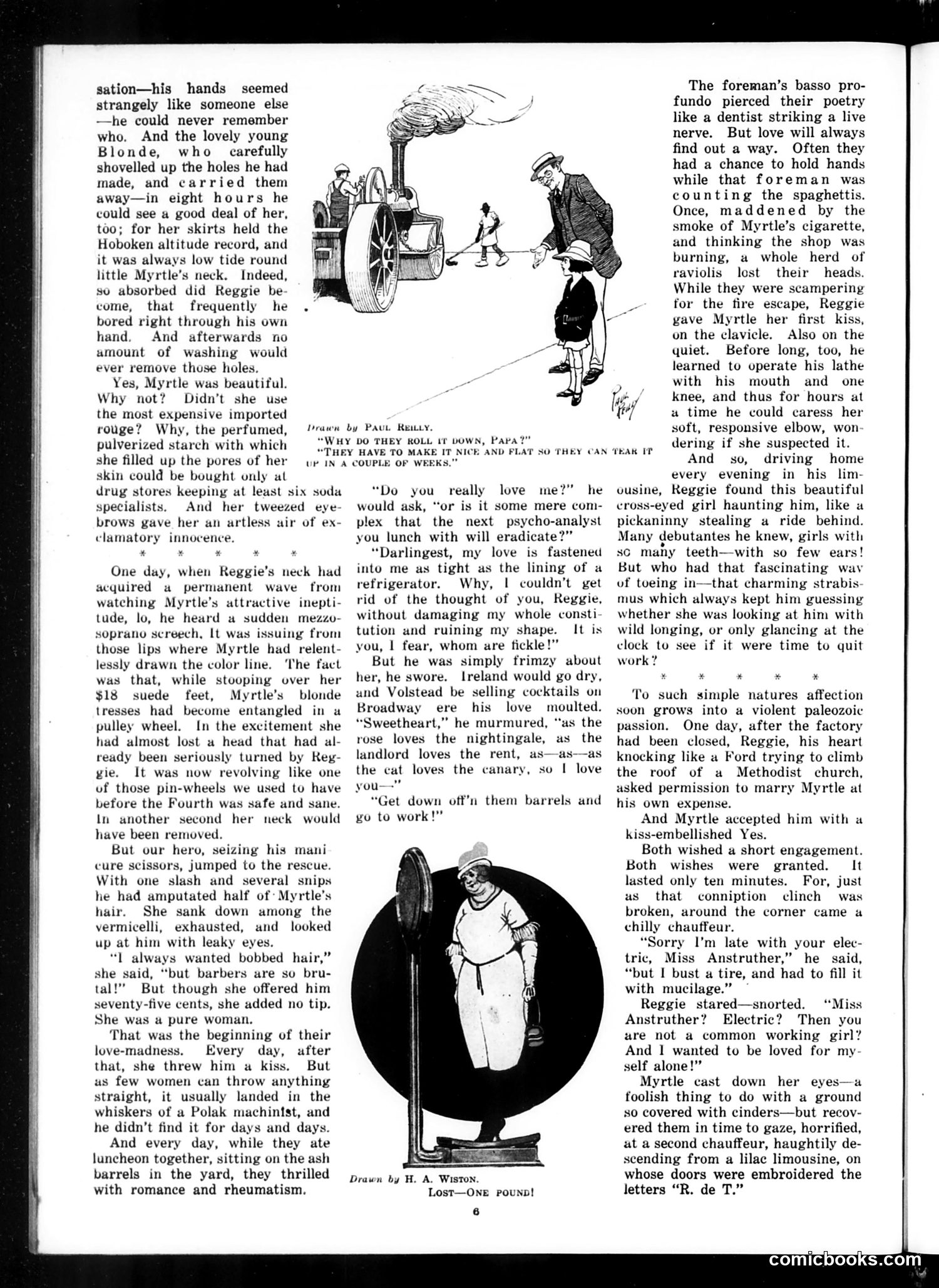
This page contains a romantic fiction story titled "Why Do They Bill It Down, Papa?" illustrated with two cartoons by Paul Reilly and H.A. Weston. The cartoons depict a working-class love story between Reggie (a factory worker/driver) and Myrtle, a cross-eyed girl. The humor derives from their courtship despite physical imperfections—her crossed eyes and his ungainly appearance. The narrative satirizes sentimental romance magazines by applying melodramatic language ("love is fastened into me as tight as the lining of a refrigerator") to ordinary working people in unglamorous industrial settings. The cartoons mock both class pretensions and the overwrought sentimentality of popular fiction, presenting genuine affection between ordinary, unpretty people as inherently comic.
📄 Transcribed text from this page (OCR, searchable)
Machine-transcribed from the original scan — historical spelling and the odd misread are preserved.
sation—his hands seemed strangely like someone else —he could never remember who. And the lovely young Blonde, who carefully shovelled up the holes he had made, and carried them away—in eight hours he could see a good deal of her, too; for her skirts held the Hoboken altitude record, and it was always low tide round little Myrtle’s neck. Indeed, so absorbed did Reggie be come, that frequently he bored right through his own hand, And afterwards no amount of washing would ever remove those holes. Yes, Myrtle was beautiful. Why not? Didn’t she use the most expensive imported rouge? Why, the perfumed, pulverized starch with which she filled up the pores of her skin could be bought only at drug stores keeping at least six soda speciali And her tweezed eye- brows gave her an artless air of ex- clamatory innocence. One day, when Reggie’s neck had acquired a permanent wave from watching Myrtle’s attractive inepti- tude, lo, he heard a sudden mezzo- soprano screech, It was issuing from those lips where Myrtle had relent- lessly drawn the color line. ‘The fact was that, while stooping over her $18 suede feet, Myrtle’s blonde tresses had become entangled in a pulley wheel. In the excitement she had almost lost a head that had al- ready been seriously turned by Reg- gie. It was now revolving like one of those pin-wheels we used to have before the Fourth was safe and sane. In another second her neck would have been removed. But our hero, seizing his mani cure scissors, jumped to the rescue. With one slash and several snips he had amputated half of: Myrtle’s hair. She sank down among the vermicelli, exhausted, and looked up at him with leaky eyes. “lL always wanted bobbed hair,” she said, “but barbers are so bru- tal!” But though she offered him seventy-five cents, she added no tip. She was a pure woman. That was the beginning of their love-madness. Every day, after that, she threw him a ki But us few women can throw anything straight, it usually landed in the whiskers of a Polak machintst, and he didn’t find it for days and days. And every day, while they ate luncheon together, sitting on the ash barrels in the yard, they thrilled with romance and rheumatism. Drawn by PAuL Reiry, “WHY DO THEY ROLL if DOWN, Papa “THEY HAVE TO MAKI ur IN A COUPLE OF WE IT NICE AND PL “Do you really love me?” he would ask, “or is it some mere com- plex that the next psycho-analyst you lunch with will eradicat “Darlingest, my love is fastened into me as tight as the lining of a refrigerator. Why, | couldn't get rid of the thought of you, Reggie, without damaging my whole consti tution and ruining my shape. It is you, | fear, whom are fickle!” But he was simply frimzy about her, he swore. Lreland would go dry, and Volstead be selling cocktails on Broadway ere his love moulted. “Sweetheart,” he murmured, “as the rose loves the nightingale, as the landlord loves the rent, as—as—as the cat loves the canary, so | love you—-" “Get down off’n them barrels and yo to work!” Drawn by H. A. Wiston. Lost—OneE Pounb! 6 SO THEY CAN TEAK IT The foreman’s basso pro- fundo pierced their poetry like a dentist striking a live nerve. But love will always find out a way. Often they had a chance to hold hands while that foreman was counting the spaghettis. Once, maddened by the smoke of Myrtle’s cigarette, and thinking the shop was burning, a whole herd of raviolis lost their heads. While they were scampering for the fire escape, Reggie gave Myrtle her first kiss, on the clavicle. Also on the quiet. Before long, too, he learned to operate his lathe with his mouth and one knee, and thus for hours at a time he could caress her soft, responsive elbow, won dering if she suspected it. And so, driving home every evening in his lim- ousine, Reggie found this beautiful eyed girl haunting him, like a pickaninny stealing a ride behind. Many debutantes he knew, girls with sc many teeth—with so few ears! But who had that fascinating wav vf tueing in—that charming strabis mus which always kept him guessing whether she was looking at him with wild longing, or only glancing at the clock to see if it were time to quit work? To such simple natures affection soon grows into a violent paleozoic passion. One day, after the factory had been closed, Reggie, his heart knocking like a Ford trying to climb the roof of a Methodist church, usked permission to marry Myrtle at his own expense. And Myrtle accepted him with a kiss-embellished Yes. Both wished a short engagement. Both wishes were granted. It lasted only ten minutes. For, just us that conniption clinch was broken, around the corner came a chilly chauffeur. “Sorry I’m late with your elec- tric, Miss Anstruther,” he said, “but I bust a tire, and had to fill it with mucilage.” Reggie stared—snorted. “Miss Anstruther? Electric? Then you ure not a common working girl? And I wanted to be loved for my self alone!” Myrtle cast down her eyes—a foolish thing to do with a ground so covered with cinders—but recov- ered them in time to gaze, horrified, at a second chauffeur, haughtily de- scending from a lilac limousine, on whose doors were embroidered the letters “R. de T.”