
A complete issue · 32 pages · 1921
Judge — May 7, 1921
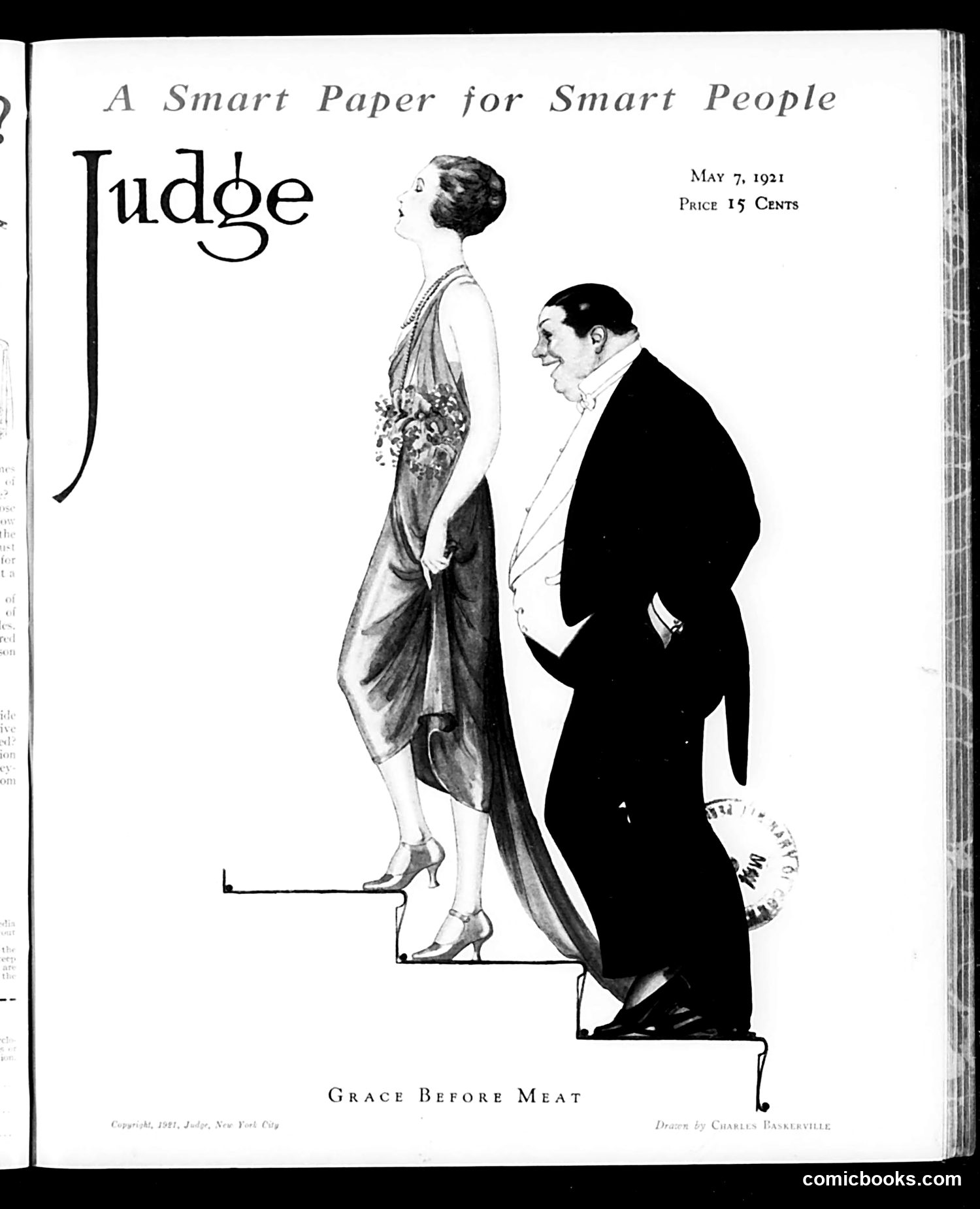
This cartoon satirizes courtship and gender dynamics of the 1920s. A man in formal attire stands on a lower step, gazing up admiringly at an elegantly dressed woman on a higher step—literally and figuratively elevating her position. The title "Grace Before Meat" is a pun: it references the traditional prayer said before eating ("grace before meals"), but here "meat" is slang for an attractive woman. The humor lies in the reversal of power dynamics: the man is in the subordinate position, metaphorically "worshipping" the woman before pursuing her romantically. For 1921 readers, this would humorously capture anxieties about changing gender relations during the Jazz Age, when women gained more independence and social freedom, leaving men uncertain about their traditional roles.
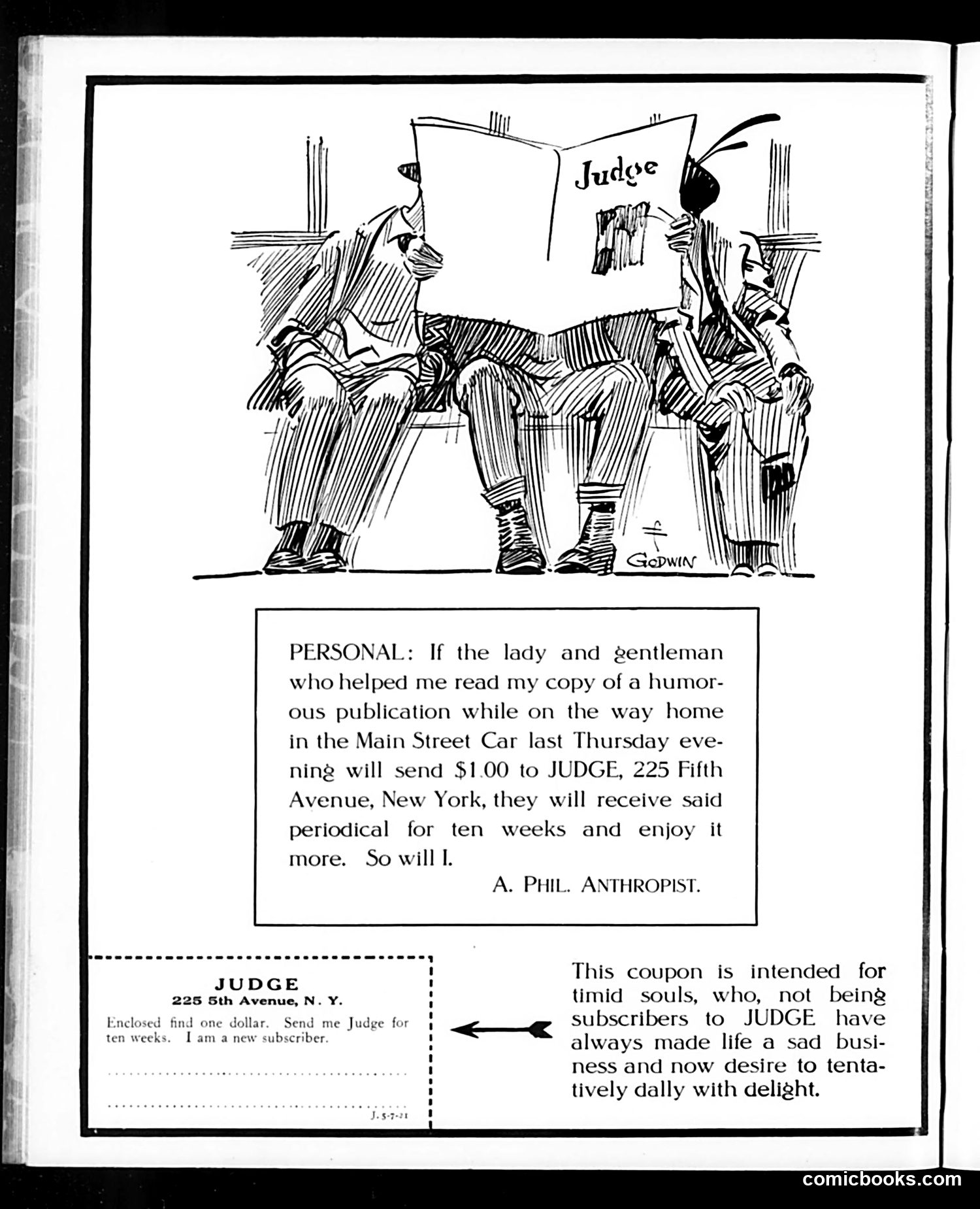
This page contains an advertisement for *Judge* magazine disguised as humorous content. The cartoon shows three men (likely representing *Judge* readers or the magazine's audience) examining a large "Judge" newspaper/publication together. The "Personal" message below is a fake testimonial from "A. Phil. Anthropist" describing how strangers shared a humorous publication on public transportation, encouraging readers to subscribe by sending $1. The accompanying coupon and text at bottom frankly admit this is marketing aimed at "timid souls" who haven't subscribed to *Judge* and desire "delight" in their lives. Rather than subtle satire, this is transparent self-promotion: the magazine is openly selling subscriptions by humorously appealing to readers' desire for entertainment and social connection.
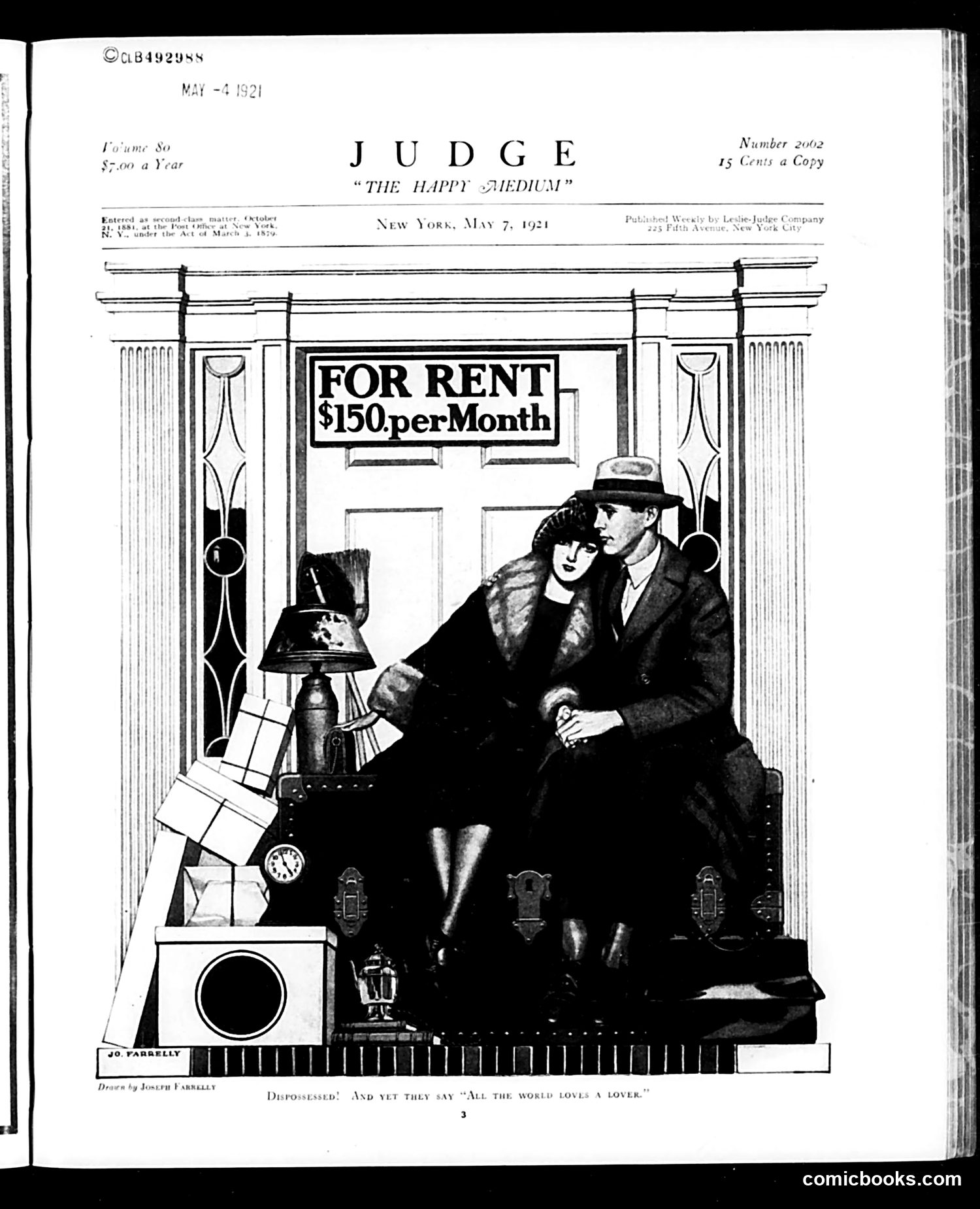
This is primarily an **advertisement for apartment rental**, not political satire. The illustration shows a couple sitting in a furnished apartment with the sign "FOR RENT $150 per Month" prominently displayed above them. The caption reads: "Disposed: And yet they say 'All the world loves a lover.'" **The joke**: The satire targets housing scarcity and high rents following World War I. The couple appears evicted or displaced—they're literally sitting among moving boxes and household goods. The ironic caption suggests that despite romance being universally beloved, landlords and economic circumstances show no such affection for lovers. It's social commentary on the postwar housing crisis and its impact on young couples trying to establish homes.
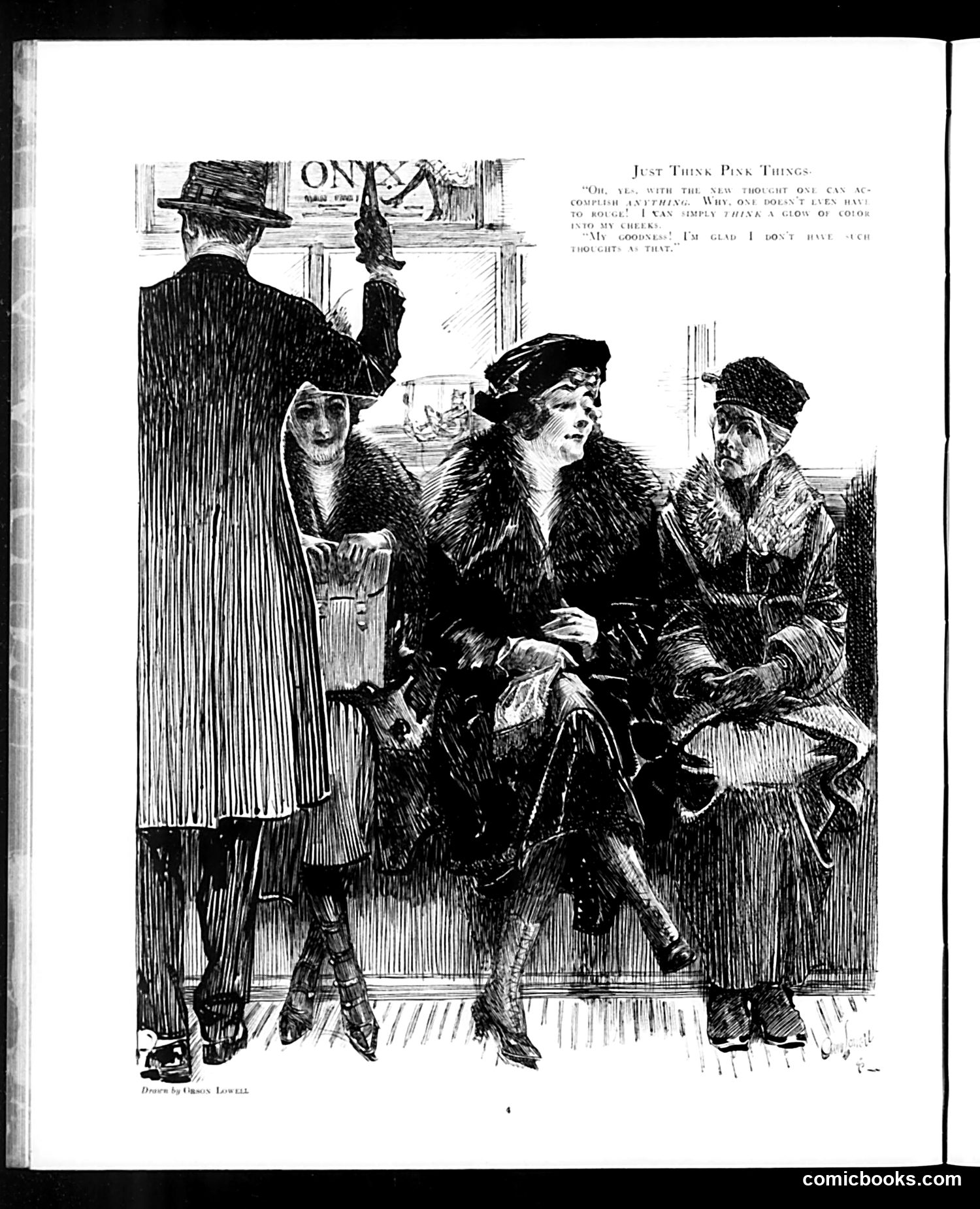
This cartoon satirizes women's consumer behavior and fashion obsession. The title "Just Think Pink Things" mocks the idea that women accomplish nothing beyond fixating on trivial pink-colored goods and fashion accessories. The scene shows three women in an exclusive shop (marked "ONYX"), dressed in expensive furs and winter wear, engaged in idle conversation about purchasing inconsequential items. A male attendant stands behind them, apparently accommodating their whimsical demands. The satire targets the stereotype of wealthy women as frivolous consumers concerned only with fashionable accessories and cosmetic purchases rather than substantive pursuits. The accompanying text reinforces this caricature, presenting their dialogue as shallow preoccupation with superficial material goods—a common early-20th-century critique of female leisure-class consumption.
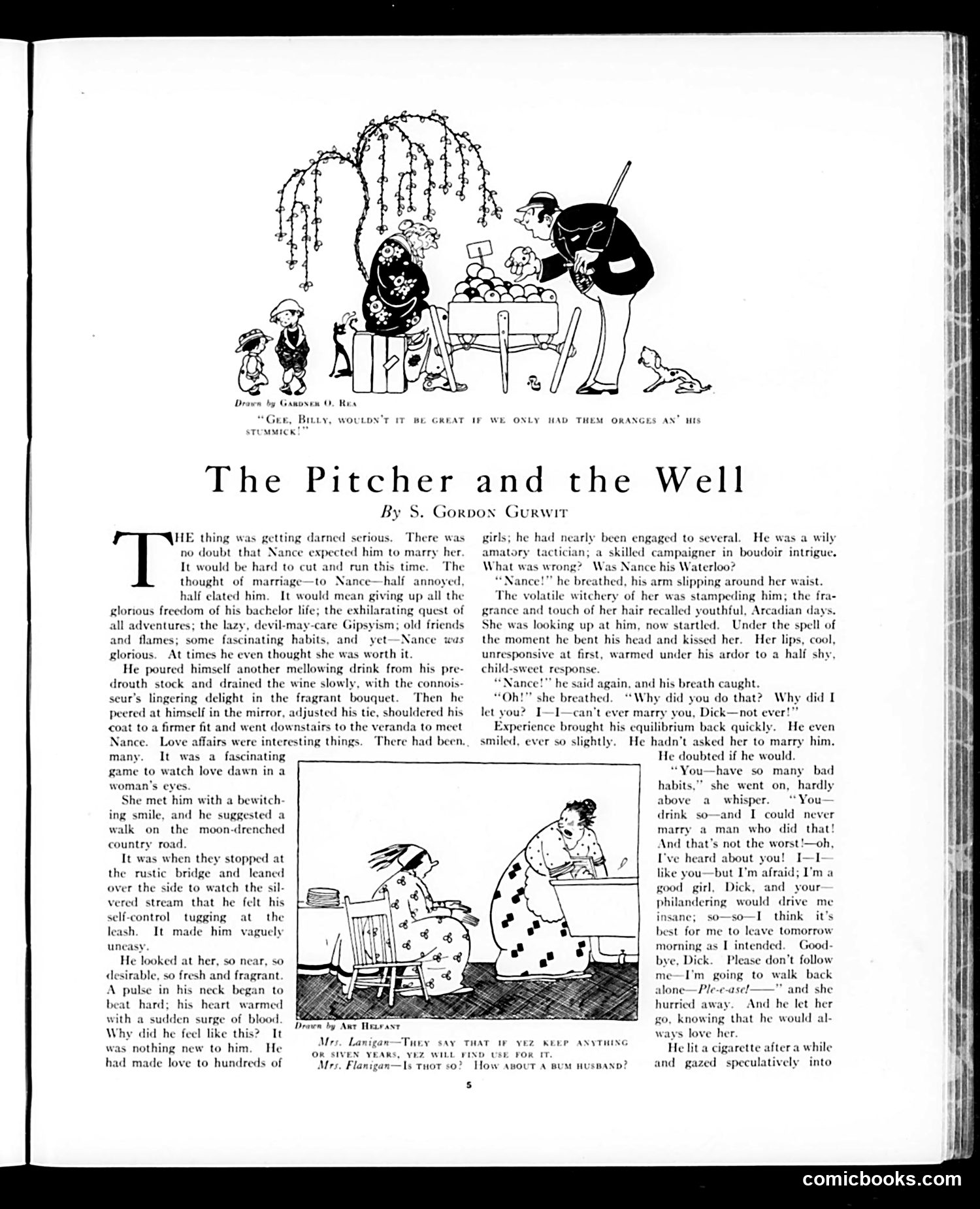
This page contains a short story by S. Gordon Gurwit rather than political satire. The narrative concerns a man named Dick who is romantically entangled with a woman named Nance. The story plays on the idiom "pitcher and well" (likely referencing infidelity or repeated romantic disappointment). The illustrations by Art Helicoat show domestic scenes: one depicts Dick and Nance at a rustic bridge, another shows them at a well. The story explores relationship tensions, with Nance expressing frustration about Dick's habits and refusing to marry him, ultimately leaving him. This appears to be entertainment content rather than political or social commentary—a romantic comedy-drama for Judge's readers.
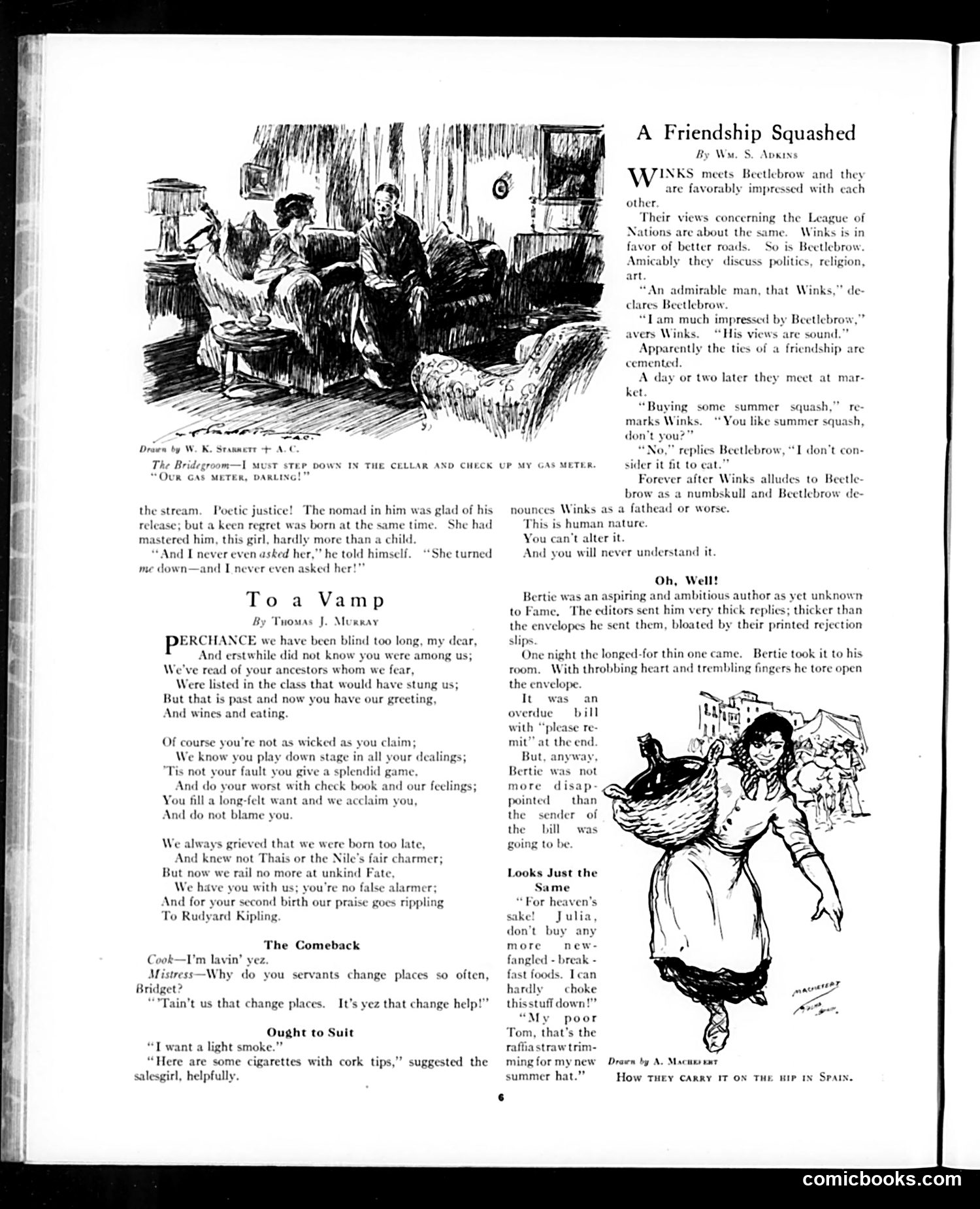
This page contains literary content rather than political cartoons. The main pieces are: **"A Friendship Squashed"** by W.S. Adkins—a satirical story about two men, Winks and Beetlebrow, who initially bond over shared views on the League of Nations but whose friendship deteriorates when Winks insults Beetlebrow by comparing him to squash (implying he's bland or worthless). The satire appears to mock how friendships collapse over trivial disagreements. **"To a Vamp"** by Thomas J. Murray—a poem addressing a female figure, likely critiquing seductive women or gold-diggers common in 1920s satire. **"The Comeback"** and **"Oughtn to Suit"**—brief comic dialogues. The accompanying sketches show domestic or social scenes. Without knowing the specific publication date, the League of Nations reference suggests this is from the 1920s-1930s period.
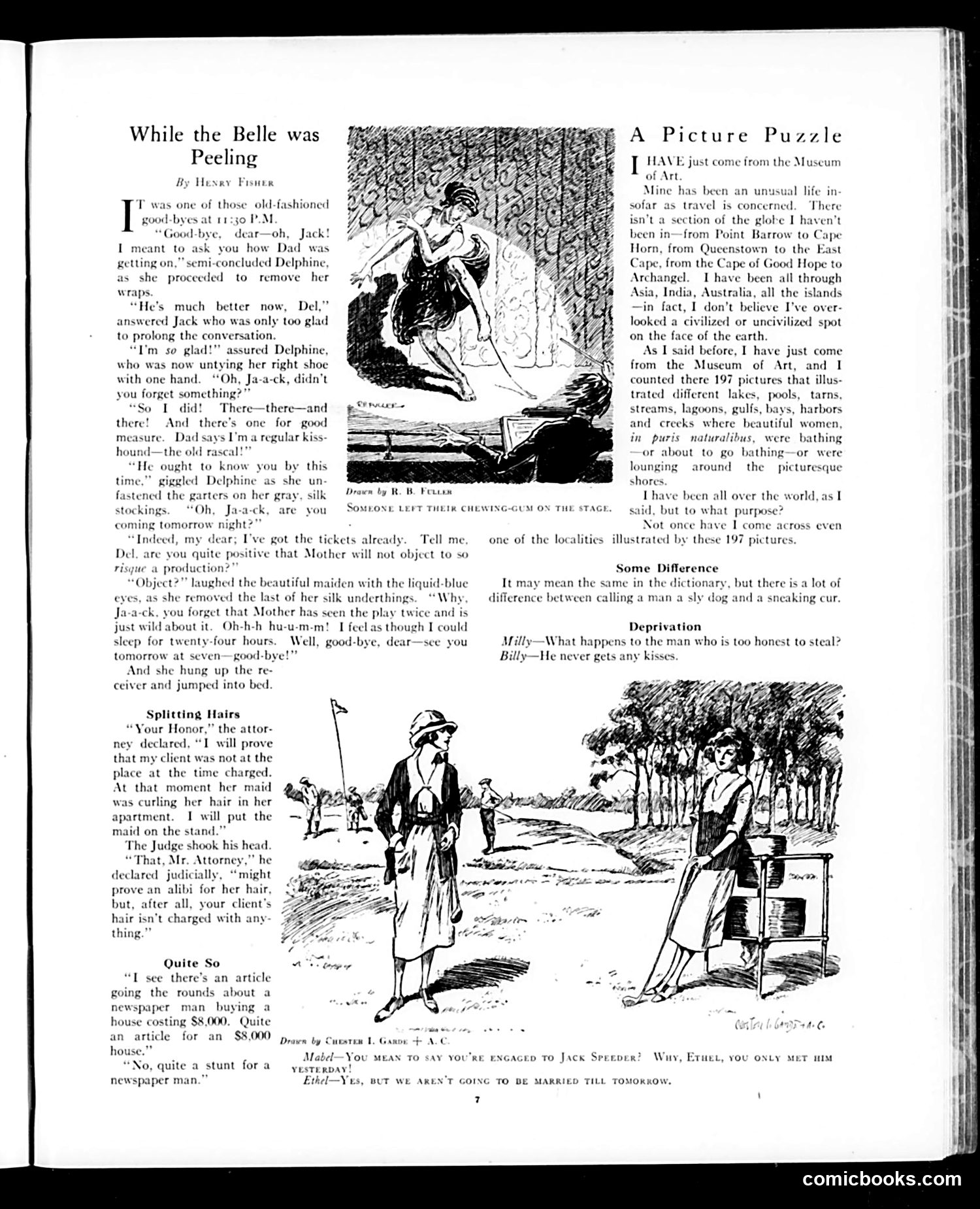
This page contains several satirical pieces typical of early 20th-century Judge humor: **"While the Belle was Peeling"** depicts a flirtatious late-night goodbye between a couple (Jack and Delphine). The humor relies on double entendre—her "peeling" off clothing while they chat, with suggestive details like removing stockings and undergarments. The satire likely mocks Victorian courtship propriety by showing young people casually intimate before marriage. **"Splitting Hairs"** satirizes legal pedantry: a lawyer argues his client wasn't at a crime scene because her *maid* was curling her *hair* there at the time—a ridiculous technicality the judge correctly dismisses. **"A Picture Puzzle"** humorously complains that a world traveler has seen 197 museum paintings depicting nude or semi-nude bathing women in exotic locations, yet never encountered such scenes in actual travel—poking fun at artistic idealization versus reality. The remaining brief jokes satirize newspaper culture and romantic conventions. The tone reflects turn-of-the-century attitudes toward propriety, sexuality, and legal absurdity.
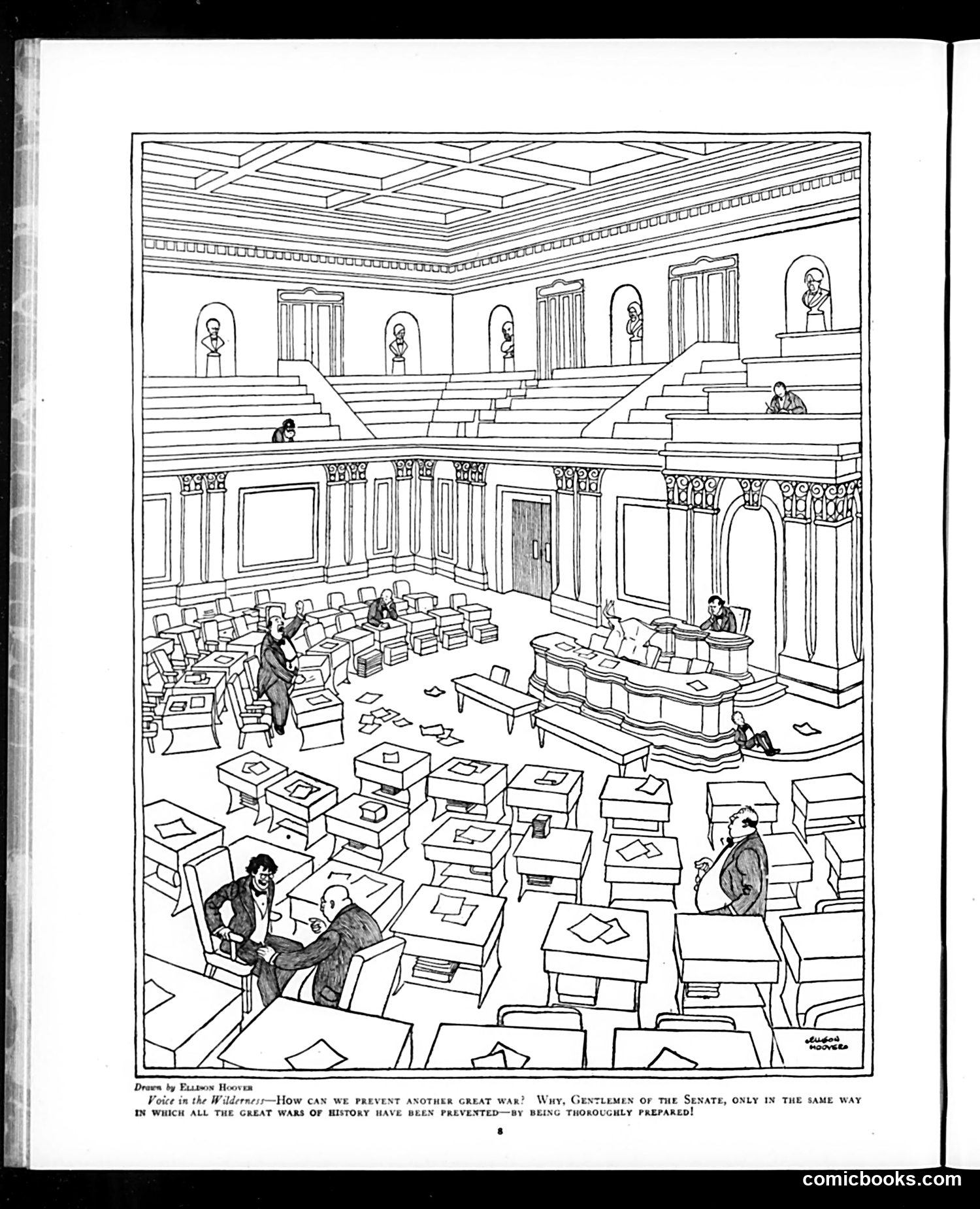
This cartoon by Elilson Hoover depicts a U.S. Senate chamber overwhelmed by filing boxes and documents scattered across the floor. The caption asks: "How can we prevent another great war? Why, Gentlemen of the Senate, only in the same way in which all the great wars of history have been prevented—by being thoroughly prepared!" The satire criticizes Senate preparedness efforts, suggesting that bureaucratic accumulation of paperwork and documentation is presented as serious war prevention. The irony is that mountains of files and desk work are being conflated with actual military or diplomatic preparation. The cartoon mocks either the Senate's ineffectiveness or the absurdity of believing that administrative procedures alone constitute meaningful defense strategy against future wars.
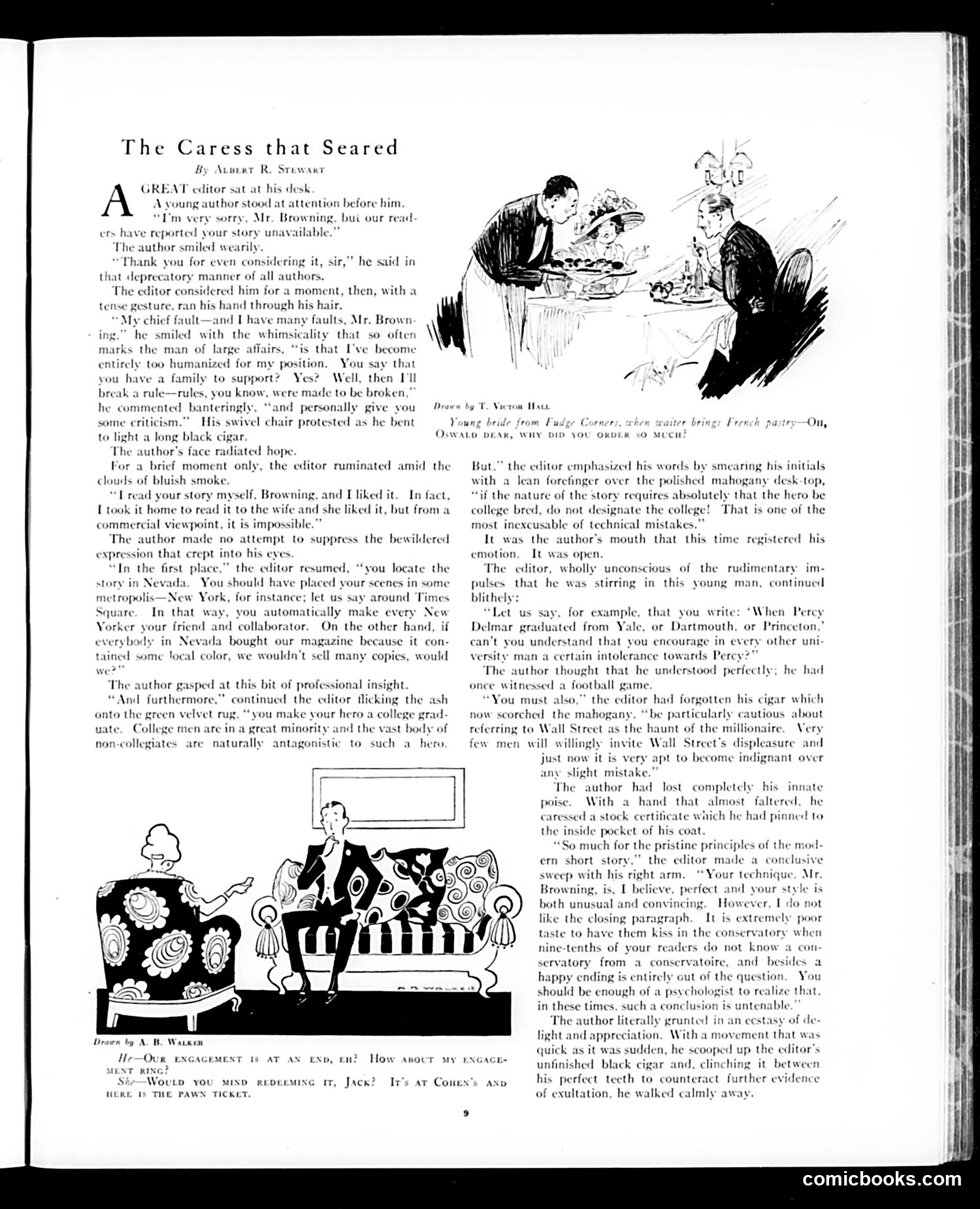
This story satirizes the editorial gatekeeping of early 20th-century magazine publishing. A young author submits a story to a powerful editor who claims to like it personally but rejects it for commercial reasons. The editor's objections reveal the absurd logic of mass-market magazine publishing: the story should be set in New York (to please New York readers), yet avoid depicting college graduates and Wall Street (to avoid alienating non-college readers and offending wealthy businessmen). The satire peaks when the editor insists the author *can* mention these places—just never actually *name* them as Yale, Dartmouth, Princeton, or Wall Street. The author's growing dismay (his "mouth...open") at these contradictory, self-serving rules illustrates how commercial interests corrupted literary integrity. The final image of him clutching a stock certificate suggests authors must compromise their principles to survive financially. This critiques both editorial cowardice and the crass commercialism that prioritized advertisers' sensibilities over authentic storytelling.
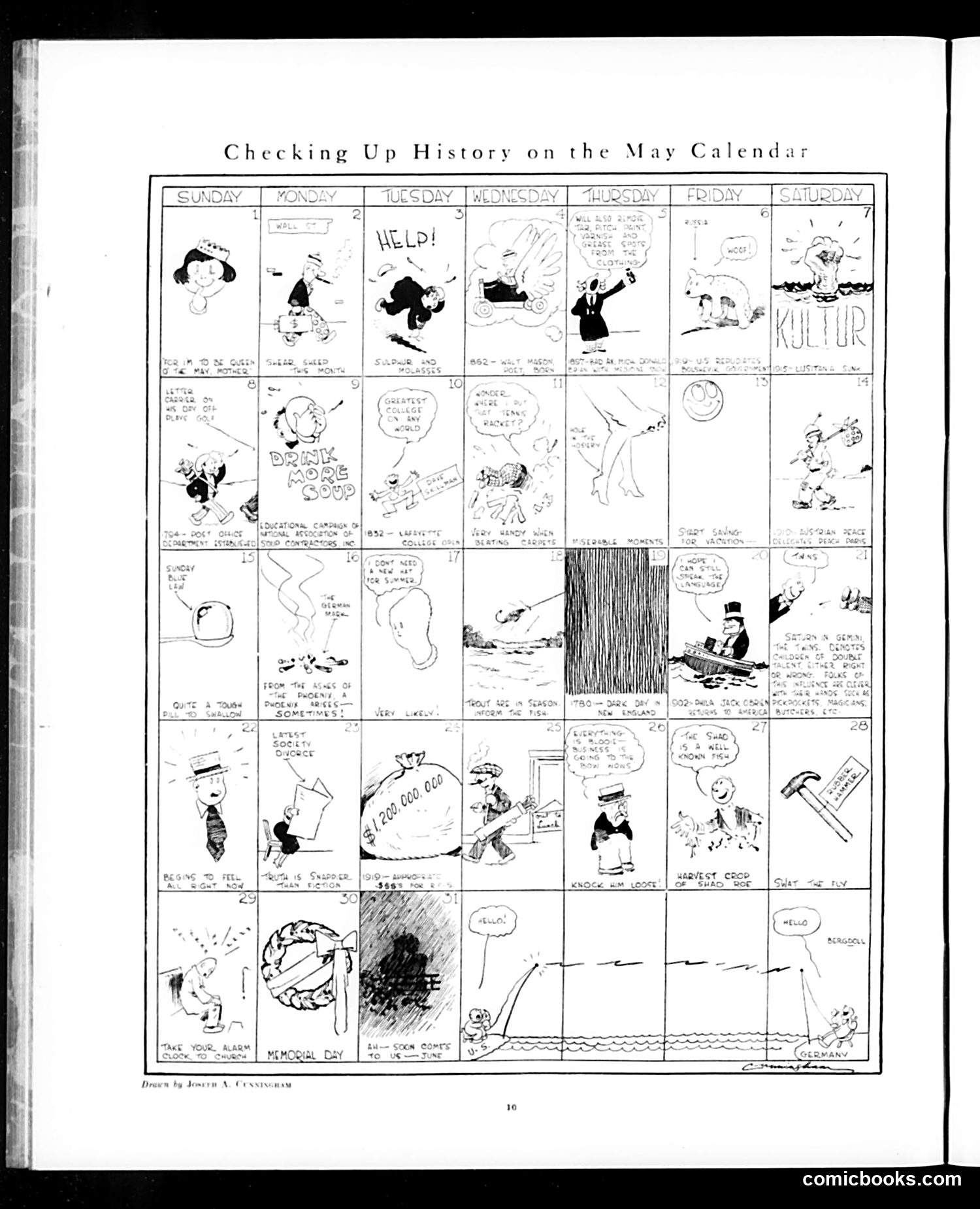
This comic calendar by Joseph A. Cunningham presents daily satirical commentary on May events and historical anniversaries. Each day's panel contains political or social jokes tied to actual May dates. The cartoons employ exaggerated caricatures and visual puns typical of Judge magazine's style. References include holidays (Memorial Day, visible on May 30), historical moments, and contemporary social situations. The humor relies on readers recognizing specific dates' significance and current events relevant to 1920s America. Without clearer legibility of individual captions, specific political figures or events remain difficult to identify with certainty, but the format suggests commentary on politics, current affairs, and American culture through historically-anchored daily jokes—a common Judge feature combining history with contemporary satire.
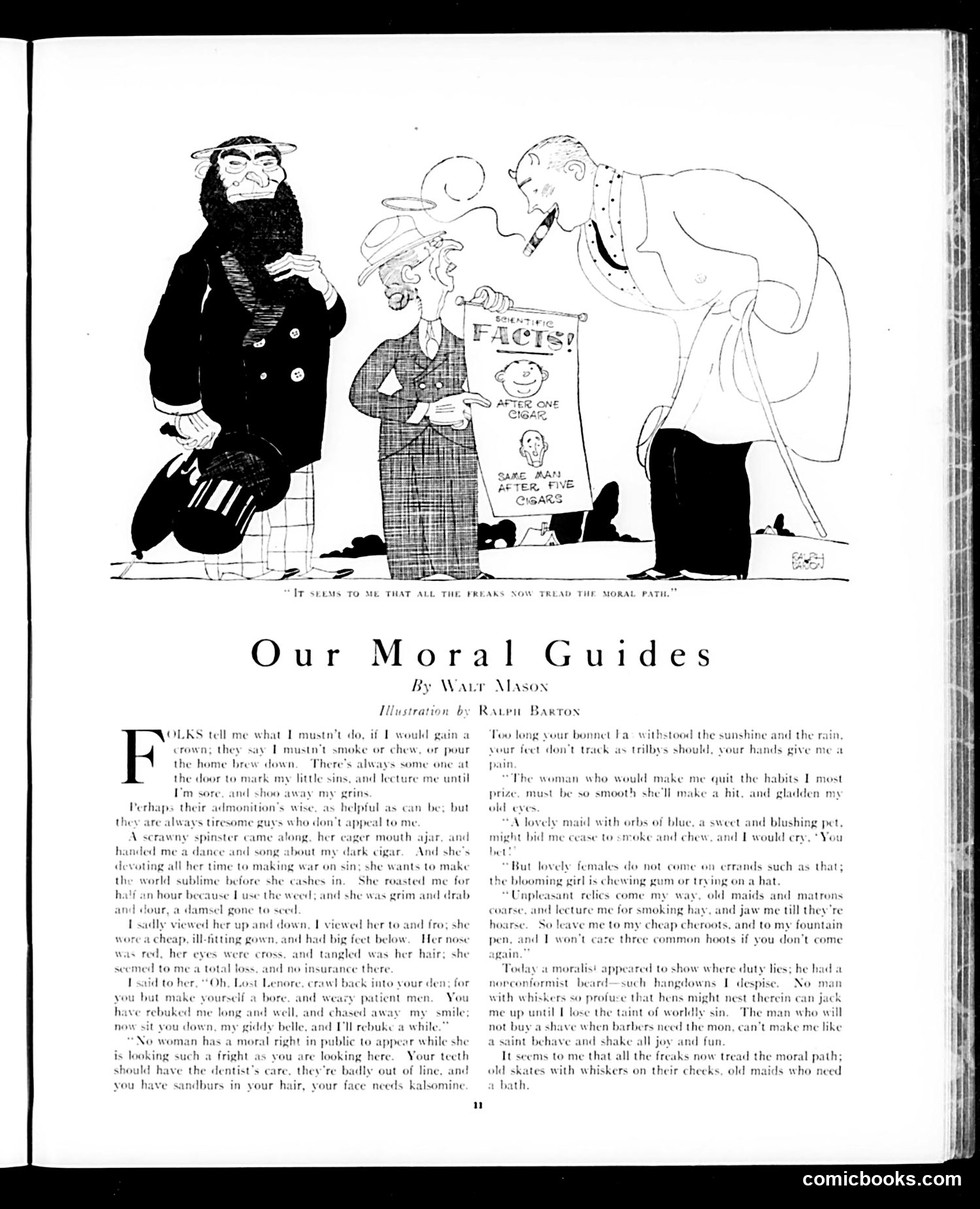
This satirical piece mocks self-righteous moral busybodies who lecture others about their behavior. The cartoon depicts various disapproving figures—a stern woman with a halo, a preachy man with a sign showing "Freaks" labeled "After One Cigar" and "After Five Cigars," and a portly authority figure—all wagging fingers at ordinary people. Mason's text rails against intrusive moralists who condemn smoking, drinking, and other minor vices while ignoring their own flaws (bad teeth, poor grooming, sanctimoniousness). He complains that these self-appointed arbiters of morality are hypocrites—the bearded, judgmental man has no right to lecture, nor do the "old maids" and "old skates" who need baths themselves. The satire targets the early 20th-century moral reform movement's finger-wagging culture, suggesting that true moral authority rests with those who practice what they preach, not meddlesome scolds.
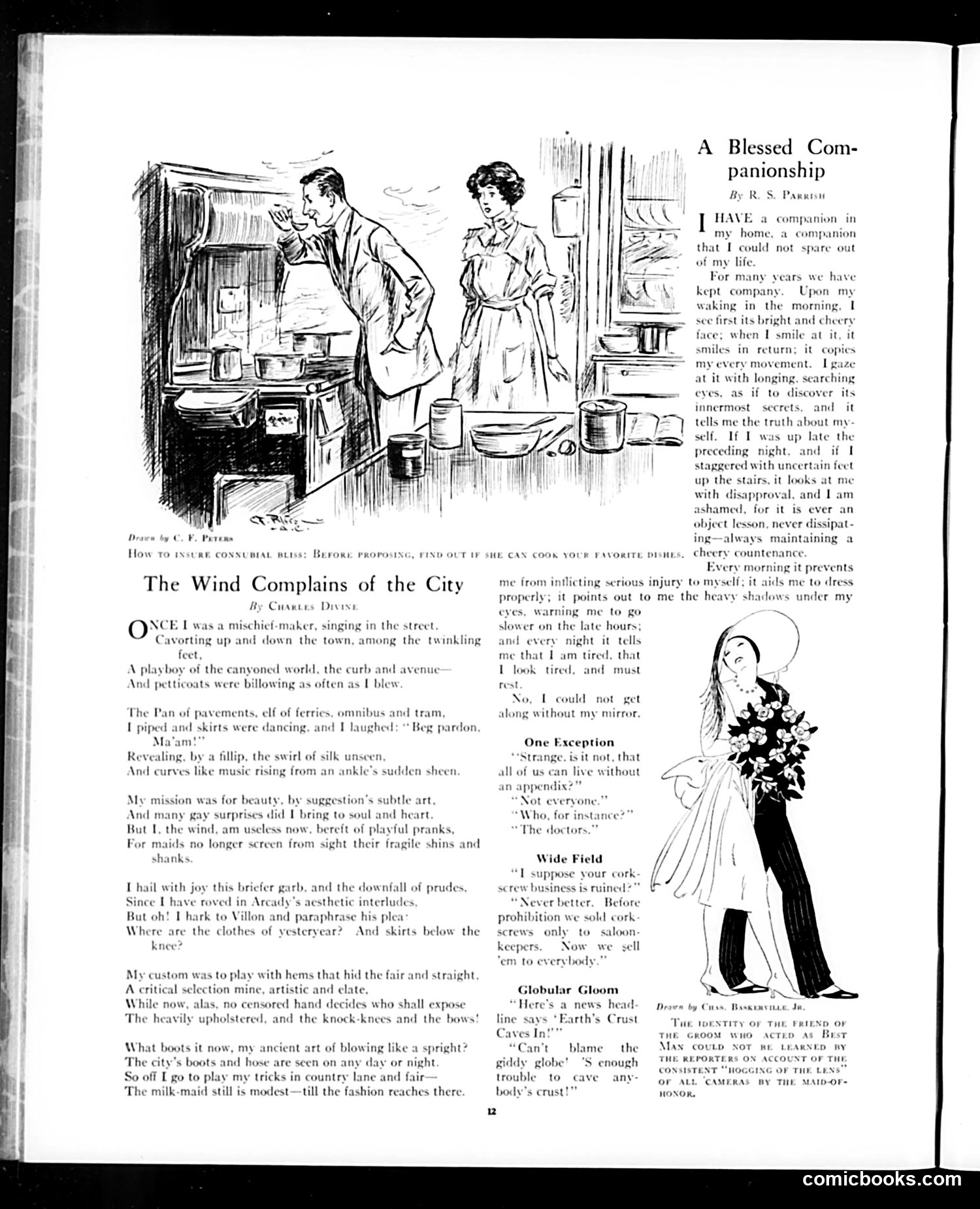
This Judge magazine page contains three distinct pieces: **"The Wind Complains of the City"** is a poem-cartoon lamenting changing women's fashion. The wind personifies itself as a mischievous force that once lifted women's skirts to reveal ankles—considered risqué and titillating in earlier eras. Now that hemlines have risen (likely 1920s flapper era), the wind has lost its power to scandalize. The satire mocks both the wind's nostalgia and, implicitly, society's prudishness about female legs. **"A Blessed Companionship"** is sentimental prose about the author's mirror—a companion that reflects both literal appearance and moral truth, preventing vanity and encouraging self-care. **The remaining shorts** are brief humor snippets: one questions whether humans need appendixes, another jokes that a cork-screw business thrived during Prohibition, and a final item jokes that a maid-of-honor hogged camera lenses at a wedding, preventing identification of the groom's best man. The overall tone reflects typical Judge satire: social commentary mixed with domestic humor and gentle mockery of contemporary manners.
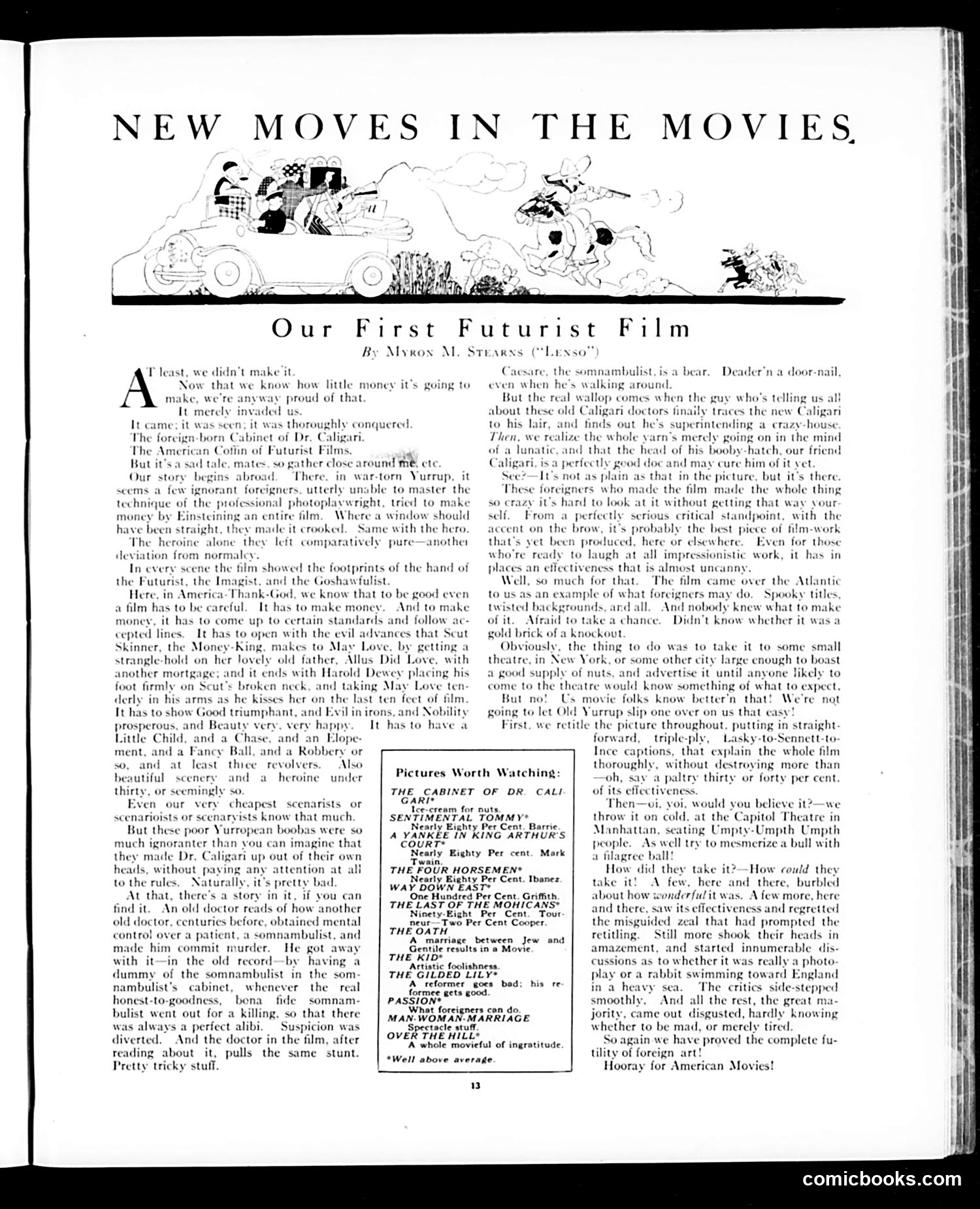
This article reviews **"The Cabinet of Dr. Caligari,"** a famous German Expressionist film, through a distinctly American lens of cultural superiority and commercial pragmatism. **The Satire:** The author mocks European filmmakers as incompetent "ignorant foreigners" and "Yurropean boobas" who don't understand profitable moviemaking. While acknowledging Caligari's technical innovation—a somnambulist (sleepwalker) framed as a murderer by a mad doctor—he dismisses its artistic value. **The Point:** American cinema, the author argues, succeeds because it follows commercial formulas: clear morality, romance, action, happy endings. Caligari's disorienting Expressionist style and dark psychology violate these rules, yet somehow work anyway—puzzling to someone who views entertainment purely as commercial product. **The Irony:** The critic's smugness about American "standards" and money-making inadvertently reveals American cinema's creative limitations compared to European art films, even as he dismisses them as inferior.
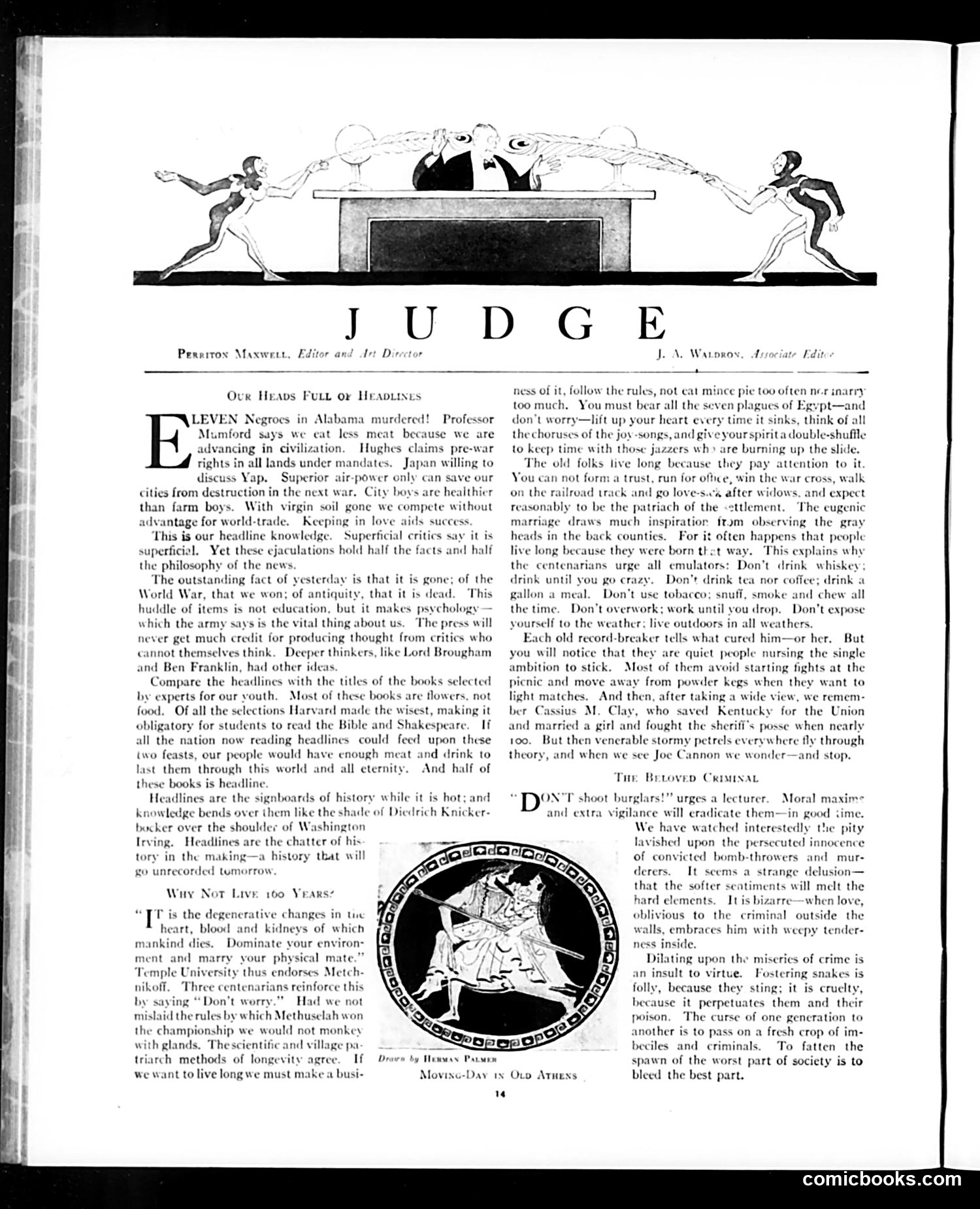
This *Judge* magazine page contains editorial commentary on contemporary headlines and a separate article about longevity. **The Main Text ("Our Heads Full of Headlines"):** Editor Pennington Maxwell critiques America's obsession with sensational newspaper headlines as poor substitutes for genuine education. He lists contemporary scandals (eleven murders in Alabama, debates over Japan's Yap mandate rights, air-power concerns) and argues these fragments of information create false "psychology" without real understanding. Maxwell advocates for substantive reading—specifically the Bible and Shakespeare—over headline-skimming. **The Illustration:** Hermes Parker's classical drawing depicts "Moving-Day in Old Athens," showing figures carrying household goods, illustrating an accompanying article about longevity practices. **The Second Article ("Why Not Live 160 Years?"):** References Temple University's endorsement of Elie Metchnikoff's longevity theories and advice from centenarians. The piece sardonically lists lifestyle rules for long life: avoid certain foods, manage stress, don't drink excessively, work moderately, and maintain proper environment—suggesting discipline and moderation as keys to extended life. The overall page satirizes superficial modern knowledge while promoting traditional wisdom and serious study.
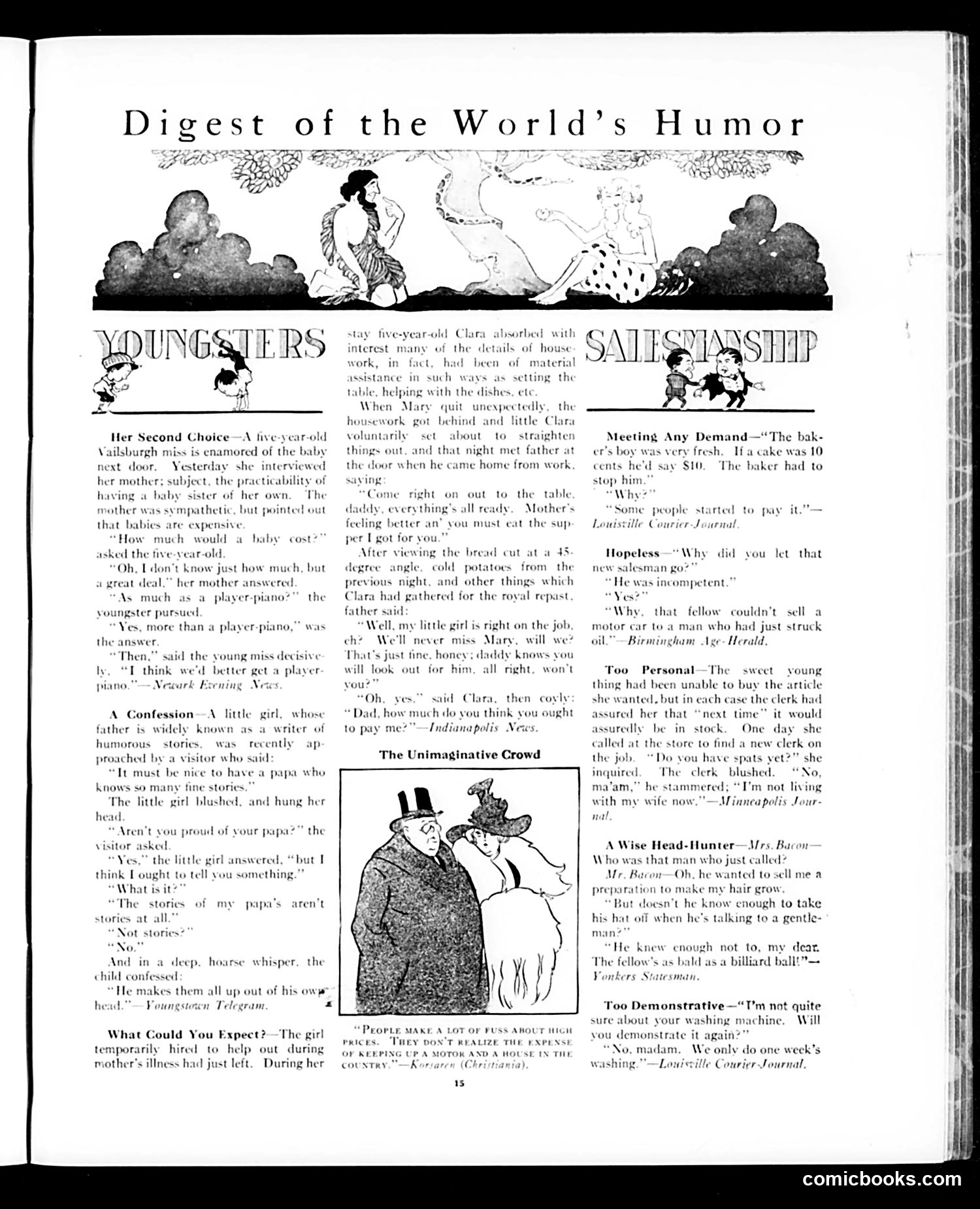
This page from *Judge* presents a collection of brief humorous anecdotes rather than political cartoons. The content satirizes domestic life and social interactions of the early 20th century. **Key themes:** - **Childhood logic**: A five-year-old prefers a player-piano to a baby sister because it costs less—mocking both children's reasoning and consumer culture. - **Parental awkwardness**: A writer's daughter confesses her father "makes up" his stories rather than observing real events—satirizing writers' claims to authenticity. - **Class/gender dynamics**: A housemaid's competence during an employer's absence highlights servant labor and domestic expectations. - **Incompetence and obliviousness**: Various anecdotes mock salesmen, clerks, and service workers who fail at their jobs through naïveté or social ineptitude. The cartoon in the center ridicules wealthy people who fuss about high prices without understanding actual expenses of maintaining luxury goods. Overall, these are gentle domestic satires reflecting middle-class anxieties and everyday social friction, typical of *Judge's* humor format.
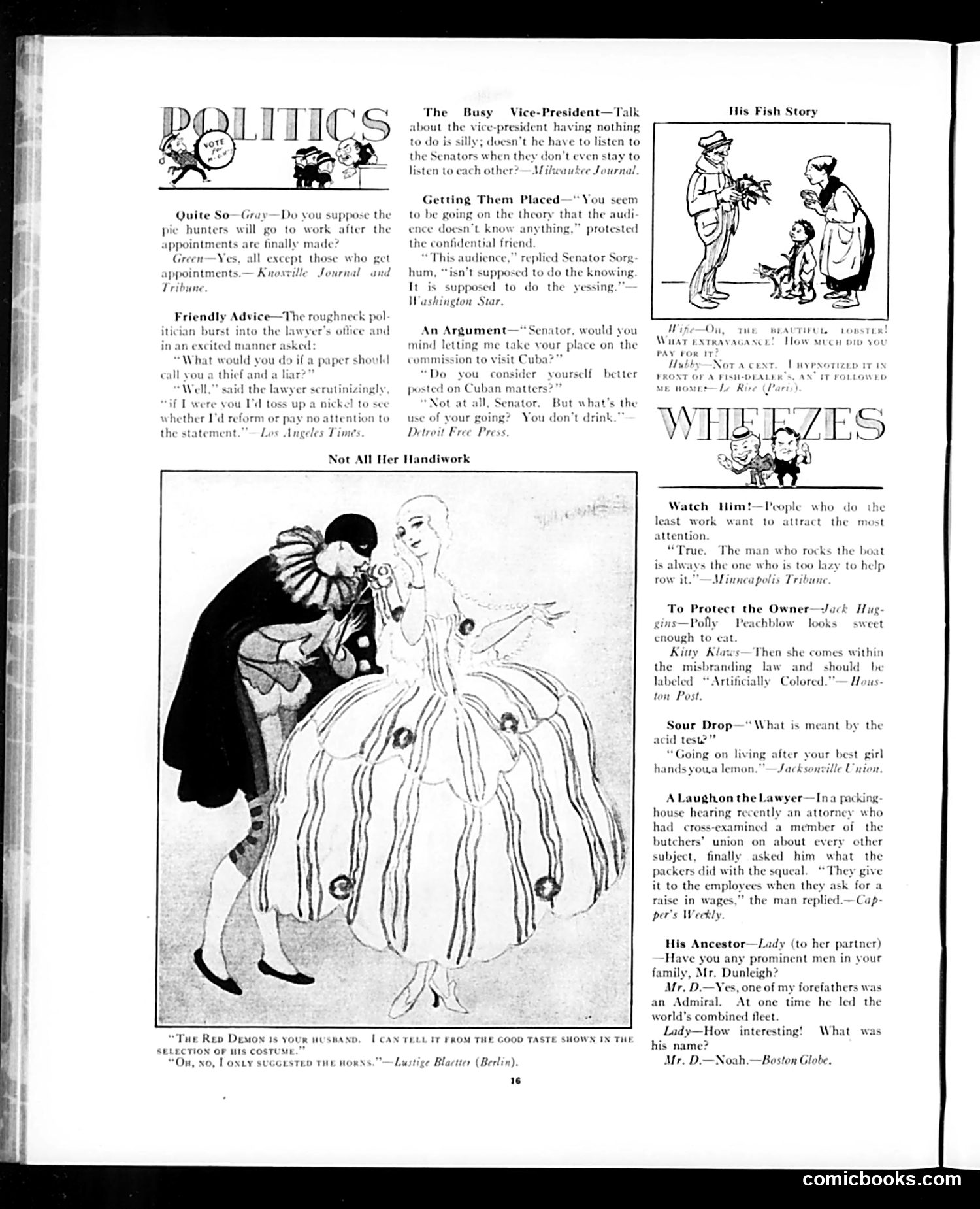
This page collects political humor and jokes typical of early 20th-century American satire. Key items: **"The Busy Vice-President"** mocks the vice presidency as ceremonially useless—the VP must listen to senators who don't listen to each other. **"Getting Them Placed"** satirizes audience expectations: a senator argues audiences aren't supposed to *know* anything, only applaud ("yessing"). **"An Argument"** depicts a senator offering another senator a Cuban commission post, with the jab that the senator "doesn't drink"—implying Cuban travel was associated with vice. **"Not All Her Handiwork"** (large cartoon) shows a woman presenting her elaborately dressed husband, joking she only "suggested the horns"—a cuckold reference implying infidelity. **Various quips** mock lawyers, laziness, and social pretension. "His Ancestor" ends with a Noah joke—the admiral led "the world's combined fleet" (animals on the ark). The humor relies on period assumptions about politics, gender, marriage, and class status now requiring historical context.
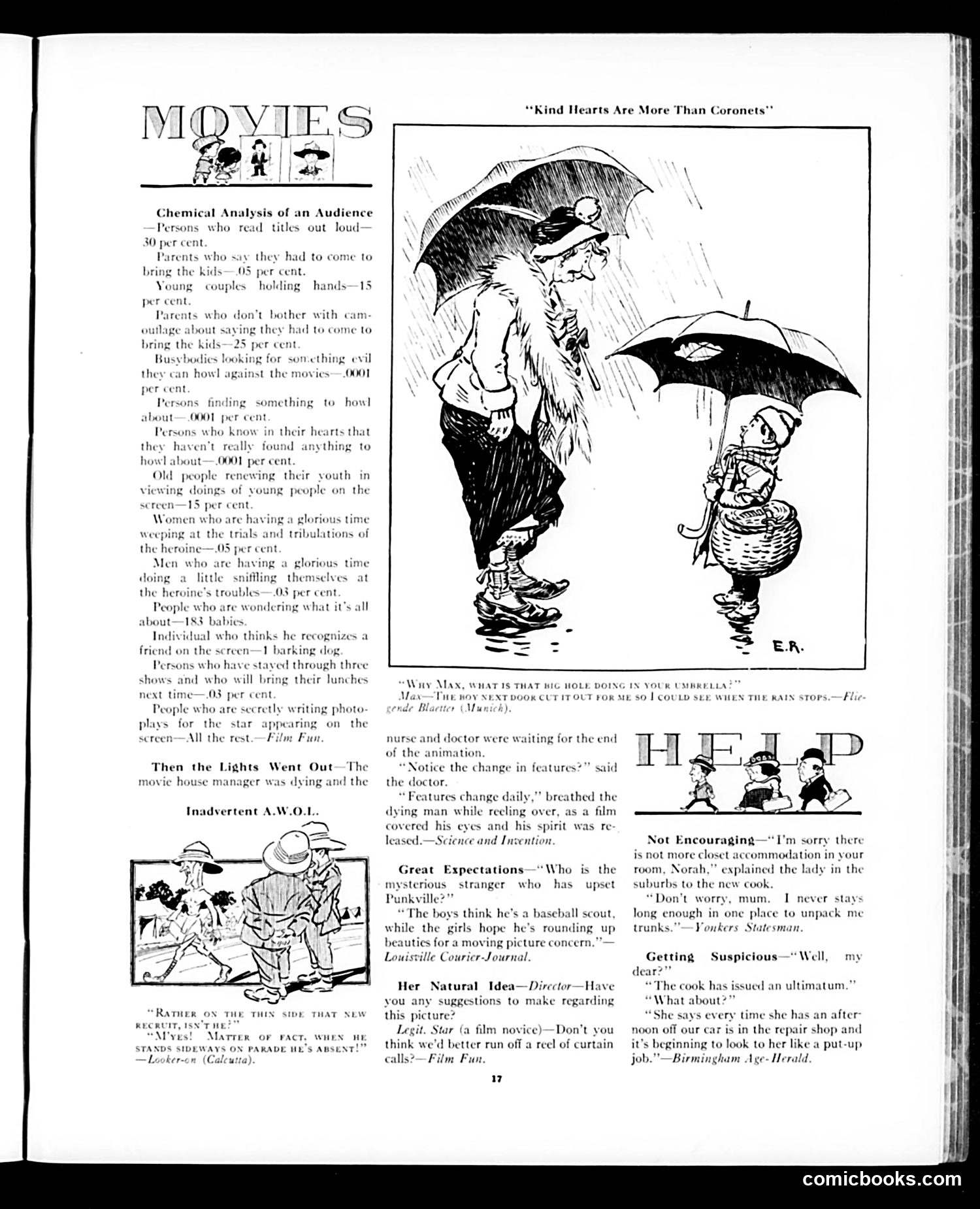
This page from *Judge* magazine satirizes early cinema culture. The main content is a humorous "Chemical Analysis of an Audience"—a mock-scientific breakdown of moviegoers' types and percentages. It pokes fun at various audience behaviors: parents dragging children along, couples holding hands, people reading titles aloud, elderly folks reliving youth, and women crying at heroines' troubles. The cartoons supplement this theme. "Kind Hearts Are More Than Coronets" depicts a shabby man protecting a child from rain—contrasting humble kindness with royal pretension (the title references nobility). "Inadvertent A.W.O.L." jokes about a thin military recruit being literally absent when standing sideways on parade. The scattered anecdotes mock film industry naiveté—actors suggesting "curtain calls" in movies, directors unfamiliar with cinema conventions, and dying men literally animated by film reels. The satire targets both cinema's newness and audiences' unsophisticated responses to this emerging medium.
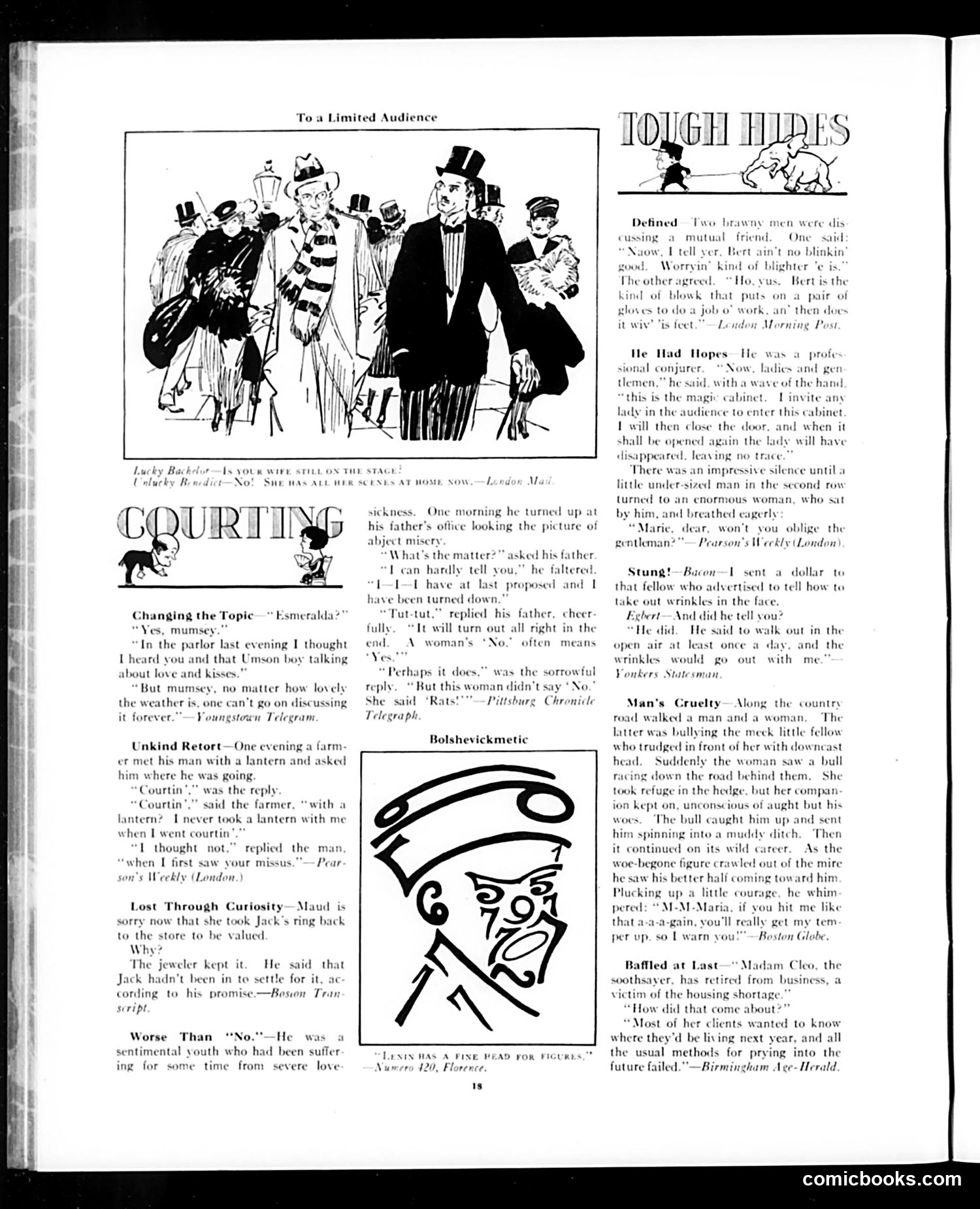
This page contains multiple humorous anecdotes and cartoons typical of early 20th-century satirical humor. The main content includes: **"To a Limited Audience"**: A cartoon showing well-dressed men in top hats, likely satirizing exclusive social circles or theater audiences. **Courting Anecdotes**: Several jokes about romance and marriage, including a farmer's quip about courtship without a lantern, and a rejected suitor told "Rats!" instead of "No"—playing on the period's social conventions where women supposedly used indirect rejections. **"Bolshevickmetic"**: A caricature labeled "Lenin has a fine head for figures," a topical reference to Lenin and Bolshevik math/ideology—contemporary Cold War-era anti-communist satire. **Miscellaneous Jokes**: Including a magician's assistant vanishing trick, beauty advice, and domestic humor about a nagging wife and a bullied husband. The humor reflects working and upper-class social anxieties of the era: courtship rituals, marriage dynamics, socialism, and class distinctions. Most jokes rely on period-specific gender roles and social expectations now largely obsolete.
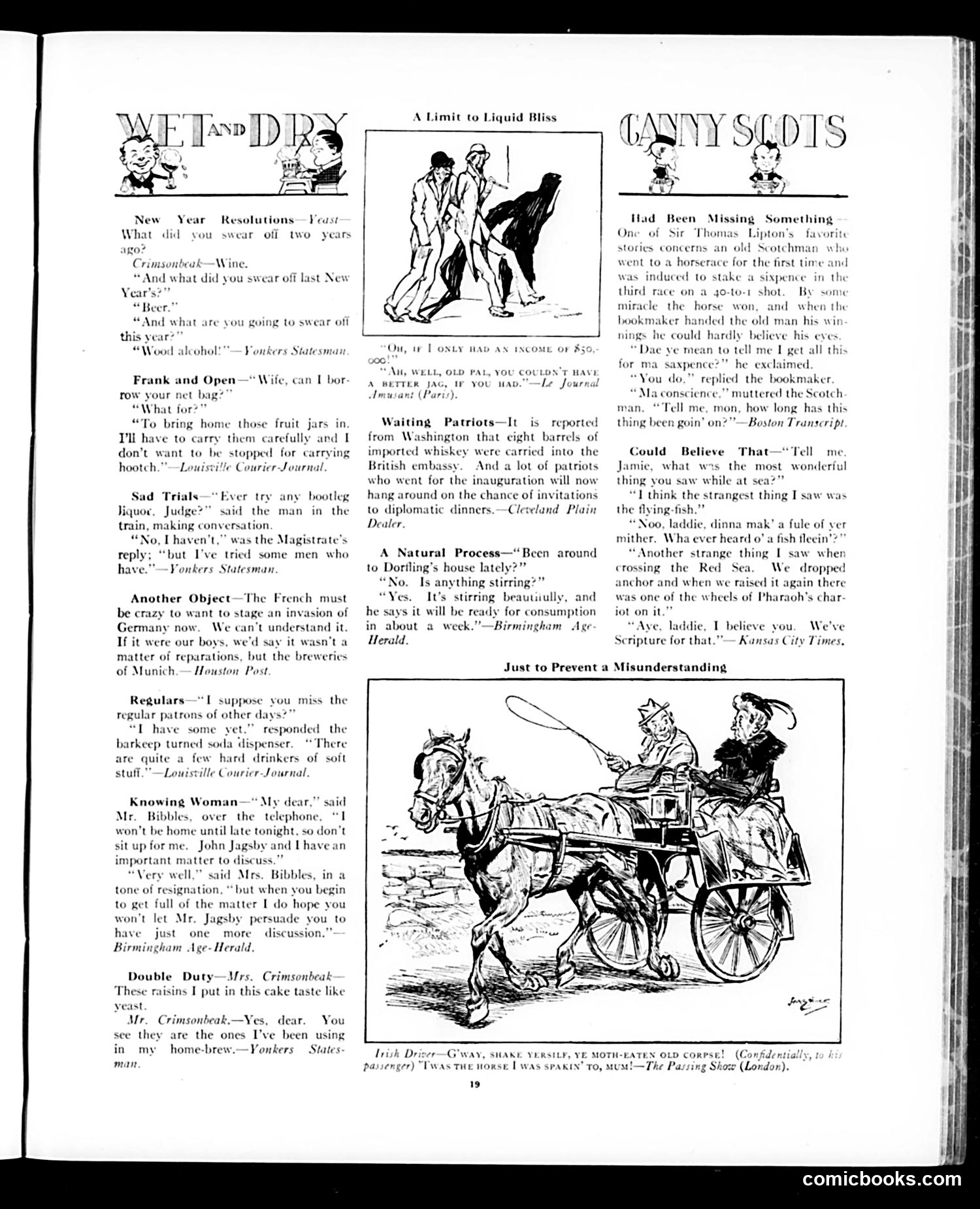
This page satirizes **Prohibition-era bootlegging and drinking culture** (1920s America, after the 18th Amendment). The jokes mock: - **Drinking as a "New Year's Resolution"**: Men swearing off alcohol types (wine, beer, "wood alcohol") only to resume—the absurdity of Prohibition's unenforceable ban - **Bootleg operations**: References to homemade "hootch," fruit jars for transporting illegal liquor, and bribing police - **Diplomatic hypocrisy**: Eight barrels of whiskey smuggled into the British embassy while officials publicly oppose drinking - **Home-brewing**: Families using raisins for illegal fermentation ("home-brew") - **Social commentary**: Even soda dispensers miss their old drinking customers The central cartoon depicts an Irish cart driver confronted by an official—likely about transporting contraband alcohol. His excuse—blaming the horse, not himself—captures the era's widespread evasion of Prohibition laws. The page's consistent theme: ordinary citizens, officials, and immigrants all circumvent Prohibition through humor and ingenuity, suggesting the law was widely ignored and culturally untenable.
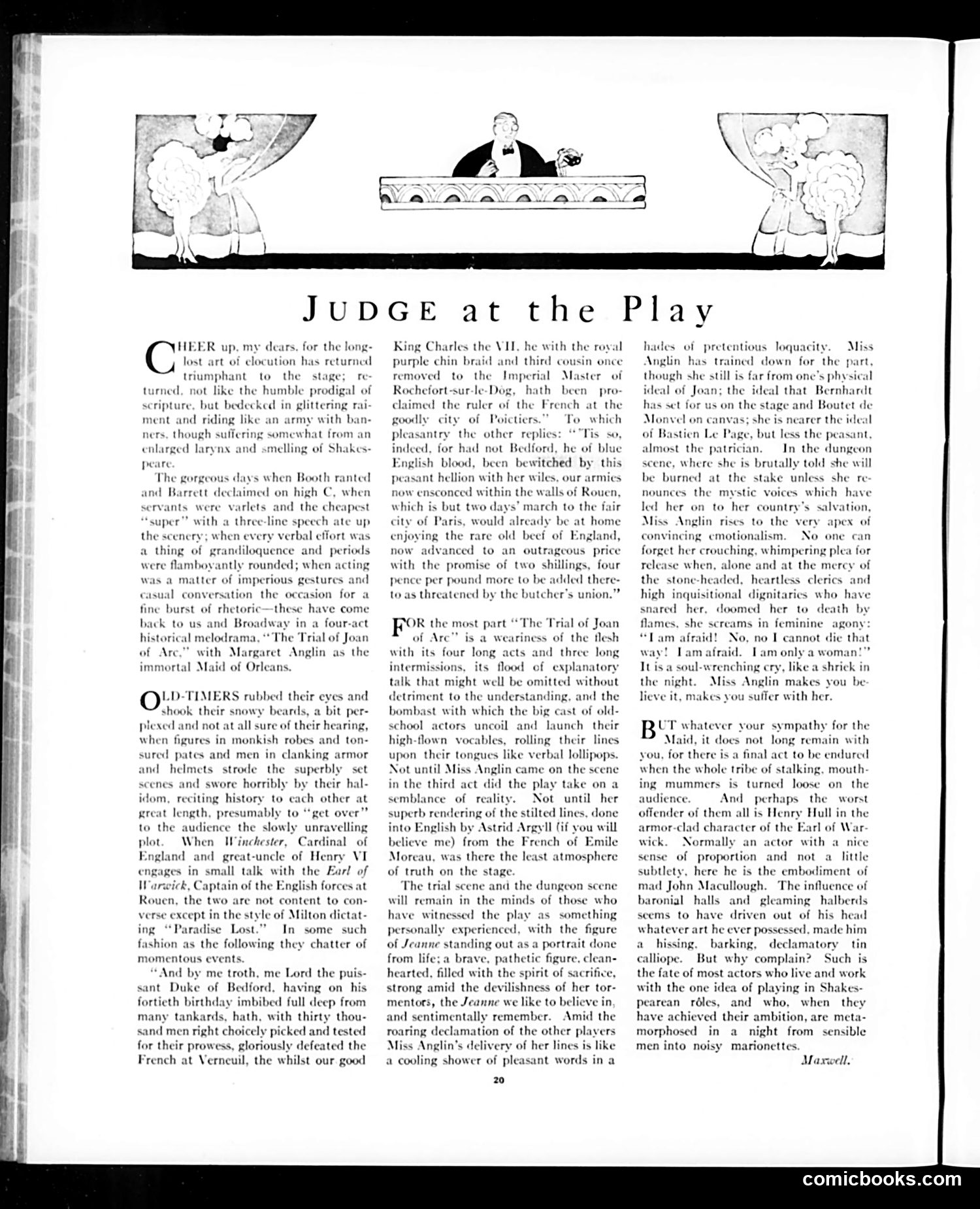
This theater review critiques Margaret Anglin's performance in a historical melodrama about Joan of Arc. The illustration shows a judge presiding over the play—a visual pun on "Judge" magazine reviewing theater. The satire targets old-fashioned, bombastic acting styles. The reviewer mocks the play's overwrought dialogue and excessive theatricality: characters speak in grandiose, Miltonic language even during casual conversation, inflating trivial matters (like butcher prices) into pseudo-historical pronouncements. The text ridicules "old-school actors" who deliver lines with exaggerated vocal flourishes and grand gestures. However, the review praises Anglin's performance in the third act, finding her portrayal of Joan authentic and moving—a "brave, pathetic figure"—finally bringing realism to the overstuffed production. The underlying critique is of theater that privileges ornate elocution and theatrical convention over genuine human emotion and truth.
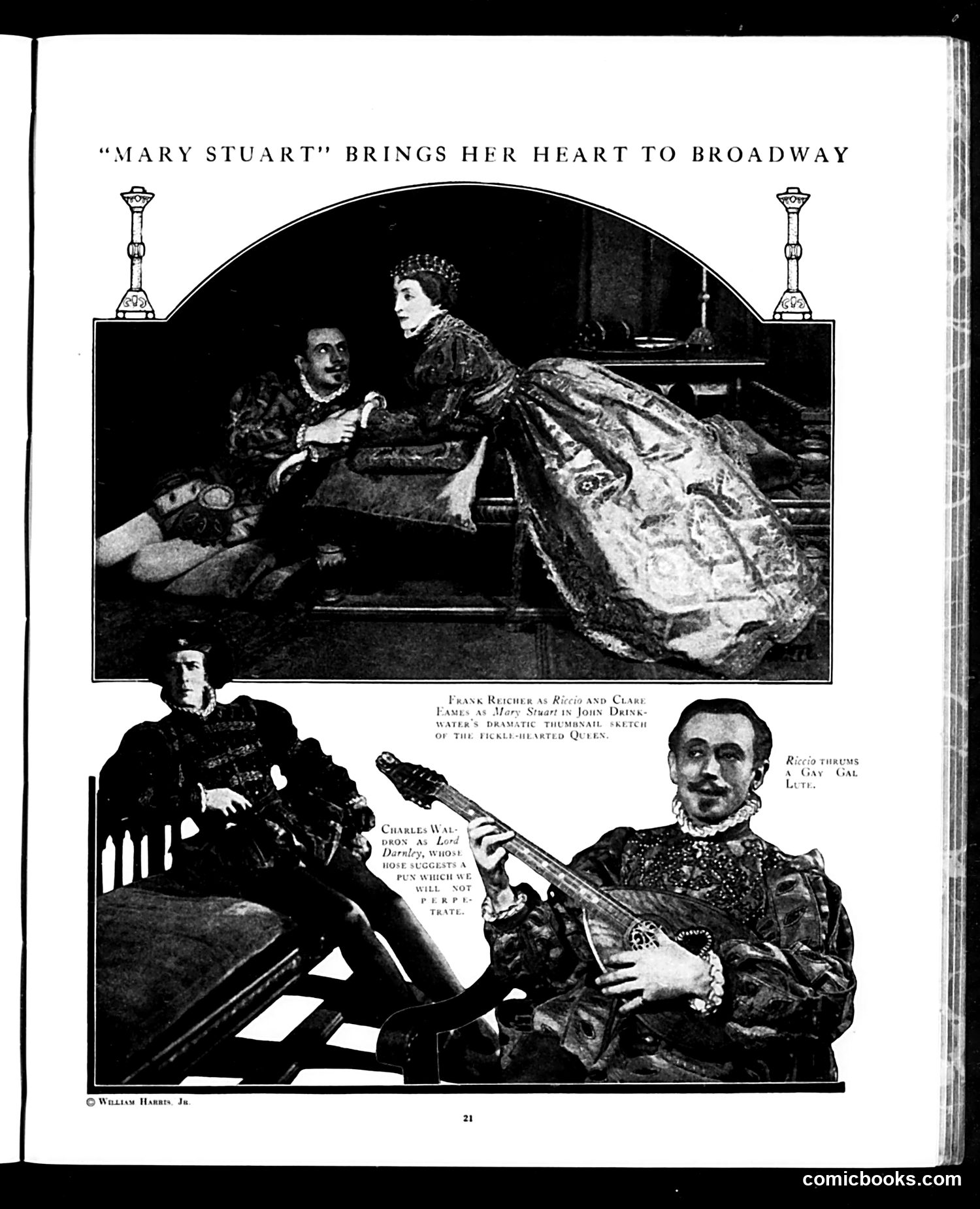
This page promotes a theatrical production of *Mary Stuart* (likely Schiller's classic play about the Scottish queen). The headline announces the work is coming to Broadway. The main image shows two costumed actors in an ornate palace setting—a man reclining and a woman in elaborate dress and tiara, presumably depicting Mary Stuart and a male character from the play. Below are portraits of cast members: Frank Reichter as Riccio and Clare Eames as Mary Stuart (with text noting John Drinkwater adapted it); Charles Waldron as Lord Burghley; and another actor identified as performing a comedic role ("thrums a Gay Lute"). The satire appears gentle—promoting the serious Shakespearean-era drama while acknowledging theatrical conventions of the era. Without a date visible, the specific production year remains unclear.
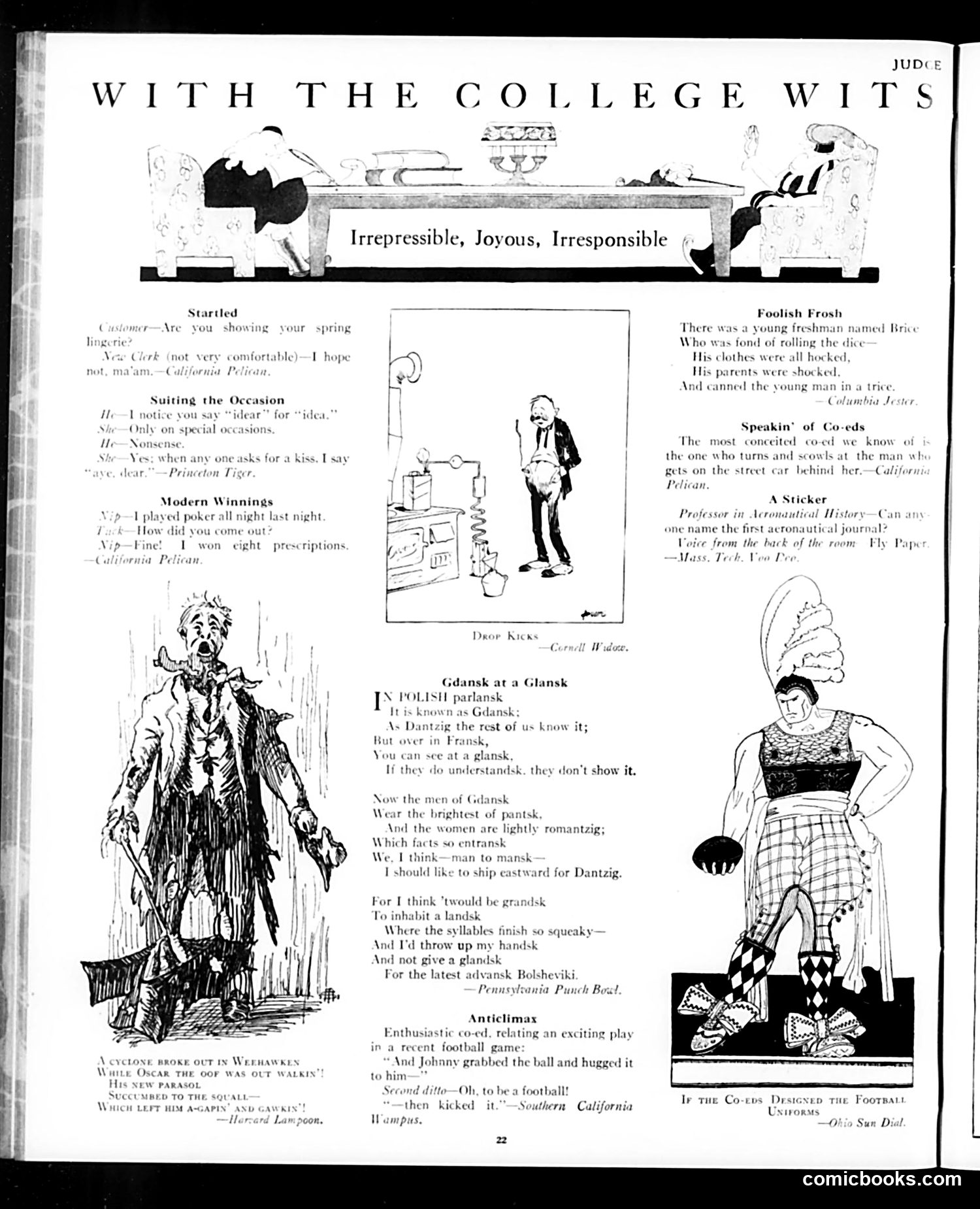
This is a humor page featuring college-themed jokes and comic sketches typical of early 20th-century satirical magazines. The content includes: **College Stereotypes**: Brief comedic dialogues mocking typical college students—the anxious freshman gambling away his clothes, the co-ed obsessed with romance, the professor annoyed by student questions. **"Gdansk at a Glansk"**: A playful poem mocking the difficulty of pronouncing Polish place names (Gdansk/Dantzig), popular humor when Eastern European immigration was high and their languages seemed comically foreign to American readers. **Miscellaneous Jokes**: Including a pun about a man's umbrella failing in a cyclone ("succumbed to the squall"), and an "anticlimax" joke about football. **Visual Humor**: Cartoons accompanying the text—a disheveled man, a fashionable co-ed in plaid skirt, etc. The page reflects period anxieties about college life, immigration, and changing gender roles (the independent co-ed), presented through crude stereotypes and wordplay typical of Judge's appeal to educated, mildly conservative readers.
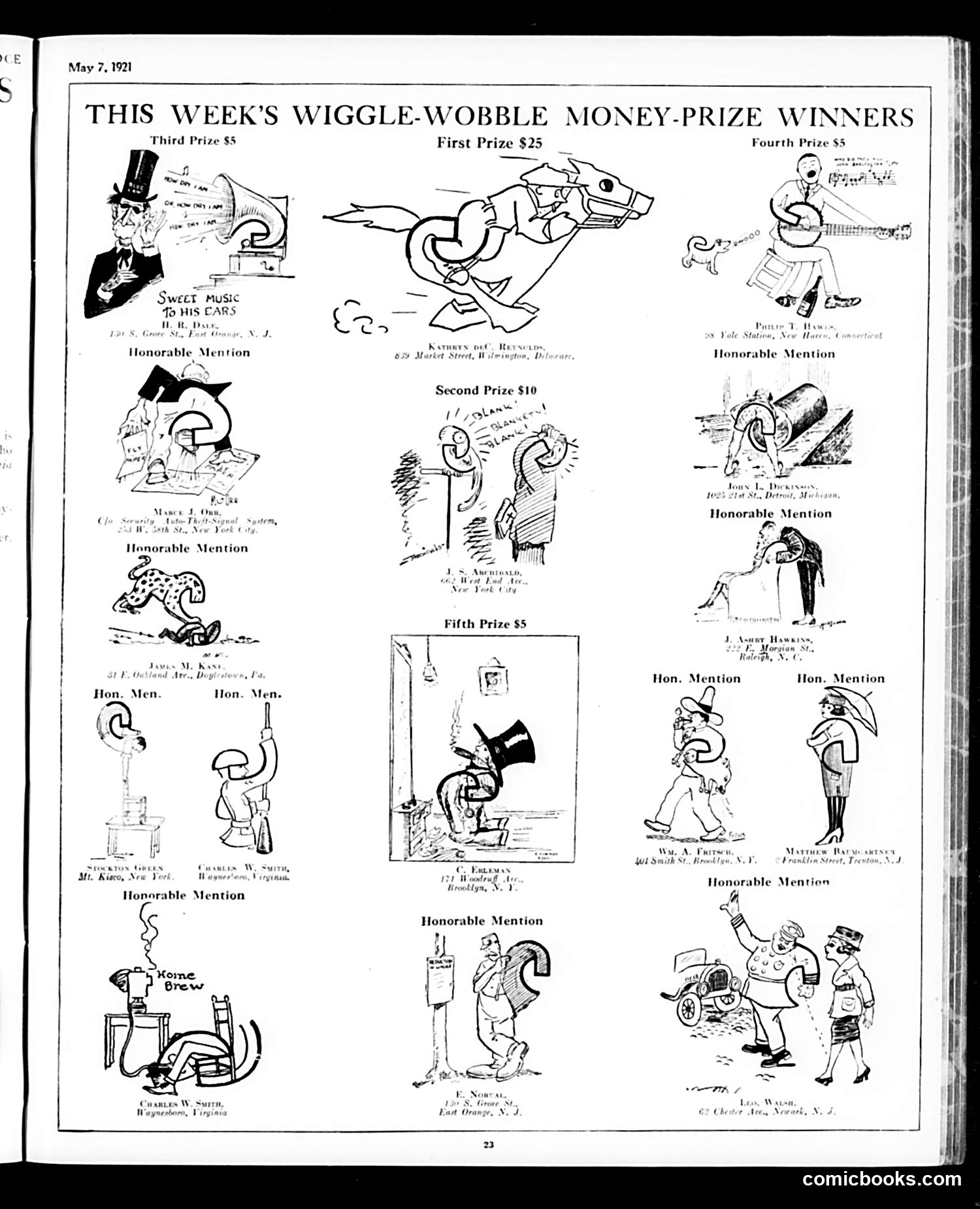
This page showcases winning entries from Judge magazine's "Wiggle-Wobble" contest—a recurring feature where readers submitted humorous cartoon drawings, typically featuring surreal or exaggerated imagery centered on wiggly, squiggly lines as the primary visual element. The prizes ranged from $25 (first) down to $5 (third/fourth/fifth), with "Honorable Mention" recognizing additional submissions. Winners came from across America—New Haven, Wilmington, New York City, and elsewhere—suggesting this was a popular, nationwide participatory feature. The cartoons themselves show crude but inventive humor: musical instruments with contorted features, anthropomorphized objects, and absurdist scenarios. This reflects 1920s popular entertainment tastes—accessible, participatory, and emphasizing visual gags over complex satire. The contest essentially crowdsourced cartoon content from amateur contributors nationwide.
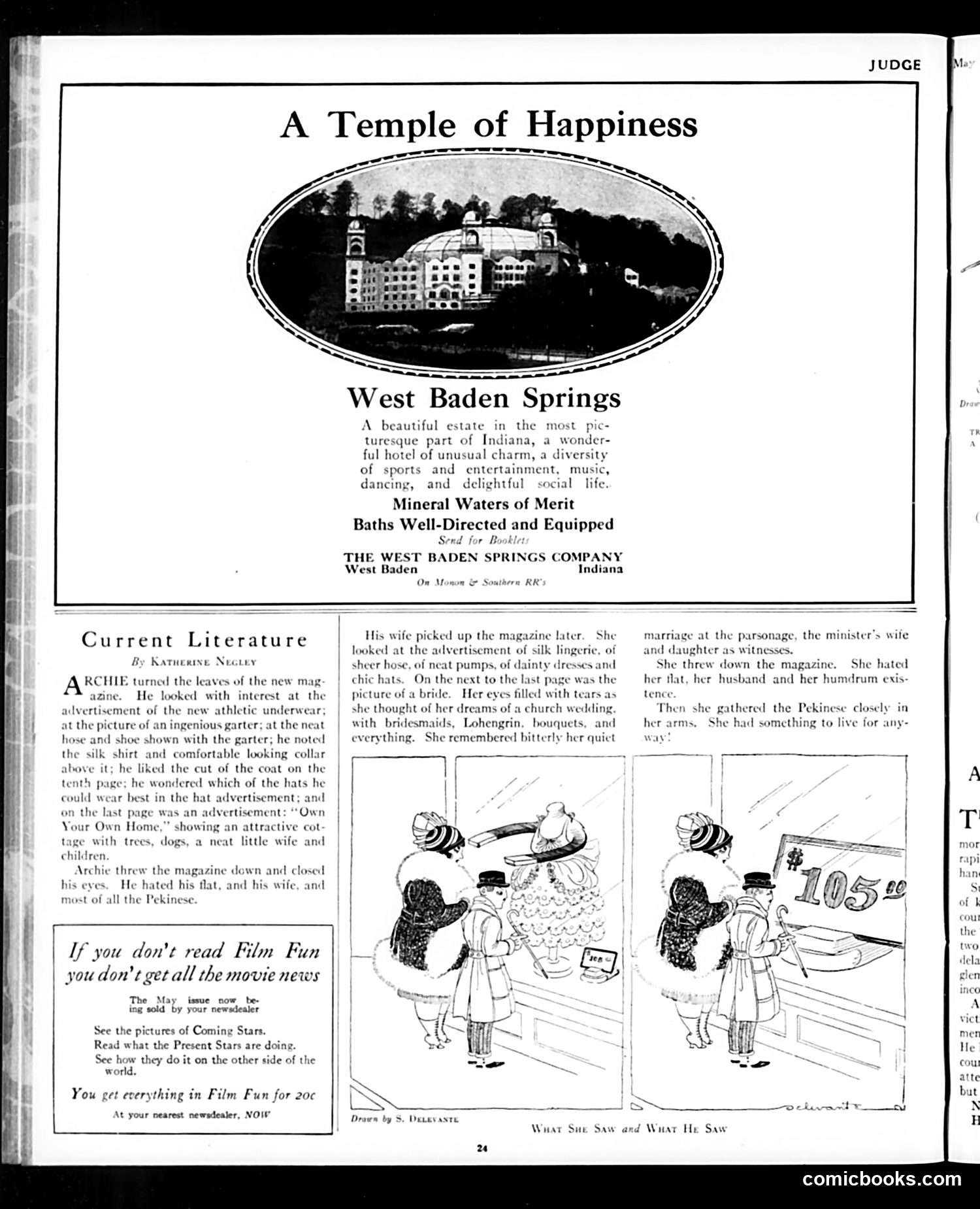
This page satirizes consumer magazine advertising and its psychological manipulation. The story "Current Literature" shows how advertisements create discontent: **The Satire:** Archie reads a magazine filled with ads for luxury goods and an attractive home. He becomes depressed about his actual flat and wife. His wife later reads the same magazine, sees ads for fine clothing and a bridal photo, and becomes miserable about her modest marriage and ordinary life. Both are dissatisfied not with reality, but with the *advertised* ideal. **The Point:** The cartoon criticizes how magazines—particularly through advertising—exploit readers' aspirations and insecurities, making them hate their real lives by constantly showing unattainable luxury. The Pekinese (a small dog, a status symbol of the era) represents the couple's only comfort. The page also advertises *Film Fun* magazine and West Baden Springs resort, ironically demonstrating the very advertising technique being mocked.
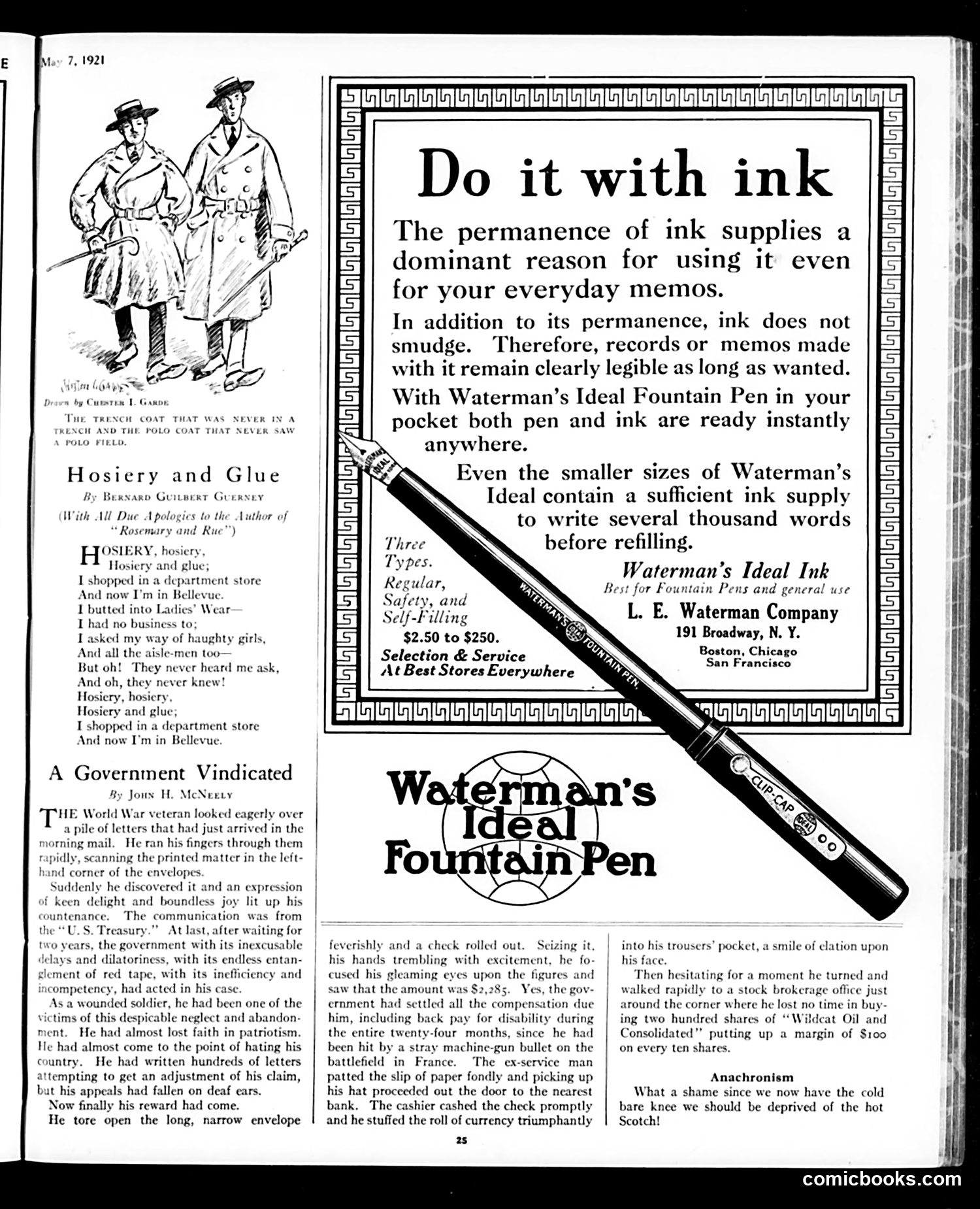
This page contains three distinct pieces: **"Hosiery and Glue"** (left): A humorous poem about a man who wandered into a women's department store asking directions, was ignored by salesgirls, and has ended up in Bellevue (a mental hospital). The joke satirizes the indifference of retail workers and the emasculation of appearing lost in a "ladies' section." **"A Government Vindicated"** (center): A satirical story about a WWI disabled veteran finally receiving his long-delayed $2,285 compensation check from the U.S. Treasury. The satire's bite comes at the end: instead of using compensation money responsibly, he immediately gambles it away on speculative "Wildcat Oil" stock, buying on margin. The title's irony is sharp—the government is "vindicated" only because the soldier's own poor judgment, not government competence, proves the real problem. **Advertisements**: Waterman fountain pen ads dominate the right side. The page's overall theme critiques American behavior and institutions in the post-war period.
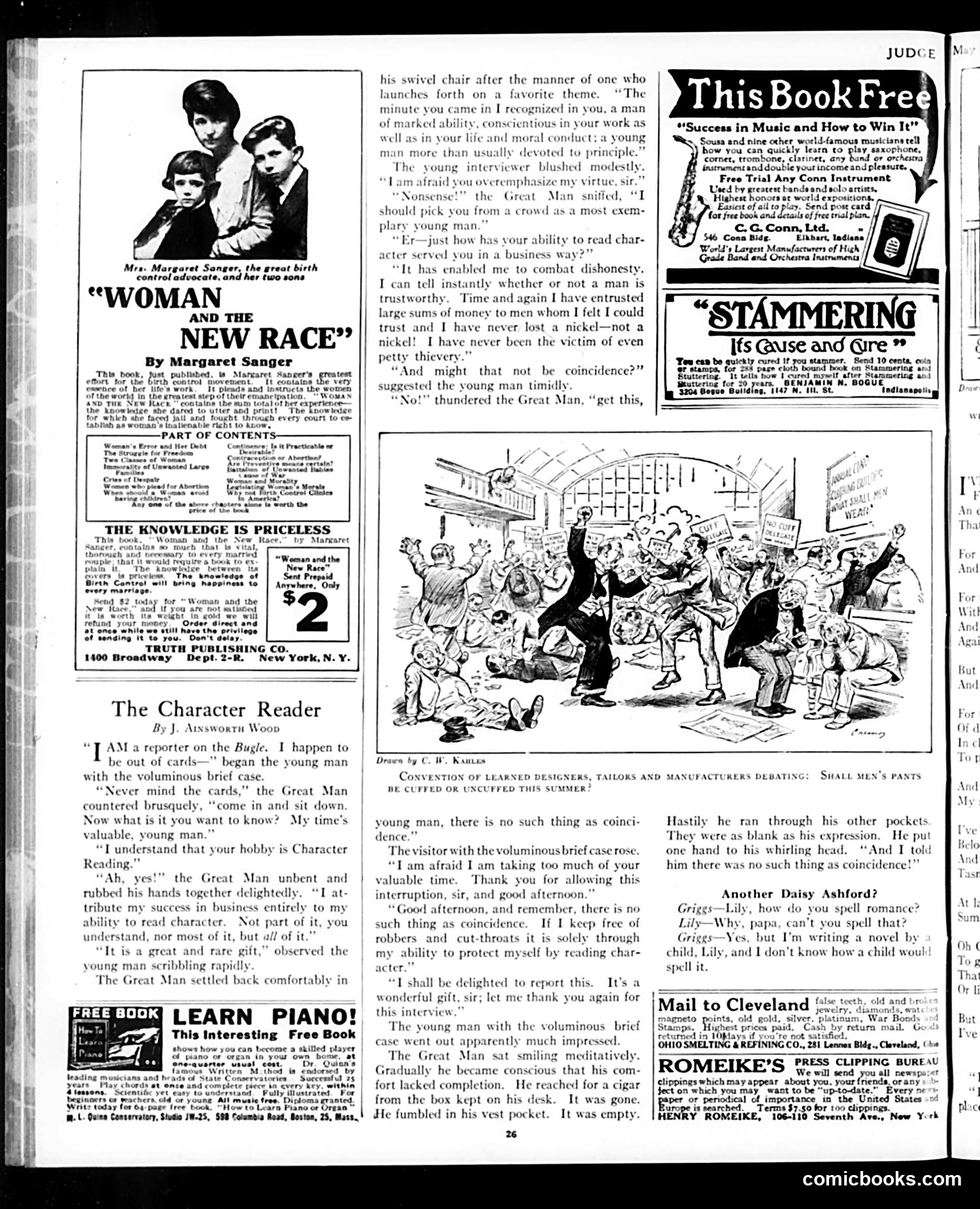
This page contains a book advertisement for Margaret Sanger's "Woman and the New Race"—a controversial work on birth control and reproductive rights. The ad emphasizes the book's radical claims about women's autonomy and education. The main cartoon depicts a convention of tailors and manufacturers debating whether men's pants should have cuffed or uncuffed bottoms that summer—a trivial fashion question treated with mock-serious formality. This satirizes how businessmen obsess over minor style details while ignoring substantive issues. The accompanying "Character Reader" story mocks self-important businessmen who claim supernatural ability to judge others' character and trustworthiness, yet attribute their success entirely to this supposed gift rather than luck or circumstance. The Great Man's refusal to acknowledge coincidence satirizes overconfident executives' inflated sense of their own judgment. Together, these pieces lampoon male vanity and pretension—particularly among business leaders—during an era when women were asserting new rights.
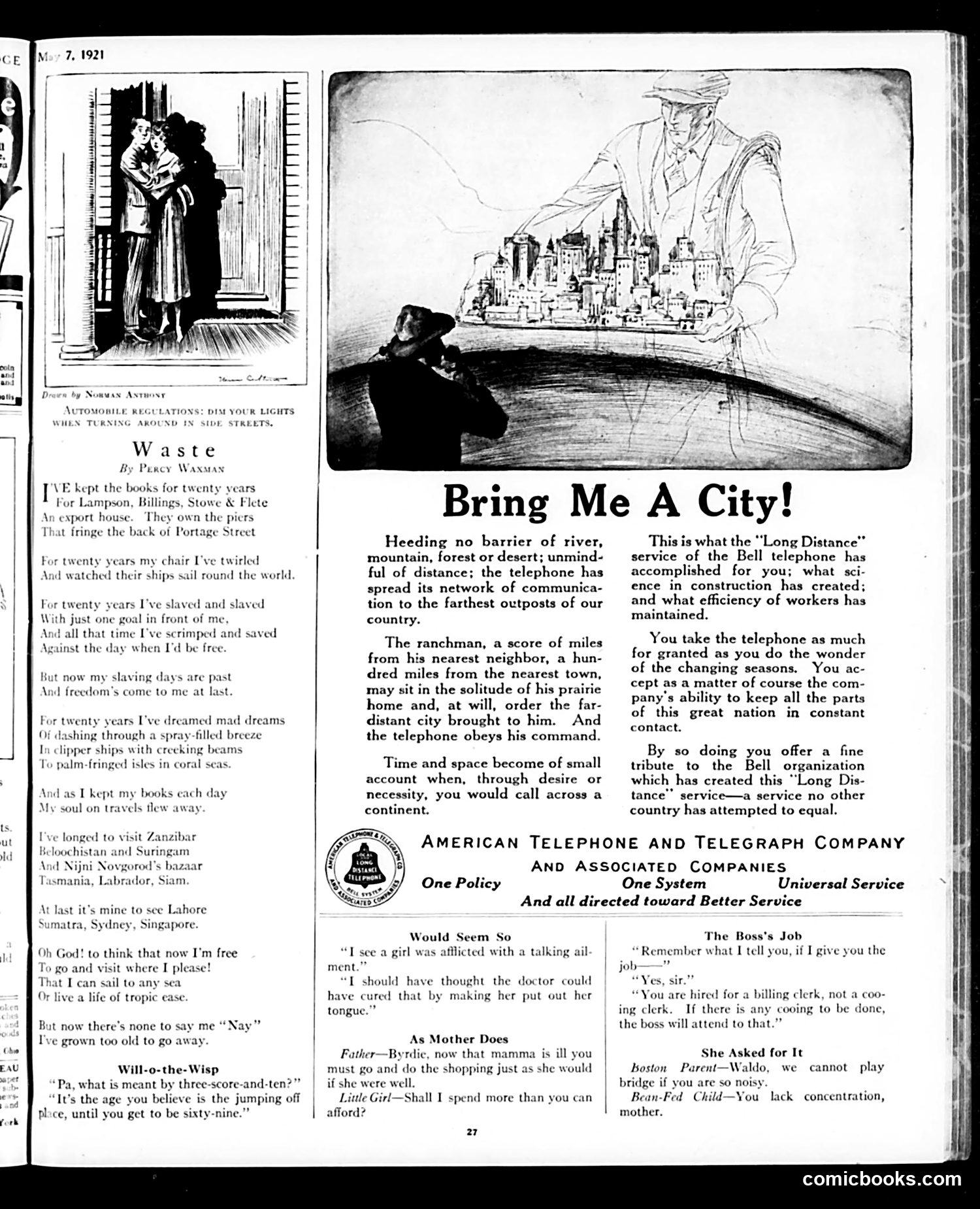
This page contains a poem titled "Waste" by Percy Waxman, accompanied by an automobile safety notice, and several separate comic items and advertisements. **The Main Poem "Waste"**: A satirical narrative about a bookkeeper who spent twenty years dreaming of exotic travel (Zanzibar, Siam, Labrador, etc.) while working diligently, sacrificing and saving. Finally achieving freedom from work, he realizes he's now too old to travel—his life's dreams wasted. The satire critiques the deferral of happiness in pursuit of financial security. **The Bell Telephone Advertisement** ("Bring Me A City!"): Celebrates the telephone's ability to connect remote locations (ranchers, distant towns) to urban centers, eliminating distance as a barrier. It's a straightforward corporate advertisement praising technological progress and the Bell system's monopoly. **Minor Comic Items**: Brief humor pieces including a doctor joke about a "talking ailment," a shopping scenario with a child, and workplace flirtation humor—typical light fare for the era. The page demonstrates Judge's mix of social commentary, advertising, and mild humor characteristic of early 1920s American periodicals.
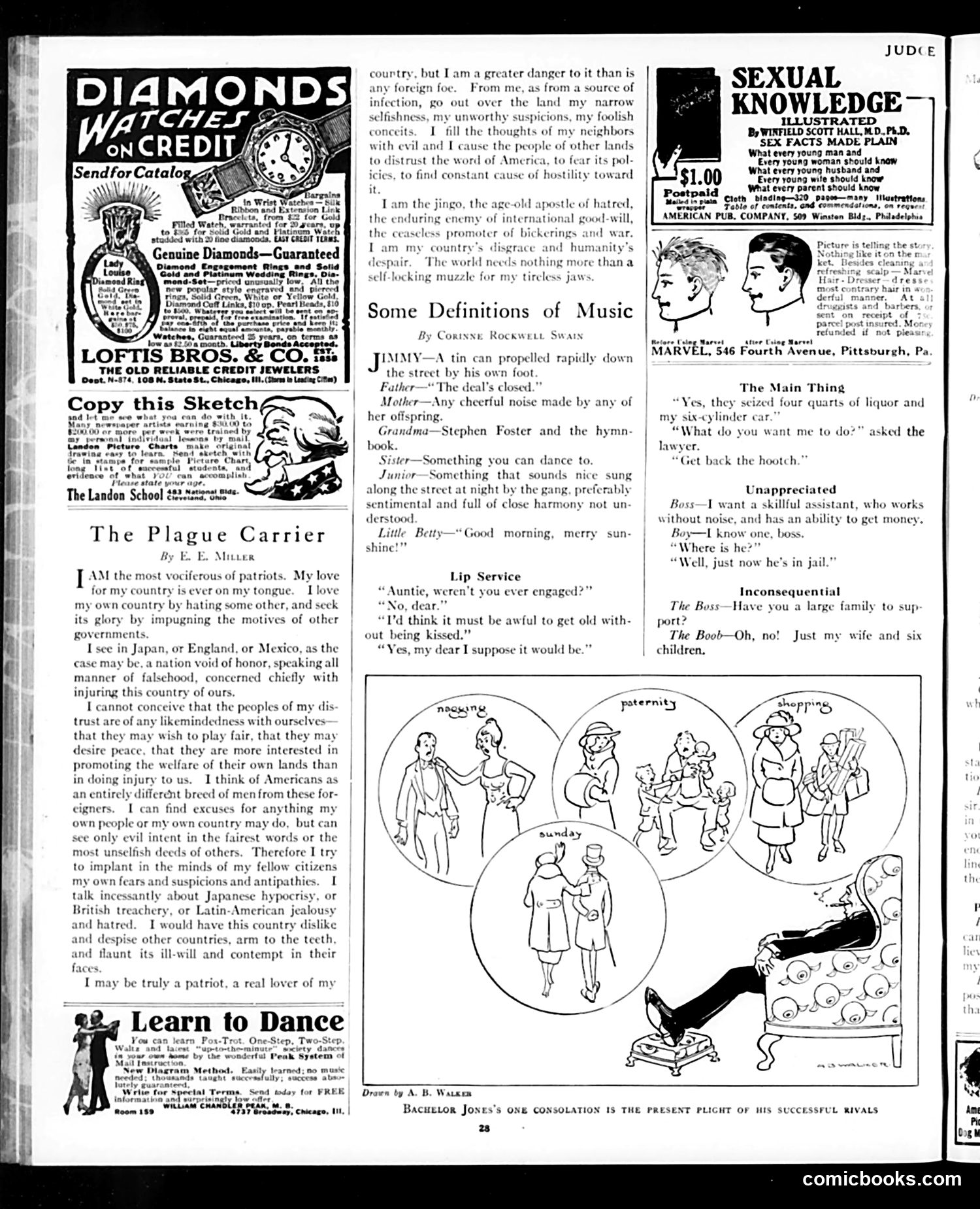
This page contains multiple satirical pieces and advertisements typical of early 20th-century Judge magazine. **"The Plague Carrier"** is the primary editorial content—a monologue by a character identifying himself as an inflammatory patriot and nationalist. He confesses to spreading suspicion of foreign nations (Japan, England, Mexico) and stoking xenophobic fear among Americans to boost national pride. The piece critiques jingoism as dangerous propaganda that harms international relations and America's reputation. He concludes by comparing himself to a "jingo," an "apostle of hatred" whose "tireless jaws" need muzzling. **"Some Definitions of Music"** offers humorous character sketches through how different family members define music—from the father's materialistic view to the grandmother's nostalgic references to Stephen Foster. Other brief humor items address Prohibition-era concerns (the seizure of liquor and cars) and workplace dynamics. The page reflects pre-WWI anxieties about nationalism and foreign policy through satire.
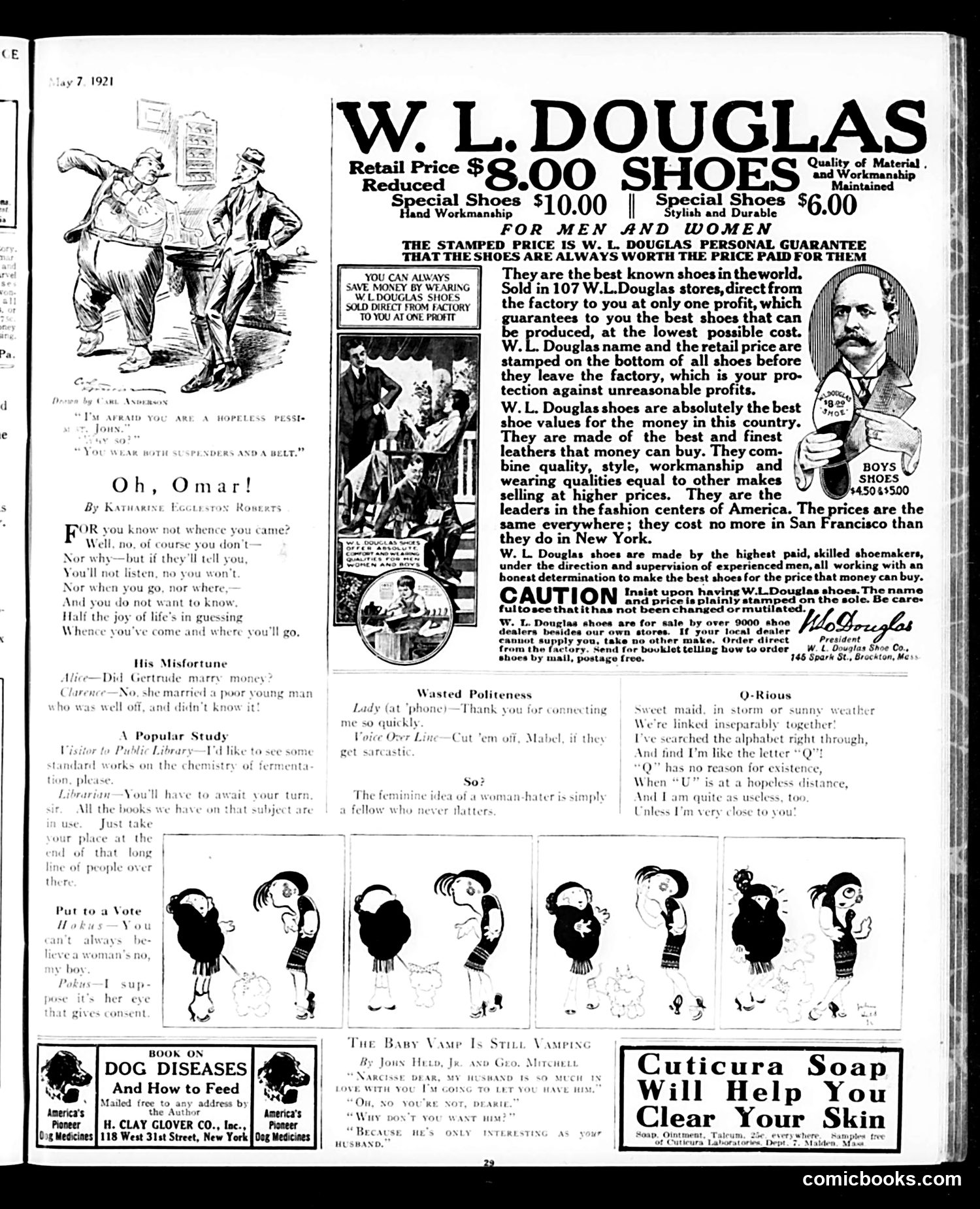
This page is primarily **advertising-driven**, dominated by a large W.L. Douglas Shoes advertisement. The shoe company uses marketing claims about factory-direct sales and quality control—stamping prices on soles to prevent markup fraud. The editorial cartoons and short humor pieces are secondary. The main cartoon, "Oh, Omar!" by Katharine Eggleston Roberts, references **Omar Khayyam's "Rubaiyat,"** using the Persian poet's fatalistic philosophy about the unknowability of life's origins and destinations as a framework for light domestic humor about uncertainty and marriage. Other brief comedic pieces include wordplay ("Q-Rious"), spousal miscommunication ("Wasted Politeness"), and voter apathy ("Put to a Vote"). A sequential comic strip titled "The Baby Vamp Is Still Vamping" depicts flirtation between characters. The page also advertises patent medicines (dog disease treatment) and Cuticura Soap for skin clarity—typical early 1920s commercial content mixed with satirical editorial material.
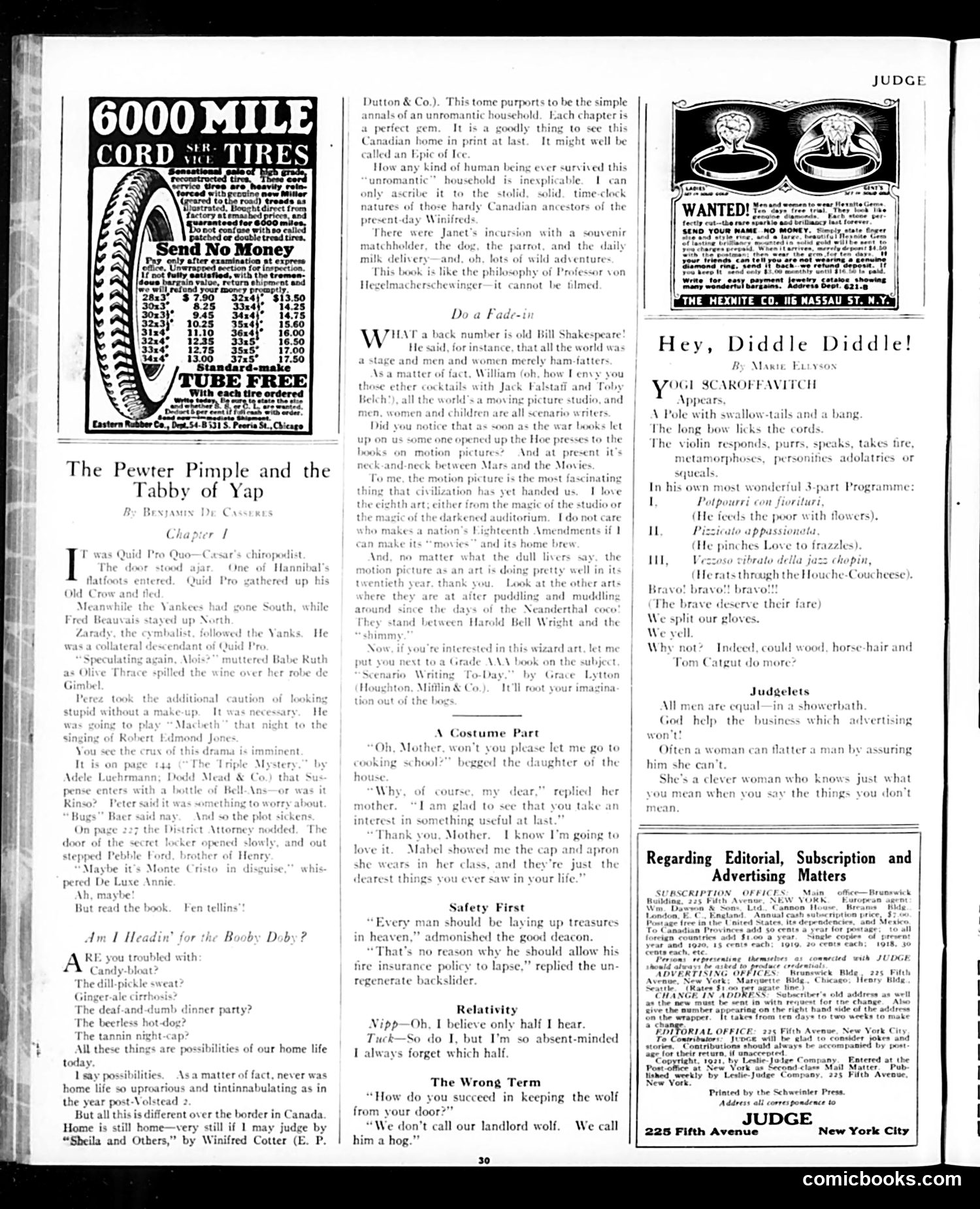
This page is primarily **literary and advertising content** rather than political cartoons. The main features are: **Content:** - "The Pewter Pimple and the Tabby of Yap" — a serialized domestic fiction story by Benjamin De Casseres about Canadian household life, featuring humorous domestic situations - "Hey, Diddle Diddle!" — a poem by Marie Elyson playing on the nursery rhyme, using musical imagery - Several humorous short sections ("Judgelets") with brief jokes about modern life: gender relations, advertising claims, landlords, etc. **The Social Satire:** The humor targets early 20th-century domestic tensions—wives managing households, husbands avoiding chores, landlord-tenant conflicts. The "Safety First" and "The Wrong Term" sections mock insurance rhetoric and euphemistic language around poverty. **Advertising:** Dominant left side features tire advertisements (6000-mile cord tires) and a "Wanted!" ad for people to send their names, typical of Judge's commercial content. The page reflects Judge's formula: entertainment blended with consumer advertising, targeting middle-class readers.
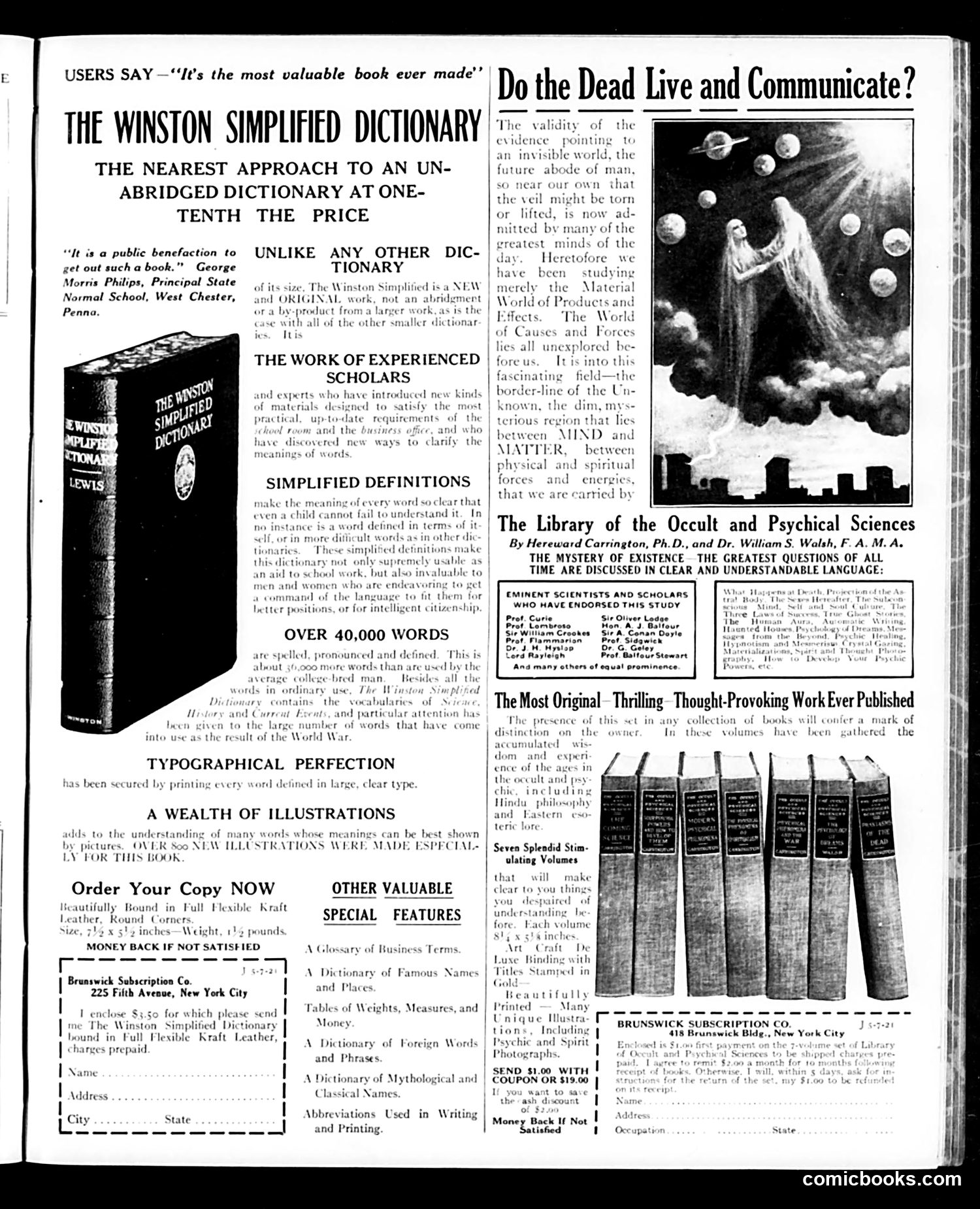
This page is primarily **advertising, not satire or political cartoon**. It contains two competing book advertisements rather than editorial content: 1. **Left side**: Promotes *The Winston Simplified Dictionary*—a condensed reference work positioned as affordable and practical for average readers, endorsed by educators. 2. **Right side**: Advertises *The Library of the Occult and Psychical Sciences*, a seven-volume set exploring spiritualism, communication with the dead, and paranormal topics. The header asks "Do the Dead Live and Communicate?"—reflecting early-20th-century fascination with spiritualism and séances. The juxtaposition is notable: a mainstream educational dictionary appears alongside occult literature, suggesting both were marketed to Judge's readers. There's no apparent satirical point—this reflects the era's genuine interest in spiritualism as a quasi-scientific pursuit, endorsed by "eminent scientists and scholars" (as claimed). **No identifiable political figures or satire is present.**
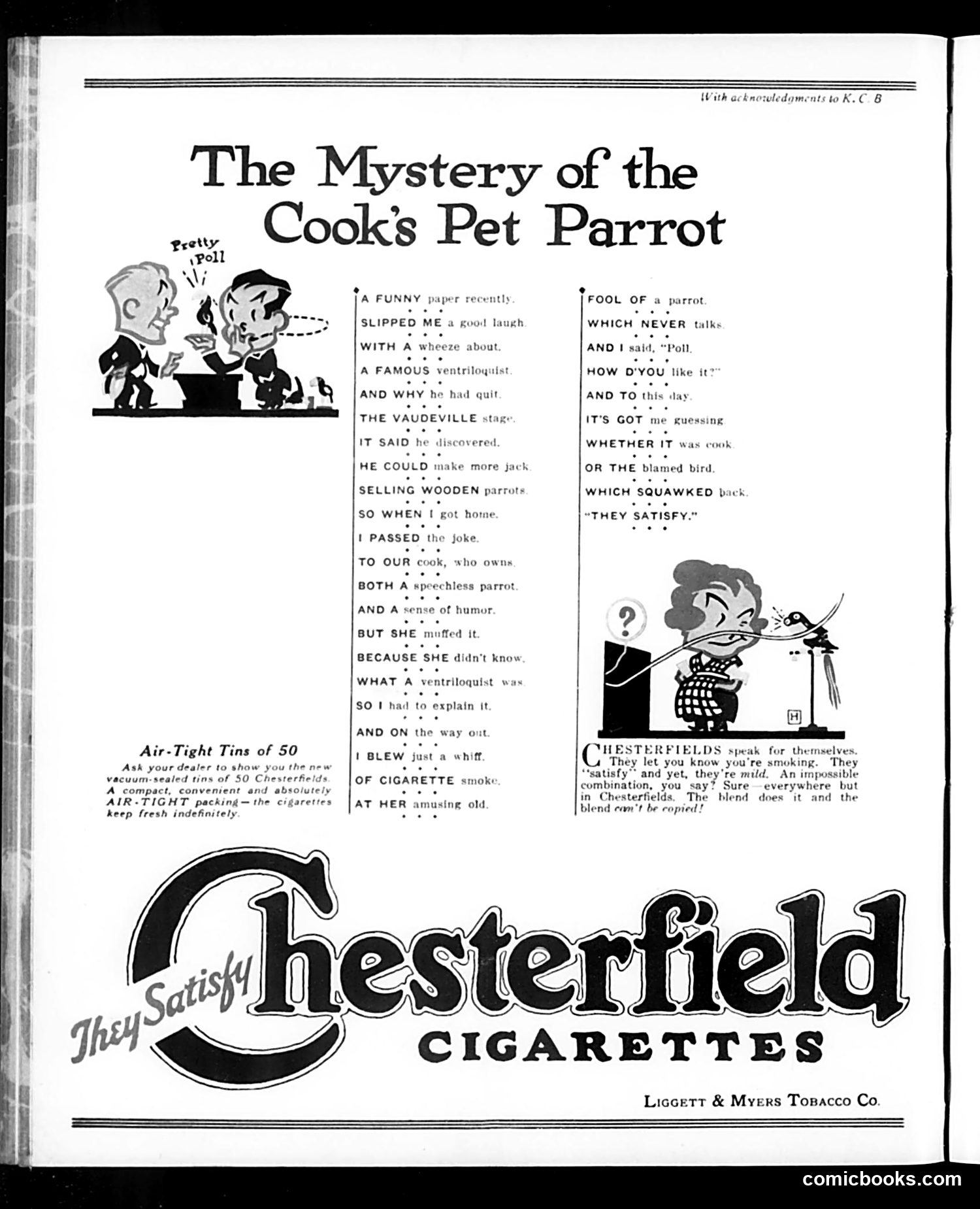
This is primarily a **Chesterfield cigarette advertisement** disguised as humor content in Judge magazine. The "mystery" joke: A man tells his cook a story about a ventriloquist who quit vaudeville to sell wooden parrots instead. She doesn't understand what a ventriloquist is, so he explains it. Later, he blows cigarette smoke at her silent parrot and says "Poll, how d'you like it?"—the parrot squawks back "They satisfy!" (a Chesterfield slogan). **The satire:** The cook can't determine whether the parrot actually spoke or if the man is ventriloquizing. This setup allows the ad to claim Chesterfields are so satisfying that even a parrot would endorse them. The accompanying text box mocks Chesterfield competitors, claiming other cigarettes are "mild" OR "satisfying" but never both—whereas Chesterfields uniquely achieve both qualities. It's vintage advertising-as-entertainment, using absurdist humor to embed the product pitch.