
Judge, 1921-05-07 · page 9 of 32
Judge — May 7, 1921 — page 9: what you’re looking at
What you’re looking at
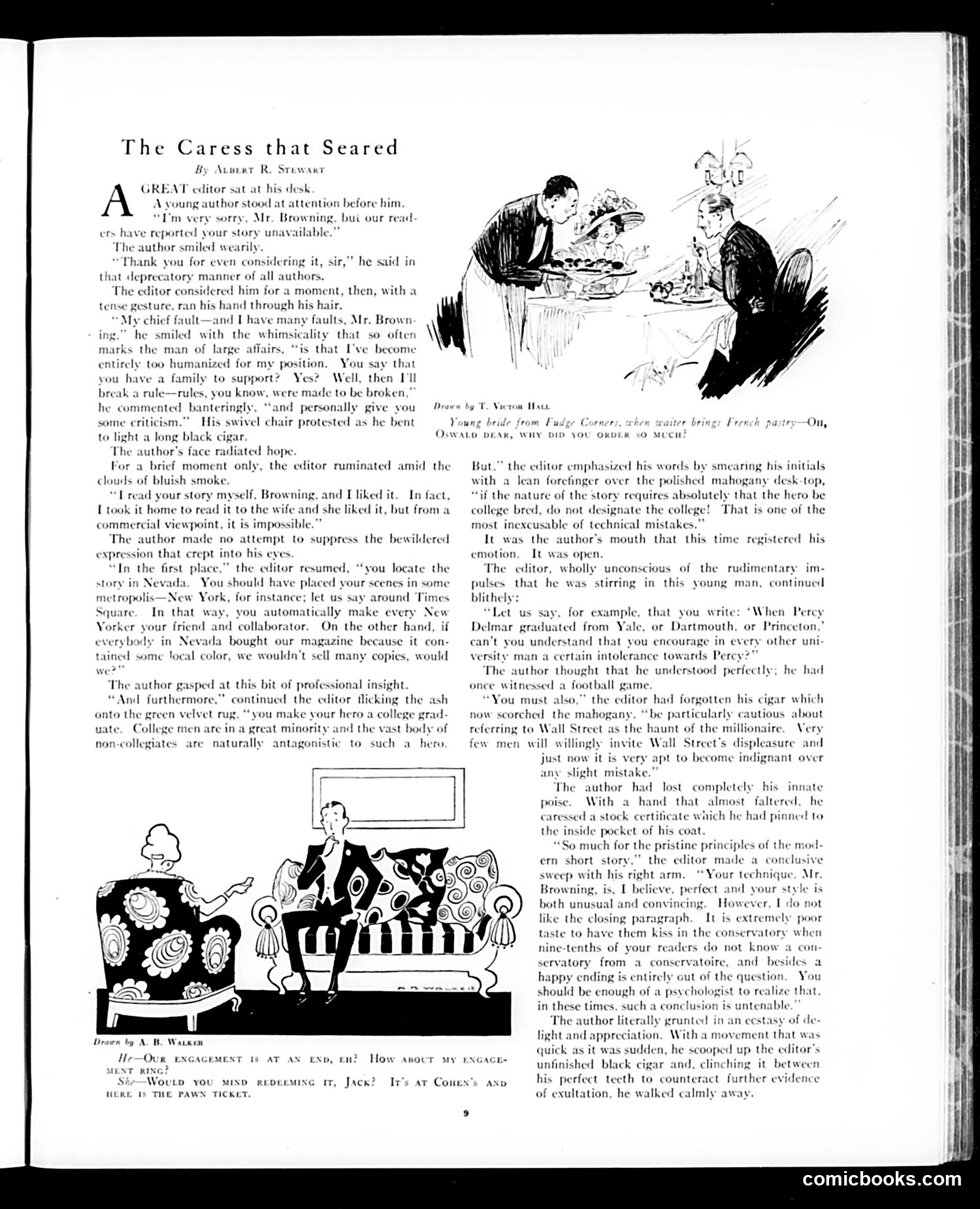
This story satirizes the editorial gatekeeping of early 20th-century magazine publishing. A young author submits a story to a powerful editor who claims to like it personally but rejects it for commercial reasons. The editor's objections reveal the absurd logic of mass-market magazine publishing: the story should be set in New York (to please New York readers), yet avoid depicting college graduates and Wall Street (to avoid alienating non-college readers and offending wealthy businessmen). The satire peaks when the editor insists the author *can* mention these places—just never actually *name* them as Yale, Dartmouth, Princeton, or Wall Street. The author's growing dismay (his "mouth...open") at these contradictory, self-serving rules illustrates how commercial interests corrupted literary integrity. The final image of him clutching a stock certificate suggests authors must compromise their principles to survive financially. This critiques both editorial cowardice and the crass commercialism that prioritized advertisers' sensibilities over authentic storytelling.
📄 Transcribed text from this page (OCR, searchable)
Machine-transcribed from the original scan — historical spelling and the odd misread are preserved.
s that Seared R. Stewart The Cares By GREAT editor sat at his desk A \ young author stood at attention before him. Mr. Browning, but our read crs have reported your story unavailable. The author smiled wearily. Thank you for even considering it, si that deprecatory manner of all authors. The editor considered him for a moment, then, with a tense gesture, ran his hand through his hair. “My chief fault—and I have many faults, Mr. Brown ing.” he smiled with the whimsicality that so often marks the man of large affairs, “is that I've entirely too humanized for my position. You say that you have a family to support? Yes? Well, then I'll break a rule—rules, you know, were made to be broken,’ he 1 banteringly, “and personally His swivel chair protested as he bent , \caret “T'm very sorry he said in become ymment Drawn some criticism.” to light a long black cigar. The author’s face radiated hope. For a brief moment only, the editor ruminated amid the clouds of bluish smoke. “Tread your story myself, Browning, and I liked it. In fact, [ took it home to read it to the wife and she liked it, but from a commercial viewpoint, it is impossible.” The author made no attempt to suppress the bewildered expression that crept into his eves. “In the first place.” the editor resumed, “‘you locate the ory in Nevada. You should have placed your scenes in some New York, for instance; let us say around Times nu automatically make every New Yorker your friend and collaborator. On the other hand, if everybody in Nevada bought our magazine because it con- tained some local color, we wouldn't sell many copies, would metropolis. Square. In that way, 5 we ‘The author gasped at this bit of professional insight. “And furthermore.” continued the editor flicking the ash onto the green velvet rug, “you make your hero a college grad. College men are in a great minority and the vast body of naturally such a uate. non-collegiates hero. are antagonistic to Drown by A.B. Wauwen He—Ovur ENT RING? Ss Wovurp you HERE Is THE PAWN ENGAGEMENT 18 AT AN END, En?) How anout sty MIND Mminc it, Jack? It’s ar Con TICKET, REDEL OswaLp DEAR, Wwity { T. Veevow Hsu Fudge ( Dip you ung bride from On, ORDER so MUCH But.’ the editor emphasized his words by smearing his initials with a lean forefinger over the polished mahogany desk-top, “if the nature of the Story requires absolutely that the hero be college bred, do not designate the college! That is one of the most inexcusable of technical mistakes.” It was the author's mouth that this time registered his emotion. It was open. The editor, wholly unconscious of the rudimentary im- pulses that he was stirring in this young man, continued blithely: “Let us say, for example, that you write: ‘When Perey Delmar graduated from Yale, or Dartmouth, or Princeton,” can’t you understand that vou encourage in every other uni versity man a certain intolerance towards Percy?” The author thought that he understood perfectly once witnessed a football game. “You must als the editor had forgotten his cigar which now scorched the mahogany, “be particularly cautious about referring to Wall Street as the haunt of the millionaire. Very few men will willingly invite Wall Street's displeasure nt to become indignant over had he and just now it is very any slight mistake. The author had poise. With a hand caressed a stock certificate ¥ the inside pocket of his coat. “So much for the pristine principles of the mod ern short story,” the conclusive sweep with his right arm. Browning, is, I believe, perfect and your style is both unusual and convincing. However, | do not like the closing paragraph lost that completely his innate alr faltered, he hich he had pinned to rst editor made a Your technique, Mr. It is extremely poor taste to have them kiss in the conservatory when nine-tenths of your readers do not know servatory from a conservatoire, and S happy ending is entirely out of the question. should be enough of a psychologist to realize that is untenable sy ¢ con besides a in these times, such a conclusi The author literally grunted in an eest ight and appreciation. With a movement that was quick as it was sudden, he scooped up the editor's unfinished black cigar and, clinching it between his perfect teeth to counteract further ev he walked calmly away. ENGACE= EX'S AND of exultation comicbooks.com