
Judge, 1921-05-07 · page 20 of 32
Judge — May 7, 1921 — page 20: what you’re looking at
What you’re looking at
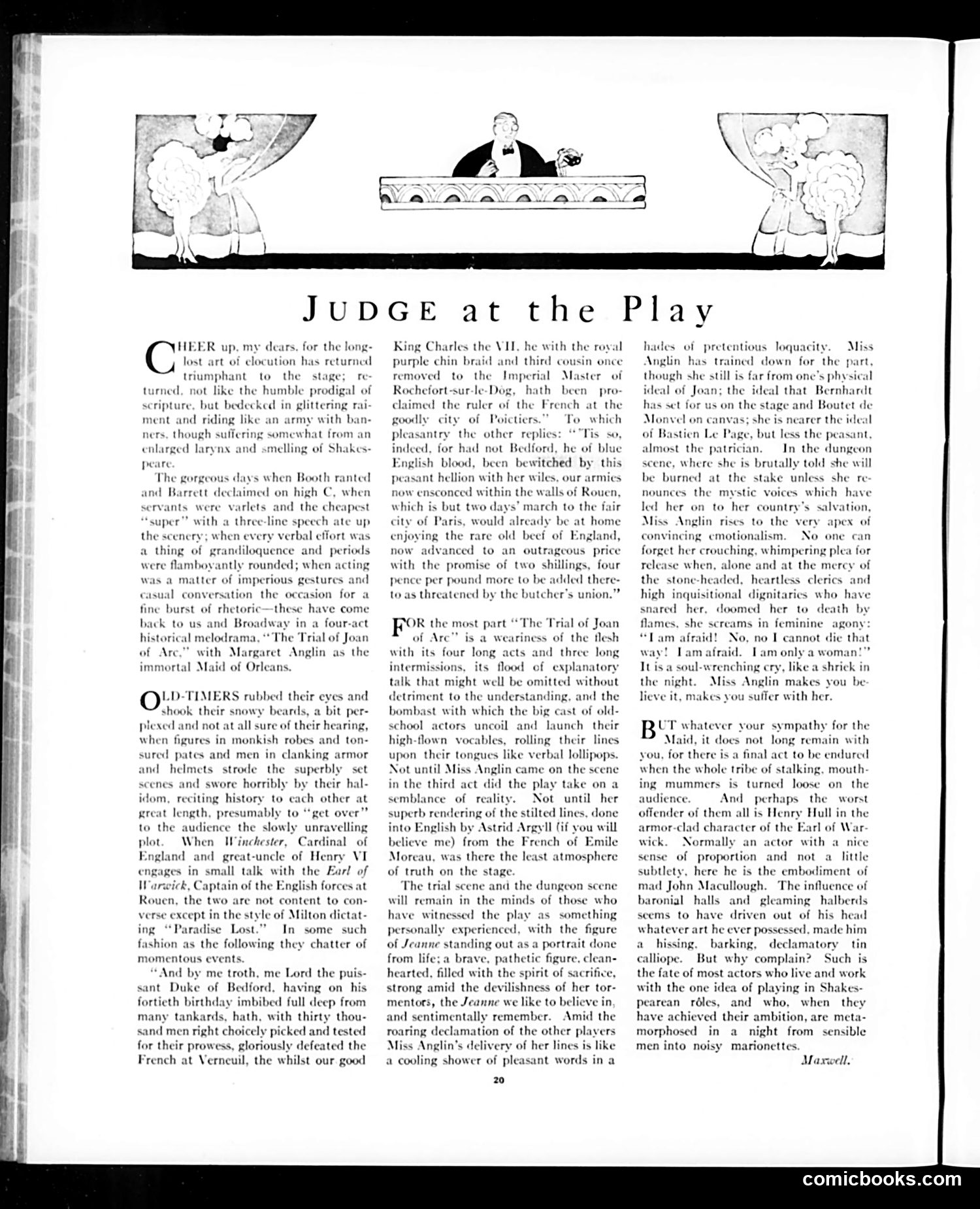
This theater review critiques Margaret Anglin's performance in a historical melodrama about Joan of Arc. The illustration shows a judge presiding over the play—a visual pun on "Judge" magazine reviewing theater. The satire targets old-fashioned, bombastic acting styles. The reviewer mocks the play's overwrought dialogue and excessive theatricality: characters speak in grandiose, Miltonic language even during casual conversation, inflating trivial matters (like butcher prices) into pseudo-historical pronouncements. The text ridicules "old-school actors" who deliver lines with exaggerated vocal flourishes and grand gestures. However, the review praises Anglin's performance in the third act, finding her portrayal of Joan authentic and moving—a "brave, pathetic figure"—finally bringing realism to the overstuffed production. The underlying critique is of theater that privileges ornate elocution and theatrical convention over genuine human emotion and truth.
📄 Transcribed text from this page (OCR, searchable)
Machine-transcribed from the original scan — historical spelling and the odd misread are preserved.
JUDGE at the Play HEER up, my dears, for the long- lost art of clocution has returned triumphant to. the not like the humble prodigal of scripture, but bedecked in glittering rai- id riding like an army with ban- ners, though suffering somewhat from an melling of Shakes- stage; re urned ment a enlarged larynx and peare The gorgeous day's when Booth ranted and Barrett declaimed on high C, when servants were varlets and the cheapest * with a three-line speech ate up twas “super the scenery; when every verbal eff a thing of grandiloquence and periods were flamboyantly rounded; when acting was a matter of imperious gestures and the occasion for a fine burst of rhetoric—these have come back to us and Broadway in a four-act historical melodrama, “The Trial of Joan of Are,” with Margaret Anglin as the immortal Maid of Orleans. casual conversation LD-TIMERS rubbed their eyes and shook their snowy beards, a bit per- plexed and not at all sure of their hearing, when figures in monkish robes and ton- sured pates and men in clanking armor and helmets strode the superbly set scenes and swore horribly by their hal- idom, reciting history to cach other at great length, presumably to ‘get over” to the audience the slowly unravelling plot. When Winchester, Cardinal of land and great-uncle of Henry VI engages in small talk with the Earl of Warwick, Captain of the English forces at Rouen, the two are not content to con- verse except in the style of Milton dictat- ing “Paradise Lost.” In some such fashion as the following they chatter of momentous events. “And me troth, me Lord the puis- sant Duke of Bedford, having on his fortieth birthday imbibed full deep from many tankards, hath, with thirty thou- sand men right choicely picked and tested for their prowess, gloriously defeated the French at Verncuil, the whilst our good King Charles the VII, he with the royal purple chin braid and third cousin once removed to the Imperial Master of Rochefort-sur-le-Dog, hath been claimed the ruler of the French at the goodly city of Poictiers.” To which pleasantry the other replies: indeed, for had not Bedford, he of L English blood, been bewitched by this nt hellion with her wiles. our armies now ensconced within the walls of Rouen, which is but two days’ march to the fair city of Paris, would already be at home pro- peas. enjoying the rare old beef of England, now advanced to an outrageous price with the promise of two shillings, four pence per pound more to be added there- to as threatened by the butcher's union. IR the most part “The Trial of Joan 4 Arc” is a weariness of the flesh with its four long acts and three long intermissions, its flood of explanatory talk that might well be omitted without detriment to the understanding, and the bombast with which the big cast of old- school actors uncoil and launch their high-flown vocables, rolling their lines upon their tongues like verbal lollipops. ot until Miss Anglin came on the scene in the third act did the play take on a semblance of reality. ot until her superb rendering of the stilted lines, done into English by Astrid Argyll (if vou will believe me) from the F Emile Moreau, was there the least atmosphere of truth on the stage. The trial scene and the dungeon scene will remain in the minds of those who have witnessed the play as something personally experienced, with the figure of Jeanne standing out as a portrait done from life; a brave, pathetic figure, clean- hearted, filled with the spirit of sacrifice, strong amid the devilishness of her tor- mentors, the Jeanne we like to believe in, and sentimentally remember. Amid the roaring declamation of the other players Miss Anglin’s delivery of her lines is like a cooling shower of pleasant words in a ench ¢ 20 hades of pretentious loquacity. Miss Anglin has trained down for the part, though she still is far from one’s physical ideal of Joan; the ideal that Bernhardt has set f son the stage and Boutet de Monvel on canvas; she is nearer the idea of Bastien Le Page, but less the peasant, almost the patrician. In the dungeon scene, where she is brutally told she will be burned at the stake unless she re nounces the mystic voices which have led her on to her country’s salvation, Miss convincing emotionalism forget her crouching, whimpering plea for release when, alone and at the mercy of the stone-headed, heartless clerics and high inquisitional dignitaries who have snared her, doomed her to death by flames, she sercams in feminine agony: “Tam afraid! No, no I cannot die that way! Lamafraid. Tam only a woman!” It is a soul-wrenching ery, like a shrick in the night. Miss Anglin makes you be lieve it, makes you suffer with her. Anglin rises to the very apex of No one can UT whatever your sympathy for the Maid, it does not long remain with you, for there is a final act to be endured when the whole tribe of stalking, mouth ing mummers is turned loose on the audience. And perhaps the worst offender of them all is Henry Hull in the armor-clad character of the Earl of War. wick. Normally an actor with sense of proportion and not a little subtlety, here he is the embodiment of mad John Macullough. The influence of baronial halls and gleaming halberds seems to have driven out of his head whatever art he ever possessed, made him a hissing. barking, declamatory tin calliope. But why complain? Such is the fate of most actors who live and work with the one idea of playing in Shakes- pearean réles, and who, when they have achieved their ambition, are meta- morphosed in a night from sensible men into noisy marionettes. Maxwell. nice comicbooks.com