
A complete issue · 32 pages · 1921
Judge — April 30, 1921
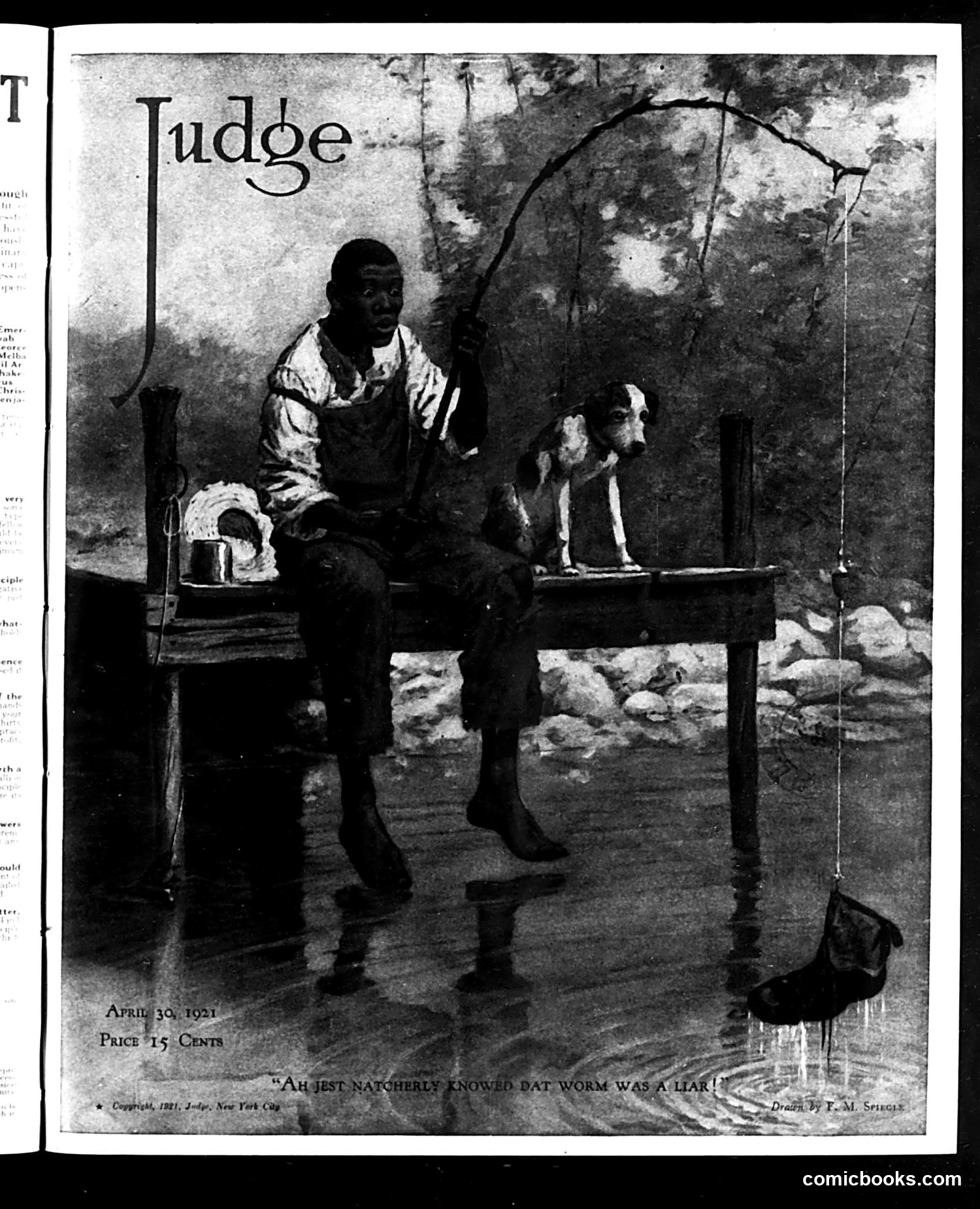
This illustration depicts two figures fishing by a stream. The caption reads: "Ah jest natcherly knowed dat worm was a liar!" The cartoon employs racist dialect and caricature typical of early 1920s American satire. One figure appears to be represented with exaggerated features associated with period racial stereotyping. The joke plays on a vernacular speech pattern, suggesting one character used a worm as bait while another character claims the worm "lied" — likely a wordplay joke about the unreliability of using false bait or deceptive methods. The satirical point remains unclear without additional historical context, though it may reference broader themes of deception or distrust common in Judge's humor of this era. The racist elements reflect the publication's problematic standards of its time.
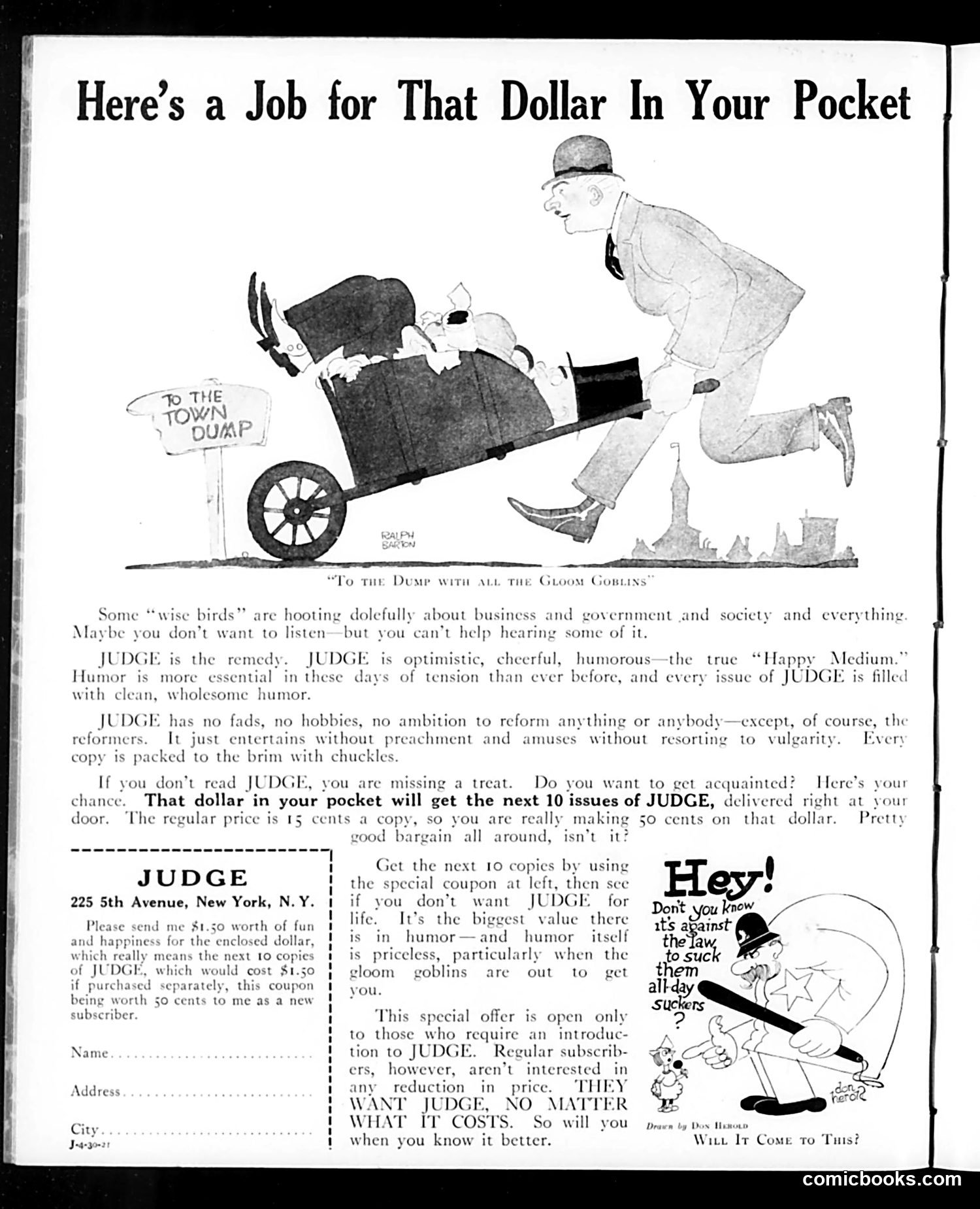
This page is primarily **advertising for Judge magazine itself** rather than political commentary. The main cartoon shows a man wheeling a barrel labeled "TO THE DUMP WITH ALL THE GLOOM GOBLINS" — a visual metaphor for discarding pessimism and negativity. The accompanying text pitches Judge as an antidote to gloomy times, emphasizing that the magazine offers **humor without preaching or vulgarity**. It positions humor as essential during "days of tension" — likely referencing economic anxiety or social unrest of the era (specific period unclear from this excerpt). The coupon offers 10 issues for $1.50, positioning Judge as an affordable escape. A smaller cartoon on the right humorously warns against resisting "the law" of laughter, reinforcing the promotional message.
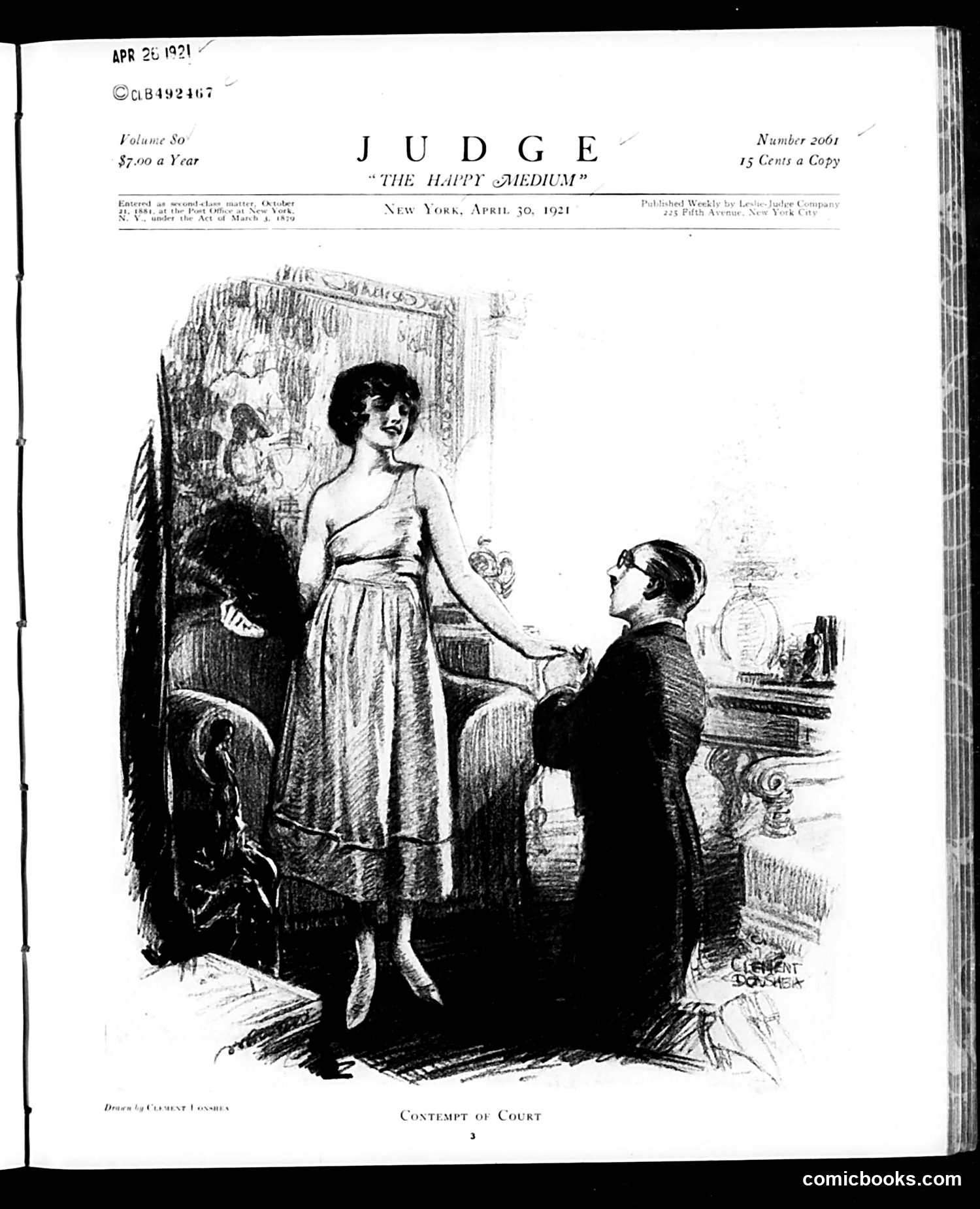
This illustration by Clement Dornela depicts a courtroom scene where a woman in a light dress stands before a man in dark judicial robes, apparently a judge or court official. The title "Contempt of Court" suggests satirical commentary on the judicial system. The joke likely plays on a double meaning: the woman's appearance and demeanor might be considered "contemptuous" (disrespectful) toward the court's dignity, or conversely, the official's conduct toward her demonstrates contempt. Given the 1921 date and the woman's fashionable, somewhat risqué attire for the era, this probably satirizes either changing social mores regarding dress codes or judicial bias—possibly how courts treated women differently during this period.
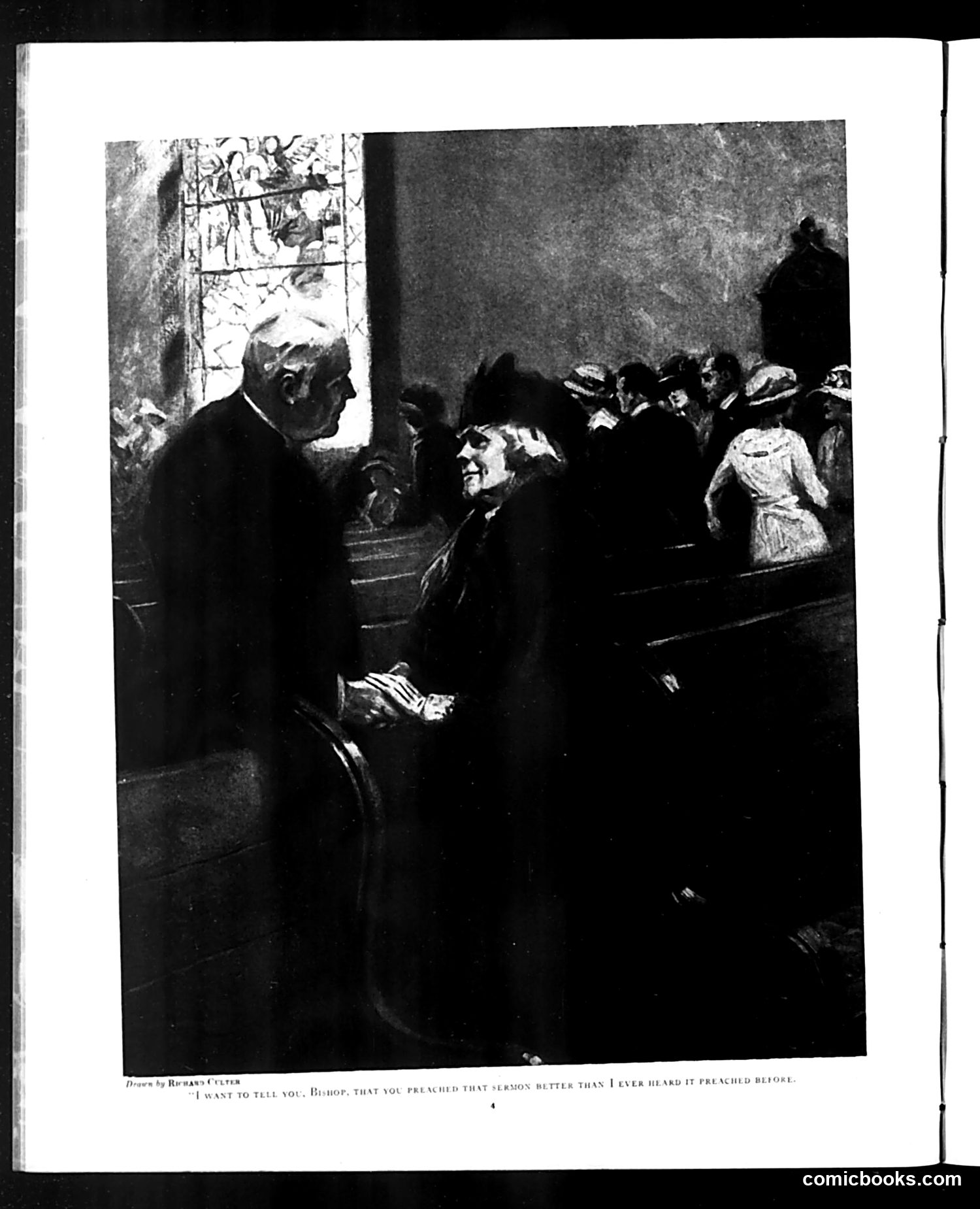
This illustration by Roswell Cocks depicts a scene in what appears to be a church or cathedral interior. The caption reads: "I want to tell you, Bishop, that you preached that sermon better than I ever heard it preached before." The satire likely critiques ecclesiastical hypocrisy or performative religiosity. A well-dressed man (presumably a bishop or clergy member) is being complimented by a congregant, but the composition suggests irony—the speaker may be praising the sermon insincerely, or the cartoon mocks how laypeople flatter clergy regardless of actual sermon quality. The crowded background of parishioners reinforces themes of organized religion as social spectacle rather than spiritual substance, a common Judge magazine target during the Progressive Era.
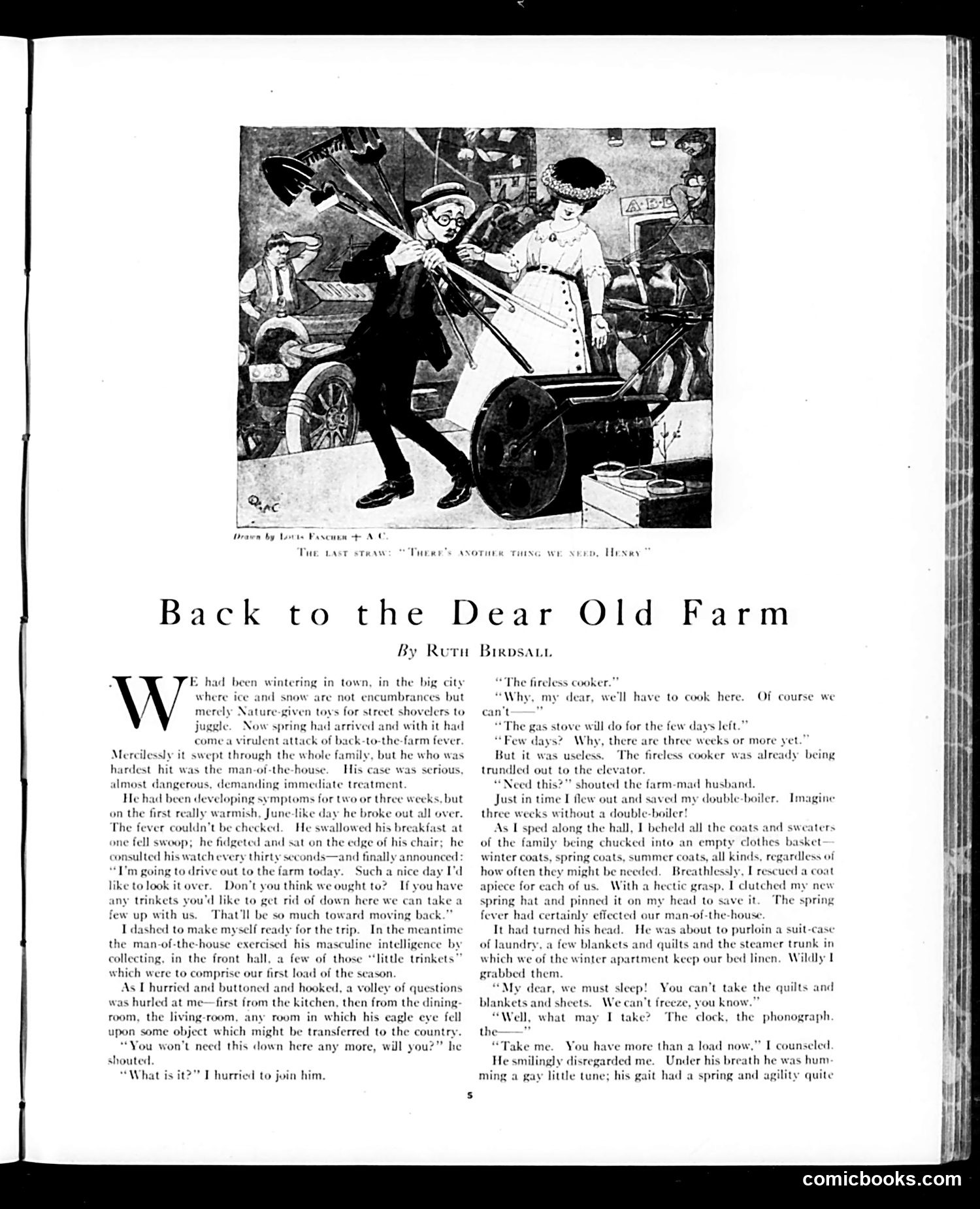
The main cartoon at the top depicts a comedic domestic scene: a man in a suit appears to be dragging a reluctant woman (wearing a large hat and light dress) toward farm equipment. The caption references "There's another thing we need, Henry," suggesting marital negotiation about returning to rural life. The accompanying story by Ruth Birdsall humorously describes a couple who wintered in the city but are now returning to farm life. The narrative contrasts urban conveniences (gas stoves, modern appliances) with rural hardships—broken equipment, lack of heating, and missing supplies—particularly focusing on the wife's dismay at losing comfortable city amenities. The satire targets post-World War I attitudes about rural versus urban living and the tensions between modern comfort and agricultural necessity.
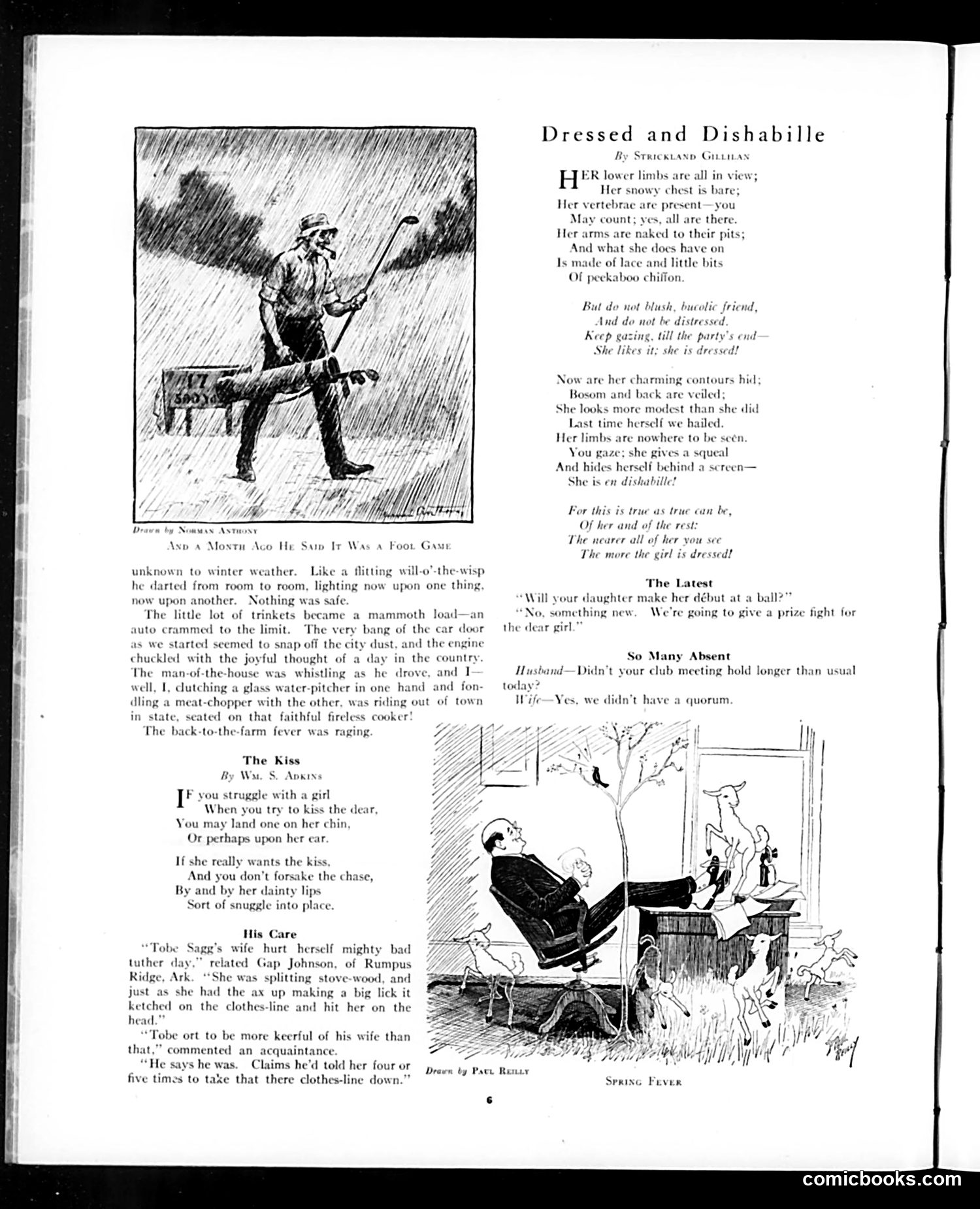
This page contains humorous verse and illustrations rather than political cartoons. The content includes: **"Dressed and Dishabille"** by Strickland Gillilan—a poem with an illustration showing a figure in rain, commenting on women's anatomy and modesty through crude observation. **"The Kiss"** by W.S. Adams—light verse about kissing etiquette. **"His Care"** and **"Spring Fever"**—short humorous anecdotes with an illustration of a man relaxing outdoors while dogs run about. **"The Latest"** and **"So Many Absent"**—brief joke exchanges about social events and club meetings. This appears to be the magazine's humor section rather than satirical commentary. The jokes are domestic and social rather than political, reflecting early 20th-century popular humor about courtship, marriage, and everyday life.
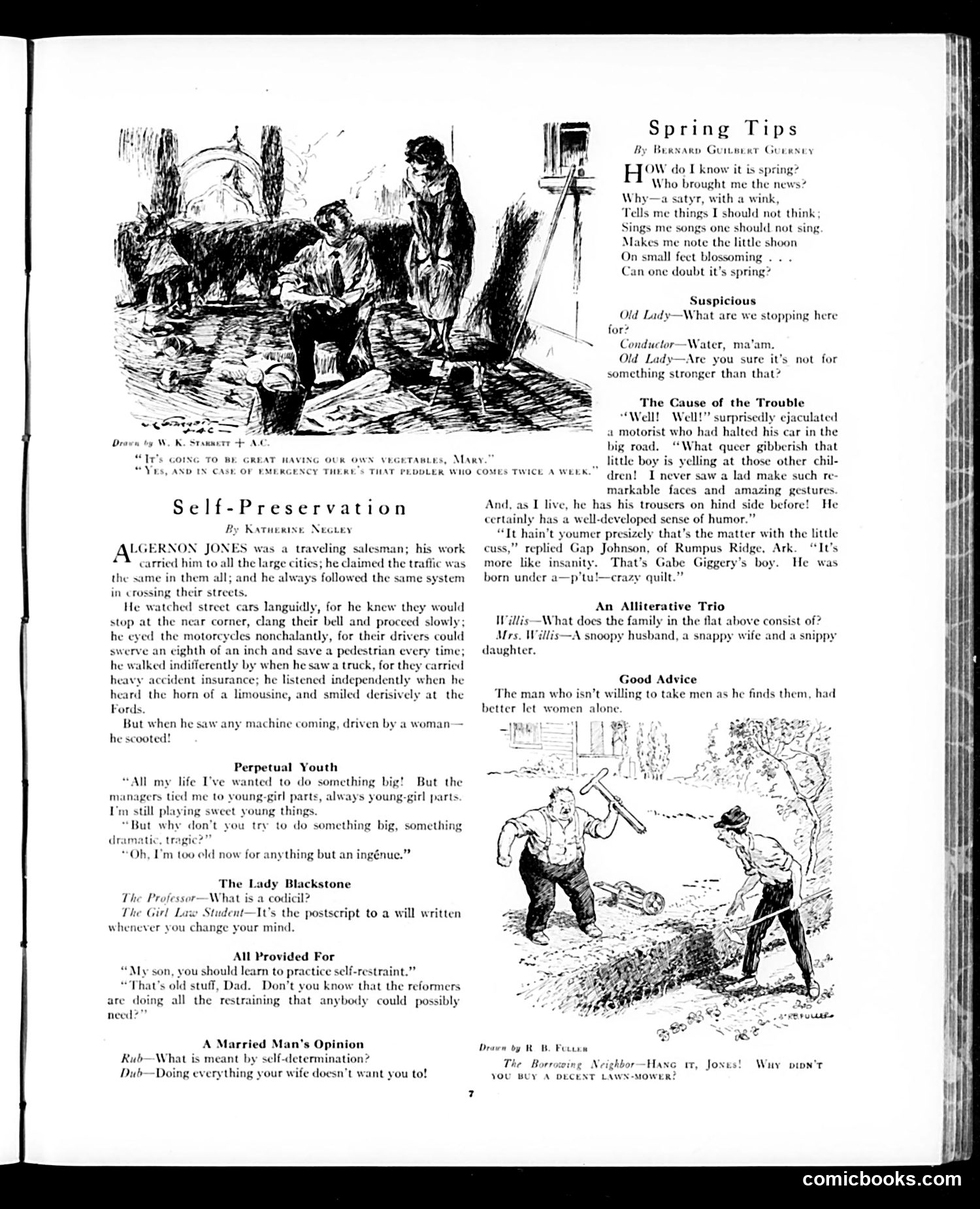
This page contains multiple satirical pieces reflecting early 20th-century American attitudes: **"Self-Preservation"** mocks gender stereotypes by depicting a traveling salesman who fearlessly ignores streetcars, motorcycles, and trucks—but panics when a woman drives. The joke reflects contemporary anxiety about women drivers, portrayed as uniquely dangerous compared to other traffic hazards. **"Perpetual Youth"** satirizes an aging actress trapped playing ingénue roles, unable to transition to dramatic parts. It critiques both the entertainment industry's youth obsession and actresses' limited career options. **"A Married Man's Opinion"** provides political satire: "self-determination" (likely referencing contemporary debates about national autonomy) becomes a joke about marital obedience—wives determine husbands' behavior. **"The Cause of the Trouble"** depicts a boy's strange behavior, blamed on wearing backwards trousers and having an unstable father figure, treating mental health casually as humor. The remaining pieces—"Spring Tips," "Suspicious," and "Good Advice"—offer lighter social commentary on seasonal romance, public transportation, and gender relations typical of the era's Judge humor.
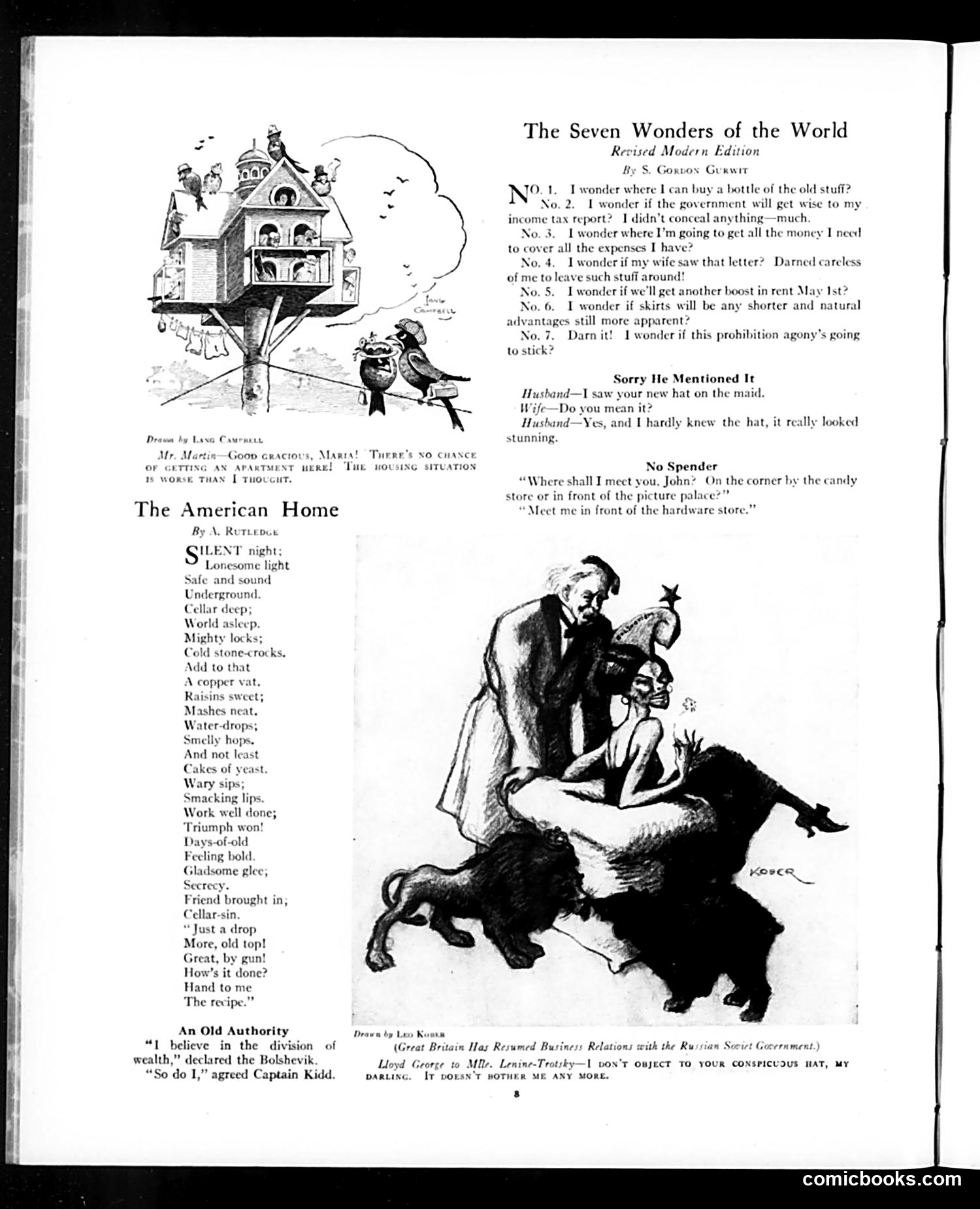
**"The Seven Wonders of the World (Revised Modern Edition)"** mocks everyday middle-class anxieties of the Prohibition era: bootleg liquor, tax evasion, rent increases, rising hemlines, and whether Prohibition will last. These replace classical wonders with mundane modern worries. **"The American Home"** satirizes home alcohol production during Prohibition—describing a cellar operation with "raisins," "mashes," "yeast," and "water-drops" (thinly veiled references to illegal distilling). The poem celebrates this criminal enterprise as virtuous domesticity. **The housing cartoon** references the post-WWI apartment shortage and soaring rents plaguing American cities. **"No Spender"** jokes about penny-pinching during economic hardship—meeting at a free location (hardware store) rather than paid venues. **The final cartoon** pairs Lloyd George (British PM) with Lenin-Trotsky, satirizing Britain's 1921 resumption of trade with Soviet Russia. The "conspicuous hat" joke suggests hypocrisy: capitalists ignore communist ideology for profit.
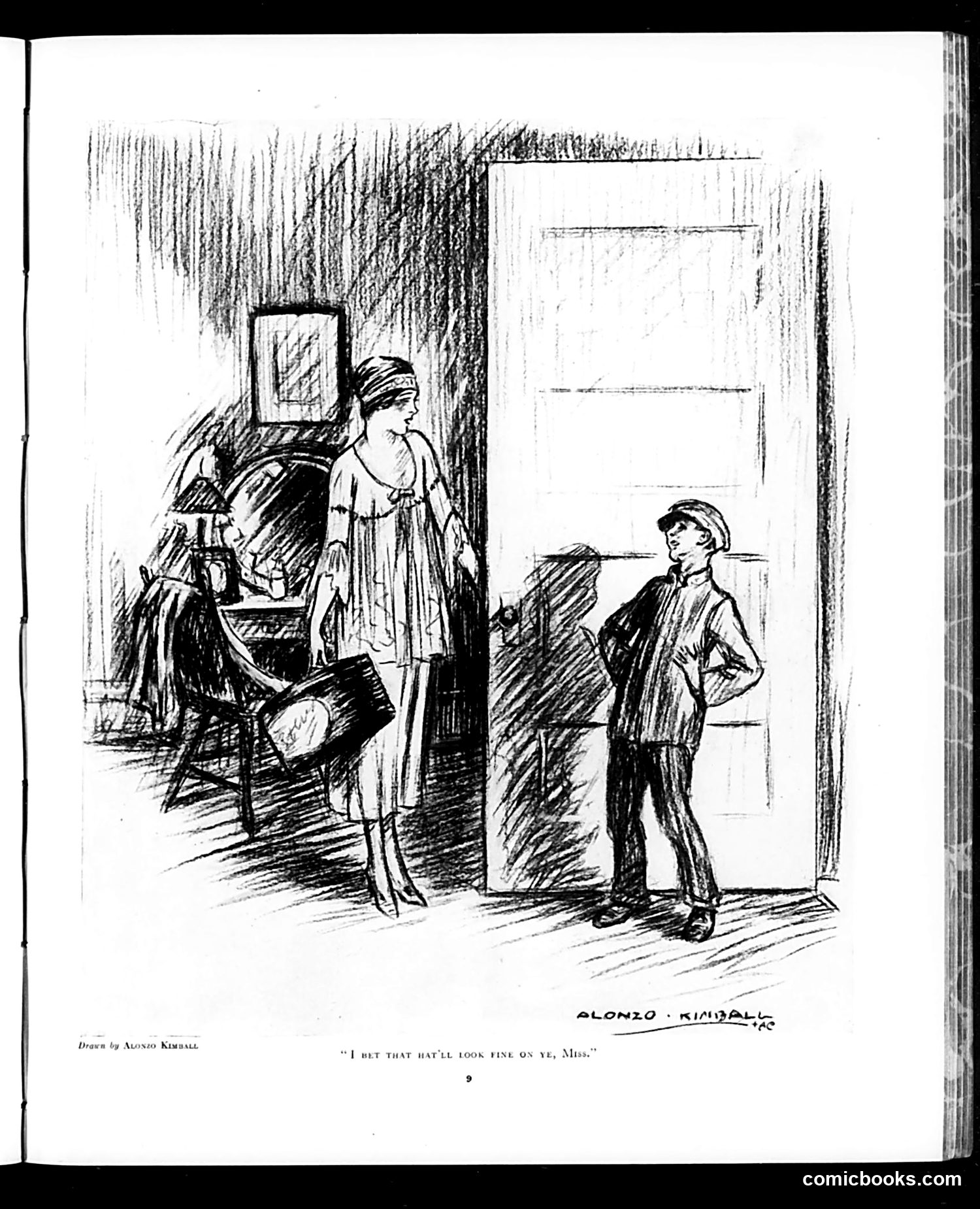
This is a sketch by Alonzo Kimball from *Judge* magazine showing a domestic scene with dialogue: "I bet that hat'll look fine on ye, Miss." The cartoon depicts a woman trying on or examining a hat while a boy (likely a shop assistant or delivery person) observes. The humor appears to rely on the boy's informal, working-class speech ("I bet that hat'll look fine on ye, Miss") contrasted with the woman's apparent upper-class status—a common satirical device in early 20th-century American humor that mocked class pretensions and the awkwardness of cross-class social interactions. The specific social commentary remains unclear without additional context about what aspect of fashion, class relations, or contemporary events this references.
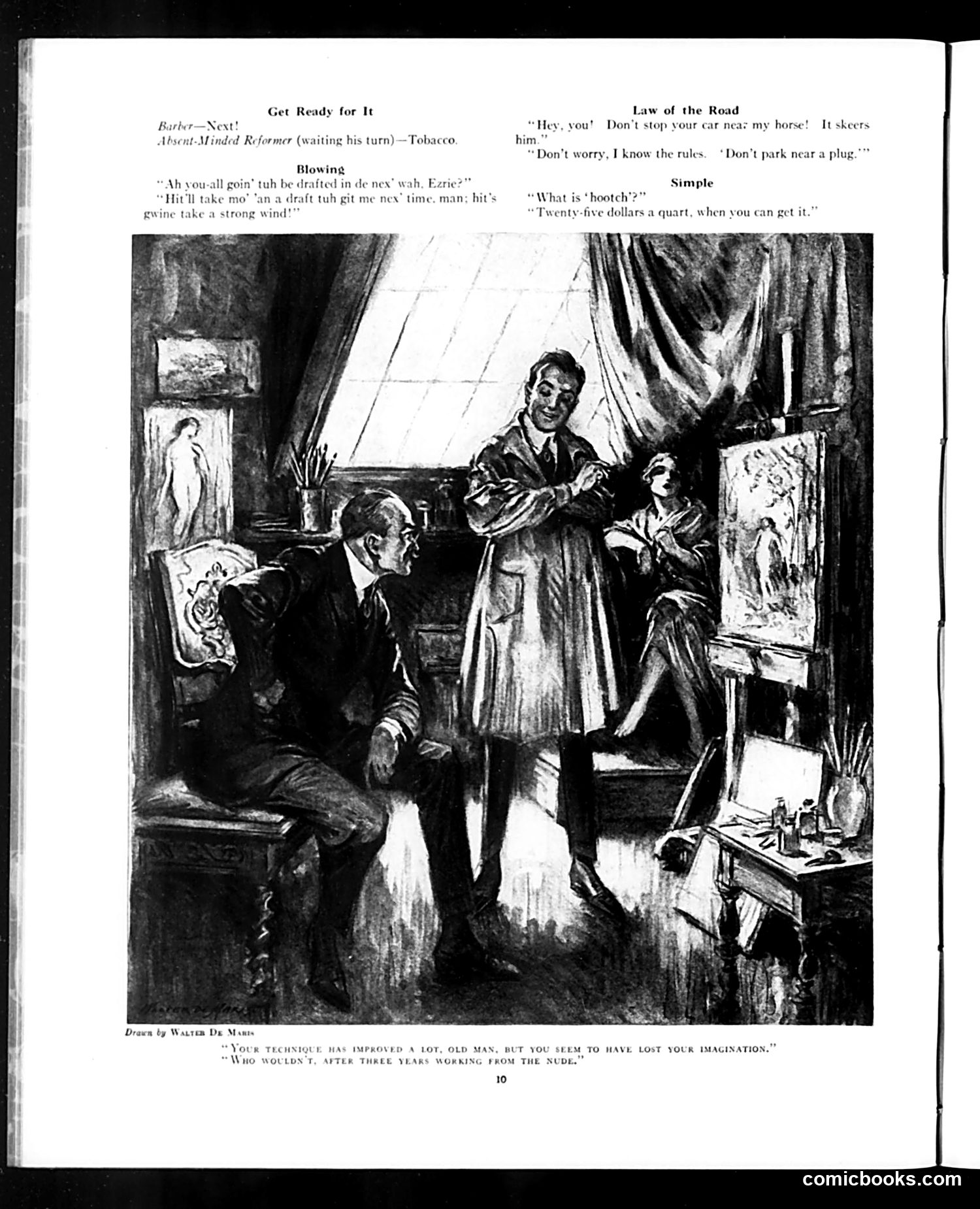
This page contains four satirical humor pieces: 1. **"Get Ready for It"**: A barber-shop joke mocking an "Absent-Minded Reformer" concerned with tobacco regulation, suggesting he's oblivious to larger threats (likely WWI conscription). 2. **"Blowing"**: A dialect-heavy joke about draft eligibility, playing on regional speech patterns for comedic effect. 3. **"Law of the Road"**: Social satire about early automobile culture conflicting with horse-drawn transportation—the car owner cynically claims knowledge of traffic rules while dismissing concerns about frightening horses. 4. **"Simple"**: A Prohibition-era joke defining "hootch" (illegal alcohol) by its exorbitant black-market price ("twenty-five dollars a quart"), reflecting 1920s underground liquor economy. 5. **The main illustration** (by Walton De Mains): An art studio scene satirizing artistic decline, suggesting a model's three-year posing job has dulled the artist's creative imagination. The page reflects Judge's focus on contemporary social issues: regulation, war anxieties, automobile modernization, Prohibition, and cultural commentary.
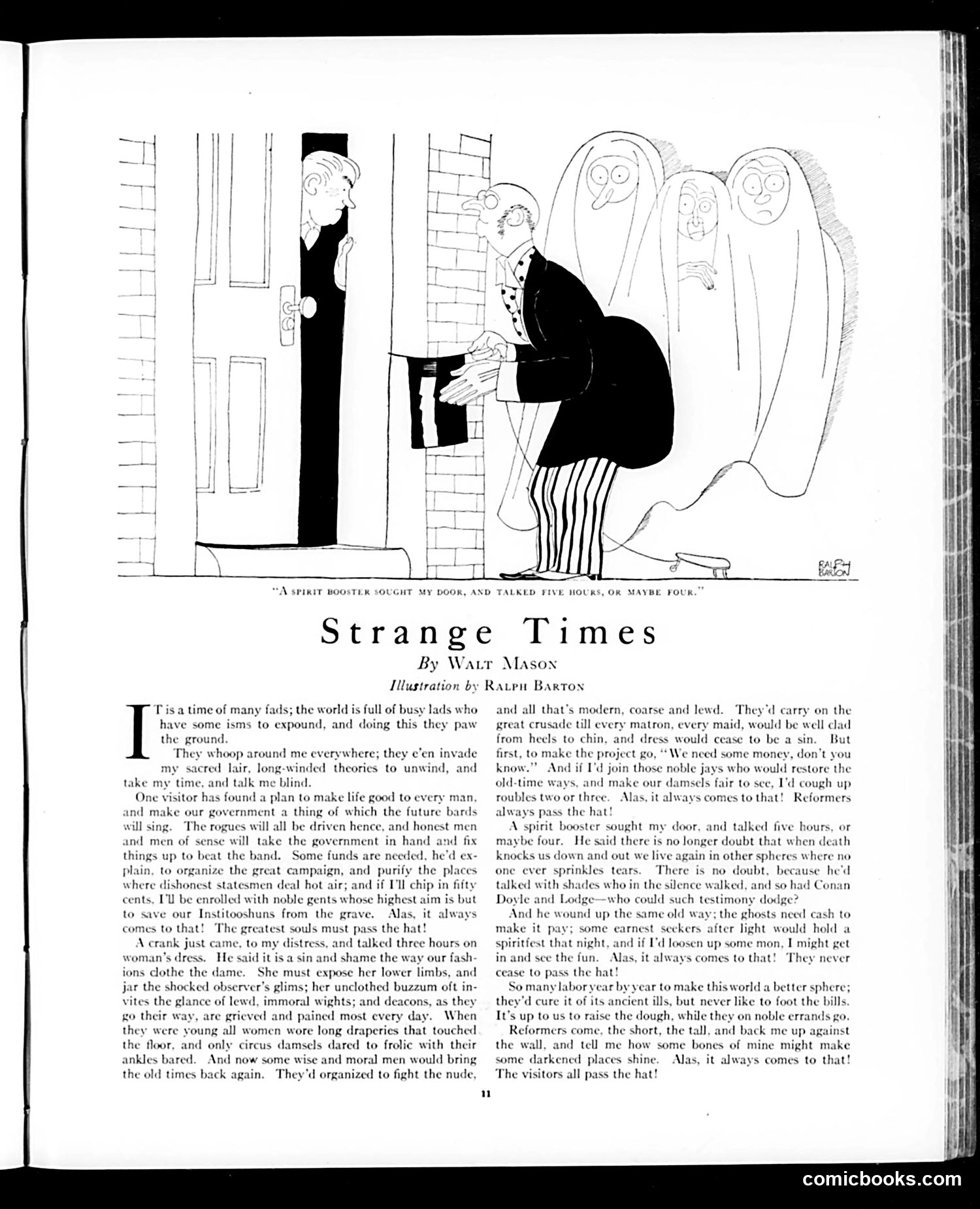
This satirical story mocks early 20th-century social reformers and their constant fundraising appeals. The cartoon illustration shows a man at his door being confronted by visitors seeking money. Mason's narrative describes three types of persistent "cranks" who interrupt the narrator's peace: a political reformer promising government improvement, a morality crusader opposing women's modern dress and exposed limbs, and a spiritualist claiming communication with the dead (referencing contemporary séance culture and figures like Arthur Conan Doyle). The satire's point: despite their noble-sounding causes—anti-corruption, moral restoration, spiritual enlightenment—all these reformers ultimately demand the same thing: "pass the hat" for donations. Mason suggests that whether their causes are genuine or dubious, reformers exploit public goodwill to extract money while offering little tangible benefit. This reflects period anxiety about rapid social change, the proliferation of fad movements, and public skepticism toward do-gooders.
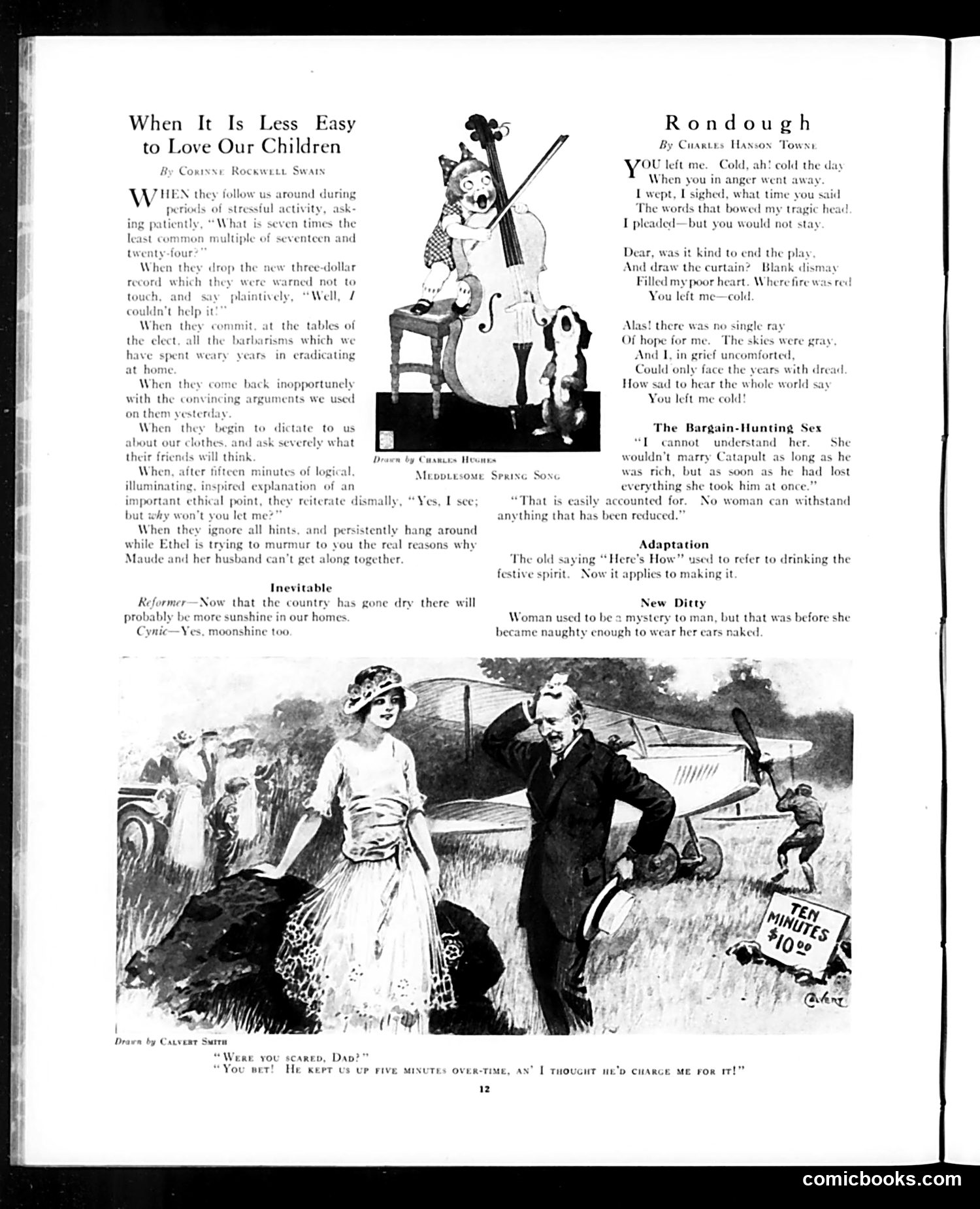
This page contains three distinct pieces of early-20th-century social satire: **"When It Is Less Easy to Love Our Children"** humorously catalogs parental frustrations—children breaking records, repeating questions, interrupting adult conversations. The humor relies on relatable domestic annoyance rather than political content. **"Rondough"** is a melancholic poem about romantic rejection, entirely non-satirical. **"The Bargain-Hunting Sex"** mocks women as obsessive bargain-hunters, joking that a woman wouldn't marry a rich man but eagerly married him after he lost his fortune—because she couldn't resist anything "reduced" (discounted). This reflects period stereotypes about female frivolity and materialism. **"New Ditty"** makes a joke about women's fashion: women were once mysterious to men, but now that they wear their ears exposed (modern bobbed hairstyles), that mystery is gone—mocking contemporary women's fashion choices as immodest. The page reflects 1920s-era attitudes toward women and parenting rather than specific political events.
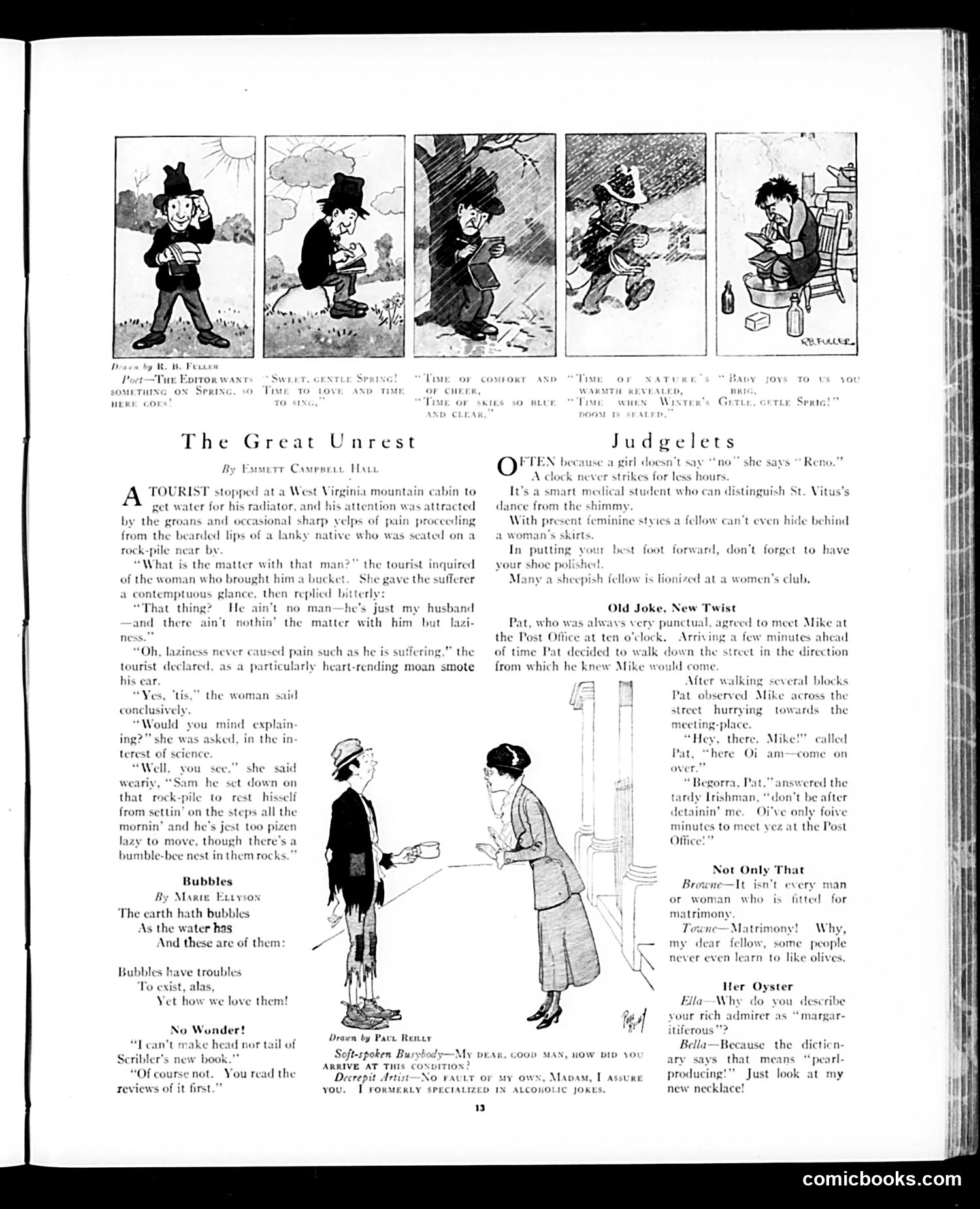
This Judge page contains social satire about early 20th-century American life. "The Great Unrest" by Emmett Campbell Hall mocks labor discontent through a story about a mountain woman's husband suffering from "laziness"—satirizing contemporary anxieties about working-class complaints and strikes. The tourist's dismissal of the woman's concerns reflects period attitudes minimizing workers' grievances. The accompanying comic strips and humor columns ("Juggles," "Bubbles," "Old Joke, New Twist") offer light domestic and social humor typical of Judge's content—poking fun at gender relations, courtship, and urban encounters. The illustrations by H.B. Fellas and Paul Henley depict period clothing and social interactions. Overall, the page reflects Judge's role satirizing labor unrest and social change during an era of significant industrial conflict.
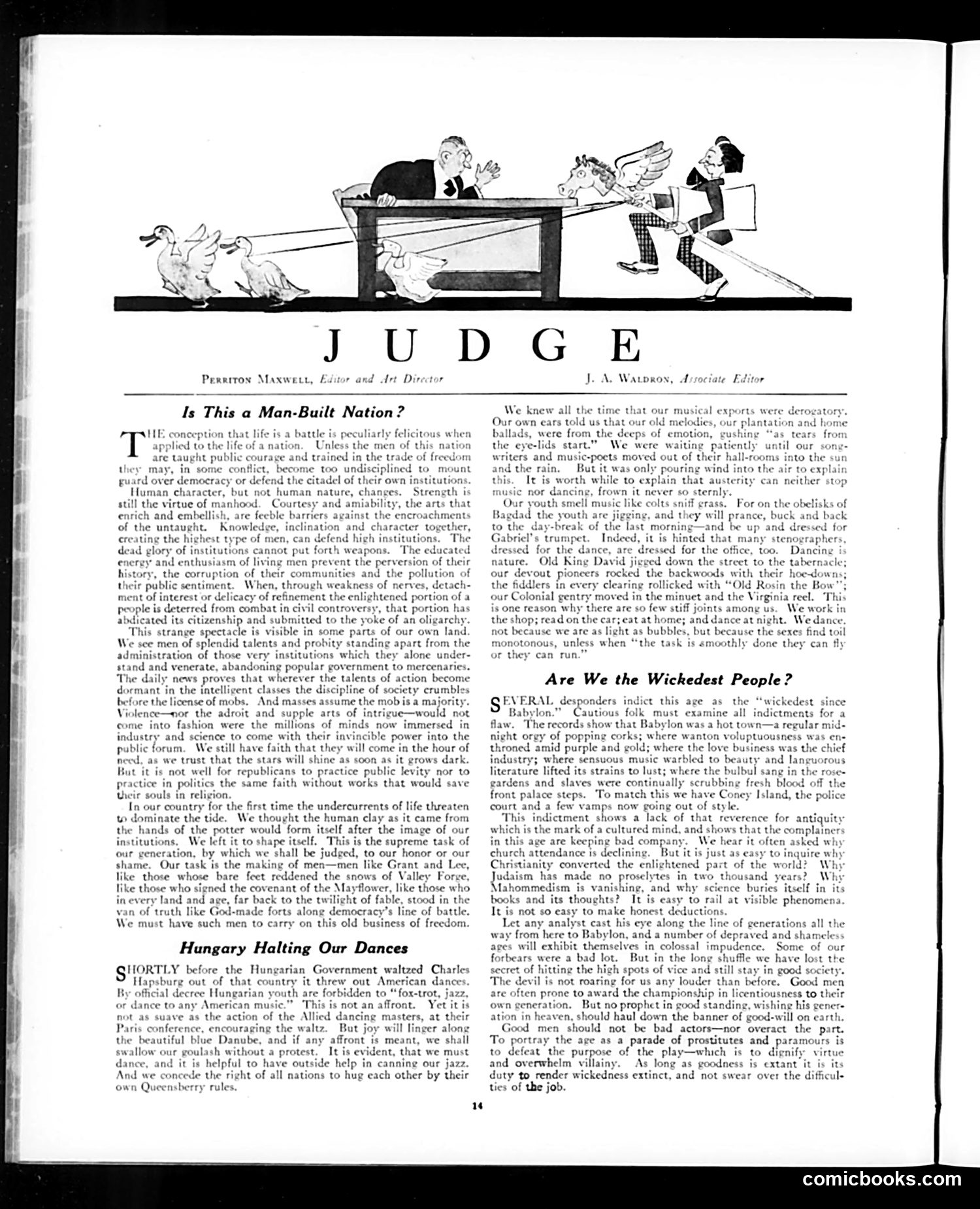
## The Main Cartoon (Top) The illustration depicts a judge presiding over a courtroom scene where geese are being tried. This is a whimsical visual metaphor supporting the article's serious argument about American civic duty. The cartoon satirizes the idea that citizens have abdicated their responsibility to participate in governance, leaving institutions vulnerable to mob rule and unqualified "mercenaries." ## The Articles' Arguments **"Is This a Man-Built Nation?"** argues that educated, talented citizens have withdrawn from public life and civic participation, allowing incompetent or corrupt people to control democratic institutions. The author warns this endangers the republic—referencing Valley Forge and the Mayflower as examples of citizens who actively defended freedom. **"Hungary Halting Our Dances"** is lighter satire: Hungary banned American jazz and fox-trotting while promoting the waltz, which Judge finds absurdly paternalistic. The piece mocks both Hungary's censorship and the Allied powers' cultural meddling in post-WWI Eastern Europe. Both pieces reflect post-WWI anxiety about democracy's fragility and foreign instability.
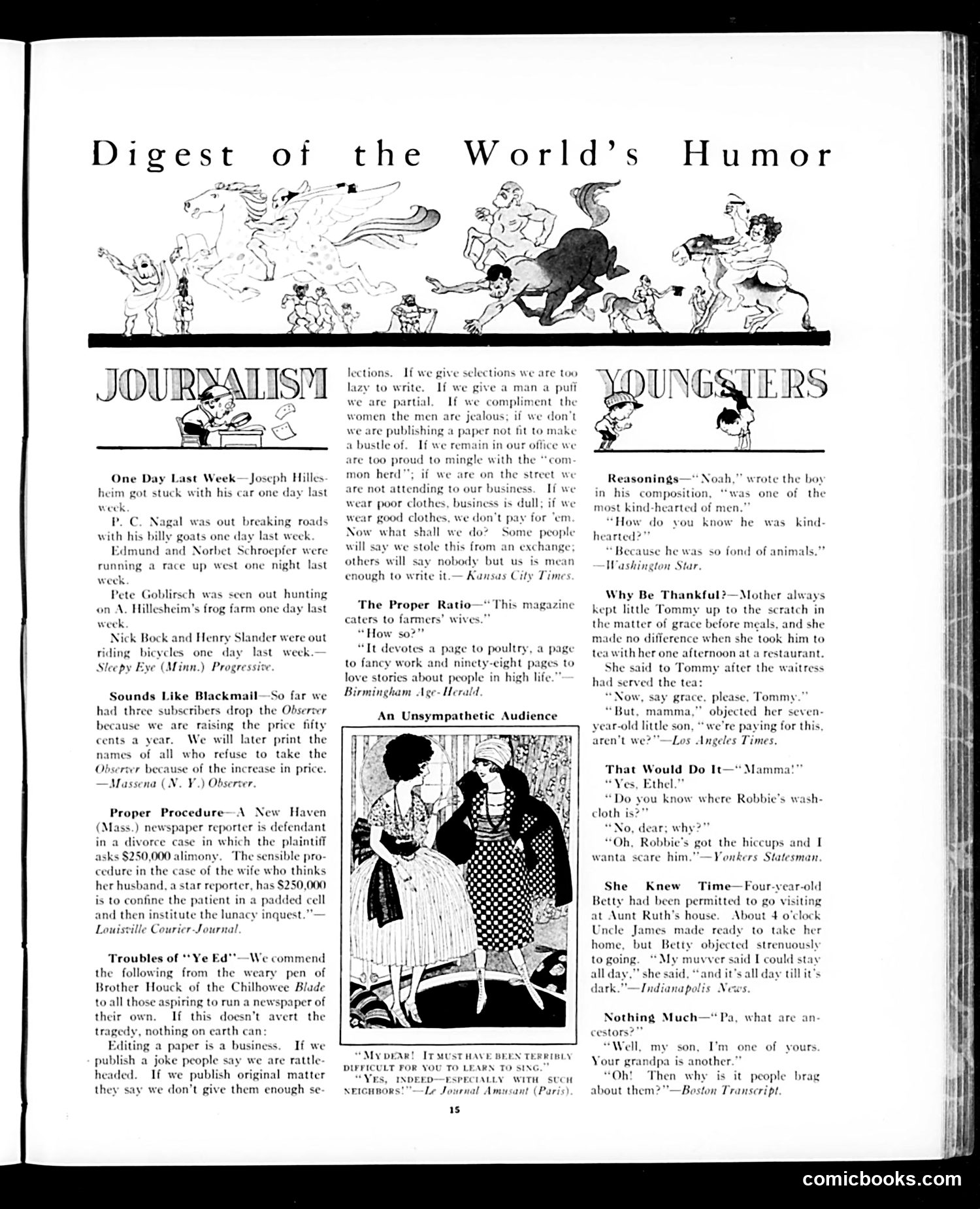
This page from *Judge* magazine contains primarily **short humorous anecdotes** rather than political cartoons. The content satirizes **small-town newspaper editors and their impossible situations**. The main satire targets **editorial dilemmas**: editors face criticism regardless of choices—publish jokes and readers call them "rattle-headed"; publish original work and readers want reprints; compliment women and men grow jealous. The piece mocks the "no-win" nature of newspaper publishing. The single **cartoon** titled "An Unsympathetic Audience" shows a woman struggling to sing while neighbors listen dismissively, captioned with them calling it "terribly difficult" to learn—social satire about amateur performances and harsh audience judgment. Other humor pieces mock **contemporary social expectations**: children's logic about grace before meals ("we're paying"), grasp of time, and understanding of ancestors. These reflect period attitudes about childhood innocence versus practical thinking. The tone is gentle social commentary on everyday frustrations rather than sharp political critique.
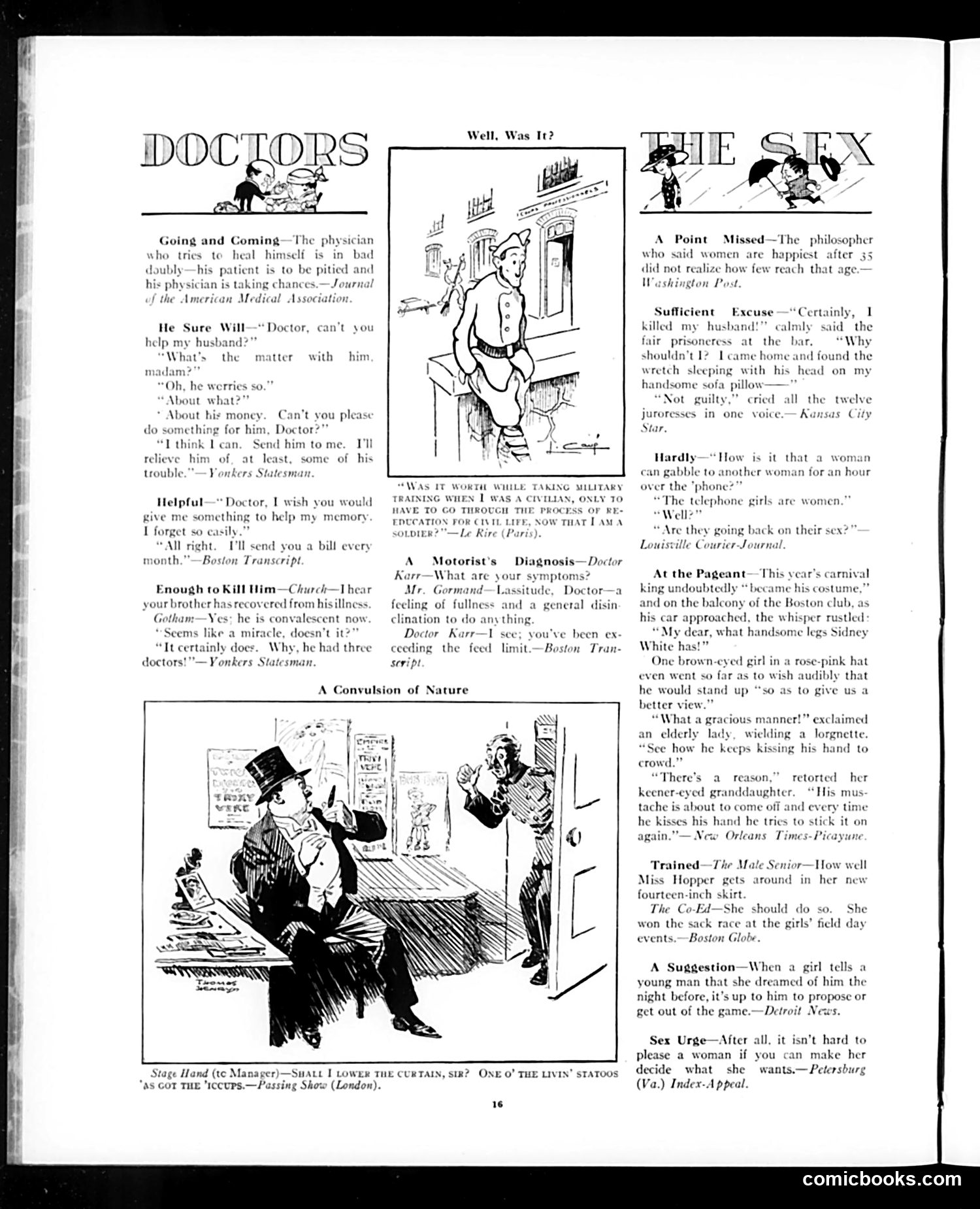
This page collects satirical humor pieces about doctors, relationships, and gender roles, typical of early 20th-century American magazine comedy. **"Doctors" section** mocks physicians and patients: a wife seeks help for her money-obsessed husband; a patient wants memory aid but dreads receiving bills; a man recovers despite having "three doctors"—implying medical incompetence. **Center cartoon** depicts a stage manager struggling with a noisy performer ("the livin' statoos"), visual slapstick humor. **"The Sex" section** targets women and relationships: philosophers underestimate female longevity; a woman acquitted of killing her husband because he slept on her sofa pillow (suggesting domestic annoyances justify violence); women supposedly gossip endlessly on phones; carnival spectators objectify a male performer; girls in short skirts; a young woman's dream confession as marriage proposition bait. The humor reflects period attitudes: wives as financially dependent, women as vain/gossipy, and domestic violence as comedic. The "sex" framing uses innuendo typical of the era's "sophisticated" magazine humor.
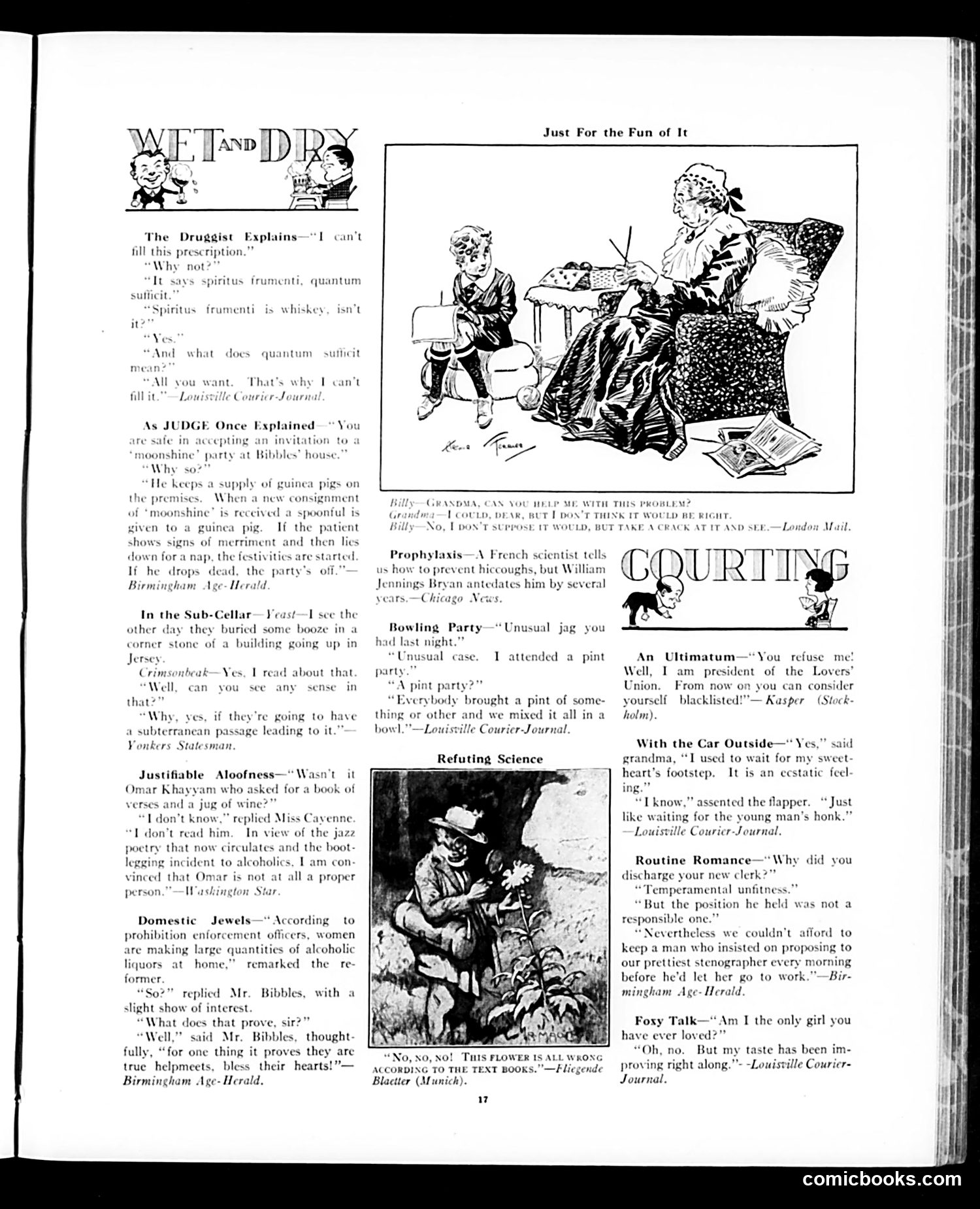
This page from **Judge** satirizes **Prohibition-era America** (likely 1920s-early 1930s), when alcohol sales were federally banned but widespread illegal production flourished. **Main Satirical Themes:** 1. **"The Druggist Explains"** mocks Prohibition enforcement. A pharmacist refuses to fill a prescription for "spiritus frumenti" (whiskey) by claiming he doesn't understand the Latin—a transparent excuse, since everyone knew this meant alcohol. 2. **"Moonshine Testing"** jokes about homemade liquor safety. The anecdote describes using guinea pigs to test bootleg whiskey's quality—if the animal survives happily, the party proceeds; if it dies, the event is cancelled. 3. **"Domestic Jewels"** subverts expectations by having a character praise women for illegally producing alcohol at home, calling them "true helpmeets"—patriotic helpers—rather than criminals. 4. **Other jokes** reference speakeasies, buried bootleg caches, and Omar Khayyam's wine-drinking poetry. **The Point:** Judge ridicules Prohibition's failure while celebrating Americans' defiant, creative responses to the unpopular law. The humor assumes readers share skepticism about enforcement.
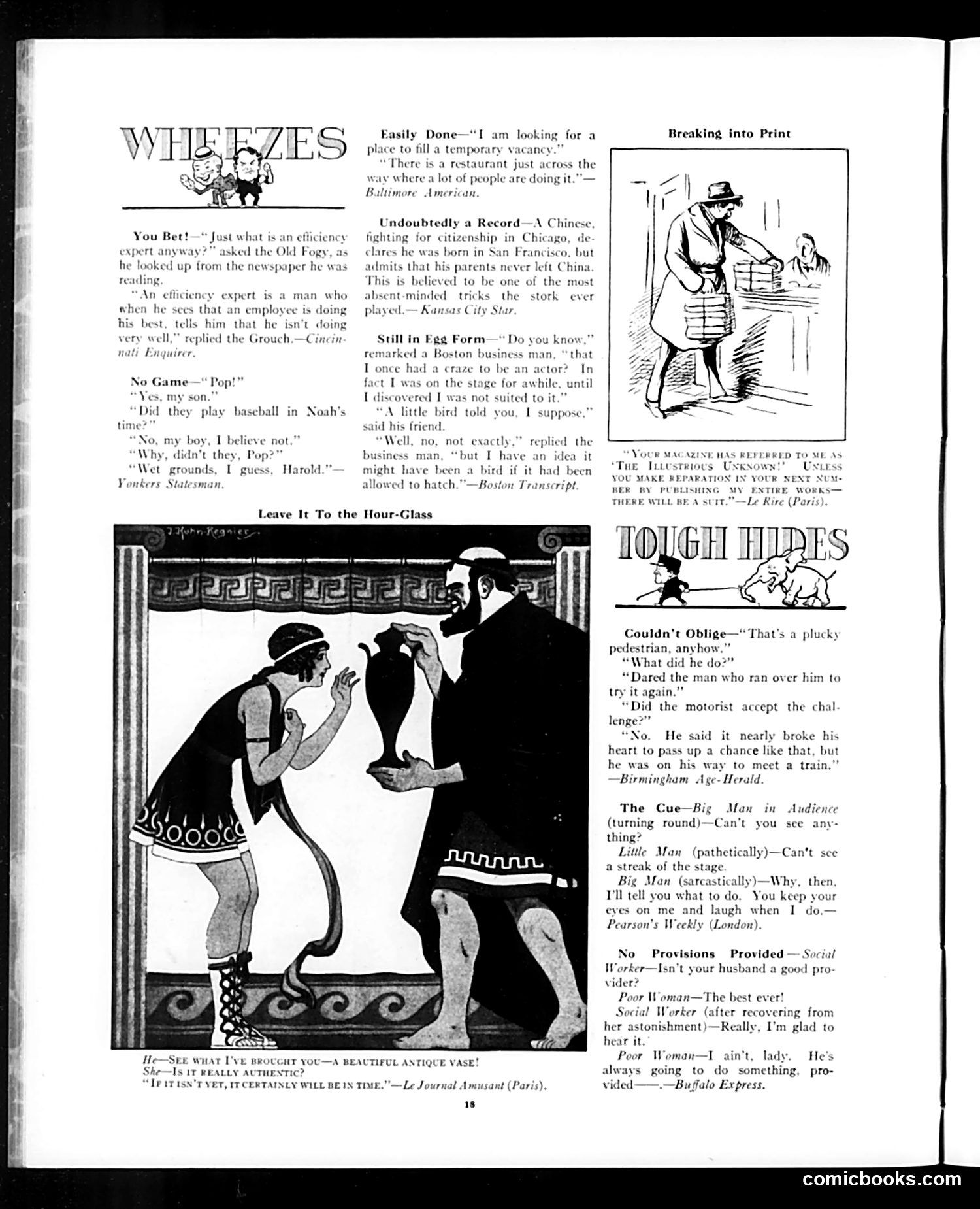
This page contains several brief satirical jokes typical of early-20th-century American humor magazines: **"You Bet!"** mocks efficiency experts—a contemporary management trend—by defining one as someone who criticizes employees for not working hard enough even when they're doing their best. **"No Game"** is a father-son joke about Noah's ark: since animals were on the ark, there were no baseball games to play during the flood. **"Easily Done"** satirizes unemployment by suggesting job-seekers look at a nearby restaurant where "a lot of people are doing it"—implying widespread unemployment or underemployment. **"Leave It to the Hour-Glass"** depicts a man presenting an antique vase to a woman; she questions its authenticity, and he replies it will become authentic eventually (a joke about fakes becoming "genuine" through age). The remaining items mock social pretension, pedestrian safety, theater etiquette, and marital irresponsibility in similar brief formats. These are light, observational humor pieces typical of Judge's satirical approach to modern life.
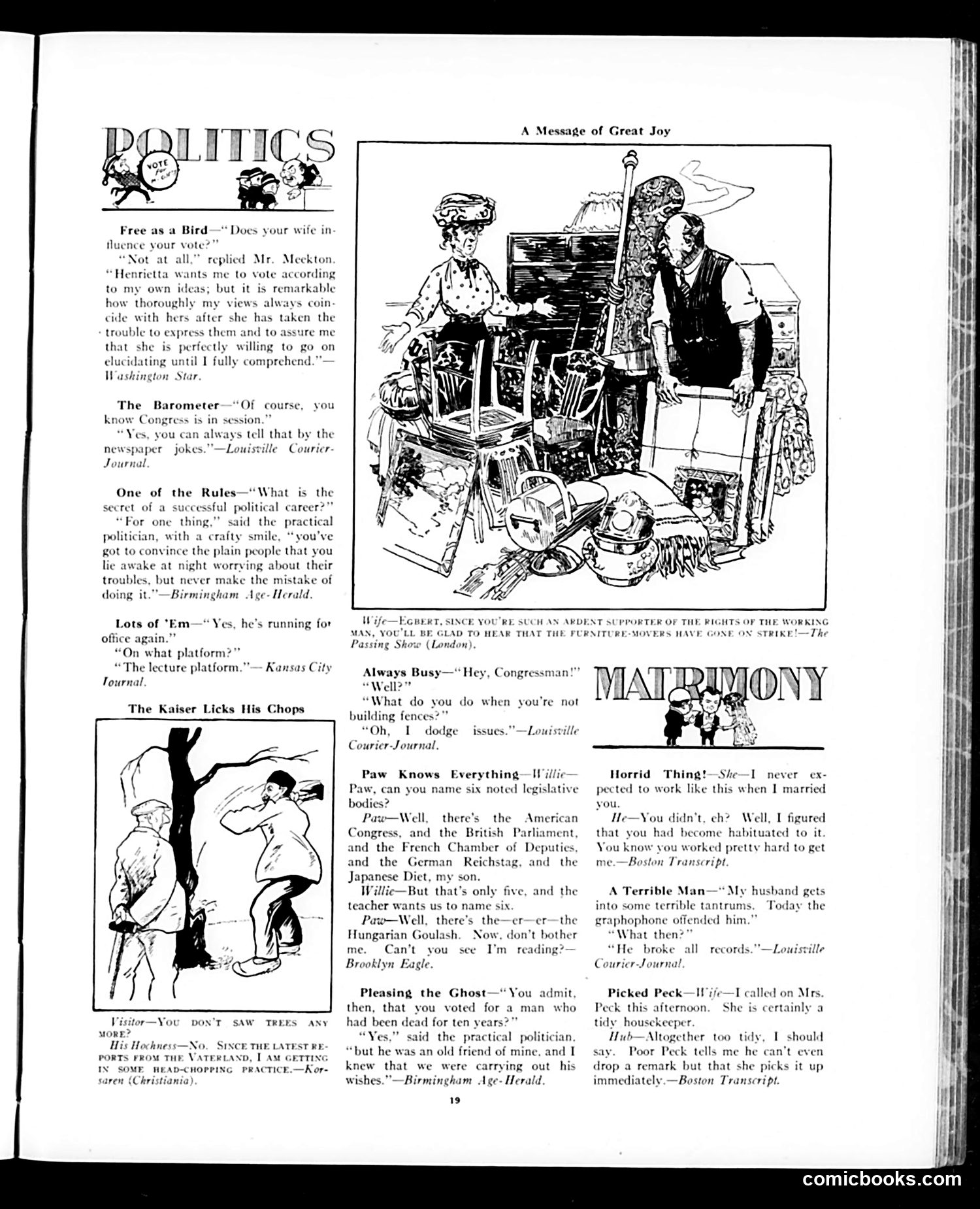
This page contains multiple brief satirical jokes about American politics and domestic life, circa early 20th century. **Key satirical targets:** - **"Free as a Bird"**: Mocks husbands who claim voting independence while wives actually control their political choices through persistent "elucidation"—satirizing both gender dynamics and voter autonomy. - **"The Barometer"**: Congress's predictability is so reliable it serves as a weather indicator for newspaper joke writers. - **"One of the Rules"**: Exposes political hypocrisy—successful politicians must *appear* concerned about ordinary people's troubles while never actually demonstrating genuine worry. - **"The Kaiser Licks His Chops"**: References WWI-era German militarism; the Kaiser jokes about "head-chopping practice" from German war reports, depicting Germany's aggression darkly. - **"Pleasing the Ghost"**: Critiques voting fraud—politicians accepting votes for deceased candidates to honor "old friendships." These jokes reflect Progressive Era skepticism toward political institutions, gender roles, and contemporary war anxiety.
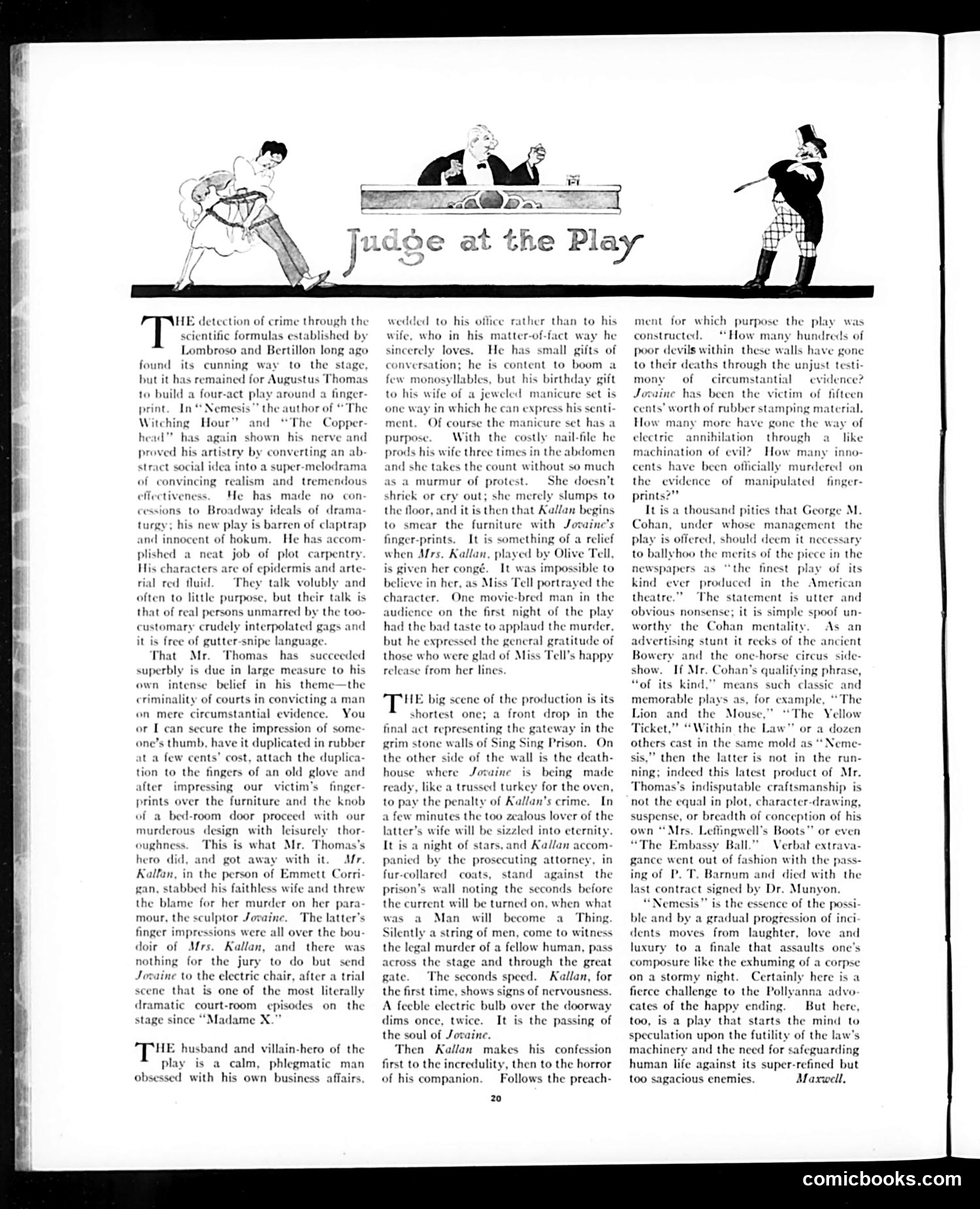
This is a theater review of Augustus Thomas's play "Nemesis," centered on a murder plot involving planted fingerprints. The cartoon header shows a judge overseeing the theatrical "play." The review describes the plot: a calm businessman named Kallan murders his unfaithful wife with a jeweled nail file, then frames a sculptor named Jovaine by smearing the victim's furniture with Jovaine's fingerprints. The play exploits contemporary anxieties about early forensic science—specifically Lombroso and Bertillon's fingerprinting methods—by showing how circumstantial evidence (fingerprints) could wrongly convict an innocent man. The reviewer praises Thomas for creating serious melodrama without Broadway clichés, though criticizes actress Olive Tell's portrayal of the murdered wife as unconvincing. The climax involves Jovaine's execution at Sing Sing Prison. The satire targets both the legal system's vulnerability to false evidence and theatrical conventions of the era.
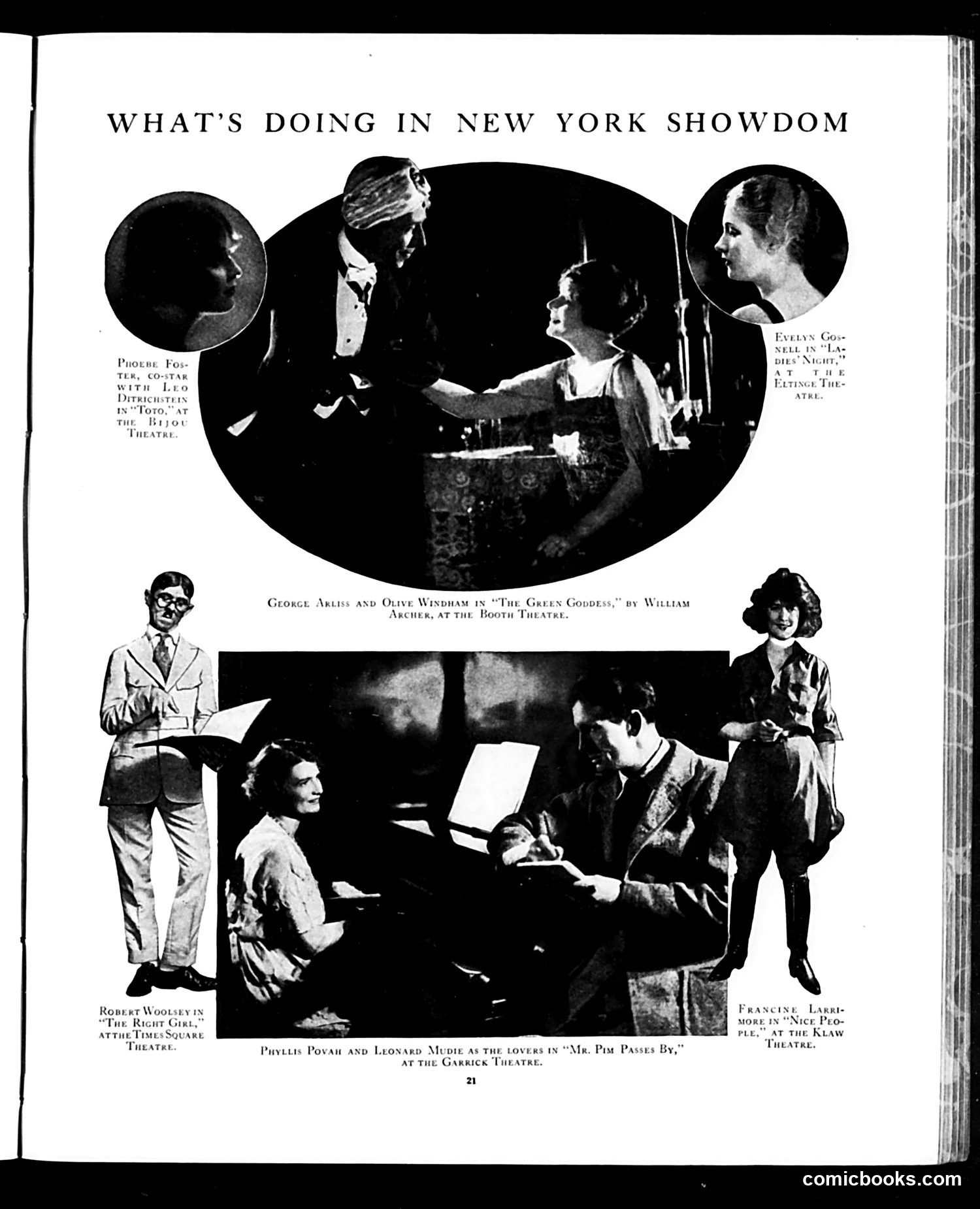
This page is a theatrical entertainment section from *Judge* magazine, not a political cartoon. It showcases New York theater productions currently running, featuring photographs of actors in various plays: - George Arliss and Olive Windham in "The Green Goddess" (Booth Theatre) - Robert Woolsey in "The Right Girl" (Times Square Theatre) - Phyllis Povah and Leonard Mudie in "Mr. Pim Passes By" (Garrick Theatre) - Evelyn Gosnell in an unspecified production at the Eiffel Theatre - Francine Larrimore in another production at the Klaw Theatre The page functions as a promotional guide to contemporary Broadway shows, allowing readers to see which plays were popular attractions in New York's theater district during this period.
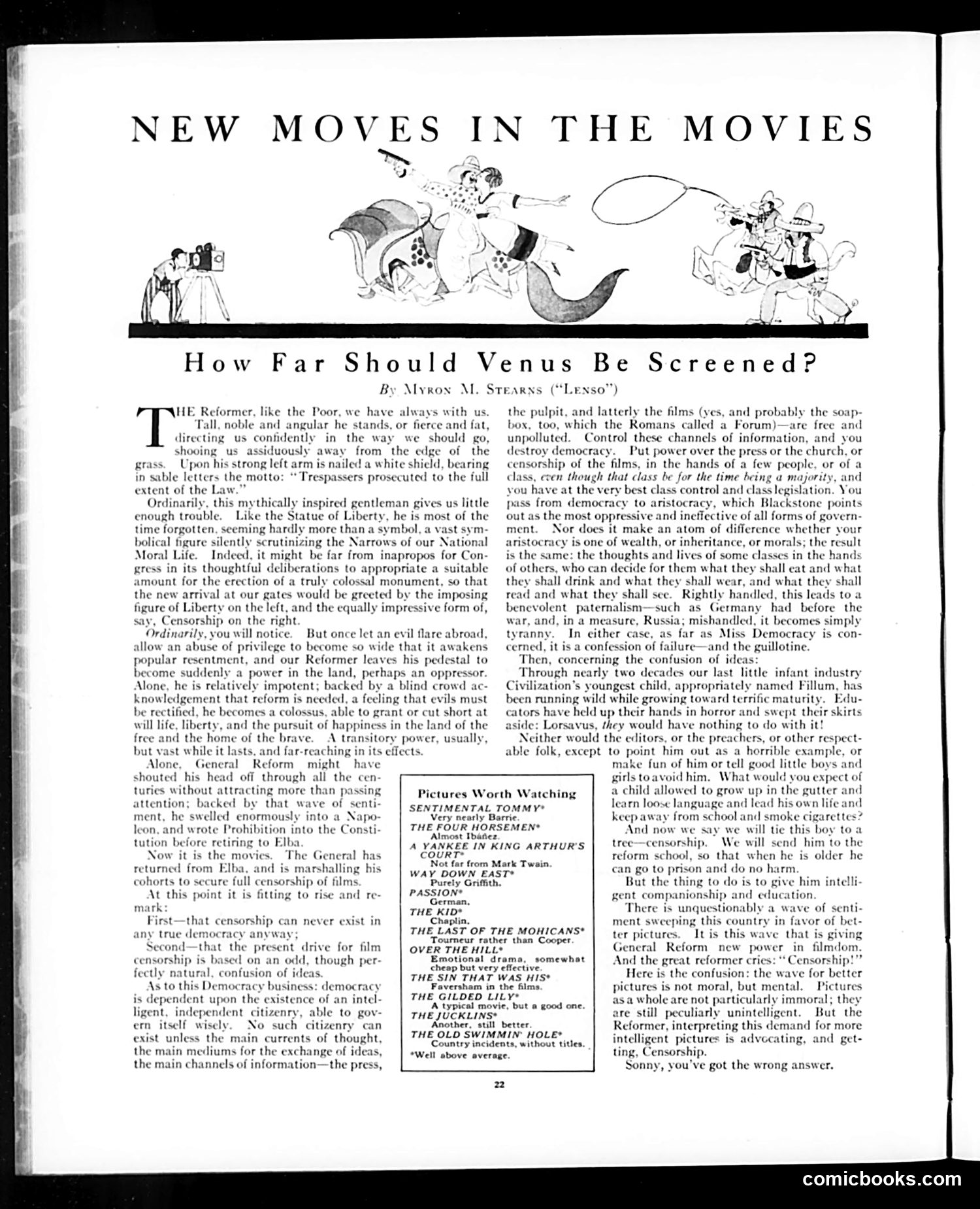
This article by Myrox M. Stearns satirizes the tension between free speech and censorship in American cinema. The author uses the metaphor of a "Reformer" figure—a censorious authority—to critique how moral crusades can dangerously concentrate power over information. The piece argues that while reformers seem harmless when powerless, they become oppressive when backed by public sentiment. Stearns warns that censoring films (like controlling the press or church) enables aristocratic control over thought and morality, destroying democracy itself. He compares this to German paternalism pre-WWI and Russian tyranny. The "Venus" reference likely alludes to sexually suggestive film content—the target of 1920s moral reformers. The sidebar lists contemporary films, presumably those facing censorship pressure. Stearns's conclusion: such censorship, however well-intentioned, inevitably leads to tyranny rather than benevolent paternalism.
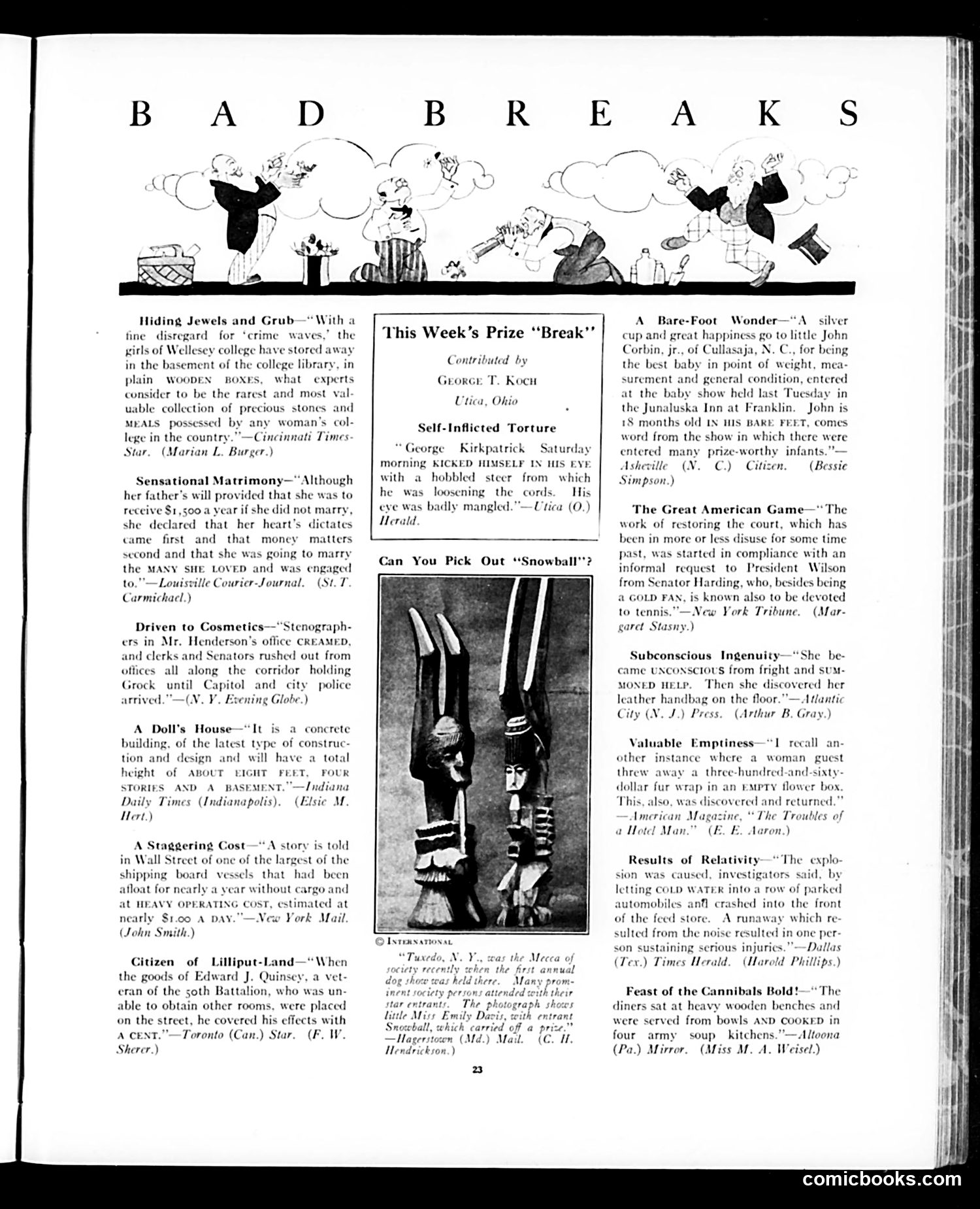
This is a humor column featuring absurd newspaper clippings. The page's title refers to humorous contradictions or logical absurdities found in real news reports—the "breaks" (mistakes or ironies) in how stories are written or what they reveal. The cartoons at the top illustrate the concept visually: figures experiencing physical mishaps or chaos. The column then collects genuine newspaper excerpts (sourced from publications like the *Cincinnati Times Star*, *New York Mail*, etc.) that contain unintentional humor—usually through exaggeration, illogical phrasing, or descriptions so odd they become comical. Examples include: a college storing valuable jewels in plain wooden boxes "with a fine disregard for crime waves," or a man kicking himself in the eye with a hobbled steer. The humor relies on readers recognizing the absurdity in what newspapers actually reported, mocking both journalism's carelessness and human folly. This was a popular satirical format in early 20th-century magazines.
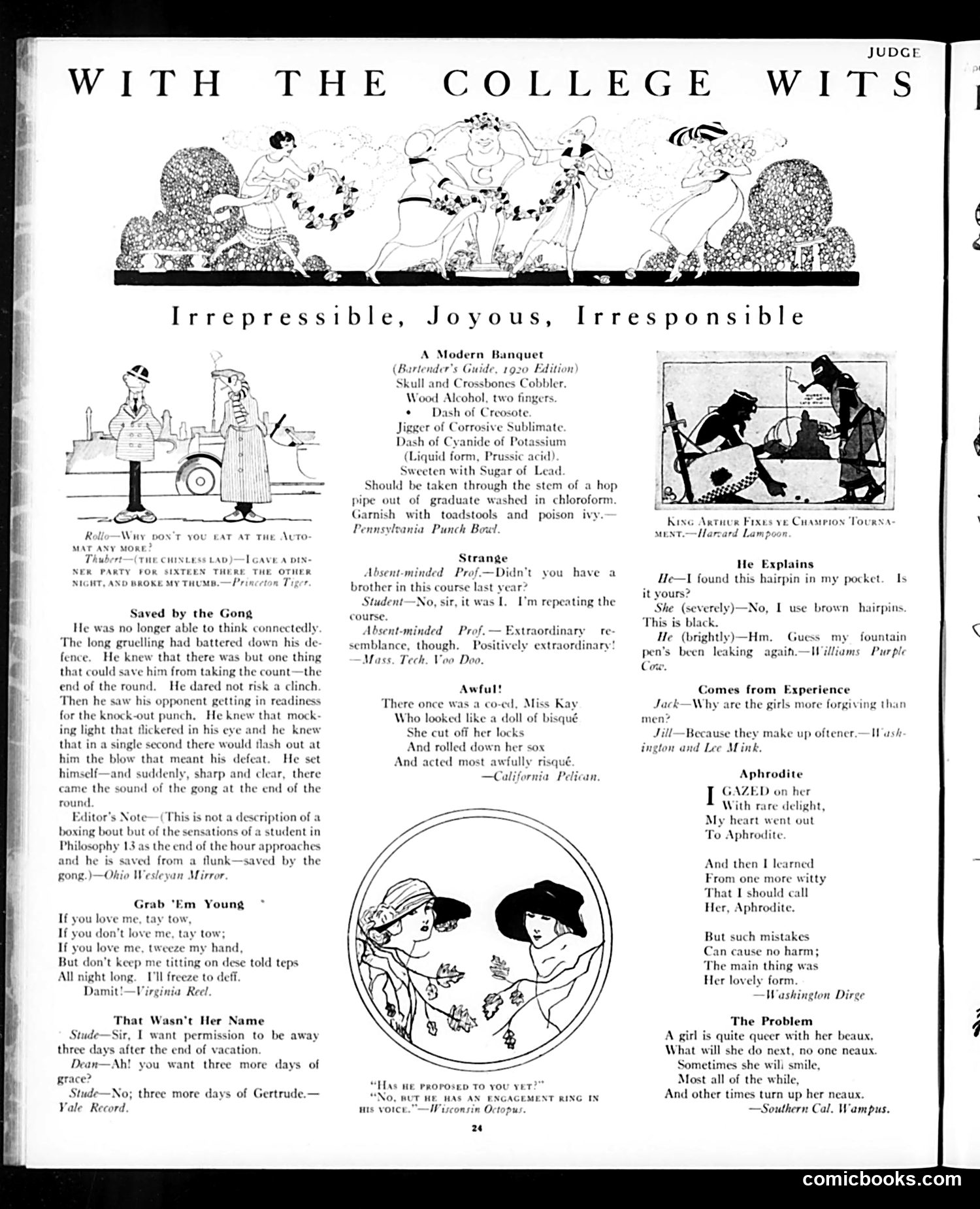
This page collects humorous snippets from college and university publications (Ohio Wesleyan Mirror, Yale Record, Wisconsin Octopus, etc.), typical of Judge's regular feature showcasing student wit. **Key satirical themes:** - **Prohibition-era humor**: "A Modern Banquet" mocks 1920s bootleg alcohol by listing poison ingredients (wood alcohol, cyanide, lead sugar)—reflecting real dangers of illegal liquor during Prohibition. - **Academic absurdities**: "Saved by the Gong" equates boxing with enduring a dull philosophy lecture, suggesting student desperation to survive tedious classes. - **Dating/romance comedy**: Multiple jokes about courtship rituals, broken engagements, and gender differences in romantic behavior—standard collegiate preoccupations. - **Co-ed behavior**: References to young women "rolling down socks" and cutting hair signal changing post-WWI social freedoms that conservative readers found scandalous. The overall tone: affectionate mockery of college life's predictable anxieties—academic survival, romantic entanglement, and youthful irresponsibility.
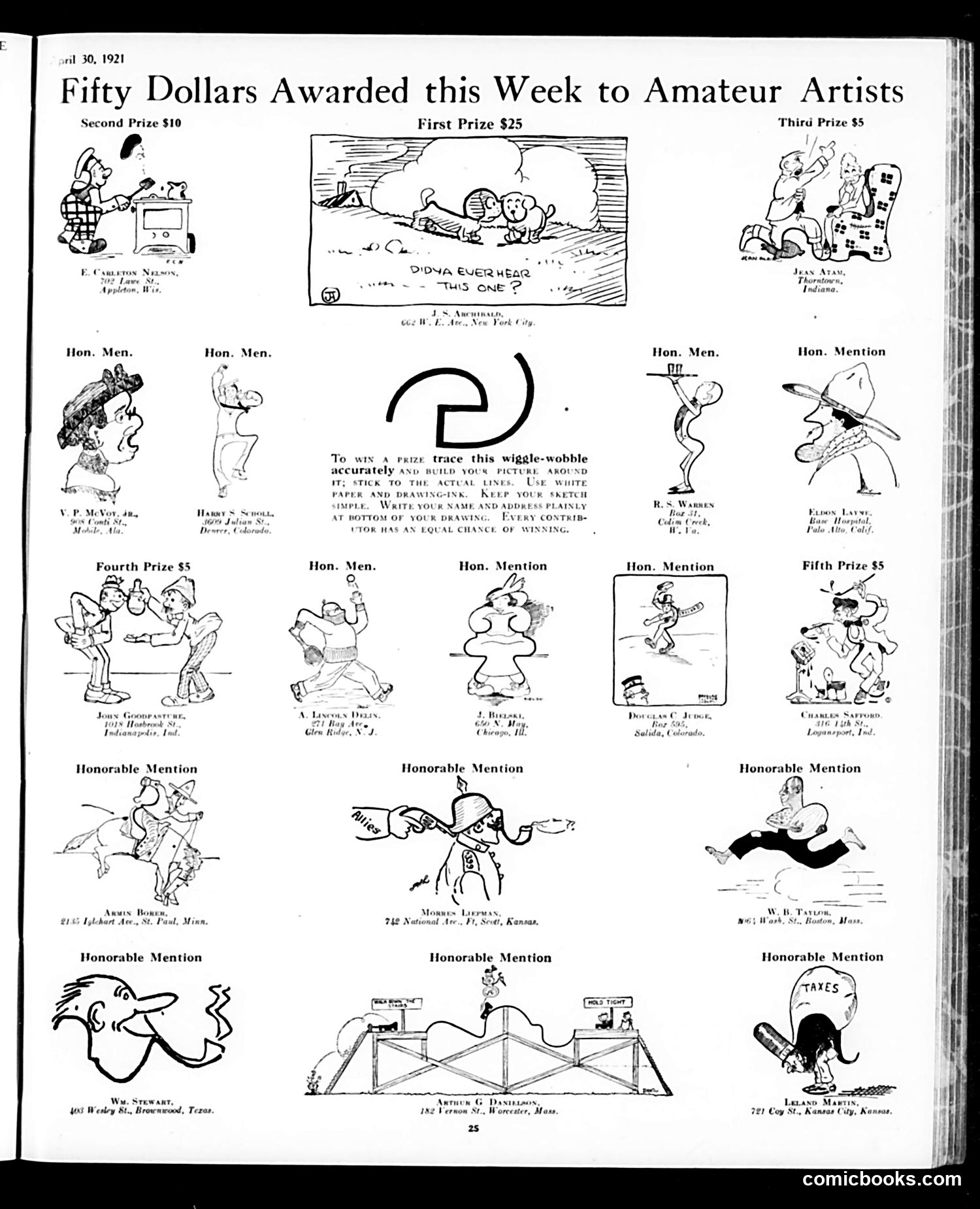
This page showcases Judge magazine's weekly amateur cartoon competition, awarding $50 total in prizes ($25 first, $10 second, $5 third, plus honorable mentions). The contest mechanic is a "wiggle-wobble" drawing game: contestants trace an abstract squiggly line accurately, then build a finished cartoon around it. The instructions emphasize following the actual line precisely while exercising creative interpretation. The winning entries display typical 1920s humor: domestic scenes, physical comedy, exaggerated character types. The first-prize winner by J.S. Amorimann depicts a dog asking "D'you ever hear this one?"—a setup for a joke, capturing the era's casual animal-character humor. This represents Judge's democratization of cartooning talent, inviting amateur submissions rather than relying solely on professional staff. The contest format was common in humor magazines of this period, engaging readers while discovering new artistic voices.
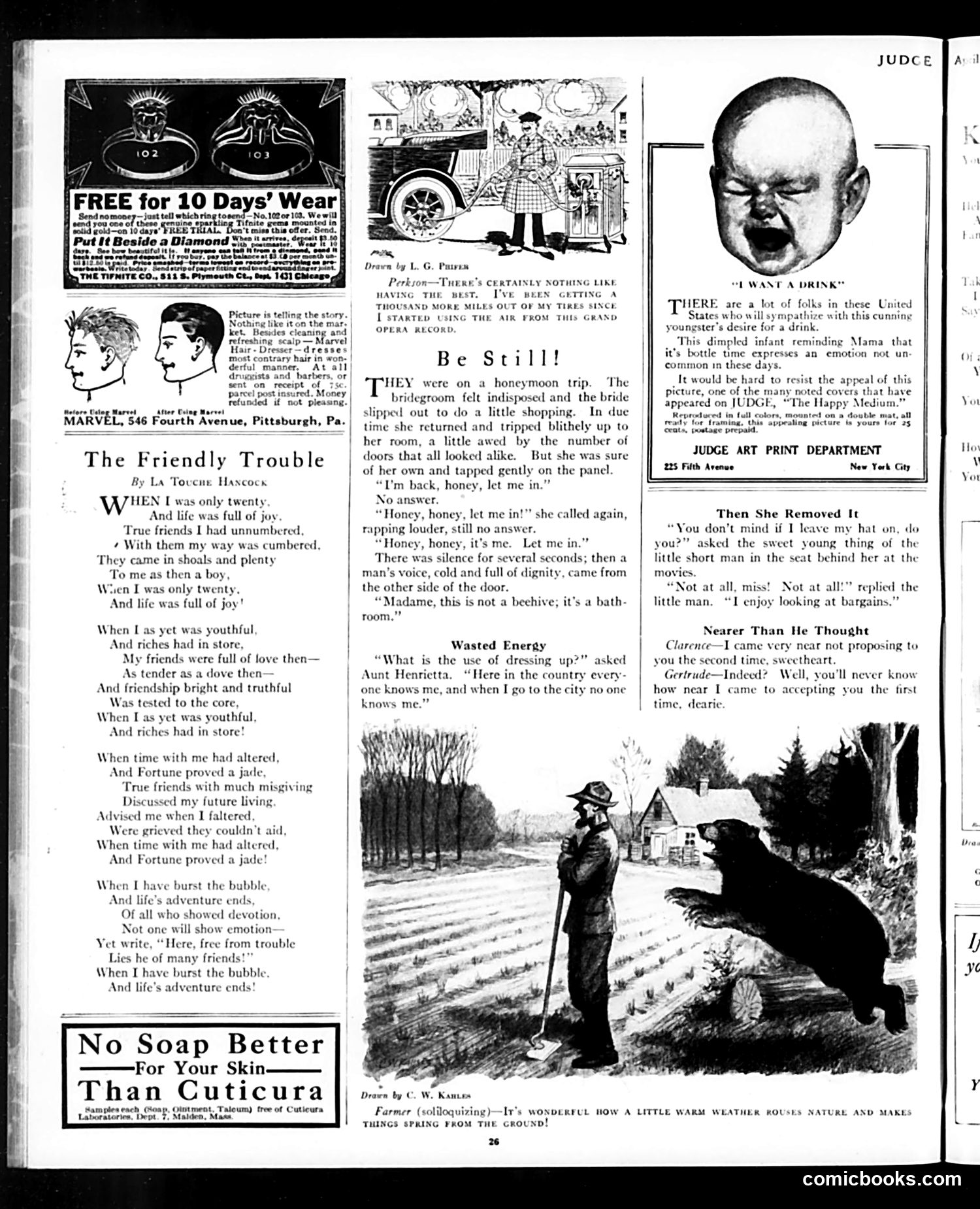
This page contains multiple satirical cartoons and advertisements typical of early 20th-century American humor magazines. **"Be Still!" cartoon**: A newlywed woman, shopping during her honeymoon, accidentally enters the wrong hotel room. When she taps on the door saying "I'm back, honey," a stranger responds coldly that this is "a bathroom, not a beehive"—the joke being her embarrassing mistake and his dignified rebuke. **"Wasted Energy"**: Aunt Henrietta complains that dressing up is pointless—country neighbors know her anyway, and city strangers don't. The satire mocks vanity and social pretense. **"I Want a Drink"**: A baby reminds his mother of bottle time. The caption notes this resonates with contemporary readers, likely alluding to Prohibition-era anxieties about alcohol deprivation—a clever double meaning treating adult drinking desires as equivalent to infant needs. **Other content**: A poem about friendship's transience, product advertisements (Marvel hair dresser, Cuticura soap, costume jewelry), and farm humor complete the page.
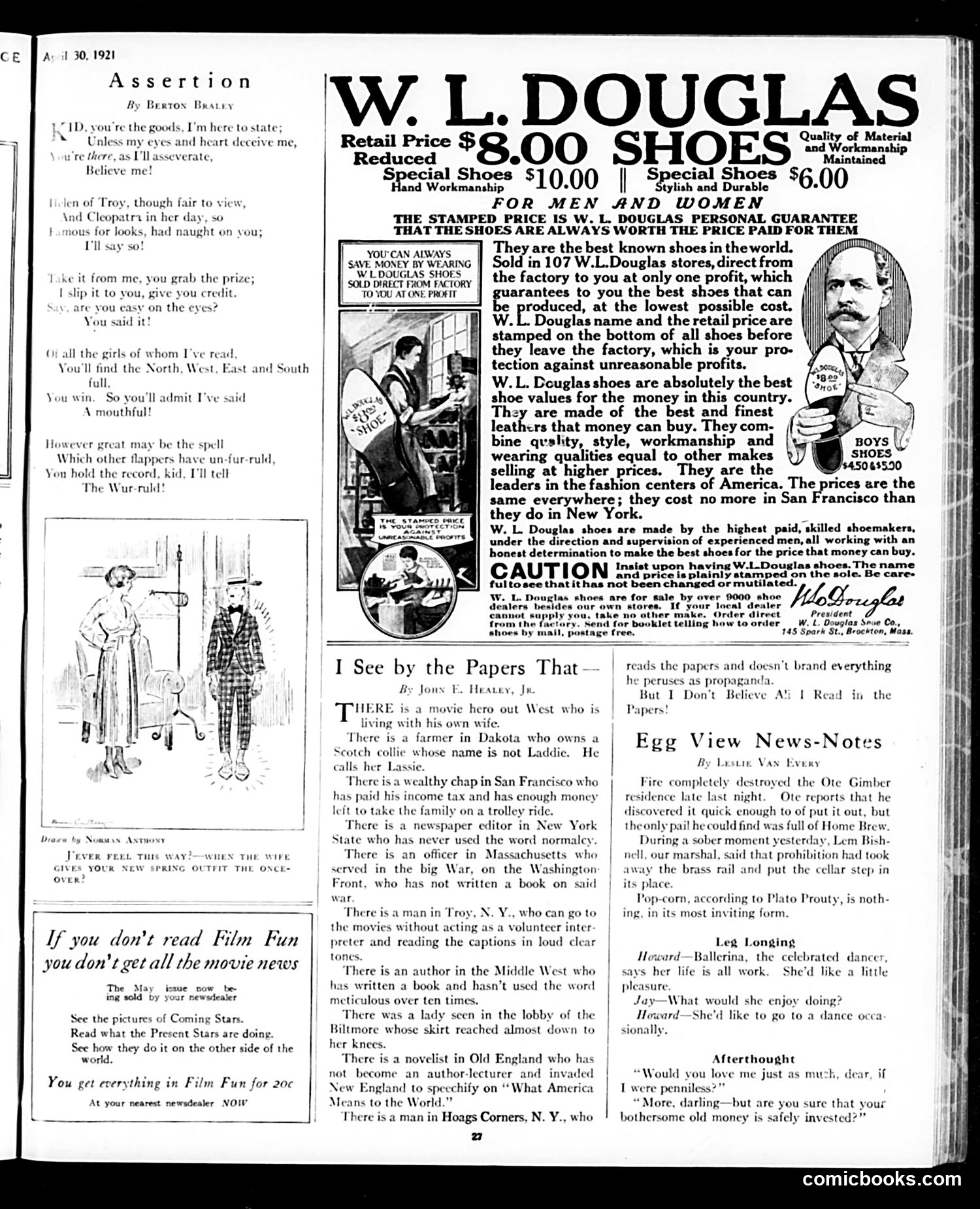
This page is primarily **advertising and light humor**, not political satire. The dominant content is a W.L. Douglas shoe advertisement emphasizing direct factory-to-consumer sales and price guarantees. The poetry "Assertion" by Barton Braley is a complimentary tribute to women (likely flapper-era women), using exaggerated praise comparing them favorably to historical beauties. The cartoon by Norman Armour, captioned "Ever Feel This Way?—When the Wife Gives Your New Spring Outfit the Once-Over?" depicts a domestic scene where a husband nervously awaits his wife's judgment on his clothing—a relatable marital humor common to the era. "I See by the Papers That" offers satirical observations about unusual modern figures (a movie star living with his own wife, an editor who doesn't use "normalcy"), gently mocking contemporary trends and affectations of the early 1920s. The page reflects 1921 consumer culture and domestic comedy rather than political commentary.
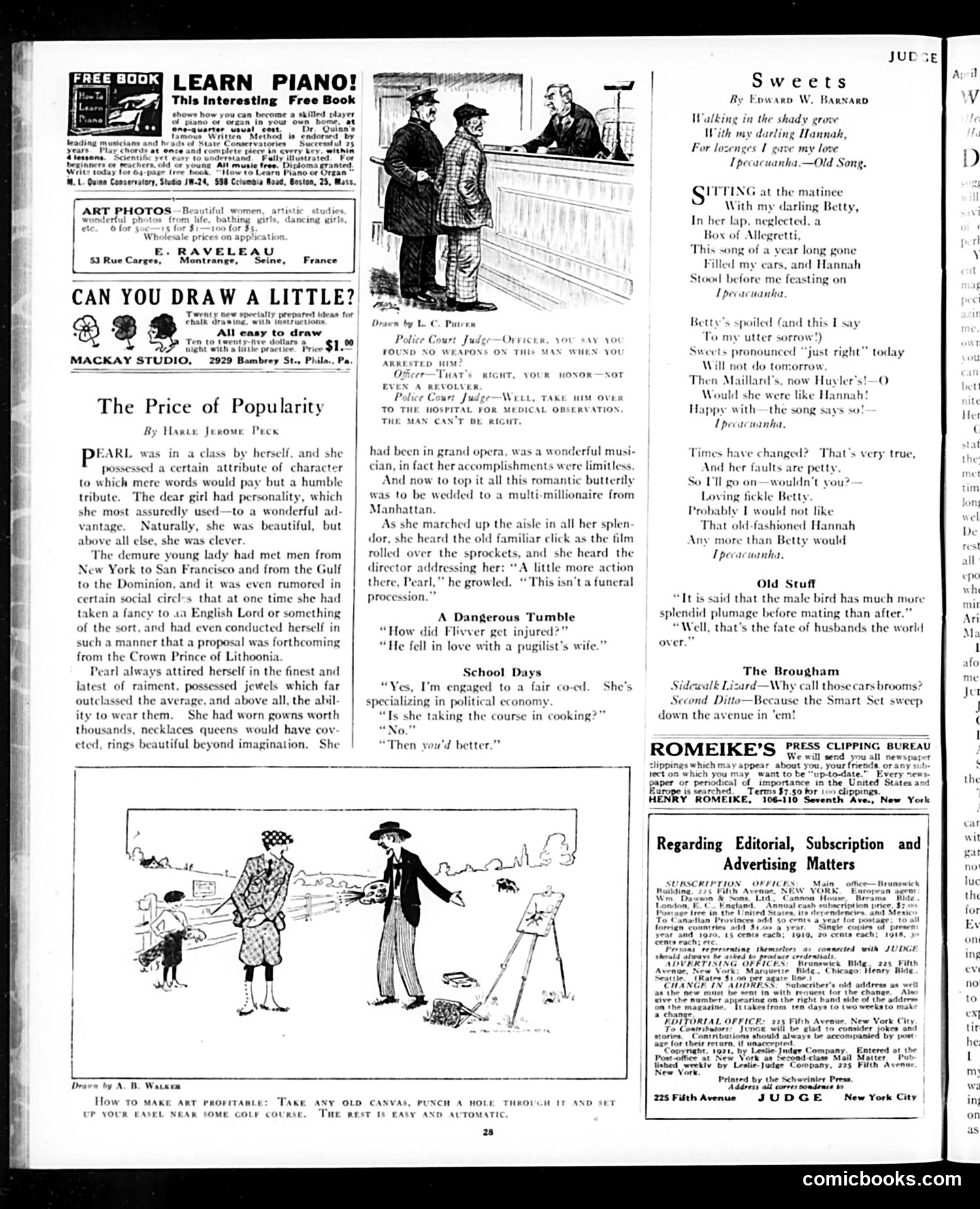
This page from *Judge* magazine contains primarily **advertisements and light humor** rather than political satire. The main content includes: **Top section**: Ads for piano lessons, art photos, and drawing instruction—typical early-20th-century self-improvement offerings. **"The Price of Popularity"**: A short story about "Pearl," a wealthy, accomplished woman marrying a Manhattan millionaire. The twist (revealed in the cartoon caption by L.C. Peters): Pearl's wedding is actually a **film production**—the director tells her to add "more action" because "this isn't a funeral procession." The satire gently mocks both Hollywood's artificiality and high society's performative nature. **Police court joke**: A man found with no weapons is deemed mentally unfit—obvious absurdist humor. **Remaining content**: Poems about candy ("Sweets"), brief jokes about courtship and marriage conventions, and press clipping bureau advertising. The page reflects *Judge*'s role as a **humor and lifestyle magazine** for educated middle/upper-class readers, mixing light social commentary with product advertisements—not hard-hitting political cartooning.
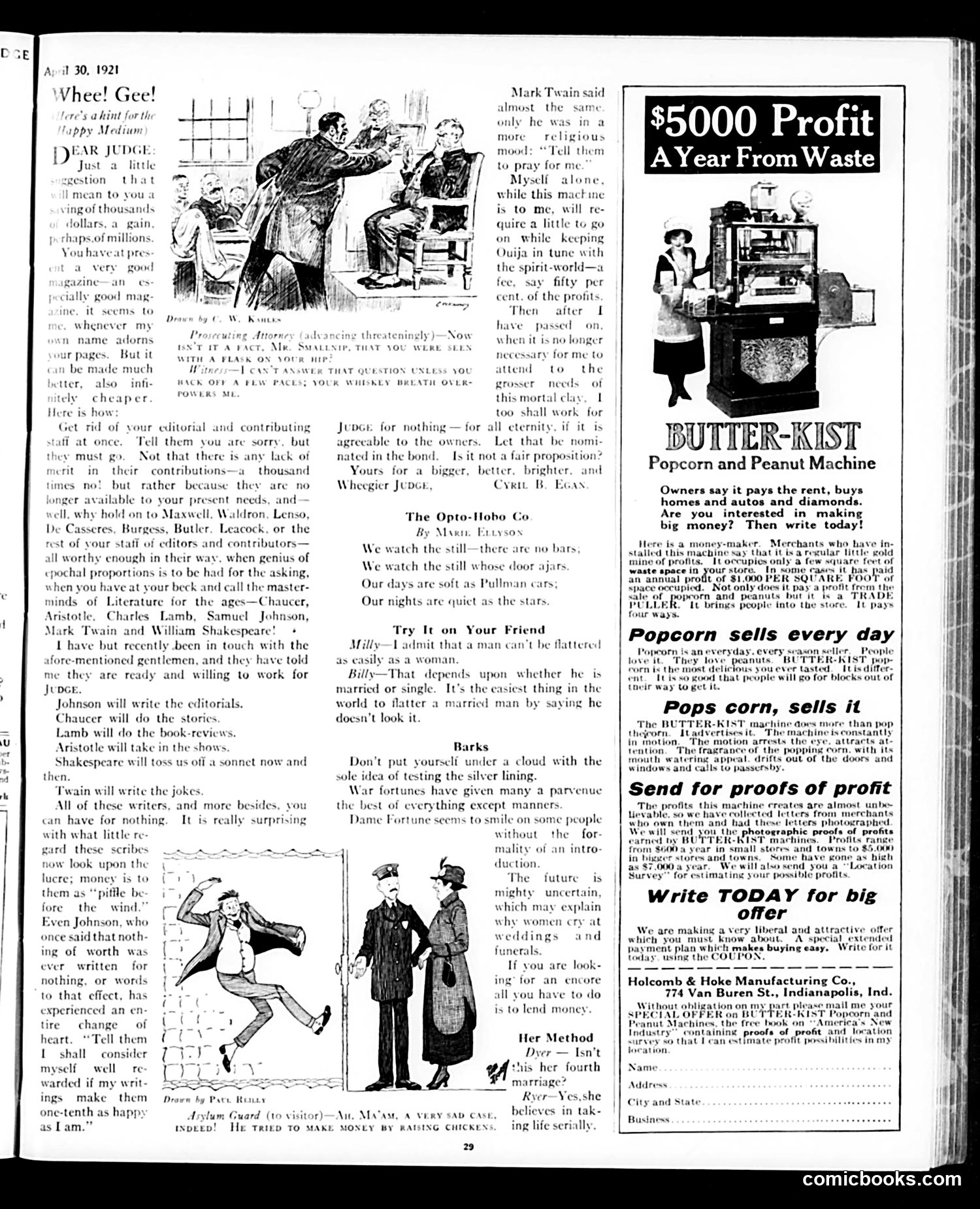
## Main Editorial Cartoon The lead piece is satirical advice to Judge's editor: fire all current staff writers (Maxwell, Waldron, Lenso, De Casseres, Burgess, Butler, Leacock) and replace them with dead literary giants—Samuel Johnson, Chaucer, Charles Lamb, Aristotle, Shakespeare, and Mark Twain. The joke mocks both the magazine's pretensions and these writers' legendary reluctance to write for payment. The satirist notes these immortals claim they'll work "for nothing," finding the proposal absurdly cost-effective. The cartoon illustrations support the absurdity: showing a disheveled man attempting schemes to make money (raising chickens), and an asylum guard describing an inmate who "tried to make money by raising chickens"—implying the whole idea is mad. ## Secondary Content Brief comic exchanges mock human nature: men can be flattered if married; war profiteers lack manners; a woman marries repeatedly as her "method." The page is primarily **satirical commentary on magazine economics and literary pretension** rather than explicit political commentary.
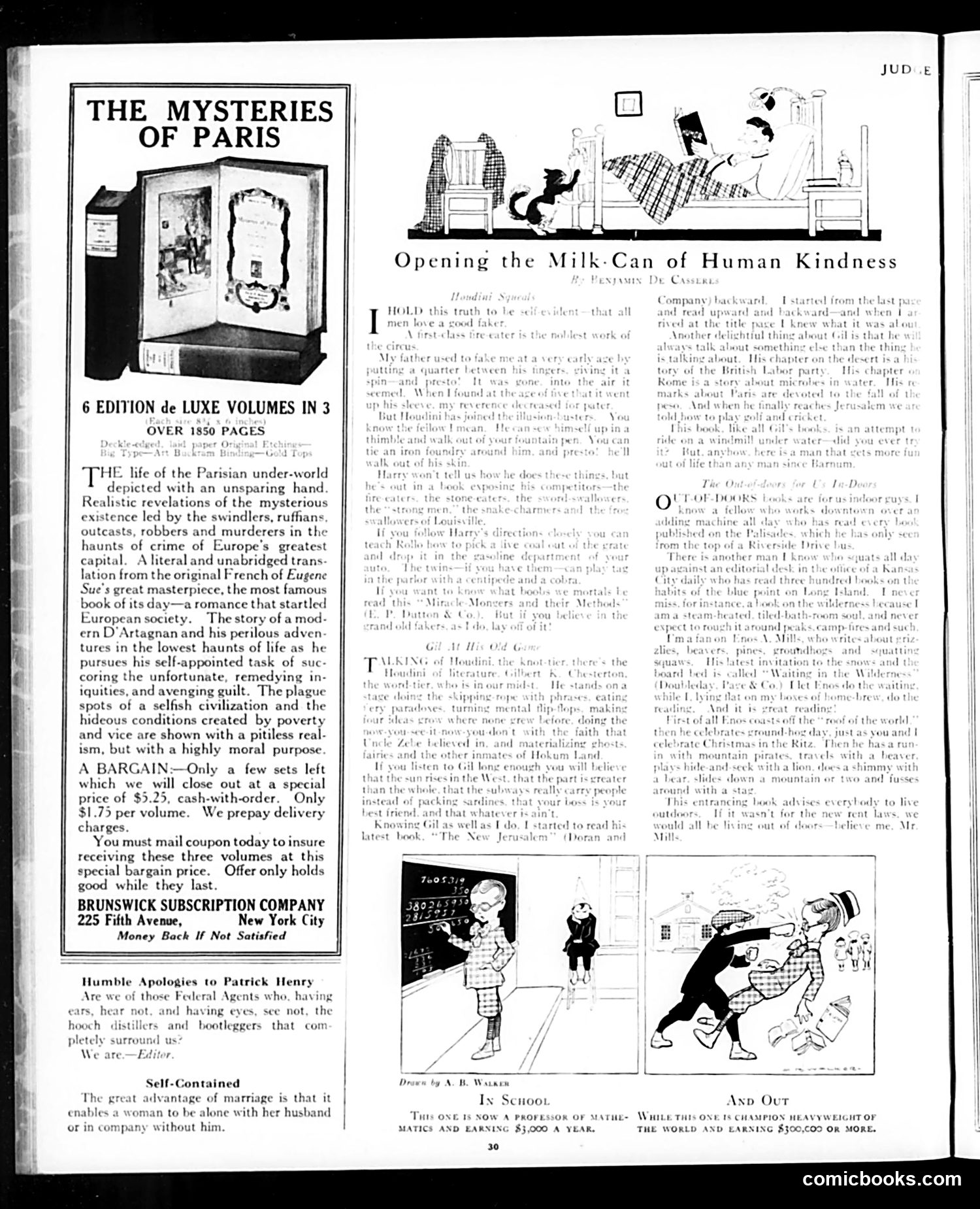
This Judge magazine page mixes advertising with satirical cartoons reflecting 1920s concerns. **"The Mysteries of Paris"** advertisement promotes a serialized French novel about urban crime and poverty—escapist fiction that was popular with middle-class readers. **"Opening the Milk-Can of Human Kindness"** (top cartoon) appears to satirize sentimental or preachy literature about helping the poor, showing a man reading while chaos erupts around him—suggesting the gap between feel-good rhetoric and actual social problems. **"Humble Apologies to Patrick Henry"** mocks Prohibition enforcement agents who ignore bootleggers ("haven't eyes, see not"). **The two bottom cartoons contrast wealth inequality**: "In School" shows a mathematics professor earning $3,000/year versus "And Out" showing a heavyweight boxing champion earning $300,000+—satirizing how athletes were far better compensated than educated professionals, reflecting 1920s economic absurdities and the era's celebrity culture.
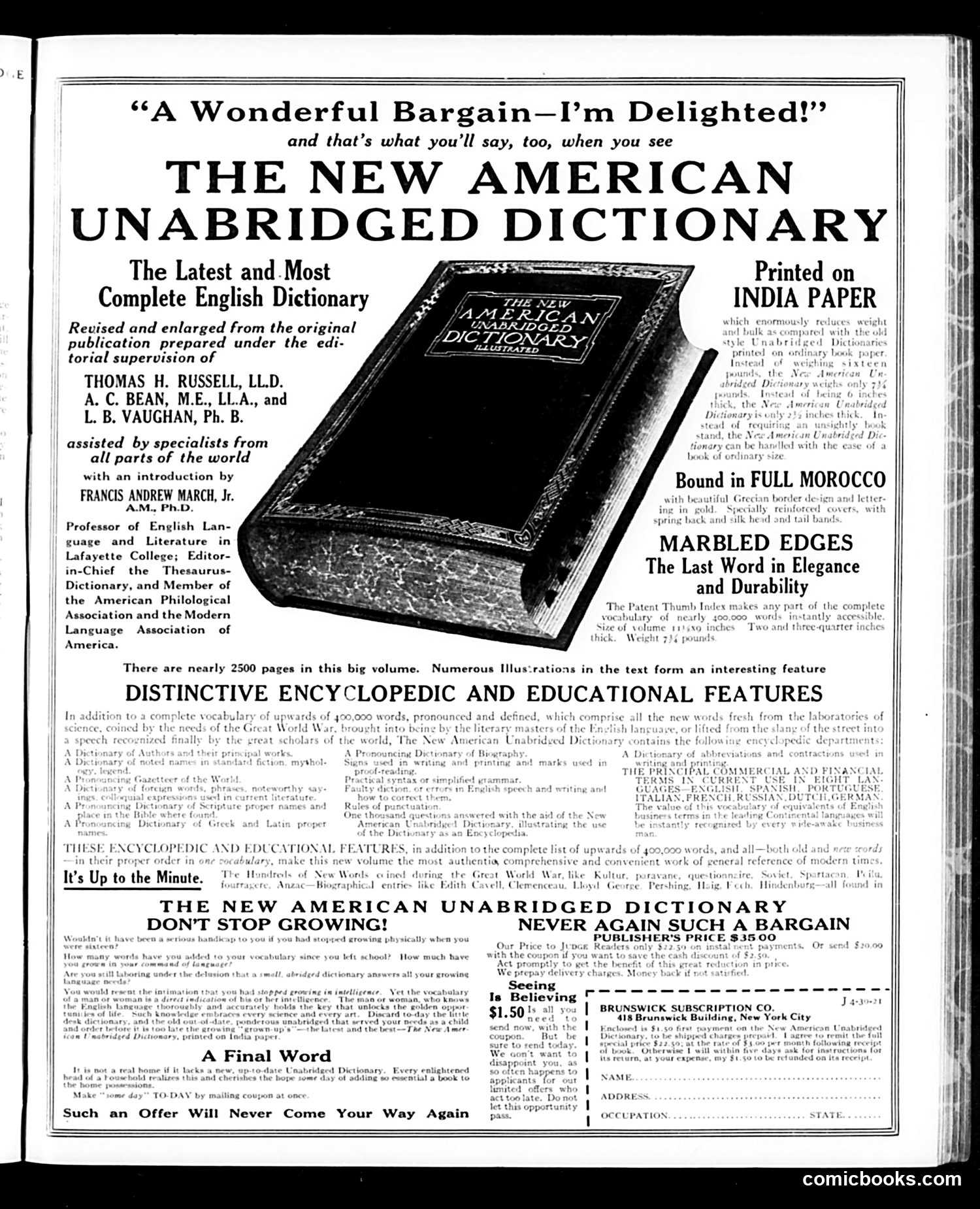
This page is **primarily a dictionary advertisement**, not a political cartoon. It promotes *The New American Unabridged Dictionary* as a bargain priced at $1.50 (reduced from the publisher's price of $35.00). The advertisement uses a common sales technique of the era: the testimonial quote "A Wonderful Bargain—I'm Delighted!" at the top, implying satisfied customers. The copy emphasizes product features (2,500 pages, morocco binding, marbled edges, India paper) to justify the low price. The phrase "Such an Offer Will Never Come Your Way Again" creates urgency—a standard marketing tactic suggesting exclusivity or limited availability. No political satire or caricature appears here. This is straightforward commercial advertising typical of *Judge* magazine's revenue model, where full-page ads subsidized the publication's satirical content elsewhere.
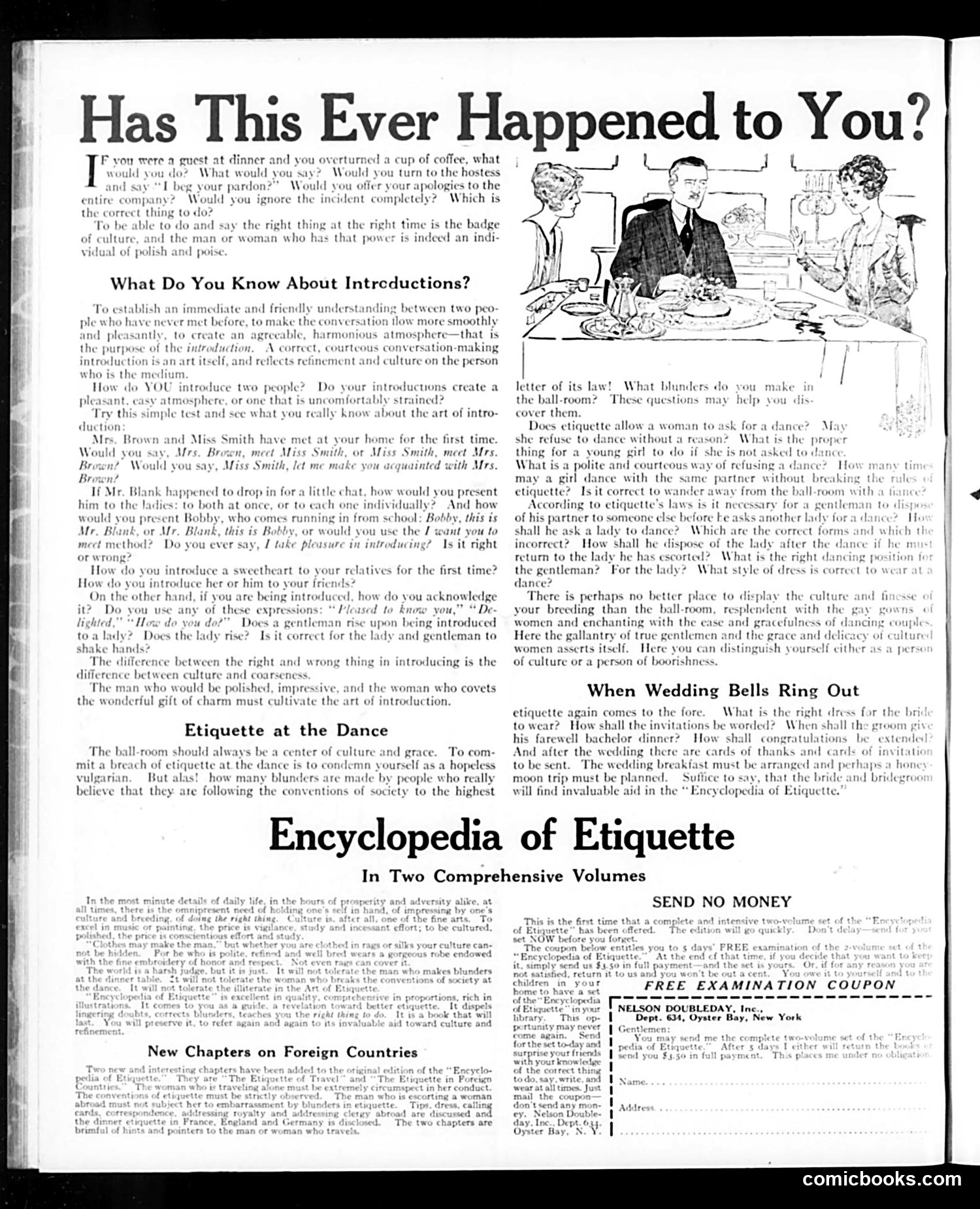
This is primarily **educational advertising content**, not satire or political commentary. The page promotes the "Encyclopedia of Etiquette," a two-volume reference book addressing social anxieties of its era. The illustration shows a dinner scene where someone has spilled coffee—a relatable social embarrassment. The accompanying text poses questions about proper responses: Should you apologize? To whom? Ignore it completely? The content reflects **early 20th-century class anxieties**: rigid rules governed introductions, dance etiquette, and wedding protocol. For readers of that period, knowing "the correct thing to do" signaled respectability and culture. The page addresses concrete concerns—how to introduce people, whether women could ask men to dance, proper wedding attire—all matters where social missteps could damage one's reputation. The marketing message: etiquette mastery distinguished "cultured" people from "vulgar" ones. A free examination coupon at bottom encourages purchasing the encyclopedia as a social insurance policy.