
Judge, 1921-04-30 · page 20 of 32
Judge — April 30, 1921 — page 20: what you’re looking at
What you’re looking at
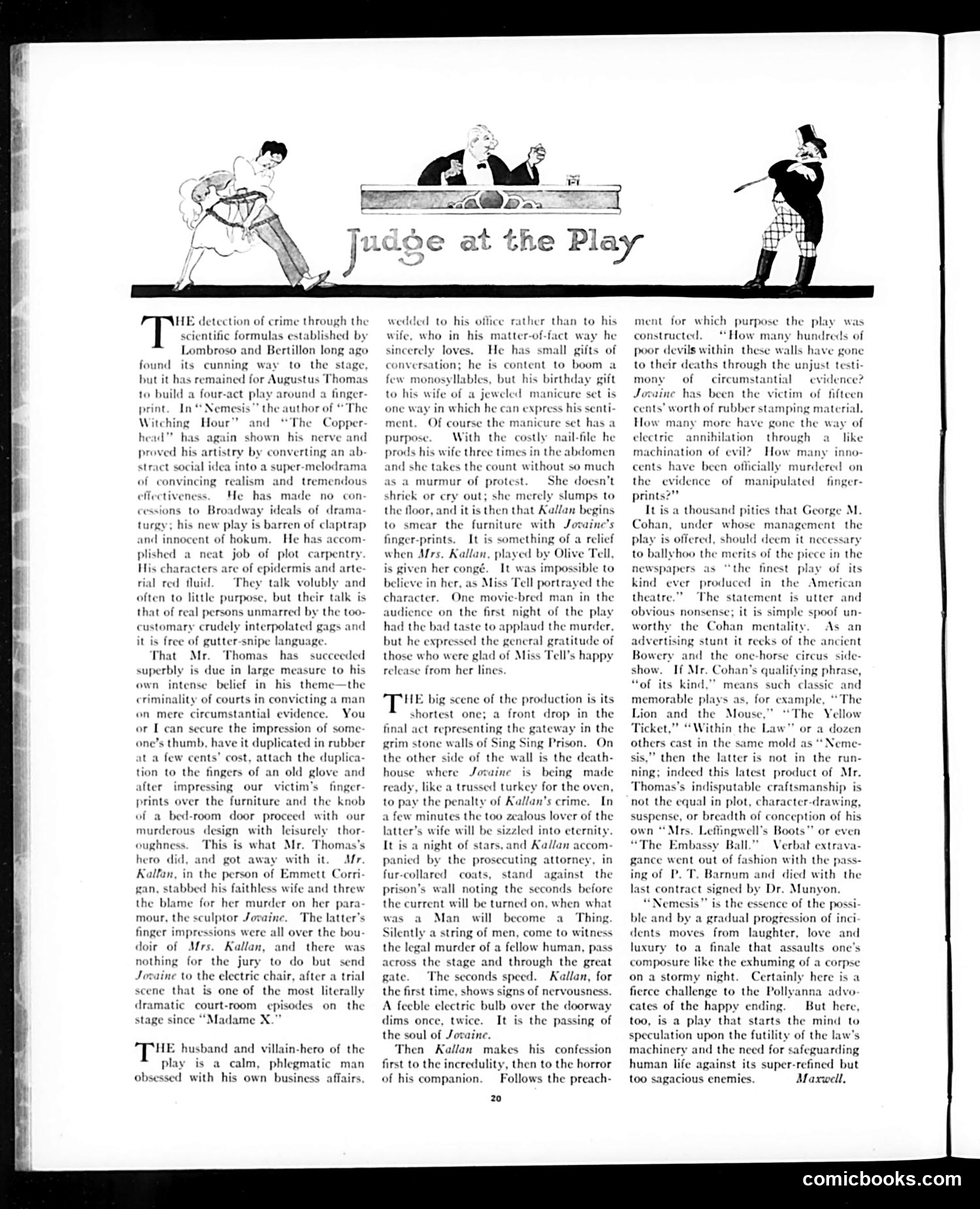
This is a theater review of Augustus Thomas's play "Nemesis," centered on a murder plot involving planted fingerprints. The cartoon header shows a judge overseeing the theatrical "play." The review describes the plot: a calm businessman named Kallan murders his unfaithful wife with a jeweled nail file, then frames a sculptor named Jovaine by smearing the victim's furniture with Jovaine's fingerprints. The play exploits contemporary anxieties about early forensic science—specifically Lombroso and Bertillon's fingerprinting methods—by showing how circumstantial evidence (fingerprints) could wrongly convict an innocent man. The reviewer praises Thomas for creating serious melodrama without Broadway clichés, though criticizes actress Olive Tell's portrayal of the murdered wife as unconvincing. The climax involves Jovaine's execution at Sing Sing Prison. The satire targets both the legal system's vulnerability to false evidence and theatrical conventions of the era.
📄 Transcribed text from this page (OCR, searchable)
Machine-transcribed from the original scan — historical spelling and the odd misread are preserved.
| A Fe said LAa@a= fa HE detection of crime through the scientific formulas established by Lombroso and Bertillon long ago found its cunning to the stage but it has remained for Augustus Thomas to build a four-act play around a finger print. In“ Nemesis” the author of “ The Witching Hour” and “The Copper head” has. agai his nerve and proved his artistry by converting an ab. stract social idea into a super-melodrama way shown of convincing realism and tremendous effectiveness. He has made no cessions to Broadway ideals of drama his new play is barren of claptrap and innocent of hokum. He has accom- plished a neat job of plot carpentry His characters are of epidermis and arte rial red fluid. They talk volubly and often to little purpose, but their talk is that of real persons unmarred by the too: customary crudely interpolated gags and it is free of gutter-snipe language. That Mr. Thomas has succeeded superbly is due in large measure to his own belief in his theme—the criminality of courts in convicting a man on mere circumstantial evidence. You or [ can secure the impression of some one’s thumb, have it duplicated in rubber ita few cents’ cost, attach the duplica- tion to the fingers of an old glove and after impressing our victim's finger prints over the furniture and the knob of a bed-room door proceed with our murderous design with leisurely thor oughness. This is what Mr. Thomas's hero did, and got away with it. Mfr Kalfan, in the person of Emmett Corri- gan, stabbed his faithless wife and threw the blame for her murder on her para mour, the sculptor Jovaine. The latter's finger impressions were all over the bou doir of Mrs. Kallan, and there was nothing for the jury to do but send Jovaine to the electric chair, after a trial scene that is one of the most literally dramatic court-room episodes on the stage since “Madame X.” con turgy; intense HE husband and villain-hero of the play is a calm, phlegmatic man obsessed with his own business affairs. aA +h OC at wedded to his office rather than to his wife, who in his matter-of-fact way he sincerely loves. He has small gifts of conversation; he is content to boom a few nosyllables, but his birthday gift to his wife of a jeweled manicure set is one way in which he can express his senti ment. Of course the manicure set has a purpose With the costly nail-file he prods his wife three times in the abdomen and she takes the count without so much as a murmur of protest. She doesn’t shriek or cry out; she merely slumps to the floor, and it is then that Kallan begins to smear the furniture with Jovaine’s finger-prints. It is something of a relief when Mrs. Kallan, played by Olive Tell, It was impossible to me is given her congé. believe in her, as Miss Tell portrayed the character. One movie-bred man in the audience on the first night of the play had the bad taste to applaud the murder, but he expressed the gencral gratitude of those who were glad of Miss Tell’s happy release from her lines. HE big scene of the production is its shortest one; a front drop in the final act representing the gateway in the grim stone walls of Sing Sing Prison. On the other side of the wall is the death- house where J being made ready, like a trussed turkey for the oven, to pay the penalty of Kallan’s crime. In a few minutes the too zealous lover of the latter’s wife will be sizzled into eternity. It is a night of stars, and Kallan accom: panied by the prosecuting attorney, in fur-collarcd coats, stand against the prison’s wall noting the seconds before the current will be turned on, when what was Man will become Thing. Silently a string of men, come to witness the legal murder of a fellow human, pass across the stage and through the great gate. The seconds speed. Kallan, for the first time, shows signs of nervousness. A feeble electric bulb over the doorway It is the passing of aine is dims once, twice. the soul of Jovaine. Then Kallan makes his confession first to the incredulity, then to the horror of his companion. Follows the preach- 20 for wh purpose the play constructed. “How many hundreds of poor devils within these walls have gone to their deaths through the unjust testi- mony of circumstantial evidence? Jo has been the victim of fifteen cents’ worth of rubber stamping material. How many more have gone the way of electric annihilation through like machination of evil? How inno- been officially murdered on manipulated finger- ment was ine many cents have the evidence of prints. It is a thousand pitics that George M. Cohan, under whose management the play is offered, should deem it necessary to ballyhoo the merits of the piece in the newspapers as “the finest play of its kind ever produced in the American theatre. The statement is utter and obvious nonsense; it is simple spoof un worthy the Cohan mentality. As an advertising stunt it recks of the ancient Bowery 1 the show. If Mr. Cohan’s qualifying phrase, “of its kind,” means such classic and memorable plays as, for example, “The Lion and the Mouse,” “The Yellow Ticket,” “Within the Law” or a dozen others cast in the same mold as “* Neme- sis,”’ then the latter is not in the run- ning; indeed this latest product of Mr. Thomas's indisputable craftsmanship is not the equal in plot, character-drawing, suspense, or breadth of conception of his own “Mrs. Leffingwell’s Boots” or even “The Embassy Ball.”” Verbat extrava- gance went out of fashion with the pass- ing of P. T. Barnum and died with the last contract signed by Dr. Munyon, Nemesis” is the essence of the possi ble and by a gradual progression of inci dents moves from laughter, love and luxury to a finale that assaults one’s composure like the exhuming of a corpse on a stormy night. Certainly here is a fierce challenge to the Pollyanna advo: cates of the happy ending. But here, too, is a play that starts the mind to speculation upon the futility of the law's machinery and the need for safeguarding human life against its super-refined but too sagacious enemie Maxwell. one-horse circus side- comicbooks.com