
Judge, 1921-04-30 · page 14 of 32
Judge — April 30, 1921 — page 14: what you’re looking at
What you’re looking at
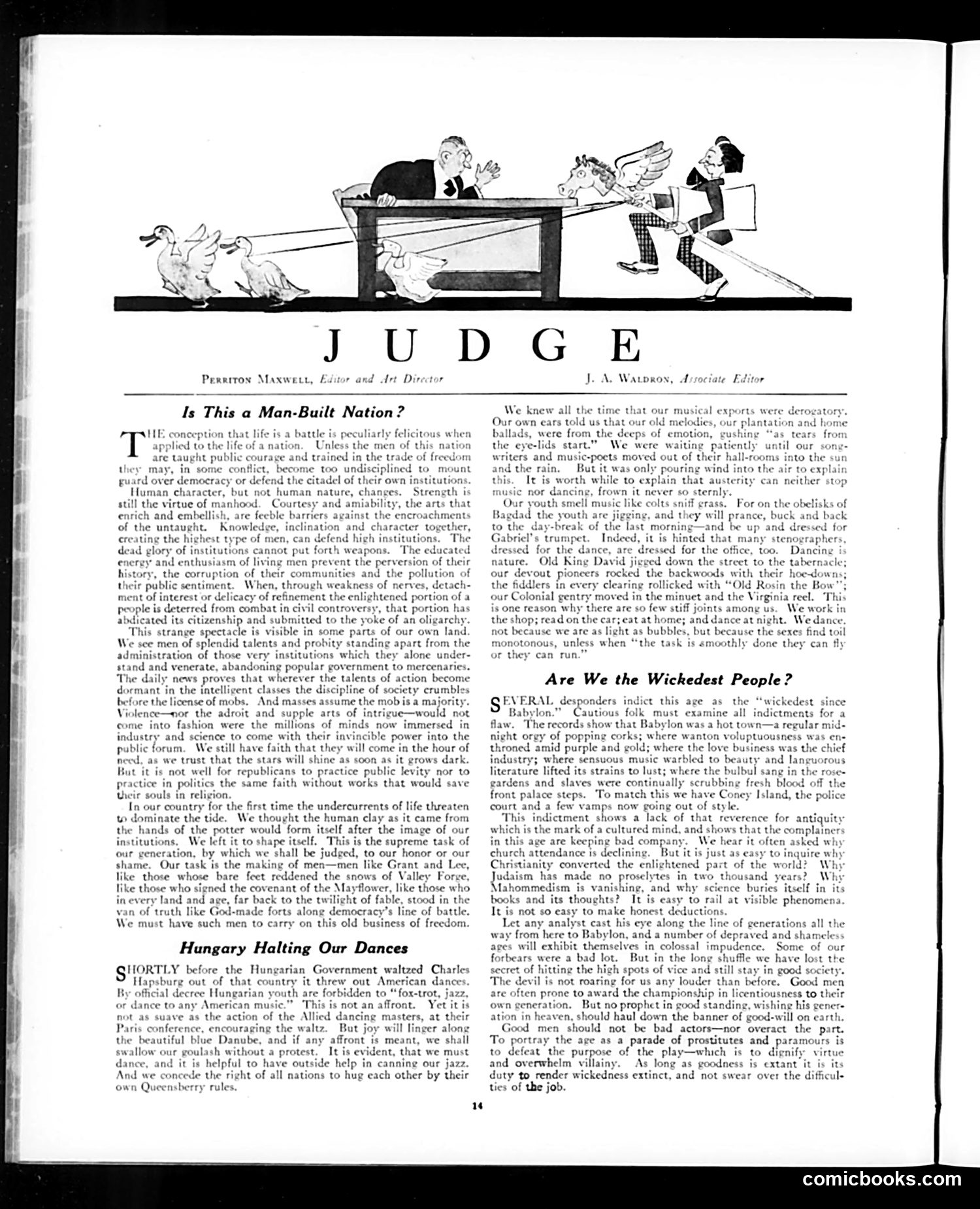
## The Main Cartoon (Top) The illustration depicts a judge presiding over a courtroom scene where geese are being tried. This is a whimsical visual metaphor supporting the article's serious argument about American civic duty. The cartoon satirizes the idea that citizens have abdicated their responsibility to participate in governance, leaving institutions vulnerable to mob rule and unqualified "mercenaries." ## The Articles' Arguments **"Is This a Man-Built Nation?"** argues that educated, talented citizens have withdrawn from public life and civic participation, allowing incompetent or corrupt people to control democratic institutions. The author warns this endangers the republic—referencing Valley Forge and the Mayflower as examples of citizens who actively defended freedom. **"Hungary Halting Our Dances"** is lighter satire: Hungary banned American jazz and fox-trotting while promoting the waltz, which Judge finds absurdly paternalistic. The piece mocks both Hungary's censorship and the Allied powers' cultural meddling in post-WWI Eastern Europe. Both pieces reflect post-WWI anxiety about democracy's fragility and foreign instability.
📄 Transcribed text from this page (OCR, searchable)
Machine-transcribed from the original scan — historical spelling and the odd misread are preserved.
Perriton Maxwett, rand Art Director Is This a Man-Built Nation? HE conception that life is a battle is elicit are taught publ hfs courage and tratned inthe trade of freed may, in some become too undisciplined to over democracy’ or defend the aman character, but not human changes. Strength is still the virtue of m. ty, the arts that enrich and embellis t the encroachmer of the untaug Knowledge, incli: jon and character together, creating the h defend high instituti The dead glory of institutions cannot put forth weapons. ‘The educated energy and enthusiasm of living men prevent the perversion of their history, the corruption of their communities and the pollution of public sentiment. When, through weakness of nerves, detach- ment of interest or delicacy of refinement the enlightened portion of a people is deterred from combat in civil controversy, that portion has abdicated its citizenship and submitted to the yoke of an oligarchy. This strange spectacle is visible in some parts of our own land We sce men of splendid talents and probity standing apart from the administration of those very institutions whi y alone under- and venerate, abandoning popular government to mercenaries. The daily: news proves that wherever the talents of action become dormant in the intelligent classes the discipline of society crumbles before the license of mobs. And masses assume the mob is a majority. Violence—nor the adroit and supple arts of intrieue—would not come into fashion were the millions of minds now immersed in industry and science to come with their invincible power into the public forum. We still have faith that they will come in the hour of need, as we trust that the stars will shine as soon as it grows dark. But it is not well for republicans to practice public levity nor to practice in politics the same faith without works that would save Uncir souls in r In our country for the first time the undercurrents of life threaten tw dominate the tide. We thought the human clay as it came from the hands of the potter would form itself after the image of our stitutions, We left it to shape itself. ‘This is the supreme task of our generation, by which we shall be judged, to our honor or our shame. Our task is the making of men—men like Grant and Lee, like those whose bare feet reddened the snows of Valley Forge, like those who signed the covenant of the Mayflower, like those who in every land and age, far back to the twilight of fable, stood in the van of truth like God-made forts along democracy’s line of battle. We must have such men to carry on this old business of freedom. i 1 sus wh peculiarly us wh contlict nhood igion. Hungary Halting Our Dances HORTLY befi ore the Hungarian Government waltzed Charles »sburg out of that country it threw out American - official di f ree Hungarian youth are forbidden to “fox-trot, jazz, American music.” ‘This is not an affront. Yet it is action of the Allied dancing masters, at thei conference, encouraging the waltz. But joy will the beautiful blue Danube, and if any affront is meant, we shall swallow our goulash without a protest. It is evident, that we must dance, and it is helpful to have outside help in canning our jazz. And we concede the right of all nations to hug each other by their own Queensberry rules. ance to any not as suave as th We knew all the t t Our own ears told us that our ¢ ballads, were from th lids start.” ‘ We we re waiting patient iters music-pocts moved out of their nd the 4: But it was only pouring wind while to explain that austerity can neither ng, frown it never so sternly. Our youth smell music like colts snif erase ‘outh are ji 1 they will prar the last morning—and be uf trumpet. Indeed, it is hinted t any’ stenographers dressed for the dance, a ssed for the office, too. Dancing nature. Old King David wn the street to the tabernacle; our devout pioncers rocked the backwoods with their hoe-downs; the fid ; clearing rollicked Old Rosin the Bow"; our Colonial gentry moved in the minuet and the Virginia reel. Th is one reason why there are so few stiff joints among us. We work the shop; read on the car; eat at home; and dance at night. We dance not because we are as li bubbles, but because the sexes find t monotonous, unless when sk is smoothly done they can fly hey can run.” Are We the Wickedest People? Sé VERAL desponders indict this age as the “wickedest since Babylon.” Cautious folk must examine all indictments flaw. The records show that Babylon was a hot town—a regular night orgy of popping corks; where wanton voluptuousness w throned amid purple and gold; where the lov © business was the ¢ industry; where sensuous music warbled to beauty and languorc literature lifted its strains to lust; where the bulbul sang gardens and slaves were continually scrubbing fresh blood front palace steps. To match this we have Coney Island, the poll court and a few vamps now going out of styl This indictment shows a lack of that reve which is the mark of a cultured mind, and shows that the complainer g bad company. We hear it often asked wh But it is just as easy to inquire why Christianity converted the enlightened part of the world? Wh: udaism has made no proselytes two thousand years? Why mmedism is vanishing, and why science buries itself in its books and its thoughts? It is easy to rail at visible phenomena. It is not so easy to make honest deduction Let any analyst cast his eye along the line of generations way from here to Babylon, and a number of depraved and shame ages will exhibit themselves in colossal in Some of our forbears were a bad lot. But in the long e we have lost the secret of hitting the high spots of v and still stay in good ety. The devil is not roaring for us any louder than before. Good men prone to award the championship in licentiousness to t own generation. But no prophet in good standing, wishing his genere ation in heaven, should haul down the banner of good-will on earth. Good men should not be bad actors—nor overact the part. To portray the age as a parade of prostitutes and paramours is > defeat the purpose of the play—which is to dignify virtue and overwhelm villainy. As long as goodness is extant it is its duty to render wickedness extinct, and not swear over the difficul- ties of the job. For on the obelisks of d back nd dressed for » buck Jers in eve! comicbooks.com