
A complete issue · 32 pages · 1921
Judge — February 26, 1921
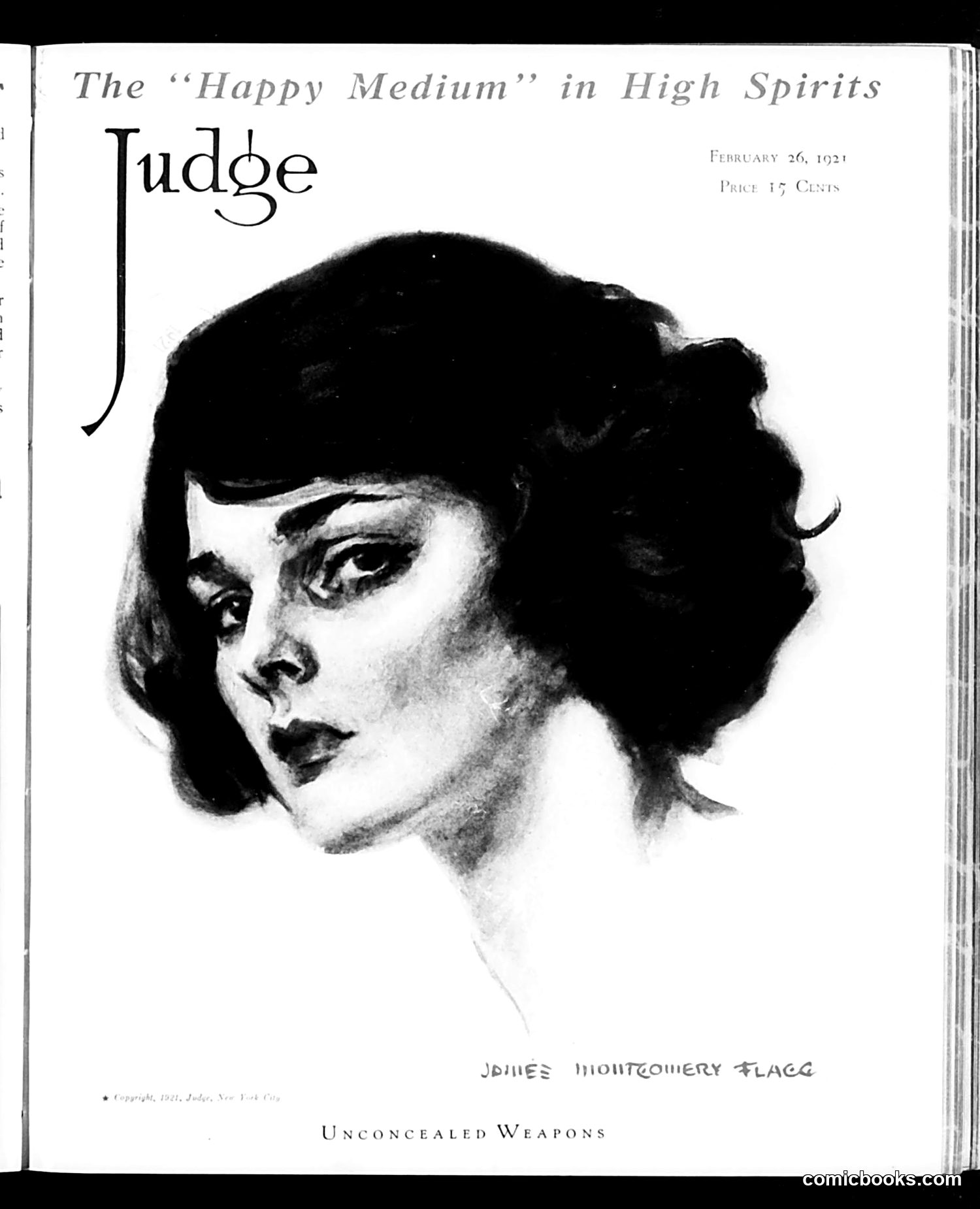
This cover features a portrait illustration credited to **James Montgomery Flagg**, a renowned illustrator of the era. The subtitle "The 'Happy Medium' in High Spirits" and the heading "Unconcealed Weapons" suggest satirical commentary, though the specific target remains unclear from the image alone. The phrase "Unconcealed Weapons" likely references contemporary concerns—possibly relating to Prohibition (enacted January 1920) or post-WWI anxieties about armaments. The woman's direct gaze and stylized 1920s appearance typify Flagg's portrait work from this period. Without additional article text, the precise satirical point is difficult to determine, though the combination of title and illustration suggests commentary on some aspect of 1920s American social or political life that would have been immediately recognizable to contemporary readers.
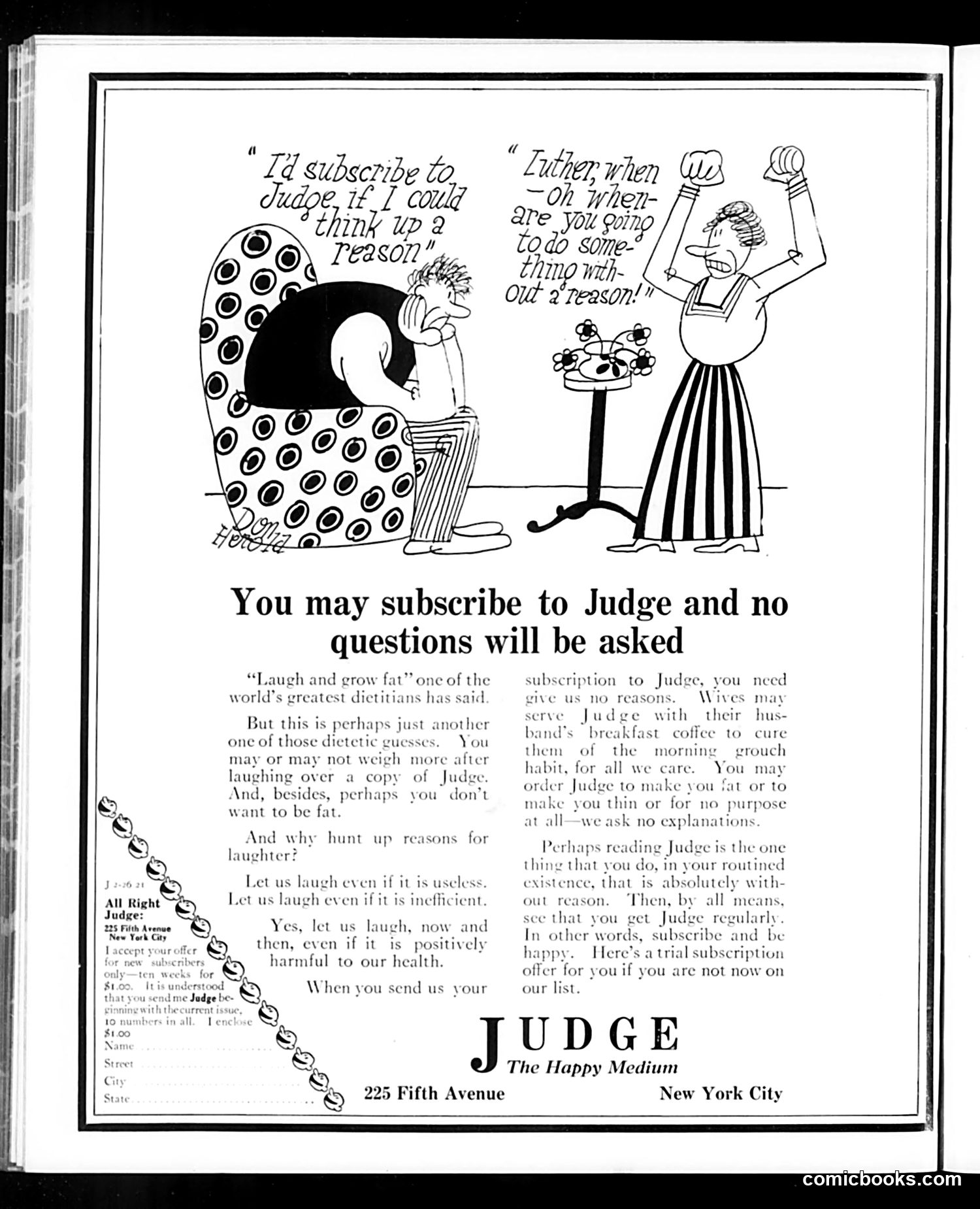
This page is primarily **advertising for Judge magazine itself**, not political satire. The cartoon depicts a domestic scene where a man sits in an armchair while a woman stands nearby with raised fists, apparently exhorting him to "do something" and "find a reason" for activity. The ad's humor relies on the common domestic trope of a sedentary husband versus an energetic wife. The accompanying text promotes Judge as "The Happy Medium"—suggesting the magazine offers guilt-free humor and entertainment without requiring justification. The satire targets middle-class leisure culture: readers needn't rationalize reading Judge; it's simply "the one thing that you do...absolutely without reason." This reflects early-20th-century attitudes about entertainment, domesticity, and gender roles.
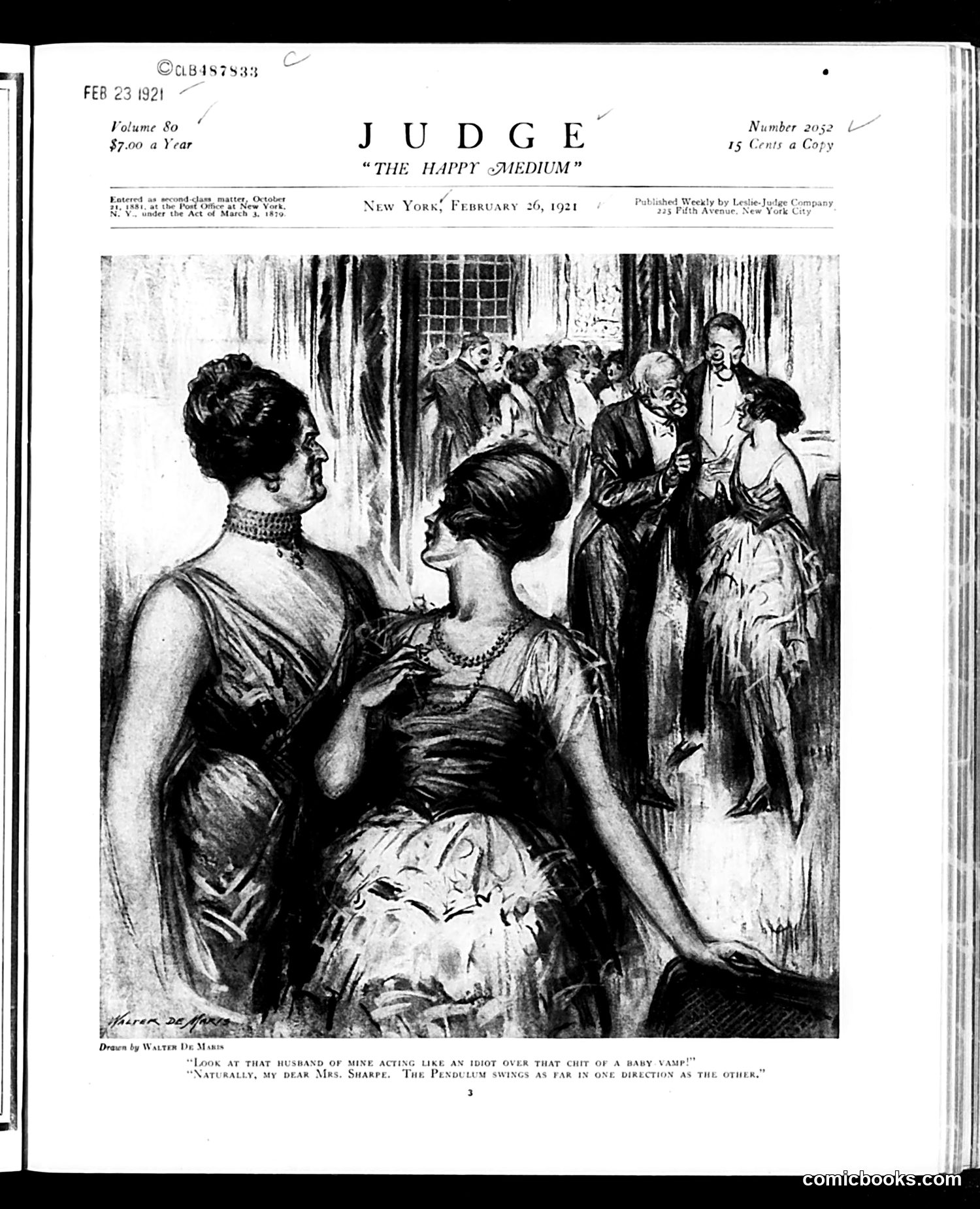
This satirical cartoon by Walter De Maris depicts a social scene at what appears to be an elegant party or gathering. The caption reads: "Look at that husband of mine acting like an idiot over that chit of a baby vamp! Naturally, my dear Mrs. Sharpe. The pendulum swings as far in one direction as the other." The satire comments on marital infidelity and the "flapper" era's social upheaval. The term "baby vamp" refers to young women who seduced married men—a common anxiety of 1920s society. The "pendulum" reference suggests moral relativism: just as women once suffered abandonment, now husbands stray after wives. It's social commentary on shifting gender dynamics and changing relationship norms during the Jazz Age.
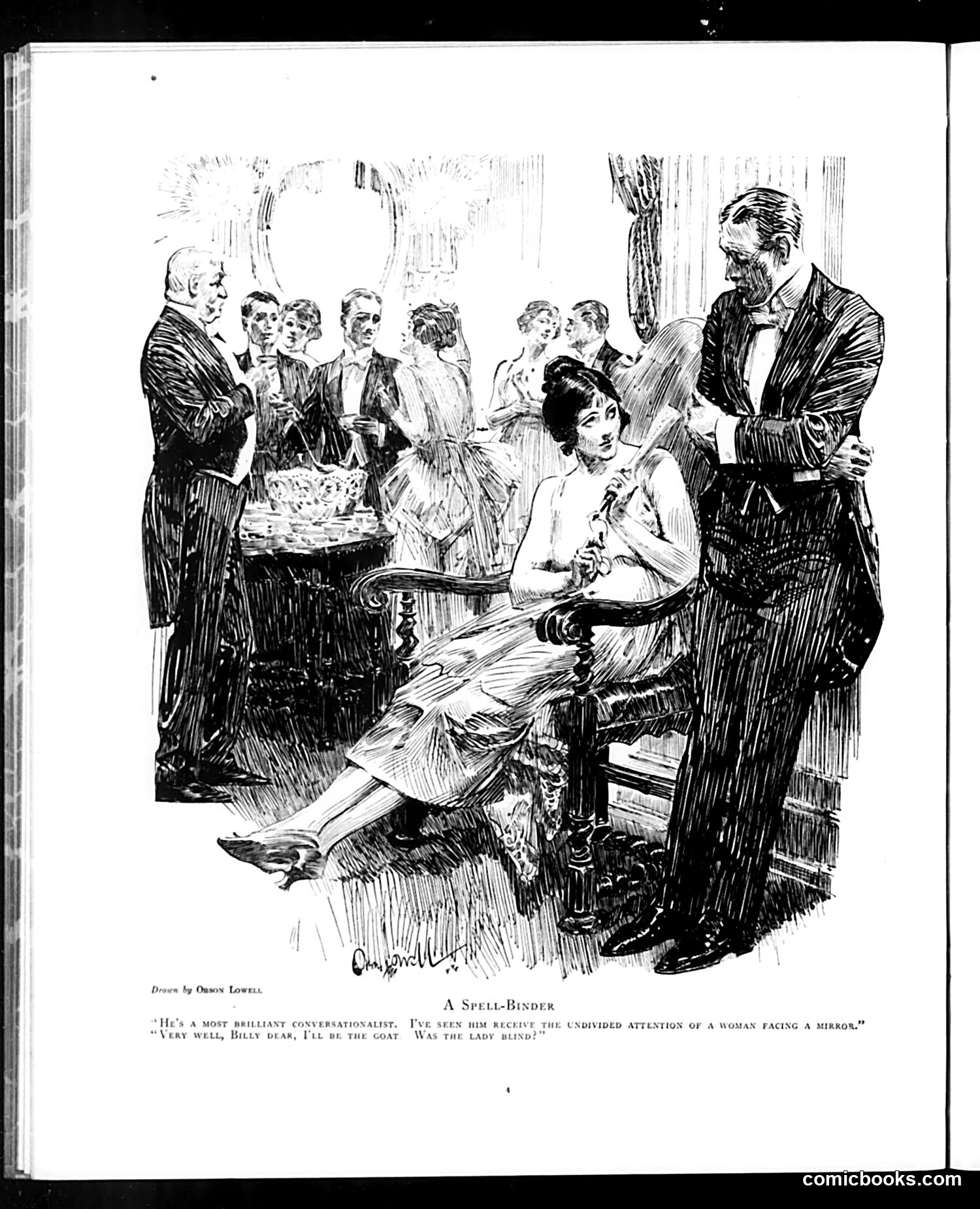
This cartoon depicts a social gathering where a man captivates the room's attention. The caption reads: "He's a most brilliant conversationalist. I've seen him receive the undivided attention of a woman facing a mirror. Very well, Billy dear, I'll be the goat. Was the lady blind?" The satire mocks male vanity and conversational prowess. The joke suggests that even a "brilliant conversationalist" cannot distract a woman from looking at herself in a mirror—implying women are vain and self-absorbed. The final exchange (about Billy being "the goat" and whether "the lady" was blind) adds crude humor, suggesting skepticism that any woman would ignore her reflection, even for engaging conversation. This reflects period attitudes about female vanity and shallow social priorities.
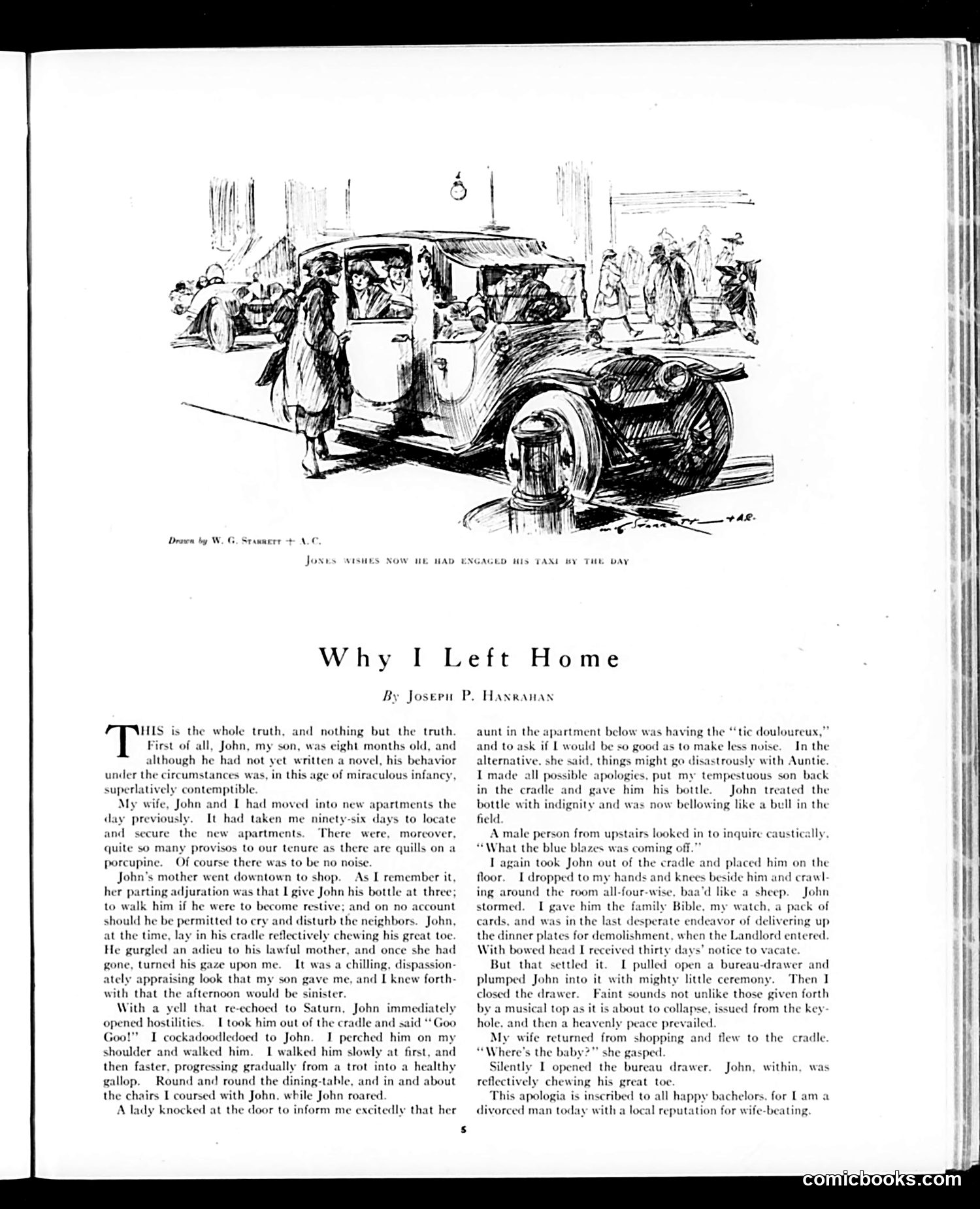
The cartoon depicts a street scene with a taxi cab and several figures. The caption reads "JONES WISHES NOW HE HAD ENGAGED HIS TAXI BY THE DAY." The joke appears to reference the expense of hiring a taxi by individual trips rather than securing a daily rate. The drawing shows what appears to be a domestic dispute scenario—the accompanying story "Why I Left Home" by Joseph P. Hanahan suggests the cartoon illustrates marital discord, with "Jones" apparently accumulating significant taxi expenses (likely for trips related to domestic troubles or escaping home). The satire targets the financial burden of casual taxi use and, more broadly, the domestic conflicts and financial pressures facing American men of the era. The artwork is credited to W.G. Starrett, A.C.
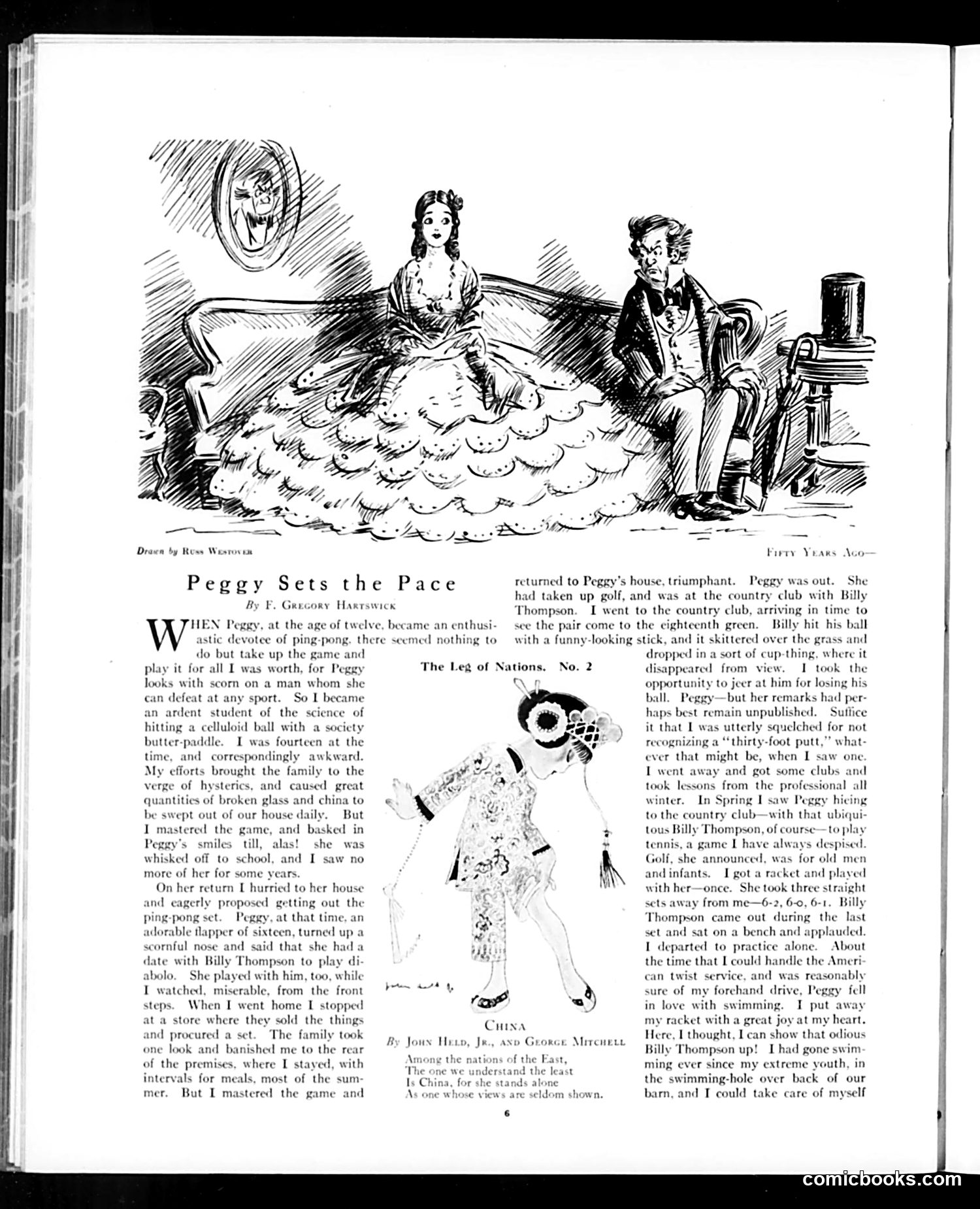
This page combines a humorous memoir essay with an unrelated illustration titled "China." **The Main Article** recounts the author's youth when twelve-year-old Peggy excelled at golf, a sport then associated with masculine prowess. The narrator, initially skeptical that a girl could master the game, became her devoted student. The piece humorously describes Peggy's social triumph—she became "the rage" at her country club, outplaying male golfers like Billy Thompson. The satire targets early-twentieth-century gender expectations: a woman's athletic competence was apparently shocking enough to warrant this lengthy, self-congratulatory narrative about recognizing female capability. The accompanying "China" illustration appears unrelated to the text, depicting a figure in Chinese dress—typical of the era's orientalist imagery in American magazines.
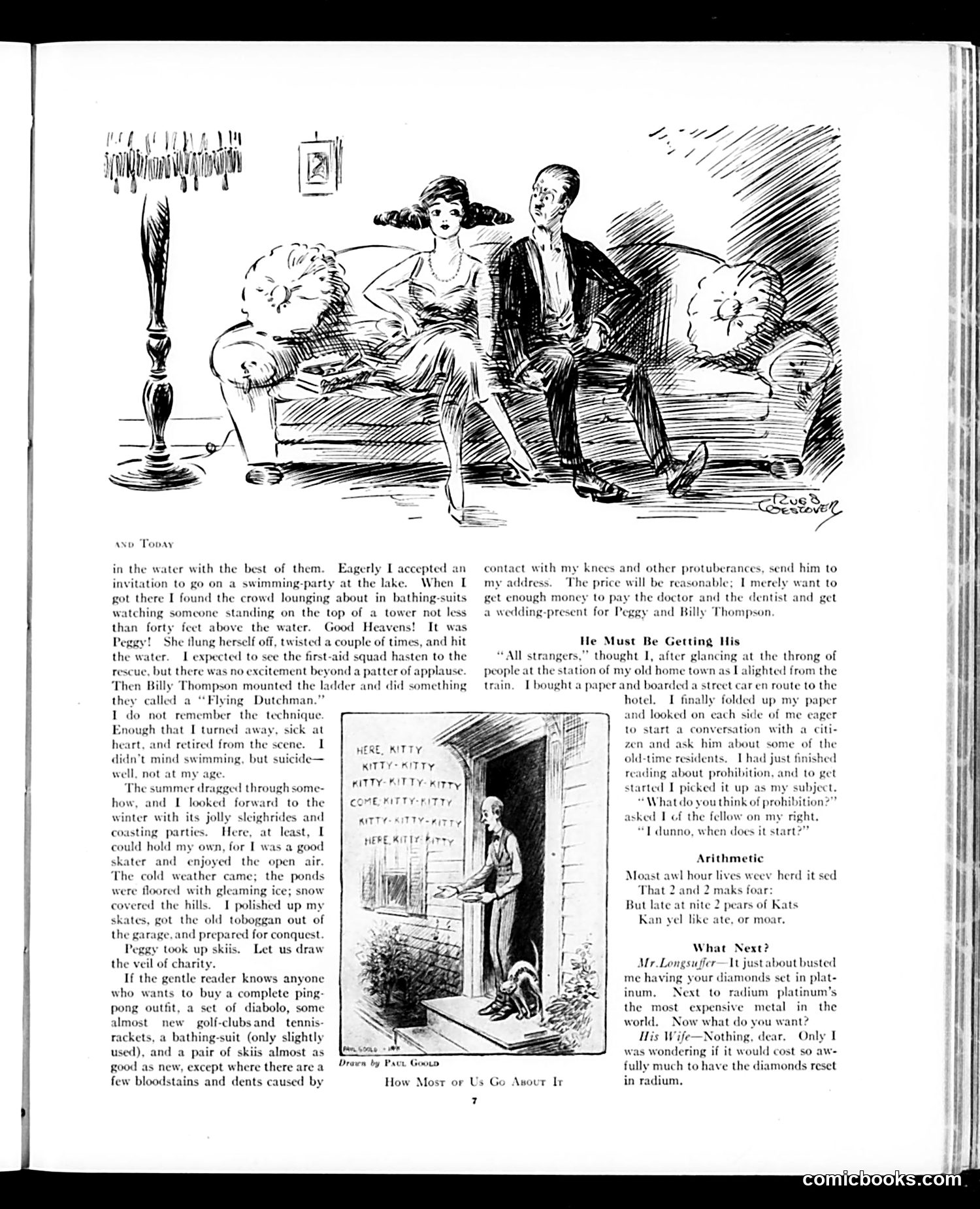
This page from *Judge* magazine contains two satirical pieces about early 20th-century leisure activities and social pretension. **Top cartoon**: A narrator recounts inviting a young woman named Peggy to a lake swimming party, where she and others perform dangerous diving stunts ("Flying Dutchman"). The joke mocks the reckless behavior of young people showing off, with the narrator humorously offering to pay strangers money if they can document his injuries so he can afford medical bills and a wedding gift for Peggy and Billy Thompson—implying he'd rather finance their wedding than participate in more dangerous activities. **Bottom section**: A humorous anecdote where the narrator, newly returned to his hometown, attempts conversation with a stranger about Prohibition (the alcohol ban of 1920-1933), but the stranger doesn't even know when it starts—satirizing public ignorance about major current events. **"What Next?" joke**: Mocks wealthy women's frivolous materialism—a wife complains that her expensive platinum diamond setting is outdated and wants them reset in radium (then fashionable but toxic), unmoved by the enormous cost.
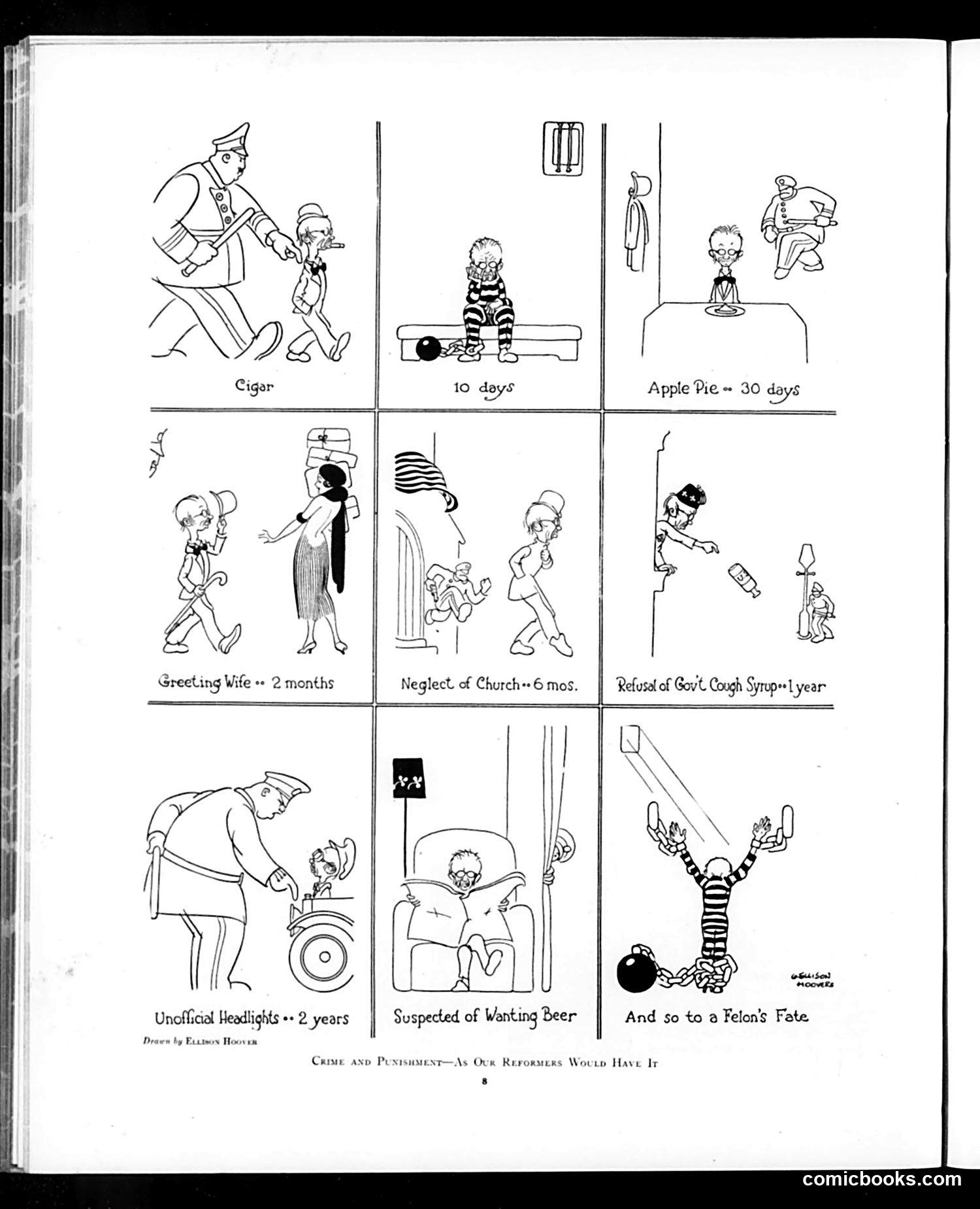
This satirical cartoon mocks Progressive-era reformers' proposed punishments for minor infractions. The title promises harsh penalties for trivial offenses, escalating absurdly: - **Cigar**: A man led away by police - **Apple Pie (30 days)**: Incarceration - **Greeting Wife (2 months)**: Arrest for marital affection - **Church Neglect (6 months)**: Punishment for religious laxity - **Government Cough Syrup refusal (1 year)**: State-mandated medicine - **Unofficial Headlights (2 years)**: Car modification penalty - **Wanting Beer**: Suspected crime - **Final panel**: Execution by hanging The cartoon ridicules overzealous reformers seeking to criminalize everyday behaviors and personal choices through excessive legislation. It argues that well-intentioned but misdirected reform efforts would transform minor personal matters into felonies, ultimately leading to capital punishment for harmless acts.
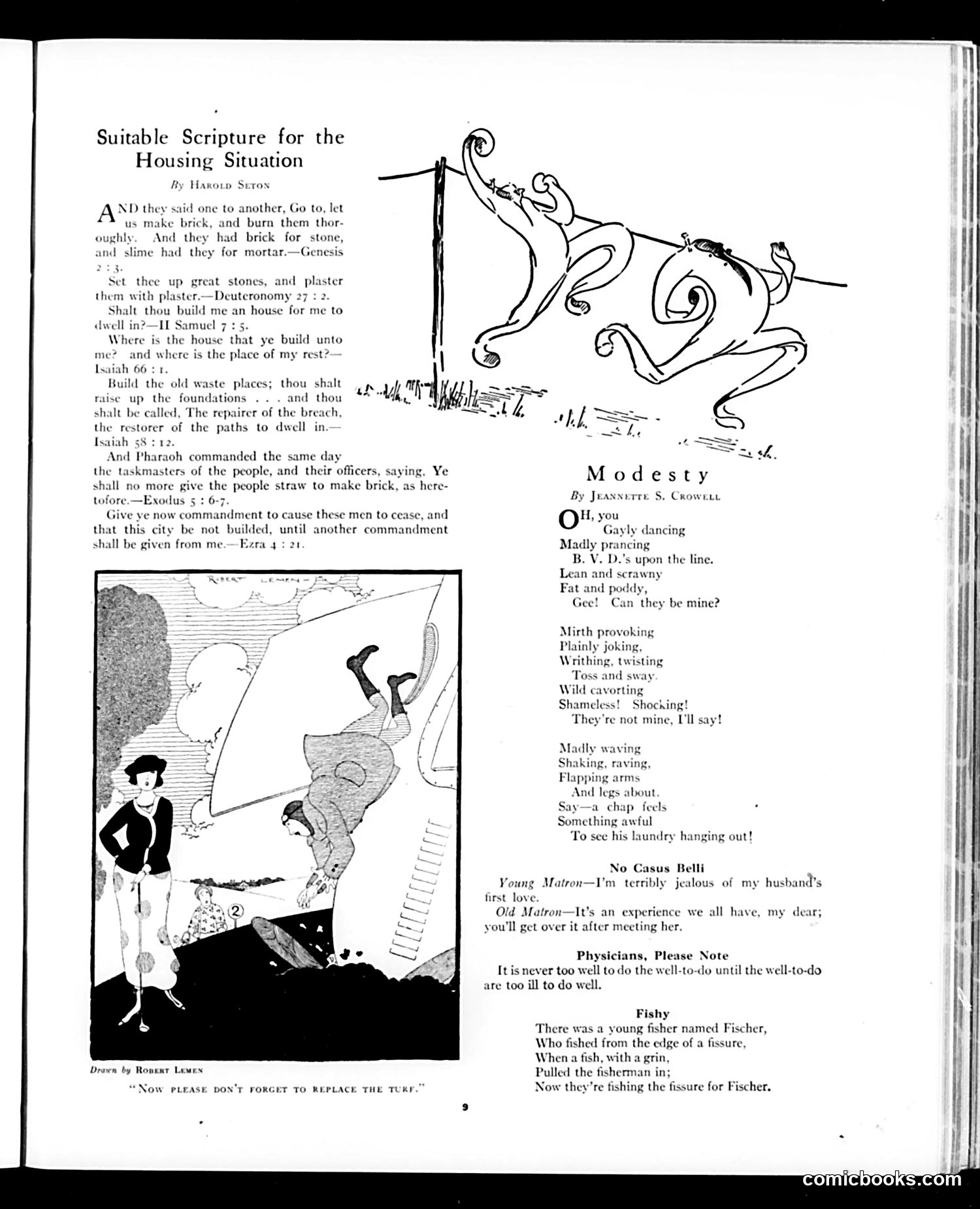
This page from Judge magazine addresses the **housing crisis** through satirical scripture and humor pieces, likely from the 1920s post-WWI housing shortage era. **Main Article**: "Suitable Scripture for the Housing Situation" by Harold Seton juxtaposes Biblical passages about building with references to Pharaoh withholding straw from brick-makers. The satire compares the housing shortage to ancient oppression—authorities preventing construction by denying resources, suggesting landlords or government are deliberately restricting housing supply. **The Cartoon** (left) depicts a man standing in a barren room with minimal furnishings, captioned "Now please don't forget to replace the turf"—mocking the absurdity of housing so scarce that even temporary shelter requires replacing the ground afterward. **Shorter pieces** like "Modesty" mock social pretense (laundry on clotheslines), while "No Casus Belli" jokes about wives meeting husbands' exes, and "Fishy" is mere wordplay. The page's overall point: the housing shortage is so severe it borders on criminal negligence, treating a basic human need as a scarcity weapon.
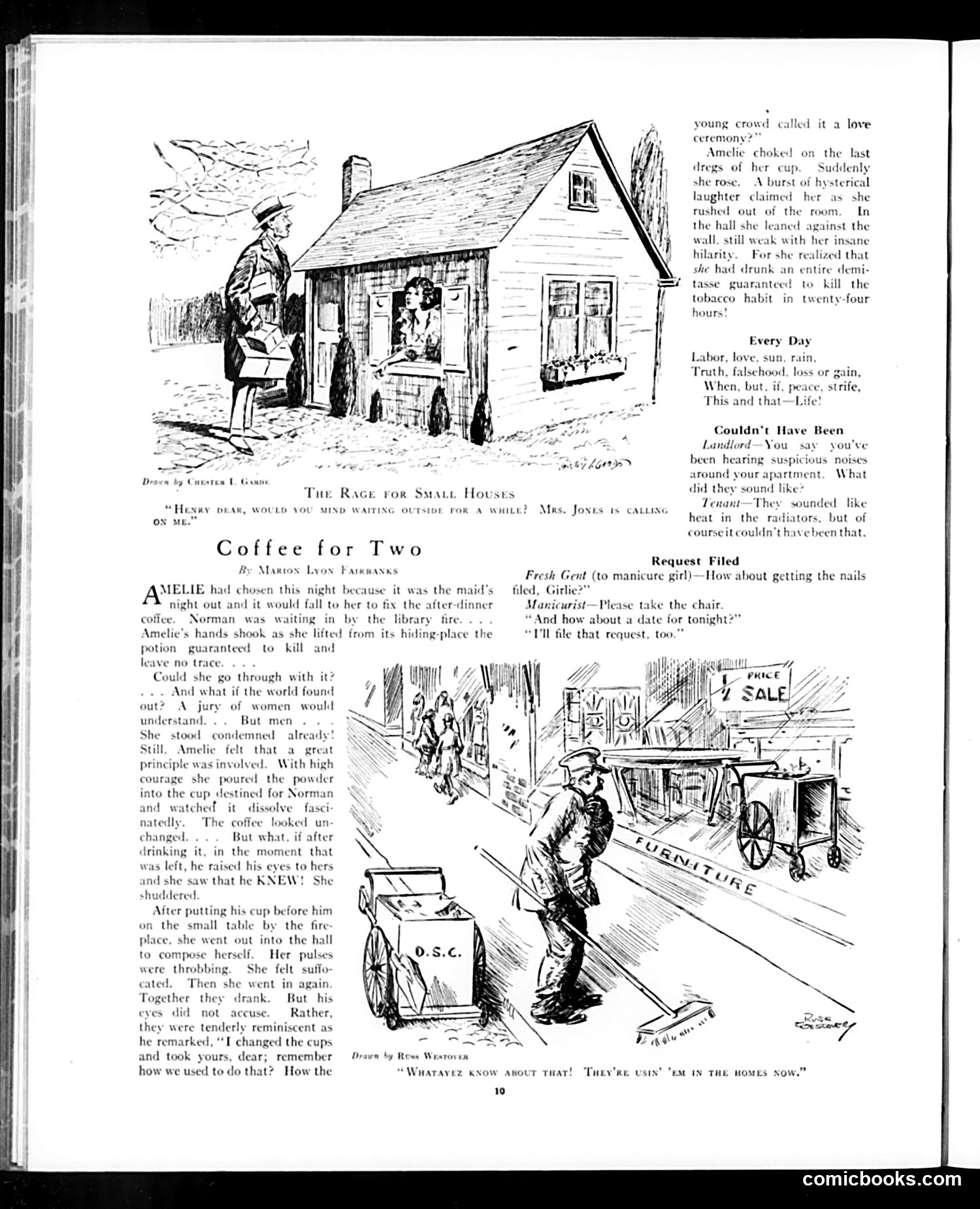
This page contains three separate satirical pieces typical of early-20th-century American humor: **"Coffee for Two"** (main story): A darkly comic tale where Amelie plans to poison her husband Norman with a "demi-tasse guaranteed to kill the tobacco habit in twenty-four hours." The joke's twist: Norman switches their cups, unknowingly drinking the potion himself. His tender response—reminiscing about their playful habit—suggests he's unharmed, making Amelie's murderous anxiety ridiculous. The satire mocks both marital tension and the era's dubious "tobacco-killing" patent medicines. **"The Race for Small Houses"** (top left): A simple domestic joke about a wife calling her husband to wait outside while she receives a caller—implying infidelity or impropriety. **"Couldn't Have Been"** and **"Request Filed"** (right side): Brief jokes about a tenant mishearing radiator sounds and a manicurist's witty comeback to a customer's dating proposition. The cartoons satirize everyday middle-class life, marital anxieties, and commercial quackery through exaggerated scenarios and punny wordplay typical of Judge's style.
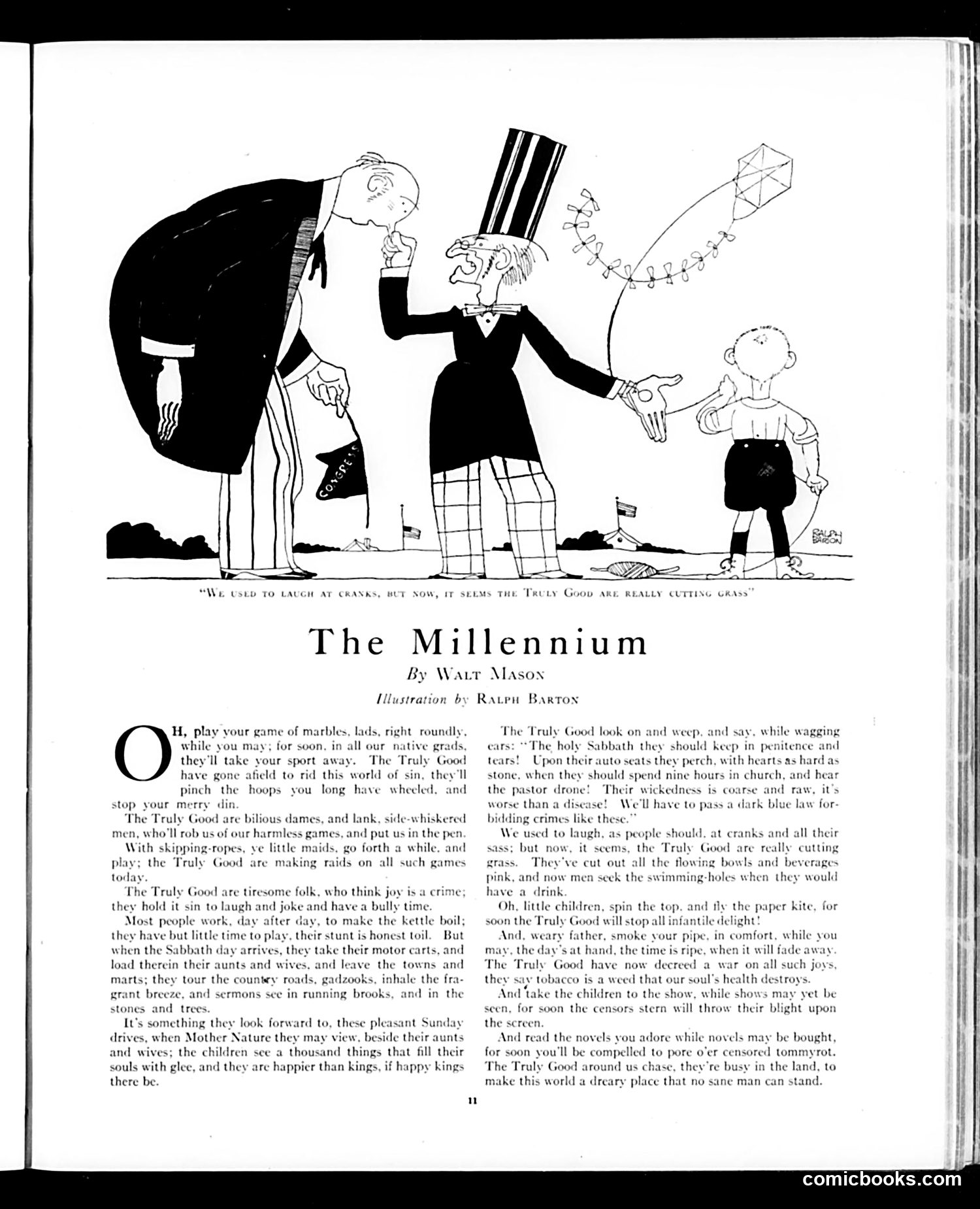
This satirical piece attacks self-righteous moral reformers—called "The Truly Good"—who are portrayed as joyless busybodies intent on eliminating all harmless pleasures. The cartoon shows stern-faced figures confiscating children's toys and kites while adult figures look on disapprovingly. The satire targets progressive-era reformers and censors who sought to regulate entertainment, recreation, and morality. Mason mocks their belief that joy is sinful, contrasting ordinary people's innocent Sunday drives and simple pleasures with the reformers' grim determination to ban smoking, theater, novels, and games—all in the name of spiritual salvation. The "Truly Good" represent what Mason sees as killjoy moralism run amok: people so obsessed with eliminating vice that they'd create a "dreary place that no sane man can stand." It's a critique of excessive censorship and moral policing during the Progressive Era.
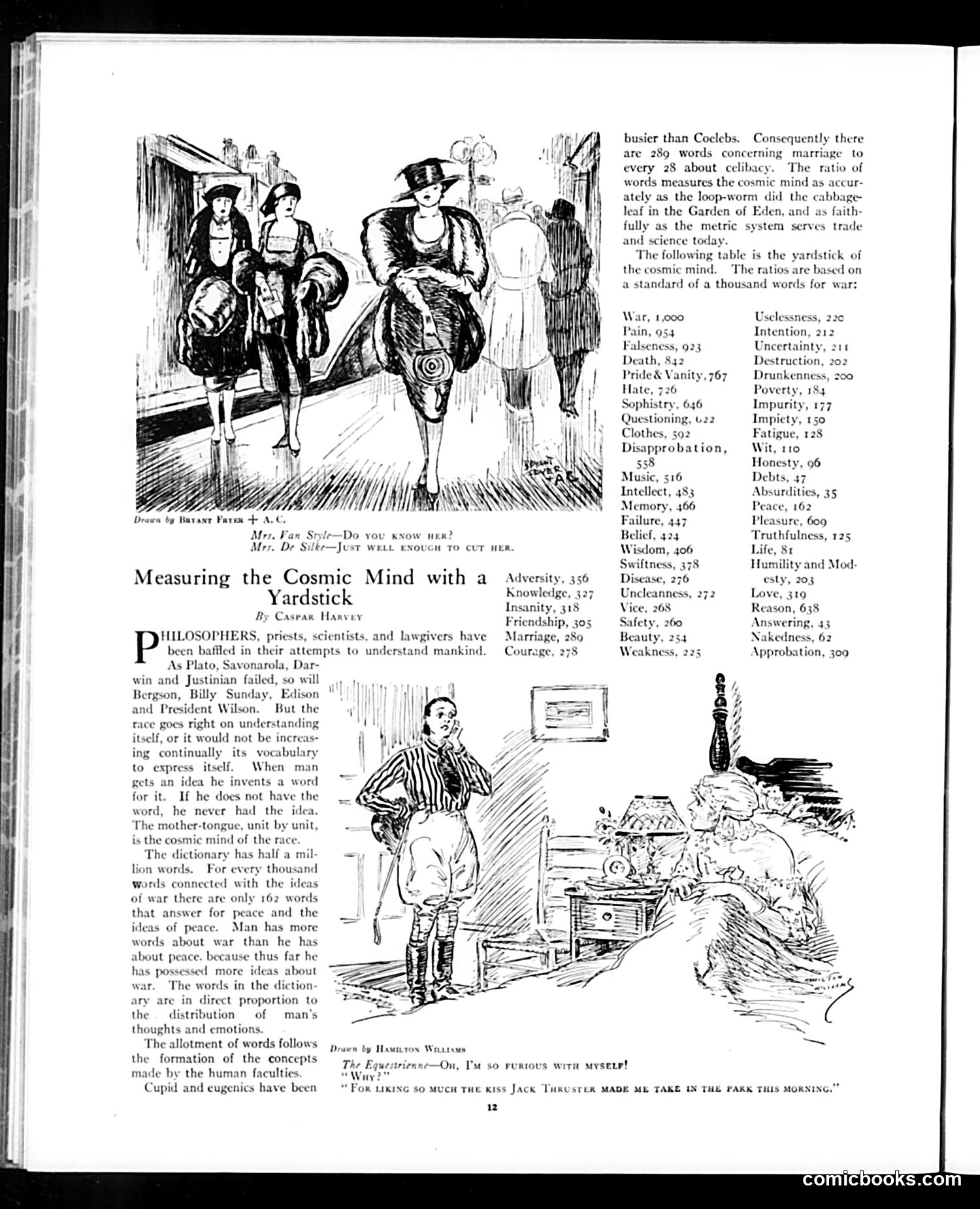
This satirical article by Caspar Harvey mocks attempts by great thinkers (Plato, Savonarola, Darwin, Bergson, Billy Sunday, Edison, and President Wilson) to understand human nature through abstract philosophy and science. Harvey's central joke: **humanity's vocabulary reveals our true priorities**. His statistical table "proves" that humans obsess over war (1,000 words) far more than peace (162 words), and care more about marriage (289 words) than celibacy (28). By treating dictionary word-counts as scientific data—measuring the "cosmic mind" with a "yardstick"—he ridicules pseudo-scientific attempts to quantify human nature. The accompanying cartoons and captions provide domestic humor about socializing and romantic interests, reinforcing the theme that people's actual concerns (appearances, romance, social climbing) differ vastly from what philosophers claim motivates us. The satire targets both grandiose intellectual pretension and human nature itself—we're simpler and more conflicted than we admit.
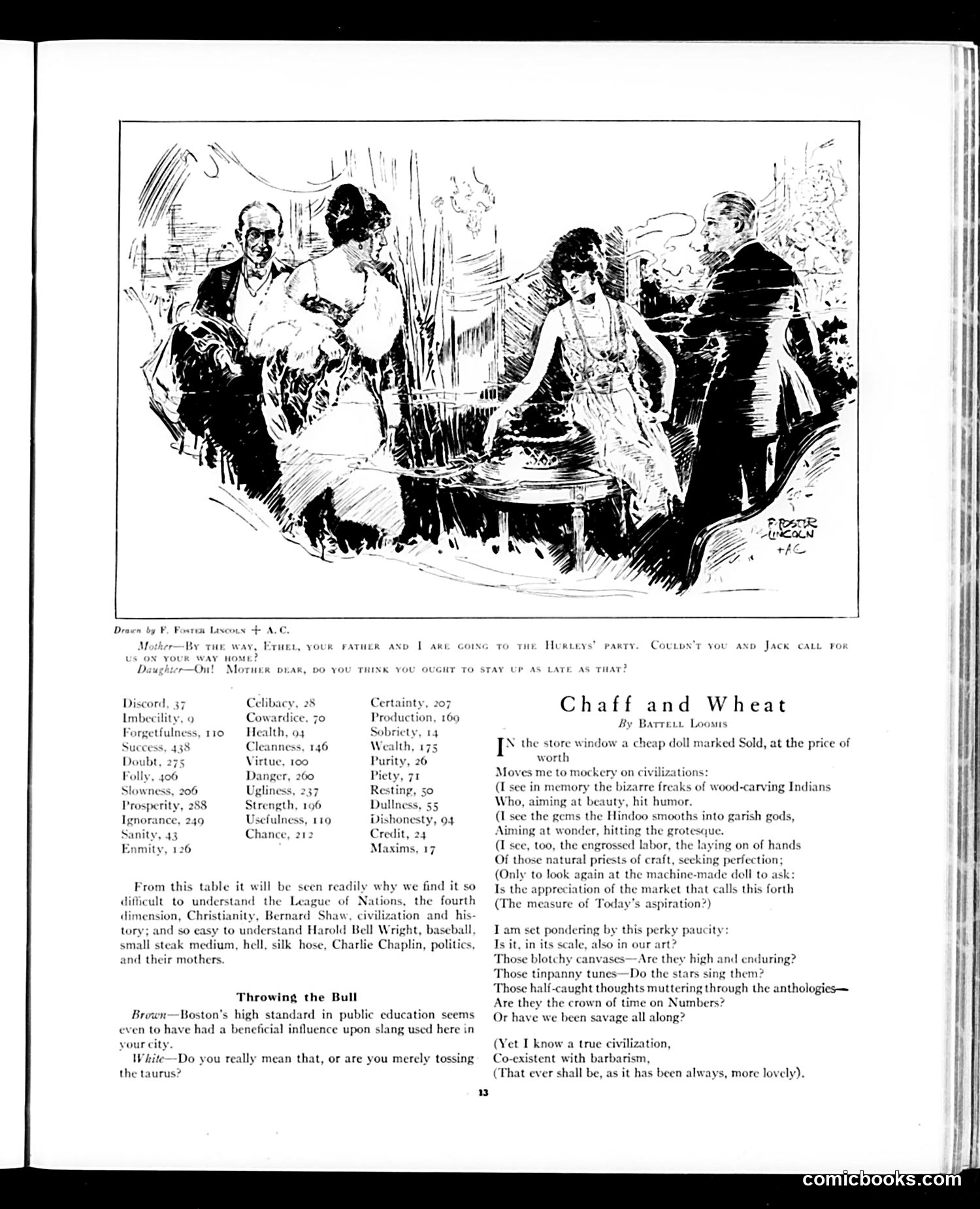
## Upper Cartoon ("Mother—By the way, Ethel...") A domestic scene satirizing parental hypocrisy about late-night socializing. A mother warns her daughter against staying up late at parties while the parents themselves are heading out to the Hurleys' party. The joke critiques the generation gap and double standards of adult moral authority—parents don't practice what they preach. ## "Throwing the Bull" Section A brief dialogue joke playing on Boston's educational reputation. "White" accuses "Brown" of exaggerating claims about education's influence on local slang, using the phrase "tossing the taurus" (a pun on "bull")—a witty rhetorical challenge to his credibility. ## "Chaff and Wheat" Poem A philosophical meditation contrasting cheap machine-made dolls with the earnest craftsmanship of non-Western artisans (Indians, Hindu workers). The poet questions whether modern consumer culture's mass production represents genuine civilization or moral progress, or whether we remain "savage." The concluding stanza suggests true civilization persists despite—or alongside—barbarism. The page reflects early 20th-century anxieties about mass production, cultural hierarchy, and authenticity.
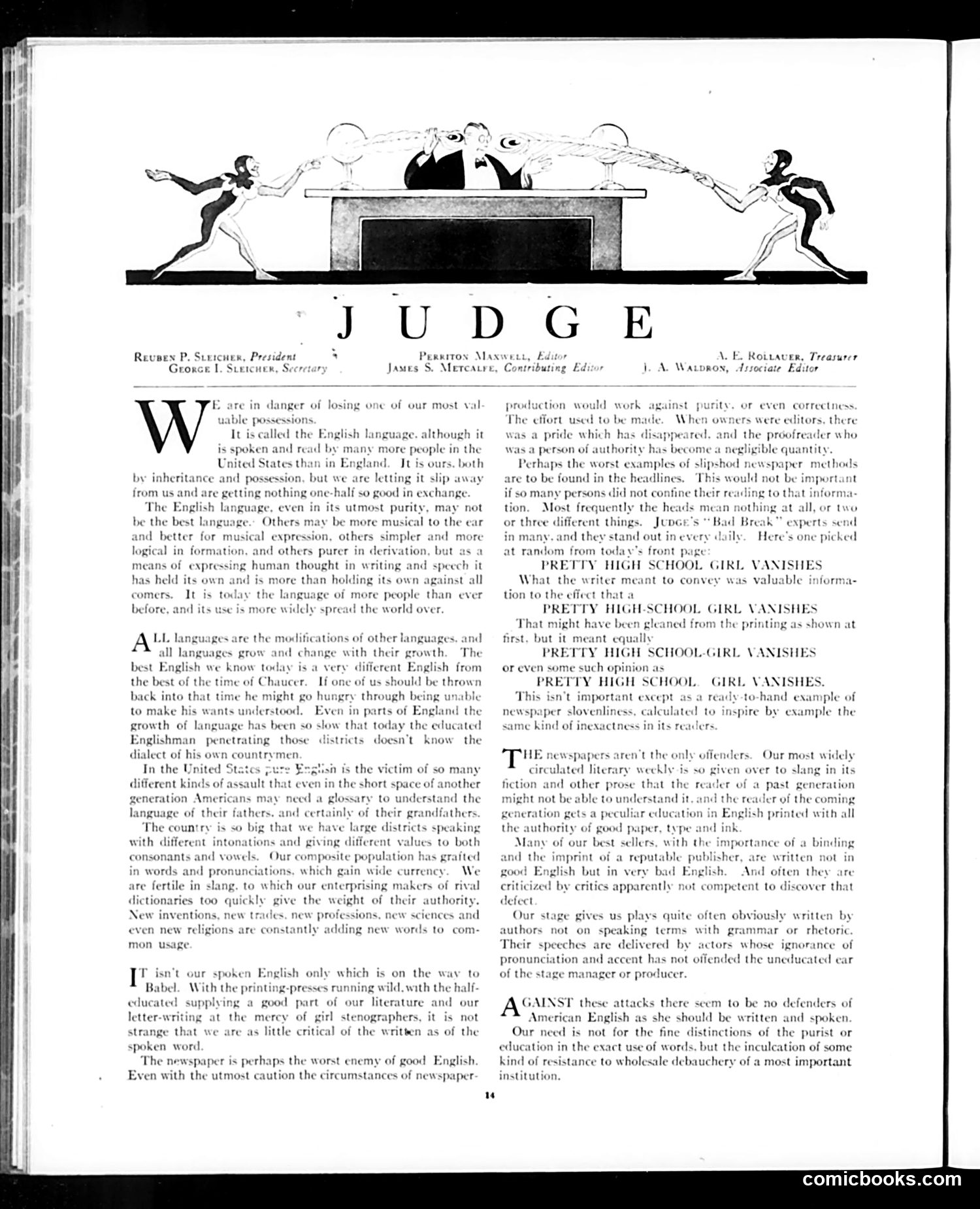
This is the editorial/masthead page of *Judge* magazine, not primarily a political cartoon. The decorative header shows two classical figures flanking a judge's bench, representing the magazine's satirical authority. The substantive content is an editorial essay **criticizing the deterioration of the English language**. The author argues Americans are "losing" proper English through: - **Newspaper slovenliness**: Headlines are ambiguous or nonsensical (the example "PRETTY HIGH SCHOOL GIRL VANISHES" could mean different things depending on punctuation/emphasis) - **Printing press carelessness**: Stenographers and uneducated typesetters debase written English - **Slang and neologisms**: New words constantly enter usage without proper gatekeeping - **Dialectical drift**: Americans are losing connection to proper English inherited from England The piece reflects **early-20th-century anxiety about linguistic "standards"** and blames commercial publishing for democratizing and thereby degrading language. It's prescriptive rather than satirical—earnest hand-wringing about cultural decline.
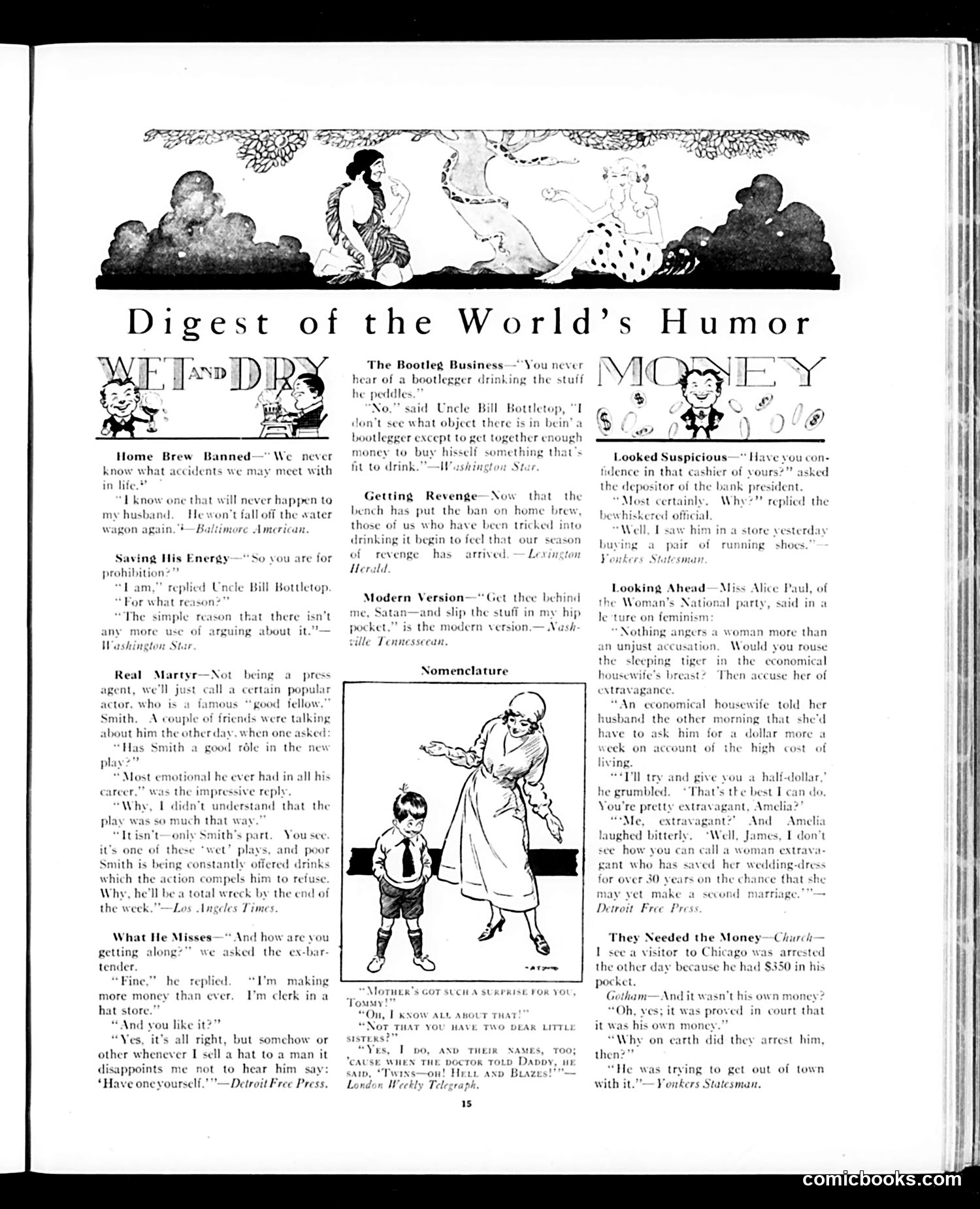
This page collects brief humorous anecdotes satirizing Prohibition-era America (likely 1920s). Key recurring themes: **Prohibition satire**: Multiple jokes mock the alcohol ban—"Home Brew Banned" jokes about accidents from homemade liquor; "Getting Revenge" suggests drinkers feel vindicated the ban failed; "Modern Version" updates religious temptation language to bootlegging. **Gender/domestic humor**: "Looking Ahead" features a woman's lecture on feminism, with a joke about an economical housewife holding her wedding dress 30 years for a potential second marriage—satirizing women's economic dependence on marriage. **Working-class observations**: A hat-shop clerk misses customers' friendly offers of drinks; a visitor arrested leaving Chicago with "$350" that courts proved was legally his—absurdist commentary on arbitrary law enforcement. The cartoons' central image shows a mother surprising children, accompanying a nomenclature joke about twins named after their father's exclamation ("Twins—on!").
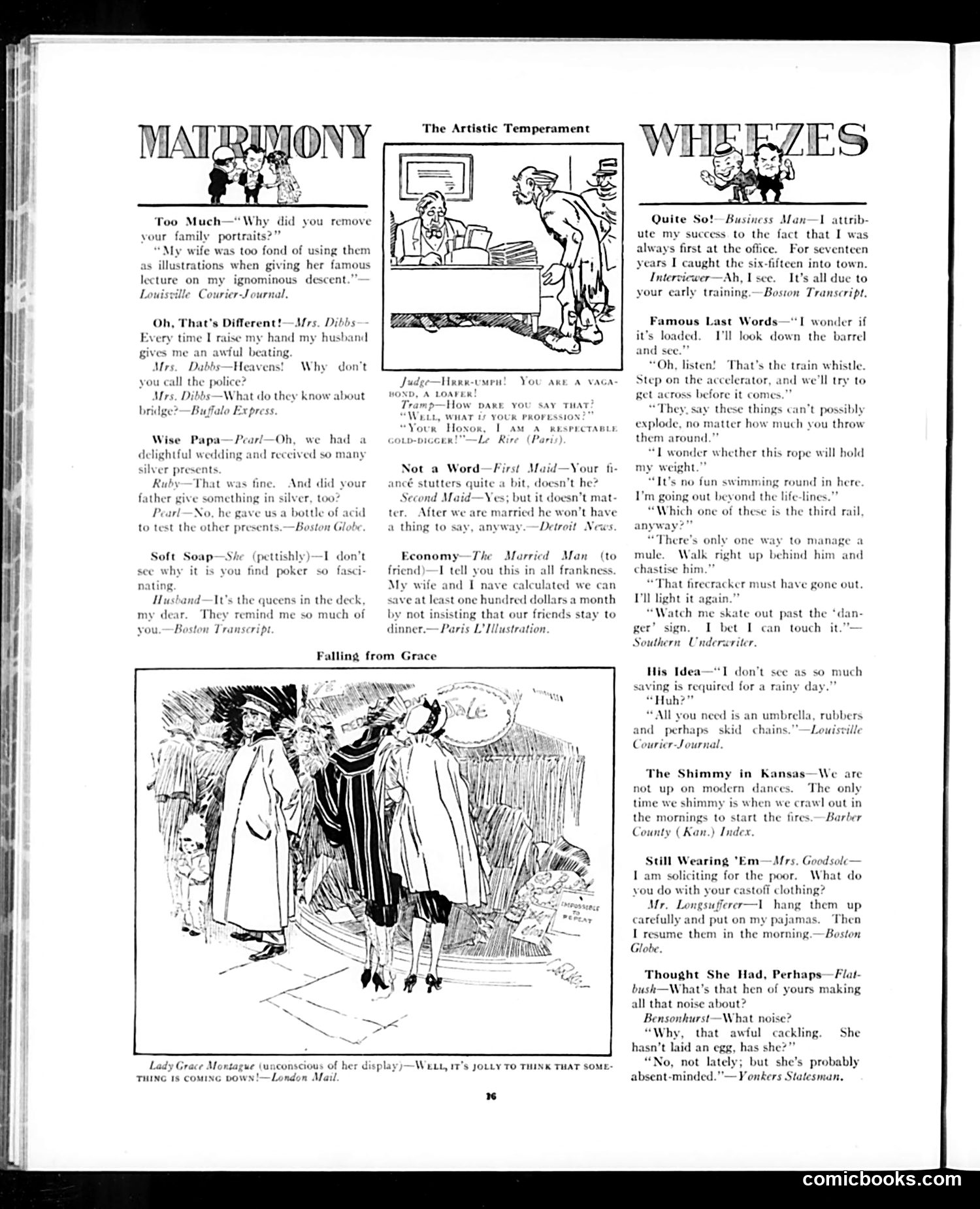
This page from the American satirical magazine **Judge** contains multiple short humorous anecdotes rather than political cartoons. The jokes mock domestic life, social conventions, and human folly circa the early 20th century. Key themes include marital discord (wife beating treated as amusing), gender stereotypes (wives as nagging spenders), and class commentary (servants, the poor, working-class domesticity). "The Artistic Temperament" cartoon shows a man at a desk, likely satirizing pretentious artistic claims. The "Falling from Grace" illustration depicts well-dressed people in apparent social embarrassment—a common Judge subject mocking upper-class propriety. Most jokes rely on dated assumptions: wives' inferiority, working-class ignorance (Kansas "shimmy"), and darkly comic "Famous Last Words" about fatal accidents treated as punchlines. The page reflects early 1900s attitudes toward gender, class, and safety that modern readers would find offensive rather than funny.
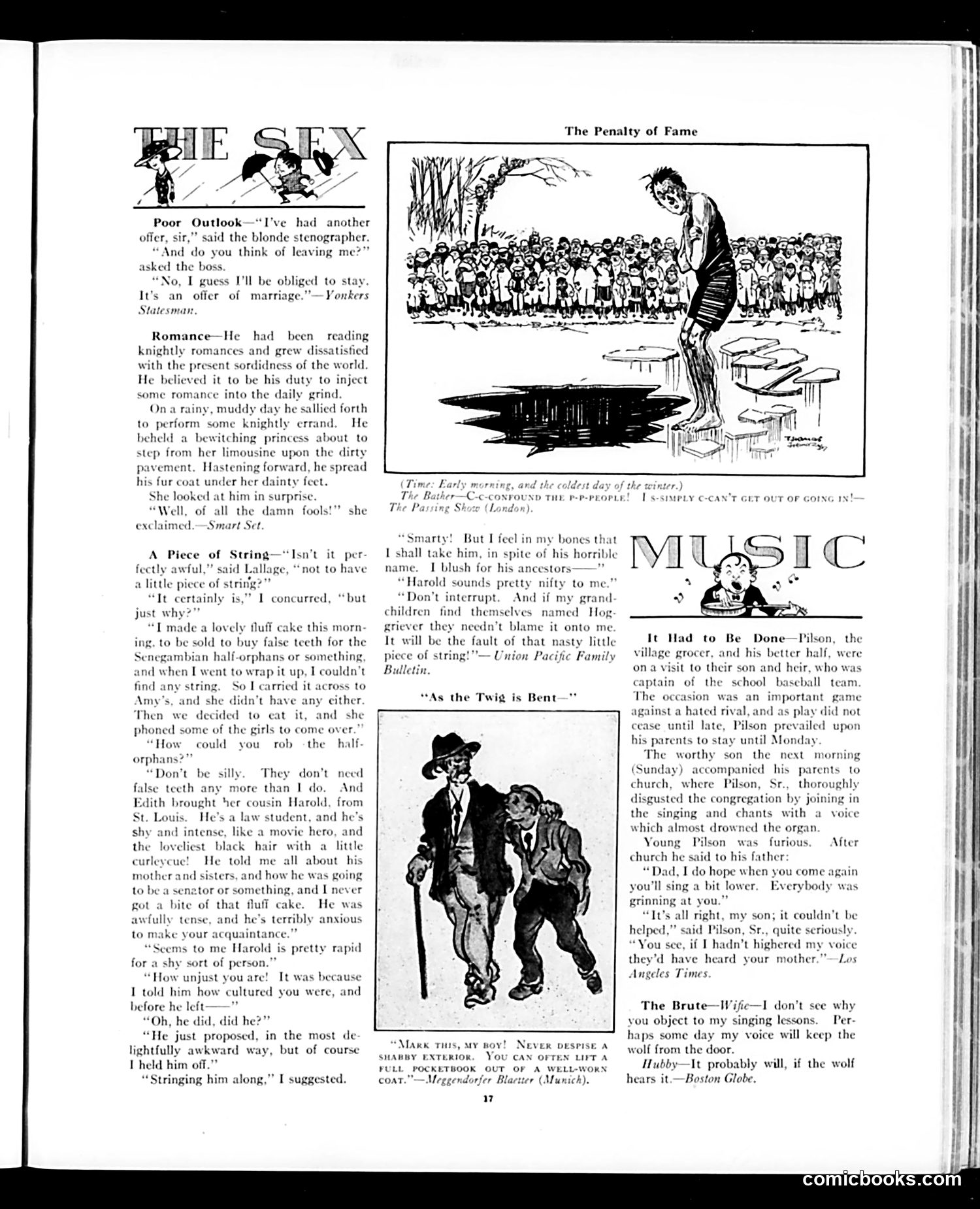
This page contains several brief satirical sketches typical of early 20th-century humor magazines: **"Poor Outlook"** and **"Romance"** mock social conventions: a stenographer rejected for marriage, and a man spreading his fur coat chivalrously before a woman who calls him a fool. **"A Piece of String"** is a longer anecdote satirizing female social behavior—women waste time gossiping and flirting rather than helping charity (orphans needing false teeth), with a young man ("Harold") rapidly proposing to an unimpressed woman. **"As the Twig is Bent"** features a cartoon of two men, illustrating a German proverb about judging people by appearance rather than wealth. **"It Had to Be Done"** mocks a father who sings loudly in church despite his embarrassed son's objection, claiming he had to drown out his wife's voice. **"The Brute"** is a brief joke about a wife's singing lessons—her husband hopes her voice will "keep the wolf from the door" by scaring it away. The humor relies on class anxieties, gender stereotypes, and domestic discord typical of the era.
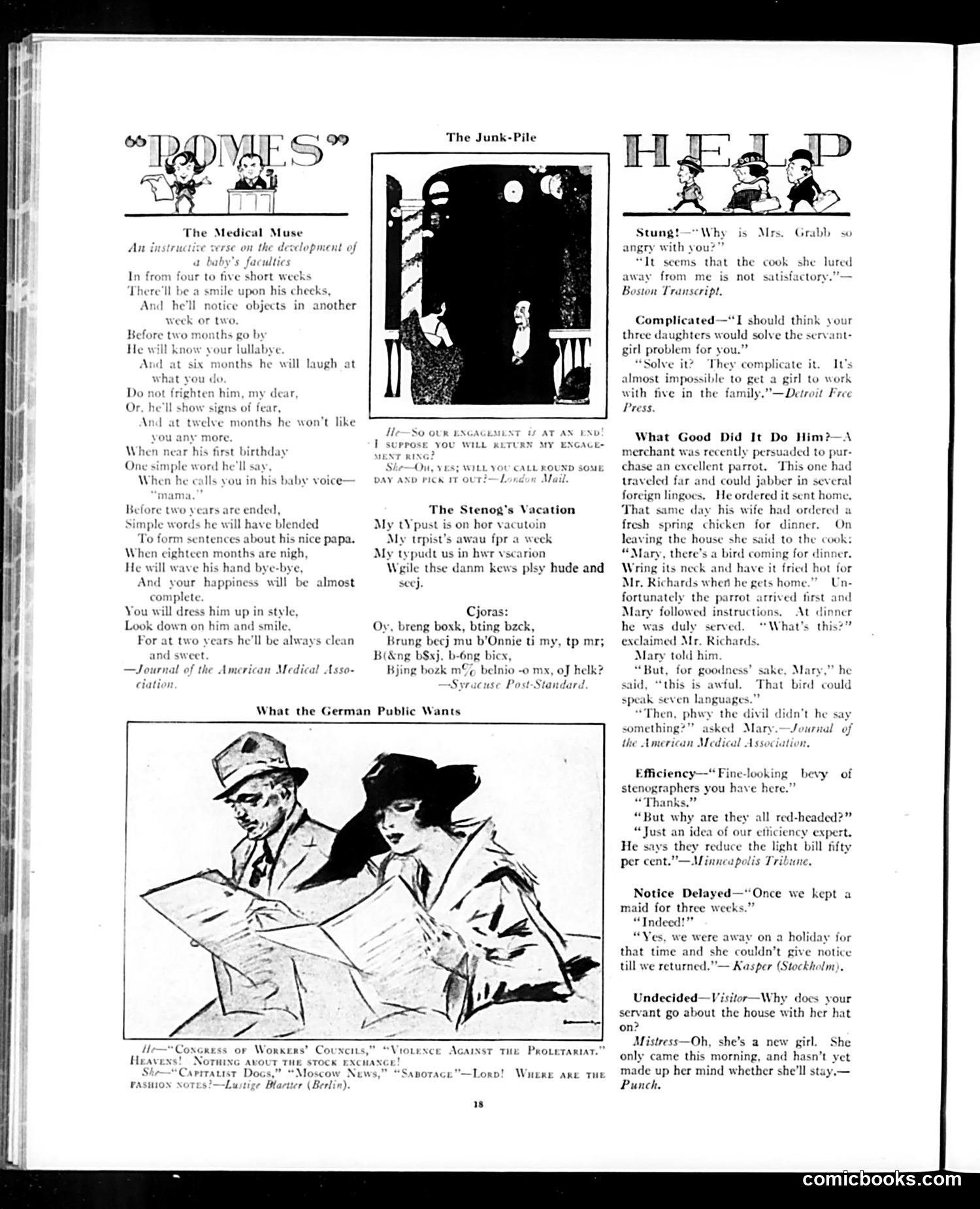
This page from the satirical magazine *Judge* contains humorous short items mocking everyday domestic and office life in the early 20th century. **"The Junk-Pile"** cartoon shows a couple at an engagement ring counter, with the woman saying she'll return it—satire on broken engagements. **"The Stenog's Vacation"** mocks office chaos when the typist is absent, showing garbled text and a chorus about missing office keys—commenting on workplace dependency and office workers' importance. **"What the German Public Wants"** cartoon depicts figures reading newspapers with suspicious headlines about "Workers' Councils" and "Violence Against the Proletariat"—likely referencing post-WWI German political upheaval and socialist concerns. The right column contains brief jokes about household servants and domestic incompetence—a recurring *Judge* theme satirizing the servant problem and family life. The humor relies on class assumptions about domestic staff and wives managing households, reflecting early 20th-century middle-class anxieties.
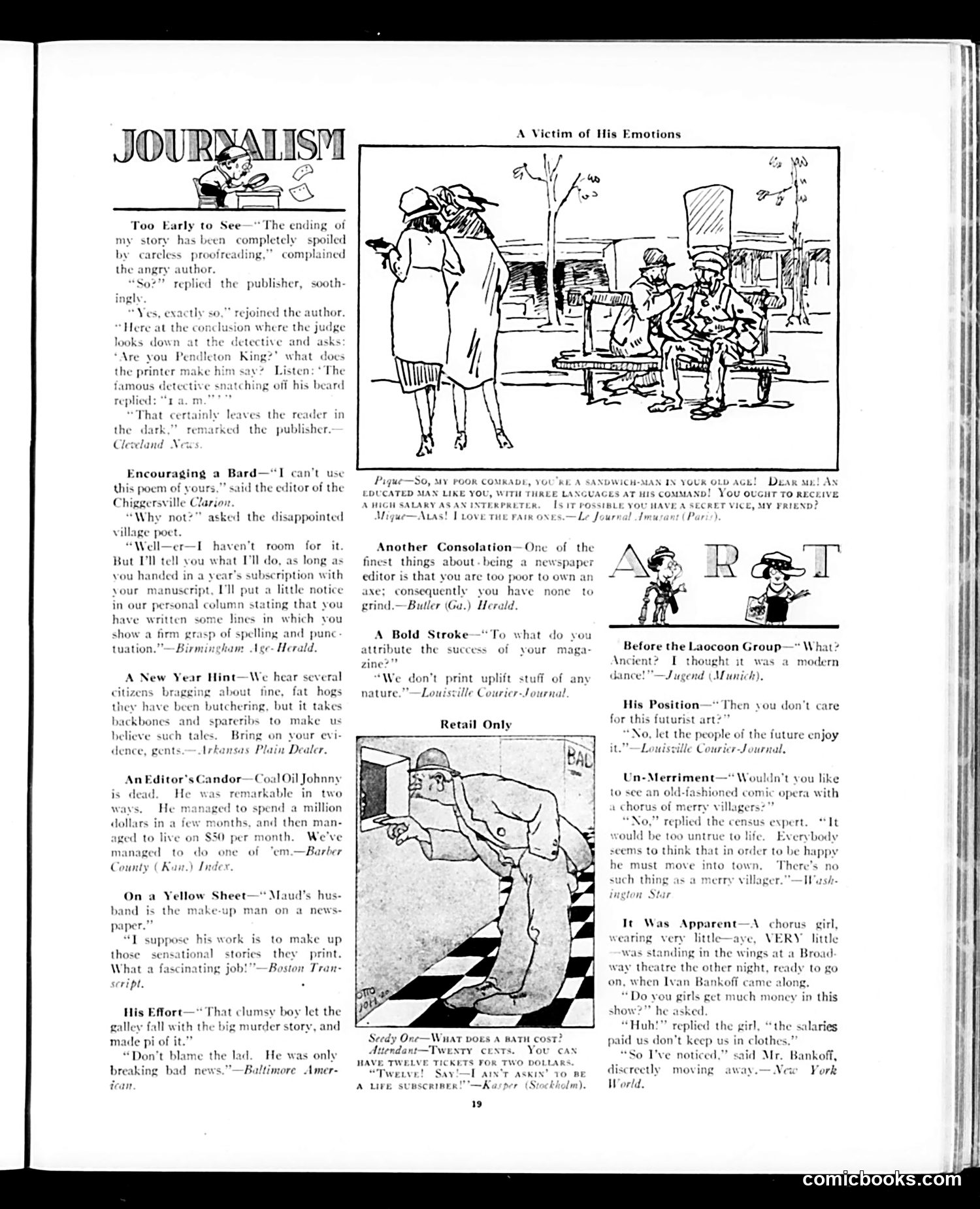
This page collects brief satirical anecdotes about newspaper work and journalism. Key points: **"Too Early to See"** mocks careless proofreading that spoils story endings before publication—a practical complaint about incompetent print production. **"Encouraging a Bard"** satirizes editors rejecting poetry submissions while patronizingly offering free publicity instead of payment—a dig at how publications treated struggling writers. **"An Editor's Candor"** ridicules "Coal Oil Johnny," a real historical figure known for reckless spending, who supposedly managed to live on $80/month despite earning a fortune. **"A Victim of His Emotions"** (main cartoon) shows a polyglot man complaining he loves "the fair ones" too much to work as a translator—mocking how emotional weakness undermines professional success. The scattered items target journalism's chronic problems: poor editing, exploitation of writers, and sensationalism. The tone assumes readers share frustrations with newspaper quality and industry practices of the era.
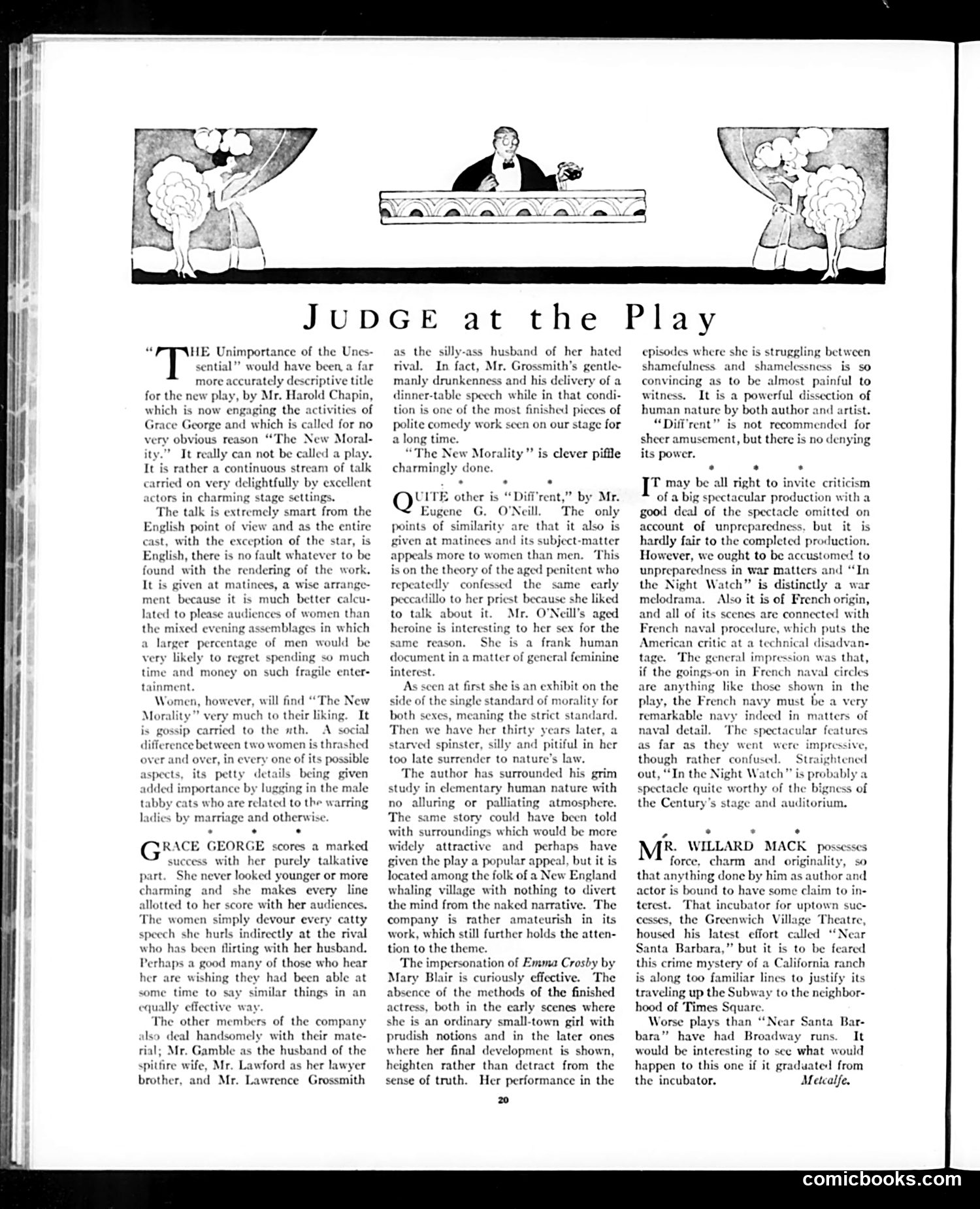
This page contains theater reviews from *Judge* magazine, a satirical publication. The illustration shows a judge presiding over theatrical productions. The reviews critique two Broadway plays: Harold Chapin's "The New Morality" (starring Grace George) and Eugene O'Neill's "Diff'rent." The critic dismisses the first as mere gossip dressed up as drama—"talk carried on very delightfully" with catty dialogue between society women. He notes it appeals primarily to female matinee audiences rather than mixed evening crowds, implying women prefer trivial social squabbles while men want substantive entertainment. O'Neill's "Diff'rent" receives slightly more respect for its serious examination of a woman's moral hypocrisy—holding strict sexual standards for others while later abandoning them. However, the critic faults its grim New England setting for lacking popular appeal. The satire targets both contemporary theater's gender-segregated audiences and critics' assumptions about women's intellectual interests versus men's.
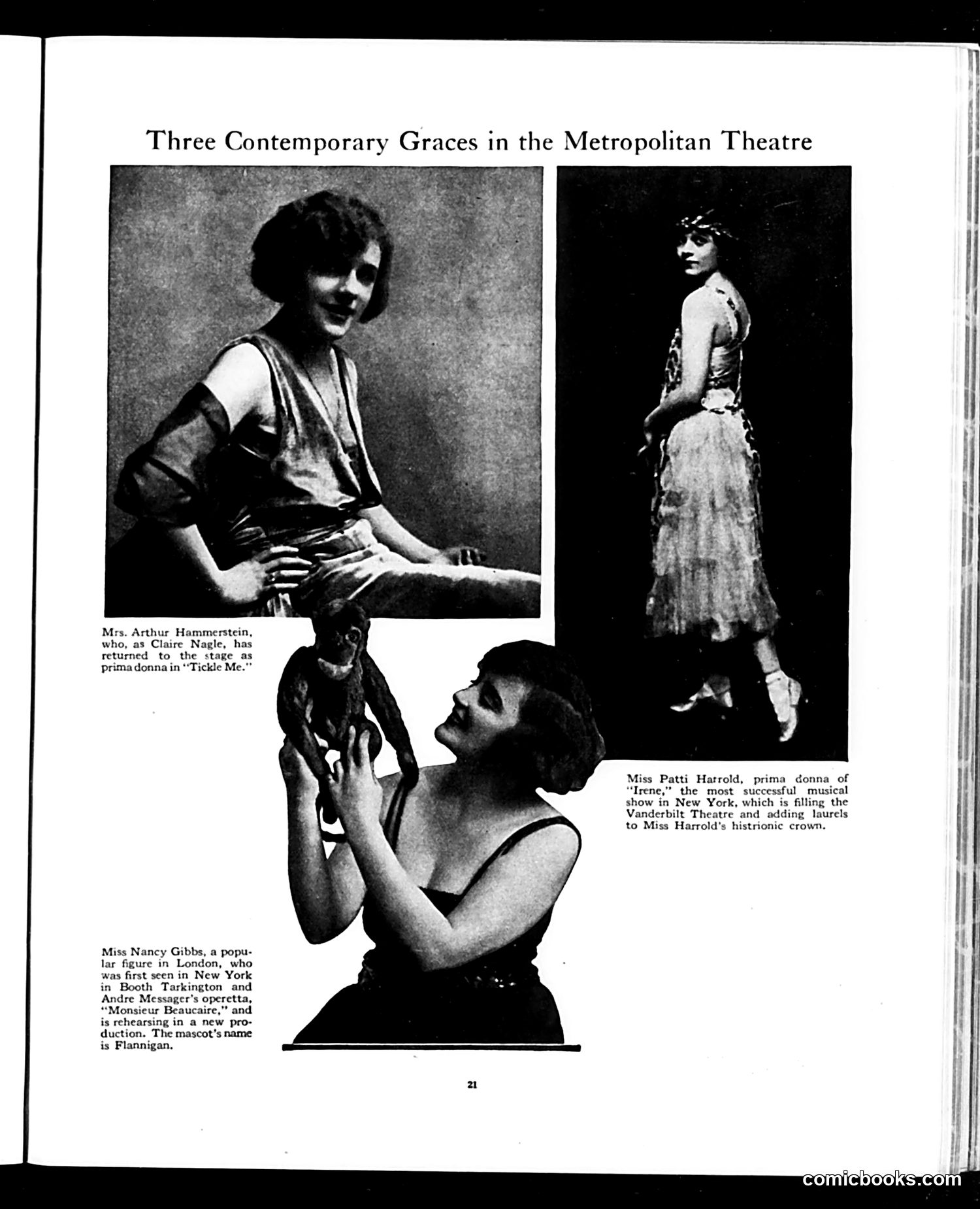
This is a theatrical feature, not satire—a straightforward celebrity showcase from Judge magazine. It presents three prominent Broadway performers of the era: 1. **Mrs. Arthur Hammerstein** (Claire Nagle), returning to stage in "Tickle Me" 2. **Miss Nancy Gibbs**, a London actress performing in "Monsieur Beaucaire" 3. **Miss Patti Harrold**, star of "Irene," described as New York's most successful musical The page celebrates these women as theatrical celebrities, using the term "graces" to denote their elegance and accomplishment. The mascot reference (Flannigan) appears to be a stage prop or in-joke. This represents how Judge covered Broadway's social and entertainment world—promotional coverage of popular actresses performing in current productions.
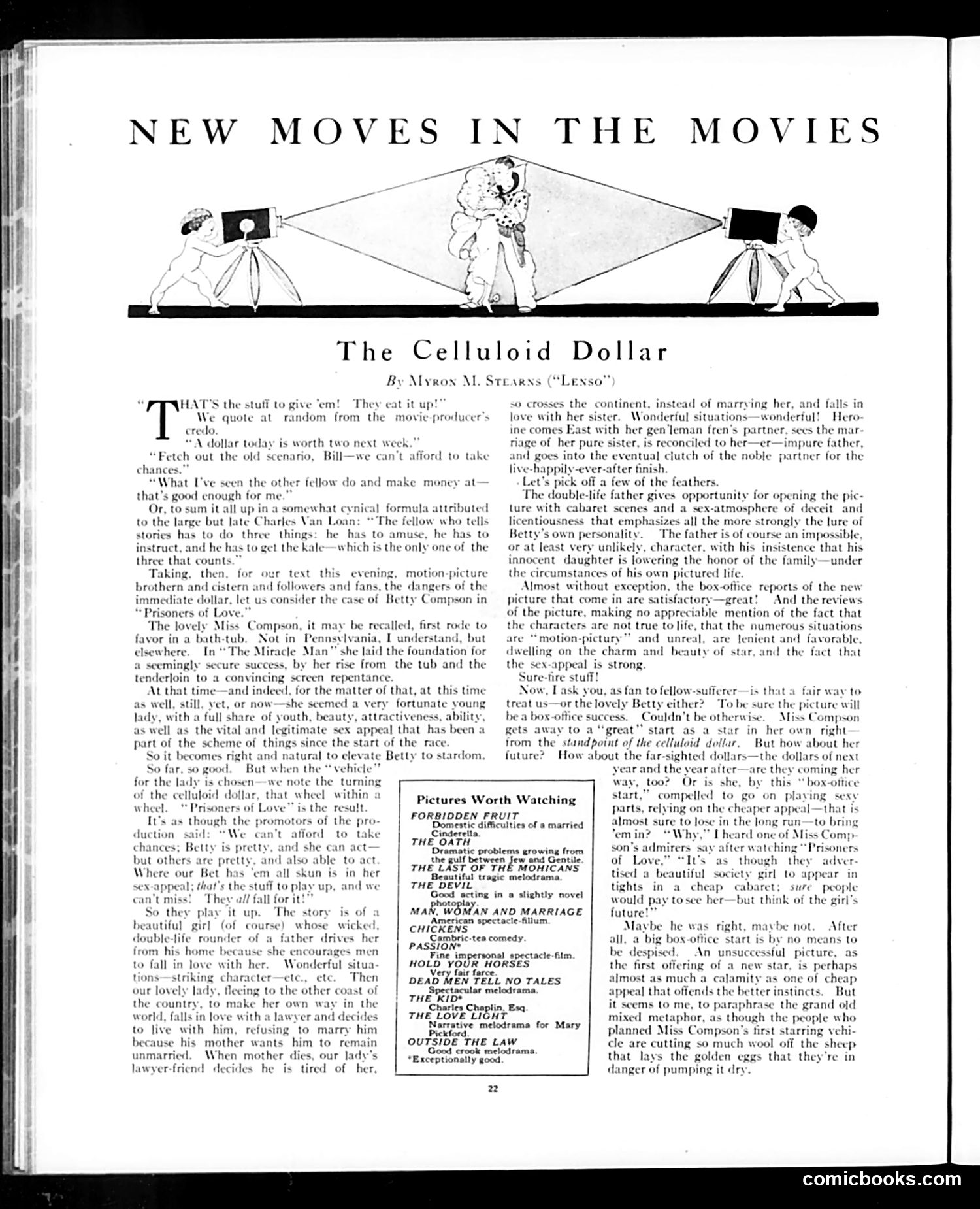
This article by Myron M. Stearns ("Lenso") critiques how 1920s Hollywood producers cynically manufacture films based on profit, not artistry. The essay uses **Betty Compson's film "Prisoners of Love"** as its primary example—noting she rose to stardom through her "sex-appeal" rather than acting ability, and producers recycled tired plots because they were cheap and proven moneymakers. The satire targets the film industry's formula: producers say "we can't afford to take chances" and instead copy successful competitors' scenarios, prioritizing the "celluloid dollar" over genuine storytelling. Stearns mocks the absurd plot of "Prisoners of Love" (involving illicit relationships, crossed continents, and convenient endings) as typical manufactured drivel designed to exploit audiences' desire for scandalous content. The accompanying "Pictures Worth Watching" sidebar lists contemporary films, some praised, most dismissively labeled as mere melodrama or spectacle—reinforcing the critique that substance matters less than commercial appeal in Hollywood's economy.
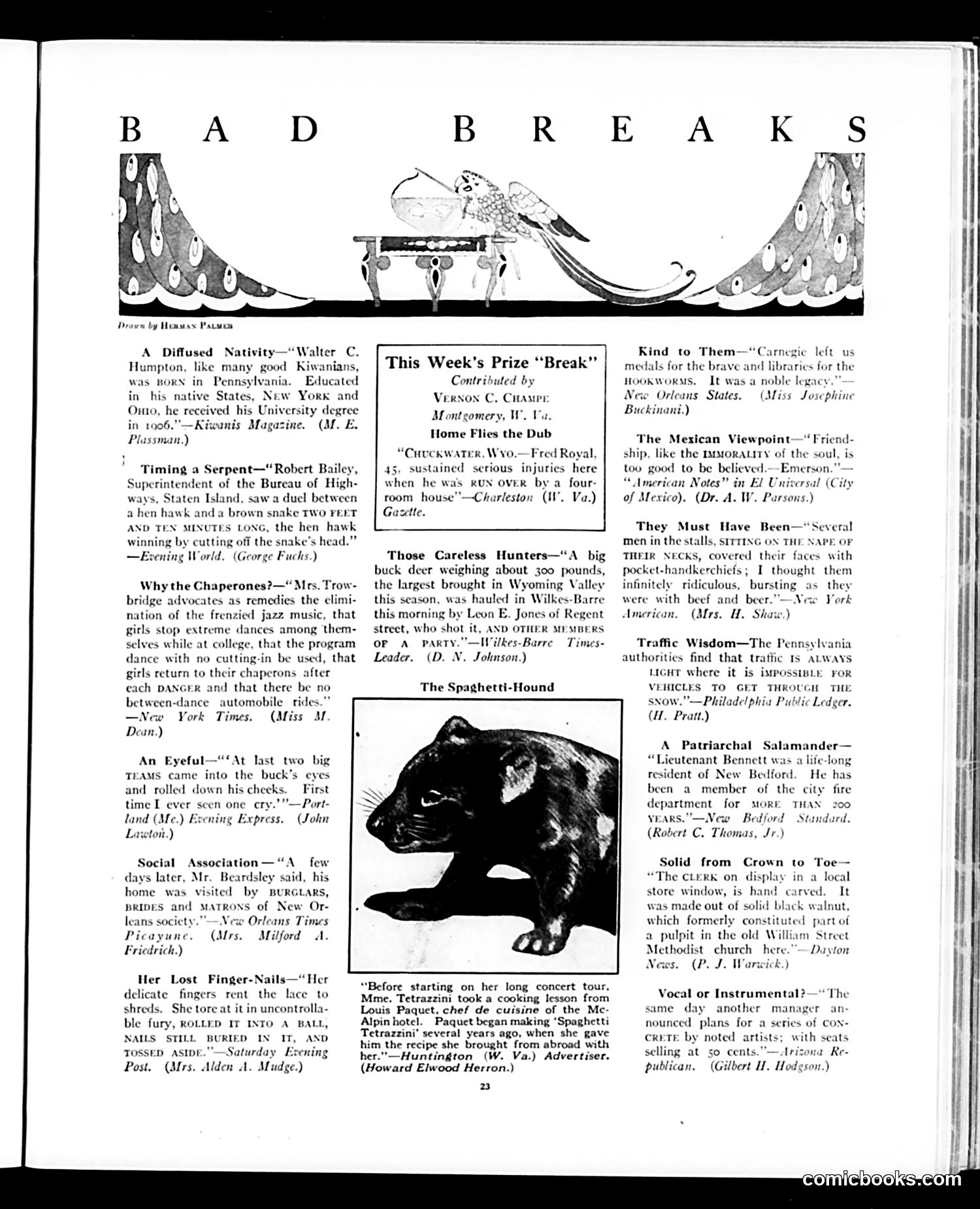
This page from *Judge* magazine presents a collection of humorous "breaks"—embarrassing or absurd incidents submitted by readers. The featured illustration shows "The Spaghetti-Hound," a dog eating pasta, accompanying a note that opera singer Luisa Tetrazzini took cooking lessons to learn the dish named after her. The page's humor derives from ironic juxtapositions: a man run over by a "four-room house," hunters bagging a 300-pound deer, and someone timing a serpent duel. The satirical "breaks" mock contemporary American society—chaperone debates at colleges, overzealous theater patrons, and traffic management failures in snowy Philadelphia. References to institutions like the Kiwanis organization and Carnegie libraries suggest early 20th-century American civic life. The international quotes (from Mexican and European sources) provide comparative commentary on American peculiarities, a common *Judge* technique for satirizing national character.
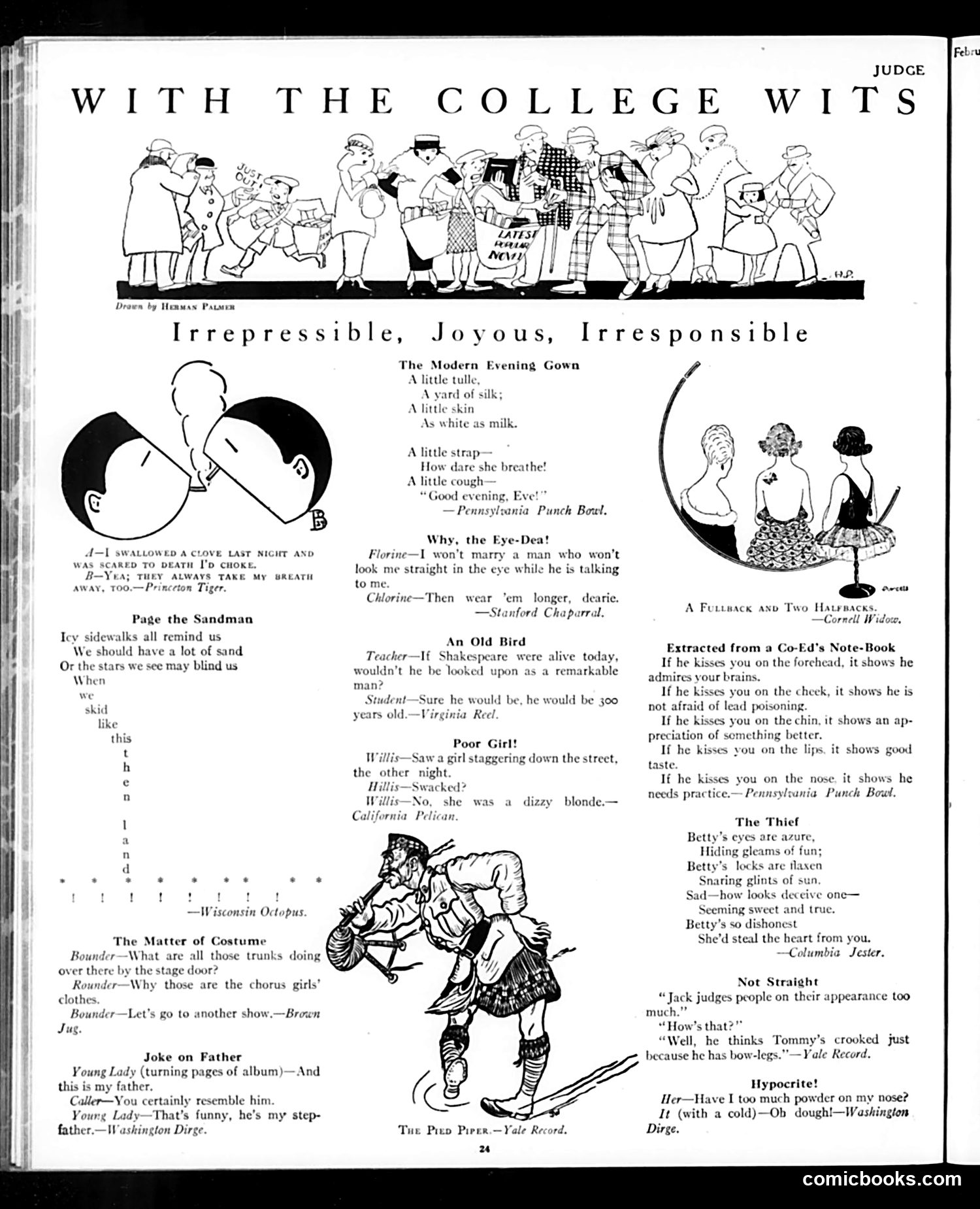
This page collects humorous quips and jokes sourced from various college humor magazines (Princeton Tiger, Wisconsin Octopus, Stanford Chaparral, Yale Record, etc.), reflecting early 20th-century collegiate humor. **Key content includes:** - **Social satire on fashion**: "The Modern Evening Gown" mocks women's revealing evening wear—minimal fabric ("a little tulle," "a little skin") yet constrictive design ("a little strap—How dare she breathe!"). - **Dating/courtship humor**: Multiple jokes about kissing and romance reflecting period anxieties about propriety and gender relations. - **Gender stereotypes**: Jokes about women drivers ("dizzy blonde"), makeup, and appearance-consciousness. - **Mild irreverence**: Humor about choking on cloves, drunkenness, and stepfathers suggests college-age audience mocking adult concerns. The cartoons and jokes collectively lampoon 1920s-era college social conventions, fashion norms, and romantic expectations, primarily targeting young women's behavior and appearance as subjects of comedic scrutiny.
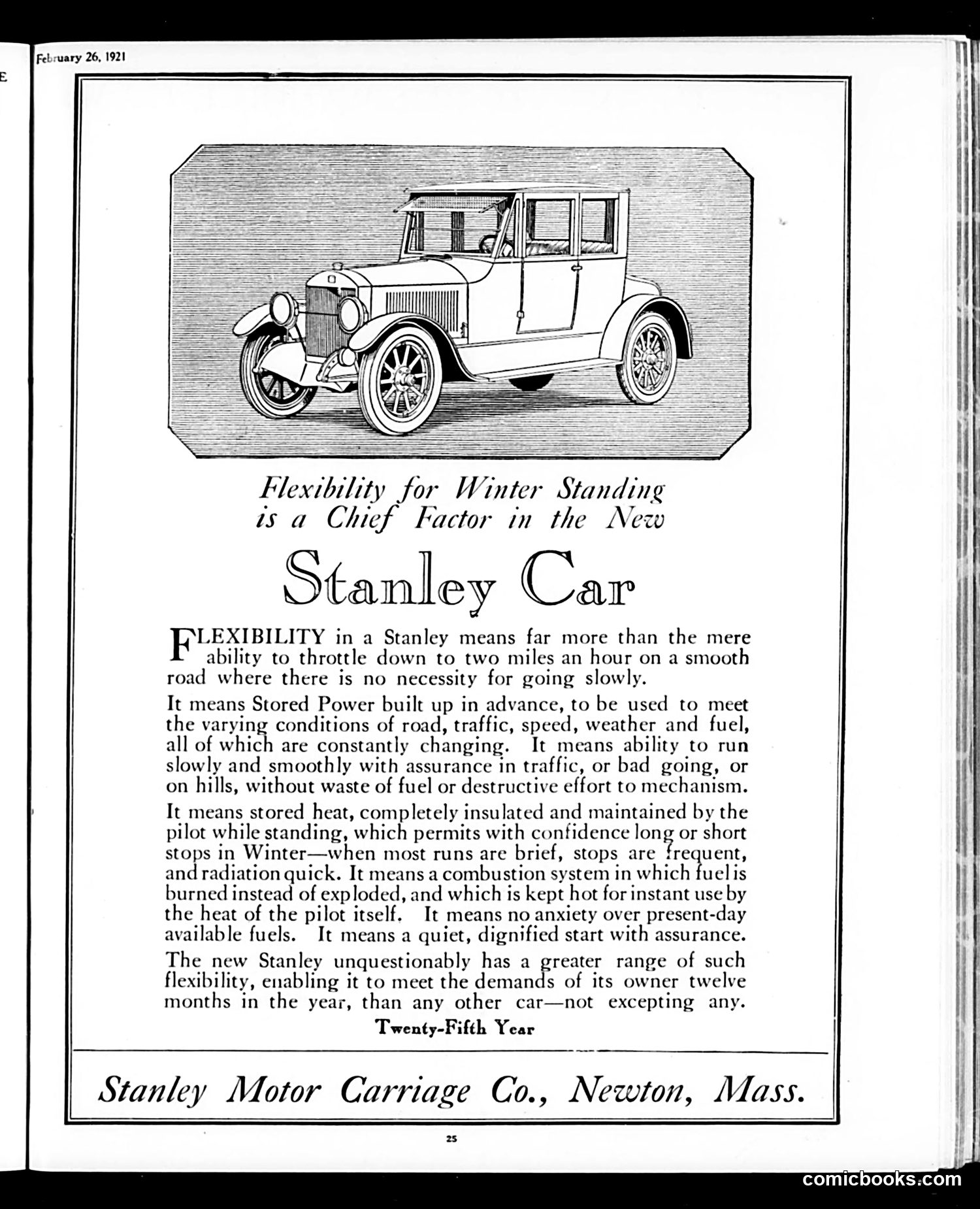
This is a **full-page advertisement**, not satire or political commentary. It's a 1921 promotional piece for the Stanley Motor Carriage Company featuring their steam-powered automobile. The ad emphasizes "flexibility for winter standing"—a key selling point for steam cars, which could maintain heat while parked and start reliably in cold weather, unlike gasoline engines of that era. The text stresses the Stanley's ability to store power and heat, run smoothly at varying speeds, and operate reliably year-round without fuel anxiety. The illustration shows a early 1920s touring car in period-appropriate engraving style. The copy presents technical advantages (stored heat, combustion system, insulation) as lifestyle benefits, appealing to affluent owners who made "brief stops" frequently. This represents the **last era of steam cars**—Stanley ceased production in 1924. The ad's emphasis on winter reliability and stored heat reflects practical concerns that would soon become obsolete as gasoline engines improved.
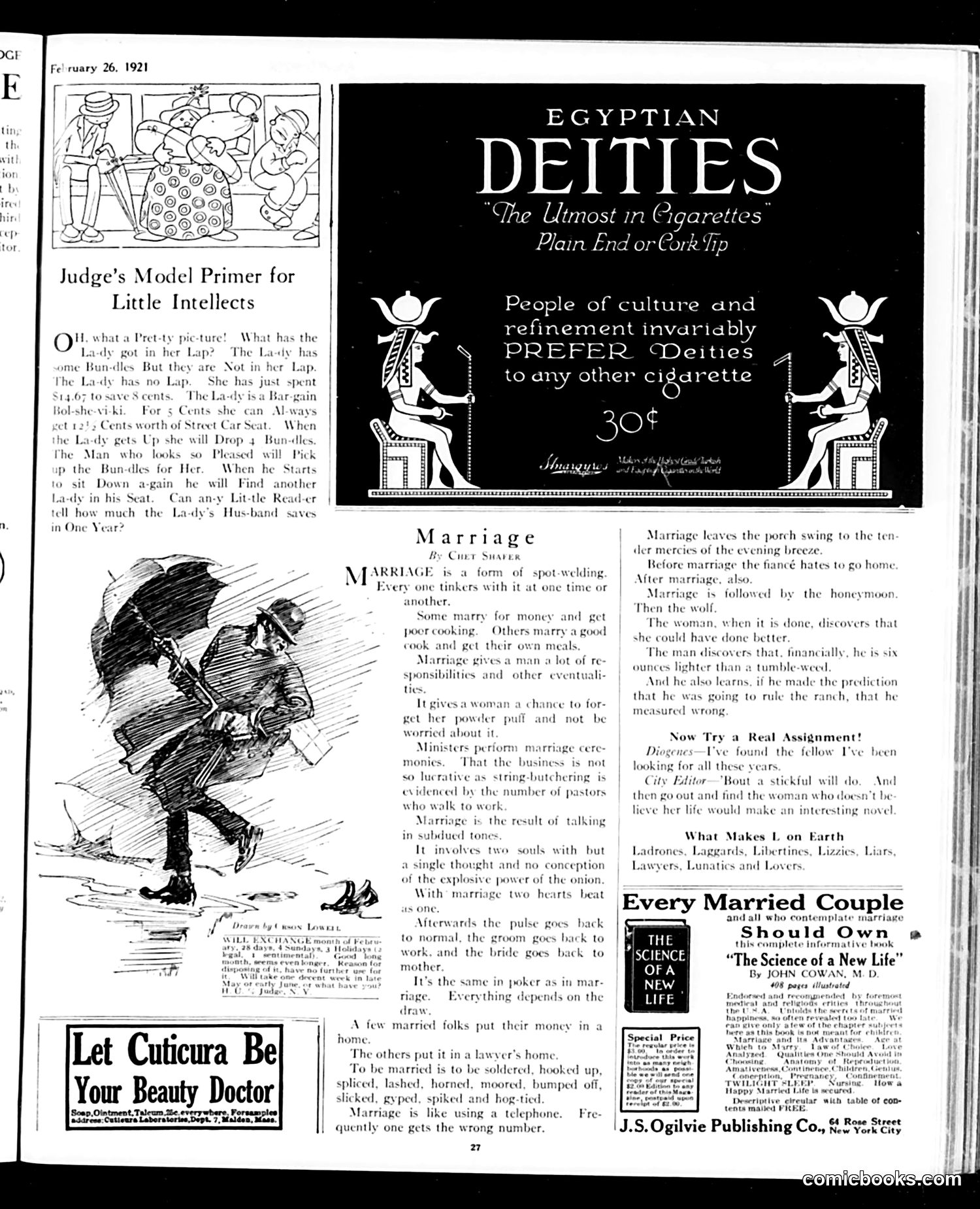
This page contains several satirical pieces mocking marriage and gender relations in early 1920s America: **"Judge's Model Primer for Little Intellects"** ridicules women's domestic dependency through mock arithmetic problems about a lady collecting "bundles" (likely children or laundry) on her lap—suggesting the absurdity of wives' unpaid labor and their husbands' financial savings from it. **The Marriage essay** by Curt Sauer presents cynical, tongue-in-cheek definitions of marriage: a "spot-welding" of incompatible partners, financial entanglement, loss of independence, and inevitable disappointment. The frequent comparisons (to poker, telephone calls, soldering) emphasize marriage as constraint rather than romance. **The cartoon** (artist unclear) depicts a man struggling under domestic burdens, visualizing the physical weight of married life. The advertisements for cigarettes and marriage advice books frame these pieces ironically—suggesting self-help solutions to the marital problems Judge has just satirized. Overall, the page expresses widespread post-WWI disillusionment with traditional marriage and women's roles.
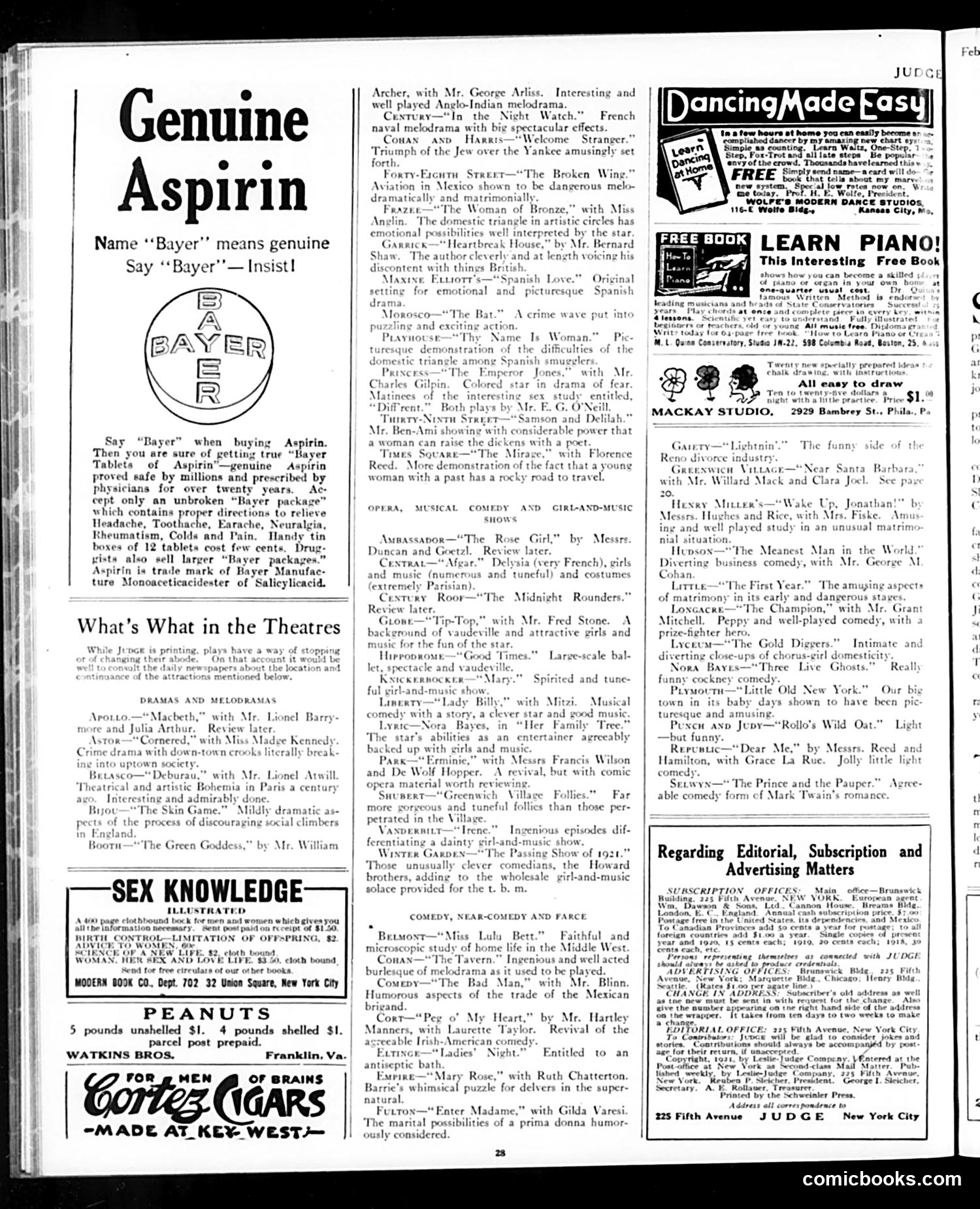
This page is primarily **advertising and theater listings**, not political satire. The dominant content includes: **Major Advertisements:** - A large Bayer Aspirin ad emphasizing brand authenticity ("Say 'Bayer'—Insist!"), reflecting post-WWI trademark concerns - Dancing lessons and piano instruction ads - A "Sex Knowledge" book advertisement for men and women - Peanuts and cigars for sale **Theater Section:** The bulk of the page catalogs contemporary Broadway productions with brief reviews—dramas like "Macbeth," comedies including "Greenwich Village Follies," and musicals. These are straightforward theatrical notices, not satirical commentary. **No Political Cartoon:** Despite Judge's typical satirical focus, this particular page contains no political cartoon or identifiable caricatures requiring historical context. It functions as a standard magazine page mixing consumer advertising with entertainment listings typical of 1920s periodicals.
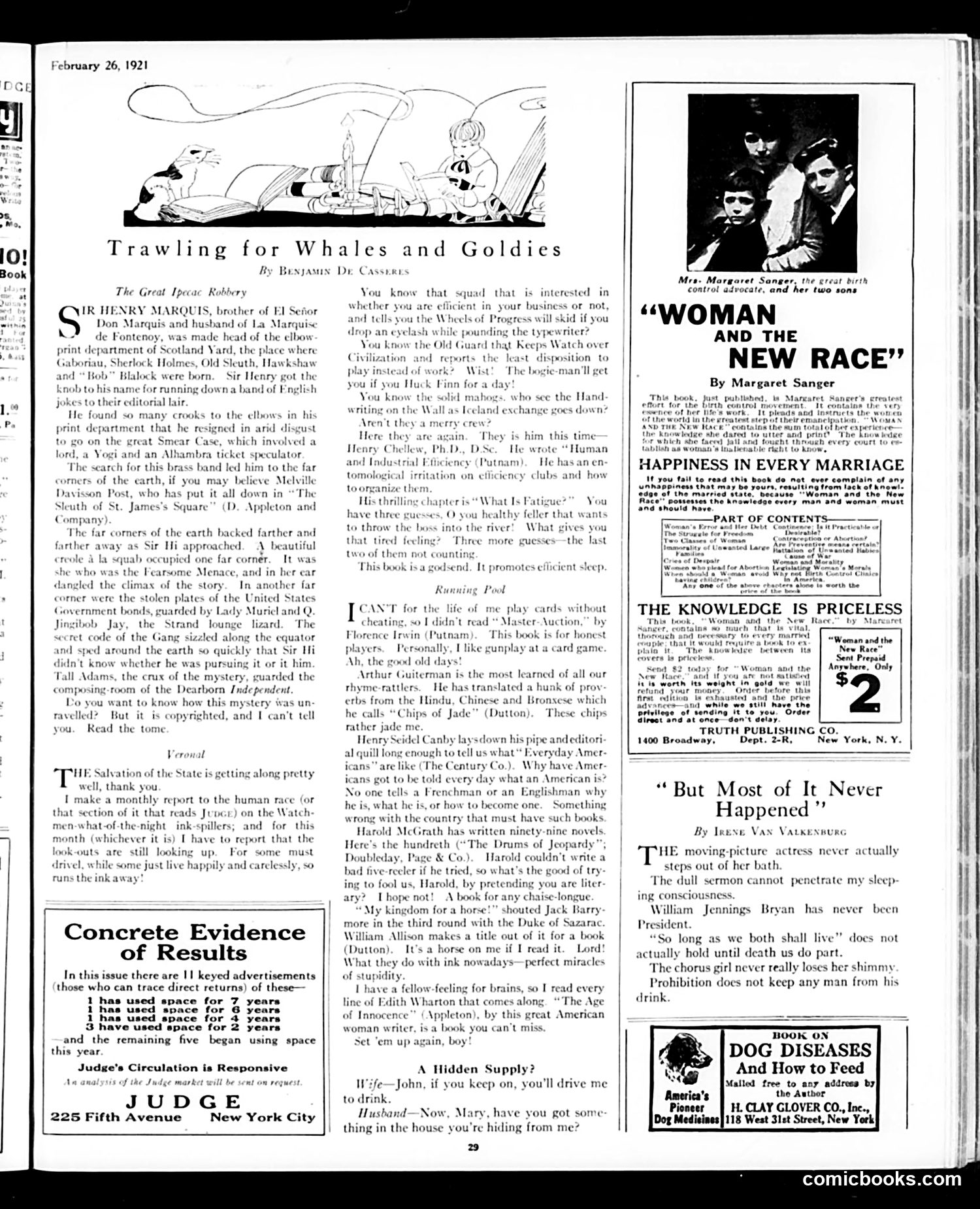
This page features a satirical short story by Benjamin De Casseres about detective fiction. The cartoon shows someone "trawling" (fishing) for "whales" (major criminals) and "goldies" (gold-related crimes), spoofing the popular mystery and detective story genre of the era. The accompanying text mocks the conventions of detective fiction—the elaborate plots, exotic locations, and contrived mysteries found in contemporary novels. The author humorously dismisses several new books, complaining that mystery writers overcomplicate their narratives and that American readers are oddly obsessed with understanding "what an American is" through imported fiction. The piece satirizes both the detective fiction craze and literary critics' breathless analysis of new releases. The bottom section contains advertisements and circulation information, indicating *Judge* magazine's competitive positioning in the marketplace.
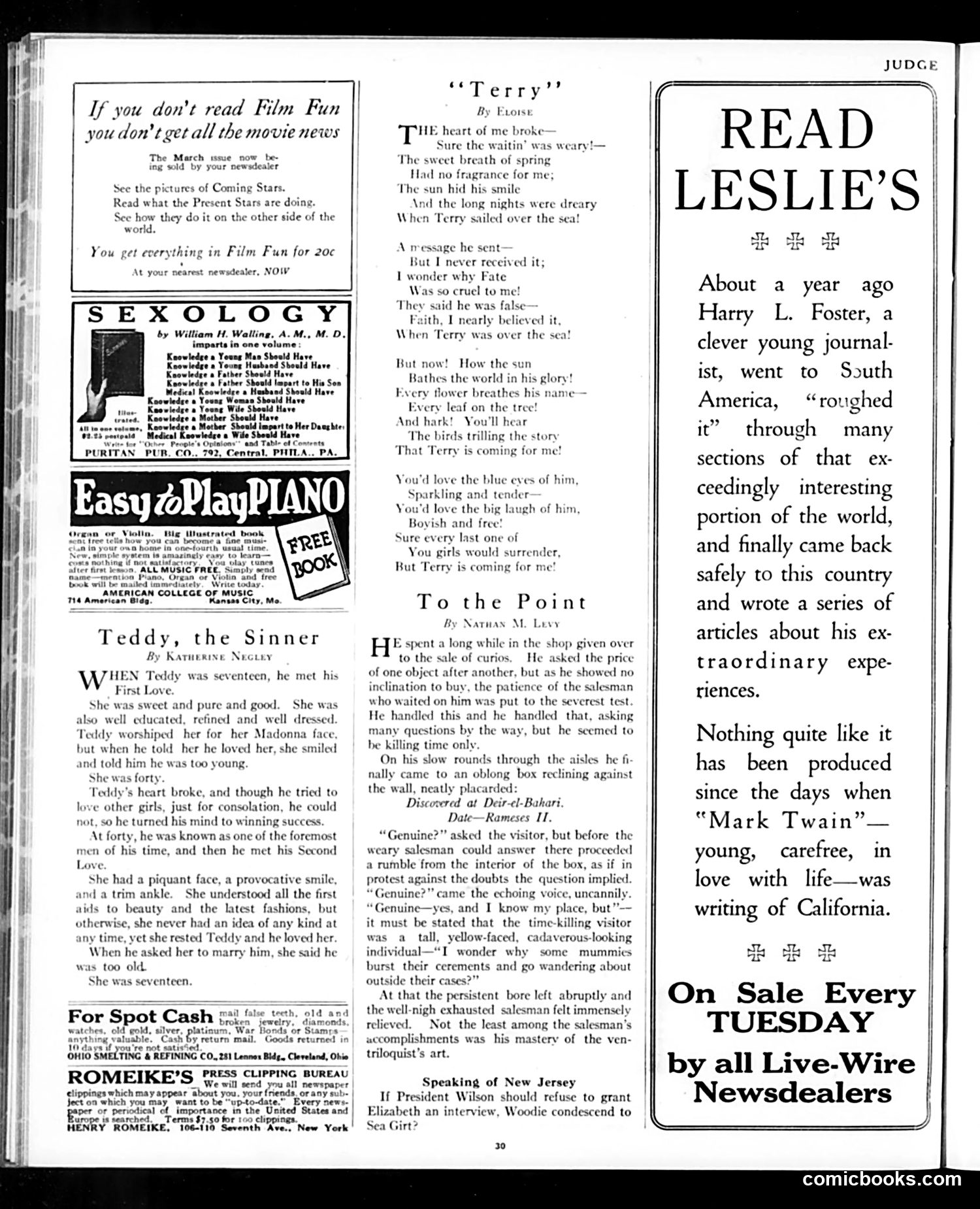
This page is primarily **advertising and light fiction**, not political satire. The content includes: **"Teddy, the Sinner"** — a morality tale about a man who loves unwisely: first a much-older woman in his youth, then a vapid teenager in his old age. The joke is ironic reversal: he's rejected for being "too young" and "too old" respectively, suggesting life's futility. **"Terry"** — a sentimental poem about a lover's return, typical period romance. **"To the Point"** — a humorous anecdote about an impatient museum-goer examining Egyptian mummy cases. The punchline: when he questions if a mummy is "genuine," it speaks back indignantly, frightening him away. It's wordplay on authenticity and supernatural humor. The page also advertises **Film Fun magazine, music instruction, and a press-clipping service** — typical early 20th-century periodical content. There is **no discernible political commentary** on this particular page.
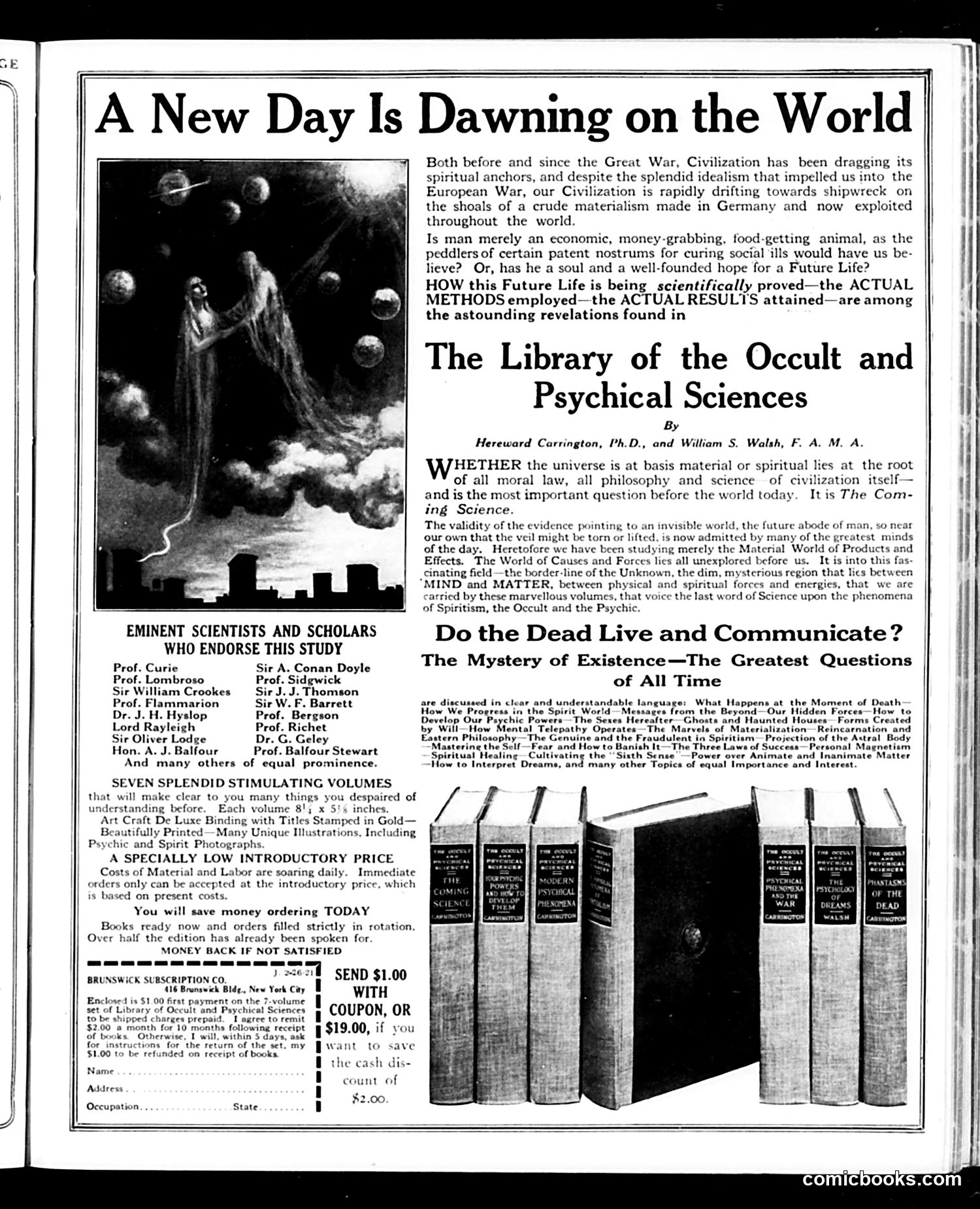
This page is primarily **advertising for "The Library of the Occult and Psychical Sciences,"** a seven-volume subscription set marketed to post-WWI audiences. **The Pitch:** The advertisement exploits post-Great War anxieties about materialism and spiritual decline. It claims eminent scientists (Marie Curie, Arthur Conan Doyle, Oliver Lodge, etc.) endorse studying the supernatural as humanity's answer to "crude materialism made in Germany." **The Appeal:** The text frames spiritualism as scientific proof of an afterlife and human soul—counteracting both German materialism and mechanistic philosophy. Questions like "Do the Dead Live and Communicate?" promise answers through "actual methods" and "actual results." **The Marketing:** Urgency tactics include "money back if not satisfied," introductory pricing ($1 down, $2/month), and claims that material costs are rising. The ornate leather-bound volumes with "spirit photographs" suggest legitimacy. **Historical Context:** This reflects genuine 1920s interest in spiritualism, séances, and psychic phenomena—partly driven by WWI grief and spiritual questioning.

This page is **primarily a mail-order advertisement**, not a political cartoon. It promotes the "Little Leather Library Corp'n's" 30-volume set of "World's Greatest Masterpieces" bound in leather, offered for $2.98 with a 30-day trial period requiring no upfront payment. The ad lists classic authors (Shakespeare, Poe, Emerson, Thoreau, Browning, Omar Khayyam, Lincoln) to appeal to middle-class readers seeking cultural refinement. The marketing strategy emphasizes affordability and convenience—customers can examine books risk-free before committing payment. While this appears in *Judge* magazine (a satirical publication), **no satirical content is visible on this page**. The OCR text is heavily corrupted, making it impossible to identify any cartoon figures or political references. The page functions as a straightforward commercial pitch targeting aspirational readers during an era when owning "leather-bound classics" signaled education and respectability.