
Judge, 1921-02-26 · page 20 of 32
Judge — February 26, 1921 — page 20: what you’re looking at
What you’re looking at
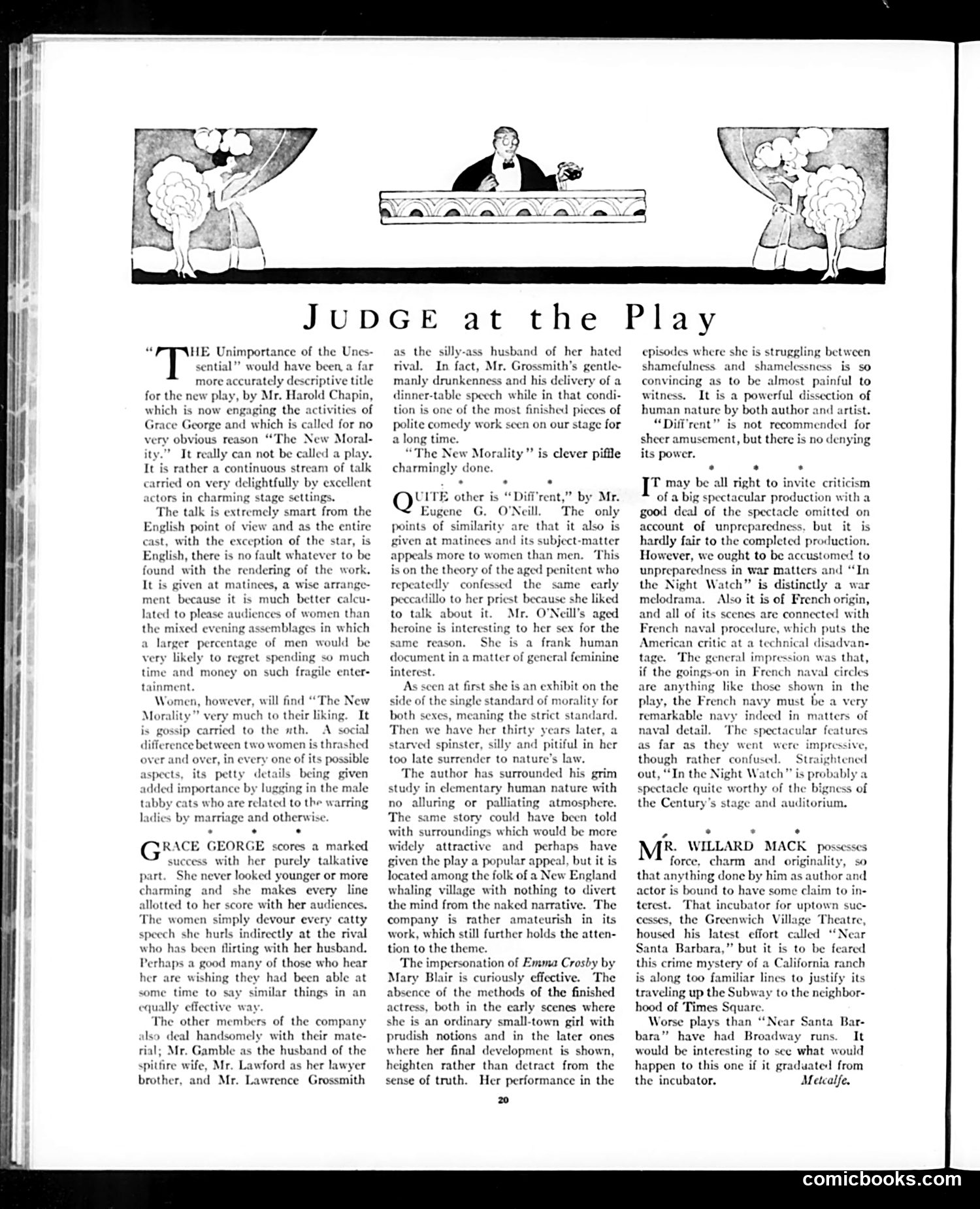
This page contains theater reviews from *Judge* magazine, a satirical publication. The illustration shows a judge presiding over theatrical productions. The reviews critique two Broadway plays: Harold Chapin's "The New Morality" (starring Grace George) and Eugene O'Neill's "Diff'rent." The critic dismisses the first as mere gossip dressed up as drama—"talk carried on very delightfully" with catty dialogue between society women. He notes it appeals primarily to female matinee audiences rather than mixed evening crowds, implying women prefer trivial social squabbles while men want substantive entertainment. O'Neill's "Diff'rent" receives slightly more respect for its serious examination of a woman's moral hypocrisy—holding strict sexual standards for others while later abandoning them. However, the critic faults its grim New England setting for lacking popular appeal. The satire targets both contemporary theater's gender-segregated audiences and critics' assumptions about women's intellectual interests versus men's.
📄 Transcribed text from this page (OCR, searchable)
Machine-transcribed from the original scan — historical spelling and the odd misread are preserved.
JUDGE at the Play a I SHE Unimportance of the Unes- sential” would have been a far more accurately descriptive tide for the new play, by Mr. Harold Chapin, which is now engaging the activities of Grace George and which is called for no very obvious reason “The New Moral- ity.” It really can not be called a play It is rather a continuous stream of talk carried on very delightfully by excellent actors in charming stage settings. The talk is extremely smart from the English point of view and as the entire cast, with the exception of the star, is English, there is no fault whatever to be found with the rendering of the work. It is given at matinces, a wise arrange- ment because it is much better calcu- lated to please audiences of women than the mixed evening assemblages in which a larger percentage of men would be very likely to regret spending so much time and money on such fragile enter- tainment. Women, however, will find “The New Morality” very much to their liking. It is gossip carried to the nth. A social difference between two women is thrashed over and over, in every one of its possible its petty details being given added importance by lugging in the male tabby cats who are related to the warring ladies by marriage and otherwise. * * . RACE GEORGE scores a marked success with her purely talkative part. She never looked younger or more charming and she makes every line allotted to her score with her audiences. The women simply devour every catty speech she hurls indirectly at the rival who has been flirting with her husband. Perhaps a good many of those who hear her are wishing they had been able at some time to say similar things in an equally effective way The other members of the company Iso deal handsomely with their mat rial; Mr. Gamble as the husband of the spittire wife, Mr. Lawford as her lawyer brother, and Mr. Lawrence Grossmith aspects, as the silly-ass husband of her hated rival. In fact, Mr. Grossmith’s gentle- manly drunkenness and his delivery of a dinner-table speech while in that condi- tion is o1 the most finished pieces of polite comedy work scen on our stage for along time. rhe New Morality” is clever piffle charmingly done. UITE other is “Diff’rent,” by Mr. Eugene O'Neill. ‘The only points of similarity are that it also is given at matinees and its subject-matter appeals more to women than men. This is on the theory of the aged penitent who repeatedly confessed the same carly peccadillo to her priest because she liked to talk about it. Mr. O'Neill's aged heroine is interesting to her sex for the same reason, She is a frank human document in a matter of general feminine interest. As seen at first she is an exhibit on the side of the single standard of morality for both sexes, meaning the strict standard. Then we have her thirty years later, a starved spinster, silly and pitiful in her too late surrender to nature's law. The author has surrounded his grim study in elementary human nature with no alluring or palliating atmosphere. The same story could have been told with surroundings which would be more widely attractive and perhaps have given the play a popular appeal, but it is located among the folk of a New England whaling village with nothing to divert the mind from the naked narrati The company is rather amateurish in its work, which still further holds the atten- tion to the theme. ‘The impersonation of Emma Crosby by Mary Blair is curiously effective. The absence of the methods of the finished actress, both in the carly scenes where she is an ordinary small-town girl with prudish notions > later ones where her final development is shown, heighten rather than detract from the sense of truth. Her performance in the episodes where she is struggling between shamefulness and shamelessness is so convincing as to be almost painful to witness. It is a powerful dissection of human nature by both author and artist. “Diff'rent” is not recommended for sheer amusement, but there is no denying its power. ° . . T may be all right to invite criticism of a big spectacular production with a good deal of the spectacle omitted on account of unpreparedness, but it is hardly fair to the completed production. However, we ought to be accustomed to unpreparedness in war matte nd “In the Night Watch” is distinctly a war melodrama. Also it is of French origin, and all of its scenes are connected with French naval procedure, which puts the American critic at a technical disadvan- tage. The general impression was that, if the goings-on in French naval circles are anything like those shown in the play, the French navy must be a very remarkable navy indeed in matters of naval detail. The spectacular features as far as they went were impressive, though rather confused. Straightened out, “In the Night Watch” is probably a spectacle quite worthy of the bigness of the Century’s stage and auditorium. - ° . . Me. WILLARD MACK possesses force, charm and originality, so that anything done by him as author and actor is bound to have some claim to in- terest. That incubator for uptown suc- cesses, the Greenwich Village Theatre, housed his latest effort called ‘‘Near Santa Barbara,” but it is to be feared this crime mystery of a California ranch is along too familiar lines to justify its traveling up the Subway to the neighbor- hood of Times Square. Worse plays than ‘‘Near Santa Bar- bara” have had Broadway runs. It would be interesting to see what would happen to this one if it graduate from the incubator. Metcalfe, comicbooks.com