
A complete issue · 37 pages · 1920
Judge — June 26, 1920
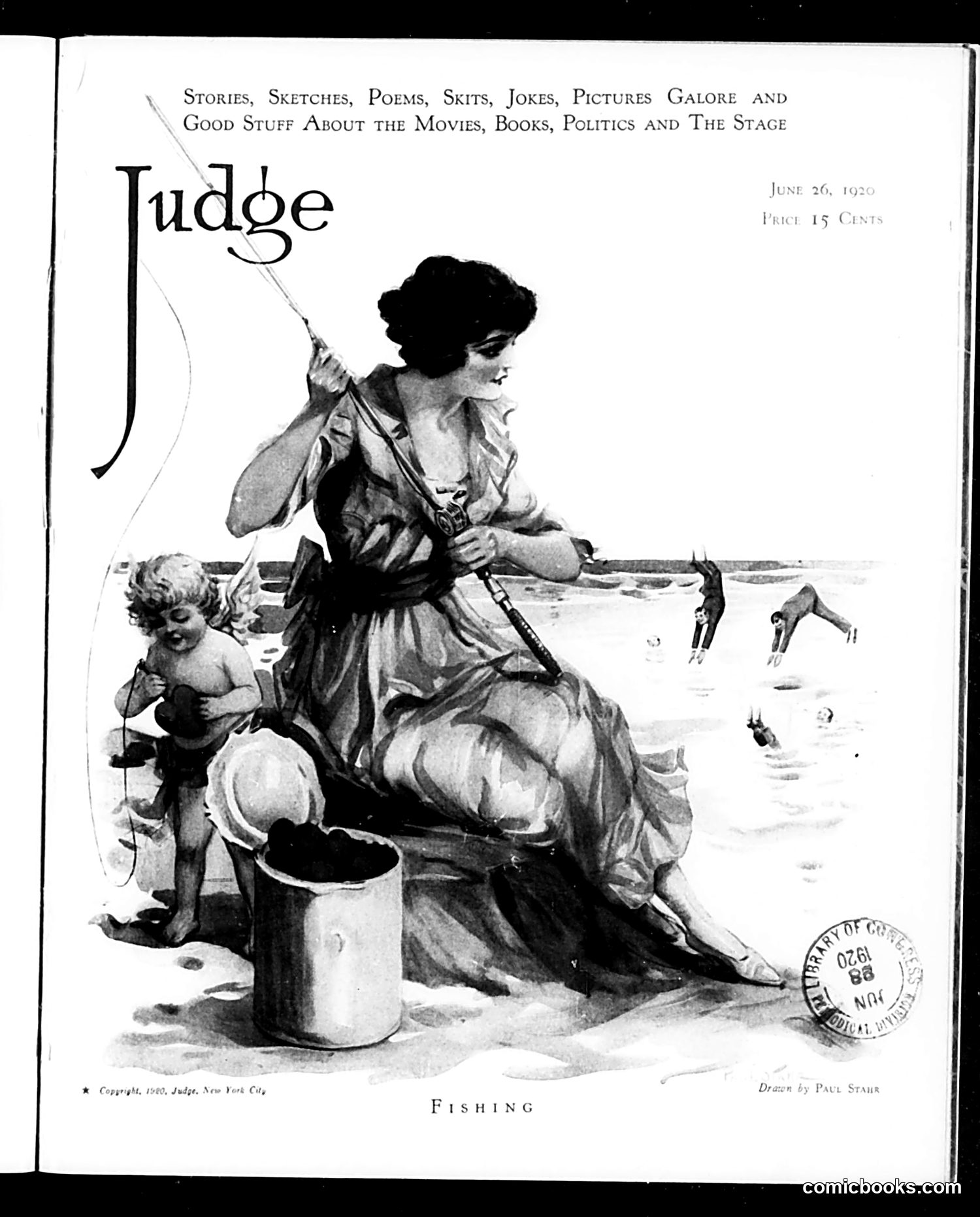
This illustration by Paul Staub depicts a woman fishing at the beach with a small cherub or cupid figure beside her. The title "Fishing" suggests a double meaning typical of Judge's humor. The satire likely plays on the contemporary slang "fishing"—flirting or seeking romantic attention from men. The woman's fashionable dress, confident posture, and the presence of the cupid figure reinforce this interpretation. The men visible in the background water appear to be the "catch" she's after. This reflects 1920s social anxieties about changing women's roles and the "New Woman"—more independent, fashionable, and openly social than previous generations. Judge's humor often mocked both modern women and traditional courtship conventions.
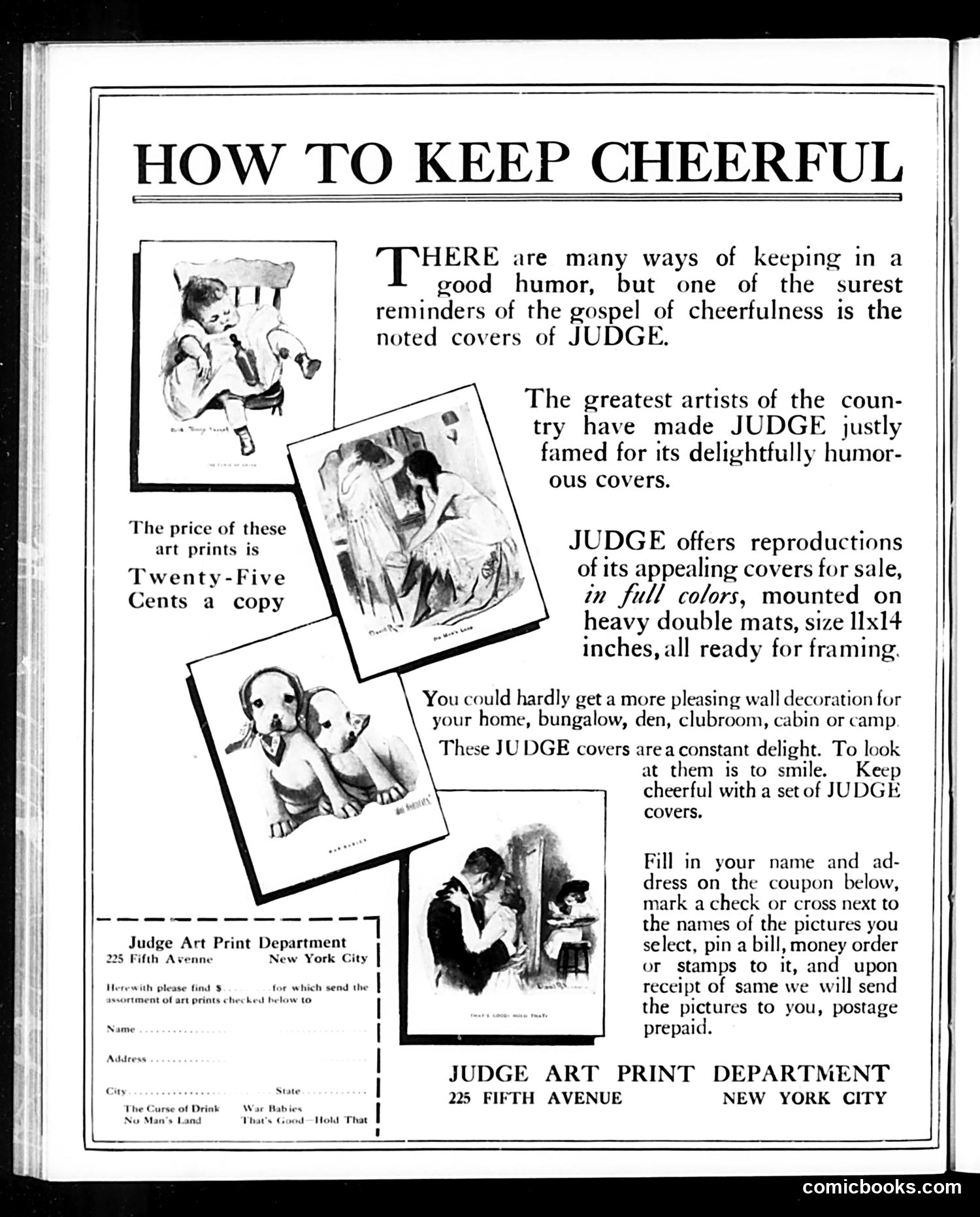
This page is primarily **advertising**, not political satire. It promotes Judge magazine's art print department, selling reproductions of the magazine's cover illustrations. The four sketched images shown are humorous domestic scenes—a child with toys, an intimate couple moment, a dog, and what appears to be a romantic or domestic scene. These represent the "delightfully humorous covers" Judge was known for. The advertisement emphasizes that these full-color reproductions (11x14 inches, mounted on heavy mats) are affordable wall decorations at 25 cents per copy. The text claims looking at them "is to smile" and promises they'll keep viewers "cheerful." This reflects early 20th-century American consumer culture, where magazine cover art was valuable enough to sell separately as home décor for middle-class audiences.
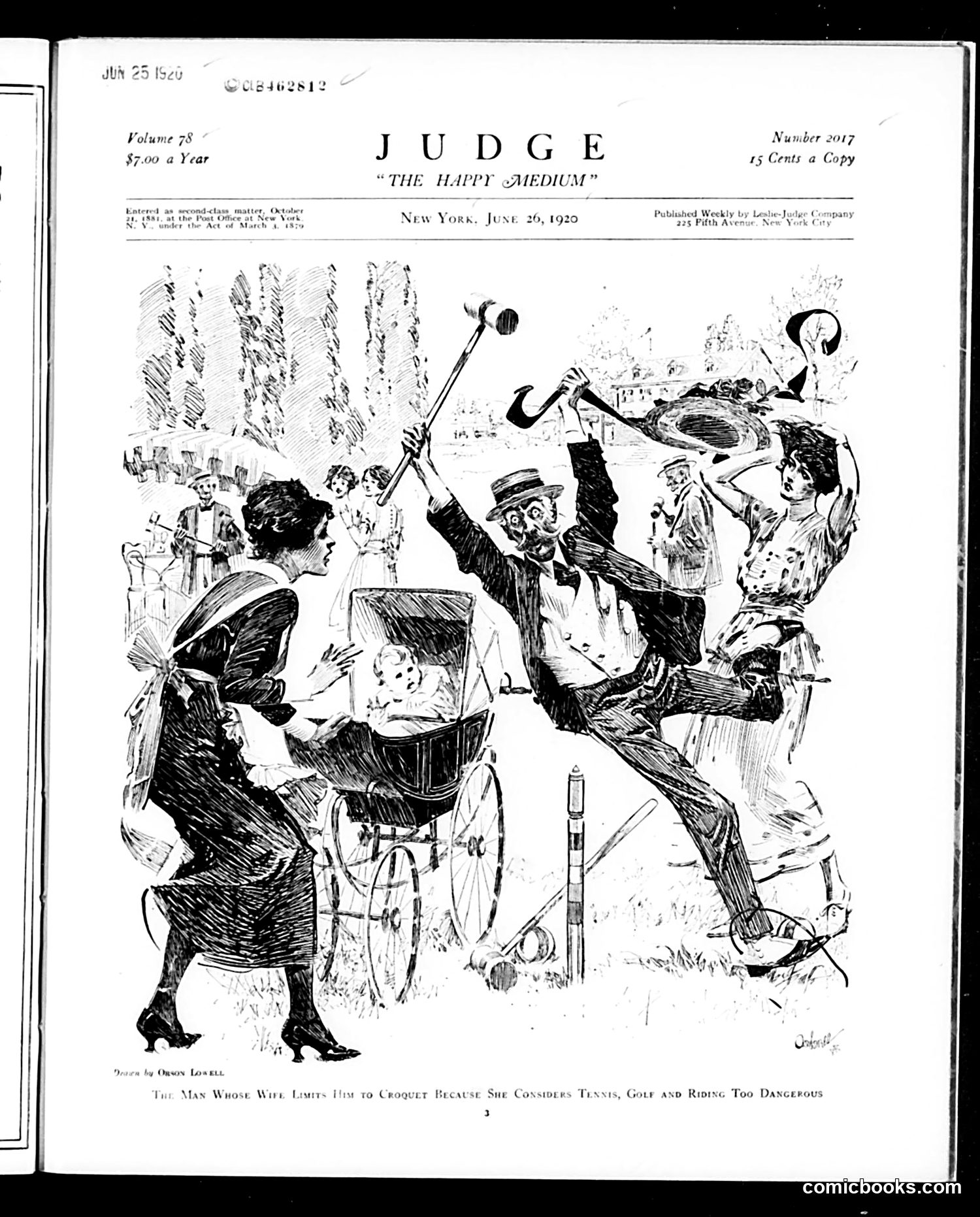
This is a satirical cartoon from *Judge* magazine (June 26, 1920) titled "The Man Whose Wife Limits Him to Croquet Because She Considers Tennis, Golf and Riding Too Dangerous." The cartoon depicts a henpecked husband whose overprotective wife restricts him to only croquet as a "safe" recreational activity. However, the illustration shows him wildly flailing at croquet while chaos erupts around him—he's striking himself, losing his hat, and creating general mayhem. The joke is ironic: the wife's attempt to protect him through extreme limitation backfires, as even the supposedly safest sport becomes dangerous when he plays it so recklessly. This reflects 1920s gender dynamics and marital humor common to the era, satirizing both controlling wives and incompetent husbands.
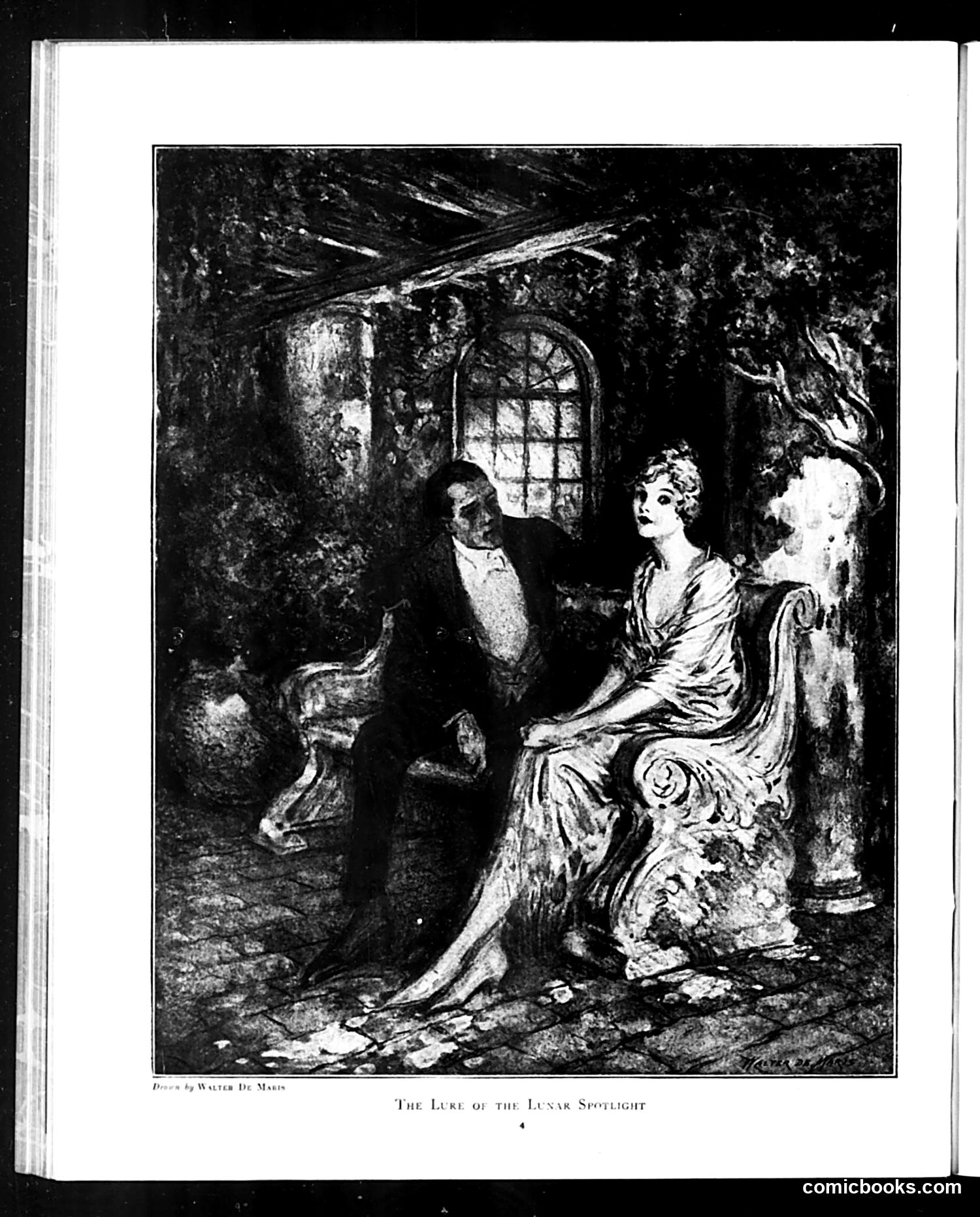
This illustration by Walter De Maris depicts a romanticized scene in what appears to be a ruined classical interior. A well-dressed man gazes upward while a reclining woman in elegant drapery looks toward him. A third figure lurks in shadows behind them. The title "The Lure of the Lunar Spotlight" suggests satire about moonlight's traditional association with romance and seduction. The composition likely mocks sentimental Victorian notions of romantic atmosphere—the "lure" of moonlit encounters. The classical setting and posed figures parody romantic literature and art conventions of the era. Without additional context, the specific social or political targets remain unclear, though the work appears to satirize contemporary attitudes toward courtship or romance through exaggerated theatrical staging.
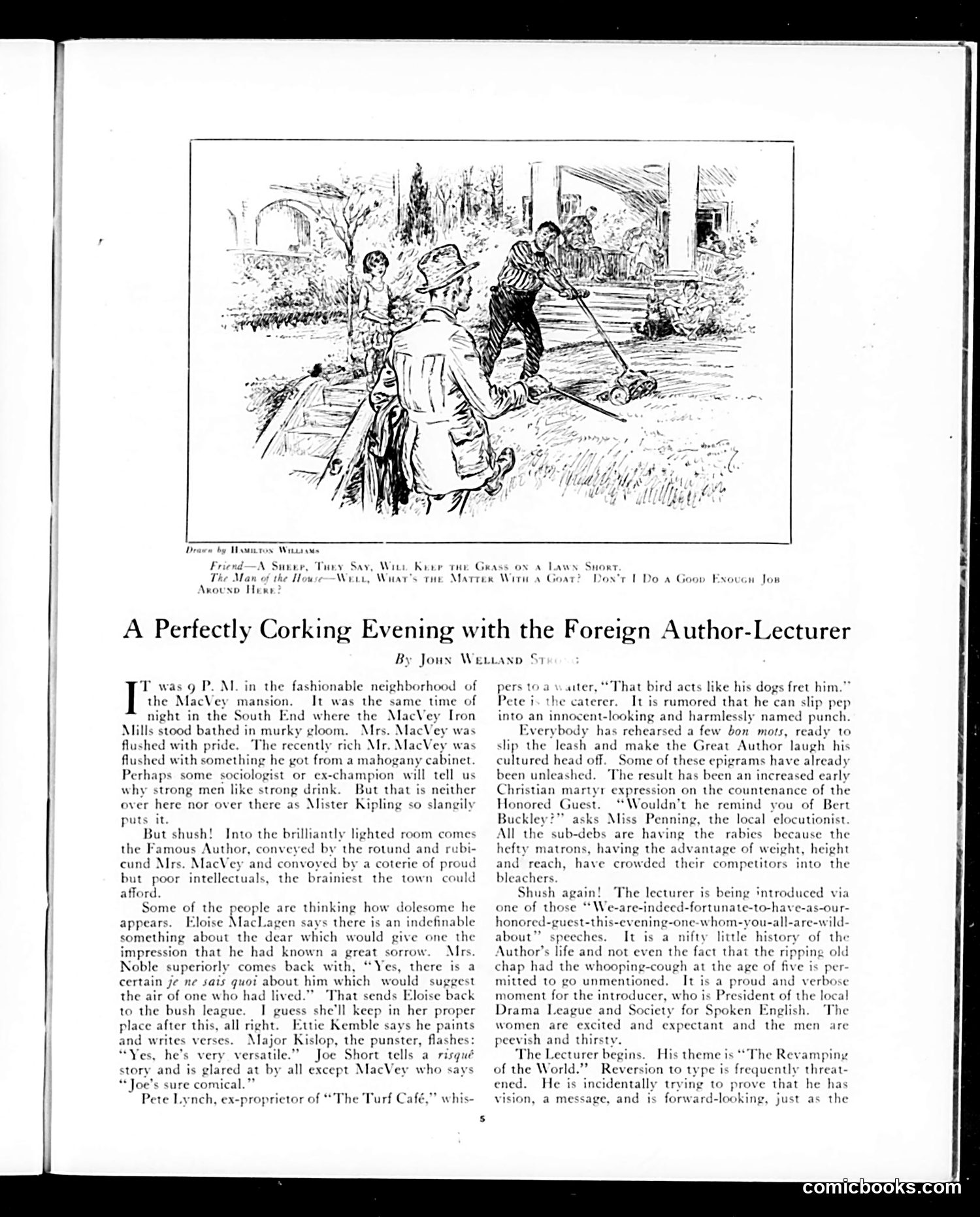
The cartoon at top, drawn by Hamilton Williams, depicts a suburban lawn scene with figures discussing sheep as lawn mowers. The caption reads: "Friend—A Sheep, They Say, Will Keep the Grass on a Lawn Short. The Man of the House—Well, What's the Matter With a Goat? Don't I Do a Good Enough Job Around Here?" **The satire:** This is a domestic humor joke playing on the husband's ego. He's comparing himself unfavorably to a goat—animals known for indiscriminate eating and destructive behavior. The joke suggests he's lazy or inadequate at yard maintenance, hence the wife's proposal to get sheep instead. It's a lighthearted jab at male domesticity and yard work responsibility, typical of Judge magazine's middle-class American humor. The accompanying article discusses a foreign author-lecturer's evening visit.
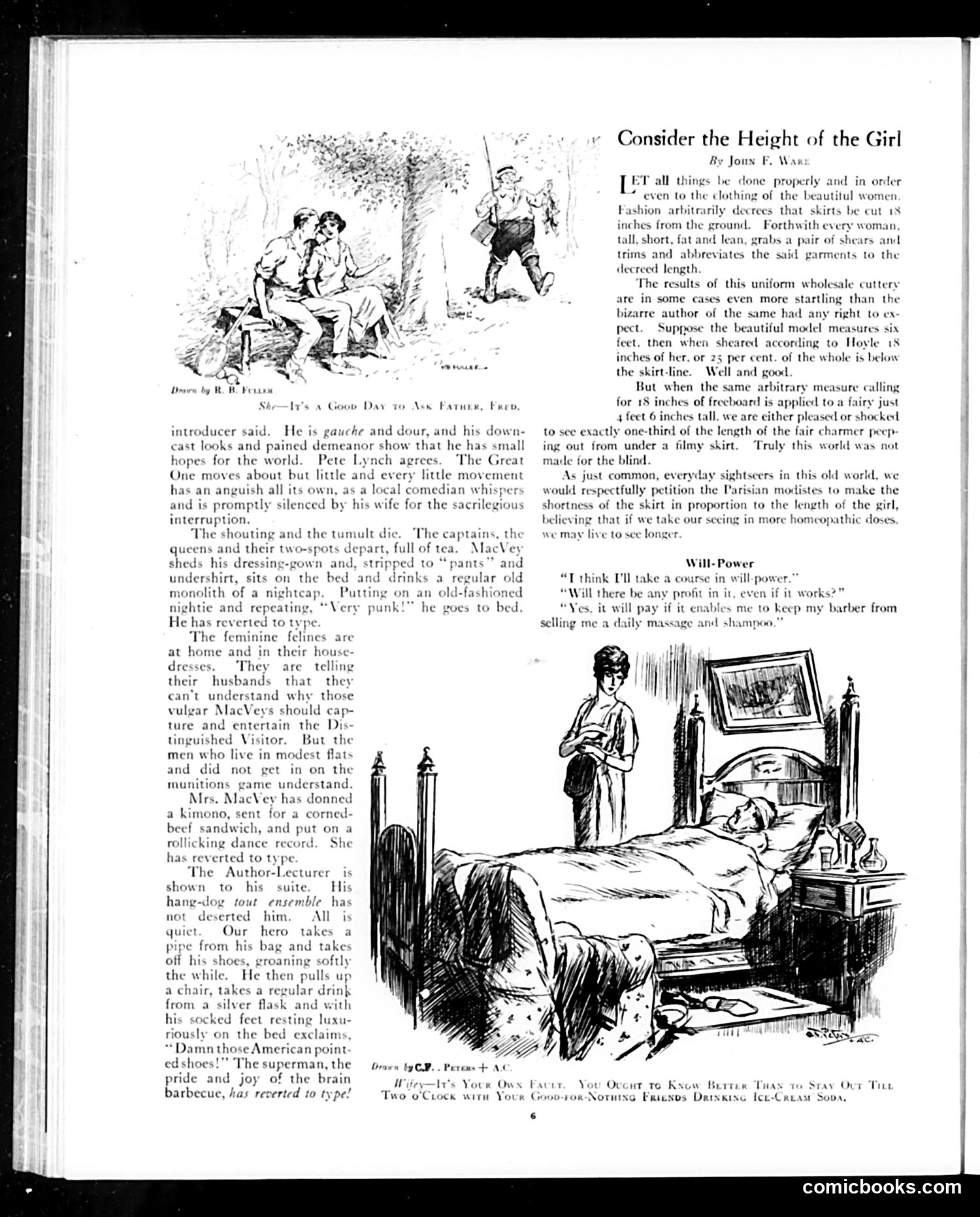
This page contains two distinct satirical pieces: **"Consider the Height of the Girl"** (top) critiques arbitrary fashion standards. The author argues that women's clothing—particularly skirt lengths—is dictated by fashion rather than practicality or proportion to individual body types. The satire mocks how designers impose uniform measurements (like 18 inches of freeboard) regardless of whether a woman is 5 feet or 6 feet tall, resulting in absurd and unflattering results. **"Will-Power"** (bottom) depicts a humorous domestic scene where a man appears to be resting in bed while a woman stands nearby, likely commenting on his laziness or lack of willpower regarding self-improvement (implied by references to barber visits and massage). Both pieces target contemporary social conventions—fashion industry arbitrariness and masculine idleness—through gentle mockery typical of Judge's satirical approach.
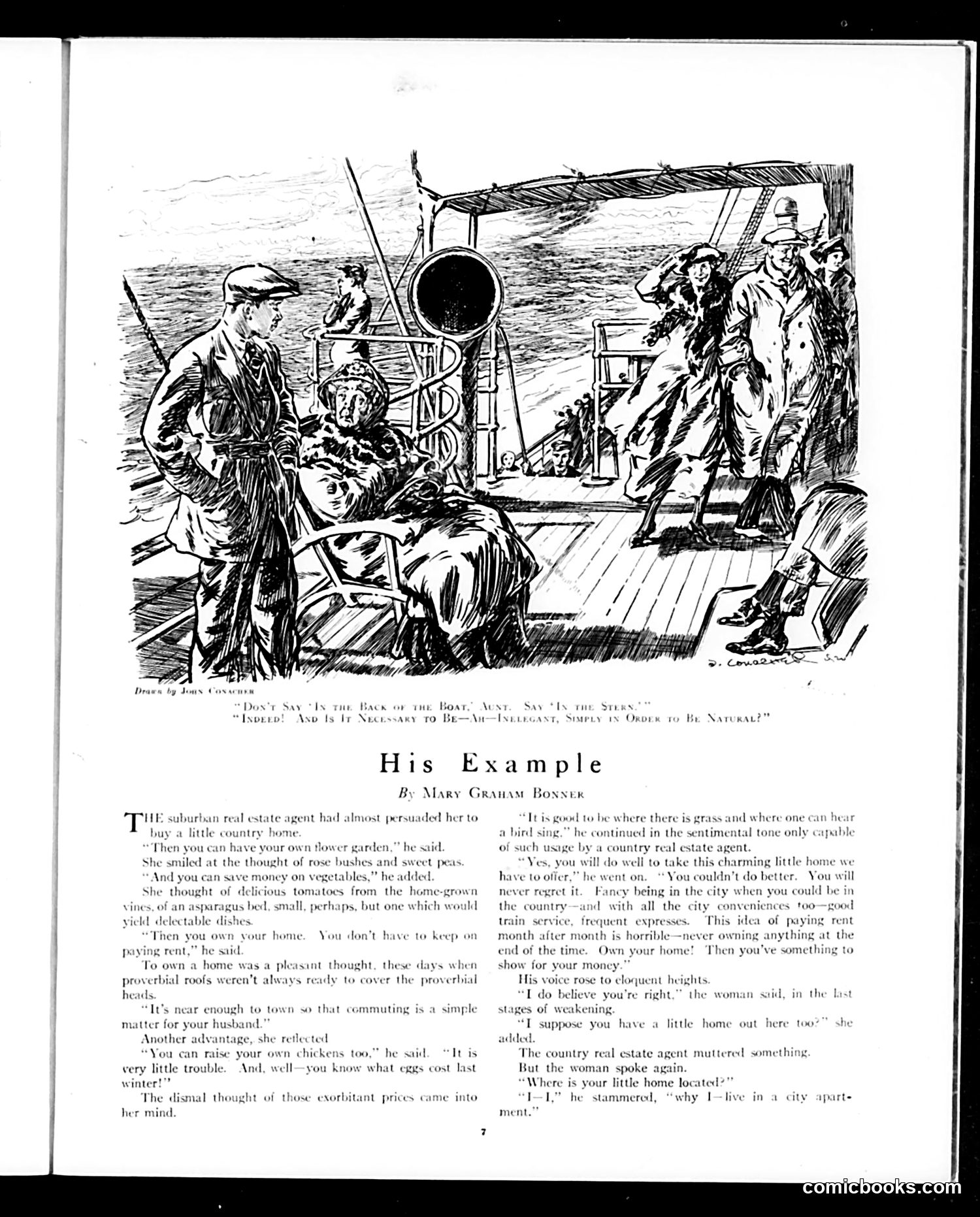
This story satirizes the hypocrisy of real estate agents selling suburban country homes. A suburban agent persuades a woman to buy a cottage by enthusiastically pitching its benefits: growing vegetables, raising chickens, owning property, avoiding city rent, and enjoying pastoral pleasures like birdsong. The satire's punchline arrives when the woman asks where the agent's own country home is located. The agent stammers that he actually lives in a city apartment—he doesn't practice what he preaches. This undercuts his entire sales pitch, revealing him as a self-interested salesman exploiting the woman's desires for a lifestyle he himself doesn't believe in or live. The joke reflects early 20th-century skepticism about both real estate salesmen and the "back to the land" movement's credibility, suggesting such agents cynically manipulate clients' aspirations for commission rather than genuine conviction.
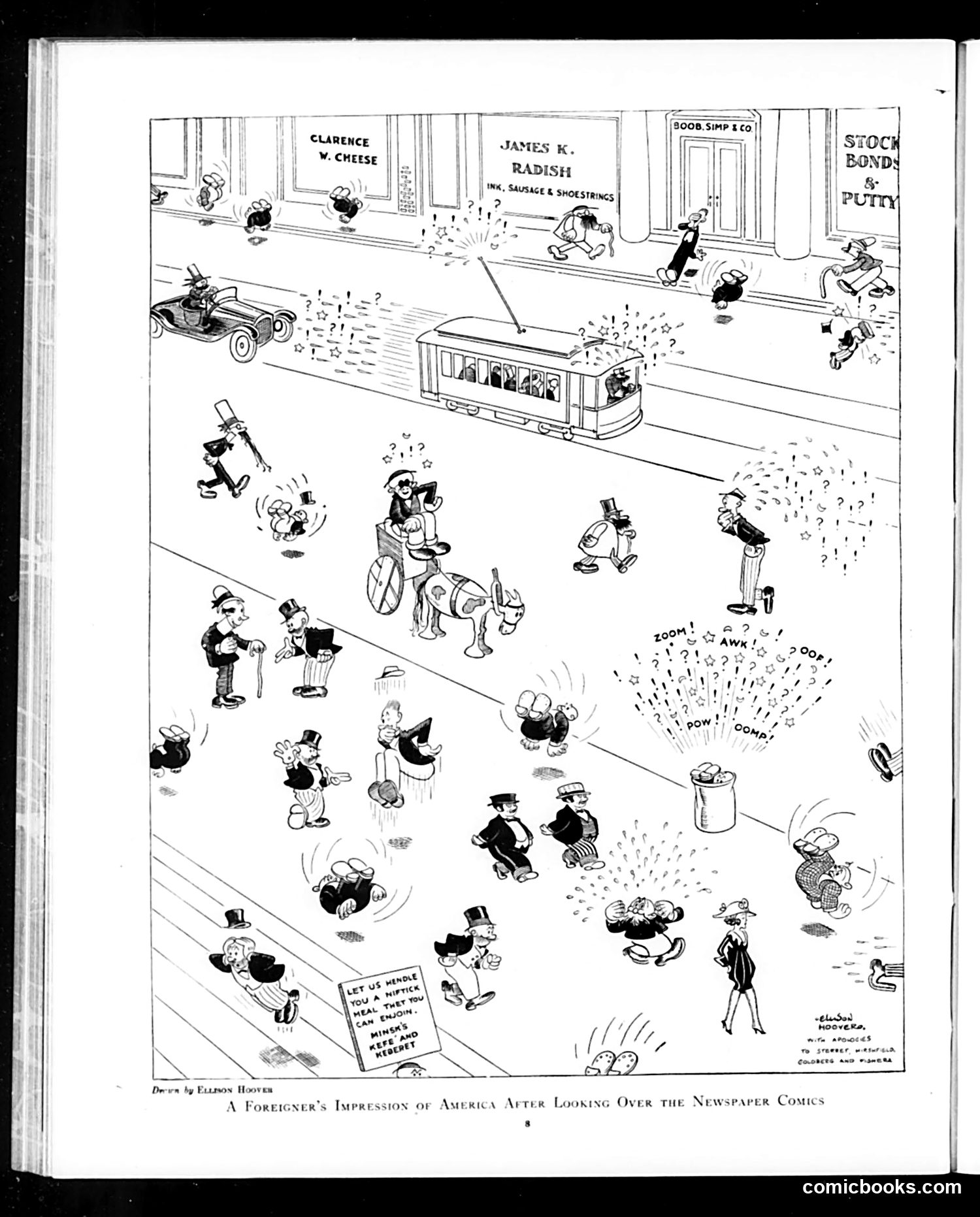
This is a satirical cartoon depicting a foreigner's bewildered impression of American street life as reflected in newspaper comic strips. The chaotic scene shows exaggerated characters—top-hatted gentlemen, slapstick performers, and absurdist figures—scattered across a city street alongside storefronts (including "James K. Radish" and "Boob Simp & Co."). The satire mocks American comic strips' reputation for chaotic, violent slapstick humor and surreal situations. To a foreign observer, the comics' constant mayhem—collisions, explosions, bizarre characters—would suggest American life itself is equally ridiculous and uncontrolled. The cartoon critiques both the comics' content and implicitly American culture's apparent zaniness through this outsider perspective. It's commentary on how newspaper comics shaped—or distorted—international perceptions of America.
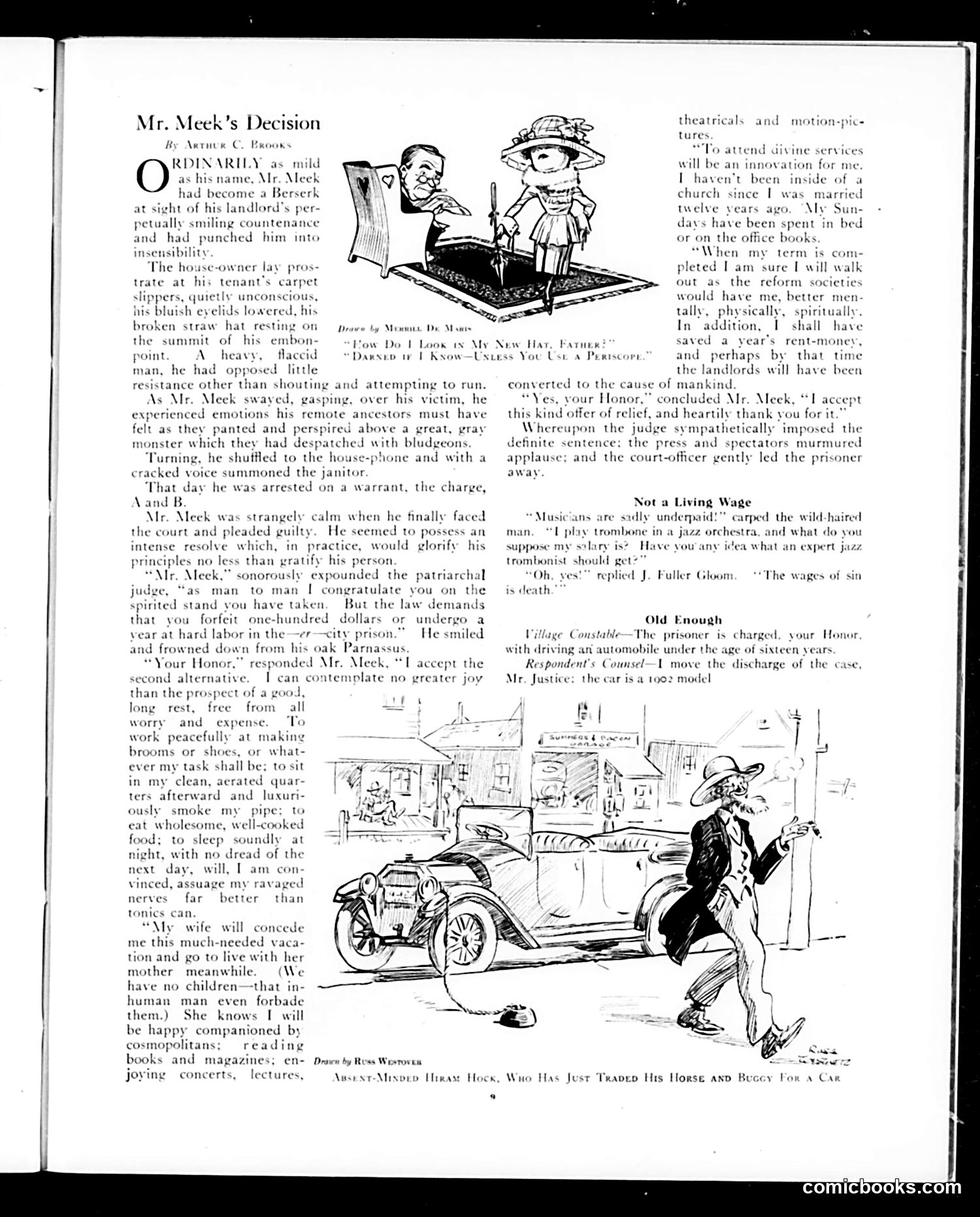
This story satirizes the legal system's treatment of working-class men. Mr. Meek, a mild-mannered tenant, attacks his landlord and faces court. Rather than punishment, the judge congratulates him for his "spirited stand"—yet still sentences him to a year's hard labor or a $100 fine. Meek cheerfully accepts prison, viewing it as a vacation: free room, board, rest from work, and time for self-improvement. He'll save money while his wife lives with her mother, and hopes his landlord converts to "mankind" by then. The satire cuts two ways: it mocks both the judge's paternalistic hypocrisy (praising Meek while punishing him) and the grim reality that imprisonment seemed preferable to poverty for ordinary people. The cartoon's second panel shows an older man having traded his horse and buggy for a car—commenting on modernization and changing times. The page suggests early 20th-century anxieties about labor, class, and justice.
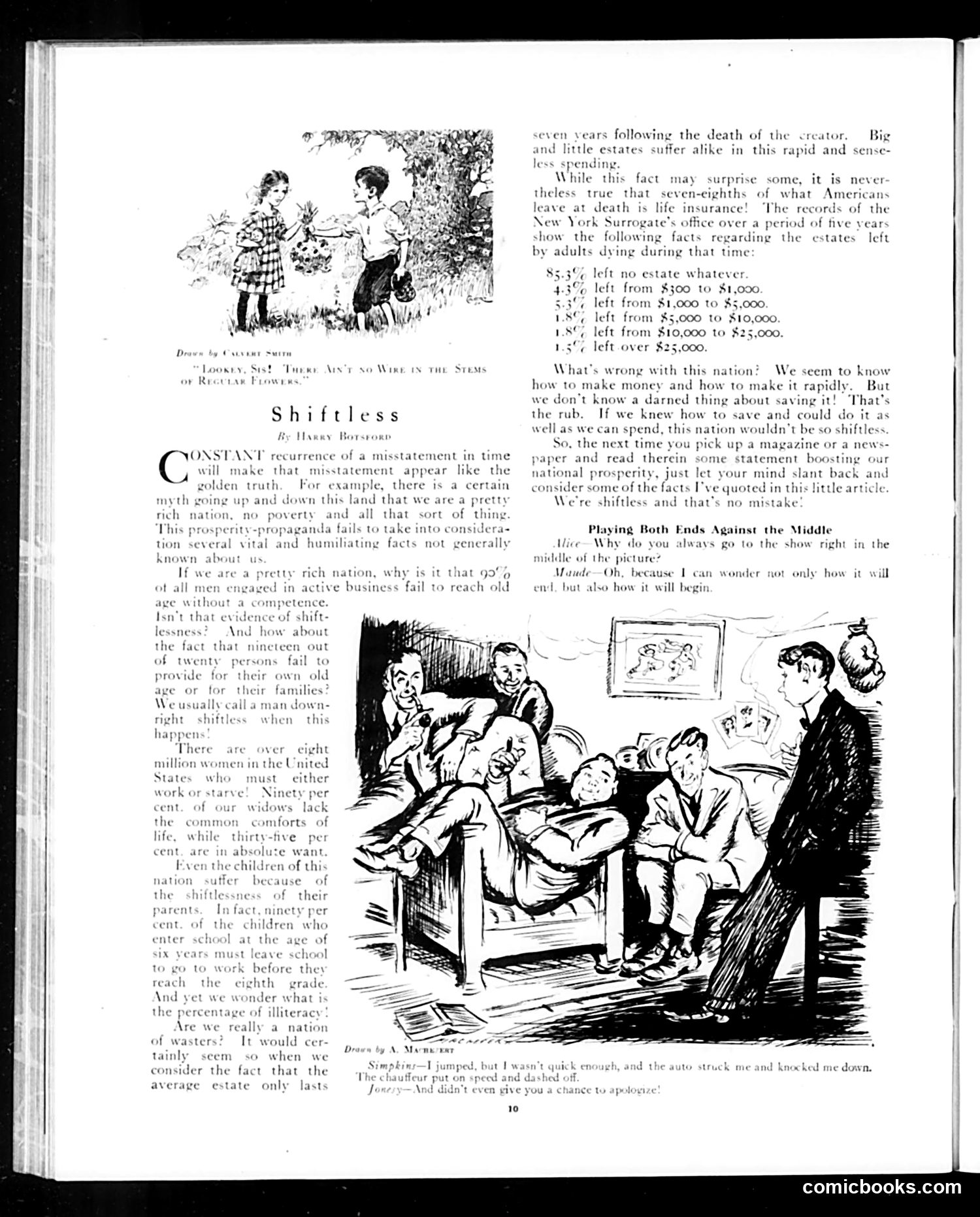
This page critiques American financial irresponsibility. The article presents statistics from New York's Surrogate office showing that most Americans die with minimal estates—85% leave under $1,000—despite supposedly earning well. The author argues Americans excel at *making* money but are utterly incompetent at *saving* it, calling the nation "shiftless" (lazy, irresponsible). The bottom cartoon titled "Playing Both Ends Against the Middle" depicts a domestic scene where a man and woman argue while children watch and a well-dressed observer stands nearby. The dialogue references a traffic accident: the husband hit-and-run a pedestrian without stopping, the wife didn't give him a chance to apologize. The joke sarcastically illustrates moral bankruptcy matching the financial theme—people prioritize speed and self-interest over responsibility in all life domains. The upper illustration shows two children by flowers, captioned about "Looks, Sis! There Ain't So Wire in the Stems of Regular Flowers"—likely a joke about artificial versus natural things, possibly extending the "fake/worthless" metaphor.
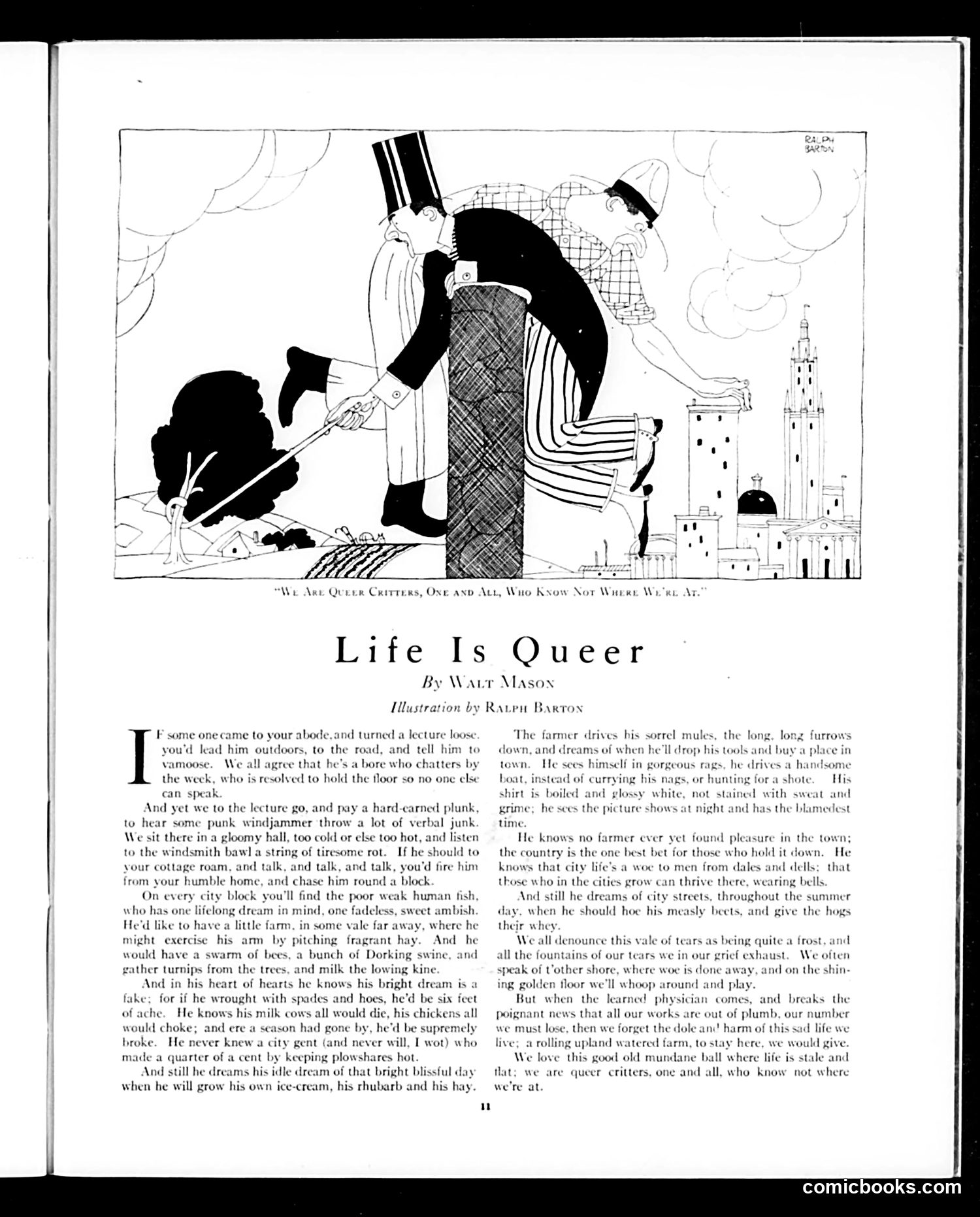
This piece satirizes human nature's fundamental contradictions and discontent. The cartoon illustrates Mason's theme: people consistently desire what they don't have while despising their actual circumstances. The satire contrasts two types: the **poor urban dreamer** who fantasizes about farming (imagining idyllic rural life with bees and crops) despite never successfully managing it, and the **farmer** who dreams of city life (fine clothes, entertainment, leisure) while working exhausting manual labor. Mason's broader point: humans are inherently dissatisfied creatures. We complain about earthly existence and dream of heaven, yet when facing mortality, we suddenly value this mundane world we've criticized. The title phrase—"queer critters, one and all, who know not where we're at"—encapsulates the irony: we're confused beings perpetually chasing impossible dreams while dismissing our actual lives. The illustration shows gentlemen in a city setting, emphasizing the urban fantasies discussed in the text.
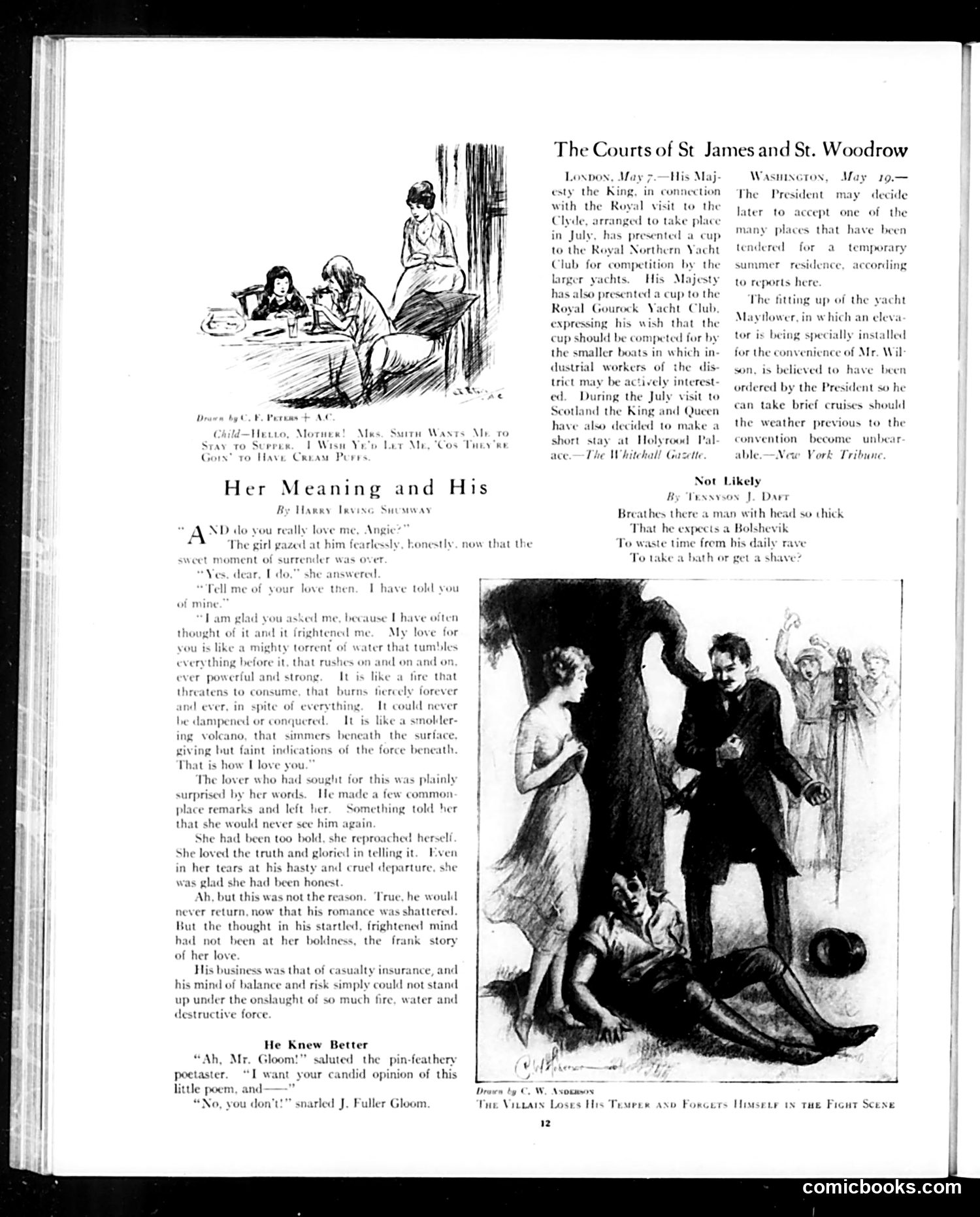
This page contains several distinct pieces of content: **Top section** ("The Courts of St James and St. Woodrow"): News briefs about British royal yacht clubs receiving cups from King George V and American President Wilson's summer residence plans, including a specially-installed elevator on the yacht *Mayflower*. This appears to be satirical social commentary on contemporary royal and presidential activities. **"Her Meaning and His"**: A short story by Harry Irving Shumway about a romantic exchange where a woman confesses passionate love, but the man—preoccupied with "casualty insurance" and risk calculation—cannot reciprocate emotionally, suggesting satire of emotionally-stunted businessmen. **"Not Likely"** (poem): A humorous verse mocking a thick-headed man who wastes time on personal grooming rather than productive work—likely anti-Bolshevik sentiment common to 1920s American satirical magazines. **Bottom illustration**: A dramatic scene labeled "The Villain Loses His Temper and Forgets Himself in the Fight Scene," depicting what appears to be a theatrical or melodramatic confrontation. The page mixes literary content with social and political satire typical of Judge magazine's format.
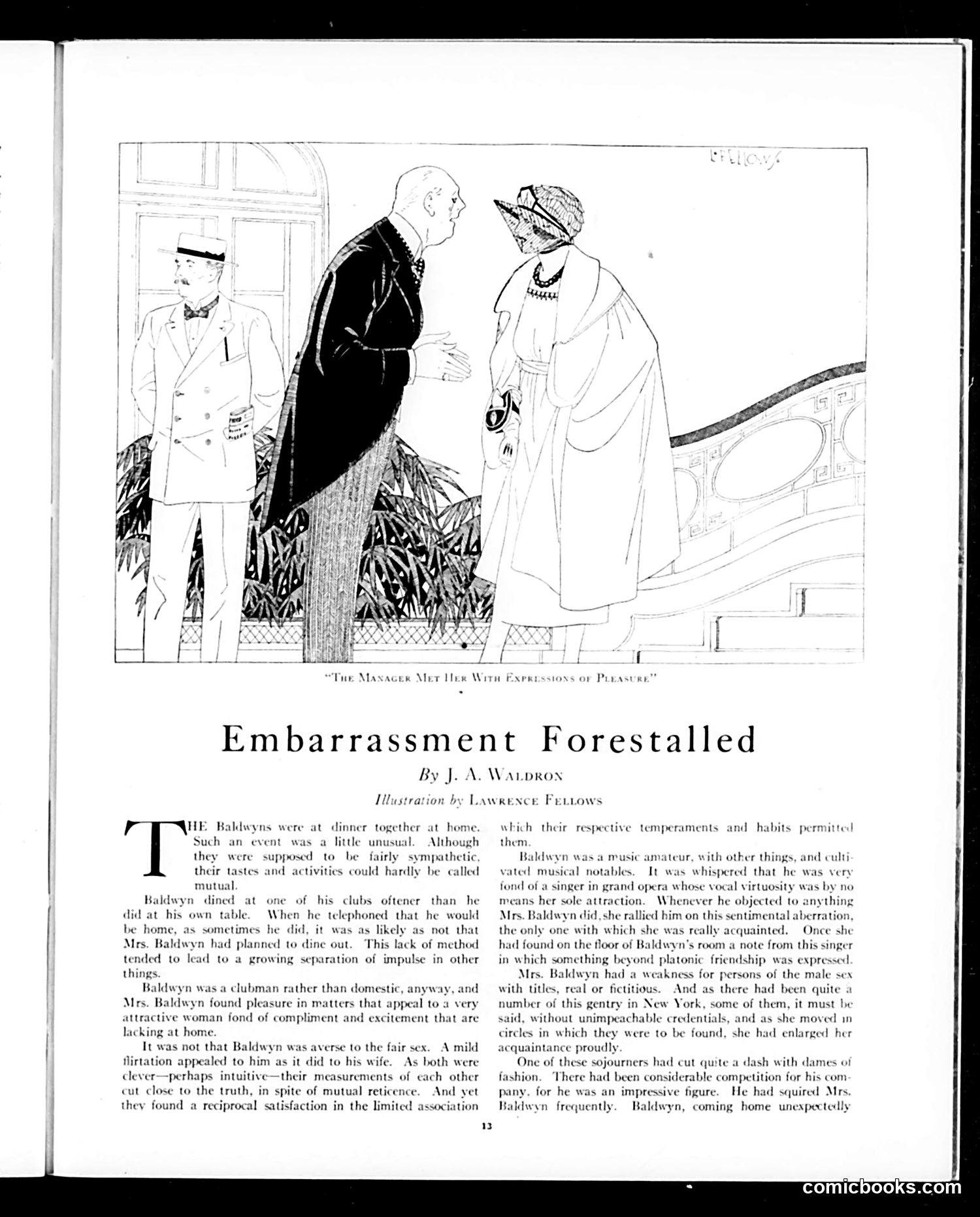
This is a short story illustration from *Judge* magazine titled "Embarrassment Forestalled" by J. A. Waldron. The cartoon depicts a social scene where a well-dressed manager or maitre d' (left) greets a bald gentleman (center) and an elegantly dressed woman (right), likely at a restaurant or hotel. The accompanying text reveals the satire: Mr. Baldwyn, a wealthy clubman, has been conducting a mild flirtation with an opera singer, while his wife Mrs. Baldwyn has been entertaining a titled European visitor. The "manager" meeting them with "expressions of pleasure" represents the awkward social moment being "forestalled"—averted through polite civility. The satire mocks upper-class marital discretion and the unspoken agreements wealthy couples maintained about extramarital interests, provided they maintained social appearances and didn't cause public embarrassment. The story suggests both parties tolerate each other's dalliances to preserve their social standing.
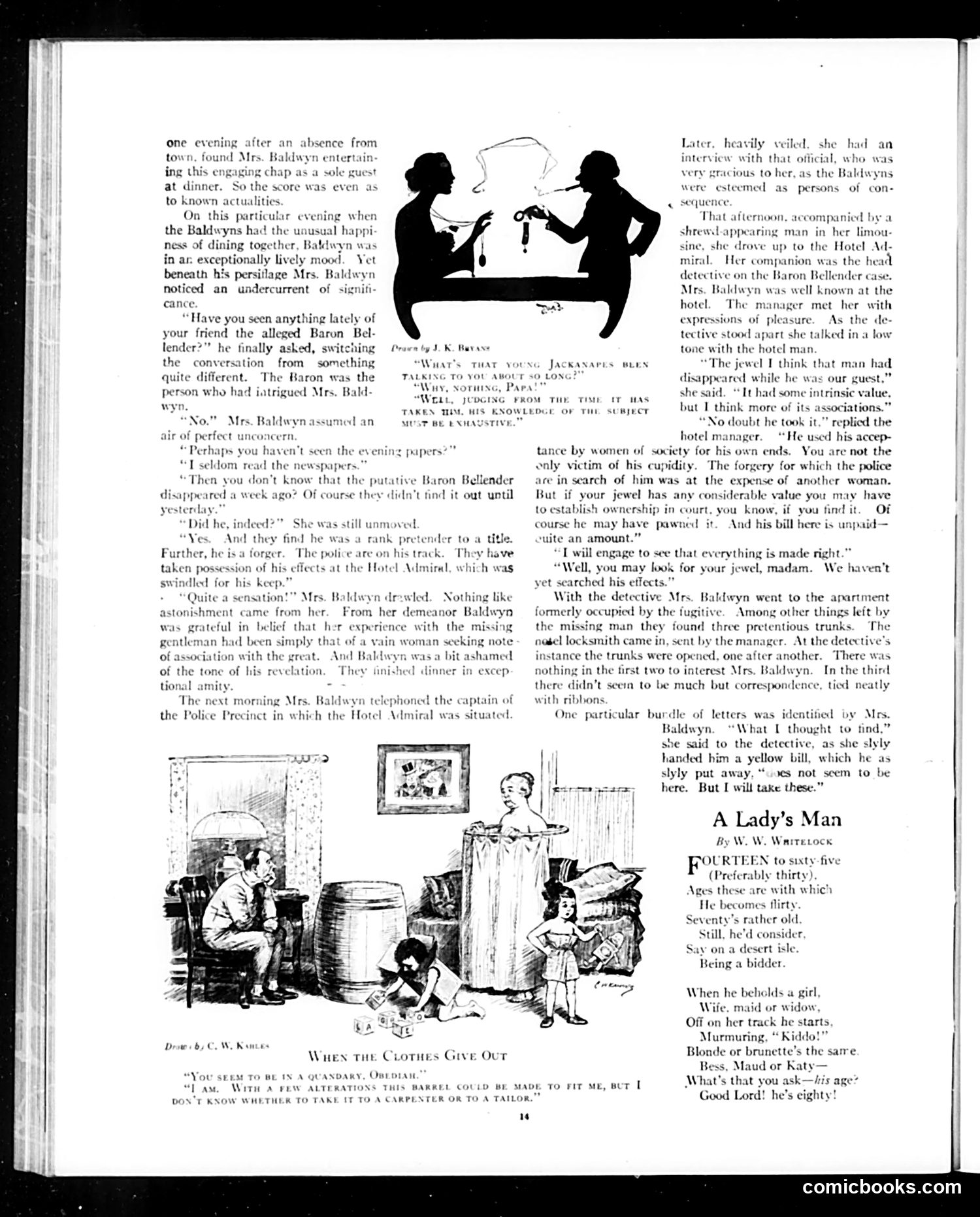
This page contains a multi-part story about Mrs. Baldwyn, a society woman whose acquaintance—a man claiming to be "Baron Bellender"—is exposed as a fraud and petty criminal. The satire targets **social climbing and gullibility among wealthy women**. The humor lies in Mrs. Baldwyn's shallow motivations: she was initially pleased to associate with the "Baron" for social prestige, but when he's revealed as a "rank pretender," she feigns indifference. However, she then pursues a missing jewel with a detective, discovering the man had defrauded multiple women. The accompanying cartoon "When the Clothes Give Out" (bottom) uses a barrel-clad beggar as visual commentary on poverty and social decline—likely satirizing economic class anxiety or unemployment. The piece reflects early 20th-century American attitudes: mockery of nouveau-riche social pretension, suspicion of titled foreigners, and portrayal of wealthy women as easily deceived by charm and false credentials.
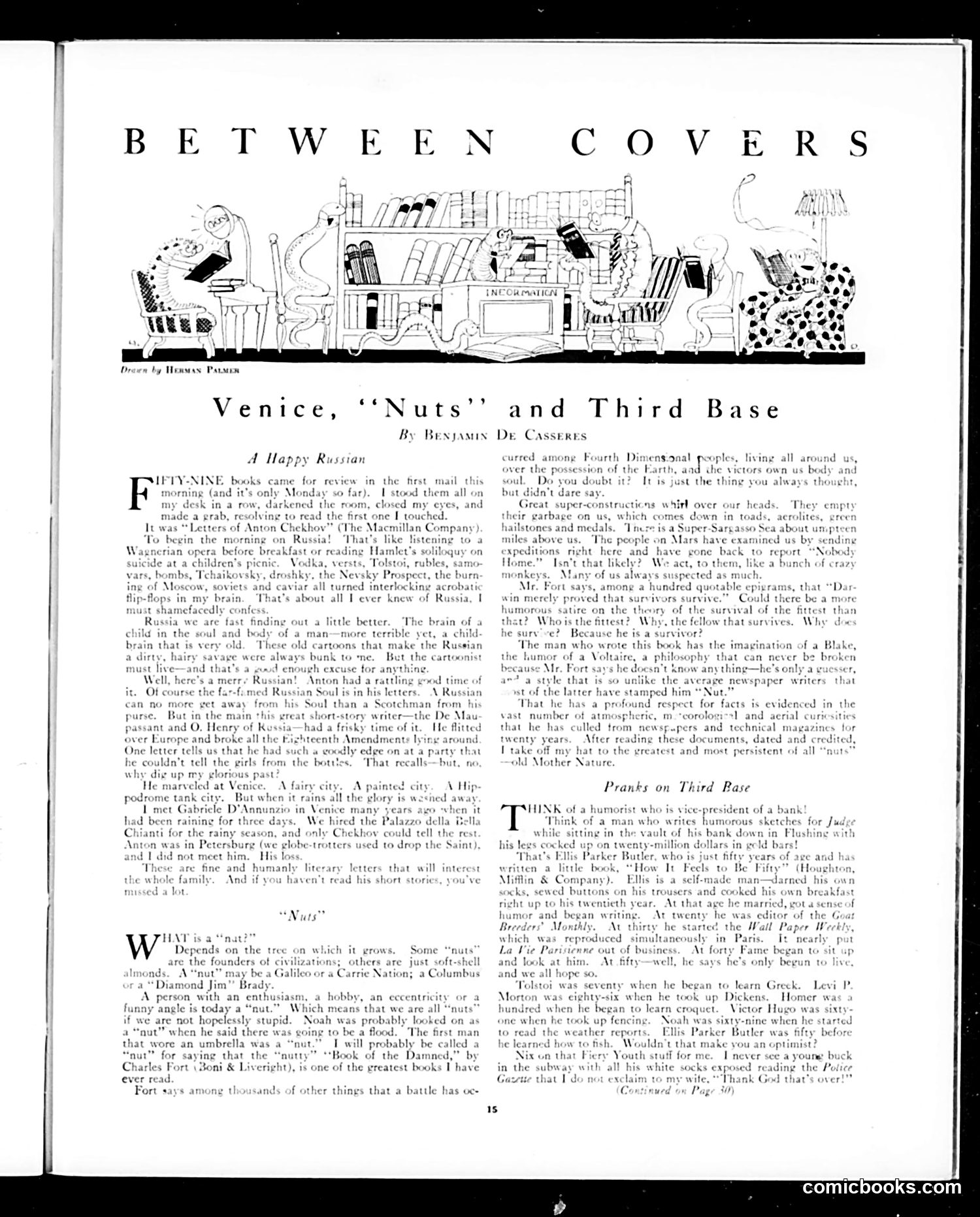
This page contains two literary essays rather than political cartoons. The header illustration by Herman Pommer shows a whimsical library scene, but the main content comprises book reviews. **"Venice, 'Nuts' and Third Base"** by Benjamin De Casseres discusses Russian literature and authors like Tolstoy and Chekhov, praising their imaginative depth and philosophical sophistication. The essay contrasts Russian literary tradition with contemporary American writing. **"Pranks on Third Base"** reviews humorous sketch collections, mentioning writers like Ellis Parker Butler and referencing *Judge* magazine itself as a source of comedy writing. The author argues these humorists deserve recognition alongside serious literary figures. The page reflects Judge's mid-century role: combining satirical illustration with literary criticism and cultural commentary. Rather than political satire, this issue emphasizes literary taste and intellectual humor as markers of sophistication for educated readers.
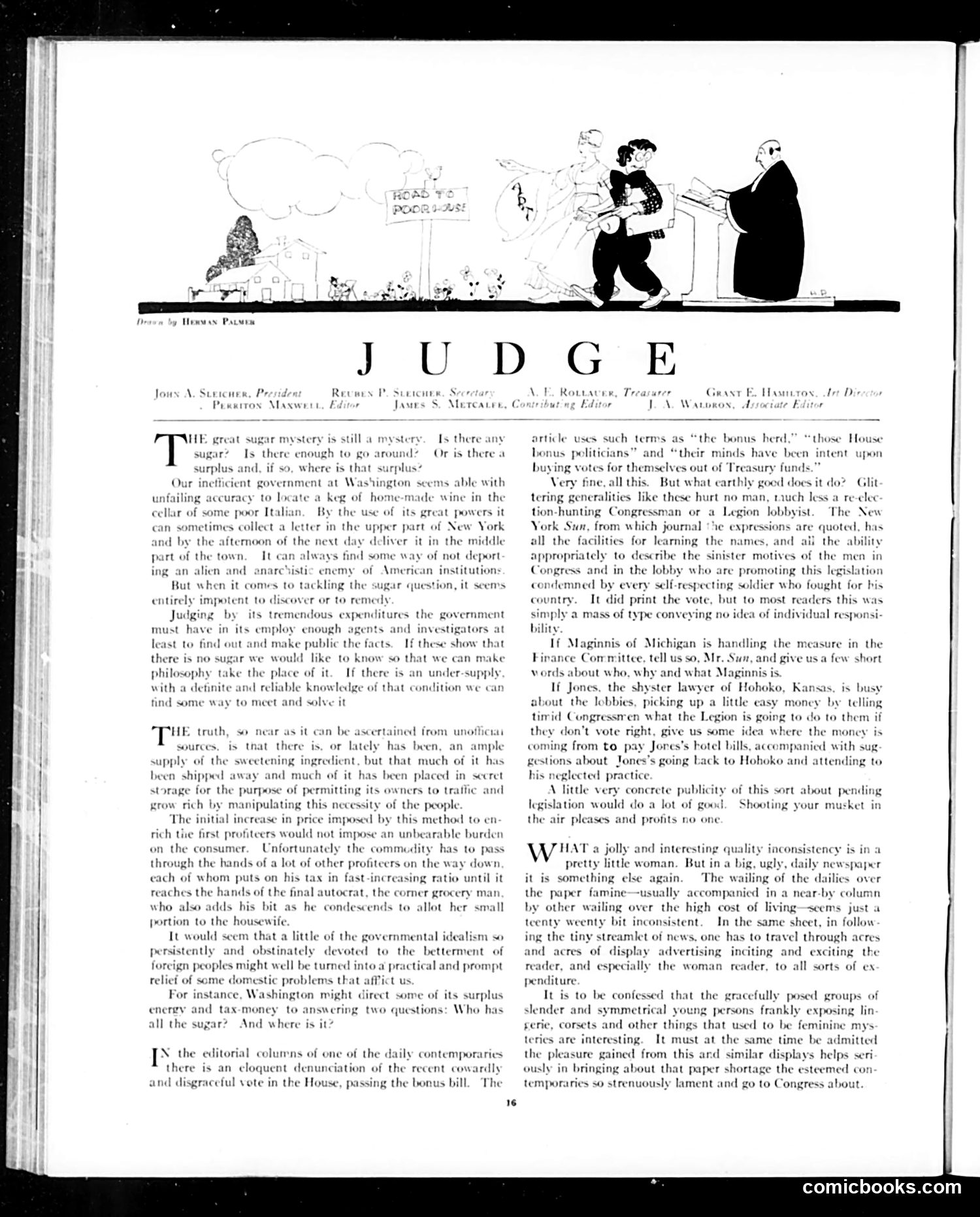
This page from *Judge* magazine contains two editorial pieces criticizing government inefficiency and Congressional cowardice. **The Sugar Editorial:** The author satirizes Washington's incompetence. While the government efficiently raids Italian homes for wine and delivers mail, it cannot locate America's sugar supply during an apparent shortage or hoarding crisis. The piece suggests profiteers are manipulating the market through artificial scarcity, creating a chain of middlemen who inflate prices. The editorial demands the government identify who controls the sugar and where it's stored—practical accountability rather than vague moralizing. **The Bonus Bill Critique:** The second piece attacks newspapers (specifically the *New York Sun*) for denouncing House members' "cowardly" vote on a veteran's bonus bill using empty language like "bonus herd" and "House bonus politicians." The author argues such generalities are useless without naming specific congressmen and lobbyists responsible—demanding concrete accountability instead of rhetorical posturing. Both pieces share a theme: *Judge* demands specific facts and named culprits rather than abstract criticism.
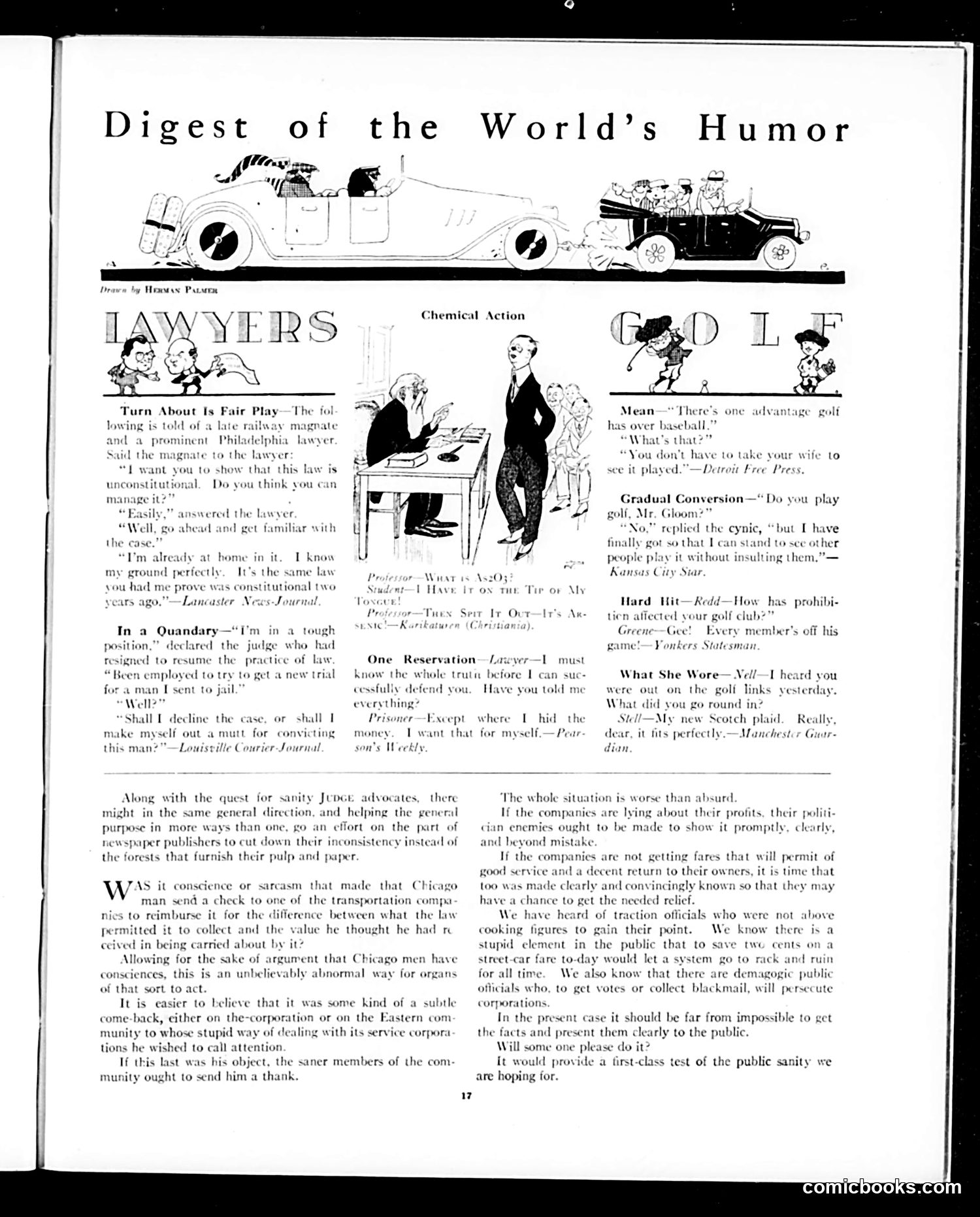
This page from *Judge* contains several brief humorous anecdotes satirizing lawyers and the legal system, plus short golf jokes, and a longer editorial commentary on corporate deception. The lawyer jokes mock legal sophistry: one depicts a railroad magnate hiring a lawyer to prove an existing law unconstitutional, only to learn the lawyer already uses that same law in his favor. Another shows a judge hiring a lawyer to convict someone, then reconsidering. The satire targets lawyers' willingness to argue any position for payment—their cynical opportunism. The editorial criticizes transportation companies (likely street-car monopolies) that lie about profits and service quality to evade regulation. It calls for transparent disclosure of facts to the public as a "test of public sanity." The golf jokes are light filler—typical period humor about the sport as tedious or marital-disrupting. The cartoons (drawn by Cesare Pissara) depict vehicles and social situations but lack sufficient context for precise identification of specific referenced figures or events.
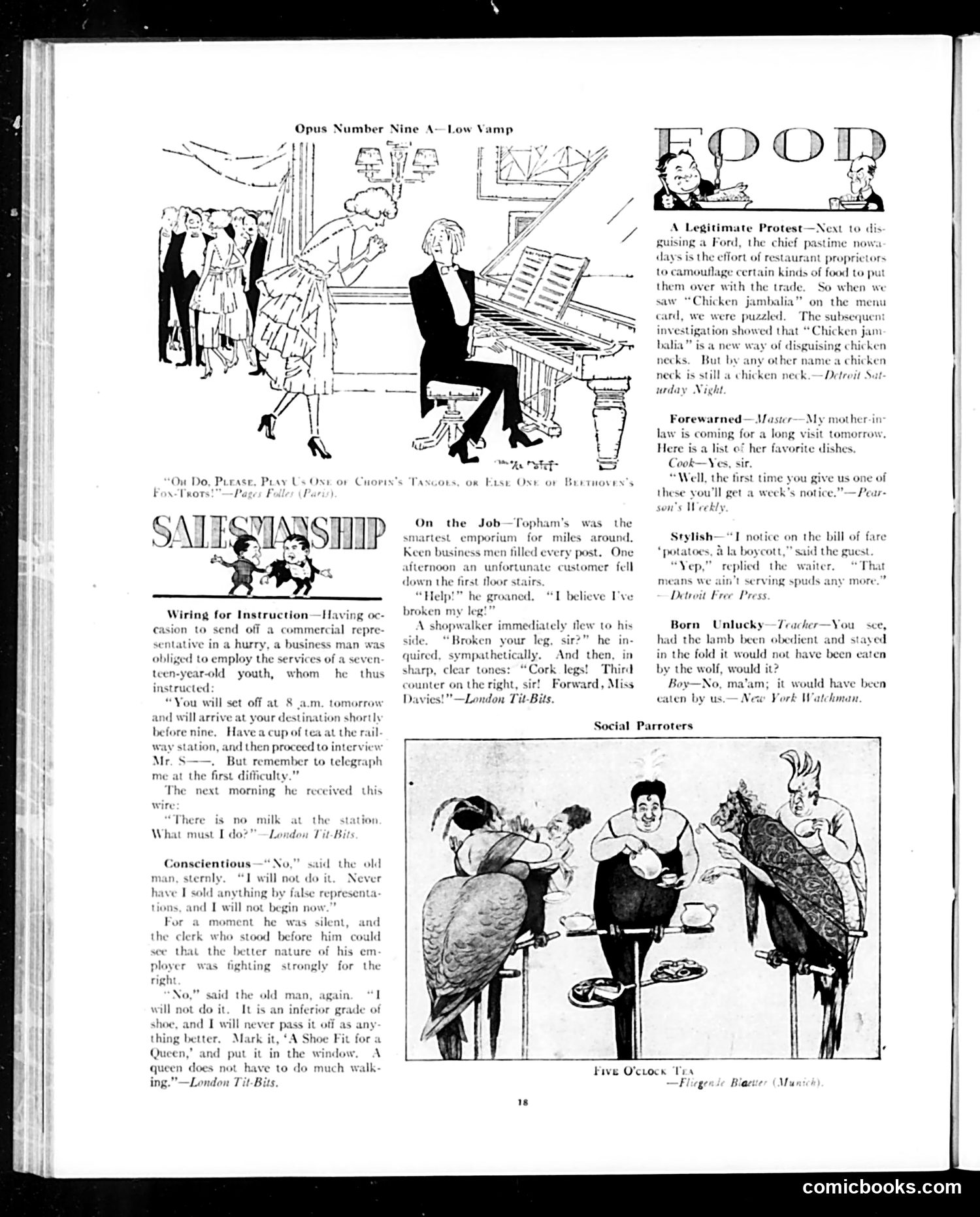
This page contains several short humor pieces satirizing early 20th-century social and business practices: **"Wiring for Instruction"** mocks overzealous salesmen and their employers' moral compromises. A business owner sends a young sales representative to pitch inferior shoes, then refuses to deceive customers—but only after internal conflict, suggesting this moral stance was *exceptional* rather than standard. **"On the Job"** satirizes callous retail efficiency. When a customer falls down stairs injured, the shopwalker immediately pivots to selling him cork legs—treating the accident as a sales opportunity rather than expressing concern. **"A Legitimate Protest"** jokes about restaurant deception: "Chicken jambalia" is exposed as disguised chicken necks, mocking restaurants' efforts to pass off cheap ingredients as upscale dishes. The remaining pieces (Forewarned, Stylish, Born Unlucky) are brief puns about mothers-in-law, menu descriptions, and lamb obedience. **Overall point:** These satirize commercial dishonesty, callous business practices, and restaurant fraud—common complaints about modern capitalism in the Jazz Age.
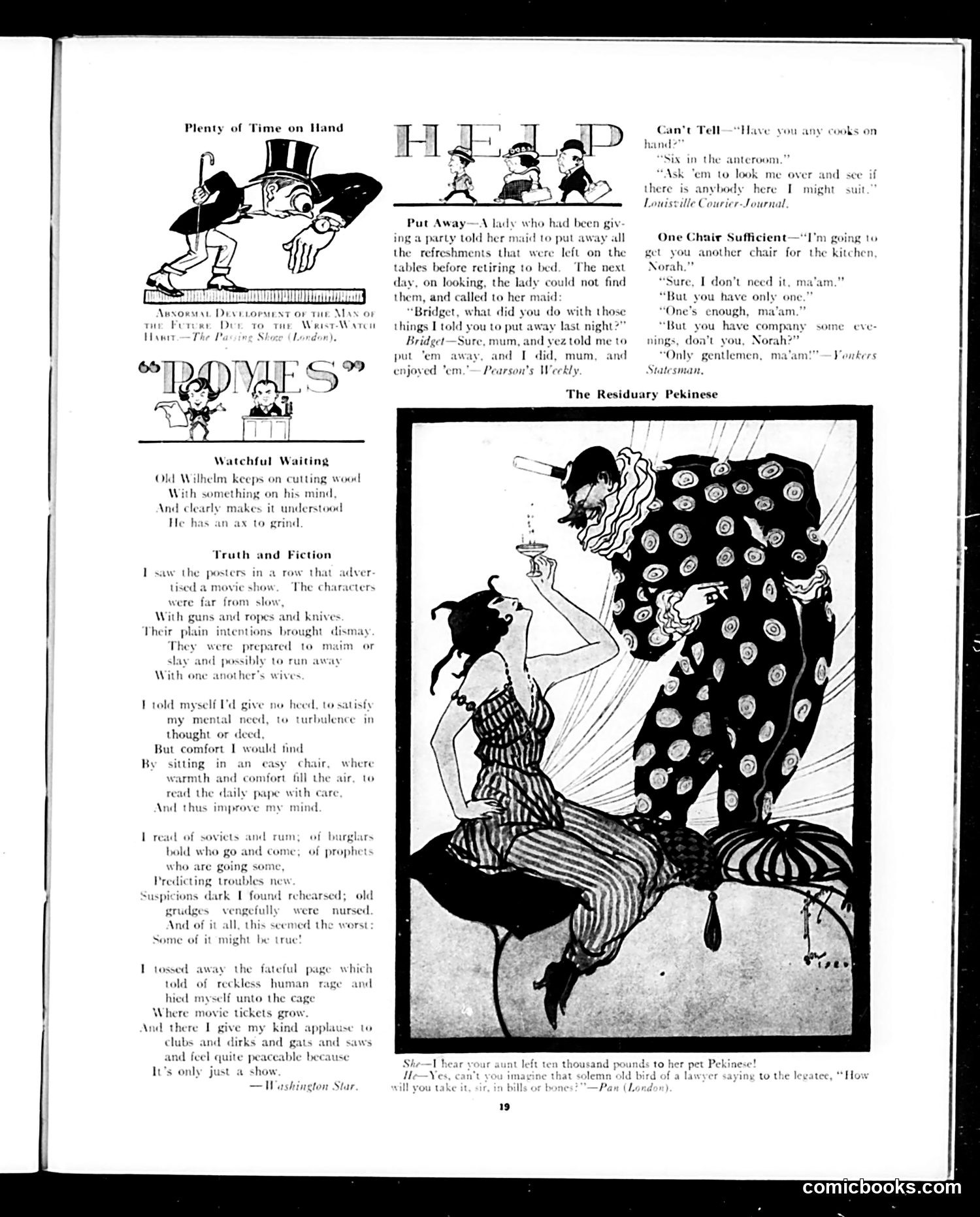
This page from Judge contains several satirical pieces mocking domestic life and contemporary attitudes: **"Watchful Waiting"** references Kaiser Wilhelm II ("Old Wilhelm"), depicting him cutting wood with "an ax to grind"—a political jab at German militarism during the pre-WWI era, suggesting hidden aggressive intentions beneath mundane activity. **"Truth and Fiction"** satirizes the hypocrisy of those who claim moral superiority while enjoying sensational entertainment. The poem mocks readers who reject violent movie posters as immoral yet eagerly consume them anyway—exposing the gap between stated values and actual behavior. **"The Residuary Pekinese"** cartoon jokes about class pretension, showing a wealthy woman's concerns that her Pekingese dog won't inherit properly if she entertains "gentlemen" (implying unmarried male visitors), suggesting anxieties about reputation and propriety among the upper classes. The smaller items ("Put Away," "Can't Tell," "One Chair Sufficient") are brief domestic humor anecdotes typical of Judge's format—poking fun at servants, children, and everyday absurdities of bourgeois life.
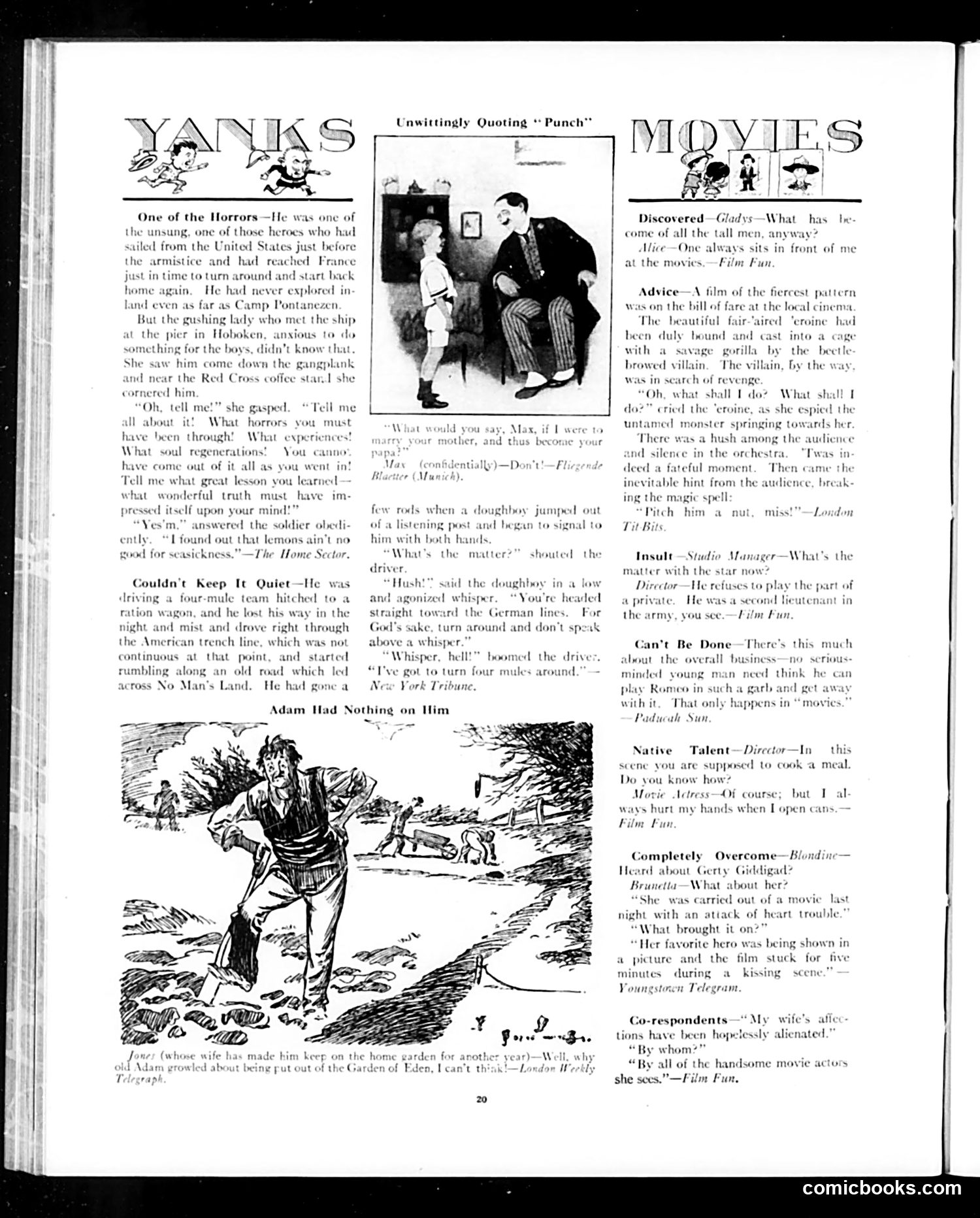
This page from *Judge* satirizes early cinema and its social impact circa 1918-1920. The content includes: **"Adam Had Nothing on Him"** (large cartoon): A disheveled soldier appears lost in no-man's-land during WWI, having driven a mule team through American trenches. The joke mocks poorly-trained soldiers sent to France near war's end who lacked basic military knowledge. **"Yanks Movies" section**: A series of short humorous anecdotes about how movies affect audiences. Key targets include: - Women emotionally overwhelmed by film romance scenes - Movie actresses' vanity and incompetence - The obsessive behavior movie stars inspire in female viewers - Studios casting untalented actors based on appearance The repeated "Film Fun" attributions suggest these are reprinted jokes from another publication. The satire reflects post-WWI anxiety about soldiers' competence and contemporary concerns about cinema's influence on (particularly female) audiences—a common anxiety in early 20th-century media criticism.
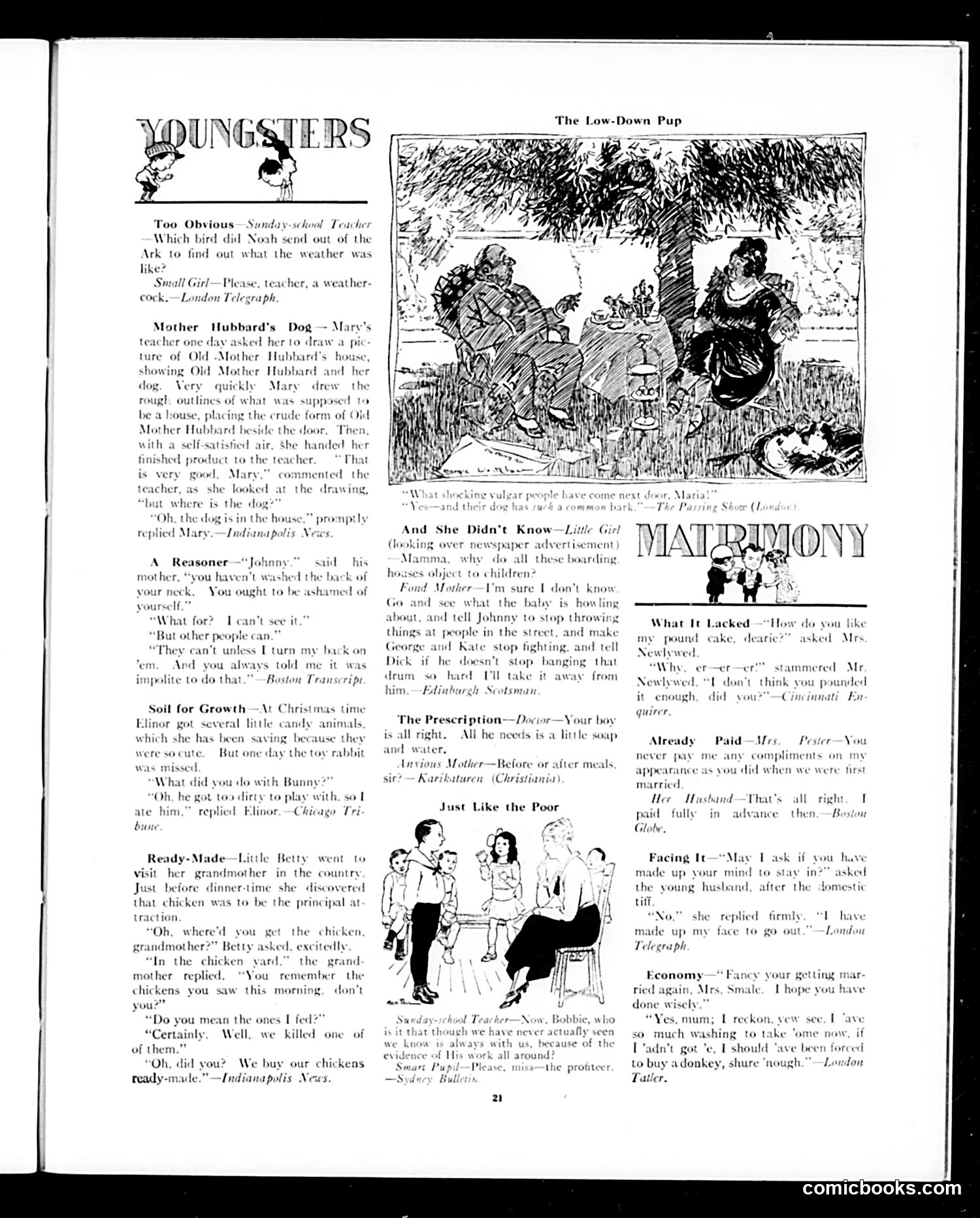
This is a humor page from *Judge* magazine featuring short jokes and comic scenarios targeted at early 20th-century middle-class audiences. The content is divided into two sections: **"Youngsters"** contains children-centered jokes exploiting innocent misunderstandings—a girl misplacing a toy rabbit, a child literally interpreting "Mother Hubbard's dog," a boy refusing to wash his neck. These play on children's literalism for adult amusement. **"Matrimony"** section mocks married life through brief domestic vignettes: a husband criticized for not complimenting his wife as he did before marriage, a wife considering leaving her husband, arguments about housework and expense. The humor is genteel and moralistic rather than edgy—jokes reinforce proper behavior, cleanliness, and marital duty. The *Lower-class* dialect humor in some pieces ("shure 'nough," working-class speech) was typical period entertainment. Overall, this reflects early 1900s sensibilities: child-focused sentimentality mixed with cynicism about marriage, class-marked humor, and conservative social values presented as comedy.
This page from *Judge* magazine showcases "Bad Breaks"—humorous newspaper clippings featuring unintentional errors or absurd statements. The format invites readers to spot logical impossibilities and contradictions in published news. Key examples include: - A man "killed MANY TIMES" on railroad tracks (impossible exaggeration) - A police officer "killed" described as "TEN MONTHS OLD" (absurd age) - Prohibition officers stopping a car with "120 GALLONS OF MOONSHINE" (during Prohibition enforcement) - References to WWI veterans and "Great War" celebrations (1920s context) The satire mocks careless newspaper writing—the absurdities result from poor editing or unclear phrasing rather than intentional jokes. By republishing these errors, *Judge* ridicules both the original papers and the culture of sensationalist reporting. This reflects 1920s-era humor about mass media's unreliability and the general skepticism toward journalism of that period.
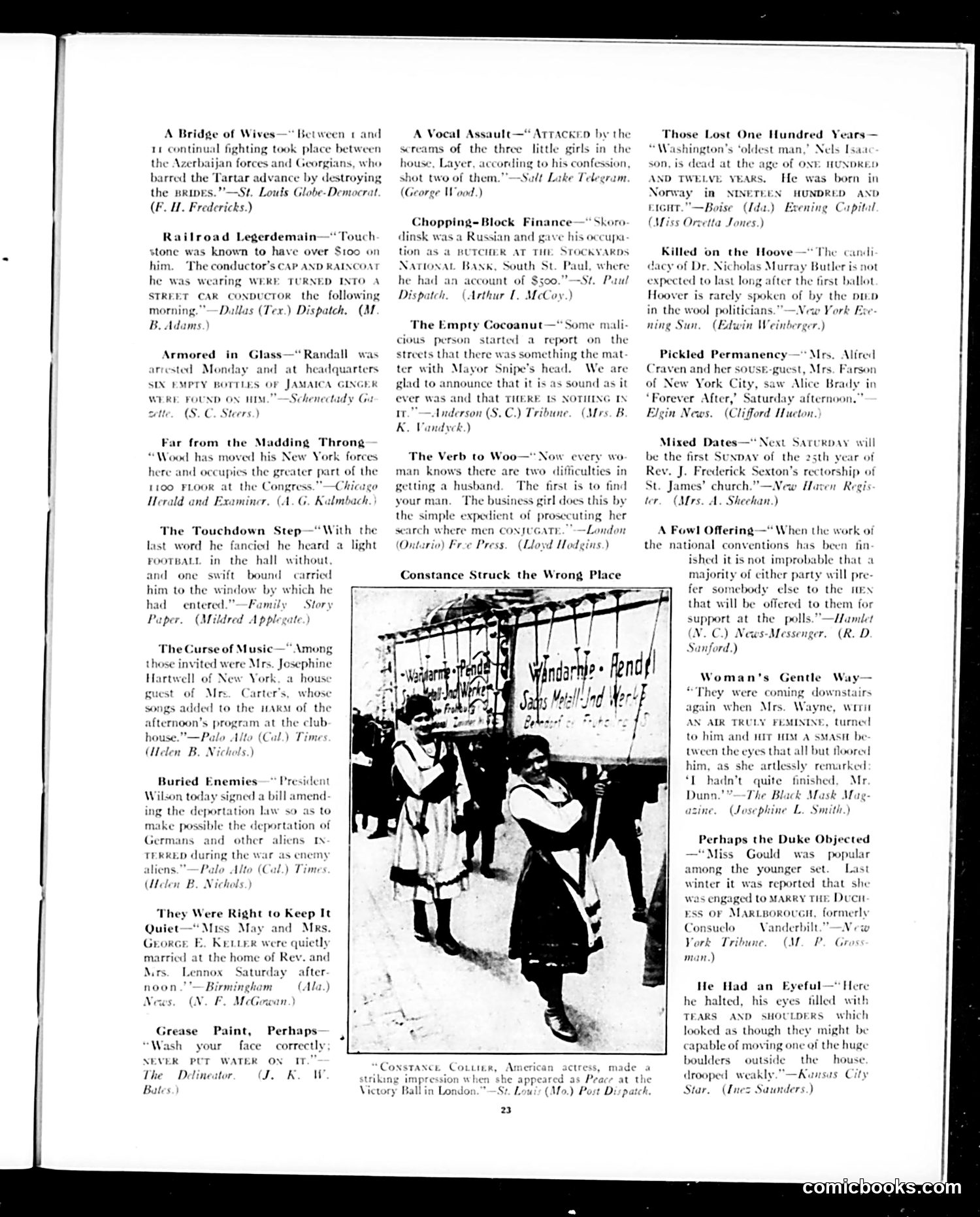
This page from Judge magazine presents a collection of brief satirical items mocking absurdities in contemporary news reports. The central cartoon depicts **Constance Collier**, an American actress, striking a dramatic pose during a "Victory Ball" in London—likely referencing post-WWI celebrations. The surrounding text items are humorous misreadings of newspaper headlines. Examples include: - A butcher applying for a bank account, satirizing Russian immigrants' unfamiliarity with American institutions - A man "armored in glass" (six bottles of Jamaica ginger, a medicinal alcohol), mocking Prohibition enforcement - "Washington's oldest man" allegedly born in 1900 yet being 112 years old—absurd math highlighting careless journalism - Mayor Snipe's head being "sound" despite rumors otherwise—deflating political pomposity The humor relies on readers catching logical impossibilities and contradictions buried in earnest news reporting, exposing editorial sloppiness and the gap between official claims and reality. This was typical Judge fare: punching at the foibles of newspapers, politicians, and public figures through exaggerated literal readings of their statements.
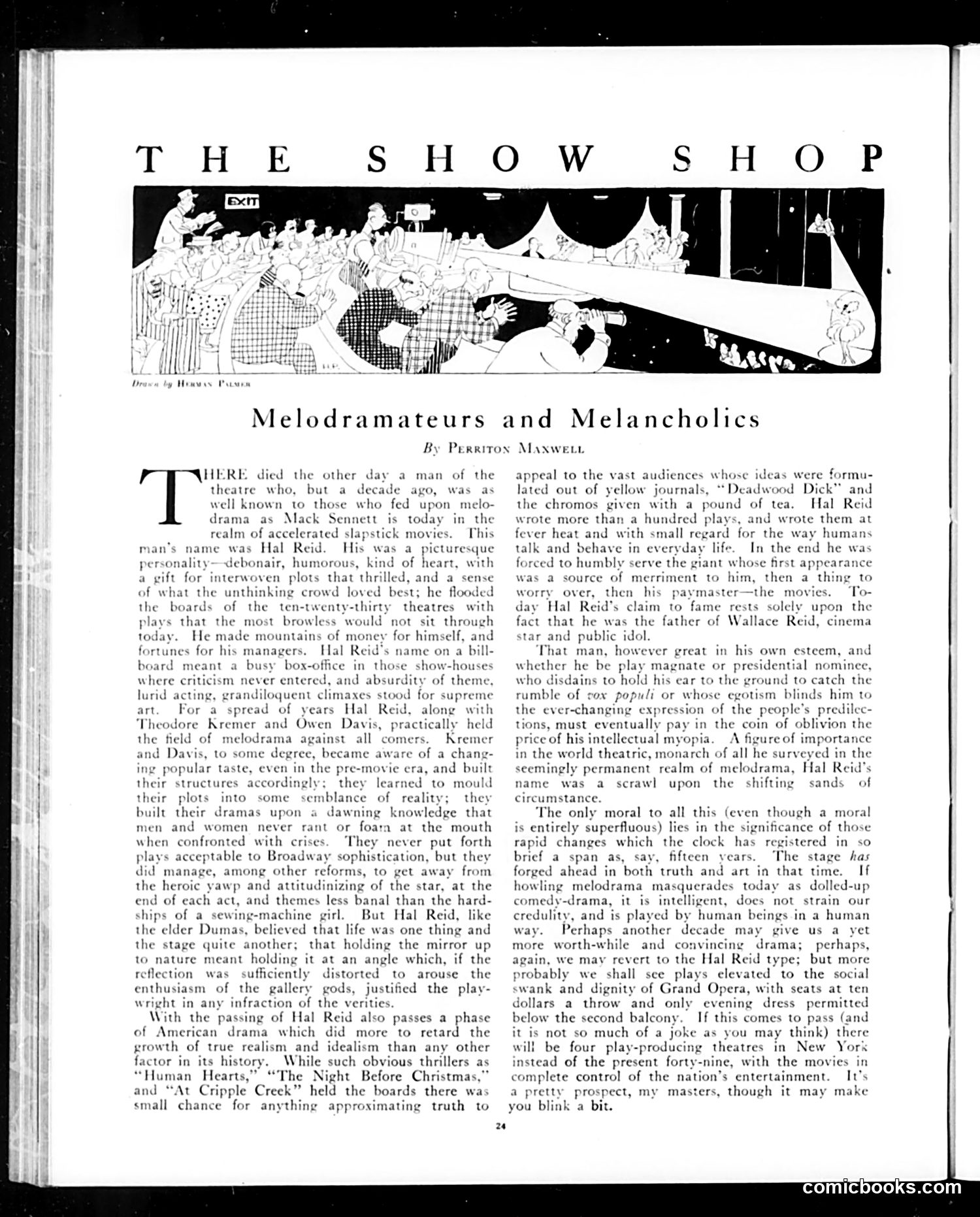
This article eulogizes **Hal Reid**, a now-deceased melodrama playwright who dominated American theater for decades. The satirical point: Reid represented an outdated theatrical tradition that *resisted* artistic progress. Reid wrote over 100 plays featuring exaggerated emotionalism, implausible plots, and overwrought acting—popular with unsophisticated audiences but artistically bankrupt. The text contrasts him with **Theodore Kremer and Owen Davis**, who adapted to changing tastes by introducing realism and psychological authenticity. The satire's sting: Reid's legacy now rests entirely on his son **Wallace Reid**, a successful cinema star. The "monarch of melodrama" is remembered not for his own work but as a footnote to his son's film career—a humbling fate for someone who once controlled American theater. The article mocks Reid's refusal to acknowledge shifts in public taste, suggesting his intellectual rigidity ("myopia") inevitably rendered him obsolete.
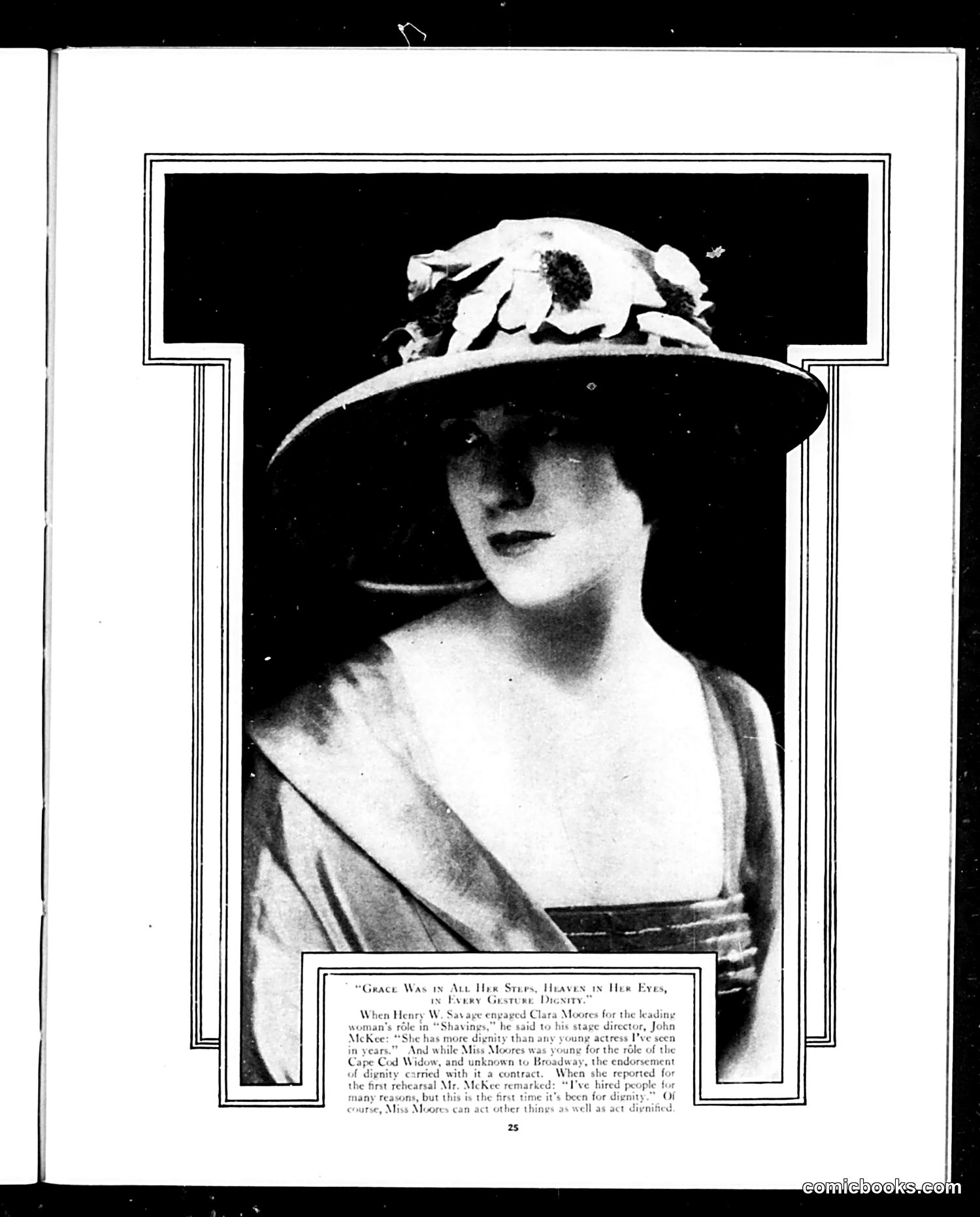
This page features a glamorous portrait photograph of a woman wearing an elaborate wide-brimmed hat with decorative elements, accompanied by text praising her dignity and composure. The caption quotes producer Henry W. Savage engaging actress Clara Moore for a leading role in a play called "Shavings," noting her exceptional dignity. The stage director John McKee reportedly hired performers "for many reasons, but this is the first time it's been for dignity." The satire appears to mock the theatrical pretension of the era—the irony being that Moore is being specifically *contracted* for dignity as a professional attribute, suggesting either that such qualities were unusual among actresses, or that the theater industry cynically packaged and commodified even intangible virtues like "grace" and "dignity" as marketable performance traits.
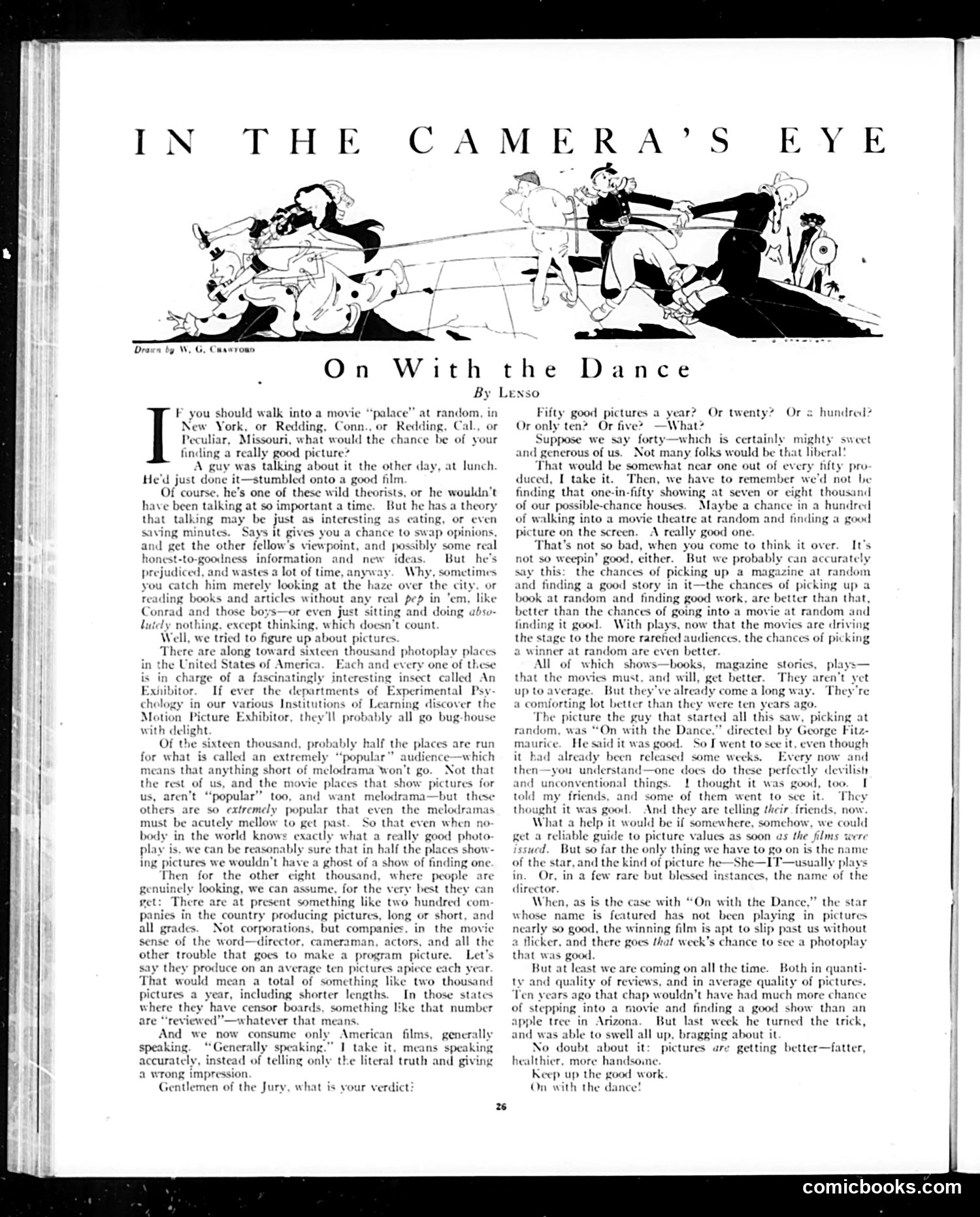
This page contains an essay by Lenso (not a cartoon) satirizing the American movie industry circa the 1920s. The author mocks the odds of randomly finding a "really good picture" at one of approximately 16,000 movie theaters across the United States. The satire targets: - **Movie "Exhibitors"** (theater owners), described as "fascinatingly interesting insect[s]" - The vast quality gap between "popular" melodrama-driven theaters and more discerning venues - The film production system: ~200 companies producing ~2,000 pictures annually, yet perhaps only 40 worth watching The author calculates that attending a random theater offers roughly a 1-in-100 chance of seeing a genuinely good film—a depressing prospect he presents with dry humor. The piece critiques both industrial quantity over quality and audiences' lowered expectations, using statistical mockery to expose the entertainment industry's fundamental mediocrity.
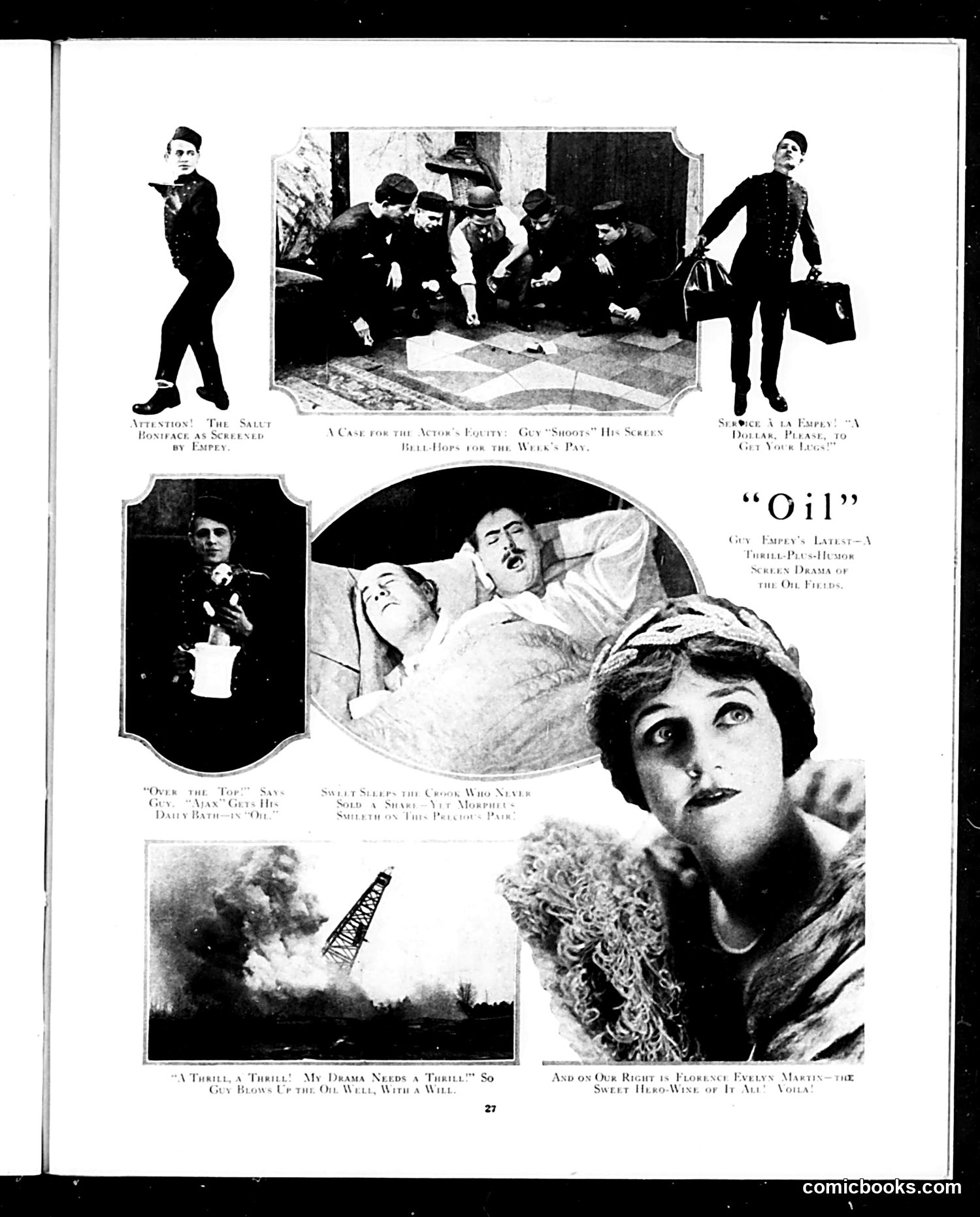
This page satirizes **Guy Empey**, a silent film actor/director of the era, through multiple comedic vignettes about his film "Oil," a drama about oil field workers. The captions mock Empey's acting ambitions and the film's melodramatic plot: - Top scenes show characters demanding payment or attention - Center images depict exaggerated oil-industry drama (sleeping crooks, oil derricks, explosions) - Right panel features Florence Evelyn Martin, described as the film's "sweet hero-wine" The satire targets **silent film conventions** of the period—overwrought emotional scenes, contrived plots, and the gap between actors' artistic pretensions and commercial entertainment. References to "salute," "crooks," and "thrill" suggest Judge is mocking both the melodramatic storytelling and Empey's self-importance as a filmmaker. The magazine uses this spread to ridicule Hollywood's emerging industry and its dramatic excesses, typical of Judge's satirical approach to popular culture.
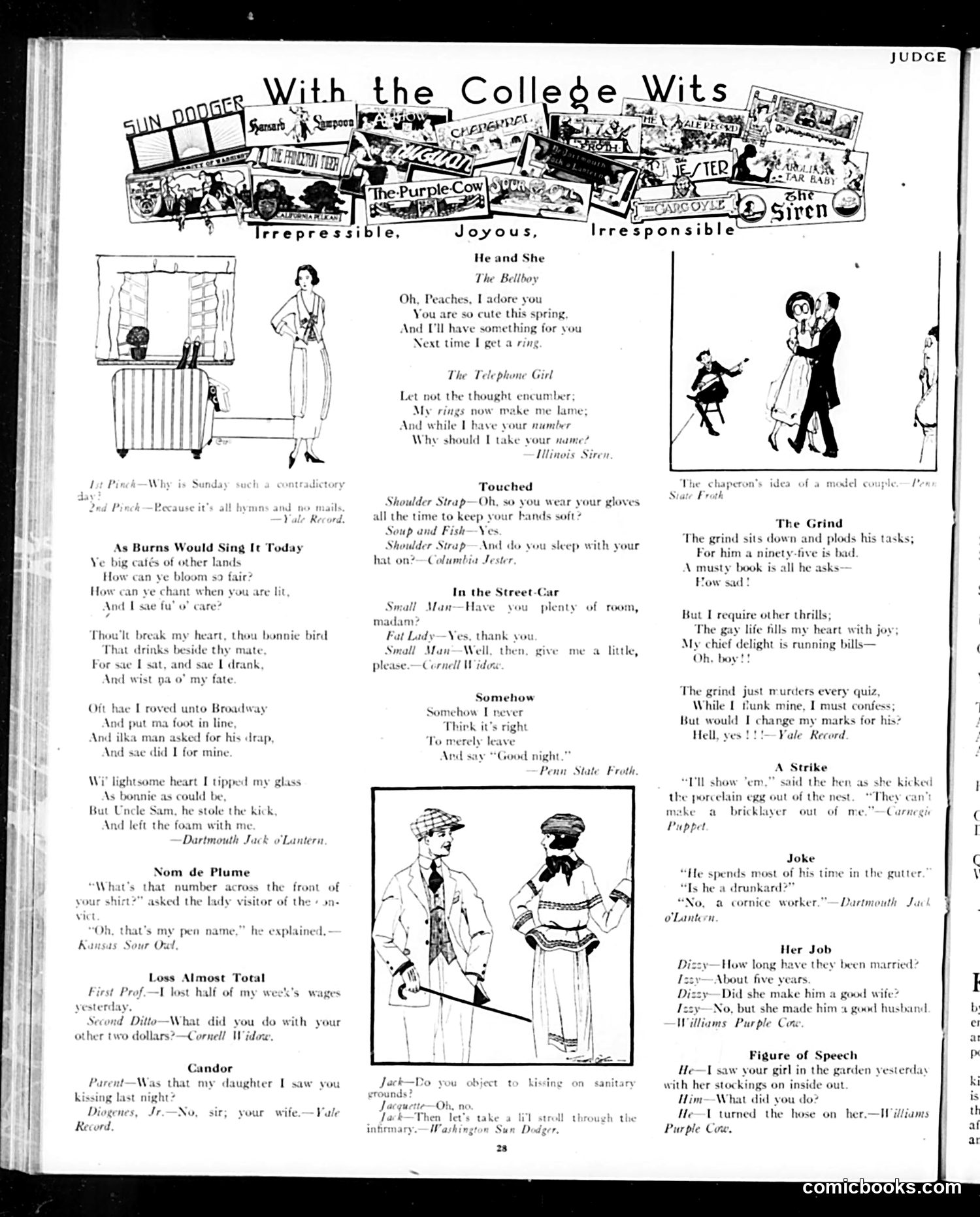
This page compiles humorous jokes and verses from various college publications (Penn State Froth, Cornell Widow, Yale Record, etc.). Rather than political satire, it's social satire targeting college life and courtship customs of the era. The humor focuses on: **romantic entanglements** ("The Bellboy" courts a woman with promises of a ring; "The Telephone Girl" complains her engagement rings made her hands sore); **gender dynamics** (the "Shoulder Strap" woman wears gloves to keep hands soft); and **student stereotypes** (the "Grind"—a diligent student who finds no joy except in "running bills"; the cornice worker making crude jokes). The satirical target is the affectations and anxieties of college-age youth navigating romance and social expectations. The cartoons and verses mock earnestness, vanity, and the gap between aspiration and reality in courtship and campus life.
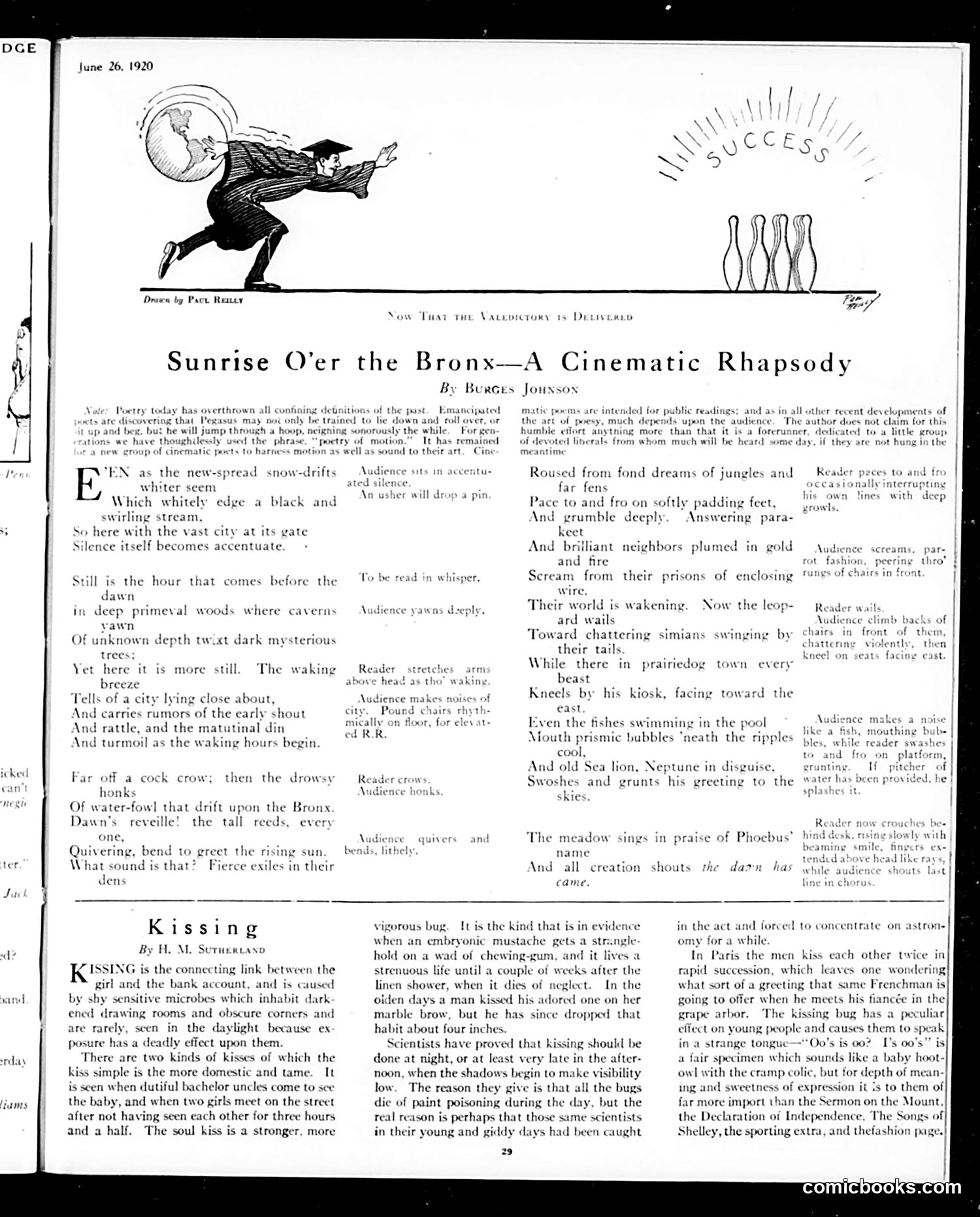
**The Cartoon:** The top illustration shows a man in business attire juggling a globe while walking a tightrope toward bowling pins labeled "SUCCESS." The caption reads "Now That the Valedictory is Delivered." This satirizes the gap between commencement speech rhetoric and real-world success—graduates are told to conquer the world, but actual achievement is precarious and difficult. **The Poetry & Articles:** The page features experimental literary content: "Sunrise O'er the Bronx" is mock-serious poetry treating a mundane industrial borough as grand subject matter (a satire of overwrought modernist poetry), while "Kissing" offers pseudo-scientific commentary on kissing customs, presented as earnest analysis of behavior. **The Satire:** Judge magazine here mocks both contemporary poetry pretensions and academic discourse. The juxtaposition—a rigged success fantasy with absurdist "serious" articles about ordinary life—ridicules how intellectuals and poets treated trivial subjects with unwarranted grandiosity, a common target of early 20th-century American humor magazines.
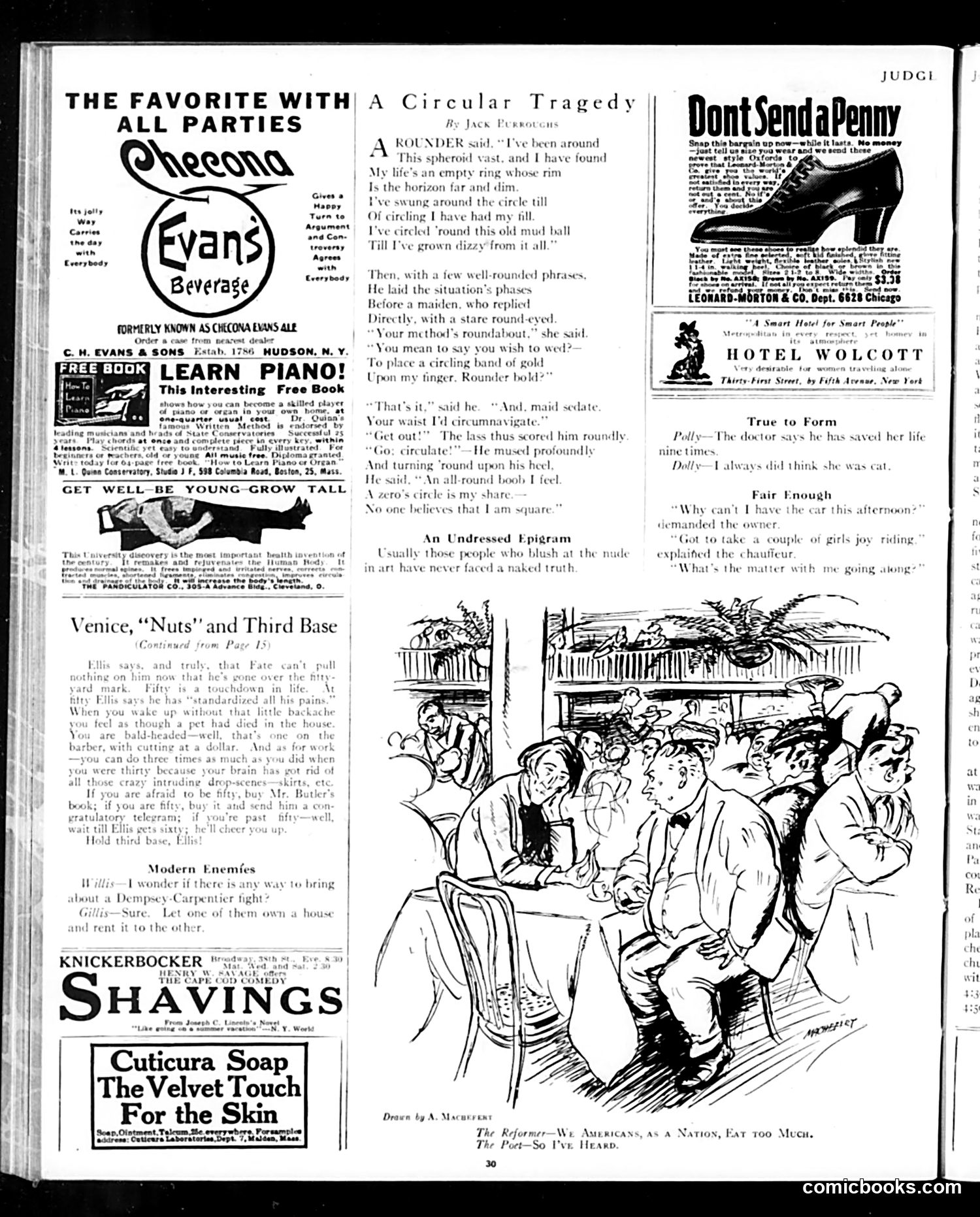
This page contains primarily **light satirical poetry and humor** rather than political cartoons. **"A Circular Tragedy"** is a humorous poem about a suitor whose romantic overtures are repeatedly rejected through wordplay involving circles and roundness. The "rounder" (a traveling man) describes circling the globe, then attempts to court a maiden using circular metaphors ("circumnavigate your waist"). She rejects him by telling him to "circulate" and "go round," punning on his circular language. The joke is wordplay-based rather than political. **The other short pieces** ("True to Form," "Fair Enough," "Modern Enemies," "An Undressed Epigram") are brief humor items typical of Judge magazine's miscellaneous comic filler—domestic humor and social observations without specific political targets. The page is largely **advertisements** (Cheona Evans beverages, piano lessons, patent medicines, Cuticura soap) interspersed with light humor content. The large cartoon illustration shows a crowded scene but lacks clear satirical intent in this context.
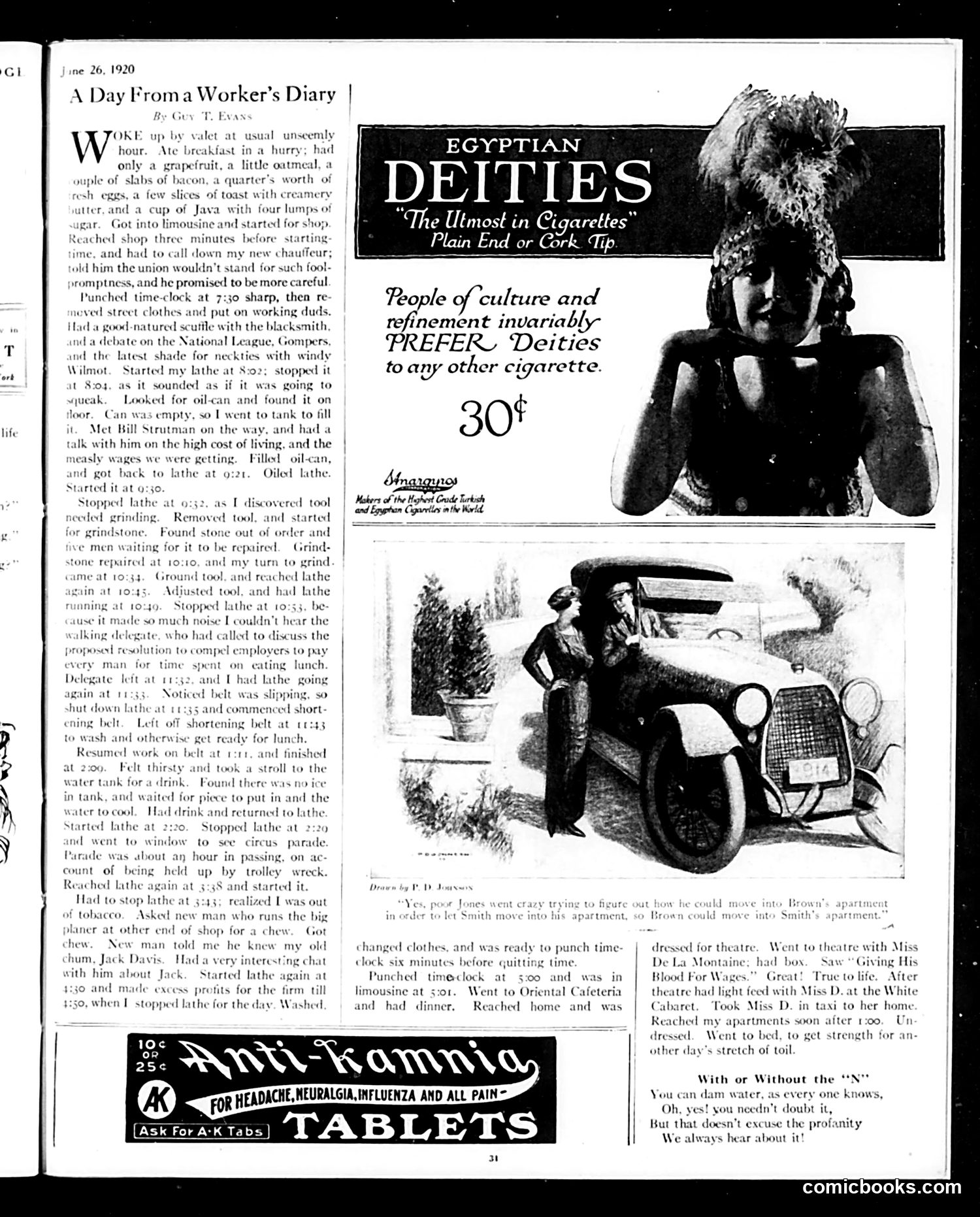
This satirical piece mocks labor union rhetoric and worker complaints of the era. The "diary" presents a factory worker who paradoxically lives a privileged lifestyle—arriving by limousine, employing a valet, attending theaters with dates—while simultaneously complaining about "high cost of living" and "measly wages" to coworkers. The joke targets union activists and labor organizers (referenced by the "talking delegate" discussing worker protections). The satire suggests that workers claiming poverty are actually living comfortably, and that union demands for fair pay and workplace conditions are hypocritical or exaggerated. The worker stops his lathe repeatedly for non-work reasons while framing minor inconveniences as hardships worthy of union action. This reflects post-WWI American anxiety about labor movements and the legitimacy of worker grievances during a period of significant labor unrest.
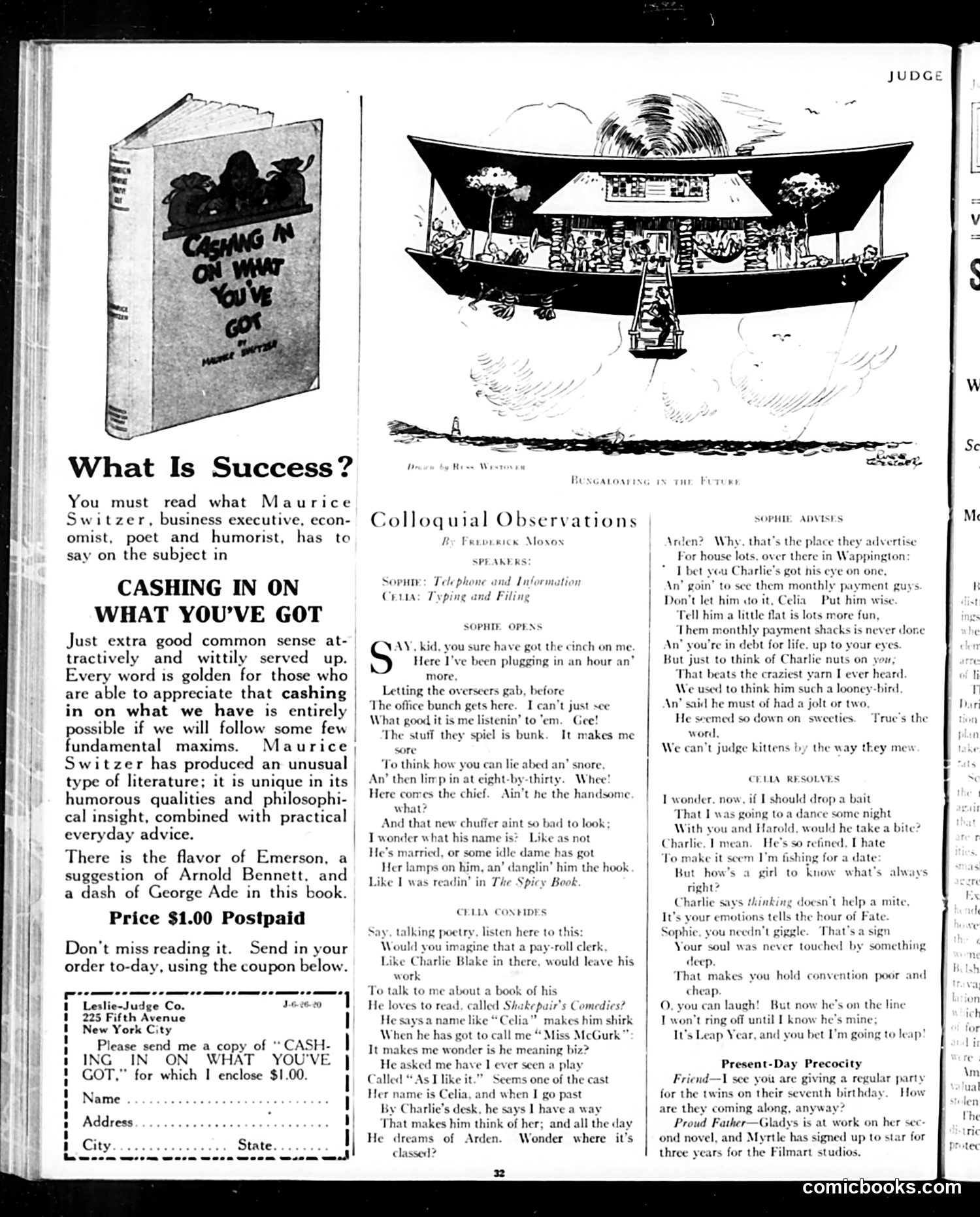
This page is primarily **advertisement and serialized fiction**, not political satire. The main content features "Cashing In On What You've Got," a self-help book by Maurice Switzer, marketed with comparisons to Emerson and George Ade—appealing to early 20th-century readers seeking practical wisdom with literary merit. Below is "Colloquial Observations," a multi-panel romantic comedy featuring office workers Sophie, Celia, and Charlie Blake. The humor derives from contemporary workplace dynamics: young women (typists and filing clerks) gossiping about romance, Charlie's literary pretensions (he references Shakespeare to impress Celia), and the scheming of Leap Year traditions (when women could propose to men). The dialogue captures period slang ("cinch," "spiel," "bunk"). The satire is gentle and social rather than political—mocking office romance clichés and the aspirations of working-class young people of the era.
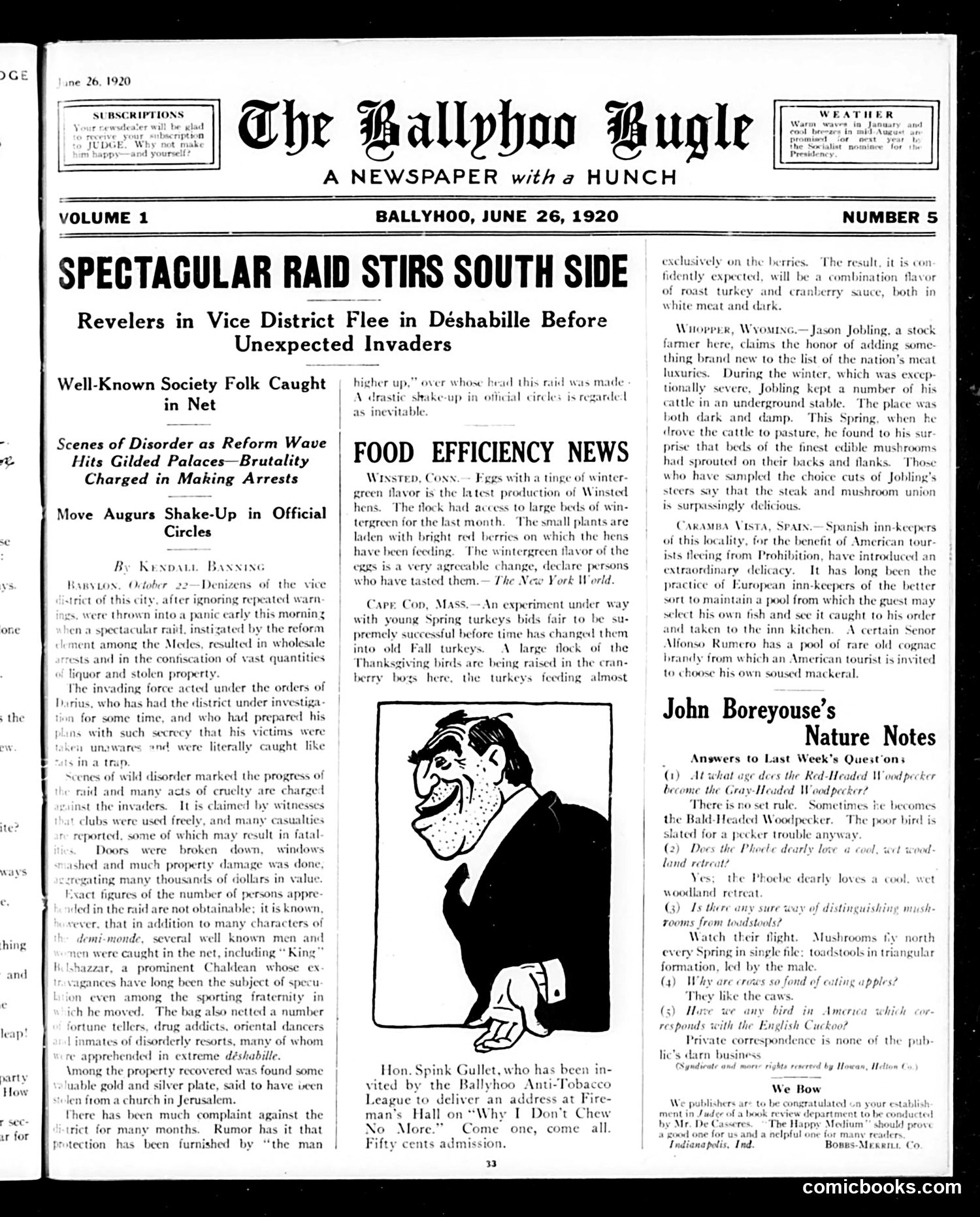
This is a satirical newspaper parody (not a real publication) lampooning Prohibition-era raid reporting and sensationalist journalism. **Main Cartoon/Content:** The large illustration depicts a caricatured figure—likely representing a stereotypical bootlegger or "speakeasy owner"—caught in a police raid. The accompanying headline "SPECTACULAR RAID STIRS SOUTH SIDE" mocks breathless newspaper coverage of Prohibition enforcement. **Social Context:** The Prohibition era (1920-1933) generated intense police raids on illegal drinking establishments ("vice districts"). Newspapers sensationalized these raids, often naming prominent society figures caught in the sweeps—a humiliating practice. **The Satire:** By naming invented characters like "King Klshazzar" and mixing absurdist details (stolen church plate from Jerusalem), the piece ridicules both: - Overwrought crime reporting's focus on moral panic - Society's hypocrisy regarding vice and reform The byline "By Kendall Banning" anchors the parody in journalistic convention, deepening the mockery.
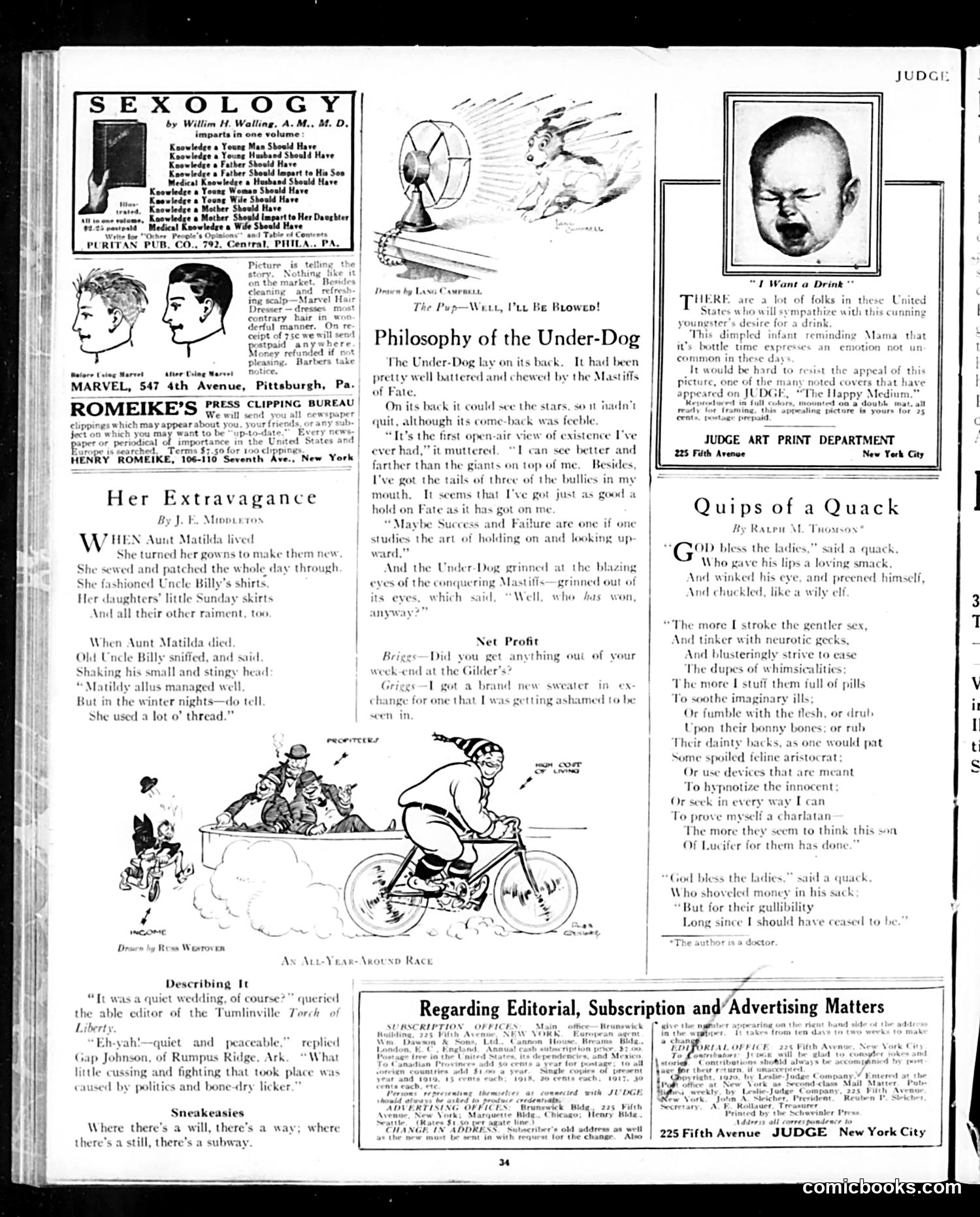
This Judge magazine page (circa 1910s-1920s) contains several satirical pieces: **"Philosophy of the Under-Dog"** is an anthropomorphic fable where a beaten dog, lying on its back, rationalizes its defeat by claiming the position gives it a better "view of existence" and equal footing with Fate. It's satire on how the powerless rationalize hardship. **"Her Extravagance"** is a brief poem about frugal Aunt Matilda who carefully managed household expenses—the punchline being Uncle Billy's only complaint was her using too much thread mending clothes. It mocks miserly attitudes toward women's thrift. **"Quips of a Quack"** exposes fraudulent doctors who exploit (particularly female) patients with fake remedies and psychological manipulation, boasting how gullibility keeps them wealthy. This reflects Progressive-era concerns about medical fraud. The cartoon **"As All-Year-Round Race"** appears to satirize some form of constant struggle or competition, though details are unclear from the image quality. These pieces exemplify Judge's satirical approach: deflating pretension, exposing fraud, and mocking social hypocrisy.
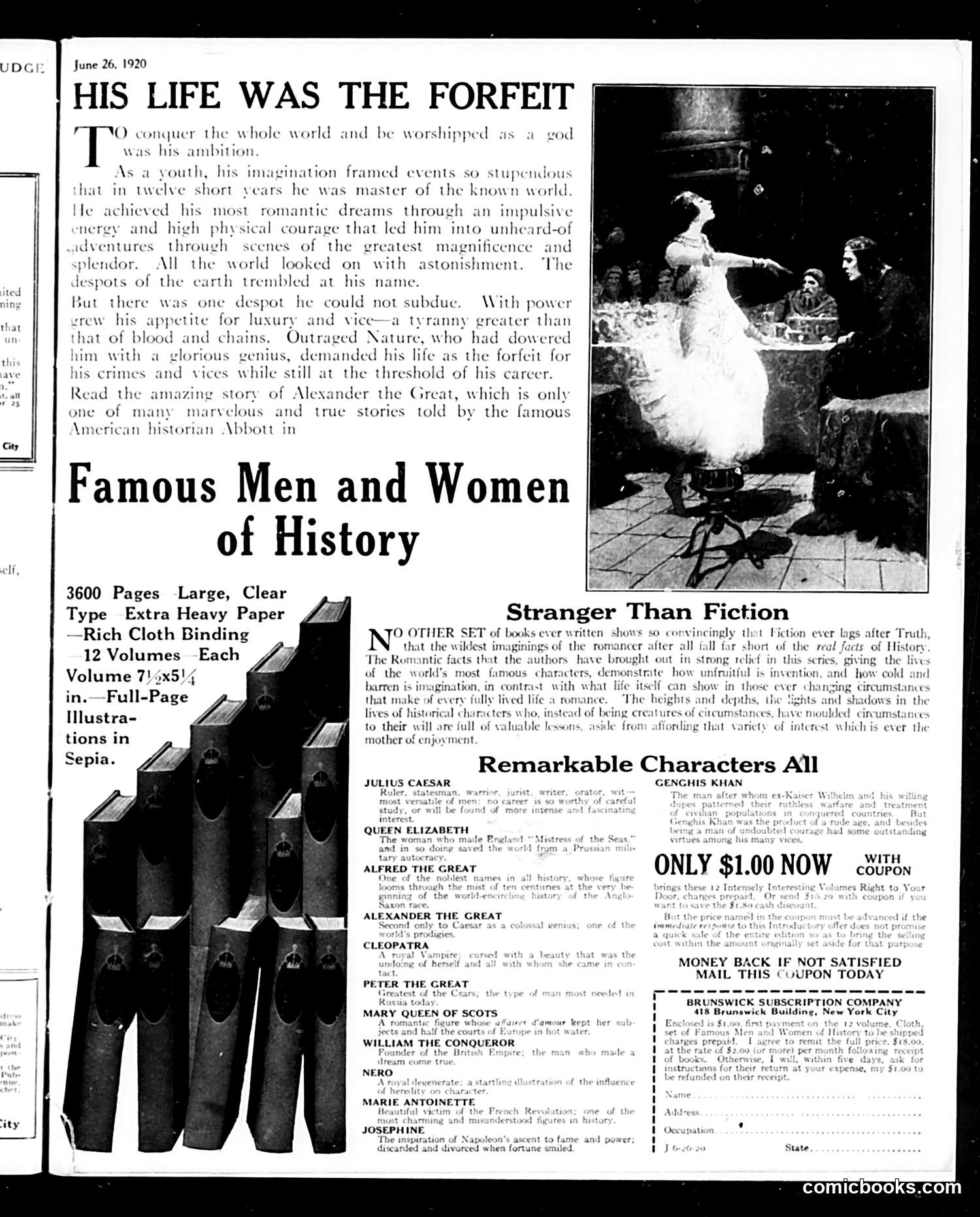
This page is primarily **advertising**, not satire or political commentary. It promotes a 12-volume encyclopedic series called "Famous Men and Women of History" by American historian Abbott, priced at $1.00 with a money-back guarantee. The opening text describes **Alexander the Great**—his world conquest, ambition, and eventual downfall through vice and luxury. This serves as the book series' hook: historical figures whose "true stories" supposedly surpass fiction in drama. The page lists famous historical figures covered (Julius Caesar, Cleopatra, Genghis Khan, etc.) and includes a photograph of what appears to be a theatrical or operatic scene, reinforcing the idea that real history is as dramatic as entertainment. The satire is subtle: the *implication* that readers crave sensational biography—that "stranger than fiction" history sells better than actual education. But primarily, this is a **direct-mail advertisement** designed to convert readers into subscribers.
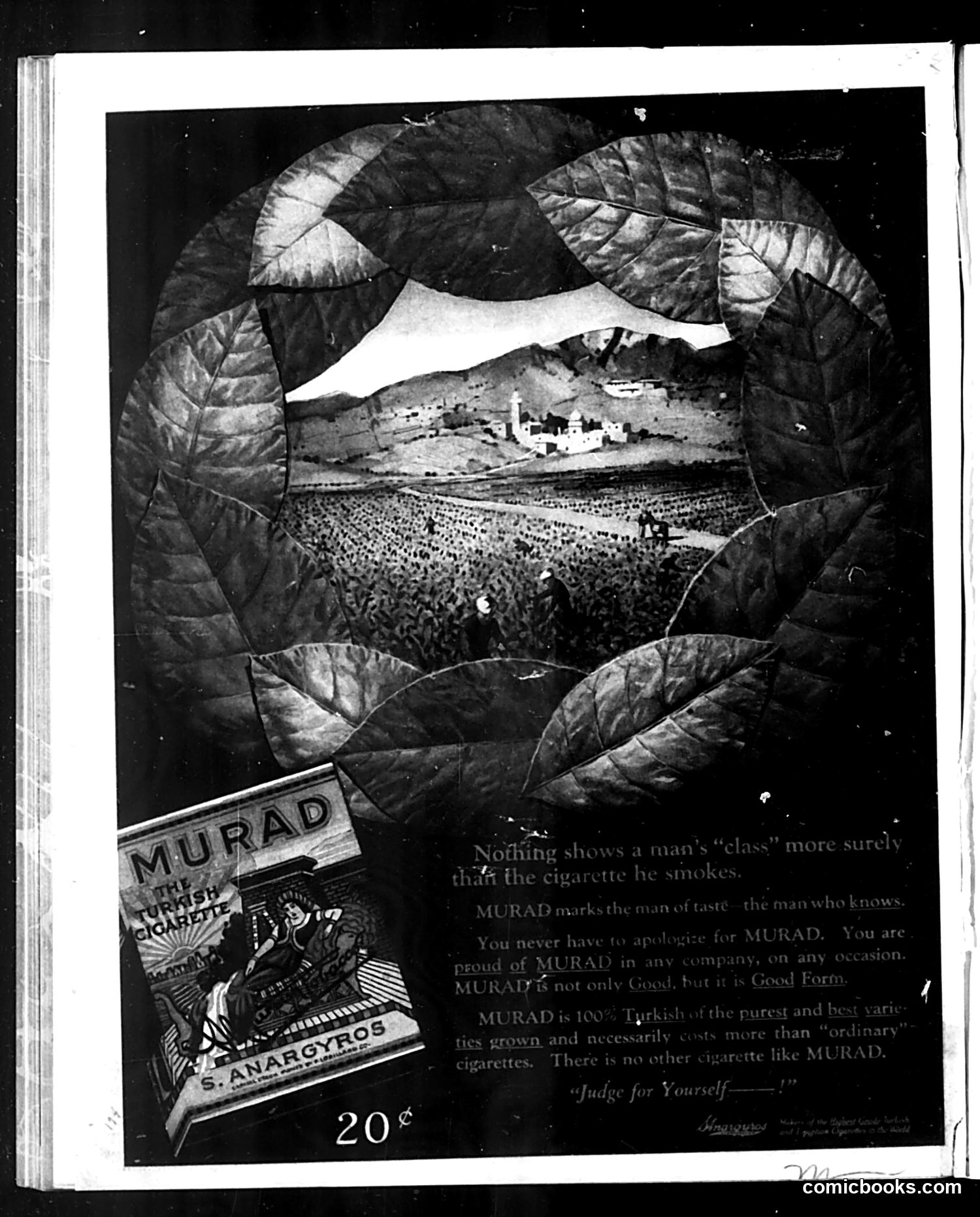
This is a **cigarette advertisement for Murad brand**, not satirical content. The page features an artistic photograph framed by large leaves showing a pastoral landscape with fields and a distant village or settlement. The ad's text emphasizes class and sophistication: "Nothing shows a man's 'class' more surely than the cigarette he smokes." It positions Murad as a premium product for discerning gentlemen who needn't apologize for their choice. The ad notes Murad is "100% Turkish" from "the purest and best varieties," justifying its higher cost than "ordinary" cigarettes. The price is marked at 20¢. This reflects early 20th-century advertising strategy: associating cigarettes with masculinity, taste, and social status—a common marketing approach before modern health warnings.

I can see this is a page from Judge magazine based on the watermark and citation at the bottom. However, the page itself appears to be almost entirely blank or very faintly printed, with only minimal visible content—primarily the binding edge on the left side and the comicbooks.com attribution at the bottom right. Without visible cartoon imagery, text, or other discernible content, I cannot identify any figures, political references, satirical points, or jokes that would require historical context for modern readers. This appears to be either a blank page, a title page, or a scanning/digitization issue where the original content did not reproduce clearly.