
Judge, 1920-06-26 · page 26 of 37
Judge — June 26, 1920 — page 26: what you’re looking at
What you’re looking at
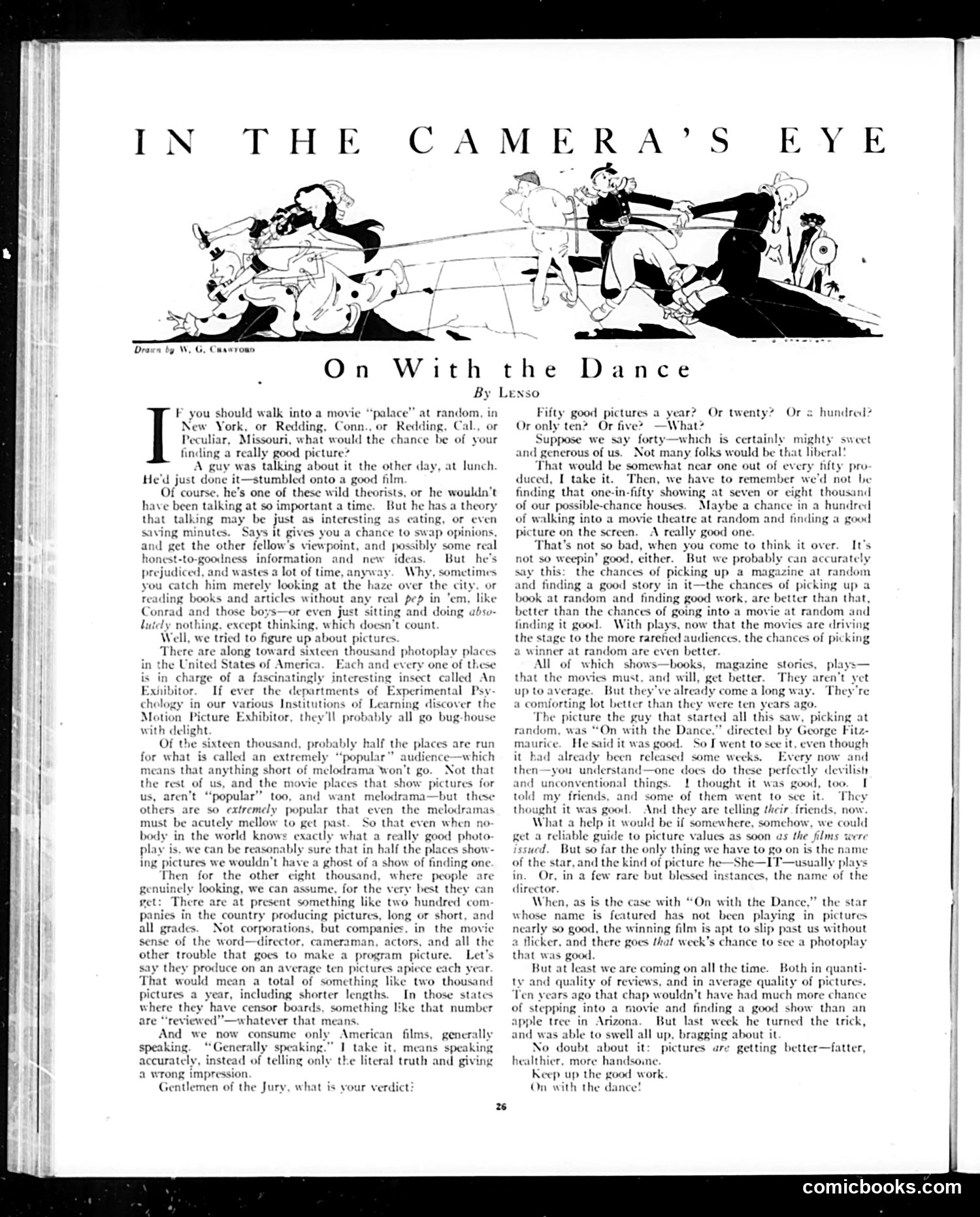
This page contains an essay by Lenso (not a cartoon) satirizing the American movie industry circa the 1920s. The author mocks the odds of randomly finding a "really good picture" at one of approximately 16,000 movie theaters across the United States. The satire targets: - **Movie "Exhibitors"** (theater owners), described as "fascinatingly interesting insect[s]" - The vast quality gap between "popular" melodrama-driven theaters and more discerning venues - The film production system: ~200 companies producing ~2,000 pictures annually, yet perhaps only 40 worth watching The author calculates that attending a random theater offers roughly a 1-in-100 chance of seeing a genuinely good film—a depressing prospect he presents with dry humor. The piece critiques both industrial quantity over quality and audiences' lowered expectations, using statistical mockery to expose the entertainment industry's fundamental mediocrity.
📄 Transcribed text from this page (OCR, searchable)
Machine-transcribed from the original scan — historical spelling and the odd misread are preserved.
CAMERA’ of i On With the Dance By Lenso F you should walk into a movie “palace” at random, in New York, or Redding, Conn., or Redding, Cal., or Peculiar, Missouri, what would the chance be of your finding a really good picture? A guy was talking about it the other day, at lunch. He'd just done it—stumbled onto a good film. Of course, he’s one of these wild theorists, or he wouldn't have been talking at so important a time. But he has a theory that talking may be just as interesting as cating, or even saving minutes. Says it gives you a chance to swap opinions. and get the other fellow’s viewpoint, and possibly some real honest-to-goodness information and new ideas. But he’s prejudiced, and wastes a lot of time, anyway. Why, sometimes you catch him merely looking at the haze over the city, or reading books and articles without any real pep in ’em, like Conrad and those boys—or even just sitting and doing abso- lutely nothing, except thinking, which doesn’t count Well, we tried to figure up about pictures. There are along toward sixteen thousand photoplay places in the United States of America. Each and every one of these is in charge of a fascinatingly interesting insect called An Exhibitor. If ever the departments of Experimental Psy chology in our various Institutions of Learning discover the Motion Picture Exhibitor, they'll probably all go bug-house with delight Of the sixteen thousand, probably half the places are run for what is called an extremely “popular” audience—which means that anything short clodrama Won't go. Not that the rest of us, and the movie places that show pictures for us, aren't “popular” too, and want melodrama—but these others are so extremely popular that even the melodramas must be acutely mellow to get past. So that even when no body in the world knows exactly what a really good photo- play is. we can be reasonably sure that in half the places show- ing pictures we wouldn't have a ghost of a show of finding one Then the other eight thousand, where people are genuinely looking, we can assume, for the very best they can get: There are at present something like two hundred com panies in the country producing pictures, long or short, and all grades. Not corporations, but companies, in the mov sense of the word—director, cameraman, actors, and all the other trouble that goes to make a program picture. Let's say they produce on an average ten pictures apiece each year. That would mean a total of something like two thousand pictures a year, including shorter lengths. In those states where they have censor boards, something like that number are “reviewed"’—whatever that means. And we now consume only American films, generally speaking. senerally speaking.” J take it, means speaking accurately, instead of telling only the literal truth and giving a wrong impression Gentlemen of the Jury, what is your verdict Fifty good pictures a year? Or twenty? Or & hundred? Or only ten? Or five? —What? Suppose we say forty—which is certainly mighty sweet and generous of us. Not many folks would be that liberal! That would be somewhat near one out of every fifty pro duced, I take it. Then, we have to remember we'd not be finding that one-in-fifty showing at seven or cight thousand of our possible-chance houses. Maybe a chance in a hundred of walking into a movie theatre at random and finding a good picture on the screen. A really good one That’s not so bad, when you come to think it over. It’s not so weepin’ good, cither. But we probably can accurately say this: the chances of picking up a magazine at random and finding a good story in it—the chances of picking up a book at random and finding good work, are better than that, better than the chances of going into a movie at random and finding it good. With plays, now that the movies are driving the stage to the more rarefied audiences, the chances of picking a winner at random are even better. All of which shows—books, magazine stories, plays— that the movies must, and will, get better. They aren't yet up to average. But they've already come a long w They're a comforting lot better than they were ten years ago. The picture the guy that started all this saw, picking at random, was “On with the Dance,” directed by George Fitz- aurice. He said it was good. So I went to see it, even though it had already been released some weeks. Every now and then—you understand—one does do these perfectly devilish and unconventional things. 1 thought it was good, too. I told my friends, and some of them went to sce it. They thought it was good. And they are telling their frien What a help it would be if somewhere, somehow, get a reliable guide to picture values as soon as the ssued. But so far the only thing we have to go on is the name of the star, and the kind of picture he—She—IT—usually plays in. Or, in a few rare but blessed instances, the name of the director. When, as is the case with “On with the Dance,” the star whose name is featured has not been playing in_ pictures nearly so good, the winning film is apt to slip past us without a flicker, and there goes that week's chance to sce a photoplay that was good But at least we are coming on all the time. Both in quanti- ty and quality of reviews, and in average quality of pictures. Ten years ago that chap wouldn't have had much more chance of stepping into a movie and finding a good show than an apple tree in Arizona. But last week he turned the trick, and was able to swell all up, bragging about it No doubt about it: pictures are getting better—fatter, healthier, more handsome Keep up the good work On with the dance! 1s, now could ms were comicbooks.com