
Judge, 1920-06-26 · page 9 of 37
Judge — June 26, 1920 — page 9: what you’re looking at
What you’re looking at
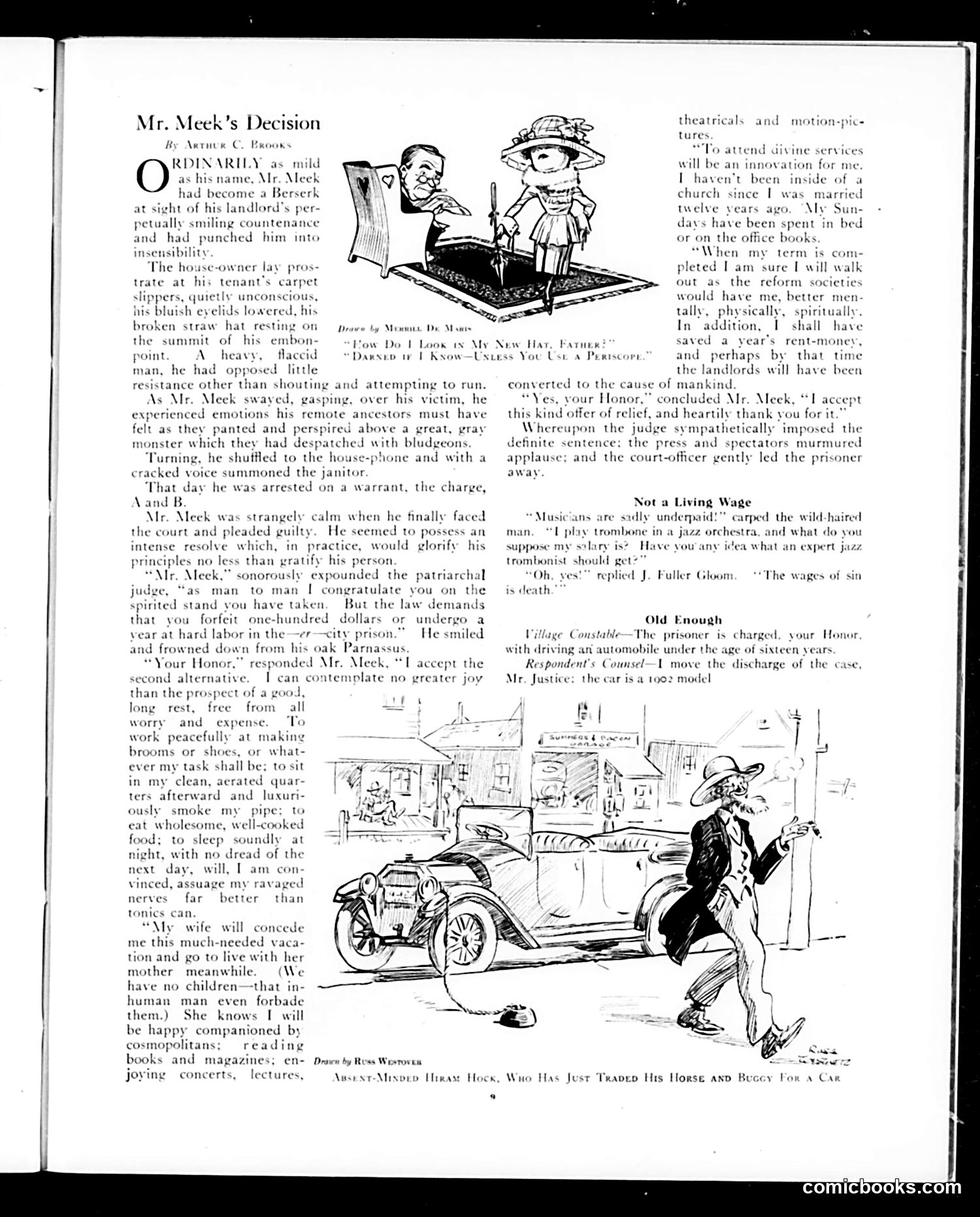
This story satirizes the legal system's treatment of working-class men. Mr. Meek, a mild-mannered tenant, attacks his landlord and faces court. Rather than punishment, the judge congratulates him for his "spirited stand"—yet still sentences him to a year's hard labor or a $100 fine. Meek cheerfully accepts prison, viewing it as a vacation: free room, board, rest from work, and time for self-improvement. He'll save money while his wife lives with her mother, and hopes his landlord converts to "mankind" by then. The satire cuts two ways: it mocks both the judge's paternalistic hypocrisy (praising Meek while punishing him) and the grim reality that imprisonment seemed preferable to poverty for ordinary people. The cartoon's second panel shows an older man having traded his horse and buggy for a car—commenting on modernization and changing times. The page suggests early 20th-century anxieties about labor, class, and justice.
📄 Transcribed text from this page (OCR, searchable)
Machine-transcribed from the original scan — historical spelling and the odd misread are preserved.
Mr. Meek’s Decision By Nernck C. Be RDINARILY as mild O as his name, Mr. Meek had become a Berserk at sight of his landlord’s per- petually smiling countenance and had punched him into insensibility The house-owner lay pre trate at his tenant's carpet quietly unconscious, h eyelids lowered, his slipper his blu broken straw hat the summit of his embon- point \ flaccid man, he had opposed little resistance other than shouting and attempting to run. As Mr. Meek swayed, gasping, over his victim, he experienced emotions his remote ancestors must have felt as they panted and perspired above a great, gray monster which they had despatched with bludgeons Turning, he shuffled to the house-phone and with a cracked voice summoned the janitor That day he was arrested on a warrant, the charge, \and B Mr. Meek was strangely calm when he finally faced the court and pleaded guilty. He seemed to possess an intense resolve which, in practice, would glorify his principles no less than gratify his person “Mr. Meek,” sonorously expounded the patriarchal jud ‘as man to man I congratulate you on the spirited stand you have taken, But the law demands that you forfeit one-hundred dollars or undergo a year at hard labor in the--er—city prison.” He smiled and frowned down from his oak Parnassus “Your Honor,” responded Mr. Meek, “1 accept the second alternative. I can contemplate no greater joy than the prospect « 0d, fi all — by Mein De Mo Drow How Do 1 Loox ts My heavy, long rest, free fro worry and expense. ‘To work peacefully at making brooms or shoes, or what- ever my task shall be; to sit in my clean, aerated quar- ters afterward and luxuri- ously smoke my pipe: to eat wholesome, well-cooked food; to sleep soundly at ht, with no dread of th next day, will, | am co vinced, assuage my rav nerves far better than tonics can, “My wife will concede me this much-needed vaca- tion and go to live with her mother meanwhile. (We have no children—that in- human man even forbade them.) She knows I will be happy companioned b; cosmopolitans; reading books and magazines; en- Drown by Re joying concerts, lectures, Woerove New Har, Parner? “Darxeo uw T Kxow—Un ess Awsent-Misxoro [trast Hoox « theatricals. and motion-pic- tures. Vo attend divine services will be an innovation for me I haven't been inside of a church s twelve ve: nce | was married ago. “My Sun- days have been spent in bed or on the office books “When my term is com- pleted | am sure I will walk out as the reform societies would have me, better men tally, physically, spiritually. In addition, IT shall have saved a year’s rent-money, and perhaps by that time the landlords will have been ov Usn a Pertscort converted to the cause of mankind. “Yes, your Honor,” concluded Mr. Meek, “I accept this kind offer of relief, and heartily thank you for it.” Whereupon the judge sympathetically imposed the definite sentence; the press and spectators murmured applause: and the court-officer gently led the prisoner away Not a Living Wage Musicians are sadly underpaid!” carped the wild-haired man. “I play trombone in a jazz orchestra, and what do you Have you'any idea what an expert jazz suppose my silary is? trombonist should get?” “Oh, yes!” replied J. Fuller Gloom. ** The wages of sin is death.” Old Enough Village Constable—The prisoner is charged. your Honor with driving an automobile under the age of sixteen years. Respondent's Counsel—1 move the discharge of the case. Mr. Justice: the car is a 1902 model | | \ Casa < Swe Wuo Has Just Trapeo Hts Horse ann Buccy For a Car