
Judge, 1920-06-26 · page 24 of 37
Judge — June 26, 1920 — page 24: what you’re looking at
What you’re looking at
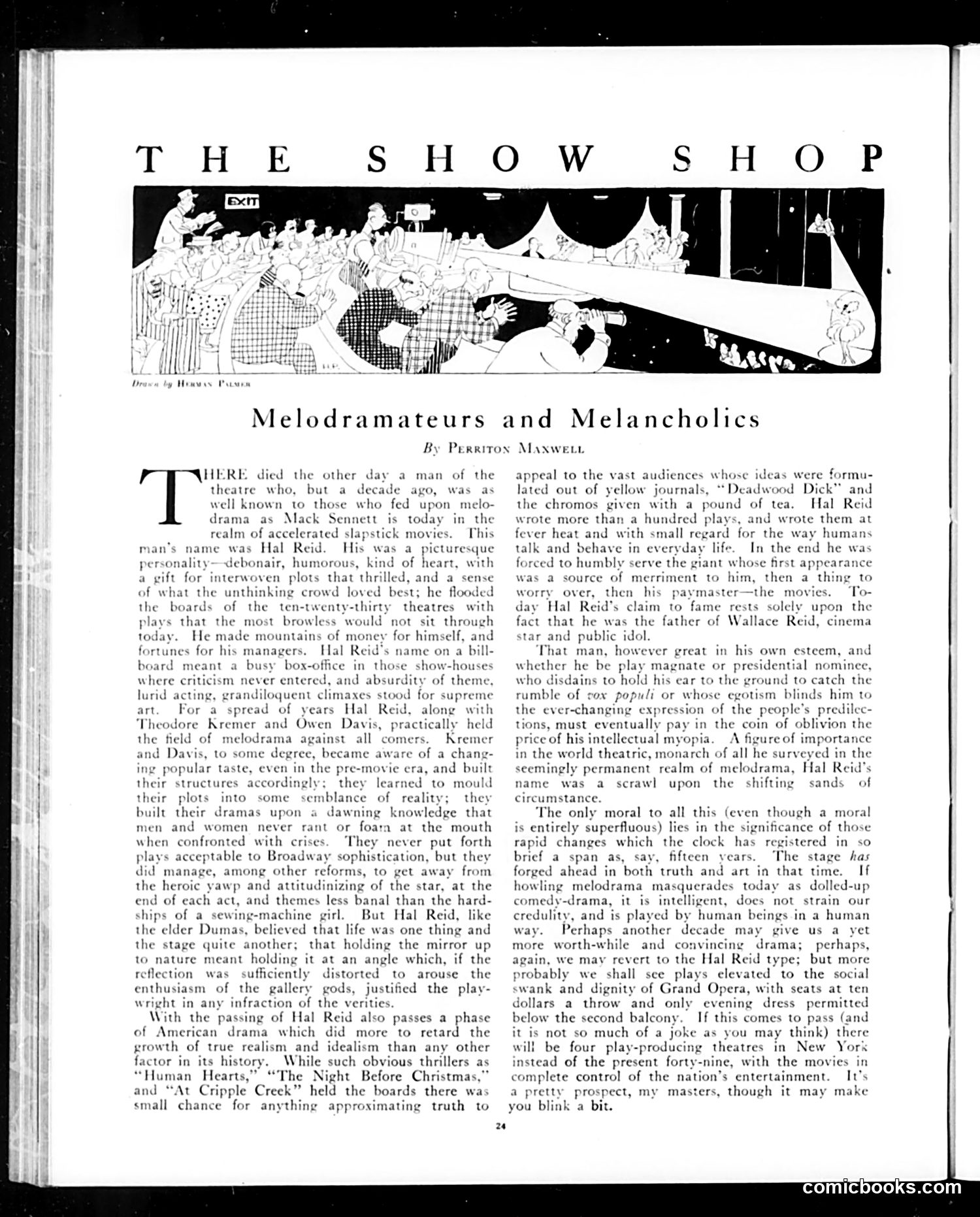
This article eulogizes **Hal Reid**, a now-deceased melodrama playwright who dominated American theater for decades. The satirical point: Reid represented an outdated theatrical tradition that *resisted* artistic progress. Reid wrote over 100 plays featuring exaggerated emotionalism, implausible plots, and overwrought acting—popular with unsophisticated audiences but artistically bankrupt. The text contrasts him with **Theodore Kremer and Owen Davis**, who adapted to changing tastes by introducing realism and psychological authenticity. The satire's sting: Reid's legacy now rests entirely on his son **Wallace Reid**, a successful cinema star. The "monarch of melodrama" is remembered not for his own work but as a footnote to his son's film career—a humbling fate for someone who once controlled American theater. The article mocks Reid's refusal to acknowledge shifts in public taste, suggesting his intellectual rigidity ("myopia") inevitably rendered him obsolete.
📄 Transcribed text from this page (OCR, searchable)
Machine-transcribed from the original scan — historical spelling and the odd misread are preserved.
Melodramateurs and Melancholics By Perritoxn Maxwetr HERE died the other day a man of the thea who, but a decade ago, was as well known to those who fed up drama as Mack Sennett is today in the realm of accelerated slapstick movies. This man’s name was Hal Reid. His was a picturesque personality—debonair, humorous, kind of heart, with a gift for interwoven plots that thrilled, and a sense | the unthinking crowd loved best; he flooded the boards of the ten-twenty-thirty theatres with plays that the most browless would not sit through or himself, and s name on a bill- ce in those show-houses of w ay. He made mountains of mon unes for his managers. Hal Re board meant a busy box where criticism never entered, and absurdity of theme lurid acting, grandiloquent climaxes stood for supreme art. For a spread of years Hal Reid, along with Theodore Kremer and Owen Davis, practically held the field of melod 1a against all comers. Kremer of a chang- a and Davis, to some degree, became awa ing popular taste, even in the pre-movie cra, and built gly; they learned to mould their structures accordin their plots into some semblance of reality; they built their dramas upon a dawning knowledge that men and women never rant or foata at the mouth when confronted with crises. They never put forth plays acceptable to Broadway sophistication, but they did manage, among other reforms, to get away from the heroic yawp and attitudinizing of the star, at the nd of each act, and themes less banal than the hard- ships of a_sewing-machine girl. But Hal Reid, like the elder Dumas, believed that life was one thing and the stage quite another; that holding the mirror up to nature meant holding it at an angle which, if the reflection was sufficiently distorted to arouse the enthusiasm of the gallery gods, justified the play- wright in any infraction of the verities With the passing of Hal Reid also passes a phase of American drama which did more to retard the growth of true realism and idealism than any other factor in its history. While such obvious thrillers as “Human Hearts,” “The Night Before Christmas, and “At Cripple Creek” held the boards there was small chance for anything approximating truth to appeal to the vast audiences whose ideas were formu- lated out of yellow journals, “Deadwood Dick” and the chromos given with a pound of tea. Hal Reid wrote more than a hundred plays, and wrote them at fever heat and with small regard for the way humans talk and behave in everyday life. In the end he was forced to humbly serve the giant whose first appearance was a source of merriment to him, then a thi worry over, then his paymaster—the movies. To- day Hal Reid’s claim to fame rests solely upon the fact that he was the father of Wallace Reid, cinema star and public idol. 1at_ man, however great in his own esteem, and her he be play magnate or presidential nominee, wh Id his ear to the ground to catch the who disdains to h rumble of cox populi or whose egotism blinds him to the ever-changing expression of the people's predilec- tions, must eventually pay in the coin of oblivion the price of his intellectual myopia. A figureof importance in the world theatric, monarch of all he surveyed in the seemingly permanent realm of melodrama, Hal Reid's name was a scrawl upon the shifting sands of istance. The only moral to all this (even though a moral is entirely superfluous) lies in the significance of those rapid changes which the clock has registered in so brief a span as, say, fifteen vears. The stage has forged ahead in both truth and art in that time. If howling melodrama masquerades today as dolled-up comedy-drama, it is intelligent, does not strain our credulity, and is played by human beings in a human way. Perhaps another decade may give us a yet more worth-while and convincing drama; perhaps, again, we may revert to the Hal Reid type; but more probably we shall sce plays elevated to the social swank and dignity of Grand Opera, with seats at ten dollars a throw and only evening dress permitted below the second balcony. If this comes to pass (and it is not so much of a joke as you may think) there will be four play-producing theatres in New Yors instead of the present forty-nine, with the movies in complete control of the nation’s entertainment. It’s a pretty prospect, my masters, though it may make you blink a bit. circ comicbooks.com