
A complete issue · 32 pages · 1918
Judge — August 31, 1918
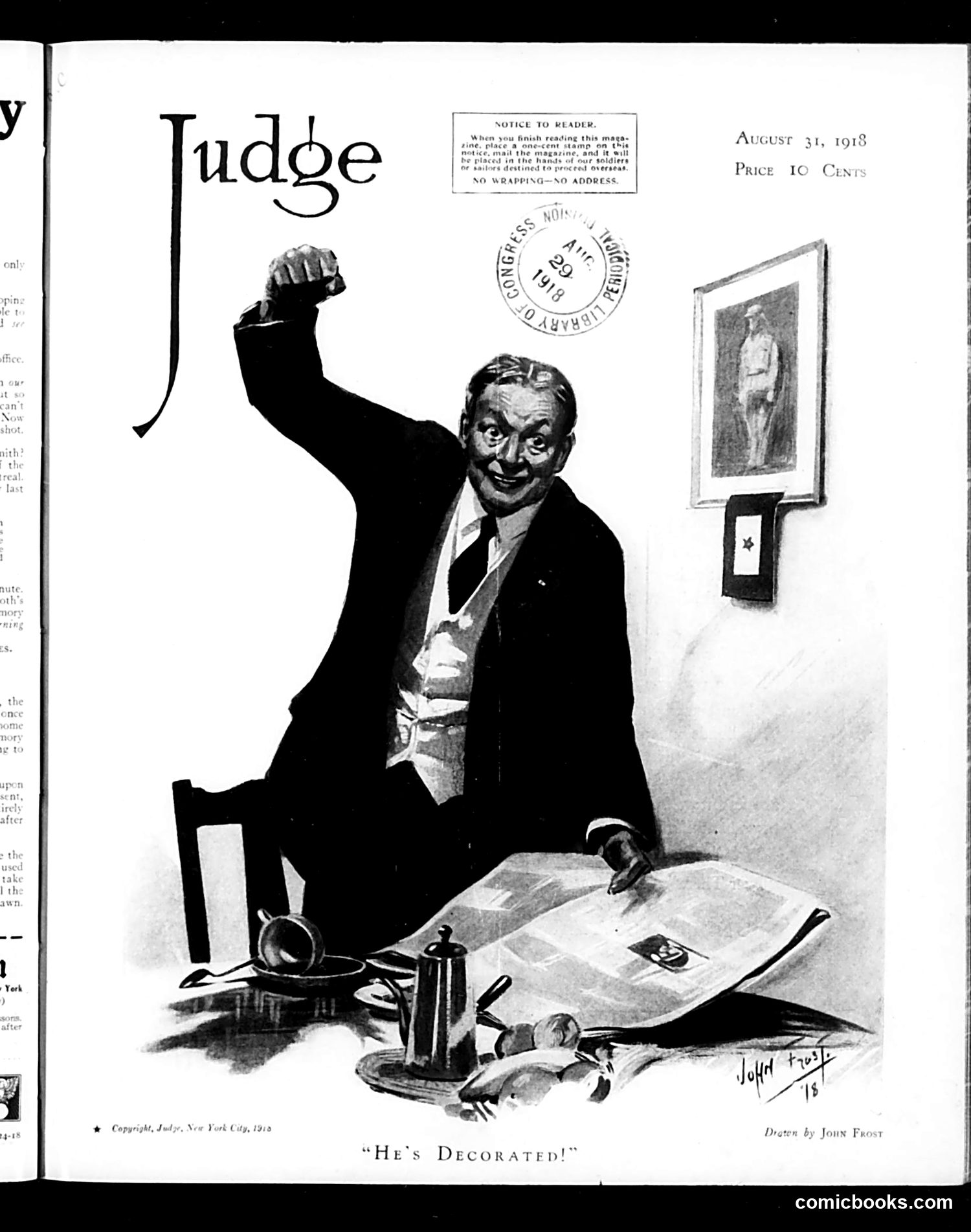
This Judge magazine cover from August 31, 1918 appears to be a WWI-era political cartoon. The exuberant man at his desk, with fist raised triumphantly, is examining what appears to be a military decoration or medal. The caption "He's Decorated!" suggests celebration of receiving official honor or recognition. The cartoon likely satirizes either: - A military official or politician receiving undeserved medals or promotions - Bureaucratic awarding of honors for minimal actual service - Wartime profiteering or desk-bound officials receiving combat decorations The overall tone—the man's theatrical expression and the cluttered desk—suggests mockery of someone celebrating recognition they may not have legitimately earned. Without identifying the specific figure, the satire appears directed at institutional hypocrisy regarding wartime honors.
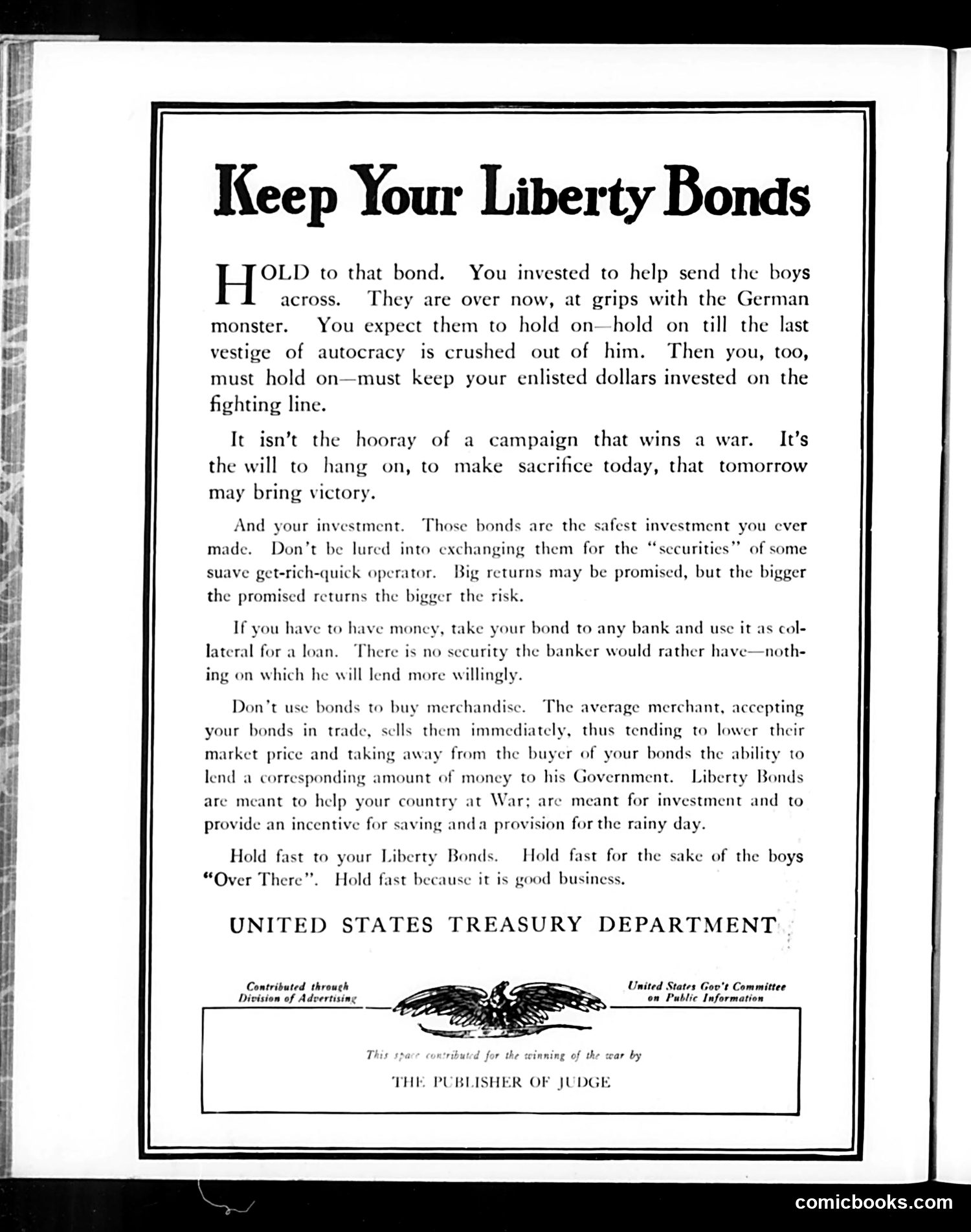
This is **not a cartoon or satire page** — it's a serious government advertisement from the United States Treasury Department promoting Liberty Bonds during World War I. The ad urges Americans to **hold rather than sell** their bond investments. It warns against: - Cashing bonds for risky speculative securities - Using bonds as collateral for loans - Trading bonds to merchants (who would resell them, depressing prices) The argument appeals to patriotism ("the boys 'Over There'") and practical self-interest ("good business"), suggesting that maintaining bond values supports the war effort and provides financial security. This represents the Treasury's effort to stabilize the bond market and encourage continued savings during wartime.
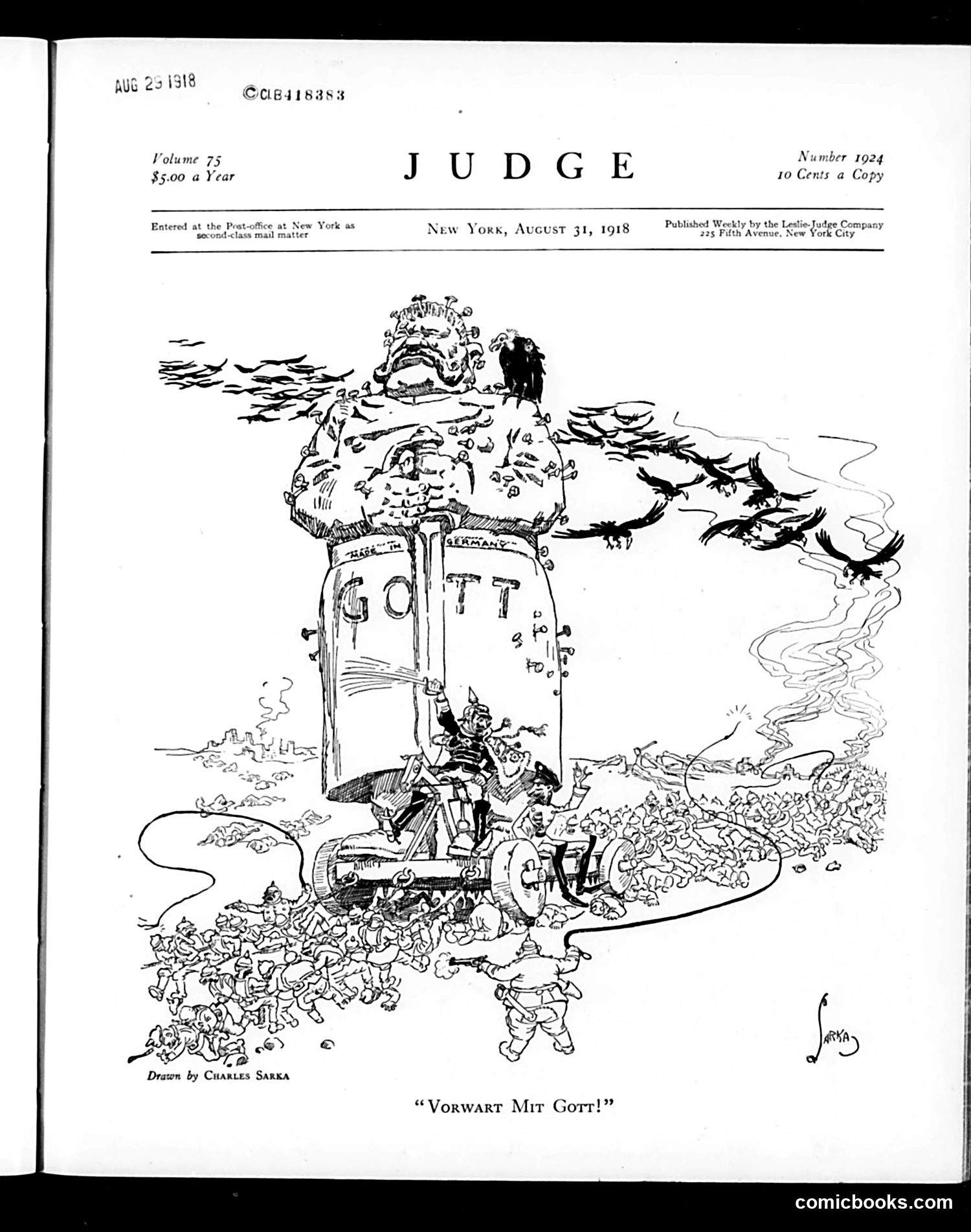
This August 31, 1918 political cartoon by Charles Sarka satirizes German militarism during World War I's final months. The central figure appears to be a German military leader or Kaiser, depicted as a grotesque giant seated on a coffin labeled "GOTT" (God). Beneath him swarms a massive crowd of soldiers and civilians being driven forward like cannon fodder. The cartoon's title—German for "Forward with God!"—mocks the militaristic invocation of divine blessing for Germany's war effort. The coffin suggests the cartoon's dark message: that German leadership was sacrificing its people to a dead god, or that God itself had died through this mechanized slaughter. It's a scathing indictment of German imperial ambitions as the war neared its end.
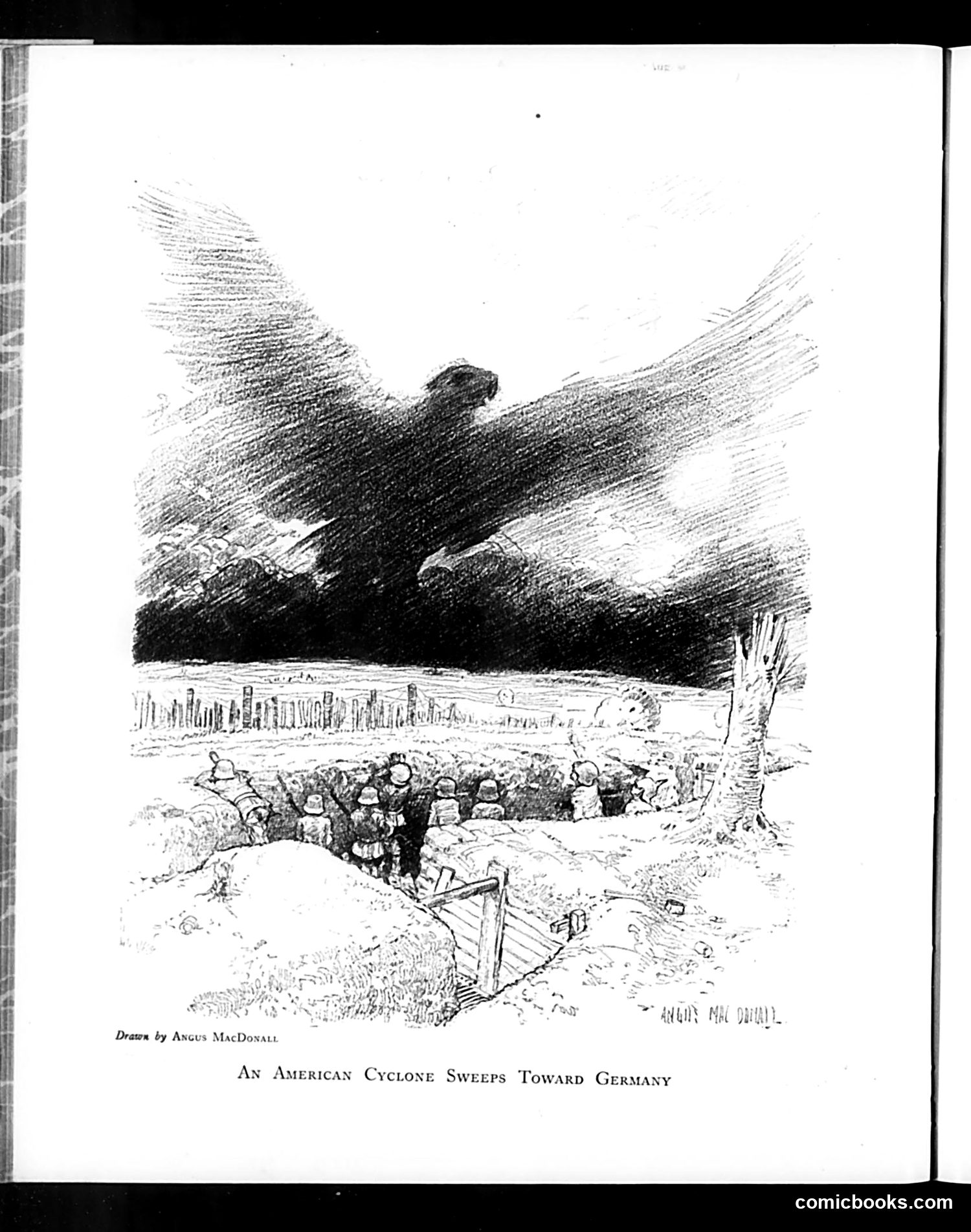
This World War I-era political cartoon depicts American military power as a massive tornado or cyclone advancing toward Germany. Soldiers in the foreground, shown in a trench (likely representing Allied forces), observe this approaching storm. The cyclone's dark, powerful form dominates the sky, suggesting overwhelming force. The satire presents American military involvement as an inevitable, destructive force that will sweep across to Germany. Published in *Judge*, a pro-Allied American magazine, this image propagandizes American entry into WWI (1917-1918) as both necessary and formidable. The cartoon appeals to American readers' sense of military superiority and patriotic duty, framing U.S. intervention as a natural, powerful phenomenon that will decisively impact the European conflict.
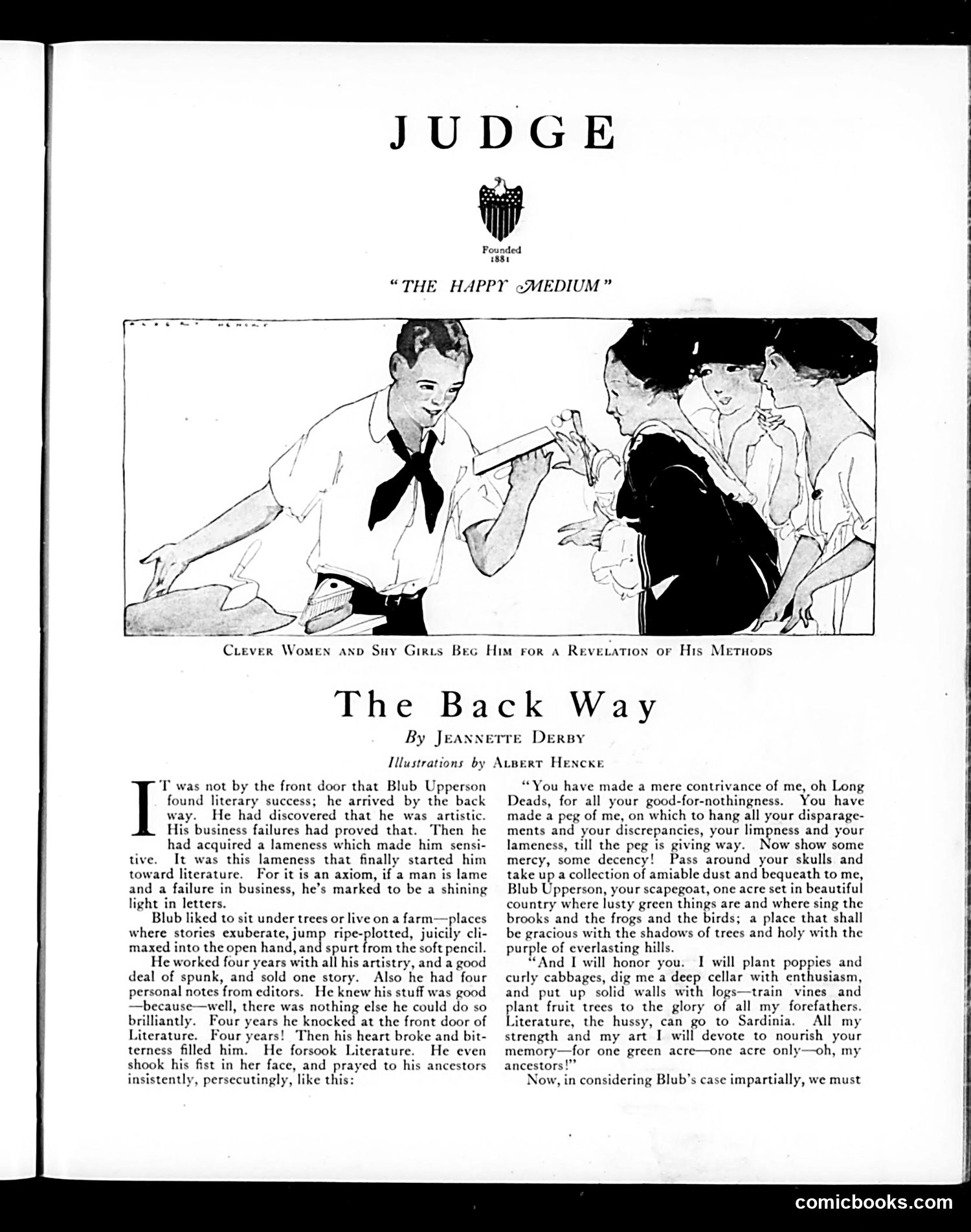
This page contains a short story illustration rather than political satire. The image shows a man demonstrating something to a group of women who are begging him to reveal his "methods." The story's title and caption—"Clever Women and Shy Girls Beg Him for a Revelation of His Methods"—suggests romantic or social comedy. The narrative concerns a character named Blub Upperson, a struggling writer who finally achieved literary success after years of failure. The excerpt focuses on Upperson's newfound success and an apparent romantic entanglement, with a woman making elaborate promises to him. The humor appears to derive from social dynamics between ambitious men and women of the era, rather than political commentary.
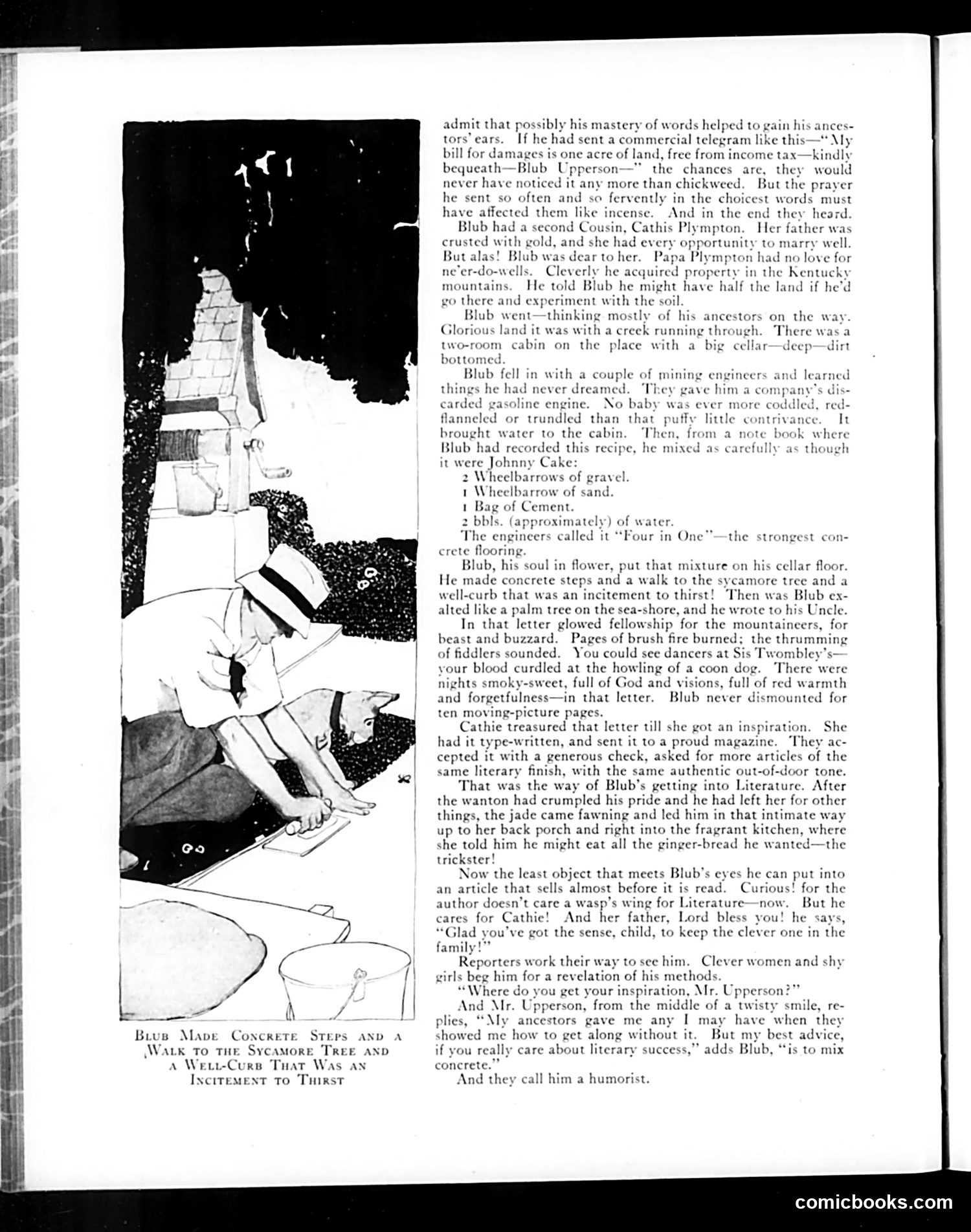
This page primarily contains **narrative fiction rather than political satire**. The illustrated story follows a character named "Blub" Upperson, a Kentucky mountaineer who becomes a writer after corresponding with his cousin Cathie Plympton, a magazine editor. The tale is humorous in a genteel, character-driven way rather than politically satirical. It depicts Blub's unlikely journey from rural poverty to literary success, including anecdotes about his concrete-mixing recipe and his eventual acceptance into literary circles. The cartoon illustration shows Blub making concrete steps, establishing the rural, working-class setting. The humor derives from his dialect, folksy wisdom, and the incongruity of a hillbilly becoming a published author—reflecting early 20th-century attitudes about regional identity and cultural aspiration rather than attacking specific political targets.
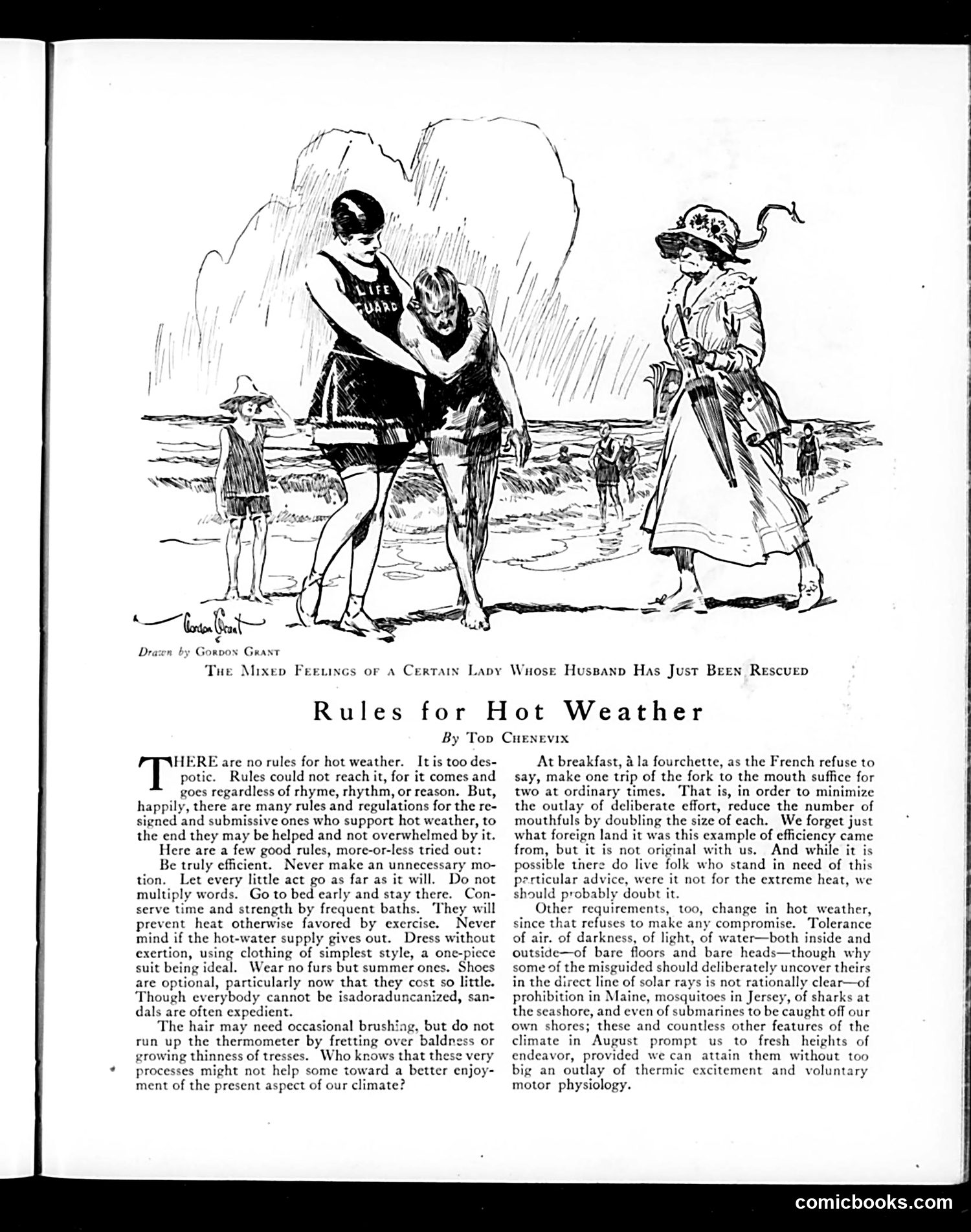
**The Cartoon:** Gordon Grant's illustration depicts a woman's conflicted reaction to her husband's rescue from the sea. She stands between a lifeguard holding a rescued man and another woman, embodying "mixed feelings"—the title's joke being that while a wife should be relieved her husband survived, she appears less than thrilled about his return. **The Article:** "Rules for Hot Weather" by Tod Chenevix is humorous pseudo-advice for enduring summer heat. It's satirical—mock-seriously suggesting impractical tips like sleeping all day, wearing minimal clothing, and doubling mouth-sizes to reduce effort. The tone mocks both the insufferable heat and the pretentious "efficiency expert" advice popular in the era. **Historical Context:** This reflects early 20th-century concerns: efficiency movements, the shocking novelty of women in swimwear (referencing Isadora Duncan's freedom in dress), and American anxiety about summer discomfort before air conditioning. The submarine reference suggests WWI-era anxieties. The humor relies on absurdism and gentle social satire typical of Judge's style.
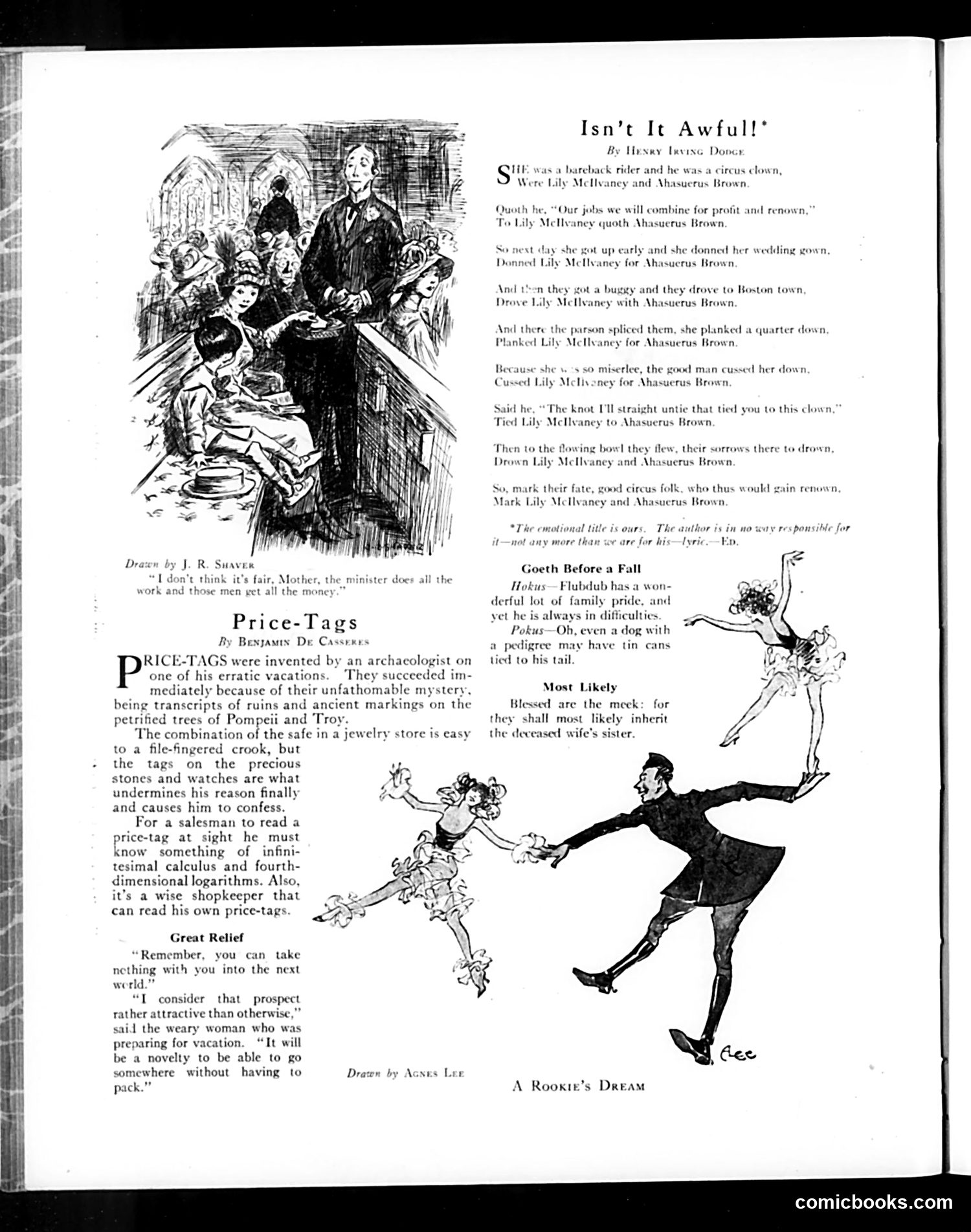
This page contains several humorous pieces typical of early 20th-century satirical magazines: **"Isn't It Awful!"** is a narrative poem about circus performers Lily McElvaney and Ahasuerus Brown who marry to combine their acts for profit. The joke escalates darkly—a cheap bride, an angry parson, and ultimately the couple drowning together in their sorrows. The moral warns against mercenary circus folk seeking renown through marriage. **"Price-Tags"** satirizes the absurd complexity of retail price-tags, claiming they're indecipherable ancient markings that confuse criminals and salesmen alike—even shopkeepers can't read their own tags. The humor mocks modern retail's opacity. **"Great Relief"** jokes that a woman preparing for vacation finds comfort in the saying "you can't take it with you"—finally, she can travel without packing! **Other brief gags** include wordplay about clerical celibacy and inheritance ("the deceased wife's sister"), and a cartoon showing a rookie's dream of athletic prowess. The page exemplifies Judge's blend of verse satire, social commentary, and visual humor targeting turn-of-the-century American life.
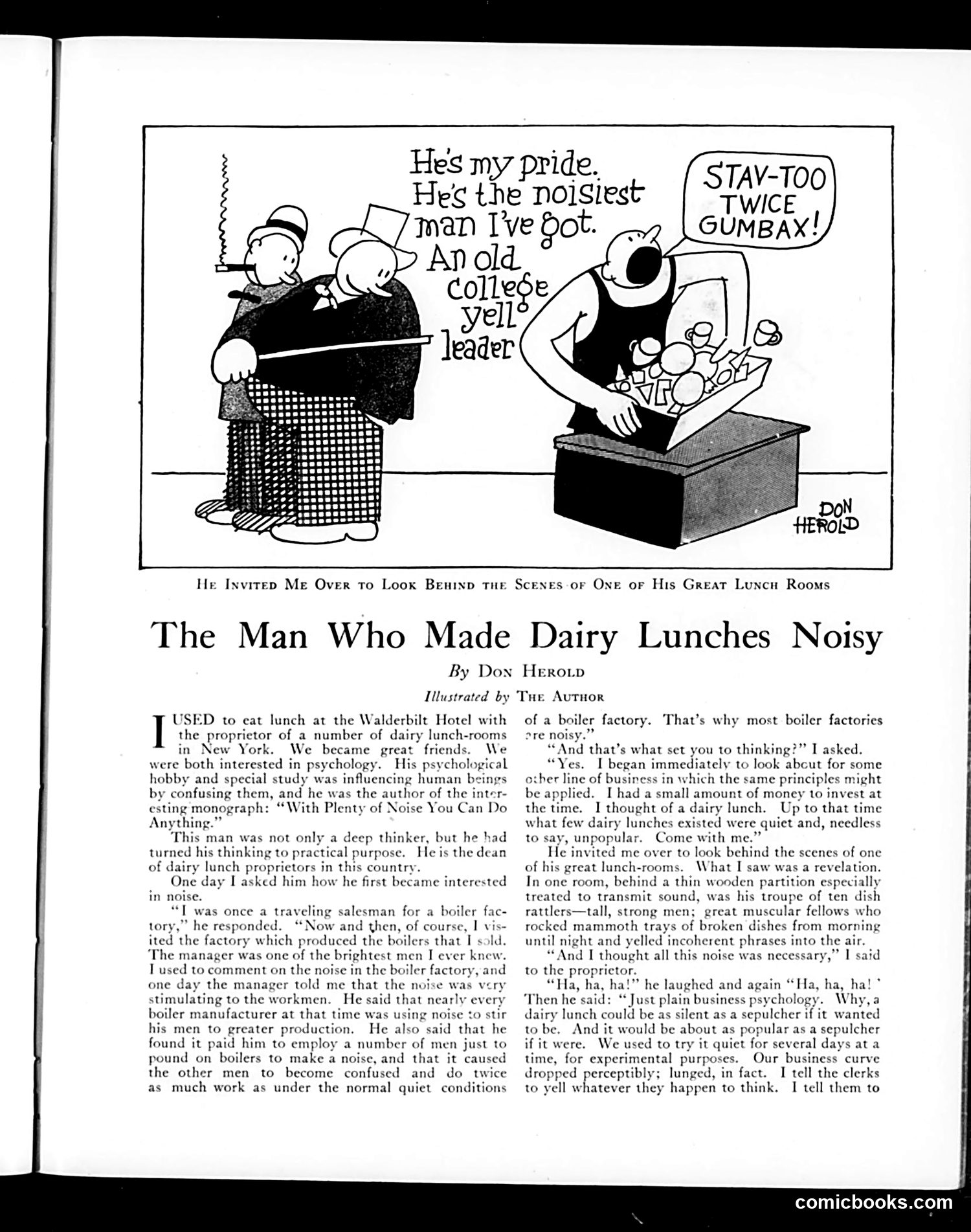
This article satirizes the psychological manipulation of workers and consumers through noise and confusion. The cartoon depicts a proud proprietor showing off his "troupe of ten dish rattlers"—men employed solely to create loud noise by banging dishes. The satire targets applied psychology fads of the early 20th century. The protagonist claims noise increases productivity, citing boiler factories where noise allegedly stimulated workers to greater output. He applies this "principle" to dairy lunch-rooms, deliberately hiring men to generate cacophony, and observes that quiet establishments prove unpopular while noisy ones thrive. The humor lies in the absurdity: noise becomes a deliberate business tool, not an unfortunate byproduct. The proprietor has scientized chaos itself—treating human psychology as something easily manipulated through sensory stimulation and confusion. The cartoon's exaggerated figures and the phrase "Stay-Too Twice Gumbax!" (nonsense yelling) emphasize the ridiculous pseudo-scientific justification for what is essentially organized bedlam masquerading as sound business strategy.
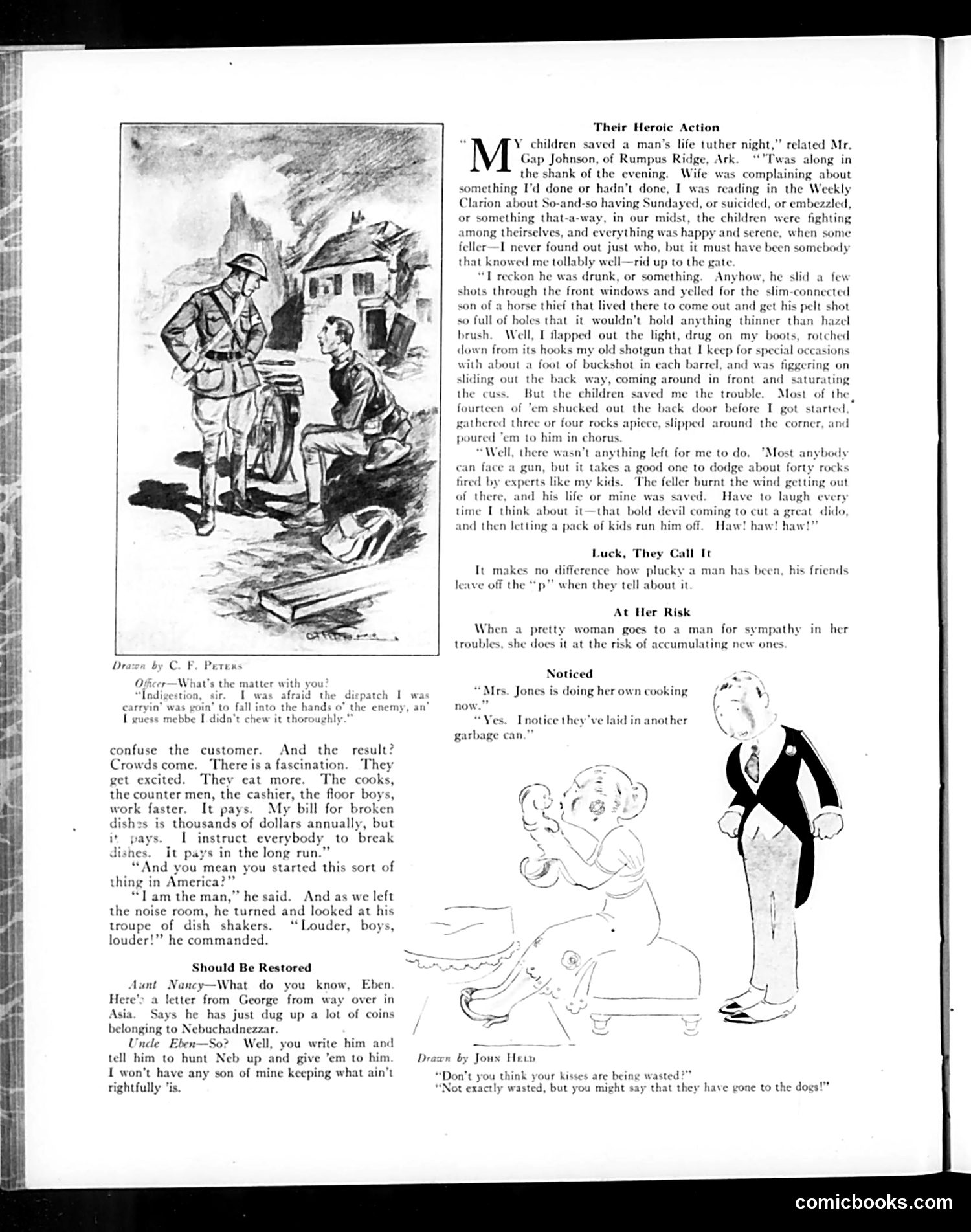
This page contains several humorous short stories and cartoons typical of early 20th-century American satire: **"Their Heroic Action"** mocks rural, uneducated speech patterns through a tall tale: a backwoods Arkansas man claims his fourteen children saved his life by pelting an armed intruder with rocks instead of him confronting the threat directly. The humor relies on dialect comedy and the absurdity of children as unlikely heroes. **"Luck, They Call It"** is a brief wordplay joke about dropping the "p" from "plucky" when gossiping. **"At Her Risk"** presents cynical commentary on women seeking male sympathy, suggesting entanglement rather than help. The remaining shorts mock domestic life (a wife's poor cooking, a husband's concern about ancestral coins) through conventional marital humor. The cartoons employ simple line drawings common to the era. Overall, the page reflects Judge's reliance on regional dialect, gender stereotypes, and domestic comedy—standard satirical fare for early 20th-century American magazines targeting middle-class readers.
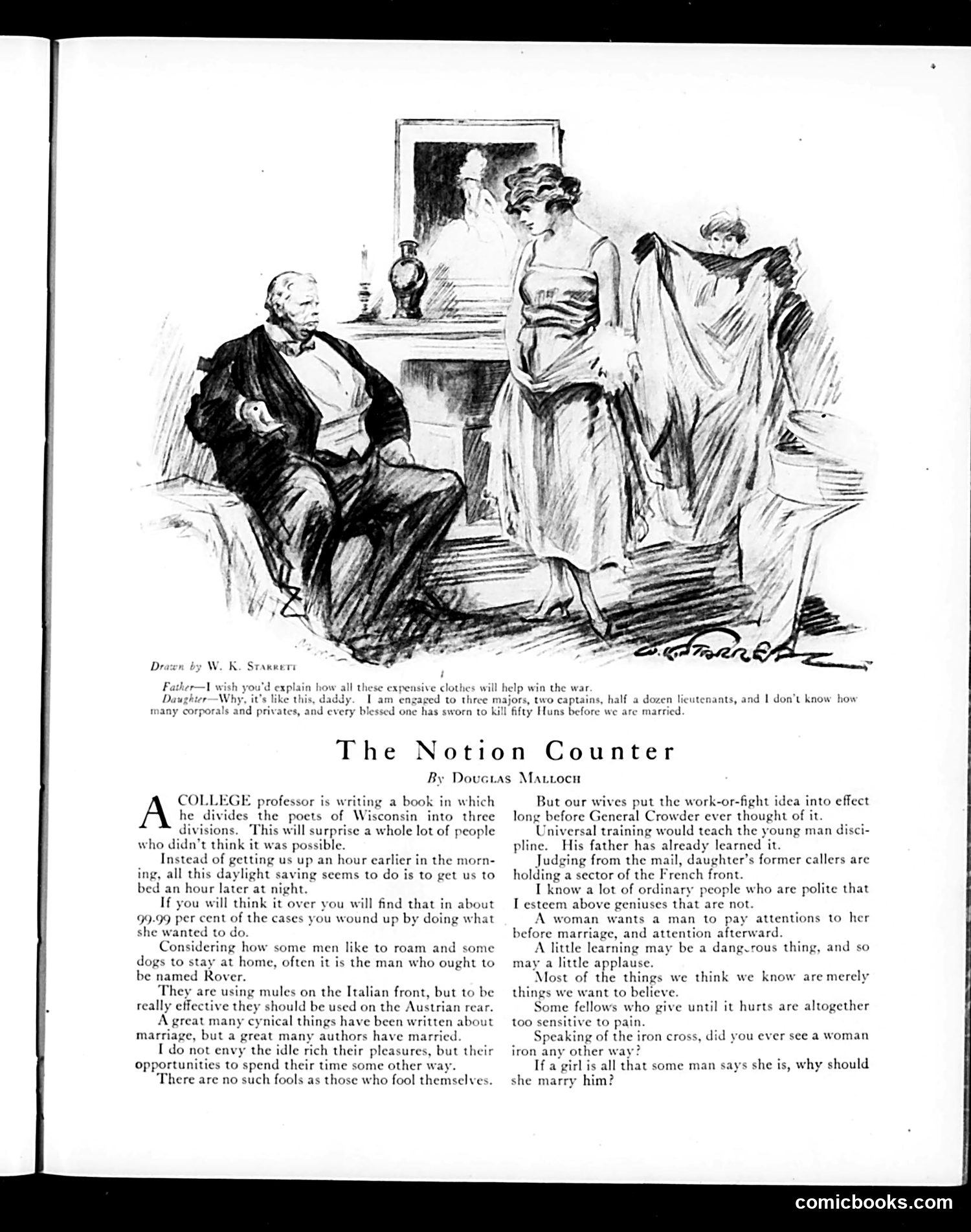
This page from *Judge* magazine features a cartoon and humorous column by Douglas Malloch, set during World War I. The cartoon depicts a father confronting his daughter about her expensive wardrobe, claiming such clothes aid the war effort. The daughter responds sarcastically that she's engaged to multiple military officers—suggesting women were using patriotic justifications for frivolous spending. "The Notion Counter" column consists of brief satirical observations about contemporary life, including: daylight-saving time's ineffectiveness, wives enforcing "work-or-fight" labor policies before government mandates, marriage's inevitable compromises, and the irony of women's iron-crossing techniques. References to General Crowder (who administered WWI draft) and the Austrian/Italian fronts ground these jokes in wartime context. The satire targets civilian hypocrisy about war sacrifice and traditional gender dynamics during mobilization.
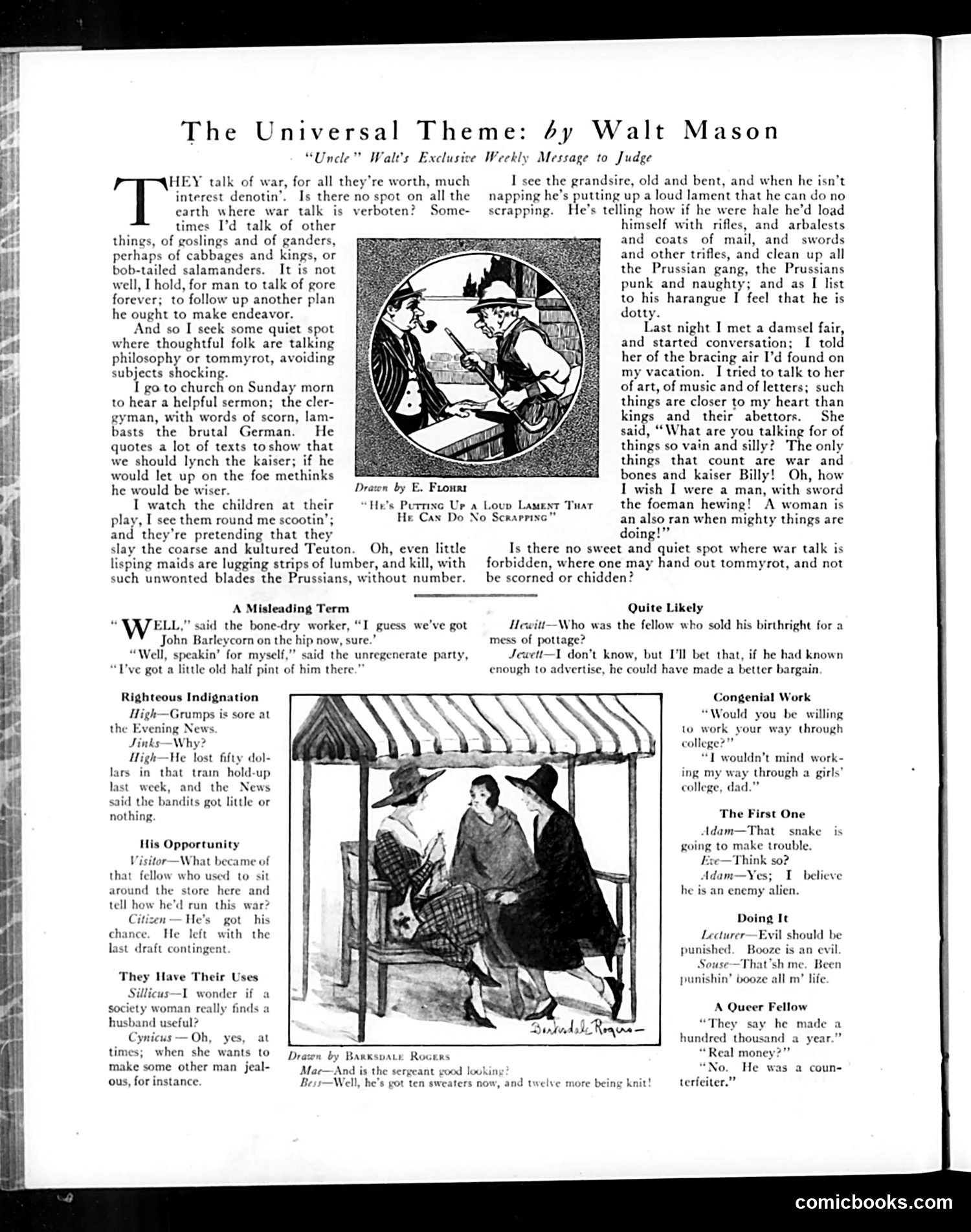
This page satirizes American obsession with World War I discourse. Walt Mason's column complains that war talk has become inescapable—even church sermons focus on the Kaiser, children play-act killing "Prussians," and casual conversation gets hijacked by war commentary. Mason seeks quiet philosophical discussion but finds it impossible. The cartoons mock this universal preoccupation. One shows a woman dismissing art and music as "vain and silly" because only war matters. Another jokes about "John Barleycorn" (alcohol personified)—relevant since Prohibition-era dry movements claimed wartime sacrifice justified eliminating liquor. The scattered jokes touch wartime anxieties: draft conscription, inflation, domestic disruption. A sergeant receiving knitted sweaters references women's wartime contribution efforts. The overall message: Americans have become so consumed by war rhetoric that normal life and thought have become impossible. It's social satire targeting both excessive patriotism and the war's totalizing grip on public discourse.
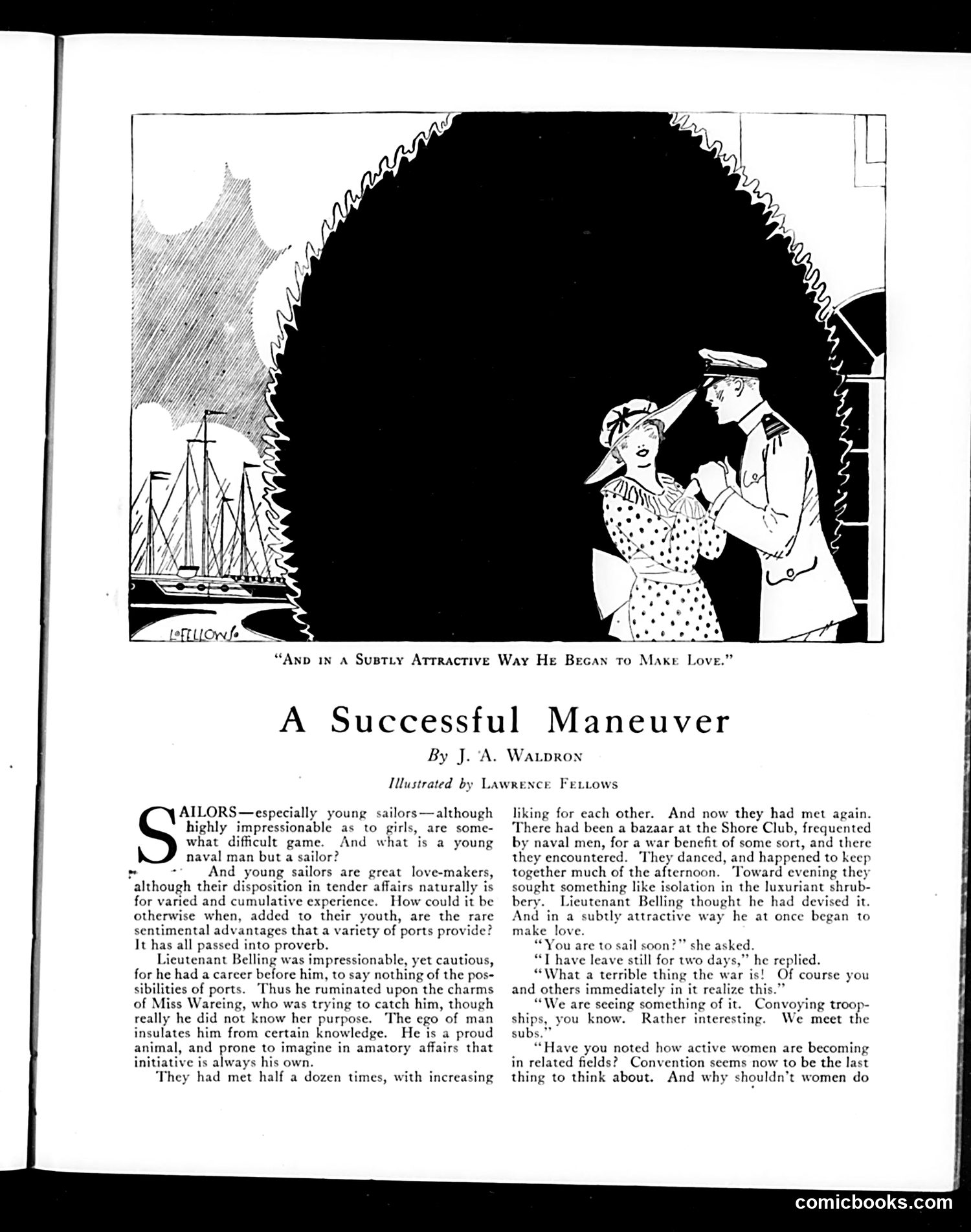
This is a short story (not a political cartoon) from *Judge* magazine illustrated by Lawrence Fellows. The narrative satirizes romantic dynamics between young naval officers and women during what appears to be World War I. The satire targets Lieutenant Belling's self-deception: he believes he's orchestrating a romantic encounter with Miss Wareing in the shrubbery at a Shore Club, imagining his "initiative" is entirely his own. The story suggests he's actually being pursued and maneuvered by her—she's the one strategically creating opportunities. The broader social commentary critiques gender dynamics and evolving female independence during wartime. Miss Wareing's remark about women becoming "active" in war-related fields and questioning why they shouldn't be implies the story is examining how women were gaining agency and independence during WWI, challenging Victorian conventions that Lieutenant Belling represents. The joke: the confident young sailor believes he's the pursuer when he's actually being skillfully pursued.
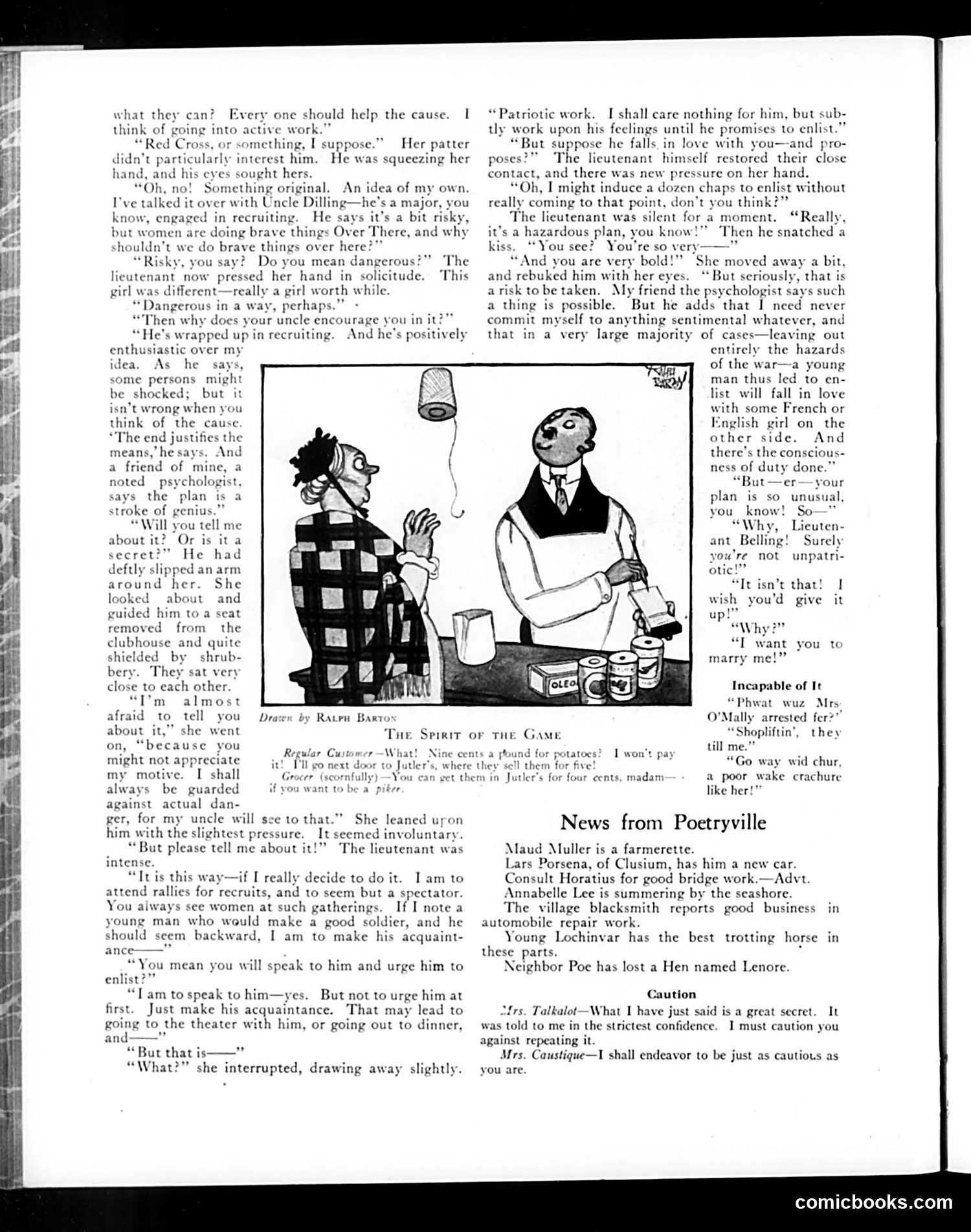
This cartoon satirizes women's wartime recruitment efforts during WWI. A young woman explains to a lieutenant her "patriotic" plan: she will attend recruitment rallies, identify reluctant young men, befriend them socially (theaters, dinners), and subtly persuade them to enlist—all without romantic commitment. The satire targets the scheme's obvious moral hazard: using romance and feminine persuasion as a recruitment tool risks entangling these women sentimentally, despite claims otherwise. The lieutenant's response—proposing marriage instead of endorsing the plan—undercuts the woman's confidence in her ability to control outcomes. The cartoon mocks both the naiveté of the recruitment strategy and contemporary attitudes toward women's wartime roles, suggesting that "patriotic work" involving seduction was neither practical nor respectable, despite wartime necessity. The title's irony is clear: this isn't honorable "spirit" but rather a morally ambiguous game.
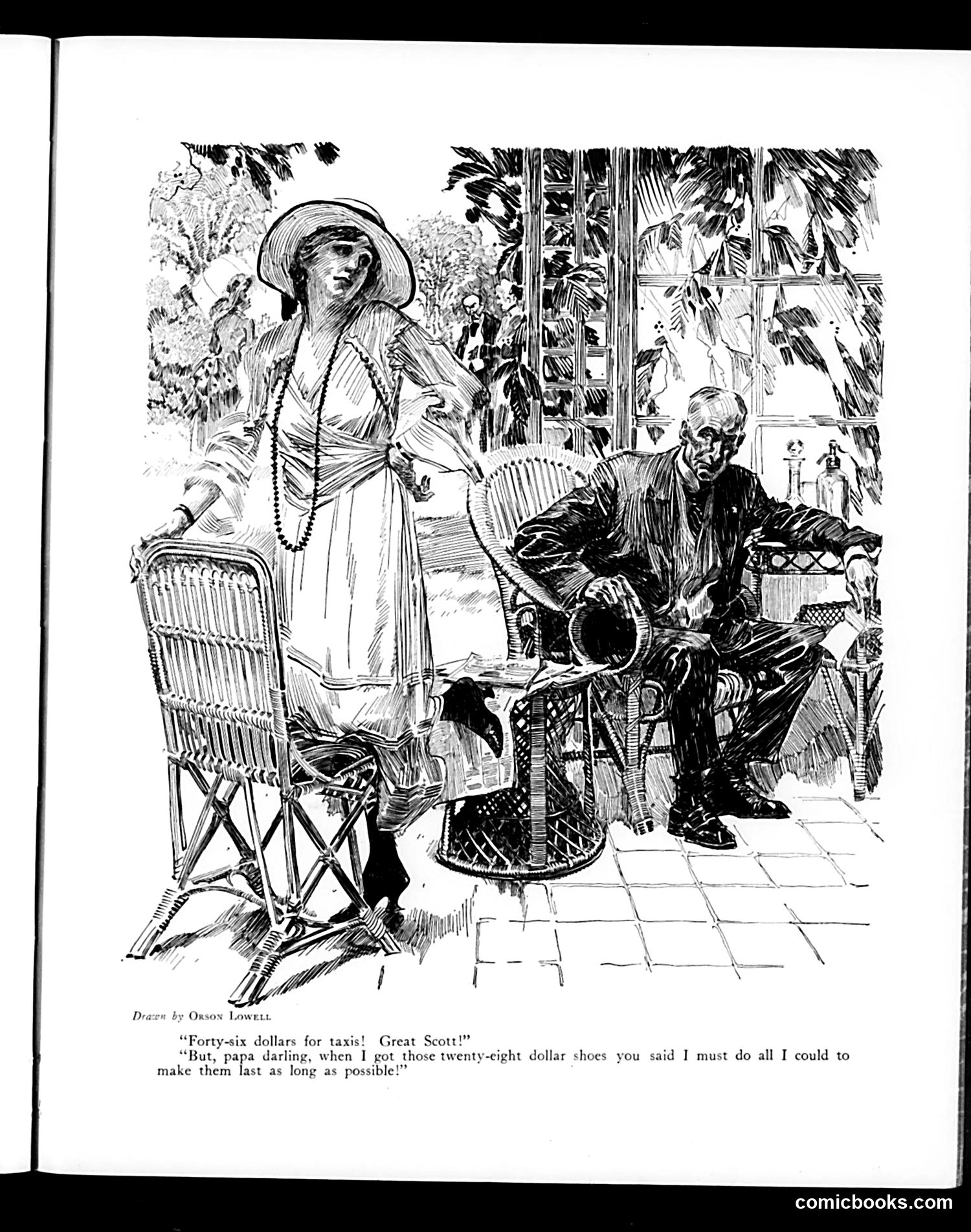
This single-panel cartoon satirizes the hypocrisy of a wealthy father's financial advice. The man expresses shock at his daughter's $46 taxi bill, while she points out he previously insisted she economize on her $28 shoes—an expensive purchase by early 20th-century standards. The joke operates on contradiction: the father demands thrift regarding her footwear yet apparently allows extravagant cab expenses. The daughter cleverly uses his own words against him, suggesting she *is* following his frugality directive by wearing out the costly shoes through extensive use rather than replacing them. The satire likely critiques wealthy families' inconsistent attitudes toward spending and the absurdity of lecturing on economy while maintaining a lifestyle of significant luxury expenses. The illustration's domestic setting—a conservatory with elegant furnishings—emphasizes their affluence.
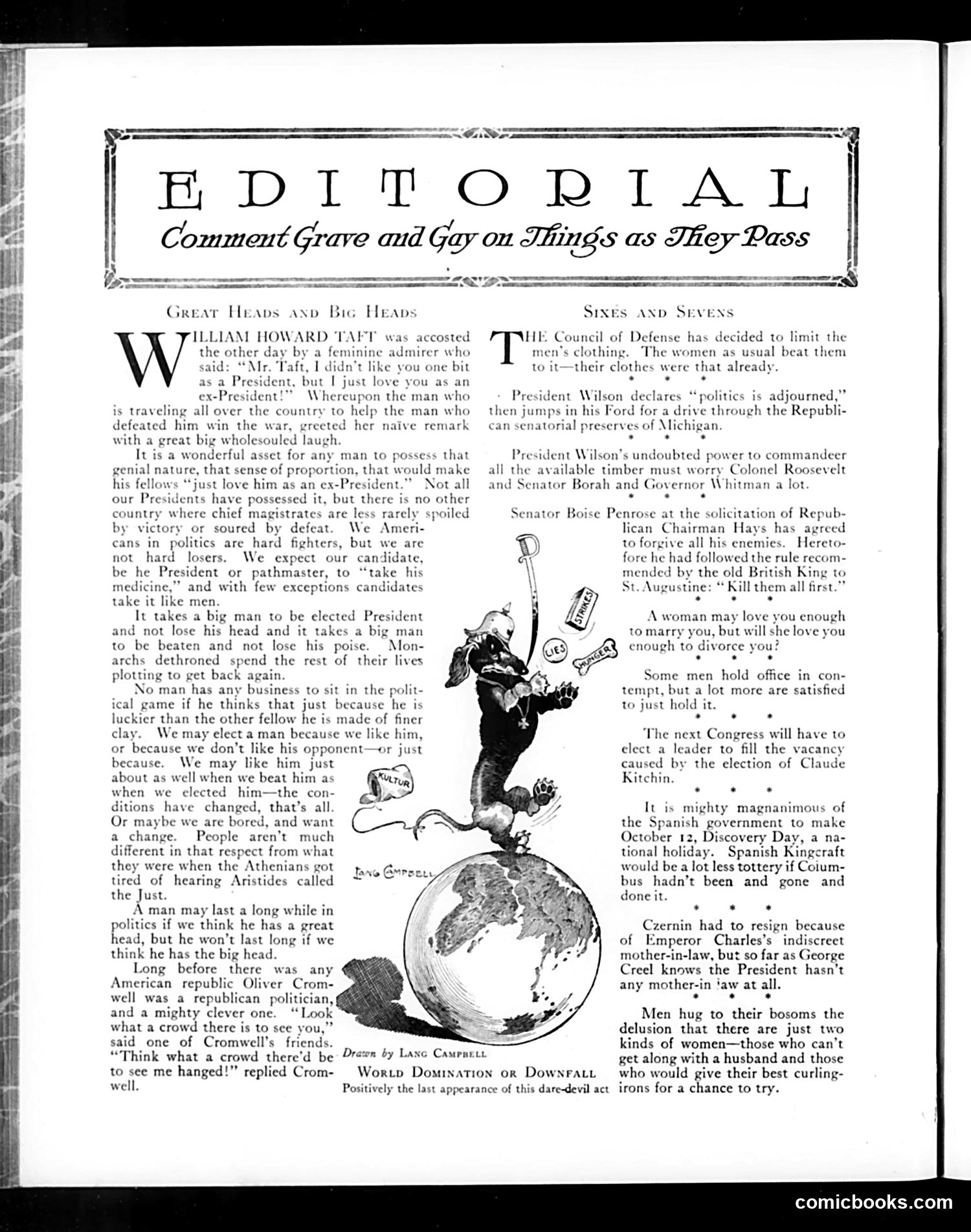
This editorial page from Judge magazine (date unclear from image) contains political commentary circa World War I era. **Main Cartoon**: Lang Campbell's illustration shows a devil-like figure juggling on a globe, captioned "World Domination or Downfall." This likely satirizes aggressive wartime politics and imperial ambitions. **Left Column ("Great Heads and Big Heads")**: Praises William Howard Taft's gracious acceptance of his 1912 electoral defeat and subsequent support for his successor. The piece celebrates American political culture where defeated leaders accept loss without bitterness, contrasting favorably with European monarchies. **Right Column ("Sixes and Sevens")**: Brief satirical quips about wartime policies, including Council of Defense clothing restrictions, President Wilson's political maneuvers in Michigan, and congressional leadership changes. References to "Claude Kitchin" and "Czernin" (Austro-Hungarian Foreign Minister) suggest WWI-era context. The overall tone celebrates American democratic resilience while mocking contemporary political figures and wartime bureaucratic measures.
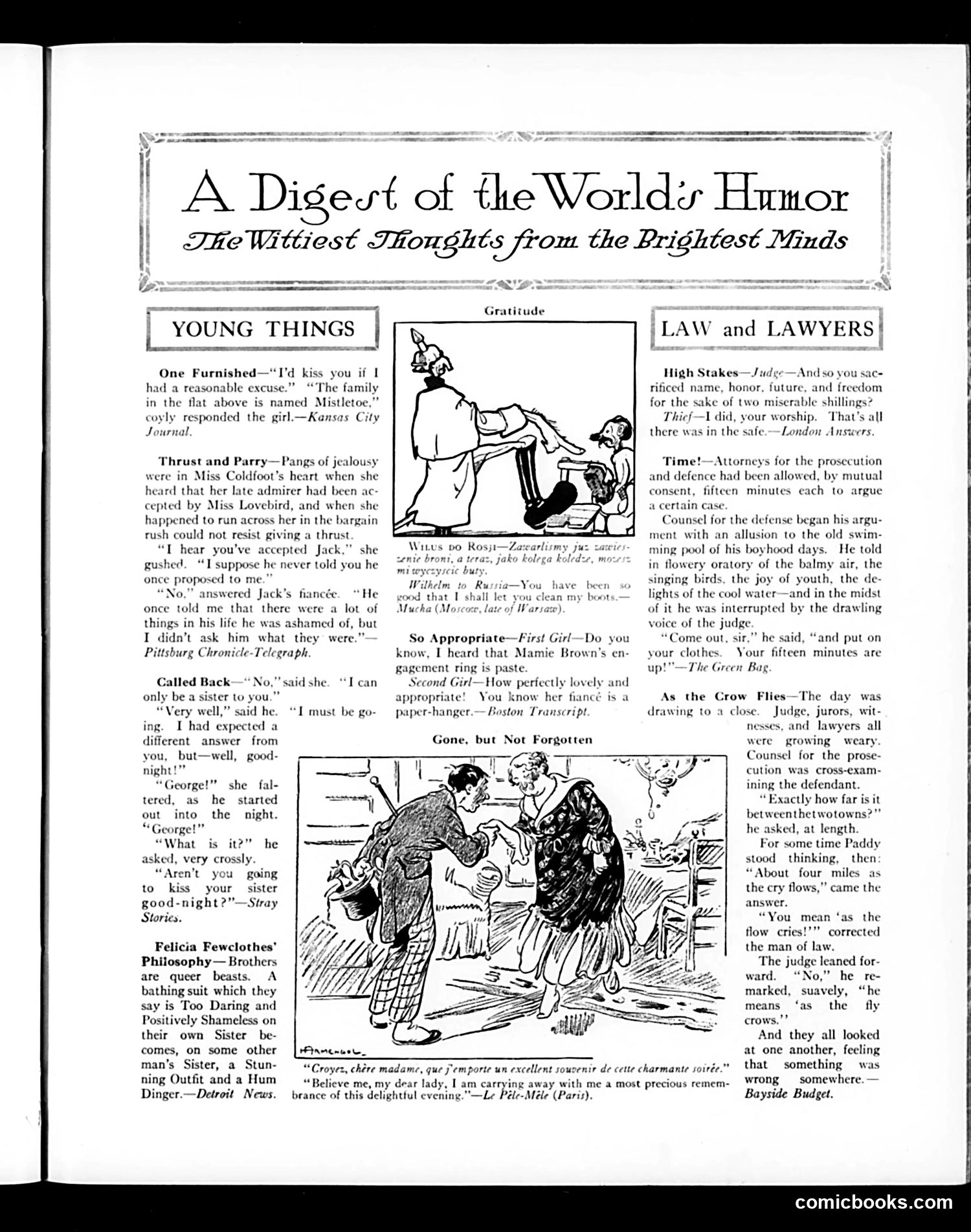
This page collects brief humorous anecdotes organized by topic. The central cartoon depicts a French gentleman gallantly complimenting a woman, illustrating the "Gone, but Not Forgotten" section's joke about romantic flattery. The humor relies on early 20th-century social conventions: young romance involving mistletoe and kissing, jealousy among suitors, appropriate courtship behavior, and gender roles. The "Law and Lawyers" section satirizes courtroom incompetence through witty exchanges—a judge interrupting flowery oratory, attorneys wasting time, and confused testimony about distances "as the crow flies" descending into linguistic absurdity. "Felicia Fewclothes' Philosophy" mocks male double standards regarding women's swimwear modesty. The anecdotes assume readers share assumptions about propriety, class, and courtship rituals now largely obsolete, making several references difficult for modern audiences without historical context about dating norms and formal court proceedings.
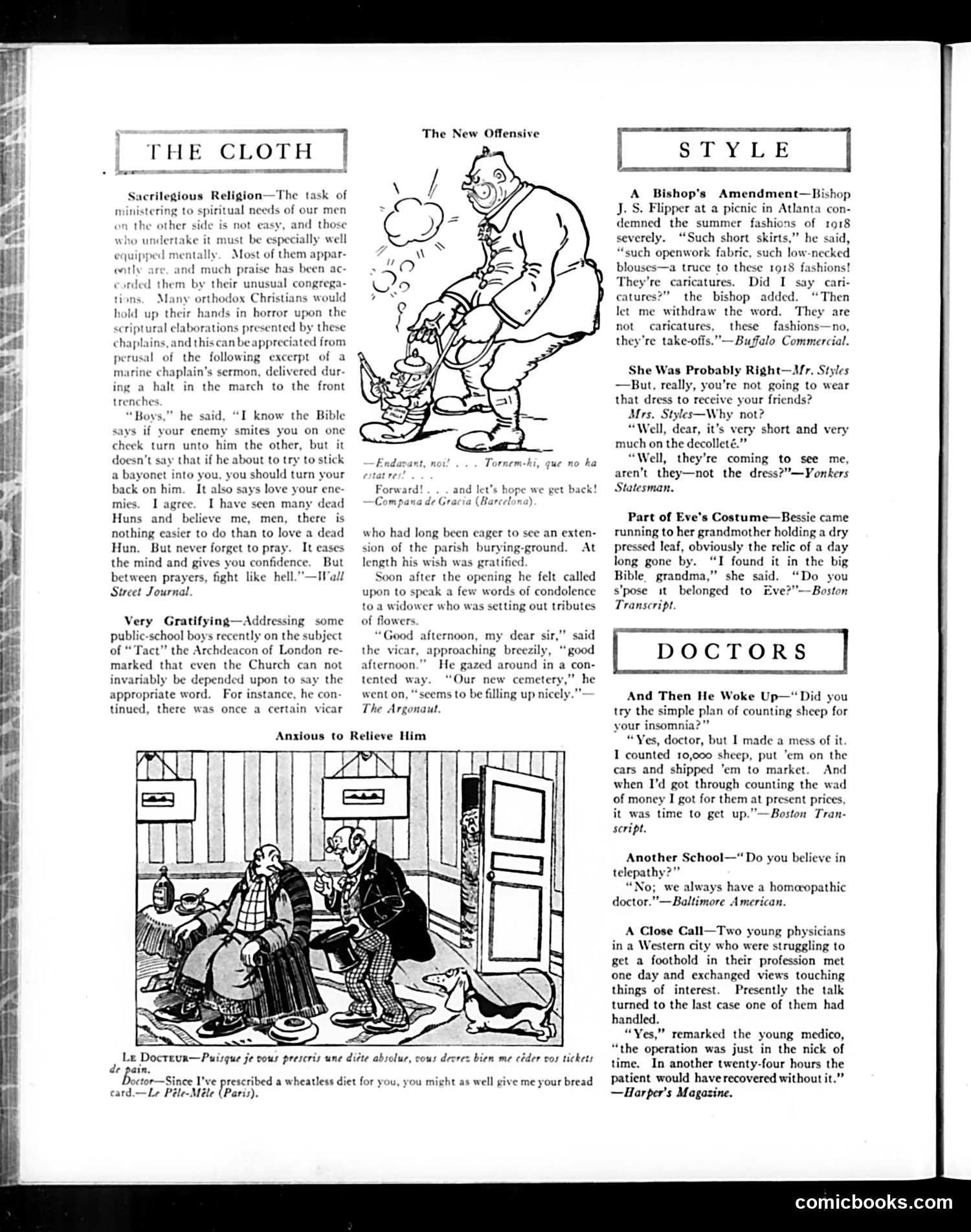
This page from Judge contains three satirical sections mocking WWI-era attitudes and society: **"The Cloth"** critiques military chaplains' theology. The cartoon and text mock a chaplain's sermon justifying violence against Germans by selectively interpreting Christian pacifism—arguing soldiers can ignore "turn the other cheek" when facing bayonets, and that loving dead enemies is easier than loving live ones. The satire targets how religious figures rationalize warfare. **"Style"** section ridicules 1918 women's fashion and religious hypocrisy. A bishop condemns short skirts and low necklines as immoral "caricatures," then admits they're actually "take-offs" (imitations/jokes). The dialogue mocking a woman wearing a revealing dress suggests absurdity in prioritizing appearance over substance. **"Doctors"** presents three jokes about medical incompetence: a patient's sheep-counting insomnia "cure" causing financial chaos, dismissal of telepathy in favor of homeopathy, and a surgeon's risky operation timing. These mock doctors' pretension and ineffectiveness. The overall theme: wartime and postwar society's moral contradictions, hypocrisy, and absurdity.
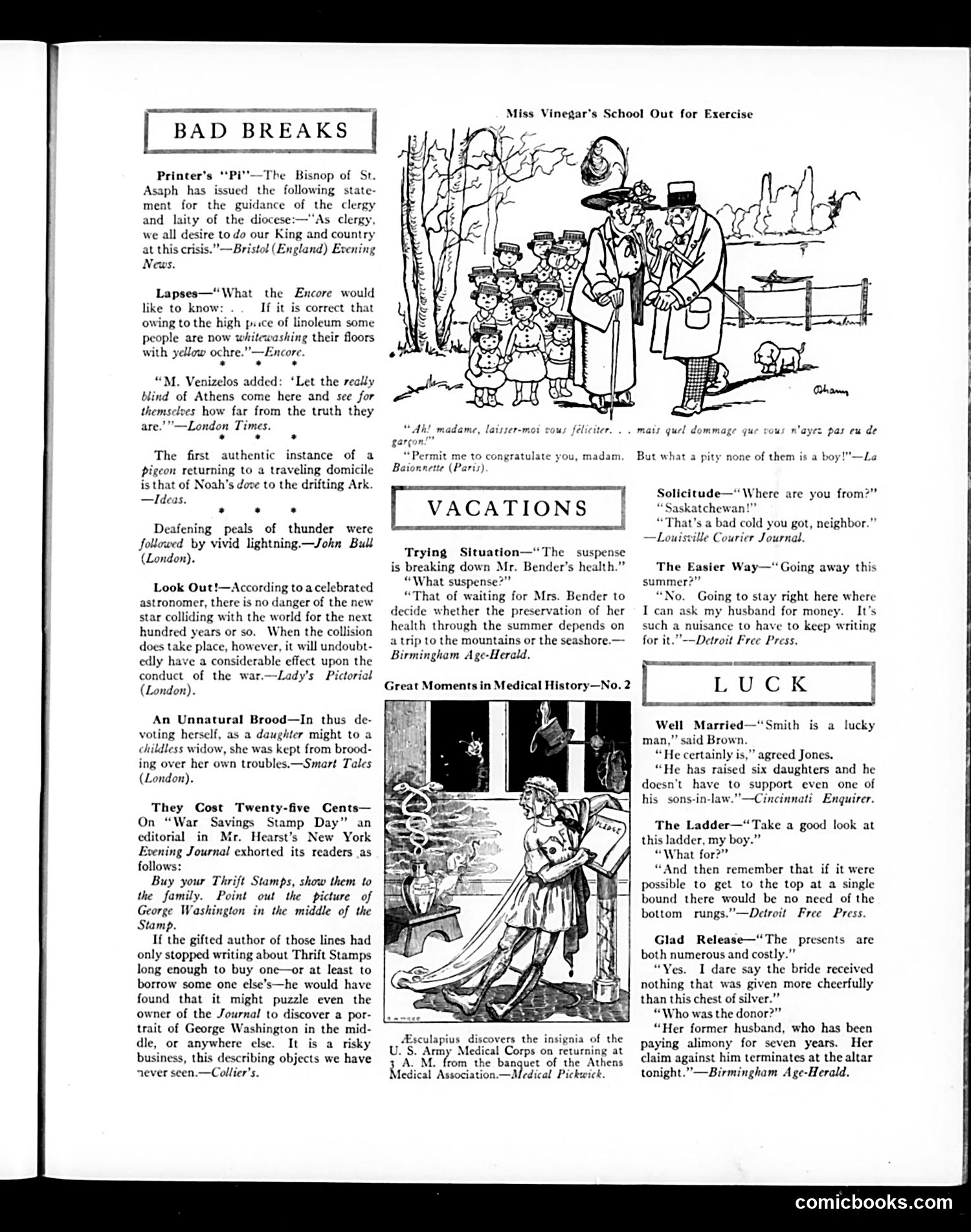
This page from Judge magazine collects brief satirical observations under sections titled "Bad Breaks," "Vacations," and "Luck." The **"Bad Breaks"** section mocks newspaper and publication errors through real examples: a bishop's awkward phrasing about duty, confusion over linoleum prices, and most pointedly, a Hearst newspaper editorial praising War Savings Stamps featuring George Washington's portrait—when no such portrait exists on the stamps. This ridicules editorial carelessness. The **cartoon** shows a French schoolmistress disappointed that all her pupils are girls, lamenting "what a pity none of them is a boy"—a gendered joke about educational outcomes. The **"Vacations"** and **"Luck"** sections are brief domestic humor pieces about marital strain (wives' indecision about summer trips) and the financial advantages of having only daughters. Overall, this reflects typical early 20th-century American satirical humor: correcting media blunders, gender-based jokes, and marital comedy—lightweight social commentary characteristic of Judge's approach.
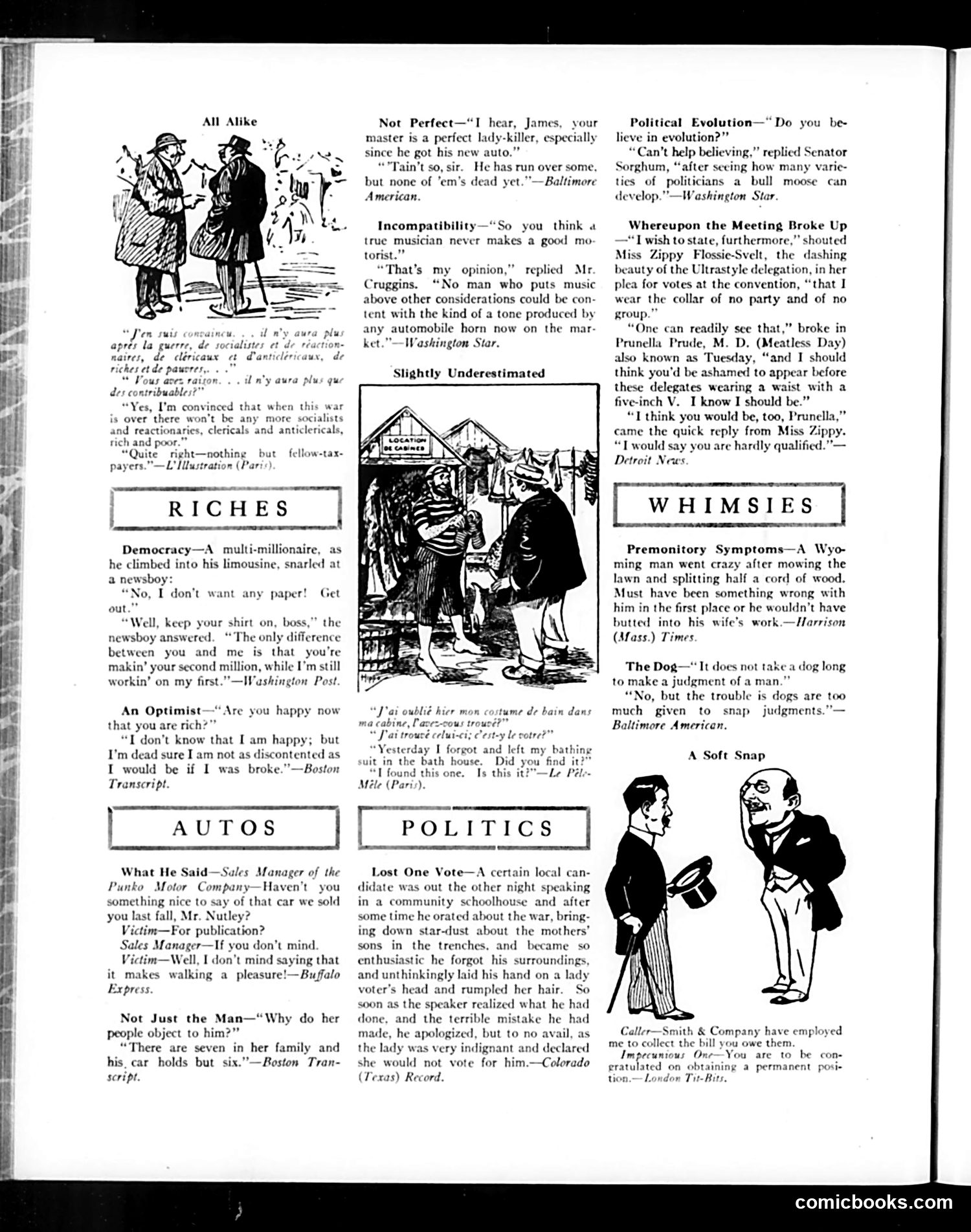
This page from *Judge* magazine contains satirical short jokes organized by topic. Key themes: **"Riches" section**: Jokes mocking wealthy people's pretensions. A millionaire demands "no paper" from a newsboy, who quips that the only difference between them is the millionaire's ahead by a million dollars—sharp commentary on class inequality. **"Autos" section**: Early automobile humor. Cars were new luxury items; jokes mock owners' poor driving and cars' unreliability ("makes walking a pleasure"). **"Politics" section**: References to contemporary political figures like "Senator Sorghum" (likely a generic politician name) and "Bull Moose" (Theodore Roosevelt's 1912 Progressive Party). One joke depicts a candidate losing a female voter's support after patronizingly touching her hair—commentary on women's emerging political voice. **"Whimsies" section**: Light observational humor about human nature. The overall tone reflects early 20th-century American middle-class attitudes: skepticism toward wealth, anxiety about new technology, and emerging women's suffrage debates.
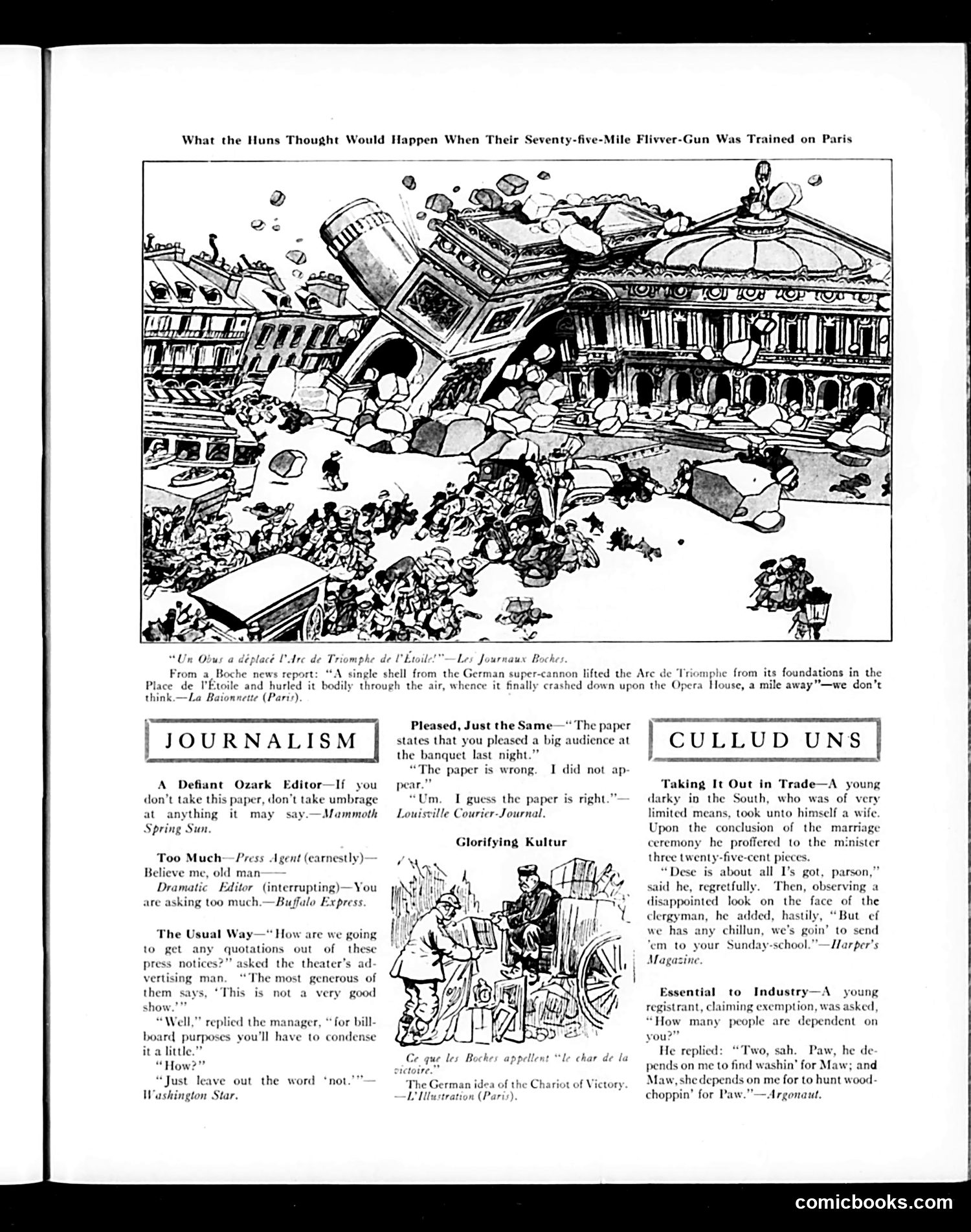
The top cartoon satirizes German military confidence during World War I. The "seventy-five-mile Flivver-Gun" (a joking reference to a German cannon) is depicted destroying Paris landmarks—the Arc de Triomphe crashes into the Opera House. The caption attributes the image to a German newspaper, suggesting Germans imagined Paris's destruction. This is wartime American satire mocking enemy boasts. Below are four brief humor columns. "Journalism" and "Cullud Uns" sections contain jokes about newspaper editors, theater advertising, and a racist dialect joke about a Black southern minister. The "Glorifying Kultur" cartoon references German militarism ("Chariot of Victory"). The page reflects 1910s-era Judge magazine: anti-German WWI propaganda mixed with casual racism common to the period. Modern readers should recognize both the historical context (wartime satire) and the deeply offensive racial stereotyping.
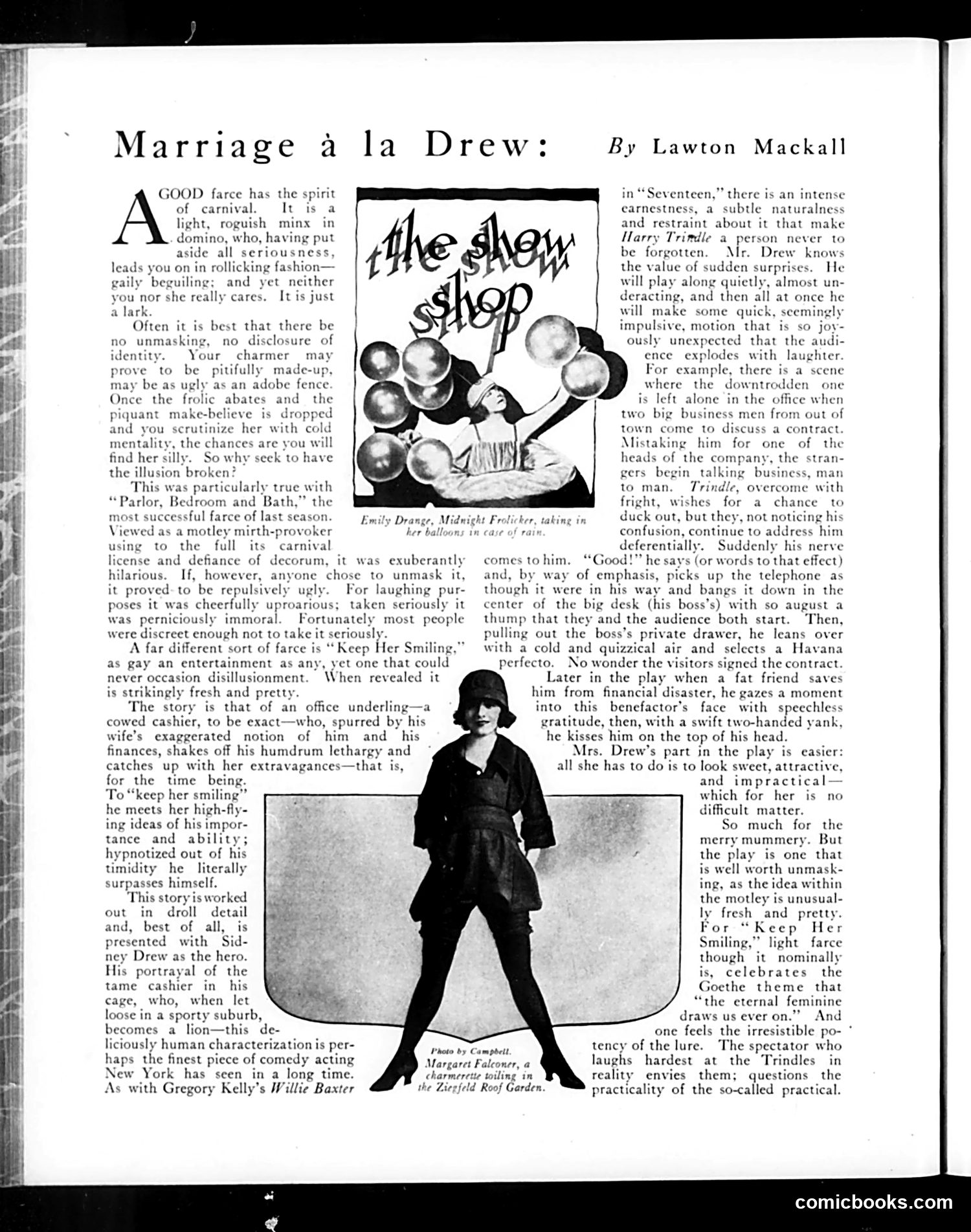
This is a theater criticism piece reviewing two farces starring Sidney Drew. The critic praises "Keep Her Smiling," a light comedy about a timid office cashier whose wife's extravagant spending habits inspire him to become more assertive. Drew plays this everyman character. The review contrasts this with "Parlor, Bedroom and Bath," which the critic argues works only as pure spectacle; examining its plot reveals it to be "repulsively ugly" and "perniciously immoral." The piece celebrates Drew's subtle comic acting—his ability to play understated, then suddenly surprise audiences with an unexpected physical gesture or expression. The critic considers this "perhaps the finest piece of comedy acting New York has seen in a long time," comparing Drew favorably to Gregory Kelly in "Willie Baxter." The accompanying photographs show Emily Drange performing and Margaret Falconer in costume, illustrating the production.
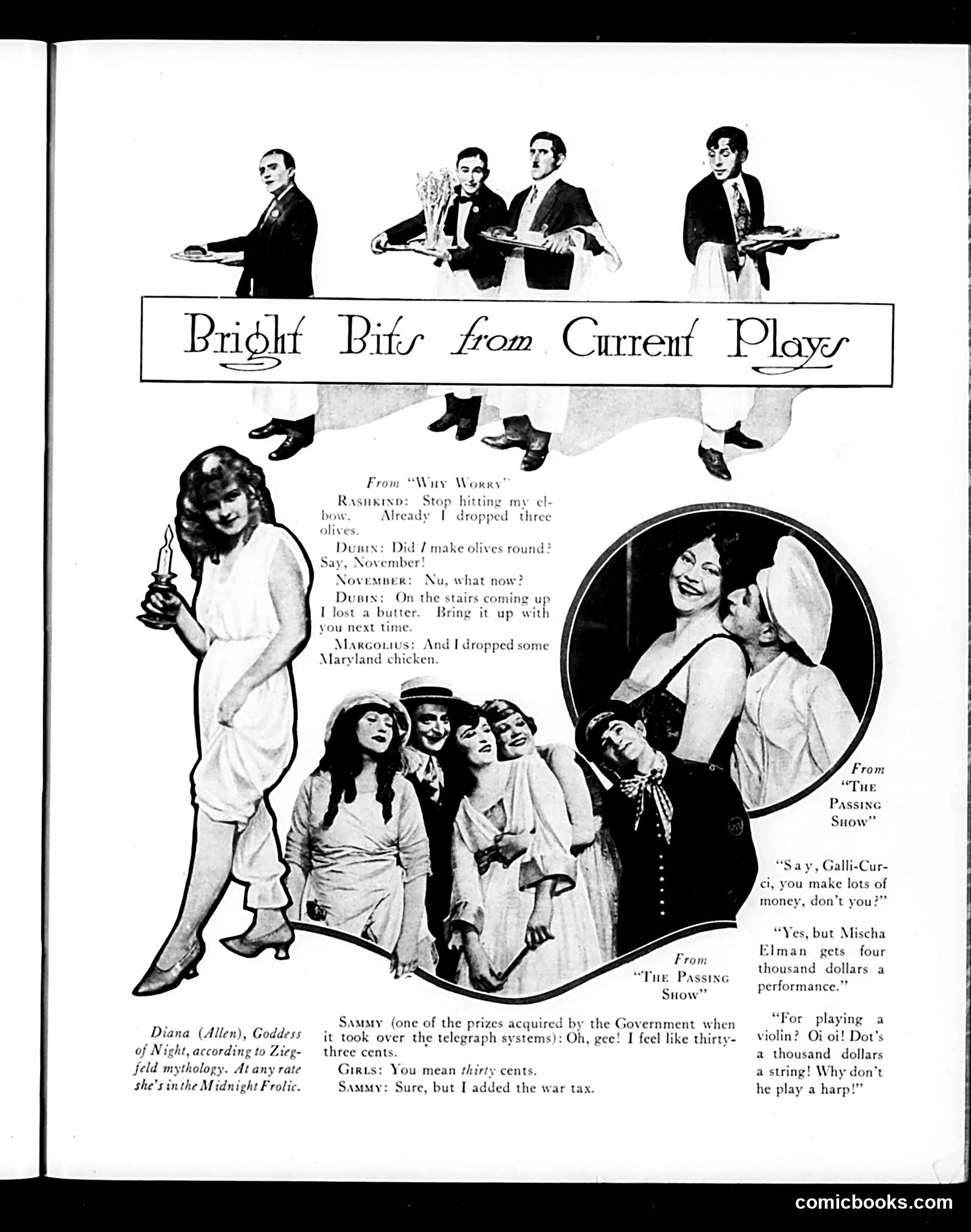
This page collects humorous quotations from Broadway productions. The top shows waiters serving at what appears to be an upscale restaurant or theater establishment. The jokes mock wartime economic conditions and profiteering. In "Why Worry," characters dropping food (olives, butter, chicken) joke about carelessness. In "The Passing Show," a character named Sammy—identified as a government telegraph operator—complains of having only "thirty-three cents" worth of energy, then adds "the war tax," satirizing how wartime taxes inflated prices on everything, even metaphorically. The final joke compares violinist Mischa Elman's four-thousand-dollar performance fee to a harp, with an ethnic Yiddish-inflected voice (indicated by "Oi oi! Dot's") expressing shock at the cost per string. This mocks both classical musicians' inflated salaries and likely reflects xenophobic attitudes toward immigrant performers during the WWI era.
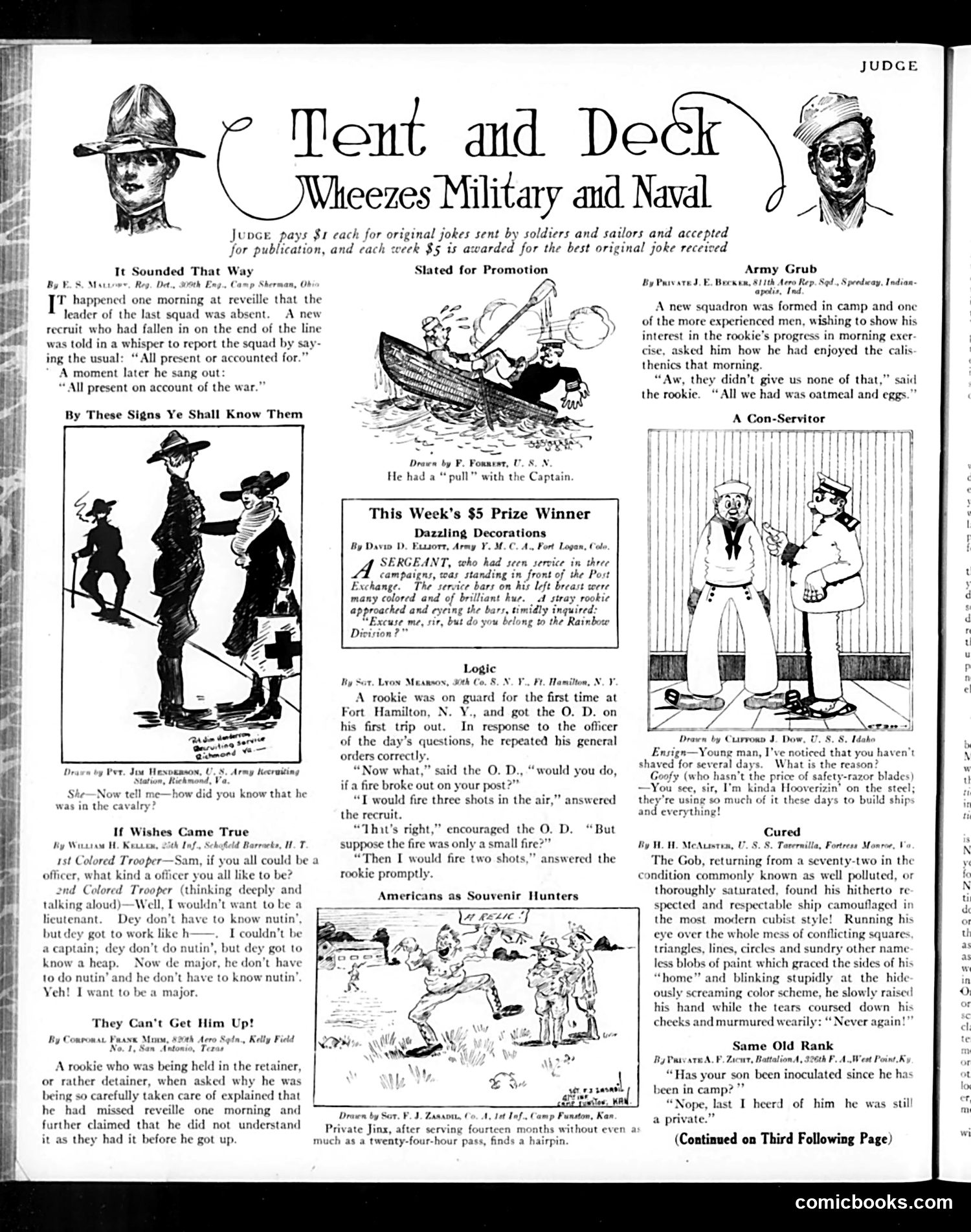
This Judge magazine page collects humorous anecdotes from American soldiers and sailors during World War I. The jokes target military life's absurdities: recruits mishearing commands, officers' arbitrary hierarchies, and the gap between enlisted men's understanding and military procedure. Key themes include: - **Class/racial humor**: Multiple jokes feature dialect-written African American soldiers ("1st Colored Trooper"), reflecting the era's casual racism - **Military stupidity**: A rookie fires warning shots for small fires, a soldier doesn't understand reveille happens while sleeping - **Food complaints**: Basic rations (oatmeal and eggs) contrasted with expected meals - **Wartime rationing**: "Hooverizin'" references President Hoover's conservation efforts The cartoons mock how military bureaucracy creates absurd situations through miscommunication and rigid hierarchies. References to "Rainbow Division" and "service bars" reflect specific WWI units and insignia. The humor is fundamentally about ordinary soldiers finding comedy in institutional dysfunction.
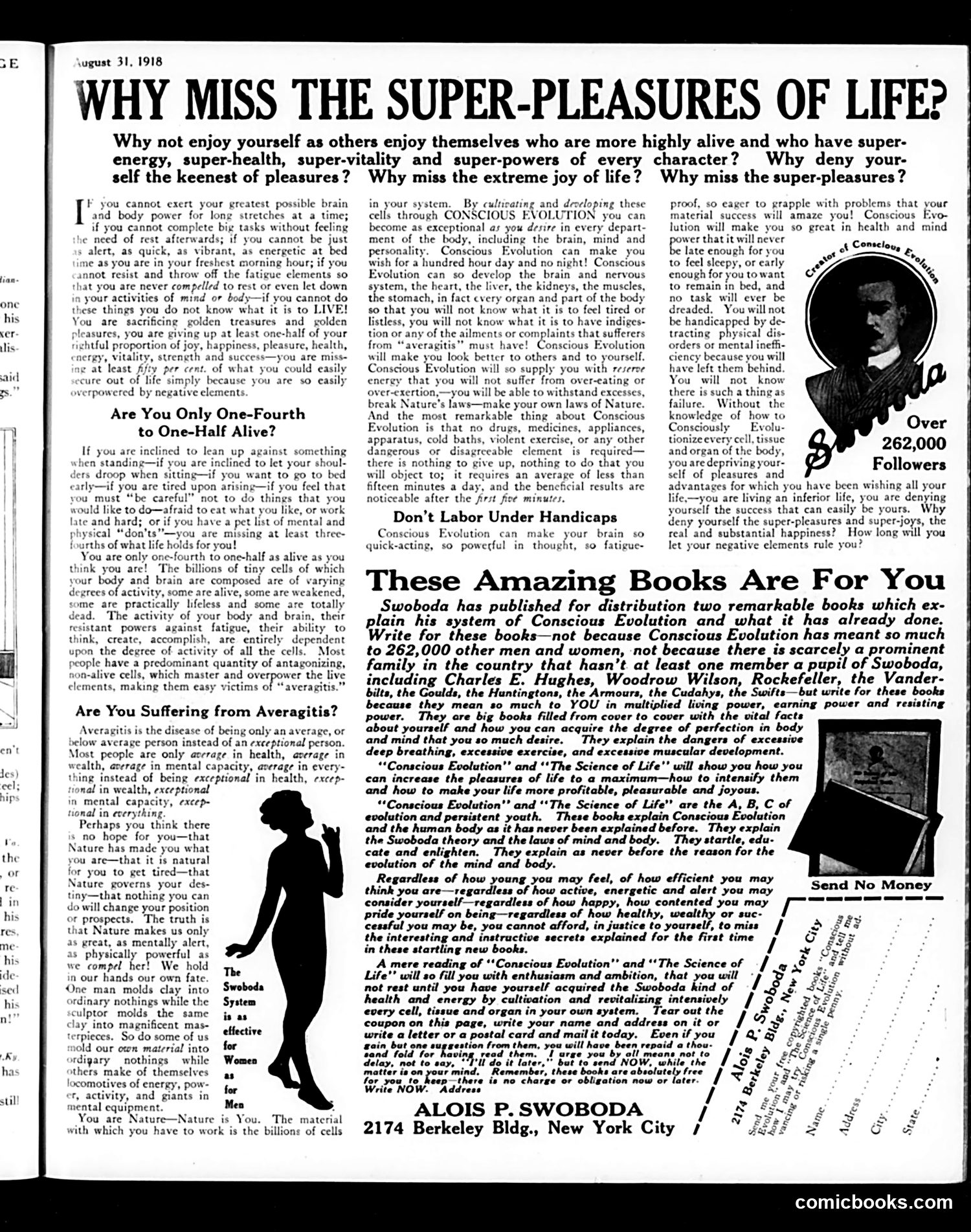
This 1918 *Judge* magazine page is primarily **advertising copy** for self-help books by Alois P. Swoboda promoting his "Conscious Evolution" system, not satire or political commentary. The text uses pseudo-scientific language ("billions of tiny cells") to pitch a self-improvement philosophy claiming readers are only living at "one-fourth to one-half" their potential. It invents a disease called "averagitis"—being average instead of exceptional—and promises that willpower and mental discipline can transform one's body and mind. The silhouettes show a slouching, tired figure contrasted with an energetic one, visually reinforcing the pitch. The rhetoric is characteristic of early 20th-century American "New Thought" self-help movements that promised health and success through mental effort alone, often targeting anxious middle-class readers. There is **no cartoon satire here**—this is straightforward (if hyperbolic) product promotion using wellness pseudoscience common to the era.
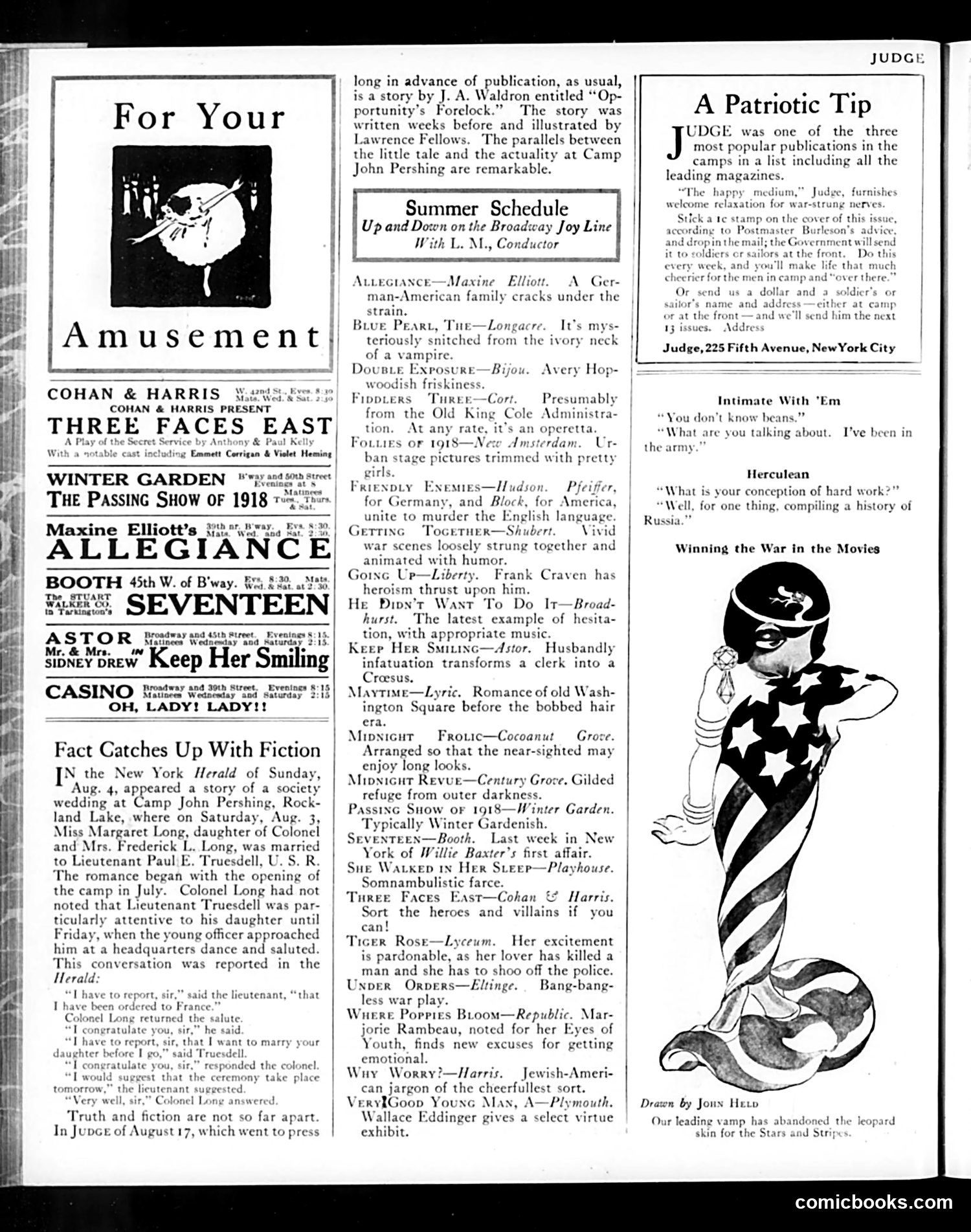
This is primarily a theatrical advertisement page from Judge magazine (dated August 17, 1918, based on the text). The main editorial content is "A Patriotic Tip," which encourages readers to support soldiers by sending them stamped envelopes or dollar donations through Judge's office—a wartime patriotic appeal. The right side features a patriotic cartoon by John Held Jr. showing a figure in military/patriotic attire (stars and stripes visible), illustrated in Held's characteristic style, captioned "Winning the War in the Movies"—likely satirizing how Hollywood portrayed WWI. The bulk of the page lists Broadway theater productions with brief, witty reviews. These reviews employ Judge's satirical house style, offering snappy critiques. Notable titles reference the war ("Under Orders," "He Didn't Want to Do It"), reflecting WWI's cultural dominance in 1918. The left column describes a coincidence: a Herald newspaper story about a real soldier proposing to Colonel Long's daughter mirrored a Judge fiction story published weeks earlier—demonstrating how "fact catches up with fiction."
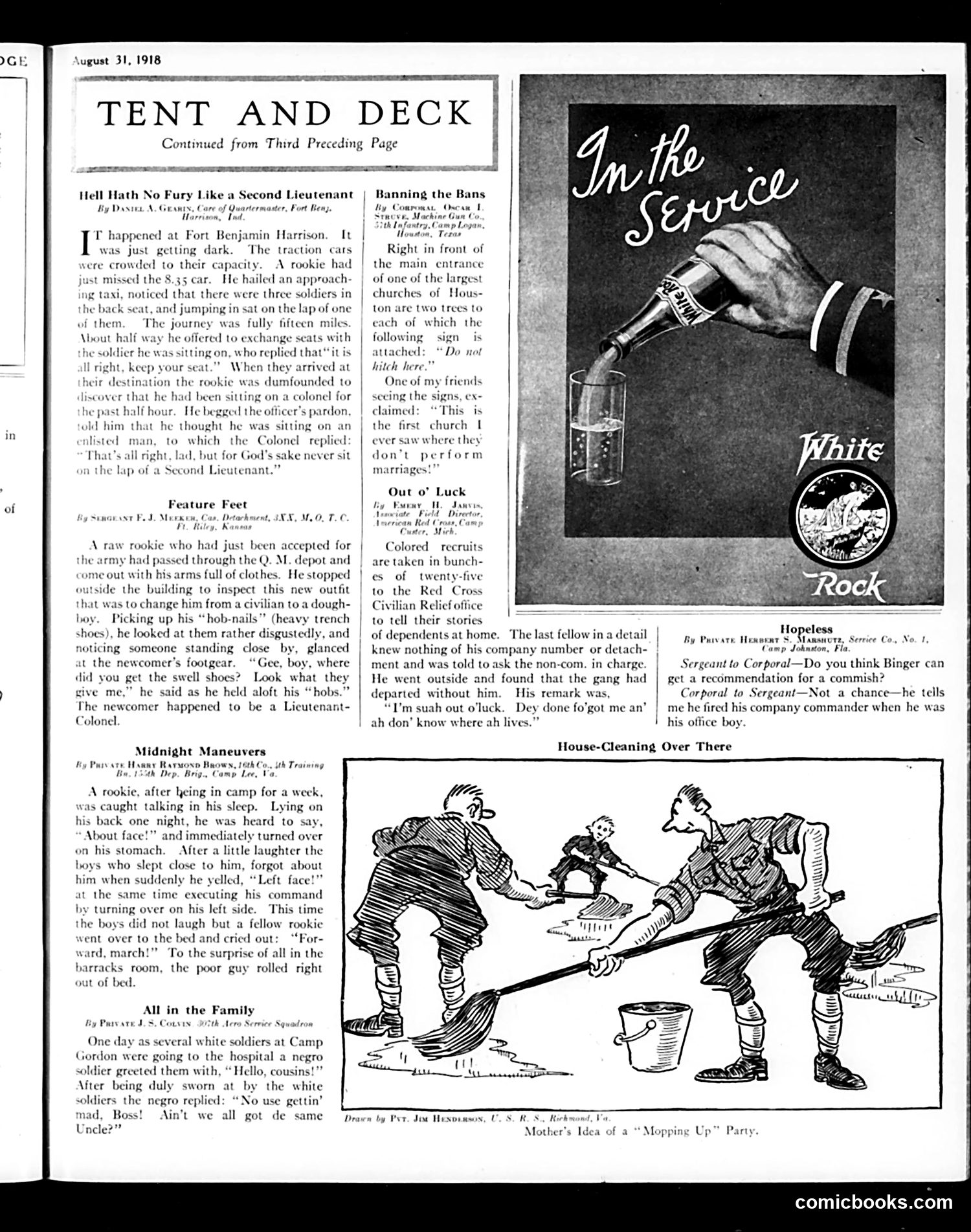
This page contains several short humorous anecdotes about World War I military life, reflecting common soldier experiences during the final months of the war. **Main Themes:** The jokes play on military rank hierarchies, recruits' ignorance of protocol, and racial dynamics among American soldiers. Multiple stories humorously depict enlisted men unknowingly disrespecting officers ("Hell Hath No Fury," "Feature Feet") or misunderstanding military procedures ("Out o' Luck," "Midnight Maneuvers"). **Notable Content:** The "All in the Family" anecdote uses dialect humor to depict a Black soldier addressing white soldiers as "cousins," then offering a racial joke about shared ancestry via slavery ("de same Uncle"). This reflects contemporary attitudes toward race without endorsing them—it's presented as a soldier's quip. The "House-Cleaning Over There" cartoon (right) shows soldiers scrubbing, likely depicting domestic camp duties. **Context:** Published August 1918, as WWI neared its end, these pieces capture soldier culture—the anxiety of raw recruits, rank confusion, and the era's casual racial humor found in mainstream publications.
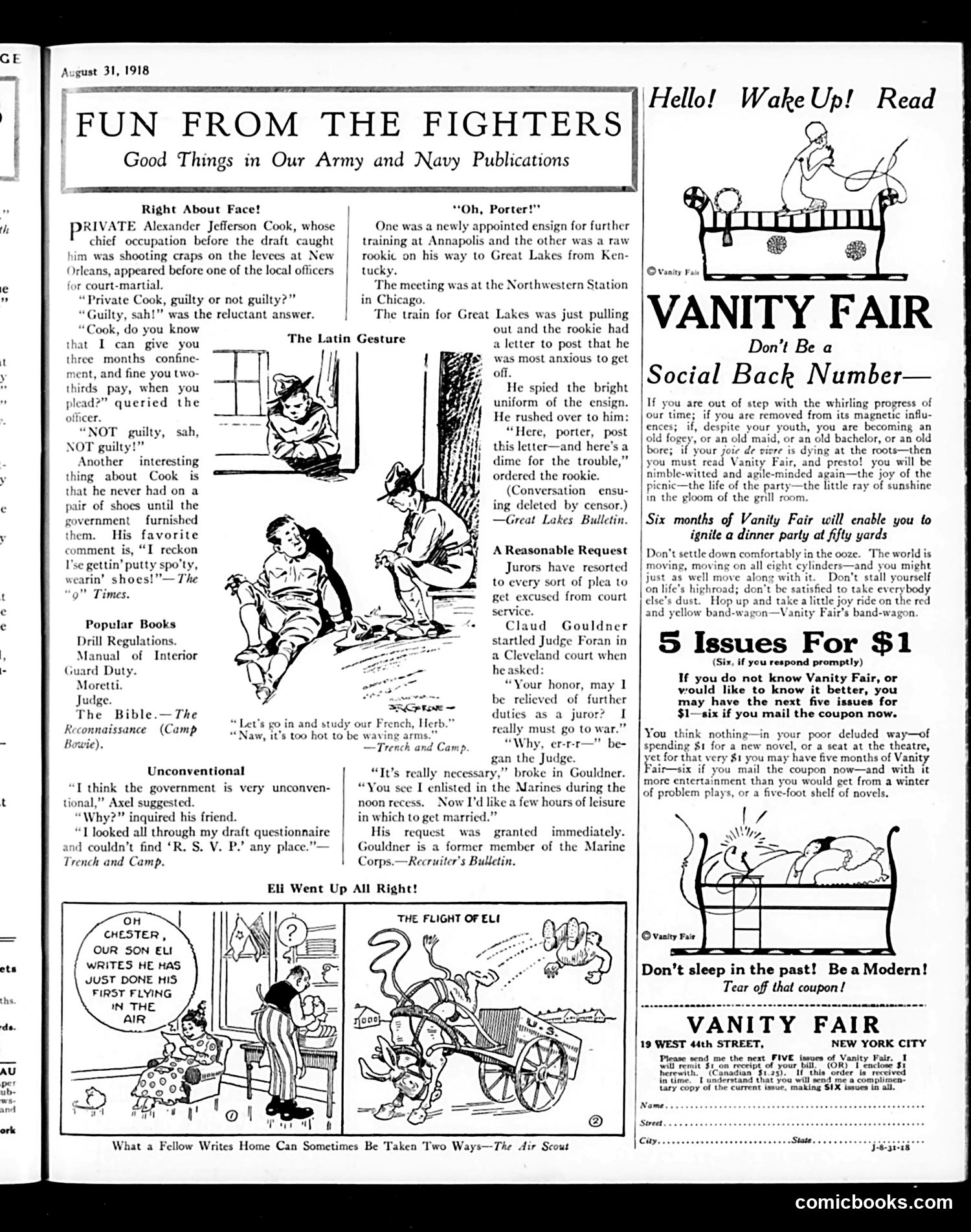
This page collects humorous anecdotes from soldiers and sailors during World War I, reflecting the magazine's patriotic support for the war effort. **"Right About Face!"** mocks Private Alexander Jefferson Cook, portrayed through racist dialect as a Southern Black man drafted into the Army. The joke plays on his illiteracy and supposed ignorance—he claims "NOT guilty" when asked if he understands military charges, suggesting stupidity. **"The Latin Gesture"** depicts a rookie mistaking an ensign for a porter, requesting he mail a letter. The humor relies on the recruit's ignorance of naval hierarchy and appearance. **"A Reasonable Request"** presents anecdotes about jurors and soldiers seeking excuses from duty—treated as cowardly or foolish. The page reflects 1918 attitudes: casual racism, mockery of enlisted men's intelligence, and patriotic glorification of military service. The Vanity Fair advertisements on the right reinforce aspirational, upper-class messaging contrasting sharply with the working-class soldiers depicted in the "fun."
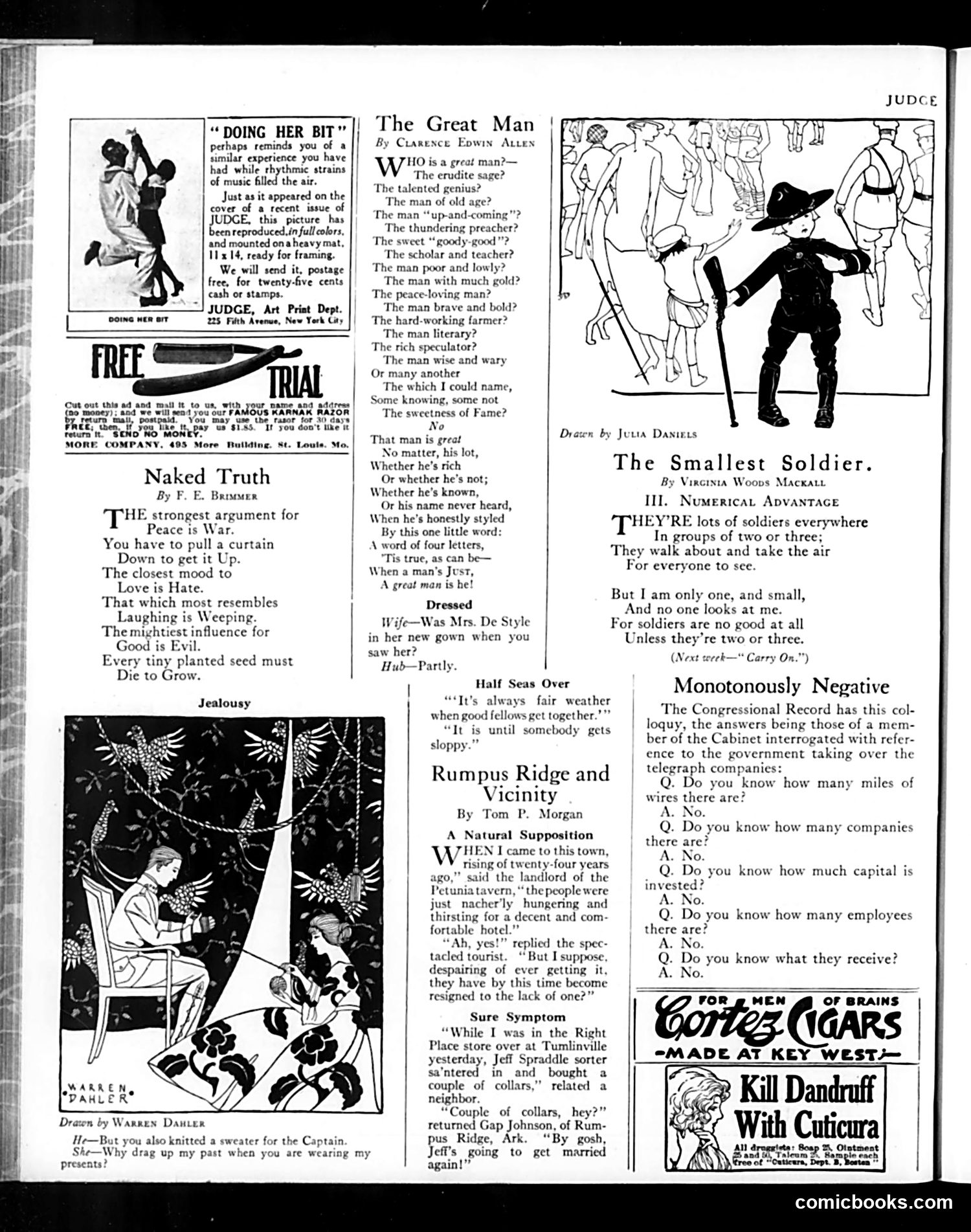
This page from *Judge* contains several satirical pieces reflecting early 20th-century American concerns: **"The Great Man"** by Clarence Edwin Allen is a philosophical poem questioning what defines greatness—wealth, morality, intelligence, or labor. The illustration shows a small figure among larger crowds, emphasizing the everyman's insignificance despite honest work. **"The Smallest Soldier"** by Virginia Woods Mackall satirizes military organization, with a lone soldier lamenting his invisibility compared to groups of soldiers who receive public attention. It mocks bureaucratic thinking about numerical efficiency. **"Monotonously Negative"** directly criticizes a Cabinet member's apparent incompetence during Congressional questioning about telegraph company takeover, showing government ignorance of basic operational facts. This reflects Progressive Era skepticism toward government expansion and competence. The remaining pieces are light humor and advertisements. Overall, the page expresses skepticism toward institutions—government, military, and corporate—while celebrating ordinary, honest individuals.
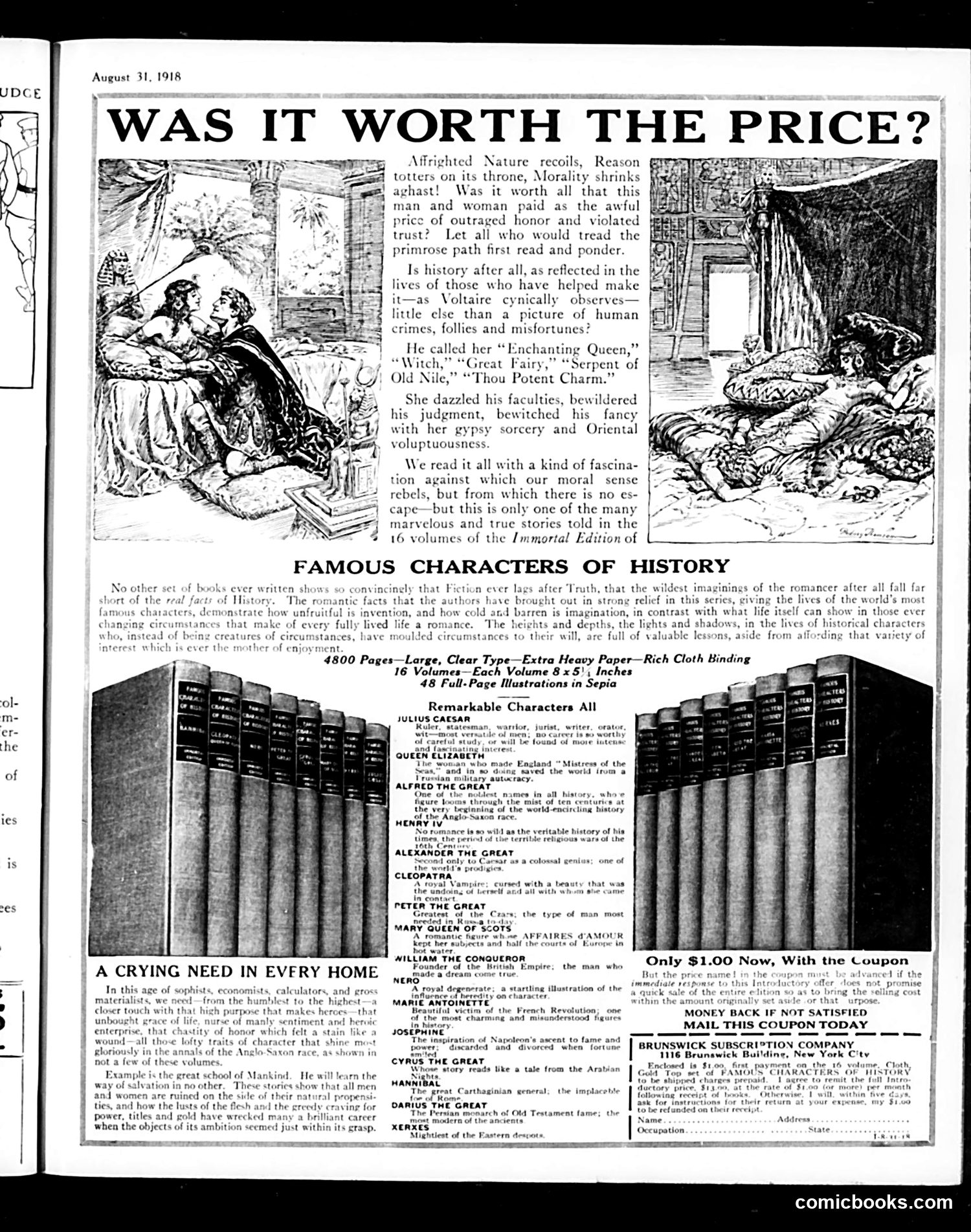
This page is primarily **advertising for a book series**, not political satire. The upper portion contains a moralistic narrative about a man and woman whose relationship violated "honor and trust," illustrated with period engravings. The text poses a rhetorical question about whether passion justified moral transgression—a common Victorian melodrama theme. The bulk of the page advertises the "Immortal Edition of Famous Characters of History," a 16-volume set published by Brunswick Subscription Company. It lists historical figures (Julius Caesar, Cleopatra, Peter the Great, Napoleon, Mary Queen of Scots, etc.) with brief descriptions emphasizing their dramatic lives and moral lessons. The framing text argues that studying history through these biographical narratives teaches valuable character lessons—contrasting "sophists, economists, calculators" with the "lofty traits of character" displayed by historical figures. The advertising copy positions the books as morally edifying for the home during WWI-era America.
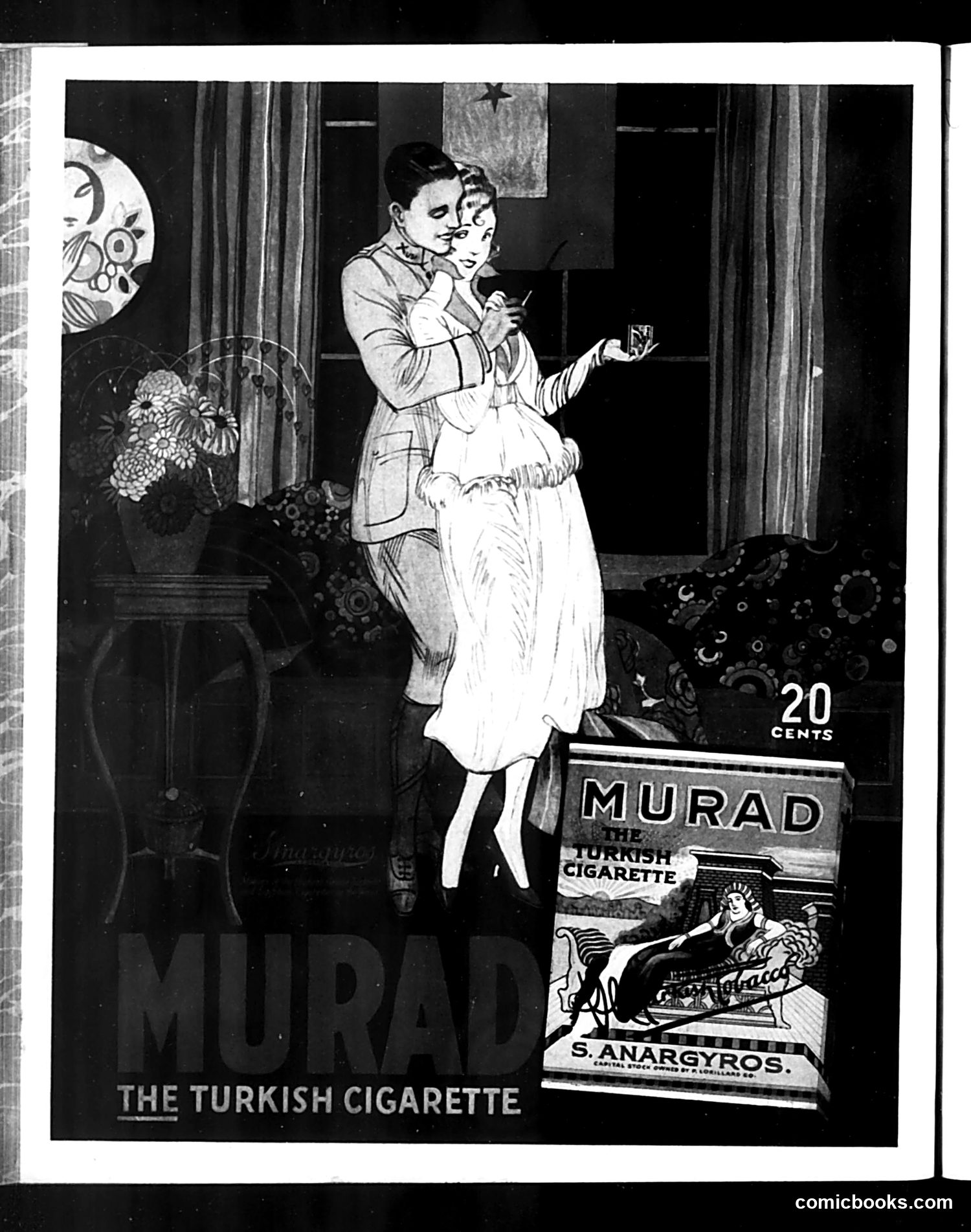
This is a **cigarette advertisement** for Murad Turkish cigarettes (20 cents), not political satire. The illustration shows an elegantly dressed woman in 1920s attire admiring herself in a mirror while holding a cigarette package. The advertisement leverages the era's association of Turkish cigarettes with **exotic sophistication and glamour**. The ornate interior setting, the woman's fashionable dress, and the mirror imagery suggest luxury and refinement—marketing cigarettes as a status symbol for modern, affluent consumers. The ad reflects early 20th-century advertising practices that used aspirational imagery and gender-coded luxury appeals to sell tobacco products without health warnings or regulatory restrictions.