
Judge, 1918-08-31 · page 22 of 32
Judge — August 31, 1918 — page 22: what you’re looking at
What you’re looking at
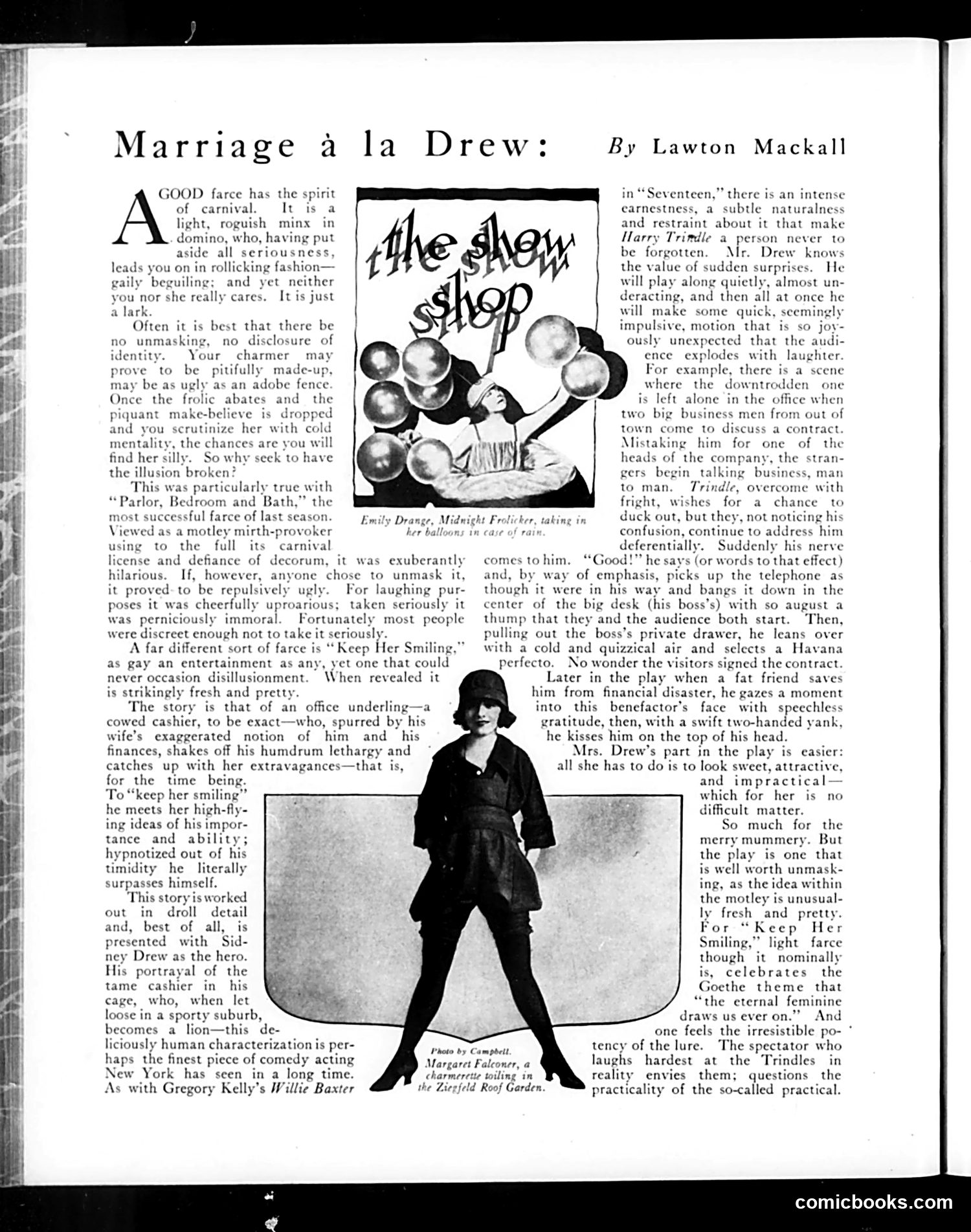
This is a theater criticism piece reviewing two farces starring Sidney Drew. The critic praises "Keep Her Smiling," a light comedy about a timid office cashier whose wife's extravagant spending habits inspire him to become more assertive. Drew plays this everyman character. The review contrasts this with "Parlor, Bedroom and Bath," which the critic argues works only as pure spectacle; examining its plot reveals it to be "repulsively ugly" and "perniciously immoral." The piece celebrates Drew's subtle comic acting—his ability to play understated, then suddenly surprise audiences with an unexpected physical gesture or expression. The critic considers this "perhaps the finest piece of comedy acting New York has seen in a long time," comparing Drew favorably to Gregory Kelly in "Willie Baxter." The accompanying photographs show Emily Drange performing and Margaret Falconer in costume, illustrating the production.
📄 Transcribed text from this page (OCR, searchable)
Machine-transcribed from the original scan — historical spelling and the odd misread are preserved.
: } | (Som ea eH Ve ae a * % BEN Marriage a GOOD farce has the spirit of carnival. It is a light, roguish minx in domino, who, having put aside all seriousness, leads you on in rollicking fashion— gaily beguiling nd yet neither you nor she really cares. It is just a lark. Often it is best that there be no unmasking, no disclosure of iden Your charmer may prove to be pitifully made-up, lobe fence d_ the may be as ugly as an Once the frolic abates a make-believe i } scrutinize her with cold mentality, the chances are you will find her silly. So why seck to have the illusion broken? This was particularly true with “Parlor, Bedroom and Bath,” the most successful farce of last season. Viewed as a motley mirth-provoker using to the full its carnival license and defiance of decorum, it hilarious. If, however, anyone chose to unmask it, it proved-to be repulsively ugly. poses it was cheerfully uproarious; was perniciously immoral. never occasion disillusionment is strikingly fresh and pretty. The story is that of an office cowed cash for the time being. ‘o “keep her smiling” he meets her high-fly- ing ideas of his impor- tance and ability; hypnotized out of his timidity he literally surpasses himself. This story is worked out in droll detail and, best of all, is presented with Sid- ney Drew as the hero. His portrayal of the tame cashier in his cage, who, when let loose in a sporty suburb, becomes a lion—this de- liciously human characterization is per- haps the finest piece of comedy acting New York has scen in a long time. y's Willie Baxter As with Gregory Kell Fortunately most people were discreet enough not to take it seriously. A far different sort of farce is ‘* Keep Her Smi as gay an entertainment as any, yet one that could When revealed it , to be exact—who, spurred by his wife’s exaggerated notion of him finances, shakes off his humdrum lethargy and catches up with her extravagances—that is, la Drew: By Lawton Mackall in “Seventeen,” there is an intense earnestness, a subtle naturalness and restraint about it that make Harry Trimdle a person never to be forgotten. Mr. Drew knows the value of sudden surprises. He will play along quietly, almost un- cting, and then all at once he will make some quick, seemingly impulsive, motion that is so joy ously unexpected that the aud ence explodes with laughte: For example, there is a scene where the downtrodden one left alone in the office when two big business men from out of town come to discuss a contract Mistaking him for one of the heads of the company, the stran- gers begin talking business, man to man. Trindle, overcome with fright, wishes for a chance to ra duck out, but they, not noticing his confusion, continue to address him deferentially. Suddenly his nerve comes tohim. “Good!” he says (or words to that effect) and, by way of emphasis, picks up the telephone as ‘or laughing pur- though it were in his way and bangs it down in the taken seriously it center of the big desk (his boss’s) with so august a thump that they and the audience both start. Then, pulling out the boss’s private drawer, he leans over ing,” with a cold and quizzical air and selects a Havana perfecto. No wonder the visitors signed the contract. Later in the play when a fat friend saves him from financial disaster, he gazes a moment into this benefactor’s face with speechless gratitude, then, with a swift two-handed yank, he kisses him on the top of his head. Mrs. Drew’s part in the play is easier: all she has to do is to look sweet, attractive, and impractical which for her is no difficult matter. So much for the merry mummery. But the play is one that is well worth unmask- ing, as the idea within the motley is unusual- ly fresh ‘and pretty. For “Keep Her Smiling,” light farce though it nominally is, celebrates the Goethe theme that “the eternal feminine draws us ever on.” And one feels the irresistible po- * tency of the lure. The spectator who laughs hardest at the Trindles in reality envies them; questions the practicality of the so-called practical. 'y Drange, her ba was exuberantly underling—a and his Photo by Campbett. Margaret Falconer, a charmerctic toiling in the Ziegfeld Roof Garden. comicbooks.com