
A complete issue · 36 pages · 1917
Judge — December 1, 1917
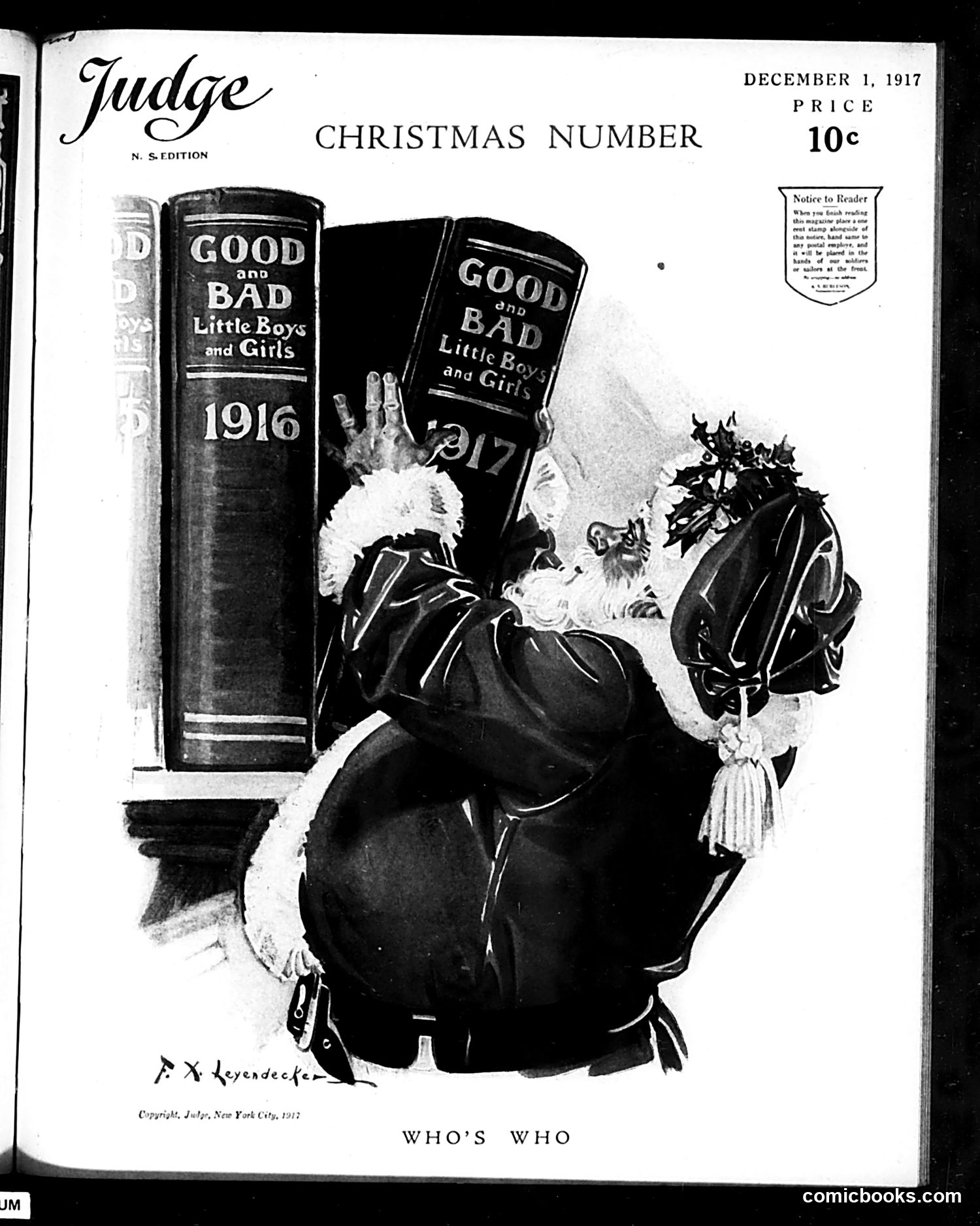
This cover depicts Santa Claus as a figure of moral judgment, holding two large books labeled "Good and Bad Little Boys and Girls" for 1916 and 1917. Santa appears to be carefully weighing or comparing these years, suggesting a commentary on children's behavior during America's involvement in World War I (the U.S. entered in April 1917). The cartoon's title "Who's Who" implies that Santa is evaluating the nation's moral character during wartime. The stark contrast between the two consecutive years likely reflects concerns about how the war was affecting American youth and society. The image suggests that 1917 presented new moral standards or challenges compared to the previous year, set against the backdrop of national sacrifice and changing values during the war.
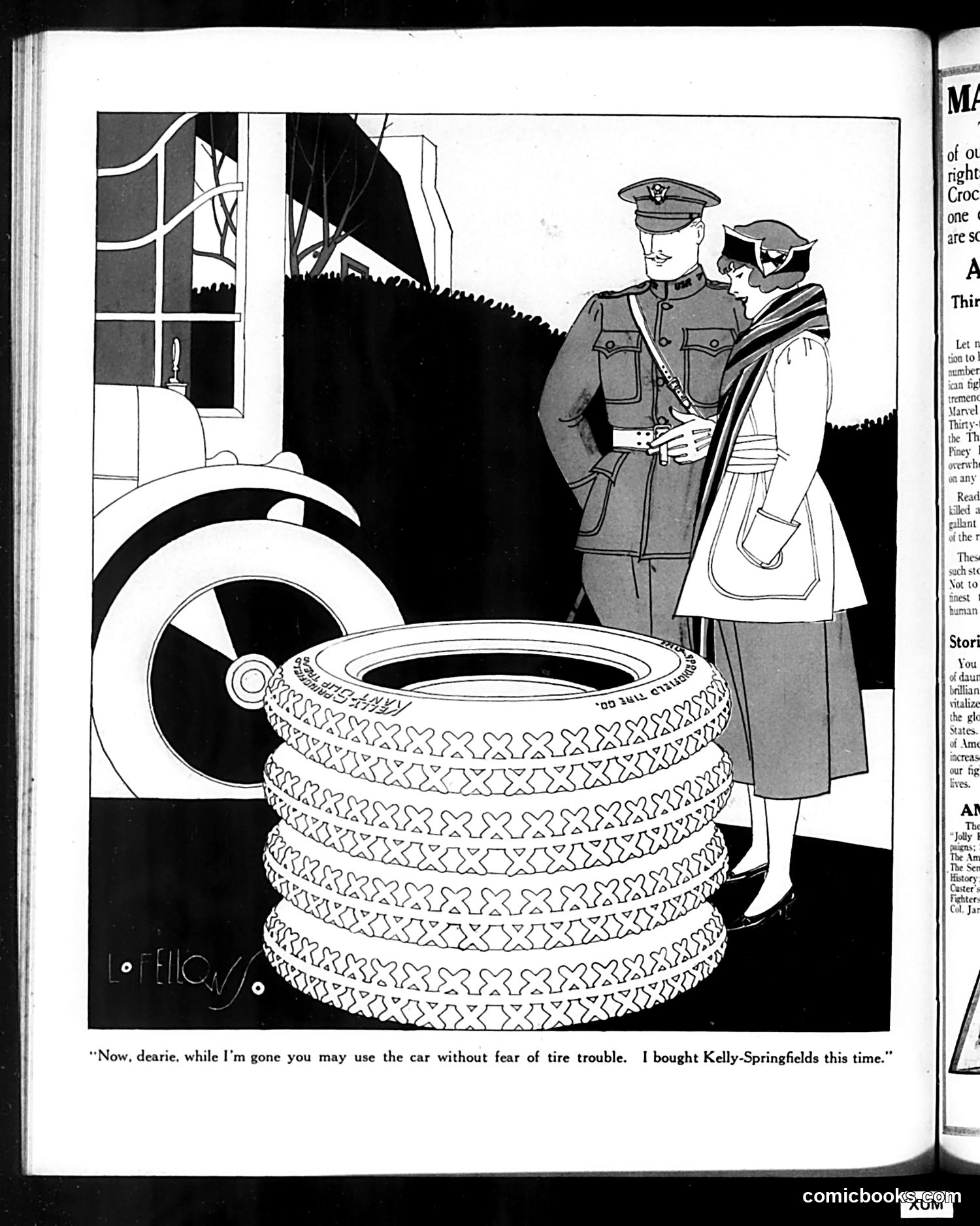
This is a commercial advertisement disguised as a cartoon, promoting Kelly-Springfield tires. The illustration shows a uniformed military officer (likely WWI-era based on the uniform style) speaking to a woman, with stacks of tires prominently displayed in the foreground. The joke relies on wartime anxiety: the officer assures the woman that while he's away, she can use "the car without fear of tire trouble" because he's purchased Kelly-Springfield tires. The humor plays on the dual concerns of the WWI home front—spousal worry about a soldier's departure, combined with practical concerns about tire durability during material shortages. It's essentially a patriotic sales pitch linking reliable tires to supporting the war effort and domestic stability.
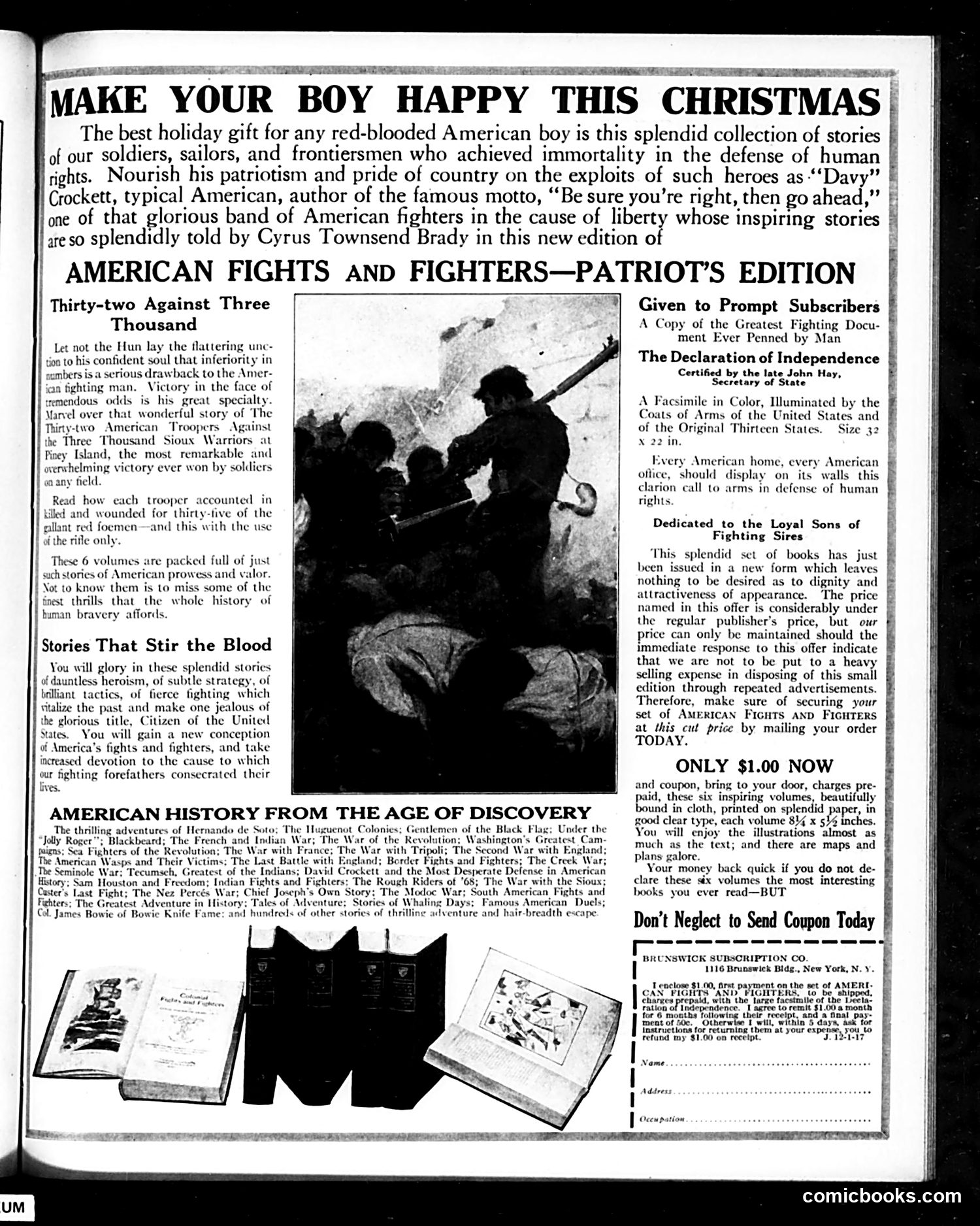
This page is **primarily an advertisement**, not political satire. It promotes "American Fights and Fighters—Patriot's Edition," a six-volume book series about American military heroes, priced at $1.00. The ad targets patriotic parents buying Christmas gifts for boys, emphasizing stories of figures like Davy Crockett and other "red-blooded American" fighters. It references historical conflicts from discovery through contemporary wars. The central image appears to show a dramatic military or frontier combat scene, though specific figures are unclear from this reproduction quality. The text appeals to nationalist sentiment and pride in American military tradition—common marketing strategy during the early-to-mid 20th century. The coupon at bottom enables mail-order subscription, a standard sales method of the era.
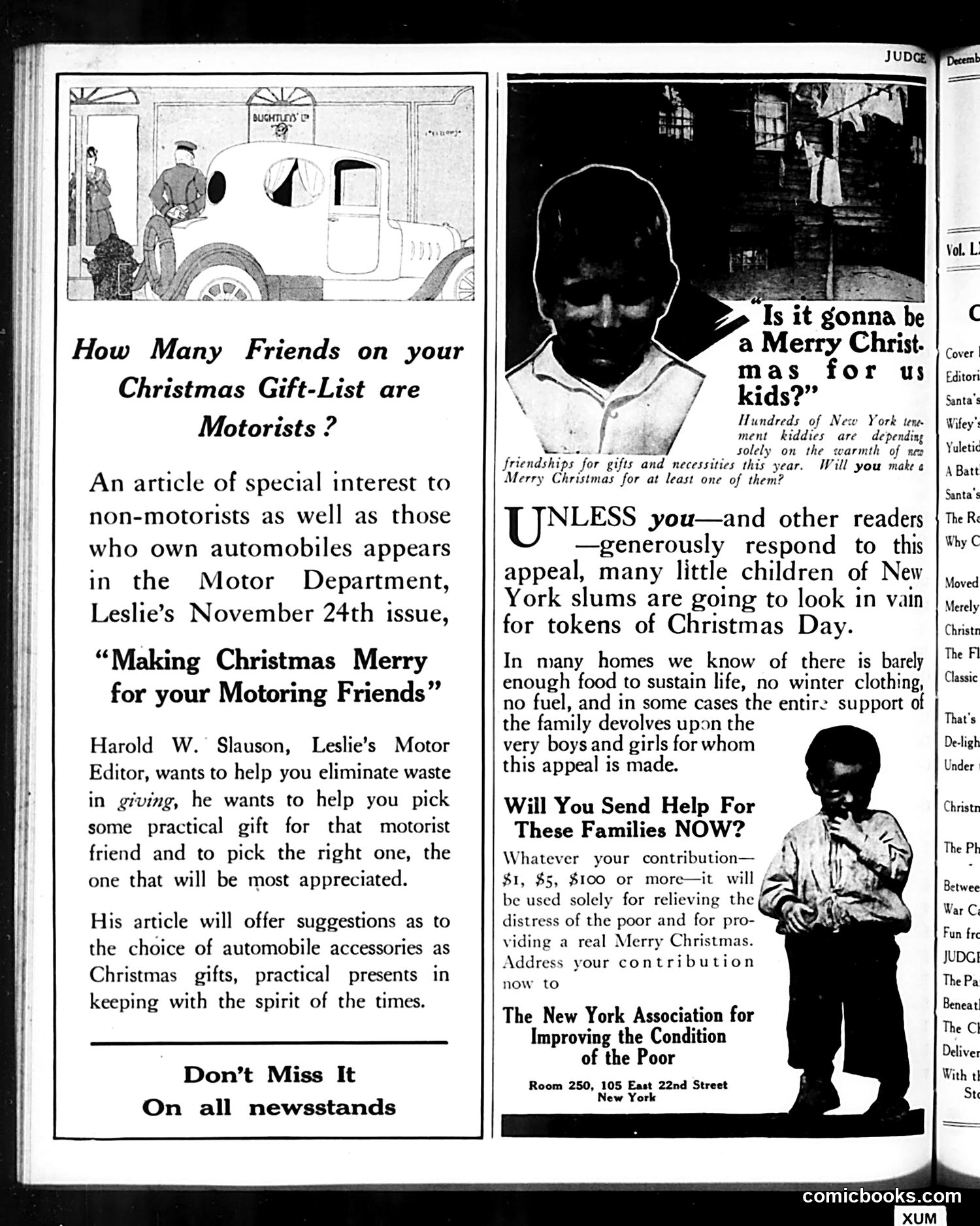
This page contains two distinct items: **Left side:** An advertisement for Leslie's magazine's Motor Department, promoting an article about selecting automobile accessories as Christmas gifts for "motoring friends." It's positioning practical car-related gifts as timely and economical. **Right side:** A charitable appeal from the New York Association for Improving the Condition of the Poor. The stark silhouette of a child asking "Is it gonna be a Merry Christmas for us kids?" contrasts sharply with the gift-giving theme opposite. The appeal explicitly states that many New York slum children lack food, winter clothing, and fuel, requesting donations ($1-$100+) to provide Christmas relief. The juxtaposition appears unintentional—the page juxtaposes consumer materialism against stark urban poverty, highlighting the economic inequality of the era.
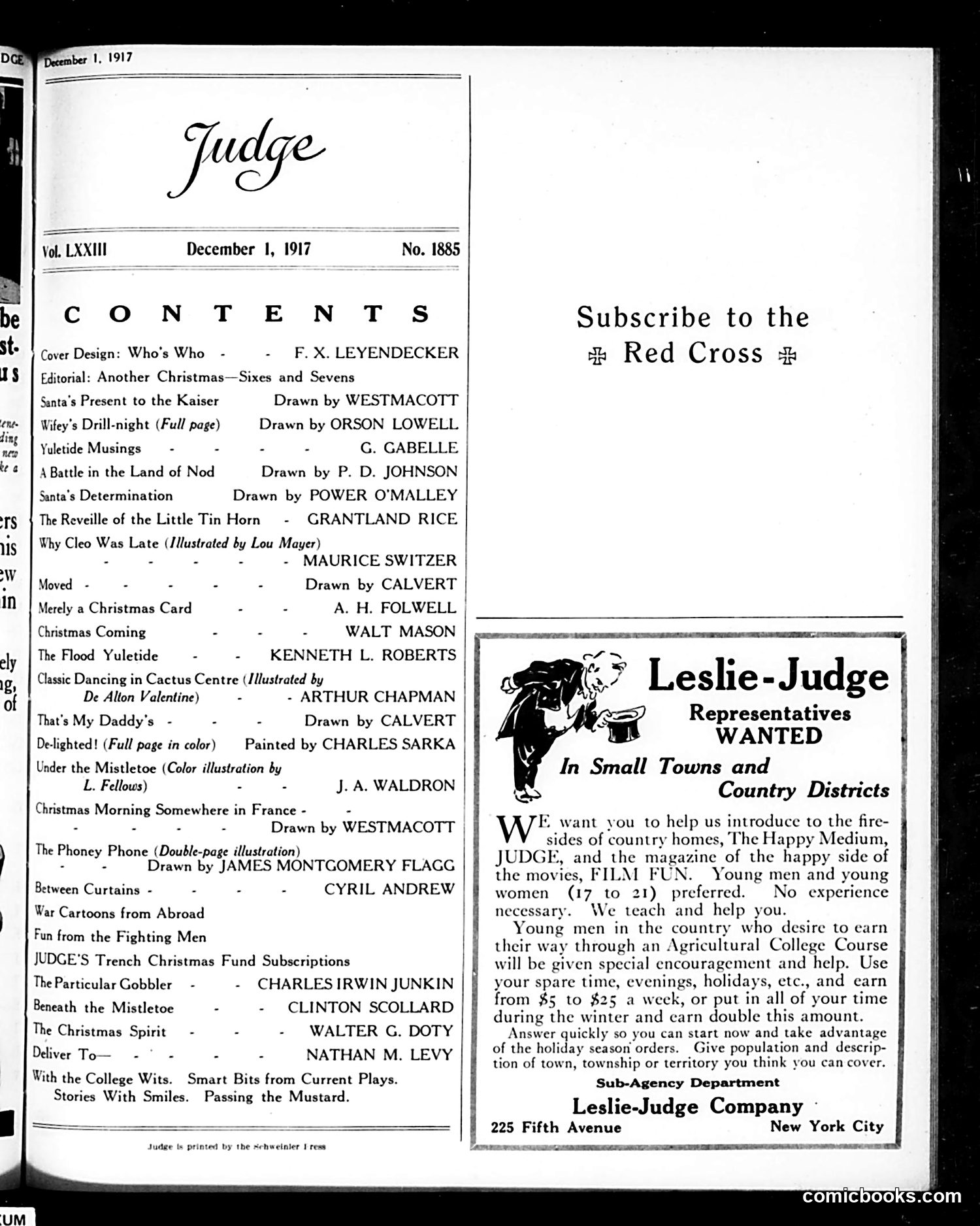
This is a contents page from *Judge*, a satirical magazine, dated December 1, 1917—during World War I. The page lists various articles and illustrations with Christmas themes ("Santa's Present to the Kaiser," "Yuletide Musings," "Christmas Coming") alongside war-related content ("Christmas Morning Somewhere in France," "Fun from the Fighting Men," "JUDGE's Trench Christmas Fund Subscriptions"). The juxtaposition reflects American wartime culture: Christmas celebrations coexisted with active military engagement. The listing of "Santa's Present to the Kaiser" suggests satirical commentary on the German enemy during the ongoing conflict. The advertisement on the right recruits young representatives (ages 17-21) for Leslie-Judge Company to sell magazines and related products in rural areas, targeting those interested in earning money during winter months.
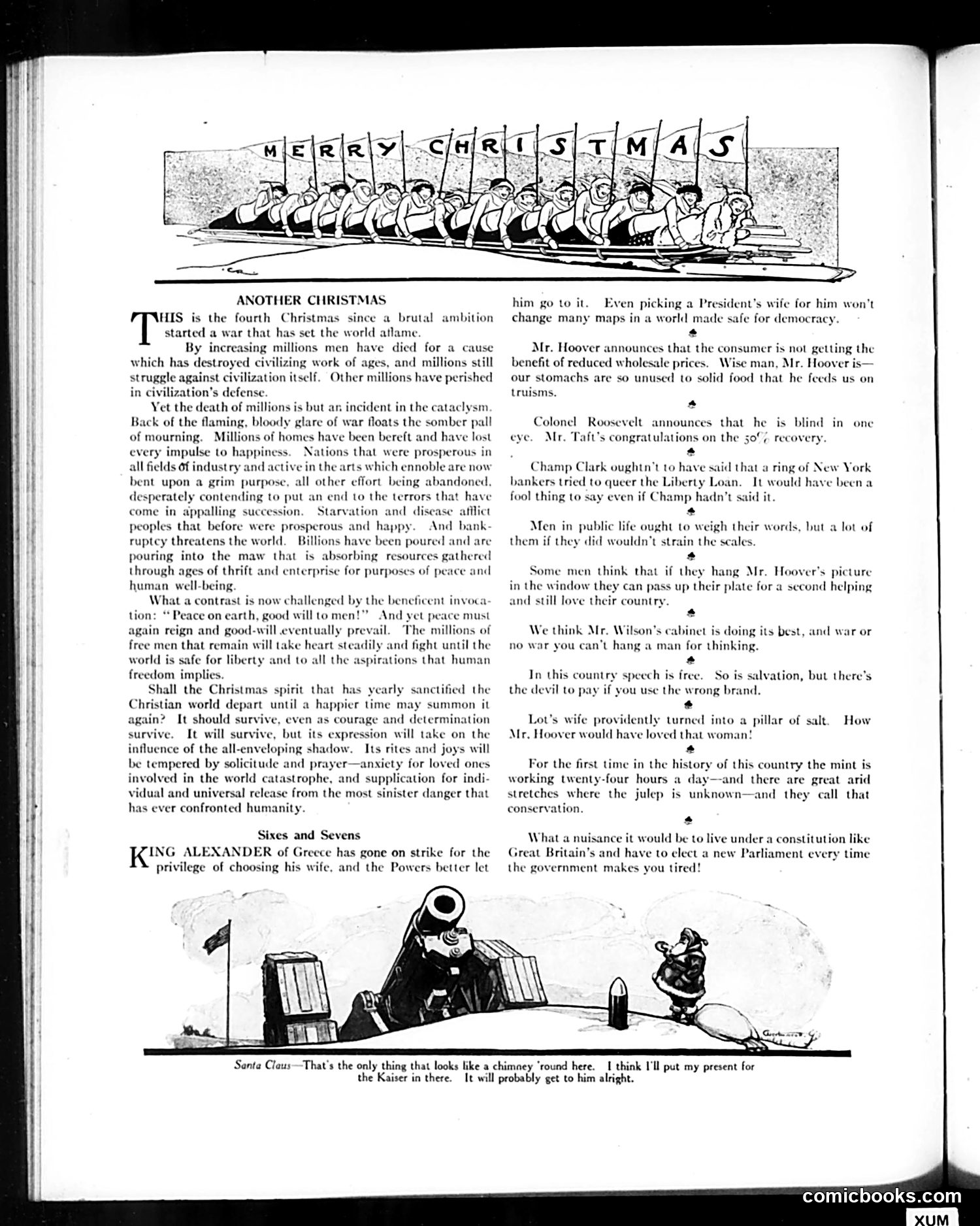
**"Another Christmas"** (top article): Satirizes the ongoing WWI carnage as the fourth Christmas of the war. The text critiques the massive human cost while politicians invoke "Peace on earth" rhetoric. It's bitter commentary on the disconnect between seasonal sentiments and battlefield reality. **"Sixes and Sevens"** (bottom section): References King Alexander of Greece's strike for the privilege of choosing his wife, suggesting the Powers (Allied nations) should let him decide independently. The Santa Claus cartoon appears to joke that putting a present "for the Kaiser" in a chimney would reach him—dark humor about Germany's position. The page reflects American WWI-era frustration with prolonged conflict and political maneuvering.
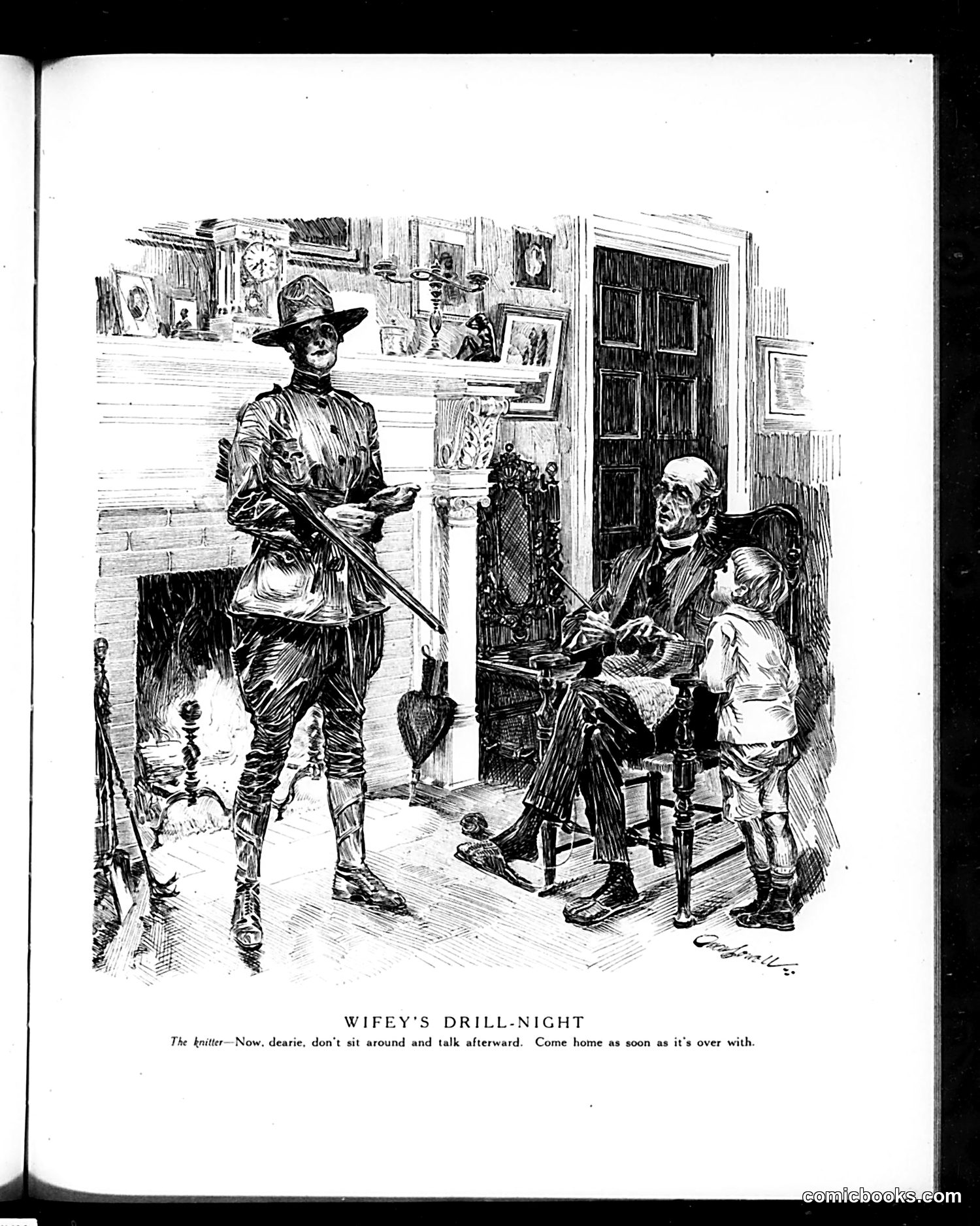
This cartoon satirizes the home-front activities of World War I. The scene depicts a knitting circle, where women gathered to produce military supplies (socks, sweaters, etc.). The "knitter" (the woman in the hat) instructs her husband—a soldier in uniform—to return home promptly after his military drill, rather than socializing afterward. The humor inverts traditional gender roles: the wife commands the husband as if *she* is the military authority figure, while he must obey domestic orders. This reflects the broader WWI-era social shift where women took on public responsibilities (war work, knitting circles) while men served militarily. The satire gently mocks both the domestic bosses on the home front and the soldiers' obligations to obey orders—whether from officers or wives.
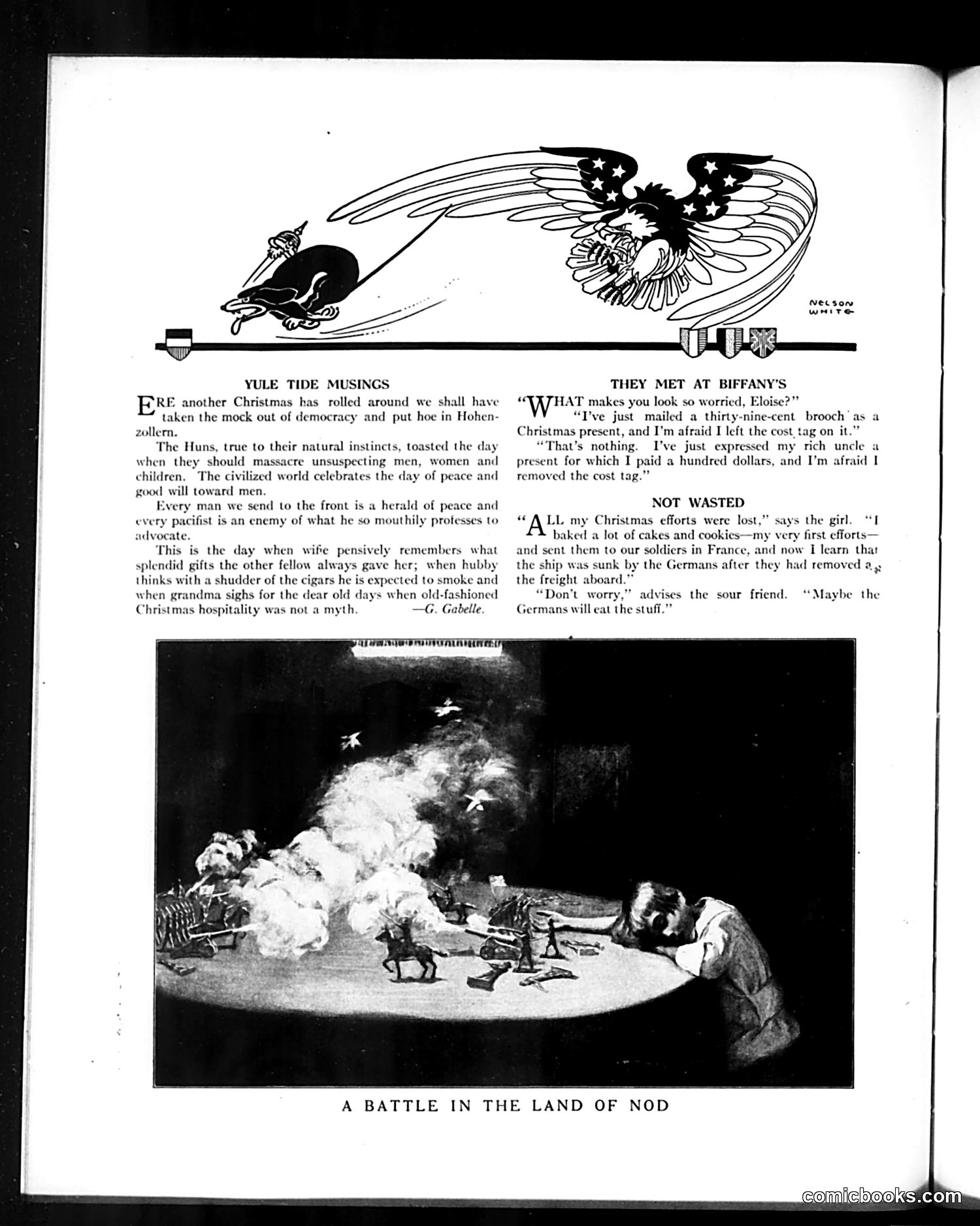
This WWI-era page satirizes American attitudes toward Christmas during wartime. **Top cartoon** (by Nelson White): An eagle carrying an American shield pursues a fleeing German imperial eagle, symbolizing America's military dominance—a visual punchline about replacing "mock democracy" with German autocracy ("Hohenzollern"). **Left column** ("Yule Tide Musings"): Contrasts German militarism (celebrating violence) with American ideals (peace and goodwill), while critiquing domestic complacency about wartime sacrifice. **Right column** ("They Met at Biffany's"): Two women worry about accidentally revealing how much they spent on Christmas gifts—one forgot to remove price tags. The joke's dark edge emerges when they discuss sending baked goods to soldiers in France; the ship was sunk by Germans, making the woman's efforts literally wasted. **Bottom photograph** ("A Battle in the Land of Nod"): Appears to be a theatrical or toy scene depicting miniature war, reinforcing the page's theme of treating serious warfare with cultural distance. The overall message critiques American distance from war's real costs.
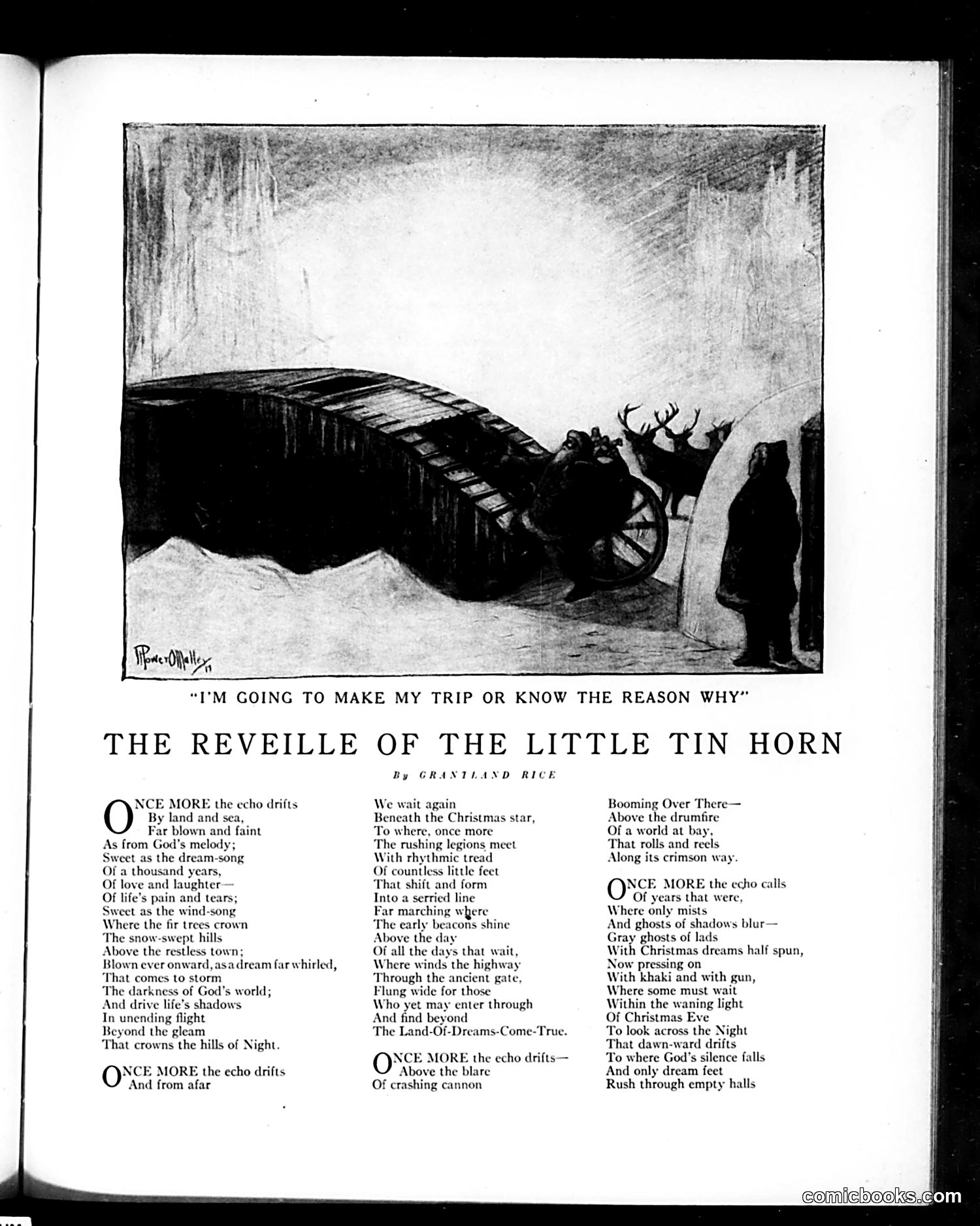
**The Cartoon:** The illustration depicts a determined figure with reindeer and sleigh confronting what appears to be military fortifications or barriers. The caption "I'M GOING TO MAKE MY TRIP OR KNOW THE REASON WHY" suggests Santa Claus refusing to be stopped by wartime obstacles. **The Context:** This is World War I-era content (references to "Over There" and "drumfire" indicate the Western Front). The poem by Grantland Rice juxtaposes Christmas imagery—children's dreams, Santa's journey, the Christmas star—against the brutal reality of modern warfare ("crashing cannon," "crimson way," "gray ghosts of lads"). **The Satire's Point:** The page presents Christmas as a symbol of hope and normalcy that persists despite the war's devastation. The cartoon's Santa figure embodies determination to maintain this tradition despite military conflict. The poem suggests that Christmas dreams sustain soldiers fighting "Over There," even as many will not survive to experience them. It's simultaneously patriotic (supporting the war effort) and elegiac (mourning its cost).
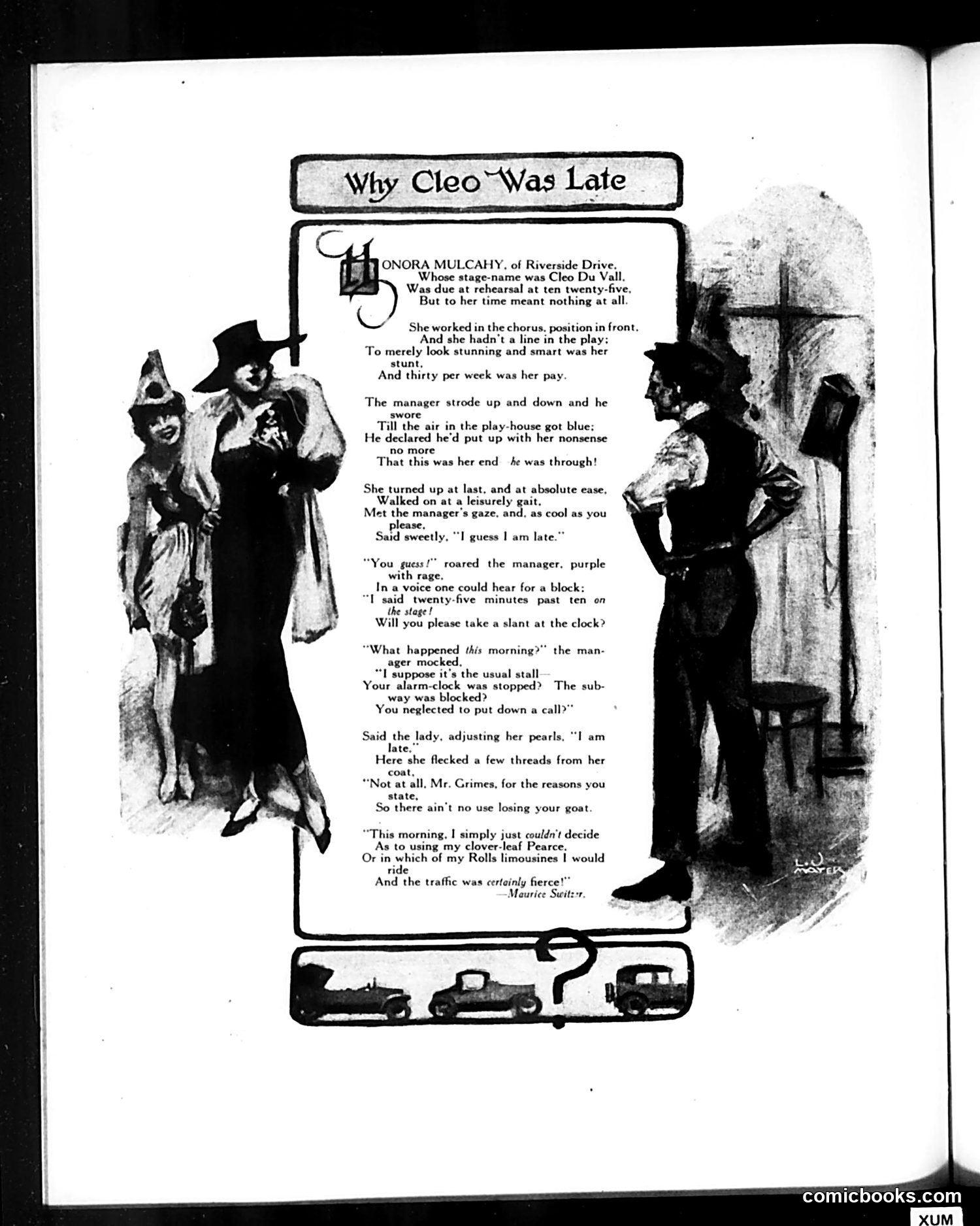
This is a humorous story-poem satirizing theatrical vanity and entitlement among chorus girls in the early 20th century. Cleo Du Vall, a chorus member with no speaking role, arrives late to rehearsal. Her manager is furious, but she arrives completely unbothered, casually explaining her tardiness wasn't due to the excuses he suggests (broken alarm clock, subway delays, forgotten wake-up call). Instead, she breezily admits she couldn't decide *which luxury car to take*—her Rolls-Royce limousines or her Pearce automobile—and blames traffic. The satire mocks the shallow materialism and narcissism of young performers who, despite earning only thirty dollars weekly for minimal stage presence ("merely look stunning and smart"), affected wealth and importance. The joke is the absurd contrast between her modest theatrical position and her pretentious wealth-flaunting, suggesting either delusion or actual moral corruption.
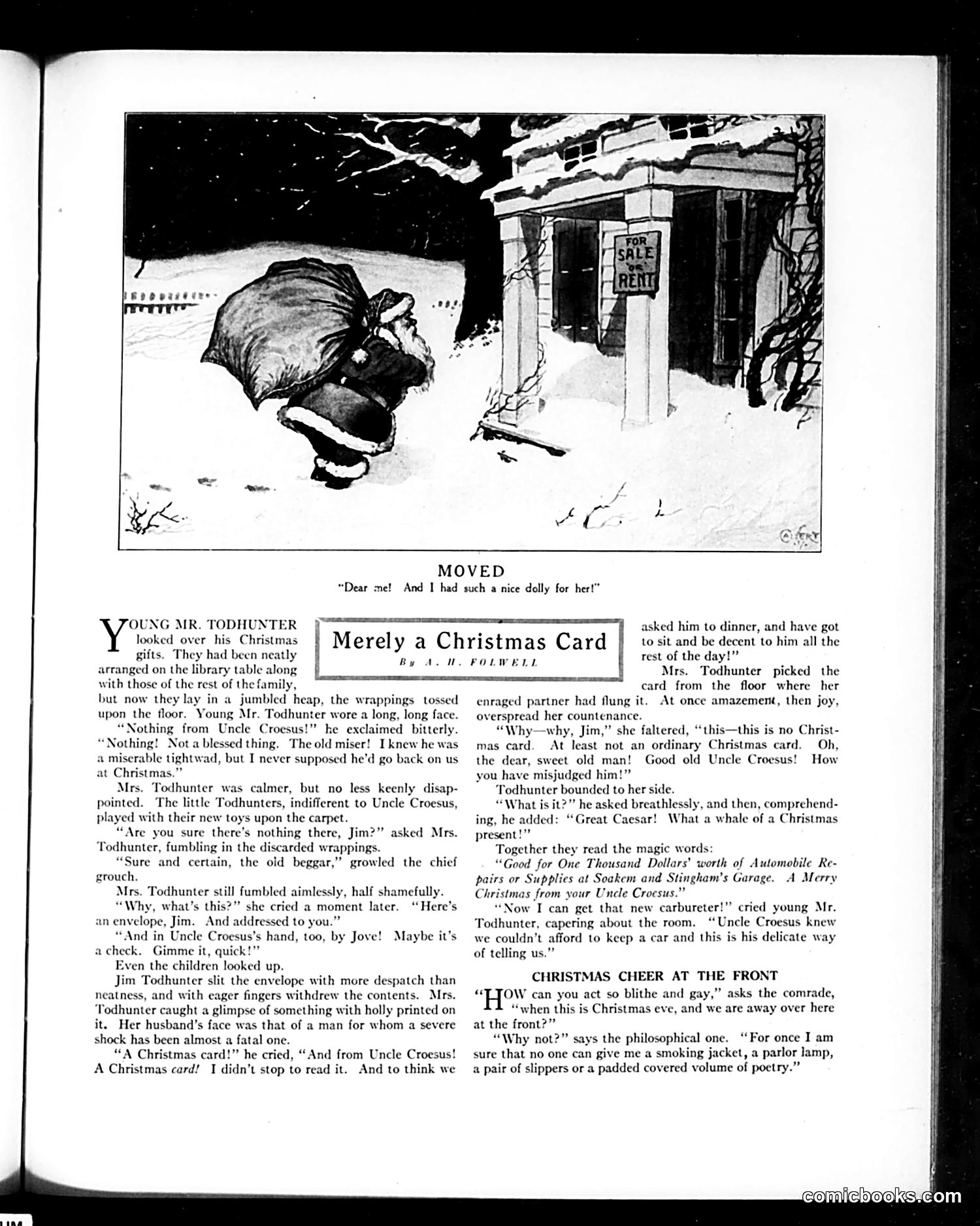
This story satirizes middle-class materialism and family hypocrisy during the Christmas season. Young Mr. Todhunter and his wife are bitterly disappointed that their wealthy relative "Uncle Croesus" (a biblical reference to an famously rich king, used as a type for any wealthy man) sends only a Christmas card instead of money or gifts. Their disappointment turns to joy when they discover the card is actually a $1,000 voucher for automobile repairs—a valuable but practical gift. The humor lies in the family's initial greed and ingratitude, exposed and then reversed. The second piece, "Christmas Cheer at the Front," contrasts this domestic materialism with soldiers' circumstances during what appears to be World War I, where a soldier jokes that at least he won't receive impractical gifts like smoking jackets or poetry books—a darker, sardonic commentary on wartime deprivation.
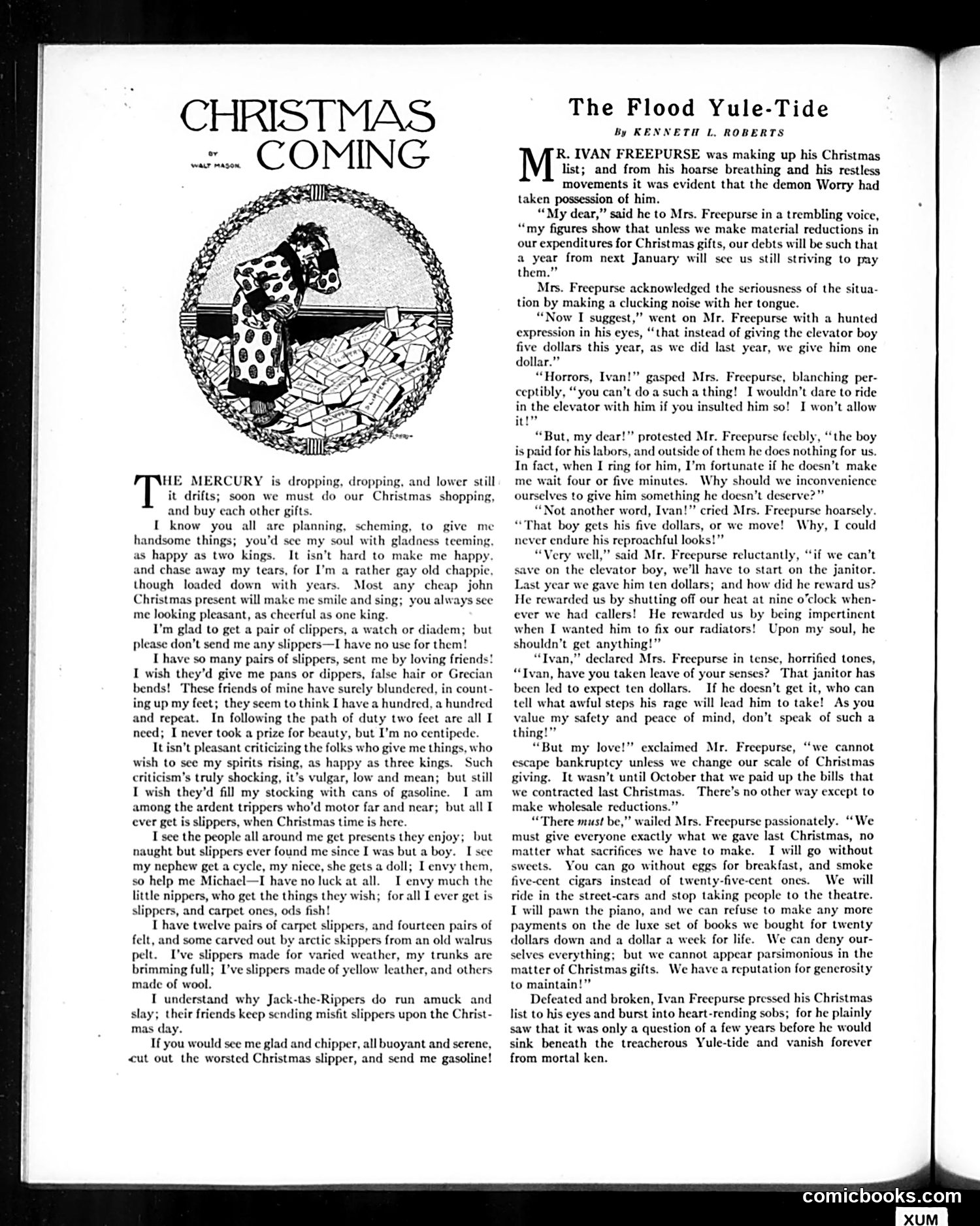
This two-part page satirizes Christmas spending anxieties among early 20th-century Americans. **Left poem**: A humorous complaint about receiving unwanted slippers repeatedly as Christmas gifts. The speaker ironically catalogs his enormous slipper collection (twelve carpet pairs, fourteen felt pairs, etc.) while expressing desire for practical gifts like gasoline for motoring—reflecting the era's fascination with automobiles. The joke mocks the ritual of obligatory gift-giving and the disconnect between what people receive and what they actually want. **Right story**: "The Flood Yule-Tide" depicts Mr. and Mrs. Ivan Freepurse facing holiday debt. Mr. Freepurse proposes cutting the elevator boy's Christmas tip from five dollars to one dollar as an economy measure. Mrs. Freepurse, horrified, refuses—not from kindness but from fear of social embarrassment riding the elevator with an insulted employee. The satire targets middle-class hypocrisy: the Freepurses care more about appearances and their own comfort than genuine generosity or fairness to working-class servants. Their "charity" is actually self-interested. Both pieces mock Christmas consumerism and class-based social pretense.
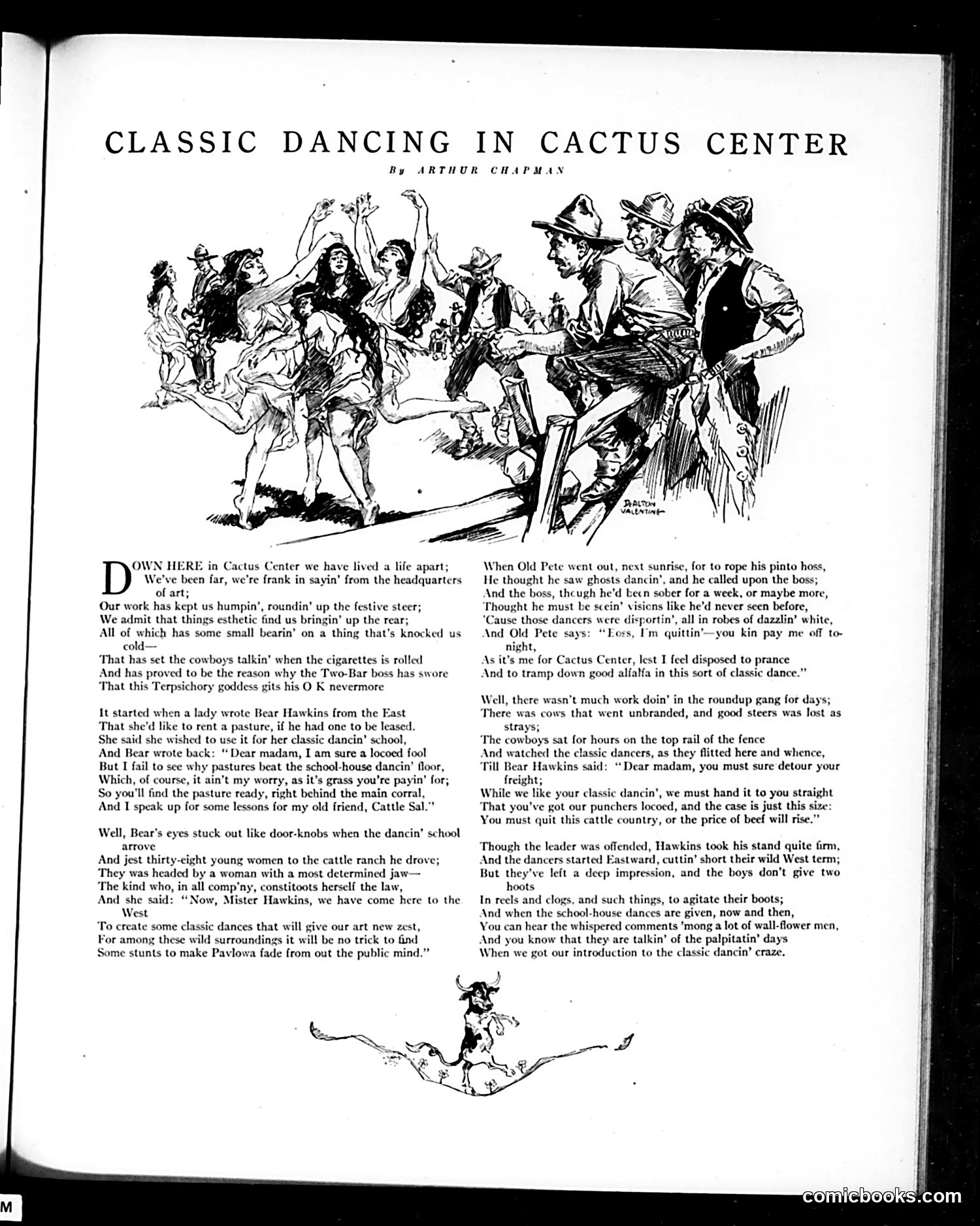
This humorous story-poem by Arthur Chapman satirizes the clash between Eastern cultural refinement and Western ranch life. A dance instructor from the East arrives at a cattle ranch to teach "classic" (ballet) dancing to 38 young women. The cowboys—hardened ranch hands named characters like "Bear Hawkins," "Old Pete," and "Cattle Sal"—are bewildered and distracted by the graceful dancers in white robes performing on the pasture. The cattle go unbranded, work halts, and cowboys spend hours watching instead of working. Eventually, Bear Hawkins must ask the dancers to leave, warning that their presence threatens the cattle industry itself ("the price of beef will rise"). The satire mocks both Eastern cultural pretension transplanted to unsuitable terrain and Western ignorance of refined art, presenting them as fundamentally incompatible. The concluding lines suggest the dancers leave a lasting impression despite their departure.
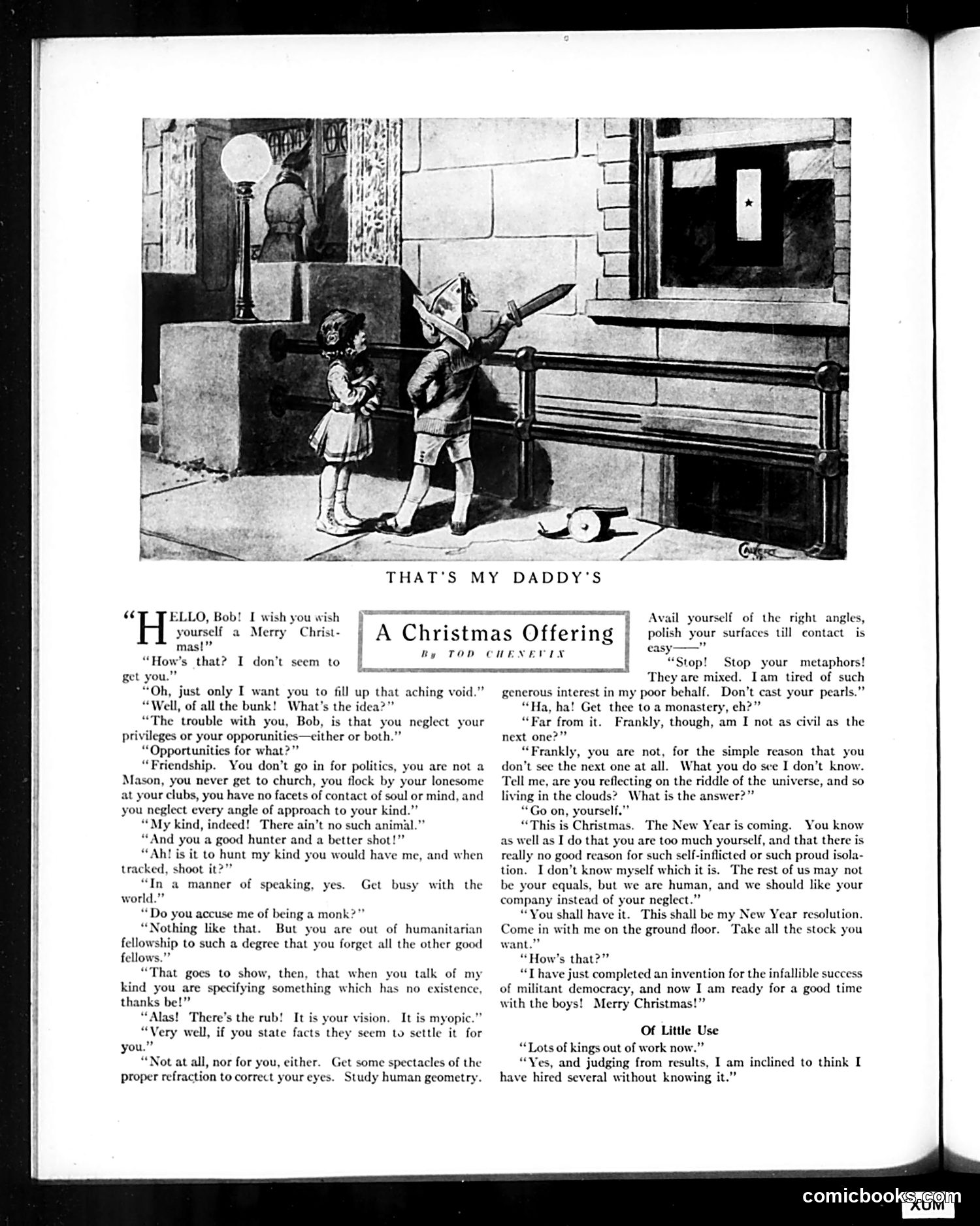
The top cartoon shows a child playing with toy soldiers, captioned "That's My Daddy's"—a dark joke about militarism and fathers returning from (likely) World War I with martial preoccupations. The main story below, "A Christmas Offering" by Rod Chenevix, presents a dialogue between two men about social isolation and citizenship. Bob is criticized for being withdrawn from community life—avoiding politics, fraternal organizations, church, and even casual socializing. His friend argues this antisocial behavior stems from myopia (literal and figurative), urging him to engage with "human geometry" and recognize common humanity. The satire targets early-20th-century masculine individualism and social detachment as moral failings. Bob's eventual "resolution" to join a "militant democracy" scheme—complete with invented technology—suggests the author is gently mocking both naive faith in technological solutions and the tendency to channel social enthusiasm into questionable ventures. The page critiques both withdrawn misanthropy and unexamined civic participation.
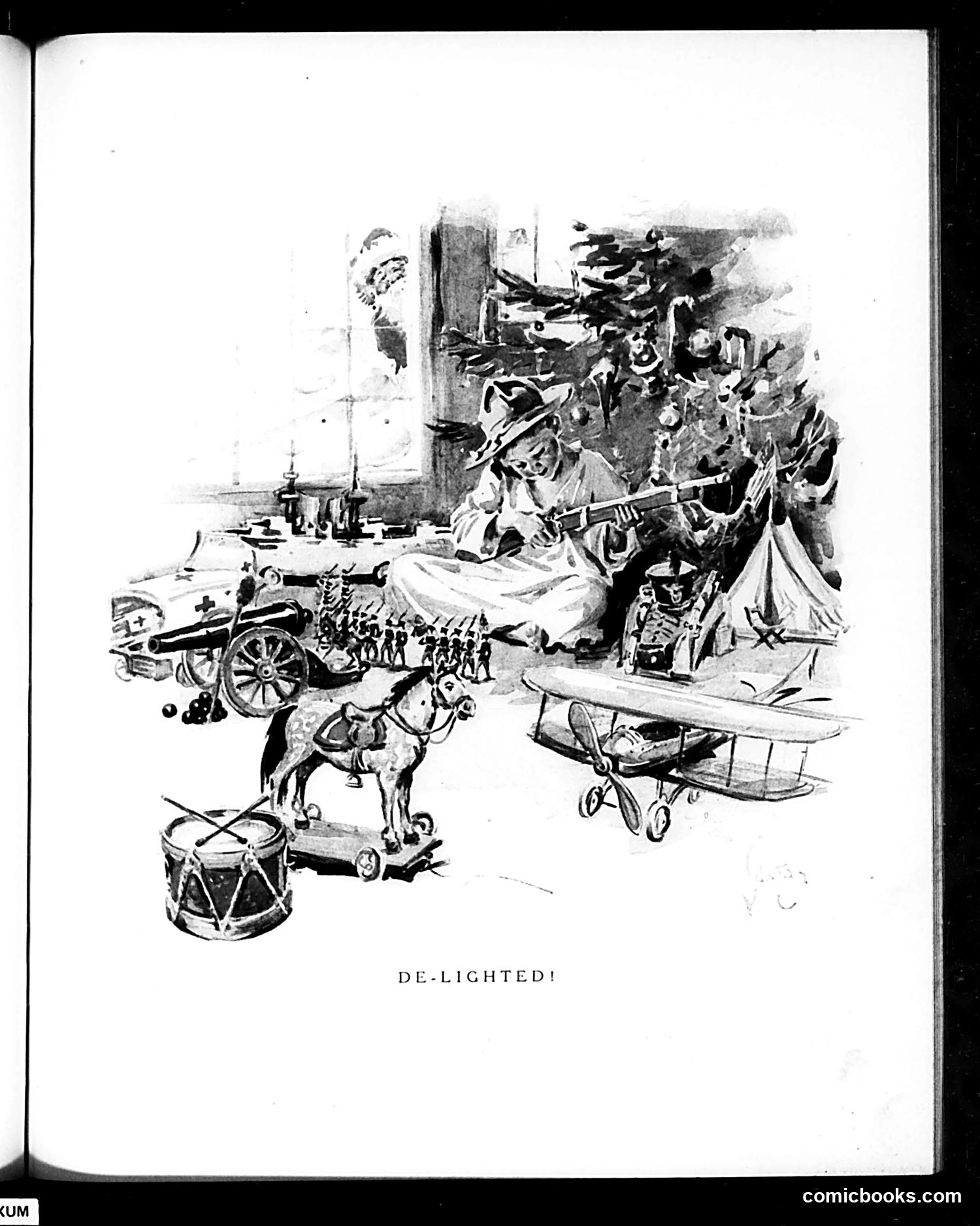
This satirical illustration depicts a chaotic military or wartime scene. A figure in the foreground (appears to be a military officer or leader) holds a rifle while surrounded by various implements of war and entertainment—cannons, drums, an airplane, a horse, military tents, and marching soldiers in the background. The title "DE-LIGHTED!" suggests ironic delight at this scene of militarism and warfare. The cartoon appears to criticize enthusiasm for military buildup or war preparation, possibly commenting on American military expansion, weapons development, or the glorification of military might. The deliberate misspelling ("de-lighted" rather than "delighted") emphasizes the satirical tone, suggesting that this display of military power should *not* actually delight citizens. The exact historical moment remains unclear without additional context.
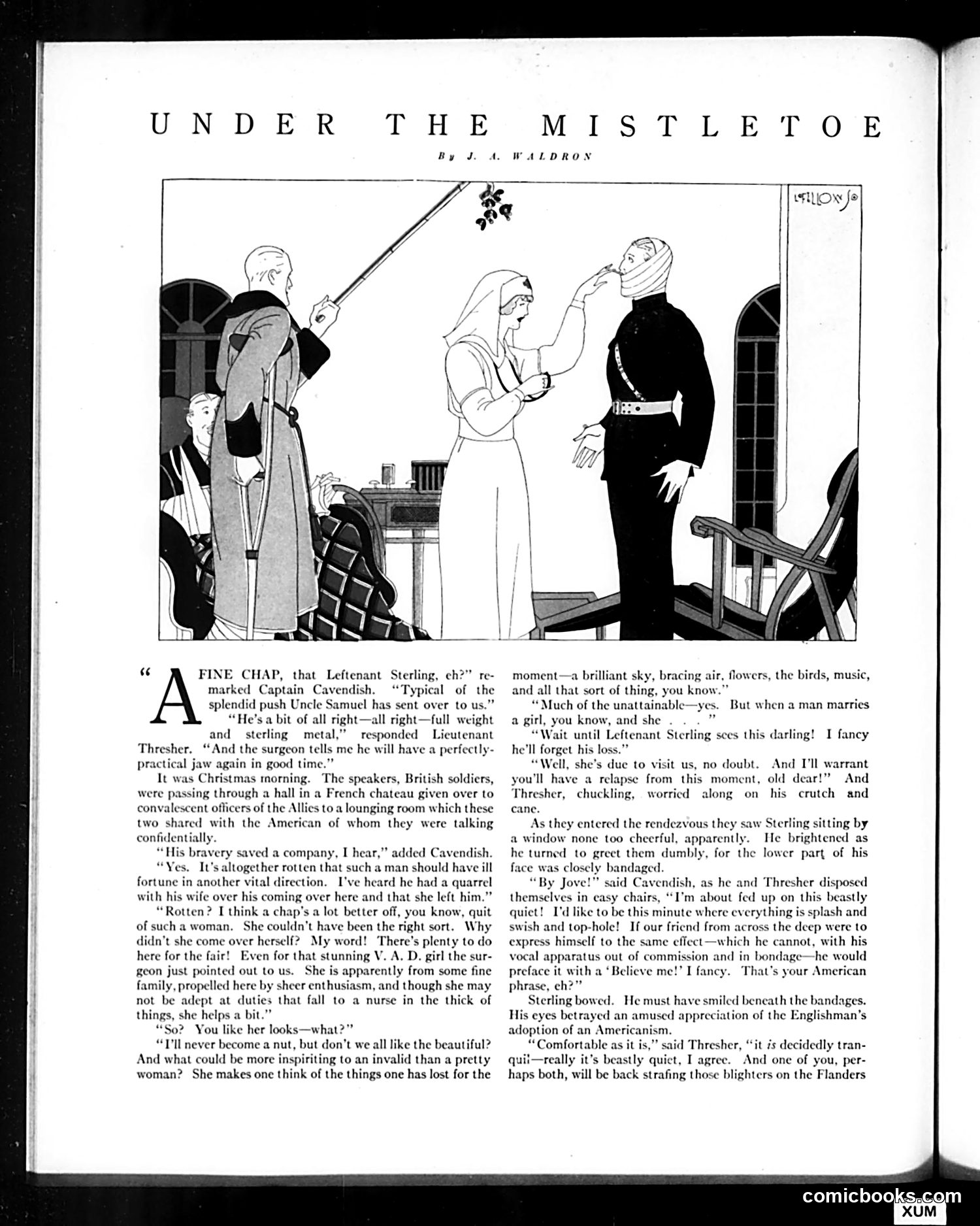
This WWI-era story depicts British and American soldiers convalescing in a French chateau. The narrative centers on Lieutenant Sterling, a wounded American officer with facial injuries who quarreled with his wife before deployment—she left him over his decision to serve. Two British officers (Thresher and Cavendish) discuss Sterling's misfortune, then anticipate a visit from an attractive VAD (Voluntary Aid Detachment) nurse. They predict she'll cheer Sterling and help him forget his marital loss. When she arrives (shown in the illustration), the implication is that her beauty and presence provide emotional solace to the injured serviceman. The satire gently mocks both British sentimentality about "inspiriting" feminine companionship for invalids and the officers' casual commentary on marriage and women. The "mistletoe" title suggests romantic holiday sentiment amid wartime hardship.
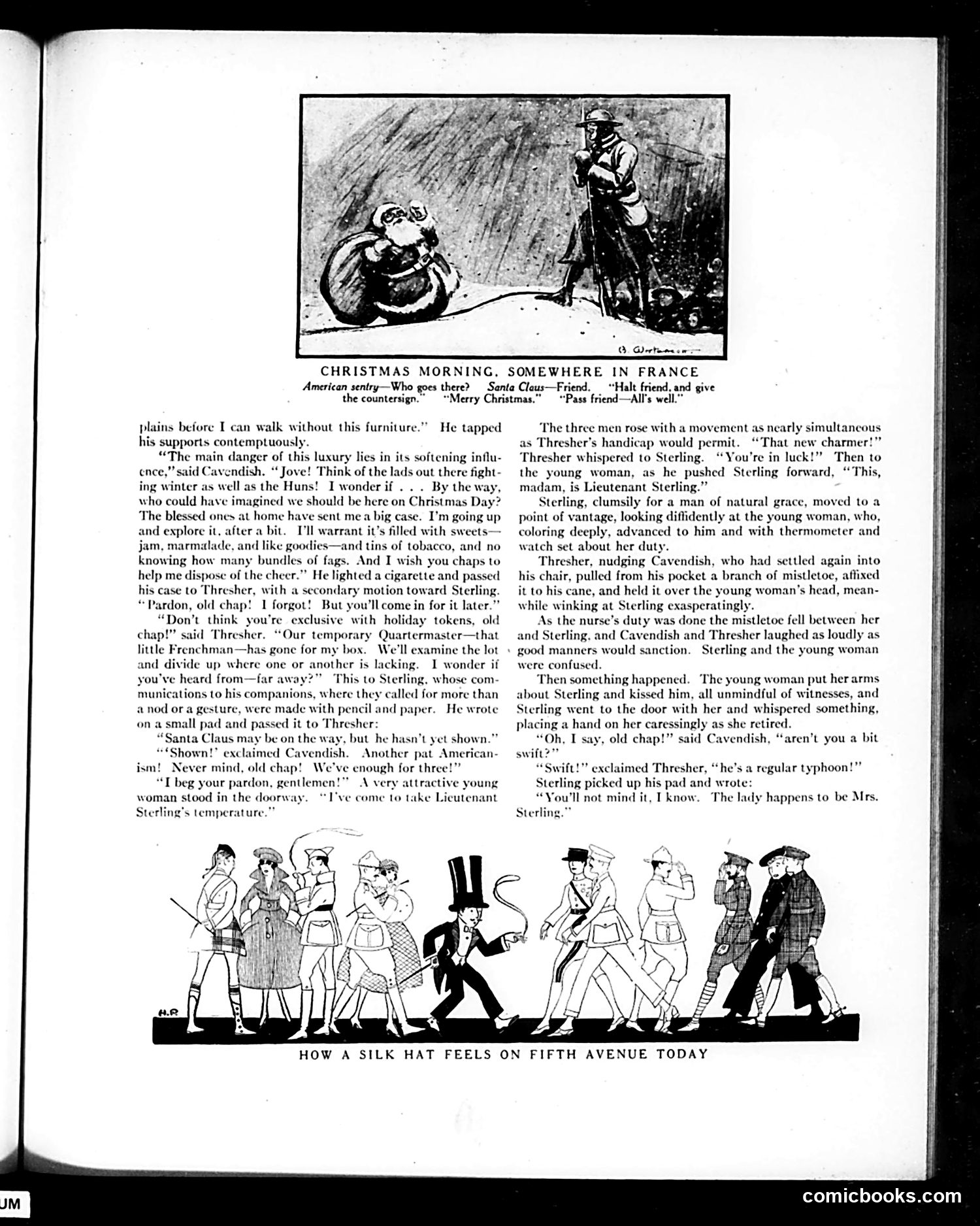
This page contains two distinct pieces from *Judge* magazine: **Top: "Christmas Morning, Somewhere in France"** A sentimental WWI story about American and British soldiers celebrating Christmas in the trenches. Lieutenant Sterling is mute (communicates by writing), and the narrative centers on a young nurse visiting to take his temperature. Fellow officers playfully hold mistletoe over them; Sterling and the nurse kiss. The twist ending reveals she's already his wife—suggesting soldiers married hastily before deployment, a common WWI reality. **Bottom: "How a Silk Hat Feels on Fifth Avenue Today"** A satirical fashion cartoon showing a man in formal dress (top hat and tails) among casually dressed pedestrians on New York's most prestigious street. The joke critiques overly formal fashion as absurdly out of place in modern, practical society—likely commenting on post-war social changes making rigid formality seem ridiculous. Both pieces reflect 1920s attitudes: romantic sentimentality about the "Great War" and social commentary on changing American manners and dress codes.
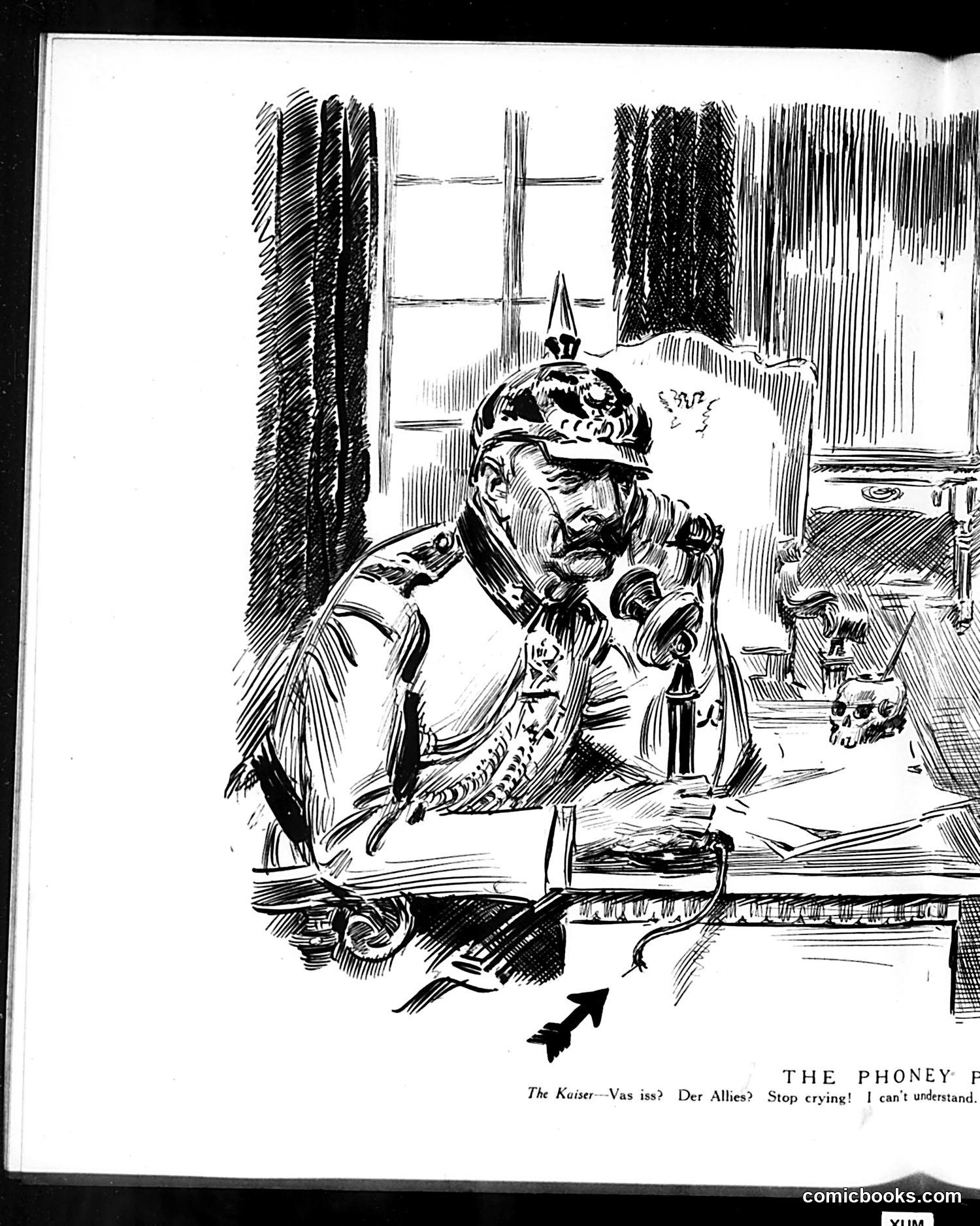
This appears to be a WWI-era political cartoon from *Judge* magazine. The central figure is a German military officer (identifiable by the spiked Pickelhaube helmet and military uniform with insignia) sitting at a desk, seemingly distressed or defensive. The caption "The Kaiser—Vas iss? Der Allies? Stop crying! I can't understand" satirizes the German Kaiser's alleged inability to comprehend the Allied opposition or his military failures. The "phoney" in the title likely references false claims or propaganda. The cartoon mocks German leadership's confusion or denial regarding military setbacks during WWI. The exaggerated Germanic accent in the dialogue reinforces period-typical stereotyping of German speakers common in American propaganda cartoons.
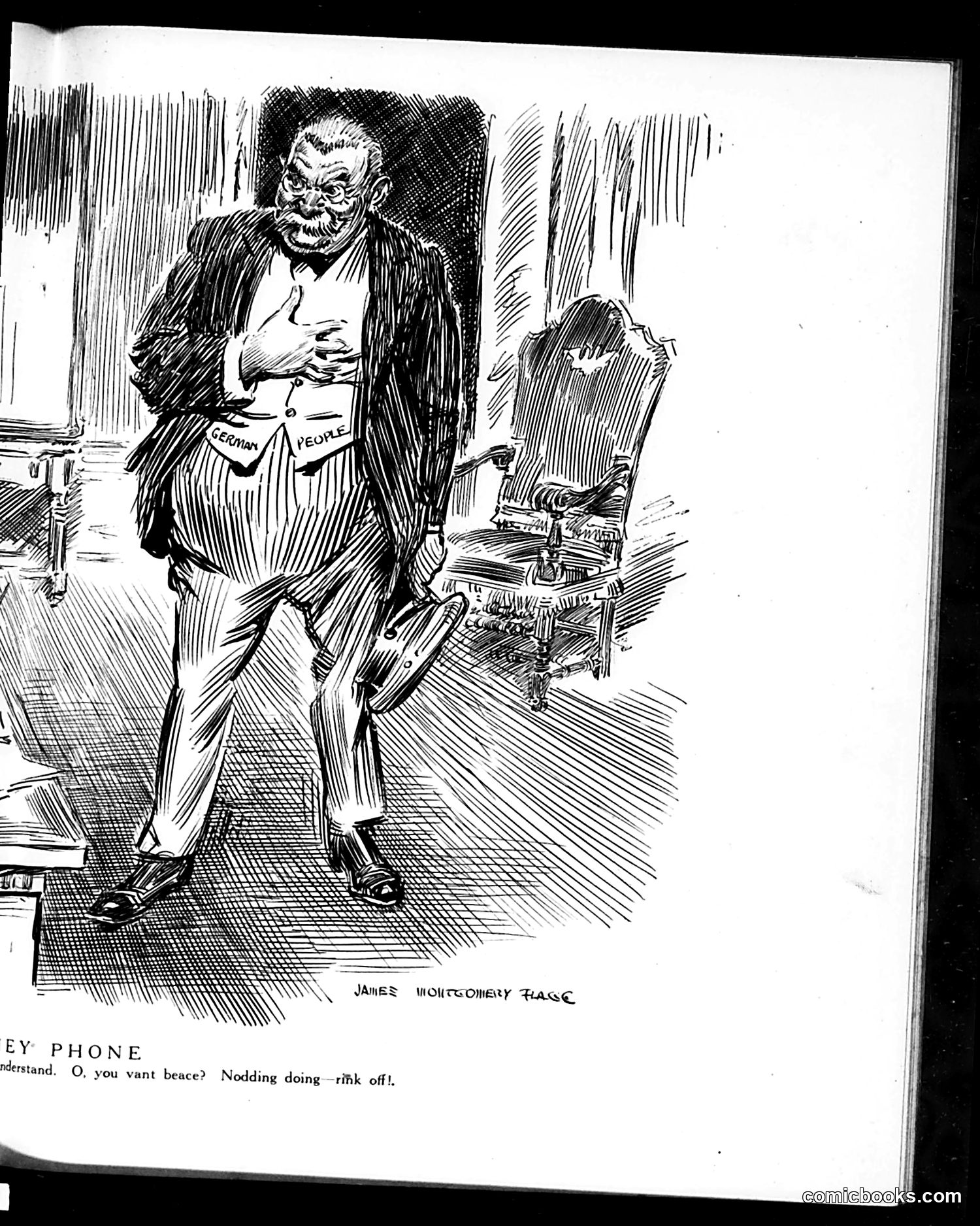
This cartoon depicts a caricatured man (labeled "James Montgomery Flagg," the artist) speaking on a telephone. The exaggerated facial features and grotesque expression employ a caricature style common to satirical magazines. The dialogue reads: "O, you want peace? Nodding doing—rink off!" This appears to be commentary on either a peace negotiation or political discussion, though the OCR errors ("Nodding doing," "rink off") make the exact meaning unclear. The cartoon likely satirizes someone's dismissive response to peace proposals or negotiations. Without clearer context about the date and specific historical event referenced, I cannot definitively identify who "James Montgomery Flagg" represents here or what specific peace negotiations are being mocked, though the tone suggests political mockery of failed diplomatic efforts.
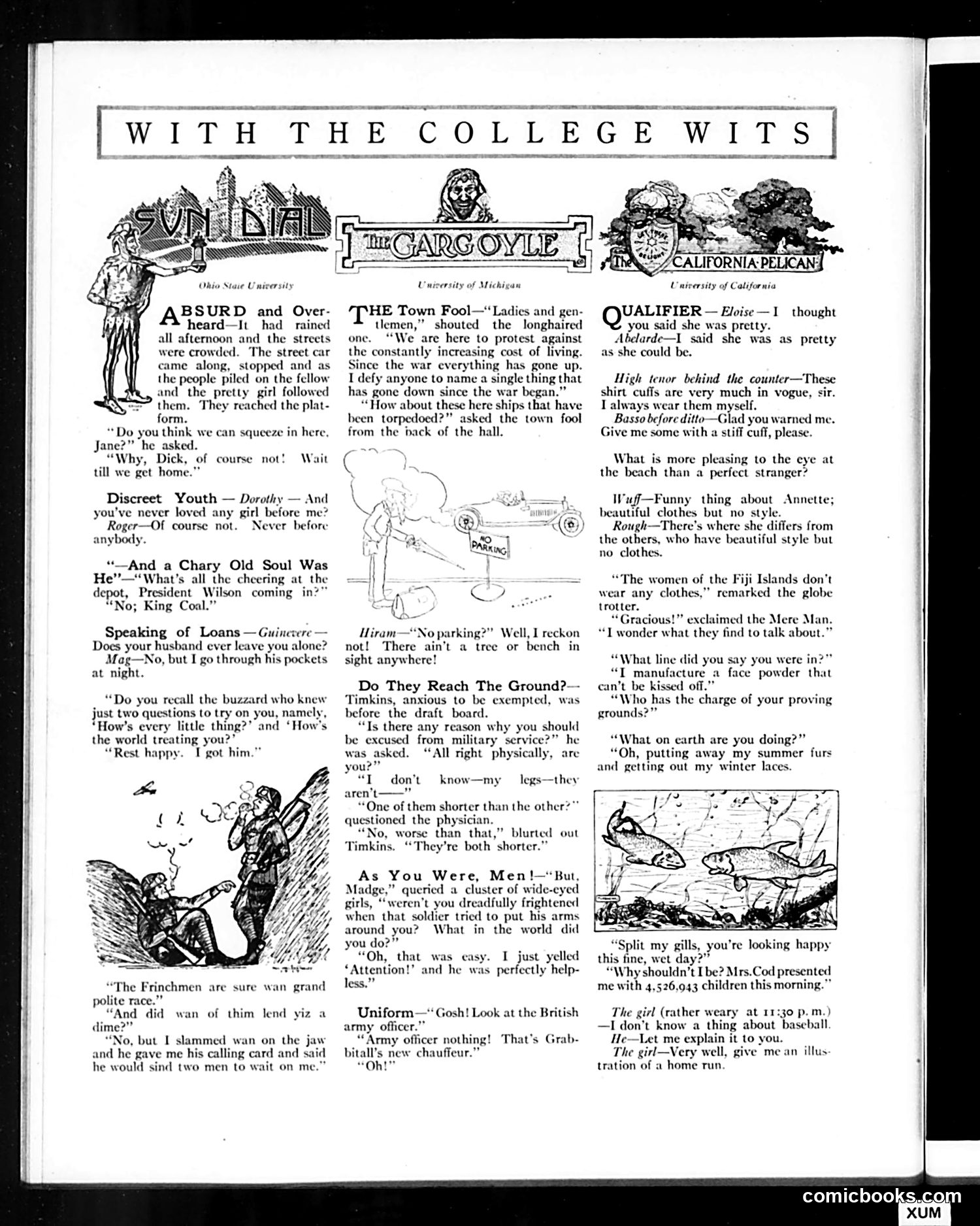
This page collects brief humorous anecdotes and jokes from three universities, organized under university mastheads (Ohio State, Michigan, California). The humor targets several contemporary concerns: **Post-WWI themes**: References to war inflation ("cost of living"), draft exemptions, and soldiers reflect American preoccupation with the recent war and its disruptions. **Gender and courtship**: Multiple jokes depict men and women negotiating romantic and physical boundaries—a woman yelling "Attention!" to stop a soldier's advances plays on military discipline tropes. **Class and social observation**: Jokes about "town fools," working-class characters (the Irishman), and affectations of sophistication mock both pretension and naïveté. The humor is gentle, collegiate-focused satire typical of Judge magazine's approach—poking fun at everyday social awkwardness rather than cutting political critique. The visual cartoons complement rather than dominate the text-heavy page.
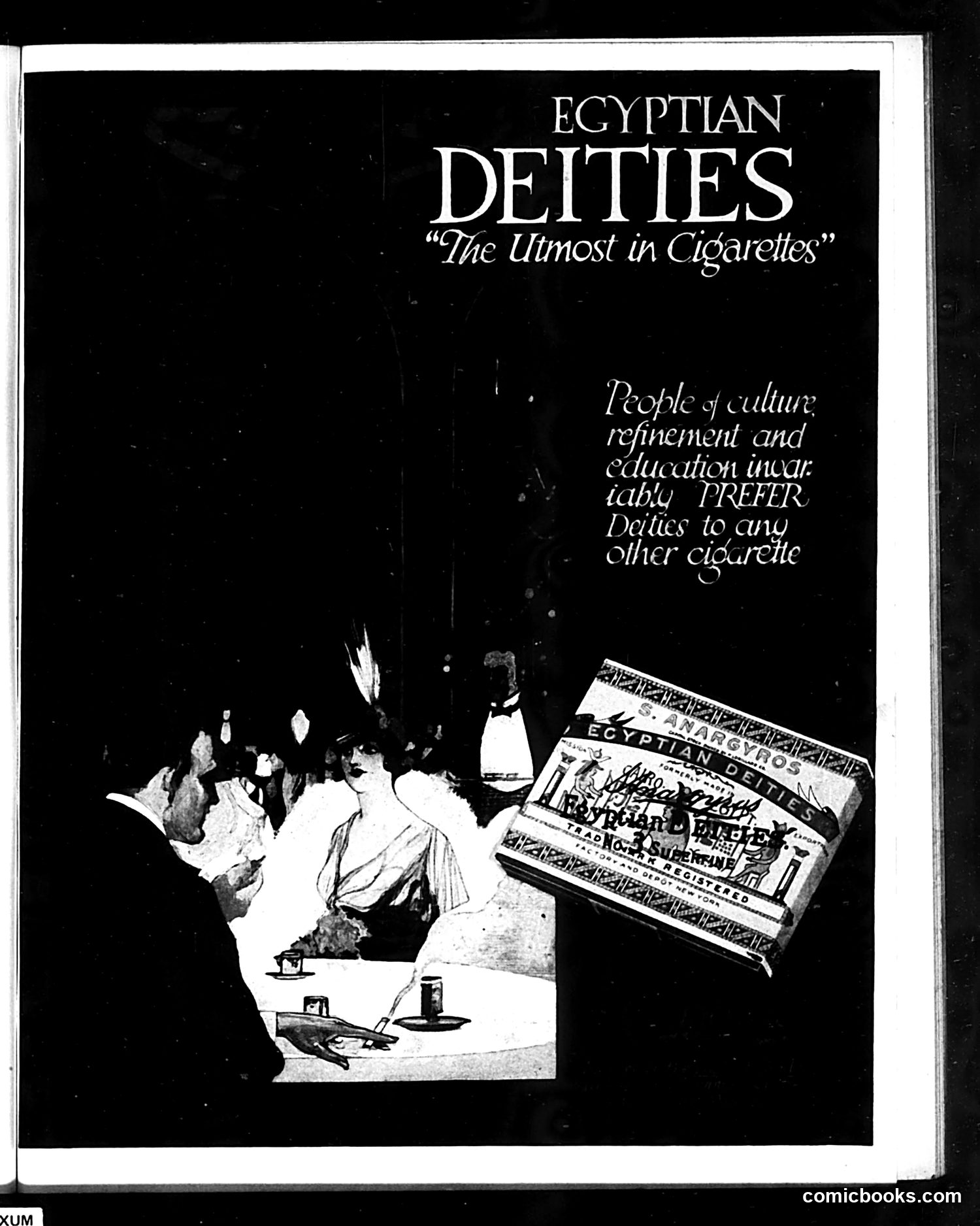
This is a cigarette advertisement, not political satire. It markets "Egyptian Deities" brand cigarettes by appealing to consumer aspirations. The ad claims that "people of culture, refinement and education invariably PREFER Deities to any other cigarette." The imagery shows an elegant woman in classical dress examining the cigarette package, surrounded by Egyptian-themed decorative elements and artifacts. The advertisement uses exotic imagery and appeals to sophistication to market the product—a common early 20th-century advertising strategy that associated cigarette consumption with taste, education, and social status. This reflects period attitudes where cigarette advertising freely targeted aspirational messaging without health warnings.
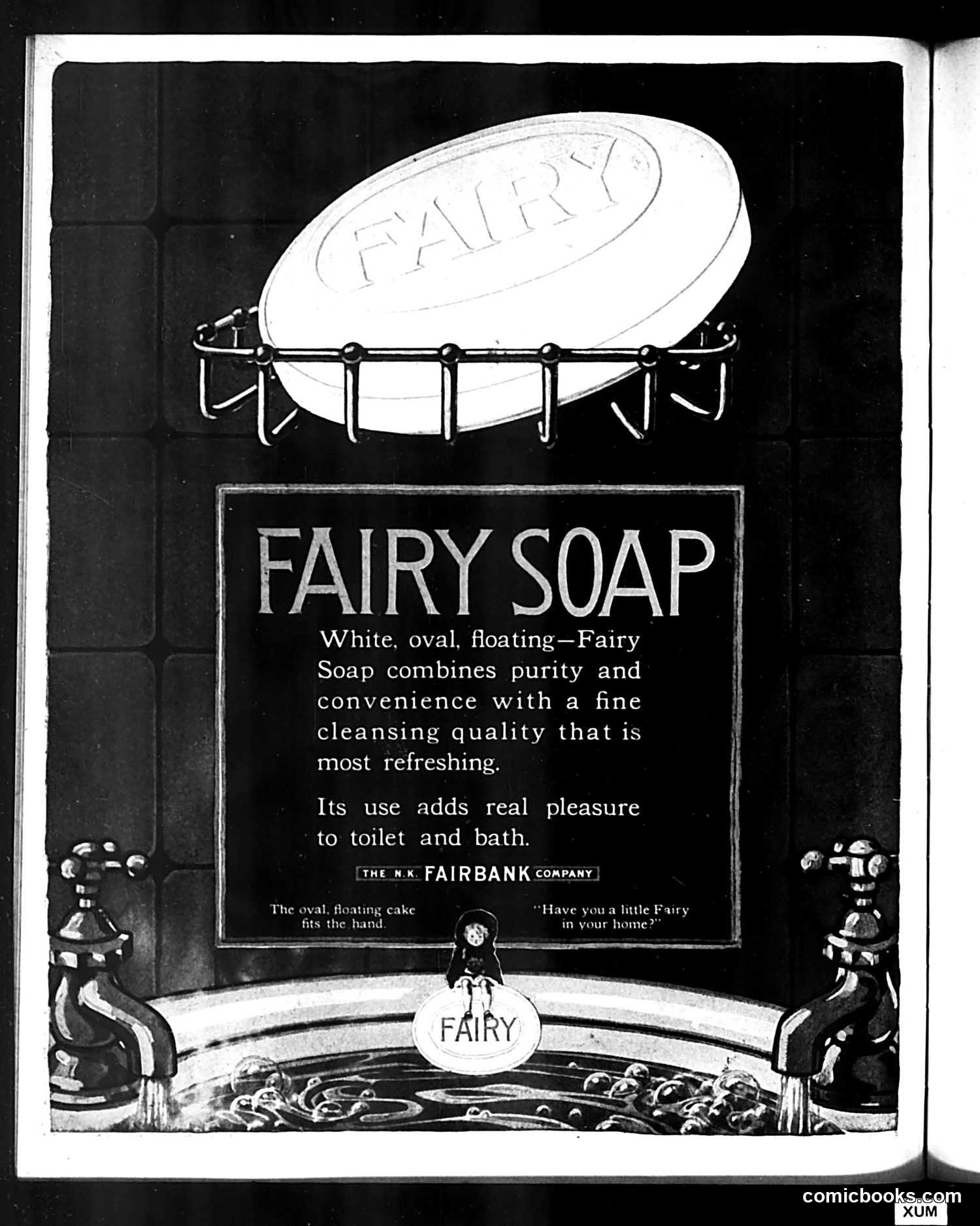
This is a **product advertisement, not political satire**. It's a full-page ad for Fairy Soap by the N.K. Fairbank Company, a real historical soap brand. The page features an illustrated soap cake suspended in an ornate Art Deco-style frame, with decorative elements flanking the sides. The ad emphasizes the soap's qualities: white, oval-shaped, floating (a practical feature), pure, and pleasant-smelling. The taglines—"The oval, floating cake fits the hand" and "Have you a little Fairy in your home?"—are straightforward marketing copy. There's no political commentary or satirical intent visible. Judge magazine regularly mixed satirical editorial content with advertisements; this page represents the latter category.
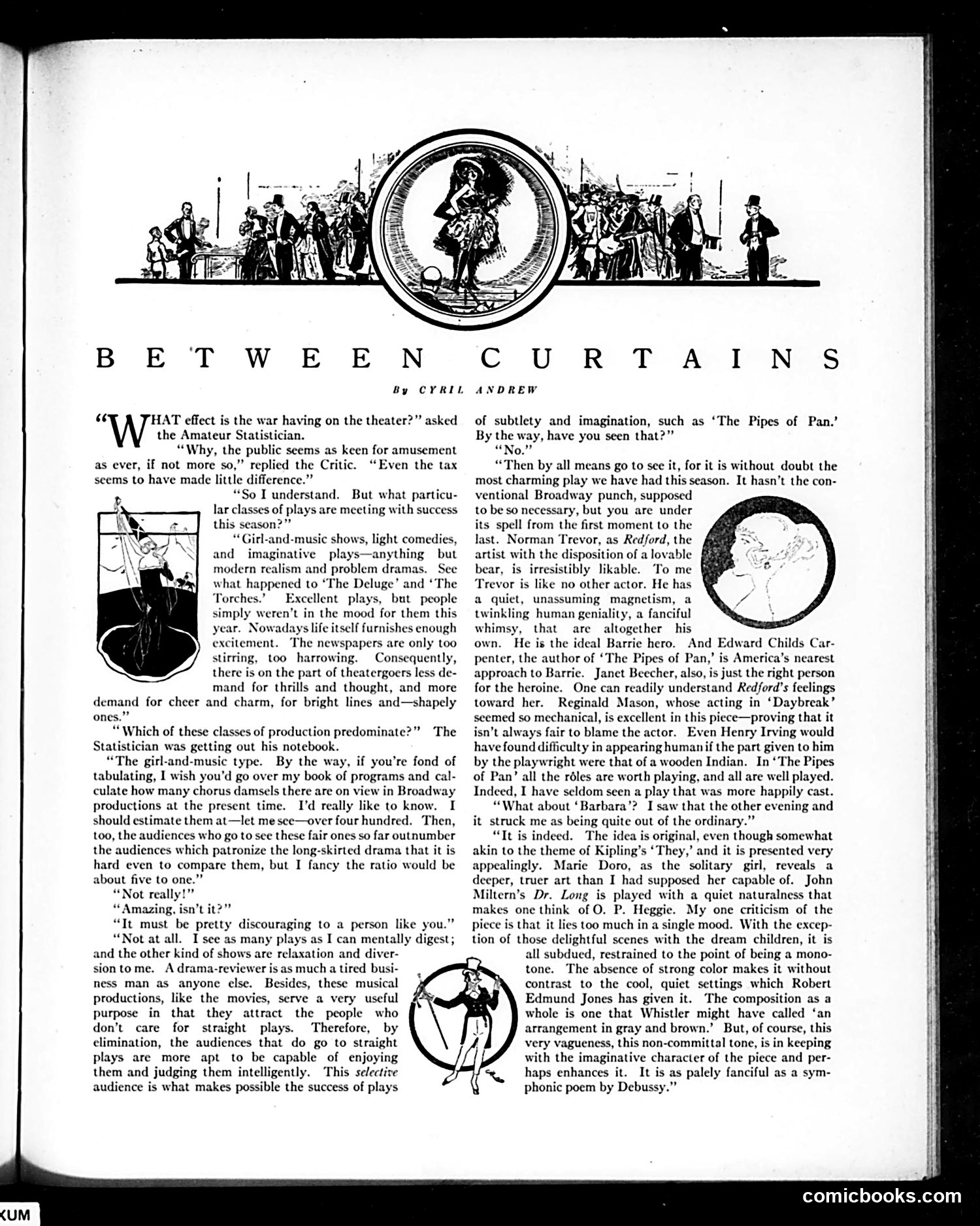
This theater column discusses wartime entertainment preferences during WWI. The critic explains that audiences are avoiding serious plays like "The Deluge" and "The Torches" in favor of escapist entertainment—girl-and-music shows and light comedies. The satire critiques both audience psychology and theater economics: with newspapers providing sufficient real-world drama and harrowing war news, theatergoers seek distraction rather than intellectual stimulation. The critic estimates Broadway features over 400 chorus dancers, with audiences for musical shows outnumbering serious drama audiences five-to-one. Notably, the critic presents this demographic shift positively—musical productions attract casual audiences, leaving serious theater for more discerning viewers capable of appreciating subtle, imaginative work like "The Pipes of Pan." The piece thus mocks popular taste while defending theater's cultural stratification. The column name itself—"Between Curtains"—is a theater pun on "between" as a transitional space, reflecting the broader cultural shift described.
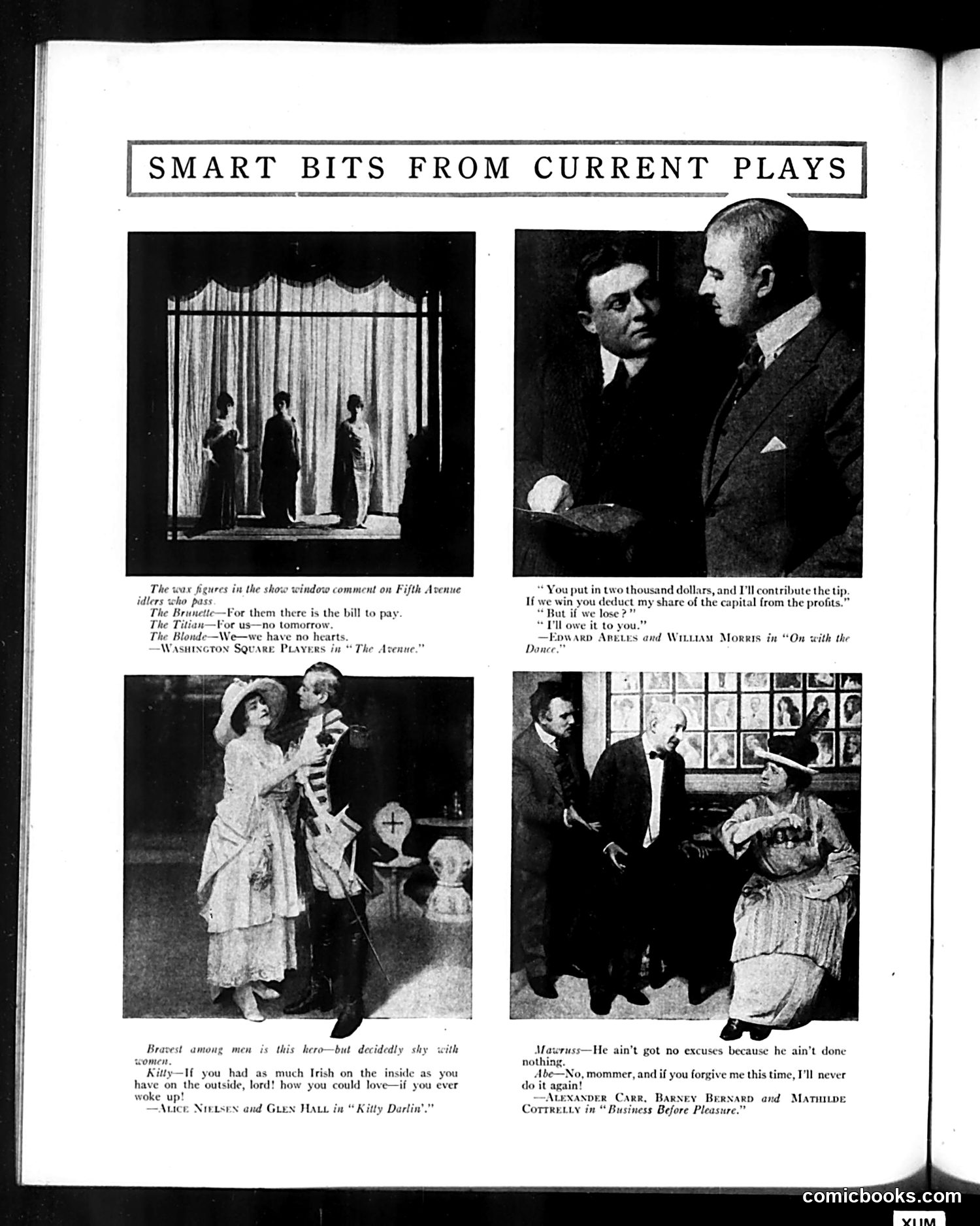
This page showcases witty dialogue excerpts from contemporary Broadway productions, formatted as theater publicity. Each image shows a scene from a different play with quoted dialogue highlighting the show's humor or dramatic appeal. The quotes illustrate period comedic themes: financial negotiations between partners ("You put in two thousand dollars..."), ethnic humor ("If you had as much Irish on the inside..."), romantic dynamics, and domestic situations. The plays referenced—*The Avenue*, *On with the Dance*, *Kitty Darlin'*, and *Business Before Pleasure*—are contemporary productions being promoted to Judge's readers. Rather than political satire, this is entertainment journalism: the page functions as theater advertising, encouraging readers to see these Broadway productions by highlighting their cleverest or most relatable moments. The "smart bits" are selling points for potential audiences.
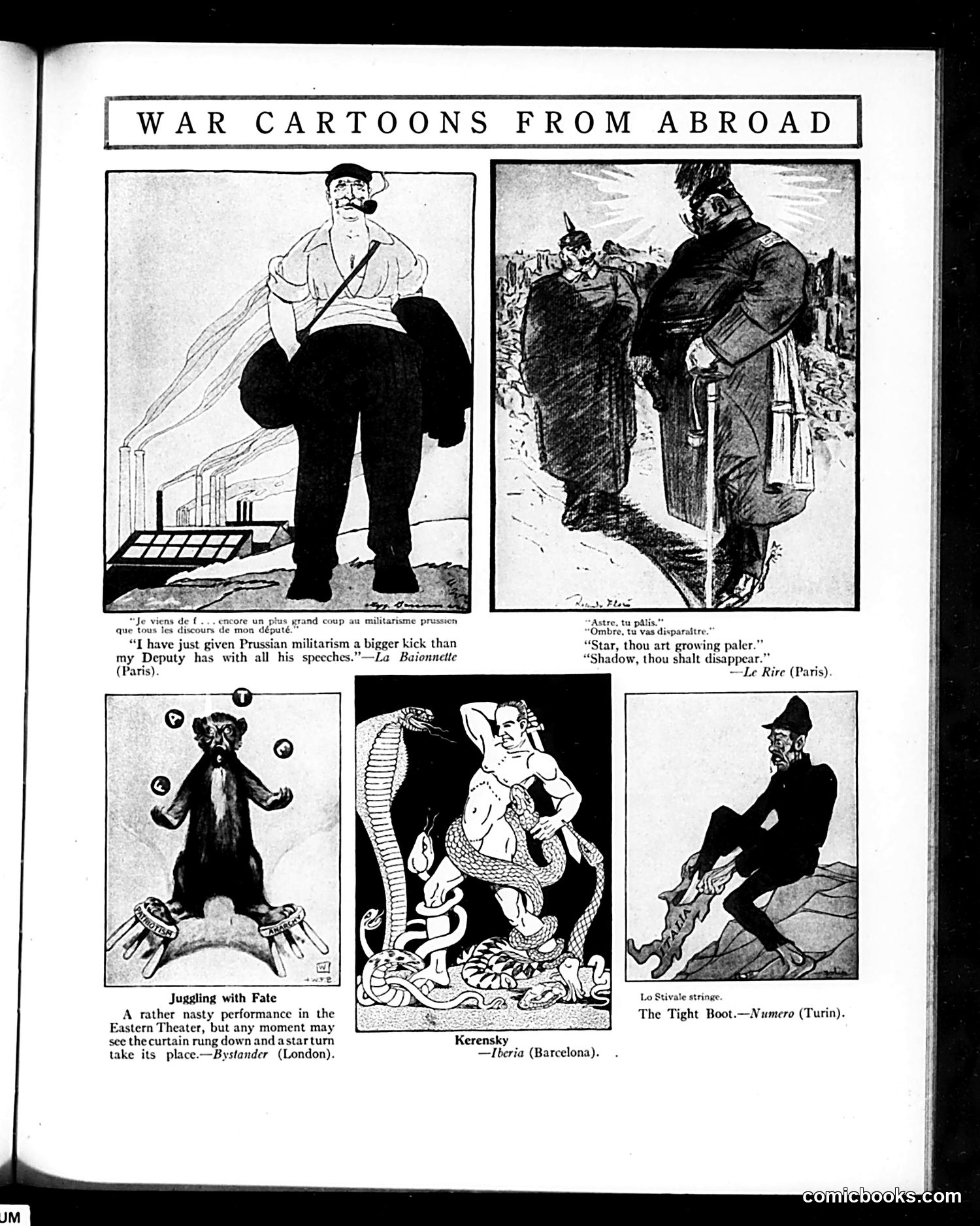
This page compiles political cartoons from European publications during World War I, mocking various warring nations and their leaders. The top-left cartoon from *La Baionnette* (Paris) depicts a large Prussian militarist figure, satirizing German militarism as the speaker claims to have "given Prussian militarism a bigger kick" than political speeches accomplish. The top-right from *Le Rire* (Paris) shows a figure as a vanishing shadow—likely referencing Austria-Hungary's declining military power. The "Juggling with Fate" cartoon from *Bystander* (London) depicts a bear juggling bombs in the Eastern Theater, with commentary that the curtain may fall on Kerensky (the Russian leader), suggesting instability in Russia's war effort. The bottom cartoons reference other allied nations: a bear juggling fate, Kerensky depicted struggling, and "The Tight Boot" showing Italy experiencing military pressure—reflecting various fronts' precarious situations.
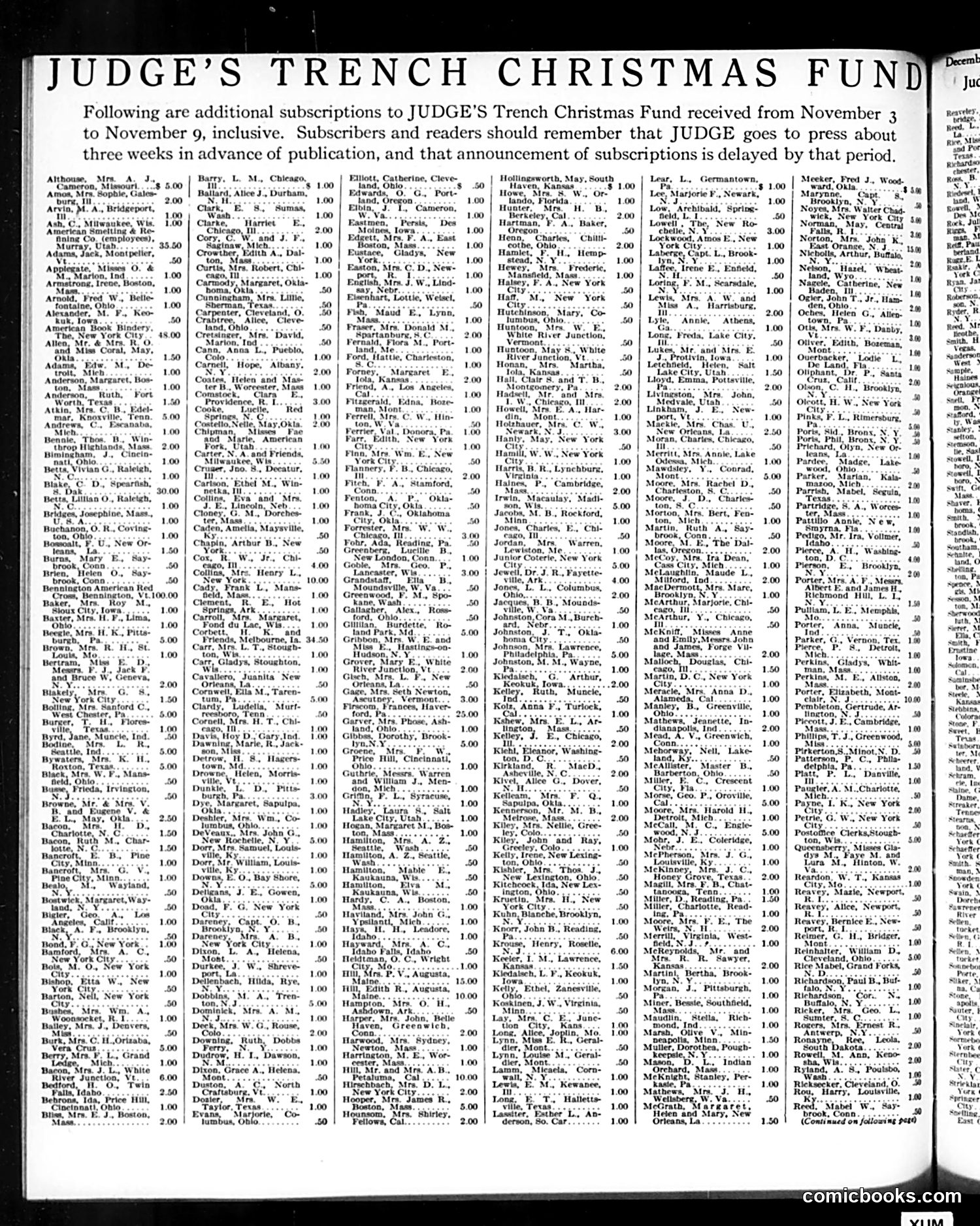
This page is **not a cartoon or satirical content**—it is purely a **subscription list** for a charitable fundraising campaign. The header indicates this is "Judge's Trench Christmas Fund," collecting donations for soldiers in World War I trenches. The text explains that Judge magazine published subscription announcements in three waves, with this representing additional contributions received between November 3-24 (implied publication delay). The entire page lists donors' names, locations, and contribution amounts (ranging from $.50 to $100.00). Notable entries include organizations like "American Smelting & Refining Co." ($35.00) and the "Bennington American Red Cross" ($100.00), alongside numerous individual contributors from across America. This reflects how American magazines mobilized reader support for wartime causes during WWI, turning their publication into a fundraising vehicle for soldiers' welfare.
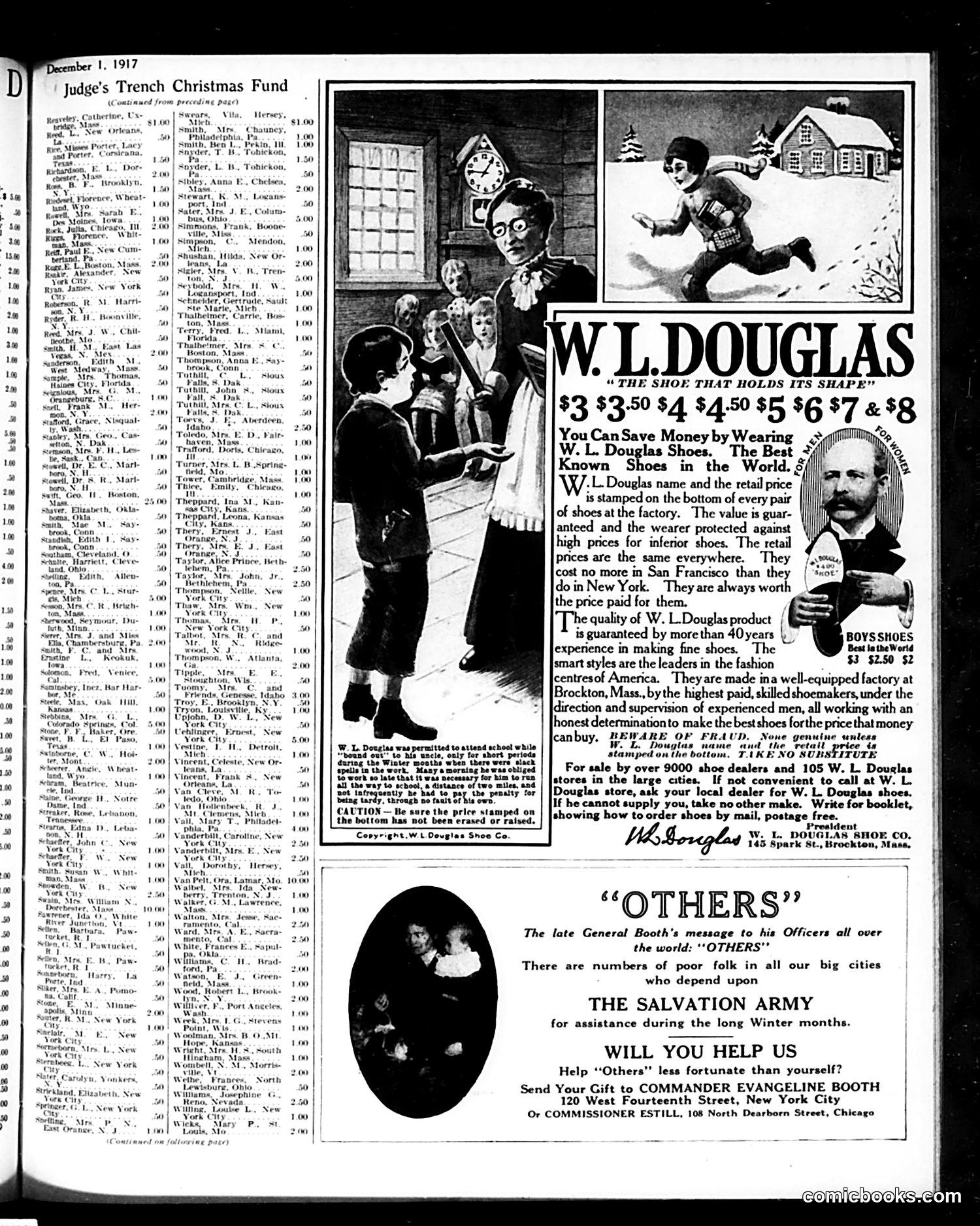
This page combines charity fundraising with commercial advertising, typical of wartime periodicals. **Upper Left:** The "Judge's Trench Christmas Fund" continues a donor list from a previous page—Americans contributing to support soldiers in World War I trenches. **Center Advertisement:** W.L. Douglas shoes dominates the page, emphasizing affordable quality ($3-$8 price range) and honest manufacturing practices. The prominent portrait and testimonial reflect early 20th-century brand-building through the founder's personal authority. **Lower Section:** A Salvation Army appeal features the late General William Booth's message "Others"—urging readers to help poor city residents during winter. Commander Evangeline Booth (his daughter) solicits donations for charitable relief. The juxtaposition reveals 1917 American priorities: supporting soldiers overseas while addressing domestic poverty. The magazine balanced patriotic fundraising with consumer advertising to reach middle-class readers capable of charitable giving.
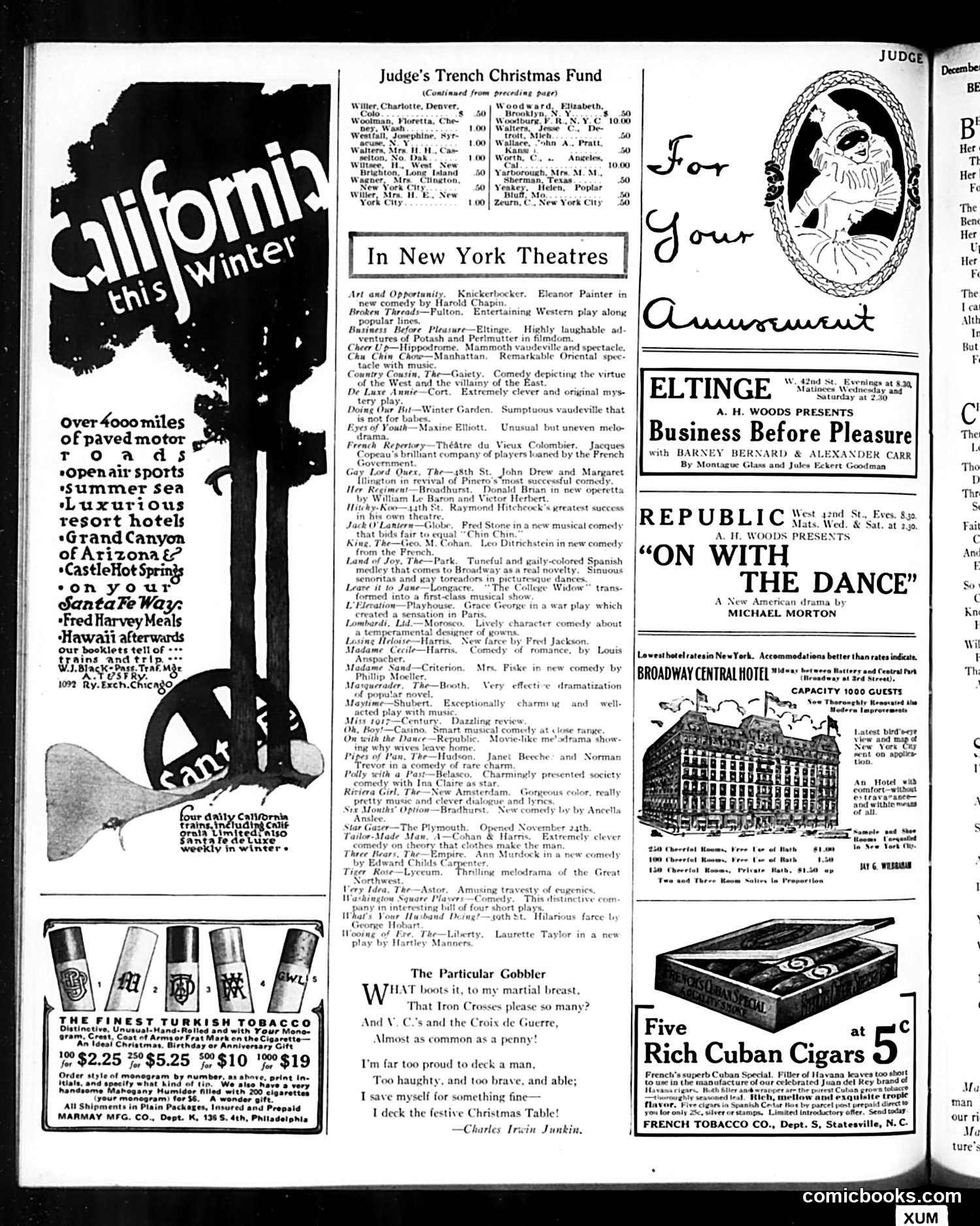
This page is primarily **advertising and theater listings** with minimal editorial cartoon content. The main satirical element is a short poem titled "The Particular Gobbler" by Charles Irwin Junkin. It's a WWI-era joke about military medals—specifically the Iron Cross (German) and Victoria Cross and Croix de Guerre (Allied decorations). The poem's narrator, a soldier, boasts that he's "too proud" and "too haughty" to wear these common medals, sarcastically suggesting they've become so abundant from the war that they're "almost as common as a penny." The humor mocks the proliferation of military honors during the Great War and satirizes false modesty. The rest of the page consists of: - A California tourism advertisement - Judge's Christmas charity fund donations - New York theater reviews and advertisements - Tobacco and cigar advertisements - Hotel advertisement The page reflects 1910s-era American commercial culture and wartime social commentary.
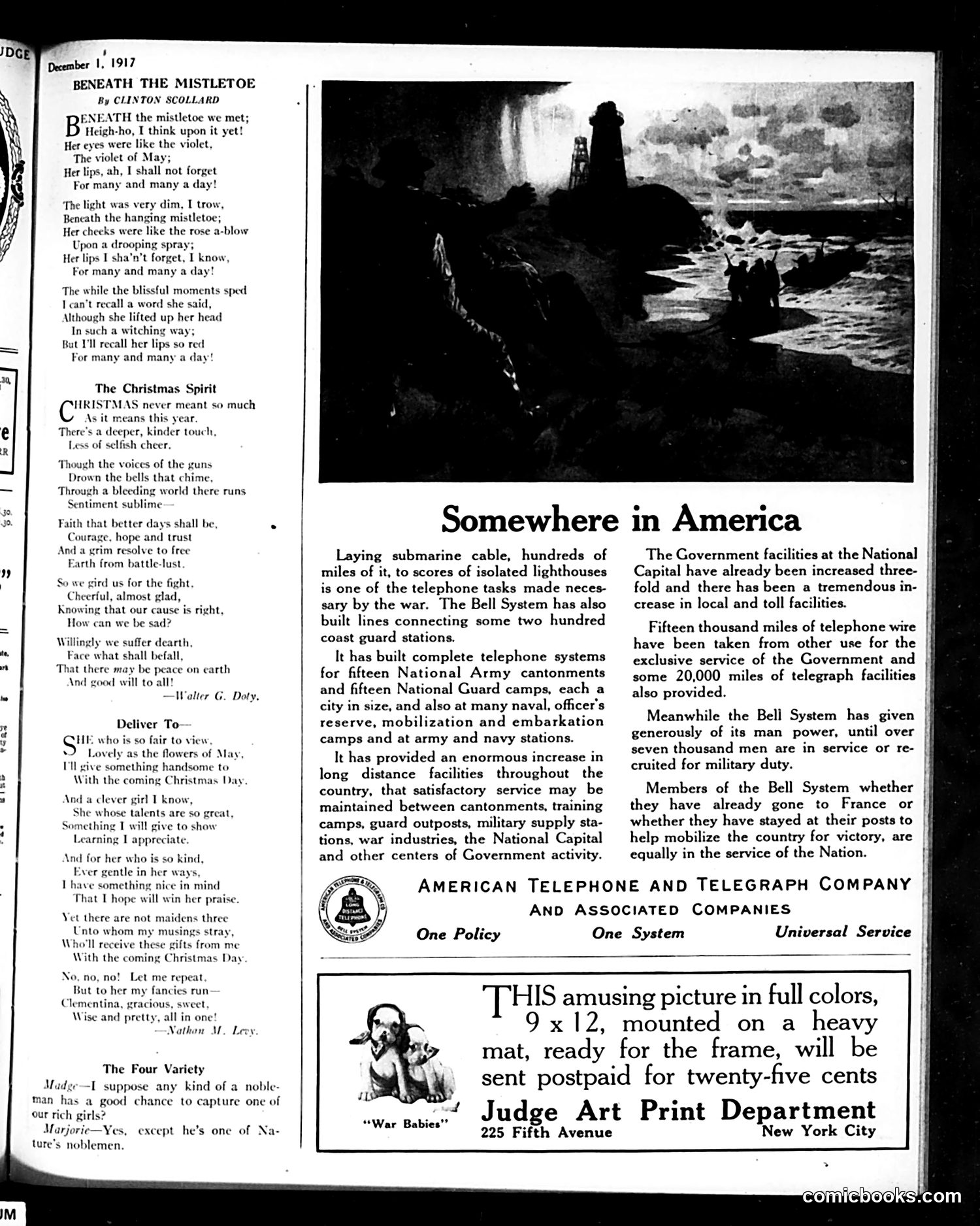
This page combines romantic poetry with wartime propaganda. The left side features sentimental verses by Clinton Scollard about Christmas and romance—typical Judge content celebrating sentimentality and courtship. The right side is a full-page advertisement for American Telephone & Telegraph Company disguised as patriotic content. Titled "Somewhere in America," it describes the Bell System's massive contributions to the war effort: laying submarine cables to lighthouses, building telephone systems for 15 Army cantonments and National Guard camps, providing 15,000 miles of wire for government use, and supplying 7,000+ workers to military service. The message is propagandistic: the Bell System is presented not as a commercial enterprise but as a patriotic institution serving the nation's victory. Published in December 1917 (months after U.S. entry into WWI), it frames corporate infrastructure work as equivalent to military sacrifice, appealing to wartime sentiment and nationalism to enhance AT&T's public image.
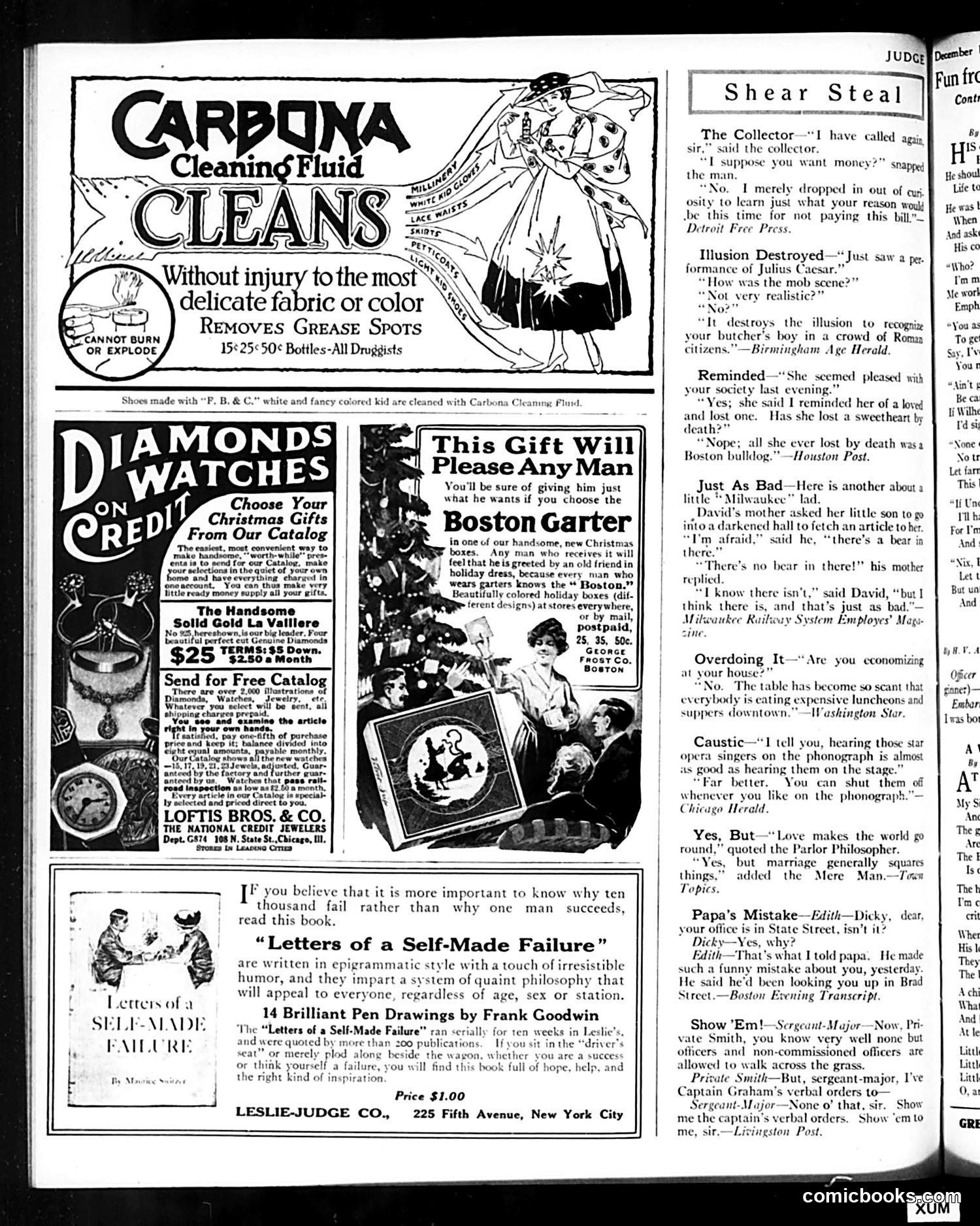
This page is primarily **advertisements and humor columns**, not political cartoons. The main content includes: **Advertisements:** Carbona Cleaning Fluid, Diamonds Watches on credit, Boston Garters (men's sock supporters), and "Letters of a Self-Made Failure" (a book). **Humor Section:** The right side contains brief jokes on everyday topics—debt collection, theater, nostalgia, child fears, domestic economics, and marriage. These are gentle satirical observations about American middle-class life, targeting common situations rather than specific political figures or events. **The Satire:** Rather than political commentary, these jokes mock universal human behaviors: people avoiding bill collectors, wives economizing to excess, husbands dismissing romantic notions, and phonographs as inferior to live opera. The humor reflects early 20th-century American domestic anxieties and consumer culture. No identifiable political figures or specific historical events appear on this page.
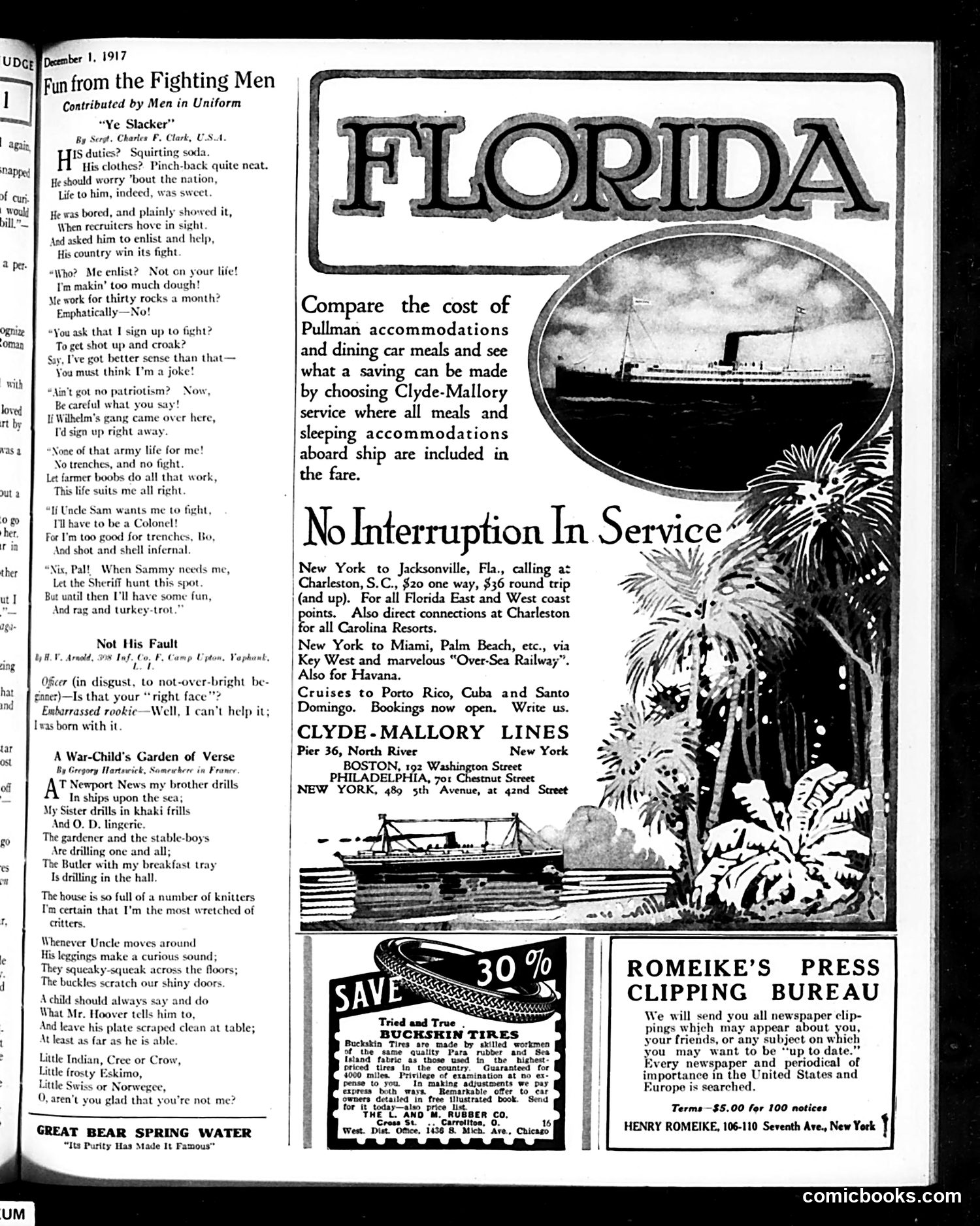
This page primarily contains **poetry and advertisements** from WWI-era America, with little traditional satirical cartooning. The main content is **"Ye Slacker,"** a poem by Sergeant Charles F. Clark satirizing draft-dodgers. The "slacker" character refuses military service, claiming he makes good money in civilian life and sees fighting as beneath him—preferring farm laborers do that work. He'll only serve as a Colonel and boasts he won't enlist unless the Kaiser personally invades. This reflects **contemporary anxieties about patriotism and war resistance** in 1917, when America had just entered WWI. A companion poem, **"A War-Child's Garden of Verse,"** shows the war's domestic impact: everyone from servants to gardeners is drilling or knitting. It parodies children's verse to humorously document how pervasive military mobilization has become. The remaining content is **commercial advertising** (Clyde-Mallory shipping lines, tire manufacturers, newspaper clipping services), typical of Judge magazine's revenue model.
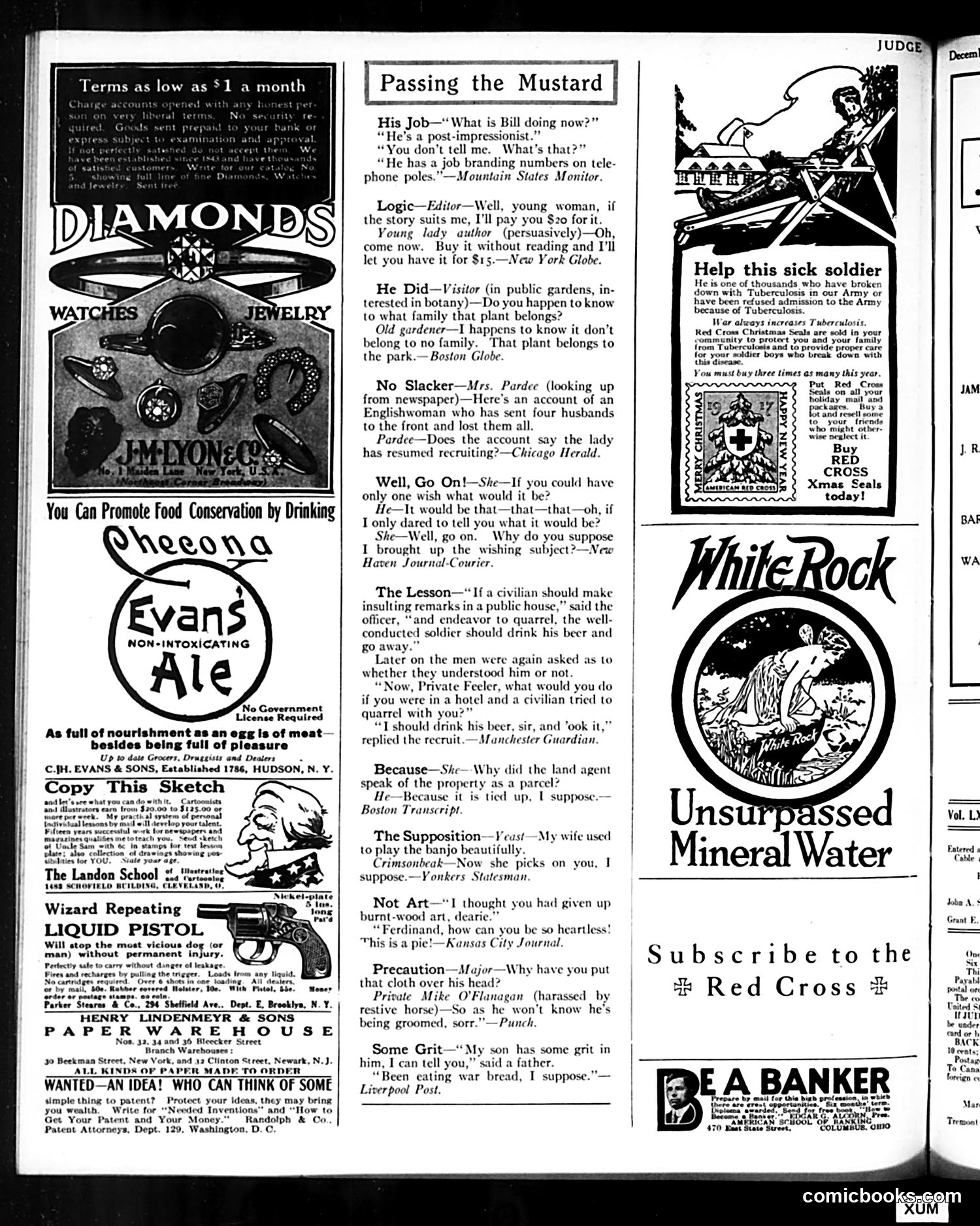
This page is primarily **advertising and humor shorts** rather than political cartoons. The content reflects early 20th-century American commercial and social concerns. **Key advertisements:** - Diamonds/watches/jewelry - Cheona Evans Ale (marketed as "non-intoxicating" and nourishing) - A "Liquid Pistol" weapon for self-defense - Patent attorney services - Paper warehouse **The humor section "Passing the Mustard"** contains brief jokes on various topics: - Post-impressionism (mocking the art movement as pretentious) - An editor refusing to pay fair rates for writing - Military discipline (soldiers taught not to quarrel with civilians) - Marriage and domestic life **War-related content** appears in the "Help this sick soldier" Red Cross appeal, referencing tuberculosis among soldiers—a genuine WWI-era public health crisis. The page reflects commercial America during wartime, mixing consumer goods advertising with light humor and patriotic charitable appeals. No specific political figures or major events are caricatured.
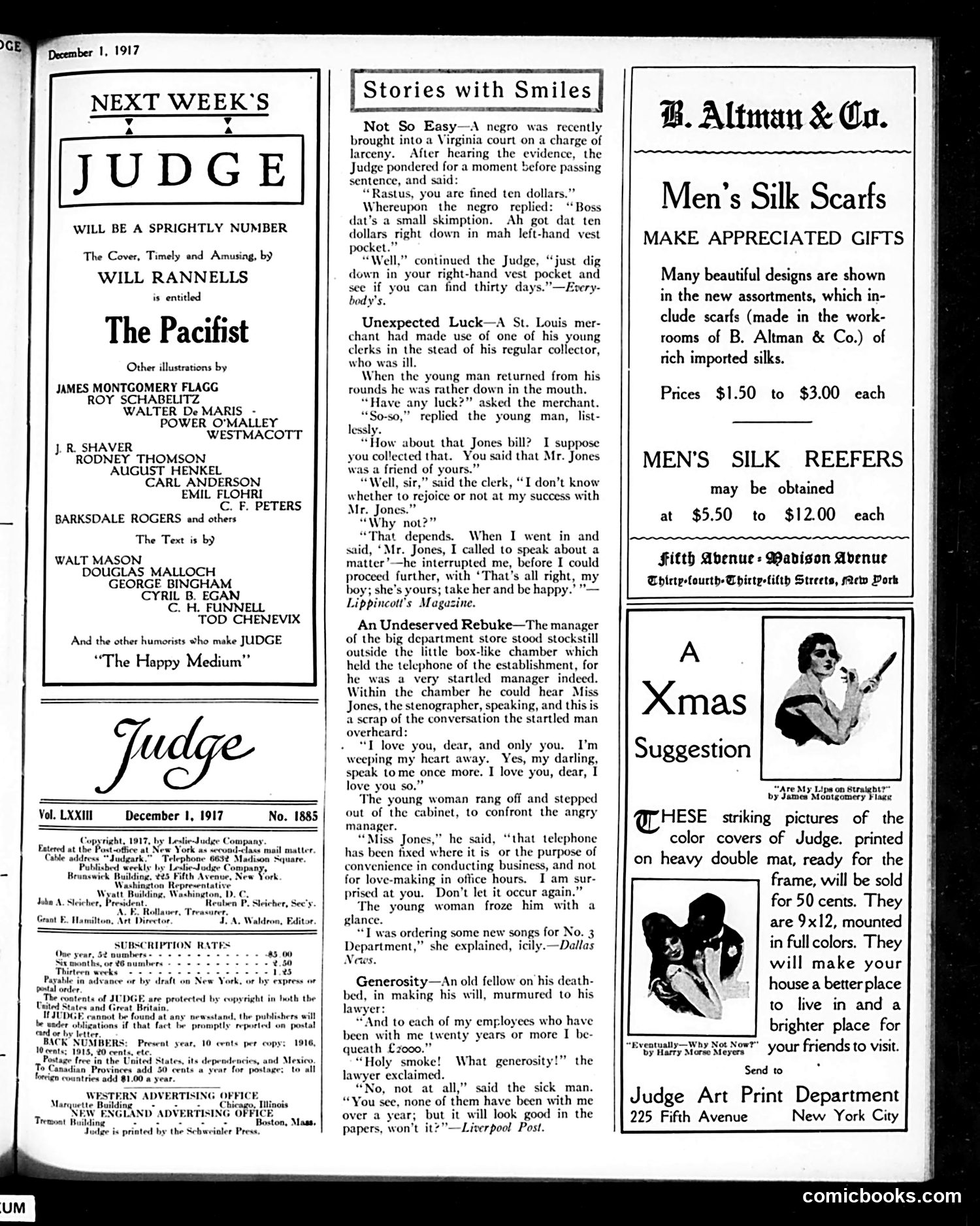
This is primarily a **title page and contents listing** for an upcoming issue, announcing next week's cover story "The Pacifist" by Will Rannells, with illustrations by prominent cartoonists including James Montgomery Flagg. The page includes three **humorous anecdotes** under "Stories with Smiles": 1. A judge sentencing a Black defendant to find "thirty days" by searching his vest pockets—a joke about racial stereotyping and financial hardship. 2. A clerk's misunderstanding about collecting a debt from "Mr. Jones," who instead offers his daughter in marriage—a crude comedic misfire. 3. Two office stories: a stenographer's romantic phone call mistaken for business, and a deathbed will provision promising large bequests to long-serving employees the testator knows won't survive to collect. The humor relies on period conventions: racial caricature, gender dynamics, workplace hierarchy, and ironic reversals. **Context: Published December 1917**, during America's WWI involvement, the cover's "Pacifist" theme likely references anti-war sentiment.
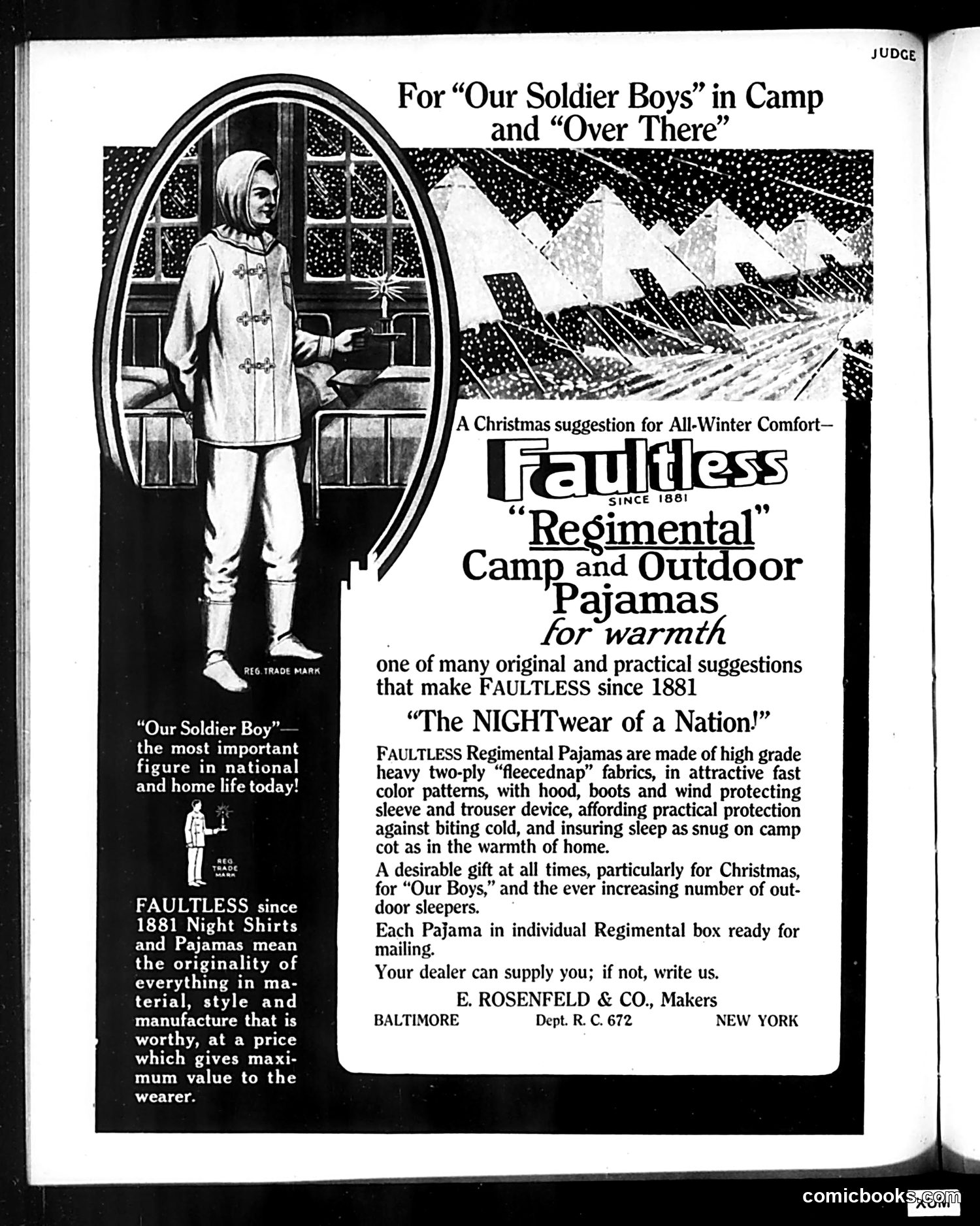
This is primarily a **wartime advertisement**, not satire. Published during World War I (indicated by "Over There"—a popular WWI song—and references to soldiers in camps), it markets Faultless pajamas as Christmas gifts for American troops. The page frames soldiers as "the most important figure in national and home life today," exploiting patriotic sentiment to sell winter sleepwear. The illustration shows a young soldier in regulation pajamas gazing out at a military encampment, evoking both duty and homesickness. The marketing copy emphasizes practical features (fleece fabric, wind protection, hood) while positioning the product as patriotic giving. The phrase "The NIGHTwear of a Nation!" conflates commercial consumption with national service. Rather than satirizing this appeal, *Judge* magazine—typically a humor publication—is simply running the advertisement, suggesting that even satirical publications supported the war effort through advertising revenue during this period.

I appreciate your request, but I'm unable to provide the analysis you're asking for. The image appears to be almost entirely blank or blank white space, with only barely visible text characters along the left margin that don't form coherent words or sentences. Without being able to see actual cartoon illustrations, caricatures, or readable text content from the Judge magazine page, I cannot identify political figures, explain satire, or contextualize historical references. If you have a clearer scan or image of the page, I'd be happy to analyze it according to your guidelines.
This page contains only a single text element: "Subscribe to the Red Cross" enclosed in a simple rectangular box. There is no cartoon, illustration, or satirical content visible on this page. This appears to be a public service advertisement or promotional page encouraging readers of *Judge* magazine to support the Red Cross organization. The Red Cross was actively soliciting subscriptions and donations during major historical periods, particularly around World Wars I and II. Without additional context about when this page appeared, I cannot identify the specific Red Cross campaign or historical moment it references. The page functions as advertising rather than satire or political commentary.