
Judge, 1917-12-01 · page 23 of 36
Judge — December 1, 1917 — page 23: what you’re looking at
What you’re looking at
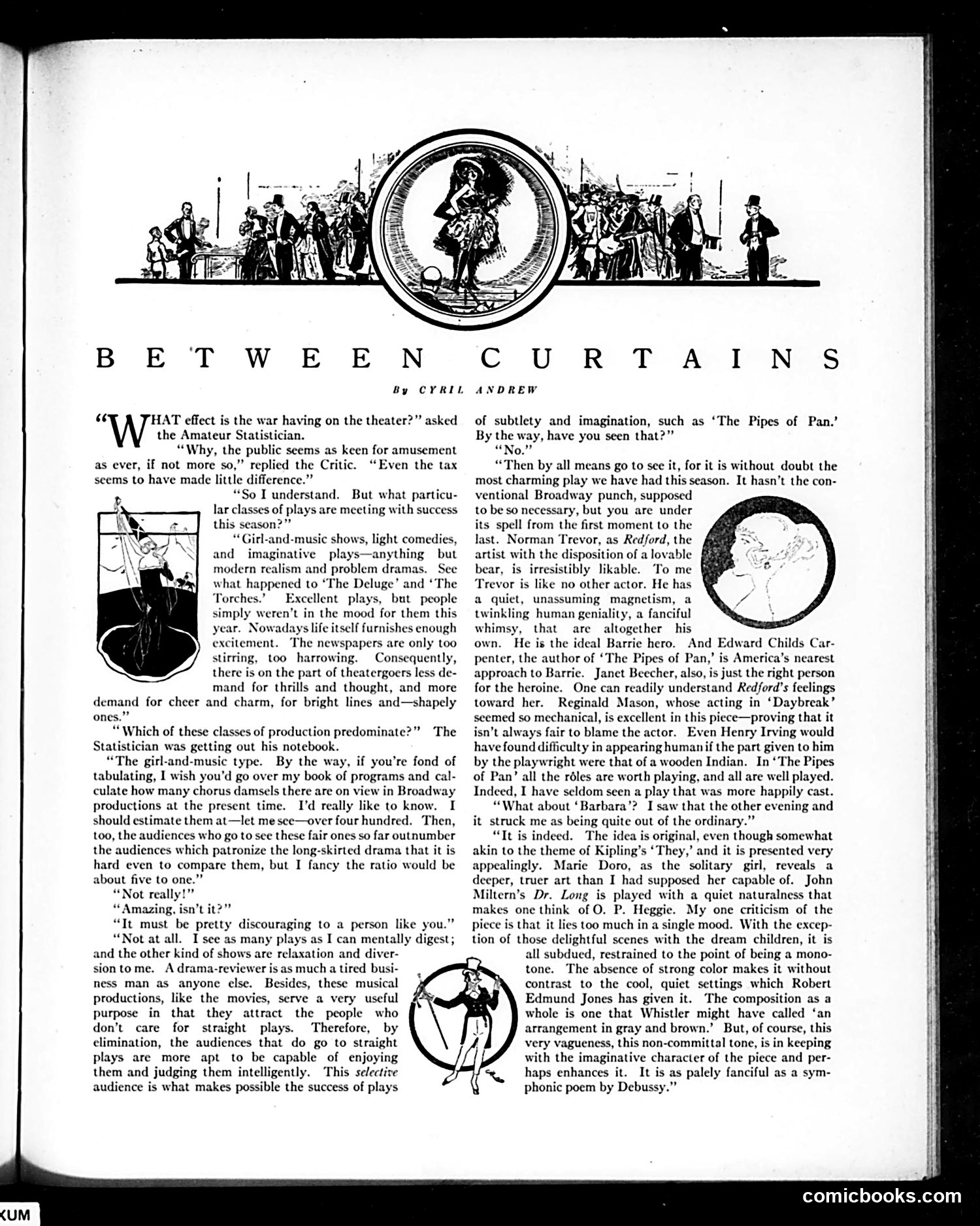
This theater column discusses wartime entertainment preferences during WWI. The critic explains that audiences are avoiding serious plays like "The Deluge" and "The Torches" in favor of escapist entertainment—girl-and-music shows and light comedies. The satire critiques both audience psychology and theater economics: with newspapers providing sufficient real-world drama and harrowing war news, theatergoers seek distraction rather than intellectual stimulation. The critic estimates Broadway features over 400 chorus dancers, with audiences for musical shows outnumbering serious drama audiences five-to-one. Notably, the critic presents this demographic shift positively—musical productions attract casual audiences, leaving serious theater for more discerning viewers capable of appreciating subtle, imaginative work like "The Pipes of Pan." The piece thus mocks popular taste while defending theater's cultural stratification. The column name itself—"Between Curtains"—is a theater pun on "between" as a transitional space, reflecting the broader cultural shift described.
📄 Transcribed text from this page (OCR, searchable)
Machine-transcribed from the original scan — historical spelling and the odd misread are preserved.
By CYRIL “ HAT effect is the war having on the theater?” asked W the Amateur Statistician. “Why, the public seems as as ever, if not more so,” replied the Critic. seems to have made little difference.” “So I understand. But what particu- lar classes of plays are meeting with success en for amusement “Even the tax “Girl-and-music shows, light comedies, and imaginative plays—anything but modern realism and problem dramas. See what happened to ‘The Deluge’ and ‘The Torches.’ Excellent plays, but people simply weren’t in the mood for them this r. Nowadays life itself furnishes enough excitement. The newspapers are only too stirring, too harrowing. Consequently, there is on the part of theatergoers less de- mand for thrills and thought, and more demand for cheer and charm, for bright lines and—shapely ich of these classes of production predominate?” The jan was getting out his notebook. “The girl-and-music type. By the way, if you’re fond of tabulating, I wish you'd go over my book of programs and cal- culate how many chorus damsels there are on view in Broadway productions at the present time. I'd really like to know. I should estimate them at—let me see—over four hundred. Then, too, the audiences who go to see these fair ones so far outnumber the audiences which patronize the long-skirted drama that it is hard even to compare them, but I fancy the ratio would be about five to one.”” “Not really “Amazing, isn’t it?” “It must be pretty discouraging to a person like you.” “Not at all. I see as many plays as I can mentally digest; and the other kind of shows are relaxation and diver- sion tome. A drama-reviewer is as much a tired busi- ness man as anyone else. Besides, these musical productions, like the movies, serve a very useful purpose in that they attract the people who don’t care for straight plays. Therefore, by elimination, the audiences that do go to straight plays are more apt to be capable of enjoying them and judging them intelligently. This selective audience is what makes possible the success of plays ANDREW of subtlety and imagination, such as ‘The Pipes of Pan.’ By the way, have you seen that?” “No.” “Then by all means go to see it, for it is without doubt the most charming play we have had this season. It hasn’t the con- ventional Broadway punch, supposed to be so necessary, but you are under its spell from the first moment to the Norman Trevor, as Redford, the artist with the disposition of a lovable bear, is irresistibly likable. To me Trevor is like no other actor. He has a quiet, unassuming magnetism, a twinkling human geniality, a fanciful whimsy, that are altogether his own. He is the ideal Barrie hero. And Edward Childs Car- penter, the author of ‘The Pipes of Pan,’ is America’s nearest approach to Barrie. Janet Beecher, also, is just the right person for the heroine. One can readily understand Redford’s feelings toward her. Reginald Mason, whose acting in ‘Daybreak’ seemed so mechanical, is excellent in this piece—proving that it isn’t always fair to blame the actor. Even Henry Irving would have found difficulty in appearing human if the part given to him by the playwright were that of a wooden Indian. In ‘The Pipes of Pan’ all the réles are worth playing, and all are well played. Indeed, I have seldom seen a play that was more happily cast. “What about ‘Barbara’? I saw that the other evening and it struck me as being quite out of the ordinary.” “Tt is indeed. The idea is original, even though somewhat akin to the theme of Kipling’s ‘They,’ and it is presented very appealingly. Marie Doro, as the solitary girl, reveals a deeper, truer art than I had supposed her capable of. John Miltern’s Dr. Long is played with a quiet naturalness that makes one think of O. P. Heggie. My one criticism of the piece is that it lies too much in a single mood. With the excep- tion of those delightful scenes with the dream children, it is all subdued, restrained to the point of being a mono- tone. The absence of strong color makes it without contrast to the cool, quiet settings which Robert Edmund Jones has given it. The composition as a whole is one that Whistler might have called ‘an arrangement in gray and brown.’ But, of course, this very vagueness, this non-committal tone, is in keeping with the imaginative character of the piece and per- haps enhances it. It is as palely fanciful as a sym- phonic poem by Debussy.” comicbooks.com