
A complete issue · 28 pages · 1917
Judge — November 17, 1917
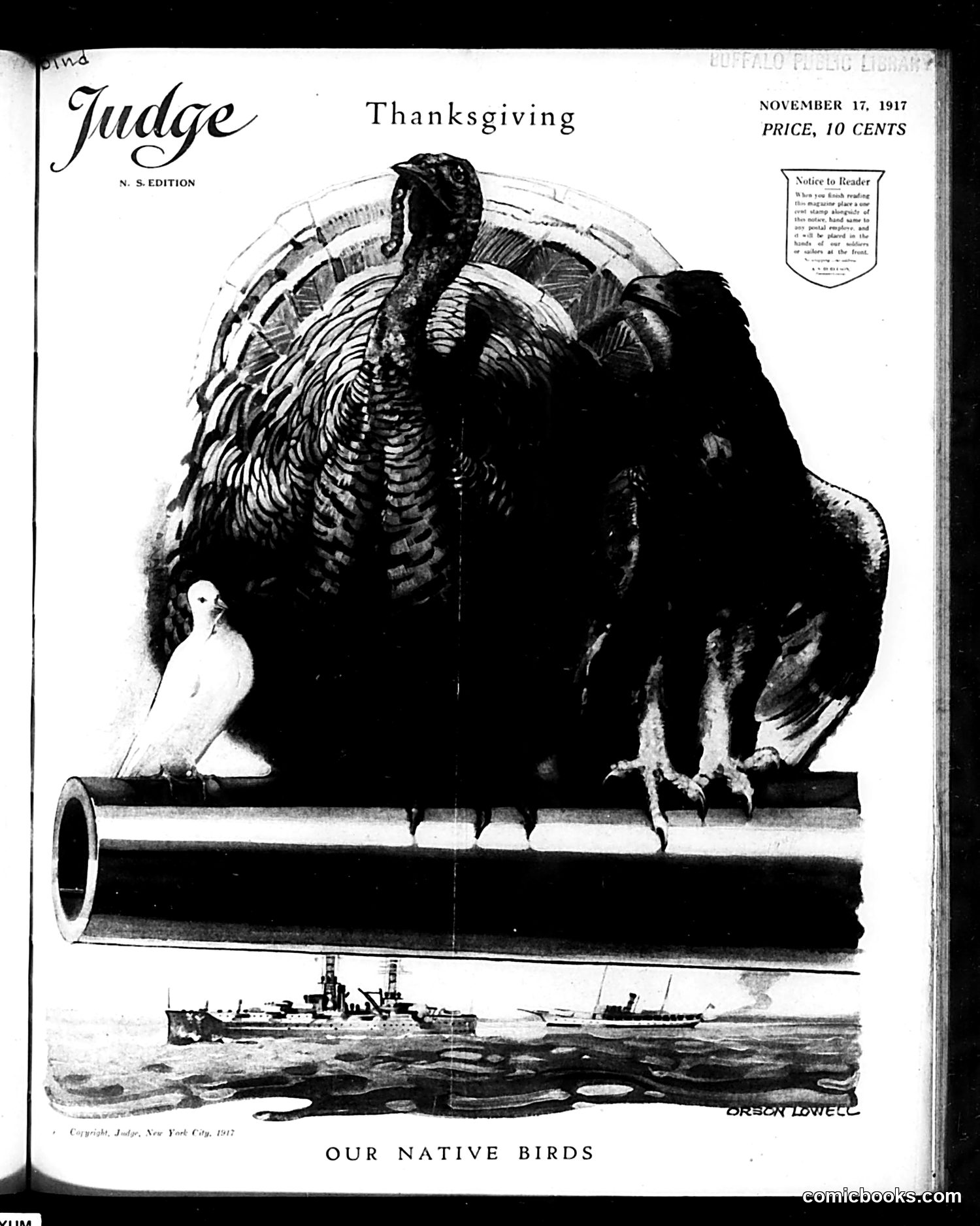
This is the cover of Judge magazine from November 17, 1917—during World War I, when the U.S. had recently entered the conflict (April 1917). The cartoon titled "Our Native Birds" depicts a large turkey alongside a white dove perched on a log, with warships visible below in the ocean. The satirical meaning appears to reference Thanksgiving during wartime: the turkey traditionally represents America's holiday bounty, while the dove symbolizes peace. The warships underscore the grim reality that peace remains distant. The juxtaposition suggests irony—celebrating traditional American abundance and peace while the nation wages war overseas. The "native birds" metaphor likely comments on American values (plenty, peace) in tension with current military necessities, making this a commentary on celebrating Thanksgiving amid the anxieties and costs of World War I.
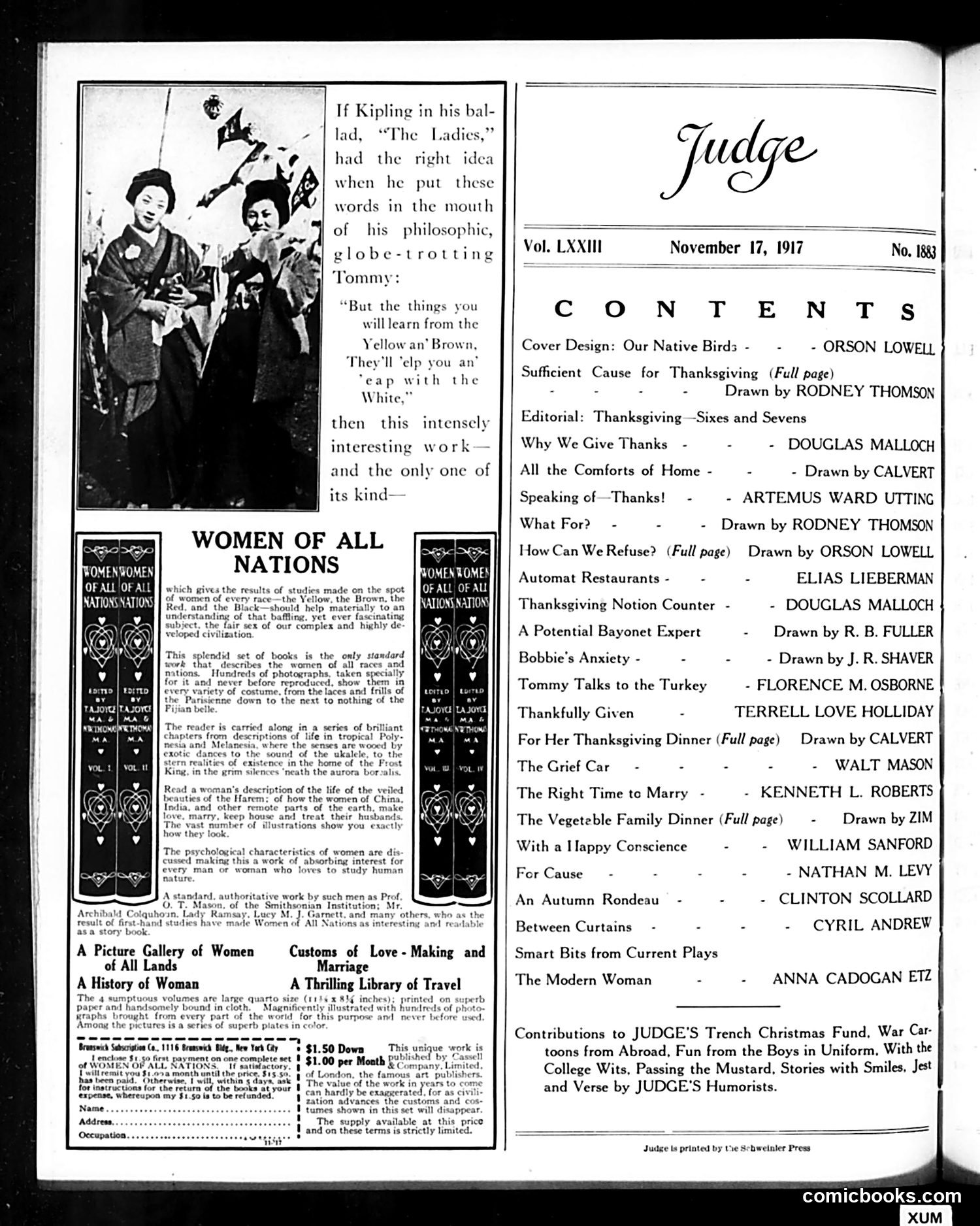
This page is primarily a **contents listing and advertisement** for "Women of All Nations," a book series. The small photograph at top left appears to show two women in Asian dress, likely illustrating the book's global scope. The satirical content is minimal on this page. The main visual joke references **Kipling's poem "The Ladies,"** with text about "Yellow an' Brown" and "cap wi' the White"—a period reference to British imperial attitudes toward women of different races. This appears gently mocking rather than harshly satirical. The bulk of the page lists typical Judge content: Thanksgiving-themed articles and illustrations befitting the **November 1917 publication date** (near U.S. Thanksgiving). The ads and contents suggest Judge's readership was educated, middle-class Americans interested in literature and humor.
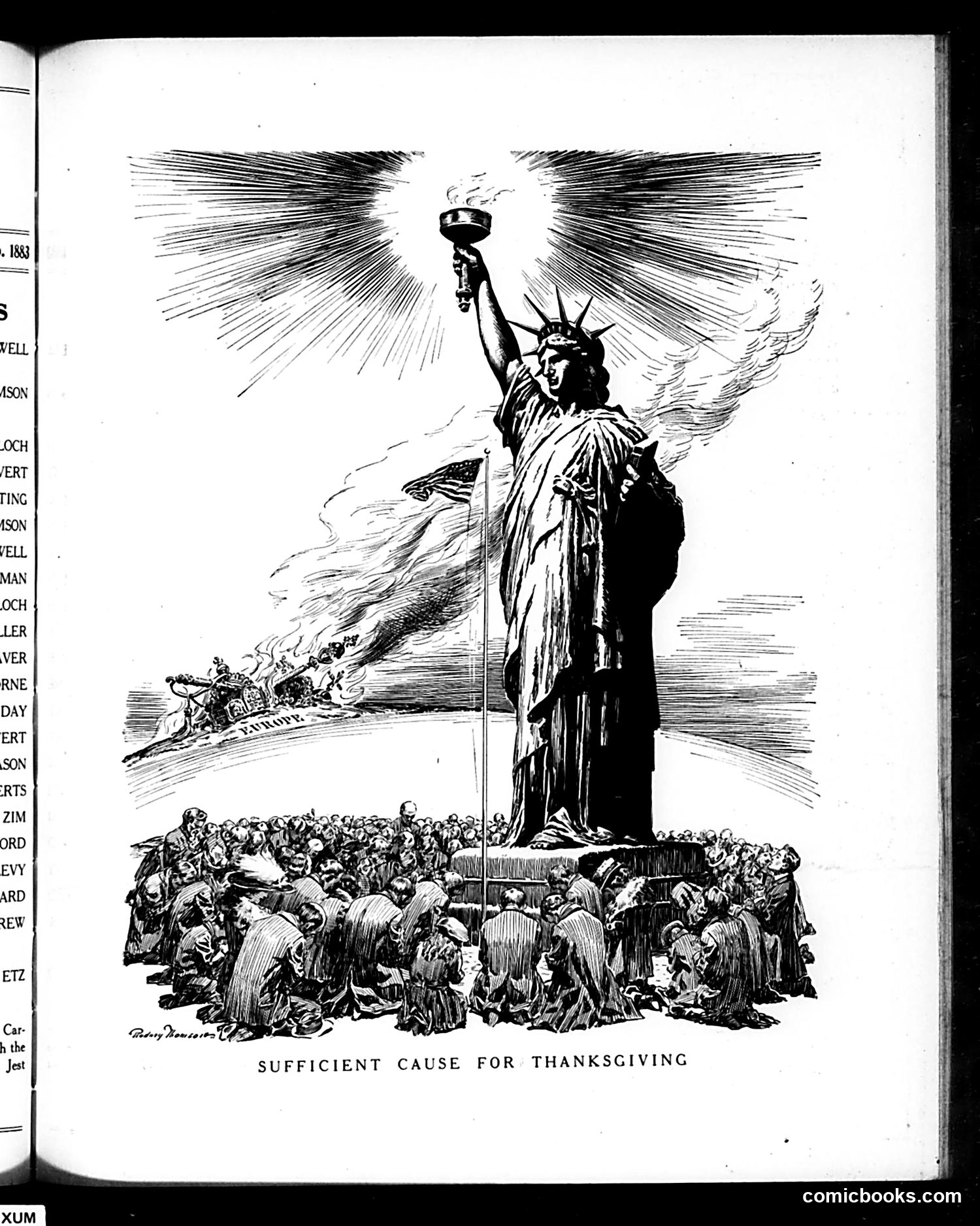
This political cartoon from *Judge* magazine depicts the Statue of Liberty holding her torch aloft, surrounded by a large crowd of people gathered at her base. The composition suggests immigrants or citizens gathering to give thanks. The title "Sufficient Cause for Thanksgiving" appears to celebrate American liberty and democratic ideals as grounds for gratitude. The Statue of Liberty—a symbol of American freedom and immigration—serves as the focal point, with the torch representing enlightenment and hope. Without a specific date visible, the exact historical context remains unclear, though the imagery suggests this cartoon celebrates American values of freedom and opportunity, likely addressing themes of immigration or national identity that were prominent in late 19th or early 20th-century American discourse.
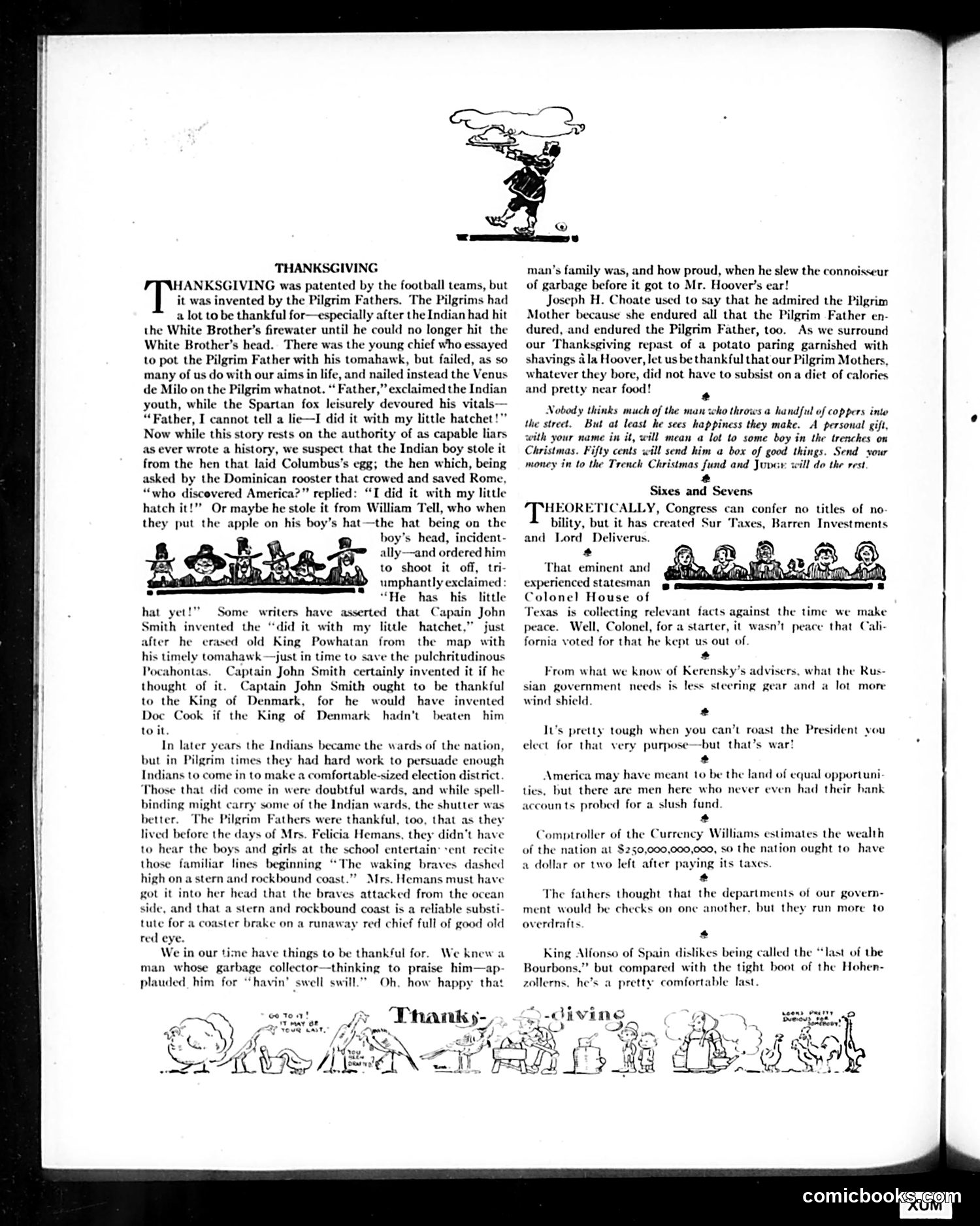
This page satirizes American Thanksgiving traditions and contemporary political issues. The main article humorously traces Thanksgiving's origins, joking that it was "patented by the football teams" and attributing various historical figures (Native Americans, Pilgrim Fathers, Captain John Smith) with inventing the holiday's traditions. The "Sixes and Sevens" section contains political commentary, including critiques of government spending, references to President Kerensky's Russian government, and complaints about banking and currency issues. One item mocks King Alfonso of Spain as "the last of the Bourbons." The cartoons at top and bottom illustrate Thanksgiving themes. Overall, the page blends holiday humor with contemporary political satire typical of Judge's satirical approach.
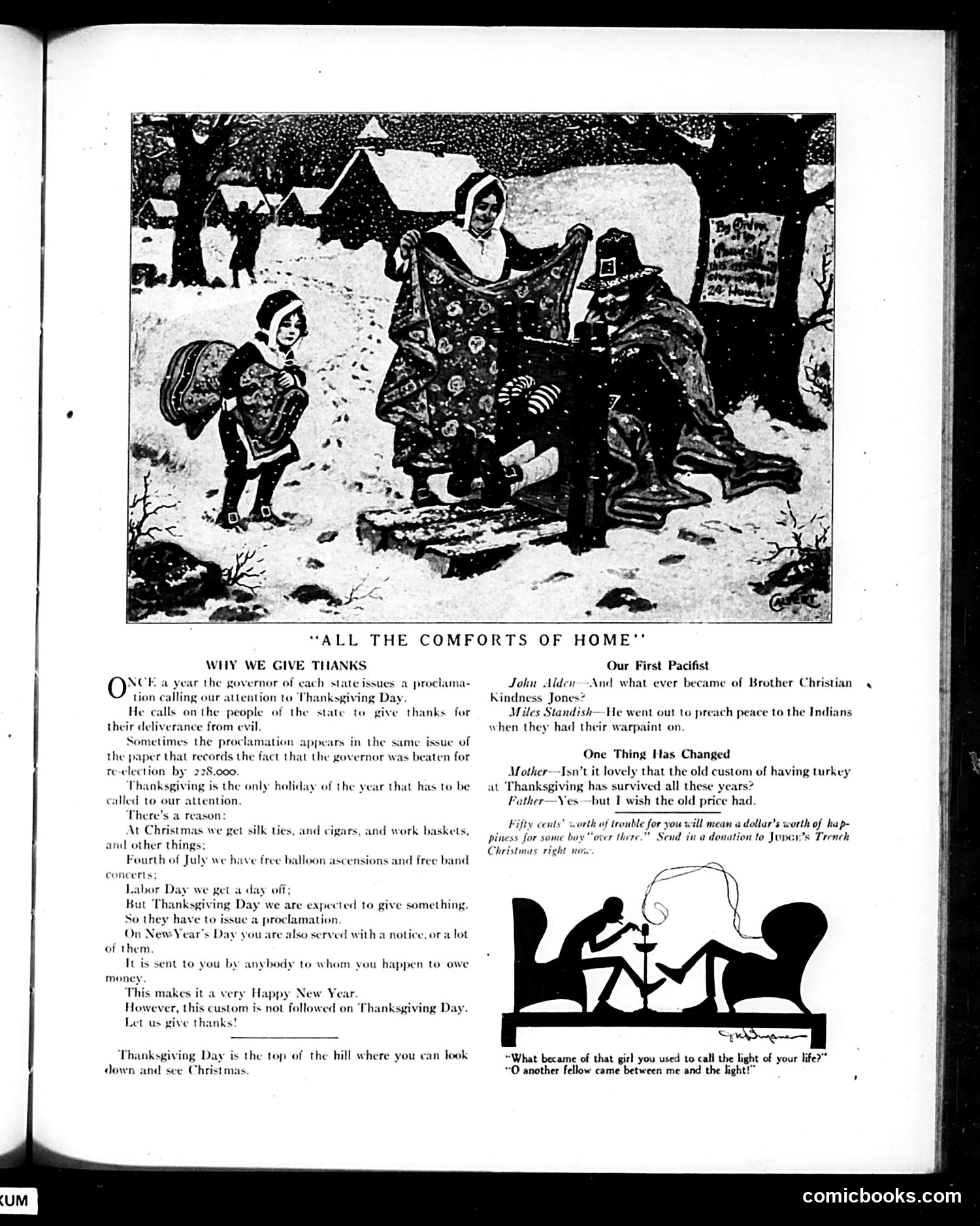
The top illustration depicts a Thanksgiving scene with a woman and children in winter clothing gathered outdoors, likely representing early settlers or a historical reference point. The text below critiques American Thanksgiving practices by contrasting the holiday with other occasions. The author argues that Thanksgiving uniquely demands *giving* (charitable donations), whereas Christmas brings commercial appeals, New Year's involves debt collection notices, and Labor Day grants rest. The satire suggests that governors' proclamations about giving thanks ring hollow—Americans are expected to demonstrate gratitude through actual financial contributions while other holidays escape such moral pressure. The bottom cartoon depicts a domestic scene with the caption questioning what became of a woman from the speaker's past, suggesting romantic nostalgia or lost love.
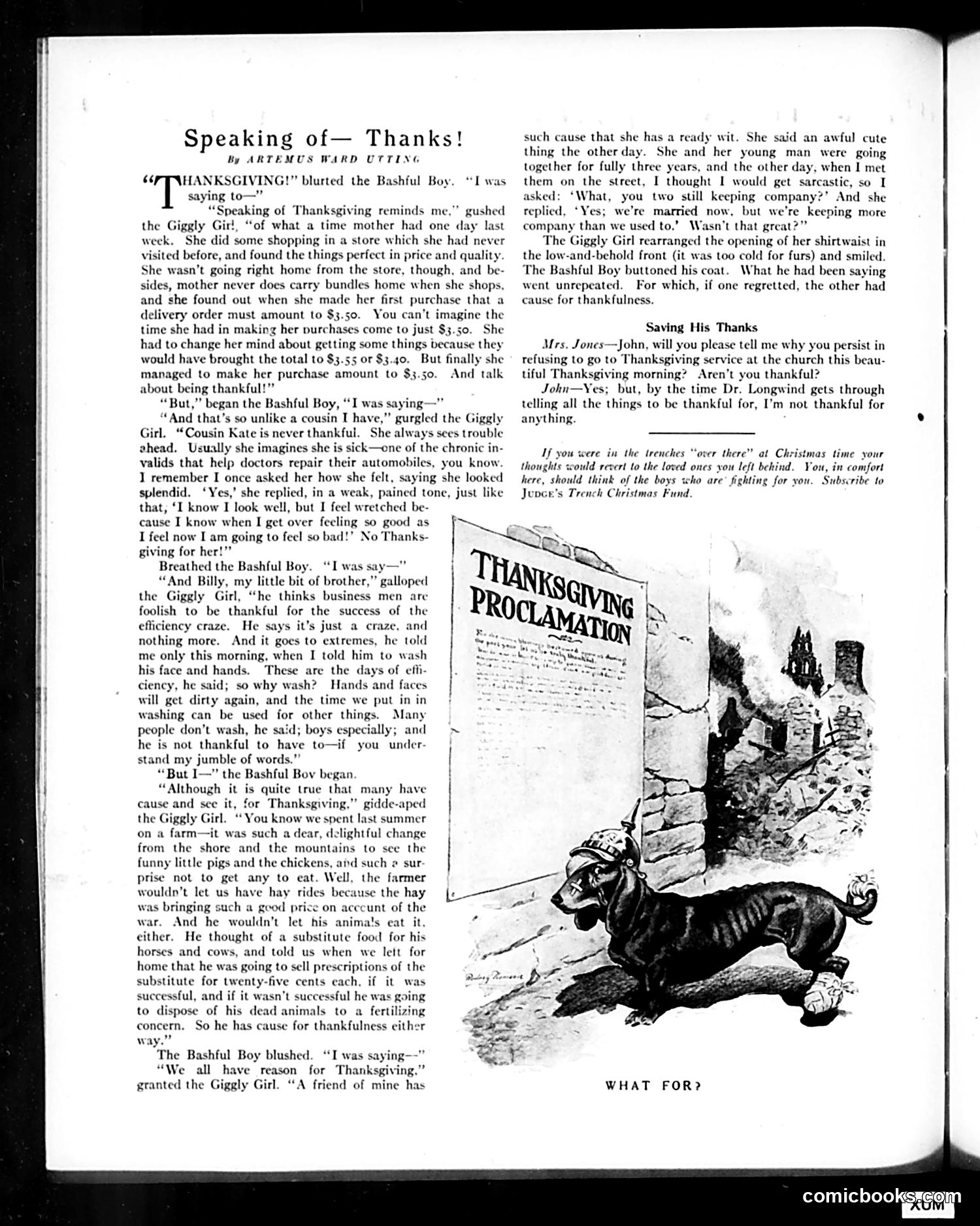
This page combines a humorous dialogue story with a political cartoon. The story features recurring characters (the "Bashful Boy" and "Giggly Girl") debating reasons for Thanksgiving gratitude during wartime, touching on rationing, efficiency concerns, and farm animals' scarcity. The cartoon "What For?" depicts a thin, exhausted cow or similar livestock lying dead before a "Thanksgiving Proclamation" sign. This appears to satirize the disconnect between official calls for gratitude and the grim agricultural realities of wartime—likely WWI era, given references to hay shortages and food substitutes. The cartoon's dark humor suggests citizens should question what they're actually thankful for when resources are scarce and animals starving.
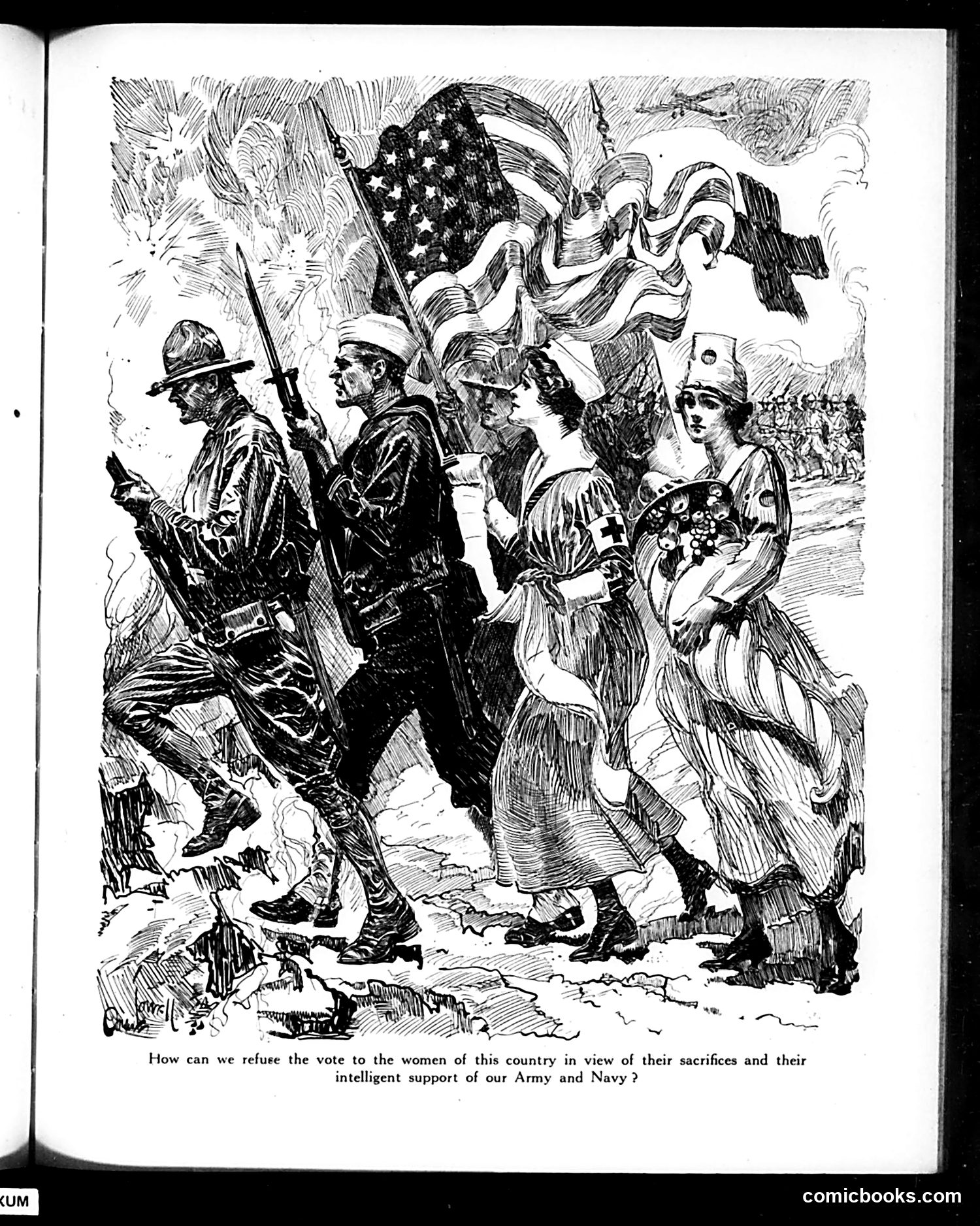
This is a pro-suffrage cartoon arguing for women's voting rights. It depicts uniformed soldiers and sailors alongside women in civilian dress, with a large American flag prominent above them. The caption poses a rhetorical question: given women's wartime sacrifices and support for the military, how can the nation deny them voting rights? The cartoon likely dates to World War I era (1917-1920), when women's suffrage became increasingly difficult to oppose. The imagery emphasizes women's patriotic contributions during wartime—working in factories, nursing, organizing relief efforts—as moral justification for enfranchisement. The juxtaposition of soldiers with women suggests they share equal stakes in the nation's welfare and deserve equal political voice. This represents a common suffragist argument: women's wartime service made denying them the vote unjust and illogical.
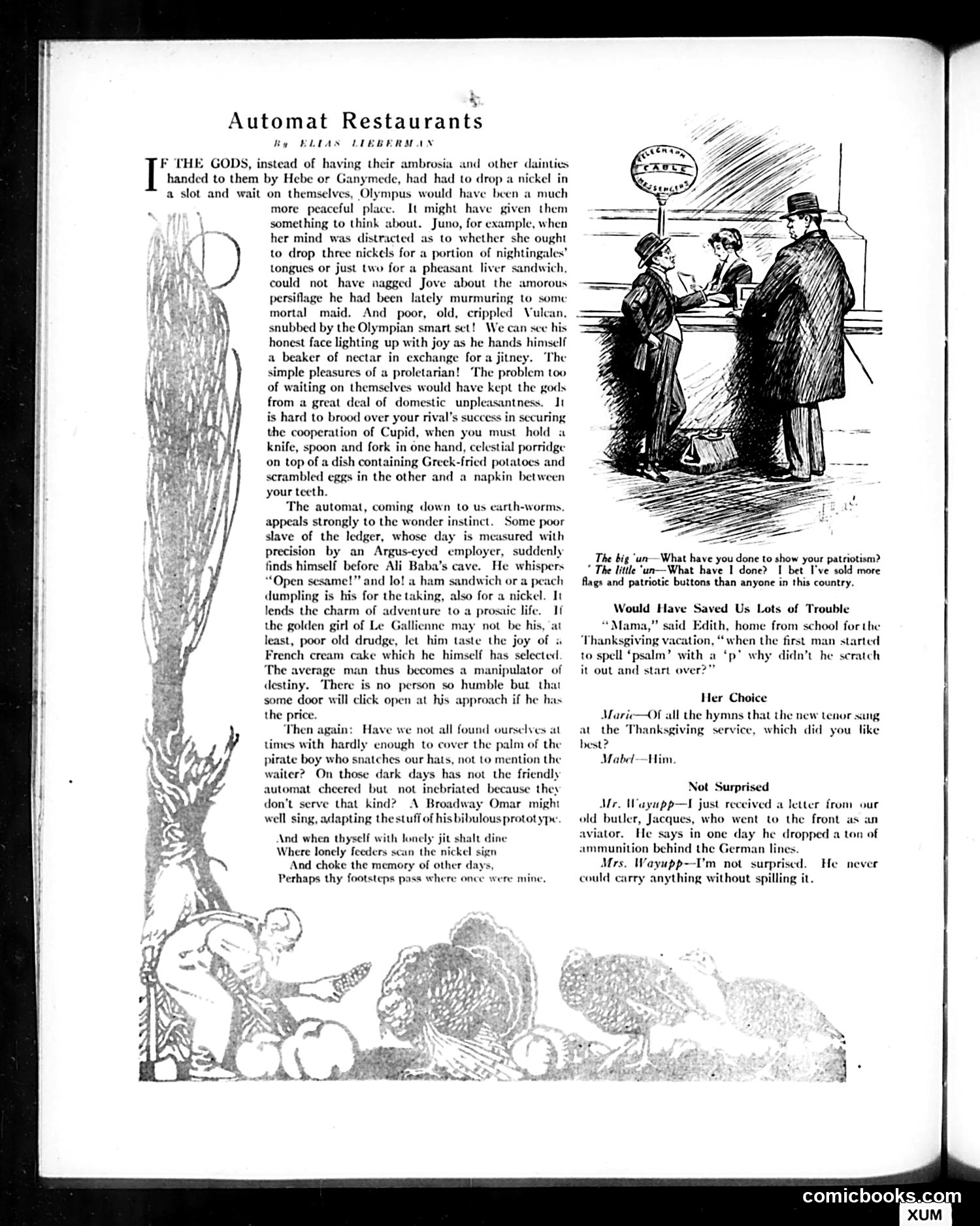
This article satirizes the newly popular **automat**—a vending-machine restaurant where customers insert nickels to retrieve food from slots. Author Elias Lieberman uses the concept as social commentary. The main essay humorously imagines Greek gods forced to use automats, arguing the experience would reduce their bickering and domestic drama. More seriously, it celebrates automats as democratizing: they give ordinary working people—"slaves of the ledger"—a sense of agency and dignity. By selecting their own meal and paying directly, rather than depending on waiters' goodwill, even humble laborers become "manipulators of destiny." The accompanying cartoon (top right) shows two working-class men at an automat window, likely illustrating this accessibility. The page also includes unrelated humor pieces about patriotic buttons, hymn preferences, and a butler's clumsy wartime service—typical of Judge's miscellaneous comic content. The automat serves as Lieberman's lens for examining **class, dignity, and modern urban life** in early 20th-century America.
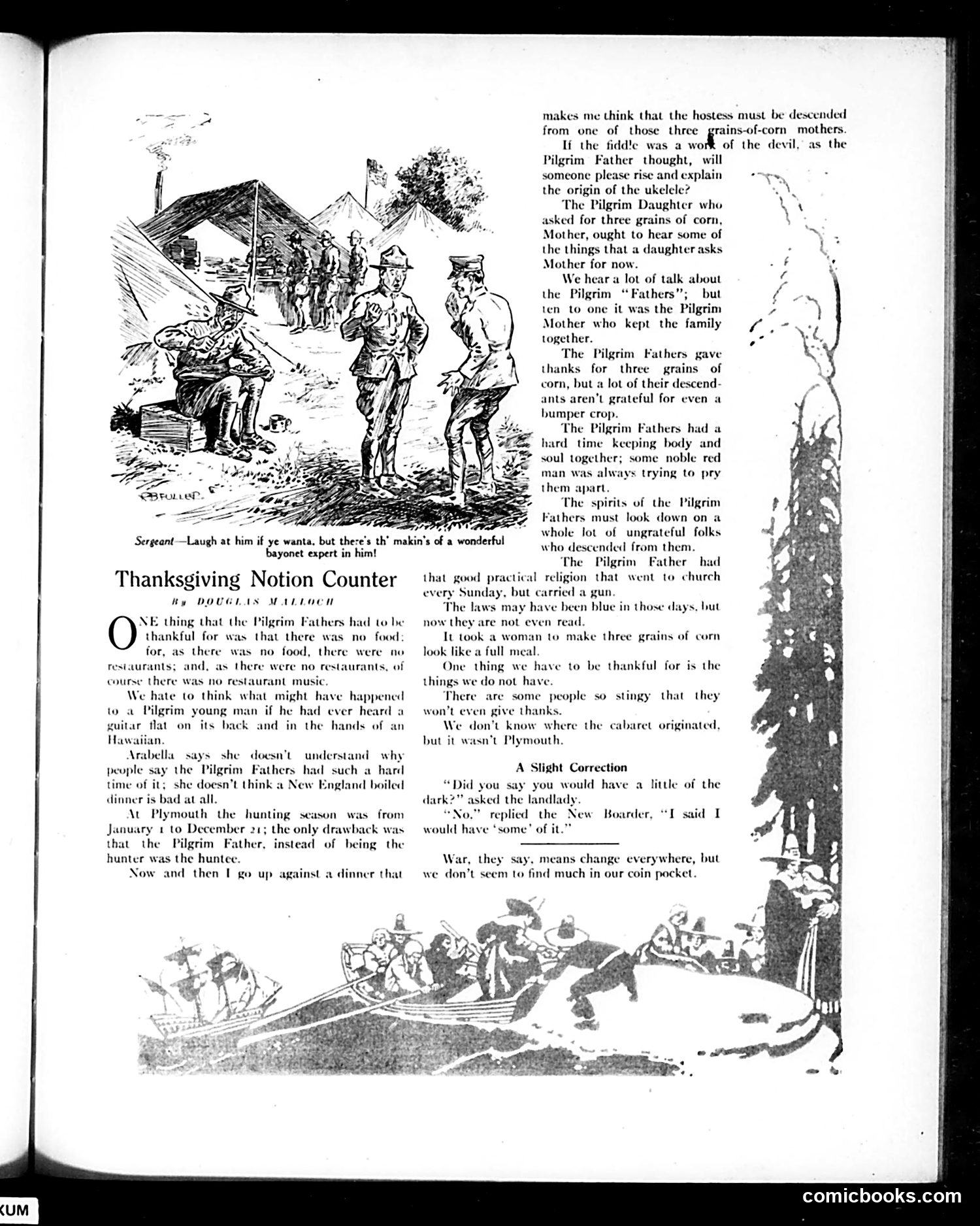
This satirical piece by Douglas Malloch uses the Pilgrim Fathers as a framework to critique modern American society circa WWI era. The humor operates through contrast: the Pilgrims' austere gratitude for minimal resources versus contemporary Americans' ingratitude despite abundance. **Key satirical targets:** - **Restaurant music**: Mocks the proliferation of commercial entertainment and Hawaiian guitar fads as cultural degradation - **Modern daughters vs. Pilgrim daughters**: Suggests spoiled entitlement in younger generations - **Ungrateful descendants**: Criticizes Americans who don't appreciate prosperity their ancestors built - **"Blue laws" no longer read"**: References outdated Puritan moral codes now ignored - **Cabaret origin**: Implies modern vice establishments contradict Pilgrim values - **War and coin pockets**: A topical jab at economic hardship despite wartime The cartoon accompanying shows soldiers, referencing WWI. Overall, the piece expresses nostalgic anxiety about American moral decline—a common Judge magazine theme during this period—using Thanksgiving as an occasion to contrast historical virtue with contemporary excess and ingratitude.
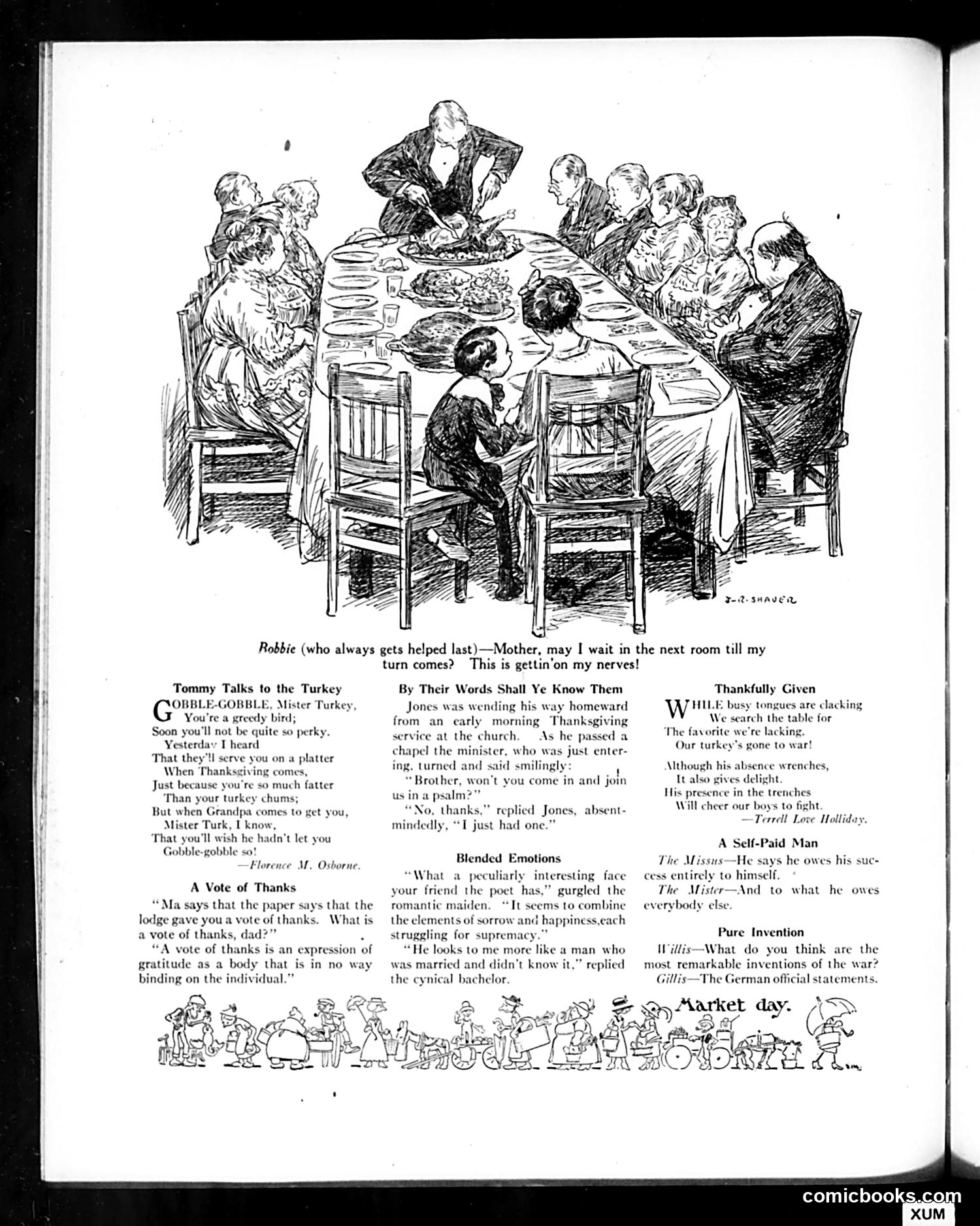
This Thanksgiving-themed page from Judge contains several short humorous pieces reflecting early 20th-century domestic life: **Main Cartoon (top):** Shows a family dinner where young "Robbie" asks to leave the table until his turn comes for serving—a joke about being the youngest and getting food last. **"Tommy Talks to the Turkey":** A child's poem mocking a turkey for overeating, warning it will regret gluttony when slaughtered for dinner. **"A Vote of Thanks":** A father explains that a "vote of thanks" is merely symbolic and non-binding—political satire on empty ceremonial gestures. **"Blended Emotions" & "Thankfully Given":** Domestic humor and a poem referencing World War I (mentioning turkey "gone to war"), suggesting wartime rationing or sacrifice. **"Pure Invention":** Sharp satire mocking German military propaganda as outright fabrication during WWI. The page reflects American life circa WWI, mixing family humor with patriotic sentiment and skepticism toward foreign military claims.
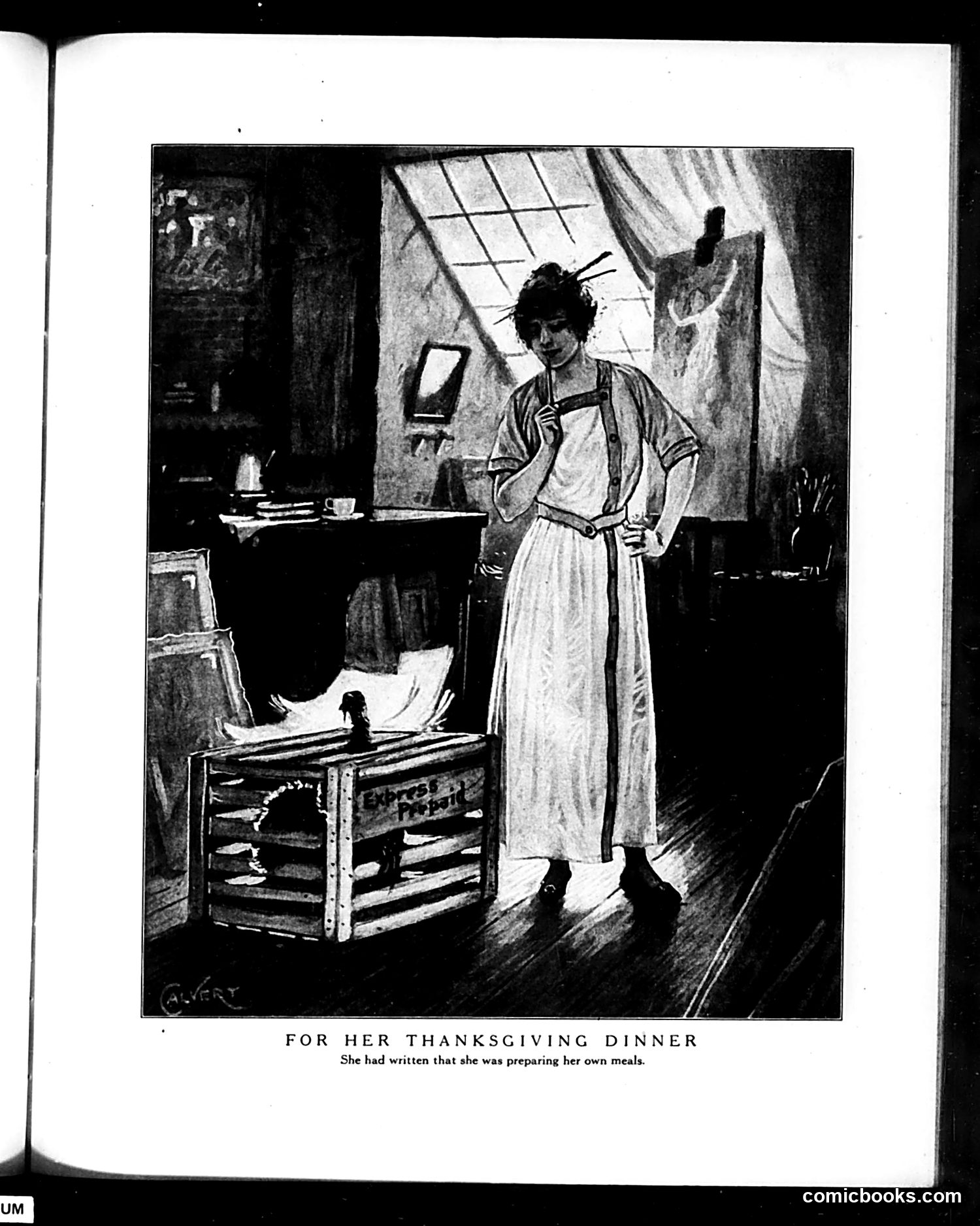
This illustration satirizes early 20th-century women's independence and domestic labor. The caption reveals the joke: a woman has written that she's "preparing her own meals," but the image shows her in a modest, sparsely-furnished room with basic cooking equipment—suggesting her claimed self-sufficiency is actually quite humble and perhaps financially constrained. The satire likely targets either women's liberation movements (mocking their practical reality versus ideals) or critiques economic inequality (a woman's "independence" means struggling poverty). The artistic style and setting suggest this is commentary on changing gender roles and women's work during this period. The implied irony is between her stated independence and her apparent material circumstances.
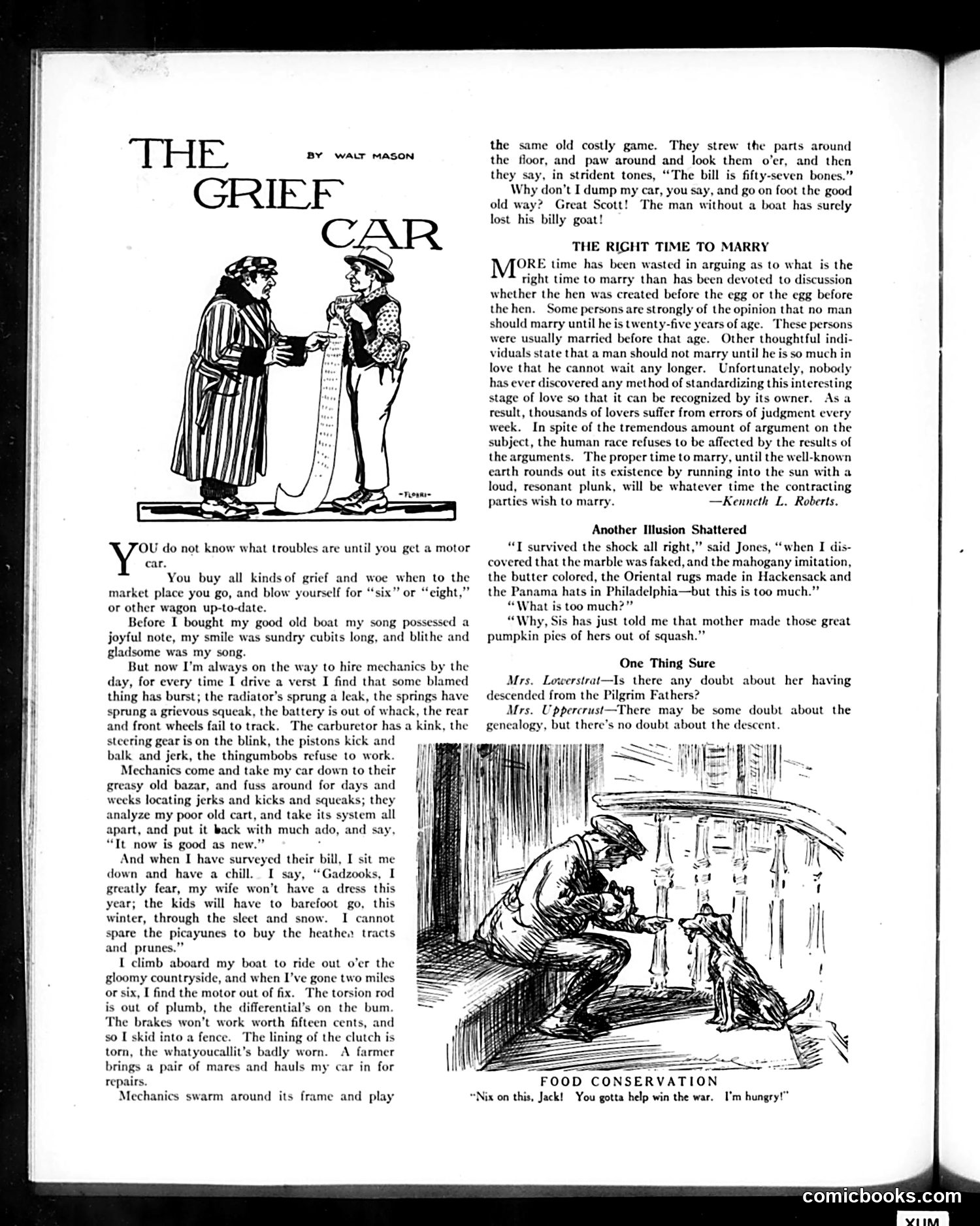
This page satirizes the emerging frustrations of early automobile ownership. Mason's poem laments how purchasing a motorcar transforms joy into endless mechanical suffering and expense. The owner catalogs failures—leaking radiators, broken springs, failed brakes—requiring costly mechanics who disassemble and reassemble the vehicle repeatedly, presenting astronomical bills ("fifty-seven bones"). The satire targets the gap between automobiles' promised modernity and their actual unreliability. The punchline—that the car owner would lose his "billy goat" (dignity/independence) without his boat—humorously suggests cars are so troublesome they're worse than useless. This reflects genuine 1910s-era frustration with early vehicles' mechanical fragility and repair costs, before automobiles became reliably functional. The page also includes unrelated humor columns on marriage timing and consumer deceptions (fake antiques, synthetic foods).
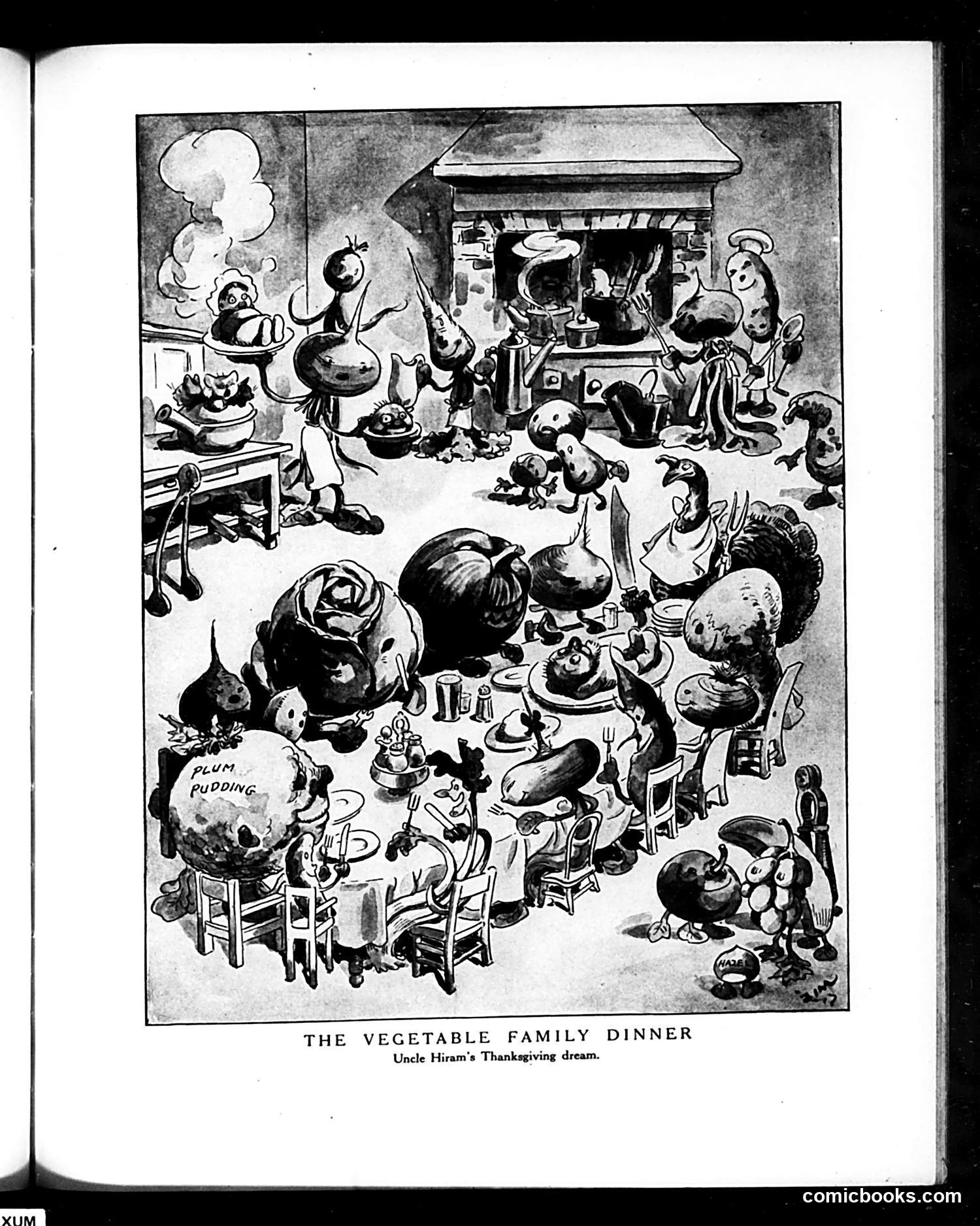
This is an anthropomorphic cartoon depicting vegetables as a family gathered for Thanksgiving dinner. The vegetables—including what appears to be a plum pudding, onions, carrots, and other produce—are personified with human characteristics, seated around a table in a domestic kitchen scene. The satire likely plays on the concept of vegetables "dining together" (a darkly humorous premise, given that they'd normally be *eaten* at such a meal). The subtitle credits this as "Uncle Hiram's Thanksgiving dream," suggesting this is a whimsical fantasy scenario. Without additional context about Uncle Hiram or the magazine's date, the specific social commentary remains unclear. However, the piece appears to be a lighthearted visual pun exploiting the anthropomorphization trend popular in late-nineteenth/early-twentieth-century American humor publications.
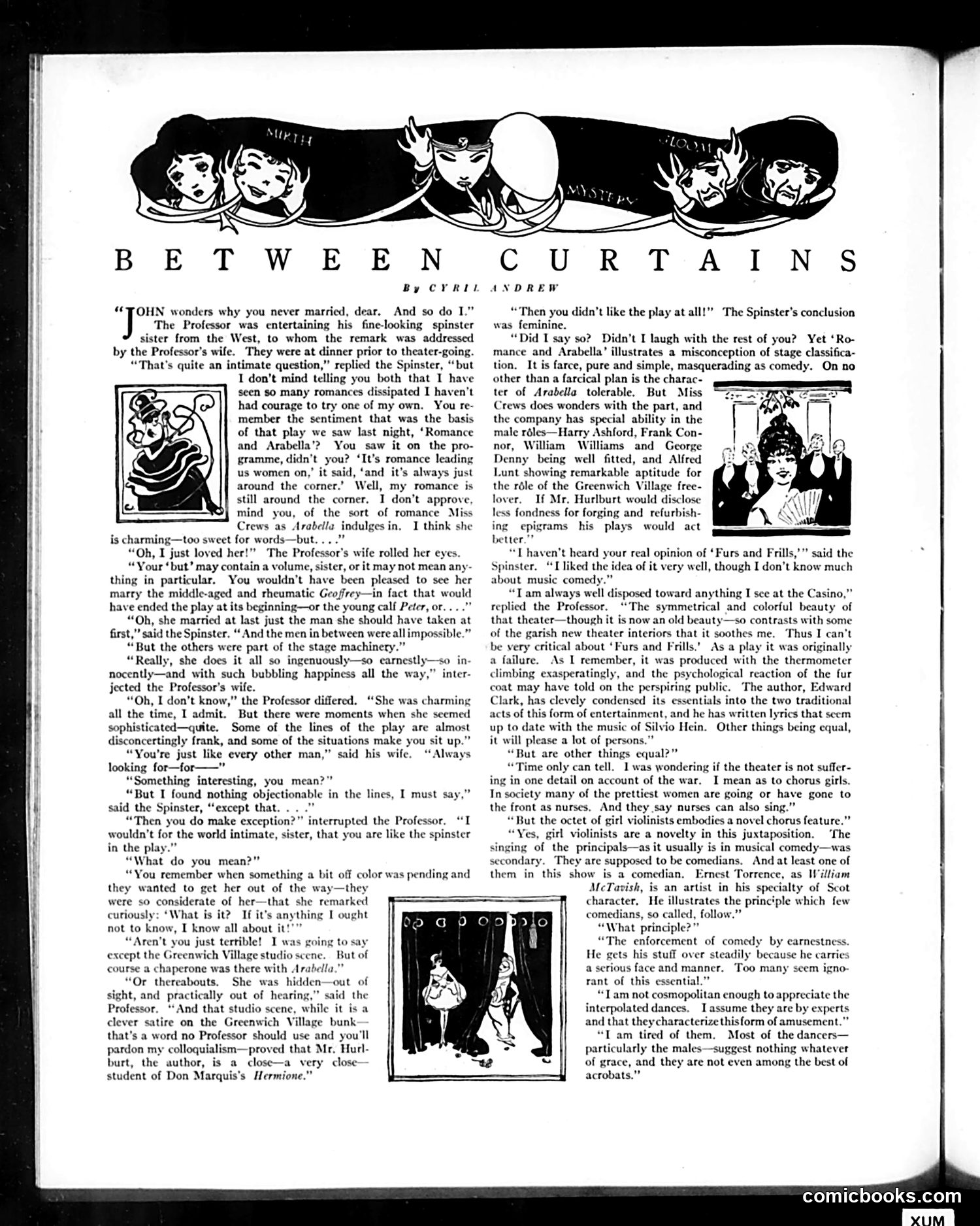
This is a theater criticism piece by Cyril Andrew discussing the play *Romance and Arabella*. The dialogue between a Professor, his wife, and his visiting spinster sister from the West debates the merits of the production. **The satire targets:** - The spinster character's contradictory prudishness—she claims moral objections to the play's frankness while admitting ignorance of "off color" content - The Professor gently mocks her by comparing her to the play's own naive spinster character who claims not to know things while clearly knowing them - The author criticizes the play itself as "farce masquerading as comedy," though praising actress Miss Crews's performance and the male cast (including Alfred Lunt) **The joke**: The spinster's defensive moralizing mirrors the very character flaws depicted onstage—she's unaware of her own hypocrisy, much like Arabella. The piece satirizes both theatrical pretension and female prudishness through this dinner conversation framing device.
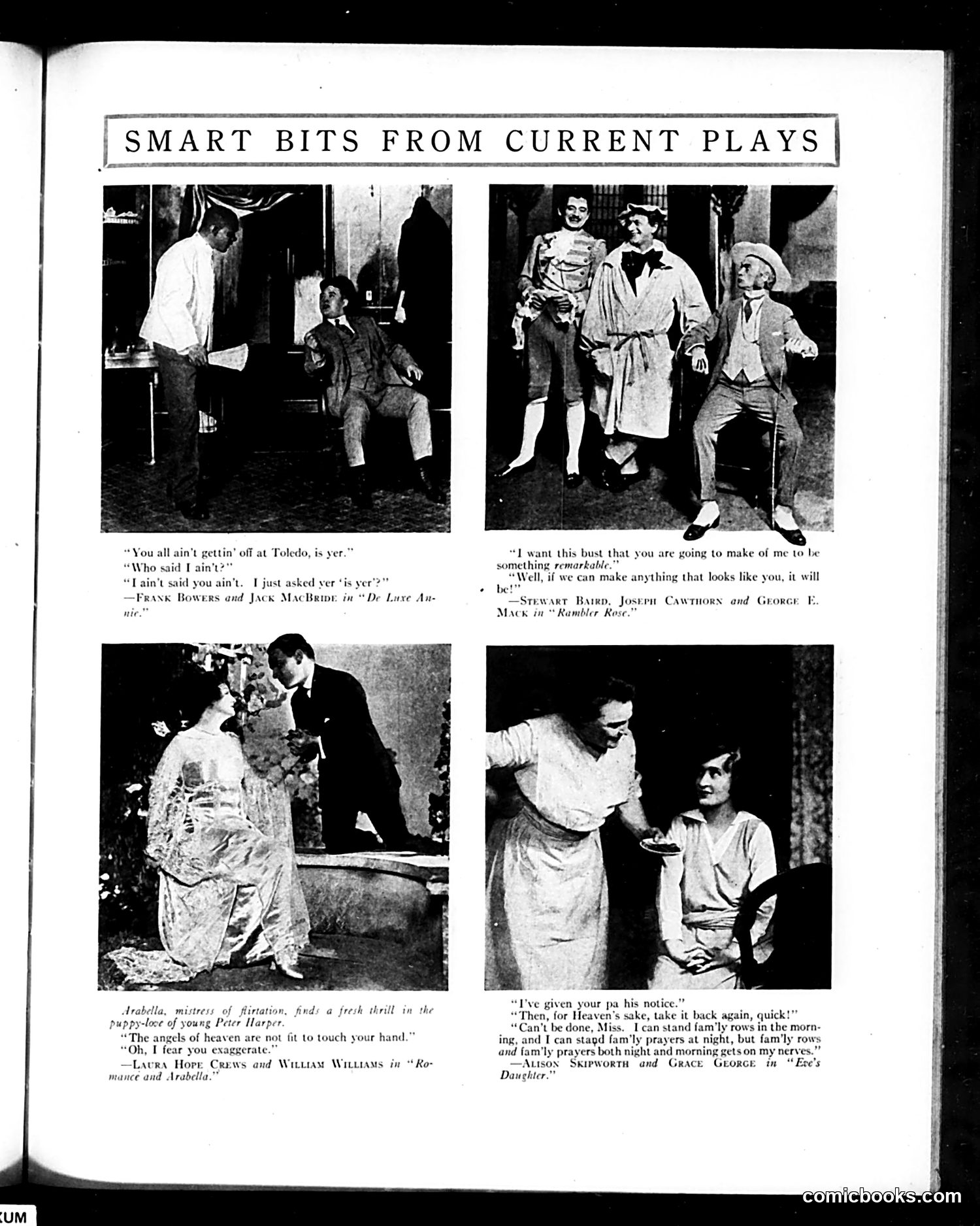
This page collects humorous dialogue excerpts from contemporary Broadway productions, presented as visual scenes with quoted one-liners. The format showcases theatrical wit for Judge magazine's readers. The jokes reflect period concerns: regional dialect humor ("ain't gettin' off at Toledo"), class dynamics (a servant giving notice), and domestic comedy (family prayers and quarrels). One scene references a sculptor's flattery about creating a "remarkable" bust—a gentle jab at artistic vanity. The references are to specific plays and their casts (Frank Bowers, Jack MacBride, Stewart Baird, and others), which contemporary readers would recognize. Without identifying the specific productions or actors beyond what's named, we can note these represent typical early-20th-century light comedies mining humor from everyday social situations, servant relationships, and romantic misunderstandings—entertainment designed for Judge's middle-class audience.
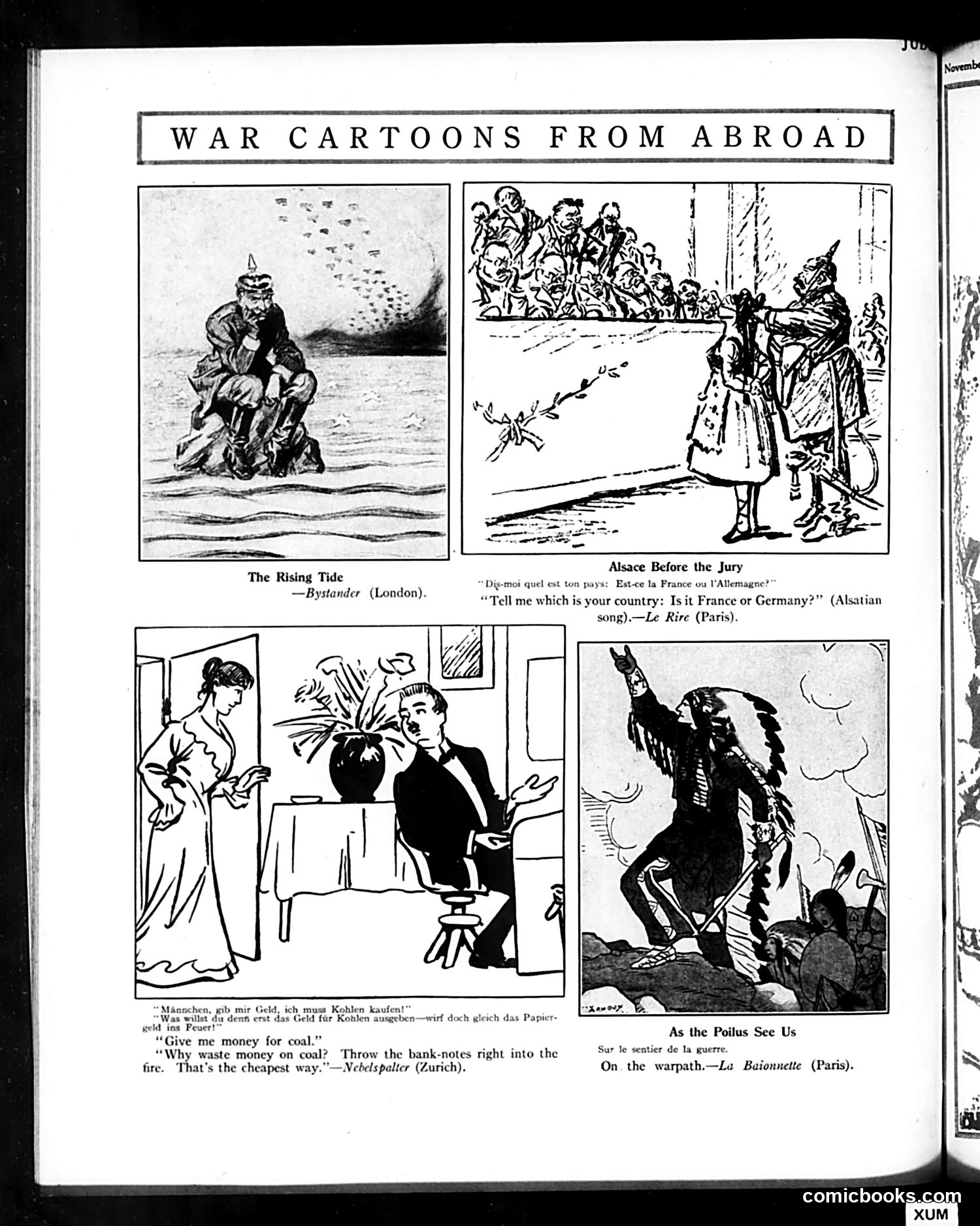
This page collects satirical cartoons from European publications during World War I, each targeting different aspects of the conflict: **"The Rising Tide"** (British): Shows a German military figure (identifiable by spiked helmet) being overwhelmed by rising water—likely representing Allied military pressure or Germany's deteriorating position. **"Alsace Before the Jury"** (French): Depicts a child being questioned about national identity, referencing the contested region of Alsace-Lorraine, disputed between France and Germany. **"Give me money for coal"** (Swiss): A darkly humorous exchange mocking wartime inflation and economic collapse—suggesting currency has become worthless, so burning banknotes for fuel is more economical than buying coal. **"As the Poilus See Us"** (French): Shows a German soldier (Poilu refers to French soldiers, so this is French perspective) on the warpath, likely portraying German militarism from the Allied viewpoint. These represent international propaganda and war commentary circulating among Allied nations.
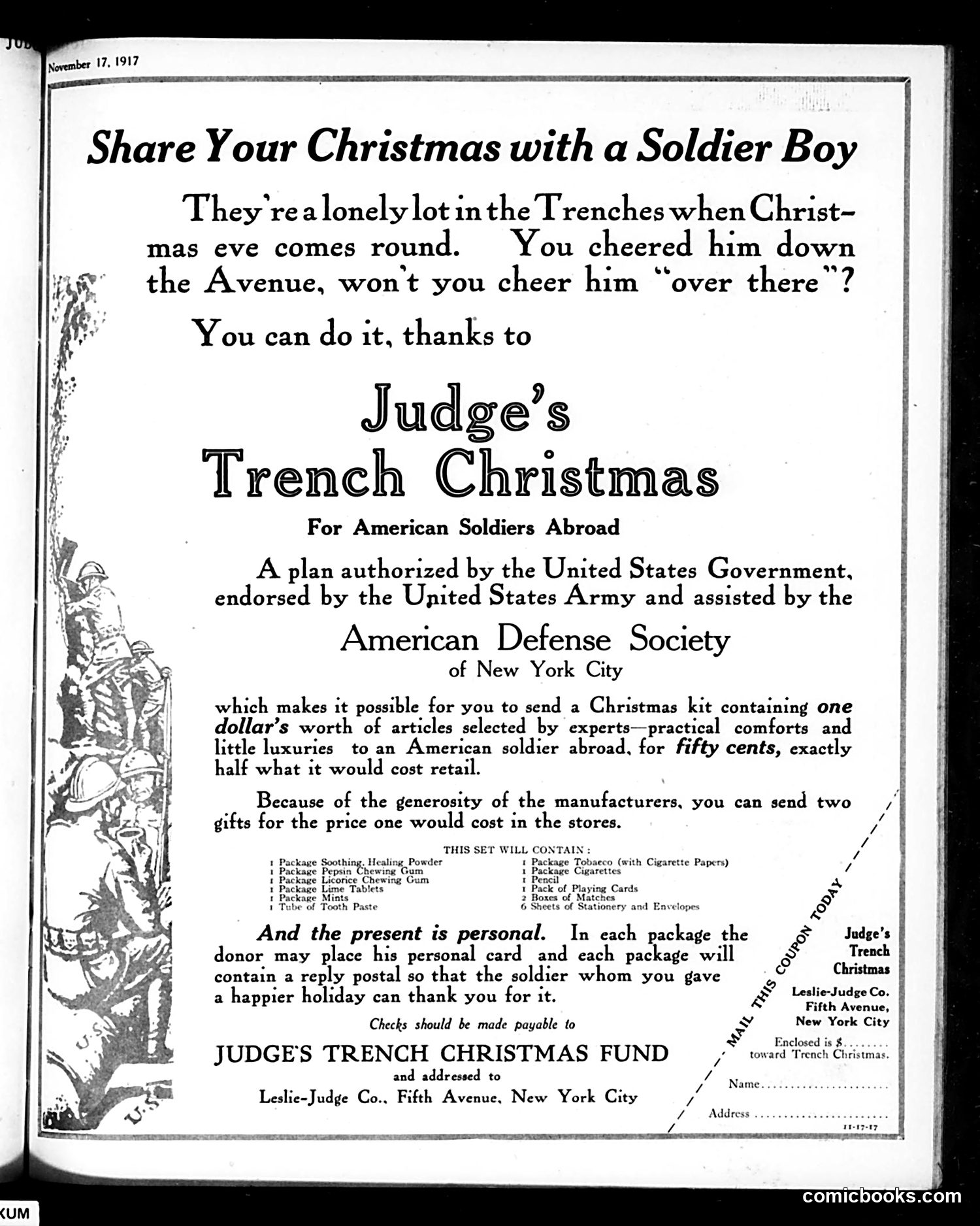
This is primarily **advertising content**, not satire. Published November 17, 1917 (during WWI), it promotes "Judge's Trench Christmas"—a fundraising campaign to send care packages to American soldiers fighting in European trenches. The appeal uses patriotic and emotional language: soldiers are "lonely" on Christmas Eve "over there" (the front lines); civilians who cheered soldiers departing down American avenues should now support them abroad. The offer is economical—$1 worth of practical items (tobacco, gum, playing cards, matches, stationery) for 50 cents, with manufacturers donating goods. Donors can include personal cards; soldiers can reply via enclosed postcards. The decorative military illustration (left side) reinforces patriotic sentiment. This represents typical American home-front mobilization during WWI, encouraging civilian financial participation in supporting troops. No specific political satire is evident—it's straightforward charitable promotion.
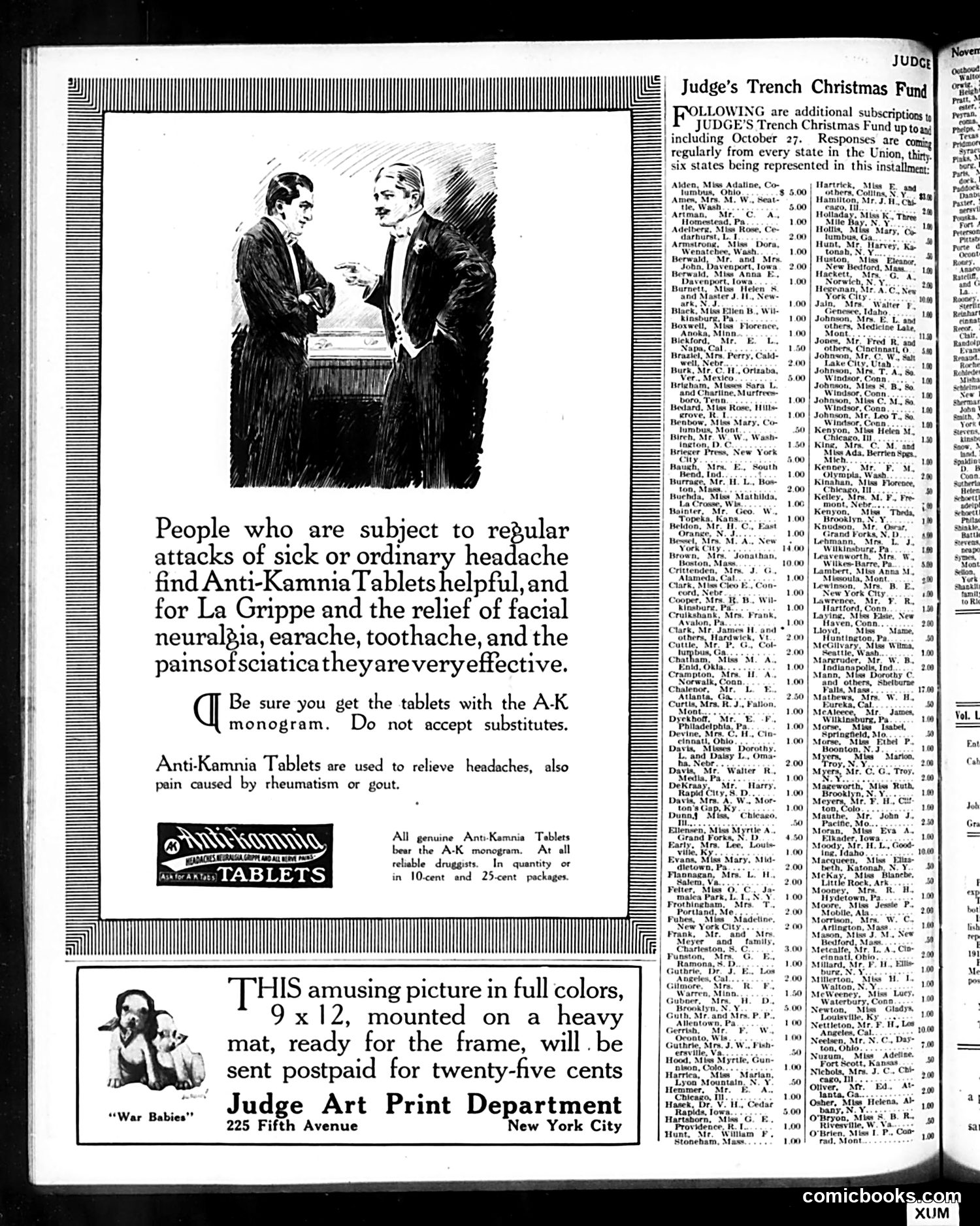
This page is primarily **advertising and fundraising**, not satire. The main content consists of: 1. **Judge's Trench Christmas Fund**: A list of donations from readers supporting soldiers in World War I trenches. This was a genuine charitable effort by the magazine during WWI. 2. **Anti-Kamnia Tablets Advertisement**: A patent medicine ad featuring two men in business attire exchanging or discussing the product. The ad claims the tablets relieve headaches, "La Grippe" (influenza), facial neuralgia, earache, toothache, and sciatica pain. The "A-K monogram" was their trademark. 3. **Judge Art Print Department**: An offer to sell a colored print titled "War Babies" for 25 cents. The illustration of two men in the medicine ad appears to be a generic business scene meant to suggest respectability and professional endorsement—typical of early 20th-century patent medicine marketing. There is no evident satire or political commentary on this particular page; it represents Judge's commercial operations during the WWI era.
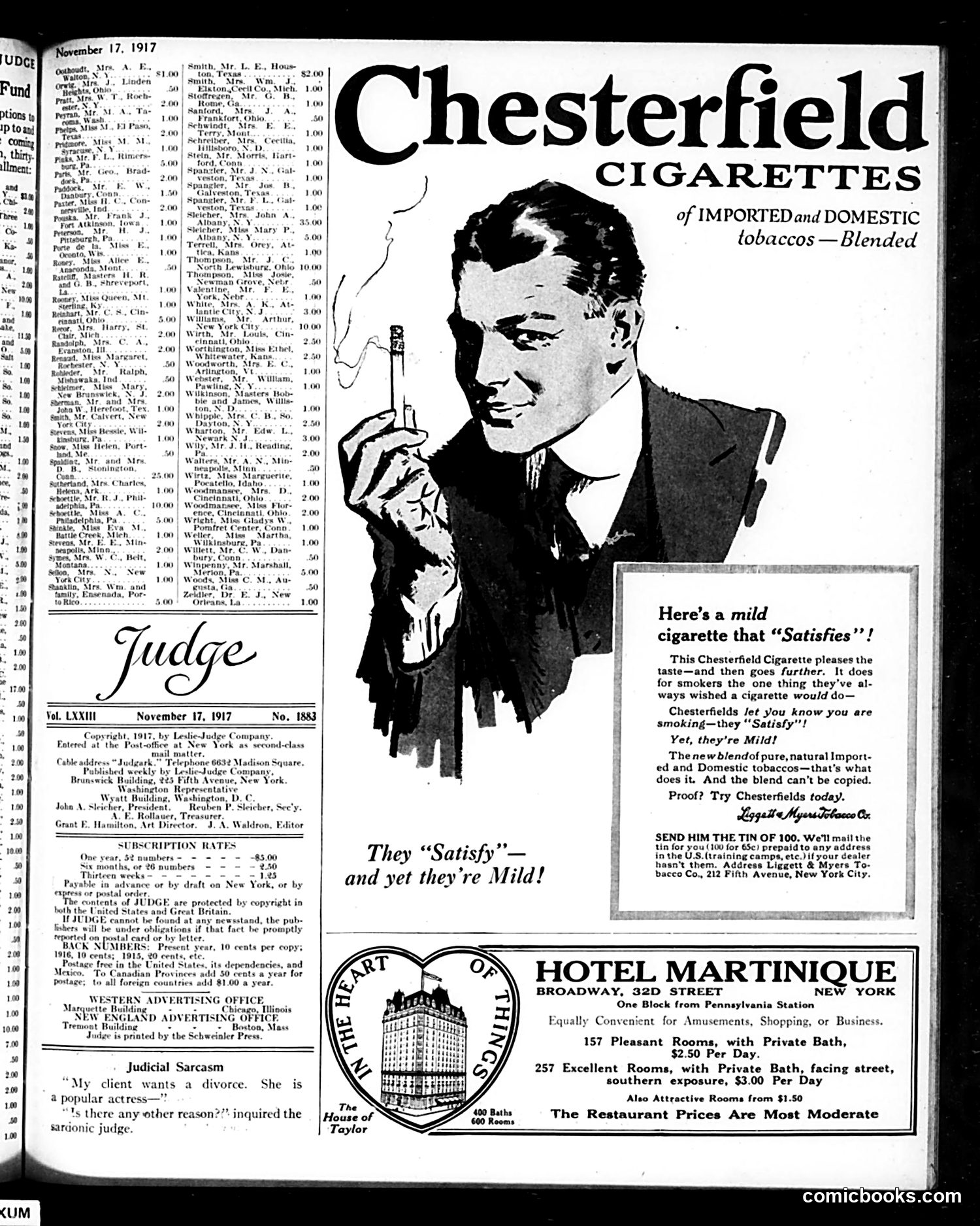
This is primarily a **magazine cover and advertisements page** rather than political satire. The main content consists of: **The Central Image**: A well-dressed man holding a Chesterfield cigarette, advertising cigarettes as products that "Satisfy" yet remain "Mild"—a marketing appeal emphasizing satisfaction without harshness. **The Small Cartoon**: Below titled "Judicial Sarcasm," a brief joke about a judge questioning a woman's divorce request from an actress, sardonically asking if there's "any other reason" beyond her profession—a light social commentary on actresses and divorce. **Context**: This 1917 issue appears during WWI (note the reference to "training camps" in the cigarette ad). The page is dominated by advertisements for cigarettes and the Hotel Martinique, reflecting the era's acceptance of tobacco marketing and luxury hotel amenities. There is no significant political satire visible on this particular page.
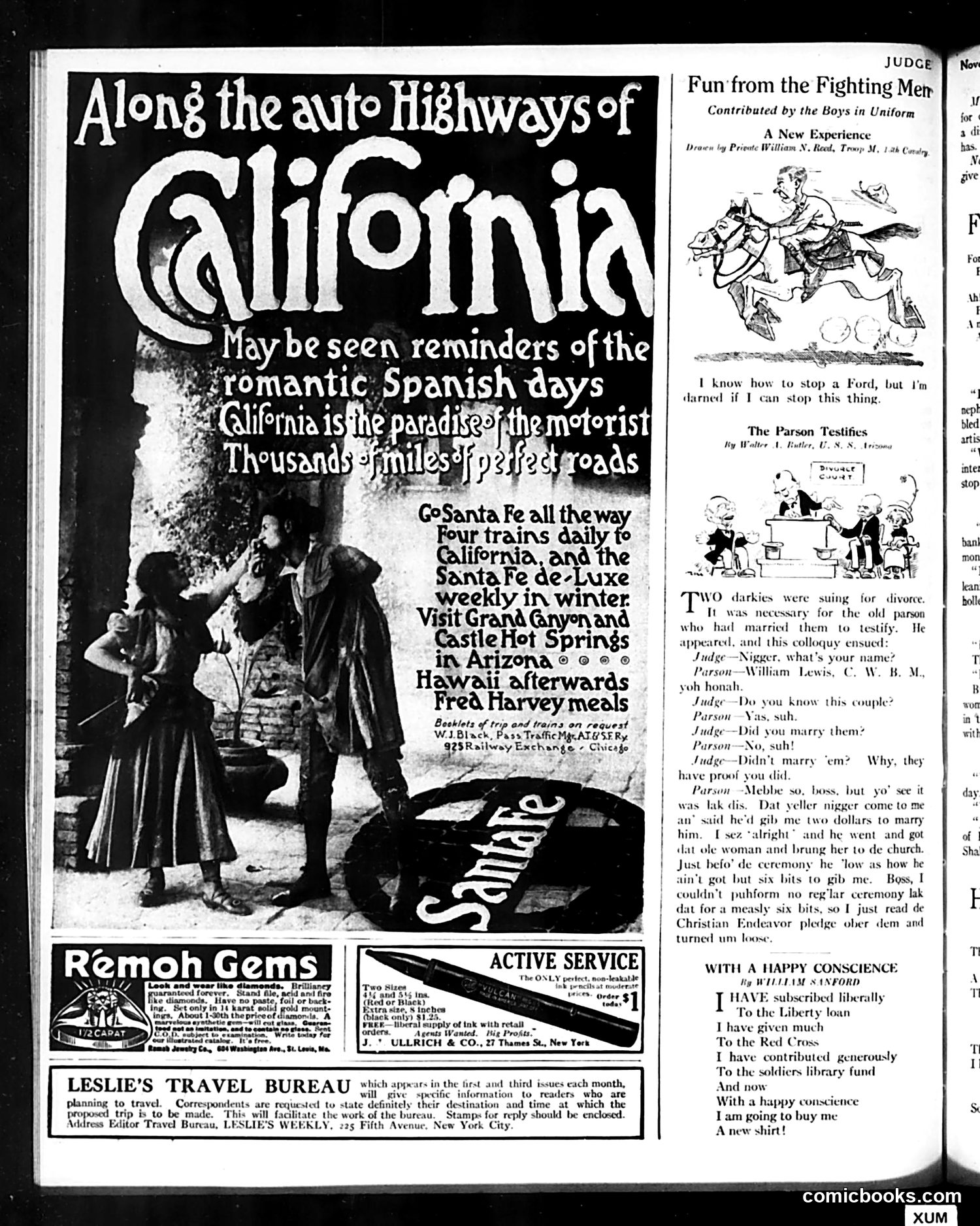
**Main Advertisement**: The large "Along the Auto Highways of California" travel ad promotes Santa Fe Railway routes, positioning California as a romantic destination recalling "Spanish days." This reflects early 20th-century American tourism marketing. **Right-side Humor Section**: "The Parson Testifies" presents a racist dialect joke typical of the era. Two Black men divorce, requiring testimony from the pastor who "married" them. The punchline: the pastor only performed an abbreviated ceremony (reading a Christian Endeavor pledge) because the groom reduced payment from two dollars to seventy-five cents. The humor relies on offensive racial stereotypes and caricatured dialect. "With a Happy Conscience" satirizes patriotic self-satisfaction—a soldier who generously donated to war bonds, the Red Cross, and military libraries now feels morally justified buying himself a new shirt. Both items reflect period attitudes: casual racism in mainstream humor and gentle mockery of wartime civic virtue-signaling.
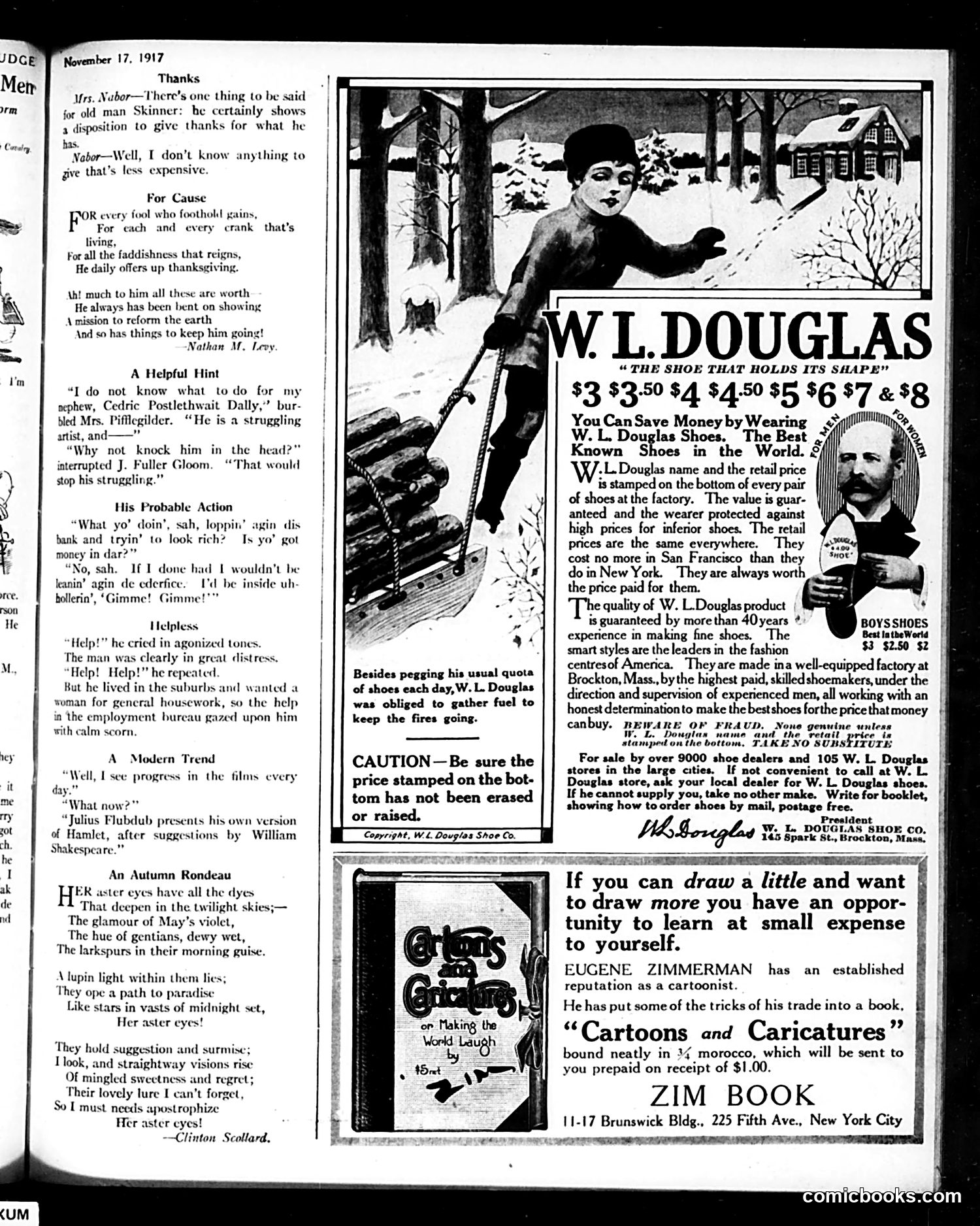
This page is primarily **advertising**, dominated by a large W.L. Douglas shoe company advertisement featuring a winter sledding scene and the company founder's portrait. The left column contains brief humorous sketches and poems typical of Judge's satirical content: - **"Thanks"** mocks a man (Skinner) who gives thanks for cheap/free things—suggesting stingy gratitude - **"A Helpful Hint"** jokes darkly about stopping a struggling artist's hardship through violence - **"His Probable Action"** depicts a poor Black man pretending wealth by leaning on a bank—satirizing economic desperation and aspirational fakery during Jim Crow era - **"A Modern Trend"** quips about film adaptations of Shakespeare, typical of 1917 cinema commentary The page also advertises Eugene Zimmerman's cartooning instruction book, appealing to readers wanting to learn drawing. The content reflects WWI-era American anxieties, class commentary, and period racial attitudes, with humor aimed at working-class and ethnic stereotypes standard to Judge's audience.
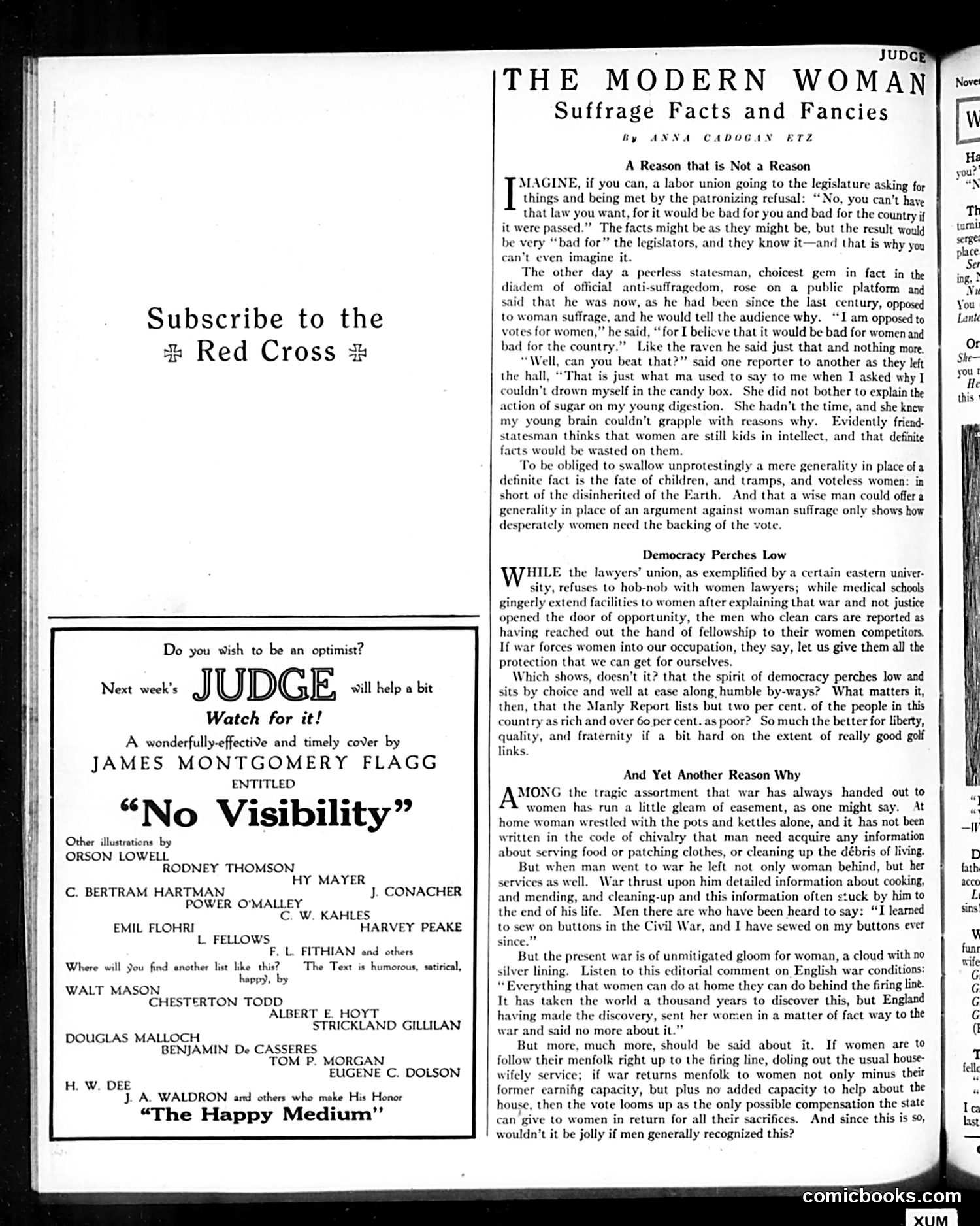
This page from Judge satirizes anti-suffrage arguments through columnist Anna Cadogan Etz's article "The Modern Woman: Suffrage Facts and Fancies." **Main Satire:** Etz ridicules politicians who oppose women's voting by offering only circular reasoning—claiming suffrage would be "bad for women and bad for the country" without providing actual evidence. She compares this to a parent dismissing a child's question with vague generalities instead of facts, implying opponents treat women as intellectually inferior children unworthy of substantive argument. **Key Points:** - Anti-suffragists refuse to engage with facts, merely asserting opposition - Women are treated as "disinherited" like children and the poor, denied the vote while facing systematic exclusion (lawyers' unions, medical schools) - War has ironically opened some occupational doors to women, yet basic democratic principles still elude them - The hypocrisy: democracy claims to value liberty while denying women political participation **Context:** This appears from the suffrage era (pre-1920). The piece mocks the paternalistic dismissal women faced rather than serious policy debate.
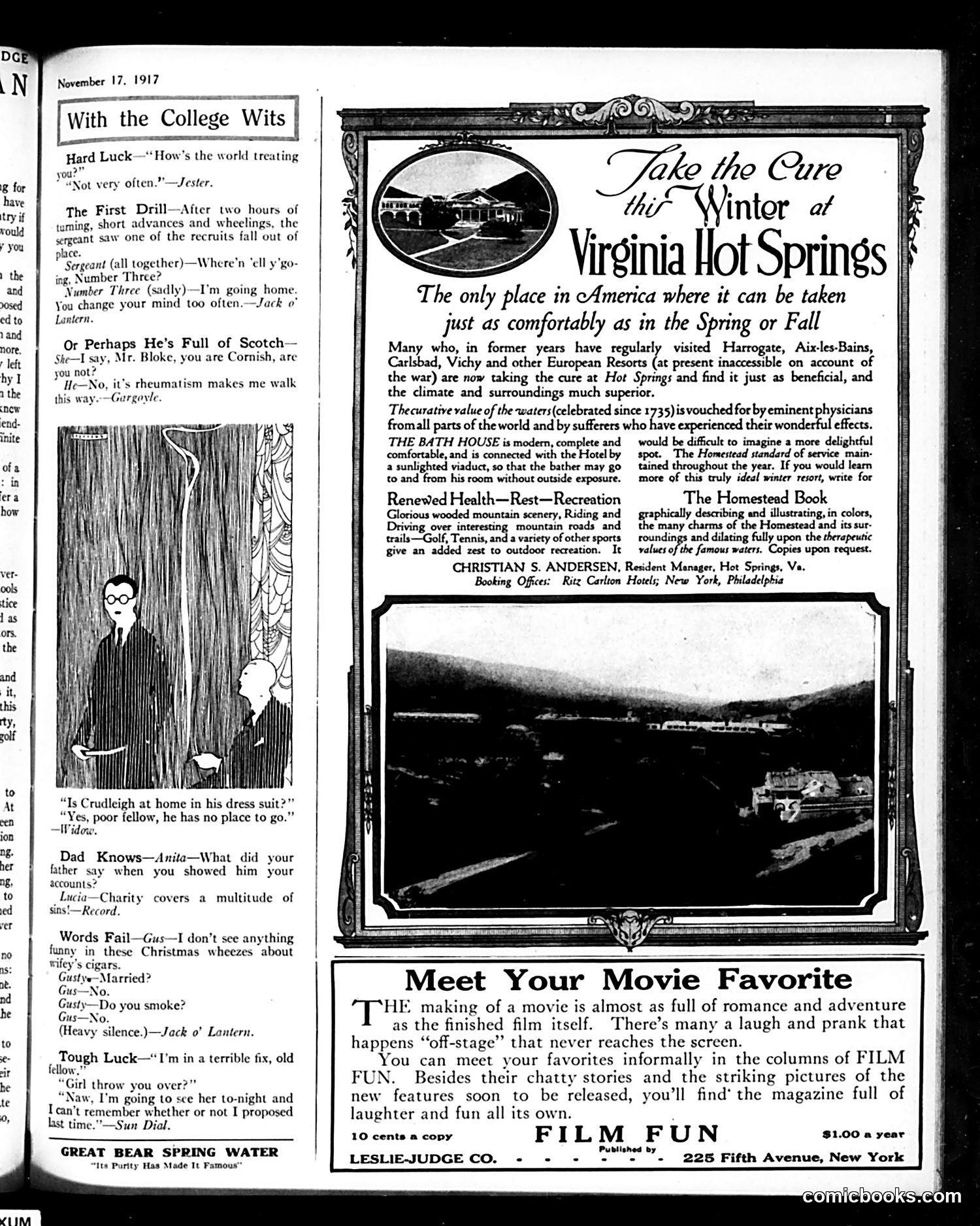
This page features **humorous college jokes** typical of early 20th-century magazines. The cartoons mock student life and common social situations: - **"The First Drill"** satirizes military training (relevant context: America entered WWI in April 1917, making military recruitment/training timely) - **"Or Perhaps He's Full of Scotch"** jokes about a man's walking difficulty, with dark humor suggesting either drunkenness or physical ailment - **"Dad Knows"** presents mild humor about a daughter's extravagant spending, with the punchline that "charity covers a multitude of sins" - **"Words Fail"** makes light of romantic confusion—a man unsure whether he actually proposed to his girlfriend The humor relies on wordplay, misunderstandings, and social embarrassment. The page also includes advertisements for Virginia Hot Springs and *Film Fun* magazine, reflecting contemporary leisure interests. The cartoons' simple line drawings and punny dialogue typify Judge magazine's light satirical style aimed at educated, urban readers.
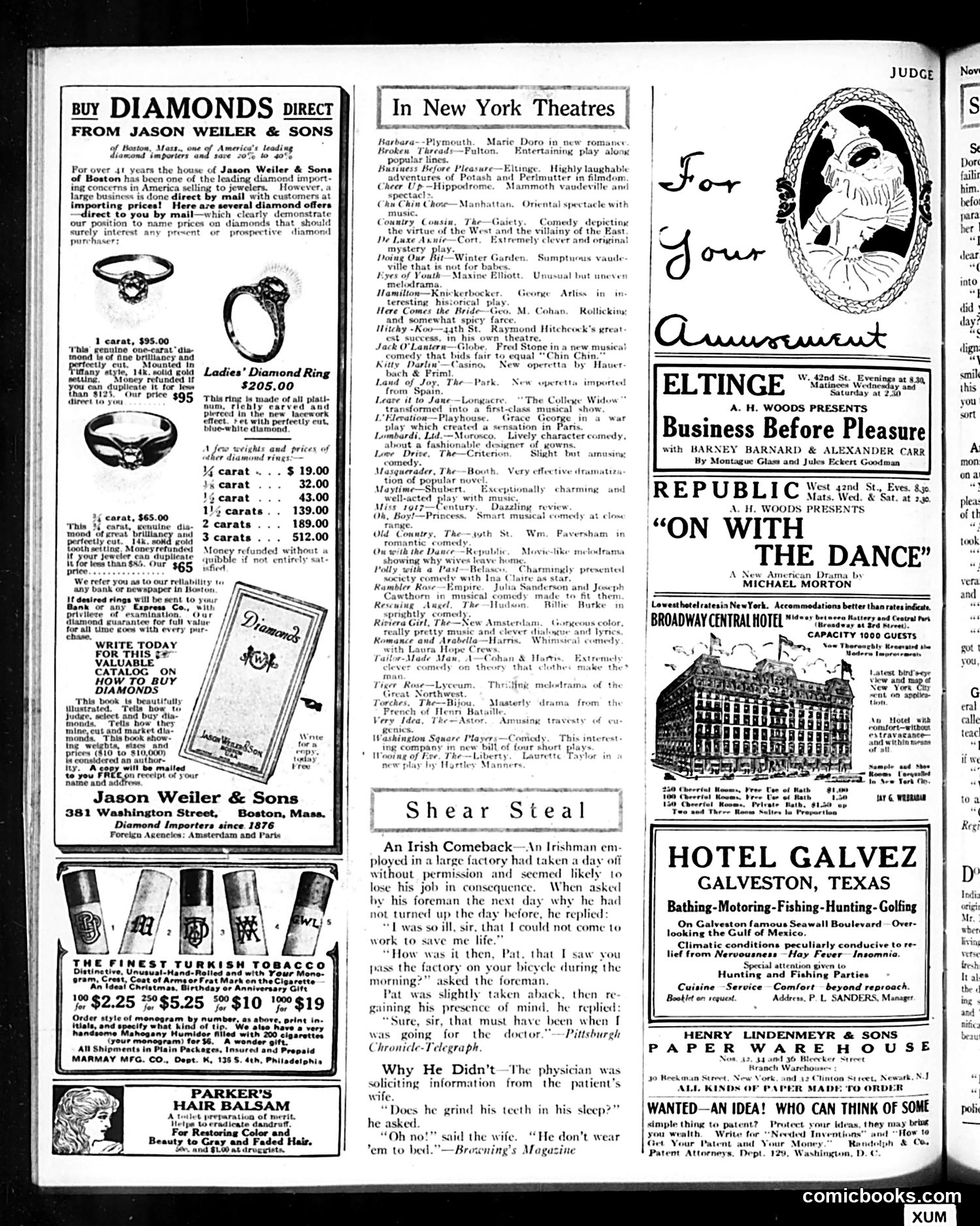
This page is **primarily advertising**, with minimal satirical content. The dominant feature is a large diamond merchant advertisement (Jason Weiler & Sons of Boston), occupying roughly one-third of the space and offering direct-mail diamond sales. The theatrical listings for "New York Theatres" provide contemporary context—noting productions like "Business Before Pleasure" and "On with the Dance"—but contain no apparent satire or commentary. The small illustrated jokes ("Shear Steal" and "Why He Didn't") are brief, conventional gags with no clear political or social satire. The "Shear Steal" piece involves an Irishman's workplace mishap; "Why He Didn't" is a domestic humor joke about a husband grinding his wife's teeth. This appears to be a **commercial issue** rather than one emphasizing Judge's typical satirical content, filled with period product advertising (tobacco, hair balm, hotel promotions) interspersed with light entertainment.
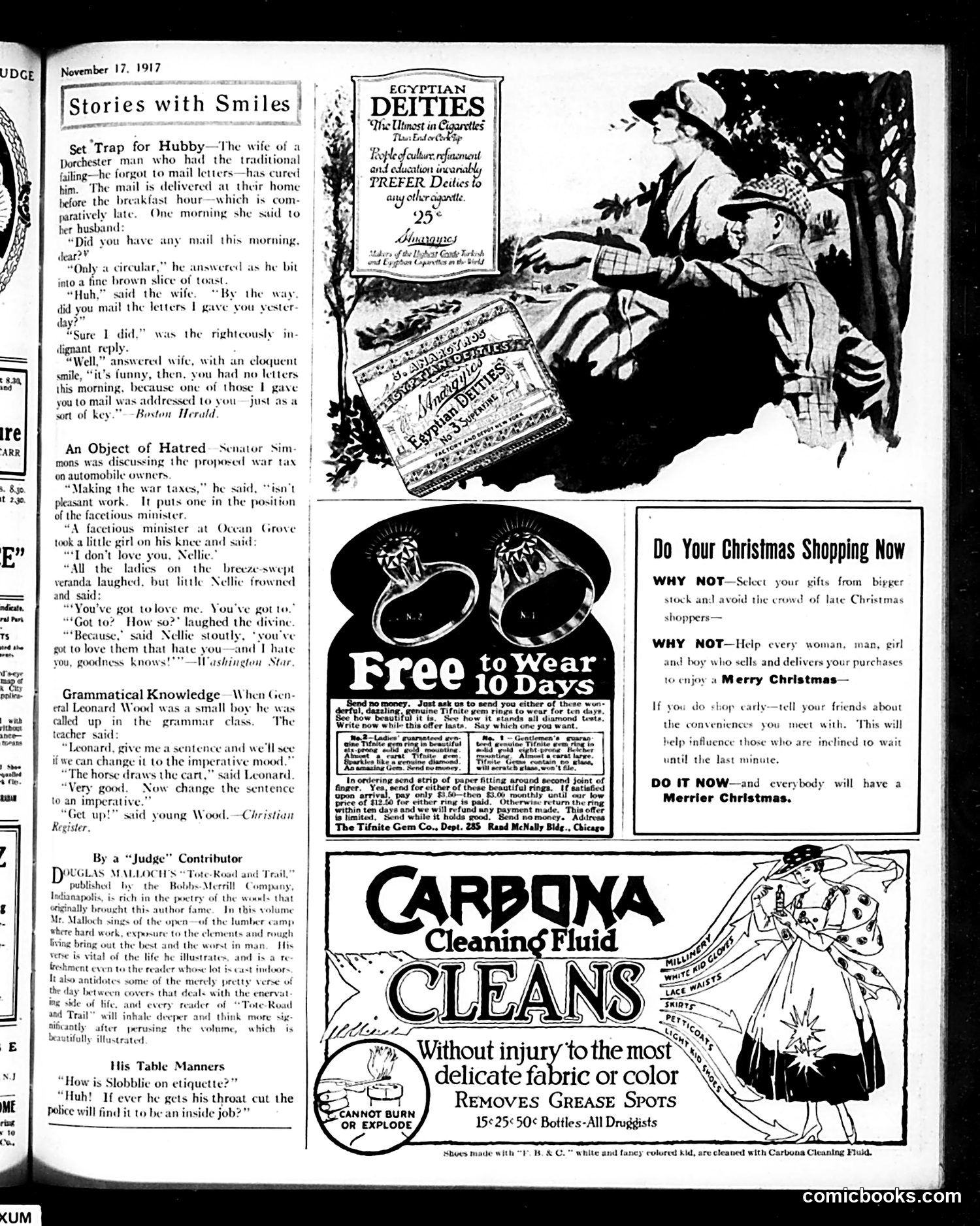
This page contains several short humorous anecdotes and advertisements typical of early 20th-century satirical magazines. **"Set Trap for Hubby"** mocks a forgetful husband who claims to have mailed letters his wife gave him—only to receive one addressed to himself that very morning, catching him in his lie. **"An Object of Hatred"** presents Senator Simmons discussing a war tax on automobiles, comparing it to a minister's discomfort with strict biblical commands—lighthearted wartime commentary. **"Grammatical Knowledge"** features young General Leonard Wood cleverly responding to a grammar lesson by converting "The horse draws the cart" to the imperative "Get up!"—a joke about his literal, military-minded reply. The page also includes product advertisements (Egyptian Deities rings, Carbona Cleaning Fluid) and a Christmas shopping appeal encouraging early holiday purchasing to help workers avoid end-of-season rush.
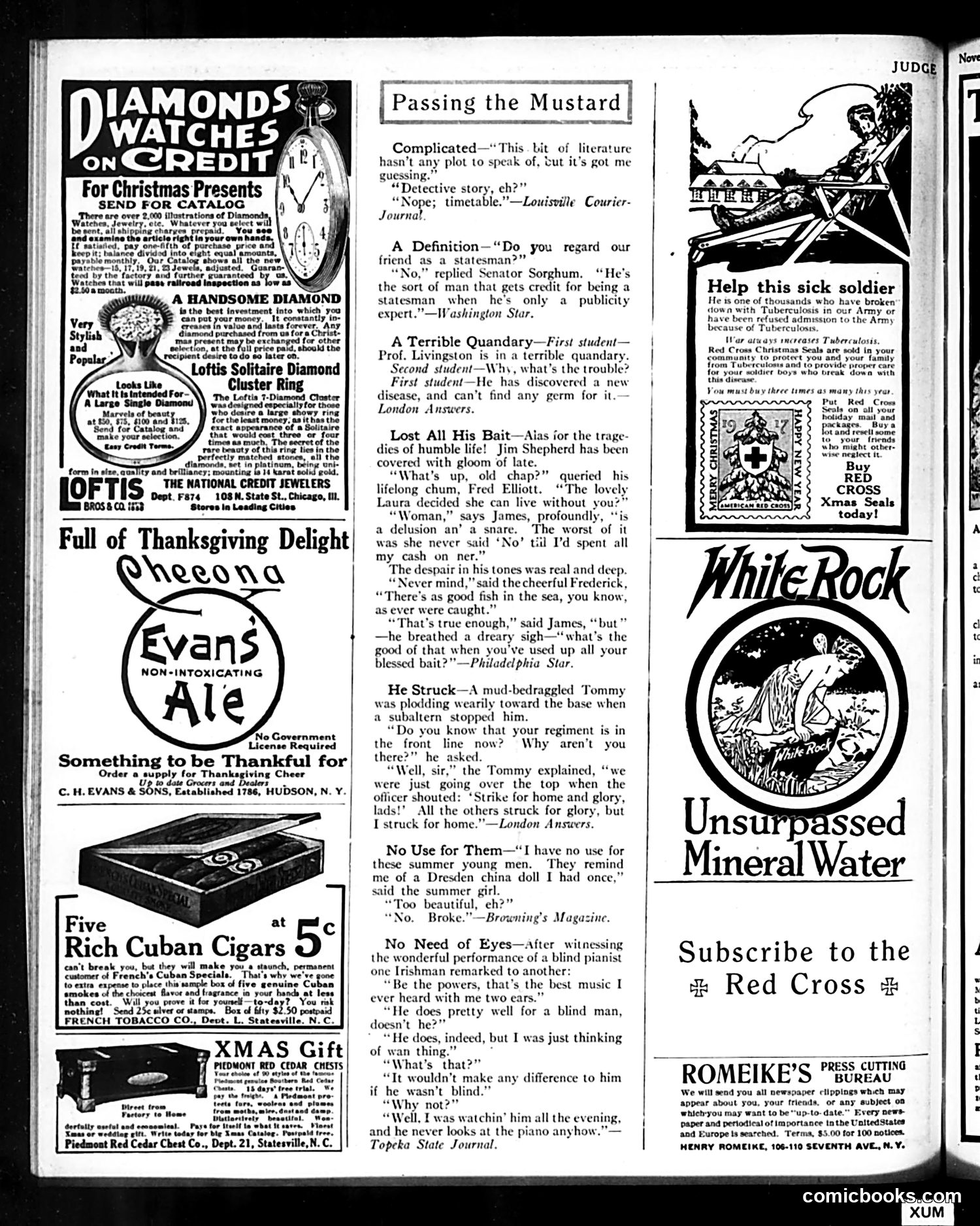
This page is primarily **advertising** for luxury goods (diamonds, watches, cigars, ale) aimed at Christmas shoppers, with a secondary section titled "Passing the Mustard" containing brief humorous anecdotes. The humor pieces are short jokes playing on wordplay and social observation—typical of early 20th-century magazines. Notable examples: - A woman mistakes a railway timetable for detective fiction (absurdist humor) - A senator is dismissed as merely seeking publicity rather than genuine statesmanship - A soldier chooses to "strike for home" rather than "glory" when ordered into battle—satirizing the gap between patriotic rhetoric and soldiers' actual survival instincts These pieces mock pretension, romantic disappointment, and military bureaucracy without targeting specific political figures. The content reflects post-WWI cynicism about authority and grand ideals versus practical reality. The page contains **no political cartoons**—only advertisements and short satirical text pieces typical of Judge's humor format.
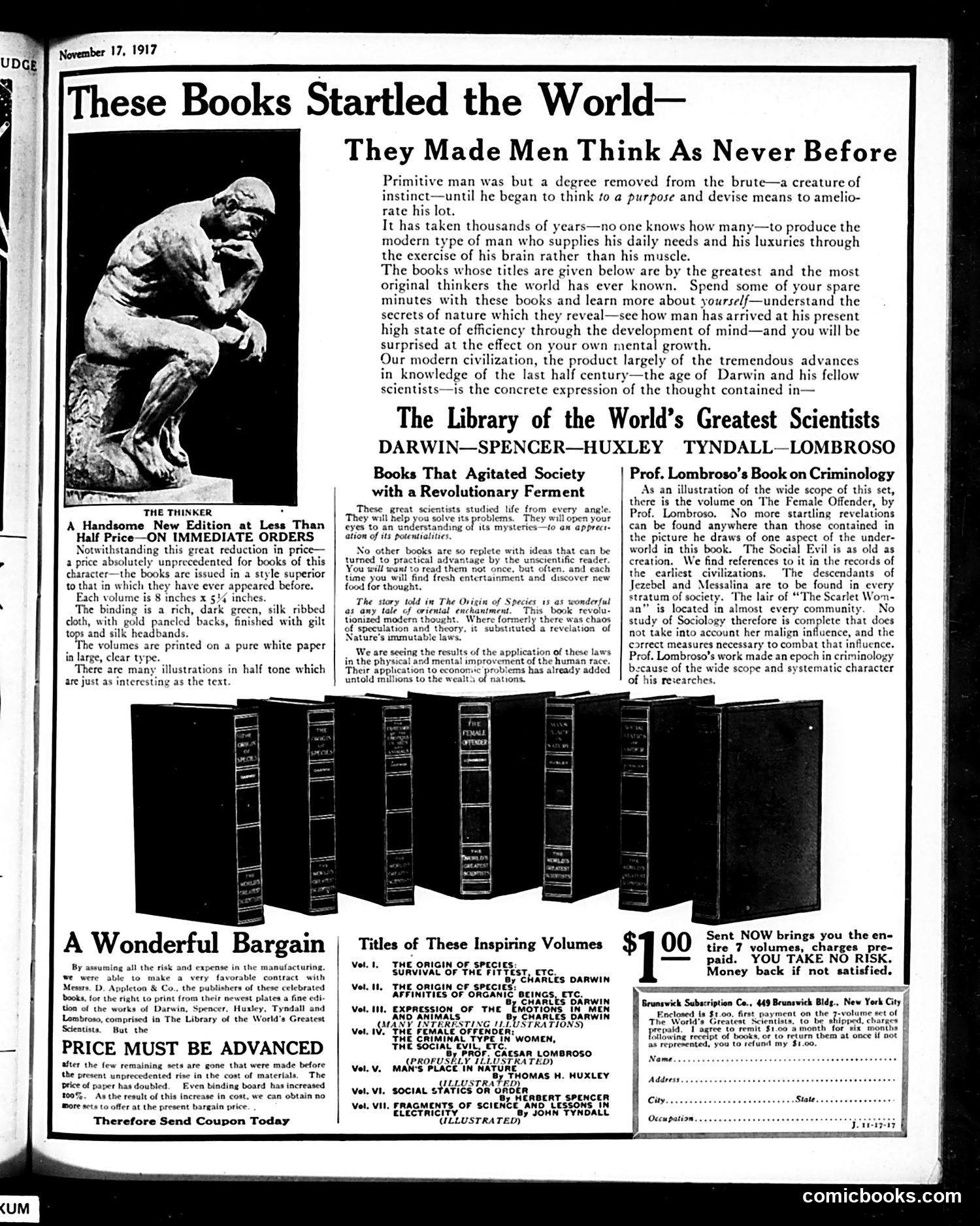
This is primarily an **advertisement**, not a political cartoon. The page promotes a discounted book collection called "The Library of the World's Greatest Scientists," featuring works by Darwin, Spencer, Huxley, Tyndall, and Lombroso. The single illustration—Rodin's famous sculpture "The Thinker"—serves as branding, symbolizing intellectual advancement. The ad's text argues that reading these scientific works will improve your mind and understanding of nature and civilization. The historical context: This November 1917 ad reflects the "age of Darwin" and positions evolutionary science and criminology as progressive, transformative knowledge. Notably, it promotes Lombroso's now-discredited theories on criminal types and female criminality—pseudoscience that was then considered cutting-edge. The "bargain" pitch emphasizes urgency due to rising material costs, a real wartime inflation concern (America was in WWI). The ad targets educated readers seeking self-improvement through scientific thought.
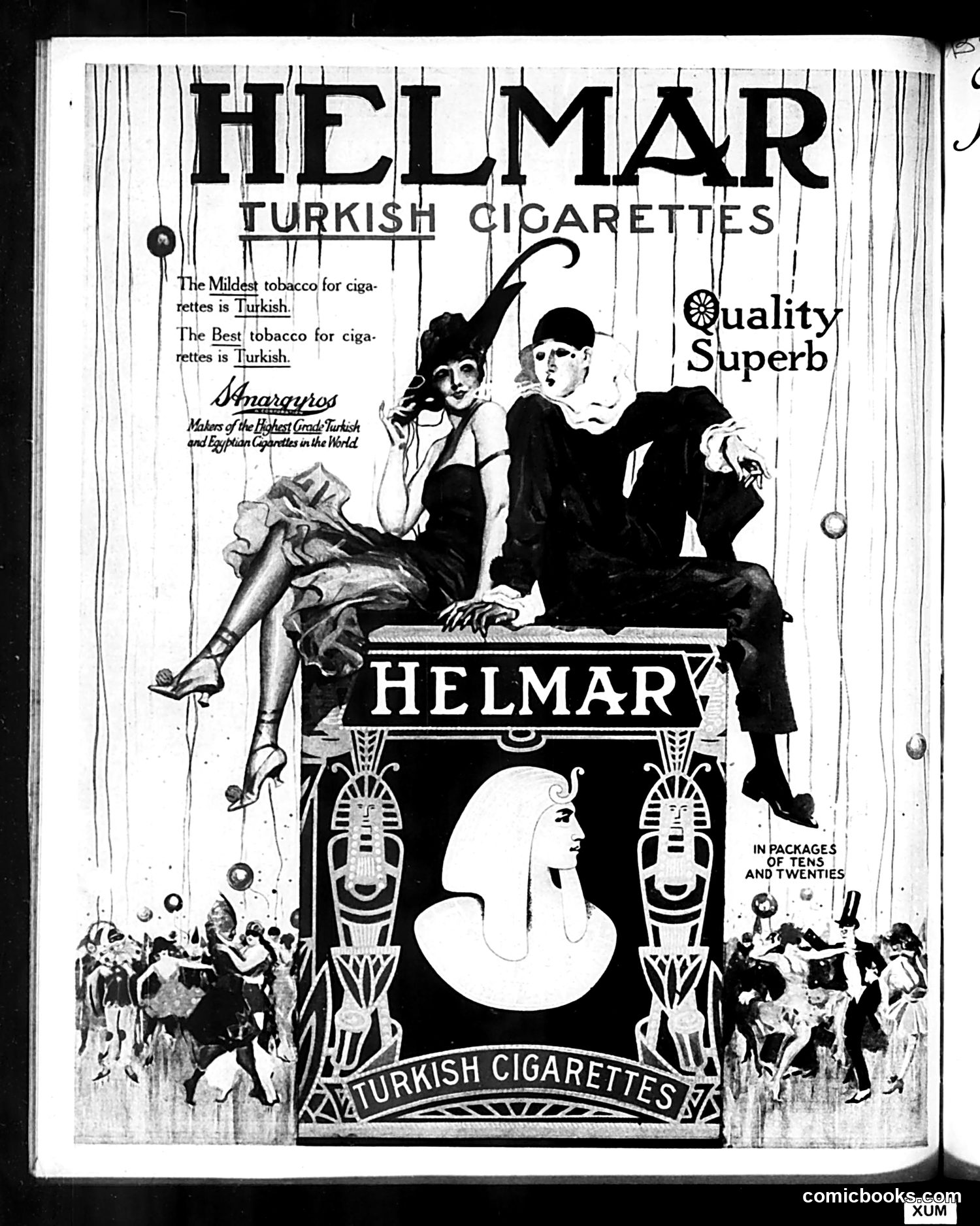
This is a full-page advertisement for Helmar Turkish cigarettes, not political satire. The ad promotes Turkish tobacco as "the Mildest" and "the Best" for cigarettes, noting it's made by Amargyos, described as makers of "the Highest Grade Turkish and Egyptian Cigarettes in the World." The imagery depicts two fashionably dressed figures (appearing to be flappers or entertainers from the 1920s era) positioned above an Egyptian-themed package design featuring a pharaonic profile. The elaborate Egyptian motifs—including hieroglyphic-style decorations and sphinxes—reflect the era's fascination with Egyptology, likely boosted by King Tutankhamun's tomb discovery (1922). The ad emphasizes "Quality Superb" and notes availability "in packages of tens and twenties." This represents period advertising aesthetics rather than editorial commentary.