
Judge, 1917-11-17 · page 8 of 28
Judge — November 17, 1917 — page 8: what you’re looking at
What you’re looking at
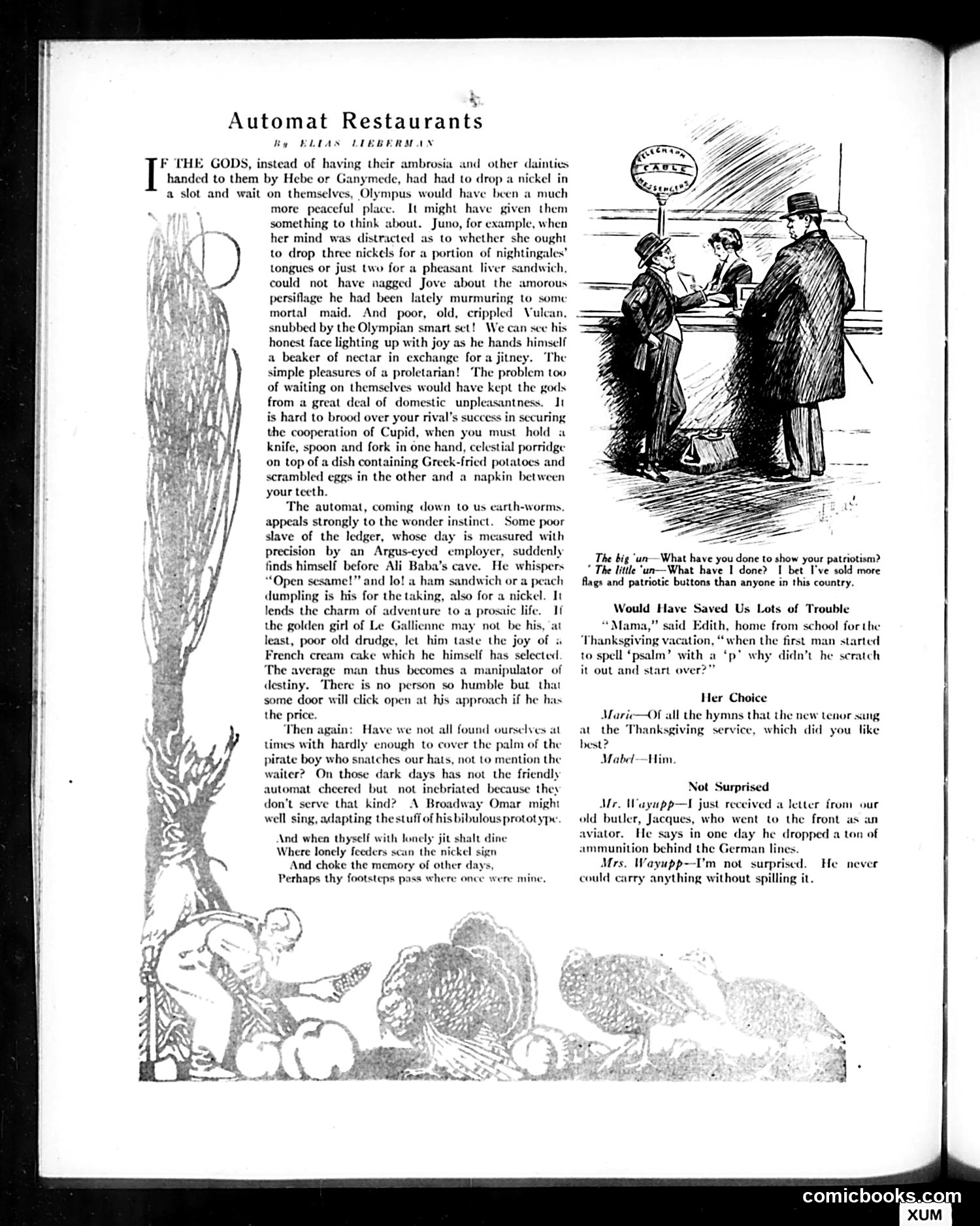
This article satirizes the newly popular **automat**—a vending-machine restaurant where customers insert nickels to retrieve food from slots. Author Elias Lieberman uses the concept as social commentary. The main essay humorously imagines Greek gods forced to use automats, arguing the experience would reduce their bickering and domestic drama. More seriously, it celebrates automats as democratizing: they give ordinary working people—"slaves of the ledger"—a sense of agency and dignity. By selecting their own meal and paying directly, rather than depending on waiters' goodwill, even humble laborers become "manipulators of destiny." The accompanying cartoon (top right) shows two working-class men at an automat window, likely illustrating this accessibility. The page also includes unrelated humor pieces about patriotic buttons, hymn preferences, and a butler's clumsy wartime service—typical of Judge's miscellaneous comic content. The automat serves as Lieberman's lens for examining **class, dignity, and modern urban life** in early 20th-century America.
📄 Transcribed text from this page (OCR, searchable)
Machine-transcribed from the original scan — historical spelling and the odd misread are preserved.
Automat Restaurants Ry ELUAS LIEBERMAN THE GODS, instead of having their ambrosia and other dainties handed to them by Hebe or Ganymede, had had to drop a nickel in a slot and wait on themselves, Olympus would have been a much more peaceful place. It might have given them something to think about. Juno, for example, when her mind was distracted as to whether she ought to drop three nickels for a portion of nightingales’ tongues or just two for a pheasant liver sandwich, could not have nagged Jove about the amorous persiflage he had been lately murmuring to some mortal maid. And poor, old, crippled snubbed by the Olympian smart set! We ca honest face lighting up with joy as he hands himself a beaker of nectar in exchange for a jitney. The simple pleasures of a proletarian! The problem too of waiting on themselves would have kept the gods from a great deal of domestic unpleasantness. It is hard to brood over your rival’s success in securing the cooperation of Cupid, when you must hold a knife, spoon and fork in one hand, celestial porridge on top of a dish containing Greck-fricd potatoes and scrambled eggs in the other and a napkin between your tecth. The automat, coming down to us earth-worms. appeals strongly to the wonder instinct. Some poor n see his slave of the ledger, whose day is measured with precision by an Argus-cyed employer, suddenly finds himself before Ali Baba’s cave. He whispers “Open sesame!” and lo! a ham sandwich or a peach dumpling is his for the taking, also for a nickel. It lends the charm of adventure to a prosaic life. If the golden girl of Le Gallienne may not be his, at least, poor old drudge, let him taste the joy of « French cream cake which he himself has selected The average man thus becomes a manipulator of destiny. There is no person so humble but that some door will click open at his approach if he has the price. Then again: Have we not all found ourselves at times with hardly enough to cover the palm of the pirate boy who snatches our hats, not to mention the waiter? On those dark days has not the friendly automat cheered but not incbriated because they don’t serve that kind? A Broadway Omar might well sing, adapting thestuffof his bibulous prototype. And when thyself with lonely jit shalt dine Where lonely feeders scan the nickel sign And choke the memory of other day Pethaps thy footsteps pass where once were mine, Vulean, < The big ‘un—What have you done to show your patriotism? * The little ‘un—What have 1 done? | bet I've sold more flags and patriotic buttons than anyone in this country. Would Have Saved Us Lots of Trouble “Mama,” said Edith, home from school forthe ‘Thanksgiving vacation, “when the first man started to spell ‘psalm’ with a ‘p’ why didn’t he scratch it out and start over?” Her Choice Marice—OF all the hymns that the new tenor sing at the Thanksgiving service, which did you like best? Mabei—Him Not Surprised Mr. Wayupp—t just received a letter from our old butler, Jacques, who went to the front as an aviator. He says in one day he dropped a ton of ammunition behind the German lines. Mrs. Wayupp-—I'm not surprised. He could carry anything without spilling it. never comicbooks.com