
Judge, 1917-11-17 · page 12 of 28
Judge — November 17, 1917 — page 12: what you’re looking at
What you’re looking at
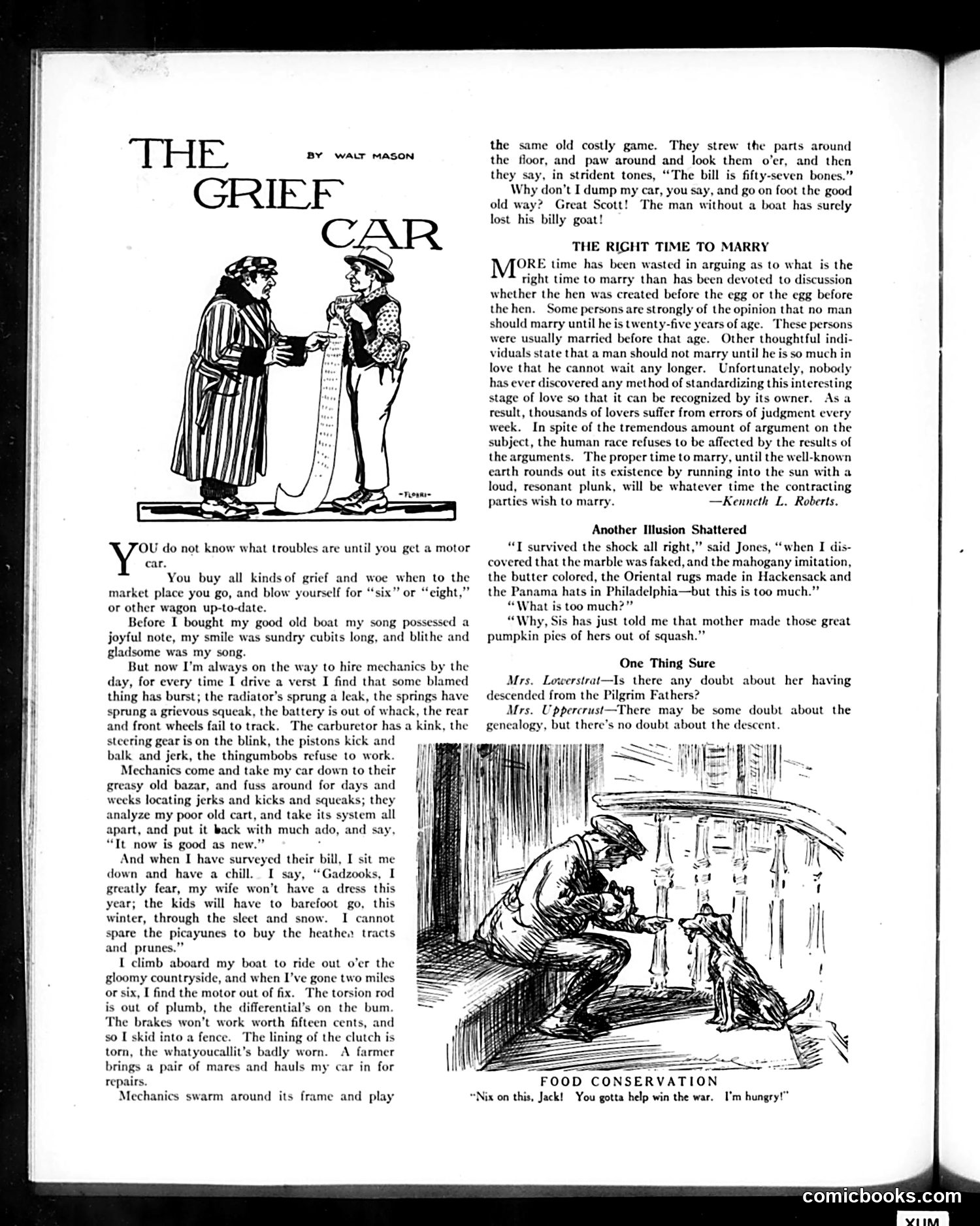
This page satirizes the emerging frustrations of early automobile ownership. Mason's poem laments how purchasing a motorcar transforms joy into endless mechanical suffering and expense. The owner catalogs failures—leaking radiators, broken springs, failed brakes—requiring costly mechanics who disassemble and reassemble the vehicle repeatedly, presenting astronomical bills ("fifty-seven bones"). The satire targets the gap between automobiles' promised modernity and their actual unreliability. The punchline—that the car owner would lose his "billy goat" (dignity/independence) without his boat—humorously suggests cars are so troublesome they're worse than useless. This reflects genuine 1910s-era frustration with early vehicles' mechanical fragility and repair costs, before automobiles became reliably functional. The page also includes unrelated humor columns on marriage timing and consumer deceptions (fake antiques, synthetic foods).
📄 Transcribed text from this page (OCR, searchable)
Machine-transcribed from the original scan — historical spelling and the odd misread are preserved.
BY WALT MASON car. You buy all kindsof grief and woe when to the market place you go, and blow yourself for “six” or ‘‘eight,”” or other wagon up-to-date. Before I bought my good old boat my song possessed a joyful note, my smile was sundry cubits long, and blithe and gladsome was my song. But now I'm s on the way to hire mechanics by the day, for every time I drive a verst I find that some blamed thing has burst; the radiator’s sprung a leak, the springs have sprung a grievous squeak, the battery is out of whack, the rear and front wheels fail to track, The carburetor has a kink, the steering gear is on the blink, the pistons kick and balk and jerk, the thingumbobs refuse to work. Mechanics come and take my car down to their old bazar, and fuss around for days and locating ji and kicks and squeaks; they analyze my poor old cart, and take its system all apart, and put it back with much ado, and say, “Tt now is good as ne’ And when I have surveyed their bill, I sit me down and have a chill. I say, ‘“Gadzooks, I greatly fear, my wife won’t have a dress this year; the kids will have to barefoot go, this winter, through the sleet and snow. I cannot spare the picayunes to buy the heathen tracts and prunes.” I climb aboard my boat to ride out o’er the gloomy countryside, and when I’ve gone two miles or six, I find the motor out of fix. The torsion rod is out of plumb, the differential’s on the bum. The brakes won't work worth fifteen cents, and so I skid into a fence. The lining of the clutch is torn, the whatyoucallit’s badly worn. A farmer brings a pair of mares and hauls my car in for repairs. Mechanics swarm around its frame and play \ JOU do not know what troubles are until you get a motor the same old costly game. They strew the parts around the floor, and paw around and look them o’er, and then they say, in strident tones, “The bill is fifty-seven bones.” Why don’t I dump my car, you say, and go on foot the good old way? Great Scott! The man without a boat has surely lost his billy goat! THE RIGHT TIME TO MARRY ORE time has been wasted in arguing as to what is the right time to marry than has been devoted to discussion whether the hen was created before the egg or the egg before the hen. Some persons are strongly of the opinion that no man should marry until he is twenty-five years of age. These persons were usually married before that age. Other thoughtful indi- viduals state that a man should not marry until he is so much in love that he cannot wait any longer. Unfortunately, nobody has ever discovered any method of standardizing this interesting stage of love so that it can be recognized by its owner. As a result, thousands of lov ffer from errors of judgment every week. In spite of the tremendous amount of argument on the subject, the human race refuses to be affected by the results of the arguments. The proper time to marry, until the well-known earth rounds out its existence by running into the sun with a loud, resonant plunk, will be whatever time the contracting parties wish to marry. —Kenneth L. Roberts. Another Illusion Shattered “T survived the shock all right,” said Jones, “when I dis- covered that the marble was faked, and the mahogany imitation, the butter colored, the Oriental rugs made in Hackensack and the Panama hats in Philadelphia—but this is too much.” “What is too much?” “Why, Sis has just told me that mother made those great pumpkin pics of hers out of squash.” One Thing Sure Mrs. Lowerstrat—Is there any doubt about her having descended from the Pilgrim Fathers? Mrs. Uppercrust—There may be some doubt about the genealogy, but there’s no doubt about the descent. FOOD CONSERVATION “Nix on this, Jack! You gotta help win the war. I'm hungry!” comicbooks.com