
Judge, 1917-11-17 · page 14 of 28
Judge — November 17, 1917 — page 14: what you’re looking at
What you’re looking at
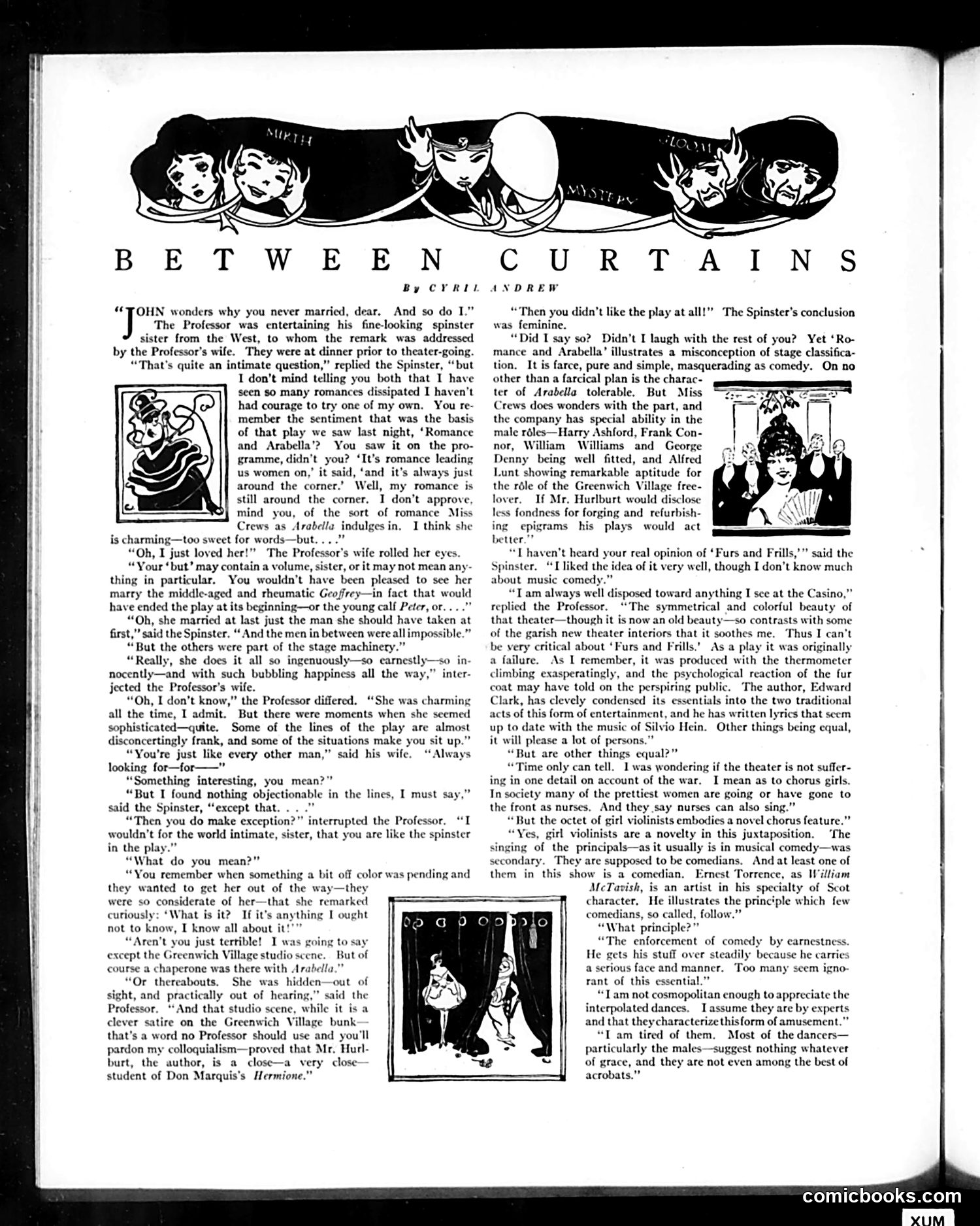
This is a theater criticism piece by Cyril Andrew discussing the play *Romance and Arabella*. The dialogue between a Professor, his wife, and his visiting spinster sister from the West debates the merits of the production. **The satire targets:** - The spinster character's contradictory prudishness—she claims moral objections to the play's frankness while admitting ignorance of "off color" content - The Professor gently mocks her by comparing her to the play's own naive spinster character who claims not to know things while clearly knowing them - The author criticizes the play itself as "farce masquerading as comedy," though praising actress Miss Crews's performance and the male cast (including Alfred Lunt) **The joke**: The spinster's defensive moralizing mirrors the very character flaws depicted onstage—she's unaware of her own hypocrisy, much like Arabella. The piece satirizes both theatrical pretension and female prudishness through this dinner conversation framing device.
📄 Transcribed text from this page (OCR, searchable)
Machine-transcribed from the original scan — historical spelling and the odd misread are preserved.
BETWEEN By CYRIL “©TOHN wonders why you never marricd, dear. And so do I.” J The Professor was entertaining his fine-looking spinster sister from the West, to whom the remark was addressed by the Professor's wife. They were at dinner prior to theater-going. “That's quite an intimate question,” replied the Spinster, “but I don’t mind telling you both that I have seen so many romances dissipated I haven't had courage to try one of my own. You re- member the sentiment that was the basis of that play we saw last night, ‘Romance and Arabella’? You saw it on the pro- gramme, didn’t you? ‘It’s romance leading us women on,’ it said, ‘and always just around the corner.’ Well, my romance is still around the corner. I don’t approve, mind you, of the sort of romance Miss Crews as Arabella indulges in, I think she is charming—too sweet for words—but. ...”” “Oh, I just loved her!” The Professor's wife rolled her eyes. “Your ‘but’ may contain a volume, sister, or it may not mean any- thing in particular. You wouldn’t have been pleased to see her in fact that would marry the middle-aged and rheumatic Geoffrey have ended the play at its beginning—or the young calf Peter, or. “Oh, she married at last just the man she should have taken at first,” said the Spinster. “And the men in between were all impossible.” “But the others were part of the stage machinery.” “Really, she does it all so ingenuously—so earn nocently—and with such bubbling happiness all the way jected the Professor's wife. “Oh, I don’t know,” the Professor differed. “She was charming all the time, I admit. But there were moments when she seemed sophisticated—quite. Some of the lines of the play are almost disconcertingly frank, and some of the situations make you sit up.” “You're just like every other man,” said his wife. “Always looking for—for——" “Something interesting, you mean?” “But I found nothing objectionable in the lines, I must say," said the Spinster, “except that. . . .”” “Then you do make exception?” interrupted the Professor. “I wouldn't for the world intimate, sister, that you are like the spinster in the play.” “What do you mean?” “You remember when something a bit off color was pending and they wanted to get her out of the way—they were so considerate of her—that she remarked curiously: ‘What is it? If it’s anything I ought not to know, I know all about it “Aren't you just terrible! I was going to say except the Greenwich Village studio scene. But of course a chaperone was there with Arabella.” “Or thereabouts. She was hidden—out of practically out of hearing,” said the . nd that studio scene, while it is a clever satire on the Greenwich Village bunk that’s a word no Professor should use and you'll pardon my colloquialism—proved that Mr, Hurl- burt, the author, is a close—a very close student of Don Marquis’s Hermione.” tly—so in- C UR TATIN S INDREW “Then you didn’t like the play at all!” The Spinster’s conclusion was feminine. “Did I say so? Didn't I laugh with the rest of you? Yet ‘Ro- mance and Arabella’ illustrates a misconception of stage classifica- on. It is farce, pure and simple, masquerading as comedy. On no other than a farcical plan is the charac- ter of Arabella tolerable. But Miss Crews does wonders with the part, and the company has special ability in the male réles—Harry Ashford, Frank Con- nor, William Williams and George Denny being well fitted, and Alfred Lunt showing remarkable aptitude for the réle of the Greenwich Village free- lover. If Mr. Hurlburt would disclose less fondness for forging and refurbish- ing epigrams his plays would act better.” “LT haven't heard your real opinion of ‘Furs and Frills,’” said the Spinster. “I liked the idea of it very well, though I don’t know much about music comedy.’ “T am always well disposed toward anything I see at the Casino,” replied the Professor. ‘The symmetrical and colorful beauty of that theater—though it is now an old beauty—so contrasts with some of the garish new theater interiors that it soothes me. Thus I can’t be very critical about ‘Furs and Frills.’ As a play it was originally a failure. As 1 remember, it was produced with the thermometer climbing exasperatingly, and the psychological reaction of the fur may have told on the perspiring public. The author, Edward Clark, has clevely condensed its essent into the two traditional acts of this form of entertainment, and he has written lyrics that seem up to date with the music of Silvio Hein. Other things being equal, it will please a lot of persons.” “But are other things equal? ‘Time only can tell. 1 was wondering if the theater is not suffer- ing in one detail on account of the war. I mean as to chorus girls. In society many of the prettiest women are going or have gone to the front as nurses. And they say nurses can sing. “But the octet of girl violinists embodies a novel chorus feature.” “Yes, girl violinists are a novelty in this juxtaposition. ‘The singing of the principals—as it usually is in musical comedy—was secondary. They are supposed to be comedians. And at least one of them in this show is a comedian, Emest Torrence, as William McTavish, is an artist in his specialty of Scot character, He illustrates the principle which few comedians, so called, follow.” What principle “The enforcement of comedy by earnestness. He gets his stuff over steadily because he carries a serious face and manner. Too many seem igno- rant of this essential.” “Tam not cosmopolitan enough to appreciate the interpolated dances. I assume they are by experts and that theycharacterize thisform of amusement. “Tam tired of them. Most of the dancers— particularly the males—suggest nothing whatever of grace, and they are not even among the best of acrobats.”” comicbooks.com